Bidding and Optimization Strategies for
Wind-PV Systems in Electricity Markets
I.L.R. Gomes
1, H.M.I. Pousinho
2, R. Melício
1,2, V.M.F. Mendes
1,31
Departamento de Física, Escola de Ciências e Tecnologia, Universidade de Évora, Portugal
2
IDMEC, Instituto Superior Técnico, Universidade de Lisboa, Lisbon, Portugal
3
Instituto Superior de Engenharia de Lisboa, Lisbon, Portugal; [email protected]
ABSTRACT
The variability in non-dispatchable power generation raises important challenges to the integration of renewable energy sources into the electricity power grid. This paper provides the coordinated trading of wind and photovoltaic energy to mitigate risks due to the wind and solar power variability, electricity prices, and financial penalties arising out the generation shortfall and surplus. The problem of wind-photovoltaic coordinated trading is formulated as a linear programming problem. The goal is to obtain the optimal bidding strategy that maximizes the total profit. The wind-photovoltaic coordinated operation is modeled and compared with the uncoordinated operation. A comparison of the models and relevant conclusions are drawn from an illustrative case study of the Iberian day-ahead electricity market.
KEYWORDS:
Coordinated bidding strategies; wind-PV power system; linear programming; day-ahead market.1
INTRODUCTION
For the next years power systems will likely show a substantially increased share of renewable energy of which a large portion will come from the variable renewable energy sources wind and photovoltaic [1]. Renewable energy grid integration increased in the E.U. to fulfill the Energy–2020 initiative [2]. The growth of renewable energy technologies is a notary fact and the market for all renewables advanced in 2014 with wind power and photovoltaic taking the lead for capacity additions [3]. The number of countries with renewable energy targets and policies increased again in 2014. As of early 2015, at least 164 countries had renewable energy targets, and an estimated 145 countries had renewable energy support policies in place [1]. Policies provide subsidy and incentives for renewable energy which include feed-in-tariff, guaranteed grid access, green certificates, investments incentives, tax credits and soft balancing costs [4].
A power producer in restructured electricity market is an entity owning power resources and participating in the market with the target of fronting the challenges of completion and uncertainty on electricity prices in order to achieve profit. Extra challenges for a wind-PV system owner come from the uncertainty on the availability of wind and solar resources meaning uncertainty in complying with power contracts [5]. The closing of the market defines power trading and price. In an attempt to reduce uncertainty from renewable energies, producers are required to provide day-ahead schedules of their generation. However, the remuneration depends on the conformity achieved on the level of the real deliver with the accepted value of the bid at the closing of the market. In absence of conformity, economic penalization for imbalances is due to happen [6]. Photovoltaic (PV) energy cannot provide a continuous source of energy due to the low availability during no-sun period and during winter. On the other hand, wind energy cannot satisfy constant load due to different magnitude of wind speed from one hour to another [7]. Typically wind farms have more availability of wind energy during the night and particular during the winter. From this point of view, wind-photovoltaic coordinated trading seems to mitigate some of the uncertainties and variability from one technology to other.
So, this paper is a research contribution for a possible wind-PV coordinated trading in order to conveniently accommodate bidding strategies by the use of a computer application based in a linear programming approach and therefore make a single bid.
2
STATE OF THE ART
A power producer from non-dispatchable renewable energy sources (like solar and wind) problem aims to find the optimal energy bids in a electricity market featuring financial penalties for energy imbalance [6], in order to maximize its revenue, reducing the risk of deviations and consequently penalties for imbalances. A photovoltaic power system is designed to operate in residential appliances [8], and with the use of storage devices. For wind power is proposed the use of stochastic optimization tools or work together with a hydro generation company to reduce the imbalances [9]. Joint operation of the uncertain renewable energy resources and other units is another method which can be used to reduce the imbalance costs [10].
In [11], a correlation between wind and solar power has been verified for the Iberian Peninsula, encouraging the coordination of wind-photovoltaic systems to mitigate the energy supply instability. In [12], an optimization approach to maximize profits of concentrated solar power plant Spain is proposed taking into account market prices. In [13], the optimal self-scheduling of the wind/CSP coordination is studied under a deterministic mixed-integer linear programming (MILP) approach, evaluating the impact on profit in the day-ahead market. In [14], the development of bidding strategies is investigated for a wind farm owner and a deterministic MILP approach for its optimal operation is proposed.
Surveys [12, 15, 16] reveal the absence of treatment of a coordinated configuration between wind and photovoltaic systems. In [17-19], linear programming is proposed for a wind energy problem instead of mixed-integer nonlinear programming with consequent gain of robustness, simplicity, and computational efficiency. Therefore, linear programming can be also proposed for the coordination of wind and photovoltaic systems as is the case of this paper.
3
PROBLEM FORMULATION
Wind and PV energy are undispatchable and plagued by the major uncertainties that constitutes wind and solar irradiation availability. In addition to the intermittence and variability of wind and solar irradiation the wind-PV power producer must also cope with uncertain market prices. Thus, the market strategy of a coordinated wind-PV system producer must take into account these uncertainties in order to maximize its revenue for trading energy in day-head electricity markets, otherwise if not conveniently addressed it is possible to occur losses on profit due to imbalances penalties. The coordination of wind and PV energy can mitigate some of these uncertainties faced by the power producer working like a complement to each other. The system operator is responsible to maintaining the equilibrium between production and consumption.
3.1
Mechanism for Imbalance Prices
System imbalance is defined as a non-null difference on the trading between the delivered energy and the agreed amount of energy in a given moment. The power producer is assumed to be a responsible entity and pay the market imbalance price for any contribution to the global system imbalance. If there is an excess of delivered energy in the power system, the system imbalance is positive, otherwise the system imbalance is negative. In the electricity market in Iberian Peninsula, like in the rest of European electricity markets, is defined a price for the positive energy deviation and a price for the negative energy deviation for each time period. In addition, these prices depends on the imbalances in the whole power system. Thus, if the system imbalance is positive, i.e., excess of generation, the system operator purchase the energy in excess of the producers with excess of offers for a price smaller than the day-ahead market-clearing price and pays just the day-day-ahead price for the producers that produce less than the offer in the same market. The prices are as follow
) , min( DNt D t t (1) D t t (2)
In (1) and (2), tand
t
, are applied in the balancing market to the energy deviations, Dt
is the day-ahead
market-clearing price and DNt is the price of the energy of offers in exceeds. Otherwise, if the system imbalance is negative,
the price are as follow
D t t (3) ) , max( Dt UPt t (4)
In (3), UPt is the price of the energy that needs to be added to the system.
3.2
Coordinated Wind-PV Bidding Strategy
The revenue from the coordinated wind-PV system of a power producer that offers and gets accepted a certain amount of energy for hour t is as follows
W t W PV t PV t D t D t t P I c P c P R (5)
In (5),PtDis the power trade by the wind-PV power producer in the day-ahead market,Itis the imbalance income
resulting from the balancing process and may be negative, i.e., it may represent a cost. cPV
and
Wc is the marginal
cost of PV and wind power respectively. PV t
P and W
t
P is the PV and wind power produced in each plant.
The total deviation incurred by the wind-PV producer for hour t is as follows
D t W t PV t t P P P (6) where W t PV t P
P is the total actual power, resulting from the sum of PV and wind power, respectively, for hour t.It
is as follows 0 , t t t t I (7) 0 , t t t t I (8)
In (6), a positive deviation means the actual production is higher than the traded in the day-ahead market and a negative deviation means an actual production lower than the traded. Therefore,t is the price at which the wind and
solar producer will be paid for its excess of generation and t the price to be charged for the deficit of generation.
Let 1 , t D t t t r r (9) 1 , t D t t t r r (10) Then 0 , t t t D t t r I (11)
0 , t t t D t t r I (12)
A wind-PV producer that needs to correct its energy deviations in the balancing market incurs an opportunity cost as it loses the chance of trading the deviated energy through the day-ahead market at a more competitive price. The revenue function in equation (5) can be reformulated, so that it explicitly reflects such an opportunity cost.
Two cases have to be considerate. If the energy deviation incurred by the wind-PV producer is positive, i.e.,t0 , the revenue is given as follows as:
W t W PV t PV t t D t D t D t t P r c P c P R (13)
Using the total deviation expressed in equation (6), the revenue is given as follows
0 , ) 1 ( ) ( t W t W PV t PV t t D t W t PV t D t t P P r c P c P R (14)
If the energy deviation incurred by the wind-PV producer is negative, i.e., t0, the revenue is given as follows 0 , ) 1 ( ) ( t W t W PV t PV t t D t W t PV t D t t P P r c P c P R (15)
Equations (14) and (15) can be expressed in a general form as follows
W t W PV t PV t W t PV t D t t P P C c P c P R ( ) (16) where 0 , ) 1 ( t t t D t t r C (17) 0 , ) 1 ( t t t D t t r C (18) In (16), the term ( W) t PV t D t P P
constitutes the maximum level of revenue that the wind-PV producer could collect from trading its energy production in a situation free of wind and solar irradiation uncertainty and without considering marginal costs. The termCtrepresents the afore-mentioned opportunity cost, which results from trading the energy deviations in the balancing market at a less attractive price. The basic linear programming formulation for the optimal revenue of the wind and solar producer over a time horizon is obtained by the maximization of the objective function given as follows
T t W t W PV t PV t t D t t t D t D t D t P r r c P c P 1 (19)The maximization is subjected to constraints as follows
t P P PD PVmáx Wmáx t ( ), 0 (20)
P P PD
t t W t PV t t , (21) t t t t , (22) t P P W t PV t t , ) ( 0 (23)t P P P P W t PV t Wmáx PVmáx t , ) ( ) ( 0 (24) t P PtPV PVmáx , 0 (25) t P PtW Wmáx , 0 (26)
In (20) the limit of offers is the maximum capacity in the coordinated wind-PV power plant. In (21) to (23) is imposed t 0 when t is negative, D t W t PV t P P
P , and imposed t 0 when
t is negative, W t PV t D t P P P .
When imbalance is negative the wind-PV producer is penalized for the deficit of energy generated below the energy traded in the day-ahead market, so the term
t t D tr
is null and the term
t t D tr
is subtracted from the revenue in the situation of no deviation, D
t D tP
. When the system imbalance is positive, the wind-PV producer is penalized for the energy generated above the energy traded in the day-ahead market, so that the term D tt
tr
is null and the term t t D tr
is added to the revenue in the situation of no deviation. In (24), the maximum negative deviation occur
when the wind-PV producer sells the equivalent to the maximum capacity, PVmáx WmáxP
P , but its final production is
W t PV
t P
P . In (25) and (26) the solar and wind power is set to be equal or less than the maximum capacity of the solar plant PVmáx
P and wind plant PWmáx.
4
CASE STUDY
The data for the case study are from a coordinated wind-PV system deployed in the Iberian Peninsula with a wind farm of 100 MW of rated power and a PV power plant of rated power of 50 MW. The data for day-ahead prices and price multipliers rt e
t
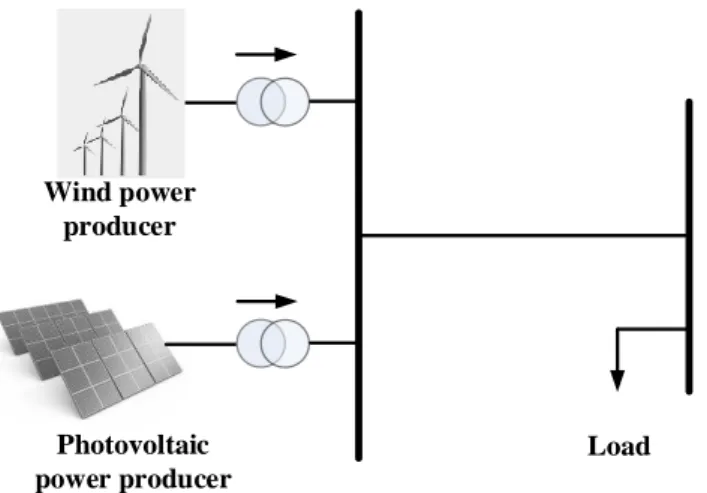
r are from the Iberian electricity market. The coordination is on an hourly basis with a 24 h range for the day-ahead market. The plants share a line to connect to the grid. The proposed linear programming approach provides the maximization of the coordinated wind-PV system taking into account power forecasts, solar irradiation and market prices. An illustration of the coordinated wind-PV system is shown in Fig. 1.
Wind power producer Photovoltaic power producer Load
Fig 1. Coordinated Wind-PV system and transmission line.
The marginal cost of the wind farm is equal to 16 €/MWh and the marginal cost of the PV system is 29 €/MWh according to [20]. The coordinated wind-PV system aims to achieve the optimal single bid for the day-ahead market. The coordinated linear programming problem is programmed in the software GAMS.
Fig 2. Day-ahead market-clearing price.
The imbalance price multipliers rtand
t
r are shown Fig. 3.
Fig 3. Imbalances price multipliers; left: rt, right:
t
r .
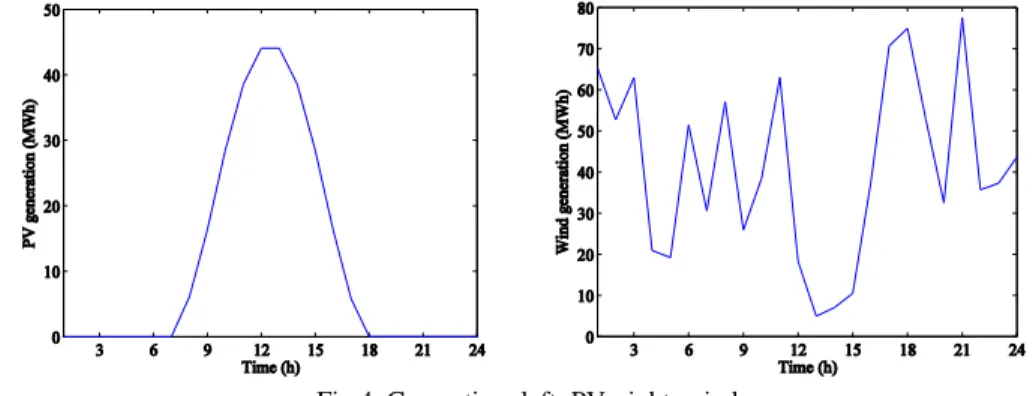
The wind and PV generation is obtained using the total energy produced along the 24 h of the wind farm scaled to the maximum power of 100 MW and of the PV system scaled to 50 MW. The total energy produced by the wind farm and PV system are shown in Fig. 4.
Fig 4. Generation; left: PV, right: wind.
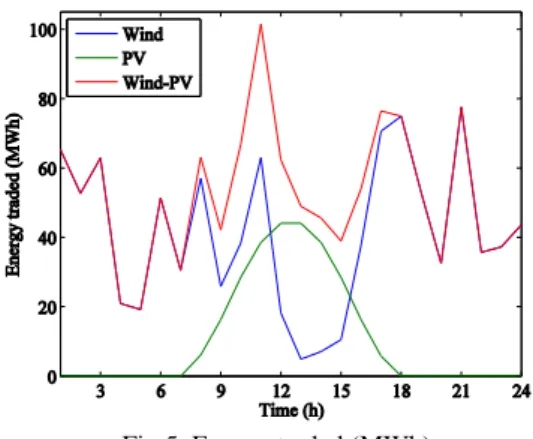
The optimal single bid from the coordinated wind-PV system traded for the period of the 24h is the result of the proposed linear programming problem. The single bid result from the contribution of each technology, namely wind and PV. The total energy traded by the coordinated wind-PV system is shown in Fig. 5.
Fig 5. Energy traded (MWh). The expected results with and without coordination are shown in Table 1.
Table 1. Results with and without coordination
Case Energy traded (MWh) Profit (€) CPU Time (s)
Wind 990.89 28,343.22 0.062
PV 266.64 6,224.17 0.032
Coordinated Wind-PV 1279.53 34,969.39 0.125
Table I shows that Wind-PV coordination provides an improvement on total profit. Moreover, the amount of energy traded in the day-ahead market is higher for the coordinated system than for the separated power systems.
5
CONCLUSION
This paper presents the coordination of wind-PV systems for a power producer with the aim of trading energy with a single bid for aggregating wind and PV power production. A linear programming approach for solving the offering strategy of the power producer in a deregulated market is discussed and find how this two energy forms can complement each other. The main result is the bidding strategy for wind and solar producer facing the wind, solar irradiation and price uncertainties, as well the system imbalances which affect the price in case of deviations between the energy traded in the day-ahead market and the actual energy produced by the wind and solar producer. It is possible to see the complementarity of wind and solar power, with wind energy producing more energy at night and solar energy during the day. This can be a good strategy for renewable energy producers trying to cope with uncertainties of both wind and solar irradiation. Linear programming have been proposed for many studies about trading energy with renewable energy sources due to its robustness, simplicity and computational efficiency and in this paper the effectiveness of this approach is proved. A possible future work can be the use of a stochastic linear programming program, considering scenarios for wind and PV generation and market prices, for the coordination of a wind-PV system.
REFERENCES
[1] Ueckerdt, F., Brecha, R., Luderer, G. (2015). Analyzing major challenges of wind and solar variability in power systems. Renewable Energy, 81, 1-10.
[2] Energy 2020 - A strategy for competitive, sustainable and secure energy, 2011. [Online]. Available: https://ec.europa.eu/energy/sites/ener/files/documents/2011_energy2020_en_0.pdf
[3] REN21. (2015). Renewables 2015 global status report
[4] Wang, T., Gong, Y., Jiang, C. (2014). A review on promoting share of renewable energy by green-trading mechanisms in power system. Renewable and Sustainable Energy Reviews, 40, 923-929.
[5] Shrestha, G.B., Kokharel, B.K., Lie, T.T., Fleten, S.E. (2005). Medium term power planning with bilateral contracts. IEEE Transactions on Power Systems, 20 (2), 627–633.
[6] Giannitrapani, A., Paoletti, S., Vicino, A., Zarrilli, D. (2014). Bidding strategies for renwable energy generation with non stationary statistics. Proc. of 19th International Federation of Automatic Control World Congress. [7] Notton, G., Diaf, S., Stoyanov, L. (2011). Hybrid photovoltaic/wind energy systems for remote locations.
Energy Procedia, 6, 666-677.
[8] Bhuiyan, M.M.H., Asgar, M.A. (2003). Sizing of a stand-alone photovoltaic power system at Dhaka. Renewable Energy, 28, 929-938.
[9] Angarita, J.L., Usaola, J., Martínez-Crespo, J. (2009). Combined hydro-wind generation bids in a pool-based electricity market. Electric Power Systems Research, 79, 1038-1046.
[10] Parastegari, M., Hooshmand, R.A., Khodabakhshian, A., Zare, A.H. (2015). Joint operation of a wind farm, photovoltaic, pump-storage and energy storage devices in energy and reserve markets. Electrical Power and Energy Systems, 64, 275-284.
[11] Widen, J. (2011). Correlations between large-scale solar wind power in a future scenario for Sweden. IEEE Transactions on Sustainable Energy, 2 (2).
[12] Usaola, J. (2012). Operation of concentrating solar power plants with storage in spot electricity markets. IET Renewable Power Generation, 6 (1) 59-66.
[13] Pousinho, H.M.I., Silva, H., Mendes, V.M.F., Collares-Pereira, M., Pereira Cabrita, C. (2014). Self-scheduling for energy and spinning reserve of wind/CSP plants by a MILP approach. Energy, 78, 524–534.
[14] Pousinho, H.M.I., Mendes, V.M.F., Catalão, J.P.S. (2010). Investigation on the development of bidding strategies for a wind farm owner. International Review of Electrical Engineering, 5 (3), 1324-1329.
[15] Shahidehpour, M., Yamin, H., Li, Z. (2002). Market operations in electric power systems - Forecasting, scheduling and risk management. J. Wiley and Sons.
[16] Bourry, F., Costa, L.M., Kariniotakis, G. (2009). Risk-based strategies for wind/pumped-hydro coordination under electricity markets. IEEE Bucharest Power Tech Conference.
[17] Morales, J., Conejo, A., Pérez-Ruiz, J. (2010). Short-term trading for a wind power producer. IEEE Transactions on Power Systems, 25 (1), 554-564.
[18] Laia, R., Pousinho, H.M.I., Melício, R., Mendes, V.M.F., Reis, A.H. (2013). Schedule of thermal units with emissions in a spot electricity market. In Technological Innovation for the Internet of Things, Springer, Berlin, 361–370.
[19] Laia, R., Pousinho, H.M.I., Melício, R., Mendes, V.M.F. (2015). Self-scheduling and bidding strategies of thermal units with stochastic emission constraints. Energy Conversion and Management, 89, 975–984.
[20] Spanish Renewable Energy Plan for 2005-2010. [Available online]: