CARBON FINANCIAL ACCOUNTING:
EVALUATING THE “DISCIPLINARIAN EFFECT” OF STANDARDS AND MARKETS ON DISCLOSURE PRACTICES OF EU-15 LISTED FIRMS
Author
Maria José Martins Lourenço da Fonseca
Doctoral Thesis in Business and Management Studies
Branch of Accounting and Management Control
Supervisor
Doctor Patrícia Andrea Bastos Teixeira Lopes Couto Viana
- i -
Biographical Note
Maria José Martins Lourenço da Fonseca was born on the 4th September of 1957. In 1984, she graduated in Economics from the Faculdade de Economia da Universidade do Porto, where she was awarded the Doutor José António Sarmento Prize.
In 1984/85, she taught Microeconomics as invited assistant at Faculdade de Economia da Universidade do Porto. From 1985 to 1996, she has worked in BPI - Banco Português de Investimento in the areas of Economic Studies, Budgetary Planning and Control (1985/90), and Corporate Banking (1990/96). In 1987, she received a Post-graduation in European Studies at Centro de Estudos Europeus from the Universidade Católica Portuguesa - Centro Regional do Porto (CRP). From 1991 to 1999, she taught Financial Accounting as invited assistant at Faculdade de Economia da Universidade do Porto. In 1992, she attended the Young Managers Programme at INSEAD - European Institute of Business Administration.
Since 1996, she is a lecturer at Faculdade de Economia e Gestão, Universidade Católica Portuguesa - CRP, having taught Management Accounting, Management Control, and Financial Accounting. She has also delivered training at the Portuguese Institute of Statutory Auditors (OROC), and the Portuguese Institute of Accountants (OTOC).
In 2002, she received a Master Degree in Business and Management Studies, branch of Accounting and Management Control, from the Faculdade de Economia da Universidade do Porto. Her Master’s dissertation, entitled “Enquadramento contabilístico de elementos intangíveis de natureza activa” was supervised by Professor José Rodrigues Jesus. She has been attending the Doctoral Programme in Business and Management Studies, branch of Accounting and Management Control, at the same institution since 2009/10.
Her main scientific area of research is International Financial Accounting. In April 2013, a research paper entitled “Carbon Financial Accounting: Evaluating the convergence of practices among EU-15 listed firms”, was presented at the International Conference for Critical Accounting, New York, co-authored by Doctor Patrícia Teixeira Lopes.
- ii -
Acknowledgements
The successful completion of this study was made possible by the contributions of various persons whom to I feel highly indebted.
First of all, I give thanks to my supervisor Doctor Patrícia Teixeira Lopes for her assistance, patience, advice, and encouragement all through the period of the study. In spite of her strong contribution, any errors or omissions remaining in the analysis are of my own responsibility.
Next, I wish to express my gratitude to Faculdade de Economia e Gestão, Universidade Católica Portuguesa - Centro Regional do Porto (CRP), for support and provision of faculty facilities. In particular, I wish to thank Doctor Alberto Castro, and Doctor Álvaro Nascimento for their encouragement.
I also wish to express my gratefulness to Doctor Pedro Duarte Silva, and Doctor João Filipe Pinto for their assistance and their advice during the all process.
In general, I am very grateful to all my colleagues and staff at Faculdade de Economia e Gestão, Universidade Católica Portuguesa - CRP. My special thanks are going to Ana Isabel Lourenço, Leonardo Costa, Luísa Anacoreta, and Paulo Alves for their friendship and their support.
I also wish to record my indebtedness to Professor José Rodrigues Jesus whose lessons inspired my interest in accounting.
Finally, I wish to thank Daffy Maria, Manel, and Ritinha for their patience and kindly tolerance.
- iii -
Abstract
In 2005, the European Union (EU) launched the European Emissions Trading System for greenhouse gases (GHG). Since then, however, EU-15 firms under IFRS have no mandatory regime on accounting for GHG emission allowances. The only exception is Spain, where domestic guidance on emissions trading schemes is compulsory to entities linked to the Spanish allowances allocation plan, regardless if they draw up their financial statements under national GAAP or under IFRS.
Prior literature suggests that harmonization of international accounting practices may arise from two different forces: institutional endeavors to harmonize international financial reporting standards; and, voluntary movements by firms acting internationally towards similar accounting practices, regardless the harmonization of accounting regulations. Building on this background, the aim of this study is twofold: to confirm the existence of a “disciplinarian effect” of accounting standards and, to test the existence of a “disciplinarian effect” of markets, both concerning disclosure on GHG emission allowances in the annual accounts (carbon financial disclosure). To that end, it was considered either the harmony in, or the level of disclosure provided, from 2005 to 2012, by 168 listed firms based in the EU-15. To measure the level of disclosure, a disclosure index was constructed. To measure harmony in disclosure, T indices (Taplin, 2004) were applied.
Results confirm the “disciplinarian effect” of accounting standards by significantly enhancing both the harmony in, and the level of carbon financial disclosure. Otherwise, the markets do not seem to exert, by itself, a “disciplinarian effect” over disclosure. Extending the hypotheses formulated by Oliver (1991) to an international environment, this study suggests that, in view of multiplicity and fragmentation of foreign stakeholders, EU-15 listed firms that operate in foreign markets tend to respond primarily to domestic institutional pressures from which organizational dependencies, particularly as regards the allocation of allowances and the control of GHG emissions, are perceived as higher. Accordingly, their disclosure strategies are ultimately driven by the accounting guidance in home-country, required, or not, for entities under IFRS.
Key words: Carbon financial disclosure, harmonization of disclosure practices,
accounting standards, internationalization, institutional theory. JEL Classification: M41, M48.
- iv -
Resumo
Em 2005, a União Europeia (UE) iniciou o sistema europeu de comércio de licenças de emissão de gases com efeito de estufa (GEE). Desde então, no entanto, as empresas da UE-15 que aplicam normas internacionais de contabilidade (IFRS) não estão sujeitas a qualquer regime obrigatório para o relato financeiro de licenças de emissão. A única exceção é Espanha, onde o normativo nacional é vinculativo para todas as entidades ligadas ao plano espanhol de atribuição de licenças, independentemente de elaborarem demonstrações financeiras segundo normas nacionais ou IFRS.
A literatura sugere que a harmonização das práticas contabilísticas internacionais pode ser induzida por duas forças diferentes: esforços institucionais para harmonizar as normas internacionais de contabilidade; e movimentos voluntários por parte das empresas que atuam internacionalmente, adotando práticas similares independentemente da harmonização das normas contabilísticas. Neste contexto, o objetivo deste estudo é duplo: confirmar o “efeito disciplinador” das normas; e testar o “efeito disciplinador” dos mercados, relativamente à divulgação de licenças de emissão de GEE nas contas anuais (divulgação financeira de carbono). Para isso, foi analisada quer a harmonia, quer o nível da divulgação prestada, de 2005 a 2012, por 168 empresas cotadas sediadas na UE-15. Para medir o nível de divulgação, foi construído um índice de divulgação. Para medir a harmonia na divulgação, foi usado o índice T (Taplin, 2004).
Os resultados confirmam o “efeito disciplinador” das normas, aumentando significativamente, quer a harmonia, quer o nível da divulgação financeira de carbono. Ao contrário, os mercados não parecem exercer, por si só, um “efeito disciplinador” sobre a divulgação. Estendendo as hipóteses formuladas por Oliver (1991) a um ambiente internacional, este estudo sugere que, perante a multiplicidade e fragmentação dos stakeholders estrangeiros, as empresas cotadas da UE-15 que atuam em mercados externos tendem a responder primordialmente às pressões institucionais domésticas face às quais as dependências organizacionais, designadamente quanto à atribuição de licenças e ao controlo das emissões de GEE, são percebidas como mais elevadas. Assim, as suas estratégias de divulgação são essencialmente determinadas pelas normas contabilísticas do país de origem, obrigatórias, ou não, para entidades a relatar em IFRS.
Palavras-chave: Divulgação financeira de carbono, harmonização das práticas de
divulgação, normas de contabilidade, internacionalização, teoria institucional. Classificação JEL: M41, M48.
- v -
List of abbreviations
AFRAC Austrian Financial Reporting and Auditing Committee AICPA American Institute of Certified Public Accountants
ANC Autorité des Normes Comptables (France)
CDP Carbon Disclosure Project
CER Certified Emission Reduction
CME Coordinated Market Economies
CO2 Carbon Dioxide
CoS Cost of Settlement
CU Currency Units
DM Disclosure Method
EASAC European Academies Science Advisory Council
EC European Commission
EEA European Environment Agency
EGRAG European Financial Reporting Advisory Group ERSE Entidade Reguladora dos Serviços Energéticos
ERU Emission Reduction Unit
ETS Emissions Trading Schemes
EU European Union
EU-ETS European Union Emissions Trading System
FEE Fédération des Experts Comptables Européens
FML Full Maximum Likelihood
GAAP Generally Accepted Accounting Principles
GEE Gases com Efeito de Estufa
GHG Greenhouse Gases
GRI Global Reporting Initiative
IAS International Accounting Standards IASB International Accounting Standards Board IASC International Accounting Standards Committee
ICAC Instituto de Contabilidad y Auditoría de Cuentas (Spain) IDW Institute of Public Auditors (Germany)
- vi -
IFRIC International Financial Reporting Interpretations Committee IFRS International Financial Reporting Standards
KHT Finnish Institute of Authorized Public Accountants
LME Liberal Market Economies
LR Likelihood Ratio
ML Maximum Likelihood
MME Mediterranean or Mixed Market Economies
NAP National Allocation Plan
NCRF Normas Contabilísticas e de Relato Financeiro
ND Not Disclosed
NLA Net Liability Approach
PhU Physical Units (CO2 tones)
PwC PricewaterhouseCoopers
RML Restricted Maximum Likelihood
SEC US Securities and Exchange Commission
UK United Kingdom
UN United Nations
UNFCCC United Nations Framework Convention on Climate Change
US United States of America
- vii -
Table of contents
1. Introduction ... 1
2. Overview of regulatory background ... 11
2.1. The Kyoto Protocol ... 11
2.2. The European Emissions Trading System ... 13
2.3. Accounting guidance on GHG emission allowances ... 16
2.3.1. Overview at the EU-15 level ... 16
2.3.2. Overview at national level... 30
3. Harmonization of financial reporting ... 37
3.1. The concept of accounting harmonization ... 37
3.2. Operationalization of the concept of de facto accounting harmonization... 41
3.2.1. Introduction ... 41
3.2.2. Improvements on measures of accounting harmony ... 44
a) Improvements related to the treatment of non-disclosure ... 45
b) Improvements related to the specification of measurement techniques 47 c) Recent developments – the T and R indices ... 52
3.2.3. Statistical tests of significance... 56
4. Theoretical background and previous empirical evidence on de facto accounting harmonization and environmental disclosure... 61
4.1. Theoretical background of de facto accounting harmonization ... 61
4.2. Theoretical background of corporate disclosure ... 66
4.3. Previous empirical evidence on disclosure and de facto accounting harmony under mandatory guidance ... 74
4.4. Previous empirical evidence on disclosure and de facto accounting harmony due to voluntary processes ... 81
4.4.1. Firm size ... 81
4.4.2. Industry affiliation ... 85
4.4.3. Foreign listing and international activity ... 90
4.4.4. Ownership concentration and foreign ownership ... 94
- viii -
5. Evaluating the “disciplinarian effect” of standards and markets on the level of
carbon financial disclosure ... 103
5.1. Introduction ... 103
5.2. Hypotheses ... 104
5.3. Data and method ... 117
5.3.1. Sample ... 117
5.3.2. Data collection ... 119
5.3.3. Data analysis ... 120
5.4. Results and conclusions ... 135
6. Evaluating the “disciplinarian effect” of standards and markets on de facto accounting harmonization in carbon financial disclosure ... 163
6.1.Introduction ... 163
6.2.Hypotheses ... 164
6.3.Data and method ... 170
6.3.1. Sample ... 170
6.3.2. Data analysis ... 172
a) The T index ... 172
b) The T index adjusted to control for industry effects ... 176
c) Statistical inference ... 177
6.4.Results and conclusions ... 181
7. Summary and conclusions ... 197
Appendix: Methodological note on how to control for industry effects within the T index framework ... 213
- ix -
Annex I: List of sample firms ... 251
Annex II: Components of the disclosure index... 253
Annex III: Descriptive statistics for the main headings of the disclosure index, over 2005-2012 - scenarios A, B, C ... 254
Annex IV: Descriptive statistics for the main headings of the disclosure index, over 2005-2012 - scenarios B1, B2 ... 255
Annex V: Pearson correlations’ matrices ... 256
Annex VI: Descriptive statistics for the independent variables, over 2005-2012 - scenario A ... 257
Annex VII: Descriptive statistics for the independent variables, over 2005-2012 - scenario B ... 258
Annex VIII: Descriptive statistics for the independent variables, over 2005-2012 - scenario B1 ... 259
Annex IX: Descriptive statistics for the independent variables, over 2005-2012 - scenario B2 ... 260
Annex X: Descriptive statistics for the independent variables, over 2005-2012 - scenario C ... 261
Annex XI: Estimation results for Model 5-3A and Model 5-3B (step 3 intermediate models including time-varying covariates, on a variable-by-variable basis) ... 262
Annex XII: Estimation results for Model 5-3C and Model 5-3D (step 3 intermediate models including control variables) ... 263
Annex XIII: Estimation results for Model 5-4A and Model 5-4B (step 4 intermediate models including control variables) ... 264
- x -
Annex XIV: Estimation results for Model 5-6.1 and Model 5-6.2 (final models including control variables) ... 265
Annex XV: βij matrices describing the coefficients of comparability between groups 266
Annex XVI: Possible disclosure methods for minimum comparable information on an aggregate approach ... 267
Annex XVII: αkl,MIM matrix describing the comparability between disclosure methods (64 x 64) ... 268
Annex XVIII: Relative frequencies of disclosure methods by type of guidance ... 271
Annex XIX: Relative frequencies of disclosure methods by type of guidance, adjusted to control for industry effects ... 273
Annex XX: Relative frequencies of disclosure methods by detail of guidance on items to be reported in the annex ... 275
Annex XXI: Relative frequencies of disclosure methods by industry ... 277
Annex XXII: Relative frequencies of disclosure methods by listing status and internationalization through sales ... 279
Annex XXIII: Relative frequencies of disclosure methods by listing status and internationalization through sales, adjusted to control for industry effects ... 281
- xi -
List of
Tables
Table 2-1: Guidance provided by IFRIC 3 Emission rights withdrawn June 2005 ... 19
Table 2-2: The main accounting practices for the recognition and measurement of GHG emission allowances after the withdrawal of IFRIC 3 ... 21
Table 2-3: Impact on annual financial statements of GHG emission allowances accounted under full market value and remainder value approaches – positions before settlement ... 23
Table 2-4: Impact on annual financial statements of GHG emission allowances accounted under full market value and remainder value approaches – positions after settlement ... 24
Table 2-5: Proposals of ANC (2012) and EFRAG (2012) for the recognition and measurement of GHG emission allowances under the compliance model ... 28
Table 2-6: EU-15 national accounting guidance on GHG emission allowances (2005-2012) ... 30
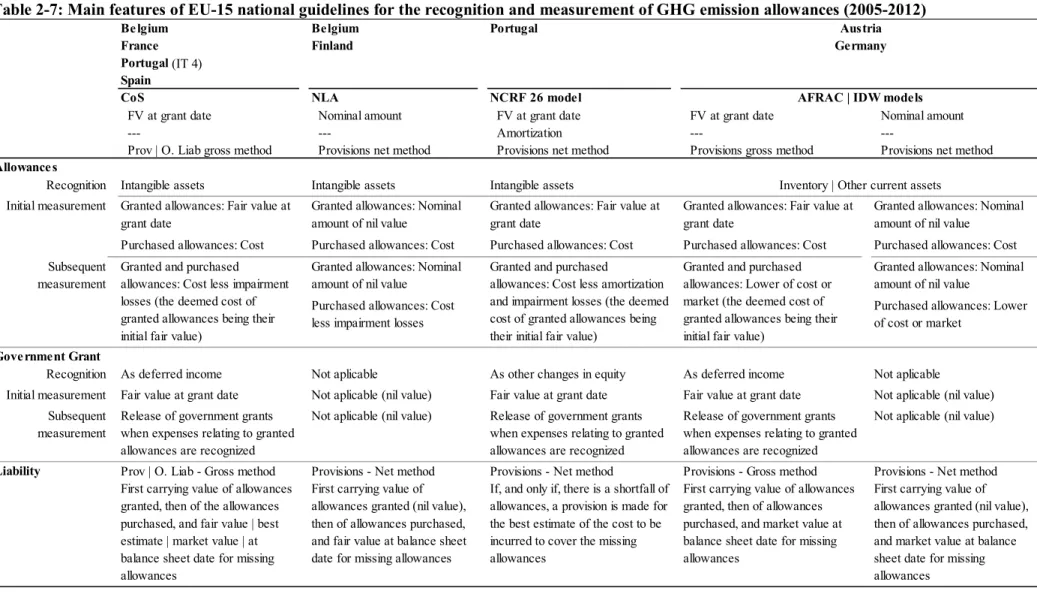
Table 2-7: Main features of EU-15 national guidelines for the recognition and measurement of GHG emission allowances (2005-2012) ... 32
Table 2-8: EU-15 national guidelines for the recognition and measurement of GHG emission allowances (2005-2012) – Illustrative example ... 33
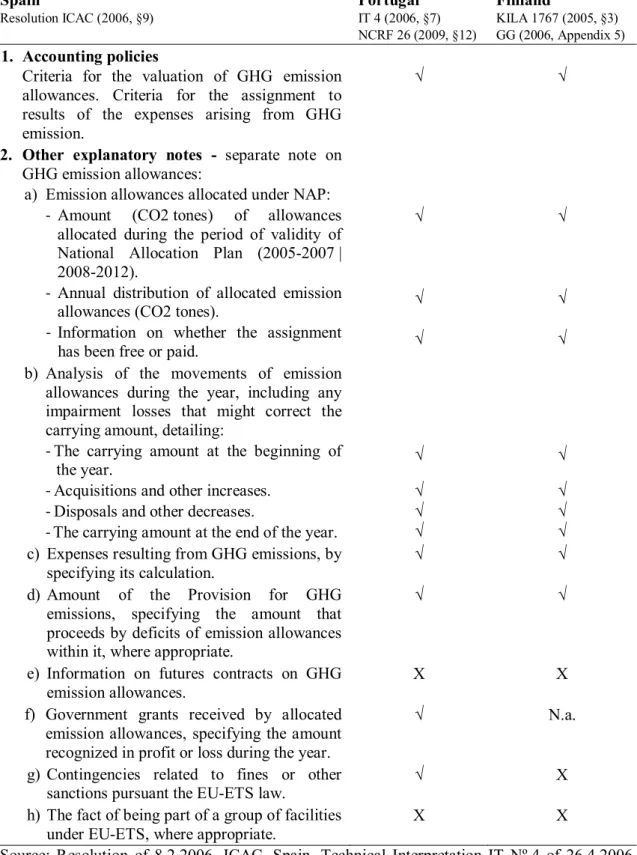
Table 2-9: Information on GHG emission allowances to be provided in the annex to the annual accounts according to Spanish, Portuguese and Finnish guidelines ... 35
Table 2-10: Synthesis of EU-15 national accounting guidance on GHG emission allowances for entities under IFRS (2005-2012)... 36
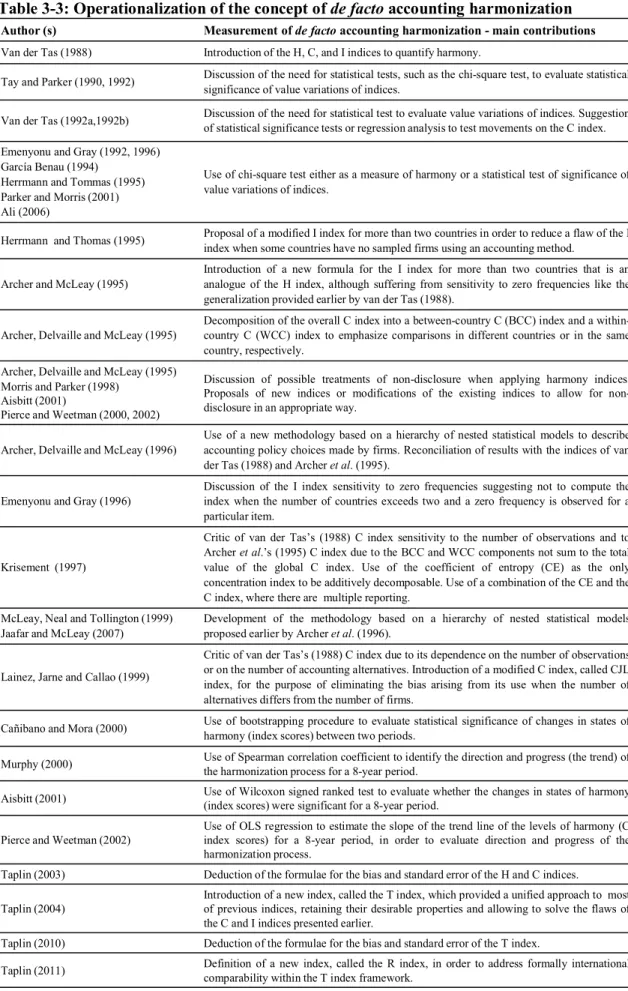
Table 3-1: Options for the T index when estimating αkl ... 54
Table 3-2: Options for the T index when estimating βij ... 55
- xii -
Table 4-1: Previous empirical evidence on the association between mandatory guidance
and level of mandatory environmental disclosure ... 76
Table 4-2: Previous empirical evidence on the association between size and level of voluntary environmental disclosure ... 82
Table 4-3: Previous empirical evidence on the association between industry affiliation and level of voluntary environmental disclosure... 86
Table 4-4: Previous empirical evidence on the association between international activity, foreign listing, and level of voluntary environmental disclosure... 90
Table 4-5: Previous empirical evidence on the association between ownership concentration, foreign ownership, and level of voluntary environmental disclosure . 95 Table 4-6: Previous empirical evidence on the association between profitability, leverage and level of voluntary environmental disclosure ... 98
Table 4-7: Synthesis of previous empirical evidence on the association between firm-specific characteristics and level of voluntary environmental disclosure or de facto accounting harmony in voluntary disclosure ... 102
Table 5-1: Sample breakdown by country of domicile and by industry ... 117
Table 5-2: Sample breakdown by type of guidance in home-country ... 118
Table 5-3: Model specification following a bottom-up approach ... 124
Table 5-4: Descriptive statistics for the dependent variables, over 2005-2012 ... 128
Table 5-5: Descriptive statistics for the overall disclosure index (DISC), by year ... 130
Table 5-6: Definitions and proxies of the independent variables ... 131
Table 5-7: Descriptive statistics for the independent variables, over 2005-2012 ... 133
Table 5-8: Estimation results for Model 5-0 - the null model with 2 hierarchical levels ... 136
- xiii -
Table 5-9: Estimation results for Model 5-1 - the null model with 3 hierarchical levels
... 137
Table 5-10: Estimation results for Model 5-2.1 and Model 5-2.2 ... 138
Table 5-11: Estimation results for Model 5-3 and Model 5-4 ... 139
Table 5-12: Estimation results for Model 5-5.1 and Model 5-5.2 ... 142
Table 5-13: Estimation results for Model 5-5.3 and Model 5-5.4 ... 150
Table 5-14: Disclosure strategies of EU-15 firms operating in foreign markets ... 159
Table 5-15: Disclosure strategies of EU-15 firms engaged in internationalization processes ... 161
Table 5-16: Summary of results on the “disciplinarian effect” of standards and markets on the level of carbon financial disclosure ... 162
Table 6-1: Sample composition and descriptive statistics by type of guidance, listing status, and internationalization through sales ... 171
Table 6-2: Possible disclosure methods for minimum comparable information ... 175
Table 6-3: Summary of results by type of guidance ... 182
Table 6-4: Summary of results by type of guidance, after control for industry effects 184 Table 6-5: Summary of results by detail of guidance on disclosure items ... 187
Table 6-6: Summary of results by industry ... 189
Table 6-7: Summary of results by listing status and internationalization through sales ... 192
Table 6-8: Summary of results by listing status and internationalization through sales, after control for industry effects ... 194
- xiv -
Table 6-9: Summary of results on the “disciplinarian effect” of standards and markets over the harmony in carbon financial disclosure ... 196
Table A-1: Sample composition - Illustrative example (IE) ... 213
Table A-2: Sample composition, T index by group of firms, and T overall (IE) ... 214
Table A-3: Sample composition and T indices after adjusting for industry effects (IE) ... 216
Table A-4: Sample composition with zero frequencies of industry S in Group 3 (IE) . 217
Table A-5: Sample composition, and T indices after adjusting for industry effects, in the case of zero frequencies of industry S in Group 3 (IE) ... 217
- xv -
List of
Figures
Figure 2-1: Emissions limitation or reduction commitments by 2012 in accordance with
Article 4th of the Kyoto Protocol (% of base year 1990) ... 13
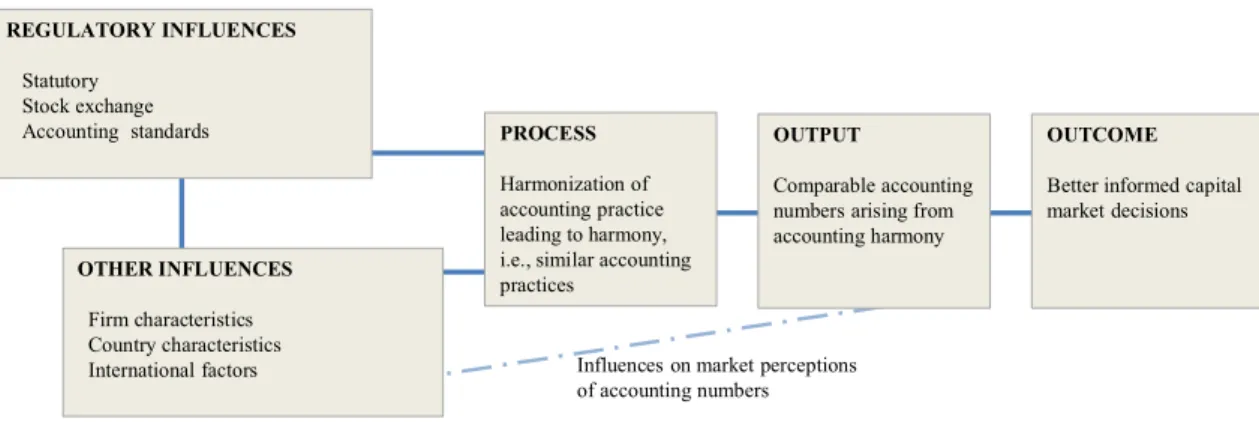
Figure 3-1: Possible combinations of de jure and de facto harmony ... 39
Figure 3-2: The concept of accounting harmonization ... 40
Figure 4-1: Determinants of international accounting harmonization ... 64
Figure 4-2: Determinants of disclosure decision and de facto disclosure harmony ... 66
Figure 4-3: Synthesis of theoretical background for corporate disclosure ... 74
Figure 5-1: Synthesis of the hypotheses testing the “disciplinarian effect” of standards and markets on the level of carbon financial disclosure ... 116
Figure 6-1: Synthesis of the hypotheses testing the “disciplinarian effect” of standards and markets on the harmony in carbon financial disclosure ... 169
- 1 -
1. Introduction
The globalization of capital markets underlined the need for internationally comparable financial statements, leading standard-setting bodies to join efforts over the last four decades to reduce disparity in financial reporting “as a means to facilitate cross-border capital formation while providing adequate disclosure for the protection of investors and the promotion of fair, orderly and efficient markets” (SEC, 2007, p. 4, italic added by the author).
At first, efforts were focused on reducing differences between the accounting principles used in major capital markets around the world. Then, international accounting harmonization became an objective of modern accounting (Baker and Barbu, 2007; Barlev and Haddad, 2007), and the title international accounting harmonization has been used to describe a process of reducing accounting differences among countries. In related literature, the concept of harmonization has been defined in many different ways (Taplin, 2011; Cole et al., 2009, 2012), and later, in the 1990s, often replaced by the concept of convergence (Ali, 2005, p. 9) when referring to the removal of existing dissimilarities, and the “development of high-quality, compatible accounting standards that could be used for both domestic and cross-border financial reporting” (IASB, 2002, italic added by the author).
According to Tay and Parker (1990), harmonization of financial reporting is a process involving movement away from total diversity towards a state of harmony indicated by a concentration of firms around one or a few of the available accounting choices. While harmonization refers to a process, harmony is a state at a given point in time, being that past literature generally uses the term harmony when referring to the comparability of firms’ accounts (Taplin, 2011). Both harmonization and harmony may be either de jure (formal) or de facto (material). The former refers to accounting standards, statutory rules or stock exchange regulations, and the latter relates to the actual practices of firms.
In an attempt to address the problem of international accounting diversities, nine professional accountancy bodies1 agreed to establish, in 1973, the first international
1 From Australia, Canada, France, Germany, Japan, Mexico, the Netherlands, the United Kingdom (UK) and Ireland, and the United States of America (US).
- 2 -
standard-setting body (IASC)2. Within the European Union (EU), the process of de jure
(formal) accounting harmonization started with the adoption of the Fourth Directive, in 1978, and had significant development with Regulation (EC) No 1606/2002, requiring publicly traded firms governed by the law of a Member State to prepare their consolidated accounts in conformity with International Financial Reporting Standards (IFRS)3 for years beginning on or after January 1, 2005.
Although there are several IFRS containing guidelines on the recognition, measurement, and disclosure of financial elements connected to environmental matters, there is not a single standard focused exclusively on environmental issues and their associated effects on firms’ accounts. To that extent, financial reporting of environmental issues is largely outside the scope of the formal accounting harmonization within the EU. However, the need to integrate environmental information into financial reporting, in order to enable transparency, is well underlined in the Commission Recommendation of May 2001 (EC, 2001) by stating that “In the absence of harmonised authoritative guidelines in relation to environmental issues and financial reporting, comparability between companies becomes difficult…” (EC, 2001, § 5).
Since Recommendation EC (2001), new issues in the environmental area have emerged. One of them is carbon financial accounting. In 2005, the EU launched the European Emissions Trading System (EU-ETS) as a policy instrument to mitigate global climate change. The scheme is based on the “cap and trade” principle, according to which there is a “cap”, or limit, on the total amount of greenhouse gases (GHG)4 that can be emitted
by the installations under the system. Within this cap, firms that operate such installations receive emission allowances (also called emission rights) that can be spent or traded, as needed. The limit on the total number of allowances available ensures that they have a market value, being their price determined by supply and demand. As a
2 IASC - International Accounting Standards Committee that since 2001 was renamed to IASB - International Accounting Standards Board.
3 International Financial Reporting Standards are standards issued by the International Accounting Standards Board (IASB). They include the International Accounting Standards and their interpretations adopted by the IASB from its predecessor, the International Accounting Standards Committee (IASC). 4 The term greenhouse gas (GHG) refers to the following gases covered by the Kyoto Protocol: carbon dioxide (CO2), the major GHG, methane, nitrous oxide, sulphur hexafluoride, hydrofluorocarbons, perfluorocarbons, and chlorofluorocarbons. These GHG are often measured as carbon dioxide equivalents, being that related literature generally uses the expressions “CO2 emissions” and “carbon emissions” interchangeably with “GHG emissions”.
- 3 -
result, a new commodity was created in the form of GHG emission allowances, and since carbon dioxide (CO2) is the principal greenhouse gas, this is known as the “carbon market”. In 2012, around 8 billion allowances were traded with a total value of € 56 billion, excluding derivatives (EC, 2013).
The purpose of EU-ETS is to generate a price signal, the carbon price, strong enough to drive investment, production and consumption decisions towards a low-carbon economy. Within this policy, carbon financial accounting and reporting could be an important tool to reduce emissions by clearly releasing costs of carbon to stakeholders so that they could incorporate this information in strategic decision-making. However, EU-15 firms under IFRS have no mandatory guidance on how to report emission allowances in their annual accounts. The only exception is Spain, where national accounting dispositions on emission allowances are compulsory to entities operating installations linked to the Spanish allowances allocation plan, regardless if they draw up their financial statements under national GAAP or under IFRS.
Due to the lack of specific guidance, divergent accounting practices have emerged, and their implications may be significant not only for the financial position and performance reported in the annual accounts, but also on how a firm may decide to manage emission allowances (PwC and IETA, 2007; Lovell et al., 2010; Black, 2013; Haupt and Ismer, 2013; Giner, 2014). In view of this, disclosure provided in the explanatory notes would be of major importance for users to evaluate firms’ performance in terms of GHG emissions. According to Lovell and Mackenzie (2011, p. 727) some firms under EU-ETS have advocated a readiness for clear guidance from standard-setting bodies “so that companies can be fairly compared with their competitors, creating a level playing field”.
Prior literature on international accounting harmonization (Meek and Saudagaran, 1990; Ali, 2005; Baker and Barbu, 2007) suggests that, in general, de facto (material) harmony may arise from two different forces: institutional endeavors to harmonize international financial reporting standards; and, voluntary movements by firms towards similar accounting practices, independently from the harmonization of accounting regulations.
- 4 -
one purpose of accounting standard-setting bodies. When this goal is achieved de jure (formal) harmonization leads to de facto (material) harmonization. But the existence of formal harmonization does not assure, by itself, the comparability of accounting information (van der Tas, 1992b; Emenyonu and Gray, 1992; Emenyonu, 1993; Cairns, 1997; Emenyonu and Adhikari, 1998; Nobes, 1998; Ali and Hwang, 2000; Ball et al., 2000; Ball et al., 2003; Barbu et al., 2014). Even when compliance with regulations is legally required, firms may not comply if it is perceived that the consequences of non-compliance are not serious (Tay and Parker, 1990; Oliver, 1991).
On the other hand, the diversity or the lack of accounting standards does not necessarily imply the diversity of practices. Some research (van der Tas, 1988; Tay and Parker, 1990; Aisbitt, 2001) suggests that convergence may occur by a process of voluntary or spontaneous harmonization when most firms consider that it is of their convenience. In particular, the globalization of capital markets and the internationalization of firms’ operations are singled out in related literature as factors that may lead to voluntary harmonization (Thorell and Whittington, 1994; Cañibano and Mora, 2000; Jaafar and McLeay, 2007).
Concurrently, some strands of international accounting research suggest that national accounting standards, in spite of no longer applying to the consolidated statements of EU listed firms since 2005, may explain some continued dissimilarities in their reporting practices (Nobes, 2006, 2008; Kvaal and Nobes, 2010), namely on the level of environmental disclosure (Barbu et al., 2014). However, most of prior multi-country studies examining disclosure practices of EU firms applying IFRS do not consider discrepancies in national accounting guidance. Moreover, as regards harmonization studies, while numerous research has been conducted on the harmonization of measurement practices, investigation concerned with the harmonization of disclosure is scarce (Emenyonu and Gray, 1996; Ali, 2006).
Against this background, this study fills a gap in literature in two different ways: primarily, by linking international accounting harmonization with environmental disclosure; additionally, taking into consideration the existing accounting guidance, in firms’ home-country, mandatory, or not, for entities under IFRS. The aim is twofold:
- 5 -
(i) To provide evidence whether guidance on accounting for GHG emission allowances, issued in firms’ home-country, enhances the harmony in, as well as, the level of disclosure on GHG emission allowances in the annual accounts (hereafter, carbon financial disclosure). If so, a “disciplinarian effect” of accounting standards over carbon financial disclosure would have occurred. (ii) To investigate whether the internationalization of firms, through the capital
markets or through foreign sales, is likely to improve, by itself, the harmony in, as well as, the level of carbon financial disclosure. If so, a “disciplinarian effect” of markets over carbon financial disclosure would have occurred.
Acknowledging that, in general, high harmony levels are more likely to take place when there is low release of information (Rahman et al., 2002), this study examines both the level of disclosure and the level of harmony (in disclosure), in order to fully evaluate a possible “disciplinarian effect” of standards and markets on the dissemination of further and more comparable information on GHG emission allowances in the annual accounts.
Overall, the purpose of this investigation is to shed light on areas where previous research showed mixed results (the relationships between firms’ internationalization and disclosure) or is scarce (disclosure practices under mandatory guidance), and simultaneously contribute to the ongoing debate on mandatory versus voluntary disclosures on GHG emissions (Simnett and Nugent, 2007; Simnett et al., 2009; Cowan and Deegan, 2011; Choi et al., 2013).
Additionally, regulatory influences coming from industry affiliation are also examined. At EU level, high carbon intensive firms are subject to further sector-level regulations on their emissions. Therefore, due to more scrutiny and institutional pressure, they are more likely to have created routines to collect, treat and release information on GHG emission allowances, than less pollutant activities (Stanny and Eli, 2008; Stanny 2013). On the other hand, harmony is likely to occur at industry level, since sector-level institutions play a key role in the diffusion of minimum standards for corporate social responsibility (Jackson and Apostolakou, 2010). Bearing this in mind, this study tests industry effects over the harmony in, and the level of carbon financial disclosure.
- 6 -
by EU-ETS was considered over an eight-year period (2005-2012), amounting to 1 344 firm-year observations. The selection of the beginning period has been due to the start of the first trading period of EU-ETS in 2005.
The research is organized into seven chapters, including this introduction. Next, Chapter 2 refers the regulatory background, describing the European scheme for the trading of GHG emission allowances, and the accounting framework for EU-15 listed firms covered by the system. The analysis comprehends an overview, at EU-15 level and by Member State, of accounting regulations on GHG emission allowances. In particular, it addresses dissimilarities in existing guidance as for the clarity and detail of the items to be reported in the explanatory notes to the annual accounts. Prior literature on mandatory disclosure remarks that simply creating further reporting regulations will not necessarily lead to real change in disclosure, unless such dispositions are clearly delineated to reduce management discretion (Criado-Jiménez et al., 2008; Peters and Romi, 2013). Expanding prior research, this study examines if the same applies to guidance that it is not mandatory.
Chapter 3 presents a review of literature concerning the concept and the measurement of harmonization of financial reporting, addressing in particular the operationalization of the concept of de facto (material) accounting harmony. Following related literature, the T index, introduced by Taplin (2004), is employed to measure de facto (material) disclosure harmony in the present research. The T index seems to be the most appropriate method as it brings together all of the required properties to quantify harmony of firms’ accounts (Cole et al., 2009; Mustata et al., 2011). The T index equals the probability that two firms randomly selected, with replacement, have accounts that are comparable (ranging from 0, when all firms have financial statements non-comparable to each other, to 1, when all firms have financial statements that are comparable to each other). Changes in index values over time would indicate that harmony is increasing (decreasing), suggesting, therefore, that harmonization (disharmonization) occurred.
Chapter 4 presents theoretical and empirical frameworks to examine harmony of firms’ accounts under mandatory guidance or due to voluntary processes, and to identify the drivers of both mandatory and voluntary environmental disclosure. Consistent with
- 7 -
prior investigation on environmental disclosure (Deegan, 2002; Cormier et al., 2005; Chen and Roberts, 2010), a multi-theoretical framework is adopted to address research questions, assuming that corporate disclosure is an outcome of management’s assessment of economic incentives, public pressures, and institutional constraints. It is beyond the scope of this study to fully investigate patterns of disclosure across different types of national institutional environments. However, considering that macro-level factors (e.g., culture, form of equity market, sociopolitical environment), are likely to affect the ways in which firms communicate with stakeholders (Midttun et al., 2006; Freedman and Jaggi, 2005, 2011; Carnevale et al., 2012; Faisal et al., 2012), variables capturing the institutional environment in firms’ home-country are also incorporated in the analysis when examining levels of carbon financial disclosure among EU-15 firms.
Chapter 5 provides empirical evidence on the effects of regulatory background, affiliation in high carbon intensive industries, and international exposure, over the level of carbon financial disclosure. For the purpose of measuring firms’ level of disclosure, a disclosure index (dichotomous, unweighted, and adjusted for non-applicable items) is constructed. Following related literature, a set of multilevel (hierarchical) models are estimated to examine the effects of firm-level and country-level explanatory variables on carbon financial disclosure, and to test if the explanatory variables at the country-level (type of guidance) serve as moderators of the firm-country-level relationships between internationalization and disclosure.
Chapter 6 provides empirical evidence aiming at evaluate whether accounting guidance or the internationalization of firms lead to increased harmony in carbon financial disclosure. For the purpose of measuring harmony (comparability) of firms’ accounts, T indices (Taplin, 2004) are computed for different groups of firms (sorted according the relevant criteria to test research questions), as well as for the whole sample to evaluate harmony in carbon financial disclosure at EU-15 level. In all cases, to assure that the harmonization towards a more informative policy gets a higher score, different levels of comparability are allocated to different disclosure methods in accordance with the extent of information provided by each method.
Chapter 7 provides a summary of the main research findings and their implications, major contributions and limitations of the study, and suggestions for further research.
- 8 -
Altogether, findings allow not reject that accounting guidance on GHG emission allowances, even not mandatory for firms under IFRS, exerts a “disciplinarian effect” over carbon financial disclosure, by significantly increasing the harmony in, as well as, the level of disclosure on GHG emission allowances in the annual accounts. As anticipated, the highest levels of harmony and disclosure are associated with the scenario of mandatory guidance followed by the case of not mandatory guidance that details the items to be reported in the annex. In the opposite pole lies the scenario of no guidance where levels of harmony and levels of disclosure are minimal.
Additionally, a more in-depth analysis reveals that, although not ensuring full compliance, mandatory guidance seems to exert the major “disciplinarian effect” on the dissemination of quantitative items, precisely the kind of disclosure that firms are less willing to reveal as it conveys more proprietary information (Cho and Patten, 2007; Cormier et al., 2009). These outcomes are important for regulatory bodies aimed at enhance utility and relevance of financial statements. It is essential that firms provide quantitative (monetary and non-monetary) disclosure on their efforts and achievements in reducing GHG emissions, namely to assist investors in assessing the trade-off between risk and return (Freedman and Jaggi, 2005, 2011), to provide the information that users need to project future cash flows (EFRAG, 2012), and to evaluate firms’ environmental and financial performances. To this end, evidence suggests that mandatory guidance is needed because, otherwise, the level of carbon financial disclosure, especially on quantitative items, is predicted to be significantly lower.
As regards the influence of regulatory background at country level, this study indicates that disclosure practices of firms applying IFRS are likely to be affected by domestic guidance on GHG emission allowances not intended for them. Actually, national guidance is the most significant predictor in explaining variance between countries, at EU-15 level. Largely, findings suggest that national guidance, even not mandatory for firms under IFRS, is able to interfere with the process of de facto (material) accounting harmonization among EU-15 firms applying IFRS.
Also, as expected, outcomes confirm the prediction that higher levels of disclosure and harmony are more likely to occur in high carbon intensive industries, than in low carbon intensive industries. In fact, among all the firm-level predictors, industry affiliation is
- 9 -
the one that added the major contribution in explaining within countries variance, and exhibits the strongest association with the level of carbon financial disclosure. Moreover, results point out that harmony is likely to occur at industry level, since levels of harmony are significantly higher within industries, than between industries.
Otherwise, results do not confirm the assumption that firms’ internationalization, through the capital markets or through foreign sales, is likely to put forth, by itself, a “disciplinarian effect” over carbon financial disclosure.
With regard to the internationalization through the capital markets, it should be noted that almost all foreign listed firms in the sample are registered in US stock exchanges. Consequently, for EU-15 firms (domiciled in countries that ratified the Kyoto Protocol) the internationalization through the quotation in US stock exchanges (a country that has not ratified the Protocol) does not seem to exert further pressure (in addition to the existing in firms’ home-country) to enhance carbon financial disclosure. In the lens of stakeholder theory and institutional theory, results suggest that, as foreign listed firms realize that this particular information is not broadly valued by their foreign stakeholders, to be accountable in front of a wider stakeholders audience is not enough to motivate, by itself, a “disciplinarian effect” over carbon financial disclosure. So, when considering either the harmony in or the level of carbon financial disclosure, results indicate that, ceteris paribus, EU-15 firms listed abroad are not likely to perform significantly different than EU-15 firms listed only in domestic stock exchanges.
As regards the internationalization through foreign sales, findings allow admitting that, ultimately, the improvement on the level of carbon financial disclosure among EU-15 firms operating internationally is triggered by guidance in home-country. Extending the hypotheses advanced by Oliver (1991) to an international environment, the lack of international consensus regarding either the commitment to the Kyoto Protocol, or the appropriate accounting model for emissions trading schemes, do not favor a process of voluntary release of costs of carbon by EU-15 multinational firms. In particular, due to multiplicity and fragmentation of foreign stakeholders (lack of broadly diffused, or widely validated, values, norms and practices on emissions trading schemes), EU-15 firms operating globally tend to respond primarily to domestic institutional pressures, from which organizational dependencies are deemed to be higher.
- 10 -
Accordingly, evidence suggests that disclosure strategies of EU-15 firms exposed to foreign markets are primarily driven by guidance in home-country. That is, under not mandatory detailed guidance the improvement on the level of disclosure is likely to occur by means of more qualitative information, while the release of quantitative data is more likely to occur under mandatory guidance. In turn, when there is no specific guidance in the firm’s home-country or when existing guidance does not specify the items to be disclosed, firms’ skepticism about the strategic utility of carbon financial disclosure as a tool to manage a multiplicity of foreign stakeholders seems to inhibit further improvements on the level of disclosure among EU-15 firms with higher exposure to foreign markets. Hence, all else equal, the levels of disclosure among them are not significantly different from those of EU-15 firms operating mainly in domestic markets. Moreover, as regards the harmony in carbon financial disclosure, results indicate that, under no mandatory regime, differences between firms with higher and lower exposure to foreign markets are not statistically significant.
Overall, when evaluating harmony in, and level of carbon financial disclosure among EU-15 firms, although some progresses were registered along the research period, we arrive at 2012 with 38% of sample firms not disclosing any information in their annual accounts. In particular, with regard to the harmony at EU-15 level, the probability that two firms randomly selected have accounts that are comparable ranges from, 3,5%, in 2005, to 5,6%, in 2012. Currently, both firms and regulators are more conscientious of the urgent need for mandatory guidance in order to enable comparability of carbon financial disclosure (Lovell and McKenzie, 2011; ANC, 2012; EFRAG, 2012; Giner, 2014). Findings confirm this view, by suggesting that we cannot rely on a possible “disciplinarian effect” of markets to induce EU-15 firms to disclose further or more comparable information on GHG emission allowances in the annual accounts.
Finally, it should be noted that, despite being consistent with theories based upon the concept of organizational legitimacy, the above mentioned results must be taken with restraint. The number of countries used for this analysis is limited to EU-15 Member States, and even within these countries the study covers just a sample of firms under EU-ETS. Hence, any attempt to generalize or extrapolate the findings of this study outside this context should be made with caution.
- 11 -
2. Overview of regulatory background
This chapter describes the European scheme for the trading of greenhouse gas emission allowances, and the accounting framework for EU-15 listed firms covered by the system.
2.1. The Kyoto Protocol
In 1992, countries participating at Rio Conference organized by the United Nations agreed to cooperate in order to stabilize greenhouse gas (GHG) concentrations (largely carbon dioxide) “at a level that would prevent dangerous anthropogenic (human induced) interference with the climate system” (UNFCCC, 1992, p. 4). The ultimate goal was that “such a level should be achieved within a time-frame sufficient to allow ecosystems to adapt naturally to climate change, to ensure that food production is not threatened, and to enable economic development to proceed in a sustainable manner” (UNFCCC, 1992, p. 4). Subsequent negotiations lead to the signature of the Kyoto Protocol in 1997, entering into force only in 2005 after a complex ratification process1.
According to the principle of “common but differentiated responsibility”, the Kyoto Protocol places a heavier burden on developed countries to reduce GHG emissions. The underlying notion is that industrialized countries are largely responsible for the current high levels of GHG emissions in the atmosphere, which are the result of more than a century and a half of industrial activity. In fact, most of the world’s emissions come from a relative small number of countries. The seven largest emitters (US, EU, China, Russia, Japan, India, and Canada) accounted for more than 70% of energy-related CO2 emissions, in 2004. In particular, the US was responsible for 20% of global emissions, being the largest emitter in absolute terms and, on a per capita basis, US emissions were roughly twice as high as those of EU or Japan and five times the world average (Pew Center on Global Climate Change, 2009, pp. 1-2). Interestingly, among the countries that signed the Kyoto Protocol in 1997, only the US has not ratified it2. In turn, Canada
(a country that has signed the agreement in 1997 and ratified it in Parliament in 2002) decided to withdraw in 2012.
1 Information available at the web site of the United Nations Framework Convention on Climate Change (UNFCCC), http://unfccc.int/essential_background/items/6031.php. Last accessed on 19 July 2014. 2 US agreed with Kyoto Protocol in principle but the US Congress has not ratified it.
- 12 -
Under the Kyoto Protocol, three market-based mechanisms were created as means for participants comply with their targets (besides adopting other climate policy measures at domestic level): (i) Clean Development Mechanism; (ii) Joint Implementation Mechanism; and (iii) International Emissions Trading. In this regard, a distinction is made between the so-called Annex I countries (industrialized countries) and non-Annex I countries (developing countries). Each non-Annex I country is obliged to reach a domestic target to mitigate climate change, while non-Annex I countries do not have emission reduction targets but must ratify the Protocol in order to be hosting emission reduction projects under the Clean Development Mechanism.
The Clean Development Mechanism, defined in Article 12th of the Protocol, allows a country with an emission-reduction or emission-limitation commitment under the Kyoto Protocol (Annex I country) to implement an emission-reduction project (for instance, a rural electrification project using solar panels or the installation of more energy-efficient boilers) in developing countries with no emission reduction targets (non-Annex I countries). Such projects can earn saleable certified emission reduction (CER) credits which can be counted towards meeting Kyoto targets.
On the other hand, the Joint Implementation Mechanism, defined in Article 6th of the Kyoto Protocol, allows a country with an emission reduction or limitation commitment under the Kyoto Protocol (Annex I country) to earn saleable emission reduction units (ERU) from an emission-reduction or emission removal project in another Annex I country, which can be counted towards meeting its Kyoto target.
Finally, the International Emissions Trading, set out in Article 17th of the Kyoto Protocol, allows Annex B countries (Annex I countries, except Turkey and Belarus) that have accepted targets for limiting or reducing emissions (expressed as levels of allowed emissions) to sell any excess capacity (emissions permitted to them but not used) to countries that are over their targets. Emissions trading schemes (ETS) may be established at the national level or the regional level. Under such schemes, authorities set emissions obligations to be reached by the participating entities.
The largest system in operation is the European Union emissions trading scheme, (described in the next section), being that, over the research period (from 2005 to 2012),
- 13 -
regional initiatives were scarce3 and at, national level, only three emissions trading
schemes were initiated outside the EU - New Zealand ETS (2008), Swiss Federal ETS (2008), and Japan Voluntary ETS (2009) -, the later working on a voluntary basis4.
2.2. The European Emissions Trading System
In 2000, the EU Commission created the European Climate Change Program5 to help
identify the most environmentally-effective and most cost-effective strategies that could be taken at the EU level to cut GHG emissions. The immediate goal was to help ensure that the EU would meet its target for reducing emissions under the Kyoto Protocol. This commitment required the countries that were EU members before 2004 (EU-15) to cut their combined emissions of greenhouse gases to 8% below the 1990 level, by 20126.
Figure 2-1: Emissions limitation or reduction commitments by 2012 in accordance with Article 4th of the Kyoto Protocol (% of base year 1990)
27,0% Portugal 25,0% Greece 15,0% Spain 13,0% Ireland 4,0% Sweden 0,0% Finland 0,0% France Netherlands -6,0% Italy -6,5% Belgium -7,5% UK -12,5% Austria -13,0% Denmark -21,0% Germany -21,0% Luxembourg -28,0% -50% -40% -30% -20% -10% 0% 10% 20% 30% 40% 50% European Community - 8,0% Source: OJ L 130, 15.5.2002, p.19.
3 New South Wales GHG Abatement Scheme (2003), Alberta ETS (2007), US Northeast and Mid-Atlantic States Regional GHG Initiative (2009), HB 7135 Florida (2010).
4 Additionally, the CRC Energy Efficiency Scheme was initiated in UK, in 2010, covering only large non-energy intensive organizations that fall below EU-ETS thresholds. Information available at the web site of the International Emissions Trading Association (IETA), http://www.ieta.org/worldscarbonmarkets. Last accessed on 19 July 2014.
5http://ec.europa.eu/clima/policies/eccp/first/index_en.htm. Last accessed on 19 July 2014.
6 The EU-28 does not have a common target under the Kyoto Protocol in the same way as the EU-15. Of the 13 countries which have joined the EU since the Kyoto Protocol was agreed, all except Cyprus and Malta have individual emission reduction commitments under the Protocol.
- 14 -
The 8% collective reduction commitment has been translated into national emission limitation targets for each one of the EU-15 Member States under what is known as the “burden sharing” agreement. These national targets, compulsory under the EU law7, are differentiated according to each Member State’s relative wealth at that time, and range from an emissions reduction of 28%, for Luxembourg, to an increase of 27%, for Portugal, as shown in figure 2-1.
In order to achieve those targets, the EU launched, in 2005, the European Emissions Trading System (EU-ETS)8. It is the first and biggest international scheme for the trading of GHG emission allowances9 (also called emission rights or licenses because one allowance gives the right to emit one tone of GHG). It covers CO2 emissions from installations, above certain levels of ability, such as power stations, combustion plants, oil refineries and iron and steel works, as well as factories making cement, glass, lime, bricks, ceramics, pulp, paper and board. Since the beginning of 2012, aviation activities were also included, and in 2013 the scheme was further expanded to the petrochemicals, ammonia, and aluminum industries, as well as to additional GHG.
The EU-ETS established by Directive 2003/87/EC (EU-ETS Directive)10 is based on the
“cap and trade” principle. According to this principle, there is a “cap”, or limit, on the total amount of GHG that can be emitted by the installations under the system. Within this cap, firms that operate such installations receive emission allowances that can be spent or traded, as needed. The limit on the total number of allowances available ensures that they have a value.
7Council Decision 2002/358/EC of 25 April 2002 concerning the approval, on behalf of the European Community, of the Kyoto Protocol to the United Nations Framework Convention on Climate Change and the joint fulfillment of commitments thereunder, 15.5.2002, OJ L 130, pp. 1-20.
8http://ec.europa.eu/clima/policies/ets/index_en.htm. Last accessed on 19 July 2014.
9 Currently, it comprises nearly 12000 industrial plants in 31 countries: the 28 EU Member States plus Iceland, Liechtenstein and Norway.
10 Directive 2003/87/EC of the European Parliament and of the Council establishing a scheme for greenhouse gas emission allowance trading within the Community and amending Council Directive 96/61/EC, 13.10.2003, OJ L 275, pp.32-46. Amended by Directive 2004/101/EC of the European Parliament and of the Council of 27 October 2004 amending Directive 2003/87/EC establishing a scheme for greenhouse gas emission allowance trading within the Community, in respect of the Kyoto Protocol’s project mechanisms, 13.11.2004, OJ L 338, pp.18-23; Directive 2008/101/EC of the European Parliament and of the Council of 19 November 2008 amending Directive 2003/87/EC so as to include aviation activities in the scheme for greenhouse gas emission allowance trading within the Community, 13.1.2009, OJ L 8, pp.3-21; and Directive 2009/29/EC of the European Parliament and of the Council of 23 April 2009 amending Directive 2003/87/EC so as to improve and extend the greenhouse gas emission allowance trading scheme of the community, 5.6.2009,OJ L 140, pp.63-87.
- 15 -
Since 2005, the EU-ETS worked for two trading periods (2005-2007 | 2008-2012). Before the start of each trading period, each Member State should submit to the EU Commission a National Allocation Plan (NAP) setting out how many allowances were being allocated for the next period and how many allowances would receive each installation covered by the scheme. The assessment of the NAP was made by the EU Commission in order to assure that the allowances were in line with the Kyoto Protocol. For the third trading period (2013-2020), there will no longer be any NAP. Instead, the allocation is determined directly at the EU level.
According to the Article 14th of the EU-ETS Directive, the EU Commission has adopted guidelines for the monitoring and reporting of GHG emissions under EU-ETS11. After the end of each calendar year, each firm has to report its actual emissions from that year, assure independent verification of this report, and submit it to the competent national authority by 31 March. By 30 April, the firm has to surrender a number of allowances equivalent to its verified emissions in the previous year. When actual emissions are lower than allowances held, a firm can keep the spare licenses to cover its future needs (within the same trading period) or sell them to another firm. Otherwise, when firms return an insufficient number of allowances to cover their emissions they have to pay a financial penalty for each missing allowance to the corresponding Member State12,
being that the payment of the excess emissions penalty does not release the operator from the obligation to surrender an amount of allowances equal to those excess emissions when surrendering allowances in relation to the following calendar year. Annual compliance cycle is closed by the cancellation of surrendered allowances by 30 June.
The information collected by firms to respond to the requirements of the GHG emission monitoring and reporting process (e.g., tones of GHG emissions made during the year, shortfall or surplus of allowances at year-end), along with other disclosure (namely monetary data showing the effects on financial position and performance), would be useful for users of financial statements be aware of the risks, and the associated mitigation efforts, that GHG emissions pose to firms.
11http://ec.europa.eu/clima/policies/ets/monitoring/index_en.htm. Last accessed on 19 July 2014.
12 The financial penalties were established at € 40 and € 100, for the first and second trading periods, respectively.
- 16 -
The need to integrate environmental matters into financial reporting as a key factor that enables transparency of information was well underlined in the Commission Recommendation of May 2001 (EC, 2001)13 by stating that “In the absence of harmonised authoritative guidelines in relation to environmental issues and financial reporting, comparability between companies becomes difficult…” (EC, 2001, § 5).
In particular, evidence suggests that, under no specific accounting guidance on how to report GHG emission allowances, firms are likely to provide very limited disclosure in their annual reports (Haque and Deegan, 2010). In view of this, accountants at major firms under EU-ETS have suggested a readiness for clear guidance from standard-setting bodies “so that companies can be fairly compared with their competitors, creating a level playing field” (Lovell and Mackenzie, 2011, p.727).
Next section describes the accounting framework for EU-15 listed firms covered by the system. The analysis comprehends an overview, at EU-15 level and by Member State, of accounting regulations on GHG emission allowances. Other explanatory factors influencing the level of disclosure and the harmony of firms’ accounts are discussed in chapter 4.
2.3. Accounting guidance on GHG emission allowances
Preliminary remark
The comprehensive accounting for GHG emissions goes beyond the scope of the financial reporting accounting standards. It involves also the establishment of internationally accepted rules for quantifying the GHG released to the atmosphere by activities producing emissions. Both issues belong to a wider research field known as “carbon accounting” (Guenther and Stechemesser, 2011; Milne and Grubnic, 2011). The last area is outside of the aim of the present investigation.
2.3.1. Overview at the EU-15 level
At the EU level, the process of de jure (formal) accounting harmonization started with
13Commission Recommendation of 30 May 2001 on the recognition, measurement and disclosure of environmental issues in the annual accounts and annual reports of companies, 13.6.2001, OJ L 156, pp. 33-42.
- 17 -
the adoption of the Fourth Council Directive14 of July 25, 1978, and had significant
development with Regulation (EC) No 1606/2002 of July 19, 200215, requiring publicly traded firms governed by the law of a Member State to prepare their consolidated accounts in conformity with IFRS for years beginning on or after January 1, 200516.
Although there are several IFRS containing guidelines on the recognition, measurement, and disclosure of environmental matters, the IASB has not delivered a standard focused exclusively on environmental issues and their associated effects in the annual accounts. To that extent, environmental financial reporting is largely outside the scope of the formal accounting convergence process within the EU.
It should be noted that the absence of harmonized authoritative guidelines on environmental reporting had already motivated the Recommendation EC (2001) concerning both the recognition, valuation and reporting of environmental issues in the annual accounts, and the provision of environmental information in firms’ annual reports.
The dispositions relating to the environmental information to be provided in the corporate management report were later incorporated in Directive 2003/51/EC (Modernisation Directive)17, and subsequently transposed into the national legal systems of the various Member States. The Modernisation Directive enhanced requirements for the annual report to include non-financial information related to environmental and employee matters, when relevant for an understanding of the firm’s
14Fourth Council Directive 78/660 of 25 July 1978 on the annual accounts of certain types of companies, 14.8.1978, OJ L 222, pp.11-31. This Fourth Company Law Directive coordinates Member States’ provisions concerning the presentation and content of annual accounts and annual reports, the valuation methods used and their publication in respect of all companies with limited liability. Together with the Seventh Council Directive that coordinates national laws on consolidated accounts, it belongs to the family of accounting directives that form the arsenal of EU legal acts governing company accounts. 15 Regulation (EC) No 1606/2002 of the European Parliament and of the Council of 19 July 2002 on the application of international accounting standards, 11.9.2002, OJ L 243, pp.1-4.
16 Member States have the option to extend this requirement to unlisted companies and to individual financial statements. On the other hand, companies traded both in the EU and on a regulated market outside the EU that were already applying another set of internationally accepted standards (for example, US Generally Accepted Accounting Principles (GAAP)), and companies that had issued debt instruments but not equity instruments could be temporarily exempted by the Member States and not required to comply with IFRS until January 1, 2007.
17 Directive 2003/51/EC of the European Parliament and of the Council of 18 June 2003 amending Directives 78/660/EEC, 83/349/EEC, 86/635/EEC and 91/674/EEC on the annual and consolidated accounts of certain types of companies, banks and other financial institutions and insurance undertakings, 17.7.2003, OJ L 178, pp. 16-22.