DEVELOPMENT AND PSYCHOMETRIC
PROPERTIES OF THE COMMUNITY
INTEGRATION SCALE OF ADULTS WITH
PSYCHIATRIC DISORDERS
Joana Moura Cabral
Master of Psychology, Research Fellow, University of Azores, Portugal
Célia Maria Oliveira Barreto Carvalho
PhD in Psychology, Assistant Prof., University of Azores, Portugal
Carolina Dall’Antonia da Motta
Master of Psychology, Research Fellow, University of Azores, Portugal
Osvaldo Dias Lopes da Silva
PhD in Mathematic and Statistic, Assistant Prof., University of Azores, Portugal
Abstract
The goal of the current study was to develop and validate the Community Integration Scale for Adults with Psychiatric Problems (CIS-APP), based on a multidimensional model of community integration. The three-dimensional structure (including physical, psychological, and social dimensions) and validity of CIS-APP was studied in a sample of 183 psychiatric patients from the Azores Islands-Portugal. Confirmatory Factor Analysis has led to the choice of a two-factor with a second order factor solution. Results showed that the CIS-APP is a measure with good psychometric properties, with very good internal consistency and validity, and with relevant applicability in both clinical and research settings. Furthermore, the current outcomes have brought relevant information concerning the refinement of the theoretical community integration model that underlies the scale’s development.
Keywords: Community integration, Psychiatric disorders, Assessment,
Scale
Introduction
Mental illness is a widespread problem in the general population. According to the World Health Organization (WHO, 2002), one out of four people is affected by a mental disorder over their lifespan. The impact and
repercussion of mental health problems have led to a growing concern regarding the understanding and the development of effective treatments.
Although several developments have been made in the definition and treatment of mental illnesses over the past decades, these efforts were not always successful, (Manderscheid, Ryff, Freeman, McKnight-Eily, Dhingra & Strine, 2010). For centuries, mental illness was misapprehended, which led to affected persons being subjected to painful and ineffective treatments, and deprived of social contact (Ruiloba, 2002). Currently, mental disorder is defined as the existence of a set of clinically identifiable symptoms or behaviors resulting from a complex interaction of biological, psychological, and social factors associated, in most cases, with functional interference and personal suffering (OMS, 2002). Nevertheless, thanks to the evolution and development in mental health, both in terms of psychiatric medicine and sociocultural aspects, many of those affected by a mental disorder are able to recover and develop a social life like any other member of the general population (Espinosa, 1998).
A new approach to mental health
During the postwar, a new community approach to mental health defended the importance of social factors in the recovery of individuals with psychiatric problems (Bond, Salyers, Rollins, Rapp & Zipple, 2004), progressively the recovery began to be seen in a broader perspective focused on some aspects such as individuals’ self-perception, their mental states, their self-efficacy and self-determination, hope, search for goals, motivation, opportunities, integration and participation in the community, as opposed to the lack of symptomatology as advocated in traditional medical models (Bond et. al, 2004 and Lieberman, Drake, Sederer, Belger, Keefe, Perkins & Stroup, 2008). Thus, this new approach states that the patient must have and active role in their own recovery process, more control over important decisions that haven an impact in their lives, increased participation in community and the resuming previous roles in the family, work and school. (Ahern & Fisher, 1999, WHO, 2002).
This perspective on the recovery of people with mental illness gained increased relevance instigating several psychiatric reforms across Europe and America (Macías, 2011). These reforms involved significant changes in the political, social and scientific approaches in mental health management and bigger investments in psychosocial rehabilitation and in mental health care models that replaced institutionalization for a community-based care (WHO, 2002).
In the last 50 years, false beliefs about mental illness have dissipated and the importance of community integration in the recovery of these patients has been reinforced (Burns-Lynch, Salzer & Baron, 2010).
However, there is still a long path concerning the recovery approach of people with mental health problems, particularly regarding the community integration of these individuals.
Community integration
The definition of community integration of people affected by mental illnesses is closely related to locality, since community integration initially refereed strictly to the place of residence, considering as integrated those individuals who lived in a habitation outside psychiatric hospitals or other treatment facilities (Rosenblatt & Mayer, 1974)
Over time, the definition of community integration encompassed other dimensions of individual’s lives. The concept of community integration was built around the notion of common citizenship, and it was defended that people affected by psychiatric problems should possess the same rights and opportunities than their unaffected counterparts (Racino, 1995), getting involved in social life as the remainder of the community (Wong, Metzendorf & Min, 2006). In general terms, community integration may be defined as the extent to which each individual lives, participates and socializes in their community (Wong & Solomon, 2002).
Community integration of people with mental illness is also defined as the process by which individuals establish and maintain significant interpersonal relationships, by the exchange with community members in non-clinical settings (Wong, Matejkowski & Lee, 2011). As such, integration implies that the person is detached from the role of a psychiatric patient living in a protected environment, having an independent stance from their illness, assuming their self-management and the role of a “normal” adult (Nelson, Lord, & Ochocka, 2001). According to several authors (Weiner, Roe, Mashiach-Eizenberg, Baloush-Kleinman, Maoz & Yanos, 2010), community integration is defined by the degree in which individuals with mental illness have the opportunity to take advantage of the existing resources in their community. Therefore, for an effective integration, it is necessary that individuals can cease the opportunities and social benefits that all members of their society have at their disposal (Bond, et.al 2004, Wong, Metzendorf, & Min, 2006, Salzes, 2005, Yanos, Felton, Tsemberis & Frye, 2007).
Aubry & Myner (1996) were the first authors to consider community integration as a multidimensional concept, comprising three dimensions: physical, social and psychological. Wong & Solomon (2002) have analyzed the way that several studies have defined and operationalized the concept of community integration of people affected by psychiatric problems, and created a model of community integration composed of 3 dimensions suggested by Aubry & Meyer (1996), using the definitions by several authors
to characterize the physical, psychological and social dimensions (Yanos, Stefanic & Tsemberis, 2011, Yanos, Felton, Tsemberis & Frye, 2007, Gulcur, Tsemberis, Stefancic & Greenwood, 2007).
The definition proposed by Wong & Solomon (2002) encompasses the following: physical integration, referring to the extent to which individuals suffering from psychiatric problems spend their time outside their homes, participate in community activities and use the community resources by their own initiative (Segal et al., 1980, cit. in Wong & Solomon, 2002); social integration, comprising two sub-dimensions – interaction and social network. The dimension of interaction refers to how individuals with mental illness engage in social interactions with other members of their community in normative contexts (as opposed to protected context aimed at people with some limitations) (Wolfensberger & Thomas, 1983, cit. in Wong & Solomon, 2002). According to those authors, the assessment of this dimension must be carried out in terms of quantity and quality of those interactions. The social network dimension assesses the extent to which individuals’ social network has an adequate size and a variety of social roles, and if the social relations of the individual with mental illness reflect a positive support (of reciprocity, instead of stress and dependence) (Fellin, 1993 and Storey, 1993, cit. in Wong & Solomon, 2002, p.10); and
psychological integration, that consist on how the individuals see
themselves as a member of their community, expressing an emotional connection to their neighbors, believing in their own capacity to satisfy their needs through their neighborhood, as well as exerting influence over their community(Aubry & Myner, 1996; McMillan & Chavis, 1986, cit. in Wong & Solomon, 2002, p.10).
This model comprising both objective and subjective elements of community integration of individuals with psychiatric problems have been extensively referred in current literature in this field (Yanos, Stefanic & Tsemberis, 2011; Wong, Matejkowski & Lee, 2011; Abdallah, Cohen, Sanchez-Almira, Reye & Ramirez, 2009; Reyes & Ramirez, 2009; Townley, Kloos & Wright, 2009; Gulcur, Tsemberis, Stefancic & Greenwood, 2007, Yanos, Felton, Tsemberis & Frye, 2007; Wong, Metzendorf & Min, 2006).
Although previous research have studied several aspects of community integration of people with psychiatric problems, Wong & Solomon (2002) are the only authors that propose a multidimensional structure combining the previously conceptualized dimensions in a conceptually coherent matrix of environmental factors that influence integration, therefore becoming a reference model in the mental health field (Gulcur, Tsemberis, Stefancic e Greenwood, 2007).
In a study by Gulcur, Tsemberis, Stefancic e Greenwood (2007), the concept of community integration of people with mental illness was
operationalized and their analysis supported the definition by Wong & Solomon (2002), but have also suggested the existence of a fourth factor: independence, regarded as the individual’s ability to carry their activities through autonomously.
Assessment of community integration
The literature in the field of community integration reveals the inexistence of assessment instruments focusing on community integration of people with psychiatric problems and their dimensions. In some studies (e.g.: Aubry & Myner, 1996, Segal.. Abdallah et. al 2009; Gulcur, Tsemberis, Stefancic & Greenwood, 2007, Yanos, Felton, Tsemberis & Frye, 2007), authors have resourced to different measures to assess the same construct, some of which are outdated or inaccessible. This evidence was confirmed in the extensive review by Wong & Solomon (2002), in which was concluded that it was necessary to create an instrument with the ability to assess the multidimensionality of community integration of people with mental illness (Wong & Solomon, 2002; Gulcur, Tsemberis, Stefancic e Greenwood, 2007).
The current study aims at responding to this need, and the main goal is to develop and validate an instrument that assesses the community integration of adults with psychiatric problems. Therefore, it is intended to create a new tool with adequate psychometric properties in order to carry out empirical studies on Community Integration, as an important aspect involved in the recovery and wellbeing of people affected by mental illnesses (Wong, Matejkowski & Lee, 2011; Burns-Lynch, Salzer, & Baron, 2010 e Perkins, Raines, Tschopp & Warner, 2009). A secondary objective is to create a measure as brief and simple as possible, decreasing the difficulties that individuals form this specific population may feel when filling self-report questionnaires.
Since this scale was developed for the Portuguese population, it is noteworthy that Portuguese is the fourth most spoken language in the world, with more than 240 million native speakers, thus allowing professional spread all across the globe to use this assessment tool (Observatório da Língua Portuguesa, 2010).
Methods Participants
A convenience sample of 183 subjects diagnosed with mental illness participated in this study. Participants were men and women with 18 years old or older, residents for a period longer than 3 years in the Autonomous Region of the Azores- Portugal. All participants were being followed by a psychologist or physician due to a psychiatric problem in outpatient settings
of regional health services at the time of evaluation, and all participants gave their informed consent before participating in the current study.
Instruments
Community integration scale for adults with psychiatric problems (CIS-APP research version by Barreto Carvalho, C. & Cabral, J., 2012)
The CIS-APP is a self-report instrument designed to assess community integration in adults (18 or older) with psychiatric problems. Items are responded in a scale ranging from 1 (Completely disagree) to 5 (Completely agree), in which higher scores indicate higher levels of community integration. Instructions include a brief definition of community, so that all respondents are provided with a uniform and consensual definition of community.
The initial version of the scale is composed of 4 dimensions: the
Physical Community Integration dimension consisted of 8 items assessing
the extent to which individuals spend their time outside their homes, participate and use community resources by self-initiative (e.g. “I go out by my own”, “I go alone to social services, the clinic, the pharmacy at the health center / hospital, or another.); The Social Community Integration dimension comprises 12 items assessing the degree with which individuals are involved in social interactions with other (healthy) members of their community, and the quantity and quality of these relationships (e.g. I usually talk to many people; I have many friends); Psychological Community Integration dimension is composed of 7 items, assessing the extent to which individuals perceive themselves as a part of their community, bond emotionally to their neighbors, believe in their ability to satisfy their needs and to influence the community (e.g. “I feel that I belong to my community”, “I feel emotionally connected with people from my community”). Finally, the Independence dimension consisted of 7 items assessing the individuals’ capacity to develop their daily activities autonomously (e.g. “When I need to talk to someone who is not around, I can get in touch with them by my own and without the need of other people”, “I manage my own medication schedule, taking it on time and in the right dosage.”)
Since the development and validation of this measure are the main goal of this study, the structure and psychometric properties of the CIS-APP are described in the results section.
Sense of community index (SCI-2; Chavis, Lee & Acosta, 2008) The Sense of Community Index (Version 2) was developed for use in different types of communities, and it is recommendable that the type of community targeted is defined prior to administration (in the current study, “community” refers to the parish in which the participant lives). This measure has an initial question to help data interpretation when necessary
(How important is it to you to feel a sense of community with other community members?). The SCI-2 is composed of 24 items answered on a Likert-type scale ranging from 0 (not at all) to 3 (completely). The scale is divided into 4 subscales “reinforcement of needs”, “member status”, “influence” and “shared emotional connections”. Higher scores in this scale indicate higher levels of integration in the community. The SCI-2 was revised and studied in a large sample, with both the total scale and the subscales revealing good reliability (α = 0.94 for the total scale, and between 0.79 and 0.86 for the subscales) (Chavis, Lee & Acosta, 2008).
Procedures
Item development
The development of CIS-APP departed from an extensive literature review of community integration of people with psychiatric problems (e.g. Yanos, Stefanic & Tsemberis, 2011; Wong, Matejkowski & Lee, 2011; Abdallah, Cohen, Sanchez-Almira, Reye & Ramirez, 2009; Townley, Kloos & Wright, 2009; Gulcur, Tsemberis, Stefancic & Greenwood, 2007, Yanos, Felton, Tsemberis & Frye, 2007; e Wong, Metzendorf & Min, 2006), and based on the three dimensions proposed by Wong & Solomon (2002) and the independence dimension suggested by Gulbur et al. (2007).
The first version of CIS-APP included 28 items that were discussed in a focus group constituted by an expert in the area and 8 individuals with psychiatric problems. Each participant has filled the questionnaire and shared their impressions regarding difficulties concerning instructions or items’ content. Taking into consideration the suggestions provided by the group, two new items were added. The 30-item version was tested for facial validity, in which 9 expert, 7 mental health professional and 2 researchers in the field assessed each item in terms of Clarity (the extent to which language is clear for the targeted population) and Pertinence (the extent to which each item assessed the conceptual dimension it referred to).
The results of the experts’ analysis were calculated with the Content Validity Coefficient (CVC) that assesses the quantity or percentage of agreement between experts over certain aspects of the measure and their items (Hernandez-Nieto, 2002). According to the criteria defined by Hernandez-Nieto (2002), coefficients of 0.7 or higher were considered the minimum CVC value for item inclusion. For the total measure, the total CVC was of 0.73 for Clarity and 0.72 for Pertinence. Items with coefficients below 0.7 were reformulated according to the suggestions provided by the experts.
The final version of the CIS-APP used in the current study included 34 items, grouped in 4 dimensions: Physical community integration (7items),
Psychological community integration (7 items), Social community integration (12 items) and Independence (7 items).
Statistical analysis
To assess the factorial validity and reliability indicators for the CIS-APP, a Confirmatory Factor Analysis (CFA) was carried out using AMOS (version 21, IBM SPSS). Standardized factor loadings (above 0.5), and Average Variance Extracted (AVE, above 0.5) and the comparison of factor’s AVE (i and j) (assuming that factors i and j AVE are higher than the square of the correlation between factors, r2ij), were used to assess factorial validity and discriminant validity, respectively. Composite Reliability (CR) was used to assess the reliability of each factor index (in which values above 0.7 indicates adequate internal consistencies between the items and their respective factor). The existence of outliers was verified by the square of Mahalanobis distance. The assessment of quality of model fit was based on several indices (RMSEA; CFI; GFI; PCFI, considering their respective reference values (Kline, 2011)), to evaluate the extent to which the model is capable of reproducing the correlational structure of the items observed in the sample of this study.
The remaining statistical and descriptive analysis was calculated in the
Statistical Package for the Social Sciences (SPSS) version 15,0.
Results
Sample characteristics
A total of 183 participants with psychiatric problems residing in the western groups of the Autonomous Region of the Azores (Santa Maria and São Miguel islands), males (n = 50, 27.3%) and females (n = 133, 72.7%) with ages between 19 and 78 years old (M= 44.26, SD = 13.5) took part in the current study.
Item analysis and scale dimensionality
Preliminary analysis of the 34-item version of CIS-APP revealed very good internal consistency of the total scale (α = 0.902). The first model including 4 factors (Physical, Social, Psychological community integration and Independence) did not present satisfactory fit: CFI=0.657; GFI=0.714; PCFI=0.625; RMSEA=0.087, considering their respective reference values. For this reason, alternative models were tested, based both on statistical and theoretical pertinence criteria, followed by to the exclusion of items that presented lower factor loadings (below 0.5) in order to reduce the total number of items and to preserve those that best assessed the latent constructs of the questionnaire. Also, the high correlations observed between the items of Social and psychological dimensions justified their aggregation in a single
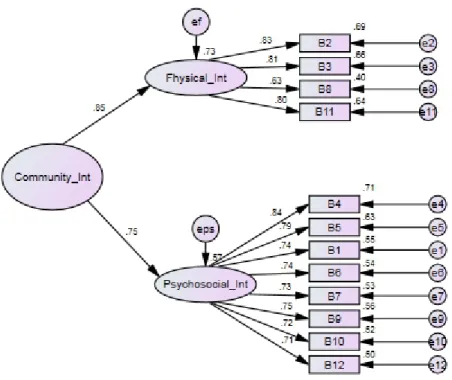
factor. The final model obtained was composed of 12 items divided into two dimensions, and a general higher order factor (Community Integration): one encompassing physical integration, comprising 4 items focusing on the extent to which individuals move and resource to community resources by their own initiative (e.g. “If necessary, I can run errands in public places, such as the bank, post office, supermarket, or others.”) and one encompassing the psychosocial integration dimension, composed of 8 items.
All items referring to the independence dimensions presented adjustment problems and their exclusion led to significant improvements in global model fit indices, suggesting that this construct may be of a different nature than the construct of community integration.
Item normality was assessed based on univariate and multivariate asymmetry (Sk<3) and kurtosis (|Ku|<10). All variables presented values of
Sk (|Sk|<3) and Ku (|Ku|<10), inferior to admissible values for normal
distribution (Kline, 2004). Five outliers were excluded based on the square of Mahalanobis Distance.
Composite reliability and AVE were calculated for the simplified model as described by Fornell & Larcker (1981). The CR values obtained for Physical integration and Psychosocial integration was adequate: 0.882 and 0.898, respectively. Convergence indicators were also adequate: AVE values (AVEPsysical_CI = 0.654 and AVEPsichoSocial_IC = 0.618 are above r2FP=0.218, and it is possible to state that both factors possess discriminant validity. After
analyzing and validating the 1st order model with 2 factors, and considering
the existence of significant correlations with residues between and within factors (Gerbing & Anderson, 1984), a higher order factor was tested (Figure 1). Figure 1 presents the values of the standardized factor loadings and individual reliability of each item in the model, while Figure 2 refers to items that presented higher values of the explained variance on their respective factors.
The final model showed an acceptable quality of global fit. All items in
the CIS-APP presented high factor loadings (λij ≥0.5) and adequate
individual reliability ((λij)2 ≥0.25). Values obtained for the adjustment indices RMSEA (0.06), CFI (0.87), GFI (0.85) e PCFI (0.71) are within the acceptable limits.
Figure 1. Confirmatory Factor Analysis, 2th order model with 2 factors (12 items)
Reliability and validity
Internal consistency for the final version of the scale revealed good reliability for the total scale (α = 0.88) and both subscales (Physical community integration, α = 0.82, and Psychosocial community integration, α = 0.89)
Convergent validity
Correlation coefficients between CIS-APP and the SCI version 2 were positive and moderate (r = 0.579; p < .001), as expected.
Discussion
The inexistence of assessment tools evaluating community integration of people with psychiatric problems has determined the main goal of this study. For this purpose, several procedures aiming at the development and validation of a new scale were adopted, in order to create a reliable and psychometrically sound measure to be used both in research and clinical settings.
The first version of the CIS-APP was composed of 28 items based on the current literature on the field. The reformulation and addition of new items were carried out with the aid of both patients and experts.
Confirmatory factor analysis of the 34-items version of the CIS-APP showed that several items in the scale did not adequately explain the assessed model. Considering the characteristics of the target population, only the items that best assessed the latent structure of the questionnaire were retained, in order to create a scale as brief and simple as possible.
The need for the elimination of items referring to the independence dimension led us to refute the suggestion by Gulgur et al. (2007), that independence may be a determinant aspect for the integration of people with similar characteristics of the participants in this study. This dimension consisted of several items assessing the individuals’ ability to perform their daily activities, one of the aspects commonly assessed in studies on community integration (Gulcur et al. 2007, cit. in Yanos, Felton, Tsemberis & Frye, 2007). However, current results suggested that these aspects of daily activities are not central to integration. This could be explained by the exclusion of institutionalized patients in the current study sample, which would present less independence and perhaps a distinct form of integration in the community (Leff & Warner, 2008). Nevertheless, it is important to take in consideration that, according to the World Health Report (WHO, 2002), the institutionalization of psychiatric patients is diminishing due to the predominance of treatments that favor the psychosocial development and independence of patients. The CFA analysis also did not reproduce entirely the expected latent structure according the multidimensional model of integration of Wong & Solomon (2002), in which scale construction was based. The interference of some items and residues in the first model has led to a poor quality of model fit, and have also revealed that the dimensions in the initial model were not independent. Therefore, the selected model included 2 factors (Physical and Psychosocial community integration) and a second order factor (Community integration). These aspects reinforce the perspective of several authors that have defined integration as a multidimensional construct, and not as completely distinct dimensions (Segal & Aviram, 1978. However, that model proposed by Wong & Solomon (2002) was based on other studies in the area that involved mostly psychiatric patients in protected settings (eg: Wong & Solomon, Gulcur, Tsemberis, Stefancic & Greenwood, 2007) or the eldery (eg: Abdallah et. al, 2009). To the best of our knowledge, this model has never been empirically tested in individuals with psychiatric problems living in community settings. This may explain why the current study did not fully confirm that model, and these outcomes may add relevant contributions to the refinement of community integration models and the conceptualizations of the construct.
In addition, the existence of high correlations between the items of Social and psychological dimensions has justified the emergence of a single factor (Psychosocial community integration). In accordance to the definitions
by Wong & Solomon (2002), in one hand, social integration refers mostly to aspects related to the characteristics of the relationships and interactions established with the members of a given community while, in the other hand, psychological integration refers to aspects related to the feelings and affects involved in these relationships (Aubry & Miner, 1996). Despite this distinction is possible on a theoretical level, both dimensions are closely related in realistic settings, because both refer to the interpersonal relationships that individuals establishes with other members of their community. Therefore, it would not be feasible to identify or isolate those factors as independent from one another in real-life contexts.
The Physical dimension, although brief, assesses the degree with which individuals with psychiatric problems take advantage of the available resources in their community (Eg: “I handle personal matters in several public entities, such as banks, post office, supermarket and others when necessary”). However, because items in this dimensions were deleted (E.g. “I participate in my community activities, such as doing volunteer work, helping with party or event arrangements, catechesis, social gatherings, and other” and “I reach for the resources and services offered by my community, such as employment centers, civil parish, “casas do povo” [common houses] and others if necessary.”), the degree of community participation and the degree with which individuals with psychiatric problems cease the community’s opportunities and resources could not be assessed as expected and pointed out as fundamental in the current literature (WHO, 2002, Wong & Solomon, 2002, Gulcur et. al,2007 & Salzer, 2005). Nevertheless, these aspects should be further explored in future studies, considering that empirical data did not provide full support to that model and the literature in the field. This may suggest the necessity of further refinements in the models and scales, or for more research providing consistent findings that can sustain the underlying theories of social integration of people with mental problems.
Further results on the associations between the CIS-APP and another measure assessing constructs related to community integration support the convergent validity of the scale. These results also demonstrates that, similarly the proposals by Townley & Kloos (2009), the feeling of community has a positive impact in community integration.
The limitations of the current study may be related to the specificity of the participants and small dimension of the sample used. Further studies should aim to obtain a more representative sample with different mental health problems and including institutionalized or individuals living in more protected settings. The context in which the study took place may also limit the generalization of our results, and further studies should try to include subjects from different areas (e.g. participants from continental territories).
In future studies, it would be also important to test the adequacy and adjust the long version of the scale in institutionalized and in the general population, in order to assess whether community integration may manifest differently across different populations.
In sum, the CIS-APP is a brief evaluation tool with adequate psychometric properties, and is one of the first instruments assessing community integration in individuals with several psychiatric problems living in the community and treated in outpatient settings. Since this area is still somewhat unexplored, the CIS-APP is of a major utility in further empirical studies on the integration of individuals with psychiatric problems and in the study of their recovery process. In addition, the questionnaire is applicable in a wide range of disciplinary areas (e.g. Community psychology, clinical psychology, social work, psychiatric medicine, and nursing) and also an important aid to all professionals involved in the treatment and intervention with psychiatric patients.
Conclusion
In this study, a new measure of community integration for psychiatric patients was developed (CIS-APP). Data analysis showed that the CIS-APP has adequate psychometric properties. Confirmatory Factor Analysis confirmed a two-factor model with a higher order factor, which does not completely confirm the theoretical model used in scale development. However, the model that emerged from this analysis has proven to be pertinent and well-adjusted to how the integration manifests itself in a sample of participants with specific characteristics. Results from this empirical study depicts how community integration is established in a group of psychiatric patients, bringing a relevant contribution to the refinement of the community integration model of people with psychiatric problems and pointing out new directions for future research. In future studies, it is relevant to take into consideration the aspects that may have influenced current results (ex: type and severity of pathology of the participants) and specificities from the community settings where participants belong.
References:
Ahern, L. & Fischer, D. (1999). Personal assistance in community existence: recovery at your own pace. Lawrence, MA: National Empowerment Center. Bond, G.R., Salyers, M. P., Rollins, A.L., Rapp, C.A. & Zipple, A.M. (2004). How Evidence-Based Practices Contribute to Community Integration. Community Mental Health Journal, 40 (6), 569-568.
Burns-Lynch, W., Salzer, M., & Baron, R.C. (2010). Managing Risk in Community Integration: Promoting the Dignity of Risk and Supporting
Personal Choice. Philadelphia, PA: Temple University Collaborative on Community Inclusion of Individuals with Psychiatric Disabilities.
Chavis, D.M., Lee, K.S. & Acosta J.D. (2008). The Sense of Community (SCI) Revised: The Reliability and Validity of the SCI-2. Paper presented at the 2nd International Community Psychology Conference, Lisboa, Portugal. Espinosa, A.F. (1998). Psiquiatria. Rio de Janeiro: McGraw-Hill.
Hernandez-Nieto, R. (2002). Contributions to statistical analysis. Mérida, Venezuela: LosAndes University Press.
Kline, R. B. (2011). Principles and practice of structural equation modeling (3rd ed). New York: The Gilford Press.
Leff, J. & Warner, R. (2008). Inclusão Social de Pessoas com Doenças
Mentais. Coimbra: Almedina.
Lieberman, J.A., Drake, R.E., Sederer, L.I., Belger, A., Keefe, R., Perkins, D. & Stroup, S. (2008). Science and recovery in schizophrenia. Psychiatric
services, 59(5), 487-496.
Macías, S. (2011). Cómo encontrar un lugar en el mundo: explorando experiencias de recuperación de personas con trastornos mentales graves.
História, Ciências, Saúde – Manguinhos, 18(1), 121-139.
Manderscheid, R.W., Ryff, C.D., Freeman, E.J., McKnight-Eily,L.R., Dhingra, S., Strine, T.W. (2010). Evolving definitions of mental Illness and wellness. Centers for Disease Control and Prevention, 7(1), 1-6.
Nelson, G., Lord, J., & Ochocka, J. (2001). Empowerment and mental health in community: Narratives of psychiatric consumer/survivors. Journal of Community & Applied Social Psy- chology, 11, 125–142.
Observatório da Língua Portuguesa. (2010). As 10 Línguas mais faladas no
Mundo. Retrieved from
http://observatorio-lp.sapo.pt/pt/dados-estatisticos/as-linguas-mais-faladas/10-linguas-mais-faladas-no-mundo Organização Mundial de Saúde. (2002). Relatório mundial da saúde, Saúde
mental: nova concepção, nova esperança (1º Ed.). Lisboa: Climepsi
Editores.
Racino, J. A. (1995). Community living for adults with developmental disabilities: A housing and support approach. Journal of the Association for
Persons With Severe Handicaps, 20(4), 300-310.
Rosenblatt, A., & Mayer, J. (1974). Recidivism of mental patients: A review of past studies. American Journal of Orthopsychiatry, 44, 697–706.
Ruiloba, J.V. (2002). Introducción a la psicopatología y la psiquiatría (5ª Ed.). Barcelona: Masson.
Salzer, M. (2005). Community integration as the roadmap to the road to recovery of people with psychiatric disabilities: Policy, practice and research implications. Presentation at the Rutgers University Institute for Health, Health Care Policy, and Aging Research, New Brunswick, NJ, 8 February 2005.
Segal, S. P., & Aviram, U. (1978). The mentally ill in community-based sheltered care: A study of community care and social integration. New York: John Wiley & Sons.
Wong, Y-L. I., Metzendorf, D. & Min, S. (2006). Neighborhood experiences and community integration: perspectives from mental health consumers and providers. Social Work in Mental Health, 4(3), 45-59.
Wong,Y-L. I., Matejkowski, J. & Lee, S. (2011). Social integration of people with serious mental illness: network transactions and satisfaction. The
Journal of Behavioral Health Services & Research, 38(1), 51-67.
Yanos, P.T., Felton, B.J., Tsemberis, S. & Frye, V.A. (2007). Exploring the role of housing type, neighborhood characteristics, and lifestyle factors in the community integration of formerly homeless persons diagnosed with mental illness. Journal of Mental Health,16(6), 703-717.