r -I t
CRITICAL EVALUATION OF RESTRICTIONS
USED TO OPTIMIZE STERILIZATION PROCESSING CONDITIONS
C. L. M. Silva & K. Korczak
A computer program, using a finite differences method, was developed to model the heat sterilization for cylindrical packaged conduction heating foods. This program was introduced into an optimizationroutineto calculate optimum processing conditions, maximizing the surface or the volume average quality, using different restrictions.
Depending on the pack dimensions and the heating rate of the product the least-lethalitypoint is at the geometric center or along the radius or the vertical axis. Therefore, sterility values specified at the center and at the least-Iethality point were used as sterility criteria for calculating optimum conditions. The effect of an integrated sterility value constraint on optimal temperaturewas also investigated. Depending on the product thermal properties, processing conditions and target lethality the optimum temperature calculated using the sterility value at the center as restriction can overestimatethe correet valueby as much as 4°C. INTRODUCTION
Container heat sterilization of conduction heating foods is based on the application of suitable time-temperature profiles to obtain commercially sterile products (Richardson
et.aI., 1988). An integrated sterility value or a sterility value at a single point are normally
used as constraints (Stumbo, 1973). Silva et. aI. (1993) stressed that the sterility value at the least-lethality point assures a minimum sterility in ali points of the food, therefore this is the most adequate criterion.
The geometric center is usually considered the least-Iethality point for a cylindrical package (Ball & Olson, 1957). This assumption is correct if only the heating phase is included in the calculation of the sterility value. Teixeira et. aI. (1969a) were the first to discuss the localization of this point. They concluded that the least-Iethality point is not always at the center and that the correet position depends on the container geometry and processing conditions. If the cooling phase is also taken into consideration for the sterility value calculation, the least-Iethality point appears along the radius or the vertical axis, depending on the half-height to radius ratio (Flambert & Deltour, 1972). The Flambert & Deltour (1972) research assumed no surface resistance to heat transfer. Reeent1y Silva & Korczak (1994) presented a similar study for the existence of surface resistance to heat transfer. They concluded that the processing temperature, target sterility and the kinetic pararneters for the microorganisms do not significant1yaffeet the location of the least-lethality point. However, the package dimensionsand the heating rate of the product (this variable also takes into consideration the surface heat transfer coefficient) have a great influence on the least-Iethalitypoint position.
Several research works on the theoretical calculationof optimal sterilization temperatures have been presented in the literature (Teixeira et. aI., 1969b, 1975; Thijssen et.al., 1978; Saguy & Karel, 1979; Ohlsson, 1980a,b; Tbijssen and Kochen, 1980; Nadkami & Hatton, 1985; Banga et.al., 1991). Silva et. aI. (1993) concluded, from a review on tbis research field, that the two optimization restrictions most commonly used are a target integrated sterility value, as defined by Stumbo (1973),or a sterility value specified at the geometric center of the cylindrical container. As it was explained above, neither of these two constraints is the most adequate. A target sterilityvalue specified at the least-Iethality
Escola Superior de Biotecnologia. Universidade Católica Portuguesa.Rua Df. António Bernardino de AImeida, 4200 Porto, Portugal
point is the most COITectcriterion, howeverthere is no research work on the calculation of optimal sterilization temperaturesusing it
Therefore the purpose of this research is a critical evaluation of the restrictions normally . used to optimize sterilization processingconditions.Optimal temperatures maximizing the surface or the volume average quality retentionwill be calculated using the three different criteria. The differences between optimal temperatures will be studied as a function of food properties, processing conditionsand target lethality.
THEORETICAL CONSIDERA TIONS
To optimize a sterilization process it is necessary to identify the des~gn variables and
tequirementsand definethe objectivefunction(Norback,1980). . ,
The design variable is the variable that can be controlled and is usually the heating
, medium temperatureprofIle.
The major requirement, or restriction, for optimizing heat stepliiatio~ p!ocesses is the . -"target lethality needed to obtain a safe product (Holdsworth, 1985). In g~era1 there are
two approaches to assess the impact of a process: i) a sierility value at the geometric center (Fe) or ii) an integrated sterility value (FS) representiIig the volume average survival of microorganisms (Stumbo, 1973):
(I) (M I Mo)c
=
10-Fc I D,cfm (2) ori
VT ASM=
-L 10<-F(V) I Drcfm)dV VT 11 (3) Fs=
Drefrn 10g(ASM) (4)The target microorganism is usually Clostridiumbotulinum, because it is one of the most lethal and more thermal resistant. The mean kinetic parameters for its inactivation are a z-value of 10°C and a D121.1°C z-value ofO.21 min (Pflug & Odlaug, 1978).
Another criterion, which is a target sterility value at the least-Iethality position (FL), has been proposed by Silva & Korczak (1994):
(5)
(M I Mok
=
10-FL/Drcfm (6)A target sterility value at the least-Iethalitypoint assures a minimum sterility in alI points of the food (Silva et. aI., 1993).
The most common objective functionused to optimize sterilization processing conditions is the maximization of the final quality retention. Depending on the quality factor under consideration, the optimization can be done in terms of maximizing surface or volume average quality. The first concept is of interest when optimizing appearance and aroma,
I I I I I
while the second one is a more suitable indicator for taste, consistency or nutrient retention (Ohlsson, 1980a). The COlTectmathematical expression of these two objective functions was critically evaluated by (Silva e/. aI., 1992):
i
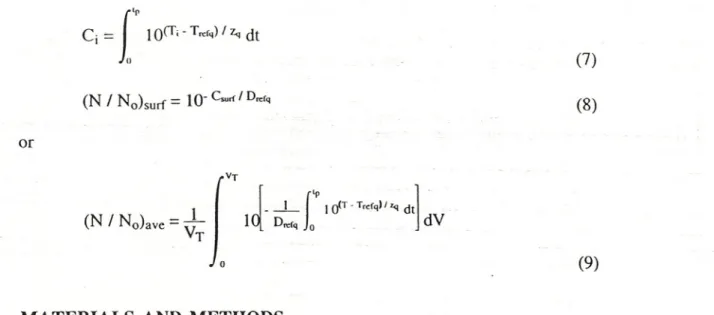
'P Cj = 1O(fi - Trcfq)I Zqdt li (7) (N I No)surf = 10- c...rf I Drcfq (8) or (9)MATERIALS AND METHODS
A computer program similar to the one presented by Silva e/.al. (1994) was developed to calculate the processing time, corresponding to a given sterilization temperature, for conduction heating products packaged in cylindrical containers. Three different types of restrictions (Equations 1, 3 and 5), as described in the theoretical considerations, were used. The cooling phase was taken into consideration in the lethality calculation. An explicit finite differences numerical method with non-capacitance surface nodes (Chau & Snyder, 1988) was used to describe the heat transfer into the food.
The model assumptions were: i) first order inactivation kinetics and expressed as a decimal reduction time Dref and a z - value, ii) heat transfer into the food was by pure conduction, iii) the food product was homogeneous and isotropic, iv) initial temperature of the food (To) was uniform, v) the heating medium time-temperature profile was a step function, with zero come-up-time, followed by instantaneous constant cooling temperature and vi) a constant and uniform surface overall heat transfer coefficient. This overall coefficient accounted for the packaging material (e.g. plastic) and heating medium thermal resistance.
To calculate optimal temperatures, the computer program was integrated in an optimization routine, using Davis, Swann and Campey method (Saguy, 1983), for minimum surface cook value or maximum volume average quality retention. Optimum holding temperature, Th, was calculated to within 0.01oCo
RESUL TS AND DISCUSSION
Study of the least-Iethality location
The least-lethality point position for a conduction heating product packaged in a finite cylinder container was studied as a function of different variables such as package <}.imensions,heating rate, surface heat transfer coefficient, heating medium temperature, target lethality and kinetic parameters for the microorganisms thermal inactivation kinetics (Silva & Korczak, 1994). The heating medium temperature, target lethality and kinetic parameters for the microorganisms thermal inactivation have no relevant effect on the least-lethality point location. The most important variables to determine this position are the package dimensions and the heating rate of the product (which takes into consideration the overall surface heat transfer coefficient).
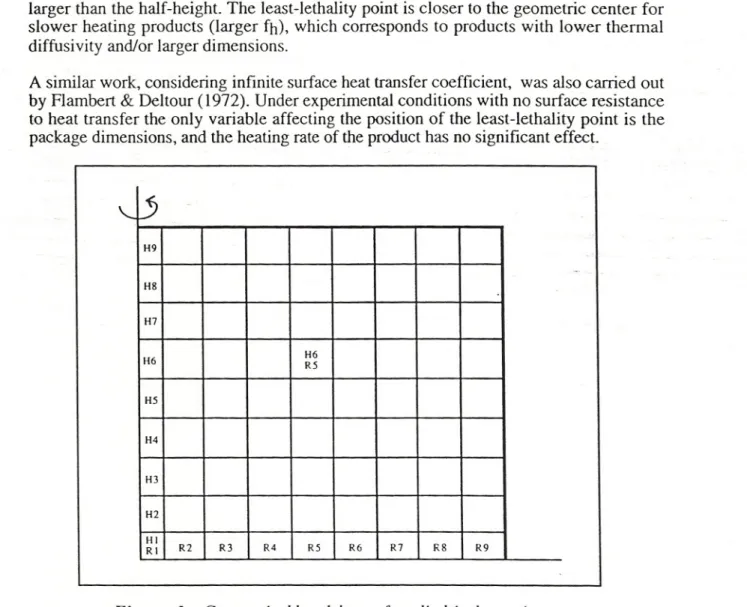
Table 1 presents the location of the least-lethality point (see Figure 1) as a function of dimensions and heating rate of the product when the surface heat transfer coefficient is equal to 10 W/m2/K. When the half-height to radius ratio is approximately equal to 0.9 the least-Iethality point position is at the center. This happens also when this ratio is very
I I
small (smaller than 0.1) or very large (larger than 4.0). When the half-height is smaller than the radius (O.1<HIR<O.9)the least-lethality point is located along the vertical axis. The least-lethality point is located along the radius (0.9<HIR<4.0) when the radius is larger than the half-height. The least-Iethality point is closer to the geometric center for slower heating products (larger fh), which corresponds to products with lower thermal diffusivity andlor larger dimensions.
A similar work, considering infinite surface heat transfer coefficient, was also carried out by Flambert & Deltour (1972). Under experimental conditions with no surface resistance to heat transfer the only variable affecting the position of the least-lethality point is the package dimensions, and the heating rate of the product has no significant effect.
Figure 1: Geometricalbreakdownof a cylindricalcontainer and identificationof the volume elements.
Effect of different restrictions on optimal sterilization temperatures
Optimal sterilization temperatures, maximizingthe volume average or the surface quality, using as restriction a target sterility value specified at the geometric center or at the least-lethality point were calculated for 14case studies (Table 2). Different surface heat transfer coefficients, heating rates of the product, package dimensions, target sterilities and kinetic parameters for the quality attribute were taken into consideration. These cases were based on the case study presented by Teixeira et.al. (1969b).
When there is no surface resistance to heat transfer the difference between optimal temperatures, using the two constraints, (Table 2) is negligible. However, when a finite surface heat transfer coefficient exists, the difference ranges from 0.5 to 3.6°C. This difference becomes more significant for case studies with larger Zqvalues. The difference between the two optimal temperatures, using as restriction a target sterility value at the geometric center or at the least-lethality point, for maximizing surface quality is smaller than the corresponding difference of temperatures for maximizing volume average quality. I I I I ! I .. .. H9 H8 H7 H6 H6RS HS H4 H3 H2 HI RI R2 R3 R4 RS R6 R7 R8 R9
.-{- \-" .. Table 1: Location of the least-lethality point, for a finite cylindrical container (see Figure 1), as a ~nction of dimensions and heating rate of the product. The surface heat transfer coefficient is equal to 10 W /m2/K. The target lethality was an ASM= 1x 10-12, Table 2: Optimal sterilization temperatures as a function of different variables, for maxirnizing volume average or surface quality, using as restriction a sterility value at the geometric center or at the least-Iethality point. (2) thermal diffusivity = 1.7 x 10.7 m2/s thermal conducúvity = 0.66 WlmlK fh P,I p.:l p,J p.4 p.) (min) '.6 P;I P,I5 ,,15) H/R ,\I IU,\I) , Il.u 11.1 11.:l 11.3 I"l IU'-1.4 lU ',NO , r:m-. .NIS ;;m 11.0 11.1 11.15 5-K2 11. \I /l,v ),fIO -,R4 ,K5 lU "v lU Ff.'!í -KO I I ,I1J :;m . "K4 -1\1 m r-',NO "HI i,Hí ,.H) ,1\1 ',K -;RI ,H:l . ;1<h "KI ,R7
:=m=
,K ,KO ',1\0 "lU> ,K7 ',KI ,K7 ;l{í . ',KO I , ,R5 1H4 ,K5 :;Jf4 'JVV lR7 iR! ,K. ,R5 1/14 IK'l 1/14 IK'l JIT ,Kl ,K ,R2 Case h fh(2) R H H/R Fo Drefq (g VI) Tnve Tnve Tape Tave Tsurt urL 11urf urf (W/m2/K) (m) (m) (min) o,e 0g,L o ,e -op,L o'?
op,e' op,L No. (min) (min) (0 ) (0 ) (0C) (0 ) (OC) .. 1.04365 .)57\15 , . .5 .. 1.0490 ,82 .. 1.0690 .86 .. 1.0980 .93 -. .. 1.0690 . , .. .0690 , ' .. ,0690 .0&40 0420 202. .U4:lU :lU:l. /lI least-let a,'" -..-,--....--To compare optimal temperatures using as a restriction an integrated sterility value (Equation 3) or a sterility value specifiedat the least-Iethalitypoiot, the two criteria values must be equivalent in terms of microorganism lethality. A few case studies were carried out and under these conditions there is not a significant difference between optimal temperatures.
ÇQNCLUSIONS
The most important variables affecting the position of the least-Iethal-ity point are the package dimensions, the heating rate of the product and the surface heat transfer coefficient. For 0.1<HIR<0.9 the least-lethality point is located along the vertical axis, 'and for 0.9<HIR<4.0 is located along the radius. When this ratio is smaller than 0.1,
larger than 4.0 or equal to 0.9 the least-Iethalitypoint is at the geometricceQte.r.
A target sterility value specified at the least-lethality point is the most adequate optimization criterion to use. Depending on the product thermal properties, processing
. cofiditionsand targetlethalitythe optimumsterilizationtemperaturecalculatedusing the
sterility value specified at the center as restrictioncan overestimate the correct value by as
müchas 40C. h
REFERENCES
Ball, C. O., & Olson, F.C.W. (1957). Sterilization in Food Technology, McGraw-Hill,
New- Y ork.
Banga, J.R., Perez-Martin, R.L, Gallardo, I.M., & Casares, J.J. (1991). Optimization of the thermal processing of conduction-heated canned foods : study of several objective functions. Joumal of Food Engineering, 14,25-51.
Chau, K.V., & Snyder, G.V. (1988). Mathematicalmodel for temperature distribution of thermally processed shrimp. Transactionsofthe ASAE, 31,608-612.
Flambert, F. & Deltour, J. (1972). Localizationof the critical area in thermally-processed conduction heated canned food. Lebensm.-Wiss. u. Technol., 5, 7-13.
Holdsworth, S.D. (1985). Optimisation of thermal processing
-
a review. Journal ofFood Engineering, 4, 89-116.
Norback, I.P. (1980). Techniques for optimization of food processes. Food Technology,2, 86-88.
Nadkami, M.M., & Hatton, T.A. (1985). Optimal nutrient retention during the thermal processing of conduction-heated canned foods : application of the distributed minimum principIe. Journal of Food Science, 50, 1312-1321.
Ohlsson, T. (1980a). Optimal sterilization temperatures for sensory quality in cylindrical containers. Joumal of Food Science, 45, 1517-1521.
Ohlsson, T. (1980b). Optimization ofheat sterilizationusing C-values. ln: Food Process
Engineering, P.137, Applied Science Publishers, U.K.
Pflug, 1.1.& Odlaug, T.E. (1978). A review of z and F values used to ensure the safety ofLow-acid canned foods. Food Technology, 6,63-70.
Richardson, P.S., Kelly, P.T., & Holdsworth, S.D. (1988). Optimisation of in-container sterilisation processes. lo: Progress in Food Preservation Processes~voI. 2, P.l, CERIA, Brussels, Belgium, ApriI12-14.
Saguy, I. (1983). Optimization of methods and applications. ln: Computer-aided
Techniques in Food Technology, L Saguy (Ed.), P.263, MareeI Dekker, New
York. .
Saguy, L, & Karel, M. (1979). Optimal retort temperature profile in optimizing thiamin retention in conduction-type heating of canned foods. Joumal of Food Science, 44,
1485-1490.
Silva, C.L.M. & Korczak, K. (1994). Systematic study of the surface heat transfer resistance effect on the least-lethality point position in heat sterilized prepackaged conduction heating foods
.
Submittedto Joumal of Food Engineering.Silva, C.L.M., Hendrickx, M., Oliveira, F. & Tobback, P. (1992). Critical evaluation of commonly used objectivefunCtiODSto optimizeoverall quality and nutrient retention of heat-preserved foods. Joumal of Food Engineering, 17,241-258.
Silva, C.L.M., Oliveira, F.A.R. & Hendrickx, M.(1993). Modelling optimum processing conditions for the sterilization of prepackaged foods. Food Control, 4, 67-78.
Silva, C.L.M., Oliveira, F.A.R. & Hendrickx, M. (1994). Quality optimization of conduction heating foods sterilized in different packages. lnternational Joumal. of
Food Science and Technology, in press.
Stumbo, C. (1973). ThemlObacteriology in Food Processing, 2nd ed., Academic Press, New York.
Teixeira, A.A., Dixon, l.R., Zahradnik, J.W. & Zinsmeister, O.E. (1969a). Computer determination of spore survival distributions in thermally-processed
conduction-" heated foods. Food Technology, 23, 78-80. . _ .
Teixeira, A.A., Dixon, 1.R., Zahiadnik, 1.W., & Zinsmeister, O.E. (1969b). Computer optimization of nutrient retention in the thermal processing of conduction-heated foods. Food Technology, 23, 137-142.
Teixeira, A.A., Zinsmeister, O.E., & Zahradnik, I.W. (1975). Computer simulation of .. variable retort control and container geometry as a possible means of improving thiamin retention in thermally processed foods. Journal of Food Science, 40,656-659.
Thijssen, H.A.C., & Kochen, L.H.P. (1980). Calculation of optimum sterilization conditions for packed conduction-type foods. Journal of Food Science, 45,
1267-1272.
Thijssen, H.A.C., Kerkhof, P.I.A.M., & Liefkens, A.A.A. (1978). Short-cut method for the calculation of sterilization conditions yielding optimum quality retention for conduction-type heating of packaged foods. Journal of Food Science, 43,
1096-1101.
NOMENCLATURE
ASM mass average survival of microorganisms C cook value (mio)
D decimal reduction (min)
fh heat penetration parameter
-
slope factor of a heating curve (min)F sterility value (min)
Fo sterility value at reference temperatureof 121.1°C and z-value of 10°C (min) F(V) sterility value in the volume elementdV (mio)
h surface heat transfer coefficient (WIm2/K) H half-height of the container (m)
(MIMo) survival of microorganisms
(NINo) quality retention
R radius of the container (m)
t time (mio)
T temperature(OC)
V volume (m3)
z z-value (0C)
Superscripts
ave volume average surf at the surface
Subscripts
ave volume average c at the geometriccenter h holding i at position i L at the least-Iethalitypoint m for microorganisms o initial op optimal Ilt
p q ref refrn refq S surf T total processing for quality factor referencetemperature
reference for microorganisms reference for quality factor integratedvalue
at the surface total