CERN-PH-EP/2012-096 2013/03/21
CMS-HIN-11-012
Azimuthal anisotropy of charged particles at high
transverse momenta in PbPb collisions at
√
s
NN= 2.76 TeV
The CMS Collaboration
∗Abstract
The azimuthal anisotropy of charged particles in PbPb collisions at√sNN = 2.76 TeV is measured with the CMS detector at the LHC over an extended transverse momen-tum (pT) range up to approximately 60 GeV/c. The data cover both the low-pTregion
associated with hydrodynamic flow phenomena and the high-pT region where the
anisotropies may reflect the path-length dependence of parton energy loss in the cre-ated medium. The anisotropy parameter (v2) of the particles is extracted by
correlat-ing charged tracks with respect to the event plane reconstructed uscorrelat-ing the energy de-posited in forward-angle calorimeters. For the six bins of collision centrality studied, spanning the range of 0-60% most-central events, the observed v2values are found to
first increase with pT, reaching a maximum around pT = 3 GeV/c and then to
gradu-ally decrease to almost zero, with the decline persisting up to at least pT = 40 GeV/c
over the full centrality range measured.
Submitted to Physical Review Letters
c
2013 CERN for the benefit of the CMS Collaboration. CC-BY-3.0 license
∗See Appendix A for the list of collaboration members
The experiments at the Relativistic Heavy Ion Collider (RHIC) have provided evidence for the formation of a strongly-coupled quantum chromodynamics (QCD) state of matter in ultra-relativistic nucleus-nucleus interactions [1–4]. The opaqueness of this matter to high-energy partons leads to a “jet quenching” phenomenon where the final-state particle yield at high transverse momentum (pT) is found suppressed compared to that expected from the scaling of
pp collision yields [1–6]. A large energy loss for partons traversing the dense QCD medium is also suggested by the recent observation of a large momentum imbalance of reconstructed back-to-back jets [7–9] in PbPb collisions at the Large Hadron Collider (LHC).
Despite the progress made on the theoretical description of jet quenching in the past decade [10], some of its key properties, such as the detailed path-length dependence of parton energy loss, remain unknown. In addition to measurements of hadron-yield suppression, observ-ables such as the azimuthal anisotropy of high-pThadrons are needed to differentiate between
the theoretical approaches [11–16]. The anisotropy can be characterized by the second-order Fourier harmonic coefficient (v2) in the azimuthal angle (φ) distribution of the hadron yield,
dN/dφ ∝ 1+2v2cos(2(φ−ΨPP)), where ΨPP is the event-by-event azimuthal angle of the
“participant plane.” In a non-central heavy-ion collision, the overlap region of the two collid-ing nuclei has a lenticular shape and the interactcollid-ing nucleons in this region are known as “par-ticipants.” The “participant plane” is defined by the beam direction and the short direction of the lenticular region. In general, the participant plane will not contain the reaction impact pa-rameter vector because of fluctuations that arise from having a finite number of nucleons. For high-pT particles, an azimuthal anisotropy can be induced if there is stronger suppression of
the hadron yield along the long axis than the short axis of the overlap region. The importance of jet-quenching measurements taking into account the jet orientation relative to the geometry of the interaction region was first demonstrated by the PHENIX experiment [17], where the azimuthal anisotropy of high-pT neutral pions (π0) was studied up to pT ≈18 GeV/c in AuAu
collisions at√sNN = 200 GeV.
This Letter presents a study of the azimuthal anisotropy extended to very high pT (up to
pT ≈ 60 GeV/c) for PbPb collisions at
√
sNN= 2.76 TeV at the LHC using the Compact Muon Solenoid (CMS) detector. The v2coefficient is determined as a function of charged particle pT
and overlap of the colliding nuclei (centrality) in the pseudorapidity regions of |η| < 1 and
1< |η| <2, where η = −ln[tan(θ/2)]and θ is the polar angle relative to the counterclockwise
beam direction. In the low momentum region (below a few GeV/c), v2 is generally associated
with hydrodynamic flow [18], as distinct from the jet energy-loss mechanism believed to dom-inate at high pT (e.g., above 10 GeV/c). Using a single-track high-level trigger, a significantly
larger event sample of high-pT tracks than previously available is obtained, providing the first
precise measurement of the v2 coefficient above 20 GeV/c in heavy-ion collisions. Our results
may impose quantitative constraints on models of the in-medium energy loss of high-pT
par-tons, particularly the influence of the path length and the shape of the interaction region on the energy loss.
The data used in this analysis correspond to an integrated luminosity of 150 µb−1 and were recorded during the 2011 LHC heavy-ion running period. A detailed description of the CMS detector can be found in Ref. [19]. Its central feature is a superconducting solenoid of 6 m internal diameter, providing a magnetic field of 3.8 T. Within the field volume are the sili-con pixel and strip tracker, the crystal electromagnetic calorimeter, and the brass/scintillator hadron calorimeter. In PbPb collisions, trajectories of charged particles with pT > 200 MeV/c
are reconstructed in the silicon tracker covering the pseudorapidity region |η| < 2.5, with
a track momentum resolution of about 1% at pT = 100 GeV/c. In addition, CMS has
calorimeters, which cover the pseudorapidity range 2.9 < |η| < 5.2. The HF calorimeters are
segmented into towers, each of which is a two-dimensional cell with a granularity of 0.5 unit in η and 0.349 rad in φ.
Minimum bias PbPb events were triggered by coincident signals from both ends of the detector in either the beam scintillator counters (BSC) at 3.23 < |η| < 4.65 or in the HF calorimeters.
Events due to noise, cosmic rays, out-of-time triggers, and beam backgrounds were suppressed by requiring a coincidence of the minimum bias trigger with bunches colliding in the interac-tion region. The trigger has an acceptance of(97±3)% for hadronic inelastic PbPb collisions. Because of hardware limits on the data acquisition rate, only a small fraction of all minimum bias triggered events were recorded. To maximize the event sample with high-pT particles
emitted in the PbPb collisions, a dedicated high-pTsingle-track trigger was implemented using
the CMS level-1 (L1) and high-level trigger system. The trajectories of charged particles from the silicon tracker were found online using a tracking algorithm identical to those employed in the offline track reconstruction, starting with a candidate from the three-layer silicon pixel tracker having pT > 11 GeV/c. For PbPb events with total transverse energy at L1 (L1 ETT)
above 100 GeV, a trigger efficiency of above 95% relative to offline reconstructed tracks was achieved for track pT greater than 12 GeV/c. For the events with L1 ETT less than 100 GeV,
an additional requirement of a calorimeter jet at L1 with pT > 16 GeV/c [8] was imposed in
order to reduce the detector readout rate. This resulted in an efficiency of about 75% starting at pT ≈ 12 GeV/c but increasing to almost 100% above pT ≈ 20 GeV/c. In this analysis, the
minimum bias data sample is used for the v2 measurement of tracks with 1< pT < 12 GeV/c
(also 12< pT <20 GeV/c for cross-check purpose), while the high-pTtrack triggered sample is
used in the range of pT >12 GeV/c.
Events are further selected offline by requiring energy deposits in at least three towers in each of the HF calorimeters, with at least 3 GeV of energy in each tower, and the presence of a re-constructed primary vertex containing at least two tracks. These criteria further reduce the background from single-beam interactions (e.g., beam-gas and beam-halo), cosmic muons, and large impact parameter, ultra peripheral collisions that lead to the electromagnetic breakup of one or both Pb nuclei [20]. The reconstructed primary vertex is required to be located within
±15 cm of the average vertex position along the beam axis and within a radius of 0.02 cm in the transverse plane. The centrality of the PbPb reaction is determined by taking fractions of the total hadronic inelastic cross section, according to percentiles of the distribution of the total energy deposited in the HF calorimeters [8]. The centrality classes used in this analysis are 0–10% (most central), 10–20%, 20–30%, 30–40%, 40–50%, and 50–60%, ordered from the highest to the lowest HF energy deposited.
The reconstruction of the primary event vertex and the trajectories of charged particles in PbPb collisions is based on signals in the silicon pixel and strip detectors and described in detail in Ref. [6]. In selecting the charged primary tracks, a set of tight quality selections were imposed to minimize the contamination from misidentified tracks. These include requirements of a rel-ative momentum uncertainty of less than 5%, at least 13 hits on the track, a normalized χ2for the track fit of less than 0.15 times the number of hits, and transverse and longitudinal track displacements from the primary vertex position less than three times the sum in quadrature of the measurement uncertainties. From studies based on PbPb events simulated usingHYD -JET[21] (version 1.6), the combined geometrical acceptance and reconstruction efficiency of the primary tracks reaches about 66% (50%) at|η| < 1.0 (1.0 < |η| <2.0) for the 5% most central
PbPb events, with little dependence on pT. For the peripheral PbPb events, the efficiency is
improved by up to 5%, again largely independent of pT. The fraction of misidentified tracks
in-creases up to 10% for very low pT (≈1 GeV/c) particles in the forward (|η| ≈ 2)region for the
5% most central PbPb events.
The analysis follows closely the event-plane method described in Ref. [22]. The observed v2
value for a given centrality and pT range is defined by vobs2 = hcos 2(φ−Ψ2)i, where the
average is taken over all particles in all events within a centrality and pT bin. The
second-order “event-plane” angleΨ2corresponds to the event-by-event azimuthal angle of maximum
particle density in PbPb collisions. It is an approximation of the participant-plane angle ΨPP,
which is not directly observable. The determination of Ψ2 uses the energy deposited in the
HF calorimeters with Ψ2 = 12tan−1 ∑
i
wisin(2φi)
∑
i
wicos(2φi), where the weight factor wi for the i
th tower at
azimuthal angle φi is taken as the corresponding transverse energy. The sums are taken over
all the towers within a slightly truncated η range of each HF calorimeter coverage. For the v2
study in this analysis, charged particles detected in the tracker with η > 0 (<0) are correlated with an event plane found using energy deposited in a region of the HF spanning−5<η< −3
(3<η< 5). In this manner, a minimum η gap of 3 units is guaranteed between particles used
in the event-plane determination and those for which the v2value is being measured, thereby
significantly reducing the effect of other correlations that might exist, such as that from dijets. This η gap is particularly important for the high-pT particle studies.
The resolution of the event plane depends on the centrality and is limited by the finite number of particles used in its determination. The final v2 coefficient in the event-plane method is
evaluated by dividing the observed value vobs
2 by a “resolution-correction” factor, R, with v2 =
vobs
2 /R and where R can range from 0 to 1 [23], with a better resolution corresponding to a
larger value of R. An event-averaged resolution correction factor can be found experimentally by extracting separate event-plane angles using particles emitted into three non-overlapping η regions. In this “three-sub-event” technique, which is described in more detail in Ref. [23], the resolution correction factor for a given η region (denoted A, with B and C used for the other two
ηranges) is found using RA =
r
hcos(2(ΨA
2−Ψ2B))ihcos(2(ΨA2−ΨC2))i
hcos(2(ΨB
2−ΨC2))i
. The averages are over all events corresponding to a given centrality bin. Reconstructed tracks with|η| < 0.8 and pT > 1 GeV/c
are used for the “third” η range (denoted C) introduced to determine the resolution of the event planes found using the HF detectors at −5 < η < −3 (denoted A) and 3 < η < 5
(denoted B). In the calculation of Ψ2C, the weight factor wi of the ith track at angle φi is taken
as the corresponding transverse momentum. The extracted R values for the HF event planes are found to vary between 0.55 and 0.84, reaching a maximum value for events in the 20–30% centrality bin. The difference in the resolution correction factors found for the two HF event planes is less than 1%.
The sensitivity of the deduced v2values to the size of the minimum η-gap is explored by
defin-ing additional event planes with different pseudorapidity ranges. Varydefin-ing the gap size from 3 to 4 units, the v2values are found to be consistent within±2.5% (central) or±10% (peripheral).
For all systematic studies, relative uncertainties to v2are quoted. The influence of misidentified
tracks is another source of systematic uncertainty at high pT. The v2 of misidentified tracks in
data is estimated using a very loose track selection. Taking the misidentified-track v2signal,
to-gether with the probability of reconstructing a fake track as determined from simulated events, the systematic uncertainty on the observed v2values is estimated to be±1–3%, depending on
pT and centrality. Potential biases of the events triggered by the high-pT track algorithm are
investigated. A comparison of v2 results for 12 < pT < 20 GeV/c obtained from minimum
bias and high-pT track triggered samples shows a variation of less than±1%. To account for
event-plane angle distribution and thereby also affect the deduced v2values, a Fourier-analysis-based
“flattening” procedure is used [23] where each calculated event-plane angle is shifted slightly to recover a uniform azimuthal distribution of angles [22]. Monte Carlo studies have shown that this flattening procedure fully corrects for non-uniformities in the CMS detector response. The overall systematic uncertainties associated with the event-plane flattening procedure and the resolution correction determination are found to be less than±1%. Additional uncertain-ties due to track-quality requirements are examined by loosening or tightening the selection criteria described previously and are found to be less than± 0.5%. The different systematic sources are added in quadrature to obtain the overall systematic uncertainty in v2.
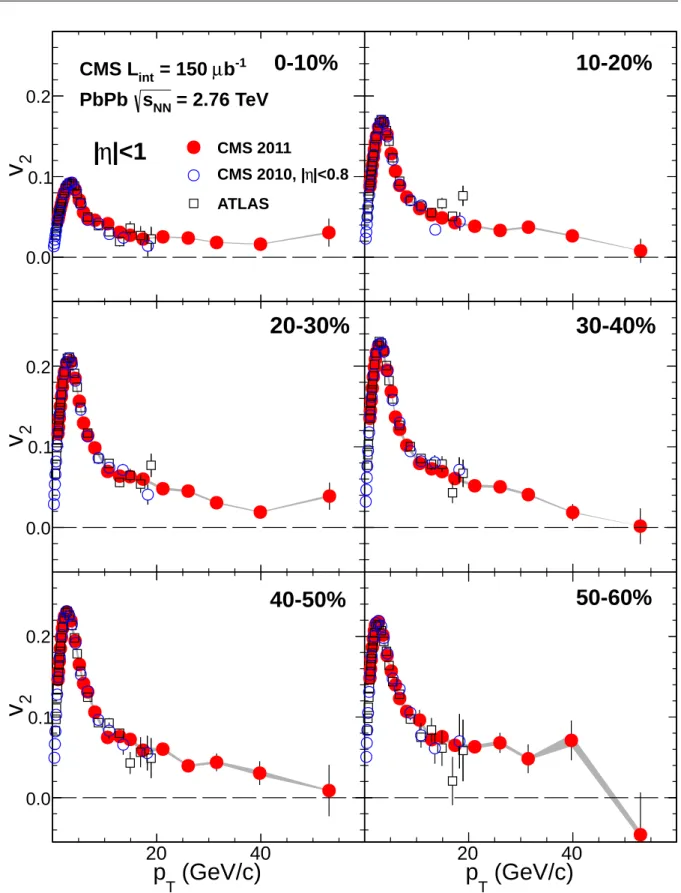
The results of v2, as a function of pT from 1 to 60 GeV/c for events with centralities ranging
from 0–10% (central) to 50–60% (peripheral), are presented in Fig. 1 for |η| < 1. The highest
pT bin covers a range from 48.0 to 60.8 GeV/c. The new CMS results in this paper significantly
extend the pT reach of v2 measurements previously achieved by the ALICE [24], ATLAS [25]
and CMS [22] collaborations. The CMS and ATLAS results based on event-plane analyses using forward calorimeters for the event-plane determination show agreement within 2–3% up to pT ≈20 GeV/c.
The pT-dependence of v2 shows a trend of rapid rise, reaching a maximum at pT ≈ 3 GeV/c,
followed by a dramatic decrease for pT values up to about 10 GeV/c. Beyond pT ≈ 10 GeV/c,
the v2 values show a much weaker dependence on pT and gradually decrease, but remain
larger than zero up to at least pT ≈40 GeV/c. The magnitude of v2 at high pT can probe the
path length (l) dependence of parton energy loss (∆E), ∆E ∼ lα [11–16]. At RHIC energies,
the π0 v2 data for pT ∼ 6–10 GeV/c support a scenario of α = 3 based on AdS/CFT
gravity-gauge dual modeling, while the pertabutive QCD calculations (α = 1 for collisional energy loss and α = 2 for radiative energy loss) seem to underpredict the data [17]. The v2 results
reported in this paper extends to a significantly wider pT regime, where particle production
is unambiguously dominated by parton fragmentation and energy-loss models are expected to be more applicable. The clear pT-dependence of v2 observed at the LHC energy suggests
that additional dynamical modeling of parton modification, particularly by incorporating the proper initial parton energy dependence, is required in order to further examine the path length dependence of energy loss (i.e., α parameter).
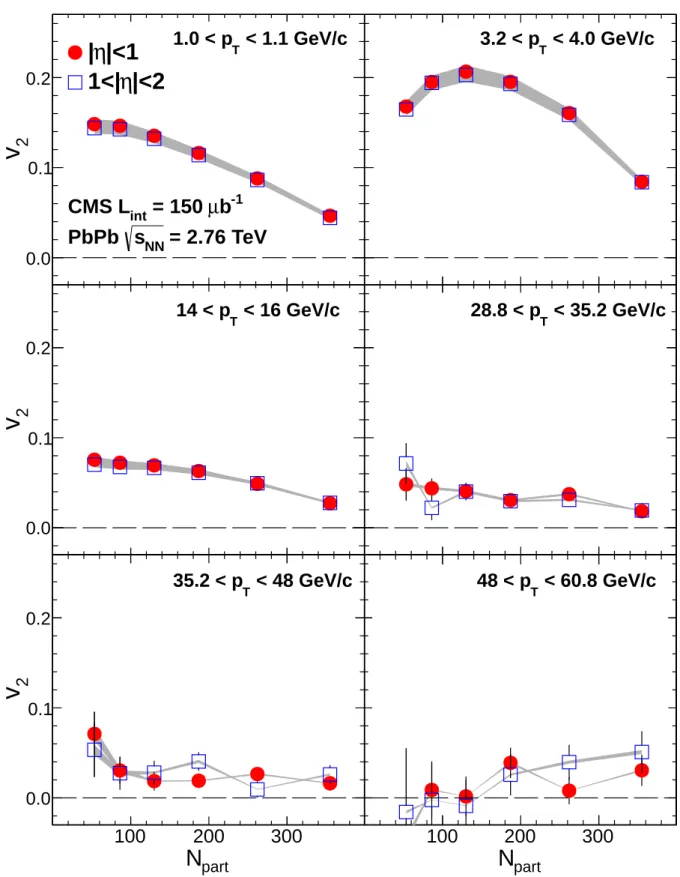
Figure 2 shows the v2 dependences on the number of participant nucleons (Npart) associated
with each centrality bin through a Glauber model calculation. The corresponding participant eccentricities of the the overlap region vary from 0.46 to 0.093. Different pT bins are shown for
two pseudorapidity ranges,|η| < 1 and 1 < |η| < 2. The results appear to be independent
of η in all pT bins within the statistical uncertainties. Also, the v2 values tend to decrease
with increasing collision centrality (i.e., larger Npart) over a wide pT range (although this trend
appears to be reversed for 3.2< pT <4.0 GeV/c toward very peripheral events). This behavior
is expected for low-pT(below a few GeV/c) particles in the context of the relationship between
hydrodynamic flow phenomena and the eccentricity of the initial-state collision geometry. The similar trend observed for very high-pT particles, at least up to pT ≈ 48 GeV/c, reflects how
the v2results at high pTare also sensitive to the initial geometry. This indicates that the initial
conditions of the hot QCD medium can be further constrained by simultaneously comparing data with theoretical calculations from both hydrodynamics at low pT and in-medium parton
energy loss at high pT.
In summary, the azimuthal anisotropy of charged particles with respect to the event plane has been studied in PbPb collisions at√sNN = 2.76 TeV using the CMS detector. The v2coefficient
colli-sion centrality. The results reported in this paper significantly improve the statistical precicolli-sion of previous v2measurements for 12 < pT < 20 GeV/c, and explore for the first time the very
high pTregion beyond 20 GeV/c. The v2(pT)behavior shows a trend of rapid rise to a maximum
at pT ≈3 GeV/c and a subsequent fall for all centrality and|η|ranges. Beyond pT ≈10 GeV/c,
the observed v2 values still show a clear pT dependence but with a more moderate decrease
with pT, remaining finite up to at least pT ≈ 40 GeV/c. A common trend in the centrality
de-pendence of v2is observed for particles over a wide range of pTup to approximately 48 GeV/c,
suggesting a potential connection to the initial-state geometry. The precision data over a wide kinematic range presented here will provide important constraints on models of parton energy loss, particularly in terms of its dependence on the initial conditions, parton energy and path length through the medium.
We wish to congratulate our colleagues in the CERN accelerator departments for the excellent performance of the LHC machine. We thank the technical and administrative staff at CERN and other CMS institutes, and acknowledge support from: FMSR (Austria); FNRS and FWO (Belgium); CNPq, CAPES, FAPERJ, and FAPESP (Brazil); MES (Bulgaria); CERN; CAS, MoST, and NSFC (China); COLCIENCIAS (Colombia); MSES (Croatia); RPF (Cyprus); Academy of Sciences and NICPB (Estonia); Academy of Finland, MEC, and HIP (Finland); CEA and CNRS/IN2P3 (France); BMBF, DFG, and HGF (Germany); GSRT (Greece); OTKA and NKTH (Hungary); DAE and DST (India); IPM (Iran); SFI (Ireland); INFN (Italy); NRF and WCU (Korea); LAS (Lithuania); CINVESTAV, CONACYT, SEP, and UASLP-FAI (Mexico); MSI (New Zealand); PAEC (Pakistan); SCSR (Poland); FCT (Portugal); JINR (Armenia, Belarus, Georgia, Ukraine, Uzbekistan); MON, RosAtom, RAS and RFBR (Russia); MSTD (Serbia); MICINN and CPAN (Spain); Swiss Funding Agencies (Switzerland); NSC (Taipei); TUBITAK and TAEK (Turkey); STFC (United Kingdom); DOE and NSF (USA).
References
[1] BRAHMS Collaboration, “Quark gluon plasma and color glass condensate at RHIC? The perspective from the BRAHMS experiment”, Nucl. Phys. A 757 (2005) 1,
doi:10.1016/j.nuclphysa.2005.02.130, arXiv:nucl-ex/0410020. [2] PHENIX Collaboration, “Formation of dense partonic matter in relativistic
nucleus-nucleus collisions at RHIC: Experimental evaluation by the PHENIX collaboration”, Nucl. Phys. A 757 (2005) 184,
doi:10.1016/j.nuclphysa.2005.03.086, arXiv:nucl-ex/0410003.
[3] PHOBOS Collaboration, “The PHOBOS perspective on discoveries at RHIC”, Nucl. Phys. A 757 (2005) 28, doi:10.1016/j.nuclphysa.2005.03.084,
arXiv:nucl-ex/0410022.
[4] STAR Collaboration, “Experimental and theoretical challenges in the search for the quark gluon plasma: The STAR Collaboration’s critical assessment of the evidence from RHIC collisions”, Nucl. Phys. A 757 (2005) 102,
doi:10.1016/j.nuclphysa.2005.03.085, arXiv:nucl-ex/0501009.
[5] ALICE Collaboration, “Suppression of Charged Particle Production at Large Transverse Momentum in Central Pb–Pb Collisions at√sNN = 2.76 TeV”, Phys. Lett. B 696 (2011) 30, doi:10.1016/j.physletb.2010.12.020, arXiv:1012.1004.
[6] CMS Collaboration, “Study of high-pTcharged particle suppression in PbPb compared to
[7] ATLAS Collaboration, “Observation of a Centrality-Dependent Dijet Asymmetry in Lead-Lead Collisions at√sNN = 2.76 TeV with the ATLAS Detector at the LHC”, Phys. Rev. Lett. 105 (2010) 252303, doi:10.1103/PhysRevLett.105.252303,
arXiv:1011.6182.
[8] CMS Collaboration, “Observation and studies of jet quenching in PbPb collisions at nucleon-nucleon center-of-mass energy = 2.76 TeV”, Phys. Rev. C 84 (2011) 024906, doi:10.1103/PhysRevC.84.024906, arXiv:1102.1957.
[9] CMS Collaboration, “Jet momentum dependence of jet quenching in PbPb collisions at√ s = 2.76 TeV”, (2012). arXiv:1202.5022. Submitted to Phys. Lett. B.
[10] A. Majumder and M. Van Leeuwen, “The Theory and Phenomenology of Perturbative QCD Based Jet Quenching”, Prog. Part. Nucl. Phys. A 66 (2011) 41,
doi:10.1016/j.ppnp.2010.09.001, arXiv:1002.2206.
[11] S. Peigne and A. V. Smilga, “Energy losses in a hot plasma revisited”, Phys. Usp. 52 (2009) 659, doi:10.3367/UFNe.0179.200907a.0697, arXiv:0810.5702. [12] S. Wicks et al., “Elastic, Inelastic, and Path Length Fluctuations in Jet Tomography”,
Nucl. Phys. A 784 (2007) 426, doi:10.1016/j.nuclphysa.2006.12.048, arXiv:nucl-th/0512076.
[13] J. Jia and R. Wei, “Dissecting the role of initial collision geometry for jet quenching observables in relativistic heavy ion collisions”, Phys. Rev. C 82 (2010) 024902, doi:10.1103/PhysRevC.82.024902, arXiv:1005.0645.
[14] J. Jia, W. Horowitz, and J. Liao, “A study of the correlations between jet quenching observables at RHIC”, Phys. Rev. C 84 (2011) 034904,
doi:10.1103/PhysRevC.84.034904, arXiv:1101.0290.
[15] T. Renk, “Pathlength dependence of energy loss within in-medium showers”, Phys. Rev. C 83 (2011) 024908, doi:10.1103/PhysRevC.83.024908, arXiv:1010.4116. [16] B. Betz, M. Gyulassy, and G. Torrieri, “Fourier Harmonics of High-pT Particles Probing
the Fluctuating Intitial Condition Geometries in Heavy-Ion Collisions”, Phys. Rev. C 84 (2011) 024913, doi:10.1103/PhysRevC.84.024913, arXiv:1102.5416.
[17] PHENIX Collaboration, “Azimuthal anisotropy of neutral pion production in Au+Au collisions at√sNN= 200 GeV: Path-length dependence of jet quenching and the role of initial geometry”, Phys. Rev. Lett. 105 (2010) 142301,
doi:10.1103/PhysRevLett.105.142301, arXiv:1006.3740.
[18] S. A. Voloshin, A. M. Poskanzer, and R. Snellings, “Collective phenomena in non-central nuclear collisions”, (2008). arXiv:0809.2949.
[19] CMS Collaboration, “The CMS experiment at the CERN LHC”, JINST 03 (2008) S08004, doi:10.1088/1748-0221/3/08/S08004.
[20] O. Djuvsland and J. Nystrand, “Single and Double Photonuclear Excitations in Pb+Pb Collisions at√sNN = 2.76 TeV at the CERN Large Hadron Collider”, Phys. Rev. C 83 (2011) 041901, doi:10.1103/PhysRevC.83.041901, arXiv:1011.4908.
[21] I. P. Lokhtin and A. M. Snigirev, “A model of jet quenching in ultrarelativistic heavy ion collisions and high-pThadron spectra at RHIC”, Eur. Phys. J. C 45 (2006) 211,
doi:10.1140/epjc/s2005-02426-3, arXiv:hep-ph/0506189.
[22] CMS Collaboration, “Measurement of the elliptic anisotropy of charged particles produced in PbPb collisions at nucleon-nucleon center-of-mass energy = 2.76 TeV”, (2012). arXiv:1204.1409. Submitted to Phys. Rev. C.
[23] A. M. Poskanzer and S. A. Voloshin, “Methods for analyzing anisotropic flow in relativistic nuclear collisions”, Phys. Rev. C 58 (1998) 1671,
doi:10.1103/PhysRevC.58.1671, arXiv:nucl-ex/9805001.
[24] ALICE Collaboration, “Elliptic flow of charged particles in Pb-Pb collisions at 2.76 TeV”, Phys. Rev. Lett. 105 (2010) 252302, arXiv:1011.3914.
[25] ATLAS Collaboration, “Measurement of the pseudorapidity and transverse momentum dependence of the elliptic flow of charged particles in lead-lead collisions at√sNN = 2.76 TeV with the ATLAS detector”, Phys. Lett. B 707 (2012) 330,
(GeV/c)
Tp
20
40
2v
0.0 0.1 0.2 CMS 2011 |<0.8 η CMS 2010, | ATLAS -1b
µ
= 150
intCMS L
= 2.76 TeV
NNs
PbPb
|<1
η
|
0-10%
(GeV/c)
Tp
20
40
2v
0.0 0.1 0.220-30%
(GeV/c)
Tp
20
40
2v
0.0 0.1 0.240-50%
(GeV/c)
Tp
20
40
2v
0.0 0.1 0.210-20%
(GeV/c)
Tp
20
40
2v
0.0 0.1 0.230-40%
(GeV/c)
Tp
20
40
2v
0.0 0.1 0.250-60%
Figure 1: The single-particle azimuthal anisotropy, v2, as a function of the charged particle
transverse momentum from 1 to 60 GeV/c with|η| < 1 for six centrality ranges in PbPb
colli-sions at√sNN = 2.76 TeV, measured by the CMS experiment (solid markers). Error bars denote the statistical uncertainties, while the grey bands correspond to the small systematic uncertain-ties. Comparison to results from the ATLAS (open squares) and CMS (open circles) experiments using data collected in 2010 is also shown.
part
N
100
200
300
2v
0.0 0.1 0.2 -1b
µ
= 150
intCMS L
= 2.76 TeV
NNs
PbPb
|<1
η
|
|<2
η
1<|
< 1.1 GeV/c
T1.0 < p
partN
100
200
300
2v
0.0 0.1 0.2< 16 GeV/c
T14 < p
partN
100
200
300
2v
0.0 0.1 0.2< 48 GeV/c
T35.2 < p
partN
100
200
300
2v
0.0 0.1 0.2< 4.0 GeV/c
T3.2 < p
partN
100
200
300
2v
0.0 0.1 0.2< 35.2 GeV/c
T28.8 < p
partN
100
200
300
2v
0.0 0.1 0.2< 60.8 GeV/c
T48 < p
Figure 2: The single-particle azimuthal anisotropy, v2, as a function of the number of
partic-ipating nucleons with |η| < 1 (solid circles) and 1 < |η| < 2 (open squares) for six selected
pT ranges in PbPb collisions at
√
sNN = 2.76 TeV, measured by the CMS experiment. Error bars denote the statistical uncertainties, while the grey bands correspond to the systematic uncer-tainties.
A
The CMS Collaboration
Yerevan Physics Institute, Yerevan, Armenia
S. Chatrchyan, V. Khachatryan, A.M. Sirunyan, A. Tumasyan
Institut f ¨ur Hochenergiephysik der OeAW, Wien, Austria
W. Adam, T. Bergauer, M. Dragicevic, J. Er ¨o, C. Fabjan, M. Friedl, R. Fr ¨uhwirth, V.M. Ghete, J. Hammer1, N. H ¨ormann, J. Hrubec, M. Jeitler, W. Kiesenhofer, M. Krammer, D. Liko, I. Mikulec, M. Pernicka†, B. Rahbaran, C. Rohringer, H. Rohringer, R. Sch ¨ofbeck, J. Strauss, A. Taurok, F. Teischinger, P. Wagner, W. Waltenberger, G. Walzel, E. Widl, C.-E. Wulz
National Centre for Particle and High Energy Physics, Minsk, Belarus
V. Mossolov, N. Shumeiko, J. Suarez Gonzalez
Universiteit Antwerpen, Antwerpen, Belgium
S. Bansal, K. Cerny, T. Cornelis, E.A. De Wolf, X. Janssen, S. Luyckx, T. Maes, L. Mucibello, S. Ochesanu, B. Roland, R. Rougny, M. Selvaggi, H. Van Haevermaet, P. Van Mechelen, N. Van Remortel, A. Van Spilbeeck
Vrije Universiteit Brussel, Brussel, Belgium
F. Blekman, S. Blyweert, J. D’Hondt, R. Gonzalez Suarez, A. Kalogeropoulos, M. Maes, A. Olbrechts, W. Van Doninck, P. Van Mulders, G.P. Van Onsem, I. Villella
Universit´e Libre de Bruxelles, Bruxelles, Belgium
O. Charaf, B. Clerbaux, G. De Lentdecker, V. Dero, A.P.R. Gay, T. Hreus, A. L´eonard, P.E. Marage, T. Reis, L. Thomas, C. Vander Velde, P. Vanlaer
Ghent University, Ghent, Belgium
V. Adler, K. Beernaert, A. Cimmino, S. Costantini, G. Garcia, M. Grunewald, B. Klein, J. Lellouch, A. Marinov, J. Mccartin, A.A. Ocampo Rios, D. Ryckbosch, N. Strobbe, F. Thyssen, M. Tytgat, L. Vanelderen, P. Verwilligen, S. Walsh, E. Yazgan, N. Zaganidis
Universit´e Catholique de Louvain, Louvain-la-Neuve, Belgium
S. Basegmez, G. Bruno, L. Ceard, C. Delaere, T. du Pree, D. Favart, L. Forthomme, A. Giammanco2, J. Hollar, V. Lemaitre, J. Liao, O. Militaru, C. Nuttens, D. Pagano, A. Pin, K. Piotrzkowski, N. Schul
Universit´e de Mons, Mons, Belgium
N. Beliy, T. Caebergs, E. Daubie, G.H. Hammad
Centro Brasileiro de Pesquisas Fisicas, Rio de Janeiro, Brazil
G.A. Alves, M. Correa Martins Junior, D. De Jesus Damiao, T. Martins, M.E. Pol, M.H.G. Souza
Universidade do Estado do Rio de Janeiro, Rio de Janeiro, Brazil
W.L. Ald´a J ´unior, W. Carvalho, A. Cust ´odio, E.M. Da Costa, C. De Oliveira Martins, S. Fonseca De Souza, D. Matos Figueiredo, L. Mundim, H. Nogima, V. Oguri, W.L. Prado Da Silva, A. Santoro, S.M. Silva Do Amaral, L. Soares Jorge, A. Sznajder
Instituto de Fisica Teorica, Universidade Estadual Paulista, Sao Paulo, Brazil
T.S. Anjos3, C.A. Bernardes3, F.A. Dias4, T.R. Fernandez Perez Tomei, E. M. Gregores3, C. Lagana, F. Marinho, P.G. Mercadante3, S.F. Novaes, Sandra S. Padula
Institute for Nuclear Research and Nuclear Energy, Sofia, Bulgaria
V. Genchev1, P. Iaydjiev1, S. Piperov, M. Rodozov, S. Stoykova, G. Sultanov, V. Tcholakov, R. Trayanov, M. Vutova
University of Sofia, Sofia, Bulgaria
A. Dimitrov, R. Hadjiiska, V. Kozhuharov, L. Litov, B. Pavlov, P. Petkov
Institute of High Energy Physics, Beijing, China
J.G. Bian, G.M. Chen, H.S. Chen, C.H. Jiang, D. Liang, S. Liang, X. Meng, J. Tao, J. Wang, J. Wang, X. Wang, Z. Wang, H. Xiao, M. Xu, J. Zang, Z. Zhang
State Key Lab. of Nucl. Phys. and Tech., Peking University, Beijing, China
C. Asawatangtrakuldee, Y. Ban, S. Guo, Y. Guo, W. Li, S. Liu, Y. Mao, S.J. Qian, H. Teng, S. Wang, B. Zhu, W. Zou
Universidad de Los Andes, Bogota, Colombia
C. Avila, B. Gomez Moreno, A.F. Osorio Oliveros, J.C. Sanabria
Technical University of Split, Split, Croatia
N. Godinovic, D. Lelas, R. Plestina5, D. Polic, I. Puljak1
University of Split, Split, Croatia
Z. Antunovic, M. Dzelalija, M. Kovac
Institute Rudjer Boskovic, Zagreb, Croatia
V. Brigljevic, S. Duric, K. Kadija, J. Luetic, S. Morovic
University of Cyprus, Nicosia, Cyprus
A. Attikis, M. Galanti, G. Mavromanolakis, J. Mousa, C. Nicolaou, F. Ptochos, P.A. Razis
Charles University, Prague, Czech Republic
M. Finger, M. Finger Jr.
Academy of Scientific Research and Technology of the Arab Republic of Egypt, Egyptian Network of High Energy Physics, Cairo, Egypt
Y. Assran6, S. Elgammal, A. Ellithi Kamel7, S. Khalil8, M.A. Mahmoud9, A. Radi8,10
National Institute of Chemical Physics and Biophysics, Tallinn, Estonia
M. Kadastik, M. M ¨untel, M. Raidal, L. Rebane, A. Tiko
Department of Physics, University of Helsinki, Helsinki, Finland
V. Azzolini, P. Eerola, G. Fedi, M. Voutilainen
Helsinki Institute of Physics, Helsinki, Finland
J. H¨ark ¨onen, A. Heikkinen, V. Karim¨aki, R. Kinnunen, M.J. Kortelainen, T. Lamp´en, K. Lassila-Perini, S. Lehti, T. Lind´en, P. Luukka, T. M¨aenp¨a¨a, T. Peltola, E. Tuominen, J. Tuominiemi, E. Tuovinen, D. Ungaro, L. Wendland
Lappeenranta University of Technology, Lappeenranta, Finland
K. Banzuzi, A. Korpela, T. Tuuva
DSM/IRFU, CEA/Saclay, Gif-sur-Yvette, France
M. Besancon, S. Choudhury, M. Dejardin, D. Denegri, B. Fabbro, J.L. Faure, F. Ferri, S. Ganjour, A. Givernaud, P. Gras, G. Hamel de Monchenault, P. Jarry, E. Locci, J. Malcles, L. Millischer, A. Nayak, J. Rander, A. Rosowsky, I. Shreyber, M. Titov
Laboratoire Leprince-Ringuet, Ecole Polytechnique, IN2P3-CNRS, Palaiseau, France
S. Baffioni, F. Beaudette, L. Benhabib, L. Bianchini, M. Bluj11, C. Broutin, P. Busson, C. Charlot, N. Daci, T. Dahms, L. Dobrzynski, R. Granier de Cassagnac, M. Haguenauer, P. Min´e, C. Mironov, C. Ochando, P. Paganini, D. Sabes, R. Salerno, Y. Sirois, C. Veelken, A. Zabi
Institut Pluridisciplinaire Hubert Curien, Universit´e de Strasbourg, Universit´e de Haute Alsace Mulhouse, CNRS/IN2P3, Strasbourg, France
J.-L. Agram12, J. Andrea, D. Bloch, D. Bodin, J.-M. Brom, M. Cardaci, E.C. Chabert, C. Collard, E. Conte12, F. Drouhin12, C. Ferro, J.-C. Fontaine12, D. Gel´e, U. Goerlach, P. Juillot, M. Karim12,
A.-C. Le Bihan, P. Van Hove
Centre de Calcul de l’Institut National de Physique Nucleaire et de Physique des Particules (IN2P3), Villeurbanne, France
F. Fassi, D. Mercier
Universit´e de Lyon, Universit´e Claude Bernard Lyon 1, CNRS-IN2P3, Institut de Physique Nucl´eaire de Lyon, Villeurbanne, France
S. Beauceron, N. Beaupere, O. Bondu, G. Boudoul, H. Brun, J. Chasserat, R. Chierici1, D. Contardo, P. Depasse, H. El Mamouni, J. Fay, S. Gascon, M. Gouzevitch, B. Ille, T. Kurca, M. Lethuillier, L. Mirabito, S. Perries, V. Sordini, S. Tosi, Y. Tschudi, P. Verdier, S. Viret
Institute of High Energy Physics and Informatization, Tbilisi State University, Tbilisi, Georgia
Z. Tsamalaidze13
RWTH Aachen University, I. Physikalisches Institut, Aachen, Germany
G. Anagnostou, S. Beranek, M. Edelhoff, L. Feld, N. Heracleous, O. Hindrichs, R. Jussen, K. Klein, J. Merz, A. Ostapchuk, A. Perieanu, F. Raupach, J. Sammet, S. Schael, D. Sprenger, H. Weber, B. Wittmer, V. Zhukov14
RWTH Aachen University, III. Physikalisches Institut A, Aachen, Germany
M. Ata, J. Caudron, E. Dietz-Laursonn, D. Duchardt, M. Erdmann, A. G ¨uth, T. Hebbeker, C. Heidemann, K. Hoepfner, T. Klimkovich, D. Klingebiel, P. Kreuzer, D. Lanske†, J. Lingemann, C. Magass, M. Merschmeyer, A. Meyer, M. Olschewski, P. Papacz, H. Pieta, H. Reithler, S.A. Schmitz, L. Sonnenschein, J. Steggemann, D. Teyssier, M. Weber
RWTH Aachen University, III. Physikalisches Institut B, Aachen, Germany
M. Bontenackels, V. Cherepanov, M. Davids, G. Fl ¨ugge, H. Geenen, M. Geisler, W. Haj Ahmad, F. Hoehle, B. Kargoll, T. Kress, Y. Kuessel, A. Linn, A. Nowack, L. Perchalla, O. Pooth, J. Rennefeld, P. Sauerland, A. Stahl
Deutsches Elektronen-Synchrotron, Hamburg, Germany
M. Aldaya Martin, J. Behr, W. Behrenhoff, U. Behrens, M. Bergholz15, A. Bethani, K. Borras, A. Burgmeier, A. Cakir, L. Calligaris, A. Campbell, E. Castro, F. Costanza, D. Dammann, G. Eckerlin, D. Eckstein, D. Fischer, G. Flucke, A. Geiser, I. Glushkov, S. Habib, J. Hauk, H. Jung1, M. Kasemann, P. Katsas, C. Kleinwort, H. Kluge, A. Knutsson, M. Kr¨amer, D. Kr ¨ucker, E. Kuznetsova, W. Lange, W. Lohmann15, B. Lutz, R. Mankel, I. Marfin, M. Marienfeld, I.-A. Melzer-Pellmann, A.B. Meyer, J. Mnich, A. Mussgiller, S. Naumann-Emme, J. Olzem, H. Perrey, A. Petrukhin, D. Pitzl, A. Raspereza, P.M. Ribeiro Cipriano, C. Riedl, M. Rosin, J. Salfeld-Nebgen, R. Schmidt15, T. Schoerner-Sadenius, N. Sen, A. Spiridonov, M. Stein, R. Walsh, C. Wissing
University of Hamburg, Hamburg, Germany
C. Autermann, V. Blobel, S. Bobrovskyi, J. Draeger, H. Enderle, J. Erfle, U. Gebbert, M. G ¨orner, T. Hermanns, R.S. H ¨oing, K. Kaschube, G. Kaussen, H. Kirschenmann, R. Klanner, J. Lange, B. Mura, F. Nowak, N. Pietsch, D. Rathjens, C. Sander, H. Schettler, P. Schleper, E. Schlieckau, A. Schmidt, M. Schr ¨oder, T. Schum, M. Seidel, H. Stadie, G. Steinbr ¨uck, J. Thomsen
Institut f ¨ur Experimentelle Kernphysik, Karlsruhe, Germany
C. Barth, J. Berger, T. Chwalek, W. De Boer, A. Dierlamm, M. Feindt, M. Guthoff1, C. Hackstein, F. Hartmann, M. Heinrich, H. Held, K.H. Hoffmann, S. Honc, U. Husemann, I. Katkov14, J.R. Komaragiri, D. Martschei, S. Mueller, Th. M ¨uller, M. Niegel, A. N ¨urnberg, O. Oberst, A. Oehler, J. Ott, T. Peiffer, G. Quast, K. Rabbertz, F. Ratnikov, N. Ratnikova, S. R ¨ocker, C. Saout, A. Scheurer, F.-P. Schilling, M. Schmanau, G. Schott, H.J. Simonis, F.M. Stober, D. Troendle, R. Ulrich, J. Wagner-Kuhr, T. Weiler, M. Zeise, E.B. Ziebarth
Institute of Nuclear Physics ”Demokritos”, Aghia Paraskevi, Greece
G. Daskalakis, T. Geralis, S. Kesisoglou, A. Kyriakis, D. Loukas, I. Manolakos, A. Markou, C. Markou, C. Mavrommatis, E. Ntomari
University of Athens, Athens, Greece
L. Gouskos, T.J. Mertzimekis, A. Panagiotou, N. Saoulidou
University of Io´annina, Io´annina, Greece
I. Evangelou, C. Foudas1, P. Kokkas, N. Manthos, I. Papadopoulos, V. Patras
KFKI Research Institute for Particle and Nuclear Physics, Budapest, Hungary
G. Bencze, C. Hajdu1, P. Hidas, D. Horvath16, K. Krajczar17, B. Radics, F. Sikler1, V. Veszpremi,
G. Vesztergombi17
Institute of Nuclear Research ATOMKI, Debrecen, Hungary
N. Beni, S. Czellar, J. Molnar, J. Palinkas, Z. Szillasi
University of Debrecen, Debrecen, Hungary
J. Karancsi, P. Raics, Z.L. Trocsanyi, B. Ujvari
Panjab University, Chandigarh, India
S.B. Beri, V. Bhatnagar, N. Dhingra, R. Gupta, M. Jindal, M. Kaur, J.M. Kohli, M.Z. Mehta, N. Nishu, L.K. Saini, A. Sharma, J. Singh, S.P. Singh
University of Delhi, Delhi, India
S. Ahuja, B.C. Choudhary, A. Kumar, A. Kumar, S. Malhotra, M. Naimuddin, K. Ranjan, V. Sharma, R.K. Shivpuri
Saha Institute of Nuclear Physics, Kolkata, India
S. Banerjee, S. Bhattacharya, S. Dutta, B. Gomber, Sa. Jain, Sh. Jain, R. Khurana, S. Sarkar
Bhabha Atomic Research Centre, Mumbai, India
A. Abdulsalam, R.K. Choudhury, D. Dutta, S. Kailas, V. Kumar, A.K. Mohanty1, L.M. Pant, P. Shukla
Tata Institute of Fundamental Research - EHEP, Mumbai, India
T. Aziz, S. Ganguly, M. Guchait18, A. Gurtu19, M. Maity20, G. Majumder, K. Mazumdar, G.B. Mohanty, B. Parida, K. Sudhakar, N. Wickramage
Tata Institute of Fundamental Research - HECR, Mumbai, India
S. Banerjee, S. Dugad
Institute for Research in Fundamental Sciences (IPM), Tehran, Iran
H. Arfaei, H. Bakhshiansohi21, S.M. Etesami22, A. Fahim21, M. Hashemi, H. Hesari, A. Jafari21, M. Khakzad, A. Mohammadi23, M. Mohammadi Najafabadi, S. Paktinat Mehdiabadi, B. Safarzadeh24, M. Zeinali22
INFN Sezione di Baria, Universit`a di Barib, Politecnico di Baric, Bari, Italy
M. Abbresciaa,b, L. Barbonea,b, C. Calabriaa,b,1, S.S. Chhibraa,b, A. Colaleoa, D. Creanzaa,c, N. De Filippisa,c,1, M. De Palmaa,b, L. Fiorea, G. Iasellia,c, L. Lusitoa,b, G. Maggia,c, M. Maggia, B. Marangellia,b, S. Mya,c, S. Nuzzoa,b, N. Pacificoa,b, A. Pompilia,b, G. Pugliesea,c,
G. Selvaggia,b, L. Silvestrisa, G. Singha,b, G. Zitoa
INFN Sezione di Bolognaa, Universit`a di Bolognab, Bologna, Italy
G. Abbiendia, A.C. Benvenutia, D. Bonacorsia,b, S. Braibant-Giacomellia,b, L. Brigliadoria,b, P. Capiluppia,b, A. Castroa,b, F.R. Cavalloa, M. Cuffiania,b, G.M. Dallavallea, F. Fabbria, A. Fanfania,b, D. Fasanellaa,b,1, P. Giacomellia, C. Grandia, L. Guiducci, S. Marcellinia, G. Masettia, M. Meneghellia,b,1, A. Montanaria, F.L. Navarriaa,b, F. Odoricia, A. Perrottaa, F. Primaveraa,b, A.M. Rossia,b, T. Rovellia,b, G. Sirolia,b, R. Travaglinia,b
INFN Sezione di Cataniaa, Universit`a di Cataniab, Catania, Italy
S. Albergoa,b, G. Cappelloa,b, M. Chiorbolia,b, S. Costaa,b, R. Potenzaa,b, A. Tricomia,b, C. Tuvea,b
INFN Sezione di Firenzea, Universit`a di Firenzeb, Firenze, Italy
G. Barbaglia, V. Ciullia,b, C. Civininia, R. D’Alessandroa,b, E. Focardia,b, S. Frosalia,b, E. Galloa, S. Gonzia,b, M. Meschinia, S. Paolettia, G. Sguazzonia, A. Tropianoa,1
INFN Laboratori Nazionali di Frascati, Frascati, Italy
L. Benussi, S. Bianco, S. Colafranceschi25, F. Fabbri, D. Piccolo
INFN Sezione di Genova, Genova, Italy
P. Fabbricatore, R. Musenich
INFN Sezione di Milano-Bicoccaa, Universit`a di Milano-Bicoccab, Milano, Italy
A. Benagliaa,b,1, F. De Guioa,b, L. Di Matteoa,b,1, S. Fiorendia,b, S. Gennaia,1, A. Ghezzia,b, S. Malvezzia, R.A. Manzonia,b, A. Martellia,b, A. Massironia,b,1, D. Menascea, L. Moronia, M. Paganonia,b, D. Pedrinia, S. Ragazzia,b, N. Redaellia, S. Salaa, T. Tabarelli de Fatisa,b
INFN Sezione di Napolia, Universit`a di Napoli ”Federico II”b, Napoli, Italy
S. Buontempoa, C.A. Carrillo Montoyaa,1, N. Cavalloa,26, A. De Cosaa,b, O. Doganguna,b, F. Fabozzia,26, A.O.M. Iorioa,1, L. Listaa, S. Meolaa,27, M. Merolaa,b, P. Paoluccia
INFN Sezione di Padovaa, Universit`a di Padovab, Universit`a di Trento (Trento)c, Padova, Italy
P. Azzia, N. Bacchettaa,1, D. Biselloa,b, A. Brancaa,1, R. Carlina,b, P. Checchiaa, T. Dorigoa, U. Dossellia, F. Gasparinia,b, A. Gozzelinoa, K. Kanishcheva,c, S. Lacapraraa, I. Lazzizzeraa,c, M. Margonia,b, A.T. Meneguzzoa,b, M. Nespoloa,1, L. Perrozzia, N. Pozzobona,b, P. Ronchesea,b, F. Simonettoa,b, E. Torassaa, M. Tosia,b,1, S. Vaninia,b, P. Zottoa,b, G. Zumerlea,b
INFN Sezione di Paviaa, Universit`a di Paviab, Pavia, Italy
M. Gabusia,b, S.P. Rattia,b, C. Riccardia,b, P. Torrea,b, P. Vituloa,b
INFN Sezione di Perugiaa, Universit`a di Perugiab, Perugia, Italy
G.M. Bileia, L. Fan `oa,b, P. Laricciaa,b, A. Lucaronia,b,1, G. Mantovania,b, M. Menichellia, A. Nappia,b, F. Romeoa,b, A. Saha, A. Santocchiaa,b, S. Taronia,b,1
INFN Sezione di Pisaa, Universit`a di Pisab, Scuola Normale Superiore di Pisac, Pisa, Italy
P. Azzurria,c, G. Bagliesia, T. Boccalia, G. Broccoloa,c, R. Castaldia, R.T. D’Agnoloa,c, R. Dell’Orsoa, F. Fioria,b,1, L. Fo`aa,c, A. Giassia, A. Kraana, F. Ligabuea,c, T. Lomtadzea, L. Martinia,28, A. Messineoa,b, F. Pallaa, F. Palmonaria, A. Rizzia,b, A.T. Serbana,29, P. Spagnoloa, P. Squillacioti1, R. Tenchinia, G. Tonellia,b,1, A. Venturia,1, P.G. Verdinia
INFN Sezione di Romaa, Universit`a di Roma ”La Sapienza”b, Roma, Italy
L. Baronea,b, F. Cavallaria, D. Del Rea,b,1, M. Diemoza, C. Fanellia,b, M. Grassia,1, E. Longoa,b, P. Meridiania,1, F. Michelia,b, S. Nourbakhsha, G. Organtinia,b, F. Pandolfia,b, R. Paramattia, S. Rahatloua,b, M. Sigamania, L. Soffia,b
INFN Sezione di Torino a, Universit`a di Torino b, Universit`a del Piemonte Orientale (No-vara)c, Torino, Italy
N. Amapanea,b, R. Arcidiaconoa,c, S. Argiroa,b, M. Arneodoa,c, C. Biinoa, C. Bottaa,b, N. Cartigliaa, R. Castelloa,b, M. Costaa,b, N. Demariaa, A. Grazianoa,b, C. Mariottia,1, S. Masellia, E. Migliorea,b, V. Monacoa,b, M. Musicha,1, M.M. Obertinoa,c, N. Pastronea, M. Pelliccionia, A. Potenzaa,b, A. Romeroa,b, M. Ruspaa,c, R. Sacchia,b, V. Solaa,b, A. Solanoa,b, A. Staianoa, A. Vilela Pereiraa
INFN Sezione di Triestea, Universit`a di Triesteb, Trieste, Italy
S. Belfortea, F. Cossuttia, G. Della Riccaa,b, B. Gobboa, M. Maronea,b,1, D. Montaninoa,b,1, A. Penzoa, A. Schizzia,b
Kangwon National University, Chunchon, Korea
S.G. Heo, T.Y. Kim, S.K. Nam
Kyungpook National University, Daegu, Korea
S. Chang, J. Chung, D.H. Kim, G.N. Kim, D.J. Kong, H. Park, S.R. Ro, D.C. Son, T. Son
Chonnam National University, Institute for Universe and Elementary Particles, Kwangju, Korea
J.Y. Kim, Zero J. Kim, S. Song
Konkuk University, Seoul, Korea
H.Y. Jo
Korea University, Seoul, Korea
S. Choi, D. Gyun, B. Hong, M. Jo, H. Kim, T.J. Kim, K.S. Lee, D.H. Moon, S.K. Park, E. Seo
University of Seoul, Seoul, Korea
M. Choi, S. Kang, H. Kim, J.H. Kim, C. Park, I.C. Park, S. Park, G. Ryu
Sungkyunkwan University, Suwon, Korea
Y. Cho, Y. Choi, Y.K. Choi, J. Goh, M.S. Kim, E. Kwon, B. Lee, J. Lee, S. Lee, H. Seo, I. Yu
Vilnius University, Vilnius, Lithuania
M.J. Bilinskas, I. Grigelionis, M. Janulis, A. Juodagalvis
Centro de Investigacion y de Estudios Avanzados del IPN, Mexico City, Mexico
H. Castilla-Valdez, E. De La Cruz-Burelo, I. Heredia-de La Cruz, R. Lopez-Fernandez, R. Maga ˜na Villalba, J. Mart´ınez-Ortega, A. S´anchez-Hern´andez, L.M. Villasenor-Cendejas
Universidad Iberoamericana, Mexico City, Mexico
S. Carrillo Moreno, F. Vazquez Valencia
Benemerita Universidad Autonoma de Puebla, Puebla, Mexico
H.A. Salazar Ibarguen
Universidad Aut ´onoma de San Luis Potos´ı, San Luis Potos´ı, Mexico
E. Casimiro Linares, A. Morelos Pineda, M.A. Reyes-Santos
University of Auckland, Auckland, New Zealand
University of Canterbury, Christchurch, New Zealand
A.J. Bell, P.H. Butler, R. Doesburg, S. Reucroft, H. Silverwood
National Centre for Physics, Quaid-I-Azam University, Islamabad, Pakistan
M. Ahmad, M.I. Asghar, H.R. Hoorani, S. Khalid, W.A. Khan, T. Khurshid, S. Qazi, M.A. Shah, M. Shoaib
Institute of Experimental Physics, Faculty of Physics, University of Warsaw, Warsaw, Poland
G. Brona, K. Bunkowski, M. Cwiok, W. Dominik, K. Doroba, A. Kalinowski, M. Konecki, J. Krolikowski
Soltan Institute for Nuclear Studies, Warsaw, Poland
H. Bialkowska, B. Boimska, T. Frueboes, R. Gokieli, M. G ´orski, M. Kazana, K. Nawrocki, K. Romanowska-Rybinska, M. Szleper, G. Wrochna, P. Zalewski
Laborat ´orio de Instrumenta¸c˜ao e F´ısica Experimental de Part´ıculas, Lisboa, Portugal
N. Almeida, P. Bargassa, A. David, P. Faccioli, P.G. Ferreira Parracho, M. Gallinaro, P. Musella, J. Seixas, J. Varela, P. Vischia
Joint Institute for Nuclear Research, Dubna, Russia
S. Afanasiev, I. Belotelov, P. Bunin, M. Gavrilenko, I. Golutvin, A. Kamenev, V. Karjavin, G. Kozlov, A. Lanev, A. Malakhov, P. Moisenz, V. Palichik, V. Perelygin, S. Shmatov, V. Smirnov, A. Volodko, A. Zarubin
Petersburg Nuclear Physics Institute, Gatchina (St Petersburg), Russia
S. Evstyukhin, V. Golovtsov, Y. Ivanov, V. Kim, P. Levchenko, V. Murzin, V. Oreshkin, I. Smirnov, V. Sulimov, L. Uvarov, S. Vavilov, A. Vorobyev, An. Vorobyev
Institute for Nuclear Research, Moscow, Russia
Yu. Andreev, A. Dermenev, S. Gninenko, N. Golubev, M. Kirsanov, N. Krasnikov, V. Matveev, A. Pashenkov, D. Tlisov, A. Toropin
Institute for Theoretical and Experimental Physics, Moscow, Russia
V. Epshteyn, M. Erofeeva, V. Gavrilov, M. Kossov1, N. Lychkovskaya, V. Popov, G. Safronov,
S. Semenov, V. Stolin, E. Vlasov, A. Zhokin
Moscow State University, Moscow, Russia
A. Belyaev, E. Boos, A. Ershov, A. Gribushin, V. Klyukhin, O. Kodolova, V. Korotkikh, I. Lokhtin, A. Markina, S. Obraztsov, M. Perfilov, S. Petrushanko, L. Sarycheva†, V. Savrin, A. Snigirev, I. Vardanyan
P.N. Lebedev Physical Institute, Moscow, Russia
V. Andreev, M. Azarkin, I. Dremin, M. Kirakosyan, A. Leonidov, G. Mesyats, S.V. Rusakov, A. Vinogradov
State Research Center of Russian Federation, Institute for High Energy Physics, Protvino, Russia
I. Azhgirey, I. Bayshev, S. Bitioukov, V. Grishin1, V. Kachanov, D. Konstantinov, A. Korablev, V. Krychkine, V. Petrov, R. Ryutin, A. Sobol, L. Tourtchanovitch, S. Troshin, N. Tyurin, A. Uzunian, A. Volkov
University of Belgrade, Faculty of Physics and Vinca Institute of Nuclear Sciences, Belgrade, Serbia
Centro de Investigaciones Energ´eticas Medioambientales y Tecnol ´ogicas (CIEMAT), Madrid, Spain
M. Aguilar-Benitez, J. Alcaraz Maestre, P. Arce, C. Battilana, E. Calvo, M. Cerrada, M. Chamizo Llatas, N. Colino, B. De La Cruz, A. Delgado Peris, C. Diez Pardos, D. Dom´ınguez V´azquez, C. Fernandez Bedoya, J.P. Fern´andez Ramos, A. Ferrando, J. Flix, M.C. Fouz, P. Garcia-Abia, O. Gonzalez Lopez, S. Goy Lopez, J.M. Hernandez, M.I. Josa, G. Merino, J. Puerta Pelayo, I. Redondo, L. Romero, J. Santaolalla, M.S. Soares, C. Willmott
Universidad Aut ´onoma de Madrid, Madrid, Spain
C. Albajar, G. Codispoti, J.F. de Troc ´oniz
Universidad de Oviedo, Oviedo, Spain
J. Cuevas, J. Fernandez Menendez, S. Folgueras, I. Gonzalez Caballero, L. Lloret Iglesias, J. Piedra Gomez31, J.M. Vizan Garcia
Instituto de F´ısica de Cantabria (IFCA), CSIC-Universidad de Cantabria, Santander, Spain
J.A. Brochero Cifuentes, I.J. Cabrillo, A. Calderon, S.H. Chuang, J. Duarte Campderros, M. Felcini32, M. Fernandez, G. Gomez, J. Gonzalez Sanchez, C. Jorda, P. Lobelle Pardo, A. Lopez Virto, J. Marco, R. Marco, C. Martinez Rivero, F. Matorras, F.J. Munoz Sanchez, T. Rodrigo, A.Y. Rodr´ıguez-Marrero, A. Ruiz-Jimeno, L. Scodellaro, M. Sobron Sanudo, I. Vila, R. Vilar Cortabitarte
CERN, European Organization for Nuclear Research, Geneva, Switzerland
D. Abbaneo, E. Auffray, G. Auzinger, P. Baillon, A.H. Ball, D. Barney, C. Bernet5, G. Bianchi, P. Bloch, A. Bocci, A. Bonato, H. Breuker, T. Camporesi, G. Cerminara, T. Christiansen, J.A. Coarasa Perez, D. D’Enterria, A. De Roeck, S. Di Guida, M. Dobson, N. Dupont-Sagorin, A. Elliott-Peisert, B. Frisch, W. Funk, G. Georgiou, M. Giffels, D. Gigi, K. Gill, D. Giordano, M. Giunta, F. Glege, R. Gomez-Reino Garrido, P. Govoni, S. Gowdy, R. Guida, M. Hansen, P. Harris, C. Hartl, J. Harvey, B. Hegner, A. Hinzmann, V. Innocente, P. Janot, K. Kaadze, E. Karavakis, K. Kousouris, P. Lecoq, P. Lenzi, C. Lourenc¸o, T. M¨aki, M. Malberti, L. Malgeri, M. Mannelli, L. Masetti, F. Meijers, S. Mersi, E. Meschi, R. Moser, M.U. Mozer, M. Mulders, E. Nesvold, M. Nguyen, T. Orimoto, L. Orsini, E. Palencia Cortezon, E. Perez, A. Petrilli, A. Pfeiffer, M. Pierini, M. Pimi¨a, D. Piparo, G. Polese, L. Quertenmont, A. Racz, W. Reece, J. Rodrigues Antunes, G. Rolandi33, T. Rommerskirchen, C. Rovelli34, M. Rovere, H. Sakulin, F. Santanastasio, C. Sch¨afer, C. Schwick, I. Segoni, S. Sekmen, A. Sharma, P. Siegrist, P. Silva, M. Simon, P. Sphicas35, D. Spiga, M. Spiropulu4, M. Stoye, A. Tsirou, G.I. Veres17, J.R. Vlimant,
H.K. W ¨ohri, S.D. Worm36, W.D. Zeuner
Paul Scherrer Institut, Villigen, Switzerland
W. Bertl, K. Deiters, W. Erdmann, K. Gabathuler, R. Horisberger, Q. Ingram, H.C. Kaestli, S. K ¨onig, D. Kotlinski, U. Langenegger, F. Meier, D. Renker, T. Rohe, J. Sibille37
Institute for Particle Physics, ETH Zurich, Zurich, Switzerland
L. B¨ani, P. Bortignon, M.A. Buchmann, B. Casal, N. Chanon, Z. Chen, A. Deisher, G. Dissertori, M. Dittmar, M. D ¨unser, J. Eugster, K. Freudenreich, C. Grab, P. Lecomte, W. Lustermann, A.C. Marini, P. Martinez Ruiz del Arbol, N. Mohr, F. Moortgat, C. N¨ageli38, P. Nef, F. Nessi-Tedaldi, L. Pape, F. Pauss, M. Peruzzi, F.J. Ronga, M. Rossini, L. Sala, A.K. Sanchez, A. Starodumov39, B. Stieger, M. Takahashi, L. Tauscher†, A. Thea, K. Theofilatos, D. Treille, C. Urscheler, R. Wallny, H.A. Weber, L. Wehrli
Universit¨at Z ¨urich, Zurich, Switzerland
E. Aguilo, C. Amsler, V. Chiochia, S. De Visscher, C. Favaro, M. Ivova Rikova, B. Millan Mejias, P. Otiougova, P. Robmann, H. Snoek, S. Tupputi, M. Verzetti
National Central University, Chung-Li, Taiwan
Y.H. Chang, K.H. Chen, A. Go, C.M. Kuo, S.W. Li, W. Lin, Z.K. Liu, Y.J. Lu, D. Mekterovic, A.P. Singh, R. Volpe, S.S. Yu
National Taiwan University (NTU), Taipei, Taiwan
P. Bartalini, P. Chang, Y.H. Chang, Y.W. Chang, Y. Chao, K.F. Chen, C. Dietz, U. Grundler, W.-S. Hou, Y. Hsiung, K.Y. Kao, Y.J. Lei, R.-W.-S. Lu, D. Majumder, E. Petrakou, X. Shi, J.G. Shiu, Y.M. Tzeng, M. Wang
Cukurova University, Adana, Turkey
A. Adiguzel, M.N. Bakirci40, S. Cerci41, C. Dozen, I. Dumanoglu, E. Eskut, S. Girgis,
G. Gokbulut, I. Hos, E.E. Kangal, G. Karapinar, A. Kayis Topaksu, G. Onengut, K. Ozdemir, S. Ozturk42, A. Polatoz, K. Sogut43, D. Sunar Cerci41, B. Tali41, H. Topakli40, L.N. Vergili, M. Vergili
Middle East Technical University, Physics Department, Ankara, Turkey
I.V. Akin, T. Aliev, B. Bilin, S. Bilmis, M. Deniz, H. Gamsizkan, A.M. Guler, K. Ocalan, A. Ozpineci, M. Serin, R. Sever, U.E. Surat, M. Yalvac, E. Yildirim, M. Zeyrek
Bogazici University, Istanbul, Turkey
M. Deliomeroglu, E. G ¨ulmez, B. Isildak, M. Kaya44, O. Kaya44, S. Ozkorucuklu45, N. Sonmez46
Istanbul Technical University, Istanbul, Turkey
K. Cankocak
National Scientific Center, Kharkov Institute of Physics and Technology, Kharkov, Ukraine
L. Levchuk
University of Bristol, Bristol, United Kingdom
F. Bostock, J.J. Brooke, E. Clement, D. Cussans, H. Flacher, R. Frazier, J. Goldstein, M. Grimes, G.P. Heath, H.F. Heath, L. Kreczko, S. Metson, D.M. Newbold36, K. Nirunpong, A. Poll, S. Senkin, V.J. Smith, T. Williams
Rutherford Appleton Laboratory, Didcot, United Kingdom
L. Basso47, A. Belyaev47, C. Brew, R.M. Brown, D.J.A. Cockerill, J.A. Coughlan, K. Harder,
S. Harper, J. Jackson, B.W. Kennedy, E. Olaiya, D. Petyt, B.C. Radburn-Smith, C.H. Shepherd-Themistocleous, I.R. Tomalin, W.J. Womersley
Imperial College, London, United Kingdom
R. Bainbridge, G. Ball, R. Beuselinck, O. Buchmuller, D. Colling, N. Cripps, M. Cutajar, P. Dauncey, G. Davies, M. Della Negra, W. Ferguson, J. Fulcher, D. Futyan, A. Gilbert, A. Guneratne Bryer, G. Hall, Z. Hatherell, J. Hays, G. Iles, M. Jarvis, G. Karapostoli, L. Lyons, A.-M. Magnan, J. Marrouche, B. Mathias, R. Nandi, J. Nash, A. Nikitenko39, A. Papageorgiou,
J. Pela1, M. Pesaresi, K. Petridis, M. Pioppi48, D.M. Raymond, S. Rogerson, N. Rompotis, A. Rose, M.J. Ryan, C. Seez, P. Sharp†, A. Sparrow, A. Tapper, M. Vazquez Acosta, T. Virdee, S. Wakefield, N. Wardle, T. Whyntie
Brunel University, Uxbridge, United Kingdom
M. Barrett, M. Chadwick, J.E. Cole, P.R. Hobson, A. Khan, P. Kyberd, D. Leggat, D. Leslie, W. Martin, I.D. Reid, P. Symonds, L. Teodorescu, M. Turner
Baylor University, Waco, USA
The University of Alabama, Tuscaloosa, USA
C. Henderson, P. Rumerio
Boston University, Boston, USA
A. Avetisyan, T. Bose, C. Fantasia, A. Heister, J. St. John, P. Lawson, D. Lazic, J. Rohlf, D. Sperka, L. Sulak
Brown University, Providence, USA
J. Alimena, S. Bhattacharya, D. Cutts, A. Ferapontov, U. Heintz, S. Jabeen, G. Kukartsev, G. Landsberg, M. Luk, M. Narain, D. Nguyen, M. Segala, T. Sinthuprasith, T. Speer, K.V. Tsang
University of California, Davis, Davis, USA
R. Breedon, G. Breto, M. Calderon De La Barca Sanchez, S. Chauhan, M. Chertok, J. Conway, R. Conway, P.T. Cox, J. Dolen, R. Erbacher, M. Gardner, R. Houtz, W. Ko, A. Kopecky, R. Lander, O. Mall, T. Miceli, R. Nelson, D. Pellett, B. Rutherford, M. Searle, J. Smith, M. Squires, M. Tripathi, R. Vasquez Sierra
University of California, Los Angeles, Los Angeles, USA
V. Andreev, D. Cline, R. Cousins, J. Duris, S. Erhan, P. Everaerts, C. Farrell, J. Hauser, M. Ignatenko, C. Plager, G. Rakness, P. Schlein†, J. Tucker, V. Valuev, M. Weber
University of California, Riverside, Riverside, USA
J. Babb, R. Clare, M.E. Dinardo, J. Ellison, J.W. Gary, F. Giordano, G. Hanson, G.Y. Jeng49, H. Liu, O.R. Long, A. Luthra, H. Nguyen, S. Paramesvaran, J. Sturdy, S. Sumowidagdo, R. Wilken, S. Wimpenny
University of California, San Diego, La Jolla, USA
W. Andrews, J.G. Branson, G.B. Cerati, S. Cittolin, D. Evans, F. Golf, A. Holzner, R. Kelley, M. Lebourgeois, J. Letts, I. Macneill, B. Mangano, J. Muelmenstaedt, S. Padhi, C. Palmer, G. Petrucciani, M. Pieri, R. Ranieri, M. Sani, V. Sharma, S. Simon, E. Sudano, M. Tadel, Y. Tu, A. Vartak, S. Wasserbaech50, F. W ¨urthwein, A. Yagil, J. Yoo
University of California, Santa Barbara, Santa Barbara, USA
D. Barge, R. Bellan, C. Campagnari, M. D’Alfonso, T. Danielson, K. Flowers, P. Geffert, J. Incandela, C. Justus, P. Kalavase, S.A. Koay, D. Kovalskyi1, V. Krutelyov, S. Lowette,
N. Mccoll, V. Pavlunin, F. Rebassoo, J. Ribnik, J. Richman, R. Rossin, D. Stuart, W. To, C. West
California Institute of Technology, Pasadena, USA
A. Apresyan, A. Bornheim, Y. Chen, E. Di Marco, J. Duarte, M. Gataullin, Y. Ma, A. Mott, H.B. Newman, C. Rogan, V. Timciuc, P. Traczyk, J. Veverka, R. Wilkinson, Y. Yang, R.Y. Zhu
Carnegie Mellon University, Pittsburgh, USA
B. Akgun, R. Carroll, T. Ferguson, Y. Iiyama, D.W. Jang, Y.F. Liu, M. Paulini, H. Vogel, I. Vorobiev
University of Colorado at Boulder, Boulder, USA
J.P. Cumalat, B.R. Drell, C.J. Edelmaier, W.T. Ford, A. Gaz, B. Heyburn, E. Luiggi Lopez, J.G. Smith, K. Stenson, K.A. Ulmer, S.R. Wagner
Cornell University, Ithaca, USA
L. Agostino, J. Alexander, A. Chatterjee, N. Eggert, L.K. Gibbons, B. Heltsley, W. Hopkins, A. Khukhunaishvili, B. Kreis, N. Mirman, G. Nicolas Kaufman, J.R. Patterson, A. Ryd, E. Salvati, W. Sun, W.D. Teo, J. Thom, J. Thompson, J. Vaughan, Y. Weng, L. Winstrom, P. Wittich
Fairfield University, Fairfield, USA
D. Winn
Fermi National Accelerator Laboratory, Batavia, USA
S. Abdullin, M. Albrow, J. Anderson, L.A.T. Bauerdick, A. Beretvas, J. Berryhill, P.C. Bhat, I. Bloch, K. Burkett, J.N. Butler, V. Chetluru, H.W.K. Cheung, F. Chlebana, V.D. Elvira, I. Fisk, J. Freeman, Y. Gao, D. Green, O. Gutsche, A. Hahn, J. Hanlon, R.M. Harris, J. Hirschauer, B. Hooberman, S. Jindariani, M. Johnson, U. Joshi, B. Kilminster, B. Klima, S. Kunori, S. Kwan, D. Lincoln, R. Lipton, L. Lueking, J. Lykken, K. Maeshima, J.M. Marraffino, S. Maruyama, D. Mason, P. McBride, K. Mishra, S. Mrenna, Y. Musienko51, C. Newman-Holmes, V. O’Dell, O. Prokofyev, E. Sexton-Kennedy, S. Sharma, W.J. Spalding, L. Spiegel, P. Tan, L. Taylor, S. Tkaczyk, N.V. Tran, L. Uplegger, E.W. Vaandering, R. Vidal, J. Whitmore, W. Wu, F. Yang, F. Yumiceva, J.C. Yun
University of Florida, Gainesville, USA
D. Acosta, P. Avery, D. Bourilkov, M. Chen, S. Das, M. De Gruttola, G.P. Di Giovanni, D. Dobur, A. Drozdetskiy, R.D. Field, M. Fisher, Y. Fu, I.K. Furic, J. Gartner, J. Hugon, B. Kim, J. Konigsberg, A. Korytov, A. Kropivnitskaya, T. Kypreos, J.F. Low, K. Matchev, P. Milenovic52, G. Mitselmakher, L. Muniz, R. Remington, A. Rinkevicius, P. Sellers, N. Skhirtladze, M. Snowball, J. Yelton, M. Zakaria
Florida International University, Miami, USA
V. Gaultney, L.M. Lebolo, S. Linn, P. Markowitz, G. Martinez, J.L. Rodriguez
Florida State University, Tallahassee, USA
T. Adams, A. Askew, J. Bochenek, J. Chen, B. Diamond, S.V. Gleyzer, J. Haas, S. Hagopian, V. Hagopian, M. Jenkins, K.F. Johnson, H. Prosper, V. Veeraraghavan, M. Weinberg
Florida Institute of Technology, Melbourne, USA
M.M. Baarmand, B. Dorney, M. Hohlmann, H. Kalakhety, I. Vodopiyanov
University of Illinois at Chicago (UIC), Chicago, USA
M.R. Adams, I.M. Anghel, L. Apanasevich, Y. Bai, V.E. Bazterra, R.R. Betts, J. Callner, R. Cavanaugh, C. Dragoiu, O. Evdokimov, E.J. Garcia-Solis, L. Gauthier, C.E. Gerber, D.J. Hofman, S. Khalatyan, F. Lacroix, M. Malek, C. O’Brien, C. Silkworth, D. Strom, N. Varelas
The University of Iowa, Iowa City, USA
U. Akgun, E.A. Albayrak, B. Bilki53, K. Chung, W. Clarida, F. Duru, S. Griffiths, C.K. Lae, J.-P. Merlo, H. Mermerkaya54, A. Mestvirishvili, A. Moeller, J. Nachtman, C.R. Newsom, E. Norbeck, J. Olson, Y. Onel, F. Ozok, S. Sen, E. Tiras, J. Wetzel, T. Yetkin, K. Yi
Johns Hopkins University, Baltimore, USA
B.A. Barnett, B. Blumenfeld, S. Bolognesi, D. Fehling, G. Giurgiu, A.V. Gritsan, Z.J. Guo, G. Hu, P. Maksimovic, S. Rappoccio, M. Swartz, A. Whitbeck
The University of Kansas, Lawrence, USA
P. Baringer, A. Bean, G. Benelli, O. Grachov, R.P. Kenny Iii, M. Murray, D. Noonan, V. Radicci, S. Sanders, R. Stringer, G. Tinti, J.S. Wood, V. Zhukova
Kansas State University, Manhattan, USA
A.F. Barfuss, T. Bolton, I. Chakaberia, A. Ivanov, S. Khalil, M. Makouski, Y. Maravin, S. Shrestha, I. Svintradze
Lawrence Livermore National Laboratory, Livermore, USA
University of Maryland, College Park, USA
A. Baden, M. Boutemeur, B. Calvert, S.C. Eno, J.A. Gomez, N.J. Hadley, R.G. Kellogg, M. Kirn, T. Kolberg, Y. Lu, M. Marionneau, A.C. Mignerey, A. Peterman, K. Rossato, A. Skuja, J. Temple, M.B. Tonjes, S.C. Tonwar, E. Twedt
Massachusetts Institute of Technology, Cambridge, USA
G. Bauer, J. Bendavid, W. Busza, E. Butz, I.A. Cali, M. Chan, V. Dutta, G. Gomez Ceballos, M. Goncharov, K.A. Hahn, Y. Kim, M. Klute, Y.-J. Lee, W. Li, P.D. Luckey, T. Ma, S. Nahn, C. Paus, D. Ralph, C. Roland, G. Roland, M. Rudolph, G.S.F. Stephans, F. St ¨ockli, K. Sumorok, K. Sung, D. Velicanu, E.A. Wenger, R. Wolf, B. Wyslouch, S. Xie, M. Yang, Y. Yilmaz, A.S. Yoon, M. Zanetti
University of Minnesota, Minneapolis, USA
S.I. Cooper, P. Cushman, B. Dahmes, A. De Benedetti, G. Franzoni, A. Gude, J. Haupt, S.C. Kao, K. Klapoetke, Y. Kubota, J. Mans, N. Pastika, R. Rusack, M. Sasseville, A. Singovsky, N. Tambe, J. Turkewitz
University of Mississippi, University, USA
L.M. Cremaldi, R. Kroeger, L. Perera, R. Rahmat, D.A. Sanders
University of Nebraska-Lincoln, Lincoln, USA
E. Avdeeva, K. Bloom, S. Bose, J. Butt, D.R. Claes, A. Dominguez, M. Eads, P. Jindal, J. Keller, I. Kravchenko, J. Lazo-Flores, H. Malbouisson, S. Malik, G.R. Snow
State University of New York at Buffalo, Buffalo, USA
U. Baur, A. Godshalk, I. Iashvili, S. Jain, A. Kharchilava, A. Kumar, S.P. Shipkowski, K. Smith
Northeastern University, Boston, USA
G. Alverson, E. Barberis, D. Baumgartel, M. Chasco, J. Haley, D. Trocino, D. Wood, J. Zhang
Northwestern University, Evanston, USA
A. Anastassov, A. Kubik, N. Mucia, N. Odell, R.A. Ofierzynski, B. Pollack, A. Pozdnyakov, M. Schmitt, S. Stoynev, M. Velasco, S. Won
University of Notre Dame, Notre Dame, USA
L. Antonelli, D. Berry, A. Brinkerhoff, M. Hildreth, C. Jessop, D.J. Karmgard, J. Kolb, K. Lannon, W. Luo, S. Lynch, N. Marinelli, D.M. Morse, T. Pearson, R. Ruchti, J. Slaunwhite, N. Valls, J. Warchol, M. Wayne, M. Wolf, J. Ziegler
The Ohio State University, Columbus, USA
B. Bylsma, L.S. Durkin, C. Hill, R. Hughes, P. Killewald, K. Kotov, T.Y. Ling, D. Puigh, M. Rodenburg, C. Vuosalo, G. Williams, B.L. Winer
Princeton University, Princeton, USA
N. Adam, E. Berry, P. Elmer, D. Gerbaudo, V. Halyo, P. Hebda, J. Hegeman, A. Hunt, E. Laird, D. Lopes Pegna, P. Lujan, D. Marlow, T. Medvedeva, M. Mooney, J. Olsen, P. Pirou´e, X. Quan, A. Raval, H. Saka, D. Stickland, C. Tully, J.S. Werner, A. Zuranski
University of Puerto Rico, Mayaguez, USA
J.G. Acosta, X.T. Huang, A. Lopez, H. Mendez, S. Oliveros, J.E. Ramirez Vargas, A. Zatserklyaniy
Purdue University, West Lafayette, USA
E. Alagoz, V.E. Barnes, D. Benedetti, G. Bolla, D. Bortoletto, M. De Mattia, A. Everett, Z. Hu, M. Jones, O. Koybasi, M. Kress, A.T. Laasanen, N. Leonardo, V. Maroussov, P. Merkel,
D.H. Miller, N. Neumeister, I. Shipsey, D. Silvers, A. Svyatkovskiy, M. Vidal Marono, H.D. Yoo, J. Zablocki, Y. Zheng
Purdue University Calumet, Hammond, USA
S. Guragain, N. Parashar
Rice University, Houston, USA
A. Adair, C. Boulahouache, V. Cuplov, K.M. Ecklund, F.J.M. Geurts, B.P. Padley, R. Redjimi, J. Roberts, J. Zabel
University of Rochester, Rochester, USA
B. Betchart, A. Bodek, Y.S. Chung, R. Covarelli, P. de Barbaro, R. Demina, Y. Eshaq, A. Garcia-Bellido, P. Goldenzweig, Y. Gotra, J. Han, A. Harel, S. Korjenevski, D.C. Miner, D. Vishnevskiy, M. Zielinski
The Rockefeller University, New York, USA
A. Bhatti, R. Ciesielski, L. Demortier, K. Goulianos, G. Lungu, S. Malik, C. Mesropian
Rutgers, the State University of New Jersey, Piscataway, USA
S. Arora, A. Barker, J.P. Chou, C. Contreras-Campana, E. Contreras-Campana, D. Duggan, D. Ferencek, Y. Gershtein, R. Gray, E. Halkiadakis, D. Hidas, D. Hits, A. Lath, S. Panwalkar, M. Park, R. Patel, V. Rekovic, A. Richards, J. Robles, K. Rose, S. Salur, S. Schnetzer, C. Seitz, S. Somalwar, R. Stone, S. Thomas
University of Tennessee, Knoxville, USA
G. Cerizza, M. Hollingsworth, S. Spanier, Z.C. Yang, A. York
Texas A&M University, College Station, USA
R. Eusebi, W. Flanagan, J. Gilmore, T. Kamon55, V. Khotilovich, R. Montalvo, I. Osipenkov, Y. Pakhotin, A. Perloff, J. Roe, A. Safonov, T. Sakuma, S. Sengupta, I. Suarez, A. Tatarinov, D. Toback
Texas Tech University, Lubbock, USA
N. Akchurin, J. Damgov, P.R. Dudero, C. Jeong, K. Kovitanggoon, S.W. Lee, T. Libeiro, Y. Roh, I. Volobouev
Vanderbilt University, Nashville, USA
E. Appelt, D. Engh, C. Florez, S. Greene, A. Gurrola, W. Johns, P. Kurt, C. Maguire, A. Melo, P. Sheldon, B. Snook, S. Tuo, J. Velkovska
University of Virginia, Charlottesville, USA
M.W. Arenton, M. Balazs, S. Boutle, B. Cox, B. Francis, J. Goodell, R. Hirosky, A. Ledovskoy, C. Lin, C. Neu, J. Wood, R. Yohay
Wayne State University, Detroit, USA
S. Gollapinni, R. Harr, P.E. Karchin, C. Kottachchi Kankanamge Don, P. Lamichhane, A. Sakharov
University of Wisconsin, Madison, USA
M. Anderson, M. Bachtis, D. Belknap, L. Borrello, D. Carlsmith, M. Cepeda, S. Dasu, L. Gray, K.S. Grogg, M. Grothe, R. Hall-Wilton, M. Herndon, A. Herv´e, P. Klabbers, J. Klukas, A. Lanaro, C. Lazaridis, J. Leonard, R. Loveless, A. Mohapatra, I. Ojalvo, G.A. Pierro, I. Ross, A. Savin, W.H. Smith, J. Swanson
†: Deceased
2: Also at National Institute of Chemical Physics and Biophysics, Tallinn, Estonia 3: Also at Universidade Federal do ABC, Santo Andre, Brazil
4: Also at California Institute of Technology, Pasadena, USA
5: Also at Laboratoire Leprince-Ringuet, Ecole Polytechnique, IN2P3-CNRS, Palaiseau, France 6: Also at Suez Canal University, Suez, Egypt
7: Also at Cairo University, Cairo, Egypt 8: Also at British University, Cairo, Egypt
9: Also at Fayoum University, El-Fayoum, Egypt 10: Now at Ain Shams University, Cairo, Egypt
11: Also at Soltan Institute for Nuclear Studies, Warsaw, Poland 12: Also at Universit´e de Haute-Alsace, Mulhouse, France 13: Now at Joint Institute for Nuclear Research, Dubna, Russia 14: Also at Moscow State University, Moscow, Russia
15: Also at Brandenburg University of Technology, Cottbus, Germany 16: Also at Institute of Nuclear Research ATOMKI, Debrecen, Hungary 17: Also at E ¨otv ¨os Lor´and University, Budapest, Hungary
18: Also at Tata Institute of Fundamental Research - HECR, Mumbai, India 19: Now at King Abdulaziz University, Jeddah, Saudi Arabia
20: Also at University of Visva-Bharati, Santiniketan, India 21: Also at Sharif University of Technology, Tehran, Iran 22: Also at Isfahan University of Technology, Isfahan, Iran 23: Also at Shiraz University, Shiraz, Iran
24: Also at Plasma Physics Research Center, Science and Research Branch, Islamic Azad University, Teheran, Iran
25: Also at Facolt`a Ingegneria Universit`a di Roma, Roma, Italy 26: Also at Universit`a della Basilicata, Potenza, Italy
27: Also at Universit`a degli Studi Guglielmo Marconi, Roma, Italy 28: Also at Universit`a degli studi di Siena, Siena, Italy
29: Also at University of Bucharest, Bucuresti-Magurele, Romania 30: Also at Faculty of Physics of University of Belgrade, Belgrade, Serbia 31: Also at University of Florida, Gainesville, USA
32: Also at University of California, Los Angeles, Los Angeles, USA 33: Also at Scuola Normale e Sezione dell’ INFN, Pisa, Italy
34: Also at INFN Sezione di Roma; Universit`a di Roma ”La Sapienza”, Roma, Italy 35: Also at University of Athens, Athens, Greece
36: Also at Rutherford Appleton Laboratory, Didcot, United Kingdom 37: Also at The University of Kansas, Lawrence, USA
38: Also at Paul Scherrer Institut, Villigen, Switzerland
39: Also at Institute for Theoretical and Experimental Physics, Moscow, Russia 40: Also at Gaziosmanpasa University, Tokat, Turkey
41: Also at Adiyaman University, Adiyaman, Turkey 42: Also at The University of Iowa, Iowa City, USA 43: Also at Mersin University, Mersin, Turkey 44: Also at Kafkas University, Kars, Turkey
45: Also at Suleyman Demirel University, Isparta, Turkey 46: Also at Ege University, Izmir, Turkey
47: Also at School of Physics and Astronomy, University of Southampton, Southampton, United Kingdom
49: Also at University of Sydney, Sydney, Australia 50: Also at Utah Valley University, Orem, USA
51: Also at Institute for Nuclear Research, Moscow, Russia
52: Also at University of Belgrade, Faculty of Physics and Vinca Institute of Nuclear Sciences, Belgrade, Serbia
53: Also at Argonne National Laboratory, Argonne, USA 54: Also at Erzincan University, Erzincan, Turkey