A test of employability perceptions
Maria José Chambel, Filipa Sobral, Mafalda Espada, and Luís Curral
Faculty of Psychology, University of Lisbon, Lisboa, PortugalThe aim of this study was to analyse whether the social exchange between temporary agency workers (TAWs) and the client organization is associated with a perception of training. In this study, we developed and tested a moderated mediation model that accounts for TAWs’ exhaustion and desire to obtain a direct contract with the client company in the relationship between the perception of training and affective commitment. Our hypotheses were tested on a sample of 425 blue-collar workers from four Portuguese companies with temporary agency work contracts. Our findings support a conditional indirect relationship between the perception of TAWs that the training provided by the client company facilitates their internal employability and their commitment towards this company via exhaustion for those TAWs who have a low desire to have a direct contract with this company. In addition, our findings show that TAWs do not reciprocally respond to the training that promotes external employability, as this factor is not associated with the affective commitment of these individuals, although exhaustion is associated with this perception. Moreover, we discuss the implications of these findings for the human resource management of TAWs.
Keywords: Temporary agency workers; Employability; Training; Affective commitment; Stress. Temporary agency workers (TAWs) are a category of
contingent workers that is increasing worldwide. In Portugal, temporary agency employment is such a large growing phenomenon that the number of TAWs has doubled between 1998 and 2008, and, at present, the penetration of TAWs in the employment market (1.6%) is the same as the average observed in Europe (CIETT, 2013). The agency is the employer of the TAWs, and a written “labour contract” is executed between these enti-ties; however, the actual labour is performed for another organization, referred to as the client company.
It has been suggested that it is impossible for a TAW and a client company to develop an employment rela-tionship characterized by a social exchange (Rousseau, 1995). As Blau (1964) described, social exchanges entail unspecified obligations for both the organization and the worker, with a reciprocity pattern determining the per-ceived balance of these exchanges over time. The work-er’s positive response towards the organization depends on the organization’s favourable treatment of the worker. In temporary work situations, the organization does not offer a sustainable long-term relationship, job security, career development, or opportunity for career
advancement, and, consequently, workers respond with less favourable attitudes and behaviours towards the organization (Cappelli, 2000; Pfeffer & Baron, 1988; Purcell & Purcell,1999; Rousseau,1995).
However, this predicted lack of a social employment relationship between TAWs and the client company is not supported in different empirical studies. Indeed, these studies have demonstrated that TAWs develop a social employment exchange relationship, reciprocated with positive responses towards the client organization (Coyle-Shapiro & Kessler, 2002; Kuvaas & Dysvik, 2009; McDonald & Makin, 2000; Van Dyne & Ang, 1998). The development of a social exchange depends on how TAWs are treated by the client company (Gallagher & Connelly, 2008). When the company develops actions that consider the specific needs of TAWs, the workers reciprocate and engage with positive attitudes and behaviours towards the company (Koene & Van Riemsdijk,2005).
The objective of this study was to investigate whether the perceptions of TAWs regarding employability facili-tated through training from the client company plays a crucial role in explaining the social employment
because the TAWs perceive that this training facilitates employability by increasing opportunities for obtaining a new job with the current employer (internal employabil-ity) or with another employer (external employabilemployabil-ity). We expect that TAWs who consider that the training received at the client company facilitates their chances of finding a new job display the highest positive attitude towards the client company, i.e., higher affective com-mitment. Furthermore, we also expect that the relation-ship between the training perceptions and the affective commitment is partially mediated through exhaustion. TAWs, who regard training as a vehicle for obtaining a new job, experience reduced stress, namely, lower exhaustion, and exhibit higher affective commitment. However, we consider that this mediating role relies on the desire of the TAW to obtain a direct contract with the client company. The responses of TAWs to the actions of the client companies differ on the basis of this desire (Connelly & Gallagher,2004; Coyle-Shapiro & Kessler, 2002). Thus, exhaustion will be less (or more) prevalent in the relationship between the perception of training, facilitating internal (or external) employability and com-mitment when TAWs have a high (or low) desire to obtain a direct contract with the client company.
This study exceeds previous research with TAWs in five ways. First, this study distinguishes internal and external employability facilitated through training and, to our knowledge, no other study has applied this dis-tinction to TAW research. Second, previous studies have documented the effects of training on TAWs outcomes by examining the role of the actions of the organizations (Finegold, Leveson, & Van Buren,2005; Forrier & Sels, 2003). The present study conceptualizes the importance of analysing the perceptions and interpretations of train-ing of TAWs. Third, consistent with other studies, we
the stress experienced by the worker (Bernhard-Oettel, Sverke, & De Witte,2005; Kompier, Ybema, Janssen, & Taris, 2009; Virtanen et al., 2005). However, based on the assumptions of Karasek’s Job Demand–Control Model (Karasek, 1989), this study considers that TAWs may experience lower stress if they perceive that the training received from the organization facilitates subse-quent employability, owing to low demands (e.g., job insecurity) and high control (e.g., more chances of remaining employed). Fourth, a large percentage of stu-dies that have analysed the impact of temporary employ-ment have examined either affective commitemploy-ment or stress (De Cuyper et al., 2008). However, no studies have conducted a simultaneous examination of how these two factors interrelate to explain employee-level outcomes. In the present study, we consider the insights of Cropanzano, Rupp, and Byrne (2003) and use the social exchange theory to integrate the simultaneous analysis of the affective commitment and exhaustion of TAWs. Moreover, we extended prior research on TAWs through an examination of the influence of the desire for a direct contract with the client company on the mediat-ing role of exhaustion between the perceptions of train-ing and affective commitment (cf. Figure 1).
LITERATURE REVIEW AND HYPOTHESES
Perceptions of training and temporary
agency workers’ affective commitment
Organizational commitment is an attitude associated with an attachment to the organization, which is conducive to the workers’ desire to maintain an organizational mem-bership (Mowday, Steers, & Porter, 1979). Although Meyer and Allen (1997) distinguished three forms of
commitment—affective, continuance, and normative— we examined only affective commitment in the present study, as this commitment entails an emotional attach-ment to the organization that presupposes a broad employment relationship, involving the intangible bene-fits characterizing a social exchange. In addition, affec-tive commitment is a form of the employment relationship that better explains positive workers’ out-comes (Meyer, Stanley, Herscovitch, & Topolnytsky, 2002; Riketta,2002,2008).
Indeed, workers respond reciprocally according to their level of affective commitment to perceptions of the organization’s commitment towards them (Eisenberger, Fasolo, & Davis-LaMastro, 1990; Shore & Tetrick,1991). When workers perceive that the orga-nization develops human resource management practices that satisfy their needs, they will respond reciprocally with this affective liaison towards the organization (Conway & Monks, 2009; Nishii, Lepak, & Schneider, 2008). The need to acquire a new job is crucial for the motivation of TAWs because they do not know how long they will be employed or how long they will work in this client company (Bernhard-Oettel et al.,2005; De Cuyper & De Witte, 2008; Kluytmans & Ott, 1999). Thus, the client company might contribute to the positive attitudes of TAWs through actions that fulfil the needs of these workers (Koene & Van Riemsdijk, 2005), namely, through the development of training (Chambel & Sobral, 2011). Through training, workers acquire new knowledge and skills and, consequently, increase their chances of employment, e.g., their employability or the acquisition and fulfilment of employment, within or out-side the current organization, immediately and in the future (Van der Heijden, Boon, Klink, & Meijs, 2009). Training may develop “general” skills, such as those that increase the labour productivity across all companies and increase external job opportunities, e.g., external employability, or “specific” skills, such as those that increase labour productivity within a single company and increase the worker’s chances for continued employ-ment, e.g., internal employability (Becker,1993).
For TAWs, the benefits acquired through training may be more salient than for permanent workers, involving perceptions concerning future employment after the tem-porary relationship with the client-organization is termi-nated, as this employment relationship is short-termed. The client organization shows commitment towards TAWs through the development of training programmes, which are perceived by TAWs as facilitating their inter-nal or exterinter-nal employability. Benson (2006) verified that employees who participate in on-the-job training that facilitates internal employability exhibit more posi-tive attitudes, whereas employees who participate in tuition-reimbursement programmes that facilitate exter-nal employability express more intentions to leave the firm. However, we propose that these considerations might be different for TAWs, as both perceptions of
training-facilitated employability, internal and external, satisfy their need for future employment.
Hypothesis 1: The extent to which TAWs perceive that training facilitates internal employability is positively associated with their affective commit-ment towards the client organization.
Hypothesis 2: The extent to which TAWs perceive that training facilitates external employability is positively associated with their affective commit-ment towards the client organization.
Mediation through exhaustion
Exhaustion is a state of chronic stress characterized by emotional and physical depletion, and this state is central to understanding stress caused through daily work (Schaufeli & Enzmann, 1998). This dimension of chronic stress exhibits a strong relationship with task performance and organizational citizenship behaviours (Cropanzano et al., 2003; Taris,2006).
Demands at work predict exhaustion, as this psy-chological state is an indication that employees are no longer able to suitably manage these demands (Schaufeli & Bakker, 2004). As previously mentioned, TAWs have high levels of insecurity regarding future employment, and this demand increases the chances of a poor quality of life (McLean Parks, Kidder, & Gallagher, 1998; Sverke, Hellgren, & Näswall, 2002). Indeed, different studies have shown that the insecurity characterizing temporary employment negatively affects the workers’ quality of life (Kompier et al., 2009; Virtanen et al., 2005). Based on the logic of the appraisal theory of stress of Lazarus and Folkman (1984), the reaction to an environmental hazard is partially dependent on the individual’s cognitive appraisal of that potential hazard. TAWs who consider that training facilitates their employability could per-ceive their current employment situation as less threa-tening and, as a consequence, experience less stress. Moreover, this situation prompts feelings of being in control of one’s career, as TAWs with high employ-ability identify opportunities to acquire or maintain employment (Fugate, Kinicki, & Ashforth, 2004). The Job Demand–Control (JDC) model (Karasek, 1989) suggests that the feeling of control over one’s career alleviates the stress experienced by TAWs (Schreurs, Van Emmerik, Notelaers, & De Witte, 2010). Consistent with the JDC model, on-the-job stress results from situations with high demands and low control. However, with high control, workers experience lower stress because the exposure to stress-ful jobs is minimized (Van der Doef & Maes, 1999). TAWs who perceive high employability might experi-ence less stress not only because they regard the job as having low demands (e.g., job incertitude), but
also these workers might feel more security (e.g., a higher likelihood of remaining employed). Consistent with these ideas, we propose that the perception of training as a facilitator of internal or external employability is associated with the reduced stress on TAWs.
However, a deleterious consequence of the exhaustion is that exhausted workers manifest lower levels of affec-tive commitment towards the organization (Lee & Ashforth, 1996; Wright & Cropanzano, 1998; Wright & Hobfoll, 2004). Cropanzano et al. (2003) proposed the social exchange theory to explain this relationship. Workers form social exchange relationships to the extent that they receive worthwhile benefits, and jobs that pro-duce emotional exhaustion are likely to violate this con-dition. Exhausted workers place less value on the benefits received through employment. Furthermore, social exchange relationships also depend on the extent to which these benefits are assigned in a fair manner, and jobs that produce exhaustion are also likely to violate this condition. If an employee considers that working for an organization causes his/her exhaustion, then this orga-nization is consequently perceived as unfair in its actions. Thus, exhaustion deters the development of a social exchange relationship, manifested through reduced organizational affective commitment.
This study considered that TAWs’ perception of training as an employability facilitator entailed a social exchange that was positively associated with affective commitment towards the organization. Indeed, this relationship reflects the positive perception of training, which reduces exhaustion. Through actions that facil-itate employment opportunities, TAWs experience lower exhaustion and more value is attributed to this employment benefit and more fairness is assigned to the organization, thereby strengthening the social exchange between TAWs and the client organization.
Our assumption is that exhaustion is a partial media-tor between the perception of training and commitment. However, it is plausible that a direct relationship exists between the perception of training and the affective commitment. Consistent with the norm of reciprocity, which posits that people feel obliged to respond posi-tively to favourable treatment received by others (Gouldner, 1960), when TAWs perceive that the client organization implements an action that satisfies their needs, these workers reciprocate with affective commit-ment (Finegold et al.,2005).
Thus, we formed the following hypotheses:
Hypothesis 3: The exhaustion of TAWs partially mediates the relationship between the extent to which they perceive that training facilitates inter-nal employability and their affective commitment. Hypothesis 4: The exhaustion of TAWs partially mediates the relationship between the extent to
which they perceive that training facilitates external employability and their affective commitment.
Desire to obtain a direct contract with the
client company as a moderator of these
mediated relationships
Studies conducted in various countries have shown that TAWs are most often involuntary workers who opt for this type of employment because there are no other alternatives; in particular, there are no other options to obtain a direct contract with a company (Amuedo-Dorantes, 2000; DiNatale, 2001; Morris & Vekker, 2001; Remery, Van Doorne-Huiskes, & Schippers, 2002). These workers obtain temporary work, but their desires and needs include the acquisition of permanent employment (Von Hippel, Mangum, Greenberger, Skoglind, & Heneman,1997).
These desires and needs may mediate the relationship between the client company actions and TAWs’ reactions (Connelly & Gallagher,2004; Coyle-Shapiro & Kessler, 2002). The expectation and desires of workers may serve as a filter of their perception of the employment relation-ship, and, when the main objectives of these workers depend on this relationship, employment will be more positively evaluated (Ferguson & Bargh,2004). Indeed, the desires and expectations regarding the future employ-ment situation influence the workers’ reactions to present employment situations (Latack, Kinicki, & Prussia, 1995). When achieving their objectives depends on the client, TAWs might be unwilling to reciprocate with actions that could potentially harm their chances. TAWs are less sensitive to the actions of client organiza-tions, as these actions are only a part of the treatment these workers expect to receive (De Jong & Schalk, 2010), thereby suggesting that the responses of TAWs are independent of the treatment of the client company when there is an increased desire to be eventually hired by that company. Thus, TAWs do not risk reciprocal responses for fear of lowering the positive action from the client organization, particularly if these responses compromise the fulfilment of this desire. The empirical evidence on this mechanism is scarce, but De Jong and Shalk (2010) showed that the perception of the fairness of the client organization was less associated with atti-tudes and behavioural intentions among employees who view a temporary job as a vehicle for achieving perma-nent employment. In this study, we further analyse two different perceptions of the client organizations actions: the extent to which workers perceive that training facil-itates internal employability, and the extent to which workers perceive that training facilitates external employability. The first perception is consistent with a desire to obtain a direct contract with the client, but the second perception is not. We therefore expect that when TAWs have a high desire to obtain a place in the client
organization, they “mask” their psychological state and show lower exhaustion, regardless of the company’s action. In contrast, when TAWs express a low desire to obtain a direct contract with the client company, these workers have nothing to lose and show increased exhaustion when the client company does not develop training that will facilitate internal employability. However, this relationship might be different with train-ing that facilitates external employability. When TAWs desire to obtain a direct contract, training that facilitates external employability is not consistent with this desire, and, consequently, these workers are more responsive to this practice, i.e., their psychological state of exhaustion is more associated with the actions of the client organi-zation. In contrast, when TAWs express a low desire to obtain a direct contract with the client company, these employees become less sensitive to treatment, and their levels of exhaustion are less associated with the extent to which they perceive that training facilitates external employability.
However, we must consider that this same desire may also explain the relative importance of psychological states to predict the worker’s attitude towards the orga-nization. When TAWs desire a direct contract with the client, they may present a positive attitude, even when under stress, to convince employers of their value to the organization. Therefore, TAWs affective commitment towards the client organization is less sensitive to their psychological states (De Cuyper, Castanheira, De Witte, & Chambel, in press), and these workers exhibit higher affective commitment, regardless of the degree of exhaustion experienced.
Hypothesis 5: The mediated role of exhaustion between training that facilitates internal employ-ability and commitment is moderated by the desire to have a direct contract with the client company, because this desire interacts: first, with the extent to which TAWs perceive that training facilitates inter-nal employability, so that the negative relationship between the extent to which TAWs perceive that training facilitates internal employability and exhaustion is significantly stronger at low as com-pared to high levels of desire to have a direct contract with the client company; and second, with exhaustion, so that the relationship between exhaustion and commitment is significantly stron-ger at low as compared to high levels of desire to have a direct contract with the client company. Hypothesis 6: The mediated role of exhaustion between training that facilitates external employ-ability and commitment is moderated by the desire to have a direct contract with the client company, because this desire interacts: first, with the extent to which TAWs perceive that training facilitates exter-nal employability, so that the negative relationship between the extent to which TAWs perceive that
training facilitates external employability and exhaustion is significantly stronger at high as com-pared to low levels of desire to have a direct con-tract with the client company; and second, with exhaustion, so that the relationship between exhaustion and commitment is significantly stron-ger at low as compared to high levels of desire to have a direct contract with the client company.
METHOD
Participants and procedure
A total of 425 blue-collar TAWs working at four Portuguese industrial companies participated in the study. In these companies, TAWs performed tasks simi-lar to permanent employees and had simisimi-lar management requirements and similar work conditions, namely, access to training (Lautsch, 2002). The four companies provided TAWs with 2 weeks of initial training to acquire the necessary skills to perform the job. If a TAW had not adapted by the end of this training period, another TAW from the same agency would be hired to replace him/her, and the initial training process would again ensue. Furthermore, whenever there was any change in the manufacturing process or the manufacture of a new product was initiated, both permanent workers and TAWs received training to prepare these employees for the new tasks. In this case, the number of training hours depended on the complexity of the product and manufacturing process. In addition, if a permanent worker or TAW showed difficulties in task performance, these employees would receive “on-the-job training”. Although these actions are more associated with internal employability (Benson, 2006), they can also be per-ceived by workers as promoting external employability, as improved skills and knowledge can be applied to other industrial companies (Matusik & Hill, 1998). The idea of the natural integration of skills likely reflects the fact that the companies included in our study were inte-grated in industrial parks where companies frequently use TAWs for operational tasks, and the skills acquired in one company are easily transferable to another.
The study sample included 53.9% men and 45.6% women. In terms of age, 57.1% of the respondents were under 30 years old, 22.2% were between 31 and 40 years old, and 20.7% were over 40 years old. To preserve the anonymity of the answers, we did not collect data con-cerning the workers’ tenure. Our study sample repre-sented 87.1% of the population of TAWs.
The research procedure involved several steps. The study was presented to the Human Resources Director of each company. After obtaining his/her approval, we col-lected data concerning the training provided by the com-pany and requested him/her to select TAWs who had been in the company for more than 3 months. Thus, we ensured that the TAWs had at least participated in 2
weeks of initial training, acquired some job experience, and could develop an affective liaison with the client company. Subsequently, a researcher met with a group of team leaders to explain the purpose and requirements of the study. The team leaders were requested to ask the TAWs to complete questionnaires. The team leaders then handed out the questionnaires and provided each respon-dent with a sealable envelope to enclose the completed survey. The researcher returned to the organization after 14 days to collect the surveys. All participants were assured of the total confidentiality of their responses, and we emphasized that participation in the study was voluntary.
Measures
Training that facilitates employability. Based on stu-dies involving training as a strategic human resource management practice and employability research, we developed six items to assess training that facilitates employability, three items to assess external employ-ability and three items to assess internal employemploy-ability. Human Resource Managers also read and examined the questionnaires for ambiguous or unfamiliar items and determined whether the questions covered the most important aspects of training that facilitates external and internal employability. The items were scored on a 5-point Likert scale (1 = “disagree”, 5 = “agree”). High scores on these scales indicated a high perception that training facilitates employability. The exploratory factor analysis (Appendix) was used to assess the fac-torial independence of the two constructs. The scale scores presented adequate reliability: alpha = .82 for external employability and alpha = .71 for internal employability.
Affective commitment. Affective commitment was measured using the scale from the Organizational Commitment Questionnaire of Meyer, Allen, and Smith (1993), previously used in another study (Chambel & Sobral,2011). The six items were measured on a 7-point scale, ranging from “strongly disagree” (1) to “strongly agree” (7). An example item included “I feel a strong sense of belonging to (organization name)”. High scores indicated high levels of affective commitment, alpha = .82.
Exhaustion. Exhaustion was assessed using the Portuguese version of the Exhaustion scale of the Maslach Burnout Inventory—General Survey (Schaufeli, Leiter, Maslach, & Jackson, 1996), previously used in another study (Castanheira & Chambel, 2010). The five items were scored on a 7-point scale ranging from 0 (“never”) to 6 (“always”). An example item included “I feel used up at the end of a work day”. High scores indicate high levels of exhaustion, alpha = .86.
Desire to obtain a direct contract with the client. The desire to obtain a direct contract with the client organiza-tion was measured using five items constructed in this study, and the items were answered using a 5-point Likert scale (1 = “strongly disagree” to 5 = “strongly agree”). The items included the following: “It is my aim to be directly hired by (name of client organization)” and “If I could choose, I would opt for being directly hired by (name of client organization)”. High scores on this scale indicate high levels of desire to obtain a direct contract with the client, alpha = .80.
Control variables. Age and gender might be associated with commitment (Hanlon,1986; Marsden, Kalleberg, & Cook, 1993) or to exhaustion (Schaufeli & Buunk, 2003). Accordingly, we controlled the demographic vari-ables, gender (by coding “0” if the respondent was male and “1” if the respondent was female) and age (in years). We also considered that the organization might have been associated with study variables; thus, we controlled its effect by coding the organizations into three dummy variables.
RESULTS
Confirmatory factor and descriptive analysis
First, we performed a confirmatory factor analysis to exam-ine the distinction between the various constructs. Three measurement models were compared: one-, four-, and five-factor models. In the one-five-factor model, all items were loaded onto a single latent variable, whereas in the four-factor model, the training items were grouped together under one factor. In the five-factor model, all the observed items were loaded onto their respective latent variables (training that facilitates internal employability, training that facilitates external employability, a desire to obtain a direct contract with the client company, exhaustion, and affective commitment). The latent variables were corre-lated. The one-factor model showed a poor fit to the data, χ2(206) = 2036.52, p < .001, SRMR = .12, TLI = .53,
CFI = .52, RMSEA = .15. The four-factor model, although better, also showed a poor fit,χ2(200) = 754.80, p < .001,
SRMR = .19, TLI = .86, CFI = .86, RMSEA = .08. The five-factor model showed an acceptable fit, χ2
(196) = 529.97, p < .001, SRMR = .06, TLI = .93, CFI = .92, RMSEA = .06, fitting the data significantly better than the one-factor model, Δχ2(6) = 1506.55,
p < .01, and the four-factor model, Δχ2(3) = 224.83,
p < .01. These analyses showed that the factor structures of the research variables were consistent with the concep-tual model, and the manifested variables loaded onto latent variables, as intended (Table 1).
The means, standard deviations, correlation coeffi-cients, and alpha reliability coefficients for each of our constructs are shown in Table 2.
Hypotheses analysis
To directly test our proposed model we used a regres-sion-based path analysis using PROCESS software, which is a computational tool for estimating and prob-ing interactions and the conditional indirect effects of moderated mediation models (Hayes, 2012; Preacher, Rucker, & Hayes,2007). This software provides many of the capabilities of INDIRECT (Preacher & Hayes, 2004), and MODMED (Preacher et al., 2007), esti-mates the coefficients of a model using OLS regres-sion (for continuous outcomes), and generates direct and indirect effects in mediation models and condi-tional indirect effects in moderated mediation models using single or multiple mediators. PROCESS offers various tools for probing two- and three-way interac-tions and constructs percentile-based bootstrap confi-dence intervals for conditional and unconditional indirect effects. The application of bootstrapped con-fidence intervals avoids the power problems of asym-metry and nonnormal sampling distributions of an indirect effect (MacKinnon, Lockwood, & Williams, 2004). In addition, Preacher and Hayes (2004) advo-cate the Sobel Z-test for assessing indirect effects, as this test is more powerful than the Baron and Kenny (1986) approach. However, the Sobel test assumes the normality of the product terms ab, and this is a neb-ulous assumption, particularly in a small sample. The use of bootstrapping techniques also avoid this assumption.
To examine Hypotheses 1 to 4, we estimated Model 4 using 5000 bootstrap samples, 95% bias-corrected boot-strap confidence intervals for all indirect effects, and partial out effects due to belonging to different organiza-tional units, which were generated from estimates of the coefficients and standard errors in the model by includ-ing the “cluster” argument in the syntax. We conducted separate analyses for the perceptions of internal (Table 3) and external employability (Table 4).
Hypothesis 1 proposed that the perception of training as facilitator of internal employability would be posi-tively associated with the affective commitment of TAWs to the client organization. The results revealed that training that facilitated internal employability had a total effect on affective commitment, B = 0.56, p < .001, thus supporting Hypothesis 1.
Hypothesis 2 proposed that the perceptions of training as a facilitator of external employability would be posi-tively associated with the affective commitment of TAWs to the client organization. The results revealed that training that facilitated external employability did not have a significant effect on affective commitment of TAWs, B = 0.11, p < . 121; thus, Hypothesis 2 was not supported.
Hypotheses 3 and 4 proposed that the exhaustion of TAWs would partially mediate the relationship between the extent to which these workers perceive that training facilitates internal and external employability, respec-tively, and affective commitment to the client organiza-tion. We observed a significant indirect effect of training
TABLE 1
Results of confirmatory factor analysis
Models χ2 Δχ2 SRMR TLI CFI RMSEA
Five-factor-model χ2(196) = 529.97** .06 .93 .92 .06
One-factor model χ2(206) = 2036.52** Δχ2(10) = 1506.55** .12 .53 .52 .15
Four-factor model χ2(200) = 754.80** Δχ2(3) = 224.83** .09 .86 .86 .08
**p < .01.
TABLE 2
Descriptive statistics and correlations for all variables
Mean SD 1 2 3 4 5 6 7 8 9 1. Organization Aa — — 2. Organization Bb — — −.35** 3. Organization Cc — — −.19** −.28** 4. Age 30.80 10.09 .54** −.54** .02 5. Genderd — — .25** .23** .34** .17*
6. Desire to have a direct contract with the client 3.76 0.81 −.01 −.02 .17** .04 .08
7. Training for external employability 3.35 0.78 .02 −.08 −.02 .04 −.04 .22** 8. Training for internal employability 3.82 0.70 −.10* −.01 .07 −.03 −.02 .44** .45** 9. Affective commitment 4.53 1.18 .07 −.02 .18** .14* .15** .50** .07 .34** 10. Exhaustion 2.18 1.53 .13** −.01 .07 −.04 .13* −.32** −.14** −.34** −.36**
Listwise N = 425. aDummy variable coded 0 if Organization = B, C, and D; and 1 if Organization = A. bDummy variable coded 0 if
Organization = A, C, and D; and 1 if Organization = B.cDummy variable coded 0 if Organization = A, B, and D; and 1 if Organization = C. dDummy variable coded 0 if male and 1 for female. *p < .05, **p < .01.
that facilitates internal employability on affective com-mitment through exhaustion, indirect effect = .17, p < .001, 95% CI: .102 to .262. Given the direct effect of the perceptions of training on affective commitment remained significant after controlling for exhaustion, B = 0.39, p < .001, we can assume a partial mediation, supporting Hypothesis 3. Unexpectedly, we did not find a significant indirect effect of training that facilitates external employability on affective commitment through exhaustion, indirect effect = .08, p < .08, 95% CI: .009 to .158; thus, Hypothesis 4 was not supported. However, we observed that perception of training that facilitates external employability related significantly with exhaus-tion, B = −0.27, p = .003.
To test for Hypotheses 5 and 6, we estimated Model 58 in PROCESS, which accounts for a first- and sec-ond-stage moderation model with 5000 bootstrap sam-ples and 95% bias-corrected bootstrap confidence intervals for all indirect effects, controlling for sex and age of participants and partialling out effects due
to belonging to different organizational units from esti-mates of the coefficients and standard errors in the model by including the “cluster” argument in the equa-tion. In this model the conditional indirect effect is estimated for three points of the moderator: the mean, one standard deviation above, and one standard devia-tion below the mean.
Hypothesis 5 proposed first that the mediated role of exhaustion between training that facilitates internal employability and commitment is moderated by the desire to have a direct contract with the client company, such that the negative relationship between the extent to which TAWs perceive that training facilitates internal employability and exhaustion is significantly stronger at low as compared to high levels of desire to have a direct contract with the client company. Results suggest that the conditional indirect effects of training that facilitates internal employability in predicting commitment to client via exhaustion were significant at low level, indirect effect = .18, SE = 0.06, CI: .094 to .314, and moderate
TABLE 4
Results of mediation analysis (Hypotheses 2 and 4)
Steps B SE t p
Direct and total effects R2= .20, p < .001
Affective commitment regressed on training for external employability (c path) 0.11 0.08 1.55 .121 Exhaustion regressed on training for external employability (a path) −0.27 0.09 −2.96 .003 Affective commitment regressed on exhaustion, controlling for training for external employability (b path) −0.30 0.04 −8.62 <.001 Affective commitment regressed on training for external employability, controlling for exhaustion (c' path) 0.03 0.07 0.43 .669
Partial effects of control variables on affective commitment
Sex 0.07 0.15 0.46 .649
Age 0.02 0.01 01.77 .077
Unstandardized value SE LL 95% CI UL 95% CI Bootstrap results for indirect effect
Effect 0.08 0.04 .009 .158 .080
Listwise N = 425. LL = lower limit. CI = confidence interval. UP = upper limit. Bootstrap sample size = 5000. All predictor variables were mean-centred. TABLE 3
Results of mediation analysis (Hypotheses 1 and 3)
Steps B SE t p
Direct and total effects R2= .25, p < .001
Affective commitment regressed on training for internal employability (c path) 0.56 0.08 7.41 <.001 Exhaustion regressed on training for internal employability (a path) −0.69 0.10 −7.08 <.001 Affective commitment regressed on exhaustion, controlling for training for internal employability (b path) −0.24 0.04 −6.87 <.001 Affective commitment regressed on training for internal employability, controlling for exhaustion (c' path) 0.39 0.08 5.13 <.001
Partial effects of control variables on affective commitment
Sex 0.07 0.15 0.46 .649
Age 0.02 0.01 1.77 .077
Unstandardized value SE LL 95% CI UL 95% CI p Bootstrap results for indirect effect
Effect 0.17 0.04 .102 .262 <.001
Listwise N = 425. LL = lower limit. CI = confidence interval. UP = upper limit. Bootstrap sample size = 5000. All predictor variables were mean-centred.
level, indirect effect = .08, SE = 0.03, CI: .036 to .145, of desire to have a contract with client organization (Table 5). As expected, conditional indirect effects of training for internal employability in predicting commit-ment to client via exhaustion were nonsignificant when TAWs had higher levels of desire to work for the client company, indirect effect = .02, SE = 0.02, CI: –.009 to .102. A closer inspection of this effect suggests that the first-stage moderation was significant, B = .22, p = .026. As can be seen inFigure 2, the relationship between the perception that training facilitates internal employability and exhaustion is stronger for TAWs with lower desire to have a direct contract with the client company, than for TAWs with higher desire.
Moreover, Hypothesis 5 also proposed that the rela-tionship between exhaustion and commitment is
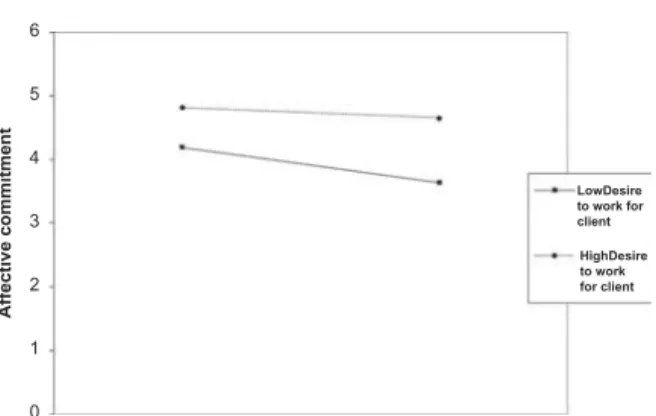
significantly stronger at low as compared to high levels of desire to have a direct contract with the client com-pany. A closer inspection of the interaction between exhaustion and the desire to have a direct contract with the client suggests that the second-stage modera-tion was significant, B = 0.10, p = .00. As expected, the relationship between exhaustion and commitment to the client company is stronger for TAWs with lower desire to have a direct contract with the client company, than for TAWs with higher desire (Figure 3). These results give support to Hypothesis 5.
Hypothesis 6 first proposed that the mediated role of exhaustion between training that facilitates external employability and commitment is moderated by the desire to have a direct contract with the client company, such that the negative relationship between the extent to
TABLE 5
Results of moderated mediation analysis (Hypothesis 5)
Predictor variable B SE t p
DV: Exhaustion (mediator variable model) R2= .19, p < .001
Constant 1.18 0.45 2.17 .009
Training for internal employability −0.45 0.11 −3.63 <.001 Desire to work for client −0.37 0.10 −3.59 <.001 Training for internal employability × Desire to work for client 0.22 0.10 1.79 .026 DV: Affective commitment (dependent variable model) R2= .35, p < .001
Constant 4.33 0.32 12.84 <.001
Exhaustion −0.18 0.03 −4.77 <.001
Training for internal employability 0.18 0.08 1.83 .017 Desire to work for client 0.41 0.07 5.40 <.001 Exhaustion × Desire to work for client 0.10 0.04 2.16 .009
Age 0.01 0.01 1.27 .206
Sex 0.08 0.14 0.55 .580
Desire to work for client Unstandardized Boot indirect effects Boot SE Boot LLCI Boot ULCI Conditional indirect effect at desire to work for client = M ± 1 SD
−1 SD (–0.81) 0.18 0.06 .094 .314
M (0.00) 0.08 0.03 .036 .145
+1 SD (0.81) 0.02 0.02 −.009 .102
Listwise N = 425. DV = dependent variable. Bootstrap sample size = 5000. All predictor variables were mean-centred.
2.5 2 LowDesire to work for client HighDesire to work for client 1.5 Exhaustion 1 0.5 0
LowTraining for internal employability HighTraining for internal employability
Figure 2. Interaction effect of desire to work for client with training for internal employability on exhaustion.
6 5 LowDesire to work for client HighDesire to work for client 4 Affective commitment 3 2 1 0 LowExhaustion HighExhaustion
Figure 3. Interaction effect of desire to work for client with exhaus-tion on commitment to client company.
which TAWs perceive that training facilitates external employability and exhaustion is significantly stronger at high as compared to low levels of desire to have a direct contract with the client company. Contrary to our expec-tations, we did not find a conditional indirect effect of the extent to which TAWs perceive that training facil-itates external employability in predicting commitment to client via exhaustion when they had high level of desire to have a direct contract with client organization, indirect effect = .00, SE = 0.02, CI: –.037 to .040. In addition, we could not find a significant conditional indirect effect at a moderate level, indirect effect = .02, SE = 0.02, CI: –.015 to .073, or low level (indirect effect = .06, SE = 0.04, CI: –.004 to .136, of the desire to have a contract with client organization (Table 6). Thus, Hypothesis 6 did not receive support from our results.
DISCUSSION
The purpose of this study was to investigate whether the TAWs’ perception of training related with their affective commitment towards the client organization and their exhaustion at work. In particular, the perceptions that training facilitates internal or external employability were expected to be associated with the exchange rela-tionship between the TAW and the client organization. Our findings suggest that perception of training that facilitates internal employability is associated with the social exchange employment relationship of TAWs, in which high affective commitment is observed. More interestingly, our findings suggest that the exhaustion
of TAWs is a mechanism that contributes to this social exchange. We observed that the desire to obtain a direct contract with the client company buffered this relation-ship. Moreover, our findings highlight the differential relationship of perceptions of training that facilitates external employability. Our results show that, although exhaustion is associated with the perception of this action, the commitment of the TAW towards the client company is not associated. Furthermore, the relationship between the perception of this organizational action and affective commitment is not moderated by the desire to have a direct contract with the client company.
Indeed, this study confirms and builds on prior research concerning the relationship between training and the affective commitment of TAWs, and these find-ings are consistent with empirical research, demonstrat-ing a positive relationship between traindemonstrat-ing and the affective commitment of TAWs (Finegold et al., 2005). We extended this research by incorporating the idea that the reactions of the workers depend on their perceptions of the actions developed by the organizations (Nishii et al., 2008). In other words, our findings illustrate that TAWs respond reciprocally with high affective commit-ment when they consider that the training developed by the organizations facilitates the possibility of maintaining employment at this organization.
In addition, our results are also consistent with a previous study demonstrating a negative relationship between training and workers’ exhaustion (Castanheira & Chambel, 2010). Moreover, we confirmed that the perception of training as a facilitator of internal or exter-nal employability is positively associated with the
well-TABLE 6
Results of moderated mediation analysis (Hypothesis 6)
Predictor variable B SE t p
DV: Exhaustion (mediator variable model) R2= .16, p < .001
Constant 1.31 0.46 2.28 .005
Training for external employability −0.114 0.09 −1.03 .216 Desire to work for client −0.55 0.09 −5.28 <.001 Training for external employability × Desire to work for client 0.13 0.09 1.14 .131 DV: Affective commitment (dependent variable model) R2= .34, p < .001
Constant 4.33 0.32 12.80 <.001
Exhaustion −0.19 0.03 −5.23 <.001
Training for external employability −0.09 0.06 −111 .159
Desire to work for client 0.48 0.07 6.72 <.001
Exhaustion × Desire to work for client 0.10 0.04 2.25 .008
Age 0.01 0.01 1.20 .232
Sex 0.08 0.14 0.59 .558
Desire to work for client Unstandardized boot indirect effects Boot SE Boot LLCI Boot ULCI Conditional indirect effect at desire to work for client = M ± 1 SD
−1 SD (.–0.81) 0.06 0.04 −.004 .136
M (0.00) 0.02 0.02 −.015 .073
+1 SD (0.81) 0.00 0.02 −.037 .040
Listwise N = 425. DV = dependent variable. Bootstrap sample size = 5000. All predictor variables were mean-centred.
being of temporary agency workers. This result is con-sistent with Berntson and Marklund (2007), who showed that employability increased the well-being of the work-ers. However, the aim of this research study was to show that this relationship is also observed for TAWs.
Consistent with Cropanzano, Chrobot-Mason, Rupp, and Prehar (2004) we observed that the exhaustion of TAWs serves as an important mechanism for understand-ing the attachment to the client organization, character-ized by a social exchange relationship. TAWs who perceive that the training provided by these organizations facilitates continued employment experienced lower exhaustion, and this psychological state is associated with their social exchange relationship with the organi-zation. TAWs attribute more value to the training pro-vided by the organization when they consider that this action increases employment security, thereby increasing feelings of control over their future and lowering stress (i.e., exhaustion), consequently reinforcing the percep-tion that the organizapercep-tion is fair and concerned with the needs of TAWs who reciprocally respond favourably with higher affective commitment.
Our study also confirms that the TAWs’ desire to obtain a direct contract with the client company moder-ates the mediating role of exhaustion. As expected, we verified that exhaustion was not a mediator between the perception that training facilitates internal employability and commitment among employees hoping that this temporary job might serve as a vehicle to achieve per-manent employment. This observation suggests that TAWs are workers with high vulnerability (De Jong & Schalk,2010), as these workers avoid showing exhaus-tion because they depend on the client organizaexhaus-tion to fulfil their desires. Moreover, these employees also show commitment towards the client organizations, indepen-dently of feelings of exhaustion.
Unexpectedly, our findings show the perception that training provides TAWs with broadly marketable skills does foster affective commitment towards the client organization. This result is consistent with Benson’s (2006) study, showing that the actions of tuition reim-bursement facilitated the exit of employees. However, our research analysed TAWs, and this result was more significant. A large percentage of TAWs are reassigned to other organizations (Gallais & Moser,2009), and the development of external employability might be an important benefit provided by the current organization (Finegold et al., 2005). However, this benefit does not imply a positive employment relationship between TAWs and the client organization. There might be a number of different explanations for the absence of this relationship. First, it might reflect the fact that TAWs also have a relationship with the employment agency (Coyle-Shapiro, Morrow, & Kessler, 2006; Liden, Wayne, Kraimer, & Sparrowe, 2003). We might also consider that the perceptions of training as a facilitator of employment opportunities in another organization
might be associated with commitment towards the com-pany mediating the reassignment. Indeed, a triangular employment relationship is often associated with beha-vioural and attitudinal problems that result in two-sided ambiguities, such as loyalty, commitment, or career advancement (Ward, Grimshaw, Rubery, & Beynon, 2001). Second, the workers’ reactions to organization practices depend on what they consider the underlying intentions of the organizations to implement such prac-tices (Nishii et al.,2008). TAWs might interpret that the client organizations have developed training that facil-itates their external employability not because of an intention to meet workers’ needs, but simply because the competences acquired were transferable to other organizations. Consistently, the relationship between training and affective commitment might depend on the Perception of Organizational Support (Chambel & Sobral, 2011; Eisenberger et al., 1990), and, within a social exchange context, training for employability might be considered by the workers as “fair” (Cropanzano et al., 2004). However, training that facilitates external employability cannot be associated with these percep-tions, as the client organization does not consider train-ing as an obligation or promise (Coyle-Shapiro & Conway, 2005). Furthermore, as previously mentioned, the client companies were integrated in an industrial park where TAWs are commonly used for employment, potentially contributing to the perception of external employability, which was not associated with the percep-tion of training.
However, our results support the assumption that training which facilitates external employability can be viewed as an organizational practice that reduces the stress of TAWs. Thus, we might consider that employ-ment insecurity is an important stressor for TAWs, and employability is a valid resource to attenuate the effect of this demand on workers’ stress or exhaustion (Kompier et al.,2009; Virtanen et al.,2005).
Limitations and future research
Several limitations of this study should be considered when interpreting the results. Multiple measurements of exhaustion and organizational commitment over time would provide a more accurate assessment of the effects of training perceptions. A one-time measure precludes any measurement of change in variables directly attrib-uted to the training experience or causal inferences from these data. There are also potential limitations to the generalization of the findings due to the particular sam-ple of companies and TAWs studied. The motive for including temporary employment impacted the training actions developed with TAWs, and these blue-collar workers desired to acquire a contract with the client organization and had identical training opportunities as the workers directly hired by the companies. Furthermore, we did not know what training (e.g.,
exact hours, content) the TAWs had received, and this lack of knowledge limited the validity of the training that facilitates employability scales. Another possible limita-tion of this study is that all the variables were measured using self-reporting surveys. Consequently, the observed relationships might have been artificially inflated as a result of tendencies to respond in a consistent manner. However, a meta-analysis of the percept-percept inflation issue indicated that the magnitude of the inflation of relationships might be overestimated (Crampton & Wagner,1994). Nevertheless, to minimize the impact of common method variance, we followed several of the methodological and statistical recommendations of Podsakoff, MacKenzie, Lee, and Podsakoff (2003). A final limitation of our study concerns the only analysis of affective commitment towards the organization where TAWs developed their skills and did not include the liaison with the agency that initially hired these workers. However, there is considerable empirical work confirm-ing the mutual influence between these two relationships (Connelly, Gallagher, & Gilley,2007; Coyle-Shapiro & Morrow, 2006; Lapalme, Simard, & Tremblay, 2011). Thus, the explanation of TAWs’ attitudes requires a perspective that considers the triangular employment relationship (Liu, Wu, & Hu,2010).
Relatively little is known about the complex reality of temporary agency work. Future studies should seek to replicate the findings reported here among TAWs with different conditions, namely, those not having the same training opportunities as the permanent workers or those with high voluntary statuses. However, the theoretical model tested in the present study should be enriched with the inclusion of different variables to enable a better explanation of the employment relationship and the psy-chological states of TAWs. For example, we considered that temporary agency workers experience stressful situations attenuated through training, and consequently, workers feel less exhaustion. However, training might also increase job demands and promote exhaustion, as workers receive more training when more complex tasks are assigned; thus, the content of training might be more specific to goals to standardize the workers’ skills and respective tasks. This specificity and standardization might have pervasive effects on stress (Holman, 2005). Therefore, training would increase job demands because workers would devote part of their time to training and might have less time to perform work-related tasks, or training could increase the level of expectations of the organization concerning the performance of the worker, thereby increasing stress. Future studies should analyse the content and respective effects of training. As pre-viously noted, a social exchange relationship should develop when TAWs perceived training as an organiza-tional action that satisfies their need for future employ-ment. However, Kuvaas and Dysvik (2009) showed that the social exchange relationship of TAWs depended on their perceived investment in permanent employee
development (PIPED) within the client organization (i.e., not self-investment). Future studies are needed to include these variables to explain the employment rela-tionship of TAWs. Moreover, our study highlights the moderating role of the desire to obtain a direct contract with the client company. However, our cross-sectional study did not assess the effects of these factors over time. Longitudinal studies are needed studies to show the reaction of TAWs when their desire for a permanent contract is not fulfilled or, on the contrary, when these workers manage to obtain a permanent contract. Furthermore, based on the assumption of Cropanzano et al. (2004) and the results of other studies (Hakanen, Bakker, & Schaufeli, 2006; Hakanen, Schaufeli, & Ahola,2008; Schaufeli & Bakker,2004), we considered that exhaustion predicted affective commitment; how-ever, it is also plausible that there was a reversed effect between these variables. For example, we might hypothesize that workers with a high affective relation-ship with the organization (e.g., commitment) have the ability to broaden their thought–action repertoires and build enduring personal resources, including physical, intellectual, social, and psychological resources, which contribute feelings of less exhaustion (Fredrickson, 2001). Thus, the development of future longitudinal studies to confirm the causality direction between these variables is needed. Furthermore, TAWs receive training that improves their skills, which might be useful in other organizational settings when these workers are relocated to another client (Matusik & Hill,1998). Future research needs to follow TAWs through various placements to analyse the extent and conditions under which transfer-able knowledge is acquired and examine the advantages for organizations and employees. Consistent with pre-vious studies (Connelly & Gallagher, 2004; Coyle-Shapiro & Kessler, 2002), our research model presup-posed that the desires and needs of TAWs influence the relationships between the client company actions and the reactions of these workers. However, according to the Self-Determination Theory (Ryan & Deci, 2000), the organizational context plays an important role in the prediction of the desires and motives of the workers, characterized by actions that promote the workers’ competences (e.g., training) to predict higher self-determination motivation (Lam & Gurland, 2008). Thus, future studies analysing the predictive role of training in the motivation of TAWs, namely, the desire to obtain a direct contract with the client, are still needed.
Theoretical implications
Gallagher and Connelly (2008) proposed that it is neces-sary to evaluate whether the existing theory developed in the context of standard employment is adaptable to con-tingent workers and to determine the individual and contextual factors that affect the possible utilization of this theory. By building on the social exchange theory,
this study shows that TAWs might develop a social exchange with the client organization, and these obser-vations are consistent with those of previous studies (Coyle-Shapiro & Kessler, 2002; McDonald & Makin, 2000; Van Dyne & Ang, 1998). Moreover, the present study has contributed to the refinement of this theoretical framework. Consistent with the idea that the induce-ments responding to TAWs need to include those that entail the reciprocity of these workers (Koene & Van Riemsdijk, 2005), we showed that the TAWs who per-ceived that the training developed by the client company facilitated their chances of finding a new job within this company displayed lower work exhaustion and higher affective commitment towards this company. Furthermore, studies concerning TAWs have focused on the workers’ stress but have not integrated this indi-vidual reaction into the workers’ employment relation-ship (De Cuyper et al.,2008). Consistent with the model of Cropanzano et al. (2004), we verified that the exhaus-tion of TAWs was the mechanism underlying the rela-tionship between the perception that the client organization acts positively towards TAWs and the posi-tive attitudes of these employees towards this company. However, our findings showed that desires to obtain a direct contract with the client company moderates the mediating role of exhaustion. Consistent with Connelly and Gallagher (2004), we also observed that this desire was associated with the employment relationship. We observed some evidence for the attenuation in the impor-tance of exhaustion to explain the relationship between the perception of the actions of the client company and the effective commitment of the TAW. Indeed, the desire to obtain a direct contract might be a motivational con-dition that buffers the mediating role of exhaustion in the perception of the training/affective commitment relationship.
Implications for practitioners
Our study has several practical implications for training TAWs. This study has shown that training can have a different relationship between commitment and exhaus-tion, depending on the nature of the perception regarding training actions. Actions that increase opportunities for maintaining employment within the client organization positively affect both the well-being and the affective liaison of TAWs. However, when workers consider that training facilitates the acquisition of new general skills, the relationship between TAWs and the client organiza-tion does not improve despite improvements in well-being. This observation indicates that it is a good option to invest in both an initial and ongoing training pro-grammes to equip TAWs with the skills and knowledge needed to conduct and improve job performance. These investments are good for both TAWs and client organi-zations and contribute to an effective employment relationship.
Although our results have shown that exhaustion is less associated with the employment relationship of TAWs desiring a direct contract with the client company, as stated by De Jong and Shalk (2010), both the legisla-tion and ethical codes prohibit discriminative seleclegisla-tion procedures. Indeed, our results show that training is a valuable human resource practice for TAWs, and practi-tioners should pay special attention to workers who have a vulnerable position with respect to client practices due to a desire to attain positions within the company. The agency is the contractor of TAWs; thus, employment agencies are the first responsible entity to ensure the client does not participate in discriminatory practices that affect TAWs.
REFERENCES
Amuedo-Dorantes, C. (2000). Work transitions into and out of invo-luntary temporary employment in a segmented market: Evidence from Spain. Industrial and Labor Relations Review, 53, 309–325. Baron, R. M., & Kenny, D. A. (1986). The moderator–mediator
vari-able distinction in social psychological research: Conceptual, stra-tegic and statistical considerations. Journal of Personality and Social Psychology, 51, 1173–1182.
Becker, G. (1993). Human capital. Chicago, IL: University of Chicago Press.
Benson, G. S. (2006). Employee development, commitment and inten-tion to turnover: A test of ‘employability’ policies in acinten-tion. Human Resource Management Journal, 16, 173–192.
Bernhard-Oettel, C., Sverke, M., & De Witte, H. (2005). Comparing alternative employment to permanent full time work: How do employment contract and perceived job conditions relate to health complaints?. Work & Stress, 19, 301–318.
Berntson, E., & Marklund, S. (2007). The relationship between per-ceived employability and subsequent health. Work & Stress, 21, 279–292.
Blau, P. M. (1964). Exchange and power in social life. New York, NY: John Wiley & Sons.
Cappelli, P. (2000). Market-mediated employment: The historical con-text. In M. M. Blair & T. A. Kochan (Eds.), The new relationship: Human capital in the American corporation (pp. 66–101). Washington, DC: Brookings Institution Press.
Castanheira, F., & Chambel, M. J. (2010). Reducing burnout in call centers through HR practices. Human Resource Management, 49, 1047–1065.
Chambel, M. J., & Sobral, F. (2011). Training is an investment with return in temporary workers: A social exchange perspective. Career Development International, 16, 161–177.
CIETT. (2013). Economic Report: The agency work industry around the world. Brussels: Author.
Connelly, C. E., & Gallagher, D. G. (2004). Emerging trends in con-tingent work research. Journal of Management, 30, 959–983. Connelly, C. E., Gallagher, D. G., & Gilley, K. M. (2007).
Organizational commitment among contracted employees: A repli-cation and extension with temporary workers. Journal of Vorepli-cational Behavior, 70, 326–335.
Conway, E., & Monks, K. (2009). Unravelling the complexities of high commitment: An employee level analysis. Human Resource Management Journal, 9, 140–158.
Coyle-Shapiro, J. A.-M., & Conway, N. (2005). Exchange relation-ships: Examining psychological contracts and perceived organiza-tional support. Journal of Applied Psychology, 90, 774–781. Coyle-Shapiro, J. A.-M., & Kessler, I. (2002). Contingent and
non-contingent working in local government: Contrasting psychological contracts. Public Administration, 80, 77–101.
Coyle-Shapiro, J. A.-M., & Morrow, P. C. (2006). Organizational and client commitment among contracted commitment among con-tracted employees. Journal of Vocational Behavior, 68, 416–431. Coyle-Shapiro, J. A.-M., Morrow, P. C., & Kessler, I. (2006). Serving
two organizations: Exploring the employment relationship of con-tracted employees. Human Resource Management, 45, 561–583. Crampton, S. M., & Wagner, J. A. (1994). Percept-percept inflation in
microorganizational research: An investigation of prevalence and effect. Journal of Applied Psychology, 79, 67–76.
Cropanzano, R., Chrobot–Mason, D., Rupp, D. E., & Prehar, C. A. (2004). Accountability for corporate injustice. Human Resource Management Review, 14, 107–133.
Cropanzano, R., Rupp, D., & Byrne, Z. (2003). The relationship of emotional exhaustion to work attitudes, job performance, and orga-nizational citizenship behaviors. Journal of Applied Psychology, 88, 160–169.
De Cuyper, N., Castanheira, F., De Witte, H., & Chambel, M. J. (in press). A multiple group analysis of associations between emotional exhaustion and supervisor-rated individual performance: Temporary versus permanent call center workers. Human Resource Management.
De Cuyper, N., De Jong, J., De Witte, H., Isaksson, K., Rigotti, T., & Schalk, R. (2008). Literature review of theory and research on the psychological impact of temporary employment: Towards a con-ceptual model. International Journal of Management Reviews, 10, 25–51.
De Cuyper, N., & De Witte, H. (2008). Volition and reasons for accepting temporary employment: Associations with attitudes, well-being, and behavioural intentions. European Journal of Work and Organizational Psychology, 17, 363–387.
De Jong, J. P., & Schalk, R. (2010). Extrinsic motives as moderators in the relationship between fairness and work-related outcomes among tem-porary workers. Journal of Business and Psychology, 25, 175–189. DiNatale, M. (2001). Characteristics of and preference for alternative
work arrangements. Monthly Management Review, 124, 28–49. Eisenberger, R., Fasolo, P., & Davis-LaMastro, V. (1990). Perceived
organizational support and employee diligence, commitment, and innovation. Journal of Applied Psychology, 75, 51–59.
Ferguson, M. J., & Bargh, J. A. (2004). Liking is for doing: The effects of goal pursuit on automatic evaluation. Journal of Personality and Social Psychology, 87, 557–572.
Finegold, D., Leveson, A., & Van Buren, M. (2005). Access to training and its impact on temporary workers. Journal of Human Resource Management, 15, 66–85.
Forrier, A., & Sels, L. (2003). Temporary employment and employ-ability: Training opportunities and efforts of temporary and perma-nent employees in Belgium. Work, Employment and Society, 17, 641–666.
Fredrickson, B. L. (2001). The role of positive emotions in positive psychology: The broaden-and-build theory of positive emotions. American Psychologist, 56, 218–226.
Fugate, M., Kinicki, A., & Ashforth, B. (2004). Employability: A psycho-social construct, its dimensions, and applications. Journal of Vocational Behavior, 65, 14–38.
Gallagher, D. G., & Connelly, C. E. (2008). Nonstandard work arrange-ments: Meaning, evidence, and theoretical perspectives. In J. Barling & C. L. Cooper (Eds.), Handbook of organizational beha-vior (pp. 621–640). Los Angeles, CA: Sage.
Gallais, N., & Moser, K. (2009). Organizational commitment and the well-being of temporary agency workers: A longitudinal study. Human Relations, 62, 589–620.
Gouldner, A. W. (1960). The norm of reciprocity: A preliminary state-ment. American Sociological Review, 25, 161–178.
Hakanen, J. J., Bakker, A., & Schaufeli, W. (2006). Burnout and engagement among teachers. Journal of School Psychology, 43, 495–513.
Hakanen, J. J., Schaufeli, W., & Ahola, K. (2008). The Job Demands-Resources model: A three-year cross-lagged study of burnout,
depression, commitment, and work engagement. Work & Stress, 22, 224–241.
Hanlon, M. D. (1986). Age and commitment to work: A literature review and multivariate analysis. Research on Aging, 8, 289–316. Hayes, A. F. (2012). An analytical primer and computational tool for
observed variable moderation, mediation, and conditional process modeling. Retrieved from http://www.afhayes.com/public/pro cess2012.pdf
Holman, D. (2005). Call centres. In D. Holman, T. D. Wall, C. W. Clegg, P. Sparrow, & A. Howard (Eds.), The essentials of the new workplace, a guide to the human impact of modern working prac-tices (pp. 111–131). Chichester: John Wiley and Sons.
Karasek, R. A. (1989). Control in the workplace and its health-related aspects. In S. L. Sauter, J. J. Hurrell, & C. L. Cooper (Eds.), Job control and worker health (pp. 129–159). New York, NY: Wiley. Kluytmans, F., & Ott, M. (1999). Management of employability in the
Netherlands. European Journal of Work and Organizational Psychology, 8, 261–272.
Koene, B., & Van Riemsdijk, M. (2005). Managing temporary workers: Work identity, diversity and operational HR choices. Human Resource Management Journal, 15, 76–92.
Kompier, M., Ybema, J. F., Janssen, J., & Taris, T. (2009). Employment contracts: Cross-sectional and longitudinal relations with quality of working life, health and well-being. Journal of Occupational Health, 5, 193–203.
Kuvaas, B., & Dysvik, A. (2009). Perceived investment in permanent employee development and social and economic exchange percep-tions among temporary employees. Journal of Applied Social Psychology, 39, 2499–2524.
Lam, C. F., & Gurland, S. T. (2008). Self-determined work motivation predicts job outcomes, but what predicts self-determined work motivation?. Journal of Research in Personality, 42, 1109–1115. Lapalme, M. E., Simard, G., & Tremblay, M. (2011). The influence of
psychological contract breach on temporary workers’ commitment and behaviors: A multiple agency perspective. Journal of Business and Psychology, 26, 311–324.
Latack, J. C., Kinicki, A. J., & Prussia, G. E. (1995). An integrative process model of coping with job loss. Academy of Management Review, 20, 311–342.
Lautsch, B. A. (2002). Uncovering and explaining variance in the features and outcomes of contingent work. Industrial and Labor Relations Review, 56, 23–43.
Lazarus, R. S., & Folkman, S. (1984). Stress, appraisal, and coping. New York, NY: Springer.
Lee, R. T., & Ashforth, B. E. (1996). A meta-analytic examination of the correlates of the three dimensions of burnout. Journal of Applied Psychology, 81, 123–133.
Liden, R. C., Wayne, S. J., Kraimer, M. L., & Sparrowe, R. T. (2003). Dual commitments of contingent workers: An examination of con-tingents' commitment to the agency and the organization. Journal of Organizational Behavior, 24, 609–625.
Liu, C.-T., Wu, C., & Hu, C. W. (2010). Managing temporary workers by defining temporary work agency service quality. Human Resource Management, 49, 619–646.
MacKinnon, D. P., Lockwood, C. M., & Williams, J. (2004). Confidence limits for the indirect effect: Distribution of the product and resam-pling methods. Multivariate Behavioral Research, 39, 99–128. Marsden, P. V., Kalleberg, A. L., & Cook, C. R. (1993). Gender
differences in organizational commitment: Influences of work posi-tions and family roles. Work and Occupaposi-tions, 20, 368–390. Matusik, S. F., & Hill, C. W. L. (1998). The utilization of contingent
work, knowledge creation, and competitive advantage. Academy of Management Review, 23, 680–697.
McDonald, D. J., & Makin, P. J. (2000). The psychological contract, organizational commitment and job satisfaction of temporary staff. Leadership & Organizational Development Journal, 21, 84–91. McLean Parks, J., Kidder, D. L., & Gallagher, D. G. (1998). Fitting
square pegs into round holes: Mapping the domain of contingent