
Deterministic and probabilistic methods for structural seismic safety assessment
409
0
0
Texto
(2)
(3) Visível ou invisível, a estrutura de tudo é tudo. (kindly written by José Luís Peixoto for this dissertation, 2012). All things are subject to interpretation; whichever interpretation prevails at a given time is a function of power and not truth. (Friedrich Nietzsche, 1844-1900).
(4)
(5) Acknowledgments It has been a long and rewarding journey, longer than envisioned, filled with twists and setbacks, excitement and frustration, both academically as on a more personal level. It has been a journey that was only made possible due to the influence of many. In the next few lines, I would like to express my sincere gratitude to those who have contributed in any way to the completion of this thesis. First of all, I would like to acknowledge my sincere gratitude to my supervisors, Prof. Aníbal Costa and Prof. Raimundo Delgado, for believing in me since the early ages of my academic career, more than twelve years ago. I also want to thank them for persuading me to change the initial topic of my research and take part in the LessLoss research project which presented me with new challenges that ultimately led to the development of this dissertation. To Prof. Aníbal Costa I would also like to gratefully and sincerely thank for his support, guidance, knowledge and friendship throughout the years, and for the opportunity to take part in many side-projects that contributed to my professional growth. To Prof. Raimundo Delgado I would also like to express my deepest gratitude for his support and guidance, while giving me the freedom to pursue independent work and explore things on my own. I am also deeply grateful to him for the long discussions that helped me to solve many technical details of the work, for the insightful comments and constructive criticisms, and for helping me to view and think outside the box in many occasions. I would like to thank also colleagues and friends from the Civil Engineering Department and the Construction Institute of the Faculty of Engineering of the University of Porto (FEUP). Among those, I would like to thank Miguel Castro for the fruitful discussions about earthquake engineering and for the many ideas for future research. I am also especially grateful to Lau for the friendship, the unending encouragement and the many discussions about losses. This journey would have been intensely isolating and a great deal more demanding had it not been for your support and for the numerous side projects and tasks that you challenged me with and that helped me keep my sanity. For their support, a special word of thanks also goes to my colleagues from the Structural Division, namely António Arêde, João Guedes and Nelson Vila Pouca. For his help and guidance with some statistical issues over the course of this work, I would like to thank Rui Gonçalves. For the many talks, her friendship and encouragement, and for bridging the gap between mathematicians and engineers, I would also like to thank Isabel Ribeiro. To those who are still completing their own journey and to those who, inevitably, came and went over the years, namely Alexandre Costa, Bruno Silva, Cristina Costa, Filipe Neves, Hugo Rodrigues, Pedro Quintela, Sandra Nunes, Tiago Ilharco and Valter Lopes, I would like to thank their companionship. Finally, I would also like to thank Nuno Pereira for the help in. v.
(6) editing some chapters and especially for picking up the things that I left behind to start his own PhD journey. From the LessLoss team, I would also like to express my gratitude to Prof. Paolo Pinto, Prof. Paolo Franchin and Prof. Alessio Lupoi from the University of Rome “Sapienza” for sharing their experience and knowledge during the project. Your work was instrumental for my research. My thanks are also due to Dr. Alexandra Carvalho, from the National Laboratory for Civil Engineering (LNEC), for providing me with the most recent Portuguese seismic hazard data. I also thank the Portuguese Foundation for Science and Technology for supporting part of this research through the grant SFRH/BD/32820/2007. Much of the research in this thesis is based on the work of many others before me. A great deal of time was spent consulting, reading, scrutinizing the research of others from many fields. My deepest thank goes to the http://www.abcdfree.com/ community for their collaborative help in providing many of the publications that I required over the years. I am also grateful to the secretaries in the Civil Engineering Department, especially Mrs. Vitória, Marta and Joana, for assisting me in many different ways, and to Manuel for his help in formatting a large part of the final text and developing some of the figures. I would also like to thank José Luís Peixoto for finding the time throughout the mists of his busy agenda to write a citation for this dissertation. To Lena, I want to thank for her support over many years, right from the beginning and, despite the hardship of times we both endured, for remaining my dearest friend. To my close and oldest friends Ani, Bela and Ricardo, I want to express my gratitude for their unconditional friendship and support, especially during more difficult times. To my parents, I must thank for their unconditional encouragement and support, allowing me to be as ambitious as I wanted. Finally, to everyone who kept asking over and over again “When will you get it done? Next week? Next month? When?” while I was thinking to myself “I just whish I could hit you… with a (sharp) stick… many times over”, thank you for believing in me.. January 1st, 2012. vi.
(7) … for wanting to know me … for letting me know you … for being everything … for everything.
(8)
(9) Abstract The proposed thesis addresses several topics in the field of seismic risk assessment of structures. The main objective is to propose probabilistic methods for the seismic risk assessment of existing buildings which can be used in the research and development of codified procedures addressing this type of structures. In light of this wide-scope objective, a preliminary analysis is carried out to characterize how the seismic safety assessment of existing structures is addressed within the scope of the Eurocodes. In this context, the seismic safety assessment methodology defined by Eurocode 8 – Part 3 (EC8-3) is analysed and discussed. Based on the limitations identified in the chord rotation demand quantification procedure defined by EC8-3, a study is made to analyse several alternative proposals for its quantification. Moreover, the definition of the Confidence Factor and its role in the safety analysis is another aspect of the EC8-3 features that is addressed with more detail. Based on the interpretation of the code procedures, a statistical framework is proposed to reflect the uncertainty of the material properties required for the safety analysis in the definition of the Confidence Factor. The analysis of the code procedures also emphasises the need for adequate methods to validate the results obtained by the EC8-3 safety assessment methodology. Such need asks for the development of a suitable probabilistic framework aiming to assess the reliability of the code procedures and calibrate parameters they involve. In this context, the remaining research presented in the thesis introduces several contributions to such probabilistic framework involving the development and enhancement of methods for the probabilistic performance assessment of structures. The aspects of the probabilistic performance assessment addressed in the proposed thesis are the adequate characterization of probabilistic models for the structural demand of building response under earthquakes, the seismic risk assessment of building components, and the seismic risk and loss assessment of building systems, combining both component-level and system-level criteria. With respect to the characterization of probabilistic models for the structural demand of building response parameters, an indepth analysis of the common assumption that structural demand conditional to a seismic intensity level follows a lognormal distribution is performed using adequate statistical methods. Having established the type of statistical distribution of the demand parameters, an extensive study is also performed to address the characterization of the parameters of such distributions using robust estimation methods. In the context of the seismic risk assessment of building components, methodologies defining analytical closed form expressions for the risk and the exceedance probability of structural component limit states are developed. The proposed procedures use a strategy similar to that of the well known SAC-FEMA method, but extend that approach by introducing different functional forms to represent the earthquake hazard and by addressing the issue of force-based limit states. ix.
(10) Finally, a probabilistic methodology is proposed to analyse the seismic performance of existing buildings using global metrics to determine if the behaviour conforms to a given limit state. The considered performance metrics are the probability of occurrence of the limit state, the corresponding loss associated to the repair of the building, and the corresponding number and type of mechanisms that occur. Based on these latter parameters, a number of possible scenarios corresponding to the limit state occurrence are established, which can then be combined to obtain a global performance value representing the expected loss over a given reference period of time. The topics addressed throughout the thesis are illustrated with several application examples involving reinforced concrete structures. These structures were selected in order to include both regular and irregular structures of different heights, as well as non-seismically designed structures and structures designed according to modern seismic design methods.. x.
(11) Resumo O objectivo principal desta dissertação consiste na proposta de metodologias probabilísticas para a avaliação do risco sísmico de edifícios existentes que possam ser utilizadas no desenvolvimento de procedimentos regulamentares dirigidos para este tipo de estruturas. Neste âmbito, foram abordadas e analisadas várias temáticas no contexto da avaliação do risco sísmico de estruturas tendo sido, nomeadamente, caracterizada a forma como a avaliação da segurança sísmica de estruturas existentes é tratada no âmbito dos Eurocódigos. Neste contexto, foi analisada a metodologia de avaliação da segurança sísmica proposta na Parte 3 do Eurocódigo 8 (EC8-3), sendo discutidas algumas das suas limitações. Assim, o procedimento proposto pelo EC8-3 para a quantificação da rotação da corda de elementos estruturais foi analisado num estudo mais detalhado em que foram discutidas diferentes alternativas para a sua determinação. Paralelamente, o Factor de Confiança e o seu papel na avaliação da segurança foram igualmente analisados com maior detalhe. Para tal, foi estabelecido um enquadramento de base estatística para a definição do Factor de Confiança, o qual reflecte a incerteza das propriedades materiais que têm de ser determinadas para proceder à avaliação da segurança sísmica. A análise dos procedimentos regulamentares salientou a necessidade de existirem métodos adequados que permitam validar os resultados obtidos pela metodologia de avaliação da segurança sísmica do EC8-3. Assim, conclui-se que é necessário estabelecer um enquadramento de base probabilística que permita avaliar a fiabilidade dos procedimentos regulamentares e calibrar os parâmetros envolvidos. Neste contexto, a presente dissertação apresenta, ainda, diversas contribuições para o estabelecimento duma formulação probabilística da avaliação da segurança sísmica, nomeadamente ao nível do desenvolvimento e do refinamento de métodos probabilísticos para avaliação do desempenho estrutural. Os conceitos abordados envolvem a caracterização probabilística da resposta estrutural de edifícios sujeitos à acção sísmica, métodos para a avaliação do risco sísmico de elementos estruturais e métodos para a avaliação do risco sísmico e das correspondentes perdas económicas em edifícios. A caracterização de modelos probabilísticos para a resposta estrutural de edifícios foi tratada em detalhe utilizando métodos estatísticos adequados, sendo analisada a legitimidade da hipótese generalizadamente assumida relativa à distribuição da resposta estrutural obtida para um determinado nível da acção sísmica seguir uma distribuição lognormal. Após estabelecer o tipo de distribuição estatística da resposta estrutural, foi realizado um estudo alargado que abordou a caracterização dos parâmetros das referidas distribuições estatísticas utilizando métodos de estatística robusta. No contexto dos métodos para a avaliação do risco sísmico de elementos estruturais foram abordadas diversas metodologias analíticas que permitiram o desenvolvimento de expressões para a avaliação do risco e da probabilidade de ocorrência de diferentes estados limite. Os procedimentos propostos foram desenvolvidos xi.
(12) com base na formulação do método SAC-FEMA, sendo alargada a aplicabilidade desta abordagem com a introdução de expressões alternativas para a representação da perigosidade sísmica e ao estabelecer propostas especificamente dirigidas para estados limite definidos em termos de esforços. Finalmente, é proposta uma metodologia probabilística para a avaliação do desempenho de edifícios existentes através da utilização de indicadores globais que determinam se o comportamento da estrutura verifica as condições de segurança associadas ao estado limite em análise. Os indicadores globais considerados são a probabilidade de ocorrência do estado limite, as perdas económicas associadas à reparação do edifício e o número e o tipo de mecanismos locais que ocorrem. Com base nestes parâmetros, é então possível definir diversos cenários que correspondem à ocorrência do estado limite em análise, os quais, posteriormente, podem ser combinados para obter um indicador global do desempenho do edifício. Os diferentes assuntos abordados ao longo da dissertação são ilustrados com recurso a várias aplicações que envolvem estruturas de betão armado. As estruturas envolvidas neste estudo foram seleccionadas de modo a incluir estruturas regulares e irregulares de diferentes alturas, e estruturas com e sem dimensionamento sísmico.. xii.
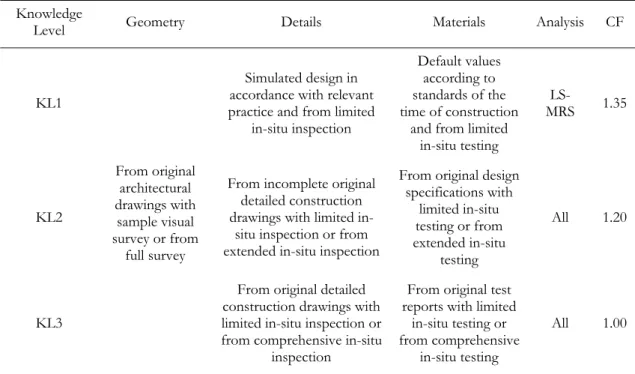
(13) Table of Contents Chapter 1 Introduction ..........................................................................1.1 1.1 General overview ...................................................................................1.1 1.2 Objectives and Scope ............................................................................1.8 1.3 Thesis Outline ........................................................................................1.9. Chapter 2 Practical aspects of demand and capacity evaluation in the context of EC8-3.....................................................................2.1 2.1 Introduction............................................................................................2.1 2.2 Brief outline of the EC8-3 procedures for seismic safety assessment of existing structures..............................................................................2.2 2.3 Review of the chord rotation demand quantification ......................2.5 2.3.1 2.3.2. The Exact Integral Method (EIM) .........................................................................2.5 The Exact Geometrical Method (EGM) ...............................................................2.6. 2.4. Alternative approaches for chord rotation demand .........................2.8. 2.4.1 2.4.2 2.4.2.1. Alternative interpretations for ...............................................................................2.9 Evaluation of the chord rotation without quantifying ......................................2.9 The Approximate Geometrical Method that considers member Drift and nodal Rotations for beams and columns (AGM-DR) ...................................................................................2.9 The Approximate Integral Method (AIM) ..................................................................2.10 The Approximate Geometrical Method that considers member Drift for columns and nodal Rotations for beams (AGM-DcRb) ..............................................................................2.10. 2.4.2.2 2.4.2.3. 2.5. Example application: the ICONS frame ..........................................2.11 xiii.
(14) 2.5.1 2.5.2 2.5.3. General description ................................................................................................ 2.11 Numerical modelling .............................................................................................. 2.11 Seismic demand....................................................................................................... 2.14. 2.6. Structural analysis results.................................................................... 2.15. 2.6.1 2.6.2. Initial considerations .............................................................................................. 2.15 Presentation and discussion of the results .......................................................... 2.17. 2.7. Analysis of the EC8-3 capacity models of RC structures ............. 2.25. 2.7.1 2.7.2 2.7.3. Review of the EC8-3 capacity models ................................................................. 2.26 Significance of the sensitivity analysis.................................................................. 2.27 Results of the sensitivity analysis .......................................................................... 2.29. 2.8. Conclusions .......................................................................................... 2.32. Chapter 3 A comparative application of the EC8-3 seismic safety assessment procedures ..........................................................3.1 3.1 Introduction ........................................................................................... 3.1 3.2 General conditions, structures and methods of analysis considered for the deterministic assessment ......................................................... 3.2 3.2.1 3.2.2 3.2.2.1 3.2.2.2 3.2.3. Structural configuration and detailing of the selected structures....................... 3.3 Numerical modelling and definition of seismic demand .................................... 3.4 Definition of the target displacements for pushover analysis.............................................. 3.6 Definition of the accelerograms for nonlinear dynamic analysis ......................................... 3.8 Capacity models for the selected limit states ...................................................... 3.13. 3.3 3.4. Additional data for the probabilistic assessment............................ 3.14 Seismic safety assessment results from the deterministic approaches ................................................................................................................ 3.18. 3.4.1 3.4.2 3.4.3 3.4.4. Results from the linear analyses............................................................................ 3.18 Results from the pushover analyses ..................................................................... 3.20 Results from the nonlinear dynamic analyses ..................................................... 3.22 Comparative assessment of the different approaches ....................................... 3.23. 3.5 3.6. Seismic safety assessment results from the probabilistic approach3.26 Conclusions and final observations.................................................. 3.28. Chapter 4 A probabilistic interpretation of the EC8-3 Confidence Factors for the characterization of material strength ...........4.1 4.1 Introduction ........................................................................................... 4.1 xiv.
(15) 4.2. General framework for the definition of the CF ..............................4.2. 4.2.1 4.2.2. The CF in the EC8-3 procedures for seismic safety assessment .......................4.2 Quantification of the CFs ........................................................................................4.5. 4.3. Probabilistic definition of the CFs ......................................................4.8. 4.3.1 4.3.2 4.3.2.1 4.3.2.2 4.3.3 4.3.3.1 4.3.3.2 4.3.4 4.3.5 4.3.6. Basic hypotheses and definitions of the probabilistic analysis ...........................4.8 Definition of the CFs for the case of a normal distributed strength.................4.9 The case of a normal distributed strength with known variance ......................................4.10 The case of a normal distributed strength with unknown variance ..................................4.13 Definition of the CFs for the case of a lognormal distributed strength .........4.15 The case of a lognormal distributed strength with known variance ..................................4.15 The case of a lognormal distributed strength with unknown variance ..............................4.16 Definition of the CFs for the case of a Weibull distributed strength..............4.19 Discussion of the results ........................................................................................4.21 Additional comments regarding the application of the results obtained to other materials....................................................................................................................4.22. 4.4. Quantification of the CFs when prior knowledge exists ...............4.23. 4.4.1 4.4.2 4.4.3. Considering prior knowledge and KL2 ...............................................................4.24 Considering prior knowledge and KL3 ...............................................................4.26 Combining data from different types of tests.....................................................4.29. 4.5. Conclusions...........................................................................................4.30. Chapter 5 Assessment of the statistical distributions of structural demand under earthquake loading ........................................5.1 5.1 Introduction............................................................................................5.1 5.2 Description of the proposed study .....................................................5.2 5.3 Statistical tests for demand distribution evaluation ..........................5.2 5.3.1. Tests for symmetric data..........................................................................................5.3. 5.3.1.1. The 32 test .................................................................................................................5.3. 5.3.1.2 5.3.1.3 5.3.1.4 5.3.2. The RsJ test....................................................................................................................5.4 The Tw test ....................................................................................................................5.4 The CS test ...................................................................................................................5.4 Tests for data with potential outliers......................................................................5.5. 5.3.2.1. The TTLmom t test.........................................................................................................5.5. 5.3.2.2. The TMC-LR test .......................................................................................................5.6. 5.4. Selected case study structures...............................................................5.7. 5.4.1. General description...................................................................................................5.7. xv.
(16) 5.4.2 5.4.3. Numerical modelling ................................................................................................ 5.9 Seismic demand....................................................................................................... 5.11. 5.5. Results of the goodness-of-fit assessment ...................................... 5.12. 5.5.1 5.5.2 5.5.2.1 5.5.2.2 5.5.2.3 5.5.3. Initial considerations .............................................................................................. 5.12 Presentation and discussion of the results .......................................................... 5.15 Global goodness-of-fit results ........................................................................................ 5.15 Structure by structure goodness-of-fit results................................................................... 5.17 Enhanced global goodness-of-fit results.......................................................................... 5.28 Complimentary discussion of the results obtained by the KolmogorovSmirnov/Lilliefors test........................................................................................... 5.30. 5.6. Conclusions .......................................................................................... 5.32. Chapter 6 Statistical characterization of structural demand under earthquake loading - Robust estimation of the central value of the data...................................................................................6.1 6.1 Introduction ........................................................................................... 6.1 6.2 Description of the proposed study..................................................... 6.2 6.3 Main concepts in robust estimation ................................................... 6.3 6.4 Selected central value estimators......................................................... 6.5 6.4.1. Estimators based on trimming................................................................................ 6.5. 6.4.1.1 6.4.1.2 6.4.1.3 6.4.1.4 6.4.2 6.4.2.1 6.4.2.2 6.4.2.3 6.4.2.4 6.4.2.5 6.4.2.6 6.4.2.7 6.4.3 6.4.3.1 6.4.3.2 6.4.3.3 6.4.3.4. The -trimmed mean..................................................................................................... 6.5 The adaptive trimming estimators................................................................................... 6.6 The trimmed L-mean..................................................................................................... 6.7 The Minimum Covariance Determinant estimator.......................................................... 6.7 M-estimators.............................................................................................................. 6.8 The Huber M-estimator ................................................................................................ 6.8 The modified Huber M-estimator................................................................................... 6.9 The Hampel M-estimator .............................................................................................. 6.9 The Andrew´s sine wave M-estimator ............................................................................ 6.9 The Tukey biweight M-estimator ................................................................................. 6.10 The logistic M-estimator............................................................................................... 6.10 The Welsch M-estimator.............................................................................................. 6.10 Other estimators ..................................................................................................... 6.10 The median ................................................................................................................. 6.11 The Hodges-Lehman estimator .................................................................................... 6.11 The least power estimator ............................................................................................. 6.11 The modified maximum likelihood estimator ................................................................ 6.11. xvi.
(17) 6.4.3.5 6.4.3.6. The Ttanh estimator ....................................................................................................6.12 The half-sample mode...................................................................................................6.12. 6.5 6.6. Selected methodology for the performance evaluation of the estimators ..............................................................................................6.13 Results of the performance evaluation of the estimators ..............6.15. 6.6.1 6.6.2 6.6.2.1 6.6.2.2. Initial considerations...............................................................................................6.15 Presentation and discussion of the results...........................................................6.17 Results of Stage 1 ........................................................................................................6.17 Results of Stage 2 ........................................................................................................6.25. 6.7. Conclusions...........................................................................................6.30. Chapter 7 Statistical characterization of structural demand under earthquake loading - Robust estimation of the dispersion of the data...................................................................................7.1 7.1 Introduction............................................................................................7.1 7.2 Description of the proposed study .....................................................7.2 7.3 Selected dispersion estimators .............................................................7.2 7.3.1 7.3.1.1 7.3.1.2 7.3.1.3 7.3.1.4 7.3.1.5 7.3.1.6 7.3.1.7 7.3.2. Location-free and scale-free estimators .................................................................7.3 The interquartile range...................................................................................................7.3 The median absolute deviation........................................................................................7.3 The Qn estimator ...........................................................................................................7.4 The Sn estimator ............................................................................................................7.4 The length of the shorth Ssh .............................................................................................7.4 The trimmed L- standard deviation ................................................................................7.5 The dispersion estimator based on the empirical characteristic function..............................7.5 Location-based and scale-free estimators..............................................................7.6. 7.3.2.1 7.3.3. The -trimmed standard deviation .................................................................................7.6 Location-based and scale-based estimators...........................................................7.6. 7.3.3.1 7.3.3.2 7.3.3.3 7.3.3.4 7.3.3.5 7.3.3.6 7.3.3.7 7.3.3.8. The -scale estimator......................................................................................................7.6 The M-estimator of scale with logistic function.................................................................7.7 The Huber M-estimator of scale .....................................................................................7.8 The biweight A-estimator of scale ...................................................................................7.8 The Andrew´s sine wave A-estimator of scale .................................................................7.9 The Andrew´s modified sine wave A-estimator of scale ...................................................7.9 The t-estimator of scale...................................................................................................7.9 The modified maximum likelihood dispersion estimator.................................................7.10. xvii.
(18) 7.4 7.5. Selected methodology for the performance evaluation of the estimators.............................................................................................. 7.10 Results of the performance evaluation of the estimators ............. 7.13. 7.5.1 7.5.2 7.5.2.1 7.5.2.2 7.5.2.3. Initial considerations ............................................................................................. 7.13 Presentation and discussion of the results .......................................................... 7.16 Results of Stage 1 ........................................................................................................ 7.16 Results of Stage 2 ........................................................................................................ 7.23 Results of Stage 3 ........................................................................................................ 7.30. 7.6. Conclusions .......................................................................................... 7.35. Chapter 8 Analytical evaluation of structural component limit state probabilities ...........................................................................8.1 8.1 Introduction ........................................................................................... 8.1 8.2 Brief review of the SAC/FEMA method.......................................... 8.3 8.3 Proposed procedures ............................................................................ 8.5 8.3.1 8.3.1.1 8.3.1.2. Methodology 1 .......................................................................................................... 8.6 Discussion of the probabilistic consistency and computational efficiency of the procedure... 8.13 Application example.................................................................................................... 8.14. 8.3.1.2.1 8.3.1.2.2 8.3.1.2.3 8.3.1.2.4 8.3.1.2.4.1 8.3.1.2.4.2 8.3.1.2.4.3. Limit states, capacity models and probabilistic modelling .............................................8.14 Hazard curves for the considered seismic scenario ........................................................8.17 Analysis of the structural demand of sections 1 and 2 ...................................................8.18 Results of the component limit state probabilities by the proposed method .............8.22 Limit state probabilities considering deterministic capacities and demand from all IM levels ........8.22 Limit state probabilities considering deterministic capacities and demand from three IM levels .....8.26 Limit state probabilities considering random capacities and demand from all IM levels................8.27. 8.3.2 8.3.2.1 8.3.2.2. Methodology 2 ........................................................................................................ 8.31 A closed form risk assessment method with a new seismic hazard function..................... 8.31 Alternative closed form risk assessment method with a new seismic hazard function and a new demand evolution expression.................................................................................. 8.35 Tentative development of an additional closed form risk assessment method .................... 8.37 Application example.................................................................................................... 8.41. 8.3.2.3 8.3.2.4. 8.4 8.5. xviii. Additional comments about the proposed procedures and the reliability of systems............................................................................ 8.44 Conclusions and final remarks .......................................................... 8.45.
(19) Chapter 9 Probabilistic performance analysis of existing buildings under earthquake loading.................................................................9.1 9.1 Introduction............................................................................................9.1 9.2 General analysis and interpretation of limit state definitions..........9.2 9.3 Probabilistic performance analysis methodology..............................9.5 9.3.1 9.3.2 9.3.3 9.3.4 9.3.4.1 9.3.4.2 9.3.4.3 9.3.5 9.3.6. General overview of the methodology ..................................................................9.5 Estimating the limit state fragility curve by using the IM-based approach ......9.7 Estimating the limit state expected loss Lsc ..........................................................9.8 Definition of the limit states..................................................................................9.12 The limit state of Damage Limitation ..........................................................................9.12 The limit state of Significant Damage...........................................................................9.13 The limit state of Near Collapse...................................................................................9.14 Accounting for the uncertainty in the limit state capacities..............................9.16 Stepwise description of the proposed methodology..........................................9.17. 9.4. Example application of the proposed methodology ......................9.19. 9.4.1 9.4.2 9.4.3 9.4.4. General description of the selected structures....................................................9.19 EC8-3 component capacities and probabilistic modelling of their uncertainty.... ...................................................................................................................................9.20 Seismic demand and hazard scenario...................................................................9.22 Cost analysis data and performance conditions..................................................9.23. 9.5. Results of the probabilistic performance analysis...........................9.24. 9.5.1 9.5.2 9.5.3 9.5.4 9.5.5 9.5.6. Initial considerations...............................................................................................9.24 Results for the DL limit state ................................................................................9.25 Results for the SD limit state.................................................................................9.31 Results for the NC limit state................................................................................9.34 Loss results obtained using the linear approximations of the loss curves ......9.37 Analysis of the lognormal distribution hypothesis for the representation of fragility curves..........................................................................................................9.38. 9.6. Conclusions...........................................................................................9.42. Chapter 10 Closure............................................................................... 10.1 10.1 Conclusions...........................................................................................10.1 10.1.1 10.1.2 10.1.3. Conclusions regarding the EC8-3 safety assessment methodology.................10.1 Conclusions addressing the probabilistic characterization of the demand under earthquake loading ..................................................................................................10.4 Conclusions associated to the development of methodologies for seismic risk assessment ................................................................................................................10.5 xix.
(20) 10.2. Recommendations for future research............................................. 10.7. Appendix A An empirical power comparison of univariate goodness-offit tests for normality ............................................................. A.1 A.1 Introduction .......................................................................................... A.1 A.2 Goodness-of-fit tests for normality................................................... A.3 A.2.1 A.2.1.1 A.2.1.2 A.2.1.3 A.2.1.4 A.2.2 A.2.2.1 A.2.2.2 A.2.2.3 A.2.2.4 A.2.2.5 A.2.2.6 A.2.2.7 A.2.2.8 A.2.2.9 A.2.2.10 A.2.2.11 A.2.3 A.2.3.1 A.2.3.2 A.2.3.3 A.2.3.4 A.2.3.5 A.2.3.6 A.2.3.7 A.2.3.8. Tests based on the empirical distribution function ............................................ A.3 The Kolmogorov-Smirnov test modified by Lilliefors .......................................................A.3 The Anderson-Darling test ...........................................................................................A.4 The Zhang-Wu ZC and ZA tests...................................................................................A.4 The Glen-Leemis-Barr test ...........................................................................................A.5 Tests based on measures of the moments ........................................................... A.6 The D’Agostino-Pearson K2 test ...................................................................................A.6 The Jarque-Bera test.....................................................................................................A.6 The Doornik-Hansen test.............................................................................................A.7 The Gel-Gastwirth robust Jarque-Bera test ...................................................................A.8 The Hosking L-moments based test ..............................................................................A.8 The Hosking test based on trimmed L-moments ............................................................A.9 The Bontemps-Meddahi tests ......................................................................................A.10 The Brys-Hubert-Struyf MC-LR test .........................................................................A.11 The Bonett-Seier test...................................................................................................A.12 The Brys-Hubert-Struyf-Bonett-Seier joint test ............................................................A.12 The Cabaña-Cabaña tests ..........................................................................................A.13 Regression and correlation tests .......................................................................... A.14 The Shapiro–Wilk test...............................................................................................A.14 The Shapiro–Francia test ...........................................................................................A.14 The Rahman-Govindarajulu modification of the Shapiro–Wilk test ............................A.15 The D’Agostino D test...............................................................................................A.15 The Filliben correlation test.........................................................................................A.16 The Chen–Shapiro test...............................................................................................A.16 The Zhang Q tests......................................................................................................A.17 The del Barrio-Cuesta-Albertos-Matrán-Rodríguez-Rodríguez quantile correlation test A.17. A.2.3.9. The 32 Coin test ......................................................................................................A.18. A.2.4 A.2.4.1 A.2.4.2 A.2.4.3. Other tests............................................................................................................... A.18 The Epps-Pulley test...................................................................................................A.18 The Martinez-Iglewicz test..........................................................................................A.19 The Gel-Miao-Gastwirth test......................................................................................A.19. xx.
(21) A.3 A.4. Comparison of empirical and asymptotical critical values............A.20 Statistical distributions considered in the simulation study..........A.24. A.4.1 A.4.2 A.4.3. Symmetric distributions ........................................................................................A.24 Asymmetric distributions......................................................................................A.25 Modified normal distributions .............................................................................A.25. A.5 A.6 A.7. Simulation study and power results..................................................A.27 Discussion of the results....................................................................A.43 Concluding remarks............................................................................A.47. References.............................................................................................R.1. xxi.
(22)
(23) Chapter 1 Introduction 1.1 General overview Earthquakes are, without a doubt, among the most impressive and powerful natural phenomena striking the Earth. The burst of energy released by major earthquakes is so large that it can lead to a redistribution of the Earth’s mass with significant implications on the planetary dynamics (Chao et al., 1996). For example, the energy released by the 2004 magnitude MW 9.1 Sumatra earthquake - equivalent to more than 63 million Hiroshima atomic bombs (USGS, 2009) - was found to have shortened the length of a day by 6.8 microseconds and to have shifted the Earth's figure axis (the axis about which the mass of the Earth is balanced) by about 7 centimetres (NASA, 2011). Similar effects were also observed after the more recent 2010 magnitude MW 8.8 Chile earthquake - the day length was shortened by 1.26 microseconds and the Earth's figure axis was shifted by about 8 centimetres - and the 2011 magnitude MW 9.0 Tohoku earthquake in Japan - the day length was shortened by 1.8 microseconds and the Earth's figure axis was shifted by about 17 centimetres, (NASA, 2011). Although changes in the Earth's rotation also occur due to several other natural phenomena, e.g. due to seasonal shifts in ocean currents, atmospheric jet streams or solar and lunar tides (Stephenson, 2003), and do not have any impacts on our daily lives, those produced by earthquakes are still significant enough to be accounted for in fields such as astronomy, geography and space navigation. Aside from these facts, the energy released from earthquakes is best known for its destructive power that generates, in many cases, extensive human and economic losses spread across large areas. In order to have an idea about the extent of the areas devastated by earthquakes, Fig. 1.1 presents several visual comparisons involving data obtained from recent earthquakes and records associated to other natural and man-made disasters. As can be observed, the scale of the affected areas by some of these earthquakes is overwhelming. 1.1.
(24) 1.2. Chile earthquake 2010 300,000 km 2. Haiti earthquake 2010 13,000 km 2. Amazon rainforest depletion yearly 6,400 km 2. Thailand floods 2011 60,000 km 2. Pakistan floods 2010 114,500 km 2. New Zealand earthquake Japan earthquake 2011 2011 5,800 km 2 140,000 km 2. Forest lost Arabe land destroyed by Indonesia yearly 2010 Russian heatwave 2 5,900 km 114,500 km 2. David McCandless & Miriam Quick // InformationisBeautiful.net. square kilometers. Scale of Devastation. Deep Water Horizon oil spill 5,750 km 2. Exxon Valdez oil spill 28,000 km 2. Australia floods 2010 850,000 km2. Wildfires during 2010 Chernobyl Russian heatwave exclusive zone 8,800 km 2 1,300 km 2. United Kingdom surface area 242,000 km2. when compared to that of the other examples. However, the size of the areas devastated does not reflect entirely the scale of the global consequences of these disastrous events.. Figure 1.1. Areas affected by recent earthquakes compared to that of other natural and man-made disasters (adapted from http://www.informationisbeautiful.net/).. To obtain a more general perspective about the considerable impact of some of these events, Fig. 1.2 presents visual comparisons of the estimated economical loss (in billions of.
(25) US$), the number of people that were affected and the number of fatalities associated to the four earthquakes, the 2010 Australian floods and the Chernobyl nuclear accident that are referred in Fig. 1.1. To complement this analysis, Fig. 1.2 also presents the extent of the areas devastated by these six events previously presented in Fig. 1.1. Loss (billion US$). (x1000). 300. 5000. 20. 200. 8. 590. 30. 45. 30. 235. 3000. 2000. Area 2 (x1000 km ). Deaths 300000. 850. 5,8 1,3 13. 35 181. 140. 497 4000. 300. 15800. Haiti earthquake (2010). Japan earthquake (2011). Australia floods (2010). Chile earthquake (2010). New Zealand earthquake (2011). Chernobyl exclusive zone. Figure 1.2. Comparison of the economical loss, number of people affected, number of fatalities and devastated areas for the four earthquakes, the 2010 Australian floods and the Chernobyl nuclear accident referred in Fig. 1.1 (Source: http://bit.ly/vNO350). 1.3.
(26) With respect to the Japan 2011 earthquake, it is noted that over 90% of the fatalities resulted from drowning as a consequence of the tsunami. In what concerns the Chernobyl nuclear accident, the number of people affected is that of residents of the Belarus, the Russian Federation and the Ukraine territories that were contaminated by the Chernobyl fallout, the 235 billion US$ loss refers to losses over thirty years for Belarus alone, and the 4000 fatalities are estimated over a period of more than twenty years (IAEA, 2006). By analysing the data presented in Fig. 1.2, it can be seen that earthquakes can be far more deadly than other disasters and that the value of their immediate economic losses can also be seen to be considerably large. Although earthquake ground shaking has a number of damaging effects that involve, for example, different types of soil failure (e.g. landslides, liquefaction, surface fault rupture or general settlements) and tsunamis, a significant part of the human losses (injuries and fatalities) can be associated to one main factor: the existence of man-made structures and infra-structures lacking appropriate seismic design that will, inevitably, exhibit inadequate behaviour when subjected to earthquakes. When focussing on the behaviour of buildings only, the importance of this factor can clearly be observed when analysing the reasons for the fatalities of the 2010 Haiti and Chile earthquakes. The severe death toll of the Haiti earthquake has been largely credited to a lack of adequate earthquake-resistant design practice and to the poor quality of a large part of the building inventory (ARUP, 2010; Eberhard et al., 2010). On the other hand, the low number of deaths (when compared to the number of people affected) resulting from the 2010 Chile earthquake can be seen to be a consequence of the relatively good performance of modern earthquake-resistant structures, which can then be attributed to the adequacy of building codes and standards adopted in that country (Elnashai et al., 2010; Kato et al., 2010; Rojas et al., 2010). Still, a significant number of non-engineered masonry and adobe constructions suffered extensive damage and collapsed as a result of that earthquake (RMS, 2010; Tanner and Carboni, 2011). A similar analysis can be made for the outcomes of the New Zealand earthquake of 2011. Findings for this event also show that modern earthquake-resistant structures were seen to exhibit adequate seismic behaviour, while unprepared constructions (e.g. unreinforced masonry buildings) did not (Chouw et al., 2011; Clifton et al., 2011; EERI, 2011). Analyses of this sort have also been made for other earthquakes (Spence and So, 2009; Pomonis et al., 2011) and the results have shown that vulnerable housing is the main cause of human casualties and injuries. In light of these findings, and as frightening as this prospect might be, it has to be acknowledged that Nick Ambraseys’ 1968 observation on the fact that “earthquakes don't kill people, buildings do” (Bilham, 2006) is as valid today as it was then, if modern earthquake-resistant design practices are not considered. Another aspect of the data in Fig. 1.2 that must be highlighted is the considerably large value of earthquake related losses. Two factors can be seen to be related to such large amounts of economical losses: the extent of the area that is affected by the earthquake and its level of development. To illustrate further the extent of earthquake related economic losses, Fig. 1.3 presents maps displaying worldwide earthquake related economic losses for 1.4.
(27) some of the earthquakes with magnitude MW higher than 6.0 that occurred between 1985 and March 2011 and that involved losses over one billion US$, according to data found in NGDC (2011) and Ferreira, (2012). The map of Fig. 1.3a) represents thirty events, where some of them are identified, while Fig. 1.3b) does not represent the events with the three largest losses (the 2011 Tohoku, Japan, earthquake, the 1995 Kobe, Japan, earthquake and the 2008 Sichuan, China, earthquake) to have a more detailed view of the remaining events. It should be noted that, although the number of earthquakes with magnitude MW higher than 6.0 during the considered time period is 604, reliable data about the economic losses they have caused could only be obtained for 133 events (NGDC, 2011). Therefore, the true representation of worldwide earthquake losses over one billion US$ could be far more significant than that of Fig. 1.3. The data in Fig. 1.3a) represents a total loss close to 835 billion US$ (i.e. about 75% of the European Union budget for the period 2007-2013) and the three largest losses represent 70% of this total loss. As can be observed by these numbers, earthquake related economic losses can be of overwhelming and economically disruptive proportions. Moreover, in earthquakes where the main cause of damage is due to ground shaking (i.e. in cases where secondary effects such as tsunamis were not felt), the share of such losses which corresponds to direct losses to the building stock can also be seen to be significant. For example, in the case of the 1994 Northridge earthquake, the global estimated losses are about 40 billion US$ and more than 60% are estimated to be losses to the building stock (Wu and Lindell, 2004). Similarly, the building stock losses from the 1995 Kobe earthquake are also close to 60% of the global estimated losses which, in this case, are 131 billion US$ (Otani, 1999). Likewise, the 1999 Athens earthquake caused over 2.5 billion US$ (fib, 2006) in losses to the building stock which are close to 60% of the 4.5 billion US$ of global estimated losses (Gurenko, 2011). Although limited, the presented data indicates that more recent structures designed according to modern earthquake resistant design codes have been able to reduce the risk to human life. However, the large monetary losses resulting from many recent earthquakes indicate that the issue of economical losses is not adequately addressed by such earthquake resistant practice. Moreover, the human and monetary losses resulting from the inadequate seismic behaviour of older sub-standard constructions emphasize the need to develop adequate procedures addressing the seismic safety assessment and strengthening of these existing structures. With the intention of answering these needs, the past fifteen years have witnessed the development and the wide dissemination of the performance-based earthquake engineering (PBEE) philosophy which is a conceptual framework that involves the design, assessment and construction of engineered structures. The fundamental principles inherent to PBEE aim to improve the adequate quantification of the behaviour of structures subjected to earthquake loading in order to predict their performance with sufficient confidence and to contribute for the development of more effective seismic risk mitigation measures. The development of the PBEE concept was triggered by several reasons (Krawinkler, 1997). 1.5.
(28) Among those, acknowledging that seismic risk in urban areas was increasing and reaching unacceptably high socio-economic levels was decisive. This awareness is a consequence of the analysis of the effects of significant earthquakes that occurred since the 1980s (Bertero and Bertero, 2004), with special emphasis on the effects of the 1989 Loma Prieta, USA, the 1994 Northridge, USA, and the 1995 Kobe, Japan, earthquakes. The unexpected large monetary losses resulting from these events were paramount for the considerable changes that earthquake engineering practice and research have been undergoing from then on. Earthquake Magnitude 6. 9.1. Loss (billion US$) 100 200 300. Kobe, Japan, 1995 Sichuan, China, 2008. Tohoku, Japan, 2011 Northridge, USA, 1994. Christchurch, New Zealand, 2011. Maule, Chile, 2010. a). Earthquake Magnitude 6. 9.1. Loss (billion US$) 10 20 30 40 Loma Prieta, USA, 1989 Haiti, 2010. Kocaeli, Turkey, 1999 Northridge, USA, 1994 Gujarat, India, 2001. Maule, Chile, 2010. Sumatra, Indonesia, 2004. Christchurch, New Zealand, 2011. b) Figure 1.3. Earthquake related economic losses for earthquakes with magnitude MW higher than 6.0 that occurred between 1985 and March 2011 and that involved losses over one billion US for the full range of the losses (a), and removing the events with the three largest losses (b), NGDC (2011) and Ferreira (2012).. 1.6.
(29) In order to reverse the progression of seismic risk, it was acknowledged that new structures should be designed using more reliable seismic standards and code provisions that should reflect the more up-to-date research-based knowledge about earthquake occurrences, ground motions and structural response characteristics. However, it is noted that a number of these developments did not target the issues and the potential risk associated with existing constructions. It is agreed by earthquake engineering experts, public authorities and general public alike that the assessment of the seismic safety and performance of the built environment is a matter of high priority. The current widespread interest in methodologies addressing the assessment and the retrofit of existing constructions reflects the global perception that such constructions are exposed to inadequate levels of seismic risk. The need for rational and cost effective interventions on the built environment has led to the development of several normative documents and guidelines addressing specifically the seismic performance assessment of existing buildings over the past fifteen years (ATC 40, 1996; FEMA 273, 1997; FEMA 274, 1997; FEMA 310, 1998; FEMA 356, 2000; BRI, 2001a; BRI, 2001b; ASCE, 2003; OPCM 3274, 2003; EC8-3, 2005; OPCM 3431, 2005; NZSEE, 2006; ASCE, 2007; NTC, 2008; ATC, 2009). In the context of the Eurocodes, Part 3 of Eurocode 8 (EC8-3) (EC8-3, 2005) was developed specifically to address this matter. Most of the referred documents include modelling, analysis and verification procedures that are more detailed and lengthy than those commonly used in the design of new structures. Hence, extensive practical application of such procedures must be carried out to observe their adequacy and to determine if some of them need to be re-examined or modified. In the case of EC8-3, as noted by Franchin et al. (2010), the document should be seen as an experimental one that will be subjected to further progress in the near future based on the results of applications and studies regarding the procedures involved. However, few comparative applications of the code procedures (Chrysostomou, 2005; Mpampatsikos et al., 2008a; Masi et al, 2008; Elefante, 2009) and a reduced number of critical discussions addressing some of the key features of EC8-3 (Pinto and Franchin, 2008; Franchin et al., 2010; Jalayer et al., 2011) have appeared until now. Therefore, research addressing the evaluation and validation of the code safety assessment procedures is needed, both in terms of their practical applicability and reliability. In addition to these standards and guidelines, the research promoted by the introduction of the PBEE concept, namely towards the development of methodologies for seismic risk reduction, also led to considerable advancements in the use and dissemination of probabilistic approaches in earthquake engineering. One of the key outcomes of these advancements was the development of the formal probabilistic framework for risk and/or loss assessment defined by the Pacific Earthquake Engineering Research (PEER) Center (Cornell and Krawinkler, 2000). The PEER framework involves several stages such as quantifying the earthquake hazard, characterizing the structural response and predicting the expected damage to the construction and to its contents, as well as the resulting 1.7.
(30) consequences (financial losses, fatalities, and business interruption). Each stage of the framework is addressed in probabilistic terms and can be handled separately, based on the fundamental assumption that each stage is independent from the others. Although some aspects of the framework might require conceptual adjustments (Kiureghian, 2005), and aside from the fact that the independence of the stages should be carefully analysed in some cases (Baker, 2005), the PEER framework has the merits of introducing several simplifications in the way seismic risk was addressed in the past, and of establishing a common language for the widespread dissemination of the many concepts involved. Furthermore, it should be noted that, over the past decade, the development of this framework has led to a considerable increase in research addressing the several stages of this probabilistic approach. One of the most recent outcomes of this research was the methodology developed by the Applied Technology Council in the ATC-63 project (Deierlein et al., 2008; Kircher and Heintz, 2008; ATC, 2009) for the quantification of building performance and the analysis of response parameters to be used in seismic design. The methodology embodies incremental dynamic analysis (Vamvatsikos and Cornell, 2002) and probabilistic methods to evaluate seismic fragility margins of the building system against collapse and to calibrate appropriate values of design-related parameters such as the behaviour factor and other parameters affecting the response of the building.. 1.2 Objectives and Scope The main objective of the thesis is to propose probabilistic methods for the seismic risk assessment of existing buildings which can be used in the research and development of codified procedures addressing this type of structures. In light of this wide-scope objective, a preliminary analysis is required to characterize how the seismic safety assessment of existing structures is addressed in the scope of the Eurocodes. Within this context, the seismic safety assessment methodology defined by EC8-3 is analysed and some of the procedures proposed therein are discussed. Based on the findings of this analysis, issues that require additional research are identified and proposals are made to address some of them, namely for the chord rotation demand quantification and for the characterization of the Confidence Factor. The analysis of the code procedures combined with the reduced number of existing studies addressing the application of such procedures emphasises the need for an adequate validation of the results obtained by the EC8-3 safety assessment methodology. Such condition asks for the development of a suitable probabilistic framework aiming to assess the reliability of the code procedures and to calibrate parameters they involve. Therefore, several contributions are presented in the thesis towards the definition of such probabilistic framework. The aspects of the probabilistic methodologies addressed in the thesis are key 1.8.
(31) features of the seismic risk assessment process and involve both proposals for new approaches as well as for the enhancement of existing ones. An important probabilistic performance assessment feature that is analysed herein is the adequate characterization of probabilistic models for the structural demand of building response under earthquakes. Based on the findings of this analysis, methodologies with different levels of detail and complexity are proposed for seismic risk assessment. At first, several methodologies are proposed for the seismic risk assessment of building components for different levels of performance. Such approaches are best suited for a component-by-component analysis which can be used to calibrate code procedures that are essentially based on componentlevel safety verifications. Finally, a methodology is proposed for the seismic risk and loss assessment of building systems for multiple performance levels, combining componentlevel and system-level criteria. By involving a more general approach to characterize building performance, this methodology can be used to analyse the adequacy of the systemlevel risk and of the loss that can be expected when applying the code procedures for seismic safety assessment.. 1.3 Thesis Outline The present thesis analyses a wide variety of topics under the common theme of seismic safety assessment. The topics are addressed over ten chapters that can be divided into two parts. The first part, comprising Chapters 2 to 4, addresses the EC8-3 procedures for the seismic safety assessment of existing structures. The second part, which consists of Chapters 5 to 9, addresses several matters in the context of probabilistic seismic demand characterization and probabilistic seismic risk assessment. The topics addressed throughout the chapters are illustrated with a number of application examples involving reinforced concrete structures. These structures were selected in order to include both regular and irregular structures of different heights, as well as non-seismically designed structures and structures designed according to modern seismic design methods. Chapter 2 provides a general overview of the seismic safety assessment methodology defined by EC8-3 and discusses several issues and limitations related to the code procedure for chord rotation demand quantification. Upon these findings, a study is made to analyse several alternative proposals for its quantification. Given the significance of the shear-span in the referred study, a sensitivity analysis of the EC8-3 limit state capacity models with respect to this parameter is also carried out to examine the importance of its accurate quantification. Results and findings of this chapter were published in Romão et al. (2010a). Chapter 3 presents an application study of the EC8-3 seismic safety assessment methodology. Besides testing the applicability of some of the code procedures, the study also aims to assess the possibility of establishing conclusions regarding the consistency and reliability of the safety levels that are obtained when using the EC8-3 methodology. Based 1.9.
(32) on the application of the deterministic procedure, the study aims to determine if the considered methods of analysis lead to similar safety results and to identify the factors that may affect these results. To reach these objectives, the application of the EC8-3 procedure is complemented with a probabilistic approach to obtain the fragility values corresponding to the deterministically assessed safety levels. Results and findings of this chapter were published in Romão et al. (2010b). Chapter 4 discusses the definition of the Confidence Factor and its role in the EC8-3 seismic safety assessment methodology. Following a detailed interpretation of the code survey procedures associated to the characterization of the Confidence Factor, a statistical framework is proposed to reflect the uncertainty involved in the evaluation of the material properties required for the safety analysis in the definition of the Confidence Factor. Results and findings of this chapter were submitted for publication in Romão et al. (2012a). Chapters 5 to 7 involve the adequate characterization of probabilistic models for structural demand under earthquake loading. Chapter 5 presents an in-depth analysis of the common assumption that structural demand conditional to a seismic intensity follows a lognormal distribution using adequate statistical methods. In addition to this analysis, the normal distribution hypothesis is also addressed. The statistical methods considered in this analysis were selected based on results of an extensive statistical study previously carried out that is presented in Appendix A. Results and findings of Chapter 5 were published in Romão et al. (2011) while those of Appendix A were published in Romão et al. (2010c). Having established the type of statistical distribution of the demand parameters, an extensive study was then performed to address the characterization of the parameters of such distributions. In this context, Chapter 6 addresses the statistical characterization of the central value of structural demand under earthquake loading using estimation methods from the field of robust statistics. These methods were selected for their ability to account for the occurrence of anomalous data (i.e. outliers). Results and findings of this chapter were published in Romão et al. (2012b). In order to complement the study presented in Chapter 6, Chapter 7 addresses the statistical characterization of the dispersion of structural demand under earthquake loading also using estimation methods from the field of robust statistics. Results and findings of this chapter were published in Romão et al. (2012c). Chapter 8 presents several methodologies for the seismic risk assessment of building components. Two approaches are presented, termed Methodology 1 and Methodology 2, which involve the analytical definition of closed form expressions for the quantification of limit state exceedance probabilities at the structural component level. The procedures use a strategy similar to that of the method presented by Cornell et al. (2000), but extend that approach by introducing different functional forms to represent the earthquake hazard and by addressing the issue of force-based limit states probabilities. Methodologies 1 and 2 differ mainly on the hypotheses made to represent the earthquake hazard and on the level of mathematical tractability that can be achieved based on these hypotheses. Results and 1.10.
(33) findings of Chapter 8 associated to the development of Methodology 1 were published in Romão et al. (2008). Additional insights on the theoretical background of Methodologies 1 and 2 were also published in Delgado et al. (2010). Finally, Chapter 9 proposes a probabilistic methodology for the seismic performance assessment of buildings systems. The proposed methodology analyses the seismic safety of a building using global performance metrics to determine if its behaviour conforms to a given limit state. The considered performance metrics are the probability of occurrence of the limit state, the corresponding expected loss associated to the repair of the building, and the corresponding number and type of mechanisms that are developed and that establish a possible scenario for the occurrence of that limit state. The final chapter presents a summary of the main conclusions and findings of the previous chapters, alongside proposals and recommendations for future research on some of the topics addressed in this thesis.. 1.11.
(34)
(35) Chapter 2 Practical aspects of demand and capacity evaluation in the context of EC8-3 2.1 Introduction The current widespread interest in methodologies addressing the assessment and the retrofit of existing constructions reflects the global perception that such constructions are exposed to inadequate levels of seismic risk. The need for rational and cost effective interventions on the built environment led to the development of several normative documents and guidelines specifically addressing the seismic performance assessment of existing buildings (ATC 40, 1996; FEMA 273, 1997; FEMA 274, 1997; FEMA 310, 1998; FEMA 356, 2000; BRI, 2001a; BRI, 2001b; ASCE, 2003; OPCM 3274, 2003; EC8-3, 2005; OPCM 3431, 2005; NZSEE, 2006; ASCE, 2007; NTC, 2008; ATC, 2009). Most of these documents include modelling, analysis and verification procedures that are more detailed and lengthy than those commonly considered in the design of new structures. Hence, extensive practical application of such procedures must be carried out to observe their adequacy and to determine if some of them need to be re-examined or modified. As previously referred, part of the present thesis addresses the procedures proposed in Part 3 of Eurocode 8 (EC8-3) (EC8-3, 2005) for structural safety assessment. In this context, some of the procedures associated to the seismic safety assessment of reinforced concrete (RC) structures are analysed herein and in the following two chapters. As seen in the following, the chord rotation demand plays an important role in the EC8-3 safety assessment procedure. Since there are several issues regarding its evaluation, as will be shown in later sections, the present chapter proposes a detailed study of its quantification. Given the significance of the shear-span in the referred study, a sensitivity analysis of the EC8-3 limit state capacity models with respect to this parameter is also carried out to examine the importance of its accurate quantification.. 2.1.
Imagem



+7

Documentos relacionados