
CERN-EP-2016-217 2017/10/10
CMS-HIN-13-005
Measurement of inclusive jet cross sections in pp and PbPb
collisions at
√
s
NN=
2.76 TeV
The CMS Collaboration
∗Abstract
Inclusive jet spectra from pp and PbPb collisions at a nucleon-nucleon center-of-mass energy of 2.76 TeV, collected with the CMS detector at the LHC, are presented. Jets are reconstructed with three different distance parameters (R = 0.2, 0.3 and 0.4) for trans-verse momentum (pT) greater than 70 GeV/c and pseudorapidity |η| < 2.
Next-to-leading-order quantum chromodynamic calculations with non-perturbative correc-tions are found to over-predict jet production cross seccorrec-tions in pp for small distance parameters. The jet nuclear modification factors for PbPb compared to pp collisions, show a steady decrease from peripheral to central events, along with a weak depen-dence on the jet pT. They are found to be independent of the distance parameter in
the measured kinematic range.
Published in Physical Review C as doi:10.1103/PhysRevC.96.015202.
c
2017 CERN for the benefit of the CMS Collaboration. CC-BY-3.0 license
∗See Appendix A for the list of collaboration members
1
Introduction
Heavy ion collisions at the CERN LHC can generate a hot and dense deconfined state of matter, also known as the quark-gluon-plasma (QGP). In these collisions, hard scattered partons are ex-pected to be attenuated due to elastic and inelastic interactions with the produced medium [1– 3]. This phenomenon is also known as “jet quenching”, originally proposed in [4], and is indi-rectly confirmed by measurements of spectra and correlations of high transverse momenta (pT)
hadrons at RHIC [5–8] and LHC [9–11]. In these measurements, jet quenching is observed to have a dependence on event multiplicity and hadron pT, and has provided significant insights,
including the color opaqueness of the QGP. However, these findings are limited by intrinsic biases. For example, the leading hadron measurements are preferentially from the popula-tion of jets that have the least interacpopula-tion with the medium. These measurements are also not sufficient to discriminate quantitatively between partonic energy loss formalisms or to extract key parameters such as the transport coefficient of the hot medium to precisely measure the stopping-power of the QGP (see Refs. [12, 13] for reviews). As jet quenching is intrinsically a partonic process, studies using hadronic observables blur essential physics due to the com-plexity of the theoretical description of hadronization and the sensitivity to non-perturbative ef-fects. The measurement of jet structure and its modification in terms of energy flow rather than hadronic distributions promises a much closer connection to the underlying theory. Therefore a quantitative picture of jet quenching with respect to theoretical assumptions can be obtained through a full reconstruction of underlying parton kinematics, i.e., jet reconstruction [14, 15]. Complementary and robust jet measurements in heavy ion collisions became feasible with the beginning of the LHC heavy ion program. For example, measurements showed that the pT
of back-to-back dijet pairs becomes increasingly unbalanced as the centrality of the event in-creases (smaller impact parameters) [16–18]. In these collisions jet pairs are also observed to be undeflected, i.e., their azimuthal angular correlations are independent of the collision central-ity. Furthermore, measurements of jet shape, fragmentation functions, jet-track correlations, and missing pT find that a significant fraction of the “lost” jet energy is observed to be
radi-ated via low-pT particles far outside the jet cone [17, 19–22]. The comparison of inclusive jets
in heavy ion collisions with those in pp collisions can differentiate between competing models of parton energy loss mechanisms [23–25]. Initial measurements of jet yields in central heavy ion collisions were compared to a pp baseline, and they are found to have a weak dependence on the jet pT, with the low pT region suffering slightly larger modification compared to the
high pT region [26, 27]. However the interpretation of the jet modification results in
nucleus-nucleus collisions and the understanding of their relation to the properties of the QGP requires detailed knowledge of all nuclear effects that could influence the comparisons with the pp sys-tem. The shape of the jet spectrum in proton-lead collisions is similar to that observed in pp collisions [28–30]. This suggests the modification of the jet spectra observed in PbPb collisions is indeed an effect of the hot medium produced in these collisions.
For this analysis, the jet measurements are performed as a function of three experimental ob-servables: the jet reconstruction distance parameter [31], the jet pT, and the event centrality
(related to the impact parameter of the incoming nuclei) of the collisions. The reference pp jet cross section is also measured and is compared to perturbative quantum chromodynamic (pQCD) calculations. The observable of interest is the jet nuclear modification factor (RAA),
defined as, RAA= d2NAA jets/dpTdη hTAAid2σjetspp/dpTdη , (1)
2 2 The CMS detector and event selection
andhTAAiis the nuclear overlap function averaged over the event class studied. The quantity hTAAiis related to the mean number of nucleon-nucleon (NN) collisionshNcolli, and σinelNN, the
nucleon-nucleon inelastic cross section, through hNcolli = hTAAi σinelNN, and is calculated with
a Monte Carlo Glauber model description of the nuclear collision geometry (for a review see Ref. [32]).
2
The CMS detector and event selection
The central feature of the CMS apparatus is a superconducting solenoid providing a magnetic field of 3.8 T. Charged-particle trajectories are measured with the silicon tracker that allows a transverse impact parameter resolution of∼15 µm and a pT resolution of∼1.5% for particles
with pT = 100 GeV/c. A PbWO4crystal electromagnetic calorimeter (ECAL) and a brass and
scintillator hadron calorimeter (HCAL) surround the tracking volume. The forward regions are instrumented with iron and quartz-fiber hadron forward calorimeters (HF). A set of beam scintillator counters (BSC), used for triggering and beam halo rejection, is mounted on the inner side of the HF calorimeters. The very forward angles are covered at both ends by zero-degree calorimeters (ZDC). A more detailed description of the CMS detector, together with a definition of the coordinate system used and the relevant kinematic variables, can be found in Ref. [33]. The first level of the CMS trigger system, composed of custom hardware processors, uses in-formation from the calorimeters to select the most interesting events in a fixed time interval of less than 4 µs. The high-level trigger (HLT) processor farm further decreases the event rate, from around 100 kHz to less than 1 kHz, before data storage. The PbPb analysis uses minimum bias triggered and single-jet HLT data sets. The minimum bias events are characterized by the coincidence of signals in the two HF detectors or the forward and backward BSCs. The triggers used in the analysis are constructed from ECAL and HCAL energies requiring a single jet with pT > 55, 65, and 80 GeV/c. For pp collisions, the triggers require at least one jet with pT > 40,
60, and 80 GeV/c. The objects used in the HLT are jets reconstructed using the iterative-cone algorithm [34] with distance parameter R= 0.5. The soft background in PbPb collisions is re-moved with the iterative pileup subtraction technique [35]. In order to extend the reach of the jet spectra, data sets from the high-pT single-jet triggers are combined together in both pp and
PbPb. To reach lower jet pTin the PbPb data set, the minimum bias triggered events are added.
This analysis uses 166 µb−1of PbPb collisions at√sNN =2.76 TeV recorded by CMS during the 2011 heavy ion run, as well as 5.43 pb−1of pp collisions at the same collision energy recorded in early 2013. The event selection techniques developed for Ref. [20] are employed. These include the identification of a primary vertex and the removal of contamination from beam background, ultra-peripheral and HCAL noise events. The primary reconstructed vertex of selected events in the z direction (beam axis) is constrained to be within±15 cm of the center of the detector. After these selections, events with more than one PbPb collision occurring in the same beam crossing remain and are later referred to as pileup. Utilizing the sensitivity of the ZDC to spectator nucleons and of the HF to particles produced in the collisions, these pileup events(0.2%)are removed by comparing the energy deposited in the ZDC to the HF. This is further substantiated by counting the number of fully reconstructed jets with pT > 50 GeV/c
and comparing this to the number of tracker pixel hit counts, since pileup events tend to have large pixel counts for the same number of jets. The selection for pileup events in data does not remove any events from the simulation. This procedure was checked by individually studying a representative sample of the rejected events.
2.76 TeV center-of-mass energy. For comparison to PbPb data, these PYTHIA events are em-bedded into a simulated PbPb event, generated byHYDJET(version 1.8) [37]. TheHYDJET sim-ulations are generated with jet quenching enabled in order to match the distribution of high-pT
jets in a minimum-bias data set. TheHYDJET simulations are tuned to represent a minimum
bias background measured in CMS collisions of PbPb at√sNN =2.76 TeV. Collision centrality is classified with the standard CMS heavy ion technique [20] using the total sum of the transverse energy in the HF towers, divided in percentiles according to the minimum bias samples. This distribution is divided into centrality bins, each representing 0.5% of the total nucleus-nucleus interaction cross section. For this analysis, the results are collected in six bins corresponding to the most central (i.e. smallest impact parameter) 5% of the events, denoted 0%–5%, as well as bins of 5%–10%, 10%–30%, 30%–50%, 50%–70% and 70%–90%. The centrality of an event can be correlated with the impact parameter, as well as with Npart , the average number of nucleons
in the nuclei that participate in the collision, using MC Glauber model calculations [32].
3
Jet reconstruction and selection
Similar to Refs. [17, 18, 20, 38], jet reconstruction in heavy ion collisions in CMS is performed with the sequential anti-kT clustering algorithm via the FASTJETframework [31]. The jet
clus-tering is performed using particle-flow (PF) [39, 40] candidates that combine information from the individual CMS detector systems. Different particle types (charged and neutral hadrons, electrons, muons, and photons) are reconstructed. The anti-kT distance parameters used are
R=0.2, 0.3, and 0.4.
For PbPb collisions, the soft underlying event (background) is removed from the jets with an iterative subtraction technique described in Ref. [35]. In this procedure, the PF candidates are grouped in towers that correspond to the calorimeter geometry. Jets are selected with|η| <2 to
ensure that they are fully contained within the CMS tracker up to a distance parameter of 0.4. Detector-based η and pT dependent energy correction factors [41] are applied to the jets. The
raw jet pT of a jet is the pT before any of the detector-based corrections are applied. To study
the background in PbPb events, data andPYTHIA+HYDJETsimulations are compared. The cor-rection to the jet pT obtained from this iterative subtraction technique (called “raw subtracted
pT”), for a jet with distance parameter Rjet is estimated by taking the difference between the
sum of all the PF candidate pTin a∆R< Rjetcone and the raw jet pT. The∆R is defined as the
distance of the PF candidate from the reconstructed jet axis in the η-φ plane: ∆R=
q
(∆φcandidate, jet)2+ (∆η
candidate, jet)2. (2)
The distributions of raw subtracted pT for R = 0.3 jets, from peripheral to central collisions
are shown in Fig. 1 for two different reconstructed jet pTselections. Data are shown with filled
circles and simulations with histograms. There is a good agreement between the two in all centralities and jet pT bins. A similar level of agreement is also seen for R=0.2 and R=0.4.
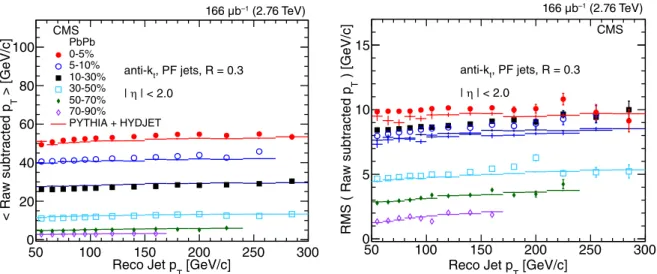
The average raw subtracted pT and its root mean square (RMS) values are shown in Fig. 2
as a function of the reconstructed jet pT, from central to the most peripheral collisions. Data
are shown with markers and are compared with thePYTHIA+HYDJETgenerated events shown as histograms. The average raw subtracted pT decreases, from the most central to peripheral
4 3 Jet reconstruction and selection [GeV/c] T Raw subtracted p 0 50 100 150 Event fraction 3 10 2 10 1 10 1 anti-kt, PF jets, R = 0.3 | < 2.0 | Data MC 70-90% [GeV/c] T Raw subtracted p 0 50 100 150 Event fraction 3 10 2 10 1 10
1 10-30% Raw subtracted pT [GeV/c]
0 50 100 150 Event fraction 3 10 2 10 1 10 1 50-70% < 80 [GeV/c] T 70 < raw p [GeV/c] T Raw subtracted p 0 50 100 150 Event fraction 3 10 2 10 1 10
1 5-10% Raw subtracted pT [GeV/c]
0 50 100 150 Event fraction 3 10 2 10 1 10 1 30-50% CMS [GeV/c] T Raw subtracted p 0 50 100 150 Event fraction 3 10 2 10 1 10 1 0-5% 166 µb–1 (2.76 TeV) [GeV/c] T Raw subtracted p 0 50 100 150 Event fraction 3 10 2 10 1 10 1 anti-kt, PF jets, R = 0.3 | < 2.0 | Data MC 70-90% [GeV/c] T Raw subtracted p 0 50 100 150 Event fraction 3 10 2 10 1 10
1 10-30% Raw subtracted pT [GeV/c]
0 50 100 150 Event fraction 3 10 2 10 1 10 1 50-70% < 130 [GeV/c] T 110 < raw p [GeV/c] T Raw subtracted p 0 50 100 150 Event fraction 3 10 2 10 1 10
1 5-10% Raw subtracted pT [GeV/c]
0 50 100 150 Event fraction 3 10 2 10 1 10 1 30-50% CMS [GeV/c] T Raw subtracted p 0 50 100 150 Event fraction 3 10 2 10 1 10 1 0-5% 166 µb–1 (2.76 TeV)
Figure 1: Raw subtracted pT for jets reconstructed with the anti-kT algorithm and a distance
parameter of R = 0.3, in the ranges 70 < jet pT < 80 [GeV/c] (top panels) and 110 < jet pT <
130 [GeV/c] (bottom panels). This quantity is found by taking the difference of the sum of PF candidates within the jet cone and raw jet pT. Solid symbols show data, and the histogram is
fromPYTHIA+HYDJETgenerated events.
3.1 Data driven correction
Although the soft background is primarily removed with the iterative-pileup subtraction, fluc-tuations in this background can result in misreconstructed jets that do not originate from hard scattering. A method to remove this contamination, used in other experiments [26, 27], is to se-lect jets with a requirement on the leading charged-particle track or calorimeter energy deposit among the constituents of the jet. However, this method can bias to preferentially select jets with hard fragmentation, distorting the low-pTregion. In CMS, tracks are reconstructed with a
minimum pTof 0.15 GeV/c, thus removing any such potential bias.
In this analysis, a novel data-driven technique, based on control regions in data, is introduced to derive the spectrum of misreconstructed jets from the minimum bias sample. This spec-trum is then subtracted from the jet-triggered sample. Two methods, operating in different kinematic regimes, are combined to get a correction factor. The first method (labeled the trig-ger object method) selects all events with a leading HLT jet pTof less than 60 GeV/c as a control
sample potentially containing misreconstructed jets. This pTthreshold is chosen based on
anal-ysis of random cones in minimum bias events, with the leading and subleading jets removed. The second method (labeled the dijet method), performed in parallel with the first method,
[GeV/c] T Reco Jet p 50 100 150 200 250 300 > [GeV/c] T < Raw subtracted p 0 20 40 60 80 100 PbPb0-5% 5-10% 10-30% 30-50% 50-70% 70-90% PYTHIA + HYDJET CMS , PF jets, R = 0.3 t anti-k | < 2.0 | 166 µb–1 (2.76 TeV) [GeV/c] T Reco Jet p 50 100 150 200 250 300 ) [GeV/c] T RMS ( Raw subtracted p 0 5 10 15 CMS , PF jets, R = 0.3 t anti-k | < 2.0 | 166 µb–1 (2.76 TeV)
Figure 2: Average raw subtracted pT(left) and its RMS (right) for PF jets reconstructed with the
anti-kT algorithm, with a distance parameter R=0.3. Symbols represent data, and lines show
PYTHIA+HYDJETsimulated events.
selects minimum bias events with dijets, which can originate either from a hard scattering or fluctuating background. There are two thresholds defined in this method, one for the leading jet (pmin1T ) and another for the subleading jet (pmin2T ) in the reconstructed event. If an event fails any of the following selections, it is tagged as a background event. An event is tagged as a signal if it passes all of the criteria: Leading jet pT > pmin1T and∆φj1,j2 > 2π/3 and
sub-leading jet pT > pmin2T . To choose the thresholds for the dijet selection, the mean and RMS of
the subtraction step in the iterative subtraction algorithm are mimicked by applying a cutoff on the transverse energies of the PF towers used in the random cone study. The RMS of the background subtracted event energy distribution is used as an estimate of the fluctuation. The thresholds are set as follows: pmin1
T = 3 RMS for the leading jet, and pmin2T = 1.8 RMS for the
subleading jet, to allow for jet modification in the medium.
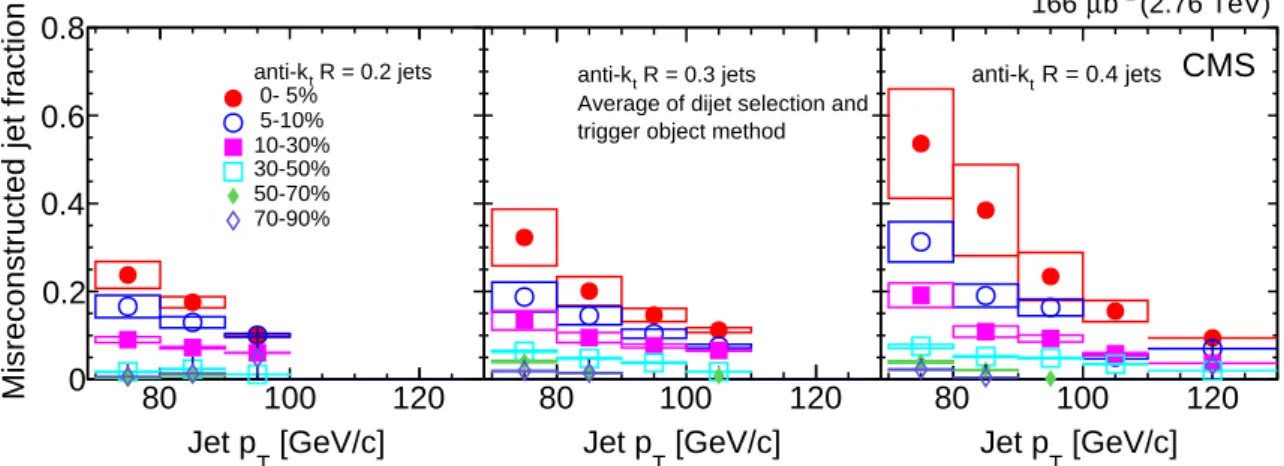
Since these two methods operate in different kinematic regimes, the average of the two is used to estimate the data driven correction factor for misreconstructed jet rates as can be seen in Fig. 3, as a function of the jet pT. These rates for different distance parameters are shown in
the different panels (left: R = 0.2, center: R = 0.3, and right: R = 0.4). The symbols corre-spond to the centrality bins in the analysis. The minimum bias background jet spectra are then normalized to a per-event yield and the background is removed from the measured jet spectra, resulting in an inclusive jet spectrum without fragmentation bias. The correction, estimated in a similar way fromPYTHIAdijet events, where one does not expect any background, is added as an additional systematic uncertainty, ranging from 6% at 70 GeV to 1% at 100 GeV. The data driven method was also applied to PYTHIA+HYDJETsimulations without quenching and, us-ing the same pTthreshold, this yielded a recovery efficiency of greater than 98% for signal jets,
which is well within systematic uncertainties as described in Sec. 4.
3.2 Unfolding studies
An unfolding method is required to remove the smearing and bin migration in jet pT due to
detector resolution, and to extract the jet cross section measurement. Three different techniques are used to determine the final jet pT spectra: Single value decomposition (SVD), Bayesian,
and a bin-by-bin unfolding technique [42–45]. Results presented here are based on the SVD technique, while the others are used as a cross-check, giving consistent results within their
6 4 Systematic uncertainties
[GeV/c]
T
Jet p
80 100 120 Misreconstructed jet fraction 0
0.2 0.4 0.6 0.8 R = 0.2 jets t anti-k 0- 5% 5-10% 10-30% 30-50% 50-70% 70-90% [GeV/c] T Jet p 80 100 120 Misreconstructed jet fraction 0
0.2 0.4 0.6 0.8 R = 0.3 jets t anti-k
Average of dijet selection and trigger object method
[GeV/c]
T
Jet p
80 100 120 Misreconstructed jet fraction 0
0.2 0.4 0.6 0.8 CMS (2.76 TeV) -1 b µ 166 R = 0.4 jets t anti-k
Figure 3: Misreconstructed jet fraction of the inclusive jet spectra, derived from the minimum bias sample, as a function of reconstructed jet pT, for various centralities and three different
distance parameters (left: R= 0.2, center: R= 0.3, and right: R=0.4). The correction factor is the average of the dijet selection and trigger object methods discussed in the text.
respective uncertainties. The three aforementioned procedures use a response matrix from
PYTHIA+HYDJET of reconstructed jets, matched to generator-level jets in the η-φ space, that originate from thePYTHIAQCD hard scattering.
The SVD unfolding is performed with a regularization parameter, which is optimized for each centrality class and each jet resolution. The simulation and data used in unfolding have a reconstructed jet pT larger than 50 GeV/c for all distance parameters, with unfolded results
reported for jets larger than 70 GeV/c.
4
Systematic uncertainties
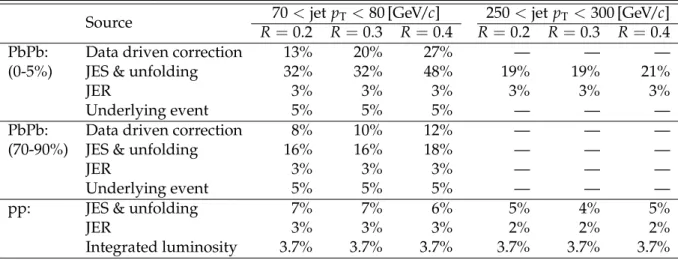
The systematic uncertainty is calculated from a number of sources and is shown in Table 1. For R = 0.3 jets, in the low pT < 80 GeV/c region, a large contribution to the jet yield
uncer-tainty in PbPb collisions is from the data driven corrections (20%). The data driven systematic uncertainty is estimated from the overlap of the two different methods (trigger object and dijet methods as described in Sec. 3.1) along with an additional uncertainty of 1-6% across all jet pT, centrality ranges, and jet distance parameters determined from its application on aPYTHIA
sample. The jet energy scale (JES) uncertainty ranges from 6–32% (from peripheral to central events), varying due to the uncertainty in the heavy ion tracking and the quark/gluon fragmen-tation. The fragmentation difference is included in the JES uncertainty for pp, but is extended for PbPb jets due to expected asymmetric jet quenching effects for quark and gluon jets. The jet response matrix is smeared by 1%, at both the generator and reconstructed levels to account for variations in the simulations. Separately the regularization parameter used for the unfolding is varied between 4 and 8 resulting in at most 8% systematic uncertainty for the PbPb jet yield and at most 2% for the pp jet cross section.
A residual jet energy correction, using the dijet balance method [41], is derived and applied to the jets from pp collisions. It corresponds to less than 1% correction to the jet pT. The jet energy
resolution (JER) uncertainty is estimated for each pT bin in the analysis and is found to be at
most 3%, for both pp and PbPb. Studies of the underlying event fluctuations in jet-triggered and minimum bias events show a contribution of up to 5% to the uncertainty of reconstructed jet yields based on differences between data andPYTHIA+HYDJETquantified in the right side of Fig. 2. The contributions due to jet reconstruction efficiency, detector noise, and unfolding
response matrix smearing are about 1% each.
Since in PbPb, the per-event jet yield is being measured, there is a 3% uncertainty on the num-ber of minimum bias events and there is no uncertainty quoted for the luminosity. For the pp cross section, there is a 3.7% uncertainty in the integrated luminosity [46]. Systematic uncer-tainties, from different contributions to the jet RAA, are summed in quadrature with an overall
uncertainty of 19–40%, from peripheral to central collisions for R=0.3 jets. Detailed systematic uncertainties for different R and two representative jet pTranges are shown in Table 1.
Table 1: Summary of the systematic uncertainties in the PbPb jet yield for the central (0–5%), peripheral (70–90%) bins, and the pp jet cross section. Each column showcases the total sys-tematic uncertainties for the corresponding source for the different R and two jet pT ranges
i.e. 70 < jet pT < 80[GeV/c]and 250 < jet pT < 300 [GeV/c]). The TAAuncertainties are not
shown in the table. Other sources mentioned in the text that are smaller than 1% are not listed explicitly below.
Source 70<jet pT <80 [GeV/c] 250<jet pT<300 [GeV/c]
R=0.2 R=0.3 R=0.4 R=0.2 R=0.3 R=0.4
PbPb: Data driven correction 13% 20% 27% — — —
(0-5%) JES & unfolding 32% 32% 48% 19% 19% 21%
JER 3% 3% 3% 3% 3% 3%
Underlying event 5% 5% 5% — — —
PbPb: Data driven correction 8% 10% 12% — — —
(70-90%) JES & unfolding 16% 16% 18% — — —
JER 3% 3% 3% — — —
Underlying event 5% 5% 5% — — —
pp: JES & unfolding 7% 7% 6% 5% 4% 5%
JER 3% 3% 3% 2% 2% 2%
Integrated luminosity 3.7% 3.7% 3.7% 3.7% 3.7% 3.7%
5
Results
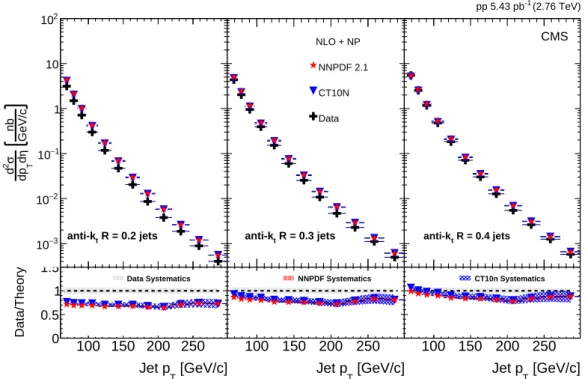
The inclusive jet cross sections in pp collisions at 2.76 TeV are shown in Fig. 4 for three differ-ent distance parameters. A comparison is made to next-to-leading-order (NLO) [47] calcula-tions of quantum chromodynamics. These calculacalcula-tions are shown for two parton distribution functions (PDF) sets: NNPDF 2.1 [48] (red stars), and CT10N [49] (purple triangles) includ-ing non-perturbative (NP) contributions such as multi-parton interactions and hadronization. Contributions to the jet cross section from NP effects are not inherently included in pQCD cal-culations due to a lower scale cutoff of a few GeV/c. Thus, the NP correction factors need to be added and are computed as the ratio of cross sections calculated with leading order (LO) + parton shower (PS) + multi-parton interactions + hadronization to LO+PS [47]. The bottom panel of Fig. 4 shows the ratio of the data for jet cross sections in pp collisions to theoretical calculations, with the measured jet cross section from pp collisions for different distance pa-rameters. The agreement with data gets better at larger distance papa-rameters. In Ref. [50] the ratio tends closer to unity for jets with R=0.7. The theoretical uncertainties shown are due to variations of the strong coupling constant and the parton shower, factorization scales involved in the NLO calculations for the different PDF sets.
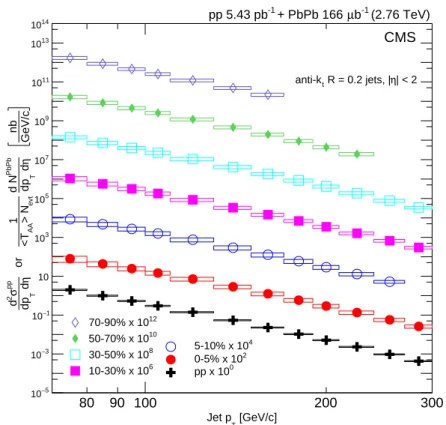
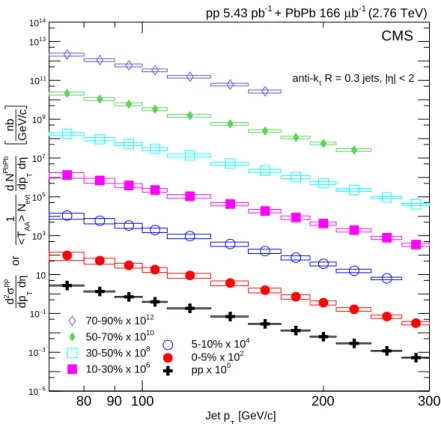
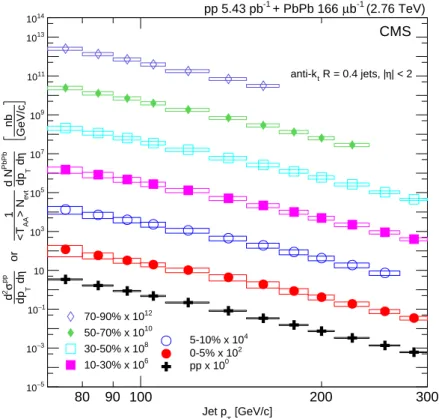
The unfolded jet cross sections for PbPb and pp events are shown in Figs. 5-7 for different dis-tance parameters. The PbPb spectra are normalized by the number of minimum bias events, and are scaled byhTAAi, with each centrality multiplied by a different factor, to separate the
8 5 Results 100 150 200 250 GeV/c nb η d T dp σ 2 d 3 − 10 2 − 10 1 − 10 1 10 2 10 R = 0.2 jets t anti-k [GeV/c] T Jet p 100 150 200 250 Data/Theory 0 0.5 1 1.5 Data Systematics NLO + NP NNPDF 2.1 CT10N Data R = 0.3 jets t anti-k [GeV/c] T Jet p 100 150 200 250 NNPDF Systematics CMS (2.76 TeV) -1 pp 5.43 pb R = 0.4 jets t anti-k [GeV/c] T Jet p 100 150 200 250 CT10n Systematics
Figure 4: Comparison of the inclusive jet cross section for anti-kT jets with distance parameters
of R= 0.2 (left), 0.3 (middle) and 0.4 (right), measured for pp collisions at 2.76 TeV (black plus markers), and NLO calculations, at the same collision energy, with NNPDF 2.1 (red star) and CT10N (blue triangle), with their respective NP corrections added. The bottom panels show the ratio of measured cross section to theory calculations. The systematic uncertainties for data are shown in the gray shaded band, while the systematic uncertainties in the NLO calculations are shown with the respective color shaded bands.
spectra for better visualization. The pp reference data is normalized to the integrated luminos-ity of the analyzed data set. The high pTcutoffs for the spectra (hence also the RAA) are dictated
by statistical limitations.
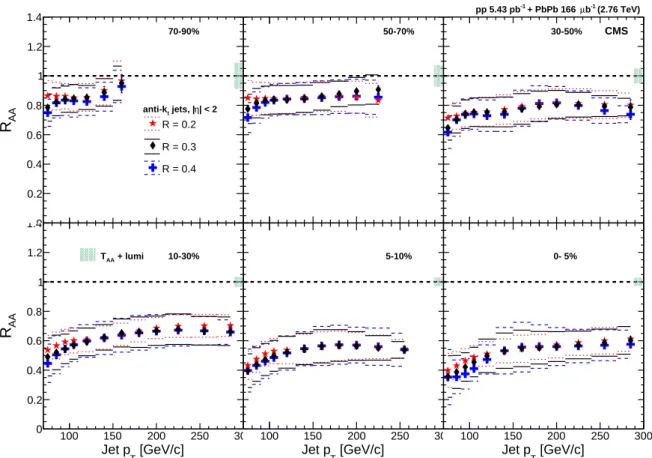
The jet RAA, found from the PbPb and pp spectra after all corrections including SVD unfolding,
are shown for different distance parameters in Fig. 8. The jet RAA decreases with increasing
collision centrality in the range of the measured jet pT. Within the systematic uncertainty, the
jet RAAshows the same level of suppression for the three distance parameters. Uncorrelated
uncertainties remain too large to further elucidate the hierarchy of the jet distance parameter dependence of this RAAmeasurement.
To focus on the centrality dependence of the jet RAA, two ranges of jet pT are selected and the
corresponding jet RAAvalues are plotted as a function of the average number of participants
(Npart) in Fig. 9, for jets of 80< pT <90 and 130< pT<150 GeV/c. The systematic uncertainty
is shown in the three bounds of lines for R=0.2 (dotted), 0.3 (solid), and 0.4 (dashed) jets. The jet RAAshows a clear trend of increasing suppression as the number of participants in the PbPb
collision increases. Overall, in the kinematic range explored, the RAAshow the same level of
suppression across the three distance parameters.
An experimental comparison of inclusive anti-kT jet RAAfor 0-10% centrality is shown in Fig. 10
(left panel for anti-kT jets with distance parameter R= 0.2 for ALICE [27] and the right panel
with R=0.4 for ATLAS [26]). Uncertainties are represented by the vertical bars for the statisti-cal and boxes for the systematic uncertainties. The TAAand luminosity uncertainty are shown
[GeV/c] T Jet p 80 90 100 200 300 GeV/c nb η d T dp PbPb d N evt > N AA <T 1 or η d T dp pp σ 2 d 5 − 10 3 − 10 1 − 10 10 3 10 5 10 7 10 9 10 11 10 13 10 14 10 | < 2 η R = 0.2 jets, | t anti-k 12 70-90% x 10 10 50-70% x 10 8 30-50% x 10 6 10-30% x 10 4 5-10% x 10 2 0-5% x 10 0 pp x 10 CMS (2.76 TeV) -1 b µ + PbPb 166 -1 pp 5.43 pb
Figure 5: Inclusive jet spectra for PbPb jets of distance parameter R=0.2, in different centrality bins, and pp reference data. The PbPb jet spectra for different centrality classes are scaled by hTAAi and multiplied by a different factor for better visualization. Vertical bars represent
statistical uncertainty (too small to see on this scale) with the systematical uncertainty in the colored boxes around the data points.
by the boxes at unity. The collection of jets for the jet RAAcalculation in these experiments
dif-fer, especially for lower jet pT, due to the techniques employed to remove or correct the jets that
did not originate in a hard scattering but that are purely due to the fluctuations in the heavy-ion underlying event. Some, but not all of the key differences are described here, for more, see ALICE [27], ATLAS [26] and [51] for a review. ALICE requires the leading track constituent of the jet to have pT > 5 GeV/c and constrains R = 0.2 jets to be within |η| < 0.9. ATLAS
requires its R = 0.4 jets in |y| < 2.1 to have a track jet with pT > 7 GeV/c or a calorimeter
cluster with pT >8 GeV/c within∆R=0.2. While ALICE doesn’t apply any correction on this
constituent selection, ATLAS corrects for the missing jets due to this selection with correction factors estimated byPYTHIA. In this analysis, as described in Sec.3.1, a data-driven background subtraction is introduced and all jets which are using tracks down to a pTof 0.15 GeV/c and
cal-orimeter deposits down to a ET of 1 GeV are included in the jet RAA calculation. Within the
current precision of jet RAA measurements, there is a good agreement in the overlapping pT
ranges despite the fact that the measured jet collections differ between experiments.
6
Summary
The cross section of anti-kT particle-flow jets has been measured in pp and PbPb collisions at √
sNN = 2.76 TeV for distance parameters R = 0.2, 0.3, and 0.4 in|η| < 2 and for jet pT above
10 6 Summary [GeV/c] T Jet p 80 90 100 200 300 GeV/c nb η d T dp PbPb d N evt > N AA <T 1 or η d T dp pp σ 2 d 5 − 10 3 − 10 1 − 10 10 3 10 5 10 7 10 9 10 11 10 13 10 14 10 | < 2 η R = 0.3 jets, | t anti-k 12 70-90% x 10 10 50-70% x 10 8 30-50% x 10 6 10-30% x 10 4 5-10% x 10 2 0-5% x 10 0 pp x 10 CMS (2.76 TeV) -1 b µ + PbPb 166 -1 pp 5.43 pb
Figure 6: Inclusive jet spectra for PbPb jets of distance parameter R=0.3, in different centrality bins, and pp reference data. The PbPb jet spectra for different centrality classes are scaled by hTAAi and multiplied by a different factor for better visualization. Vertical bars represent
statistical uncertainty (too small to see on this scale) with the systematical uncertainty in the colored boxes around the data points.
over predict the pp cross sections, with a smaller discrepancy for larger distance parameters. The PbPb inclusive jet nuclear modification factors show a steady decrease from peripheral to central events, with a slight rise with jet pT. No significant dependence of the jet nuclear
mod-ification factor on the distance parameter is found for the jets in the kinematic range measured in this analysis.
[GeV/c] T Jet p 80 90 100 200 300 GeV/c nb η d T dp PbPb d N evt > N AA <T 1 or η d T dp pp σ 2 d 5 − 10 3 − 10 1 − 10 10 3 10 5 10 7 10 9 10 11 10 13 10 14 10 | < 2 η R = 0.4 jets, | t anti-k 12 70-90% x 10 10 50-70% x 10 8 30-50% x 10 6 10-30% x 10 4 5-10% x 10 2 0-5% x 10 0 pp x 10 CMS (2.76 TeV) -1 b µ + PbPb 166 -1 pp 5.43 pb
Figure 7: Inclusive jet spectra for PbPb jets of distance parameter R=0.4, in different centrality bins, and pp reference data. The PbPb jet spectra for different centrality classes are scaled by hTAAi and multiplied by a different factor for better visualization. Vertical bars represent
statistical uncertainty (too small to see on this scale) with the systematical uncertainty in the colored boxes around the data points.
12 6 Summary [GeV/c] T Jet p 100 150 200 250 300 AA R 0 0.2 0.4 0.6 0.8 1 1.2 1.4 70-90% | < 2 η jets, | t anti-k R = 0.2 R = 0.3 R = 0.4 [GeV/c] T Jet p 100 150 200 250 300 AA R 0 0.2 0.4 0.6 0.8 1 1.2 1.4 10-30% + lumi AA T [GeV/c] T Jet p 100 150 200 250 300 AA R 0 0.2 0.4 0.6 0.8 1 1.2 1.4 50-70% [GeV/c] T Jet p 100 150 200 250 300 AA R 0 0.2 0.4 0.6 0.8 1 1.2 1.4 5-10% [GeV/c] T Jet p 100 150 200 250 300 AA R 0 0.2 0.4 0.6 0.8 1 1.2 1.4 30-50% (2.76 TeV) -1 b µ + PbPb 166 -1 pp 5.43 pb CMS [GeV/c] T Jet p 100 150 200 250 300 AA R 0 0.2 0.4 0.6 0.8 1 1.2 1.4 0- 5%
Figure 8: Inclusive jet RAAas a function of the jet pT, for anti-kT jets with distance parameters
R=0.2 (red stars), 0.3 (black diamonds), and 0.4 (blue crosses) for different centrality bins. The vertical bars (smaller than the markers) indicate the statistical uncertainty and the systematic uncertainty is represented by the bounds of the dotted, solid, and dashed horizontal lines. The uncertainty boxes at unity represent the TAAand luminosity uncertainty.
part N 0 100 200 300 400 AA R 0 0.2 0.4 0.6 0.8 1 1.2 1.4 1.6 < 90 [GeV/c] T 80 < Jet p R = 0.2 R = 0.3 R = 0.4 + lumi AA T | < 2 η jets, | t anti-k CMS (2.76 TeV) -1 b µ + PbPb 166 -1 pp 5.43 pb part N 0 100 200 300 400 AA R 0 0.2 0.4 0.6 0.8 1 1.2 1.4 1.6 < 150 [GeV/c] T 130 < Jet p R = 0.2 R = 0.3 R = 0.4 + lumi AA T | < 2 η jets, | t anti-k CMS (2.76 TeV) -1 b µ + PbPb 166 -1 pp 5.43 pb
Figure 9: Inclusive jet RAA for anti-kT jets with distance parameters R = 0.2 (red stars), 0.3
(black diamonds), and 0.4 (blue crosses), as a function of the average Npart for each collision
centrality, for jets of 80 < pT < 90 and 130 < pT < 150[GeV/c], in the left and right panels
respectively. Points are shifted to the left (R=0.2) and right (R=0.4) for clarity. The statistical uncertainty is indicated by colored vertical lines (smaller than the markers). The systematic uncertainty is represented by the bounds of the dotted, solid, and dashed horizontal lines for the corresponding distance parameters. The uncertainty boxes at unity represent the TAAand
[GeV/c]
TJet p
100
200
300
AAR
0
0.2
0.4
0.6
0.8
1
1.2
1.4
1.6
+ L AA T R = 0.2 t anti-k | < 2.0 η CMS Jets, | | < 0.5 η w/o PYTHIA Correction, |> 5 GeV/c; lead,ch T ALICE Jets, p
[GeV/c]
TJet p
100
200
300
400
AAR
0
0.2
0.4
0.6
0.8
1
1.2
1.4
1.6
+ L AA T LHC PbPb (0-10%) 2.76 TeV R = 0.4 t anti-k | < 2.0 η CMS Jets, |with PYTHIA Correction, |y| < 2.1 > 7/8 GeV/c;
trk-jet/neut T
ATLAS Jets, p
Figure 10: Left Panel: Inclusive jet RAA as a function of the jet pT, for anti-kT jets with
dis-tance parameter R = 0.2 in the 0%–10% centrality bin for CMS (closed circles) and ALICE (pluses) [27]. Right Panel: Inclusive jet RAA as a function of the jet pT, for anti-kT jets with
distance parameter R = 0.4 in the 0%–10% centrality bin for CMS (closed circles) and ATLAS (diamonds) [26]. The vertical bars indicate the statistical uncertainty. The systematic uncer-tainty is represented by the bounds of the boxes. The unceruncer-tainty boxes at unity represent the TAAand luminosity uncertainty, open for CMS and shaded for ALICE and ATLAS. See text for
14 References
Acknowledgments
We congratulate our colleagues in the CERN accelerator departments for the excellent perfor-mance of the LHC and thank the technical and administrative staffs at CERN and at other CMS institutes for their contributions to the success of the CMS effort. In addition, we gratefully acknowledge the computing centers and personnel of the Worldwide LHC Computing Grid for delivering so effectively the computing infrastructure essential to our analyses. Finally, we acknowledge the enduring support for the construction and operation of the LHC and the CMS detector provided by the following funding agencies: BMWFW and FWF (Austria); FNRS and FWO (Belgium); CNPq, CAPES, FAPERJ, and FAPESP (Brazil); MES (Bulgaria); CERN; CAS, MoST, and NSFC (China); COLCIENCIAS (Colombia); MSES and CSF (Croatia); RPF (Cyprus); SENESCYT (Ecuador); MoER, ERC IUT and ERDF (Estonia); Academy of Finland, MEC, and HIP (Finland); CEA and CNRS/IN2P3 (France); BMBF, DFG, and HGF (Germany); GSRT (Greece); OTKA and NIH (Hungary); DAE and DST (India); IPM (Iran); SFI (Ireland); INFN (Italy); MSIP and NRF (Republic of Korea); LAS (Lithuania); MOE and UM (Malaysia); BUAP, CINVESTAV, CONACYT, LNS, SEP, and UASLP-FAI (Mexico); MBIE (New Zealand); PAEC (Pakistan); MSHE and NSC (Poland); FCT (Portugal); JINR (Dubna); MON, RosAtom, RAS and RFBR (Russia); MESTD (Serbia); SEIDI and CPAN (Spain); Swiss Funding Agencies (Switzerland); MST (Taipei); ThEPCenter, IPST, STAR and NSTDA (Thailand); TUBITAK and TAEK (Turkey); NASU and SFFR (Ukraine); STFC (United Kingdom); DOE and NSF (USA). Individuals have received support from the Marie-Curie program and the European Research Council and EPLANET (European Union); the Leventis Foundation; the A. P. Sloan Founda-tion; the Alexander von Humboldt FoundaFounda-tion; the Belgian Federal Science Policy Office; the Fonds pour la Formation `a la Recherche dans l’Industrie et dans l’Agriculture (FRIA-Belgium); the Agentschap voor Innovatie door Wetenschap en Technologie (IWT-Belgium); the Ministry of Education, Youth and Sports (MEYS) of the Czech Republic; the Council of Science and In-dustrial Research, India; the HOMING PLUS program of the Foundation for Polish Science, cofinanced from European Union, Regional Development Fund, the Mobility Plus program of the Ministry of Science and Higher Education, the National Science Center (Poland), contracts Harmonia 2014/14/M/ST2/00428, Opus 2013/11/B/ST2/04202, 2014/13/B/ST2/02543 and 2014/15/B/ST2/03998, Sonata-bis 2012/07/E/ST2/01406; the Thalis and Aristeia programs cofinanced by EU-ESF and the Greek NSRF; the National Priorities Research Program by Qatar National Research Fund; the Programa Clar´ın-COFUND del Principado de Asturias; the Rachadapisek Sompot Fund for Postdoctoral Fellowship, Chulalongkorn University and the Chulalongkorn Academic into Its 2nd Century Project Advancement Project (Thailand); and the Welch Foundation, contract C-1845.
References
[1] M. Gyulassy and M. Pl ¨umer, “Jet quenching in dense matter”, Phys. Lett. B 243 (1990) 432, doi:10.1016/0370-2693(90)91409-5.
[2] X.-N. Wang, “Simulations of ultrarelativistic heavy ion collisions”, in Proceedings, 26th International Conference on High-energy Physics (ICHEP 92), p. 1812. Dallas, Texas, USA, August, 1992.
[3] U. A. Wiedemann, “Jet quenching in heavy ion collisions”, in Springer Materials - The Landolt-B¨ornstein Database, R. Stock, ed., volume 23: Relativistic Heavy Ion Physics, p. 521. Springer-Verlag, 2010. arXiv:0908.2306. doi:10.1007/978-3-642-01539-7_17.
[4] J. D. Bjorken, “Energy loss of energetic partons in QGP: possible extinction of high pTjets
in hadron-hadron collisions”, FERMILAB-PUB-82-059-THY, 1982.
[5] PHENIX Collaboration, “Formation of dense partonic matter in relativistic nucleus nucleus collisions at RHIC: Experimental evaluation by the PHENIX collaboration”, Nucl. Phys. A 757 (2005) 184, doi:10.1016/j.nuclphysa.2005.03.086, arXiv:nucl-ex/0410003.
[6] STAR Collaboration, “Experimental and theoretical challenges in the search for the quark gluon plasma: The STAR collaboration’s critical assessment of the evidence from RHIC collisions”, Nucl. Phys. A 757 (2005) 102,
doi:10.1016/j.nuclphysa.2005.03.085, arXiv:nucl-ex/0501009.
[7] PHOBOS Collaboration, “The PHOBOS perspective on discoveries at RHIC”, Nucl. Phys. A 757 (2005) 28, doi:10.1016/j.nuclphysa.2005.03.084,
arXiv:nucl-ex/0410022.
[8] BRAHMS Collaboration, “Quark gluon plasma and color glass condensate at RHIC? The perspective from the BRAHMS experiment”, Nucl. Phys. A 757 (2005) 1,
doi:10.1016/j.nuclphysa.2005.02.130, arXiv:nucl-ex/0410020.
[9] CMS Collaboration, “Study of high-pTcharged particle suppression in PbPb compared to
pp collisions at√sNN =2.76 TeV”, Eur. Phys. J. C 72 (2012) 1945, doi:10.1140/epjc/s10052-012-1945-x, arXiv:1202.2554.
[10] ALICE Collaboration, “Suppression of charged particle production at large transverse momentum in central Pb–Pb collisions at√sNN =2.76 TeV”, Phys. Lett. B 696 (2011) 30, doi:10.1016/j.physletb.2010.12.020, arXiv:1012.1004.
[11] ATLAS Collaboration, “Measurement of charged-particle spectra in Pb+Pb collisions at√ sNN =2.76 TeV with the ATLAS detector at the LHC”, JHEP 09 (2015) 050,
doi:10.1007/JHEP09(2015)050, arXiv:1504.04337.
[12] J. Casalderrey-Solana and C. A. Salgado, “Introductory lectures on jet quenching in heavy ion collisions”, Acta Phys. Polon. B 38 (2007) 3731, arXiv:0712.3443. [13] D. d’Enterria, “Jet quenching”, in Springer Materials - The Landolt-B¨ornstein Database,
R. Stock, ed., volume 23: Relativistic Heavy Ion Physics, p. 99. Springer-Verlag, 2010. arXiv:0902.2011. doi:10.1007/978-3-642-01539-7_16.
[14] S. A. Bass et al., “Systematic comparison of jet energy-loss schemes in a realistic hydrodynamic medium”, Phys. Rev. C 79 (2009) 024901,
doi:10.1103/PhysRevC.79.024901, arXiv:0808.0908.
[15] JET Collaboration, “Extracting the jet transport coefficient from jet quenching in high-energy heavy-ion collisions”, Phys. Rev. C 90 (2014) 014909,
doi:10.1103/PhysRevC.90.014909, arXiv:1312.5003.
[16] ATLAS Collaboration, “Observation of a Centrality-Dependent Dijet Asymmetry in Lead-Lead Collisions at√sNN =2.77 TeV with the ATLAS Detector at the LHC”, Phys. Rev. Lett. 105 (2010) 252303, doi:10.1103/PhysRevLett.105.252303,
16 References
[17] CMS Collaboration, “Observation and studies of jet quenching in PbPb collisions at nucleon-nucleon center-of-mass energy = 2.76 TeV”, Phys. Rev. C 84 (2011) 024906, doi:10.1103/PhysRevC.84.024906, arXiv:1102.1957.
[18] CMS Collaboration, “Jet momentum dependence of jet quenching in PbPb collisions at√ sNN =2.76 TeV”, Phys. Lett. B 712 (2012) 176,
doi:10.1016/j.physletb.2012.04.058, arXiv:1202.5022.
[19] CMS Collaboration, “Modification of jet shapes in PbPb collisions at√sNN =2.76 TeV”, Phys. Lett. B 730 (2014) 243, doi:10.1016/j.physletb.2014.01.042,
arXiv:1310.0878.
[20] CMS Collaboration, “Measurement of jet fragmentation in PbPb and pp collisions at√ sNN =2.76 TeV”, Phys. Rev. C 90 (2014) 024908,
doi:10.1103/PhysRevC.90.024908, arXiv:1406.0932.
[21] CMS Collaboration, “Measurement of transverse momentum relative to dijet systems in PbPb and pp collisions at√sNN =2.76 TeV”, JHEP 01 (2016) 006,
doi:10.1007/JHEP01(2016)006, arXiv:1509.09029.
[22] CMS Collaboration, “Correlations between jets and charged particles in PbPb and pp collisions at√sNN =2.76 TeV”, JHEP 02 (2016) 156,
doi:10.1007/JHEP02(2016)156, arXiv:1601.00079.
[23] A. Majumder, “A comparative study of jet-quenching schemes”, J. Phys. G 34 (2007) S377, doi:10.1088/0954-3899/34/8/S25, arXiv:nucl-th/0702066.
[24] J. Casalderrey-Solana, D. Pablos, and K. Tywoniuk, “Two-gluon emission and
interference in a thin QCD medium: insights into jet formation”, JHEP 11 (2016) 174, doi:10.1007/JHEP11(2016)174, arXiv:1512.07561.
[25] Y.-T. Chien and I. Vitev, “Towards the understanding of jet shapes and cross sections in heavy ion collisions using soft-collinear effective theory”, JHEP 05 (2016) 023,
doi:10.1007/JHEP05(2016)023, arXiv:1509.07257.
[26] ATLAS Collaboration, “Measurements of the Nuclear Modification Factor for Jets in Pb+Pb Collisions at√sNN =2.76 TeV with the ATLAS Detector”, Phys. Rev. Lett. 114 (2015) 072302, doi:10.1103/PhysRevLett.114.072302, arXiv:1411.2357. [27] ALICE Collaboration, “Measurement of jet suppression in central Pb-Pb collisions at√
sNN =2.76 TeV”, Phys. Lett. B 746 (2015) 1,
doi:10.1016/j.physletb.2015.04.039, arXiv:1502.01689.
[28] CMS Collaboration, “Measurement of inclusive jet production and nuclear modifications in pPb collisions at√sNN = 5.02 TeV”, Eur. Phys. J. C 76 (2016) 372,
doi:10.1140/epjc/s10052-016-4205-7, arXiv:1601.02001.
[29] ALICE Collaboration, “Measurement of charged jet production cross sections and nuclear modification in p-Pb collisions at√sNN =5.02 TeV”, Phys. Lett. B 749 (2015) 68, doi:10.1016/j.physletb.2015.07.054, arXiv:1503.00681.
[30] ATLAS Collaboration, “Centrality and rapidity dependence of inclusive jet production in√ sNN =5.02 TeV proton-lead collisions with the ATLAS detector”, Phys. Lett. B 748 (2015) 392, doi:10.1016/j.physletb.2015.07.023, arXiv:1412.4092.
[31] M. Cacciari, G. P. Salam, and G. Soyez, “FastJet user manual”, Eur. Phys. J. C 72 (2012) 1896, doi:10.1140/epjc/s10052-012-1896-2, arXiv:1111.6097.
[32] M. L. Miller, K. Reygers, S. J. Sanders, and P. Steinberg, “Glauber modeling in high energy nuclear collisions”, Ann. Rev. Nucl. Part. Sci. 57 (2007) 205,
doi:10.1146/annurev.nucl.57.090506.123020, arXiv:nucl-ex/0701025. [33] CMS Collaboration, “The CMS experiment at the CERN LHC”, JINST 3 (2008) S08004,
doi:10.1088/1748-0221/3/08/S08004.
[34] CMS Collaboration, “Performance of jet algorithms in CMS”, CMS Physics Analysis Summary CMS-PAS-JME-07-003, 2007.
[35] O. Kodolova, I. Vardanian, A. Nikitenko, and A. Oulianov, “The performance of the jet identification and reconstruction in heavy ions collisions with CMS detector”, Eur. Phys. J. C 50 (2007) 117, doi:10.1140/epjc/s10052-007-0223-9.
[36] T. Sj ¨ostrand, S. Mrenna, and P. Skands, “PYTHIA 6.4 physics and manual”, JHEP 05 (2006) 026, doi:10.1088/1126-6708/2006/05/026, arXiv:hep-ph/0603175. [37] I. P. Lokhtin and A. M. Snigirev, “A model of jet quenching in ultrarelativistic heavy ion
collisions and high-pT hadron spectra at RHIC”, Eur. Phys. J. C 45 (2006) 211,
doi:10.1140/epjc/s2005-02426-3, arXiv:hep-ph/0506189.
[38] CMS Collaboration, “Studies of jet quenching using isolated-photon+jet correlations in PbPb and pp collisions at√sNN =2.76 TeV”, Phys. Lett. B 718 (2013) 773,
doi:10.1016/j.physletb.2012.11.003, arXiv:1205.0206.
[39] CMS Collaboration, “Particle-flow event reconstruction in cms and performance for jets, taus, and met”, CMS Physics Analysis Summary CMS-PAS-PFT-09-001, 2009.
[40] CMS Collaboration, “Commissioning of the Particle-flow Event Reconstruction with the first LHC collisions recorded in the CMS detector”, CMS Physics Analysis Summary CMS-PAS-PFT-10-001, 2010.
[41] CMS Collaboration, “Determination of jet energy calibration and transverse momentum resolution in CMS”, JINST 6 (2011) P11002,
doi:10.1088/1748-0221/6/11/P11002, arXiv:1107.4277.
[42] L. Eld´en, “A weighted pseudoinverse, generalized singular values, and constrained least squares problems”, BIT Numer. Math. 22 (1982) 487, doi:10.1007/BF01934412. [43] G. D’Agostini, “A multidimensional unfolding method based on Bayes’ theorem”, Nucl.
Instrum. Meth. A 362 (1995) 487, doi:10.1016/0168-9002(95)00274-X.
[44] P. C. Hansen, “Rank-Deficient and Discrete Ill-Posed Problems: Numerical Aspects of Linear Inversion”. SIAM, Philadelphia, PA, 1998. doi:10.1137/1.9780898719697, ISBN 978-0898714036.
[45] T. Adye, “Unfolding algorithms and tests using RooUnfold”, in Proceedings, PHYSTAT 2011 Workshop on Statistical Issues Related to Discovery Claims in Search Experiments and Unfolding, CERN,Geneva, Switzerland 17-20 January 2011, pp. 313–318, CERN. CERN, Geneva, 2011. arXiv:1105.1160. doi:10.5170/CERN-2011-006.313.
18 References
[46] CMS Collaboration, “Luminosity calibration for the 2013 proton-lead and proton-proton data taking”, CMS Physics Analysis Summary CMS-PAS-LUM-13-002, 2013.
[47] fastNLO Collaboration, “Theory-Data Comparisons for Jet Measurements in Hadron-Induced Processes”, (2011). arXiv:1109.1310.
[48] NNPDF Collaboration, “Parton distributions with LHC data”, Nucl. Phys. B 867 (2013) 244, doi:10.1016/j.nuclphysb.2012.10.003, arXiv:1207.1303.
[49] J. Gao et al., “CT10 next-to-next-to-leading order global analysis of QCD”, Phys. Rev. D 89(2014) 033009, doi:10.1103/PhysRevD.89.033009, arXiv:1302.6246. [50] CMS Collaboration, “Measurement of the inclusive jet cross section in pp collisions at√
s =2.76 TeV”, Eur. Phys. J. C 76 (2016) 265,
doi:10.1140/epjc/s10052-016-4083-z, arXiv:1512.06212.
[51] M. Connors, C. Nattrass, R. Reed, and S. Salur, “Review of Jet Measurements in Heavy Ion Collisions”, arXiv:1705.01974.
A
The CMS Collaboration
Yerevan Physics Institute, Yerevan, Armenia V. Khachatryan, A.M. Sirunyan, A. Tumasyan Institut f ¨ur Hochenergiephysik, Wien, Austria
W. Adam, E. Asilar, T. Bergauer, J. Brandstetter, E. Brondolin, M. Dragicevic, J. Er ¨o, M. Flechl, M. Friedl, R. Fr ¨uhwirth1, V.M. Ghete, C. Hartl, N. H ¨ormann, J. Hrubec, M. Jeitler1, A. K ¨onig, I. Kr¨atschmer, D. Liko, T. Matsushita, I. Mikulec, D. Rabady, N. Rad, B. Rahbaran, H. Rohringer, J. Schieck1, J. Strauss, W. Waltenberger, C.-E. Wulz1
National Centre for Particle and High Energy Physics, Minsk, Belarus V. Mossolov, N. Shumeiko, J. Suarez Gonzalez
Universiteit Antwerpen, Antwerpen, Belgium
S. Alderweireldt, E.A. De Wolf, X. Janssen, J. Lauwers, M. Van De Klundert, H. Van Haevermaet, P. Van Mechelen, N. Van Remortel, A. Van Spilbeeck
Vrije Universiteit Brussel, Brussel, Belgium
S. Abu Zeid, F. Blekman, J. D’Hondt, N. Daci, I. De Bruyn, K. Deroover, N. Heracleous, S. Lowette, S. Moortgat, L. Moreels, A. Olbrechts, Q. Python, S. Tavernier, W. Van Doninck, P. Van Mulders, I. Van Parijs
Universit´e Libre de Bruxelles, Bruxelles, Belgium
H. Brun, C. Caillol, B. Clerbaux, G. De Lentdecker, H. Delannoy, G. Fasanella, L. Favart, R. Goldouzian, A. Grebenyuk, G. Karapostoli, T. Lenzi, A. L´eonard, J. Luetic, T. Maerschalk, A. Marinov, A. Randle-conde, T. Seva, C. Vander Velde, P. Vanlaer, R. Yonamine, F. Zenoni, F. Zhang2
Ghent University, Ghent, Belgium
A. Cimmino, T. Cornelis, D. Dobur, A. Fagot, G. Garcia, M. Gul, D. Poyraz, S. Salva, R. Sch ¨ofbeck, A. Sharma, M. Tytgat, W. Van Driessche, E. Yazgan, N. Zaganidis
Universit´e Catholique de Louvain, Louvain-la-Neuve, Belgium
H. Bakhshiansohi, C. Beluffi3, O. Bondu, S. Brochet, G. Bruno, A. Caudron, S. De Visscher, C. Delaere, M. Delcourt, B. Francois, A. Giammanco, A. Jafari, P. Jez, M. Komm, V. Lemaitre, A. Magitteri, A. Mertens, M. Musich, C. Nuttens, K. Piotrzkowski, L. Quertenmont, M. Selvaggi, M. Vidal Marono, S. Wertz
Universit´e de Mons, Mons, Belgium N. Beliy
Centro Brasileiro de Pesquisas Fisicas, Rio de Janeiro, Brazil
W.L. Ald´a J ´unior, F.L. Alves, G.A. Alves, L. Brito, C. Hensel, A. Moraes, M.E. Pol, P. Rebello Teles
Universidade do Estado do Rio de Janeiro, Rio de Janeiro, Brazil
E. Belchior Batista Das Chagas, W. Carvalho, J. Chinellato4, A. Cust ´odio, E.M. Da Costa,
G.G. Da Silveira5, D. De Jesus Damiao, C. De Oliveira Martins, S. Fonseca De Souza, L.M. Huertas Guativa, H. Malbouisson, D. Matos Figueiredo, C. Mora Herrera, L. Mundim, H. Nogima, W.L. Prado Da Silva, A. Santoro, A. Sznajder, E.J. Tonelli Manganote4, A. Vilela Pereira
Universidade Estadual Paulistaa, Universidade Federal do ABCb, S˜ao Paulo, Brazil
20 A The CMS Collaboration
P.G. Mercadanteb, C.S. Moona, S.F. Novaesa, Sandra S. Padulaa, D. Romero Abadb, J.C. Ruiz Vargas
Institute for Nuclear Research and Nuclear Energy, Sofia, Bulgaria
A. Aleksandrov, R. Hadjiiska, P. Iaydjiev, M. Rodozov, S. Stoykova, G. Sultanov, M. Vutova University of Sofia, Sofia, Bulgaria
A. Dimitrov, I. Glushkov, L. Litov, B. Pavlov, P. Petkov Beihang University, Beijing, China
W. Fang6
Institute of High Energy Physics, Beijing, China
M. Ahmad, J.G. Bian, G.M. Chen, H.S. Chen, M. Chen, Y. Chen7, T. Cheng, C.H. Jiang, D. Leggat, Z. Liu, F. Romeo, S.M. Shaheen, A. Spiezia, J. Tao, C. Wang, Z. Wang, H. Zhang, J. Zhao
State Key Laboratory of Nuclear Physics and Technology, Peking University, Beijing, China Y. Ban, G. Chen, Q. Li, S. Liu, Y. Mao, S.J. Qian, D. Wang, Z. Xu
Universidad de Los Andes, Bogota, Colombia
C. Avila, A. Cabrera, L.F. Chaparro Sierra, C. Florez, J.P. Gomez, C.F. Gonz´alez Hern´andez, J.D. Ruiz Alvarez, J.C. Sanabria
University of Split, Faculty of Electrical Engineering, Mechanical Engineering and Naval Architecture, Split, Croatia
N. Godinovic, D. Lelas, I. Puljak, P.M. Ribeiro Cipriano, T. Sculac University of Split, Faculty of Science, Split, Croatia
Z. Antunovic, M. Kovac
Institute Rudjer Boskovic, Zagreb, Croatia
V. Brigljevic, D. Ferencek, K. Kadija, S. Micanovic, L. Sudic, T. Susa University of Cyprus, Nicosia, Cyprus
A. Attikis, G. Mavromanolakis, J. Mousa, C. Nicolaou, F. Ptochos, P.A. Razis, H. Rykaczewski Charles University, Prague, Czech Republic
M. Finger8, M. Finger Jr.8
Universidad San Francisco de Quito, Quito, Ecuador E. Carrera Jarrin
Academy of Scientific Research and Technology of the Arab Republic of Egypt, Egyptian Network of High Energy Physics, Cairo, Egypt
E. El-khateeb9, S. Elgammal10, A. Mohamed11
National Institute of Chemical Physics and Biophysics, Tallinn, Estonia B. Calpas, M. Kadastik, M. Murumaa, L. Perrini, M. Raidal, A. Tiko, C. Veelken Department of Physics, University of Helsinki, Helsinki, Finland
P. Eerola, J. Pekkanen, M. Voutilainen
Helsinki Institute of Physics, Helsinki, Finland
J. H¨ark ¨onen, V. Karim¨aki, R. Kinnunen, T. Lamp´en, K. Lassila-Perini, S. Lehti, T. Lind´en, P. Luukka, J. Tuominiemi, E. Tuovinen, L. Wendland
Lappeenranta University of Technology, Lappeenranta, Finland J. Talvitie, T. Tuuva
IRFU, CEA, Universit´e Paris-Saclay, Gif-sur-Yvette, France
M. Besancon, F. Couderc, M. Dejardin, D. Denegri, B. Fabbro, J.L. Faure, C. Favaro, F. Ferri, S. Ganjour, S. Ghosh, A. Givernaud, P. Gras, G. Hamel de Monchenault, P. Jarry, I. Kucher, E. Locci, M. Machet, J. Malcles, J. Rander, A. Rosowsky, M. Titov, A. Zghiche
Laboratoire Leprince-Ringuet, Ecole Polytechnique, IN2P3-CNRS, Palaiseau, France
A. Abdulsalam, I. Antropov, S. Baffioni, F. Beaudette, P. Busson, L. Cadamuro, E. Chapon, C. Charlot, O. Davignon, R. Granier de Cassagnac, M. Jo, S. Lisniak, P. Min´e, M. Nguyen, C. Ochando, G. Ortona, P. Paganini, P. Pigard, S. Regnard, R. Salerno, Y. Sirois, T. Strebler, Y. Yilmaz, A. Zabi
Institut Pluridisciplinaire Hubert Curien, Universit´e de Strasbourg, Universit´e de Haute Alsace Mulhouse, CNRS/IN2P3, Strasbourg, France
J.-L. Agram12, J. Andrea, A. Aubin, D. Bloch, J.-M. Brom, M. Buttignol, E.C. Chabert, N. Chanon, C. Collard, E. Conte12, X. Coubez, J.-C. Fontaine12, D. Gel´e, U. Goerlach, A.-C. Le Bihan, K. Skovpen, P. Van Hove
Centre de Calcul de l’Institut National de Physique Nucleaire et de Physique des Particules, CNRS/IN2P3, Villeurbanne, France
S. Gadrat
Universit´e de Lyon, Universit´e Claude Bernard Lyon 1, CNRS-IN2P3, Institut de Physique Nucl´eaire de Lyon, Villeurbanne, France
S. Beauceron, C. Bernet, G. Boudoul, E. Bouvier, C.A. Carrillo Montoya, R. Chierici, D. Contardo, B. Courbon, P. Depasse, H. El Mamouni, J. Fan, J. Fay, S. Gascon, M. Gouzevitch, G. Grenier, B. Ille, F. Lagarde, I.B. Laktineh, M. Lethuillier, L. Mirabito, A.L. Pequegnot, S. Perries, A. Popov13, D. Sabes, V. Sordini, M. Vander Donckt, P. Verdier, S. Viret
Georgian Technical University, Tbilisi, Georgia A. Khvedelidze8
Tbilisi State University, Tbilisi, Georgia Z. Tsamalaidze8
RWTH Aachen University, I. Physikalisches Institut, Aachen, Germany
C. Autermann, S. Beranek, L. Feld, A. Heister, M.K. Kiesel, K. Klein, M. Lipinski, A. Ostapchuk, M. Preuten, F. Raupach, S. Schael, C. Schomakers, J. Schulz, T. Verlage, H. Weber, V. Zhukov13 RWTH Aachen University, III. Physikalisches Institut A, Aachen, Germany
A. Albert, M. Brodski, E. Dietz-Laursonn, D. Duchardt, M. Endres, M. Erdmann, S. Erdweg, T. Esch, R. Fischer, A. G ¨uth, M. Hamer, T. Hebbeker, C. Heidemann, K. Hoepfner, S. Knutzen, M. Merschmeyer, A. Meyer, P. Millet, S. Mukherjee, M. Olschewski, K. Padeken, T. Pook, M. Radziej, H. Reithler, M. Rieger, F. Scheuch, L. Sonnenschein, D. Teyssier, S. Th ¨uer
RWTH Aachen University, III. Physikalisches Institut B, Aachen, Germany
V. Cherepanov, G. Fl ¨ugge, F. Hoehle, B. Kargoll, T. Kress, A. K ¨unsken, J. Lingemann, T. M ¨uller, A. Nehrkorn, A. Nowack, I.M. Nugent, C. Pistone, O. Pooth, A. Stahl14
Deutsches Elektronen-Synchrotron, Hamburg, Germany
M. Aldaya Martin, T. Arndt, C. Asawatangtrakuldee, K. Beernaert, O. Behnke, U. Behrens, A.A. Bin Anuar, K. Borras15, A. Campbell, P. Connor, C. Contreras-Campana, F. Costanza, C. Diez Pardos, G. Dolinska, G. Eckerlin, D. Eckstein, T. Eichhorn, E. Eren, E. Gallo16,
22 A The CMS Collaboration
J. Garay Garcia, A. Geiser, A. Gizhko, J.M. Grados Luyando, P. Gunnellini, A. Harb, J. Hauk, M. Hempel17, H. Jung, A. Kalogeropoulos, O. Karacheban17, M. Kasemann, J. Keaveney, C. Kleinwort, I. Korol, D. Kr ¨ucker, W. Lange, A. Lelek, J. Leonard, K. Lipka, A. Lobanov, W. Lohmann17, R. Mankel, I.-A. Melzer-Pellmann, A.B. Meyer, G. Mittag, J. Mnich,
A. Mussgiller, E. Ntomari, D. Pitzl, R. Placakyte, A. Raspereza, B. Roland, M. ¨O. Sahin, P. Saxena, T. Schoerner-Sadenius, C. Seitz, S. Spannagel, N. Stefaniuk, G.P. Van Onsem, R. Walsh, C. Wissing
University of Hamburg, Hamburg, Germany
V. Blobel, M. Centis Vignali, A.R. Draeger, T. Dreyer, E. Garutti, D. Gonzalez, J. Haller, M. Hoffmann, A. Junkes, R. Klanner, R. Kogler, N. Kovalchuk, T. Lapsien, T. Lenz, I. Marchesini, D. Marconi, M. Meyer, M. Niedziela, D. Nowatschin, F. Pantaleo14, T. Peiffer,
A. Perieanu, J. Poehlsen, C. Sander, C. Scharf, P. Schleper, A. Schmidt, S. Schumann, J. Schwandt, H. Stadie, G. Steinbr ¨uck, F.M. Stober, M. St ¨over, H. Tholen, D. Troendle, E. Usai, L. Vanelderen, A. Vanhoefer, B. Vormwald
Institut f ¨ur Experimentelle Kernphysik, Karlsruhe, Germany
C. Barth, C. Baus, J. Berger, E. Butz, T. Chwalek, F. Colombo, W. De Boer, A. Dierlamm, S. Fink, R. Friese, M. Giffels, A. Gilbert, P. Goldenzweig, D. Haitz, F. Hartmann14, S.M. Heindl, U. Husemann, I. Katkov13, P. Lobelle Pardo, B. Maier, H. Mildner, M.U. Mozer, Th. M ¨uller,
M. Plagge, G. Quast, K. Rabbertz, S. R ¨ocker, F. Roscher, M. Schr ¨oder, I. Shvetsov, G. Sieber, H.J. Simonis, R. Ulrich, J. Wagner-Kuhr, S. Wayand, M. Weber, T. Weiler, S. Williamson, C. W ¨ohrmann, R. Wolf
Institute of Nuclear and Particle Physics (INPP), NCSR Demokritos, Aghia Paraskevi, Greece
G. Anagnostou, G. Daskalakis, T. Geralis, V.A. Giakoumopoulou, A. Kyriakis, D. Loukas, I. Topsis-Giotis
National and Kapodistrian University of Athens, Athens, Greece S. Kesisoglou, A. Panagiotou, N. Saoulidou, E. Tziaferi
University of Io´annina, Io´annina, Greece
I. Evangelou, G. Flouris, C. Foudas, P. Kokkas, N. Loukas, N. Manthos, I. Papadopoulos, E. Paradas
MTA-ELTE Lend ¨ulet CMS Particle and Nuclear Physics Group, E ¨otv ¨os Lor´and University, Budapest, Hungary
N. Filipovic
Wigner Research Centre for Physics, Budapest, Hungary
G. Bencze, C. Hajdu, P. Hidas, D. Horvath18, F. Sikler, V. Veszpremi, G. Vesztergombi19, A.J. Zsigmond
Institute of Nuclear Research ATOMKI, Debrecen, Hungary N. Beni, S. Czellar, J. Karancsi20, A. Makovec, J. Molnar, Z. Szillasi University of Debrecen, Debrecen, Hungary
M. Bart ´ok19, P. Raics, Z.L. Trocsanyi, B. Ujvari
National Institute of Science Education and Research, Bhubaneswar, India
Panjab University, Chandigarh, India
S. Bansal, S.B. Beri, V. Bhatnagar, R. Chawla, U.Bhawandeep, A.K. Kalsi, A. Kaur, M. Kaur, R. Kumar, P. Kumari, A. Mehta, M. Mittal, J.B. Singh, G. Walia
University of Delhi, Delhi, India
Ashok Kumar, A. Bhardwaj, B.C. Choudhary, R.B. Garg, S. Keshri, S. Malhotra, M. Naimuddin, N. Nishu, K. Ranjan, R. Sharma, V. Sharma
Saha Institute of Nuclear Physics, Kolkata, India
R. Bhattacharya, S. Bhattacharya, K. Chatterjee, S. Dey, S. Dutt, S. Dutta, S. Ghosh, N. Majumdar, A. Modak, K. Mondal, S. Mukhopadhyay, S. Nandan, A. Purohit, A. Roy, D. Roy, S. Roy Chowdhury, S. Sarkar, M. Sharan, S. Thakur
Indian Institute of Technology Madras, Madras, India P.K. Behera
Bhabha Atomic Research Centre, Mumbai, India
R. Chudasama, D. Dutta, V. Jha, V. Kumar, A.K. Mohanty14, P.K. Netrakanti, L.M. Pant, P. Shukla, A. Topkar
Tata Institute of Fundamental Research-A, Mumbai, India
T. Aziz, S. Dugad, G. Kole, B. Mahakud, S. Mitra, G.B. Mohanty, B. Parida, N. Sur, B. Sutar Tata Institute of Fundamental Research-B, Mumbai, India
S. Banerjee, S. Bhowmik23, R.K. Dewanjee, S. Ganguly, M. Guchait, Sa. Jain, S. Kumar, M. Maity23, G. Majumder, K. Mazumdar, T. Sarkar23, N. Wickramage24
Indian Institute of Science Education and Research (IISER), Pune, India S. Chauhan, S. Dube, V. Hegde, A. Kapoor, K. Kothekar, A. Rane, S. Sharma Institute for Research in Fundamental Sciences (IPM), Tehran, Iran
H. Behnamian, S. Chenarani25, E. Eskandari Tadavani, S.M. Etesami25, A. Fahim26, M. Khakzad, M. Mohammadi Najafabadi, M. Naseri, S. Paktinat Mehdiabadi27, F. Rezaei Hosseinabadi, B. Safarzadeh28, M. Zeinali
University College Dublin, Dublin, Ireland M. Felcini, M. Grunewald
INFN Sezione di Baria, Universit`a di Barib, Politecnico di Baric, Bari, Italy
M. Abbresciaa,b, C. Calabriaa,b, C. Caputoa,b, A. Colaleoa, D. Creanzaa,c, L. Cristellaa,b, N. De Filippisa,c, M. De Palmaa,b, L. Fiorea, G. Iasellia,c, G. Maggia,c, M. Maggia, G. Minielloa,b, S. Mya,b, S. Nuzzoa,b, A. Pompilia,b, G. Pugliesea,c, R. Radognaa,b, A. Ranieria, G. Selvaggia,b,
L. Silvestrisa,14, R. Vendittia,b, P. Verwilligena
INFN Sezione di Bolognaa, Universit`a di Bolognab, Bologna, Italy
G. Abbiendia, C. Battilana, D. Bonacorsia,b, S. Braibant-Giacomellia,b, L. Brigliadoria,b, R. Campaninia,b, P. Capiluppia,b, A. Castroa,b, F.R. Cavalloa, S.S. Chhibraa,b, G. Codispotia,b, M. Cuffiania,b, G.M. Dallavallea, F. Fabbria, A. Fanfania,b, D. Fasanellaa,b, P. Giacomellia, C. Grandia, L. Guiduccia,b, S. Marcellinia, G. Masettia, A. Montanaria, F.L. Navarriaa,b, A. Perrottaa, A.M. Rossia,b, T. Rovellia,b, G.P. Sirolia,b, N. Tosia,b,14
INFN Sezione di Cataniaa, Universit`a di Cataniab, Catania, Italy
S. Albergoa,b, M. Chiorbolia,b, S. Costaa,b, A. Di Mattiaa, F. Giordanoa,b, R. Potenzaa,b, A. Tricomia,b, C. Tuvea,b
24 A The CMS Collaboration
INFN Sezione di Firenzea, Universit`a di Firenzeb, Firenze, Italy
G. Barbaglia, V. Ciullia,b, C. Civininia, R. D’Alessandroa,b, E. Focardia,b, V. Goria,b, P. Lenzia,b, M. Meschinia, S. Paolettia, G. Sguazzonia, L. Viliania,b,14
INFN Laboratori Nazionali di Frascati, Frascati, Italy L. Benussi, S. Bianco, F. Fabbri, D. Piccolo, F. Primavera14
INFN Sezione di Genovaa, Universit`a di Genovab, Genova, Italy
V. Calvellia,b, F. Ferroa, M. Lo Veterea,b, M.R. Mongea,b, E. Robuttia, S. Tosia,b
INFN Sezione di Milano-Bicoccaa, Universit`a di Milano-Bicoccab, Milano, Italy
L. Brianza14, M.E. Dinardoa,b, S. Fiorendia,b, S. Gennaia, A. Ghezzia,b, P. Govonia,b, M. Malberti,
S. Malvezzia, R.A. Manzonia,b,14, D. Menascea, L. Moronia, M. Paganonia,b, D. Pedrinia, S. Pigazzini, S. Ragazzia,b, T. Tabarelli de Fatisa,b
INFN Sezione di Napolia, Universit`a di Napoli ’Federico II’b, Napoli, Italy, Universit`a della
Basilicatac, Potenza, Italy, Universit`a G. Marconid, Roma, Italy
S. Buontempoa, N. Cavalloa,c, G. De Nardo, S. Di Guidaa,d,14, M. Espositoa,b, F. Fabozzia,c, F. Fiengaa,b, A.O.M. Iorioa,b, G. Lanzaa, L. Listaa, S. Meolaa,d,14, P. Paoluccia,14, C. Sciaccaa,b, F. Thyssen
INFN Sezione di Padova a, Universit`a di Padova b, Padova, Italy, Universit`a di Trento c,
Trento, Italy
P. Azzia,14, N. Bacchettaa, L. Benatoa,b, D. Biselloa,b, A. Bolettia,b, R. Carlina,b, A. Carvalho Antunes De Oliveiraa,b, P. Checchiaa, M. Dall’Ossoa,b, P. De Castro Manzanoa, T. Dorigoa, U. Dossellia, F. Gasparinia,b, U. Gasparinia,b, A. Gozzelinoa, S. Lacapraraa, M. Margonia,b, A.T. Meneguzzoa,b, J. Pazzinia,b, N. Pozzobona,b, P. Ronchesea,b, F. Simonettoa,b, E. Torassaa,
M. Zanetti, P. Zottoa,b, G. Zumerlea,b
INFN Sezione di Paviaa, Universit`a di Paviab, Pavia, Italy
A. Braghieria, A. Magnania,b, P. Montagnaa,b, S.P. Rattia,b, V. Rea, C. Riccardia,b, P. Salvinia, I. Vaia,b, P. Vituloa,b
INFN Sezione di Perugiaa, Universit`a di Perugiab, Perugia, Italy
L. Alunni Solestizia,b, G.M. Bileia, D. Ciangottinia,b, L. Fan `oa,b, P. Laricciaa,b, R. Leonardia,b,
G. Mantovania,b, M. Menichellia, A. Sahaa, A. Santocchiaa,b
INFN Sezione di Pisaa, Universit`a di Pisab, Scuola Normale Superiore di Pisac, Pisa, Italy
K. Androsova,29, P. Azzurria,14, G. Bagliesia, J. Bernardinia, T. Boccalia, R. Castaldia, M.A. Cioccia,29, R. Dell’Orsoa, S. Donatoa,c, G. Fedi, A. Giassia, M.T. Grippoa,29, F. Ligabuea,c, T. Lomtadzea, L. Martinia,b, A. Messineoa,b, F. Pallaa, A. Rizzia,b, A. Savoy-Navarroa,30, P. Spagnoloa, R. Tenchinia, G. Tonellia,b, A. Venturia, P.G. Verdinia
INFN Sezione di Romaa, Universit`a di Romab, Roma, Italy
L. Baronea,b, F. Cavallaria, M. Cipriania,b, G. D’imperioa,b,14, D. Del Rea,b,14, M. Diemoza, S. Gellia,b, E. Longoa,b, F. Margarolia,b, B. Marzocchia,b, P. Meridiania, G. Organtinia,b, R. Paramattia, F. Preiatoa,b, S. Rahatloua,b, C. Rovellia, F. Santanastasioa,b
INFN Sezione di Torino a, Universit`a di Torino b, Torino, Italy, Universit`a del Piemonte
Orientalec, Novara, Italy
N. Amapanea,b, R. Arcidiaconoa,c,14, S. Argiroa,b, M. Arneodoa,c, N. Bartosika, R. Bellana,b,
C. Biinoa, N. Cartigliaa, F. Cennaa,b, M. Costaa,b, R. Covarellia,b, A. Deganoa,b, N. Demariaa, L. Fincoa,b, B. Kiania,b, C. Mariottia, S. Masellia, E. Migliorea,b, V. Monacoa,b, E. Monteila,b, M.M. Obertinoa,b, L. Pachera,b, N. Pastronea, M. Pelliccionia, G.L. Pinna Angionia,b, F. Raveraa,b,
A. Romeroa,b, M. Ruspaa,c, R. Sacchia,b, K. Shchelinaa,b, V. Solaa, A. Solanoa,b, A. Staianoa, P. Traczyka,b
INFN Sezione di Triestea, Universit`a di Triesteb, Trieste, Italy
S. Belfortea, M. Casarsaa, F. Cossuttia, G. Della Riccaa,b, A. Zanettia Kyungpook National University, Daegu, Korea
D.H. Kim, G.N. Kim, M.S. Kim, S. Lee, S.W. Lee, Y.D. Oh, S. Sekmen, D.C. Son, Y.C. Yang Chonbuk National University, Jeonju, Korea
A. Lee
Chonnam National University, Institute for Universe and Elementary Particles, Kwangju, Korea
H. Kim
Hanyang University, Seoul, Korea J.A. Brochero Cifuentes, T.J. Kim Korea University, Seoul, Korea
S. Cho, S. Choi, Y. Go, D. Gyun, S. Ha, B. Hong, Y. Jo, Y. Kim, B. Lee, K. Lee, K.S. Lee, S. Lee, J. Lim, S.K. Park, Y. Roh
Seoul National University, Seoul, Korea
J. Almond, J. Kim, H. Lee, S.B. Oh, B.C. Radburn-Smith, S.h. Seo, U.K. Yang, H.D. Yoo, G.B. Yu University of Seoul, Seoul, Korea
M. Choi, H. Kim, J.H. Kim, J.S.H. Lee, I.C. Park, G. Ryu, M.S. Ryu Sungkyunkwan University, Suwon, Korea
Y. Choi, J. Goh, C. Hwang, J. Lee, I. Yu Vilnius University, Vilnius, Lithuania V. Dudenas, A. Juodagalvis, J. Vaitkus
National Centre for Particle Physics, Universiti Malaya, Kuala Lumpur, Malaysia
I. Ahmed, Z.A. Ibrahim, J.R. Komaragiri, M.A.B. Md Ali31, F. Mohamad Idris32, W.A.T. Wan Abdullah, M.N. Yusli, Z. Zolkapli
Centro de Investigacion y de Estudios Avanzados del IPN, Mexico City, Mexico
H. Castilla-Valdez, E. De La Cruz-Burelo, I. Heredia-De La Cruz33, A. Hernandez-Almada,
R. Lopez-Fernandez, R. Maga ˜na Villalba, J. Mejia Guisao, A. Sanchez-Hernandez Universidad Iberoamericana, Mexico City, Mexico
S. Carrillo Moreno, C. Oropeza Barrera, F. Vazquez Valencia Benemerita Universidad Autonoma de Puebla, Puebla, Mexico S. Carpinteyro, I. Pedraza, H.A. Salazar Ibarguen, C. Uribe Estrada Universidad Aut ´onoma de San Luis Potos´ı, San Luis Potos´ı, Mexico A. Morelos Pineda
University of Auckland, Auckland, New Zealand D. Krofcheck
University of Canterbury, Christchurch, New Zealand P.H. Butler
![Figure 1: Raw subtracted p T for jets reconstructed with the anti-k T algorithm and a distance parameter of R = 0.3, in the ranges 70 < jet p T < 80 [GeV/ c] (top panels) and 110 < jet p T <](https://thumb-eu.123doks.com/thumbv2/123dok_br/15726977.1071082/6.892.209.688.168.694/figure-subtracted-reconstructed-algorithm-distance-parameter-ranges-panels.webp)
![Figure 10: Left Panel: Inclusive jet R AA as a function of the jet p T , for anti-k T jets with dis- dis-tance parameter R = 0.2 in the 0%–10% centrality bin for CMS (closed circles) and ALICE (pluses) [27]](https://thumb-eu.123doks.com/thumbv2/123dok_br/15726977.1071082/15.892.122.771.468.692/figure-panel-inclusive-function-parameter-centrality-closed-circles.webp)