Universidade de Aveiro 2017
Departamento de Química
Mariana Rodrigues
Ferreira da Silva
Bionanocompósitos activos e inteligentes para embalagem
alimentar
Active and intelligent bionanocomposites
for food packaging
iii Universidade de Aveiro 2017 Departamento de Química
Mariana Rodrigues
Ferreira da Silva
Bionanocompósitos activos e inteligentes para
embalagem alimentar
Active and intelligent bionanocomposites
for food packaging
Dissertação apresentada à Universidade de Aveiro para cumprimento dos requisitos necessários à obtenção do grau de Mestre em Biotecnologia, realizada sob a orientação científica da Doutora Paula Celeste da Silva Ferreira, Equiparada a Investigadora Coordenadora do Departamento de Engenharia de Materiais e Cerâmica da Universidade de Aveiro e da Doutora Cláudia Sofia Cordeiro Nunes, Pós-Doutoranda do Departamento de Engenharia de Materiais e Cerâmica da Universidade de Aveiro
This work was developed within the scope of project CICECO-Aveiro Institute of Materials, POCI-01-0145-FEDER-007679 (FCT Ref.
UID/CTM/50011/2013).
This was work was financed by national founds through the FCT/MEC and when appropriate co-financed by FEDER under the PT2020 Partnership Agreement.
v Júri
Presidente Professor Doutor João Filipe Colardelle da Luz Mano
professor catedrático do Departamento de Química da Universidade de Aveiro
Arguente Professora Doutora Maria Elisabete Jorge Vieira
professora auxiliar do Departamento de Engenharia de Materiais e Cerâmica da universidade de Aveiro
Orientadora Doutora Paula Celeste da Silva Ferreira
equiparada a investigadora coordenadora do Departamento de Engenharia de Materiais e Cerâmica da Universidade de Aveiro
vii Acknowledgements Firstly, I would like to thank my supervisors Dr. Paula Ferreira and Dr. Cláudia
Nunes for all the help provided and for their positivity, which was greatly appreciated, since I’ve been told (more than once) that I can be a little pessimistic. I would like to thank: Dr. Rosário Soares from Laboratório Central de Análises of University of Aveiro for her support in XRD, Eng. Marta Ferro for help in SEM and TEM, Eng. Célia Miranda for her help providing data in DTA/TGA and BET analyses, both from the Department of Materials and Ceramic Engineering of University of Aveiro, and lastly but not least I would like to thank MSc. Celeste Azevedo from the Chemical Department of University of Aveiro for her help with Raman and UV-vis analyses.
I’m thankful for my lab colleagues namely for their help and camaraderie: Ana (thanks for answering my questions, I’m aware I’ve asked a lot of them), Joana, Zélia, Manuel, Mirtha, Idalina, Diana, Sara, Rita, Cátia and Alfredo.
And most importantly I would like to thank:
- My parents as cliché as the saying is, it is true - I wouldn’t trade you for the world. I love you guys.
- My friends, you make my life better;
- My family thanks for always being there for me (special shout-out to my aunt Amélia not only for her remarkable exercise in patience and kindness but also for being one of the best people I have ever met);
ix Palavras-chave Dióxido de titânio, nanopartículas, hidrotermal, quitosana, compostos fenólicos,
antocianinas, filmes.
Resumo A produção de plásticos, baseados no uso de combustíveis fósseis, está a aumentar e estima-se que esta tendência continuará no futuro com impactos ambientais consideráveis. Os bioplásticos são uma alternativa amiga do ambiente. Biopolímeros como quitosana já foram adotados com sucesso para produzir bioplásticos que agem como substitutos do plástico em embalagem.
A quitosana foi selecionada devido às suas numerosas vantagens para embalagem alimentar, principalmente devido às suas atividades antioxidantes e antimicrobiana. Por outro lado, o dióxido de titânio foi selecionado como aditivo devido à sua capacidade de retirar oxigénio do ambiente e devido à possibilidade de poder ser facilmente funcionalizado para a formação de um sensor. Isto permitiria a formação de uma embalagem ativa e inteligente na proteção do alimento. Assim, nanopartículas homogéneas arredondadas e monofásicas de anatase de dióxido de titânio (TiO2) foram usadas para melhorar os filmes de quitosana, criando um
bionanocompósito. Estas nanopartículas de TiO2 foram produzidas por síntese
hidrotermal, tendo sido otimizadas as condições de síntese, como a temperatura e tempo, para selecionar as condições que originam as nanopartículas com as caraterísticas desejadas. As condições escolhidas para a produção do TiO2 foram
200 ºC e 2,5 h devido ao tamanho, dispersão e tipo de nanoparticulas de TiO2
produzidas. Os filmes de quitosana foram preparados com cerca de 9 mg de nanopartículas de TiO2.
Para criar uma embalagem ativa e inteligente compostos fenólicos (principalmente antocianinas) de arroz preto (Oryza sativa L. Indica) foram adicionados para funcionalizar o TiO2 (4,1 mg de extrato por filme).
Os filmes foram caracterizados em relação à sua atividade antioxidante, humidade, solubilidade, hidrofobicidade da superfície e propriedades mecânicas. Os melhores resultados foram obtidos nos filmes com nanopartículas e compostos fenólicos e foi demonstrado que a forma como cada componente é adicionado altera as suas propriedades. Os melhores resultados foram o aumento da atividade antioxidante, diminuição da solubilidade e da elasticidade, elongação e resistência à tração no filme composto por pigmento e TiO2,. No entanto nestes últimos três parâmetros, a
sua diminuição pode ser um aspeto positivo ou negativo dependendo das propriedades desejadas para o filme e o produto alimentar a embalar.
xi Keywords Titanium dioxide, nanoparticles, hydrothermal, chitosan, phenolic compounds,
anthocyanins, films.
Abstract Plastic production based in fossil fuels is rising, and predictions supports it continuous and enhanced use, with consequent environmental damage. Bioplastics are an environmentally friendly alternative. Biopolymers as chitosan have already been successfully used to produce bioplastics that act as plastic substitutes in packaging.
Chitosan was chosen for its numerous advantages for food packaging namely due to its antioxidant and antimicrobial activities. On the other hand, TiO2 was selected due
to its oxygen scavenging ability and due to its possibility to be easily functionalised to create a sensor. This would allow the construction of an active and intelligent packaging for food protection. Thus, monophasic anatase homogeneous round-shaped nanoparticles of titanium dioxide (TiO2) were used as filler to improve the
chitosan films, creating a bionanocomposite. These TiO2 nanoparticles were
produced via a hydrothermal method and its synthesis was optimized testing various reaction times and temperatures to find the conditions that create TiO2 nanoparticles
with the desired features. The conditions used for the chosen TiO2 were 200 ºC and
2.5 h due to the size, dispersion and TiO2 of thenanoparticles produced. The chitosan
films were prepared with about 9 mg of TiO2 nanoparticles.
To develop an active and intelligent food packaging, phenolic compounds (mainly anthocyanins) from black rice (Oryza sativa L. Indica) were used to functionalise the TiO2 (4.1 mg of extract in each film).
The films were characterised regarding its antioxidant activity, humidity, solubility, surface hydrophilicity and mechanical properties. The best results were from films with both nanoparticles and phenolic compounds, and it was established that the order in which they are added alters its properties. The more notable improvements are an increase in antioxidant activity and a decrease in solubility, elasticity, elongation and tensile strength in the film containing pigment and TiO2. However, the
reduction of the later three properties can either be positive or negative, it depends on desired properties for the film for a chosen food product.
.
xiii
Table of Contents
Table of Contents... xiii
Index of figures ... xv
Index of tables ...xvii
List of symbols ... xix
Abbreviations... xxi
Chapter 1 ... 1
1.1 Objective ... 3
1.2 Structure of the thesis ... 3
Chapter 2 Introduction ... 5
2.1. Food packaging ... 7
2.2. Biopolymers... 8
2.2.1. Natural polymers ... 9
2.2.2. Strategies to enhance natural polymer properties ... 12
2.3. Bionanocomposites ... 13
2.4. Nanoparticles of TiO2 ... 14
2.4.1. Types of TiO2 ... 14
2.4.2. Creating TiO2 nanoparticles ... 16
2.4.3. General principles ... 16
2.4.4. Methods for TiO2 production ... 18
2.4.5. Properties TiO2 ... 22
2.4.6. Sensors for food packaging ... 23
2.5. Biogenic amine detection ... 23
Chapter 3 Experimental section ... 27
3.1. Particles production ... 29
3.2. Phenolic compounds extraction ... 30
3.3. Phenolic compounds quantification ... 31
3.4. Films preparation ... 31
3.5. Structural and morphological characterization ... 32
3.5.1 X-Rays Diffraction (XRD) ... 32
3.5.2. Scanning Electron Microscopy (SEM) ... 32
3.5.3. Transmission Electron Microscopy (TEM) ... 33
xiv
3.5.5. Differential Thermal (DTA) and Thermogravimetric Analysis (TGA) ... 33
3.5.6. Raman spectroscopy ... 34
3.5.7. Ultraviolet–visible spectroscopy (UV-Vis) ... 34
3.5.8. Fourier Transform Infrared spectroscopy (FTIR) ... 34
3.5.8. Contact angle ... 34 3.6. Mechanical properties ... 35 3.7 Antioxidant activity ... 35 3.8. Humidity ... 36 3.9. Solubility test ... 36 3.10. Statistical analyses ... 37
Chapter 4 Synthesis and characterization of TiO2 nanoparticles ... 39
4.1. Synthesis optimization ... 41
4.2. Characterization of the selected samples ... 48
The importance of methylamine ... 55
Chapter 5 Synthesis and characterization of chitosan films ... 57
5.1. SEM ... 60
5.2. UV-Vis ... 63
5.3. FTIR ... 64
5.4. Raman ... 65
5.5. Humidity and Solubility ... 66
5.6. Contact angle ... 68
5.7. Mechanical properties ... 68
5.8. Antioxidant activity ... 71
Chapter 6 Conclusion and future work ... 73
References ... 77
xv
Index of figures
Figure 2.1 - Ideal properties for food packaging. ... 8
Figure 2.2. - Chitin and chitosan structures.[24] ... 10
Figure 2.3. - Representation of the TiO2 anatase, rutile and brookite unit cells [52]. ... 15
Figure 2.4 - La Mer model for nucleation and growth kinetics of nanoparticles [49]. ... 17
Figure 2.5. - Types of chemical TiO2 synthesis. ... 18
Figure 4.1 - SEM micrographs of samples: 170_5h; 180_5h; 190_5h; 200_5h; 215_5h; 230_5h, indicating the average particle size obtained by measuring about 100 particles (DSEM) using imageJ [89]. The insets show a higher magnified view of the particles... 42
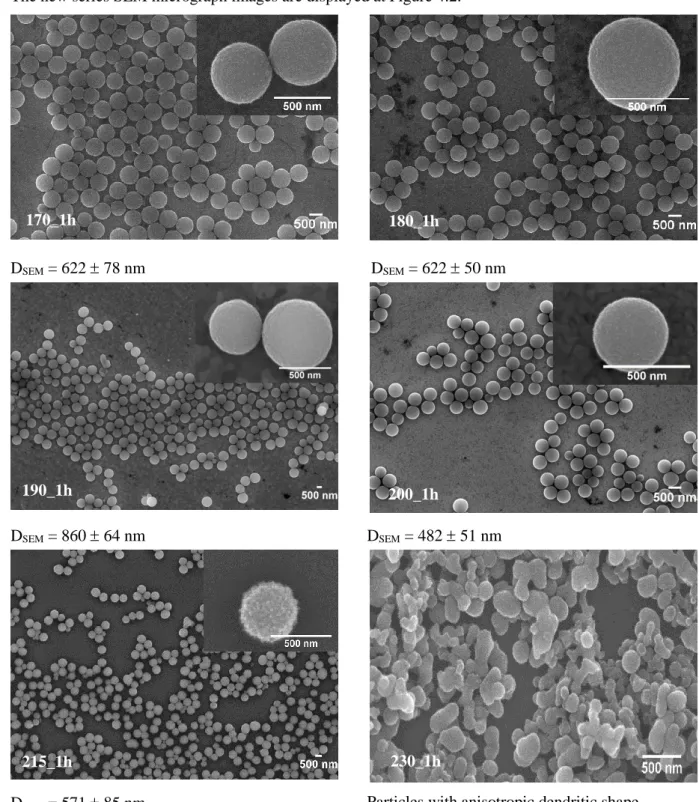
Figure 4.2- SEM micrograph images of series temperature nr. 2 of samples: 170_1h; 180_1h; 190_1h; 200_1h; 215_1h; and 230_1h. The average particle sizes obtained by measuring about 100 particles (DSEM) using imageJ [89]. The insets show a higher magnified view of the particles. ... 43
Figure 4.3. - Particles size distributions of temperature series nr. 2 (1h). ... 44
Figure 4.4. - Crystallographic phase content (in percentage) in series temperature nr. 2 as determined by XRD data analysis. ... 45
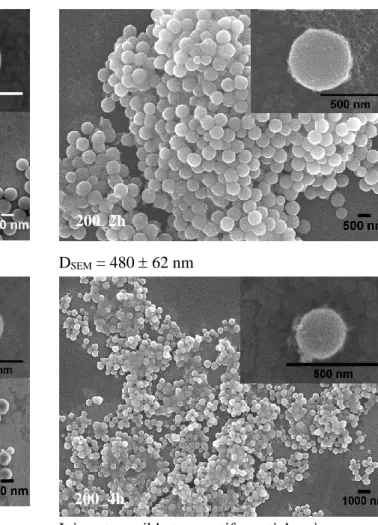
Figure 4.5 - SEM micrograph images of TiO2 particles synthesized during various times of hydrothermal synthesis: 200_1h; 200_2h; 200_3h; 200_4h; and 200_5h, showing average particle size (DSEM) measured using about 100 particles using imageJ [89]. The insets show a higher magnified view of the particles. ... 46
Figure 4.6. - Crystallographic phase content (in percentage) in series time determined by XRD data analysis. Above 3 hours of reaction under the specified conditions, it is always achieved anatase pure phase. ... 47
Figure 4.7 - SEM micrograph of TiO2 sample synthesized during 2.5 h at 200 ºC (200_2.5h) of hydrothermal synthesis. ... 48
Figure 4.8 – XRD analyses of 200_2.5h against reference pattern anatase (nr. 04-016-2837). ... 48
Figure 4.9 - TEM micrographs of TiO2 particles synthesized at 200 °C during various times of hydrothermal synthesis (1, 2.5 and 5 h), illustrating that the round-shape particles were formed by very small nanoparticles. ... 49
Figure 4.10 – Raman spectrum of 200_1h, 200_2.5h, and 200_5h samples. ... 51
Figure 4.11. - Differential thermal (DTA) and thermal gravimetric (TGA) analyses of 200_lh sample illustrating the loss of the adsorbed water, hydroxyl groups and decomposition of organic compound residues. It is observed the thermal formation of anatase phase at 570 ºC. ... 52
xvi Figure 4.12 – Differential thermal (DTA) and thermal gravimetric (TGA) analyses of 200_2.5h sample, illustrating
loss of adsorbed water, hydroxyl groups and organics decomposition. ... 53
Figure 4.13 - Differential thermal (DTA) and thermal gravimetric (TGA) analyses of 200_5h, illustrating loss of adsorbed water, release of hydroxyl groups and decomposition of organic compounds. ... 54
Figure 4.14 - SEM micrographs of samples: 200_5h_none; 200_5h_M; 200_5h_3xM; 200_5h_E, indicating the average particle size obtained by measuring about 100 particles (DSEM) using imageJ [89]. The insets show a higher magnified view of the particles... 56
Figure 5.1 – Photo of squares of 4 cm2 of the films. The films designations follow Table 3.3 from the experimental section. ... 59
Figure 5.2 - Phenolic compounds/pigment after concentration of about 45.32 mg of phenolic compounds. ... 60
Figure 5.3 – SEM micrographs of films C, T and P, from surface and transversal views of the films. ... 61
Figure 5.4 – SEM micrographs films, T+P and TP. The micrographs were taken from the surface and transversal view of the films. Under the micrograph it is specified which film and view type it is. ... 62
Figure 5.5 – UV-visible light spectra of all films (C, T, P, TP and T+P ). ... 63
Figure 5.6 – FTIR spectra of pigment (P) and TiO2 with pigment (T). ... 64
Figure 5.7 – Raman spectra of the following films: T, P, TP and T+P. ... 66
Figure 5.8 – Humidity (%) and solubility (% loss matter) of each film (C, T, TP, T+P and P). Different letters represent significantly different values, the latin and greek alphabet were used for the humidity and solubility results, respectively. Each sample had 3 replicas. ... 67
Figure 5.9 - Average contact angles of the films with ultra-pure water. Different letters were used to represent significantly different values. ... 68
Figure 5.10 – Young modulus of the film. Each film had 6 replicas. Different letters represent significantly different values. ... 69
Figure 5.11 - Average percentage of film elongation in the elastic phase resulting from 6 replicas. Different letters were used to represent significantly different values... 70
Figure 5.12 – Average amount of force exerted in the film, in MPa, to rupture it in the plastic phase. Each film had 6 replicas. Different letters were used to represent significantly different values. ... 71
xvii
Index of tables
Table 3.1.- Sample designation and synthesis conditions. ... 29 Table 3.2 - Sample designation and synthesis conditions of the amine series. ... 30 Table 3.3 - Chitosan- based films designations and components used in their preparation. ... 31 Table 4.1 – Average crystallite sizes obtained via X-ray, average crystal sizes observed in TEM (DTEM), SEM (DSEM) and specific surface area (ABET) of samples prepared during 1, 2.5 and 5 h of hydrothermal synthesis. ... 50 Table A - Table summarizing the mechanical properties. Each letter represents a significantly different value
xix
List of symbols
ABET Specific surface area (measured by BET) DSEM Average nanoparticles size (measured by SEM) DTEM Average nanoparticles size (measured by TEM) DXRD Average crystallite size in X-ray diffraction
xxi
Abbreviations
a.u. Arbitrary units
BET Brunauer-Emmet-Teller
BHA Butylated hydroxyanisole BHT Butylated hydroxytoluene COD Chemical oxygen demand DC Direct current
DSSC Dye-sensitive solar cells DTA Differential Thermal Analysis EFSA European Food Safety Authority PHA Poly(hydroxyalkanoate)
PLA Poly(lactic acid)
ROS Reactive oxygen species SEM Scanning electron microscopy TEM Transmission electron microscopy TiO2 Titanium dioxide
TGA Thermogravimetric analysis TTIP Titanium tetraisopropoxide UV-Vis Ultraviolet and visible XRD X-ray Diffraction
1
3
1.1 Objective
The emerging need of moving towards biodegradable plastics made from renewable resources, as well as to improve food safety and security by implementing nanotechnologies to design intelligent and active food packaging, is the driving force for this Master thesis in Biotechnology. In this work, the main objective is to develop competitive active and intelligent biopolymer-based composite films for food packaging application.
The strategy to achieve the packaging material encompasses 4 main steps: i) preparation of TiO2 particles; ii) extraction and quantification of phenolic compounds of black rice; and iii) preparation and full characterisation of chitosan-based composite films integrating the TiO2 particles and the extracted phenolic compounds; and iv) preliminary testing of the bioplastic composite as anti-oxidant.
1.2 Structure of the thesis
The content of the thesis is divided in 6 chapters. The following chapter, chapter 2, is dedicated to the introduction of the material properties and State of Art. The experimental procedure and materials are described in chapter 3. Chapter 4 is about the particles synthesis and characterisation, so that the protocol can be refined to achieve the desired characteristics. The following chapter, chapter 5, is about films synthesis and characterization. In the 6th and closing chapter, conclusions and future work are presented.
5
7 Nowadays everyone interacts with a wide variety of plastics. Plastics are used in packaging, office supplies, children’s toys, gym equipment and manifold other products. The food packaging industry, in particular, heavily relies on its use. Plastic has been used in that industry since mid-20th century, mainly because of their low cost, good physicochemical properties, being easy to produce and use in large scale and it is aesthetically pleasant [1].
Every year about 300 million tons of plastic are made and this production accounts for 4% of the total global fossil fuel consumption. Even though 4% appears to be a small number it still pertains to tons of fossil fuel use, and moreover this number is on the rise and is expected that, in 2050, plastic production represent 20% of non-renewable fuels expenditure [2].
Fossil fuels are considered non-renewable since their use greatly outweighs its production. Fuels extraction and burning contribute to global warming by increasing the amount of greenhouse gases in the atmosphere. Additionally, the increase of atmospheric CO2 also reduces water pH levels disturbing sea life [3]. On the other hand, several environmental issues arise as consequence of the non-biodegradability of plastics. Plastic waste is widespread, with extensive accumulation in oceans, landfills and other terrestrial compartments, affecting wildlife and possibly human health. In oceans, plastic products and debris are fragmented into smaller pieces and microplastics, which are then ingested and/or trapped by marine organisms [3]. Huge quantities of plastics are disposed in the environment, being extremely persistent, independently of their single or short-term use [4, 5].
For all of the aforementioned problems a need for alternative polymers that are biodegradable and/or made from renewable resources, ideally both, emerged [6]. Biopolymers can be found in animals (hydrocarbons, proteins, fats, nucleic acids, etc.), plants (e.g. cellulose, oils, starch, even polyesters) as well as in lower organisms [7].
Proteins and polysaccharides are the biopolymers of prime interest because they can be used effectively to make biodegradable films that can replace short shelf-life plastics [8]. It is therefore necessary to understand and improve these films to enhance and broaden its applications, turning them into viable alternatives to synthetic plastics. Additionally, it is also possible to improve the packaging materials with other functional capabilities such as to use components that actively react upon certain stimuli protecting food and enhancing its shelf-life. Another possibility is to use materials that can detect the food conditions and inform the consumer (intelligent packaging) [9].
2.1.
Food packaging
Packaging materials play a very important role in maintaining food quality and safety during the products life cycle. A good packaging material should have good mechanical, thermal and
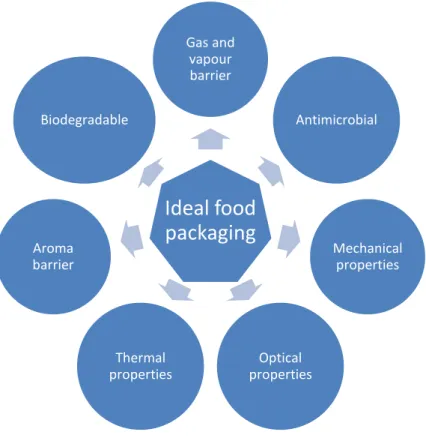
8 optical properties, resist to microbial growth and prevent contamination by hindering loss or gain of moisture (vapour barrier), prevent the permeation of undesirable gases such as oxygen, carbon dioxide or even volatile compounds that could change flavour and/or taste of the food stuff [10–13] Those characteristics make for a superior product all around but some properties can and should be added. The ideal packaging has all the aforementioned properties, but it should also be environmentally friendly by being biodegradable and made from bio-resources (Figure 2.1).
Several attempts have been made to create different packaging materials needed for each foodstuff. From the many materials explored, biopolymers in particular, show promising abilities.
Figure 2.1- Ideal properties for food packaging.
2.2.
Biopolymers
Biopolymers refer to polymers that are biobased and/or biodegradable [14]. A biodegradable polymer is a polymer that can be broken down into lower molecular products by cell (human, animal, fungi, etc.) activity, through an enzymatic process, although it is usually accompanied and promoted by physicochemical phenomena as well. The two types of processes, i.e. physic and
Ideal food
packaging
Gas and vapour barrier Antimicrobial Mechanical properties Optical properties Thermal properties Aroma barrier Biodegradable9 enzymatic, cannot be distinguished and/or separated, in general, and their combined effect leads to the complete degradation of the polymer.
In order to evaluate the polymers ability to be biodegraded, lab tests are used either based on the measurement of oxygen demand or on the amount of carbon dioxide involved in the process. This evaluation of biodegradability of polymeric materials is well defined in European standards [14].
Biopolymers can be divided, according to their sources, into artificial (bioplastics) or in natural polymers [7].
2.2.1. Natural polymers
Natural polymers occur in nature as macromolecules that can also be physically or chemically modified. They can be produced in complex metabolic processes, involving polymerization and enzymatic catalysis in cells of living organisms. These natural polymers are biodegradable, since they are created by metabolic processes in nature, they can be decomposed in that same environment [14]. Normally, the decomposing of these polymers releases the energy that they stored allowing its reuse. Natural biopolymers can include polysaccharides (such as cellulose, starch, and chitin), proteins (such as wheat gluten, soy, and glycerol), polyesters (polyhydroxyalkanoate, PHA, and polylactic-acid, PLA) [15]. One of the most used are polysaccharides due to their low cost and accessibility.
Chitin and chitosan
Chitin is the second most abundant polysaccharide in nature. Chitosan, known as soluble chitin, is a natural product obtained from alkaline deacetylated chitin [16] and is a potential renewable-resource-based plastic alternative. Chitosan is a linear polysaccharide of 2-amido-2-deoxy-β-D-glucoses attached by β(1→4) links (Figure 2.2) with a deacetilation percentage superior to 50% [17]. Chitosan molecular weight depends on its source and can vary from 100 to 1100 kDa and its deacetylation percentage can be between 50 and 90% [18]. Manipulation of deacetylation percentages allows tailoring its physicochemical properties and degradation profile [19]. Chitin can be retrieved mainly from the exoskeleton of marine crustaceans,[19] from fungal cell walls of
Aspergillus fumigares and Histoplasma farciminosum and from the yeast Saccharomyces cerevisiae [20, 21].
Chitosan has an amino group (NH2) that can be protonated to NH3+, and readily forms electrostatic interactions with anionic groups in an acidic environment. This amino group also
10 allows the incorporation of a variety of chemical groups, enabling its range of properties to be extended [22], allowing the prepared systems to react to external stimuli [23].
Figure 2.2. - Chitin and chitosan structures.[24]
This biopolymer has been widely studied for its potential use in areas such as biotechnology, material science[25], and pharmacology [26] because it can be obtained at low cost; has large scale availability; is non-toxic; biodegradable [19]; and has antifungal, antibacterial and antioxidant activities [27]. Those attributes create a material that protects food, mainly from fungal decay and can modify its atmosphere decreasing ripening and transpiration rates of fresh fruits [15]. These films are clear, tough, flexible and good oxygen barriers [15, 28]. However, they have weaknesses namely their lack of long-term stability and low water vapour barrier characteristics.
Chitosan antimicrobial activity depends on several factors, namely the origin of chitosan, molecular weight, degree of deacetylation, target organism, and conditions of the medium (pH, ionic strength, solutes that could interact with the active amine group of chitosan) [16]. It is, however, widely recognised that the most sensitive groups to chitosan are yeasts and moulds followed by Gram-positive and Gram-negative bacteria [16].
Regarding the effect of the molecular weight, it was found that chitosan of lower molecular weight (averaging less than 10 kDa) shows greater antimicrobial activity than chitosan of high molecular weight [29]. It is known that high solubility and charge density are fundamental for antimicrobial effect, so a possible explanation is that the low molecular weight chitosan is more soluble. The increased solubility facilitates the accessibility of the chitosan to the active sites of the target microorganisms enhancing antimicrobial activity rates [16].
11 The pH level can, if it is low enough (under 5.5), increase antimicrobial activity and provide a hurdle effect which contributes to increase bacterial stress [16]. A well-recognized theory, but not completely proven, is that the effect of pH levels, when under 6.3 (the pKa of chitosan), allow the positives charges of the amine group (NH3+) to interact with the cellular membranes, which are negatively charged. This results in leakage of intracellular components [30]. Another theory is that the cationic nature of this polysaccharide binds to bacterial cell walls through electrostatic interactions and disrupts its transport system for solutes or nutrients [16]. Additionally it is also possible that the charged amino group can bind to metals or metal complexes present in the medium [31] making them unavailable to the microorganisms metabolism, impairing their survival and/or growth.
The degree of deacetylation is also very important, a high amount of deacetylated amino groups results in more free amino groups to be protonated at low pH. This polymer requires a degree of polymerisation of at least seven glucosamine for it to have any antibacterial and/or antifungal activity.
Chitosan antioxidant activity is important because oxidation is a major problem affecting the food quality. Currently, the most frequently used antioxidants in active packaging are butylated hydroxyanisole (BHA) and butylated hydroxytoluene (BHT). These synthetic antioxidants although efficient and used in active food packaging (because of high stability, low cost and efficiency), have significant concerns regarding their toxicological aspects. Moreover, use of synthetic antioxidants is under strict regulation due to potential health risks. Therefore, extensive research has been conducted to employ some natural antioxidants such as phenolic compounds as alternatives to synthetic antioxidants as well as the use of natural antioxidant biopolymers (such as chitosan) [32]. Chitosan antioxidant activity, mainly chitooligomers, has shown a significant scavenging capacity against different reactive oxygen species (ROS). Its activity is even comparable to those obtained for commercial antioxidants, such as Trolox (6- hydroxy-2,5,7,8-tetramethylchroman-2-carboxylic acid) [33].
This antioxidant ability, both in chitosan and chitooligomers, is due the action of the amino group. As aforementioned when in acidic conditions, the nitrogen in the amino group receives a proton forming an ammonium group (NH3+), consequently its hydrogen ion can react with free radicals forming a stable molecule with oxidative ability [34]. Chitosan can also scavenge free radicals by donating a lone pair of electrons [35].
12 2.2.2. Strategies to enhance natural polymer properties
Natural biopolymers have drawbacks such as poor mechanical (brittleness), thermal (low heat distortion temperature) and barrier properties (high gas and vapour permeability), which compromises their use as food packaging materials [1, 32]. In order to improve natural biopolymers characteristics, different strategies can be employed, namely addition of plasticisers, other polymers (to form blends), molecules (to reticulate the polymers), and other fillers, creating biocomposites.
The use of plasticisers such as glycerol, ethylene glycol, and propylene glycol can be used to increase the flexibility, reducing brittleness and to improve processing. However, some of these compounds, such as ethylene glycol and propylene glycol, can be considered cytotoxic [37]. Plasticisers are usually used in conjunction with other approaches.
Making blends of biopolymers with other polymers allows the creation of materials with “tailor-made” properties (functional properties and at least a certain degree of biodegradability). Also, the incorporation of relatively low cost natural biopolymers into synthetic polymers provides a way to reduce the overall cost of the material and offers a method of modifying both properties and degradation degree [15].
Another alternative is the implementation of linking agents that, through chemical cross-linking processes (covalent bond), improve the physical properties of chitosan films, namely enhance its mechanical strength and chemical stability, as well as decrease aqueous permeability and solubility. All while maintaining the films biological properties [33]. Some of the most used cross-linking agents are formaldehyde, glutaraldehyde, triphosphates, and glycerol polyglycidyl ether (also a plasticizer). However, these compounds are also cytotoxic [37]. Consequently non-cytotoxic alternatives were searched upon, resulting in the adoption of genipin (a natural cross-linking agent). Two genipin molecules can link to chitosan via its amine group forming heterocyclic compounds. Genipin is obtained from its parent compound, geniposide, via enzymatic hydrolysis with β-glucosidase. The compound is isolated from the fruits and flowers of Genipa
Americana and Gardenia jasminoides Ellis [38].
Genipin has already been successfully used to improve chitosan films properties. In 2013, Nunes et
al.[33] reticulated chitosan films with genipin and grafted with caffeic acid, resulting in a decrease
in its solubility coupled with an 80% increase in its antioxidant ability.
Cross-linking can change properties but simple covalent bonds can also change properties although not always in a positive way, since it can disrupt the films matrix and interfere with mechanical properties. An example of compounds covalently linked to chitosan is phenolic compounds from wine (such as anthocyanins among others). They were covalently linked to
13 chitosan via its carbon 2 or 3 of glycosamine residues, which along with a cross-linking with genipin and using glycerol as plasticiser showed, in its best results, a decreased in solubility (mainly owed to genipin and to the hydrophobic behaviour of anthocyanins) and increase of antioxidant ability, of around 80%, due to the presence phenolic compounds [39].
One of the most promising ways of improving natural biopolymers films is by using nanofillers within the biopolymer. This creates a new type of material called bionanocomposites.
2.3.
Bionanocomposites
This new typology of material plays an important role in increasing competiveness of natural biopolymers. Nanofillers are particles sized under 100 nm in one or more dimensions. There are numerous types of organic and inorganic nanofillers. The latter can be made of metals (e.g. silver, copper), metal oxides (e.g. TiO2, ZnO), clays (e.g. cloisite, sepiolite, montmorillonite) and carbon. The nanofillers can exhibit different shapes such as nanoparticles, nanofibrils, nanorods, nanotubes, and nanoplatelets.
Different nanofillers bring distinctive effects to the bionanocomposites. The type of filler, morphology, and concentrations allow for some different arrangement and functionalities of the composites [36]. For instance, nanoclays are the most commonly used nanofillers in the synthesis of polymer layered silicate nanocomposites. Also when using carbon as filler, several nanostructures are possible, including fullerene (bucky-balls), carbon nanotubes (single-wall and multi-wall), carbon nanofibers, carbon nanoparticles, and graphene nanosheets. These carbon structures have been investigated due to their excellent physicochemical, mechanical and electrical properties [40].
Typical improvements of the use of nanofillers are the better mechanical and barrier properties. The mechanical properties of bionanocomposites strongly depend on the amount of nanofiller used. The enhancement of the mechanical property can be explained by the rigidity provided by the nanofillers as well as, in some cases, the affinity between biopolymer and nanofiller [1]. The interfacial interactions mentioned lead to a more rigid bionanocomposite which also improves thermal properties [1]. The betterment of barrier properties i.e. the decrease on the permeability, is especially important in the enhancement of food shelf-life. The addition of nanofillers increases the effective path length for gases to cross through the bionanopolymer. The longest the pathway for the gas or vapour molecules to cross the film, the most difficult is their diffusion and their contact with the foodstuffs. Particular nanofillers can also provide additional features to the bionanopolymer, like antimicrobial activity, oxygen scavenger capacity and sensor possibilities. Nanofillers such as silver or ZnO nanoparticles provide antibacterial and antifungal
14 abilities to the material [36]. Oxygen scavenger properties can be found in titanium dioxide (TiO2) under ultraviolet radiation. Its use can help reduce or maintain oxygen levels, which is important since oxygen can lead to food deterioration. This ability to manipulate the amount of oxygen in a closed packaged makes the package an active one [9]. The presence of oxygen can cause browning in fruits and vegetables. When in contact with fat it can provoke rancid flavours, odours and it can turn food stale. Furthermore it can make the product seem less appealing to customers by causing pigment changes [36].
Another use of bionanocomposites can be the creation of flexible sensors, achieved by functionalizing suitable nanofillers. These sensors are able to detect and inform about the presence of by-products of food spoilage adding therefore, a new function to the packaging material to protect consumers [41].
An option of nanofiller with multiple advantages, when added to biopolymers, is the TiO2.
2.4.
Nanoparticles of TiO
2TiO2 has a wide variety of applications in conventional areas (pigments and cosmetics) and in more functional areas such photo-electrochemical cells [42], dye-sensitive solar cells (DSSC) [43], lithium ion batteries [44], sensors [45], electron field transition [46], microwave absorbing material, biomimetic growth and biomedical treatments [47, 48]
TiO2 has been one of the most studied semiconductors because it has high efficiency, good thermal and chemical stability. In addition, it is non-toxic and low-cost [49]. TiO2 is an EFSA (European Food Safety Authority) approved food additive (E171) and it has been used in the packaging industry due to its favourable characteristics. In the last 5 years TiO2 has been found in more than 3500 foods or drinks, mainly in chewing gums, cakes and pastries, and confectionary. There are no epidemiology studies available regarding possible associations with adverse health outcomes [50].
2.4.1. Types of TiO
2TiO2 appears in three crystalline polymorphs in nature: rutile, anatase and brookite as seen in Figure 2.3. Each crystallographic phase exhibits different physical properties, such as refractive index, chemical reactivity, and photochemical reactivity [51].
15 Figure 2.3. Representation of the TiO2 anatase, rutile and brookite unit cells [52].
The stability of the polymorphs/phases depends on particle size. Anatase and brookite are metastable phases, difficult to synthesize and observe in pure forms, while rutile is the thermodynamically stable phase. Usually, anatase and brookite phases transfer, irreversibly, into rutile phase at high temperature (600 °C), nevertheless the specific temperature at which this transformation takes place depends on the preparation methods, precursors, and additives used in the particles syntheses [53]. Although rutile phase is thermodynamically stable, it is believed that anatase is the most active in photocatalysis, being the most intensely studied polymorph [49].
The difference between the polymorphs lies in the way their TiO6-2 octahedral basic units connect. They share edges and corners in different orientation and distortions. Anatase forms from octahedra that share four edges. In brookite and rutile only three and two edges are shared, respectively [54, 55]. To distinguish between the three polymorphs, X-ray diffraction (XRD), Raman spectroscopy and transmission electron microscopy (TEM) are usually used.
To form a specific phase, the right precursor and pH level must be used, since they influence how the octahedral units assemble. At high pH, the high content of hydroxyl groups favours edge sharing, contributing for the formation of anatase. At low pH, more water molecules are bound to the positively charged Ti4+ centre. This favour corner sharing and the rutile phase formation [56].
The different crystallographic types of TiO2 particles have facets [57]. Only in 2008, it was discovered that anatase crystals possessed promising properties associated with its {001} facet [58].
Certain ligands are known and used to expose particular facets so that the final product is further manipulated for specific uses. The choice of ligands plays a very important role in the structure and morphology of the final titanium oxide product [59].
16
2.4.2. Creating TiO
2nanoparticles
There are many methods used for preparing TiO2 nanoparticles. Those methods can be either physical or chemical. Physical methods usually consist of top-down approaches i.e. from raw material (visible at naked eye) to small-sized (nanoscaled). The advantage of this type of method is that it can usually produce large quantities of material. Top-down approaches have successfully fabricated highly uniform nanostructures and nanoparticles with controllable shapes and dimensions. For instance, Seungkyu Ha and his colleagues produced single-crystal TiO2 with various nanoscale shapes, including cylinders, cones, and hourglass-shaped structures ranging from 100-600 nm in diameter and up to 1–2 μm in height. These structures were made by CHF3-based and SF6-based etching processes [60].
Chemical methods are usually a bottom-up approach, which uses molecular precursors (units) to form large structures. This type of method is typically performed at a small scale, therefore it is not used for industrial purposes like the physical approaches. The big advantage of this bottom-up method versus the top-down physical approach is that it allows for more precision in the material created. Due to the advantages that bottom-up approaches present, some of their methods will be the ones explored bellow for TiO2 nanoparticle production.
2.4.3. General principles
The general principles of nanoparticles formation, in a bottom-up approach, in a solution-phase type synthesis occur in two events: nucleation and growth [49].
Nucleation is when nuclei are formed from the decomposition of the chosen precursor or by a sudden variation in the concentration of the reactive species. In both cases the concentration of precursors in solution reaches a supersaturating, which allows the nucleation event (Figure 2.4). For this reason the precursor used is important since it will determine the energetic pathway by which its monomers became active in the nuclei formation [49].
When the supersaturation decreases due to nuclei formation, the growth phase begins (Figure 2.4). In this phase no additional nuclei will be formed they will only grow to be larger clusters of monomers [61]. Growth can happen through two distinct mechanisms, monomer addition or Ostwald ripening. During monomer addition, the nuclei absorb the monomers, increasing its size. Ostwald ripening consists in making the smaller nanocrystals to be integrated by the larger particles. This process allows for a continuous process of size-focussing, which in turn makes for improved uniform particles [62]. In order to have uniform particles, other than having the Ostwald ripening mechanism, it is important that the nucleation stage happen in a very small time window,
17 meaning fast supersaturation followed by almost immediate nuclei formation. In this way the nuclei enter the growth phase all at the same time and all grow in similar conditions.
Figure 2.4 - La Mer model for nucleation and growth kinetics of nanoparticles (adapted) [49]. There are critical components for TiO2 nanoparticles formation, namely some form of surfactants, protecting ligands, and the chosen metallic precursor. Some molecular species, such as ethanol, oleic acid, and benzyl alcohol, need to be used in order to prevent agglomeration of nanoparticles. This is possible by the introduction of steric and/or electrostatic interactions that keep the particles separated. Steric repulsion comes from the use of long-chain ligands or polymers with passive surface atoms, which results in reduced free surface energy that keeps the inorganic cores from fussing together. Electrostatic repulsion is obtained by forming an electrical double layer of ions around the nanoparticles, thus repulsing the charged particles [49].
The use of organic ligands or polymers that contain hydrolysable groups provide simultaneous steric and electrostatic stabilization. The most common organic functional groups used for this purpose are carboxylic acids, alcohols and diols, amines, phosphines, and phosphonic acids. The choice of a particular molecule is important to obtain the expected final product, because studies show that the ripening and particle orientation can be influenced by the adsorption of the ligand onto a particles specific facet [63]. Different ligands can also be used at various steps of the reaction in order to move the process forward. Distinct ligands have different binding strength and by substituting a molecule that binds to the inorganic core by another that binds to that same place but stronger, drives the nanoparticle syntheses process onwards.
There are several titanium precursors available. The main options are: titanium halides (TiCl4, TiF4 among others), titanatranes, titanium alkoxides (Ti(OR)4), titanium(IV)bis(ammoniumlactato) dihydroxide ((NH4)2(OH)2Ti(C3H4O3)2), titanium sulfate (Ti(SO4)2) and titanium oxysyulfate (TiOSO4). Usually, the most used are alkoxides represented as Ti(OR)4, where R represents an organic group. Titanium n-butoxide (R = CH2CH2CH2CH3), titanium tert-butoxide (R = C(CH3)3) and titanium isopropoxide or TTIP (R = CH(CH3)2) are mostly used. The latter was the one chosen as precursor in this work [64]. In alkoxides, the Ti(IV) centres are Lewis acids, being susceptible to
18 nucleophilic attack. This attack usually consists in a nucleophilic addition of water molecules onto the Ti(IV) centre followed by the transfer of hydrogen ions from water to the alkoxy groups. By control further the hydrolyses and the condensations, TiO2 network can be created [49]. Since water is highly reactive with titanium alkoxides, the compounds must be handled with added attention to avoid excess humidity that would cause premature hydrolyses which would damage the TiO2 synthesis.
Another important aspect are the methods employed, these also play a determinant role in the morphology and properties of the final products.
2.4.4.
Methods for TiO
2production
Within the chemical approach for TiO2 synthesis exist three different categories: aqueous methods, nonaqueous methods and templated approach. Each of these categories has different methods (Figure 2.5).
Figure 2.5. - Types of chemical TiO2 synthesis.
Methods
Aqueous
method
Sol-gel method
Hydrothermal
method
Nonaqueous
method
Solvothermal
Nonhydrolytic
Templated
approach
Soft templates
Hard templates
19
Aqueous methods
The main used aqueous methods are the sol-gel and the hydrothermal methods.
When using aqueous methods for TiO2 production, the main steps of the process are hydrolysis, condensation and polymerization. During hydrolysis, the titanium precursor suffers modification due to reaction with water. The condensation is the nucleophilic addition of the hydrolysed metal species forming Ti-O-Ti bonds. The condensation proceeds further until a metal oxide network is formed. At the same time water elimination is common in order to form the Ti-O-Ti bonds. The basic building unit consist of octahedral clusters where titanium atoms were coordinated to six oxygen species. These clusters share oxygen corners in a manner determined by the nature of the oxygen groups and by the presence of the chosen stabilizing molecules [49]. The morphology of the final particles depends on the poly-condensation direction determined by the different facets and on the capping agents action in the process [65].
In aqueous methods, the rates of aforementioned reactions can be altered either by using different pH or by using catalysts. Catalysts increase the speed at which the bonding network is formed. The catalysts can be acids or bases, promoting hydrolyses by dihydroxylation or deprotonation. [49]
Sol-gel method
The sol-gel method is widely used and involves the transformation of a sol (solution of colloidal particles) into a gel (metal-oxide tridimensional network). This gel then suffers a thermal treatment which allows the decomposition of the organic content resulting from solvents and, eventually, alkoxide precursors, followed by the formation of the desired final product [49].
The sol-gel method for TiO2, specifically, can use both organic and inorganic precursors to form a gel that is usually transparent. The gel consists of a network of solid metal-oxygen bonds formed from precursors after chemical reactions and/or thermal treatments that exist in a liquid phase. This gel is then dried and transformed into TiO2 by thermal treatment(s) [53].The disadvantages of this approach are the control of the kinetics of the hydrolyse and condensation reactions. The speed at which these reactions occur is extremely high, thus turning the control over shape, size and dispersion quite poor [49]. Additionally the precipitates are usually amorphous and require further heat treatment to induce crystallization [51]. However, the calcination process frequently gives rise to particle agglomeration and grain growth [66].
20
Hydrothermal method
Hydrothermal method allows to achieve crystalline materials at a temperature significantly lower than the required by sol-gel, however shape control and uniformity are still a challenge [49]. This method typically uses a base such as ammonia or an alkaline hydroxide in order to form a titanium hydroxide intermediate. The intermediate is then dehydrated to form TiO2 under hydrothermal conditions at temperatures between 150 and 250 ºC using an autoclave container, which creates pressure under heating. In order to control size and shape, it is fundamental to use mineralizers to define the optimal pH, vary the temperature levels, as well as stirring speed, keeping similar solution volume quantities. The reaction time under said conditions is also an important factor; since it can be necessary go through metastable phases in order to reach the final desired morphology [49].
Non-aqueous methods
In non-aqueous methods, the TiO2 reacts through mechanisms, which do not involve hydrolysis and condensation. Non-hydrolytic sol−gel describes reactions in which an oxide forms without any addition of water, through reactions with oxygen-containing organic molecules. For non-aqueous sol−gel processes, hydrolysis occurs through reactions with water produced in situ. The distinction between the two can be difficult leading to mistakes in literature [49, 53].
The mechanisms for TiO2 production usually have three steps: i) alkyl halide or ether elimination by cross-reactions between different titanium precursors to form Ti−O−Ti bonds; ii) thermal decomposition of the organic part of the precursors and solvents; and iii) in situ formation of water (or another activated form of water), either by esterification or aminolysis through the reaction of a metal carboxylate precursor with an alcohol [67] or an amine [68]. As previously mentioned, it is difficult to distinguish between non-aqueous sol−gel and non-hydrolytic sol−gel because it is unclear whether water is produced or not during the reaction. The main advantage of non-aqueous approaches is the better control over reaction rates than in the case of aqueous methods (sol-gel and hydrothermal methods). When water is not present or is produced in situ in small quantity, hydrolysis and condensation occur slowly, offering a kinetic control of the hydrolysis reaction. Even more, it becomes possible the use surfactants and organic ligands which were insoluble in an aqueous medium. This increases the amount of substances available to adjust the precursor reactivity allowing for unprecedented control over the morphology of TiO2 crystals and nanoparticles [49].
The two main approaches classified as non-aqueous methods are the solvothermal and the non-hydrolytic syntheses.
21
Solvothermal method
Solvothermal methods are conducted in an autoclave with non-aqueous primary solvents at elevated pressures, similarly to hydrothermal methods [49]. It is widely used to produce crystals with tailored facets, like the hydrothermal method, due to the versatility to manipulate nucleation and growth [57].Water is not used as a primary solvent but it can, sometimes, be added to induce hydrolysis [49].
Non-hydrolytic method
As opposed to the solvothermal method the non-aqueous surfactant-assisted protocols are conducted at, or near, atmospheric pressure. This process is based on reactions that yield the desired Ti−O−Ti bonds while using surfactants that participate both in the growth of TiO2 and in the modulation of its facets [57]. An advantage of this type of synthesis is the modulation of the reactivity of the chosen titanium precursors using surfactant molecules, which act also as protecting agents.
Templated approaches
Templates or structuring directing agents can be used to define the morphology of TiO2 nanoparticles [49]. They belong to two main categories: the soft and the hard templates.
Soft templates
Soft templates are formed from flexible organic or biological based molecules. They may form microemulsions or micelle arrangements. Microemulsions are thermodynamically stable dispersions in which amphiphilic surfactants (containing hydrophilic and hydrophobic parts) stabilize small droplets of one liquid within a second liquid in which it is immiscible. Alternatively, micelles are aggregates of surfactants that are formed in solution when the concentration of surfactant exceeds the critical micelle concentration (cmc) [49]. In the soft template approaches in order to produce TiO2 particles, the droplets act as nanoscale reactors in which precursors are dissolved, needing to be stabilized by surfactants [69]. Usually alkoxides are the chosen precursors in microemulsions or swollen reverse micelles [49].
22
Hard templates
The hard templating uses rigid inorganic or polymeric materials as templates, which allow TiO2 to be coated on the surface of a material forming shells. After that, the template can be dissolved or thermally decomposed [49].
2.4.5. Properties TiO
2TiO2 nanoparticles can be used as fillers in composites to improve mechanical and barrier properties by the mechanisms explained in the subchapter 2.3.
A notable aspect of the use of TiO2 is the oxygen scavenger ability. Under UV light, nanocrystalline TiO2 films, in the presence of excess of hole scavengers, can cause deoxygenation of closed environments. Under aerobic conditions, the oxygen reduction reaction is observed to exhibit first order kinetics with a rate constant of 70 s−1 from the reduction of oxygen by photogenerated TiO2 electrons. The reaction steps can be summarised by the Equation 2.1. The development of an efficient light driven oxygen scavenging system would be novel approach to achieving anaerobic environments. These environments could be key in a wide range of applications, ranging from food packaging to organic electronics [70].
Equation 2.1 – Typical photocatalytic reaction [70].
Moreover, during these photocatalyzed chemical reactions, reactive oxygen species (ROS), including superoxide radicals (O2-•) and singlet oxygen, as well as other intermediate species such as H2O2 or O2 are also formed [71]. Due to those highly reactive free radicals generated during UV irradiation, engineered TiO2 NPs have also been recognized for their light-induced biocidal effects against a broad range of harmful microorganisms, such as the bacteria Escherichia coli [72] and molds, like Aspergillus niger [73]. This is possible because ROS play critical roles in several physiological processes in living beings namely in the regulation of the immune system and in the development of the inflammatory response, activation of transcription factors and gene expression, and modulation of programmed cell death (i.e. apoptosis) [74]. Excessive levels of ROS can also oxidize cell constituents such as lipids, proteins, and DNA, and consequently pose a threat to cell integrity [75].
23 Thanks to titanium dioxides usefulness against photo-oxidation, due to its ability to scatter light and absorb UV light energy, it has been added at different concentrations to HDPE (High-density polyethylene) and PETE (Polyethylene terephthalate) as a light blocker [76]. It is also frequently used in sunscreen for protection, particularly, against UV-B radiation. The TiO2 valence band possesses many densely packed electron states that allow many absorption possibilities, as long as the energy absorption exceeds the band gap width. That is partly why TiO2 nanoparticles absorb more in the UV-B spectrum [77].
2.4.6. Sensors for food packaging
The functionalization of TiO2 nanoparticles surface allows the creation of unique target sites for selected molecules. TiO2 has been used in sensors because it can form coordination bonds with the amine and carboxyl groups of enzymes, maintaining the enzyme biocatalytic activity [78]. In addition, TiO2 has the ability to harvest electrons produced by the reaction between certain (bio)molecule and an analyte. These electrons can then be transferred to an outer circuit, which detects the reaction.
The construction of these sensors will allow the packaging to become an intelligent one with systems capable of providing the consumer with information on the conditions of the food or its environment (temperature, pH) [9]. It is important to note that sensing purposes can only be achieved using TiO2, which has been tailored for this application.
Titanium dioxide is mostly used for COD (chemical oxygen demand), gas, and other sensors [79].
2.5.
Biogenic amine detection
One of the main adversaries to food safety are biogenic amines, such as tyramine, trimethylamine, 2-phenylethylamine, histamine, putrescine, cadaverine, among others. These amines result from the decarboxylation of amino acids in food (such as meat, fish, and milk) by bacteria (including pseudomonas and lactic acid bacteria) [80]. These amines are undesirable in food stuff because they are frequently involved in human pathologies such as: neurological disorders, gastrointestinal diseases, abnormal immune responses, cancer and are potentially toxic [81]. It is therefore understandable why a sensor for its detection would improve food safety and avoid potential health hazards for consumers.
There are several different approaches taken for amine detection based on different sensing mechanisms. These include electrochemical, mass, optical-based among other gas sensing methods. However, for packaging the best option is an optical-based sensor.
24 Even though many reports are available on the physical characterization of TiO2 films and the different methods to produce it, the gas sensing properties of this promising material have not been explored in great amount [82]. This is even more glaring when searching for gas detection for biogenic amines. The better option found was made by pigment-sensitizing a thin layer of TiO2. The TiO2 film was deposited by a DC reactive magnetron sputtering technique onto a well-cleaned glass substrate equipped with interdigitated comb shaped electrodes. The natural pigments used to detect amines were extracted from spinach (Spinacia oleracea), red radish (Raphanus sativus L), winter jasmine (Jasminum nudiflorum), and black rice (Oryza sativa L. indica) using alcohol. The pigment displaying the best results was from black rice because it had the biggest amount of anthocyanin, promoting the strongest interaction between its carbonyl and hydroxyl groups the TiO2 film. Anthocyanins (ATH) represent a large group of natural, water soluble, nontoxic pigments. They are polyphenolic plant pigments, responsible for the red, blue and purple colours of many fruits, vegetables and grains. They are most frequently glycosylated at the C3-position, followed by the C5- position. Glycosylation at C-7, C-3 or C-5 is often found. The colour of ATH changes depending on the pH, co-existing colourless compounds (co-pigments, typically flavones and flavonoids), storage temperature, chemical structure, concentration, light, oxygen, solvents and the presence of enzymes, proteins and metallic ions [83]. This pigment has successfully been used in biocomposites of chitosan and ATH to detect pH changes [83].
When ATH is used to functionalise TiO2, relatively low humidity is necessary for sensing because water could promote pigment desorption from TiO2. Darkness is also required, because light could cause the pigments degradation and as result decrease the sensor sensibility. This gas sensor works because, under amines gas condition, anthocyanin absorbs electrons from the amines (and injects electrons into the semiconductor conduction band). Therefore, the conductivity of the TiO2 films correlates with the concentration of the amines.This sensor was used the detect amines during pork meat decomposition and the results were highly positively correlated with the content of cadaverine and putrescine [84]. Other works have been made with other natural pigments such as cyanidin and have achieved similar successful amine detection [85].
Colourimetric approaches have also been successfully used using natural pigments namely the aforementioned ATH. These type of sensors use colour to display pH changes in food that usually signify food decay. The following example uses ATH from red cabbage, chitosan and starch but not TiO2 for amine detection; This study had good results namely: colour change at different pH levels while knowing that the extract was physically incorporated into the polymeric matrix, meaning that the chemical properties of the extract are not affected by the incorporation into the matrix. This is important information because until this point it was unknown if chemical
25 interaction between the polymeric matrix and the extract would affect the sensitivity of the extract to pH changes [86].
Another example of a colourimetric sensor was the work by Yoshida et al used anthocyanins in chitosan films resulting in the achievement of colour changing-pH dependent (as expected) and a reduced solubility with a slight interference in chitosans mechanical properties, namely a decrease in elongation at break [83].
27
29 3.1. Particles production
The TiO2 particles were made using the hydrothermal method. This method proceeds as follows: 10 mL ethanol (anhydrous, 99%, Carlo Erba) and 8 mL acetonitrile (anhydrous, 99.8%, Sigma-Aldrich) were mixed and 6.9 µL methylamine (40 wt% in H2O, Aldrich) solution was added. Then, 1.20 mmol titanium(IV) isopropoxide or TTIP (97% trace metals basis, Aldrich) was dripped into ethanol (2 mL) and dissolved in the above solution with continuous magnetic stirring. Subsequently, 30 mL ethanol/H2O (1:1) solution was added drop wise to the solution with stirring for 1 h. The mixture was transferred into a 100 mL Teflon-lined stain steel autoclave and kept at a set time and temperature in a lab oven. After cooling, the solution was centrifuged and washed with absolute ethanol and deionized water and stored in the latter.
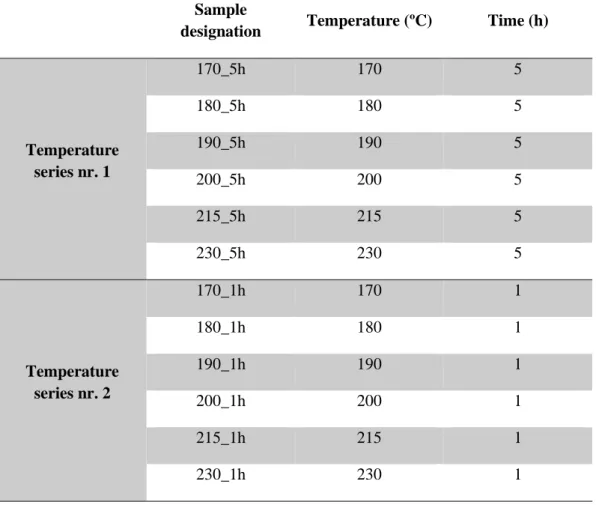
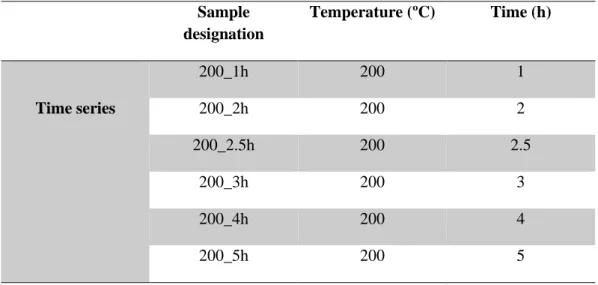
Table 3.1 details the synthesis conditions of all particles. The samples were divided in series by the variable studied, i.e. the samples in the temperature series have different temperatures. All samples are designated with the following pattern: “temperature_# h”, in which the value of temperature is presented in Celsius degree (°C) and # means number of reactions hours.
Table 3.1. Sample designation and synthesis conditions. Sample
designation Temperature (ºC) Time (h)
Temperature series nr. 1 170_5h 170 5 180_5h 180 5 190_5h 190 5 200_5h 200 5 215_5h 215 5 230_5h 230 5 Temperature series nr. 2 170_1h 170 1 180_1h 180 1 190_1h 190 1 200_1h 200 1 215_1h 215 1 230_1h 230 1
30 Table 3.1. Continued Sample designation Temperature (ºC) Time (h) Time series 200_1h 200 1 200_2h 200 2 200_2.5h 200 2.5 200_3h 200 3 200_4h 200 4 200_5h 200 5
An amine series was also created to investigate its impact in TiO2 particles formation. The series follows this designation: 200_5h_quantatity and type of amine used (M for methylamine and E for ethylamine). For instance, 200_5h_3xM, used triple the usual amount of methylamine (described above).
Table 3.2 -Sample designation and synthesis conditions of the amine series. Sample
designation
Amine used Amount used (µL)
Amine series 200_5h_none - 0
200_5h_ M Methylamine 6.9
200_5h_3xM Methylamine 20.7
200_5h_E Ethylamine 6.9
3.2. Phenolic compounds extraction
The phenolic compounds were extracted from black rice (Oryza sativa L. Indica). The rice was blended (Blender CPE10 Model 39BL16, Cole-Palmer® Instrument Company) to a fine powder, which was then incubated for a minimum of 48 h in a lab oven at 60 ºC. The powder was subsequently immersed in absolute ethanol (anhydrous, 99%, Carlos Erba) for a week. The solids were filtrated out, and the filtrates were concentrated at 40 ºC in a vacuum rotary evaporator for further application in the films (Figure 5.2).
![Figure 2.2. - Chitin and chitosan structures.[24]](https://thumb-eu.123doks.com/thumbv2/123dok_br/15733534.1071746/32.892.132.686.190.550/figure-chitin-and-chitosan-structures.webp)
![Figure 2.4 - La Mer model for nucleation and growth kinetics of nanoparticles (adapted) [49]](https://thumb-eu.123doks.com/thumbv2/123dok_br/15733534.1071746/39.892.158.539.198.398/figure-mer-model-nucleation-growth-kinetics-nanoparticles-adapted.webp)