96
Revista da AMDE – ANO: 2016 – VOL. 16
Impeachment’s Institutional Insecurity and
Foreign Direct Investment
Lukas de Farias Sasaki
Com foco nas teorias acerca do conhecimento institucional, a pretensão do artigo é trazer um estudo básico, sobre o impacto do processo de impeachment na economia, à academia brasileira, lugar onde atualmente não existe discussão o bastante sobre o tópico. O artigo irá analisar empiricamente o impacto que do processo de impeachment nas taxas de investimento estrangeiro direto, estudando antigos casos de impeachment ao redor do mundo. Levando em consideração o caso Collor no Brasil (1992) e o caso Clinton nos Estados Unidos da América (1998), a proposta é de desmistificar o conhecimento do senso comum de que apenas se retirando o presidente a economia irá crescer novamente.
Palavras-Chave: Impeachment - Economia - Investimento – Direito – Politica.
Resumo
With a focus on the theories surrounding institutional knowledge, the article’s pretension is to bring a basic study, of the impact the process of Impeachment has on the economy, to Brazilian academy, place where nowadays there no enough discussion about the topic. The article will analyze empirically the impact of an impeachment process in foreign direct investment rates by studying former impeachments around the world. Taking the Collor’s case in Brazil (1992) and Clinton’s in United States (1998), the proposition is to demystify the common sense knowledge that only by taking down the president the economy will rise again.
Keywords: Impeachment – Economy – Investment – Law – Politics.
97
Revista da AMDE – ANO: 2016 – VOL. 16
“Other forms of learning may separate knowledge from action; wisdom tends to unite them. Other forms of inquiry may be content with knowing and understanding the facts; the pursuit of wisdom aspires to a knowledge of good and evil.” (Adler, 1952, p. 1052)
1. INTRODUÇÃO
Even though Brazil is one of the largest economies in the world, the country presents a massive uncertainty in terms of institutional structure, judiciary acts, bureaucracy attributes and many other political and social aspects. However, how does these problems affect directly and indirectly the foreign direct investment (FDI) rates and also the gross domestic product (GDP) is still a question without a complete answer.
To understand the influence that these factors have in the macroeconomic landing it is required a great study about the theme and many empirical data analyses. The proposition of this article is to draw a brief introduction on how institutions in a large concept can impulse or hold Brazilian development, specifically with regards to FDI and the image of confidence that the country exports after the political crisis culminating in the Impeachment of Dilma Roussef.
To accomplish this challenge, the idea is to disentangle the article into two minor case studies, in different historical moments where institutions in the world passed through large ruptures and mutations:
(1) Collor’s Impeachment in Brazil in 1992:
With no doubt one of the most important facts of the Brazilian political history, the Impeachment represented the hope for changes not only in political fields but also in a fight against recession and economic insolvency.
(2) Bill Clinton’s Impeachment in United States in 1998:
The end of Bill Clinton’s Era came as a shock to the American population. Being involved in many political and civil scandals, the President was impeached and acquainted in a time where US was passing through international instability. It was the
98
Revista da AMDE – ANO: 2016 – VOL. 16
second time in USA history that the senate tried to impeach the President1.
The primary idea is to study the periods while correlating with data from different sources. Then, see if these ruptures caused impact on FDI rates. To determine how institutional scope can be important in the international investment and the image the country exports it is crucial to stress that correlation does not necessarily show causality.
2. COLLOR’S IMPEACHMENT IN 1992
To proceed with the idea of analyzing the economic consequences of insecure institutions and government policies in the context of the first Latin-American Impeachment, it is crucial to firstly acknowledge the scope of what was going on in Brazil at that period.
By the end of the military dictatorship in 1985, Brazil was diving into one of the biggest crisis the country ever faced, with the failure of the politic-economic model implanted by the government - leading the state to elevated rates of inflation and an enormous economic deficit. This lead to a wave of public displeasure in innumerous sectors of the society, emerging, then, a wish for direct elections in the country; a change of path for the nation.
With José Sarney in the power of the executive – in office as Acting President after the death of Tancredo Neves – new policies were implanted such as the Plano Cruzado, which imposed a price-freeze provision and changed the official currency from the cruzeiro to the cruzado. Although searching for a heterodox plan for Brazil, due to many economic and political factors, the Sarney’s govern failed in its goal to retain inflation rates and even deepened the crisis, raising the external debt and increasing the disbelief of the country in the international market.2
1 Despite not being vastly known, the first impeachment of a United States president was in 1868, with Andrew Johnson being acquainted by one vote.
99
Revista da AMDE – ANO: 2016 – VOL. 16
When the elections came, two candidates were highlighted, and Fernando Collor was elected with a strong campaign against corruption and in favor of a cut in the government budget. Unfortunately, since the beginning of his mandate, many political scandals were reveled and his plans to fight inflation failed astoundingly.
On the figure 1 it is easy to affirm that during the mandate, the evaluation of Collor’s Government decrease drastically, this factor is vital to understand how the society at that time was seeing their own govern and leaders. The rise of the perception of corruption was important in a way that showed the people what was going on outside their yard.
100
Revista da AMDE – ANO: 2016 – VOL. 16
As said before, the intention of this article is not to fully determine what are the specific political policies that can influence the FDI rates, but to demonstrate some cases that appear to show a correlation between drastic political institutions reforms and the rates of foreign direct investments.
Graphic 2 – GDP, billions of dollars X Foreign Direct Investment (1985-2000/Brazil)
On the graphic 2, it is clearly seen that after Collor the amount of dollars coming to Brazil by foreign investments rose extraordinarily, appearing to start increasing alongside the beginning of Itamar Franco’s Government. During these period, Itamar – that were the vice-president of Fernando Collor and came to the Office after the Impeachment – implanted the famous “Plano Real”, that improved the economy by instituting a fiscal adjustment, changing the coin and reducing inflation. Comparing to the chaotic situation that Brazil was passing through, this new plan came as a way to restructure the economic basis and changed a lot the institutions in that matter.
It is arguable that the increase of the FDI investments show that Brazil became a country more susceptible to investments, and come to be an advantage to investors, rather than a place where no one can even have the safety that their money will be there
101
Revista da AMDE – ANO: 2016 – VOL. 16
and will grow. According to MOTA and TREBILCOCK (2014):
“In principle, the theory of comparative advantage should apply as much to international movements of FDI as to international trade in goods or services – capital is likely to gravitate to where its marginal productivity is greatest.”3
Although this idea, it is hard to define that the impeachment process caused this raise on the FDI rates in Brazil. Many other determinants and world events must be analyzed before one states that the abrupt changes in the political structure of the country did actually benefit its economy. Some authors like Bénassy-Quéré, Coupet and Mayer state a difficulty when believing so strictly about the importance of institutions on FDI, according to them:
“[…] GDP per capita can (also) be viewed as one driving force of FDI. If the literature on institutions on growth is correct, there exists a positive correlation between institutions and GDP per capita. Hence a positive correlation between institutions and FDI could just stem from the impact of institutions on GDP per capita.”4
3 Trebilcock, M.J. and Prado, M.M., 2014. Advanced introduction to law and development. Edward Elgar Publishing. Pp. 195.
4Bénassy‐Quéré, A., Coupet, M. and Mayer, T., 2007. Institutional determinants of foreign direct investment. The World Economy, 30(5), pp.764-782.
102
Revista da AMDE – ANO: 2016 – VOL. 16
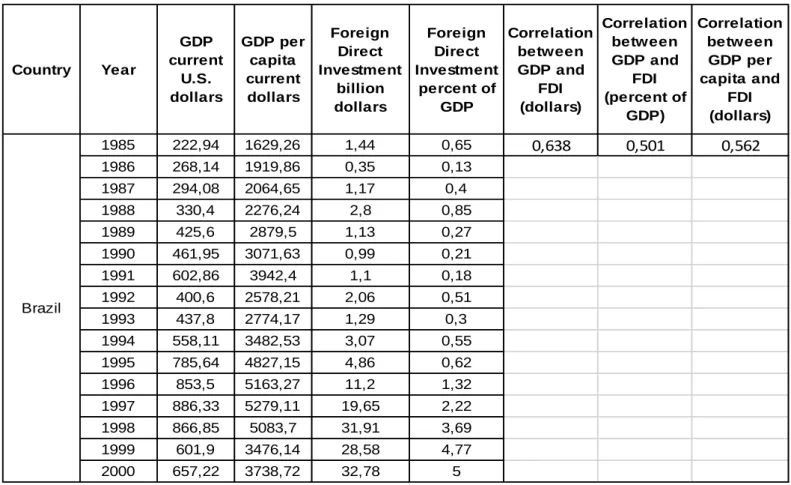
Country Year GDP current U.S. dollars GDP per capita current dollars Foreign Direct Investment billion dollars Foreign Direct Investment percent of GDP Correlation between GDP and FDI (dollars) Correlation between GDP and FDI (percent of GDP) Correlation between GDP per capita and FDI (dollars) 1985 222,94 1629,26 1,44 0,65 0,638 0,501 0,562 1986 268,14 1919,86 0,35 0,13 1987 294,08 2064,65 1,17 0,4 1988 330,4 2276,24 2,8 0,85 1989 425,6 2879,5 1,13 0,27 1990 461,95 3071,63 0,99 0,21 1991 602,86 3942,4 1,1 0,18 1992 400,6 2578,21 2,06 0,51 1993 437,8 2774,17 1,29 0,3 1994 558,11 3482,53 3,07 0,55 1995 785,64 4827,15 4,86 0,62 1996 853,5 5163,27 11,2 1,32 1997 886,33 5279,11 19,65 2,22 1998 866,85 5083,7 31,91 3,69 1999 601,9 3476,14 28,58 4,77 2000 657,22 3738,72 32,78 5 Brazil
Table 1 – Correlation between GDP and FDI (1985-2000), Brazil
In table 1, there is data from 1985 to 2000 – period taken into account to examine the Collor case – and the result of some correlation tests show that even with the increase of FDI rates, this was not followed by an enormous GDP growth, taking to believe that even though the Impeachment open doors for foreign investments, it did not help the economy in general by itself.
If analyzing the GDP per capita growth in Brazil during the period, it can be stated that it had a downfall of almost 35% during the year of 1992, moment where FDI increased almost 100%.
3. CLINTON’S IMPEACHMENT IN 1998
103
Revista da AMDE – ANO: 2016 – VOL. 16
America, and the first one born after the World War II. In December of 1998 he was impeached on charges of perjury and obstruction of justice. To understand the data involving FDI rates of the case, it is primarily important to acknowledge, again, the situation of USA.
Since the beginning of his term, Clinton suffered a lot of investigations, culminating in a famous paperwork sent to the House Judiciary Committee. The charges in question began to emerge from an investigation leaded by Independent Counsel Ken Starr, conduction inquiries of alleged abuses like the firing of White House travel agents, misuse of FBI files, misconduct during the well-known sexual harassment lawsuit against Bill Clinton, by Paula Jones, former employee, and many other events that appear during the investigations.
After the long time investigations, Starr turn over all the documentation to the Judiciary Committee, when the Chief Prosecutor, David Schippers, determined there was sufficient evidence to impeach Clinton. Of the four charges, two passed and in December 19th of 1998, Willian Jefferson Clinton was impeached.
A month later, in January 7th of 1999, took place in the world media the beginning of The Senate Trial of the President, that finished only in February, when Bill Clinton was acquitted from all the charges against him.
104
Revista da AMDE – ANO: 2016 – VOL. 16
following graphic and table emerge:
Graphic 3 - GDP, billions of dollars X Foreign Direct Investment (1991-2006/USA)
Since before the Impeachment, the FDI rates in USA were growing at good rates, and after the Impeachment this progress continue, with the FDI in dollars moving from 179,03 to 289,44 (billion) – the immense fall appear to have no causality with the Impeachment, probably with some influence of the 9/11 event in the country.
Again, the GDP appears to have no correlation with the FDI rates and the Impeachment don’t act to have a big impact in these indicators.
Country Year GDP current U.S. dollars GDP per capita current dollars Foreign Direct Investment percent of GDP Foreign Direct Investment billion dollars Correlation between GDP and FDI (dollars) Correlation between GDP and FDI (percent of GDP) Correlatio n between GDP per capita and FDI (dollars) 1991 6174,04 24405,2 0,38 23,18 0,591 0,393 0,599 1992 6539,3 25493 0,3 19,81 1993 6878,72 26464,9 0,75 51,38 1994 7308,76 27776,6 0,63 46,13 1995 7664,06 28782,2 0,75 57,8 1996 8100,2 30068,2 1,07 86,52 1997 8608,51 31572,7 1,23 105,59 1998 9089,17 32949,2 1,97 179,03 1999 9660,62 34620,9 3 289,44 2000 10284,78 36449,9 3,12 321,27 2001 10621,82 37273,6 1,57 167,02 2002 10977,51 38166 0,77 84,37 2003 11510,67 39677,2 0,55 63,75 2004 12274,93 41921,8 1,19 145,97 2005 13093,73 44307,9 1,06 138,33 2006 13855,89 46437,1 2,12 294,29 USA
Table 2 - Correlation between GDP and FDI (1991-2006), USA
The second table shows that the correlation between the data presented is low, probably representing that there is no causality in GDP x FDI. Again, it can be stated that the impeachment did not generated wealth to the country and that the FDI rates can
105
Revista da AMDE – ANO: 2016 – VOL. 16
change drastically in a short period.
4. CONCLUSION
Therefore, criticizing the common sense idea that only by taking down the president the economy will rise from a critical state, the main conclusion is that the Impeachment process must take place only in the juridical area – without being bombarded with political and social opinions. The argument that removing the president will be the cause of emergence of a new and more righteous leader is, at least, poetical and out of reality.
In addition, empirical data reveals that there isn’t explicit correlation with the Impeachment Process and changes of the foreign direct investments around the world. This reveals that an impeachment by itself will not change other important aspects of society, economy and politics. It is of crucial importance to improve legal certainty and institutional structure in order to develop a country. The impeachment must take place only when necessary, and following not only the rite of the process, but respecting the legal principles of maintaining it in the juridical scope.
The actual political and economic crisis plead for innovative ways and models of government policies, to achieve development not only in its common sense view of economic growth, but also in what regards to equality, freedom and political transparency.
5. REFERENCES
TREBILCOCK, M.J. and PRADO, M.M. Advanced introduction to law and development. Cheltenham and Northampton. Edward Elgar Publishing. 2014.
BÉNASSY‐QUÉRÉ, A., COUPET, M. and MAYER, T.. Institutional determinants of foreign direct investment. The World Economy. 2007. 30(5), pp.764-782.
BARDHAN, P.K.. Role of governance in economic development. Development Centre of the Organisation for Economic Cooperation and Development. 1997.
PERRY, A. Effective legal systems and foreign direct investment: In search of the evidence. International and Comparative Law Quarterly. 2000. 49(04), pp.779-799.
106
Revista da AMDE – ANO: 2016 – VOL. 16
WEYLAND, K.G. The politics of corruption in Latin America. Journal of Democracy. 1998. 9(2), pp.108-121.
FLEISCHER, D. Political corruption in Brazil. Crime, Law and Social Change. 1996. 25(4), pp.297-321.
POSNER, R.A. An affair of state: The investigation, impeachment, and trial of President Clinton. Harvard University Press. 2009.
The Global Economy, available at http://www.theglobaleconomy.com/index_api.php. (accessed july/august 2016)
Trading Economics, available at http://www.tradingeconomics.com/ (accessed july/august 2016)