FOOD PRODUCT DEVELOPMENT:
WHEY CHEESE WITH PUMPKIN JAM
Raquel P. F. Guiné CI&DETS, ESAV, Polytechnic Institute of Viseu
PORTUGAL
Elisa Costa ESAV,
Polytechnic Institute of Viseu PORTUGAL
Sandra Santos CI&DETS, ESAV, Polytechnic Institute of Viseu
PORTUGAL
Ana C. Correia ESAV,
Polytechnic Institute of Viseu PORTUGAL
Paula M. R. Correia CI&DETS, ESAV, Polytechnic Institute of Viseu
PORTUGAL
Lúcia Pato CI&DETS, ESAV, Polytechnic Institute of Viseu
PORTUGAL
ABSTRACT
In Portugal a very popular desert consists in whey cheese with pumpkin jam. However, these two products are only sold separately, being necessary to join them together so as to obtain the desired product. Having in mind that the production of a combination of these two products would be a potentially interesting field for new food commercializing, studies were conducted on the development of this new food product. This, was complemented with a sensorial evaluation, so as to perceive how consumers accepted this new product, and with a consumer study, in order to understand how the consumers would react when faced with the offer of such a new product. The sensorial evaluation was performed by means of a descriptive analysis, with a panel of 17 tasters, of which 12 were women and 5 men. The parameters evaluated using five points hedonic scales were: homogeneity in colour, homogeneity of the product, milk aroma, intensity of aroma, intensity of taste, salty taste, milk taste, sweetness, consistency, granules. The consumer study was performed by applying questionnaires to 100 persons, of which 57 were women and 43 were men. With respect to the results obtained, the sensory analysis to the product developed showed a good global appreciation, indicating that this product could be successful. Regarding it’s acceptability by consumers, the preliminary results are encouraging, since the major part of the enquired liked the combination of whey cheese with pumpkin jam.
Keywords: whey cheese, pumpkin jam, food development, sensorial analysis, consumer study.
INTRODUCTION
Whey is a dilute liquid that contains lactose, proteins, minerals, and traces of fat and organic acids, besides calcium. It contains 7 % (w/v) of total solids, being 75 % lactose and 10 % whey protein (Mulvihill, 1991). Whey protein concentrates are ingredients widely used in the food industry in a variety of formulated products, such as dairy, bakery, meat, beverage and infant formula products (Morr, 1992) due to the excellent functional properties of their proteins (Kinsella and Whitehead, 1989). Traditionally, this whey is used in whey cheese production, such as Requeijão in Portugal, especially after ovine whey (Díaz et al., 2004; Pintado et al., 1996). The traditional method of production of Requeijão is based in heating the starting material, so that the curd rises spontaneously to the surface and is scooped into plastic moulds and allowed to drain and cool for several minutes (Pintado et al., 1996). Portuguese whey cheese (requeijão) has been reported as a food vector for
Pumpkin (Cucurbita moschata or Cucurbita maxima) is a vegetable from tropical and subtropical zones (Bisognin, 2002), which can be used to obtain different food products, such as syrups, jams, jellies and purees. With respect to nutrients composition it is a good source of carotenoids, potassium,
vitamins (B2, C and E), and it has a large quantity of fiber (Escalada et al., 2007). Furthermore it has a
low energetic content, being a good food from the nutritional point of view. Beta-carotene, for instance, helps preventing certain types of cancer, cardiovascular diseases and macular degeneration, and it is pro-vitamin A (Gliemmo et al., 2009). In addition, beta-carotene has antioxidant properties, through singlet oxygen quenching and deactivation of free radicals (Rodriguez-Amaya, 2001). Pumpkin jam is obtained using thermal treatment, one of the most important methods of preservation of vegetables (Lund, 1975). Thermal processing has the ability to improve the bio-availability of beta-carotene, in view of the fact that breaks down the cellulose structure of plant cells (Dutta et al., 2006). However, during thermal processing some degradation of pigments and colour of food products inevitably occurs (Dutta et al., 2006).
Product innovation is commonly regarded as a major success factor in aggressive and competitive food markets (Grunet and Valli, 2001; Suwannapom and Speece, 2010). This is so because consumer demands change and becomes more differentiated. So, successful development of new products can be a solution to this: it can meet new and more differentiated consumer demands and it can create new competitive edges replacing those which are about to disappear. On the other hand, it is also commonly acknowledged that new product development is difficult and it is a risky activity. In fact, most new products launched on consumer markets result in failures. Although the exact figures vary a great deal (and naturally depend on the way one defines success and failure), it is commonly accepted that this failure rate for new products of consumer food markets is somewhere between 60 and 80 %, according to Grunert and Valli (2001) or 75 % according to Buisson (1995). However food preferences are recognised as playing a central role in food choices and consumption in adults (Logue and Smith, 1986; Steptoe, 1995) and so product development process controlled with a sensory analysis for delivery of acceptable products to consumers is a strategy to reduce the risk of failure (Lawless and Heymann, 1998), . Therefore, developing a successful new product requires a correct sensory evaluation and a complete understanding of an acceptance pattern of consumers (Tang et al., 2000).
The main objective, when a new food product is developed, is to ensure that it will be accepted by consumers, and that acceptance is based on the intimate relationship between the set of characteristics or attributes of the product and the human perception and psychological response. Sensory evaluation is often described like a scientific method used to evoke, measure, analyze and interpret those responses to foods as perceived through the senses of sight, smell, touch, taste and hearing (Amerine et al., 1965). Sensory characteristics comprising appearance, odour, flavour and texture are included within the quality of food products. Descriptive sensory analysis can be considered as the first step in the characterization of a food product, providing a pre-defined terminology for describing sensory perceptions as objectively as possible (Moskowitz, 1983). However, the validity of the results obtained depends on the correct initial selection of descriptors, and on the ability of judges to identify and quantify each attribute (McEwan, 2002). In addition, a search for connections between the results of the sensory analysis by a panel and the hedonic judgment of the products by consumers is necessary. Apart from the sensory analysis, more new products would succeed in food industry if processors changed the way they approach new product development, such as more careful adaptation to the market and consumers (Suwannapom and Speece, 2010). In other words, food producers must have a market orientation, they must understand consumers, their needs and expectations. Stewart and Martinez (2002) say that use of consumer information helps improve success rates in new product introductions. In fact, any systematic use of customer information throughout the new product process can improve new product performance. Many of the success factors mentioned in Kleinschmidt and Cooper (1995, 2007) require accurate market knowledge. To them, it is a way for bringing an extensive information about customer needs, wants and preferences.
Van Kleef (2006) shows the wide range of methods used in consumer research for the early stages of food in new product development (NPD), and argues that research helps marketing and research and development together more strongly. Focusing on a specific application – cheese making – Bogue et al. (1999), show how marketing research (and so consumer research) can be used to guide research and development of the new product.
In Portugal the combination of whey cheese with pumpkin jam is very frequently used, either at home or in restaurants as a desert. However, these two products are sold only separately, and the joining happens only at the time of consumption. The selling of a combined product, whey cheese plus pumpkin jam together in the same package, offers consumers the possibility of acquiring a more convenient food, and therefore may increase its consumption, due to the easiness in use. This opportunity was explored in the present work, with the development of such a combination. The work included the development of the product in two alternative forms: a layer of pumpkin jam between two layers of whey cheese or only one layer of each. In addition, a sensorial evaluation was performed to evaluate how the consumer would perceive and accept such a product. Finally, a consumer study was carried out from a sample of 100 persons, chosen using arbitrary criteria, with the purpose of obtaining information that would enable knowing the possible acceptance of this product, for future possible release in the market.
Consumer research can be defined as the problem related with new product development, data analysis and recommending actions to improve an organization’s marketing activities. We used questionnaires obtained by asking people (100 persons) about their attitudes, awareness and behaviours related with consumer of cheese and/ or pumpkin jam. Although in a exploratory way, the results give us indications about frequency of consumption of the product components and possible acceptance of the new product. Therefore, this information may be used by the food industry to produce and commercialize the new product.
EXPERIMENTAL
To make the sensorial evaluation, a panel constituted by 17 untrained tasters was used, being 12 female and 5 male, between 19 and 35 years old. All members had already participated in the sensory evaluation of other foods. International protocols (ISO 6658: 1985) were used to perform the descriptive analyses. The parameters evaluated using five points hedonic scales were: homogeneity in colour, homogeneity of the product, milk aroma, intensity of aroma, intensity of taste, salty taste, milk taste, sweetness, consistency, granules and as an overall perspective the global appreciation.
In order to evaluate the acceptability of the product by potential consumers a market study was performed by applying questionnaires to 100 persons, of which 57 were women and 43 were men.
RESULTS AND DISCUSSION
Figure 1 shows the characteristics of the panel used for this product. The members are mostly of the female sex and aged between 19 and 24 years old.
Figure 1. Characteristics of the panel used.
Panellists sex 71% 29% Female Male Panellists age 65% 35% Between 19 and 24 years Aged over 24 years
Before the sensory analysis a prescreening questionnaire was made at all panelists to evaluate they taste for the two products (“whey cheese” and “pumpkin jam”) in separate. According the answers obtained, almost all panelist admitted liking each product separately (Figure 2).
Figure 2. Preferences for whey cheese and pumpkin jam.
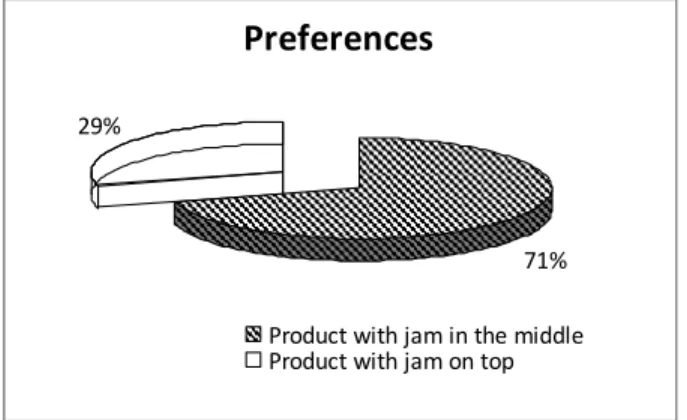
The sensory analysis of the product under development (whey cheese with pumpkin jam) was achieved in two steps. In the first place, the tasters should choose between two presentations: (i) a layer of pumpkin jam between two layers of whey cheese; and (ii) pumpkin jam on top of whey cheese. The first option was the preferred (by more than 70 % of the panelists) (Figure 3). After this result, the sensory profile of the chosen product was established considering the attributes analyzed: homogeneity in colour, homogeneity of the product, milk aroma, intensity of aroma, intensity of taste, salty taste, milk taste, sweetness, consistency, and presence of granules (Figure 4). From the results obtained, it was concluded that the product was considered consistent, very sweet with some granules and homogen in colour. It was well appreciated the milk aroma, as well as the intensity of aroma and taste.
Figure 3. Preference of the two types of product developed.
0 25 50 75 100
Like pumpkin jam Like w hey cheese
P a n e ll is ts ( % )
Preferences
29% 71%Product with jam in the middle Product with jam on top
Figure 4. Sensorial profile of the chosen product.
In contrast, the attributes less evaluated by the tasters were the “homogeneity of the product”, as a consequence of the unstable layer of pumpkin jam in the middle of whey cheese, and “salty taste” because of the sweetness of the jam. However, the “global appreciation” was considered good (Figure 5).
Figure 5. Global appreciation of the developed product.
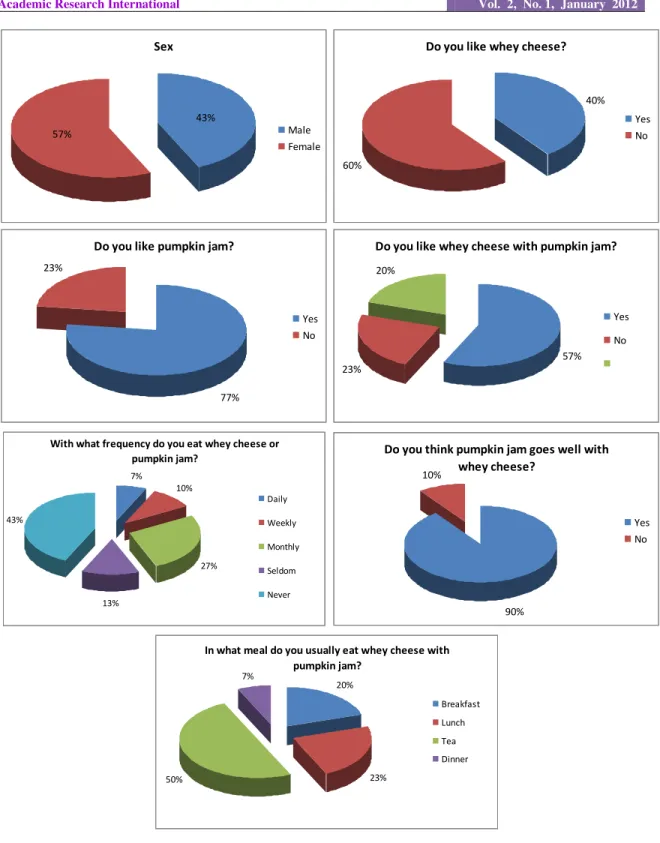
As noted above, the sample used for the market research was composed by 100 persons: 57 women and 43 men. The first two questions asked were about the tastes of the enquired (Figure 6). They were asked, with closed-end questions if they liked “whey cheese” and “pumpkin jam”. Their answers allow some leeway since almost half of the people liked whey cheese and three quarters liked jam. The third question was also a closed-end question and was about the liking and disliking of whey cheese with pumpkin jam. More than half of the enquired answered positively to this question. So, once again, there is some indication that the product development could proceed.
The next question was about the frequency of consumption of the products in question: whey cheese or pumpkin jam. To measure the frequency of consumption, the possible answers were provided – daily, weekly, monthly, seldom, never. Unfortunately, these results were not very encouraging, because almost half of the enquired said that they did not consume any of the products. However, more than one quarter of the enquired said that they consume these products (whey cheese or pumpkin jam) monthly and 10 % even weekly.
0 1 2 3 4 Homogeneity in color Homogeneity of the product Milk aroma Intensity of aroma Intensity of taste Salty taste Milk taste Sweetness Consistency Granules 0 20 40 60 80 100Very bad Bad Acceptable Good Very good
Figure 6. Graphs relative to the market research.
According to the questionnaire it was still possible to know that half the people of the sample consume whey cheese or pumpkin jam at tea and almost on fourth at lunch. Finally, 90 % of the sample agrees that pumpkin goes well with whey cheese, which is an encouraging result.
These results give an idea of the acceptance by the consumers of the product at stake. Consequently, this should be designed, primarily, to meet the food needs regarding a snack food. However, it can still
Sex
43%
57% Male
Female
Do you like pumpkin jam?
77% 23%
Yes No
With what frequency do you eat whey cheese or pumpkin jam? 7% 10% 27% 13% 43% Daily Weekly Monthly Seldom Never
Do you like whey cheese with pumpkin jam?
57% 23% 20% Yes No Never
In what meal do you usually eat whey cheese with pumpkin jam? 20% 23% 50% 7% Breakfast Lunch Tea Dinner
Do you like whey cheese?
40%
60%
Yes No
Do you think pumpkin jam goes well with whey cheese?
90% 10%
Yes No
be explored in other market segments - the people who consume it on other occasions, particularly at lunch as a desert.
CONCLUSIONS
The sensory quantitative profile analysis to the final form of the product developed (a layer of pumpkin jam between two layers of whey cheese) emphasized a good global appreciation. However more studies would be necessary to still improve the product in order to introduce it in the marked in the future.
With respect to it’s acceptability by consumers, the preliminary results are encouraging, since the major part of the enquired liked this combination of products (whey cheese and pumpkin jam), and therefore would appreciate the product developed. However, a more detailed study should be conducted with a bigger sample and with other types of questions, such as: ‘Would you buy this product if you found it on a supermarket shelf?’ ‘With what frequency would you buy this product?’ or ‘What price would you be willing to pay for this product?’
ACKNOWLEDGEMENTS
Thanks to the group of IDAPA - Food Engineering/ESAV-IPV.
REFERENCES
Mulvihill, D. M. (1991). Trends in the production and utilization of dairy protein products: production.
Food Research Quarterly, 51: 145-157.
Morr, C. V. (1992). Whey utilization. In J. G. Zadow (Ed.), Whey and lactose processing. Maryland Heights, MO: Elsevier Science Publishers.
Kinsella, E. & Whitehead, D. M. (1989). Proteins in whey: chemical, physical and functional properties. Advances in Food and Nutrition Research, 33: 343–438.
Pintado et al. (1996). Characterization of Requeijão and Technological Optimization of its Manufacturing Process. Journal of Food Engineering, 30: 363-376.
Díaz et al. (2004). Functional properties of ovine whey protein concentrates produced by membrane technology after clarification of cheese manufacture by-products. Food Hydrocolloids, 18: 601-610. Cruz et al. (2009). Probiotic cheese: health benefits, technological and stability aspects. Trends in
Food Science & Technology, 20: 344-354.
Bisognin, D. L. (2002). Origin and evolution of cultivated cucurbits. Ciência Rural, 32(5): 715-723. Escalada et al. (2007). Composition and functional properties of enriched fiber products obtained from pumpkin (Cucurbita moschata Duchesne ex Poiret). LWT – Food Science and Technology, 40: 1176-1185.
Gliemmo et al. (2009). Color stability of pumpkin (Cucurbita moschata, Duchesne ex Poiret) puree during storage at room temperature: Effect of pH, potassium sorbate, ascorbic acid and packaging material. Food Science and Technology, 42: 196-201.
Lund, D. B. (1975). Effects of blanching, pasteurization and sterilization on nutrient. In R. S. Harris & E.. Karmas (Eds.), Nutritional evaluation of food processing. New York: AVI Publishing.
Dutta et al. (2006). Rheological characteristics and thermal degradation kinetics of beta-carotene in pumpkin puree. Journal of Food Engineering, 76: 538-546.
Grunet, K. G. & Valli, C. (2001). Designer-made meat and dairy products: consumer-led product development. Livestock Production Science, 72: 83-98.
Suwannapom, P. & Speece, M. W. (2010). Assessing new product development success factors in the Thai food industry. British Food Journal, 112: 364-386.
Buisson, P. D. (1995). Developing new products for the consumer. In D. Marshall (Ed.). Food choice
and the consumer. Glasgow: Blackie Academic and Professional.
Logue, A. W. & Smith, M. E. (1986). Predictors of food preferences in adult humans. Appetite, 7:109-125.
Steptoe et al. (1995). Development of a measure of the motives underlying the selection of food: the food choice questionnaire. Appetite, 25: 267-284.
Lawless, H. T. & Heymann, H. (1998). Sensory Evaluation of Food: Principles and Practices. New York: Chapman and Hall.
Tang et al. (2000). Alternatives to data averaging of consumer preference data. Food Quality and
Preference, 11: 99-104.
Amerine et al. (1965). Principals of Sensory Evaluation of Food. New York: Academic Press.
Moskowitz, H. (1983). Descriptive analysis of perceptions. In Product testing and sensory evaluation
of foods. Westport, CT: Food Nutrition Press.
McEwan et al. (2002). Profiency testing for sensory profile panels: measuring panel performance.
Food Quality and Preference, 13: 181-190.
Stewart, H. & Martinez, S. (2002). Innovation by food companies key to growth and profitability.
Food Review, 25: 28-32.
Cooper, R. G. & Kleinschmidt, E. K. (2007). Winning businesses in product development: the critical success factors. Research Technology Management, 50: 52-66.
Kleinschmidt, E. J. & Cooper, R. G. (1995). The relative importance of new product success determinants – perception versus reality. R&D Management, 25: 281-298.
Van Kleef, E. (2006). Consumer research in the early stages of new product: issues and application in
the food domain. Doctoral dissertation. Wageningen: Wageningen University.
Bogue et al. (1999). Market-oriented methodologies to optimize consumer acceptability of cheddar-type cheeses. British Food Journal, 101: 301-326.