Preoperative abnormalities in serum sodium
concentrations are associated with higher in-hospital
mortality in patients undergoing major surgery
M. Cecconi
1,
*, H. Hochrieser
2
, M. Chew
4
, M. Grocott
5
, A. Hoeft
6
, A. Hoste
7
,
I. Jammer
8
, M. Posch
2
, P. Metnitz
3
, P. Pelosi
9
, R. Moreno
10
, R. M. Pearse
11
,
J. L. Vincent
12
and A. Rhodes
1
for the European Surgical Outcomes Study
(EuSOS) group for the Trials groups of the European Society of Intensive Care
Medicine and the European Society of Anaesthesiology
1
Anaesthesia and Intensive Care, St George’s Hospital and St George’s University of London, London, UK,
2Center
for Medical Statistics, Informatics, and Intelligent Systems,
3Clinical Department of General Anaesthesiology,
Emergency and Intensive Care Medicine, Department of Anaesthesiology and Intensive Care Medicine, LKH
-University Hospital of Graz, Medical -University of Graz, Austria,
4Department of Anaesthesia and Intensive Care
and Institute of Clinical Sciences Malmö, Lund University, Lund, Sweden,
5Anaesthesia and Critical Care
Medicine, University of Southampton, Southampton, UK,
6Department of Anaesthesiology, University of Bonn,
Bonn, Germany,
7Intensive Care Unit, Ghent University Hospital, Ghent, Belgium,
8Department of Anaesthesia
and Intensive Care, Haukeland University Hospital, Bergen 5021, Norway,
9Department of Surgical Sciences and
Integrated Diagnostics, IRCCS San Martino IST, University of Genoa, Genoa, Italy,
10Hospital de São José, Centro
Hospitalar de Lisboa Central, EPE, UCINC, Lisbon, Portugal,
11Barts and The London School of Medicine and
Dentistry, Queen Mary University of London, London, UK, and
12Department of Intensive Care, Erasme Hospital,
Université Libre de Bruxelles, Brussels, Belgium
*Corresponding author. E-mail: [email protected]
Abstract
Background: Abnormal serum sodium concentrations are common in patients presenting for surgery. It remains unclear whether these abnormalities are independent risk factors for postoperative mortality.
Methods: This is a secondary analysis of the European Surgical Outcome Study (EuSOS) that provided data describing 46 539 patients undergoing inpatient non-cardiac surgery. Patients were included in this study if they had a recorded value of preoperative serum sodium within the 28 days immediately before surgery. Data describing preoperative risk factors and serum sodium concentrations were analysed to investigate the relationship with in-hospital mortality using univariate and multivariate logistic regression techniques.
Results: Of 35 816 (77.0%) patients from the EuSOS database, 21 943 (61.3%) had normal values of serum sodium (138–142 mmol
litre−1) before surgery, 8538 (23.8%) had hyponatraemia (serum sodium≤137 mmol litre−1) and 5335 (14.9%) had hypernatraemia
(serum sodium≥143 mmol litre−1). After adjustment for potential confounding factors, moderate to severe hypernatraemia
(serum sodium concentration≥150 mmol litre−1) was independently associated with mortality [odds ratio 3.4 (95% confidence
interval 2.0–6.0), P<0.0001]. Hyponatraemia was not associated with mortality.
Accepted: September 5, 2015
© The Author 2015. Published by Oxford University Press on behalf of the British Journal of Anaesthesia. All rights reserved. For Permissions, please email: [email protected]
doi: 10.1093/bja/aev373 Clinical Practice
63
at Apollo Group on June 8, 2016
http://bja.oxfordjournals.org/
Conclusions: Preoperative abnormalities in serum sodium concentrations are common, and hypernatraemia is associated with increased mortality after surgery. Abnormalities of serum sodium concentration may be an important biomarker of
perioperative risk resulting from co-morbid disease.
Key words:high-risk surgery; hypernatraemia; hyponatraemia; perioperative medicine
Editor’s key points
• Abnormalities of serum sodium (dysnatraemia) are likely to be associated with increased perioperative risk.
• Dysnatraemias are more common in those with co-morbid-ity or undergoing emergency surgery.
• Dysnatraemia could be a useful biomarker of perioperative risk and warrant further investigation before surgery.
Postoperative mortality and morbidity are significant problems
for health-care systems.1–3A better understanding of the
pre-operative factors associated with postpre-operative complications could lead to improved methods of risk stratification. This could allow more effective allocation of perioperative care re-sources in order to maximize the benefit to the greatest number
of patients.4–6A number of tests are routinely performed before
surgery, but the predictive utility of most investigations is
un-clear.7 8The UK National Institute for Health and Care Excellence
(NICE) has confirmed the paucity of information regarding the clinical value of preoperative electrolyte testing.
Serum sodium concentrations are commonly measured before major surgery. Sodium, chloride, and bicarbonate ions contribute ∼90% of the extracellular osmolality. In normal homeostatic con-ditions, serum sodium concentrations are maintained within a
very tight range (138–142 mmol litre−1), although values slightly
outside this range are often considered normal. Previous studies suggest that dysnatraemia, defined as either hyponatraemia or hypernatraemia, is associated with worse outcomes in medical and surgical patients in both hospital wards and intensive care
units (ICUs)9–14 and is associated with increased health-care
costs.15However, there are few published data exploring the
asso-ciation between preoperative dysnatraemia and postoperative
adverse outcomes. Recently, Leung and colleagues16 17reported
that both preoperative hypo- and hypernatraemia are independ-ently associated with increased hospital mortality, length of hos-pital stay, and complications in surgical patients. Similar
associations have been found in postsurgical ICUs.18Given that
derangements of serum sodium are detected using routine pre-operative blood tests and are potentially treatable, understanding the implications of dysnatraemia for perioperative outcomes is of great importance.
We therefore performed a secondary analysis of data
col-lected during the European Surgical Outcomes Study (EuSOS)19
to describe the relationship between preoperative serum sodium concentration and postoperative mortality, in order to evaluate whether dysnatraemia is independently associated with death after surgery.
Methods
This study is a secondary analysis of data collected during a major prospective observational study of non-cardiac surgery (EuSOS). The investigators collected data on all patients undergoing surgery in participating hospitals within a 1 week period in April 2011. Full
methodological details can be found in the original publication.19
All surgical patients were enrolled unless they were <16 yr of age or were having outpatient, obstetric, cardiac, or neurosurgical procedures.
Cohort description
Patients were included in this analysis if there were complete data describing preoperative serum sodium measurements and postoperative hospital mortality in the database. For the pur-poses of the present study, a preoperative serum sodium meas-urement was the most recent measmeas-urement performed within the 28 days before surgery. Patients were excluded if they were re-cruited in a hospital that provided data describing 10 patients or fewer in the study week, or in hospitals above the 95th centile for mortality.
Definitions
For the analyses, seven intervals were defined from severe hypo-natraemia to severe hyperhypo-natraemia, with the reference serum
so-dium interval defined as being between 138 and 142 mmol litre−1.
Statistical analysis
The primary outcome measure was in-hospital mortality, cen-sored at 30 days. Statistical analyses were performed with SAS (version 9.2, produced by Statistical Analytical Software, North Carolina State Universtity, USA) and R (version 2.13.0 produced by R Development Core Team). Categorical variables are pre-sented as n (%) and continuous variables as mean (). Results of statistical models are reported as adjusted odds ratios (ORs) with 95% confidence intervals (CIs).
General estimating equations were used to assess the associ-ation between preoperative serum concentrassoci-ation and subse-quent postoperative in-hospital mortality. First, the association between the risk factors and in-hospital mortality was explored using logistic regression analysis, including the dysnatraemia
groups asfixed factors only. All factors significantly associated
with mortality (P<0.05) were then entered as covariables into a general estimating equation regression model, accounting for clustering of patients within sites. Patients were excluded if their data were missing values for any of the covariates. Patients with serum sodium concentrations within the normal range
(138–142 mmol litre−1) were used as the reference group. To
account for multiple comparisons, an adjusted two-sided signifi-cance level of P<0.008 (0.05/6) was applied.
In order to illustrate graphically the association between poperative serum sodium concentration and mortality, a logistic re-gression function was estimated using splines. We expected the association between mortality and extreme values for serum so-dium concentrations to be unreliable because of low patient num-bers. Patients with serum sodium values from the lowest and highest 0.25% of values were therefore excluded from the analysis. In a secondary analysis, resource utilization variables were com-pared across the sodium categories in univariate analysis using
the analysis of variance () and χ2tests.
Three sensitivity analyses were performed to assess the ro-bustness of the results. Two multivariate generalized estimating
at Apollo Group on June 8, 2016
http://bja.oxfordjournals.org/
equation regression models were developed using the categories of hyponatraemia, normal serum sodium, and hypernatraemia, where borderline dysnatraemia was included in either the normal or dysnatraemia groups. To adjust for multiple testing (compari-son of the two dysnatraemia groups with reference) an adjusted two-sided significance level of P<0.025 (0.05/2) was applied. A number of sensitivity analyses were performed. These included the following: (i) a multiple imputation methodology that was per-formed to account for the influence of selection bias through pre-operative sodium measurements; and (ii) a propensity score analysis that was performed to account further for this factor. The propensity score-matched analysis was performed for the multivariate model for hospital mortality, adjusting it based on the propensity score for serum sodium measurement. The pro-pensity score was calculated using logistic regression on the full data set, including patients with no available data describing serum sodium, and then introduced into the multivariate model.
Results
Cohort description and prevalence of dysnatraemias From the full EuSOS cohort of 46 539 patients, a total of 35 816
patients were included in this analysis (Table1and
Supplemen-tary data Table S1). The mean () age was 59 (18) yr, and 17 683
patients (49%) were male. Of the total number of patients, 26 282 (73%) were presenting for elective surgery. For 21 943 (61.3%) patients, the serum sodium measurement was within
the 138–142 mmol litre−1interval, whereas 8538 (23.8%) patients
were hyponatraemic (serum sodium≤137 mmol litre−1) and 5335
(14.9%) were hypernatraemic (serum sodium concentrations
≥143 mmol litre−1). Patients presenting with dysnatraemia were
more likely to undergo emergency surgery (Table1) and to
pre-sent with co-morbid disease (Table2). Hyponatraemia and
hy-pernatraemia were twice as frequent in patients with cirrhosis, congestive heart failure, or coronary artery disease as in those who did not have these diseases. Hyponatraemia was also more prevalent in patients with chronic obstructive pulmonary
disease (Table2).
Association of dysnatraemias with mortality
In the univariate analysis, both hyponatraemia and moderate to severe hypernatraemia were associated with increased mortality
(Table3). In the logistic regression model, after correcting for age,
gender, ASA score, co-morbid disease, surgical procedure cat-egory, severity, grade, and urgency of surgery, only moderate and severe hypernatraemia were significantly associated with in-creased mortality [OR 3.4 (95% CI 2.0–6.0), P<0.001]. The associ-ation between mortality and serum sodium concentrassoci-ation is
Table 1Basic patient characteristics of cohort split by preoperative serum sodium measurement. COPD, chronic obstructive pulmonary
disease
Baseline characteristics Total ≤130 mmol litre−1 131–135 mmol litre−1 136–137 mmol litre−1 138–142 mmol litre−1 143–144 mmol litre−1 145–149 mmol litre−1 ≥150 mmol litre−1 P-value Number of patients [n (%)] 35 816 (100) 602 (1.7) 3338 (9.3) 4598 (12.8) 21 943 (61.3) 3805 (10.6) 1422 (4.0) 108 (0.3) Age (yr) 58.5 (18.2) 67.2 (16.2) 63.0 (17.9) 58.5 (18.9) 57.3 (18.1) 59.2 (17.1) 60.4 (17.5) 62.8 (18.9) <0.0001 Male sex [n (%)] 17 683 (49) 303 (50.3) 1686 (50.5) 2322 (50.5) 10 740 (49.0) 1861 (48.9) 712 (50.1) 59 (54.6) 0.26 Urgency of surgery [n (%)] Elective 26 282 (73.4) 252 (41.9) 1732 (51.9) 2998 (65.2) 16 988 (77.4) 3129 (82.2) 1130 (79.5) 53 (49.1) <0.0001 Urgent 7394 (20.6) 257 (42.7) 1189 (35.6) 1228 (26.7) 3932 (17.9) 532 (14) 223 (15.7) 33 (30.6) <0.0001 Emergency 2140 (6) 93 (15.5) 417 (12.5) 372 (8.1) 1023 (4.7) 144 (3.8) 69 (4.9) 22 (20.4) <0.0001 General anaesthesia 27 804 (77.6) 463 (76.9) 2557 (76.6) 3605 (78.4) 17 111 (78.0) 2908 (76.4) 1073 (75.5) 87 (80.6) 0.05 ASA score [n (%)] I 7732 (21.6) 40 (6.7) 389 (11.7) 943 (20.6) 5246 (24.0) 823 (21.7) 277 (19.6) 14 (13.0) <0.0001 II 16 619 (46.5) 178 (29.8) 1263 (37.9) 1956 (42.6) 10 625 (48.5) 1901 (50) 666 (47) 30 (27.8) <0.0001 III 9929 (27.8) 297 (49.7) 1368 (41.0) 1423 (31.0) 5426 (24.8) 978 (25.7) 402 (28.4) 35 (32.4) <0.0001 IV 1389 (3.9) 77 (12.9) 299 (9.0) 248 (5.4) 570 (2.6) 100 (2.6) 69 (4.9) 26 (24.1) <0.0001 V 78 (0.2) 6 (1) 14 (0.4) 19 (0.4) 33 (0.2) 0 (0) 3 (0.2) 3 (2.8) <0.0001
Table 2Co-morbidities by preoperative serum sodium measurement. COPD, chronic obstructive pulmonary disease; ID, insulin dependent;
NID, non-insulin dependent
Co-morbidities Total ≤130 mmol litre−1 131–135 mmol litre−1 136–137 mmol litre−1 138–142 mmol litre−1 143–144 mmol litre−1 145–149 mmol litre−1 ≥150 mmol litre−1 P-value Cirrhosis 427 (1.2%) 26 (4.3%) 81 (2.4%) 61 (1.3%) 194 (0.9%) 38 (1%) 22 (1.6%) 5 (4.6%) <0.0001 Congestive heart failure 1830 (5.1%) 72 (11.9%) 271 (8.1%) 275 (6.0%) 939 (4.3%) 174 (4.6%) 86 (6.1%) 13 (12.0%) <0.0001 COPD 4220 (12.0%) 104 (17.2%) 515 (15.5%) 569 (12.4%) 2423 (11.1%) 412 (10.8%) 186 (13.1%) 11 (10.2%) <0.0001 Coronary artery disease 5289 (15%) 147 (24.4%) 709 (21.3%) 754 (16.4%) 2900 (13.2%) 532 (14%) 225 (15.8%) 22 (20.4%) <0.0001 Diabetes mellitus ID 1786 (5%) 70 (11.6%) 326 (9.8%) 304 (6.6%) 884 (4.0%) 136 (3.6%) 59 (4.2%) 7 (6.5%) <0.0001 Diabetes mellitus NID 2919 (8.2%) 71 (11.8%) 373 (11.2%) 428 (9.3%) 1637 (7.5%) 283 (7.4%) 116 (8.2%) 11 (10.2%) <0.0001 Metastatic cancer 1898 (5.3) 61 (10.1%) 265 (8.0%) 272 (5.9%) 1026 (4.7%) 196 (5.2%) 66 (4.7%) 12 (11.1%) <0.0001 Stroke 1748 (4.9%) 53 (8.8%) 236 (7.1%) 260 (5.7%) 953 (4.4%) 163 (4.3%) 74 (5.2%) 9 (8.3%) <0.0001
at Apollo Group on June 8, 2016
http://bja.oxfordjournals.org/
shown in Figure1. Overall, patients with serum sodium
concen-trations <136 mmol litre−1represented 11% of the overall
popula-tion and accounted for 243 deaths (6.2% mortality in this category), which represented 20.1% of all deaths. Patients with
a serum sodium >144 mmol litre−1represented 4.3% of the overall
population. They accounted for 87 deaths (5.7% mortality in this category) and 7.4% of all deaths. Both hypo- and hypernatraemia were associated with a three-fold greater use of central venous catheters during surgery. Patients with serum sodium <130 or
>150 mmol litre−1were, respectively, three andfive times more
likely to be admitted to critical care after surgery. The use of both mechanical ventilation and inotropic support in the imme-diate postoperative period was also greater for patients with
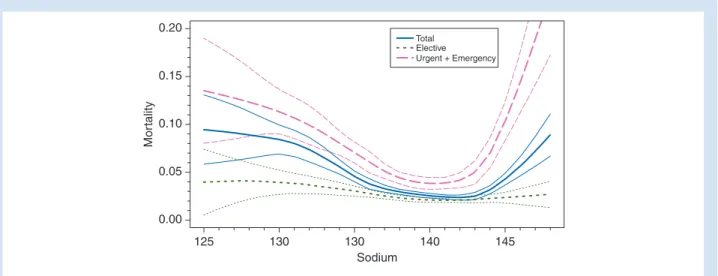
dys-natraemia (Table4). Graphical representation of mortality in the
overall, the elective, and the non-elective population is present in
Figure2.
Sensitivity analyses
Owing to the proportion of patients with missing serum sodium values in the initial cohort (21%), a multiple imputation analysis
was performed, which confirmed the original multivariate ana-lysis. A propensity analysis with probability of having serum so-dium measured being the outcome was conducted to validate the association between preoperative serum sodium and mortality. The effect of serum sodium on mortality was significant even after this adjustment, meaning that the association between serum sodium and mortality were maintained even after correct-ing for this factor (see Supplementary data Table S4).
Discussion
The principalfindings of this study were that dysnatraemia was
common in patients presenting for non-cardiac surgery, and was significantly associated with mortality. However, after correction for confounding factors, only severe hypernatraemia was inde-pendently associated with mortality. Our results suggest that although abnormal serum sodium concentrations may be asso-ciated with adverse postoperative outcomes, it is likely that the underlying cause of the abnormality has much greater prognos-tic significance. Preoperative serum sodium abnormalities
Table 3Odds ratios for in-hospital mortality according to preoperative serum sodium, patient characteristics, and type of surgery. Odds
ratios [OR (95% confidence intervals)] are presented for the univariate and multivariate analysis (adjusted in a two-level analysis with patient at thefirst level and site at the second level)
Serum sodium intervals OR (univariate model) P-value OR (multivariate analysis) P-value
Normal range (138–142 mmol litre−1) Reference Reference Reference
Severe hyponatraemia (Na≤130 mmol litre−1) 3.5 (2.6–4.6) <0.0001 1.4 (1.0–2.0) 0.061 Moderate hyponatraemia (Na 131–135 mmol litre−1) 2.3 (1.9–2.7) <0.0001 1.3 (1.0–1.6) 0.033
136–137 mmol litre−1Na range 1.4 (1.1–1.6) 0.0007 1.0 (0.8–1.2) 0.94
143–144 mmol litre−1Na range 1.1 (0.9–1.3) 0.55 1.1 (0.9–1.3) 0.48
Moderate hypernatraemia (Na 145–149 mmol litre−1) 1.8 (1.4–2.3) <0.0001 1.3 (1.0–1.8) 0.074 Severe hypernatraemia (Na≥ 150 mmol litre−1) 10.1 (6.3–16.1) <0.0001 3.4 (2.0–5.9) <0.0001
0.0 0.1 0.2 Mor tality Numbf er of Cases 0.3 0.4 0.5 10 000 Sodium 110 115 115 125 130 135 140 145 150 155 160 165 170 1000 100 10 1 Predicted mortality Cl
Distribution of patients who died Number of cases, logarithmized
Observed mortality
Fig 1Distribution of sodium concentration-predicted mortality and contribution to total mortality according to sodium concentration (in millimoles per litre) in the
total study population. CI, confidence interval.
at Apollo Group on June 8, 2016
http://bja.oxfordjournals.org/
therefore remain an important biomarker of postoperative mor-tality risk.
Ourfindings differ from those of previous studies in the sense
that in our study only severe hypernatraemia was independently associated with increased mortality after surgery. These results
are in contrast with thefindings of Leung and colleagues16 17in
the perioperative setting and studies in medical and critically ill
patients.9 11 20In two separate studiess from a large American
database, Leung and colleagues16 17found that both
hyponatrae-mia and hypernatraehyponatrae-mia were independently associated with increased mortality and incidence of postoperative complica-tions. In a large cohort of patients from the Austrian Center for Documentation and Quality Assurance in Intensive Care,
Funk and colleagues11found that mild degrees of dysnatraemia
(hyponatraemia and hypernatraemia) were associated with worse outcome. This was confirmed recently by Darmond and
colleagues9in another large multicentre study in French ICUs.
From a physiological point of view, dysnatraemia originates
from disturbances in water balance;10 21this is normally under
the control of antidiuretic hormone.14 21Several preoperative
conditions may predispose patients to a deranged water balance, such as volume depletion, pain, nausea, and preoperative co-morbid conditions, such as heart failure or cirrhosis. In the context of hyponatraemia, in patients requiring long-term renal
replacement therapy, Waikar and colleagues22demonstrated
that the association between mortality and hyponatraemia was independent of antidiuretic hormone activity. This association
was also found in the SAPS II and APACHE II score23 24validations
studies. In our study, we collected data for a wide range of co-morbidities. It is possible that our results differ from previous studies because we corrected better for preoperative co-morbid-ities. Another possible explanation for the difference between our results and previous literature is that we may have stratified hyponatraemia in more detail. It is possible that the classification used in our study allowed for a better stratification and therefore a more robust correction for confounding factors in the multivari-ate analysis. Nonetheless, the results regarding hypernatraemia
are consistent with the published literature.17In the multivariate
analysis, after adjusting for confounding factors we found a more than three-fold increase in mortality for patients presenting with
serum sodium higher than 149 mmol litre−1(OR 3.42). There are
several possible explanations for thisfinding. First, it is possible
that these patients were dehydrated, which was not a variable we collected in our data set, and were thus unable to correct for it; and secondly, it is possible that they were more exposed to sig-nificant fluid and electrolyte shifts during the perioperative per-iod.25 26A further possible explanation could relate to other
adverse effects of hypernatraemia, such as increased peripheral
insulin resistance27and decreased cardiac contractility.28We
also investigated the urgency of surgery as a possible confound-ing factor. In this sense, it is important to note that even if pa-tients with hypernatraemia undergoing urgent and emergency surgery had a higher mortality than patients undergoing elective
surgery (Fig.2), the relationship between severe hypernatraemia
and mortality was maintained after correcting for these factors. These results have important implications in the periopera-tive setting. Although from our analysis it is difficult to justify serum sodium correction before surgery, dysnatraemia should
be seen as a warningflag or a biomarker for risk of mortality
and should prompt investigation for underlying disease pro-cesses that may warrant treatment before the commencement of surgery. In practice, our analysis suggests that preoperative serum sodium concentrations could be used to stratify periopera-tive mortality risk. It is a routine and cheap test, and in practice,
T able 4 P erioper a tiv e outcomes a ccording to pr eoper a tiv e serum sodium values Outcomes T otal ≤ 130 mmol litr e − 1 131 –135 mmol litr e − 1 136 –137 mmol litr e − 1 138 –142 mmol litr e − 1 143 –144 mmol litr e − 1 145 –149 mmol litr e − 1 ≥ 150 mmol litr e − 1 P-value In-hospital mortality [n (%)] 1172 (3.3) 51 (8.5) 192 (5.8) 162 (3.5) 574 (2.6) 106 (2.8) 64 (4.5) 23 (21.3) <0.0001 Length of sta y in hospital [da y s; median (IQR)] 4.0 (2.0 –7.0) 7.0 (3.0 –15.0) 6.0 (2.0 –11.0) 4.0 (2.0 –8.0) 3.0 (1.0 –7.0) 3.0 (1.0 –6.0) 3.0 (2.0 –7.0) 7.0 (2.0 –16.0) <0.0001 Admitted to critical car e [n (%)] 3028 (8.5) 112 (18.6) 469 (14.1) 454 (9.9) 1532 (7.0) 275 (7.2) 149 (10.5) 37 (34.2) <0.0001 Non-invasive v entila tion within 24 h [n (%)] 368 (1.0) 8 (1.3) 43 (1.3) 52 (1.1) 211 (1.0) 35 (0.9) 18 (1.3) 1 (1.0) 0.63 Mechanical v entila tion within 24 h [n (%)] 1307 (3.7) 62 (10.3) 237 (7.1) 203 (4.4) 590 (2.7) 109 (2.9) 78 (5.5) 28 (26.0) <0.0001 Inotr ope or vasopr essor [n (%)] 1079 (3.0) 59 (9.8) 219 (6.6) 162 (3.5) 481 (2.2) 72 (1.9) 64 (4.5) 22 (20.4) <0.0001 C entr al v enous ca theter inserted [n (%)] 2766 (7.7) 99 (16.6) 436 (13.1) 416 (9.1) 1386 (6.3) 255 (6.7) 145 (10.2) 29 (26.90) <0.0001
at Apollo Group on June 8, 2016
http://bja.oxfordjournals.org/
behaves as a postoperative mortality biomarker related to the co-morbidity status of surgical patients. Interestingly, although this may seem obvious, our data suggest that clinicians do not use serum sodium in this way. This is apparent when we look at resource utilization. In our study, dysnatraemia was also asso-ciated with different resource utilization in terms of ICU admis-sion, use of ventilation, vasoactive drugs, central lines, and cardiac output monitors, but not all patients in the highest risk group used the same level of resources. Patients with moderate and severe hypernatraemia showed an in-hospital mortality in excess of 21%, but only <35% of this group were admitted to an ICU. It is difficult to interpret these results, because there may be many reasons for which high-risk surgical patients are not
ad-mitted to a critical care unit after surgery,29and can be explained
partly by different resource availability and practice among the departments that took practice in the study; our results, however, suggest that risk was either not recognized or not acted upon, either for lack of resources or for clinical reasons.
Our study has several limitations. First, the original EuSOS database was not designed to investigate the effect of preopera-tive dysnatraemia on outcome. Second, we had no control on the timing of the blood test before surgery (we only knew that it was performed within 28 days before surgery). It is also not known whether some of the patients had already received specif-ic treatment for dysnatraemia before or after the blood test and before or after surgery. It is also possible that severe hypernatrae-mia was still associated with mortality even in the multivariate analysis because other variables related to hypernatraemia were not collected in the EuSOS database; for instance, there was no descriptive description of volaemic status of these patients.
Conclusions
Dysnatraemia is a commonfinding in patients about to undergo
surgery and is associated with increased mortality. However, after correction for other risk factors, this association with mor-tality is weakened, suggesting that other risk factors may be of greater importance, and only severe hypernatraemia was inde-pendently associated with increased mortality. Further research
is needed to establish whether preoperative measurement of serum sodium has a valid role in assessment of mortality risk be-fore surgery and whether treatment of dysnatraemia bebe-fore sur-gery could improve outcome.
Ethics approval
This was a secondary analysis of the EuSOS database.19For the
original publication, ethics requirements differed by country. In Denmark, centres were exempt from ethics; in all other nations, ethics approval was applied for and given. In Finland, written in-formed consent was obtained from individual patients. No add-itional research ethics committee approval was required for this publication.
Authors
’ contributions
Design of the study: M.Ce.
Participated in design of the study: P.M., R.P., A.R. Supervised the statistical analysis: M.P.
Performed the statistical analysis: H.H., P.M. Participated in analysis of the data: M.Ce., A.R. Interpreted the data: H.H.
Interpreted the results: M.Ce.
Participated in interpretation of the data: M.Ch., M.G., A.H., E.H., I.J., M.P., P.M., P.P., R.M., R.P., J.-L.V., A.R.
Drafted the manuscript: M.Ch., M.G., A.H., E.H., I.J., M.P., P.M., P.P., R.M., R.P., J.-L.V., A.R.
Wrote the manuscript: M.Ce.
Participated in writing the manuscript: H.H.
Approved thefinal version of the manuscript: M.Ce., H.H., M.Ch.,
M.G., A.H., E.H., I.J., M.P., P.M., P.P., R.M., R.P., J.-L.V., A.R.
Supplementary material
Supplementary material is available at British Journal of Anaesthesia online.
Declaration of interest
R.P. has received honoraria or speaking fees from Edwards Life-sciences, Massimo, and Nestle Health Sciences, and a research
Mor tality Sodium 125 0.00 0.05 0.10 0.15 0.20 130 Total Elective Urgent + Emergency 130 140 145
Fig 2Predicted mortality according to sodium concentration in the total study population and in elective and non-elective (urgent plus emergency) surgery. On the
y-axis, mortality rate (from 0 to 1). On the x-axis, sodium range (in millimoles per litre). Data are presented for the overall population (total; blue lines), for the elective population (elective; green lines) and for the non-elective population (urgent + emergency; pink lines). For each of the three groups, the central line represents the
mean mortality for the sodium value and the top and bottom lines represent the 95% confidence interval.
at Apollo Group on June 8, 2016
http://bja.oxfordjournals.org/
grant from Nestle Health Sciences. R.P. is a member of the Asso-ciate Editorial Board of the British Journal of Anaesthesia. Other authors: none declared.
Funding
This study is a secondary study of the EuSOS project, which was funded by the European Society of Intensive Care Medicine and the European Society of Anaesthesiology.
References
1. Weiser TG, Regenbogen SE, Thompson KD, et al. An estima-tion of the global volume of surgery: a modelling strategy based on available data. Lancet 2008; 372: 139–44
2. Ghaferi AA, Birkmeyer JD, Dimick JB. Complications, failure to rescue, and mortality with major inpatient surgery in medi-care patients. Ann Surg 2009; 250: 1029–34
3. Birkmeyer JD, Gust C, Dimick JB, Birkmeyer NJ, Skinner JS. Hospital quality and the cost of inpatient surgery in the Uni-ted States. Ann Surg 2012; 255: 1–5
4. Bentrem DJ, Cohen ME, Hynes DM, Ko CY, Bilimoria KY. Identification of specific quality improvement opportunities for the elderly undergoing gastrointestinal surgery. Arch Surg 2009; 144: 1013–20
5. Crawford RS, Cambria RP, Abularrage CJ, et al. Preoperative functional status predicts perioperative outcomes after infra-inguinal bypass surgery. J Vasc Surg 2010; 51: 351–8; discus-sion 8–9
6. Grocott MP, Pearse RM. Prognostic studies of perioperative risk: robust methodology is needed. Br J Anaesth 2010; 105: 243–5
7. Munro J, Booth A, Nicholl J. Routine preoperative testing: a systematic review of the evidence. Health Technol Assess 1997; 1: i–iv; 1–62
8. Reynolds TM, National Institute for Health and Clinical Excel-lence, Clinical Scince Reviews Committee of the Association for Clinical Biochmistry. National Institute for Health and Clinical Excellence guidelines on preoperative tests: the use of routine preoperative tests for elective surgery. Ann Clin Biochem 2006; 43: 13–6
9. Darmon M, Diconne E, Souweine B, et al. Prognostic conse-quences of borderline dysnatremia: pay attention to minimal serum sodium change. Crit Care 2013; 17: R12
10. Reynolds RM. Disorders of sodium balance. Br Med J 2006; 332: 702–5
11. Funk GC, Lindner G, Druml W, et al. Incidence and prognosis of dysnatremias present on ICU admission. Intensive Care Med 2010; 36: 304–11
12. Deubner N, Berliner D, Frey A, et al. Dysnatraemia in heart failure. Eur J Heart Fail 2012; 14: 1147–54
13. Li M, Hu YH, Chen G. Hypernatremia severity and the risk of death after traumatic brain injury. Injury 2013; 44: 1213–8 14. Maggiore U, Picetti E, Antonucci E, et al. The relation between
the incidence of hypernatremia and mortality in patients with severe traumatic brain injury. Crit Care 2009; 13: R110 15. Callahan MA, Do HT, Caplan DW, Yoon-Flannery K. Economic
impact of hyponatremia in hospitalized patients: a retro-spective cohort study. Postgrad Med 2009; 121: 186–91 16. Leung AA, McAlister FA, Rogers SO Jr, Pazo V, Wright A,
Bates DW. Preoperative hyponatremia and perioperative complications. Arch Intern Med 2012; 172: 1474–81
17. Leung AA, McAlister FA, Finlayson SRG, Bates DW. Preopera-tive hypernatremia predicts increased perioperaPreopera-tive morbid-ity and mortalmorbid-ity. Am J Med, 2013; 126: 877–86
18. Sakr Y, Rother S, Ferreira AMP, et al. Fluctuations in serum so-dium level are associated with an increased risk of death in surgical ICU patients. Crit Care Med 2013; 41: 133–42 19. Pearse RM, Moreno RP, Bauer P, et al. Mortality after surgery in
Europe: a 7 day cohort study. Lancet 2012; 380: 1059–65 20. Lindner G, Funk GC, Schwarz C, et al. Hypernatremia in the
critically ill is an independent risk factor for mortality. Am J Kidney Dis 2007; 50: 952–7
21. Kumar S, Berl T. Sodium. Lancet 1998; 352: 220–8
22. Waikar SS, Curhan GC, Brunelli SM. Mortality associated with low serum sodium concentration in maintenance hemodi-alysis. Am J Med 2011; 124: 77–84
23. Le Gall JR, Lemeshow S, Saulnier F. A new Simplified Acute Physiology Score (SAPS II) based on a European/North Ameri-can multicenter study. JAMA 1993; 270: 2957–63
24. Knaus WA, Draper EA, Wagner DP, Zimmerman JE. APACHE II: a severity of disease classification system. Crit Care Med 1985; 13: 818–29
25. Roth E, Lax LC, Maloney JV Jr. Ringer’s lactate solution and
extracellularfluid volume in the surgical patient: a critical
analysis. Ann Surg 1969; 169: 149–64
26. Holte K. Pathophysiology and clinical implications of
peri-op-erativefluid management in elective surgery. Dan Med Bull
2010; 57: B4156
27. Bratusch-Marrain PR, DeFronzo RA. Impairment of insulin-mediated glucose metabolism by hyperosmolality in man. Diabetes 1983; 32: 1028–34
28. Lindner G, Kneidinger N, Holzinger U, Druml W, Schwarz C. Tonicity balance in patients with hypernatremia acquired in the intensive care unit. Am J Kidney Dis 2009; 54: 674–9 29. Pearse RM, Harrison DA, James P, et al. Identification and
characterisation of the high-risk surgical population in the United Kingdom. Crit Care 2006; 10: R81
Handling editor: P. S. Myles
at Apollo Group on June 8, 2016
http://bja.oxfordjournals.org/