Organizational Training within Digital Transformation:
The ToOW Model
Maria João Ferreira
1,4, Fernando Moreira
1,2,3and Isabel Seruca
1,41Universidade Portucalense, DEGI, Rua Dr. António Bernardino de Almeida, 541, Porto, Portugal 2Portucalense Institute for Legal Research – IJP, Porto, Portugal
3Universidade Aveiro, IEETA, Aveiro, Portugal 4Centro Algoritmi, Universidade do Minho, Portugal
Keywords: Digital Transformation, Social Media Tools, Organizational Training.
Abstract: Information systems and technologies (IST) are the essence of up-to date organizations, and changes in this field are occurring at an uncontrollable pace, interrupting traditional business models and forcing organisations to implement new models of business. Social media tools represent a subset of these technologies that contribute to digital transformation (DT) of organizations and which are already used within organizational training contexts. However, the adoption of social media tools, by itself, does not guarantee such a transformation; changes in the organization’s culture and behaviour are also needed. Taking advantage of the DT technology enablers and realising the need for updated approaches to address organizational workers’ training, we propose a model to guide organizational training within DT. The model, called Training of Organizational Workers (ToOW), addresses the 2nd layer of the mobile Create, Share, Document and Training (m_CSDT) framework formerly described. The advantages foreseen for the model usage are two-fold. On the one hand, the model acknowledges the crucial role that an organization plays in promoting a culture of continuous learning/training of its employees; on the other hand, the model provides guidance on setting up the training strategies and activities, as well as on the monitoring of training results achieved, which are measured according to the performance metrics considered within the organizational strategy.
1 INTRODUCTION
It is widely acknowledged that organizations have suffered a large evolution at the social, economic and technological levels where the traditional barriers of transferring information and knowledge have been progressively eliminated. This evolution allowed the elimination of silos, the breaking down of hierarchies, the connection of internal and external stakeholders and the empowering of employees (Berkman, 2014). In this context, the integration of technological innovations, such as Big Data – Analytics, Cloud Computing, Mobile Connectivity, and Social, the four pillars of digital transformation (DT), in business practice can enable significant competitive advantage (Uhl and Gollenia, 2016).
According to Earley Information Science (2016) DT is today a top priority for executives, being that (1) 125000 enterprises expect revenue from their digital initiatives to increase by 80% by 2020; (2) DT initiatives will more than double by 2020, from 22%
to almost 50% and, (3) only 27% of businesses have a coherent digital strategy for creating customer value in place.
The main purpose of digital transformation is to obtain benefits of digital technologies, such as productivity improvements, cost reductions and innovation (Hess et al., 2016). Nevertheless, as stated in (Miller, 2016), for these results to be achieved, a total organizational commitment is required.
To this extent, Hinchcliffe (2016) points out that “…because digital itself is so intangible…. It’s often
even harder to understand the diverse needs, perspectives, and skill gaps of the people that have to change along with the technology”. Hence, it may be
assumed that continuous education/training is an imperative in the organizational context.
Continuous education/training may be seen as the process of identifying and implementing professional skills, enabled by new scientific and technological knowledge and implemented in an organisational context, to address new professional needs.
526
Ferreira, M., Moreira, F. and Seruca, I.
Professionals need new life-long learning approaches to assist them in keeping up with the rhythm of technological change that requires a continuous update of the learning contents, learning processes and delivery approaches of developing training (Kadiri et al., 2016).
The learning mechanisms require an immediate update, putting people, particularly the organizational workers, in the centre of the flow of knowledge and, changing the traditional learning to experimental, social and data-driven learning. This update will allow new knowledge to be acquired more quickly and to be more adapted to the Generation Y (those born in 1980 or later) that constitutes 75% of the world’s current labour force (Uhl and Gollenia, 2016).
Taking advantage of the DT technology enablers and realising the need for updated approaches to address organizational workers’ training, we propose a model – Training of Organizational Workers (ToOW) – for the 2nd layer – of the mobile Create,
Share, Document and Training (m_CSDT) framework formerly described in (Ferreira et al., 2014; Ferreira et al., 2015).
The paper is structured as follows: Section 2 describes the new technology trends for organizations while engaging in digital transformation. Section 3 provides a summary of the use of social media tools by organizattions in several contexts and discusses their particular use for organizational training ativities. Section 4 presents our model contribution to address the gaps identified, supporting the education and training of organizational workers. Finally, Section 5 concludes with a summary of our achievements and directions for future work.
2 NEW TRENDS FOR
ORGANIZATIONS
2.1 Digital Transformation
The definition of digital transformation (DT) is not consensual among the stakeholders involved in this issue, particularly in organizations, leading to several perspectives of what it really means. These perspectives range from a focus on technology, to digital customer engagement, to new digital business models and so on. The lack of clarity often results in piecemeal initiatives, missed opportunities and false starts in the organization digitalization. According to Solis (2017) DT may be defined as “the realignment
of, or new investment in, technology, business models,
and processes to drive new value for customers and employees and more effectively compete in an ever-changing digital economy”
Following this line of reasoning, from the organizations’ point of view, DT can be seen as a deep and accelerating transformation with regard to processes, activities, competences and models, in order to take advantage of the changes and opportunities offered by the inclusion of digital technologies into an organization.
On the other hand, Uhl and Gollenia (2016) enrich the DT concept, arguing that the adoption of technology-based change is focused on four technology enablers: (1) cloud, (2) mobile, (3) social, and (4) big data - analytics. Hence, DT draws on these four pillars to place a business context over the technologies, while taking advantage of them to support innovation.
2.2 Big Data – Analytics
As discussed in (Chen et al., 2014), on the one hand Big data is considered an abstract concept and, on the other hand, the academic and industrial communities have different views on the definition (Team O. R., 2011; Laney, 2001). However, some definitions have appeared over time, namely by Apache Hadoop, IBM, McKinsey & Company and IDC. The first definition was though introduced by Doug Laney (2001), where he presents the 3Vs model (Volume – great volume, Velocity – rapid generation, and Variety – various modalities). In 2012 the 3Vs model evolves to a 4Vs model with the inclusion of Value (huge value but very low density).
Despite the added value that Big Data presents in responding to new requests, some of the existing challenges need to be addressed. In (Agrawal et al. 2012) eight challenges are presented. Within our contribution, we place special emphasis on the challenge identified by these authors as "Analytical mechanism", since it will be tackled in the solution proposed in Section 4.
2.3 Cloud Computing
The basic definition of cloud computing can be found in (Armbrust et al. 2010) and is given as “Cloud
computing refers to both the applications delivered as services over the Internet and the hardware and systems software in the data centers that provide those services. The services themselves have long been referred to as Software as a Service (SaaS). Some vendors use terms such as IaaS (Infrastructure
as a Service) and PaaS (Platform as a Service) to describe their products.”
This new paradigm is supported by a set of vendors such as Amazon, Google, and Microsoft. Microsoft offers SaaS, PaaS and IaaS cloud packages to end users (Amato et al., 2013). Some of the significant benefits of cloud computing include device and location independence, 24x7 support, lower total cost of ownership (TCO), reliability, scalability, sustainability, agile deployment, lower capital expenditure and a single infrastructure to fulfil all computing, networking and storage needs for various applications.
2.4 Mobile Connectivity
Mobile devices and connections grew in 2013 to 7 billion, and will grow to 50 billion by 2020 (Reddi and Zhu, 2017). Not only the devices are targeted by this growth, but also the volume of mobile Web traffic, which often exceeds the "traditional" Web traffic.
This massive use of mobility devices through the vast amount of applications and services is based on Mobile computing. Mobile computing is defined in (Bucki, 2016) as “a generic term used to refer to a
variety of devices that allow people to access data and information from where ever they are. Sometimes referred to as "human-computer interaction," mobile computing transports data, voice and video over a network via a mobile device.”
The growth of the mobile computing market allows access to a wide range of technologies, and the integration of a variety of environments, such as cloud computing, social networks, big data computing and big data analytics.
2.5 Social Business and Social Media
According to (Bharadwaj et al., 2013), digital technologies are transforming the relations of the digital structure, regarding the spaces of action of customers and companies, due to social media and social networks. The social business concept encompasses two directions, the resolution of social problems and, in a broader perspective, allowing a transformation of organizations so as to turn them more agile and more resilient.
Hence, Social Business may be regarded as a popular tendency that is revolutionizing organizational work and generating value for all of its elements, i.e. employees, customers, partners and suppliers. It means that all departments in an organization integrate their social capabilities into traditional business processes (Dorn el al., 2007) to
change the way of working in order to create value. This view is reinforced by (Bharadwaj et al., 2013) as they state that "digital business strategy is simply that
of organizational strategy formulated and executed by leveraging digital resources to create differential value.” These authors also defined three indicators to
assess this added value: “(1) going beyond the
traditional view; (2) going beyond systems and technologies; and (3) explicitly linking digital business strategy to creating differential business value”.
3 SOCIAL MEDIA TOOLS
3.1 The Use of Social Media Tools in
Organizations
There is a growing number of reports of use of social media tools in organizations. In this section, we provide only an example, but we can find out several more (Hummer (Hansen and Sia, 2015), LEGO (Sawy et al., 2016)) that are focused on the companies’ digital transformation efforts.
Starbucks is a multinational company with more than 20,000 stores worldwide, headquartered in Seattle, USA. In 2009, Starbucks, after a poor performance and share price value, which was cut in half, focused its digital strategy to re-establish the connection with its customers (Fitzgerald et al., 2013). One of the first measures introduced was to offer free Wi-Fi in all Starbucks stores, in addition to free access to The Economist's magazine contents.
Furthermore, an important step in the undergone digital transformation was to restructure teams to collaborate from the start of projects. By that time, the company was able to reduce 10 seconds in the processing of each card transaction, reducing the total service time by 900,000 hours, considering 3 million mobile payments per week.
The use of social media tools, in addition to other technologies, changed customer relationships, operations, and the business model, leading to increased customer relationships; as a result, the Starbucks company shares value increased from $8 in 2009, to nearly $73 in July 2013.
Internal communication also benefited from this strategy of use of social media tools; to that extent, the company’s CIO remarked that “social business
tools and processes had transformed the company's innovation culture, helping it develop products and understand risks as rapidly as new markets emerged.” (Fitzgerald et al., 2013).
3.2 The Use of Social Media Tools in
Training
This section reviews some scenario attempts found in the literature to use social media tools within a training context.
Mamaqi (2015) argues that informal learning or training can today be considered as one of the most viable ways for companies to have better-qualified employees. This author shows that organizations are increasingly using social media tools for collaborative learning through informal learning or workplace training.
To better understand this reality a study was conducted where the efficiency that the different modes of training (classroom, social media tools and traditional training in the workplace) may have in the performance of the organization was analyzed. The results of the study showed that there are differences in training according to job categories; however, evidence was found that the use of the three training modes is associated with increased performance.
The international Intensive Programme Empowering Learning environments in nursing education (EleneIP) was created by Finland together with partners from Cyprus, Lithuania and Spain (Salminen et al., 2016). The goal of EleneIP was to provide a platform for the use of social media tools in nursing education, to provide a collaborative learning environment and to increase technological literacy among teachers in order to adjust their pedagogical approaches to new types of apprentices.
Manca and Ranieri (2016) conducted a study aimed to find empirical evidence on how higher education teachers are using social media tools for
personal, educational and professional purposes. The results have shown that the use of these tools is still rather limited and restricted, and issues like age and antiquity seem to influence the adoption of these tools.
4 TRAINING OF
ORGANIZATIONAL WORKERS
DT in organizations is already a reality that needs to be implemented and in some cases. Acknowledging this context, the m_CSDT framework was formerly proposed in Ferreira et al., (2015); the framework will serve as a basis for the model proposal presented in this paper. In the following sub-sections, the ToOW model will be described as well as a model usage scenario, addressing the 2nd layer of the m_CSDT
framework.
4.1 The Rationale for the Model
Proposal
As discussed in the previous sections, the need for digital transformation of organizations, and consequently, in light of this paradigm, the need to introduce changes in the conduction of business and training of employees, are now recognized within the scientific community and by organizations. However, new approaches to address this paradigm are needed, so that guidance may be provided for their implementation within an organization.
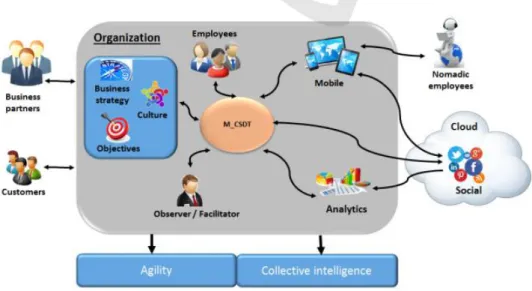
Figure 1: 2nd layer – ToOW – of the m_CSDT framework.
Hence, a new contribution is hereby presented, originating from the work reported in (Ferreira et al., 2015). The former approach was focused only on the changes introduced by social business, supported by social media tools. However, DT, as discussed earlier, is based on its four pillars discussed in section 2.
Thus, to address this objective – taking into account these four pillars and not just one – the former approach was extended; it consists of a three-tier framework (m_CSDT), covering: (i) the creation, sharing and documentation of information and knowledge in and out of an organization; (ii) training of organizational workers, and (iii) promotion of ad-hoc discussion.
As shown in Figure 1, it is possible to consider a generic approach for the implementation of DT, based on the four technology enablers mentioned as well as in the Agility and Collective Intelligence dimensions. Furthermore, emphasis is placed on the production of value for the organizational ecosystem. The ToOW addresses the 2nd layer of the
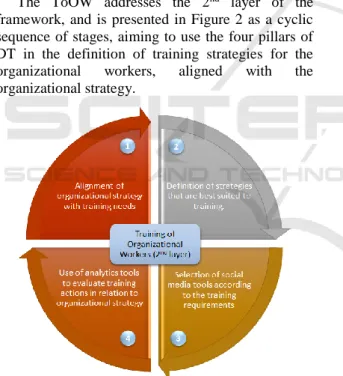
framework, and is presented in Figure 2 as a cyclic sequence of stages, aiming to use the four pillars of DT in the definition of training strategies for the organizational workers, aligned with the organizational strategy.
Figure 2: The ToOW model.
As depicted in Figure 2, the ToOW model is designed to train organizational workers supported by social media tools (3) (see section 3). The training strategies of the organization (2) are aligned with the organizational strategy (1) and analytical tools are used to evaluate the employees training, on the basis of their performance, according to the defined organizational strategy (4).
In order to enable a more flexible training scheme, the model also considers training actions proposed by employees; however, training attendance will always be compulsory according to the defined training strategies (2). The definition / adjustment of the training strategies (2) should be made in a periodical basis, so as to pace with the evolution / needs of the organization.
Regarding the use of social media tools, the model considers a complete set of tools to be used within the training activities, which can be used inside and outside the organization, that is, in different learning contexts. The model is designed in such a way as to enable training in the classroom, at distance or in workplace context, in a formal or informal way. In the case of informal training there will always be, as shown in Figure 1, an Observer / Facilitator, who will have a role of moderator on the ongoing training.
As cloud is one of the pillars of DT and social is one of the others, the use of social media tools located in the cloud, will allow to consider the ToOW approach as collaborative learning, as it enables internal training (Figure 1 – Employees) as well as external training (Figure 1 – Nomadic employees), enabling the interaction and collaboration among the participants and, thus, the sharing of information and/or knowledge.
All the training sessions carried out have to be evaluated so that it can be understood if the investment made in training employees meet the needs of the organization and the impact it may have on organizational processes’ improvement. Hence, analytics tools – one of the pillars of DT – will be used to monitor and compare training results with the defined metrics goals to improve organizational processes.
The absence of a training culture embedded in the organization's ecosystem may lead to the failure of training strategies set for the employees and for the organization in general. In order to avoid this failure scenario, the model hereby proposed aims to promote the development of a culture of lifelong training, adding value to organizational development and being central to achieve the objectives defined in the alignment of the organizational strategy with the organization training needs.
4.2 A Scenario for the Model Usage
In this section, we outline an application scenario for a training plan that uses the ToOW model proposed in this paper. The scenario targets a real estate agency which seeks to be more agile in its interactions with customers and sellers, in order to better promote its properties, while enhancing its selling staff training
procedures and staff performance assessment system (Stage 1, Figure 2).
The corporate website is the main institutional platform of communication of the agency with its customers, by advertising the properties offered and providing further sellers contact information; it is also from the website that it is possible to access social media platforms, newsletters and blogs. For internal communication and training purposes, the agency sets up an intranet based on cloud computing technology (e.g. DropBox; Google Drive) for training of its selling staff (Stage 2, Figure 2). In the intranet, there is a folder for each property with the property full description and promotion images, and a video for guiding the seller with the highlights that should be focused on the property visits’ with the potential customers. Virtual reality and/or augmented reality applications may also be considered for that purpose. The entire promotion plan for the property (advertisement in the corporate newsletter, web site promotion, social media campaigns, special events, etc.) is also available so that the seller is aware of the agency sales and marketing strategy regarding that property; hence, the seller can record what was the trigger of contact of a customer with the agency regarding a given property. This folder is shared by all the sellers in charge of the property’s promotion. After each property visit or customer interaction, the seller uses his/her mobile device to fill a spreadsheet record with the main features of the visit/interaction and results achieved, which may also involve updating the property status. After each visit, the customer is invited to fill an online questionnaire so as to assess his/her satisfaction on the service level provided by the seller and agency. The results of all the questionnaires filled regarding a property are saved into a spreadsheet available in the property folder.
There is also an institutional blog for the real estate agency (accessed from the corporate website) where customers may establish a chat conversation with the sellers and post comments and questions about the property as a result of the contacts or visit they did or even discuss further meetings (Stage 3, Figure 2).
As the history of all the interactions and engagements of the seller with customers about a property is stored, loading a datawarehouse of sellers-customers interactions, analytic tools may easily be used to monitor the KPI’s set by the real estate agency regarding the performance of the seller (Stage 4, Figure 2). Hence, KPI’s like the number of property visits promoted, the visits conversion rate, sales growth, blog engagement, top sellers in sales revenue,
website traffic lead ratio, newsletter signup conversion rate, customer satisfaction, customer retention may be measured and contribute to the seller’s assessment. Depending on the organizational strategy, some of the KPI’s related with the sellers performance may be shared among the sellers team, so as to improve the collective intelligence, generate useful sales and marketing insights and stimulate organizational goals achievement. If the assessment results of sellers are not satisfactory, the reasons may be analysed and the alignment of organizational strategy with the training needs may be resettled, generating a new cycle of application of the ToOW model.
5 CONCLUSIONS AND FURTHER
WORK
DT is currently one of the major challenges faced by organizations and involves a set of highly complex activities. Within these activities, organization workers’ learning/training plays a fundamental role and requires particular attention.
Learning/training of organizational workers involve restrictions and requirements which were not considered in formal higher education study programmes, as training is now targeted to “students” who have already entered their working life. These requirements include time expenditures and facilities costs for the learning/training process. Additionally, the starting point and expected outcomes of the learning/training process can differ significantly.
While these new training processes do not fit within formal education, they can benefit from the opportunities offered by informal processes of learning. Acknowledging this new context of learning/training, the m_CSDT framework referred in this paper aims to contribute for the implementation of DT in an organization.
Taking advantage of the DT technology enablers and realising the need for updated approaches to address organizational workers’ training, we extended the m_CSDT framework and proposed the ToOW model to address the 2nd layer of the
framework.
The advantages foreseen for the model usage are two-fold. On the one hand, the model acknowledges the crucial role that an organization plays in promoting a culture of continuous learning/training of its employees; on the other hand, the model provides guidance on setting up the training strategies and activities, as well as on the monitoring of training
results achieved, which are measured according to the performance metrics considered within the organizational strategy.
Future work will include the testing of this model within a business environment, based on the experiences obtained with pilot tests performed under an academic context.
REFERENCES
Agrawal, D., et al. 2012. “Challenges and opportunities with big data,” A community white paper developed by leading researches across the United States.
Amato, F., et al., 2013. “A Framework for Semantic Interoperability over the Cloud,” In 27th IEEE International Conference on Advanced Information Networking and Applications Workshop, 1259–1264. Armbrust, M., et al., 2010. “A View of Cloud Computing,”
Communications of the ACM, 4(53), 50–58.
Berkman, R., 2014. “The social enterprise: where does the information professional fit?” Online Searcher, 6. 45-48.
Bharadwaj, A., et al., 2013. “Digital Business Strategy: Toward a next generation of insights,” MIS Quarterly, 37(2), 471–482.
Bucki, J., 2016. “Definition and Explanation of Mobile Computing,” https://www.thebalance.com/definition-of-mobile-computing-2533640
Chen, M., Mao, S., Liu Y, 2014. “Big Data: A Survey,” Mobile Network, vol. 19, 171–209.
Dorn, J., et al., 2007. “A Survey of B2B Methodologies and Technologies: From Business Models towards Deployment Artifacts,” In 40th Hawaii International Conference on Systems Science, Hawaii, USA Earley Information Science, 2016, “Building a Successful
Digital Transformation Roadmap, “ https://cdn2.hubspot.net/hubfs/109038/EIS_Assets/EI S-Whitepaper-Building-a-Successful-Digital-Transformation-Roadmap.pdf
Ferreira, M. J., Moreira, F., Seruca, I., 2014. “A traditional organization towards a new dimension of labour – social business,“ Information systems and Technology for Organizational Agility, Intelligence, and Resilience, pp. 180-204, Hershey: Information Science Reference. Ferreira, M. J., Moreira, F., Seruca, I., 2015. “Social Business: A Way to Promote Organizational Transformation,” International Journal of Information System Modeling and Design. 6(4), 57-81.
Fitzgerald, M., et al., 2013. “Embracing Digital Technology: A New Strategic Imperative,” MIT Sloan Management Review. 1-12.
Hansen, R., Sia, S., 2015. “Hummel’s Digital Transformation Toward Omnichannel Retailing: Key Lessons Learned,” MIS Quarterly Executive 14(2). 51-66.
Hinchcliffe, D. 2016. “Using online community for digital transformation,” https://dionhinchcliffe.com/.
Hess, T., Matt, C., Benlian, A., Wiesböck, F., 2016. “Options for Formulating a Digital Transformation Strategy,” MIS Quarterly Executive, 15(2). 123-139. Kadiri, E., et al., 2016. “Current trends on ICT technologies
for enterprise information systems,” Computers In Industry, 79, 14-33.
Laney, D. 2001. “3-d data management: controlling data volume, velocity and variety,” META Group Research Note.
Mamaqi, X., 2015. “The efficiency of different ways of informal learning on firm performance: A comparison between, classroom, web 2 and workplace training,” Computers in Human Behavior, 51, 812–820.
Manca, S., Ranieri, M., 2016. “Yes for sharing, no for teaching!”: Social Media in academic practices. Internet and Higher Education, 29, 63–74.
Miller, R., 2016. “Digital transformation requires total organizational commitment,” https://techcrunch .com/2016/01/31/digital-transformation-requires-total-organizational-commitment/
Reddi, V., Zhu, Y., 2017. “The Red Future of Mobile Web Computing,” Communications of the ACM, 60(1), 52-53.
Salminen, L., et al., 2016. Nurse teacher candidates learned to use social media during the international teacher training course. Nurse Education Today 36. 354–359 Solis, D., 2017. “Digital Transformation – The six stages of
digital transformation,” http://www.briansolis.com/ 2017/01/definition-of-digital-transformation/
Sawy, O., et al., 2016. “How LEGO Built the Foundations and Enterprise Capabilities for Digital Leadership,” MIS Quarterly Executive, 15(2). 141-166.
Team, O. R., 2011. “Big data now: current perspectives,” OReilly Radar. OReilly Media.
Uhl, A., Gollenia, L., 2016. “Digital Enterprise Transformation: A Business-Driven Approach to Leveraging Innovative IT,” USA: Routledge Taylor & Francis Group.