1
A Work Project, presented as part of the requirements for the Award of a Master Degree in Economics from the NOVA – School of Business and Economics
Social Impact Bond Feasibility Study
Youth Employability: Academia de Código
Eva Ferreira de Magalhães Pereira 869
A Project carried out on the Master in Economics Program, under the supervision of: Prof. António Miguel, Executive Director of the Social Investment Lab
2
Abstract
Youth unemployment remains one of the most pressing social issues in Portugal. Tackling youth unemployment requires more social policies and more effective social interventions oriented for young people.
Academia de Código is one example of a successful social intervention in the field of youth unemployment, which develops Computer Programming training courses that enable young unemployed individuals to find a job in the growing Portuguese ICT sector.
The present work project evaluates the feasibility of scaling-up this effective intervention through a Social Impact Bond, an outcomes-based financing model. The analysis conducted demonstrates the significant economic and social value of a Social Impact Bond contract for Academia de Código.
Keywords
3
TABLE OF CONTENTS
1. Introduction ... 3
2. Methodology ... 5
3. Social Impact Bonds - Literature Review ... 5
4. Youth Unemployment - Understanding the Social Problem ... 10
Characteristics of the Portuguese NEET ... 11
Root Causes of the NEET phenomenon in Portugal ... 13
Consequences and Societal Costs of the NEET phenomenon ... 15
5. Identifying a Strong Intervention Model ... 16
6. Academia De Código – Developing a Social Impact Bond ... 21
Structure of the Project ... 23
Intervention Scope ... 24
Intervention Costs ... 25
Outcomes Metrics ... 25
Payment Mechanism ... 26
SIB Financial Model ... 28
Value for the Public Sector ... 29
Sensitivity Analysis ... 30
7. Concluding Remarks ... 31
8. References ... 32
9. Bibliography ... 34
1. Introduction
In the last century, developed nations have experienced great levels of economic growth and a significant improvement in living standards. Yet poverty is far from being eradicated. Homelessness, unemployment, substandard housing, financial exclusion, poor healthcare access and other forms of poverty still affect the lives of many individuals. In fact, the most recent data on poverty in the European Union illustrates the depth of the problem: in 2014, 9% of the EU-28 population was severely materially deprived1, which means that almost 1
4
The persistence of social problems in our societies, despite our significant growth, demonstrates the need for more effective social interventions and higher social innovation. A new approach that addresses the challenges faced by the Social Sector is fundamental if we aim to build a better future. The concept of Social Impact Bond, a new financial instrument for the social sector, is an example of social innovation that has the potential to help Governments and social organizations improve performance, increase efficiency and drive positive social change.
Social Impact Bond are outcomes-based contracts between the Public Sector, social organizations and social investors. Through this contract, social investors finance high-performing service providers and are repaid by the Government only if the agreed social outcomes are achieved. Thus, SIBs have the potential to drive resources towards effective social programmes, create sustainable financing flows to the social sector and create positive social change. In this context, Portugal2020, the most recent EU funding framework, has allocated 4 billion euros to social inclusion and employment and it includes a specific funding programme for Social Impact Bonds2.
The aim of this work project is to study the feasibility of scaling up a social intervention in the field of youth unemployment through a Social Impact Bond: Academia de Código. This social programme has been selected as a strong intervention model to tackle youth unemployment, one of the most pressing social problems in Portugal. The idea of this study is to contribute to a future application to the Portugal Inovação Social Financing Programme to be developed by Laboratório de Investimento Social.
This feasibility study is divided in four main parts: a literature review on Social Impact Bonds to better understand this new concept; an analysis of the youth unemployment social problem in Portugal; a description of Academia de Código’s social intervention and why it has been
5
selected as a strong intervention model; and the SIB investment case describing the structure of the contract and the cost-benefit analysis.
2. Methodology
This feasibility study was developed within the Social Impact Bond Research Programme created by Laboratório de Investimento Social. The methodology employed in this feasibility study followed closely the methodology proposed by Social Finance UK, an organization dedicated to the development of a social investment market in UK. The research project’s chronogram is included in Appendix 1. The necessary data regarding Academia de Código’s social programme was provided by Laboratório de Investimento Social, through in-person meetings and documents. Additionally, the Social Impact Bond Research Programme included a training plan which covered the concept of SIB contracts, SIB financial modeling and PowerPoint presentations.
3. Social Impact Bonds - Literature Review
Governments, non-profit, non-governmental organizations and other institutions have been developing social interventions and programmes to tackle poverty for long. However, they are faced with many challenges regarding financial sustainability, lack of resources and inefficiencies, which compromise their ability to create social change.
Beginning with the Governments’ challenges, the research on this topic points to many structural problems within its social approach responsible for inefficiencies, from which two must be noted. Firstly, Governments tend to invest in tried-and-tested social programmes with a set of pre-defined services (‘fee-for-service’) believed to produce the desired outcomes. The problem with this ‘fee-for-service’ approach is that it only creates incentives for the completion of the pre-defined activities, providing weak incentives to strive for better
6
outcomes and to innovate in the social interventions. The focus is on outputs, the services delivered, rather than on outcomes, the results of the intervention, giving room for inefficiencies (Choosing Social Impact Bonds, Bridges Impact, 2014). Secondly, another structural problem identified in the Governments’ effort to eradicate poverty is related with the way the social problems are addressed. The Governments’ social approach currently focuses on addressing the most pressing needs with intervention and crisis management programmes, rather than designing efficient preventive and early interventions. Given the Governments’ budget constraints, this prioritization is to be expected. Nevertheless, addressing social problems by investing in early interventions and preventive measures can be more beneficial in some cases, helping vulnerable individuals at risk more effectively (Choosing Social Impact Bonds, Bridges Impact, 2014).
Alongside Governments, non-governmental organizations have been developing services aiming to improve the lives of the most vulnerable. In many cases, their activities can produce better outcomes, due to the fact that this type of interventions require close connections with communities, social ties and understanding the reality on the ground, characteristics which are hard to find in actions developed at the national level by Governments (The Potential and Limitations of Impact Bonds, Emily Gustafsson-Wright et al, 2015). However, their ability to produce better outcomes is often compromised, due to the frequent financial constraints most organizations face. As a result of the unpredictability and insufficiency of the social sector income streams, organizations are unable to deliver services to those who need it the most as effectively as they could or to expand their services to more beneficiaries (Towards a new social economy, Social Finance, 2010). Increasing the financial sustainability of non-profit organizations, through higher social investment and better contracting mechanisms, would allow them to overcome their biggest setback and would foster the growth of the social sector.
7
Last but not least, a central issue in the social sector, common to both Governments and non-governmental organizations, is the insufficient attention to outcome and impact measurement as well as the lack of accountability for the results (The Potential and Limitations of Impact Bonds, Emily Gustafsson-Wright et al, 2015). As a result, the services targeted for the most vulnerable in society are often provided without having the knowledge on their impact, how they can be improved or if they should even be provided.
Taking into account the challenges and setbacks faced by Governments and other impact-driven organizations described so far, it becomes clear that a new approach is needed to eradicate poverty and its related social issues. A new proposal for the social field is Social Impact Bonds.
A Social Impact Bond is a public-private partnership between federal, state or local governments/donors and high-performing service providers, intended to develop effective social interventions through a performance-based contract. The costs of the social programme carried out by the service provider are funded by socially-motivated investors on the basis of the contract. In this outcome-based contract, the government/donor commits to repay the initial investment, plus a financial return, if and only if the desired social outcomes are delivered with the services provided by the organization (A Technical Guide to Developing Social Impact Bonds, Social Finance, 2013).
Through its innovative design, SIBs have the potential to overcome the challenges presented above that have been compromising the social sector. Its outcome-based nature, which links financial returns directly to results, shifts the focus from outputs to outcomes, providing the necessary incentives for service providers to deliver better-than-expected results. Given this shift in focus, from outputs to outcomes, one of the challenges we have identified before, organizations are enabled and encouraged to innovate, adapt and improve their existing
8
programmes or even to develop new ones (Social Impact Bonds, The Early Years, Social Finance, 2016).
On top of that, a SIB contract uniquely aligns the three parties involved – the service providers, the investors and the Government – to work together in order to maximize the social outcomes. (Choosing Social Impact Bonds, Bridges Impact, 2014) The investors are incentivized to provide management support or to help improve organizational capacity, whilst Governments are motivated to provide knowledge on the social issue and available resources, thereby enhancing the ability of the service provider to deliver the agreed social outcomes (Better Outcomes, Better Value, The evolution of social impact bonds in the UK, 2016).
Taking into account that Social Impact Bonds are carefully designed contracts that ensure governments or donors only pay for services that achieve the desired social outcomes, building track records on service delivery, in order to ensure progress towards the pre-agreed results, and creating performance and outcome measurement become a requirement. Thus, SIBs have the potential to overcome one of the problems identified earlier regarding performance/outcome measurement on the social sector, which is crucial to improve social programmes and to tackle poverty efficiently (The Potential and Limitations of Impact Bonds, Emily Gustafsson-Wright et al, 2015).
Following the effort to tackle poverty more efficiently, governments are incentivized to take on an expanded focus in the way social issues are addressed with Social Impact Bonds. By establishing contracts for early interventions and preventatives services that target the root causes of social problems, Governments can help more people at risk earlier on. And since, the services are only paid if and when positive outcomes are achieved, Governments can repay in the future through the cashable savings acquired from the reduction of people in need (Choosing Social Impact Bonds, Bridges Impact, 2014).
9
Finally, it is also important to address the role played by investors in Social Impact Bonds. As it was mentioned, both Governments and non-governmental organizations face financial constraints that compromise their efforts to improve the lives of people in need, a consequence of the difficulties to attract private capital towards the social sector. Simultaneously, socially motivated investors are increasingly seeking to align their investments with their values to create and foster social change. Social Impact Bonds represent an innovative way to attract these type of investors towards the social sector, due to their outcome-based nature which provides a greater guarantee that their investment will deliver a higher social return and as a result a positive financial return (Best to Invest?, 2013). All in all, Social Impact Bonds have the potential to overcome the fundamental challenges and setbacks faced by the social sector to eradicate poverty. Despite all the benefits presented so far, theory does not always meet practice. Social Impact Bonds are still an unproven model, but the good news is that it is being tested. From the first launched SIB, in 2010 in the UK aiming to reduce recidivism amongst ex-offenders until June of 2016, 60 projects have been launched and more than 90 000 lives have been touched3. So far, SIBs have been delivering positive results in areas such as homelessness, youth employment or children’s services. Social Impact Bonds are still in their early years, the model can be improved, its applications expanded and the social investment market must grow and evolve, suggesting much work ahead. Nevertheless, a significant benefit of Social Impact Bonds has already been fulfilled: aligning organizations, Governments and socially motivated investors that share the common goal of improving the lives of people in need and creating positive social change.
10
4. Youth Unemployment - Understanding the Social Problem
The consequences of the recent economic crisis have been particularly hard on young individuals’ employment prospects, putting youth unemployment at the centre of the European Policy Agenda. In 2013, in the midst of the economic crisis, 23.7% of young Europeans aged 15-24 were unemployed4, the highest level of youth unemployment ever
recorded in the history of the EU. The last two years showed signs of improvements, with a steady decline of these figures: as of August 2016, the unemployment rate in the European Union was 18,6%5, lower than in 2009. However, despite the overall improvement, not all
countries have been able to reverse the effects of this crisis, namely Mediterranean countries in which youth unemployment rates remain strikingly high: Cyprus and Portugal still register youth unemployment rates above 30%, whilst Croatia, Greece, Italy and Spain it is still above 40%6. Thus, tackling youth unemployment remains a challenging task and a priority for the
European future.
The focus of this chapter is to understand youth unemployment in depth. Starting with the analysis of key concepts, the definition of the NEET concept and its importance. Secondly, an overview of the trends and characteristics of the Portuguese NEETs will be developed, followed by an evaluation of the root causes of this issue. Finally, in the fourth section the consequences and costs of the problem are evaluated.
Defining and measuring the problem - The definition of NEET
Young people, especially in the 15-24 age group, are in a moment of transition between education and work, which is difficult to adequately capture through statistical measures that rely on the employment/unemployment dichotomy like the youth unemployment rate. Seeing that a significant proportion of young people are full-time students, and thus not considered as active individuals in the labour market, these statistical measures fail to be a representative
11
indicator for this age group. Furthermore, it is far too common for young people with no prior working experiences to not be registered at public employment services, despite being actively looking for a job, which means that an unknown number of young people unable to find a job are not being accounted in the youth unemployment rates, as they are considered inactive by such measures. Therefore, it becomes clear that analyzing the youth unemployment problem in depth requires the selection of an indicator that considers young people’s activities and includes the inactive individuals: the NEET indicator.
The NEET indicator, which stands for young people neither in employment nor in education and training, has become the key measure to analyze the labour market issues faced by young people. This indicator corresponds to the percentage of young people who are not employed and are not enrolled in any education or training7. The official NEET definition, in European
countries, considers young people between 15-24, although considering other age groups proves to be very useful for this analysis. Due to its broader definition, this indicator identifies all young people who are unemployed, whether registered in public employment services or not, who are unavailable to work due to sickness or disability and who are discouraged from looking for a job due to lack of employment prospects. Despite the heterogeneity of the group, all NEETs share a common problem: they are not accumulating human capital through formal channels, due to their disengagement from work and education, and therefore face a greater risk of future poor employment outcomes and social exclusion (Eurofound, 2016).
Characteristics of the Portuguese NEET
In 2015, the NEET rate in Portugal, in the 15-24 age group, was 11,3%, which represents 125 000 young Portuguese not in employment, education or training. The analysis of different age categories reveals that the NEET rate tends to increase with age. In fact, while the NEET rate in 2015 was 5.2% in the 15-19 age category, for those aged 20-24 years it was 17.5%, exposing the latter as the most problematic group. For the Portuguese case, it is also
12
fundamental to extend the definition of NEET to include the 25-29 age group, as their NEET rates tend to be relatively high and similar to the 20-24 age group (in 2015 it was 17,1%)8.
NEET trends over time
The analysis of the NEET trends over time reveals the particularly severe effects of the economic crisis on Portuguese young people (Appendix 2.). In 2008/2009, the NEET rates began to increase sharply across most age groups, affecting mostly the 20-24 and 25-29 age groups. The overall NEET rate, for the 15-29 broad age category, increased from 11,9% in 2008 to 16,4% in 2013.
With the recovery underway, NEET rates started to decrease from the record levels of 2013 in the following two years and are expected to continue decreasing in 2016 (OECD, 2016). However, as of 2015 they remained well above the levels registered before the crisis.
Despite the harsh effects of the economic crisis, it is important to look at other trends in the Portuguese case. Between 2000 and the onset of the crisis, the Portuguese NEET rates already showed an increasing pattern and were already relatively high. Hence, the analysis over time shows that there are other causes besides the economic crisis driving the high NEET and youth unemployment rates in Portugal that must be examined.
Educational Attainment of Portuguese NEETs
Considering educational attainment, figure 7 (Appendix 2) reveals that the largest share of NEETs is composed by young people with lower levels of education (pre-primary to lower secondary), followed by those with an upper secondary level of education. Accordingly, the smallest group of NEETs corresponds to young people with tertiary levels of education. The analysis of the composition of NEETs by education level demonstrates that the risk of becoming NEET decreases with education, which still constitutes a protection against youth disengagement and unemployment9.
13 Labour Status of Portuguese Neets
Breaking down the NEET group into unemployed and inactive, considering the 15-29 age group, shows that the majority are registered as unemployed and only 35% are registered as inactive, as of 2015. However, according to the European Labour Survey, in 2015, only 15% of Neets in this age group declared they didn’t want to work10. Henceforth, many jobseekers
are considered inactive due to the fact that they are not registered in Public Employment Services. This data brings to light the challenge faced by Governments developing social interventions for NEETs since it is difficult to reach the ones looking for work but not registered at PES.
Root Causes of the NEET phenomenon in Portugal
The analysis so far has already established a significant cause for this problem: the economic crisis11. Nevertheless, the analysis of Portuguese NEET rates over time already demonstrated
an increasing pattern before the onset of the crisis. In addition to its increasing trend, the NEET rate for the 15-29 group was already a matter of concern, situated at 12,7%. Given these points, it is possible to conclude that the crisis only exacerbated an existing social problem originated from other causes, which require our analysis.
Research on the NEET phenomenon has pointed out that the cause is a complex mix of institutional and economic factors as well as individual factors. The institutional and structural problems frequently addressed by the literature on youth unemployment and inactivity are: skills mismatch and the lack of vocational training and Apprenticeships.
Skills mismatch
Even though the generation currently entering the labour market is the most educated so far, employers frequently report lack of skilled workers, which can be either technical skills needed for the profession or more general and soft skills (Eurofund, 2012).
14
A study focused on Skills Mismatch conducted by the McKinsey Institute12, found that 39%
of employers state that the main reason for having entry-level vacancies is the lack of the right skills in new graduates. Furthermore, this study found that the lack of engagement between education providers and employers was the leading cause of the reported Skills Mismatch13,
which is supported by most research on this topic. It is therefore fundamental that education providers work together with employers in order to increase youth employability.
Vocational Training and Apprenticeships
Another important driver of youth integration in the labour market is the institutional configurations of the education and training system. Apprenticeships and vocational training are dual education models which combine classroom based vocational education with workplace-based training. This type of education tends to be more focused on practical knowledge, offering an alternative to academically oriented education. The existence of another education system parallel and equivalent to academic oriented paths creates more diversified and inclusive options, reducing school drop-out. Simultaneously, these dual education systems frequently incorporate some form of Internship in a related company, allowing students to have a first work experience. Due to the characteristics of these programmes, Apprenticeships and vocational training help and guide young people in their transition from education to the labour market (Wolbers, 2007).
Despite its benefits, not all education systems have this alternative strongly implemented. In many countries, vocational training still carries a stigma and tends to be less valued by society and employers, which keeps many young people from choosing this education method (Arum and Shavit, 1995). However, different cross-country comparative studies have demonstrated that in countries with strong implementation of dual educational training, young people are less affected by unemployment risks (Breen, 2005).
15
Consequences and Societal Costs of the NEET phenomenon
Long periods of economic inactivity and disengagement have numerous negative consequences for young workers both in the short and long term.
In the short term, on the account of their inactivity, NEETs become vulnerable to problems such as poverty and social exclusion (Eurofound, 2012). In addition to the risk of poverty, these young individuals may suffer from psychological distress due to a sense of lack of direction or purpose, which can lead to further disengagement from society (Sidra Goldman-Mellor et al., 2016). Hence, it is important that social interventions developed for NEETs include some form of counselling, mentoring or motivational actions.
In the long term, youth unemployment or inactivity can lead to lower future employment outcomes and to a wage penalty that may last for a long time. The accumulation of working experiences, education and training enables individuals to accumulate human capital, signaling their abilities to employers, and as a result earn higher wages. Given that NEETs are not accumulating human capital through formal channels it can become increasingly difficult to re-enter the labour market (Narendranathan and Elias, 1993). As a result of the implied loss of human capital, employment prospects and earnings can be significantly reduced14.
However, the negative impact of the NEET phenomenon is not only felt at the individual level, it also represents a significant cost for society and the economy.
In principle, high unemployment represents a loss of human capital, time and skills which could otherwise contribute for the production and growth of the economy. In addition to the opportunity cost, there are also direct costs such as the unemployment benefits or the expenses made by the Government in order to develop social interventions for the NEETs. Measuring the total societal costs of the NEET social problem is a challenging task, as many costs are unmeasurable. A research conducted by Eurofound focused on NEETs15 computed
16
people. The methodological approach of this estimation considers two types of costs: public finance costs, which correspond to the current policy expenditure to support the NEETs group (public transfers such as unemployment insurance, minimum income schemes or housing benefits); and resource costs, which correspond to the economic loss of the lack of labour participation of NEETs.
Through this approach, Eurofound estimated the total societal costs of NEETs in 2011 for European Countries. The results of these estimations showed that for Portugal as of 2011, the unit societal cost of a NEET is 8 610 € (the sum of the unit public finance cost of 8 136 € and the unit resource cost of 474 €), which totals an economic loss of 1,57% of the GDP (2 680 128 907 €).
5. Identifying a Strong Intervention Model
This chapter will focus on the selection and analysis of a social intervention model that targets the social problem described in the previous chapter: the high levels of youth not engaged in any form of employment, education or training in Portugal.
Selection
In order to select an intervention model we can depart from the identified root causes of the high Portuguese NEET rates to define a strong intervention model. In the previous chapter three root causes were identified: the economic crisis, skills mismatch and lack of vocational training/apprenticeship programmes. Since the economic crisis that affected the Portuguese labour market is a complex macroeconomic problem, it becomes clear that skills mismatch and lack of vocational training programmes are suitable starting points to develop a social intervention through a SIB.
In this context, skills mismatch will refer to a labour market failure in which there is a shortage supply of workers for a certain occupation, resulting in unfilled job vacancies. In an
17
economy, such as the Portuguese, recovering from a recession, with high unemployment levels and high NEET rates, the fact that skills mismatch occurs and is considered a cause for unemployment can seem paradoxical. However, it is actually the result of the other identified cause: the lack of vocational/apprenticeship programmes that, in this specific case, address skills shortage and the needs of the labour market. Thus, given these points, developing a vocational training programme tailored to build the core skills young people are required in the occupations with a supply shortage constitutes a strong intervention model capable of re-integrating NEETs in the labour market.
Therefore, the next step is to identify the occupations with supply shortage in the Portuguese labour market that at the same time require skills suitable to be developed through vocational training programs.
According to Skills Panorama16 latest report (October, 2016), the occupations that exhibit the
highest supply shortage relative to its demand in Portugal are: health professionals, Information and Communications Technology (ICT) professionals, engineering professionals and legal, social and religious associate professionals. From these four occupations, the one this intervention will focus on is ICT due to its expected growth trend in upcoming years. In the recent years, the Portuguese ICT sector has shown positive signs of progress with growing numbers of job creation, even during the recent economic crisis that affected the Portuguese labour market. The growing number of employment levels are demonstrated in Table 1 in Appendix 2, which describes the change (%) in the number of job vacancies between 2011 and 2014 by NACE17 activity branches in Portugal. Accordingly, not only did
job vacancies in the ICT activities grew during the period of the crisis, but the estimated growth was 154%, which represents the highest growth of job vacancies from all the activity branches.
18
However, the labour demand growth in the ICT sector was not accompanied by a supply growth. A research conducted by Empirica18 on the Portuguese ICT sector, estimated the level
of excess demand for ICT professionals to be around 3 900 in 2012.The study also provided forecasts for unfilled ICT jobs in Portugal in 2015 and in 2020, which are estimated to be 8 100 and 15 000 respectively, as represented in Figure 2 (Appendix 2), indicating that the level of skills mismatch for this sector will continue to rise. Furthermore, this research also pointed to a recent growing trend: the incorporation of ICT solutions into non-technology based firms, which in turn increases the demand for workers with ICT skills. In fact, the forecasts for ICT practitioner jobs, working in firms from all fields, in Portugal in 2020 point to 95 000 ICT practitioner jobs (Figure 8, Appendix 2).
Considering the data and forecasts provided, we can conclude that the ICT sector constitutes a unique opportunity of qualified employment for Portuguese Youth.
The Social Intervention - Academia de Código
In line with the points addressed above, the proposed intervention is a vocational training programme in the field of Information and Communications Technology targeted for NEETs: Academia de Código.
Academia de Código (AdC) is a Portuguese educational business in the ICT field, created from the identification of a need in the market: the increasing demand for ICT professionals, creating a shortage in the labour market, while at the same time youth unemployment levels remain high in Portugal. Thus, Academia de Código’s mission is to provide ICT training to young unemployed individuals who were unable to find a job in their respective fields19. In
order to achieve its mission, AdC has created Coding Bootcamps, which are intensive full-time 3-month courses with 15-20 students per programme. A detailed description of the programme can be found in Figure 1.
19 1. Selection Process
Taking into account that the applicants will learn an entire new occupation in 3 months of intensive coursework, the AdC programme requires highly motivated people. Thus, the selection process constitutes a fundamental step for the success of the intervention. AdC’s selection process is designed to evaluate the particpants’ learning skills as well as motivation and commitment. The applicants must complete an online introductory course in Computer Science, profile and language skills tests and a 2-day workshop with theoretical and practical exercises (based on the mentioned introductory course). This demanding selection process ensures that the 15 students chosen to participate in the bootcamp, from an average of 700 applicants, are the ones that will take the most advantage of the programme.
2. Coding Bootcamp
The Coding Bootcamp is a full-time programme that lasts 3 months with intensive coursework 5 days a week, 8 hours a day, which corresponds to a total of 650 hours dedicated to learning computer programming.
The design of the Syllabus was conducted through a market analysis of the skills required in most of the ICT job vacancies. According to AdC’s research the main skills needed by the ICT market are: Java and Javascript knowledge, backend and frontend programming. For this reason, the 3-month course aims to train its students, both in theory and practice, on these skills (Syllabus of AdC in Appendix 3.)
The AdC programme is also composed by other activities, that occur throughout the whole learning process, and are intended to promote engagement, motivation and know-how on the ICT market and occupation: the Code Breaks20. These activities are important in any training
2. Coding Bootcamp
1. Selection Process 3. Entry in the Labour
Market
20
or apprenticeship programme, but they are especially relevant when the participants are NEETs, in the sense that they are learning and entering in an entire new occupation and were in a situation of unemployment/inactivity prior to the programme.
From this description, we can identify two key differentiating factors of Academia de Código’s social intervention from other training/vocational programmes. Firstly, the skills and content lectured in the programme match the skills needed in the ICT job market, identified by the firms that are currently recruiting in Portugal. AdC has also established close relationships with ICT firms in Portugal in order to better assess the skills needed and the standard coding languages being used. Secondly, the programme includes other activities -the Code Breaks - that allow the participant to feel motivated and engaged about the new career perspectives, which eases the process of learning and requalification.
3. Entry in the labour market
The final step of AdC’s intervention model is the entry in the labour market, supporting and assisting the candidate in the process of finding the right job.
Throughout the programme AdC’s team helps the candidates improve their CV and create portfolios to showcase their work to potential employers. Each candidate’s profile and background is analyzed in order to find the most suitable matches, and their CVs are sent to AdC’s partner firms.
The fact that AdC’s has established partnerships with a total of 16 ICT firms21
is also another key differentiating factor of this programme. Through these partnerships, the potential recruiters become aware of the content provided and its quality. Additionally, given the very demanding selection process which selects the 15 most motivated, capable of learning and adapting from an average of 700 applicants per Bootcamp, firms are reassured of the qualities
21
of their potential candidates. Thus, these close partnerships are another key drive to AdC’s success rate related with the students’ entry in the job market.
Academia de Código’s History and Business Model
Academia de Código was legally constituted as an enterprise since January 2015. Since then, they have developed 5 successful Bootcamps and are on track to complete 6 more in the next 2 years. So far, these 5 bootcamps have had an average of 700 applicants and all beneficiaries started working in ICT jobs within 2 months after the conclusion of the programme (100% success rate) (detailed data in Appendix 4).
AdC’s business model is based on establishing partnerships with Public Institutions, which fund the social intervention as a way to provide better services to aid unemployed individuals. The idea behind this partnership is that unemployed individuals need training and vocational programmes to find a job, but at the same time they often lack the financial means to afford such an investment due to their situation. Thus, the establishment of such partnerships allows Academia de Código to have a higher demand for their programme than they would have otherwise and Public Authorities to accomplish better results within their Social Policies. So far, AdC has established two partnerships of this kind: Lisbon City Hall and Fundão City Hall.
6. Academia De Código – Developing a Social Impact Bond
In the previous chapter, Academia de Código’s Coding Bootcamp Programme has been identified as a strong intervention model to improve youth employability, especially amongst the target population NEETs. Through the development of a training programme tailored for the needs of the market, in a field with high skills mismatch and high growing prospects, AdC has managed to develop 6 successful Coding Bootcamps with an employability rate of 100%. However, the current structure of the organization only provides these Coding Bootcamps in
22
two cities in Portugal and for an average of 90 beneficiaries per year, which is a very small number when compared with the number of NEETs in Portugal and especially when compared to the programme’s demand (on average 700 applicants for only 15 available spots). Thus, it becomes clear that scaling Academia de Código’s successful intervention programme to other locations is crucial, allowing more NEETs to benefit from this efficient social intervention and making it more accessible for NEETs in other areas of Portugal. The concept of a Social Impact Bond (SIB), as examined in the chapter 3, constitutes a suitable financing method to enable AdC’s Coding Bootcamp to scale to other locations in Portugal, helping more NEETs enter the labour market. In line with this work project, this chapter will focus on the analysis and development of a Social Impact Bond for AdC’s intervention model in two new locations in Portugal.
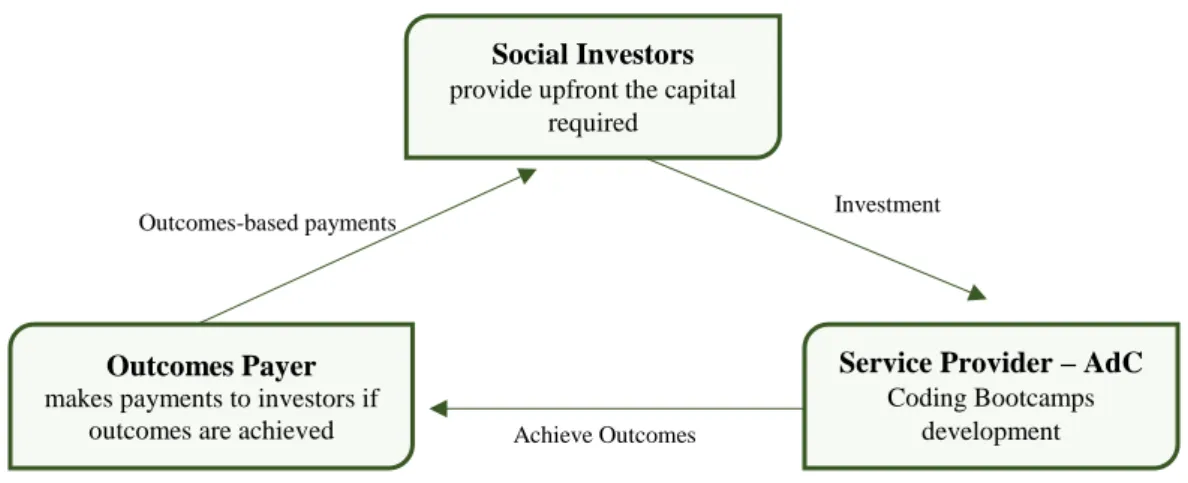
Figure 2 - AdC’s SIB Structure
As demonstrated in Figure 2, with a Social Impact Bond, Academia de Código’s Coding Bootcamp Programme would be financed by socially motivated investors, allowing the intervention to scale to other locations and to benefit more NEETs. If AdC’s Programme achieves a set of pre-agreed outcomes, the Government will pay investors for financing the intervention.
Social Investors
provide upfront the capital required
Service Provider – AdC
Coding Bootcamps development
Outcomes Payer
makes payments to investors if
outcomes are achieved Achieve Outcomes
Investment Outcomes-based payments
23
For the Government, this SIB is very beneficial as it is related with one of the most challenging social problems in Portugal: the high rates of Youth Unemployment. This financing tool allows the Government to support an innovative solution, with historical high success rates, capable of decreasing the number of NEETs and therefore, reduce the costs incurred by the Government with this particular problem (mentioned in chapter 4). Furthermore, with a SIB the Government does not need to provide upfront the capital required to develop this intervention and it does not bear the risks involved, representing a risk-free solution.
For socially motivated investors, this SIB is a unique opportunity to drive social change, in such a crucial social crisis like youth unemployment. The design of the SIB contract is different from most social investment schemes, as financial returns are directly linked with positive social outcomes, ensuring that all parties are working towards the same objective. In essence, the Social Impact Bond for AdC’s Coding Bootcamps aligns Academia de Código, the Public Sector and socially motivated investors around one common goal: re-integrating NEETs in the labour market.
Structure of the Project
The proposed structure of the intervention is the development of AdC’s Coding Bootcamps in two new locations in Portugal: Porto and Alentejo; for the period of three years.
Given the time required for each bootcamp, including all the phases from recruitment to completion, it is suitable to execute 3 bootcamps per year for each location. Following AdC’s current formula, each Bootcamp will have 20 participants. Hence, it is proposed a total of 18 Bootcamps, 9 for each location, in the three-year period. This project will benefit a total of 360 beneficiaries, 120 per year.
24 Table 1 | Structure of the Project
Coding Bootcamps Students
Locations Porto Alentejo Locations Porto Alentejo
Year 1 3 3 Year 1 60 60
Year 2 3 3 Year 2 60 60
Year 3 3 3 Year 3 60 60
Intervention Scope
The analysis of the social problem in chapter 4 showed that Portuguese NEET rates are particularly high in the 20-29 age category (whereas it is relatively small in the 15-19 age group) and that the majority of NEETs are enrolled in PES (as of 2015, only 35% of young individuals age 15-29 were registered as inactive). Taking into account these conclusions as well as the nature of the programme, the target population, eligibility criteria and referral point are defined as follows:
Target Population: NEETs in the 20-29 age group
Eligibility Criteria: Currently, AdC does not impose any specific eligibility criteria for the participation in the programme, besides the age limit. The selection of the applicants is conducted through a rigorous recruitment process that evaluates learning skills, language skills, motivation and commitment, which are the most important, according with AdC’s experience so far. For these reasons, there will be no specific eligibility criteria for participation besides the age limit.
Referral Point: The Coding Bootcamp is a self-enrollment programme, since its success is also dependent on the beneficiaries’ motivation. However, it is important that the organization and the Outcomes Payer coordinate actions in order to promote and publicize the Programme through PES but also through other channels in order to reach NEETs (as of 2015, 35% of Portuguese NEET s were not registered in PES, as seen in Chapter 4).
25 Table 2 | Intervention Costs
Intervention Costs
The costs of this intervention, presented in table 2, were estimated considering the costs of the previous AdC Coding Bootcamps, following a principle of prudency. The costs are divided in two main categories: initial investment and operational costs. The initial investment includes all the costs necessary to begin the operations, in each location for the three-year period (e.g. the equipment for the Coding Bootcamps). Whereas, the operational costs relate to the monthly costs incurred in the development of the Coding Bootcamps, divided in three categories: human resources, bootcamp expenses and housing expenses. In each location, AdC’s programme requires six full-time workers: 3 teachers, an admissions assistant, a project manager and the CTO. Additionally, the programme requires expenditure in marketing (to reach the maximum number of NEETs), course material and equipment maintenance. Finally, housing and utilities costs were estimated consulting average costs for Porto and Alentejo.
Considering the costs mentioned above, the total cost of AdC’s Coding Bootcamp Programme, in the two locations for the three-year period, is 1 401 727 euros. Considering 360 participants, the cost per participant is 3894 €.
Cost Category Monthly Cost Annual Cost Total Cost (Project – 3 years) Initial Investment - - 92 958 € Operational Costs Human Resources 27 078 € 324 940 € 974 820 € Bootcamp Expenses 3 007 € 36 080 € 108 240 € Housing Expenses 6 270 € 75 236 € 225 709 € Total 36 355 € 436 256 € 1 401 727 € Outcomes Metrics
The set of pre-defined outcome metrics constitute the foundation of the contract between the Government and Social Investors. As stated by Social Finance, 2013, the key to designing such contracts is to develop outcome metrics that are measurable and objective, that generate
26
the right incentives for the various stakeholders and that are linked to cashable savings on the part of the outcomes payer. Following these lessons, the best outcome metrics to consider in this SIB contract are:
1) Entrance in the Job Market (ICT Sector) – considering only paid professional experiences and solely on the ICT sector (to ensure a direct causality between the intervention and the outcome) within 2 months after the completion.
2) Maintenance of job for one year (ICT Sector) – to ensure that all parties in the contract are aligned with the real objective of the project which is to help young people enter the labour market in stable and secure jobs. Henceforth, this outcome metric is the most important one. Given the nature of the outcomes metrics, it is possible to evaluate its achievement through the beneficiaries’ employment situation registered in Social Security. Finally, these types of contracts require the establishment of a measurement system, carried out by an independent evaluator, in order to ensure a proper evaluation of the achieved outcomes.
Payment Mechanism
The next step of the SIB design is to define the payment mechanism: the outcome payments that the investors receive once outcomes are achieved. Following the methodology proposed by Social Finance, 2013, the development of an effective payment mechanism should consider the following requirements: provide the right incentives for stakeholders to achieve the agreed outcomes; the total value should be below the current cost incurred by the Outcomes Payer with the social problem; and calculated so that the cost savings accrued by the Government if the SIB funded intervention is successful are shared with the investors. The total amount paid per participant by the Government must not exceed 8 136 euros22,
which is the estimated total annual cost of a NEET to the government (explained in chapter 4). On the other hand, the cost per result incurred by the investor, assuming a 90% success rate, is 4 327€23, indicating that this is the minimum value the Government must pay per
27 Table 3 | Outcomes payment
participant that achieves both outcomes. Hence, the total value paid per participant within this SIB contract is between 4 327€ and 8 136€. Through the development of realistic scenarios, detailed and analyzed in the Sensitivity Analysis section, the total value proposed to be paid for each participant that achieves both outcomes is 5 500€. The value proposed provides incentives for the achievement of the agreed outcomes (and to increase the success rate) and ensures that the cost savings accrued by the Government as a result of this intervention are shared with the investor.
Having defined the maximum value per participant, a weighting factor for each outcome was considered so that if both outcomes are achieved the investors receive the full amount, whereas if only one of them is achieved investors receive the corresponding percentage, as demonstrated in the table below:
Outcomes Payment Weighting Factor Time to outcome
Employment - 2 months €1 650 30% 5 months
Employment - 1 year €3 850 70% 15 months
Maximum per participant €5 500 100%
The idea behind this scheme is to provide the right incentives: the fundamental aim of social interventions in the field of employability is to help the beneficiaries secure stable employment. Thus, the 70% weighting factor for the second outcome – maintenance of the job in the ICT sector for one year. By setting the payment of the second outcome to be more than double of the first outcome’s payment, this payment mechanism design incentivizes the organization and the investors to consider adapting the programme if deemed necessary in order to achieve the second outcome.
28 Figure 3 | AdC’s Investment Strucutre
Table 4 | SIB Financials
SIB Financial Model
In order to estimate the total repayment made by the Government under this SIB it is also necessary to define the number of participants and the success rate.
Success rate| For both outcomes, a 90% success rate will be considered. Given AdC’s track history of 100% success rate with this programme, the proposed 90% rate is a conservative and prudent assumption.
Number of participants| The total number of participants will be 360 (20 per bootcamp) as defined in the structure of the project. This assumption is based on the high demand for these bootcamps experienced so far (demonstrated in chapter 5).
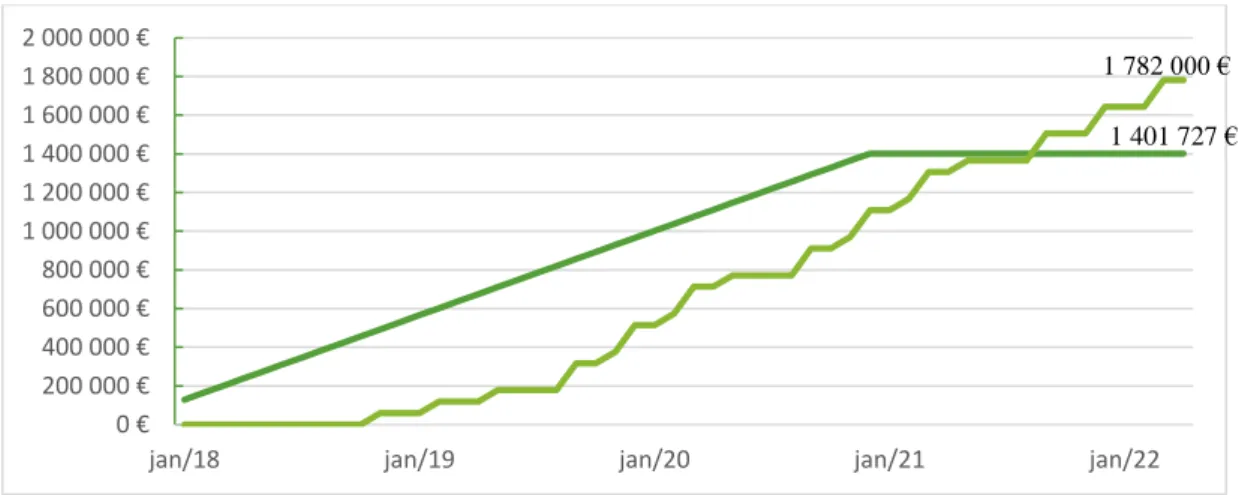
Having estimated the total costs of the intervention, the outcome metrics, the payment mechanism, the success rate and the number of participants, the proposed SIB model will have the following investment structure:
0 € 200 000 € 400 000 € 600 000 € 800 000 € 1 000 000 € 1 200 000 € 1 400 000 € 1 600 000 € 1 800 000 € 2 000 000 €
jan/18 jan/19 jan/20 jan/21 jan/22
SIB FINANCIALS Contract Value 1 782 000 € Project Costs 1 401 727 € Investor Requirement 782 515 € Project Surplus 380 273 € IRR 9.2% 1 782 000 € 1 401 727 €
29 Cost to Government Without the SIB With the SIB Cost of the intervention Investor Return Public Sector Savings Total Outcome-Payments 1 782 000 € 854 064 € 2 636 064 €
Figure 4 | SIB Savings to the Government (Social Finance, 2013)
A detailed description of the revenues and costs per year of this project can be found in Appendix 5.
Considering all the assumptions explained above, this project requires an investment of 782 515 euros and yields a surplus of 380 273 euros, with an internal rate of return of 9,2%.
Value for the Public Sector
In the proposed SIB contract, the total amount paid by the Government will be 1 782 000 euros (assuming a 90% success rate and defining a maximum of 5 500 euros paid by participant if both outcomes are achieved). In order to evaluate the value of the proposed SIB contract for the Public Sector, the total amount paid to investors for this social intervention must be compared with the costs savings accrued by the Government from the achievement of the defined outcomes. Maintaining the assumptions defined above, it is estimated that 324 participants will achieve the agreed outcomes, that is, will be employed for at least one year as a result of this intervention. Given that the estimated annual public finance cost is 8 136€ per NEET, the cost savings accrued by the Government are 2 636 064 euros, which is above the amount required to pay to investors under the SIB. Hence, the value of this project to the Public Sector, considering only a cash basis criteria, is 854 064 euros. The value-for-money calculation is demonstrated below:
30 Table 5 | Scenario Analysis: Success Rate
Table 6 | Scenario Analysis: Outcomes Payment
Sensitivity Analysis
The proposed SIB contract was based on several estimations and assumptions modelled from AdC’s previous Bootcamps and applying a prudency principle. However, it is important to compute a sensitivity analysis to evaluate the effects of changes in our assumptions and to access the risk of the project. The sensitivity analysis, in the tables below, demonstrates the possible risks of the investment if the success rate and the defined outcome payment change from our original hypothesis.
From this analysis, we can conclude that the risk involved in this project, related with the success rate, is relatively low, since even with a considerably lower success rate, when compared with AdC’s track history, the investment would yield a positive internal rate of return.
Scenario Analysis Worst Case
Scenario Base Case Scenario Best Case Scenario Outcome Payment 4 800 € 5 500 € 6 500€
Maximum Contract Value 1 555 200 € 1 782 000 € €1 782 000 €
Investor Surplus 153 473 € 380 273 € 704 273 €
IRR 1,1% 9,2% 20,4%
Secondly, the risks of the project related with the value of the outcome payment are evaluated. SIB contracts exhibit a trade-off between pleasing the investors or the government. The first scenario, with an outcome payment of 4 800 €, would be the ideal scenario for the government, yielding higher cost savings. However, the premium payment paid to investors is
Scenario Analysis Worst Case
Scenario Base Case Scenario Best Case Scenario Success Rate 80% 90% 100%
Maximum Contract Value 1 584 000 € 1 782 000 € 1 980 000 €
Investor Surplus 182 273 € 380 273 € 578 273 €
31
introduced to compensate the investors for financing the intervention and to incentivize them to engage in the SIB contract. Hence, the first scenario, with an IRR of 1,1%, considering the total value of the investment, would provide low incentives for investors when compared with the base case scenario.
7. Concluding Remarks
The consequences of the recent economic crisis were particularly harsh for young individuals in Portugal, leading to an increase of youth unemployment. As a result, in 2015, the youth unemployment rate stood at 32%. This social problem imposes costs no only at the individual level but also for the government and society as a whole.
Tackling youth unemployment requires more effective and innovative social action. In particular, it is beneficial to identify and support effective initiatives that are currently working to solve this problem. One of these cases is Academia de Código, a successful social intervention in the field of youth unemployment that demonstrates positive social outcomes. Following the aim of this work project, a SIB model for Academia de Código was developed. This feasibility study proves the viability of scaling up Academia de Código to two new locations in Portugal through a Social Impact Bond that generates positive social outcomes, a significant financial return for the investors and a strong value for money proposition for the Government.
32
8. References
1
Eurostat. 2016. “Income and Living Conditions” http://ec.europa.eu/eurostat/statistics-explained/index.php/Material_deprivation_statistics_-_early_results
2
Grupo de Trabalho Português Para o Investimento Social. 2015.“Portuguese Social Investment Taskforce”.
3
Dear, Annie et al. 2016. “Social Impact Bonds. The Early Years” Social Finance
4Eurostat. 2016. “Employment and unemployment (LFS)”
5
Ibidem
6
Ibidem
7
The NEET indicator employed in the present work project follows the definition provided by Eurostat.
8Eurostat. 2016. “Employment and unemployment (LFS)”
9
However, it is still important to note that despite their underrepresentation among the total population of NEETs, young people with higher education levels were severely affected by the crisis in Portugal. The youth unemployment rate of young individuals aged 20-29 years with completed levels of tertiary education rose from 16.9% in 2007 to 24,7% in 2013. This recent phenomenon is a growing concern in Portugal, as it represents a loss of highly trained human capital and promotes further disengagement from the labour market.
10Eurostat. 2016. “Employment and unemployment (LFS)”
11
The particularly adverse effects of the crisis on young people’s employment prospects are explained by the fact that youth unemployment tends to be more sensitive to business cycles than the overall unemployment (Freeman and Wise, 1982). Portugal was no exception to the rule: according to OECD estimations, while the overall job destruction between 2007 and 2015 was 9%, for jobs intended for young people the job destruction was 34% (OECD,2016).
33 12
Mourshed, Mona et al. 2013. “Education to Employment: Designing a System that Works”. McKinsey Center for Government
13
It is also important to note another identified cause of skills mismatch in the labour market: the Fourth Industrial Revolution. The gap between an individual’s job skills and the demands of the job market is expected to widen with the Forth Industrial Revolution. According to the World Economic Forum, the expected new professions are related with the Computer and Mathematical fields, which will represent a large share of the future job creation. Undoubtedly, the Forth Industrial Revolution poses a new challenge for individuals, education providers, businesses and Governments. The ability to forecast future skills requirements is the key to help the new generation enter in a labour market set to change.
14
An estimation of the wage penalty found that youth unemployment leads to a negative impact of 12%-15% on individual wages by the age of 42 (Gregg and Tominey, 2004).
15Mascherini, Massimiliano et al. 2013. “NEETs Young people not in employment, education
or training: Characteristics, costs and policy responses in Europe” Eurofound, Publications Office of the European Union, Luxembourg
16
Skills Panorama is an Information Center created by the European Commission within Cedefop, the Europan Centre for the Development of Vocational Training, with the aim of assessing and anticipating skill needs across European labour markets.
17
Statistical classification of economic activities in the European Community, Eurostat
18
The cited research was conducted by Empirica, a research and consulting firm specialized in the ICT sector, for the European Comission.
19
The organization has set the goal of training and preparing 10 000 candidates for the job market until 2020.
34 20
The Code Breaks promoted and organized by AdC are: pizza nights with a guest from the ICT field, lectures with professionals from the field, simulation exercises of real work life situations, workshops and open days with potential employers.
21
In total, the organization has 16 partner firms: Altran, Farfetch, Accenture, Lusolabs, Wiz, PrimeIt, ComparaJá, AMT Consulting, Bold, Aubay, Uniplaces, Talkdesk, Cycloid, Clickly, Boldplaces and Affinity.
22
8 136€ corresponds to the unit annual public finance costs defined in chapter 4, which are the estimated immediate cost to the Government with young unemployed individuals.
23
The calculation of the minimum value the Government must pay per successful outcome consists in dividing the cost per student by the success rate.
9. Bibliography
Arum, R. and Shavit, Y. 1995. “Secondary vocational education and the transition from school to work”. Sociology of Education, Vol. 68, pp. 187–204.
Barclay, Lisa and Symons, Tom. 2013. “A Technical Guide to Developing Social Impact Bonds”. Social Finance.
Breen, R. 2005. ‘Explaining cross-national variation in youth unemployment. Market and institutional factors’, European Sociological Review, Vol. 21, pp. 125–134.
Bridges Impact+. 2016 “Better Outcomes, Better Value. The evolution of social impact bonds in the UK”
Bolton, Emily and Savell, Louise. 2010 “Towards a new social economy. Blended value creation through Social Impact Bonds” Social Finance
Dear, Annie et al. 2016. “Social Impact Bonds. The Early Years” Social Finance
Freeman, Richard and Wise, David. 1982. “The Youth Labor Market Problem: Its Nature, Causes, and Consequences”
35
Goodhall, Emilie. 2014. “Choosing Social Impact Bonds, A Practitioner’s Guide” Bridges Impact+
Gregg, P. and Tominey, E. 2004. “The wage scar from youth unemployment”. CMPO Working Paper Series No. 04/097, University of Bristol
Grupo de Trabalho Português Para o Investimento Social. 2015. “Portuguese Social Investment Taskforce: A Blueprint For Portugal’s Emerging Social Investment Market” Gustafsson-Wright, Emily et al. 2015. “The Potential and Limitations of Impact Bonds. Lessons from the first five years of experience worldwide.” Global Economy and Development Program – Brookings
Hüsing, Tobias et al. 2015. “e-Skills in Europe: Trends and Forecasts for the European ICT Professional and Digital Leadership, Labour Markets (2015-2020)”. Empirica.
Mascherini, Massimiliano and Ledermaier, Stefanie. 2016. “Exploring the diversity of NEETs” Eurofound, Publications Office of the European Union, Luxembourg
Mascherini, Massimiliano et al. 2013. “NEETs Young people not in employment, education or training: Characteristics, costs and policy responses in Europe” Eurofound, Publications Office of the European Union, Luxembourg
Miguel, António and Abughannam, Samer. 2014. “Housing First Social Impact Bond Feasibility Study”. Social Finance and MaRS
Mourshed, Mona, et al. 2013. “Education to Employment: Designing a System that Works”. McKinsey Center for Government
Narendranathan, W. and Elias, P. 1993. “Influences of past history on the incidence of youth unemployment - Empirical findings for the UK”, Oxford Bulletin of Economics and Statistics, Vol. 55, No. 2, pp. 161–186.
36
Rotheroe, Abigail et al. 2013. “Best to Invest? A funders’ guide to social investment” New Philanthropy Capital
Skills Panorama. 2016. “Portugal: Mismatch priority occupations” Accessed October 28
http://skillspanorama.cedefop.europa.eu/en/analytical_highligths/portugal-mismatch-priority-occupations
Symons, Tom. 2015. “Technical guide: Designing Outcome Metrics”. Social Finance.
Valente, Ana and Correia, Isabel. 2015. “Mapeamento da Oferta de Educação e Formação em Tecnologias de Informação, Comunicação e Electrónica em Portugal”. Coligação Portuguesa para a Empregabilidade Digital
Wolbers, Maarten. 2007. “Patterns of labour market entry: A comparative perspective on school-to work transitions in 11 European countries”. Acta Sociologica. Vol. 50, pp. 189–210. World Economic Forum. 2016. “The Future of Jobs Employment: Skills and Workforce Strategy for the Fourth Industrial Revolution”