METHODOLOGIES FOR PROMOTING THE INFORMATION AND PUBLIC
PARTICIPATION IN THE PROCESS OF IMPLEMENTING LOCAL AGENDA
21 – AN EXPERIENCE FROM A SMALL MUNICIPALITY IN PORTUGAL –
Marta PINTO 1; Pedro SANTOS 2; Conceição ALMEIDA 3; Nuno QUENTAL 4; Margarida SILVA 5Grupo de Estudos Ambientais - Escola Superior de Biotecnologia - Universidade Católica Portuguesa Rua Dr. António Bernardino de Almeida, 4200-072 Porto - Portugal
1Research Assistant, [email protected] 2Research Assistant, [email protected] 3Research Assistant, [email protected]
4Research Assistant, [email protected] 5Assistant Professor [email protected]
Abstract: The concept of Local Agenda 21 comprises a process of participatory development by which the consensus between the authorities and several stakeholders is created, to agree on the common development and implementation of a “plan of action” in which environmental protection should be integrated, dealing with the local problems and priorities as well as economic prosperity and the social entity of the community. The council of São João de Madeira has started implementing the Local Agenda 21 by a co-operation between the City Council and the Portuguese Catholic University of Porto. Besides sustainable development one of the main goals of this process is the promotion of democratic participation. In this report the implementation of Local Agenda 21 in this council is described on the level of instruments and media used in this process: forums of discussion, strategic co-operations, direct questioning of the public, support of opinion leaders in particular teachers and the publishing of information material. The results are presented and the pros and cons of the instruments are discussed. In this report it will also be analyzed whether the perception measured among the population, about how much potential and what problems they observe in the council and whether this corresponds to the points identified by the politicians and technicians of the City Council. Identifying the diverging opinions helps to show the importance of public participation and therefore supports the decision-making process.
INTRODUCTION
The topic of sustainable development has been put on the agenda and discussion about it has steadily increased during the last decade especially since the United Nations Conference on Environment and Development in Rio de Janeiro in 1992 which is more known as the Earth Summit. This conference with nearly 200 countries participating, reflected the necessity of a global political discussion showing/stating that socio-economic development is neither opposing nor should it be separated from environmental protection.
Earlier, in 1987, a definition on the concept of sustainable development, frequently used, has been introduced in the Report “Our common future” elaborated by the World Commission on Environment and Development (under the presidency of the Norwegian Gro Brundtland). It has been defined as “the development that corresponds to the present needs without restricting the possibility of future generations to satisfy their needs”.
It is without doubt an appellative and ambitious concept although it sometimes causes problems when applied in practice due to the diverse aspects involved that comprise more than just the protection of the environment (FIDELIS, 2001). Sustainable development also implies the demand for a plan/model capable of creating abundances and contributing to an improvement of the quality of the people’s life as a whole (including the fight against social injustice and poverty) without endangering the quality of the environment and without provoking the exhaustion of natural resources. This should ensure that also future generations being able of living in an environment they can enjoy.
“Agenda 21”, is one of the most important documents adopted on the Earth Summit. One of the chapters is entirely dedicated to “Local Agenda 21” in which it is recognized that the local authorities are, on the level of administration, closest to the citizens. It is assumed to be an important paper for the creation of conditions to educate and mobilize the citizens for implementing sustainable development in that area. (SEITZ, 1994). Local Agenda 21 describes the participatory process by a consensus between the local authorities and several stakeholders (e.g. companies, NGOs, etc) which should be achieved, in order to jointly agree on the development and implementation of a Plan of Action, in which environmental protection should be integrated, dealing with local problems and priorities as well as economic prosperity and the social equity of the community on the long run. Due to the strong participatory character of this process, every citizen has the responsibility to participate in defining the future of its council and region, also contributing to a more representative democracy. Public participation helps making decisions more inclusively and representatively and adds some creativity to the problem-solving process. (UNDP, 2003) Furthermore, it is an excellent method to gather additional important information and to make the participants change their attitude towards the environment (the probability of making people change their attitude and behavior, especially with respect to environmental issues, increases if they are systematically sensitized and educated) (CONNOR, 1994).
Although public participation is as old as democracy itself, no unique/clear definition exists. A possible one is offered by CONNOR (1972): “Public participation in a planning process is a systematic process of mutual education and co-operation which gives the citizens affected by the project the opportunity to work jointly on the development of a plan, by their representatives and engineers.” As a form of democracy this plan is going to reflect the values, knowledge and experience of the people and therefore gives a better insight into the prevailing opinion. This leads to the understanding and support of the plan of action by the majority of the people involved in or affected by it. (CONNOR, 1994)
In Portugal, similar to the global level, the citizens are unsatisfied with the authorities/institutions (CARTER et al, 2002 in VASCONCELOS et al, 2002). The local authority is one of the institutions being most criticized. Only 5% of the Portuguese state that they have confidence in/trust the authorities when dealing with environmental issues (EORG, 2002). This example of dissatisfaction is the chance for Portugal to make a decisive step into the direction of deliberative democracy. This can be very important for the Local Agenda 21 as it has already become common knowledge that public participation is used as a fundamental tool in that process. (VASCONCELOS et al, 2002).
Unfortunately the numbers are not encouraging. What the implementation of Local Agenda 21 processes in Portugal is concerned, the data of this report recently has been presented by the Portuguese Government (2001) stating that there are only 27 municipalities where Local Agenda 21 is being implemented (UNDP, 2003). Regarding the exercise of their citizenship the Portuguese people are denoted by a big passiveness. During a survey carried out during the last five years dealing with the participation of the citizens in the political and social life of the country, 80% answered that they “vote during elections”, 54% responded that they “keep themselves informed about social and political issues”. Not more than 8% stated that they “participate in public discussions”. (ALMEIDA et al, 2001). This data shows that the process has just started in Portugal.
In the report this development is described in the light of S. João da Madeira on the level of instruments, media and public participation used in the process of implementing Local Agenda 21: open forums (participatory), the creation of strategic partnerships, direct questioning of the population, the support of opinion leaders and the publishing of information material. Furthermore explicit examples of media, that were used, are presented and the results of the consultation of the people as well as the main priorities of the council identified. Comparing the data one receives a good insight into the diverging perceptions of the population on the one hand and the politicians and technicians of the authority on the other hand, which shows the potential and the problems in this council. With this information we want to identify the main aspects, where public participation can help to explain and assist the decision-making process. SHORT DESCRIPTION OF S. JOÃO DA MADEIRA
SaHo JoaHo da Madeira is a council of Beira Litoral, in the district of Aveiro, with a total area of 8,1 km², belonging to a community of the same name. It is considered to be a very small council in Portugal and is one of the smallest in Europe. In SaHo JoaHo de Madeira live, according to the data of Census 2001, about 21,000 people, with a population density of 2,647 inhabitants/km², a value higher than the Portuguese
14.4%, which is 3.7 times higher than in the average Portuguese city. The population living in the council has, according to the statistics, a good living standard, with a spending power higher than the Portuguese average and general access to basic infrastructure (electricity, water and sanitation) (CONSELHO LOCAL DE ACLAHO SOCIAL DE S. JOAHO DA MADEIRA, 2003).
SaHo JoaHo da Madeira (SJM) is a dynamic council mainly relying on conventional economy. The industrial sector is predominating, representing a huge diversity of firms – in 1999 340 firms existed, working in 22 different fields. Due to this diversity SJM could avoid the worst crises and continues to be one of the areas with the highest productivity in Portugal. In total the industrial sector in this council, where agriculture is negligible, is about to expand and revitalizes the whole commercial network (VIANA, 2002).
Concerning the environmental view São João da Madeira presents indicators that are not of so much concern, as there are several means of preventing and treating pollution sources existing. But some environmental problems are more visible including the intensive road traffic and the pollution of the river Antuã (VIANA, 2002).
LOCAL AGENDA 21 IN S. JOÃO DA MADEIRA
Despite the small size of the council of SJM it can take on an important document on the national and regional promotion of sustainable development, as the authority started the implementation of Local Agenda 21 in co-operation with the Superior School of Biotechnology of the Portuguese Catholic University in Porto (SSB-PCU). With this process it progressively wants to define and implement a plan of action showing a more sustainable development and encouraging the citizens of SJM to help promoting it. This should create a strong feeling affiliation/membership, individual responsibility and a corporate feeling. In this context a set of information tools and instruments for involving the population were defined according to the general steps of the process which complies with the basic methodological definition by ICLEI (ICLEI, 1996) (Figure 1).
Figure 1 – Basic steps of the implementation process of LA21 in S. João da Madeira.
In a previous step an investigation about the council has been enforced, in form of defining a social profile of the community. This is the key information about the community in question of integrating technical information into humanitarian and political considerations (CONNOR, 1994). The social profile also helps characterizing the community and can predict how one should react in a certain situation. In case of SJM the social profile was carried out by the Rede Social (CONSELHO LOCAL DE ACÇAO SOCIAL DE S. JOAO DA MADEIRA, 2002), a local organization doing research on social aspects of community life.
During this initial step a Co-ordination Group for Local Agenda 21 was founded and the executive of the municipality as well as Municipal Assembly subscribed to the Aalborg Charter – which is a first and important political step. The Co-ordination Group (CG) is a group with executive power to support and assure the counseling/observation of the implementation process. It consists of representatives from the level of the City Council, educating institutions, the business sector, civil protection municipalities (e.g. police), members from Rede Social and the Superior School of Biotechnology. Furthermore they have been meeting fortnightly since March 2003, which in a total results in 16 meeting until the very moment.
Sensibilisation and creation of the Participatory Forum
Step 2 Step 3
Step 1
Diagnosis and development of plan of action
Implementation, monitoring and revision
PRIMARY STEP: SENSITIZING THE COMMUNITY AND CREATING A PARTICIPATORY FORUM
During this step different methods to sensitize and involve the community are especially important because they promote the participation of the local community in the process of Local Agenda 21. Another important action during this primary step is the creation of a Participatory Forum, which forms the framework and offers the platform to discuss and reflect all topics of importance.
The creation of an image
At this level the creation of an image has been initiated, so that people can easily identify the process and understand the idea of Local Agenda 21 in S. JoaHo da Madeira – all together for this one goal: to improve life in the community (Figure 2).
Figure 2 – The logo
The use of the City Council’s information tools
The City Council of S. JoaHo da Madeira regularly publishes a municipal journal. This journal is used to present projects and information about recent developments to the public and is one example of how already existing resources can be used to increase the acceptance of the process of Local Agenda 21. This service has already been successfully used by sending press releases, with the help of City Council Press, to the local, regional and national media.
Information leaflet
An information leaflet about Local Agenda 21 has been produced for the council of S. JoaHo da Madeira (Figure 3).
This leaflet has, as the main goal, the task to explain the importance of this process, the different steps and offering a platform on which citizens and technicians can start a flow of information from the people to the assistant team. Due to that fact an invitation to participate can be found in the leaflet.
The advantage of these printed messages is, as they are long lasting and reach their target, the people, in their homes where they feel save thus enabling the message to be absorbed in an environment of low anxiety and at the recipient’s convenience. (CONNOR, 1994)
The official launch of the process
The official launch of the process of Local Agenda 21 took place on the event “A city in the garden”, which is an annual event organized by the municipality where clubs and associations from S. JoaHo da Madeira present themselves and their work to the public. During the last event in June 2003, which has been attended by many citizens from SJM, the first contact with the project has been established (Figure 4).
Figure 4 – LA21 information box at the event “A city in the garden”
Local Agenda 21 was presented at the event by an information box, offering various information materials, namely the information leaflet on Local Agenda 21 and an information leaflet on the importance of environmental friendly behavior. The latter was named “A world of people making a better environment” in form of promoting the corporate feeling and by emphasizing the importance of the individual behavior for the well-being of the community (Figure 5).
Figure 5 – Leaflet “A world of people making a better environment”
This official launch of the project included the use of “informal participation” techniques, defended by CONNOR (1994), which encourage meetings with the residents in their familiar surrounding. This comprises asking questions, listening and observing their social environment. It was the perfect opportunity for the assisting team from SSB-PCU to immerse into the community and to get a better insight into their attitude. Through dialogues with the citizens it was possible to get to know the history and facts of SJM and also the people’s personal thoughts.
By using a particular instrument called “the wall of wishes” this informal participation was realized, asking the citizens to write down, how they would like S. JoaHo da Madeira to look like in 2010. This initiative proved to be a success as more than 100 suggestions have been written down by people of different age and background during the five days of the event. The “wall of wishes” was an excellent tool to attract the people’s attention and to start a dialogue with the initiators of Local Agenda 21 in SJM. Additionally a series of debates about environmental issues were organized ranging from waste management to genetically modified food as well as offering organic food.
After the event “the city in the garden” the information given about Local Agenda 21 there was used for a council-wide exhibition where information boards were put up in public places of high frequency to reach even more people.
Website
Offering a diversity of information tools and complementing them with the option of including a website was taken, so that citizens easily can obtain desired information (5-20% of the readers of an information leaflet require more information (CONNOR, 1994)).
At www.agenda21sjm.orgall relevant information is available for a wide public (Figure 6). This page has been online since June 5th 2003, the International Day of the Environment being the day of the official launching as well.
Figure 6 –Website www.agenda21sjm.org
On this page several faces and activities of Local Agenda 21 are revealed, like reports of the regular meetings of the Co-ordination Group and the Participatory Forum and all documents of public discussion and many more. Besides that information about the work being realized by educational institutions is published as well as a calendar of events. It is not new that the internet as a communication platform serves as a powerful tool of high efficiency, which is essential for this ambitious project.
Apparently the number of users is not so motivating. During the months of September and October 2003 the number of requests were 1213 with a daily average of 26. These numbers do not correspond to the number of visitors as normally each visitor looks at more than one page. If assuming each person requests an average of three pages the number mentioned above would correspond to only 303 visitors, which is a very small percentage of the citizens of SJM (about 1%). However, the amount of requests is increasing: from 350 in September to 863 in October. These values might indicate a slight upward trend in the process and result in broader knowledge about the existence of this website.
According to the statistics the Internet serves as an information source about environmental issues to 11% of the Portuguese population being mostly higher-educated people or students (ALMEIDA et al, 2001). The goal of the initiators of Local Agenda 21 in SJM is to exceed this average in the council considered. Hotline
A final means of communication is the hotline and fax complemented with an e-mail address to receive comments and enquiries on the implementation process. This promotes a diversity of communication levels corresponding to the needs of the Portuguese people – one third state that they would like to be informed about environmental issues by these means (ALMEIDA et al, 2001).
The hotline is mainly used by institutions that take an active part in the Participatory Forum as well as teachers asking for information on the school program of Local Agenda 21 in SJM. Some citizens do also use this information tool to get more information about recent activities.
Newsletter
The newsletter is another way of spreading information especially for those people not using the electronic tools offered. (Figure 7). The people are expected to send comments and/or information, that will be put into this newsletter. The first edition was published in September 2003 using the City Council’s possibilities of distributing it in SJM. There is also a version available on the website.
Figura 7 – Newspaper of LA21 in S. João da Madeira
Strategic partnership – local media
Local media plays an important role in the community, connecting people with each other (CONNOR, 1994). Besides the importance of this network people usually see the information offered in newspaper as more reliable than receiving direct information from the promoters (CONNOR, 1994). A majority of the Portuguese people state that they want to get informed by means of media (ALMEIDA et al, 2001). However (referring to CONNOR, 1994), “the only way of having clear and accurate information is to make it yourself”. Therefore the initiators of Local Agenda 21 in SJM have met with four local newspapers which resulted in a collaboration: one page is offered fortnightly (in two weekly newspapers) and every edition (in a newspaper published every second month). This co-operation proved to be an effective way to get the people informed.
According to a recent study the newspaper “O Regional” is read by 43% of the people living on the district of Aveiro, which makes it the third most important regional newspaper. Due to its broad readership the publication of information on Local Agenda 21 every second week there promotes public participation.
Strategic partnership – local associations
Due to intense public relations a partnership with a local youth organization came into being. Based on that a photo contest was organized. People were invited to present photos on environmental, economic and social facets of SJM. A total number of 63 photos were exhibited and the citizens could vote for their favorite.
The voluntary program which is a way of involving young and elder people in achieving the implementation of Local Agenda 21 is going to be introduced with the help of this youth organization. The voluntaries will be trained and later on supported in their work.
School program of Local Agenda 21
In June 2003 school representatives were invited to a meeting where the Local Agenda 21 process was presented and the concept of a school program on Local Agenda 21 for the school year 2003/2004 was introduced. In another meeting with the school representatives (kindergarten, primary and secondary school) they could contribute their opinion to the concept. Based on that the outline of the program has been developed consisting of 8 different topics: Waste; Composting; Sustainable consumption; Eco-design; School Agenda 21, “Three generations, three visions”; Water and riparian ecosystems; Energy and transportation. A school year calendar was set up for this program as well as a framework for the teachers. Furthermore technical and logistic support will be offered to the schools like training sessions for the teachers involved. Education material on the 8 topics is prepared, being used by the teachers responsible during the School Program. All information about this program is available on the internet. The topics preferred by the schools were Composting (6 votes), Waste (4 votes), Eco-design (3 votes), Energy and transportation (3 votes) and “Three generations, three visions” (3 votes). The topics of Water and riparian ecosystems and Sustainable consumption have been chosen each by two schools.
All secondary schools as well as second and third level primary schools and 56% percent of the first level primary schools of SJM subscribed to the program. Moreover, one private school takes part.
Questionnaire of the population
In order to get a first idea about potentials and problems of the municipality, a small questionnaire was elaborated. It was distributed by mail to all households in SJM and was also put on the internet. Boxes were established all over town where people could post their answered questionnaires. But only one percent of the population used this opportunity to participate.
The data received was evaluated and revealed in the first meeting of the Participatory Forum and afterwards published on the website.
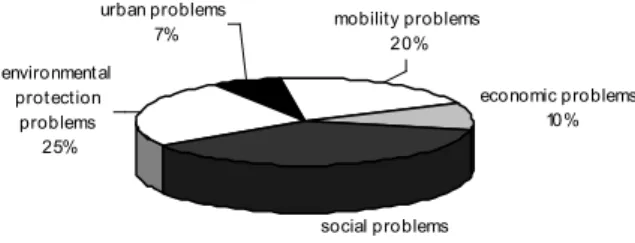
The problems mentioned can be grouped as followed: 1) social problems; 2) urban problems; 3) mobility problems; 4) environmental protection problems and 5) economic problems.
The first group (with 38% of the answers) comprises culture and entertainment, social risk situations and education (Figures 8 and 9).
social problems 38% environmental protection problems 25% urban problems 7% economic problems 10% mobility problems 20%
Figure 8– Main groups of problems identified by S. João da Madeira citizens
Entertainment 50% Education 12% Risk factors 18% Health 7% Security 9% Housing 4%
Figure 9 – Main problems identified in the social problems group by S. João da Madeira citizens
The second group is about environmental protection (with 25% of the answers). The problems of waste management and hygiene, air quality and natural areas (green areas) were especially highlighted (Figure 10).
air quality 20% water resources and
water treatment 16% noise 7% general 18% waste and hygiene
21% natural areas
18%
Figure 10 – Main problems identified in the environmental problems group by S. João da Madeira citizens
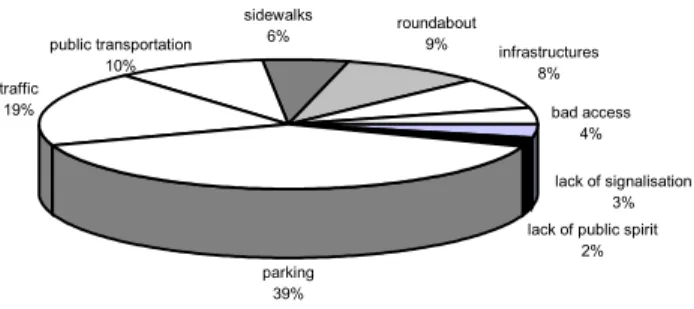
Mobility is the third most important problem (with 20% of the answers). Here the lack of parking lots, followed by traffic problems and an inefficient transportation system are seen as the most urgent topics (Figure 11). parking 39% traffic 19% roundabout 9% bad access 4% lack of signalisation 3% sidewalks 6% public transportation 10% infrastructures8%
lack of public spirit 2%
Figure 11 – Main problems identified in the mobility problems group by S. João da Madeira citizens
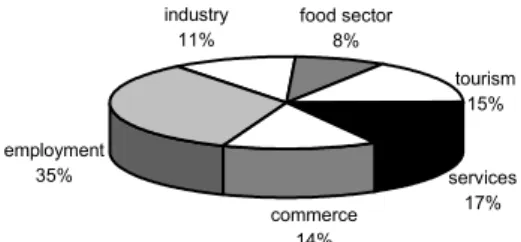
With 10% of references, economic problems include employment as the main topic followed by service and industry sectors (Figure 12).
commerce 14% employment 35% industry 11% services 17% food sector 8% tourism 15%
Figure 12 – Main problems identified in the economic problems group by S. João da Madeira citizens
Urban problems occupy the fifth rank (with 7% of the answers). The degree of dilapidation of buildings was especially highlighted, as well as the quality and quantity of construction and lack of urban planning (Figure 13).
degree of decay of buildings 40% quant it y of const ruct ion
12%
qualit y of const ruct ion 10%
unpleasant public parks 6% lack of f acilit ies f or disabled
people 6% graf f it i 6% lack of planning 8% ot her 12%
Figure 13 – Main problems identified in the urban problems group by S. João da Madeira citizens
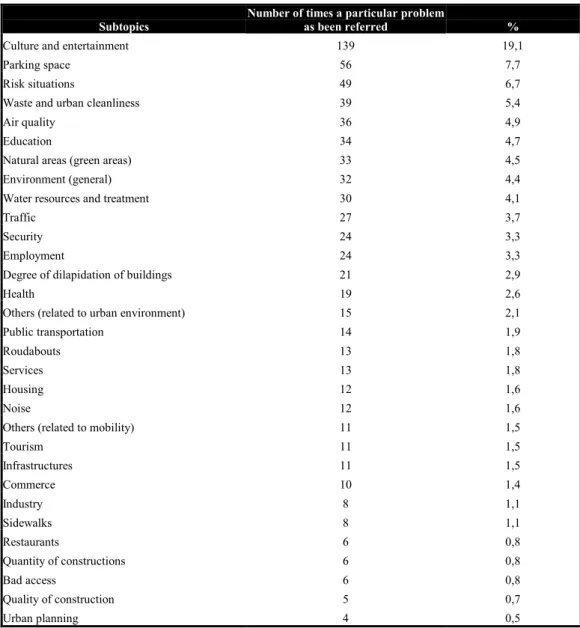
Table 1 – Main particular problems identified by the public
Subtopics
Number of times a particular problem
as been referred %
Culture and entertainment 139 19,1
Parking space 56 7,7
Risk situations 49 6,7
Waste and urban cleanliness 39 5,4
Air quality 36 4,9
Education 34 4,7
Natural areas (green areas) 33 4,5
Environment (general) 32 4,4
Water resources and treatment 30 4,1
Traffic 27 3,7
Security 24 3,3
Employment 24 3,3
Degree of dilapidation of buildings 21 2,9
Health 19 2,6
Others (related to urban environment) 15 2,1
Public transportation 14 1,9
Roudabouts 13 1,8
Services 13 1,8
Housing 12 1,6
Noise 12 1,6
Others (related to mobility) 11 1,5
Tourism 11 1,5 Infrastructures 11 1,5 Commerce 10 1,4 Industry 8 1,1 Sidewalks 8 1,1 Restaurants 6 0,8 Quantity of constructions 6 0,8 Bad access 6 0,8 Quality of construction 5 0,7 Urban planning 4 0,5
For the general population the six most eminent problems are (1) culture and entertainment: lack of places and facilities provided, cultural events and activities for young and elder people; (2) lack of parking lots at the center of the city; (3) risk situations: dependence on drugs, lack of support for people in need and families; (4) waste management and urban cleanliness: inefficiency in waste collection and urban cleanliness, lack of containers, lack of investment in recycling programs, waste in natural areas; (6) education: lack of universities and technical schools, dilapidation of the school buildings and lack of equipment, lack of new schools and lack of public spirit.
It is interesting to verify that environmental problems like waste and urban cleanliness, air quality, natural areas, environment and water resources and treatment are more urgent to citizens than traffic, security, employment and health.
The citizens of SJM believe that for future prosperity of their community the highest potential can be found in the industrial and service sector. They also see education as being essential (Figure 14).
There was a huge diversity of answers although many opinions about the future development of the community have only been mentioned a few times. Therefore, all aspects referred to less than 7 times are grouped under the heading of “others”.
20% 13% 7% 5% 5% 6% 3% 3% 4% 4% 3% 4% 23% industry commerce education services sports
parks and gardens recreational areas cultural events strategic location people shoe industry mobility other
Figure 14 – Potencials of S. João da Madeira identified by the citizens.
Questionnaire of the decision makers
In order to get to know the perceptions of the politicians and engineers of the authorities a questionnaire, similar to the one for the citizens, has been distributed among the departments of the Municipal Assembly, to the president of the City Council, to six members of the town council, to the president of the parish and to the five head officers of the technical departments of the City Council. In total 29 questionnaires were sent by mail to politicians and five to the five head officers. Nine replies have been received (five from politicians and four from the technical departments) which corresponds to a rate of 26%.
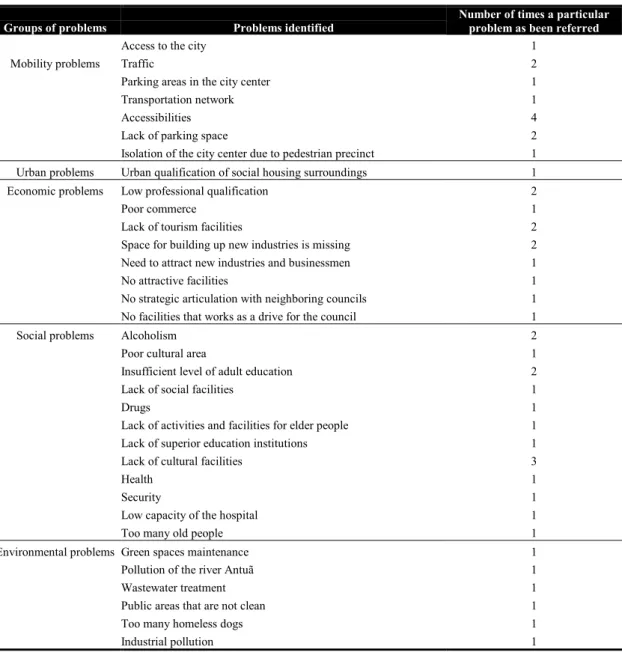
The answers have been grouped into the main categories of problems that are shown in Table 2. Table 2 – Main groups of problems identified by decision makers (absolute numbers corresponding to the
number of times a problem within these groups was referred).
Groups of problems Total Politicians Head officers
Mobility problems 12 6 6
Urban problems 1 1 0
Economic problems 11 4 7
Social problems 16 11 5
Environmental problems 6 4 2
For decision makers the most eminent categories of problems are (1) social problems with 35% of the answers, (2) mobility complying with 26%, (3) economic problems with 24%, (4) environmental problems with 13% and (5) urban problems complying with only 2% of all answers.
Table 3 - Main particular problems identified by the decision makers (absolute numbers corresponding to the number of times a problem was referred).
Groups of problems Problems identified
Number of times a particular problem as been referred
Access to the city 1
Mobility problems Traffic 2
Parking areas in the city center 1
Transportation network 1
Accessibilities 4
Lack of parking space 2
Isolation of the city center due to pedestrian precinct 1 Urban problems Urban qualification of social housing surroundings 1
Economic problems Low professional qualification 2
Poor commerce 1
Lack of tourism facilities 2
Space for building up new industries is missing 2
Need to attract new industries and businessmen 1
No attractive facilities 1
No strategic articulation with neighboring councils 1
No facilities that works as a drive for the council 1
Social problems Alcoholism 2
Poor cultural area 1
Insufficient level of adult education 2
Lack of social facilities 1
Drugs 1
Lack of activities and facilities for elder people 1
Lack of superior education institutions 1
Lack of cultural facilities 3
Health 1 Security 1
Low capacity of the hospital 1
Too many old people 1
Environmental problems Green spaces maintenance 1
Pollution of the river Antuã 1
Wastewater treatment 1
Public areas that are not clean 1
Too many homeless dogs 1
Industrial pollution 1
The number of replies received was low, which did not allow a very profound analysis. A large number of problems have been identified but the most important ones are the lack of cultural facilities, bad access to the city. Other problems named by more than one person were traffic, lack of parking lots, a low professional qualification, space for building up new industries is missing, alcoholism and a low, insufficient level of adult education.
According to the decision makers the potential of the council for the future lies in the industrial sector (19% of the votes) and in the advantageous geographical location (15%) (Figure 15).
15 19 12 12 4 4 4 8 4 4 12 4 Strategic location Industry Commerce Services Work Sports Education Organisations Other municipalities ally People
Infrastructures
Small area of the municipality
Figure 15 – Potencials of S. João da Madeira identified by the decision makers (numbers in percentage).
The results of the questionnaire of the population and of the decision makers on the problems of the community have been compared and the result is shown in Figure 16.
0 5 10 15 20 25 30 35 40
social economic urban mobility environmental
protection population
decision makers
Figure 16 – Comparison of the frequency of references to each group of problems in population and decision makers (values correspond to the percentage of references to that problem).
There is a large conformity between decision makers and the population on the question of social problems and more or less as well on the topic of mobility. A huge discrepancy can be observed in the perception of the economic problems – clearly favored by the authorities – and the urban problems and the issue of environmental protection – more important to the population.
When comparing the results about the social problems obtained by both questionnaires (Table 1 and Table 3) one can clearly see a large conformity on the problem of lack of facilities for culture and entertainment. The next most important problem in this group is the lack of parking space in the city center.
A closer look at the problems pointed out by the decision makers and those stated by the population reveals a gap between both parties. For the politicians and engineers the access to the community, which
The perception of the remaining problems named also shows huge discrepancies. While the population is concerned about environmental problems and the lack of education tools/equipment and community services (like urban cleanliness) the decision makers have identified problems that are related to the low professional qualification of the citizens and the overall low level of education.
A comparison of the different perceptions of both parties on the potentiality of the community is offered in Figure 17.
According to this question the population especially pointed out economic aspects (industry, commerce and services) followed by education.
The decision makers highlighted the importance of industry and the strategic geographical location for the future of S. JoaHo da Madeira. Furthermore they named the aspects of commerce and service as well as infrastructure as the fields with a high potential .
Both the citizens and the authorities share their view on industry and on commerce and services as being the key factors for the further development of the community. With respect to other potentialities there is a gap between the opinion of the population and the decision makers. While the latter concentrate more on the issue of infrastructure and the strategic geographical location of the council, the population sees more potential in improving education and creating more natural and recreational areas as well as the supply of cultural events.
0 5 10 15 20 25 Stra tegic locat ion Indu stry Com mer ce Serv ices Work Spor ts Educ ation Orga nisat ions Othe r mun icipa lities ally Peop le Infra struc ture s Small area ofth emun icipa lity Park s and gard ens Recr eatio nal a rea Cultu ral e vent s Shoe indus try Mob ility Othe r decision makers (%) population (%)
Figure 17 – Comparison of the frequency of references to potentials in population and decision makers (values correspond to the percentage of references to that potential factor).
The creation of the Participatory Forum
The Participatory Forum forms an excellent platform for discussion and civil participation as representatives of various fields of social life are taking part: organizations, schools, companies, city councilors and other public and private institutions.
Normally public meetings are organised when the project has already been defined. Therefore those discussions “bring more heat than light” to the process (CONNOR, 1994) mostly ending in a quarrel. This
underlines the importance of the Participatory Forum which has been taken place since the very beginning of the process promoting constructive debates.
According to literature people create intellectual, social and political capital when having the chance of sharing and debating ideas (INNES et al 1994; GRUBBER, 1994 in VASCONCELOS et al, 2002). “Social capital relates to the form of trust, norms of behavior, and networks of communication, which are the basis of an environment where serious discussion is possible. Intellectual capital relates to the form of commonly shared and accepted information, which creates a framework for the discussions among stakeholders to move toward agreement. Political capital creates the possibility of turning agreements into meaningful action.” (GRUBER, 1994: 3 in VASCONCELOS et al, 2002).
These capitals can only be revealed after the opportunity is created and therefore institutions have to adjust to this new process of interaction and development of a shared responsibility between different stakeholders (VASCONCELOS et al, 2002). This leads to the conclusion that this aim should be promoted in SJM.
Another important principle of the Forum is the concept that there is no prerequisite of any knowledge needed to participate as people should share their personal opinions, feelings and knowledge. For the process it is only necessary to attend the meetings and contribute their experience (WEISBORD & JANOFF, 2000).
To create the Participatory Forum the community profile was used and several meetings were organized. The first official meeting (Figure 18) took place at the end of September 2003 and its main goal was to present the results of the implementation of Local Agenda 21 done so far. 68 citizens representing 56 institutions attended the meeting as well as the Mayor and the Secretary of State of Environment.
Figure 18 – First official meeting of the Participatory Forum of LA21 in S. João da Madeira
The distribution of the community representatives can be seen in Table 4.
Table 4 – Distribution of the community representatives in the first meeting of the Participatory Forum
Institution invited People attending (number)
City councilors 5
Mucicipal Assembly 1
Junta de Freguesia (President of the parish) 1
City Coucil technical departments 3
Municipal services 1
Companies 8 Associations 11
Social support organisations 8
Central administration 2
Teaching institutions 7
Citizens 3 Press 7
Companies and citizens were the interest groups under-represented compared to the total amount of them in the city.
SECOND STEP: SELECTIVE DIAGNOSIS AND THE PLAN OF ACTION
A plan of action will be developed by the assistant team in co-operation with groups dealing with the topics identified by the Participatory Forum.
This step will kick off with the realization of a second meeting of the Participatory Forum. The goal of this meeting will be the identification of a future vision of the council and its main obstacles.
The meeting will be started with a short presentation of the general objectives and procedures of meetings. An explanation of the terms will be given to the participants.
Then the participants will randomly be divided into working groups of six to seven people that are moderated by a facilitator. Every group gets one hour to find a compromise on six problems and a future vision of the community. After this each group will select one of its members to present their results in the plenary session. In the final part of this session all those problems discussed will be grouped and voted upon individually.
The six problems identified will be considered by the assistant team of SSB-PCU with respect to the scope of the council diagnosis.
CONCLUSION
Since the launch of Local Agenda 21 eight months ago in the community the foundations have been laid. Relating to communication and public involvement conventional instruments – leaflets, exhibitions, hotline, newsletter e website - have been used. Moreover there were used other methods like partnerships with local newspapers, associations and schools. The creation of that network has been facilitated by the small size of the community.
These partnerships bundles up the interests and potentials of civil society. Many institutions have already contacted the Co-ordination Group for integration Local Agenda 21 into their activities.
The vast diversity of communication instruments has promoted the interaction between the local population and the team of Local Agenda 21.
Although so many efforts to involve the people have been made they are not responding as hoped. Unfortunately the companies and the general public are the parties missing but they are important groups to the process as they form the basis of social and economic life in the community. This may indicate that different methods should be used.
The recent results have shown that the opinions of the population and the decision makers about the problems in SJM do not coincide to a great extent. The only group matching is the one related to social problems with the main issue being the lack of cultural and entertainment facilities.
The other groups of problems being “Mobility“, “Economic problems“, “Urban problems” and “Environmental problems” have been evaluated differently by both parties. In general, the decision makers tended to see the most urgent tasks related to “Economic problems” and “Mobility”, while the citizens were more concerned about the issues of “Urban problems” and “Environmental problems”. The same tendency can be observed in the group of future potentials of the council. Both groups refer to industry and commerce as being the key factors, but the citizens are furthermore more concerned about education, environment and culture while the authorities see more potential in improving the infrastructure and using the strategic geographical location of the community. Apparently the decision makers do prefer investments in physical actions while the population of SJM claim the social development to achieve a healthy, prosperous city.
This data, despite the preliminary, will reinforce the importance of the process of Local Agenda 21 in S. JoaHo da Madeira.
It was an excellent opportunity for the decision makers to profit from the information received by public participation as it helps to reorganise the priorities of the council, increasing the representative character and legitimation of the decisions made.
ACKNOWLEDGEMENT
We would like to thank the Fundação Luso-Americana para o Desenvolvimento for their support in presenting this paper and our helpful colleague and friend Elke Christoph as well as Ingrid Christoph for all the support and help with the translation of the document.
REFERENCES
Almeida, J. F. et al, 2001. II Inquérito Nacional “Os portugueses e o ambiente”. Observa – Observatório de Ambiente, Sociedade e Opinião Pública. 39pp.
Baptista, I., 2001. Desenvolvimento sustentável e planeamento territorial. Novos desafios no envolvimento da sociedade civil. Suplemento de Engenharia do Ambiente do Jornal Expresso de 3 de
Novembro.
Connor, D. M., 1994. The social profile. Constructive Citizen Participation. II:1-2p.
Connor, D.,1997. Constructive Citizen Participation: a resource book. Development Press. 6th Edition Conselho Local de Acção Social de S. João da Madeira, 2002. Rede Social: Diagnóstico Social. Rede Social. 179pp.
Conselho Local de Acção Social de S. João da Madeira, 2003. Rede Social: Plano de Desenvolvimento
Social e Plano de Acção 2003 (2º Semestre). Rede Social. 13pp.
EORG, 2002. Eurobarometer 58.0 – The attitudes of Europeans towards the environment. Survey managed by Directorate-General Press and Communication “Public Opinion Analysis” written by The European Opinion Research Group for Directorae-General Environment. 42pp.
Farinha, J. et al, 2002. Participação pública no combate à desertificação. Ed. Direcção Geral das Florestas & Universidade Nova de Lisboa. 34pp.
Fidélis, T., 2001. Planeamento territorial e ambiente – o caso da envolvente à Ria de Aveiro. Ed. Principia – Publicações Universitárias e Científicas. 315pp.
Gonçalves, M. E.(ed.) et al. 2001. O caso de Foz Côa: um laboratório de análise sociopolítica. Edições 70. 270pp.
Hallo, R. E., 1997. Public Acess to Environmental Information. Experts Corner number 1997/1. Ed. European Environment Agency. 41pp.
Hernández, F. H., 2002. EntreTantos - Guia prática para dinamizar procesos participativos sobre
problemas ambientales y sostenibilidad. Ed. Gea. 137pp.
ICLEI – International Council for Local Environmental Initiatives, 2001. Accelerating Local
Sustainability – Evaluating European Local Agenda 21 Processes – Volume I. ICLEI. 135pp.
ICLEI – International Council for Local Environmental Initiatives, 2001. Accelerating Local
Sustainability – Evaluating European Local Agenda 21 Processes – Volume II. ICLEI. 124pp.
ICLEI – International Council for Local Environmental Initiatives, 1999. Módulos para Workshop: um
suplemento do Guia de Planejamento da Agenda 21 Local. ICLEI.
ICLEI - International Council for Local Environmental Initiatives, 1996. The Local Agenda 21 Planning
Guide – An introduction to Sustainable Development Planning. 211 pp.
Marques, 2001. Desenvolvimento local em espaço rural e novas competências: a participação dos
Oliveira, R. & Baptista, I., sem data. Guadiana Vivo: uma abordagem participada ao planeamento e
gestão do Parque Natural do Vale do Guadiana. Ed. Associação de Defesa do Património de Mértola.
61pp.
Seitz, D., 1994. Agenda 21 – The Earth Summit Strategy to Save our Planet. Earthpress. 321pp.
UNCHS & UNEP, 1999. Establishing and Supporting a Working Group Process. Sustainable Cities
Programme Source Book Series. Volume 3. 123pp.
UNDP, UNEP, WB, WRI, 2003. World Resources 2002-2004: Decisions for the Earth: Balance, Voice
and Power. World Resources Institute, 315pp
Vasconcelos, L.T., Baptista, I., Henriques, T., 2002. Sustainability at the local level - intellectual, social
and political capital building. Paper presented at the XV Conference: Planning and Regional Issues in the
Border Regions. 18pp.
Viana, C. I., 2002. Caracterização do Concelho de S. João da Madeira. Trabalho de Pós-Graduação em Gestão Ambiental. Escola Superior de Biotecnologia, Universidade Católica Portuguesa. 78pp
Weisbord, M & Janoff, S., 2000. Future Search: an action guide to finding common ground in