Título da Tese
UrbArch Emptiness – Lisbon Riverside
From theoretical foundation to analytical application by 3D Solid
Representations of Open Public Spaces
Ramo de Doutoramento: Arquitetura
Especialidade: Teoria e Prática do Projeto
Nome da Doutoranda: Ljiljana Čavić
Nome do Orientador: Doutor Jorge Filipe Ganhão da Cruz Pinto
Nome do Coorientador: Doutor José Nuno Dinis Cabral Beirão
Constituição do Júri:
Presidente e vogal:
Doutora Ana Marta das Neves Santos Feliciano, Professora Auxiliar,
Faculdade de Arquitetura da Universidade de Lisboa
Vogais:
Doutor Jorge Filipe Ganhão da Cruz Pinto, Professor Catedrático,
Faculdade de Arquitetura da Universidade de Lisboa;
Doutor João Carlos Vassalo Santos Cabral, Professor Associado,
Faculdade de Arquitetura da Universidade de Lisboa;
Doutora Teresa Marquito Marat-Mendes, Professora Auxiliar, ISCTE
–
Instituto Universitário de Lisboa;
Doctor of Philosophy Jorge Alberto Lopes Gil, Assistant Professor,
Chalmers University of Technology;
Doutor Carlos Jorge Henriques Ferreira, Professor Auxiliar, Faculdade
de Arquitetura da Universidade de Lisboa
Tese especialmente elaborada para a obtenção do grau de doutor
Documento definitivo
I
Acknowledgements
Since October 2012, when this research* started, I got in touch with several people who profoundly influenced the research direction making this journey and its output unique and possible.
I would start with mentioning my scientific supervisor and friend, prof. Jorge Cruz Pinto, whose investigation and own interest in notion of emptiness within urban and architectural practices, together with his perspicacity, criticism, relentless creativity and sense of conceptual accuracy profoundly inspired the research. I would also like to express my deep appreciation to prof. José Nuno Beirão, whose scientific and pedagogic dedication, constant pursuit of precision and methodological validity turned this research practically applicable and achievable.
Moreover, I would like to express my gratitude to several other professors: prof. Alexandra Quintas, prof. João Cabral, prof. Nuno Nabais; prof. David Vale; prof. Graça Moreira; prof. Jorge Ribeiro; to collegues: Rusne Sileryte, André Chasar, Rui Van Zeler, Alexander Gerner and to dear friends: Rita Jacinto and Rita Martins, whose interest and involvement made the process possible.
I would also like to thank to my sister, my parents and my life partner who went with me through this important phase of my academic and personal development. Finally, I want to thank to my son, whose arrival set an inflexible deadline that architects undoubltly need.
*The presented research was completed with financial support of FCT, Fundação para a Ciência e Tecnologia Portugal in form of PhD scholarship with a reference SFRH/BD/76730/2011.
II
Abstract
In the nowadays tightly built environment we recognize the unbuilt part of urban-architectural space as its gradient and structural element, which influences its formal and functional qualities. Based on the references of urbanism, architecture and human geography and in order to analyse Open Public Spaces through the prism of its unbuilt part, the study proposes, defines and captures the notion of urban-architectural emptiness – UrbArch Emptiness. It starts from a theoretical analysis of emptiness wherefrom the UrbArch Emptiness was conceptualised. It further develops a way to represent the realm of the negative of built environment by objectifying it into novel 3D solid representations (Convex, Solid and Fragmented Voids) which are combined with already existing View field representations (Isovist and Viewsheds) and applied on case study of Lisbon Riverside. These representation models are used for capturing attributes of Open Public Spaces by approaching their measurable properties which are further related to spatial experiences and usages as expressions of spatial qualities. The expressions of qualities are inferred through first person in-situ phenomenological analysis and natural observation wherefrom correlations between Open Public Spaces‘ quantitative properties and qualities were preliminarily established.
Combining qualitative and quantitative methodologies, the research takes the 3D solid representation and investigates the role of UrbArch Emptiness in generating qualities of Open Public Spaces in Lisbon riverside. To do so research: a) Introduces the concept of Emptiness as inspirational and theoretical basis of research (chapter 2); b) Defines objectified focus of research – UrbArch Emptiness (chapter 3); c) Develops models for Open Public Spaces representation and analysis based on UrbArch Emptiness (chapter 4); d) Defines specific Open Public Spaces‘ attributes to be approached (chapter 5); Applies the methodology wherefrom correlations between attributes, qualitative properties and spatial qualities are preliminarily established (chapter 6).
Key words: UrbArch Emptiness, Open Public Spaces, Representation Models, Lisbon Riverside, Attributes, Properties, Qualities
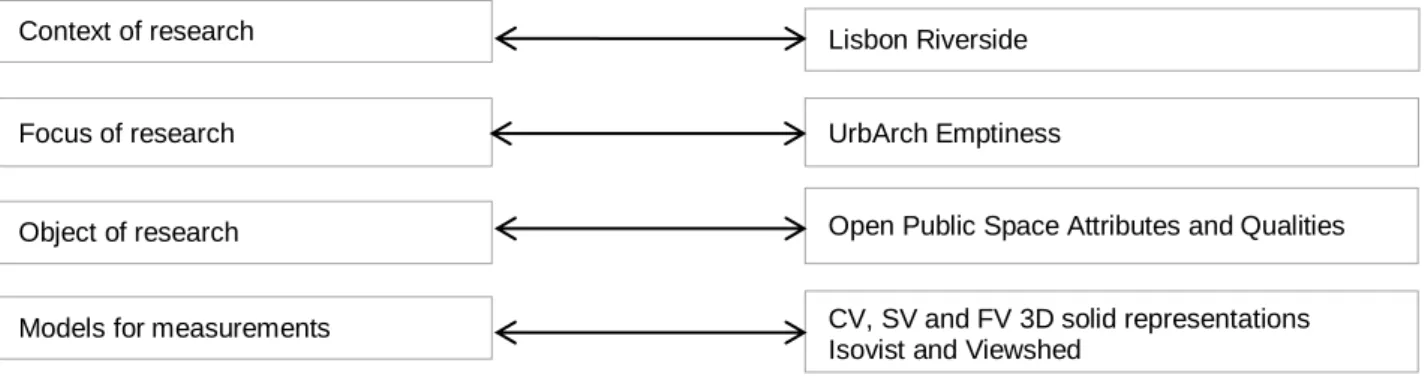
III Figure 1 Research Guidelines
Open Public Space Attributes and Qualities UrbArch Emptiness
Lisbon Riverside
Focus of research
Object of research Context of research
CV, SV and FV 3D solid representations Isovist and Viewshed
Models for measurements
How does UrbArch Emptiness participate in generating and structuring Open Public Spaces and their formal and functional Qualities? Research Question
Quantitative-qualitative Correlation Analysis Methodology
Novel representation model and method for Open Public Space Analysis
IV
Index
URBARCH EMPTINESS – LISBON RIVERSIDE ... ERROR! BOOKMARK NOT DEFINED. ACKNOWLEDGEMENTS ... I ABSTRACT ... II INDEX ... IV INDEX OF FIGURES ... IX INDEX OF TABLES ... XIII
INTRODUCTION ... 1 1. 1.0. AUTHORS‘ BRACKETING ... 2 1.1. RESEARCH INSPIRATION ... 3 1.2. RESEARCH DRIVERS ... 4 1.3. RESEARCH IN NUTSHELL ... 6
1.4. FOCUS, OBJECT AND CONTEXT OF RESEARCH ... 7
Focus of Research - UrbArch Emptiness ... 7
Object of Research - Open Public Space ... 9
From spatial attributes towards properties and qualities ... 10
Spatial Context – Lisbon Riverside ... 12
Temporal Context – Past, Contemporaneity, Future ... 14
Multi-Scale approximation toward subject ... 15
1.5. RESEARCH QUESTION AND HYPOTHESIS ... 17
1.6. RESEARCH AIMS ... 17
1.7. METHODOLOGY ... 18
Research Methods Scheme ... 20
First Methodological Phase – Theoretical Analysis ... 21
Second Methodological Phase - Critical and Correlational Analysis ... 23
Third Methodological Phase – Practical Synthesis ... 25
1.8. RISKS OF THE RESEARCH... 27
1.9. IMPORTANCE OF OUR RESEARCH ... 27
1.10. DISSEMINATION ... 28
V
THEORETICAL ANALYSIS OF EMPTINESS... 33
2. 2.0. ON EMPTINESS ... 34
Buddhist‘s full emptiness as manifestation of everything and manifested in everything ... 35
Taoists breathing emptiness and built environment ... 38
Atomists‘ Emptiness and Movement ... 39
Plato Space/Emptiness Converging and Overlapping ... 42
Aristotle‘s Void and Emptiness ... 45
Stoic‘s Extracosmic Empty Space ... 51
Horror Vacui ... 53
From Extracosmic Void towards Extracosmic Space ... 55
XVI and XVII century Non-scholastic - Infinite Space and Emptiness ... 57
Summary of Historical Concepts of Emptiness ... 60
2.1. EMPTINESS IN URBAN-ARCHITECTURAL DISCIPLINES ... 63
Architecture of Emptiness ... 65
Building by erasing architecture... 69
Building by Hollowness ... 72
Building by Un-building ... 75
Instability of Emptiness ... 79
Fullness of emptiness - Radiance of Objects and Density of Emptiness ... 82
Articulation and Tempo of Emptiness ... 84
Space-Limit ... 88
Latency and Potentials of Emptiness ... 91
2.2. EMPTINESS AND BUILT CONTEXT ... 92
Built Environment between Natural and Manufactured Setting ... 93
Built environment and Breathing emptiness ... 101
UrbArch emptiness and nature-city process ... 105
Place – Landscape – Space ... 109
Emptiness and Open Public Space ... 116
Different types of UrbArch emptiness ... 122
2.3. EMPTINESS IN LISBON RIVERSIDE ... 123
Terreiro do Paço – The Representative Emptiness ... 123
Bélem and multileveled Emptiness ... 126
Lisbon – A city of the Riverside ... 128
VI
2.4. FROM THEORETICAL FOUNDATIONS TOWARDS RESEARCH‘S MAIN CONCEPTS 133
Absolute emptiness ... 133
Absolute Space ... 135
Specific space... 137
Specific emptiness ... 138
Between Specific and Absolute Emptiness ... 140
Between Emptiness and Void ... 142
2.5. CONCLUSIONS ON THEORETICAL FOUNDATION OF RESEARCH ... 143
DEFINITION OF URBARCH EMPTINESS ... 147
3. 3.0. URBARCH EMPTINESS AS MANIFESTED ARTEFACT ... 148
3.1. URBARCH EMPTINESS AS REFLECTION OF ITS FULL ANTIPODE ... 149
3.2. LIMITS ... 152
Conceptual limits... 152
Urban-architectural Limits ... 155
Depth of limits ... 157
Semantic and structural level of limits ... 159
Explicit vs implicit limits ... 160
Limits of UrbArch Emptiness and Open Public Space Types ... 162
3.3. CONCLUSIONS ON URBARCH EMPTINESS ... 164
THE MATERIALISATION OF THEORY - REPRESENTATION MODELS FOR OPEN 4. PUBLIC SPACES BASED ON URBARCH EMPTINESS ... 167
4.0. REPRESENTATION OF SOLIDIFIED URBARCH EMPTINESS ... 168
Abstract ... 168
Introduction ... 169
4.1. DEFINITION OF 3D SOLID REPRESENTATION MODELS ... 170
I Solidification of UrbArch emptiness ... 173
II Convex Spaces ... 175
III 3D-informed Convex Spaces ... 177
IV Research approximations – Convex, Solid and Fragmented Voids ... 180
V Open Public Space Properties ... 191
4.2. FIELD-BASED REPRESENTATION OF URBARCH EMPTINESS ... 193
VII
Viewshed ... 197
4.3. CONCLUSIONS ON REPRESENTATION MODELS ... 198
OPEN PUBLIC SPACE ATTRIBUTES ... 201
5. 5.0. ABSTRACT ... 203
5.1. INTRODUCTION ... 205
5.2. PROBLEM STATEMENT ... 206
5.3. IMPORTANCE OF SPATIAL ATTRIBUTES AND CATEGORIES ... 207
5.4. AMBIGUITY OF PUBLIC SPACES ... 208
5.5. OPPORTUNITY FOR REFOCUSING URBAN AND ARCHITECTURAL PRACTICES ON USERS ... 210
5.6. METHODOLOGY ... 211
5.7. DATA GATHERING ... 213
5.8. DATA ANALYSIS - FROM DATA CODING TO SPATIAL ATTRIBUTES AND CATEGORIES ... 214
5.9. CODING BY SYSTEMATISATION OF DATA – TOWARDS ATTRIBUTES ... 215
5.10. CODING BY DISCIPLINARY LEVEL – TOWARDS CATEGORISATION ... 216
5.11. CODING BY TYPES OF WORDS – TOWARDS MEASURABILITY ... 218
5.12. MEASURABILITY OF ATTRIBUTES ... 221
5.13. CONCLUSION ON OPEN PUBLIC SPACE ATTRIBUTES ... 223
5.14. FROM COMPLEXITY TOWARDS FEASIBILITY – NARROWING OBJECT OF RESEARCH ... 228
CAPTURING OPEN PUBLIC SPACES ATTRIBUTES BY APPROACHING URBARCH 6. EMPTINESS ... 233
6.0. CASE STUDIES CHOICE ... 236
6.1. CAPTURING GEOGRAPHICAL AND NATURAL CATEGORY ... 237
Abstract ... 237
Introduction ... 238
Methodology ... 240
Natural environment in Portuguese urbanism ... 242
Natural advantages and Lisbon‘s Riverside ... 243
Constructed Topography of Contemporary Lisbon ... 244
VIII
Topography and Open Public Space Characterisation ... 246
Visual Amplitude and Open Public Space Contextualisation ... 253
Conclusions on Capturing Geographical and Natural Category ... 262
6.2. CAPTURING ARCHITECTURAL AND URBAN CATEGORY... 265
Abstract ... 266
Urban-Architectural Open Public Space Attributes ... 266
Spaciousness ... 268
Openness ... 278
Conclusions on Capturing Architectural and Urban Category ... 290
6.3. CAPTURING BEHAVIOURAL CATEGORY - FROM OPEN PUBLIC SPACE ATTRIBUTES TO QUALITIES ... 295
Qualitative reflextion on Lisbon Riverside ... 301
Conclusions on Capturing Behavioural Category - From Open Public Space Attributes to Qualities ... 335
CONCLUSIONS AND FINAL CONSIDERATIONS ... 339
7. 7.0. FROM THEORETICAL FOUNDATION TOWARDS PRACTICAL APPLICATION - FROM EMPTINESS TO URBARCH EMPTINESS ... 341
7.1. ON REPRESENTATION MODELS ... 343
7.2. ON 3D SOLID REPRESENTATIONS AS RESEARCH OUTPUT ... 345
7.3. ON URBARCH EMPTINESS AND OPEN PUBLIC SPACES ANALYSIS ... 346
7.4. ON OPEN PUBLIC SPACES TYPOLOGY ... 348
7.5. ON FUTURE WORKS... 350
7.6. ON RESEARCH LIMITATIONS ... 352
7.7. ON URBARCH EMPTINESS – TOWARDS ARCHITECTURE OF EMPTINESS ... 353
GLOSSARY OF CONCEPTS USED ... 357
8. BIBLIOGRAPHY ... 363 9.
IX
Index of figures
Figure 1 Research Guidelines ... III Figure 2. Pedro Moura Pinheiro, Riverside, [Online] Available from:
http://www.flickr.com/photos/pedromourapinheiro/4416871476/, [Accessed 13th
February 2013] ... 1
Figure 3 Open Public Space Attributes, Properties and Qualities... 11
Figure 4 Research Objectives and correspondent Methodological phases ... 19
Figure 5 On Emptiness - Emerging, author's drawing ... 32
Figure 6 On Emptiness - Dome, author's drawing ... 49
Figure 7 On Emptiness - Nature, author's drawing ... 67
Figure 8 Oribe Tea House by Kengo Kuma, Available at: http://kkaa.co.jp/img/2011/12/oribe_05.jpg accessed at 18.12.2016 ... 71
Figure 9 Donald Judd, Untitled (1980-84), Chinati Foundation, Marfa, Thailand [Online] Available from: http://dalebriantaylor.files.wordpress.com/2012/04/judd-concrete.jpg, [Accessed 14th February 2013] ... 74
Figure 10 Gordon Matta-Clark, Bronx Floors: Threshole 1972, 2 black and white photographs, Each 356 x 508 mm ... 78
Figure 11 Stoa in Athen, by Jamie Brown, available from http://www.lightphonics.co.uk/Blog/Rhythm accessed at 18.12.2016 ... 87
Figure 12 Space-Limit, pintura, Jorge Cruz Pinto ... 90
Figure 13 Built environment between natural and manufactured settings, author‘s drawing ... 95
Figure 14 Grande Cretto, Alberto Burri, Gibellina, 1989 ... 98
Figure 15 Anselm Kiefer, Buch (The Secret Life of Plants), 2002, Mixed media on lead, Page Dimensions: 77 x 57 x 1", Diameter of open book: 113". ... 100
Figure 16 RPM-1200, Chu Enoki, accessed on 23.11.2015 http://chuenoki.com/works.html ... 108
Figure 17 Baltic Film and Media School, Salto Architects, available at: http://www.salto.ee/baltic-film-and-media-school/ accessed on 09.02.2016 ... 118
Figure 18 Process of concretisation - from Absolute Emptiness, through Space towards Specific Emptiness ... 133
Figure 19 Kazimir Malevich_1918_Suprematist-Composition_PLZ-161 http://imgkid.com/white-on-white-malevich.shtml accessed 5.6.2015. ... 134
Figure 20 Process of concretisation - From Absolute Emptiness to Absolute Space 135 Figure 21 Critical Whiteness, from http://www.whiteonwhite.eu/index.php?/project/whiteness/ accessed at 15.12.2016 . 136 Figure 22 Process of concretisation - From Absolute Emptiness to Specific Space .. 137
X
Figure 24 L.L. H&J from http://yana-a-art.tumblr.com/post/105439908867 accessed at
15.12.2016 ... 139
Figure 25 Nicolas Alan Cope photography, available at http://cargocollective.com/cope1 accessed at 18.12.2016 ... 145
Figure 26 UrbArch Emptiness grasped as Field or Solidified Object ... 150
Figure 27 Light, Wills, available from https://www.flickr.com/photos/willsun/5148550136/in/photostream/ accessed at 20.12.2016 ... 151
Figure 28 Emptiness, Wills, available from https://www.flickr.com/photos/willsun/5469022465/in/photostream/ accessed at 20.12.2016 ... 154
Figure 29 Offices in Zamora, Alberto Campo Baeza, available from http://www.campobaeza.com/offices-for-the-junta-de-castilla-y-leon/ accessed at 20.12.2016 ... 158
Figure 30 Brick country house, Mies Van der Rohe, from ―Mies van der Rohe: European works‖ 1986 ... 163
Figure 31 UrbArch Emptiness and Representation Models ... 168
Figure 32 Rome map by Giambattista Nolli, detail, https://commons.wikimedia.org/wiki/File:Nolli_detail_pantheon.jpg accessed on 10.5.2017 ... 173
Figure 33 Central Lisbon 3D Solid Representation Model ... 174
Figure 34 Convex Spaces examples, available from http://www.favelas.20m.com/paper.htm accessed at 20.12.2016... 176
Figure 35 Solid Representation Model of Terreiro do Paço, Ribeira das Naus 3D .... 178
Figure 36 Projection of Explicit Limits into Implicit Ones ... 179
Figure 37 Process of encoding of 3D Information ... 182
Figure 38 Convex Voids, Solid Voids and Fragmented Voids ... 184
Figure 39 Constriction of 3D solid representation model ... 184
Figure 40 Possible construction of Solid Voids, from (Beirão et al., 2015) ... 187
Figure 41 Poço do Bispo Dock ... 190
Figure 42 Content of Convex, Solid and Fragmented Voids Models ... 191
Figure 43 Isovist from Poço do Bispo ... 196
Figure 44 ―Calculating a viewshed‖ from http://www.innovativegis.com/basis/mapanalysis/topic15/topic15.htm accessed on 22.12.2016 ... 197
Figure 45 Chapter main objective ... 201
Figure 46 Completing Experts imperatives with Users‘ ... 202
Figure 47 Emerging public space in Lisbon Riverside... 205
Figure 48 Emerging pubic usages in Lisbon Riverside ... 208
XI
Figure 50 Disciplinary frameworks and levels of research ... 216
Figure 51 Spatial categories and attributes ... 218
Figure 52 Linguistic types and related spatial attributes ... 219
Figure 53 Approached Categories and Scales ... 230
Figure 54 Slope shape adapted from (Sheng, 1990) ... 247
Figure 55 Places implanted at convex slope – a) Lisbon (Portugal), b) Ostuni (Italy), c) Macchu Picchu (Peru), d) Cordes sur Ciel (France), author‘s drawing ... 248
Figure 56 a) Warka, ‗the White Temple‘ in Uruq (Iraq), b) Ur ziggurat (Iraq) and c) Tower of Babel, author‘s drawing ... 249
Figure 57 Importance of scale in place implantation, author‘s drawing ... 250
Figure 58 Place-landscape relatioships in Lisbon Riverside: 1. Terreiro do Paço, 2. Ribeira das Naus, 3. Praça do Município 4. Campo das Cebolas 5. Cais do Sodré 6. Santos 7. Jardim Dom Luis, author‘s illustration ... 252
Figure 59 Place-Landscape-Space Visual Amplitude and Experiential Wholeness, author‘s illustration ... 253
Figure 60 Jardim de Belém - Visual amplitude reaches horizon ... 259
Figure 61. Spaciousness /Openness and Spaciousness/Compactness Relationship 271 Figure 62 Convex Spaces as Representation of Facades' Average Height and Angle 272 Figure 63 SVF / Angle correlation ... 273
Figure 64 Spaciousness captured through several Properties ... 275
Figure 65 Same openness percentage with different view type ... 281
Figure 66 Wave analogy applied to Open Public Spaces rhythm ... 282
Figure 67 High, Mid and Low-Spaciousness ... 290
Figure 68 Spaciousness, Solidification and Portuguese Linguistic notions ... 291
Figure 69 A) Praça do Município - Low Openness (weak field) B) Ribeira das Naus - High Openness (strong field) ... 292
Figure 70 Openness and Notion of Field ... 293
Figure 71Examples of authors‘ diagrams made during Natural Observation, above Ribeira das Naus, bellow Cais dos Santos ... 298
Figure 72 Terreiro do Paço - Author's drawing ... 301
Figure 73 Ribeira das Naus - Author's drawing... 311
Figure 74 Lisbon panorama with the departure of S. Francisco de Xavier to India, beginning of the 18th century, source: Lisboa Manuelina - Helder Carita... 314
Figure 75 Praça de Municipio - Author's drawing ... 317
Figure 76 Campo das Cebolas - Author's drawing ... 321
Figure 77 Cais do Sodré - Author's drawing ... 325
Figure 78 Cais de Santos - Author's drawing ... 329
Figure 79 Gradual process of conceptual narrowing of Emptiness into UrbArch Emptiness ... 341
XII
Figure 80 Process of concretisation of Absolute Emptiness, through Space towards
Specific Emptiness ... 342
Figure 81 UrbArch Emptiness as Field and Solidified Object and corresponding representations ... 342
Figure 82 UrbArch Emptiness as Field and Solidified Object and corresponding methods ... 343
Figure 83 Convex, Solid and Fragmented Voids Models ... 345
Figure 84 Attributes, Properties and Qualities of Open Public Spaces ... 346
Figure 85 Spaciousness and Openness in Central Lisbon riverside ... 349
XIII
Index of tables
Table 1 Usage of terms Attribute, Properties and Qualities ... 11
Table 2 Primary and Secondary Case Studies ... 12
Table 3 Research Methodological phases, Objectives and Methods adopted ... 20
Table 4 Defining 3D solid representation models ... 172
Table 5 Applied convexity type ... 180
Table 6 Representation Models description... 182
Table 7 Equipment Elements Types... 189
Table 8 Some of possible properties extracted from CS, CV and SV models ... 192
Table 9 Research phases, methods and outputs ... 212
Table 10 Disciplinary levels and corresponding users‘ responses ... 217
Table 11 People - in - place complexity ... 217
Table 12 Linguistic types and related spatial qualities – examples ... 220
Table 13 Measurability of Attributes ... 225
Table 14 Public space attributes and categories ... 227
Table 15 Usage of terms Attribute, Properties and Qualities ... 233
Table 16 Primary and Secondary Case Studies ... 236
Table 17 Characterisation and Contextualisation of Open Public Spaces ... 242
Table 18 Type of Slope in Case Studies of central riverside ... 251
Table 19 Viewshed analysis - Place contextualisation in potentiality and actuality / from Google Earth ... 257
Table 20 Isovists (360º) from 7 case studies of Lisbon Riverside ... 261
Table 21 Structural and Semantic Urban-Architectural Attributes... 267
Table 22 Application of Convex, Solid and Fragmented Voids ... 267
Table 23 Attribute of Spaciousness captured by Convex, Solid and Fragmented Voids ... 271
Table 24 Classification of Open Public Spaces by Area and Angle properties ... 276
Table 25 Classification of Open Public Spaces by Angle ... 277
Table 26 Attribute of Openness captured by Convex and Solid Voids ... 278
Table 27 Attribute of Diversity captured by Convex and Solid Voids ... 280
Table 28 Capturing Spatial Qualities Expressed through Usages they provide ... 299
Table 29 Capturing Spatial Qualities of Terreiro do Paço ... 301
Table 30 Capturing Spatial Qualities of Cais das Colunas ... 307
Table 31 Capturing Spatial Qualities of Ribeira das Naus... 312
Table 32 Capturing Spatial Qualities of Praça de Município ... 318
Table 33 Capturing Spatial Qualities of Campo das Cebolas ... 322
Table 34 Capturing Spatial Qualities of Cais do Sodré ... 326
1
Introduction
1.
The research recognises unbuilt part of built environment as vital and fraught part of Open Public Spaces. To demonstrate that finding, research takes following shape:
1. After the research overall introduction (chapter 1)
2. The research starts with theoretical introduction of notion of Emptiness (chapter 2.0) for further clarification and systematisation of research‘s triggers and inspirational concepts
3. It further defines the very focus of the observation and research main topic –
UrbArch Emptiness (chapter 3) which corresponds to the realm negative of built
environment
4. Based on the findings on UrbArch Emptiness it develops Representation Model for Open Public Spaces analysis (chapter 4) which objectify the realm of the negative of built environment into 3D solid representations
5. and used them for capturing quantitative properties of Open Public Spaces in Lisbon Riverside which depict several Open Public Space attributes taken from inquiries made to public space users (chapter 5)
6. Further, some correlation between attributes, measured by capturable properties, and expression of qualities is established wherefrom the developed methodology and representation model are verified on Study of cases in Lisbon Riverside (chapter 6)
7. Finally, some correlation and final consideration are highlighted (chapter 7).
Figure 2. Pedro Moura Pinheiro, Riverside, [Online] Available from: http://www.flickr.com/photos/pedromourapinheiro/4416871476/, [Accessed 13th February 2013]
2
1.0.
Authors‟ Bracketing
The author‘s interest for the notion of Emptiness has started during her academic education and completion of the Diploma project – The Museum of Contemporary Art in Vojvodina. The work was based on the investigation of the idea of contemporary museum and its possible relationships with local industrial heritage, discovered on the proposed location. Using the not built space of the industrial complex and pronouncing it as a main museum gallery, the work tried to shift the prior-learnt way of designing architectural space being focused on the positive and generative qualities of Emptiness.
Further, with a group of young architects the author established the movement Neodeconstruction - experimental theoretical framework that was trying to deal with and to critic the contemporary architectural local practice. Neodeconstruction has obtained several exhibitions as critical platforms for architectural and social trend-context that conceals distorted social and political structure behind it (https://neodeconstruction.wordpress.com/category/neodeconstruction/). Those analyses have led to the belief that such a local architectural practice might be unnecessary and that instead of it Not-building should be planed as a solution.
In short, author understands concept of Emptiness as fertile and inspirational thus possibly useful in redesigning the contemporary urban-architectural agendas and paradigms. Taking off the focus from materiality of built, the research leans towards the importance of what material have moulded. It examines the unbuilt part of our surrounding as a constructed element which is, by being moulded, also built.
3
1.1. Research Inspiration
The author‘s interest about Emptiness and possibility for its more proximate observation and application in urban and architectural practices found its inspiration in Lisbon Riverside which, because of its vastness and hollowness appeared as a very suitable context for cherishing and developing that interest. The size of river Tagus, which due to its scale pushes away another shore to the distance of horizon; the topography which is orientated towards the River and inclined in direction of its immensity; the popups of infiniteness which are catchable at the western riverside giving us preview of proximity of Atlantic ocean, are only few specificities that prove Lisbon Riverside as a case in which emptiness could be comprehensively studied. In Lisbon, the proposed introduction of the phenomenon of Emptiness in urbanism and architecture, suggests a control of extensive building practice for sake of thoughtful revelation of landscape, preservation of views, and respect towards historical sites. It is also deemed an important component in enhancing uniqueness of Lisbon‘s spatial experience by enabling alternation of claustrophobia and agoraphobia between traditional small-scale Lisbon‘s neighbourhoods and its vast River and Riverside areas. The configuration of Lisbon‘s terrain allows existence of numerous viewpoints towards river Tagus, where high density of built structure and narrow streets make permanent alternation of contraction and expansion, exchanging a feeling of River's presence with surprising breath-taking when we actually face it. These phenomenological specificities consolidated the selection of Lisbon Riverside as a framework of our investigation. Even though in urbanism and architecture, both full and empty are generative and constructive spatial elements, we primarily approached the empty one1. For that
1
The importance of moulded space and its prevail over built structures is clearly present in a discourse of Jugendstil architect, August Endell as Álvarez cited: ―Whoever thinks of architecture, always understands, firstly, the constructive elements, the façades, the columns, the ornaments. All these, however, are secondary. What is important is not form,
4
reason, we addressed phenomenon of Emptiness not as collateral in the process of conceiving and building urban and architectural space, but as its valuable and gradient element. Even though UrbArch emptiness is not physically built space, architects should create it just the same. Taking this into consideration, we found important to investigate tools and methods that can upgrade our comprehension, production and creation of UrbArch emptiness in order to improve Open Public Spaces qualities.
1.2. Research Drivers
Later architectural discourses reveal an increasing interest about ‗non-building‘ approaches. Books such as J.Hill's ―Immaterial architecture‖ (2006), O.Bouman's and R.Van Toorn, "The invisible in architecture" (1994) O. Bouman‘s, K.L.Thomas' "Material matters" (2006), together with articles such as Utaiwatananont and Aruni's "Suan Mokkh: The Architecture of Emptiness", show shift in attention towards unbuilt and invisible part of our surroundings2.
Similarly, urban studies also address unbuilt part of surrounding as potentially useful for development of uncontrolled and creative usages (Solà-Morales, 2002), restoration of wildlife, city resilience and biodiversity (Baines, 1986). In 2007, Lisbon‘s Triennial of
but its opposite, space, the void that extends between the walls, that is limited by them, but whose vitality stands out above them. Whoever is capable of feeling space, its directions and its size, whoever hears music in these movements of emptiness, for him are opened the gates of an almost unknown world‖ (Alba, 1990).
2 ―The increasing interest in interface of materiality has to do with a shift towards the experience of the space by all the
senses; not only vision…The visual is and has probably always been within the western civilization the primary sense culturally contemplated. In recent architectural examples, materiality is not overpowered by form; it creates effects and atmospheres, it navigates the user by activating his touch, smell or aural sense‖ (Karandinou, 2007,p.1). ―The increasing interest in interface of materiality has to do with a shift towards the experience of the space by all the senses; not only vision…The visual is and has probably always been within the western civilization the primary sense culturally contemplated. In recent architectural examples, materiality is not overpowered by form; it creates effects and atmospheres, it navigates the user by activating his touch, smell or aural sense‖ (Karandinou, 2007,p.1).
5 Architecture focused on Urban Voids allowing several authors to show different but predominantly positive, points of view on Urban Voids phenomenon. Sofia Morgado (2005) developed a thesis on urban voids of Lisbon Metropolitan Area showing the urban relevance of ―Protagonismo de la ausencia‖ in balancing contemporary city. She argued that unoccupied spaces determine various stages of urban development leading to the metropolitan status. This premise is unquestionable in case of Lisbon, which is formed around a large unoccupied central space: the Tagus Estuary. In proceedings from Trienal de Arquitectura (2007) João Rodeia points that Urban Emptiness is never actually empty – ―Urban is always something‖, a respiration space of the city necessary to be kept. Jose Mateus, see Urban Voids as biggest city resources full of memories and collective imaginary. Pedro Janeiro describes them as breading spaces that should be thought as a silence in music, Luis Pedro Sa as spaces of contemplation of city. These positive accounts on unbuilt part of our environment, together with overall rise of consciousness about waste and overproduction control, consolidated the main research target dislocating its focus from built towards unbuilt part of surrounding.
These positive accounts on unbuilt part of our environment together with overall raise of consciousness about control of waste and overproduction set the main research target dislocating its focus from built towards unbuilt surrounding. Even though, unbuilt part of environment has been extensively present in urban, architectural and geographical discourses, a more systematic study which would account for its theoretical background, representation difficulties and application potential seem to be missing. The research therefore rethinks the concept of unbuilt part of environment and for that purpose defines notion of UrbArch Emptiness through exploration of its conceptual and formal limitations. Moreover, it approaches issue of UrbArch Emptiness representation and develops 3D solid models which are further applied to Open Public Spaces analyses.
6
1.3. Research in Nutshell
The research proposes the notion of UrbArch Emptiness as generative and informative part of built environment. It defines the notion proposing some preliminary validation of its importance for urban-architectural disciplines in general and comprehension of open public spaces in particular.
Definition UrbArch Emptiness Theoretical introdouction Emptiness Built environment + Lisbon Riverside Emptiness in urban-architectural practices Conclusions Application
7
1.4. Focus, Object and Context of Research
Focus of Research - UrbArch Emptiness
As proposed by the research the integrated notion of UrbArch Emptiness accounts for indissociable relationship between urban space and architectural and natural limits which define it. Said differently, UrbArch Emptiness represents the phenomenon which unifies urban voids, natural limits and architectural volumes addressing their intrinsic dependence, depicting their conjoint proportions and overall scale. Urban voids denote places of urban occurrences which provide framework and background for public life. Their size can be expressed through so called cubage or cubic capacity, which together with its topography and full elements that can be expressed in occupied volumes, defines the specific character of a city. This unity, made by architectural pieces which compose a city, and unbuilt space whose morphology penetrates and shapes its architecture is what Nuno Portas terms ―architecture of city3‖ (Portas, 1968).
Concerning disciplinary frame and scales where the question of UrbArch Emptiness is developed and applied, we considered not only urban or architectural, but the area where these two fields overlap into urban-architectural framework. It accounts for both, urban vessel and surrounding architectural forms approached not as isolated and self-standing objects but as defining borders for scenography for urban life. Architectural facades, buildings‘ functions, their symbolic values, morphologic and typological specificities (such as galleries, porches, patios), are reflected in UrbArch Emptiness, the same way urban spaces with their topology, proportions, views and natural advantages are.
8
In short, UrbArch Emptiness represents the area where urban and architectural spaces join into unified phenomena of approachable, liveable, publicly accessible space. The work addresses these unbuilt cells aiming at their definition and better comprehension without especially focusing on any urban layout or particular plan that traced them. However, it approaches specific unification possibilities of unbuilt cells into more complex spatial agglomerations that can demonstrate characteristics of the layout they are inscribed in. It is due to these multi-scale characteristics that we proposed both multilevel research approximations (global, local and human) and multilevel representation models (Convex, Solid and Fragmented Voids).
Focusing on UrbArch Emptiness, the research ultimately aims at displacement of focus of urbanism and architecture from built to unbuilt, where the built would serve the empty and the empty would, in return, enhance the built. UrbArch Emptiness is thus approached as a structural, formal and functional spatial component rather than residual space intended to work as the receptacle for a built mass. It is seen as constructive element of built environment in general and open public spaces in particular – ‗being empty‘ is deemed a vital and fraught part of our built environment the same way ‗being built‘ is.
Starting from this postulate, we gathered information on UrbArch Emptiness; systematised it and provided a glossary, theoretical foundation, application basis and previous practical validation for its observation and analysis. After introducing notion of Emptiness in general (chapter 2) and defining UrbArch Emptiness as specific apprehensible and catchable object of research in particular (chapter 3) we developed representation models (chapter 4) for comprehension of gathered Open Public Space attributes (chapter 5) and observed them from the prism of its unbuilt part (chapter 6) aiming at understanding how UrbArch Emptiness influences Open Public Spaces Attributes and as such contributes to generating Open Public Spaces Qualities.
9
Object of Research - Open Public Space
There are several notions that concentrate on outdoor urban spaces as stages for public life such as: public space, public domain, place, urban open spaces, etc. The multiplicity of notions depicts existence of numerous perspectives which can be taken before phenomenon of negative of built structure in which urban life occurs.
We decided not to use the notion of ‗public space‘ due to its predominantly social connotation which lacks a spatial designation and it is often tightened rather to broader social than to specific spatial phenomena. Since it accounts for more than spatial ideas including all the spaces in which public life takes place, such as virtual ones, the usage of ‗public space‘ designation was avoided. Another stimulating designation of ‗urban open spaces‘ is defined by Thompson (2002) who explains that 21st century open spaces should respond to new lifestyles, values and attitudes towards nature and sustainability. It should encompass green networking linking urban with recreational area and better accessibility responding to ageing demographic trends (Thompson, 2002, p.60).
To define terminology around the subject of the research we joined the terms of ‗public space‘ and ‗urban open space‘ into ‗Open Public Space‘. On one side the proposed notion represents diverse types of publicness accounting for urban spaces that are commonly used regardless their administrative ownership, including spaces that are privately managed collective spaces that function as public space4. On the other, it includes all open and unbuilt spaces that offer spatial framework for both traditional and emerging usages.
4
For the same reason some authors have chosen to use the term of ‗public domain‘ representing all places that are ‗perceived as public‘ (Hwang and Koile, 2005, p.273).
10
From spatial attributes towards properties and qualities
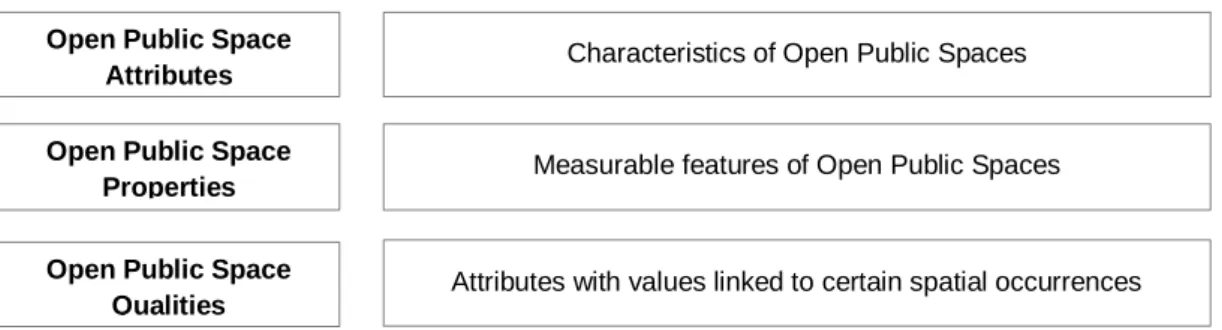
The work approaches three levels of Open Public Spaces depicters: attributes, properties and qualities, which are the main components of the methodological proposal and bearing structure of research application and practical part. While attributes are approached as characteristics ―attributed‖ to space, properties are measurable features that explain those attributes. Further, qualities are defined as attributes linked to a certain spatial occurrence. Said differently, qualities are attributes put in a specific functional, political or social context.
When addressing space, we often project over it a certain prism of interest and interpretation that is reflected in attributes we search to observe – the attributes correspond to our way of observing reality. To address those attributes, a selection of measurable properties was needed. Finally, to make use of both attributes and properties, the interpretation of their contribution in qualities of specific context was necessary.
To define attributes, or spatial imperatives that are nowadays relevant in Open Public Spaces we conducted a survey directed to users and combined it with findings from literature review. In this way we defined spatial attributes which gave an actuality to our methodological approach and faced it with nowadays comprehension of Open Public Space. That way, we: 1) provided a register of space attributes that are important to be considered for a more comprehensive reading of open public spaces and to 2) established a guideline to further assess how these attributes are influenced by UrbArch Emptiness of Lisbon Riverside.
To define properties for capturing attributes, we dug into literature and works of other researchers who already established correlations between certain attributes and their explanatory properties. After having Open Public Space attributes we developed models for Open Public Spaces representation where from quantitative properties
11 linked to specific attributes were measured. In this way, quantitative properties of specific attributes were inferred and their correlation with expression of qualities was enabled.
Terms attributes, properties and qualities were used in the research as following:
Table 1 Usage of terms Attribute, Properties and Qualities
Open Public Space Attributes
Characteristics of Open Public Spaces without attributed qualitative weight. They become expression of qualities when their specific value is linked to a certain positive spatial occurrence.
Ex. Spaciousness is an Open Public Space attribute which might be deemed as either positive or negative spatial occurrences depending on its signification and contextual purposefulness.
Open Public Space Properties
Measurable features of Open Public Spaces which give an insight into specific value of Open Public Space attribute.
Ex. Attribute of spaciousness is found correlated to measurable properties of Open Public Spaces such as Area and surrounding building Height. Spaces with big area and low surrounding building have higher value of Spaciousness Attribute and vice versa.
Open Public Space Qualities
Attributes with specific values inferred from properties‘ measurements which can be tied to a certain spatial occurrence.
Ex. High value of spaciousness attribute is deemed linked to good recreational usages.
Open Public Space Attributes
Open Public Space Properties
Open Public Space Qualities
Characteristics of Open Public Spaces
Measurable features of Open Public Spaces
Attributes with values linked to certain spatial occurrences
12
Spatial Context – Lisbon Riverside
The main spatial context of the research is Lisbon Riverside, more specifically several Open Public Spaces situated in between Belém and Poço do Bispo. Precisely, the research places special attention to Open Public Spaces of central Lisbon Riverside as the main study of cases which are chosen due to the following reasons: 1) diversity of spatial typologies that might be found within the area (from several traditional formalised squares to various emerging non-traditional and non-formalised Open Public Spaces) and 2) the increasing importance of riverside in nurturing 21st century spatial usages due to new lifestyles, values, attitudes towards nature and sustainability. The variety of Open Public Spaces within central Lisbon Riverside enabled a set of diverse case studies for both, theory construction and verification. When necessary beside the primary case studies situated in central Lisbon Riverside, secondary examples were introduced (Table 2).
Table 2 Primary and Secondary Case Studies
Primary Case Studies Secondary Case Studies
Terreiro do Paço with Cais das
Colunas Terreiro do Trigo Ribeira das Naus Rua da Alfândega Praça do Município Rua dos Bacalhoeiros Campo das Cebolas Jardim de Belém
Cais do Sodré Poço do Bispo Santos
Jardim Dom Luis
In harbour-cities, due to transportation related technological changes, decline and displacement of industries which dictated the obsolescence of the traditional urban waterfronts, the waterfront redevelopment is a major part of the competitive agenda, claims Hall (1991a).
13 ―Lisbon is an extended city placed along the Tagus River. A water city that in past centuries has been strongly related to fishing activities, exploration of the oceans and maritime trading both national and international. The waterfront has been in the cultural and commercial heart of the city‖ (Garcia, 2004).
Of 18 municipalities that compose the LMA, 16 have one or more waterfronts: 6 of them by the sea and 10 of them along either the Tagus or the Sado rivers estuaries. Hence, the Riverside is of the utmost and inevitable importance both in Lisbon‘s
municipal and metropolitan discussions and policies5. In the ancient times, the current
territory of Lisbon Riverside used to be mostly flooded by the river Tagus and quite different from its present form. The natural changes of the silting up the river together with human made land fills, as open, plane and empty spaces, constructed outside of the proper urbanised area, were during the history fundamental in the continuous adaptation of the city using the river according to the specific requirements and circumstances from each epoch (Durão, 2012a).
The importance of UrbArch Emptiness in generating Open Public Spaces of Lisbon Riverside is evident in success and interest this area has nowadays, though its growth can be followed throughout historical development of our framework space. From its
5
The importance of Riverside question can be seen, as well, through the importance of the different actors interested in its improvement and exploitation: Lisbon's Port Administration (APL, Administração do Porto de Lisboa), Lisbon's town hall technical services (CML, Câmara Municipal de Lisboa), Parque Expo, Ordem dos Arquitectos, the Public, with their objectives, through several projects and proposals (POZOR, anti POZOR, Expo 98, post EXPO 98, The competition for Ideas 1988), shows a high interest in Lisbon's waterfront. There are several recent landmarks publicized by urban-planning and architecture institutions that show the importance of Lisbon´s fluvial and maritime façade, among others: The competition for Ideas, Project of Belém Cultural Centre, The strategic Plan and Lisbon Master Plan, Pozor, EXPO´98, Póst EXPO´98, PNPOT, PROT – AML. As described by Costa, in his thesis ―Riverside between projects‖, processes of industrialisation and post-industrialisation led the Lisbon Riverside toward a fragmented, territorially extensive, heterogeneous and diverse reality (Costa, 2007, p.14)
14
beginning, Lisbon‘s characteristic positioning turned its Riverside into the most dynamic area of the city (Carita, 1999). Linked to the marine and port commercial activities since the Middle Ages, Riverside was an area of vital importance for Lisbon´s inhabitants. It was providing them by food, work, and trade possibilities and later by colonially gained wealth. Its positive, promising and hopeful connotation made it attractive for development of various strategies and investments. Even though the Open Public Spaces of Lisbon Riverside, such as Praça do Comercio, have been changing during history, UrbArch Emptiness here proposed to be addressed in more details, remained their constructive element.
Temporal Context – Past, Contemporaneity, Future
Regarding the temporal context, the research in general approaches three times: past, present and future.
Historical perspective
As a non-Portuguese researcher, the author felt necessity to conduct a historical study about Lisbon Riverside and deepen comprehension of the research context. In that regard we did an analysis of Lisbon Riverside from early Middle Ages to 20th century Lisbon which is because of its extensiveness excluded from the main body of the thesis.
Contemporary perspective
The analysis of Open Public Spaces presented in the thesis, as a goal had understanding of contemporary Lisbon Riverside. Due to duration of PhD process analysis took several years during which some of the spaces changed substantially. To lock a temporary context and make analysis executable we approached the data from an official Lisbon map from 2010 available at Municipality of Lisbon.
15
Future implementation
One of the research goals is to provide a new perspective and a novel methodology for observation and evaluation of Open Public Spaces which would, by focusing on UrbArch Emptiness, allow for improvements of future urban and architectural practices. The important considerations on further implementation of research and research outputs can be found in section 7.5 On Future Works.
Multi-Scale approximation toward subject
Throughout the research UrbArch Emptiness is defined and conceptualised as a generating part of urban environment. It creates city image as a whole and structures Open Public Spaces as units. Its influence in Open Public Spaces of Lisbon Riverside is tracked from global-urban (contextual) to particular-architectural scale. Therefrom, its impact is understood as not limited on the exact spatial area - its radiance goes further seaward and deeper inside the city. It is continuous thus it exceeds its limits, it is transparent thus it allows visual connections between remote city parts. Beyond its formal and structural force, it also enters into fields of atmospheres, individual imagination, idealisation, poetry. Due to its nature, it participates extensively on various levels of urban-architectural contexts.
To approach its multidimensionality, our work investigates how UrbArch Emptiness contributes in forming the Open Public Space qualities of Lisbon Riverside taking into consideration three scales of approximation toward the subject:
Global – Natural and Geographic Scale
Chapter 6.1 Capturing Geographical and Natural Category
UrbArch Emptiness extends over architectural and urban limits, it leakages from a specific place towards further geographical and natural surroundings. In that regard UrbArch Emptiness is approached from the perspective of its natural and geographical context.
16
Local – Urban-architectural Scale
Chapter 6.2 Capturing Architectural and Urban Category
According to Bruno Zevi, who addressed the problem of architectural-urban dichotomy, the roles of architect and urban planner diverge and the genuine modern architect should be the urban-architect (Zevi, 1974). In this field the UrbArch emptiness can be established as a merging element which reflects both architectural and urban limits thus joins these disciplines, improves their relation and unification, and as such enhances Open Public Spaces and public contexts.
Human – Behavioural Scale
Chapter 6.3 Capturing Behavioural Category - From Open Public Space Attributes to Qualities
Moreover, UrbArch Emptiness provides necessary space for urban life thus the human perspective is recognized as equally important.
17
1.5. Research Question and Hypothesis
Research Question:
How does UrbArch Emptiness participate in generating and structuring Open Public Spaces and their formal and functional Qualities on contextual-global scale (chapter 6.1 - Capturing Geographical and Natural Category), on urban-architectural particular scale (chapter 6.2 Capturing Architectural and Urban Category) and human scale (chapter 6.3)?
In short, the research hypothesis is:
UrbArch Emptiness participates, on different scales and levels, in generating Open Public Spaces and their formal and functional Qualities (in Lisbon Riverside).
1.6. Research Aims
Research aims to provide a database on contribution of UrbArch Emptiness in generating Open Public Space of Lisbon Riverside (Theoretical Objectives) and to construct a methodological set for addressing UrbArch Emptiness (Application Objectives) which is practically applied (Practical Objectives) on several case studies of Lisbon Riverside.
Aim 1 To define UrbArch Emptiness and understand how it contributes in the generation of Open Public Spaces and their Qualities on different scales using a
study of cases in Lisbon Riverside.
Aim 2 To develop theoretical, application and practical glossary for operating with
UrbArch Emptiness and based on that to develop and test necessary representation
models for Open Public Space analysis
Aim 3 To change the paradigm about UrbArch Emptiness as a residual space and
receptacle of a built mass, proving it as structural, formal and functional component of Open Public Spaces and increasing consciousness on how to design the void rather than the built space.
18
1.7. Methodology
The research combines qualitative and quantitative noninterventionist methodology focusing on the phenomenon of UrbArch Emptiness in central Lisbon Riverside aiming at discovering how UrbArch Emptiness participates in generating open spaces and influences Open Public Space qualities. It does so by introducing and developing representation model necessary for that discovery.
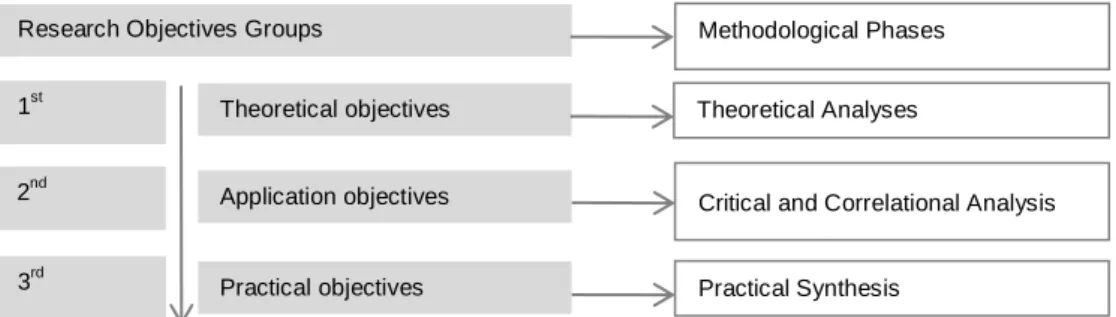
The research is divided into 3 phases (Figure 4).
In the 1st methodological phase, research focuses on general theoretical analyses of notion of Emptiness through interpretative reading of literature review. Further, it aimed at definition of the focus of research – UrbArch Emptiness and the main research object – Open Public Space Attributes which are relevant in generating qualities of nowadays Open Public Space and as such used as research guidelines.
In the 2nd methodological phase, the Open Public Space attributes are narrowed on those which are more directly linked to UrbArch emptiness and Lisbon Riverside and are mouldable by disciplines of urbanism and architecture and as such useful for improvement of these practises. In this phase we also developed novel representation models of the negative of built environment by objectifying it into 3D solid representations. These representations correspond to extrusions of convex space representations of Open Public Space that take information from the heights of its limits to generate the extrusion – convex voids. Besides developing new representation models, in this phase we used already existing view-field based representations which were also further applied on case studies of Lisbon riverside.
19 In the 3rd phase, the proposed methodology is applied on case studies of Lisbon riverside, for capturing quantitative properties of Open Public Spaces with focus on phenomenon of UrbArch Emptiness. Those measures are then related to the expression of quality linked to a certain positive spatial occurrence from which correlation with the Open Public Spaces attributes is established.
Methodologies are structured according to research phases and defined upon corresponding objectives:
Figure 4 Research Objectives and correspondent Methodological phases
Theoretical objectives
Application objectives
Practical objectives
Theoretical Analyses
Critical and Correlational Analysis
Research Objectives Groups Methodological Phases
Practical Synthesis 1st
2nd
20
Research Methods Scheme
Table 3 Research Methodological phases, Objectives and Methods adopted Methodological
Phases and Objectives Groups
Research Objectives Methodologies and methods adopted 1st phase Theoretical Analysis T h e o re ti c a l o b je c ti v e s TO.1
Theoretical introduction of notion of Emptiness (chapter 2) for further clarification and systematisation of research‘s triggers and inspirational concepts
Literature review, Interpretative reading
TO.2
Definition of the very focus of observation –
UrbArch Emptiness (chapter 3) which corresponds to the realm negative of built environment
Literature review, Interpretative reading Ap p lic a ti o n o b je c ti v e s AO.1
Development of Representation Model for Open Public Spaces analysis (chapter 4) which objectify the realm negative of built environment into 3D solid representations
Introduction of existing view-field based models
of Isovist and Viewsheds
Literature review, Convex and Solid Voids‘ method construction, Isovist and Viewshed introduction
2ndphase Critical and Correlational Analysis
AO.2
Definition of object of research - Spatial
attributes relevant in generating qualities of
nowadays Open Public Space (chapter 5)
Literature review, Survey directed to Users
AO.3
Narrowing Open Public Space attributes on those that are going to be practically addressed in case studies of Riverside Lisbon (section 5.14)
Assessment of relevance of Open Public Space attributes in urban and architectural disciplines through critical analysis of results 3rd phase Practical Synthesis Pra c ti c a l o b je c ti v e s PO.1
Capturing UrbArch Emptiness by analysing Open Public Space attributes and properties (chapter 6.1, 6.2)
Application of developed representation models on study of cases in Lisbon Riverside
PO.2
Correlating measured attributes and properties with their expression of qualities
inferred from first person phenomenological analysis and natural observation (chapter 6.3)
First person phenomenological analysis and natural observation of study of cases in Lisbon Riverside, Critical and correlation analysis
PO.3
Conclusions (chapter 7)
Discussion on research aims and findings
21
First Methodological Phase – Theoretical Analysis
To establish a firm theoretical basis for analysis of Open Public Spaces qualities with focus on UrbArch Emptiness, we started by addressing broader concepts of Emptiness heading towards its more specific manifestations. To do so, we conducted literature review (Chapter 2.0, On Emptiness) on concepts of emptiness and other notions which are usually interchangeably used with it (ex. Void, Space). Through this concretisation process we defined the actual focus of our research, namely urban-architectural emptiness, termed shortly UrbArch Emptiness (Chapter 3 Definition of UrbArch Emptiness).
Theoretical Objective 1
Chapter 2 - Theoretical Analysis of Emptiness
TO.1 Clarification and systematisation of essential concepts of Emptiness through literature review and interpretative reading
The goal of the TO.1 is delineation of notions that are in the very foundation of the research and definition of the way those were engaged and addressed. We did so from general to particular level by gradually narrowing the object of observation. Starting by a general introduction of concept of Emptiness (Chapter 2.0, On Emptiness) we defined and distinguished it from others, somewhat overlapping concepts, such as Void, Space. Further, we reflected on the concept of Emptiness in urban-architectural disciplines (2.1 Emptiness in Urban-architectural Disciplines) and on the relationship between Emptiness and its built environment and Portuguese contexts (2.2 - Emptiness and Built Context, 2.3. - Emptiness in Lisbon Riverside).
Importance of objective
The notion of Emptiness is extensive, broad and rich but also vague and ambiguous, nevertheless strongly present in various discourses from oriental mysticism to western philosophy. Therefore, it was important to clarify usage of terminology that surrounds phenomenon of Emptiness and linguistic and conceptual ambiguities to it related.
22
We started with literature review on Emptiness in various cultural contexts whence the difference between Emptiness, Void and Space was clarified. As output of the objective we provided a Glossary of terms and terminology (chapter 8) for a clearer conveying of our research procedure.
Methodology and methods adopted: Literature review, Interpretative reading
Theoretical Objective 2
Chapter 3 - Definition of UrbArch Emptiness
TO.2 Definition of the focus of observation – UrbArch Emptiness – through literature review and interpretative reading
Starting from the broad notion of Emptiness and its presence in urban-architectural disciplines, we defined the very focus of analysis and narrowed down the abstract notion of emptiness into specific urban-architectural one which belongs to the built environment and participates in Open Public Space generation (Chapter 3).
Importance of objective
Definition of the UrbArch Emptiness as focus of research is crucial for the investigation achievability because it directs the analysis, narrows down Open Public Space attributes and inspires development of representation models.
23
Second Methodological Phase - Critical and Correlational Analysis
Further, to understand how UrbArch Emptiness participates in generating and structuring Open Public Spaces we developed a Representation Models for Open Public Spaces analysis (chapter 4) which objectify the realm negative of built environment into 3D solid representations. To analyse Open Public Space behind representation model we had to define the object of research - Spatial attributes relevant in nowadays Open Public Space (chapter 5).
The second methodological phase is completed when attributes of Open Public Spaces are Narrowed down (Section 5.14). The selected attributes are further addressed in the third methodological phase using previously developed representation models for Open Public Spaces analysis.
Application Objective 1
Chapter 3.3 – Conclusions on UrbArch emptiness
AO.1 Development of Representation Model for Open Public Spaces analysis based on findings on UrbArch Emptiness
To analyse Open Public Spaces focusing on UrbArch Emptiness we developed Representation Model for Open Public Spaces analysis (chapter 4) which objectify the realm negative of built
environment into 3D solid representations. Apart from 3D solid representations which we had to theoretically constructed, practically applied and tested (such as Solid, Convex Voids and Fragmented Voids) there are others which were chosen within the spectrum of existing ones (Viewsheds, Isovists).
Methodology and methods adopted: Literature review and Convex, Solid and Fragmented
24
Application Objective 2
Chapter 5 – Open Public Space Attributes
AO.2 Definition of object of research - Spatial attributes relevant in generating qualities of nowadays Open Public Space
To respond to the main research question: how does UrbArch Emptiness participate in generating and structuring Open Public Spaces and their formal and functional Qualities; it was necessary to define the attributes relevant for comprehension of Open Public Spaces. Through a survey directed to users preselected contemporary demands of public space based on literature review are tested, completed and categorized.
Since the successful usage of public space is an overall goal of thesis we used a survey directed to users for completing the imperatives‘ list pre-defined through literature review giving like that a social fidelity to our point of view. We conducted a survey directed to users where from we gathered attributes of Open Public Space that are deemed important by users. These were confronted with attributes of Open Public Space extracted from literature review producing a holistic list. Further, Open Public Space attributes were categorized and used as directional inputs for development of the research.
Importance of objective
Since the work tends to understand how UrbArch Emptiness influences contemporary Open Public Space, it was necessary to define the attributes nowadays relevant in UrbArch Open Public Space. Through survey to users, together with literature review (experts‘ point of view), we defined contemporary spatial imperatives that gave relevance to the overall methodological approach.
That way, we established a qualitative guideline and a base point for further assessing of how UrbArch Emptiness influences these imperatives or space qualities. As well, we provided a register of space imperatives that are important to be considered to make a holistic and user orientated reading of Open Public Space. This register of demands put in front of nowadays urban-architectural space lead the research assuring its actuality and contemporary accomplishment.
![Figure 2. Pedro Moura Pinheiro, Riverside, [Online] Available from: http://www.flickr.com/photos/pedromourapinheiro/4416871476/, [Accessed 13th February 2013]](https://thumb-eu.123doks.com/thumbv2/123dok_br/15467274.1033022/17.892.2.887.8.279/figure-pinheiro-riverside-online-available-pedromourapinheiro-accessed-february.webp)


![Figure 4 M.C. Escher, Mosaic II, [Online] Available from: http://loganwarberg.blogspot.pt/, [Accessed 14th February 2013]](https://thumb-eu.123doks.com/thumbv2/123dok_br/15467274.1033022/97.892.155.727.409.896/figure-escher-mosaic-available-loganwarberg-blogspot-accessed-february.webp)