N . N e v e s 9 J. S. H e s l o p - H a r r i s o n 9 W. Viegas
rRNA gene activity and control of expression mediated by methylation and
imprinting during embryo development in wheat • rye hybrids
Received: 10 October 1994 / Accepted: 5 January 1995
Abstract
Ribosomal RNA genes originating from one
parent are often suppressed in interspecific hybrids. We
show that treatments during germination with the
cytosine analogue 5-azacytidine stably reactivate the
expression of the suppressed rRNA genes of rye origin in
the wheat x rye amphiploid, triticale, by preventing
methylation of sites in the rye rDNA. When 5-aza-
cytidine is applied to embryos of triticale and
wheat x rye F1 hybrids nine, or more, days after fertili-
zation, rye rRNA gene expression is stably reactivated in
the resulting seedling. Earlier treatments have no effect
on rye rRNA gene expression, indicating that under-
methylation of D N A early in embryo development is
reversible. After 9 days, the methylation status of rRNA
genes in maintained throughout development. Since the
change in expression follows a methylation change at
particular restriction-enzyme sites, the data establish a
clear correlation between gene activity and methylation
in plants.
Key words
Nucleolar dominance 9 Genomic
imprinting - N O R expression 9 Silver staining
Introduction
Nucleolar dominance, where the rRNA genes from one
parent are suppressed, is well known in plant and animal
interspecific hybrids (Navashin 1934; Reeder 1985).
Lacadena et al. (1988) have summarized the hierarchy of
supression of rRNA genes in many hybrids between
species in the tribe Triticeae. In wheat x rye F 1 hybrids
Communicated by G. S. Kush N. Neves ( ~ ) 9 J. S. Heslop-Harrison
Karyobiology Group, Department of Cell Biology, John Innes Centre, Norwich NR4 7UH, U K
W. Viegas
Departamento de Bot~nica, Instituto Superior de Agronomia, P- 1399, Lisboa, Portugal
(either ABR or ABDR genome constitution), and in the
amphiploid triticale (AABBRR), the rRNA genes of rye
origin are strongly suppressed (Lacadena et al. 1984).
The rDNA occurs as a tandemly repeated unit, with
the genes encoding the 18s, 5.8s and 25s rRNA at the
nucleolar organizing regions (NORs). Several results
have indicated the involvement of methylation in gene
expression (Heslop-Harrison 1990; Vieira et al. 1990;
Ottaviani et al. 1993) and in wheat rRNA gene expres-
sion partly depends on the structure of the large inter-
genic region between the 25s and 18s genes in the r D N A
repeat unit (Sardana et al. 1993). The cytosine analogue
5-azacytidine (5-AC) inhibits many proteins binding to
D N A (Hayashibara and Verdine 1992) and acts as a false
substrate and potent inhibitor of D N A methyltrans-
ferases (methylases; Jones 1985). Hence 5-AC incorpor-
ation, even at low levels, causes newly replicated D N A
to be under-methylated. It has been shown that rRNA
gene expression can be evaluated by silver staining of the
acidic non-histonic proteins in the nucleoli, which re-
main associated with metaphase chromosomes at the
NORs active at the previous interphase (Hubbell 1985;
Jimenez et al. 1988).
In wheat x rye F 1 hybrids, inactivation of the rye
rDNA must occur during embryogenesis, as in the case
of animals where developmental patterning occurs at
this stage (Ferguson-Smith et al. 1993). Thus we aimed
to investigate the effect of 5-AC on rRNA gene imprint-
ing during embryo development in wheat x rye Fa hy-
brids and in triticale. We also examined the correlation
between methylation and rRNA gene expression pat-
terns in triticale to study the control of this imprinting
system.
Materials and methods
Hexaploid wheat (Triticum aestivum L. em Thell cv Chinese Spring, 2n = 6x = 42, genome constitution AABBDD) x rye (Secale cereale L., 2n = 2x = 14, cv Centeio do Alto, RR) F 1 hybrids were obtained by sexual hybridization, and have 28 chromosomes (ABDR). Triticale
loid derived by doubling the chromosome number of the F 1 hybrid between durum wheat
(T. turgidum L.,
2n = 4x = 28, AABB) and rye; the varieties Lasko (Poznan Plant Breeders, Poland), Juanilho and Drira (ENMP, Elvas) were used in our experiments.For examination of the effects of 5-AC during embryogenesis, hexaploid wheat and triticale were emasculated and pollinated artifi- cially with rye and triticale pollen respectively. The volume enclosing the developing embryos was injected with 100 gl of a 10 gg/ml 5-AC solution on three consecutive days, centred 3, 6 and 9 days after pollination in the three different treatments. The seed was then matured normally, germinated in water, and the roots were silver stained. Seeds were germinated at 24 ~ in the dark for about 3 days and metaphases accumulated in 1.25 mM hydroxyurea over 18 h. Root-tips were fixed in formaldehyde (37%):acetic acid: 50% ethanol (1:1:18) at 4 ~ for 2-3 days. After washing, they were soaked in a 15% silver nitrate solution, pH 5.5, at 60 ~ for 16h in the dark before washing, then developed in 10% formaldehyde (37%): 1% hy- droquinone (1:1 ), 5 min, and fixed in 4% Kodafix. Washed root-tips were dissected and squashed in 45% acetic acid.
To examine the effects of 5-AC on germinating embryos, dry seeds were imbibed and germinated in water or in a 10 gg/ml solution of 5-AC, in a Petri dish on filter paper in the dark, which was renewed daily. One or two root tips per seed were excised and silver stained as above, while the seedlings were grown for DNA extraction.
DNA isolation, enzyme digestion, Southern transfer and non- radioactive hybridization (Amersham ECL) were carried out with standard methods (Anamthawat-J6nsson et al. 1990) using as probes the wheat rDNA repeat unit clone, pTa71 (Gerlach and Bedbrook 1979), and the rye intergenic spacer clone, pScR4.T1 (Appels et al. 1986), kindly supplied by R.B. Flavell and R. Appels respectively.
Results
Figure la shows an untreated root-tip metaphase from
triticale having two pairs of chromosomes with active
rRNA genes on sub-terminal NORs, identified as the
major wheat N O R chromosomes 1B and 6B. More than
92% of untreated cells showed three or four silver-
stained satellite NORs. After 5-AC treatment, more
than 90% of cells showed three pairs of subterminal
N O R chromosomes with active rRNA genes; the pairs
are 1B and 6B from wheat and the only N O R chromo-
some from rye, 1R (Fig. lb). These three chromosome
pairs are the only ones with satellite NORs.
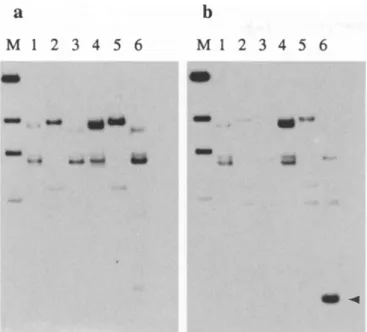
Southern-blot hybridization analysis using rDNA
cloned from wheat as a probe to DNA from control and
5-AC-treated triticale plants showed that an extra res-
triction fragment was present only in D N A from the
treated plants digested with
ApaI,
a methylation-sensi-
tire restriction enzyme (Fig. 2a). The same blot, re-
probed with a clone of the rye rDNA inter-18s-25s-
spacer, showed that the extra fragment, now showing a
strong hybridization signal, originated from the rye
intergenic spacer region (Fig. 2b).
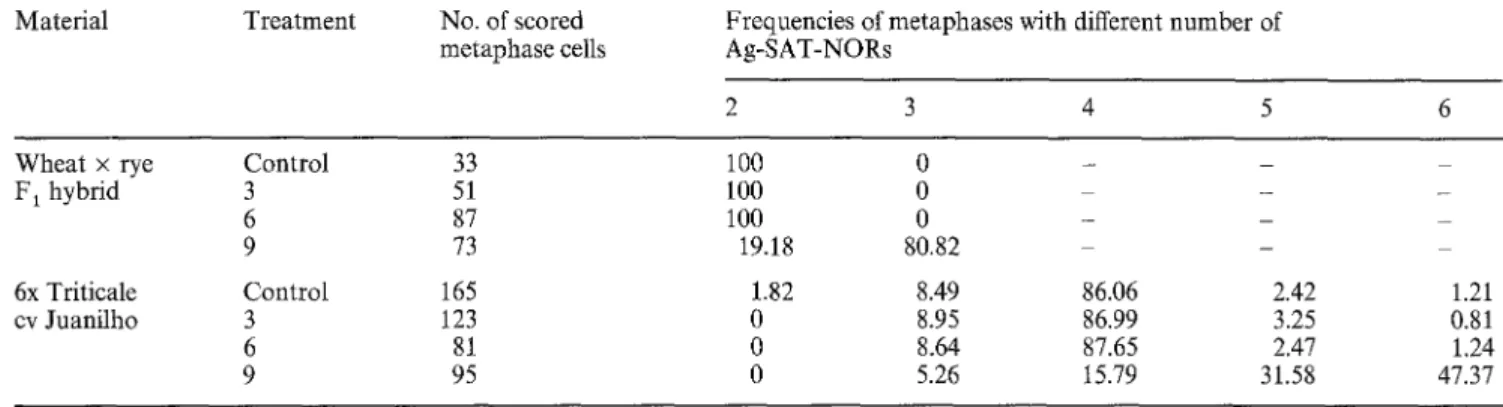
Counts of silver-stained NORs in metaphases from
Triticale seedlings from embryos injected with 5-AC
shortly after fertilization showed that those from treat-
ment 9 (injected 8, 9 and 10 days after pollination)
regularly had five or six active NORs, in contrast to the
control and treatments 3 and 6, where most cells showed
only four major NORs (Table 1). In F 1 hyrids, no cells
with more than two subterminal NORs were found from
the control and treatment 3, while 80% of treatment 9
cells had three subterminal NORs (Table 1, Fig. 3).
Discussion
The control of gene expression by methylation has been
widely discussed, but there are few cases where modifica-
tion of methylation has been shown to alter expression
(Barlow 1993). This is at least partly because of the
difficulty of examining the activity of any specific gene
locus. As well as being of practical importance in
crops, the wheat-rye r D N A system is an ideal model
because expression of individual loci can be monitor-
ed and, as shown here, may be modulated and control-
led at a specific developmental stage in the life of the
plant.
Fig. la, b Triticale metaphases after silver staining showing rRNA gene activity at the previous interphase, a Root-tip metaphase from an untreated seedling with two pairs of chromosomes with silver-stained subterminal NORs
(arrows),
both of wheat origin, b Root-tip metaphase from a seed germinated in 5-AC with three paris of silver-stained, active NORs(arrows).
The major silver signal detected at six intercalary sites shows the expression of NORs on the three pairs of satellited chromosomes (the two major wheat-origin NORs and the pair of rye-origin NORs). As often seen, there is some staining of heterochromatin of rye origin531
Fig. 2 a,b Southern-blot hybridization showing control and 5-AC-
treated triticale rDNA restriction patterns. Untreated plant
(lanes 1-3);
5-AC-treated
(lanes 4-6); ApaI
digest
(lanes 1,
4);
DraI (lanes 2,
5);
ApaI/DraI (lanes 3, 6). M
bacteriophage lambda digested with
HindIII,
bands at 23, 9, 7, and 4 kb. a Probed with the wheat rDNA repeat unit
(pTa71); b reprobed with the rye intergenic spacer (pScR4.T1). An extra
restriction fragment, 1.9 kb
(arrowed),
largely of rye origin, is present
only in the 5-AC treatment, where the NOR of rye origin is active
Silver staining of root-tip cells shows that germina-
tion of triticale seeds in 5-AC activates r R N A genes of
rye origin which are n o r m a l l y inactive (Fig. 1). Southern
hybridization indicates that the effect correlates with a
reduction in the methylation of a cytosine residue in the
intergenic spacer (Fig. 2), a n d is presumably mediated
t h r o u g h this, or other, methylated sites. Rye and wheat
r D N A repeat units have a
DraI
p o l y m o r p h i s m (Heslop-
Harrison et al. 1990), a n d
ApaI
activity is inhibited by
5-methylcytosine at either underlined _C in the recogni-
tion sequence G G G C C C . Figure 4 shows restriction
maps of the wheat 6B a n d rye 1R r D N A repeat units. In
Fig. 2, there is one major r D N A fragment visible only in
lane b6, showing that the 5-AC treatment reduces
m e t h y l a t i o n of r D N A (because the fragment is absent in
lane b3 and hence 5-AC treatment facilitates
ApaI
diges-
tion), a n d the novel r D N A fragment is of rye origin
(Figs. 2, 4).
C o m p a r i s o n of the wheat (Barker et al. 1988) and rye
(Appels et al. 1986) intergenic spacer a n d the subtending
25s sequence shows that both have an
ApaI
site about
2.1 kb from the 5'
DraI
site while rye alone has a
DraI
site
in the 18s-25s intergenic spacer (Fig. 4). It is evident that
two rye
ApaI
recognition sites are methylated in the
untreated triticales, but 5-AC treatment prevents their
methylation, resulting in fragments including the 1.9-kb
ApaI-DraI
fragment strongly revealed in Fig. 2b, lane 6
(Fig. 4 c). Therefore, external application of 5-AC causes
a reduction o f m e t h y l a t i o n at defined sites in a gene unit.
Such methylation reduction within the gene unit itself is
likely to lead to its expression.
In n o r m a l wheat and rye plants, r R N A genes are
active at least up to late gametogenesis, but in the
wheat x rye F 1 hybrids the rye genes are inactive in the
seedling and adult plant. O u r results show that the
inactivation is established early in embryogenesis, but is
Fig. 3a-e
Wheat x rye F 1
hybrid metaphases from
treatment 3 (a) treatment 6 (b)
treatment 9 (c) after silver
staining
(arrows).
Two
subterminal, silver-stained
wheat-origin NORs are visible
in all treatments. Rye-origin
subterminal subterminal NORs
are strongly silver stained in
treatment 9, while they are
unstained or only weakly stained
(b,
open arrow)
in all other
treatments, indicating that the
rRNA genes of rye origin are
inactive
Table 1 The frequency of metaphases with different numbers of silver-stained subterminal NORs in root-tips of (a) wheat x rye F1 hybrids and (b) triticale cv Juanilho from untreated embryos, or embryos treated with 5-AC 3, 6 and 9 days after pollination. In
triticale, chi-square contingency tests showed that untreated embryos and treatments 3 and 6 were not significantly different (0.5 > P > 0.25), but treatment 9 was very high significantly different (P < 0.001) from the others
Material Treatment No. of scored metaphase cells
Frequencies of metaphases with different number of Ag-SAT-NORs
2 3 4 5 6
Wheat x rye Control 33 100 0 - -
F 1 hybrid 3 51 100 0 - - 6 87 100 0 - - - 9 73 19.18 80.82 - 6x Triticale Control 165 1.82 8.49 86.06 2.42 1.21 cv Juanilho 3 123 0 8.95 86.99 3.25 0.81 6 81 0 8.64 87.65 2.47 1.24 9 95 0 5.26 15.79 31.58 47.37
5'
3'
the rye-origin rDNA methylation pattern largely con-
a. Wheat ~
T
~
~
stant.
2,1 6.4 0.9
Acknowledgements We thank Mrs. Augusta Barao and Gill Har-
b. RyeH2o I~
~
TI~
rison for assistance. NunoNevesisgratefultothePortugueseJNlCT
(BD/1605) for financial support.
4.0
4.4
0.2
c. Ryeo-Ac'I'
T T
I'
T'I'
1.5 0.6 1.9 4.4 0.2
D Dral restriction sites T Apal restriction sites
Fig. 4a---e Maps of the rDNA repeat unit showing
DraI
andApaI
restriction sites in wheat and rye (based on sequences in the EMBL/Genbank database), a Constant restriction fragments ori- ginating from wheat chromosome 6B are visible in all lanes (Fig. 2; the 1B N O R has some minor variants), b From rye-origin sequence, only one
ApaI
site is cut in the DNA from the control plants, giving a single rye-originApaI
restriction fragment (Fig. 2,lanes I)
and no limiting- mobility DNA. e After 5-AC treatment, two furtherApaI
sites become accessible in the rye-origin rDNA unit. Additional fragments are seen in theApaI/DraI
double digests, of which the 1.9-kb fragment is strongly detected (Fig. 2,lanes
6), correlating with activation of the rye-origin NORs detected by silver staining (Fig. 1)reversible by 5-AC treatment at a later stage (Fig. 3,
Table 1). Hence there is an important change during
embryo development. Before 7 days post-fertilization,
modifications of the rDNA methylation patterns with
5-AC are not maintained as no effect on rRNA gone
expression is detected in the resulting seedling. These
data imply that
de novomethylases (or associated, per-
haps, sequence-specific, DNA-binding proteins) are act-
ive and establish the methylation imprint on the rye-
origin rRNA genes. Later, the methylation imprint can
be irreversibly erased by 5-AC treatment. Hence we
suggest that
de novomethylases are active until the 7th
day after fertilization when the imprinting is completed
and the activity of maintenance methylases then keeps
References
Anamthawat-J6nsson K, Schwarzacher T, Leitch AR, Bennett MD, Heslop-Harrison JS (1990) Discrimination between closely re- lated Triticeae species using genomic DNA as a probe. Theor Appl Genet 79:721-718
Appels R, Moran LB, Gustafson JP (1986) The structure of DNA from the rye
(Secale cereale)
NOR R1 locus and its behaviour in wheat backgrounds. Can J Goner Cytol 28 : 673-685Barker RF, Harberd NP, Jarvis MG, Flavell RB (1988) Structure and evolution of the intergenic region in a ribosomal DNA repeat unit of wheat. J Mol Biol 201:1-17
Barlow D P (1993) Methylation and imprinting - from host defence to gone regulation. Science 260:309-310
Ferguson-Smith AC, Sasaki H, Cattanach BM, Surani MA (1993) Parental origin-specific epigenetic modification of the mouse H 19 gone. Nature 362:751-755
Gerlach WL, Bedbrook JR (1979) Cloning and characterization of ribosomal RNA genes from wheat and barley. Nucleic Acids Res 7:1869-1885
Hayashibara KC, Verdine GL (1992) Template-directed interference footprinting of cytosine contacts in a protein-DNA complex: potent interference by 5-aza-2'deoxycytidine. Biochemistry 31:11265-11273
Heslop-Harrison JS (1990) Gone expression and parental dominance in hybrid plants. Development 1105: 21-28
Heslop-Harrison JS, Leitch AR, Schwarzacher T, Anamthawat-J6ns- son K (1990) Detection and characterization of 1B/1R transloca- tions in hexaploid wheat. Heredity 65 : 285-294
Hubbell HR (1985) Silver staining as an indicator of active ribosomal genes. Stain Technol 60:285-294
Jimenez M, Jimenez R, Burgos M, Diaz de la Espina R (1988) A study of the Ag-staining significance in mitotic NORs. Heredity 60:125-127
Jones PA (1985) Altering gone expression with 5-azacytidine. Cell 40:485-486
Lacadena JR, Cermefio MC, Orellana J (1984) Evidence for wheat- rye nucleolar competition (amphiplasty) in triticale by the silver- staining procedure. Theor Appl Genet 67:207-213
Lacadena JR, Cermeno MC, Orellana J, Santos JL (1988) Nucteolar competition in Triticeae. Kew Chrom Conf III: 151-165
Navashin M (1934) Chromosomal alterations caused by hybridi- zation and their bearing upon certain general genetic problems. Cytologia 5:169-203
Ottaviani M-P, Smits T, H/inische ten Cate C (1993) Differential methylation and expression of the beta-glucuronidase and neomysin phosphotransferase genes in transgenic plants of potato cv Bintje. Plant Sci 88:73-81
Reeder H (1985) Mechanisms of nucelolar dominance in animals and plants. J Cell Biol 101:2013 2016
Sardana R, O'Dell M, Flavell RB (1993) Correlation between the size of the intergenic regulatory region, the status of cytosine methyl- ation of rRNA genes and nucleolar expression in wheat. Mol Gen Genet 236:155-162
Vieira R, Queiroz A, Morais L, Barao A, Mello-Sampayo T, Viegas WS (1990) 1R chromosome nucleolus organizer region acti- vation by 5-azacytidine in wheat x rye hybrids. Genome 33: 707-712