Full Terms & Conditions of access and use can be found at
http://www.tandfonline.com/action/journalInformation?journalCode=uaar20
Arctic, Antarctic, and Alpine Research
An Interdisciplinary Journal
ISSN: 1523-0430 (Print) 1938-4246 (Online) Journal homepage: http://www.tandfonline.com/loi/uaar20
Present-Day Solifluction Processes in the Semi-Arid
Range of Sierra Nevada (Spain)
Marc Oliva, Antonio Gómez Ortiz, Ferran Salvador Franch & Montserrat
Salvà Catarineu
To cite this article:
Marc Oliva, Antonio Gómez Ortiz, Ferran Salvador Franch & Montserrat Salvà
Catarineu (2014) Present-Day Solifluction Processes in the Semi-Arid Range of Sierra Nevada
(Spain), Arctic, Antarctic, and Alpine Research, 46:2, 365-370, DOI: 10.1657/1938-4246-46.2.365
To link to this article: https://doi.org/10.1657/1938-4246-46.2.365
© 2014 Regents of the University of Colorado
Published online: 16 Jan 2018.
Submit your article to this journal
Article views: 32
Arctic, Antarctic, and Alpine Research, Vol. 46, No. 2, 2014, pp. 365–370
Present-Day Solifluction Processes in the Semi-arid
Range of Sierra Nevada (Spain)
Marc Oliva*
Antonio Gómez Ortiz†
Ferran Salvador Franch† and
Montserrat Salvà Catarineu†
*Corresponding author: Institute of Geography and Spatial Planning, University of Lisbon, Alameda da Universidade, 1600-214 – Lisbon, Portugal,
†Department for Physical and Regional Geography, University of Barcelona, Montalegre, 6-8, 08001 – Barcelona, Catalonia, Spain
DOI: http://dx.doi.org/10.1657/1938-4246-46.2.365
Introduction and Objectives
Solifluction is a slow periglacial mass movement caused by frost creep and gelifluction (French, 2007). While frost creep is the downslope movement of soil particles originating from frost heaving normal to the slope followed by nearly vertical thaw consolidation, gelifluction is the saturated soil movement asso-ciated with ground thawing (Washburn, 1979). Solifluction is considered to be the most widespread slow mass wasting slope process in periglacial environments (Matsuoka, 2001). Over the past few decades, a significant number of studies have addressed solifluction movement rates in relation to sediment transport and environmental conditions. Recent studies also suggest that simi-lar processes may have been active on Mars (Gallagher et al., 2011; Johnsson et al., 2012). Our understanding of solifluction processes has also benefited from laboratory experiments where environmental conditions can be controlled (Kern-Luetschg and Harris, 2008; Harris et al., 2008a). Solifluction-derived land-forms are distributed in regions with mean annual temperatures ranging from −20 to 7 °C; most of the data on solifluction pro-cesses are referred to wet mid-latitude mountain ranges and high latitudes (Matsuoka, 2001). There is a clear lack of studies focus-ing on solifluction processes in mid-latitude semi-arid mountain environments.
In the Iberian Peninsula, there has been substantial progress in the past several decades in research on periglacial processes, with many research groups studying the dynamics of cold-climate geomorphological processes in the Iberian mountains (Gómez Or-tiz and Vieira, 2006). However, very few papers have examined solifluction processes in Iberian mountain ranges (Chueca and Julián, 1995; Palacios et al., 2003; Gómez Ortiz et al., 2005). In former studies, we presented the first results of an experiment im-plemented in Sierra Nevada, southern Spain, to monitor solifluc-tion processes (Oliva et al., 2008, 2009). Preliminary data showed very slight solifluction activity during a two-year monitoring pe-riod, suggesting a crucial role of water availability in the move-ment of the solifluction landforms. As climate conditions are
high-ly variable in this semiarid Mediterranean massif, a longer record on solifluction processes was needed to substantiate preliminary conclusions.
The purpose of this paper is to report the final results of this experiment, presenting the longest continuous record for solifluction rates in a high massif of the Mediterranean Basin. We introduce new data on the movement rates of tens of solif-luction landforms, soil temperatures in these periglacial fea-tures, and climate conditions in the summit area of this massif from 2005 to 2011. The contemporary sediment transport rates due to solifluction processes are also related to the present-day climate regime.
Study Area
Sierra Nevada is the highest massif of the Betique range and of the entire Iberian Peninsula, with peaks exceeding 3000 m a.s.l. in its western fringe (Mulhacén, 3478 m; Veleta, 3398 m). This massif is the most studied mountain area of the Iberian Peninsula with respect to present and past cold-climate geomorphological processes (Gómez Ortiz et al., 2005, 2012). During the Pleistocene glaciations, glacial processes shaped the highest lands in Sierra Nevada (above 2500 m), a sparsely vegetated environment today dominated by seasonal frost with active and widespread perigla-cial landforms. Permafrost conditions have been detected only in isolated patches at the Mulhacén and Veleta cirques (Gómez Ortiz et al., 2005). At 2500 m, the average annual air temperature is 4.4 °C and precipitation reaches 710 mm per year (1965–1992) (Oliva et al., 2008).
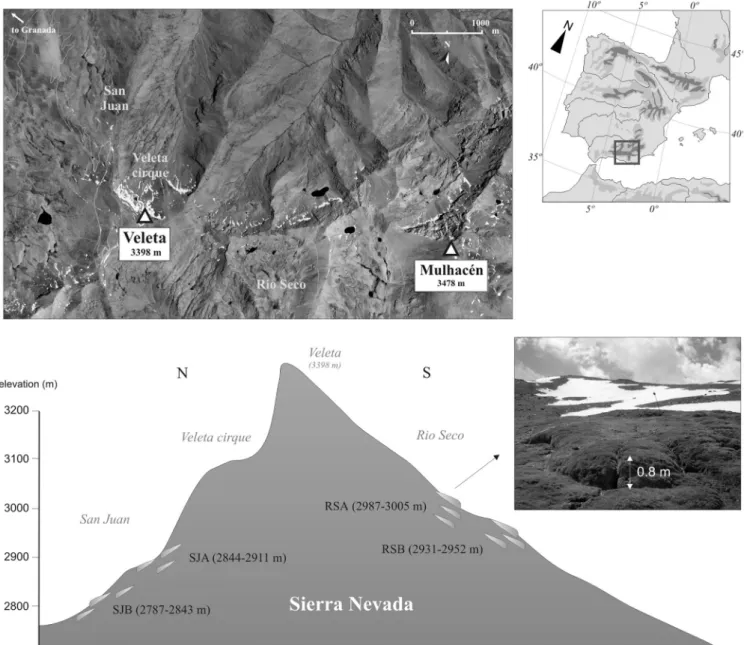
Hundreds of solifluction landforms are distributed in the headwaters of the highest glacial valleys in Sierra Nevada. They show a large variety of morphologies and dimensions, and the majority is densely vegetated (Oliva et al., 2009). Up to 17 solifluction features concentrated in four study areas from San Juan and Rio Seco valleys have been monitored in this study (Fig. 1). These solifluction landforms are turf-banked lobes, stone-turf-banked lobes, turf-turf-banked terraces,
Abstract
In the highest land of the Sierra Nevada National Park, an experiment to monitor solif-luction rates together with the thermal regime of the ground was implemented during the period 2005–2011. Data show evidence of the low activity of solifluction pro-cesses in the present-day periglacial belt of Sierra Nevada. Annual displacement rates were lower than 1 cm yr–1 both in northern and southern slopes. Solifluction was more
active near snow patches and streams. Rates were also higher during snowier years. Soil temperatures showed seasonal frost occurrence, though the depth and duration of the frozen layer is strongly conditioned by the annual snow cover. Water availability appears to be a crucial factor for solifluction processes in this semiarid environment.
366 / arctic, antarctic, and alpine research
ploughing boulders, and solifluction steps (Oliva et al., 2009). The U-shaped glacial valley of San Juan is located on the northern slope of the mountain, with lobes distributed in two elevation belts: SJA (2844–2911 m) and SJB (2787–2843 m). In the southern glacial cirque of Rio Seco there are two areas of significant solifluction features: RSA (2987–3005 m) and RSB (2931–2952 m).
Through monitoring landforms located in different sites in terms of topography, altitude, and aspect—but similar slope gradients between 8° and 12°—we may infer the most appropri-ate environments for active solifluction processes today in this semiarid massif. The presence of a steeply sloping lobe riser, a dense grass cover, intact root network, and formation of thin A horizons suggests very low activity under current climate condi-tions (Oliva et al., 2008). Moreover, sedimentological studies also show evidence of other phases during the middle to late Holocene with much more intense solifluction activity than to-day (Oliva et al., 2011).
Methodology
The methodology used in this research is described in Oliva et al. (2009), where we also presented the type and characteristics of the solifluction landforms monitored in this experiment. Up to nine wooden stakes in each lobe (50 cm long × 3 cm diameter) were in-serted ~45 cm in the ground next to the lobe tread for monitoring the movement of the solifluction landforms. It must be taken into account that movement rates vary across a solifluction landform (van Everdin-gen, 2005; Kinnard and Lewkowicz, 2005; Harris et al., 2008b), hence data discussed here represent an average of the displacements of these landforms. Annual surface solifluction rates were obtained by annu-ally measuring (in late August) the relative displacement of the stakes according to the benchmarks drawn on each stake (Oliva et al., 2009). Data presented in this paper correspond to the average of the displace-ments of the peg lines in each of the study areas. In accordance with current legislation in the National Park of Sierra Nevada, all the stakes had to be removed at the end of the experiment.
FIGURE 1. Sketch with the location of the study areas in Sierra Nevada in which solifluction landforms are distributed. Example of a solifluction lobe formed below a snow patch.
Universal Temperature Loggers (UTL-1) were installed in a solifluction lobe in the Rio Seco cirque at 3005 m to monitor ground temperatures at depths of 2, 10, 20, 50, and 100 cm every 2 hours. Unfortunately, no data on soil moisture content is available. Air temperatures were recorded by a temperature logger installed at the summit of the Veleta peak. Since no data of snow thickness were available for the summit area, we use monthly precipitation from the nearby weather station of Granada (~15 km) as an ap-proximate reference for precipitation considering the high correla-tions between the precipitation in Granada and in the summits of the massif, and taking into account that 80% falls as snow above 2500 m (Oliva and Moreno, 2008; Oliva et al., 2008).
Solifluction movement and air temperatures were monitored from August 2005 until August 2011. Soil temperatures in Rio Seco cirque were recorded from August 2006 until August 2011.
Results
The displacement of the monitored lobes in the valley of San Juan followed a very similar pattern during all the years of the study, with higher solifluction rates recorded at those lobes located at higher elevations (Fig. 2). In SJA the mean annual rates of move-ment of the stakes between 2005 and 2011 ranged from 0.4 to 0.8 cm yr–1, while in SJB, rates oscillated between 0.3 and 0.5 cm yr–1.
The last four years had on average greater rates of movement than the first two, in both areas, especially in the case of SJA. This pat-tern is also observable in the number of stakes that showed move-ment, reaching 80%–90% in the last four years in San Juan, with consistently higher rates in SJA.
The data reveal a lower activity of solifluction processes in Rio Seco than in San Juan. Rates of movement in RSA varied be-tween 0.2 and 0.5 cm yr–1, while in RSB they ranged from 0.3 to
0.5 cm yr–1. The rates of movement were also greater during the
last four years, similar to those in San Juan valley. Moreover, the
number of stakes that exhibited movement was also significantly lower than the pattern observed in San Juan, between 10%–20% in RSA and 40%–60% in RSB. Therefore, a very significant per-centage of stakes in both areas of the southern cirque of Rio Seco showed no displacement.
The year 2005–2006 was the driest of the study period, and movement rates varied between 0.2 and 0.4 cm yr–1 (Fig.
3). No data for ground temperatures are available during this year. The dry conditions in late autumn and early winter 2006 favored the rapid formation of a deep frozen layer that lasted until June 2007. The thawing of the most superficial centimeters occurred during the snow melt period, after heavy snowfalls in spring that supplied abundant water to the ground. At 10 cm depth, several freeze-thaw cycles were recorded during these days, and the soil at 30–60 cm remained frozen for two more weeks. The saturation of the soil facilitated surface movements that were higher than those recorded the year before, between 0.3 and 0.6 cm yr–1. A similar pattern, with abundant snowfalls
in late spring after a dry winter, was observed during the year 2007–2008, though a period of superficial thawing occurred in April. The combination of a deep frozen layer and greater water availability promoted higher solifluction rates, oscillating be-tween 0.4 and 0.75 cm yr–1.
The three following years (2008–2009, 2009–2010, and 2010–2011) had a consistent soil temperature regime that was sig-nificantly different from the previous years. The stabilization of the snow cover in late autumn by early and abundant snowfalls conditioned a very shallow and short frozen layer. The thicker snow cover during these years was parallel to a slight increase of solifluction rates in both valleys (0.4–0.5 to 0.8 cm yr–1). The
cold-est winter of the control period occurred in 2008–2009. Moderate precipitation, combined with long and persistent negative tempera-tures, promoted a thick snow cover at the end of the accumulation period that conditioned more intense solifluction processes in Si-erra Nevada. In 2009–2010 and 2010–2011, snow cover was also
368 / arctic, antarctic, and alpine research
thick, favoring a shallow freezing of the ground and a stabilization of soil temperatures at slightly positive temperatures until mid to late July when the snow melted. The abundant water availability during these two years also enhanced solifluction processes.
Movement rates varied between different solifluction land-form types. The number of turf-banked lobes that moved ranged from two landforms during the dry 2005–2006 and seven during the snowy year 2008–2009 (Table 1). The proportion of the stone-banked lobes that showed displacement was always higher than the turf-banked lobes, ranging from two to three of the three monitored units. Movement was reported during all the years of the period in the case of the monitored ploughing boulder, while it was never recorded in the solifluction steps. The turf-banked terrace only showed displacements during the snowier years of 2008–2009, 2009–2010, and 2010–2011.
Discussion and Conclusions
In August 2011, we closed a pioneering experiment of solif-luction control in the context of Mediterranean mountain ranges that was implemented between 2005 and 2011 in the highest west-ern valleys of Sierra Nevada. Although periglacial landforms and processes have been described as being active today above 2500 m (Gómez Ortiz et al., 2005), data show evidence of very low solif-luction rates (0.2 to 0.9 cm yr–1) with significant interannual
vari-ability. Assuming the limitation of not having direct measurements of snow cover and soil moisture conditions in this experiment, we
confirm preliminary results that pointed to the crucial role of water availability and snow patches controlling solifluction processes in this semiarid environment (Oliva et al., 2009). The importance of snow patches in triggering solifluction processes during the melt season has been described in other solifluction environments with high moisture conditions, such as in Scandinavia (Seppälä, 1993; Matthews et al., 2005; Harris et al., 2008b). As suggested by the data presented here, in this Mediterranean alpine range with very intense insolation and dry summer conditions, the importance of snow patches for solifluction may be even higher than in moist periglacial environments.
The distribution of long-lying snow patches in Sierra Nevada is strongly controlled by the orientation of the valleys, with north-erly exposed valleys having longer duration of snow cover (Oliva, 2009). In Sierra Nevada, solifluction landforms are mostly distrib-uted below snow patches, as can be seen in Figure 1. The proxim-ity of solifluction landforms to snow patches lengthens the water runoff period, which in turn enhances slow mass movement per-iglacial processes during late spring and early summer. Therefore, in Sierra Nevada it is mainly at this time of year that solifluction processes are active, when the snow melts and provides abundant water that saturates the first decimeters of the soil, favoring the slow movement of the overlying soil mass. In autumn the dryness of the ground and the lack of a frozen layer beneath the surface impede solifluction processes.
In the northern valley of San Juan, solifluction rates are higher (0.3 to 0.9 cm yr–1) than in Rio Seco (0.2 to 0.5 cm yr–1), despite the
fact that lobes in the latter are located 100–150 m higher. Rates are
FIGURE 3. (a) Monthly precipitation at Granada weather station and total precipitation between November and June. (b) Mean annual horizontal movement rates at elevation belt SJA and solifluction area RSB. (c) Daily air temperatures at Veleta Peak. (d) Days with freeze-thaw cycles at Veleta Peak and at 10 cm depth in a solifluction lobe from the Rio Seco cirque. (e) Ground thermal conditions in the same solifluction lobe.
also higher in better-drained areas of each valley (SJA and RSB). Therefore, water supply rather than altitude (i.e., temperature) conditions solifluction activity in this range. The control of water availability on solifluction processes is also confirmed by the dis-tribution of the monitored landforms with the highest solifluction displacements, which were always located near long-lying snow patches and streams (Oliva, 2009). Accordingly, changes in the to-tal precipitation and its distribution throughout the year result in notable changes in solifluction activity. Solifluction rates showed similar trends in all the study areas during the monitoring period: rates were higher during wetter (snowier) years, which implied larger water availability during the snowmelt season.
Together with water availability, another limiting factor for active solifluction processes is the presence of a dense vegetation cover (Ulfstedt, 1993). In this sense, solifluction landforms in Sier-ra Nevada with abundant gSier-ravels at the surface (e.g., stone-banked lobes) showed more displacement than lobes covered by vegetation with low gravel content (e.g., turf-banked lobes).
While solifluction processes in permafrost environments are strongly controlled by the depth of thaw penetration in summer (Harris et al., 2011), in the periglacial belt of Sierra Nevada—a semiarid environment today dominated by seasonal frost occur-rence, without permafrost conditions—the depth of the frost pene-tration in winter is not a crucial variable for enhancing solifluction. The timing of the first snowfall and subsequent stabilization of the snow cover is decisive in insulating the soil from external tem-perature variations. Ground temtem-peratures in a solifluction landform of Rio Seco cirque showed evidence of the large control of the snow cover on the rhythm and intensity of freezing. The number of freeze-thaw cycles at 10 cm depth was significantly lower than those recorded at Veleta Peak (Fig. 3, part d). The role of diurnal freeze/thaw cycles in promoting movement rates in the first cen-timeters of the ground was highlighted by Matsuoka (2005) in the Japanese and Swiss Alps. In Sierra Nevada, in autumn, when the ground is dry, little frost heave and thaw settlement is expected, but in late spring and early summer, when the soil is still wet, there appears to be a considerable potential for diurnal heave and set-tlement, and hence frost creep. However, very few stakes became tilted downslope over the study period, suggesting higher rates of movement at the surface than at depth.
Although the goal of the present paper is not to identify the magnitude of the different components involved in solifluction pro-cesses (frost creep and gelifluction), data suggest that these mecha-nisms in Sierra Nevada may be substantially conditioned by the annual climate regime. Years with a thin snow cover promoted the formation of a 60- to 70-cm-deep frozen layer with low
solifluc-tion rates (2006–2007, 2007–2008). The low soil moisture con-tents may have been more favorable for diurnal/annual frost creep. Conversely, years with a thick snow cover favored the develop-ment of a very shallow frozen ground that thawed in early to mid winter (2008–2009, 2009–2010, 2010–2011). During these years, the presence of long-lying snow patches may raise the moisture content of the thawed soil and promote gelifluction (Matsuoka, 2001). In contrast to what happens in areas such as the Austrian Alps, where dry years promote the development of a deep seasonal frost layer and enhance solifluction (Veit, 1993), in Sierra Nevada solifluction processes are more intense during snowier years where the ground remains mostly unfrozen and prevents winter frost pen-etration (Fig. 3).
In conclusion, solifluction in the periglacial environment of Sierra Nevada is a shallow and very slow process under present-day climate conditions. The magnitude of solifluction rates in Sier-ra Nevada is more similar to the Sier-rates reported from polar latitudes and dry mid-latitude mountain areas (<5 cm yr–1) than to those
re-ported for subpolar regions and wet alpine environments (up to 40–50 cm yr–1; Matsuoka, 2001; Oliva et al., 2009).
Acknowledgments
The first author thanks the AXA Research Fund for funding a postdoctoral grant during which this paper was written. This re-search was financially supported by the rere-search project “Evolu-ción del paisaje reciente de cumbres de Sierra Nevada. Interés científico de registros naturales y documentos escritos de época (CSO2012-30681)” and the Consolidated Research Group of the University of Barcelona “Landscape Research and Mediterranean Mountain Palaeoenvironments.” The authors would also like to thank the logistic facilities offered by the National Park of Sierra Nevada during the field work campaigns, Dr. Dermot Antoniades for his revision of the text, and the manuscript’s reviewers for their many helpful suggestions.
References Cited
Chueca, J., and Julián, A., 1995: Cuantificación de movimientos en masa lentos en medios de montaña: Pirineo Central. Lurralde, 18: 173–196.
French, H. M., 2007: The Periglacial Environment. Third edition. Chichester, U.K.: Wiley, 480 pp.
Gallagher, C., Balme, M. R., Conway, S. J., and Grindrod, P. M., 2011: Sorted clastic stripes, lobes and associated gullies in high-latitude craters on Mars: landforms indicative of very
TABLE 1
Types of monitored solifluction landforms and their activity during the monitoring period. Active landforms are considered to be those in which >50% of the stakes installed in the landform showed movement.
Type Monitored landforms Year of monitoring. Active/Inactive 2005–2006 2006–2007 2007–2008 2008–2009 2009–2010 2010–2011 Turf-banked lobes 10 2/8 4/6 6/4 7/3 6/4 5/5 Stone-banked lobes 3 2/1 2/1 3/0 3/0 3/0 2/1 Turf-banked terraces 1 0/1 0/1 1/0 1/0 1/0 0/1 Ploughing boulders 1 1/0 1/0 1/0 1/0 1/0 1/0 Solifluction steps 2 0/2 0/2 0/2 0/2 0/2 0/2
370 / arctic, antarctic, and alpine research
recent, polycyclic ground-ice thaw and liquid flows. Icarus, 211: 458–471.
Gómez Ortiz, A., and Vieira, G., 2006: La investigación en geomorfología periglaciar en España y Portugal. Evolución reciente y estudios actuales. Finisterra, XLI (82): 119–137.
Gómez Ortiz, A., Schulte, L., Salvador-Franch, F., Palacios, D., Sanz de Galdeano, C., Sanjosé, J. J., Tanarro, L. M., and Atkinson, A., 2005: Field trip to Sierra Nevada massif. Glacial geomorphology and present cold processes. In Desir, G., Gutiérrez, F., and Gutiérrez, M. (eds.), Field Trip Guides of the Sixth International Conference on
Geomorphology. Volume 2. Zaragoza: Kronos, 309–354.
Gómez Ortiz, A., Palacios, D., Palade, B., Vázquez-Selem, L., and Salvador-Franch, F., 2012: The deglaciation of the Sierra Nevada (southern Spain). Geomorphology, 159-160: 93–105.
Harris, C., Smith, J. S., Davies, M. C., and Rea, B., 2008a: An investigation of periglacial slope stability in relation to soil properties based on physical modelling in the geotechnical centrifuge.
Geomorphology, 93: 437–459.
Harris, C., Kern-Luetschg, M., Smith, F., and Isaksen, K., 2008b: Solifluction processes in an area of seasonal ground freezing, Dovrefjell, Norway. Permafrost and Periglacial Processes, 19: 31–47.
Harris, C., Kern-Luetschg, M., Christiansen, H. H., and Smith, F., 2011: The role of interannual climate variability in controlling solifluction processes, Endalen, Svalbard. Permafrost and Periglacial Processes, 22: 239–253.
Johnsson, A., Reiss, D., Hauber, E., Zanetti, M., Hiesingerb, H., Johanssona, L., and Olvmoa, M., 2012: Periglacial mass-wasting landforms on Mars suggestive of transient liquid water in the recent past: insights from solifluction lobes on Svalbard. Icarus, 218: 489–505. Kern-Luetschg, M., and Harris, C., 2008: Centrifuge modelling of
solifluction processes: displacement profiles associated with one-sided and two-one-sided active layer freezing. Permafrost and Periglacial
Processes, 19: 379–392.
Kinnard, C., and Lewkowicz, A. G., 2005: Movement, moisture and thermal conditions at a turf-banked solifluction lobe, Kluane Range, Yukon Territory, Canada. Permafrost and Periglacial Processes, 16: 261–275.
Matsuoka, N., 2001: Solifluction rates, processes and landforms: a global review. Earth Science Reviews, 55: 107–134.
Matsuoka, N., 2005: Temporal and spatial variations in periglacial soil movements on alpine crest slopes. Earth Surface Processes and
Landforms, 30: 41–58.
Matthews, J. A., Seppälä, M., and Dresser, P. Q., 2005: Holocene solifluction, climate variation and fire in a subarctic landscape at Pippokangas, Finnish Lapland, based on radiocarbon-dated buried charcoal. Journal of Quaternary Science, 20: 533–548.
Oliva, M., 2009: Holocene alpine environments in Sierra Nevada (southern Spain). Ph.D. thesis, Department of Physical and Regional Geography, University of Barcelona, Spain, 343 pp.
Oliva, M., and Moreno, I., 2008: Sierra Nevada, nexo entre dos patrones de teleconexión: la NAO y la WeMO. In Sigró, J., Brunet, M., and Aguilar, E. (eds.), Cambio Climático Regional y sus
Impactos. Tarragona: Publicaciones de la Asociación Española de Climatología, Serie A (6), 199–208.
Oliva, M., Schulte, L., and Gómez Ortiz, A., 2008: Solifluction lobes in Sierra Nevada (southern Spain): morphometry, process monitoring and palaeoenvironmental changes. In Kane, D. L., and Hinkel, K. M. (eds.), Proceedings of the Ninth International Conference on
Permafrost. Volume 2. Fairbanks, Alaska: Institute of Northern Engineering and University of Alaska Fairbanks, 1321–1326. Oliva, M., Schulte, L., and Gómez Ortiz, A., 2009: Morphometry and
late Holocene activity of solifluction landforms in the Sierra Nevada (southern Spain). Permafrost and Periglacial Processes, 20(4): 369– 382.
Oliva, M., Schulte, L., and Gómez, A., 2011: The role of aridification in constraining the elevation range of Holocene solifluction processes and associated landforms in the periglacial belt of the Sierra Nevada (southern Spain). Earth Surface Processes and Landforms, 36(10): 1279–1291.
Palacios, D., Andrés, N., and Luengo, E., 2003: Distribution and effectiveness of nivation in Mediterranean mountains: Peñalara (Spain). Geomorphology, 54: 157–178.
Seppälä, M., 1993: Solifluction in northern Finland: past and present.
In Frenzel, B., Matthews, J. A., and Gläser, B. (eds.), Solifluction
and Climatic Variation in the Holocene. Stuttgart: Gustav Fischer Verlag, 59–70.
Ulfstedt, A. C., 1993: Solifluction in the Swedish mountains: distribution in relation to vegetation and snow cover. In Frenzel, B., Matthews, J. A., and Gläser, B. (eds.), Solifluction and Climatic
Variation in the Holocene. Stuttgart: Gustav Fischer Verlag, 217– 224.
van Everdingen, R. (ed.), 2005: Multi-language Glossary of Permafrost
and Related Ground-Ice Terms. Boulder, Colorado: National Snow and Ice Data Center/World Data Center for Glaciology, 90 pp. Veit, H., 1993: Holocene solifluction in the Austrian and southern
Tyrolean Alps: dating and climatic implications. In Frenzel, B., Matthews, J. A., and Gläser, B. (eds.), Solifluction and Climatic
Variation in the Holocene. Stuttgart: Gustav Fischer Verlag, 23–32. Washburn, A. L., 1979: Geocryology, a Survey of Periglacial Processes
and Environments. London: Edward Arnold, 406 pp.