E-Learning as an Educational Strategy on Islands
With Low Population Density
Case Study in the Autonomous Region of Azores
doi:10.3991/ijet.v5i1.1063
S.A. Ferreira1 and E. L. Cardoso2
1 Escola Básica e Secundária das Flores, Santa Cruz das Flores - Azores, Portugal 2 Universidade Católica Portuguesa, Porto, Portugal
Abstract—The Regional Department of Education and Cul-ture of the Autonomous Region of the Azores in the 2003-2004 school year implemented an innovative project for adult learning. The school EB 3/S Vitorino Nemésio, a pub-lic school, on Terceira Island, became the first Portuguese school offering adult education mediated through the Inter-net, serving elementary level (5th grade) to the secondary level (12th grade) adult learners. This research strives to understand to what extend media-based adult education provides an effective answer to geographic and demo-graphic adult education issues in the Azores. Results indi-cate that this system appears to meet the geographical and demographic needs of the Azores Islands. Nevertheless, there are still unsolved problems related mostly to teacher limitations, more specifically pedagogic and technical skills in the fields of Information and Communication Technolo-gies and e–learning. Adult e-learning also offers the possi-bilities of teacher and staff continuous training as well as its wider and more effective implementation outside the region. Index Terms—e-learning, distance learning, adult education, low population density.
I. INTRODUCTION
The Autonomous Region of Azores (ARA) is an island archipelago that consists of nine islands with very dispa-rate territorial areas and populations. São Miguel, the larg-est and most populous island in the archipelago, has an area of 745 km². According to the last General Population and Housing Census it had a population of more than 131,609 residents. In contrast, Corvo, the smallest and least populated island, has an area of 17 km² and a popula-tion of only 425 inhabitants [1].
To overcome the constraints caused by geography and demography, the Regional Department of Education and Culture (RDEC) of the ARA implemented an innovative adult education project during the 2003-2004 school cy-cle. The school, EB 3/S Vitorino Nemésio, on the island of Terceira, became the first Portuguese school with adult education mediated through the Internet, including studies from the 5th to 12th grades. This project is significant be-cause of its innovative nature and long period of opera-tion, as well as its generalised implementation across the entire ARA and peninsular Portugese and emigrant com-munities.
This article provides a global assessment of the manner in which this project has been implemented in the territory
and results. The following sections will provide answers to the following questions:
How has e-learning been implemented? How did the actors in the process operate?
How are the teaching and learning activities pro-gressing in this environment?
What examples of sharing or collaboration have been witnessed among the different elements (RDEC, school, teachers & students).
Has the system facilitated learning?
What is the future development of e-learning? II. METHODOLOGY
The objective of this investigation is to answer ques-tions relating to a contemporary system about which there is little information. The development of a case study ap-peared to us as an appropriate way of approaching the problem under study, in that it allows a detailed observa-tion of a context or specific happening [2].
The objective of this study is to describe and analyze tutoring activities in mediated adult education courses in the ARA and discuss implications for the teach-ing/learning process. The model followed is of an explora-tory nature in that it seeks gain insight and understanding of a specific context [3] [4].
To this end, we interviewed the following people: The regional director of education (E1);
The Technical-pedagogical advisor and coordinator of mediated adult education (E2);
Seven teachers, who at the time at which the field study was carried out, in May 2008, were teaching in mediated adult education (E3). For the teacher inter-views (E3), we selected seven teachers from different areas and with different levels of experience in e-learning. We did this to have the most heterogeneous sample possible so that we could cover the widest range of situations possible. Rather than achieve sta-tistical significance, the aim of the interviews was to obtain relevant data.The aims of the information ob-tained were:
o To outline a profile of the teachers regarding skills in the fields of Information and Communication Technologies (ICT) and e-learning;
o To assess the type of sharing and collaboration be-tween the instructors.
To assess mediated adult education in the ARA, we re-viewed literature that covered the four areas considered by INOFOR (2002) [5], as seen in Fig. 1.
To assess the four different areas, we considered the proposals of different relevant authors [6], [7], [8], [9] [10] and we selected a set of items that appeared relevant to us in meeting the objectives of the study. From this review of the literature, we created a direct observation grid, whose main goals are:
To provide a framework to the system in theoretical terms, in what concerns to some of today's most sig-nificant proposals;
To define the system assessment process, in a clear way, once different authors present several proposals for categorisation in different areas;
To enrich proposed improvements to the system by comparing the characteristics of the current system and what is proposed by specialists who contribute towards identifying weaknesses, and ways of over-coming them.
The filling in of the ARA mediated adult education items in the observation grid was carried out, essentially, using information gathered in teacher interviews and an analysis of the materials, activities and synchronous vir-tual lessons (which are recorded and put into Formare) made available on the LMS (Learning Management
Sys-tem) platform by the seven teachers interviewed.
III. PRESENTATION OF RESULTS
A. Origin of the Project
The data gathered in the interview (E1) allows us to see that the primary constraints are the geographical and demographic nature of the archipelago, which led the RDEC to reflect on the problems and how to overcome them. The constraints identified were:
Geographical discontinuity and the asymmetry of the populations of the nine islands;
The villages on the majority of the islands are widely dispersed [1] and, in many cases, are not served by public transport at night;
The target audience for adult education is adults with professional lives and families;
On the less densely populated islands, there is a greatly limited potential audience for attending adult education courses. Three problems arise from this situation:
Limited educational offering. The RDEC would have to oblige students to choose certain courses and sub-jects in order to have sufficient students to constitute a face-to-face group;
The pedagogical quality would be affected, as dis-cussion and the collaborative work would be greatly limited due to the limited number of pupils;
From a financial point of view, this situation would be unsustainable because of the considerable human resources (teachers and employees) and service ex-penses that would be necessary to provide a service to very small groups.
Figure 1. Areas of e-learning proposed by INOFOR (2002)
Figure 2. The number of pupils enrolled in adult education mediated through the Internet in Azores
As could be established through the interview data (E1), mediated adult education was a project designed and developed from scratch by the RDEC, resulting from in-ternal reflection and not based on any domestic or foreign model. Indeed, at the level of the 2nd and 3rd years and secondary education, it is a pioneering project at a national level.
B. Implementation of the project
The interview (E1) allowed us to understand the way in which the e-learning project was implemented. Initially, the RDEC launched a call for schools in the Region to apply. The cumulative fulfilment of the following re-quirements was demanded of applicant schools: availabil-ity of boards to offer and maintain courses in operation for at least 5 years; to have teaching personnel, preferably on their own staff, with the necessary skills, and have teach-ing and non-teachteach-ing staff with the necessary proficiency in matters of telecommunications and information tech-nology, or a consultancy that could fulfil these require-ments.
The diagram in Fig. 2 shows a gradual increase in the number of pupils enrolled. In the 2003-2004 school cycle, when the project began, a total of 106 pupils enrolled. Enrolment has gradually increased over the past few years. The highest enrolment was in the 2006-2007 school cycle when 279 pupils enrolled. There was only a slight decrease in the 2007-2008 school cycle when the enrol-ment dropped to 265 pupils. This fall the number of stu-dents enrolled has remained much the same, which may be a sign that the system is serving almost all of the pre-sent demand.
It was not possible to accurately establish the area of residence of these students because of an absence of data. Nevertheless, analysis of the enrolment in the different subjects allowed us to ascertain that the number of stu-dents outside the ARA is small. As well as a lack of awareness of e-learning outside of the region, perhaps one of the reasons for the limited number of students outside the ARA may also be the prices charged, which are ten times higher for pupils outside the region.
C. Method of operationalising adult education mediated through the Internet
The school, EB 3/S Vitorino Nemésio is responsible for the pupils' entire schooling process from registration to graduation. Local schools offer support in the students' area of residence primarily with regards to logistics, offer-ing teacher service for monitoroffer-ing face-to-face written tests and the constitution of a judging panel for face-to-face oral tests.
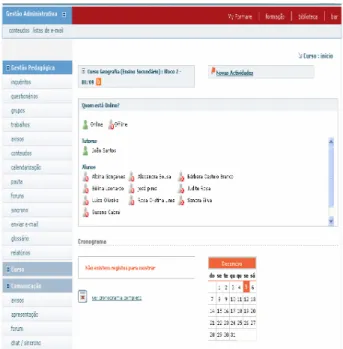
For each subject, there is one synchronous session per week with a duration of two hours. The synchronous vir-tual lessons are taught through the EB 3/S Vitorino Nemésio’s electronic office, a room equipped with around a dozen computers where teachers and pupils interact in a chat environment. Teachers may opt to teach from home with board authorisation. The Formare platform from PT Inovação (a portuguese enterprise - Portugal Telecom Inovation) serves as support for the process of teaching and learning (Fig. 3).
Although this platform provides audio synchronisation, the teachers we interviewed stated that they do not use it and asserted that they were not aware of any teacher that did so regularly. The innumerable technical problems pre-sented by the audio made normal use impossible, the drawbacks thus proved greater than the advantages.
Collaborative relationships between the coordinator of e-learning and the teachers are favoured by the coordina-tor’s practical experience as a teacher that uses the e-learning system. As a result, the coordinator is better able to maintain permanent contact with the system and with the other teachers, more easily resolving problems that arise
.
D. Development of the teaching and learning process
The persons participating in the teaching/learning proc-ess also proc-essentially work on an individual basis in accor-dance with the face-to-face teaching model. In the devel-opment of the teaching/learning process, there is a re-markable transposition of content, as well as face-to-face teaching methodologies to e-learning . At the level of con-tent, a great predominance of Office tools was witnessed, with Word standing out (representing 71% of all the files made available on the platform), followed by PowerPoint (10%).
Regarding methodology, a transposition of the activities and strategies of face-to-face teaching to e-learning is also evident. None of the teachers that taught in e-learning had any prior experience as a tutor or student in e-learning. Participation in training courses specifically designed for
e-learning was also absent.
The development of the process of teaching and learn-ing in e-learnlearn-ing does not sharlearn-ing or collaborative rela-tionships. Virtual lessons have an expositive nature, with teachers taking on a very central role. In the interviews conducted (E3), all of the teachers indicated pupil - pupil interaction as a less valued factor in the teaching/learning process. The options of organizing group work, discussion forums and authoring tools are examples of the functional-ity offered by Formare that enhance collaborative study, and of which there was no visible use.
The creation of materials was never carried out collabo-ratively between the teachers. Informally, and occasion-
Figure 3. Overview of Formare from the teacher's viewpoint
ally, there were exchanges of teaching materials and mu-tual help with problem solving.
E. Assessment of the teaching and learning process
Legislation [11], which provides the legal framework for the rules of assessment, states: “The assessment is
con-tinuous, elements of multimedia assessment coexisting with moments of face-to-face assessment.” EB 3/S
Vi-torino Nemésio's pedagogical board determined an 80% weighting for the face-to-face assessments. Face-to-face assessments always involve administering two or three tests (written assessment forms), according to the duration of the module. The tests are devised and corrected by the subject’s teacher at the EB 3/S Vitorino Nemésio. The results are sent to the school in the student's area of resi-dence by email, and the tests are sent for correction to the EB 3/S Vitorino Nemésio by post. In the foreign language subject modules, the 80% weighting of the face-to-face assessments is divided into the written test (70%) and the oral test (30%). The oral tests are taken at the school in the student's area of residence before a judging panel of teachers of that school, but in accordance with a matrix drawn up by the teacher at EB 3/S Vitorino Nemésio. The test judging panel marks and sends a descriptive report to the principal teacher on Terceira Island.
F. Pupils academic results
In relation to the results, Table 1 shows that for the two academic years for which data exists (2005/2006 and 2006/2007), the percentage of passes was 45.5%, failure translating into, in the first place, abandonments, 29.3%, and failures, 25.2% (Table I).
As regards secondary education, the EB 3/S Vitorino Nemésio made data available to us about passes, aban-donments and failure from when the e-learning began (2003/ 2004 to 2006/ 2007). The percentage of passes was very similar to that of elementary education, m the mean of the 4 years being 49% (Table II).
In summary, failure in mediated adult education trans-lates more into abandonment of the system than into fails.
TABLE I.
PASSES,FAILSANDABANDONMENTSINTHE7THTO9THOF
ELEMENTARYEDUCATION,ACADEMICYEARS2005/2006 AND2006/2007
Absolute number In percent
Academic
year
No. pupils Passes
Fails
Abandon- ments No. pupils Passes
Fails 2005/ 2006 347 174 82 91 50.1 23.6 26.2 2006/ 2007 390 161 104 125 41.3 26.7 32.1 Total 737 335 186 216 45.5 25.2 29.3 TABLE II.
PASSES,FAILSANDABANDONMENTSINGRADES10TO12OF SECONDARYEDUCATION,ACADEMICYEARS 2003/2004AND
2006/2007
Absolute number In percent
Academic
year
No. pupils Passes
Fails
Abandon- ments No. pupils Passes
Fails 2003/ 2004 317 171 26 120 53.9 8.2 37.9 2004/ 2005 444 239 38 167 53.8 8.6 37.6 2005/ 2006 498 236 81 181 47.4 16.3 36.3 2006/ 2007 569 249 124 196 43.8 21.8 34.4 Total 1828 895 269 664 49.0 14.7 36.3
G. Future of the project
According to the RDEC (E1), the project is to continue, correcting inefficiencies detected and broadening the scope of training for teaching and non-teaching staff.
IV. DISCUSSION OF RESULTS AND CONCLUSIONS
E-learning allows some of the geographical and demo-graphic barriers that the archipelago faces to be overcome, namely geographical dispersion and the existence of iso-lated rural areas with very low populations. This system enables us to diversify the delivery of educational services at costs that would make on-site teaching unaffordable. The spatial and temporal flexibility in terms of lesson fre-quency and the completion of activities offered by the system allows audiences to be provided for that would otherwise be prevented from progressing with their stud-ies.
E-learning may offer other advantages, namely the con-tinuous training of teachers and educational assistants. Currently, the system essentially serves students in the Azores. Broadening to emigrant communities and students outside the region is dependent on wider dissemination and an adjustment in price levels for registration and en-rolment. However, it is important to solve some issues related to the quality of the system so it may be improved.
Ramos, Carmo, Fernandes, Leask and Younie (2001) [12] conducted a multiple case study under the scope of the educational use of ICT in Portuguese schools. The
study concluded that the following were factors that facili-tated the use of ICT by teachers:
Training for the acquisition of technical and peda-gogical skills;
Personal motivation in this area
A spirit open to criticism and innovation
The presence of teachers for technical support and for dynamising projects
Relationships and collaborative work habits in differ-ent areas
Knowledge of the software and its potential Sensitivity of school management to the use of ICT
Bernath and Ruben (2001) [13], basing themselves on the study Virtual Seminar in Distance Education, also highlight the importance of training in the acquisition of technical and pedagogical skills. These researchers con-sider that training with professionals in the field of dis-tance learning is a factor of great impordis-tance in the devel-opment of quality tutoring. Benneth and Marsh (2002) [14] describe the success of their experiments in training new online tutors through the simulation of learning communities. Given that the EB 3/S Vitorino Nemésio does not have a critical mass of professionals with experi-ence in online education, providing their teachers the op-portunity to attend simulated online courses, taught by professionals, would be a fundamental factor in achieving a leap in the quality of e-learning. This training takes on an even greater importance when the teachers do not have any experience as e-learning students [9], [13].
Taking the conclusions of the studies of Ramos et al [12] in mind, we thought that the following could be measures to facilitate a more effective use of the ICTs and the quality of teaching materials:
Provide teachers with training in the pedagogical area of e-learning with professionals [14]
Create working groups during the non-teaching com-ponent time for the collaborative creation of multi-media materials;
Constitute of a team of more experienced teachers to offer support in the technical sphere;
Develop coaching systems
Zimmer, Haris and Muirhead (2000) [15] consider it fundamental to utilise the proper methodological frame-work in the exercise of successful tutoring. Being a teacher in an online environment is not exactly the same as being a classroom teacher. Many institutions consider that an efficient classroom teacher can also teach online. Nothing could be more wrong [16]. This false impression is often made in e-learning because, as we have already mentioned, none of the teachers interviewed (E3) pos-sessed a solid training in the field of e-learning, nor had experience as a student or tutor in online instruction.The lack of models of the operational dynamics of an online course has resulted in the transposition of methodologies used in face-to-face instruction to mediated instruction. The use of ICTs in education does not necessarily mean greater value, or a break with the educational models of the past [17].
Establishing a common asynchronous means of com-munication, with defined rules of participation, and col-laborative work may promote inclusion, accountability
and the development of a sense of belonging that would probably mitigate abandonment.
Regarding assessment parameters, the elevated weight-ing of the face-to-face tests in the final grade (80%) is the most relevant factor. According to what we established in the interviews conducted with the teachers (E3), the ma-jority agree that face-to-face assessment must necessarily take on an important weighting as a guarantee of credibil-ity. Lagarto (2005) [18] recognises the importance of this problem, namely when there is a need for certifying train-ing. Nevertheless, he considers that mechanisms may be developed to improve this setback, in order to favour in-teractivity and collaborative work, including group work, participation in asynchronous discussions and discussion forums or the use of software [18]. E-learning, beyond cognitive assessment, allows the collaborative work to be assessed. The questions of socialisation, a paradigm of face-to-face systems, also may be circumvented by tech-nology through synchronous communication tools [18].It is important to rethink the weighting of the face-to-face and distance-learning components, finding a point of bal-ance between the credibility of the training and the ade-quation of the assessment to the type of activities devel-oped.
REFERENCES
[1] OVGA, Atlas Básico dos Açores. Ponta Delgada, OVGA, 2004. [2] R. Bogdan, S. Bilken, Investigação Qualitativa em Educação.
Porto: Porto Editora, 1994.
[3] R. Sampiere, C. Collado, P. Lucio, Metodologia de Pesquisa, 3rd
ed, São Paulo: McGraw-Hill, 2006.
[4] L. Almeida, T. Freire, Metodologia da Investigação em Psicologia
e Educação. Braga: Psiquilíbrios, 2003.
[5] INOFOR, “Dimensões do e-learning”, retrieved 2007-10-10, from
www.iqf.gov.pt/novaformacao, 2002.
[6] D, Jonassen, K. Peck, B. Wilson, Learning With Technology - A
Constructivist Perspective. New Jersey: Merril Prentice Hall,
1999.
[7] P. Barker, Philip, “Skill Sets for Online Teaching,” Paper pre-sented at the World Conference on Educational Multimedia,
Hy-permedia and Telecommunications 2002, Denver, Colorado, USA.
2002a
[8] P. Barker, Philip. “On Being an Online Tutor,” in Innovations in
Education and Teaching International, vol. 39 (1), 2002b, pp.
3-13.
[9] G. Salmon, E-moderating: The key to teaching & learning online. Oxon: RoutledgeFalmer, 2004.
[10] M. Cejudo, M. Llorente, “El tutor en E-learning: aspectos a tener en cuenta” [Electronic Version], in Edutec. Revista Electrónica de
Tecnologia Educativa, n.º 20, 2006, pp.1-24. retrieved 2008-03-10
from http://edutec.rediris.es/Revelec2/revelec20/llorente.htm. [11] SREC, “Portaria n.º 17/ 2003”, in Jornal Oficial, vol. n.º 13, 2003. [12] J. Ramos, M. Carmo, I. Fernandes, M. Leask, S. Younie, “A
escola que aprende: um estudo múltiplo de casos no âmbito da uti-lização educativa das TIC em escolas europeias. O caso portu-guês,” in Revista Inovação - Novas Tecnologias na Educação, vol. 14, 2001, pp. 97-118.
[13] U. Bernath, E. Ruben, “Professional development in distance education - a successfull experimenta and future directions,” in
Innovations in Open and Distance Llearning - Sucessful Develop-ment of Online and Web-Based Learning, F. Lockwoord, A.
Goo-ley, Eds. London: Kogan Page, 2001.
[14] S. Bennett, D. Marsh, “Are we expecting online tutors to run be-fore they can walk,” in Innovations in Education and Teaching
In-ternational, vol. 39, 2002, pp. 14-20.
[15] B. Zimmer, R. Harris, B. Muirhead, “Building an Online Learning Community”. In Online Tutoring e-book, C. Higgison, Eds. Edin-burgh: The Institute for Computer Based Learning, Heriot-Watt University, 2000, pp. 3.1 -3.24.
[16] J. Rooney, W. Scott, “E-Learning: a Primer,” in The Journal for
quality & participation, vol. 26 (4), 2003, pp 4-9. 2003.
[17] A. Fernandes “As falácias ou os grandes equívocos do e-Learning. Retrieved 2008-01-13, from http://abt-br.org.br/index.php?option= com_content&task=view&id=386&Itemid=2, 2002.
[18] J. Lagarto, “Avaliação em e-Learning - Perguntas mais fre-quentes” in Nov@ Formação,2005, pp. 54-55.
AUTHORS
S. A. Ferreira, ([email protected]) Mas-ter in Sciences of the Education, specialization in educa-tion computer sciences. Geography teacher in the high school EBS das Flores, Azores, Portugal
E. L. Cardoso, ([email protected]) Doctorate in Technologies and Systems of Information - area of the Technologies and Systems of Information in Education. Professor at Universidade Católica Portuguesa, Portugal.
Submitted September 20, 2009. Published as resubmitted by the authors February 12, 2010.