Alexandre Barbosa Augusto
A Mobile Based Attribute
Aggregation Architecture for
User-Centric Identity Management
Departamento de Ciˆ
encia de Computadores
Faculdade de Ciˆ
encias da Universidade do Porto
Alexandre Barbosa Augusto
A Mobile Based Attribute
Aggregation Architecture for
User-Centric Identity Management
Disserta¸c˜ao submetida `a Faculdade de Ciˆencias da
Universidade do Porto como parte dos requisitos para a obteno do grau de Mestre em Engenharia de Redes em Sistemas Inform´aticos
Orientador: Prof. Manuel Eduardo Carvalho Duarte Correia, Professor Auxiliar do Departamento de Ciˆencia de Computadores
da Faculdade de Ciˆencias da Universidade do Porto Departamento de Ciˆencia de Computadores Faculdade de Ciˆencias da Universidade do Porto
I have to thank my advisor, Manuel Correia, for believing and supporting me, my family for all its support, my friends for being there always when i needed them, Casa Melo for the memories (including the ones which i do not remember) and, last but not
least, my love, C´atia, for supporting me and for not killing me when i was (rarely) sleeping during the thesis process.
Alexandre Barbosa Augusto September 2012
Acknowledgments
I have to thank my advisor for his unconditional support during all the process of OFELIA project that leaded the way for this thesis work.
I also have to thank the ERDF through the Programme COMPETE and by the Portuguese Government through FCT - Foundation for Science and Technology, the project OFELIA ref. PTDC/EIA-EIA/104328/2008 and is being conducted with the institutional support provided by DCC/FCUP and the facilities and research environment gracefully provided by the CRACS (Center for Research in Advanced Computing Systems) research unit, an INESC TEC associate of the Faculty of Science, University of Porto.
Resumo
O crescimento explosivo da Internet est´a a acelerar a migra¸c˜ao das infraestruturas sociais essenciais do mundo real para o mundo virtual. A gest˜ao de identidade tem desempenhado um servi¸co fundamental neste processo, tornando mais f´acil planear, distribuir e proteger o acesso online. Recentemente o desenvolvimento em modelos de gest˜ao de identidade estruturados `a volta de conceitos centrados no utilizador tem sido foco de aten¸c˜ao. Este processo est´a assim de acordo com a exigente sociedade digital e empoderamento do utilizador com ferramentas digitais que permitem uma gest˜ao da identidade digital centrada no utilizador de uma forma mais fi´avel, respons´avel e segura. Incidentes recentes ligados com a divulga¸c˜ao n˜ao autorizada de informa¸c˜ao sens´ıvel, mostram o qu˜ao importante ´e para o utilizador conseguir exercer algum controlo sobre aquilo que sobre ele ´e publicamente conhecido e disseminado na Internet. Deste modo ´e imperativo promover o desenvolvimento de sistemas interoper´aveis padronizados que permitam uma gest˜ao focada no utilizador de informa¸c˜ao privada e ajudar a proteger os direitos fundamentais de privacidade do utilizador.
Fornecedores de identidade tal como Google e Facebook, est˜ao atualmente numa feroz competi¸c˜ao por utilizadores. Um dos seus principais objetivos ´e a cria¸c˜ao de enormes e monopolizadas bases de dados pessoais, permitindo a produ¸c˜ao de perfis de utilizadores altamente precisos que podem ser monetizados eficientemente para fins de marketing e ”lock-in”. Alguns tipos de dados pela sua natureza podem ser sujeitos a constantes mudan¸cas ficando assim facilmente desatualizados. Com um gestor de identidade centralizado e ”distante”, pode tornar-se dif´ıcil gerir o grau de atualiza¸c˜ao para esses dados pessoais dinˆamicos. Por todas estas raz˜oes, acreditamos que toda a informa¸c˜ao privada do utilizador deve ser mantida o mais pr´oximo poss´ıvel da fonte prim´aria do seu propriet´ario e sobre seu controlo direto. Estes dados podem ent˜ao ser geridos pelo utilizador com a ajuda de entidades conhecidas como Autoridade de Atributos (At-tribute Authority - AA) pessoais na rede. Estes AAs partilham dados pessoais a outras aplica¸c˜oes apenas depois do consentimento expl´ıcito do propriet´ario que deve ter em
limitada e facilmente revog´avel. Estas condi¸c˜oes s˜ao essenciais para a gest˜ao focada no utilizador, que constitui a base da nossa proposta para desenvolvimento de um modelo totalmente descentralizado, focado na privacidade e no utilizador para gest˜ao de identidade baseado na agrega¸c˜ao de dados privados distribu´ıdos e protegidos por um conjunto de AAs pessoais.
Abstract
The explosive growth of the Internet is accelerating the translation of essential real world societal infrastructures to the virtual world. Identity management has been playing a fundamental structuring service role in this process, by making it easier to plan, deploy and secure online access to an ever increasing number of systems and applications. More recently, the general tendency has been to concentrate development efforts on identity management models structured around user-centric concepts, totally in concert with a digital society that is demanding and is ever more focused on em-powering individuals with tools for a more reliable, responsible and secure user-centric management of private digital data. Recent incidents related with the unauthorized disclosure of sensitive information also shows how important it is for users to be able to exercise some control on how much about them is publicly known and disseminated on the Internet. It is therefore crucial to promote the development of standardised interoperable systems that enable the user-centric management of private information and help secure users basic right for privacy.
Massive centralized identity providers (Google, Facebook), are currently under a fierce competition over the hearts and minds of users. One of their main purposes is to create enormous monopolized user personal data database as they enable them to produce highly accurate user profiles that they can then monetize very efficiently for marketing and lock-in purposes. There are also some types of important personal data that by their very nature can be subjected to change and thus become stale, sometimes very quickly. With a centralized and distant identity provider it can therefore become quite difficult to manage the degree of staleness for dynamic personal data. For all these reasons we believe that all users private information should be kept as much as close as possible to their owners primary source, under his direct control. This data can then be managed by the user with the help of personal Attribute Authority(AA) entities in the network. These AAs disclose personal data to other applications only after the owners explicit consent, which should also take into
limited and easily revocable authorizations. These essential general assumptions for user-centric management of private data constitute the base for our proposal on the development of a fully decentralized privacy and user-centric model for identity management based on the aggregation of users private data, distributed and protected by a set of personal AAs.
Palavras Chave / Keywords
Palavras Chave: • Agente de autoriza¸c˜ao • Centrado no utilizador • Identidade m´ovel • Agrega¸c˜ao de atributos • Controlo de acesso • Dispositivos m´oveis • Gest˜ao de identidade • Identidade digital Keywords: • Authorization broker • User centric • Mobile Identity • Attribute aggregation • Access control • Mobile device • Identity management • Digital Identity xiiiAcronyms
CA certification authority
HTML Hypertext Markup Language HTTP hypertext protocol
IdM Identity Management
IdMS Identity Management Systems IdP identity provider
IETF Internet Engineering Task Force IP internet protocol
PKI Public Key Infrastructure
SAML Security Assertion Markup Language SSO Single Sign-On
STS Security Token Service TLS Transport Layer Security SSL Secure Socket Layer
XML Extensible Markup Language AA Attribute Authority
SP Service Provider same as RP RP Rely party same as SP PGP Pretty Good Privacy
EER Enhanced Entity Relationship JDK Java Development Kit
Contents
Acknowledgments vii
Resumo ix
Abstract xi
Palavras Chave / Keywords xiii
Acronyms xv
List of Tables xxiii
List of Figures xxvi
1 Introduction 1 1.1 Motivation . . . 3 1.2 Proposed Solution . . . 4 1.2.1 Objectives . . . 5 1.2.2 Features . . . 5 1.2.3 Applications . . . 6 1.3 Application Domain . . . 7 1.3.1 Identity Management . . . 7 xvii
1.3.2.1 Patients EHR (Access and Control) . . . 8
1.3.3 Physical Security Access . . . 9
1.4 Contributions . . . 10
1.5 Outline . . . 12
2 State of the Art 13 2.1 Research Methods . . . 13
2.1.1 Identity management systems . . . 15
2.1.2 Traditional model . . . 16
2.1.3 Federated Model . . . 17
2.1.3.1 Shibboleth . . . 18
2.1.4 Centralized Model . . . 19
2.1.4.1 OpenID . . . 20
2.1.4.2 Microsoft .NET Passport . . . 21
2.1.5 User Centric Models . . . 21
2.1.5.1 Higgins . . . 21
2.2 Attribute Aggregation . . . 22
2.2.1 Client mediated assertion . . . 23
2.2.2 Identity Federation model . . . 23
2.2.3 Relying Party mediated attribute aggregation . . . 23
2.2.4 Identity proxying/chaining . . . 24
2.2.5 Identity Relay . . . 24
2.2.6 Linking Service . . . 24
2.3 Identity Management Common Standards . . . 25
2.3.1 Kerberos . . . 25 xviii
2.3.2 Security Assertion Markup Language (SAML) . . . 26
2.3.3 Extensible Access Control Markup Language (XACML) . . . 27
2.3.4 Web Services Federation (WS-Federation) . . . 27
2.3.5 Digital ID wallet . . . 28
2.3.6 Open Identity Exchange (OIX) . . . 28
2.4 Security Concepts . . . 29
2.4.1 Public Key Cryptography . . . 29
2.4.1.1 Public Key Infrastructure . . . 29
2.4.1.2 Digital Certificates . . . 30
2.4.2 Smartcard . . . 33
2.4.2.1 Mobile Secure Card . . . 33
2.4.3 Valet key based protocol . . . 34
2.4.3.1 Open Authorization (OAuth) . . . 34
2.4.3.2 Azure Microsoft . . . 35
2.5 Communication Concepts . . . 35
2.5.1 XMPP . . . 35
2.5.2 Web service . . . 36
2.5.2.1 REpresentation State Transfer (REST) . . . 36
2.5.2.2 Simple Object Access Protocol (SOAP) . . . 37
2.5.3 Quick Response code . . . 38
3 Architecture Components 39 3.1 Architecture Technologies Overview . . . 39
3.1.1 microSD mobile card . . . 39
3.1.2 The XMPP messaging protocol . . . 40
3.1.3 Secure access authorization tokens . . . 41 xix
3.1.5 XML Schema . . . 42
3.1.6 QR Code . . . 44
3.2 Architecture nodes overview . . . 44
3.2.1 OpenID Connect Identity Services . . . 44
3.2.2 Relying Party/Service Provider (RP/SP) . . . 44
3.2.3 Attribute Authorities . . . 45
3.2.4 The Identity Broker . . . 46
3.2.5 The smartphone as a Secure Digital Wallet . . . 46
4 Entities enrollment and case scenario 49 4.1 Attribute Authority enrollment . . . 50
4.2 Identity broker enrollment . . . 51
4.3 Service provider enrollment . . . 53
4.4 Usage case Scenario . . . 55
4.4.1 Attribute Aggregation scenario in e-commerce . . . 55
4.4.2 Attribute authorization access scenario in healthcare . . . 56
5 Conclusions and Future Work 59 5.1 Research summary . . . 59
5.2 Main findings . . . 60
5.3 Current OFELIA implementation limitations . . . 61
5.4 Future work . . . 62
5.5 Conclusion . . . 62
A Development notes 65 A.1 Identity Broker Web Service . . . 65
A.2 Attribute Authority standalone application . . . 68
A.3 Secure Digital Wallet application . . . 70
A.4 Relying Party web service . . . 71
A.5 Screen captures: . . . 74
References 76
List of Tables
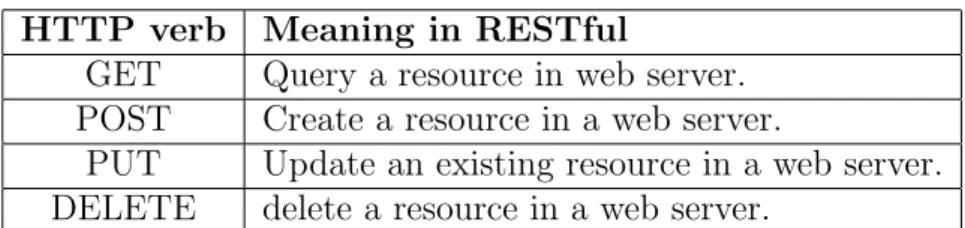
2.1 The Seven Laws of Identity . . . 15 2.2 Traditional model limitations . . . 16 2.3 Information Security Attributes . . . 25 2.4 HTTP verbs and their meaning in RESTful web servers . . . 37
List of Figures
2.1 Federated model example . . . 17 2.2 Single sign-on model example . . . 19 2.3 Smartphone user centric model . . . 22 2.4 Components of the SAML Specifications . . . 26 2.5 Public key cryptographic signature process . . . 30 2.6 Public key cryptographic encryption process . . . 31 2.7 Certification validation by the usage of a Certification Authority . . . . 32 3.1 The purposed architecture communication . . . 40 3.2 Architecture data exchange XML Schema . . . 43 4.1 AA enrollment flow . . . 51 4.2 Identity Broker enrollment flow . . . 52 4.3 RP/SP enrollment flow . . . 54 4.4 Agnes access permissions to Katherines’ breast pathology folder . . . . 57 A.1 IdB package tree . . . 67 A.2 Identity Broker Database EER . . . 68 A.3 AA Android package tree . . . 69 A.4 Attribute Authority Database EER . . . 70 A.5 Digital wallet Android package tree . . . 71
A.7 Relying party package tree . . . 72 A.8 Relying Party Database EER . . . 73 A.9 Ofelia digital wallet authorization request box. . . 74 A.10 Ofelia digital wallet token list. . . 74 A.11 Relying Party user area. . . 74 A.12 Relying Party data request page. . . 75 A.13 Relying Party GPS coordinate consultation. . . 75
Chapter 1
Introduction
There is a massive privacy problem on the Internet that needs to be solved in a more meaningful and user centric way. The problem lies not only on the lack of trust but also on how users can effectively regain control by exercising privacy rights [1] in a more meaningful way. There are many users that spend a very significant part of their lives online, thus creating and many times unconsciously contributing with enormous quantities of personal data to less scrupulous service providers, which can then easily become as individually traceable as the user’s own biological DNA. And like the DNA, this data can be used, and it is in fact been abused by service providers, to track and store private personal information that users usually would not want to have publicized. Controlling our own data and ensure its privacy is the only way to secure and at the same time maintain the intrinsic value of our personal information preventing it from being trivialized, exploited or shared without our consent or have a rightful share of the profits associated with the exploitation of its value. It is thus vitally important to determine and set a hard limit on what should be deemed acceptable service provider behaviour and what constitutes a flagrant violation of our constitutional rights, after all it is our own digital personal data that is at stake. All this is happening right under our noses. The massive growth of the Internet is being fed by an ever increasing set of apparently free online services that are being sustained by the still highly unregulated mercantilization of the users personal data. Remember that when a popular Internet service is ”free” and it is not trying to sell you anything it generally means that it is the user that is the product being sold. Traditionally, many web sites require the user to disclose hitherto unnecessary sensitive identity information, like postal addresses, telephone numbers, gender, credit cards, geographic location and even otherwise highly sensitive personal data like for example health
records (Google Health, Microsoft Healhtvault) in order to provide an apparent ”free” service. In essence these services are definitely not free and constitute a means by which the user is being mercantilized by the service provider. As an example consider the current fierce competition being fought off by Google and Facebook about digital identity services. This has led to the development of massive identity infrastructures that accelerated the deployment of efficient and easily deployable identity and access control protocols like OpenID [2] and OAuth [3] to better cater the needs of the service providers web applications. Unbeknownst to users they are currently being played as pawns in a very complex scenario that they do not fully understand, where the real value of their identity attributes is not disclosed and where their identity and privacy is constantly being negotiated between a set of internet services, without their consent or opportunity for control [4].
In order to better contextualize and understand the relevant real issues behind this problem we have conducted an highly comprehensive research and analysis of the published literature on identity management, user centric access control mechanisms and identity attributes aggregation and management models. This led to the devel-opment of a novel user centric framework architecture for identity attributes ag-gregation (OFELIA - Open Federated Environment for the Leveraging of Identity and Authentication) that has been designed right from the start to cater with the problems related with the service providers abuse of confidence over matters related with digital identity management. Our architecture defines an innovative user centric authorization/authentication mechanism that protects users’ privacy by the means of novel discretionary access control mechanisms, that are managed and exercised by the means of mobile devices, more specifically the users smartphones. The smart-phone nowadays provides tremendous opportunities because it can also be seen as a truly personal platform for sensoring the users surrounding environment. They are provided with cameras, microphone, gyroscope, GPS and a plethora of other sensoring equipment that can be connected via bluetooth, like for example the cardiac rhythmic sensors that are nowadays so popular within the jogging community. To cater with this so much richer universe of highly dynamic personal data, with OFELIA we have also expanded the set of static identity attributes, being currently managed by standard Internet identity management systems [5, 6], with a new set of highly changeable identity attributes. This opens a whole new range of opportunities and possibilities by having real time dynamic personal data being Processed As Requested (PaR). In other words, every time a Relying Party (RP) or Service Provider (SP) requests a dynamic mutable identity attribute, data retrieval occurs in real time and
1.1. MOTIVATION 3 goes as deep as its authoritative origin. This new digital identity paradigm is useful in contexts where identity attributes are highly volatile, because of its high rate of change, where PaR becomes mandatory if the service provider objective is to keep a coherent timeline for the identity attributes being thus retrieved. This is easily illustrated with for example GPS positioning. If we consider applications where this is an identity attribute (the users current location), in situations where the users are in constant movement, the more recent the value for this attribute is the more valuable is for the service provider. For example service providers (relying parties) would be very keen to serve high value banner advertisements based on the user current user’s GPS positioning. The more current, the more valuable the advertisement would be. This can only happen within a PaR paradigm where the Relying Party is provided with a digital identity infrastructure where it can obtain the real current time positioning of an individual and not the last time the user or application remembered to update it. This of course opens a new Pandora Box of privacy violation and surveillance nightmares that can only be coped if user is given full control over who can access, for how much time and on what conditions can this highly dynamic real time data be retrieved from the source by the service providers.
1.1
Motivation
After graduating in Computer Engineering Sciences at faculty of Sciences of University of Porto, the author started his master degree in Network and Information Systems Engineering following the Communication Networks minor at the same institution of his graduation. The first year of his master degree amplified the authors’ interest in computer security, leading the author to develop a special taste over the complexity of digital identity management.
During the second year the author joined the OFELIA (Open Federated Environment Leveraging Identity and Authorization, ref. PTDC/EIA-EIA/104328/2008) project, that acted as the main motivation source for this thesis. This work was funded by the ERDF through the Programme COMPETE and by the Portuguese Government through FCT - Foundation for Science and Technology. The main institutions behind the project are the faculty of science (CRACS research unit an INESC TEC associate), faculty of medicine (CINTESIS research unit) both from the University of Porto, the University of Minho and the Portugal OpenID foundation. The purpose of this project is to research the conceptualization and implementation of new ideas and extensions
for user centric identity management and authorization mechanisms for the Internet, where sensitive identity attributes can be directly stored on the users personal mobile devices or other user controlled secure storage services on the Internet, whose location can be hidden from the service providers to enhance and protect users privacy. Our first identity management framework model, implemented by the author for the OFELIA project, allowed users to asynchronously control and effectively share sensitive dynamic identity attributes directly held on mobile devices (in this case android smartphones) [7]. This initial model served as the starting point for the rather more complex process of effectively decoupling the storage of identity attributes from the mobile phone, and it is this rather more complex identity management infrastructure that is described in this thesis.
1.2
Proposed Solution
We have developed an identity/access control model that aims the development of standardised interoperable systems that enable the user-centric management of private information by the usage of smartphones. This model establish the right means to the users to guarantee the basic right for privacy over their valuable identity attributes. The adoption of smartphones as a user-centric management platform is highly appropriate because these devices are nowadays ubiquitous, have more then adequate processing CPU power to run modern operating systems, are being deployed with full Internet access, are accompanied by fully matured development systems and constantly follow their owners everywhere as the ”de facto” personal mobile device. Therefore providing a practical solution for the users Internet reachability challenge [8]. The use of smartphones for identity management is currently also recognized as essential for enhancing security and privacy [9, 10, 11] and has been proved to play a crucial role on more flexible user-centric models [12, 13]. Based on these facts, the proposed architecture adopt the use of smartphones as an Authorization Broker in order to grant users a dynamic and more active role over their identity attributes. The proposed architecture has been divided in four different components: (1) one application programming interface (API) in order to establish a fast deployment of the architecture for the relying parties and service providers; (2) other API for the At-tribute Authorities (AAs) creating the necessary security means to allow data access; (3) an implementation of an identity broker based on the linking service aggregation model referred on section 2.2.6; (4) and an android application, implementing the
1.2. PROPOSED SOLUTION 5 secure mobile authorization broker to aggregate AAs and authorize, manage and revoke access to their identity attributes over the different AAs.
1.2.1
Objectives
The main goals of this thesis is to define and implement a user-centric distributed architecture for identity management by the means of mobile devices. We have identified and proposed the following main objectives:
• Research of the current state of the art on identity management and attribute aggregation.
• Definition of an architecture that creates an authentication/authorization mech-anism to protect users privacy by using the research results.
• Implementation of the defined architecture that can be used to fulfill one of the main goals of the OFELIA project.
• Deployment of the implemented architecture in real scenarios in order to analysis the architecture performance and usage.
• Dissemination of the results on identity management and access control related symposiums and international conferences in order to diffuse our results thus enriching our research.
1.2.2
Features
The main features of the proposed architecture are:
• Attribute Aggregation - Establish the right means for a user aggregate their personal attributes and at the same time keep in the control over the data these characteristics are archived by the usage of the identity broker and the authorization broker.
• User centric model - Personal attributes are only disclosure with previous user authorization. The owner of personal attributes maintain the capacity to revoke or limit the access at any time.
• Dynamic Attributes - These type of attributes are temporal sensitive and can only reside, not in the cloud, but in mobile personal devices in order to keep those values up to date creating the necessary temporal stream.
• Easy Integration - The architecture provides two distinct application pro-gramming interface in order to allow all kind of relying parties and attribute authorities quickly integrate in the proposed architecture.
• High privacy level - Personal attributes are only disclosure for an authorized requester. Despite the fact that every personal attribute pass through the identity broker the data exchanged is always encrypt by the requester certificate and sign by the data attribute authority.
• Decentralized solution - The Users’ digital information are fragmented through various attribute authorities, decreasing the chance of success attacks in order to obtain a user full digital information.
1.2.3
Applications
In the course of our work we have developed several applications to further illustrate and explore the attribute aggregation architecture for user centric identity manage-ment that is the objective of this thesis. They are:
1. A mobile application: that implements a secure mobile authorization broker to aggregate attribute authorities and authorize, manage and revoke access to their identity attributes allowing the user to asynchronously exercise dis-cretionary access control over its identity attributes in a simple and highly transparent way.
2. An application programming interface for relying parties: in order to establish a fast deployment of our proposed architecture in the most diverse types of relying parties.
3. An application programming interface for attribute authorities: in order to create the necessary security means to allow data access.
4. A standalone application: that implements a secure attribute authorities. This application was developed in Java language in order to provide system portability.
1.3. APPLICATION DOMAIN 7 5. Identity Broker: a web service that acts as an identity proxy, based on the
linking service aggregation model.
6. A QR Registration plugin application: in order to establish a fast account creation between the mobile device and XMPP server.
1.3
Application Domain
Identity management system has became an essential tool for economical evolution on almost every sector. This section further explores some sectors that show great potential for the deployment of our proposed architecture.
1.3.1
Identity Management
The interest on user digital identity has been increasing dramatically over the recent years due to the discovery of its highly strategic commercial value for the market [14]. Massive centralized identity providers started to flourish, companies like Google, Facebook and even Microsoft, are currently under a fierce competition over the hearts and minds of users for their personal data. One of their main purposes is to create enormous monopolized centralized databases of user identity attributes as they allow them to produce highly accurate user profiles that they can then monetize very efficiently for marketing and lock-in purposes [15]. These global companies harvest and aggregate personal data in such a large scale that, lest it is put under some kind of control, it will very soon represent a major global threat to personal security and privacy the like of which the world has never seen.
Due to this competition over digital identity, protocols like OpenID for authentication and OAuth [16] for authorization started to appear in order to cater the need for web applications data interoperability creating the necessary means for centralized identity providers. These protocols are employed as standardized mechanisms to build single sign-on systems and attribute sharing based on valet keys [17]. More recently a new open standard named as OpenID Connect [18] is under development, as a single solution for aggregating both authentication and authorization.
In the middle of this dispute lies the user that usually do not understand where his identity and privacy is being negotiated between a set of fancy internet services and sometimes even without his consent or control [4]. This privacy abuse is not the only
problem, if a centralized identity provider like Google suffers an attack, millions of highly well detailed personal attributes will be compromised.
In order to struggle against these massive centralized identity providers our proposed architecture defined that the users private information should be kept as much as close as possible to their owners primary source, under his direct control and never with a ”trusted” third party like Facebook for instance. This data should be managed by the user with the help of personal Attribute Authority (AA) entities in the network. These AAs disclose the personal digital data to Relying parties or Service Providers only after the data owner authorize it. These authorization take the form of conditional, temporal limited and easily revocable by the data owners. [7, 13]
1.3.2
eHealth
In the healthcare domain, patients digital data is normally collected into what is called the Electronic Health Record (EHR). The EHR encompasses many functions that can include different types of data items such as diagnoses, medications and operations [19, 20]. The EHR is nowadays indispensable for health institutional purposes and could be used to empower patients by giving them the necessary information to play a more active role in their own health and in their families health as well [21].
OFELIA has the potential to change current eHealth practices and business practices by giving the patients the means by which they can directly manage and exercise revocable access control to their EHR and thus effectively decide with whom to share their EHR, be it healthcare professionals or even family members and caring friends [22].
1.3.2.1 Patients EHR (Access and Control)
Nowadays, patients want to be better informed about their medical conditions and play a more active role on their own treatments. They usually consult online information by using search engines to educate themselves about etiology, treatments, and the prognosis of the medical conditions. Getting access to their medical records would help the patient to better understand their medical conditions [23]. On this issue the European Recommendation [24] and American Legislation [25] for protection of medical data agree that the patient must have access to his/her medical record and play a major role in the decisions regarding the content and the distribution of his/her
1.3. APPLICATION DOMAIN 9 medical data [26].
Currently, for patients to have access to their medical records they need to write a request to their custodian healthcare institution and the response delay depends on their country legislation (e.g. 10 days in Portugal [27], 21 days in England [28] and 30 days in USA [25]). We believe that the latest developments in digital communications and information technologies should provide the patients a simpler and more secure way to access their medical records and at the same time provide a better collaboration and interaction experiences with the healthcare professionals [29].
Unfortunately, by opening up the access to the EHR with inadequate access control mechanisms and policies carries some substantial risks as illustrated by the grim statistics observed during the period of 2006 to 2007, where in the USA, over 1.5 million names were exposed during data breaches that occurred in hospitals [30]. One of the most important and complex requirement for eHealth systems [31] is to keep patients’ information private and secure and that is exactly where our proposed framework could be framed, acting as the authorization infrastructure that acts as node between the health institution patient records and the patient
Patient medical records exchange between health institutions is very difficult due to problems ranging from incompatible platforms and data formats, passing through dif-ficult to negotiate access policies that are acceptable by all participating Institutions, to the lack of a common agreed upon identity/authorization federated infrastructure for both patients and health professionals that would allow them to assume compat-ible/recognizable roles within each hospital eHealth system. Under this very difficult scenario, our proposed framework, can again act as the authorization infrastructure that allows the patient to share their medical information with health professionals independently of the platform since the health professionals would be accessing the desired data directly from the data source. This scenario would create a false but helpful kind of interoperability between health institutions
1.3.3
Physical Security Access
The key is the most used token of all time to give/have access to a house, a car, a safety box and etc. The most common keys are the house keys and the car keys. Usually the usage of these keys have several problems like:
• Non revocable, once you give it you have to change your lock in order to ”revoke” the access.
• Its a physical device, if you take it by mistake you can only solve this problem by returning it or having a copy.
• Not possible to define special conditions in the key usage, in other words its not possible to set usage polices.
By the usage of the proposed architecture we aim the use of smartphones as master devices that could be used as a key to start a car or/and open a house. This master device could also virtually authorize other devices to have access by setting special policies access like temporal constrains. This scenario would help to overcome the presented problems of the traditional key usage since the master device could manage all authorizations by limiting its access and revoking it at any time. Obviously the usage of mobile devices as keys to physical access will create a set of new issues related with security, however this issues could also be overcame with research.
1.4
Contributions
This section describes the contributions that were obtained during this research. These include: articles, book chapters, journals and technical reports that were published or submitted waiting for approval and as well as the studies and prototypes developed in this thesis process.
Articles in Journals
• A paper in Computers in Biology and Medicine journal titled as ”A proposal for a secure patient empowerment architecture” from Elsevier. (submitted and waiting for approval)
Book Chapters
• A book chapter on the book named ”Innovations in XML Applications and Meta-data Management: Advancing Technologies”, titled as ”A secure and dynamic mobile identity wallet authorization architecture based on a XMPP messaging infrastructure” from IGI Global.
1.4. CONTRIBUTIONS 11 • A book chapter on the book named ”Architectures and Protocols for Secure Information Technology”, titled as ”A Mobile Based Attribute Aggregation Architecture for User-Centric Identity Management” from IGI Global. (accepted and waiting to be published)
Articles in Conferences
• A paper in International Information Security and Privacy conference (IFIP SEC 2012) titled as ”OFELIA - A Secure Mobile Attribute Aggregation Infrastructure for User-Centric Identity Management” held in Crete, Greece.
• A paper in Information Technology in Bio- and Medical Informatics conference (DEXA, ITBAM 2012) titled as ”A Mobile Based Authorization Mechanism for Patient Managed Role Based Access Control” held in Vienna, Austria.
• A paper in Conferenca Ibrica de Sistemas y Tecnologas de Informacins (CISTI 2012) titled as ”A literature review of security mechanisms employed by mobile agents” held in Madrid, Spain
• A paper in XML: Aplicaes e Tecnologias Associadas conference (XATA 2011) titled as ”An XMPP messaging infrastructure for a mobile held security identity wallet of personal and private dynamic identity attributes”, held in Vila do Conde, Portugal. (best paper award)
Studies and Prototypes:
• A comprehensive research over identity management models including the ag-gregation of attributes.
• The designing of a simplified identity semantic language in xml schema.
• The design and development and specifications of a user-centric distributed infrastructure for identity management by the means of mobile devices.
Technical Reports
• A technical report in Center for Research in Advanced Computing Systems (CRACS) titled as ”OFELIA: Open Federated Environment for the Leveraging of Identity and Authorisation”.
International conferences administrative work
• Member of the organizer committee of the special track on: Security and Privacy in Healthcare IT in the 26th IEEE International Symposium on Computer-Based Medical Systems (CBMS2013).
1.5
Outline
The remaining chapters of this thesis are organised as it follows:
Chapter 2 Presents an overview how digital identity is managed by the different models of identity management systems and how the mainly attributes aggrega-tion models work. It finishes by explaining the methods to establish and secure a communication channel.
Chapter 3 Describes the proposed architecture by explaining each node of the pro-posed architecture and contextualizing with the used technologies and methods. Chapter 4 Describes in detail the protocol messages exchanged to establish the connection between the architecture components and describes a usage case scenario, which can be quite useful to help to better understand the different components interaction.
Chapter 2
State of the Art
The explosive growth of the Internet is being supported by the translation of essential real world societal and monetary infrastructures to the virtual world, where digital identity plays a central catalyzing role that is accelerating the whole process. A digital identity can also be seen as being composed by a set of personal data attributes that in some sense characterizes one of the many roles a real person may assume in the virtual world when he uses an application. Like in the real world, where different persons can assume different roles depending on the situation and context, in the virtual world, digital identity is the process by which one can manage a set of personal attributes that are appropriate to assume a contextual identity, usually referred as an identity persona[32]. The association between a persona and a user is achieved by the means of an authentication process that is managed by an identity management system [33]. A successful authentication assures that a certain entity as the right to a certain set of personal credentials that the information systems can then use to determine the kind of resources that persona has the right to use. In this chapter we review the identity management models currently accepted and described in the literature, including identity attribute aggregation models and the necessary security and communication concepts and technologies necessary to properly understand them.
2.1
Research Methods
The literature review we have conducted to better contextualise the research and work we have done for this thesis was performed on January 2012, using the IEEE Xplore, ACM Digital Library and Google Scholar search engines. We have applied the
following queries:
• ”[ANY FIELD] ((((((((user centric model) AND security) AND privacy) OR identity management) AND digital identity) OR ) attribute aggregation) OR Federated model)” in IEEE Xplore
• [ANY FIELD] identity management OR attribute aggregation OR user centric OR Federated identity management in Google Scholar
• ”[ANY FIELD] ((((((((user centric model) AND security) AND privacy) OR identity management) AND digital identity) OR ) attribute aggregation) OR Federated model)” in ACM Digital Library
Due to the high number of results thus obtained we had them filtered by their abstracts, according to the following inclusion criteria:
1. English as language;
2. Recent articles, less than five years old;
3. Articles with high relevance on the search engines;
4. Well known and highly referenced authors in the field of digital identity man-agement;
5. A cautiously review of titles, abstracts, keywords and section titles, to exclude papers with the same or somewhat outdated subjects.
After the analysing the most promising papers/standards texts, their citations were also reviewed and those that suited the inclusion criteria were also integrated in the review. The search and full text retrieval of the selected papers was performed in the following databases:
• Biblioteca do Conhecimento Online (b-on), • Open Repository at the University of Porto,
• Open Access Scientific Repository of Portugal (RCAAP), • Google Scholar
2.1. RESEARCH METHODS 15 In the end we have selected 26 papers. Due to the advisor recommendation, we have also included six extra papers, amounting to 32 papers that were fully reviewed to determine a more accurate and useful context for the work we have done for this thesis.
2.1.1
Identity management systems
Digital identity is maintained by identity management systems that are systems com-posed of policies, economic model, business processes and technologies that implement and manage the personal identity users attributes (personas) needed to establish and manage access rights to the organization digital resources [34]. Moreover Identity management systems are also responsible for the digital identity lifecycle manage-ment within organizations as they provide the infrastructure deployed to validate and exchange the digital personal data attributes needed to establish and promote interoperability among different systems in accordance with some set of security and legal policies. According to Kim Cameron, to be useful, an Identity Managament System (IdMS), must follow the “seven Laws of Identity” [35]. (see table 2.1) Identity
Table 2.1: The Seven Laws of Identity Description Comments
One User consent An identity is identified and used only when the user agrees to it. Two Limited disclosure The system provides the minimum
identifying information required for the transaction.
Tree Fewest parties Only relying parties that need to know receive identifying information. Four Directional identity Omni-directional versus uni-directional Five IdMS should work with Designers cannot assume the
a variety of identity feasibility of a universal identity or technologies, run by the availability of a single
multiple providers. expression of an identity.
Six Human integration High levels of reliability between the human user and the system Seven Consistent experience across Similar to the way the web
platforms appears to users
management systems are employed by identity providers [33] that can assume several distinct models depending on the social and/or financial benefits.
2.1.2
Traditional model
The term identity management indicates the need to verify the identity of the entity accessing the system and the negotiation of rights and privileges based on privacy requirements and identity attribute disclosure associated with that identity. Identity management architectures could be server-based, client-based, or networked-based. Most common architectures are proprietary, application driven, and server-based. E.g. Amazon maintains its own users information, resulting in a silo approach, which is the most common identity management approach currently employed by the vast majority of Internet service providers. With this approach the user ends up being forced to have too many digital identities, each one of them managed by a different entity and requiring its own resources.
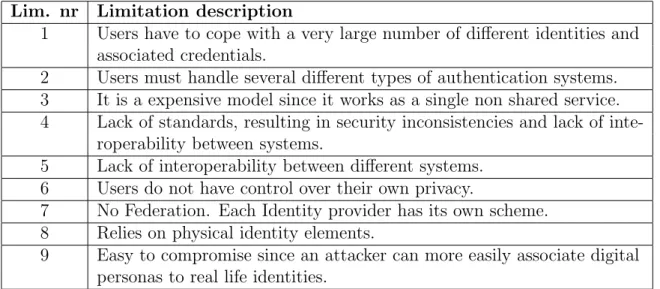
Moreover today’s mainstream identity management in the Internet does not align well with most users, since it requires too much effort from the users (they have to maintain a huge collection of user credentials, one for each site they use) and a lot of resources for service providers (resources allocated specifically for identity management that could have been easily shared with other service providers lest they employed other more versatile identity management systems). In addition, a Silo based approach is not compatible with web services, ad-hoc and mobile computing, and possesses a plethora of well know limitations and liabilities. (see table 2.2)
Table 2.2: Traditional model limitations Lim. nr Limitation description
1 Users have to cope with a very large number of different identities and associated credentials.
2 Users must handle several different types of authentication systems. 3 It is a expensive model since it works as a single non shared service. 4 Lack of standards, resulting in security inconsistencies and lack of
inte-roperability between systems.
5 Lack of interoperability between different systems. 6 Users do not have control over their own privacy.
7 No Federation. Each Identity provider has its own scheme. 8 Relies on physical identity elements.
9 Easy to compromise since an attacker can more easily associate digital personas to real life identities.
2.1. RESEARCH METHODS 17
2.1.3
Federated Model
An Identity federation can be defined as the set of agreements, standards and tech-nologies that allows a group of distinct administration domains to negotiate the establishment of a circle of trust [36] where they can then mutually recognise the user identifiers that are managed and entitlements that are issued by the other federation members they trust. Within a federation, several identity providers (IdP) can be used to provide a valid identity to any service domain that falls within the federation and authentication within the federation is achieved by presenting a valid identifier emitted and authenticated by an IdP that is trusted by the federation. However each service domain is still free to differentiate the level of service provided to his own managed identities from the level of service and resources that are provided to other identities managed by the other distinct federated administrative domains.
Relying party A Relying party B
Identifier B
Authentication credential B
User
Figure 2.1: Federated model example
In a federated identity domain, agreements are established between the participating members to determine which identity attributes need to be recognised across all the different participating federated domains. These agreements include well defined policies and technology standards that allow for the mutual interoperabililty of the participating federated members. A connection can also be established between the
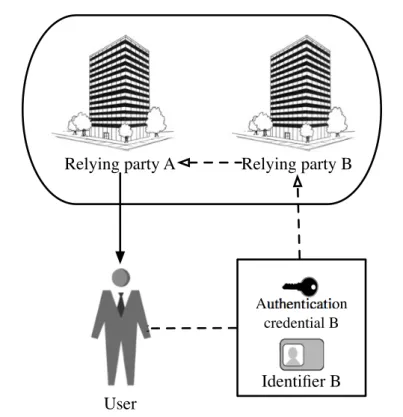
different identifiers owned by the same user in different domains thus linking these identities within the federation. This results in a single virtual identity domain where a user authenticated by a single identity provider using one of his identifiers, can be considered to have been identified and authenticated within all the other identity providers within the federation as well. This can be technically achieved by passing assertions between service providers. (see figure 2.1)
Sending an assertion does not require the users’ credentials. The acceptance of user access assertions from one identity provider to another is based on the trust established by the adherence to the circle of trust common policies. A federation of isolated identifier domains gives the client the idea that there is in fact a single identifier domain. The user can still hold separate identifiers for each identity provider, however, he does not necessarily need to know and manage them all. A single identifier and credential is sufficient for him to access all services within the federated domain and this can be used to provide a Single-Sign-On solution for the entire federation.
2.1.3.1 Shibboleth
Shibboleth [37] is a very popular, widely deployed and standardized single sign-on federated platform for the web. It has been developed in the United Kingdom by the Joint Information Systems Committee (JISC) to support federated identity management across all educational institutions. Shibboleth deploys a wide variety of standards, like for example the OASIS Security Assertion Markup Language (SAML) for attribute assertions, in order to provide a federated single sign-on environment and a secure attribute exchange mechanism for web applications.
In shibboleth, access control is based on a set of identity attributes provided by a trusted identity provider and a set of rules defined by the relying party the user wants to interact with. If the users’ attributes positively match the relying party’s rules, access is granted. The basic premise lies on the existence of a circle of trust, where the federated institutions trust the assertions provided by every member of the federation. Shibboleth main objective is to have everyone involved in the educational system (elementary school to higher education) enrolled into a wide circle of trust, in order to better promote the sharing of online educational resources.
2.1. RESEARCH METHODS 19
2.1.4
Centralized Model
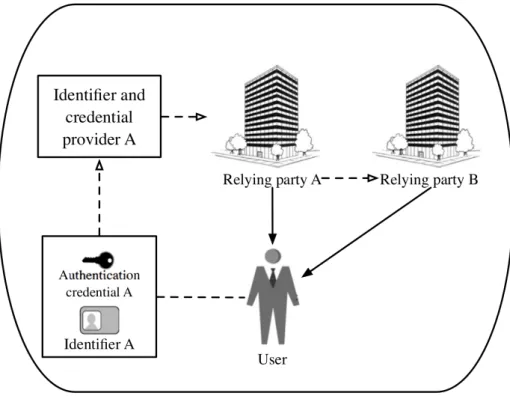
In centralised models, there exists a single identity manager that is used by all relying parties, either exclusively, or in addition to other security domains identity managers. The concept of single sign-on [6] was introduced by this model in order to create an integration solution for the still highly popular traditional based applications. There is only one centralized identity provider that is trusted by all the participating relying parties to manage the user credentials necessary to gain access to their resources. The user only needs to authenticate once to gain access to the services provided by the trusting relying parties. (see figure 2.2)
Figure 2.2: Single sign-on model example
This Single Sign-On scenario is very similar to the previously described federated identifier scenario, except that no mapping of user identifiers is needed because the same identifier is being used by every relying party. For example Kerberos based authentication solutions, where the Kerberos Authentication Server acts as the cen-tralised identity provider, belongs to this category (Kerberos was described in sub-section 2.3.1). We now proceed to describe other identity management solutions that may fall within this category.
2.1.4.1 OpenID
OpenID is an open standard for identity management and user authentication that was originally conceived to be deployed on an highly decentralized manner. The idea was to provide each user with the possibility of deploying his own OpenID identity provider and thus establish a truly user centric, massively distributed, self assembly identity infrastructure for the Internet. However it did not work this way. Big Internet identity providers like for example Google and Facebook started to employ OpenID as the SSO mechanism to uniform access to their own services. This resulted in the construction of massive OpenID based identity management systems with hundreds of millions of users that they then opened up for other relying parties, belonging to other administrative domains, to use. In practice this ended up transforming OpenID, the paradigm of decentralization, into a protocol that is nowadays mainly employed in the Internet to make use of the Identity services provided by Google or Facebook, in a truly centralized way.
The OpenID protocol [2] allows a user to sign-in into very distinct domains with the same OpenID identifier (a URL) and at the same time control what subset of his identity attributes will be disclosed to each one of the relying parties he logins to. In order for a user to be authenticated with OpenID at a relying party, he starts by having his browser redirected to his OpenID provider by the relying party, where he is then authenticated (usually by login/password). If the authentication process is successful the user is then asked to authorise the OpenID provider to disclose the identity attributes that are being requested by the relying party, after which the user is once again redirected to the originating requesting relying party where access is finally granted.
Unfortunately the full set of standardised and universally recognised identity attributes for OpenID is unfortunately very small. This decreases the usefulness of the protocol and has so far limited its deployment almost exclusively to the simple authentication domain. More recently the OpenID foundation has started to work on a new protocol named OpenID Connect [18] that aims to unify authentication and authorization into a single service protocol. This unification creates the right means for data access authorization and it is a firm step towards solving the issues resulting from a too limited set of widely recognized identity attributes.
2.1. RESEARCH METHODS 21 2.1.4.2 Microsoft .NET Passport
.NET Passport is a single sign-on identity management system developed for e-commerce by Microsoft, where email addresses have been adopted as the user main identifier. In .NET Passport, credential issuance and authentication are fully centralised operations under the strict control of the Microsofts identity provider.
Microsoft extended the centralized model with the creation of ”InfoCards” [38] (later named Windows CardSpace) in order to ensure a better level of security and trust be-tween the involved parties however in 2011 the Windows CardSpace was discontinued. Microsoft is currently working on a replacement called U-Prove [39].
U-Prove aims to provide a multiparty security (issuing organizations, users, and relying parties can protect themselves not just against outsider attacks but also against attacks originating from each other) and at the same time enables customized privacy settings (including authenticated anonymity and pseudonymity).[40]
2.1.5
User Centric Models
User centric identity management is currently a hot research topic. Its main objective is to empower users by returning control about who can access their personal data back to them, the truly legitimate data owners [41, 12]. User centric identity management models provide the users with the means to effectively decide who can access their identity data. The whole process is based on having an identity manager receiving requests for user attributes made by the data requesters, the relying parties, for which the user is then provided with the means to choose the most appropriate subset of identity attributes to disclose. This gives end users more privacy control and at the same time more responsibility over their own choices.
For example Figure 2.3 illustrates a user centric scenario where users can store and manage their identifiers and credentials, from different service providers, with a smart-phone. The user decides which identifier and identity attributes will be deployed to the a service provider and then inserts a pin to authorize the operation.
2.1.5.1 Higgins
Higgins was initially known as the Eclipse Trust Framework[42]. Its main objective is to establish a software layer that can be built upon and expanded with other
Figure 2.3: Smartphone user centric model
components and adapters. The Higgins Project splits identity information into small blocks of data, known as i-cards, which can then be directly controlled by the user and are meant to replace traditional password-based login systems.
I-cards can be created by mixing different digital identity data from different domains. By mixing these different contexts, data aggregation is accomplished and interoper-ability between distinct domains is thus established. The Bridging contexts is done by a user agent operated by a browser extension and the Higgins card selector service. Since the users’ data is directly processed at the user agent, the browser, identity information does not need to be shared with a trusted third party and interoperability can be reached by just having the user fully managing his own data.
2.2
Attribute Aggregation
Attribute aggregation is the process of acquiring identity attributes from multiple distinct identity providers and Attribute Authorities (AA) in a single session. An AA is an entity responsible for the security, management and disclosure of users data. The users attribute aggregation deployment scenarios can be quite involved and
com-2.2. ATTRIBUTE AGGREGATION 23 plex and we where therefore required to first delve into a more comprehensive ex-ploratory explanation of the different ways this has been described in the literature to better understand the existing models and to start providing some answers to some interesting but difficult research problems like: How much personal information the relying parties/service providers (RP/SP) and Identity Providers should have access to ? Who should be responsible for the final aggregation of the users’ data? What authorizations and proofs are necessary to securely request a set of personal data? How can a RP/SP be sure that who provided the data is really its legitimate Attribute Authority ? How can the RP/SP know that a complete set of attributes relates only to one single identity ?
After a comprehensive research about what are the most popular and comprehensive user-centric attribute aggregation models, we came to the conclusion that the most relevant models are:
2.2.1
Client mediated assertion
Based on an intelligent browser user agent that guide the user to the different identity providers, obliging the users a high level of interaction by authenticate themselves on each identity providers. The browser user agent is responsible for the attribute aggregation and the attribute delivery to the requester relying party. In this model no relying party or third trust party is involved in order to request and aggregate the information its only based on browser technologies. [43]
2.2.2
Identity Federation model
Require a federated network in order to operate, during users’ authentication process, a secret is generated and shared between all federated identity providers by a user agent. The first contacted identity provider provides to the requester relying party the details of the others identity providers that falls into the federation thus establishing the necessary means to the relying party request the necessary attributes. [44]
2.2.3
Relying Party mediated attribute aggregation
Its based on the identity federated model however discards the necessity of a federated network. The relying party redirects the user-agent to each identity provider thus
obliging the users to a high level of interaction since the user has to authenticate himself in every identity provider. The browser user agent is the responsible for attribute aggregation thus requiring specifics browser based technologies. [45]
2.2.4
Identity proxying/chaining
The relying party has to fully trust in a single master federated identity provider that is responsible to request and aggregate all requested attributes before send it back to the requester relying party. In other words the master identity provider can request attributes from all others identity providers that are within its federation circle. This model have a low level of protection for user attributes since every intermediary identity provider must relay on credentials intended for a third party. This means create a possibility for a substitution attacks and as well as the possibility of an identity provider sending false authentication information. [46]
2.2.5
Identity Relay
The relying party trust in a single master federated identity provider that is responsible to request all attributes to the relying party, these attributes are returned directly to relying party, in other words relying party is responsible to aggregate the set of necessary attributes.
This model is like identity proxying but with a reduced level of trust on master identity provider since the attribute aggregation is done by the relying party. The master identity provider only redirect the attribute requests the others identity providers that answer directly to the relying party. [43]
2.2.6
Linking Service
In this model only the user knows about all his identity providers. A service called linking service is responsible to hold minimal information that allow relying parties to obtain their queries from different identity providers domains. After a user au-thenticates, the identity provider offers the possibility of attribute aggregation and if the user authorizes it, the information to access the linking service is shared with the relying party. The aggregation of attributes can be done by the linking service itself
2.3. IDENTITY MANAGEMENT COMMON STANDARDS 25 Table 2.3: Information Security Attributes
Key aspect Description
Confidentiality Information is shared only among authorised persons or organisa-tions.
Integrity Information is authentic, complete and can only be accessed or modified by those authorized to do so.
Availability Assurance that the systems responsible for delivering, storing and processing information are accessible when needed.
or by the relying party.
The linking service model offers a good level of privacy for user attributes, since all attribute assertions are signed by their sources, and users permission are requested in order to deploy the attributes. The relying party must have a high trust on the liking service node. [47]
2.3
Identity Management Common Standards
In order to establish the right means to guarantee key aspects of information security (see table 2.3) in identity management systems, several standards started to appear, some of them nowadays became essential tools in the deployment of identity manage-ment systems.
In this section we described the most common standards used in identity management systems and give a view of a new and still on development named OIX.
2.3.1
Kerberos
Kerberos is one of the earlier security standards developed. Kerberos is a secure method for authenticating a request for a service in a computer network. Kerberos was developed in the Athena Project at the Massachusetts Institute of Technology (MIT). [48]
Kerberos allows a user to request an encrypted ”ticket” from an authentication process that can then be used to request a particular service from a server. In Kerberos the users’ password is computed by an one-way hash function that is used as a symmetric key to read the ”ticket” provide by the kerberos server in order to establish the
authentication. Notice that the users’ plaintext password do not pass through the network.
2.3.2
Security Assertion Markup Language (SAML)
Security Assertion Markup Language is a XML-based open standard data format for exchanging authentication and authorization data between an identity provider and relying parties, in other words, SAML defines an XML-based secure framework for ex-changing identity information across security domains for purposes of authentication, authorization and single sign-on. [49]
SAML specifies four components (see image 2.4): (1) The assertion component where it is divided into three types: (a) the authentication assertion to validate the users’ identity, (b) the attribute assertion to hold specific attribute about the user, (c) and the authorization assertion to identify what the user is allowed to do; (2) the protocol component to defines how SAML requests for and receives assertions; (3) the binding component to defines how SAML message exchanges are mapped into standard messaging and communication protocols like HTTP, SMTP and also SOAP; (4) and the profile component describes in detail how SAML assertions, protocols, and bindings combine to support a defined use case, the most well known SAML profile is the web browser single sign-on profile.
Figure 2.4: Components of the SAML Specifications
2.3. IDENTITY MANAGEMENT COMMON STANDARDS 27 identity provider, and the service provider/relying party. In the use case addressed by SAML, the user requests a service from the service provider that requests and obtains an identity assertion from the identity provider. On the basis of this assertion, the service provider can decide whether to perform some service for the connected user. Before delivering the identity assertion to the service provider, the identity provider may request some identification or authentication from the user such as user/password login scheme in order to authenticate the user.
2.3.3
Extensible Access Control Markup Language (XACML)
XACML is an initiative to develop a standard for access control and authorization systems by defining a declarative access control policy language implemented in XML and a processing model describing how to evaluate authorization requests according to the rules defined in policies. In other words XACML not only processes the authoriza-tion requests, but it defines the mechanism for creating the complete infrastructure of rules, policies, and policy sets to arrive at the authorization decisions. [50]
In XACML the access requests, are sent to a Policy Enforcement Point (PEP), located at a web server, which creates a XACML request and sends it to the Policy Decision Point (PDP). The PDP determines the answer based on the existing policies in the policy repository and sends back its determination to the PEP. The response can be either access permitted or denied, with the appropriate obligations. Obligation is a directive that if applicable must always be carried on the authorization process.
2.3.4
Web Services Federation (WS-Federation)
WS-Federation [51] describes how the assertions transformation model inherent in security token exchanges can enable trust relationships and federation of services. This allows scenarios where authorized access to resources managed in one realm can be provided to security principals whose identities and attributes are managed in different realms.
Web Services Federation has mechanisms for identity brokerage, attribute discovery and retrieval, authentication and authorization assertions between federation mem-bers, and protecting the privacy of these assertions across federation boundaries. These mechanisms provide a basic trust model between identity providers and
de-pendent parties through Security, Trust, and Security Policy: (1) WS-Security is a communications protocol and is the component that allows secure access from web clients using HTTP or from web services clients directly. (2) WS-Trust is the component that defines the Security Token Service (STS) and the protocol used to request or issue a token. These tokens are generated from the assertions about an entity requesting a service, (3) and WS-SecurityPolicy describes the STS policies and its associated assertions.
2.3.5
Digital ID wallet
Digital ID wallet is an ITU-T international standard [52] that is a web-based digital wallet. It is employed as storage for private data such as addresses, users’ ID, and passwords. This standard follows the user-centric method diffusing the user empowerment concept facing the federated identity management systems that move the users’ control to the service providers and identity providers. The Digital ID wallet standard emerges to shift back the control to its right owner, the user.
This standard uses tokens as secret keys that are automatically created for each visited web site, which is stored in a client-based digital wallet. Thus, it is not necessary for users to memorize individual passwords. The Digital ID wallet enables the user to register and log onto a website, store personal information, and other data at any time. This approach is independent of the existence of a Certification Authority and is well suited to support mobile communication.
2.3.6
Open Identity Exchange (OIX)
The Open Identity Exchange [53] is a non-profit corporation serving as an independent, neutral provider of certification trust frameworks for open identity technologies. This means it follows an open market model to provide the certification services requested to guarantee the necessary levels of identity assurance and protection. In other words OIX is an open identity trust framework provider that provides certification in order to enables a relying party to trust the identity, security, and privacy assurances from an identity provider.
The OIX objective is to reduce the friction of using the Web by solving problems like: how does a relying party know it can trust credentials from an identity service provider without knowing if that providers’ security, privacy, and operational policies