What Top 25 Most Cited Jibs
Articles Can Tell us About the Firm’s
Internationalization Process?
Flávio Régio Brambilla1
Abstract
This paper aims for a theoretical approach based on the top 25 most cited articles published in the Journal of International Business Studies (Jibs). Based on a list made by the editorial board of Jibs, throughout the Web of Science, in early 2009 a list was developed observing citations in other articles, without self citation that was removed from the final sum. The compilation is presented in this paper in an analytical approach, to explore this content contribution. The list is composed by 26 titles, because equal number of citation in 25th position. To improve the results, some additional articles
are added in this paper. The object of this study is raleted to international business studies, and the objective is to present the content from the articles that compose the list, establishing an analytical relation among papers. The purpose is to find some commom sense theoretical discussion and to explore the complementary nature of papers, to help academics in the understanding of the field.
Keywords: Analytical Literature Review. International Business. Internationalization. Market Choice. Strategy.
O QUE OS 25 ARTIGOS MAIS CITADOS DO JIBS PODEM DIZER DO PROCESSO DE INTERNACIONALIZAÇÃO DAS FIRMAS?
Resumo
Este artigo tem por objetivo uma abordagem teórica baseada nos 25 artigos mais citados publicados no Journal of International Business Studies (Jibs). Baseado em lista feita pelo comitê editorial do Jibs, mediante consulta na Web of Science, no começo de 2009, a lista foi desenvolvida observando citações em outros artigos, desconsiderando autocitações que foram removidas da soma final. A compilação é apresentada neste artigo de modo analítico, para explorar a sua contribuição. Esta lista
1 Doutor em Administração pela Universidade do Vale do Rio dos Sinos (Unisinos). Professor do Programa
de Pós-Graduação em Administração da Universidade de Santa Cruz do Sul (Unisc). flaviobrambilla@ terra.com.br
está relacionado com a área de negócios internacionais, e o objetivo é apresentar o conteúdo dos artigos que compõem a lista, estabelecendo relações analíticas entre as obras. O propósito é encontrar teorias de senso comum na discussão e explorar a natureza complementar entre estes artigos, para auxiliar acadêmicos no entendimento do campo de estudo.
Palavras-chave: Revisão Sistemática da Literatura. Negócios Internacionais. Internacionalização. Escolha de Mercado. Estratégia.
There is a considerable difference between the first and the last paper of the top texts in Jibs. The number one was 709 times cited; the last ones 117. But, that is not the very important argument, which resides in the content differences of internationalization processes. Theories and modes of entry substantially vary across the development of the field, and frequent restatement of theories and steps to expand in international markets are revisited. Some of the theoretical implications, probably the most important ones, are commented in this paper, that focus in the clustering of that judged top studies in this arena. This study was developed to discuss the literature content of those papers and, at the end, explore some theoretical conections that can better explain the general dynamic of international business.
The Jibs (2009) editorial team readapted the past top 20 list to a new top 25 wich summarizes titles that represents the essence of this Journal pu-blication. In the website of the publication, the direct criteria to this ranking is elucidated when was written that, after the time citation search every paper “was then examined for self citations and those citations removed to verify the paper would still be in the top 25” list (Jibs website, 2009). This paper is composed as the steps described. At first, this introduction. As a second step, the direct and objective summary of methodological approach followed. Then, a general consideration about the top 25 list papers subject and about the production’s content. As well, is presented a “summary table” which comprises general ideas of each text separately. The table is followed by the main approaches about internationalization process, and other pos-sibilities in terms of categories to act in external markets. The categories considered are labeled as: Nordic or Uppsala School based; The Eclectic Paradigm; Transaction Cost Economics; Network cooperation’s approach; and, International Market Orientation (Marketing based processes to expand operations abroad). Than, an analytical section to discuss the relationship among papers and authors (contributions from the approaches).
In the final considerations, contributions and limitations of this paper, and ways to expand the investigation for future research activities, based on literature content. The initial pupose of this paper was the identification of theoretical contribution of the list, but in the development was identified that the relationship among papers and ideias can contribute better to the understanding and evolution of this fild. More than a literature review, the study was conduced to a discussion of the relationship among authors’ ideias and different schools o thought for the field of international business studies.
Methodological Procedures of Analysis
In general overview, the methodological procedures adopted in this research are simple. That doesn’t mean that the contributions are superficial. The option to consider the top 25 papers proposed in Jibs (2009) website list supposes that the main content in internationalization in this top journal is represented. One of the evidences is that the pioneering paper in that research stream, the seminal Johanson and Vahlne (1977) still the first more relevant. Equally is observed as the list is revisited, and that presumption validated the manner that the main works of this paper are included. Other works are included after, based on the topics that are considered to analyze the internationalization possibilities.
Mainly this study is about a literature review. But, the purpose is a systematically and analytical sequence of review, including other elements that could enrich the contributions. In the next section, about articles’ explo-ration, connections are established between the papers and authors’ ideas, that in the subsequently section, are organized in groups of possibilities to the entry procedures in the international market.
Even simple, this study follows some steps to be observed. The papers list for analysis was selected based in the Jibs methodology of classification. In the second selection of studies, considering the resear-cher knowledge, was choosed other subjects considered important for the
international markets action. The additional categories were Network Alliances/Cooperation and Market Orientation (from Operations Manage-ment and Marketing areas). The analyses were developed in a qualitative approach, by the author, reading paper from paper in a complete content format. Each paper that was read were cathegorised in schools of tought based in the researcher expertise, based in argumentation and content si-milarities. In the session called discussions the relationship among papers were improved to look for similarities and differences among the studies (academic directions).
The objectives of this paper are two, literature review and con-tent analysis. The literature was classified by theoretical schools of tought from the international business area. In the second moment, the researcher discusses the conections among those papers. The paper was systemized basically by similarities and differences analyses from papers subject.
Journal Articles General Considerations
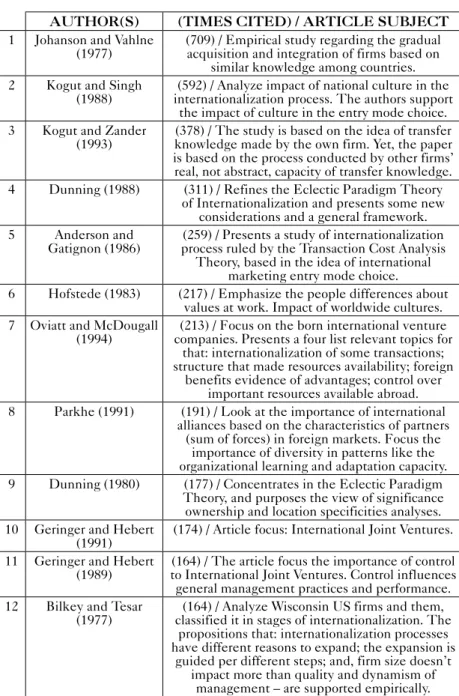
As a first step on this section, the individual check in the papers was conducted to clarify the main purposes of each research. Analyzing the text content, a general characteristic of each one was established, and presented below in “Table 1”. The information is posed in order of ranking, presen-ting authors, year of publication, times cited and main goals. Secondly, the connections between those 26 papers are established, to final observations about the number of articles per author in the list and the number of au-thors per article. Mainly, this kind of simple observation can drawn general characteristics of the body of academics in this area. For example, “Table 3” illustrates partnership in research.
Table 1 – Exploring the 25 top Jibs articles general content
AUTHOR(S) (TIMES CITED) / ARTICLE SUBJECT
1 Johanson and Vahlne
(1977) (709) / Empirical study regarding the gradual acquisition and integration of firms based on similar knowledge among countries. 2 Kogut and Singh
(1988) internationalization process. The authors support (592) / Analyze impact of national culture in the the impact of culture in the entry mode choice. 3 Kogut and Zander
(1993) knowledge made by the own firm. Yet, the paper (378) / The study is based on the idea of transfer is based on the process conducted by other firms’ real, not abstract, capacity of transfer knowledge. 4 Dunning (1988) (311) / Refines the Eclectic Paradigm Theory
of Internationalization and presents some new considerations and a general framework. 5 Anderson and
Gatignon (1986) process ruled by the Transaction Cost Analysis (259) / Presents a study of internationalization Theory, based in the idea of international
marketing entry mode choice.
6 Hofstede (1983) (217) / Emphasize the people differences about values at work. Impact of worldwide cultures. 7 Oviatt and McDougall
(1994) companies. Presents a four list relevant topics for (213) / Focus on the born international venture that: internationalization of some transactions; structure that made resources availability; foreign
benefits evidence of advantages; control over important resources available abroad. 8 Parkhe (1991) (191) / Look at the importance of international
alliances based on the characteristics of partners (sum of forces) in foreign markets. Focus the
importance of diversity in patterns like the organizational learning and adaptation capacity. 9 Dunning (1980) (177) / Concentrates in the Eclectic Paradigm Theory, and purposes the view of significance ownership and location specificities analyses. 10 Geringer and Hebert
(1991) (174) / Article focus: International Joint Ventures. 11 Geringer and Hebert
(1989) to International Joint Ventures. Control influences (164) / The article focus the importance of control general management practices and performance. 12 Bilkey and Tesar
(1977) classified it in stages of internationalization. The (164) / Analyze Wisconsin US firms and them, propositions that: internationalization processes have different reasons to expand; the expansion is
guided per different steps; and, firm size doesn’t impact more than quality and dynamism of
13 Dunning (1995) (149) / Reexamine the Eclectic Paradigm Theory and the alliances’ impact, interdependencies and assets based on the regions, nationally and in external market, based in interdependencies. 14 Agarwal and
Ramaswami (1992) (149) / The research are oriented to the possible entry modes in external scenario. The bases are three categories: acquisition, local advantages and
advantages of integration. Interactions matter. 15 Kim and Hwang
(1992) considerations to choose entry modes, and (144) / Concentrate in global strategic proposes and test an Eclectic framework. 16 Dunning (1998) (140) / Past scenarios considerations, and them,
implications from site and investments abroad. Considerations: importance of intangible assets; adequate use o local assets; knowledge structure. 17 Bilkey and Nes (1982) (138) / Effects related to “country of origin”
products in the international market. 18 Lyles and Salk (1996) (129) / They explore the knowledge acquisition
from international partners or operation’s sites abroad (in joint ventures). The relationship between knowledge acquisition and performance
is supported; also that between organization’s characteristics and knowledge. 19 Andersen (1993) (128) / Propose measures related to evaluations
of a firm’s performance in international market. Explains the initial process’ internationalization. 20 Rosenzweig and
Nohria (1994) (122) / Identify that human processes’ are close related, or quite the same, between local and international operations of a firm. Then, they tend
to differ for the adaption to different scenarios. 21 Black (1988) (121) / Examine the expatriation phenomena, and
the work role transitions. Help to the adaption and clear job descriptions facilitate adjustment abroad. 22 Patel and Pavitt
(1991) technological initiatives) that, sometimes, the (120) / Mentioned cases (like large firms of best option is no expanding operations to external
markets. The main conclusion is that, if the fundamental resources are available local, the firms
doesn’t need to expand globally. 23 Beamish and Banks
(1987) Enterprises” that is supported by the transaction (119) / They present a “Theory of Multinational cost paradigm. Also compare differences between
owned subsidiaries and joint ventures. Authors concludes that, in some cases, is better joint ventures than international direct investments.
24 Shenkar (2001) (117) / Work that seeks to refine the cultural distance construct in international operations. 25 Sullivan (1994) (117) / This work aim to a positivistic and
instrumental scale to measure the degree of internationalization reached by a firm. 26 Bonaccorsi (1992) (117) / The results falsify the view that firm size
is positively related to export intensity ever. In the author word’s, internationalization process and “competitiveness of small firms is much more based on general competitive factors, like product quality, than on explicit marketing strategies and
policies” (Bonaccorsi, 1992, p.631). Source: Author.
Uppsala or Nordic School and considerations
about internationalization
To a more dense considerations, the first comments drawn over the top paper in the list, coincidently, one of the creators of that research stream line. The conceptual understanding is that a firm, entering international market, develop operations abroad throughout acquisition, integration and knowledge based attitudes gradually, or an orientation made step-by-step (Johanson; Vahlne, 1977). That orientation presumes that an external market operation is an extension of domestic market. The sequence of actions begins with export activities driven by local agents, subsidiaries and lastly, production abroad.
Knowledge about operations and country of entrance is imperative to reach success. Parallel attentions to national cultures and to the ways or modes of entrance are considered in other authors’ research (Kogut; Singh, 1988). Continuing the idea, in another Bruce Kogut’s text, Kogut and Zander (1993) claims to the transfer of knowledge gradually, trough proper plants in the country of entrance, similar to the steps of Uppsala or Nordic School (Johanson; Vahlne, 1977). Coincidently, those papers are the top in the citations’ list.
Again, the Uppsala School rules that first step in international markets are made in similar markets, to reduce the psychological distance among countries. Incremental in nature, the experience in that theory matters. To that kind of experience, Johanson and Vahlne (1977, p.28) clas-sified as “experiential knowledge”, acquired gradually in external market activities.
Hofstede (1983) conceptualize values in the international action. Mainly, the author considers differences in national cultures. That assump-tions, national culture and knowledge gradually experienced (experiential knowledge) are closer patterns in international market actions. Observance about origins and local traditions matter to adaption in external scenario. Distance among cultures is still discussed in Shenkar (2001) that refines the cultural distance construct. To reduce the cultural distance, the author analyzes the issues related to globalization and integration (enhancing communications and interactions); geographical proximity (that represent a set of lower costs advantages); foreign experience (related to human resources experiences); acculturation (increased by time abroad); cultural attractiveness’ (related to interests in the external culture of the partner); and staffing (familiarity in the cultures involved in external processes facili-tate the operations, in other words, if the individual is global in knowledge and attitudes, tend to perform better across different scenarios and cultural differences as well).
Empirical evidences are discussed in the work of Bilkey and Tesar (1977), specially changing the understanding about firm size impacts in in-ternational markets. The stages of inin-ternationalization are considered. For the authors’ “the export development process of firms tends to proceed in stages” (Bilkey; Tesar, 1977, p. 95). They concluded that size-range of the firm are less important than the general quality and the management dyna-mism. Bilkey and Nes (1982) face the effects related to “country of origin”, or “made in effects” that bring implications for exporters. The relationship between reputation and expenditures is lightened, and supports that lower
the reputation of origin, higher the investments to consolidate the product abroad, or lower the value perceived by the foreign consumers. Contrary, the higher reputation, the less is needed to a successful firm campaign abroad. The next section of this paper, contemplate another stream of research, related to the Eclectic Paradigm.
The Eclectic Paradigm of international market actions
The most important person in that stream of thinking is John H. Dunning. He is the author more visible in the top list of Jibs, alone in the head with four articles. The fourth position, for the first one, reveals a ta-lent in that research perspective. A bad notice is that he died recently, as communicated by the Jibs (2009) home-page (mentioned as a top scholar).
In the first pace of his idea about the international market operation, Dunning (1980) proposed the Eclectic Paradigm Theory. The first claim in his work is that exists “a consensus of opinion that the propensity of an enterprise to engage in international production […] rests on three main determinants”, assets differentiation, possibility to use that resources inside company or selling it and, the advantages to explore that assets abroad in a better way than in domestic market (Dunning, 1980, p. 9).
Dunning (1988) refines the 1980’ work, and proposes a widely framework to the identification of factors that impact in the entrance and growing in international markets, looking to the operations of the firm in productive plans abroad. Six directions are proposed: [1] a more formal de-velopment of the paradigm, which can use game theory and net analyses in a supportive way; [2] made abroad, in terms of production processes, based in dynamic actions and development perspective (looking to the growing of host country, more than specific development of firms / considering economic tools); [3] understanding the different mechanisms of international economic involvement, intangible assets, rights, local resources and the possibility to acquire within the chosen country, best price resources than in home market.
Yet, [4] the locus of decision making process (geographical considerations: where? and what?); [5] divestment, or reversion of investments, related to the quest about reasons for acquire or for sell assets in international operations, and; [6] consequences of international operations (mainly in multinational firms) – economic impacts of operations in the chosen country and in the home country, considering also governmental perspectives.
In his next work, Dunning (1995), the Eclectic Paradigm is refined, and the impact of alliances comes to discussion. Interdependencies are considered as extremely relevant issue to international operations. The perspective of co-operations is discussed in a broader sense in the 3.4 ses-sion that resides in networks and alliances in international actions. For the author, at that moment, many questions about partnerships remain in the black box of operations.
Finally, in the paper of Dunning (1998), past experiences are again discussed, and the importance of the intangible assets, adequate use of the local assets and, about the knowledge structure comes to light. Related to the intangible assets, the intellectual capital is the relevant issue, especially in terms of distribution to a variety of important locations. About the local assets, the discussion rounds the core competencies, and the creation of assets, not excluding macro-firm policies, local benefits and government influence. Knowledge creation and knowledge dissemination includes the interdependence factor in the analysis.
Kim and Hwang (1992) focus in the entry modes basing in a pro-posed and tested framework in the eclectic paradigm perspective. Global strategies are part of their interest. Basically, the framework focus in entry mode decision in international market, impacted by global strategic variables (global concentration, synergies and strategic motivations), and by ambient/ environmental variables (risks in the foreign country, location differences, demand uncertainty and the intensity of competition). That composition will be considered in the decision of transaction adequate variables, related to know-how of the firm and its tacit nature of this know-how. The empirical
analysis confirmed the indicators and results in a Manova tests that indica-tes “overall differences in the profiles of the three distinct entry modes of licensing, joint venturing, and wholly owned subsidiaries” that composes the proposed and tested eclectic framework (Kim; Hwang, 1992, p. 50).
Transaction Cost Analysis Theory
The work of Anderson and Gatignon (1986), basically presents a framework for international entry market action, based in the Theory of Transaction Cost Economics. Bases the entry decision making, level of control of the firm and choose of the better alternative to initiate external action. Comprise firm characteristics, their products and an environmental analysis. Control is related to the ability for influence systems, methods and the decisions, indicating when the firm needs to catch control and the risk management. Control and risk exerts a balanced influence in the decision making international processes. More control provides autonomy, paradoxically higher levels of risk as well. Tradeoff between these varia-bles defines the modus operand of resources employed. As main topics for Anderson and Gatignon (1986) control, risk and flexibility rules that logic of transaction costs analyses.
Also, the external market experience can improve control, and this action could generate higher levels of capacity and efficient results. Brand increasing the power abroad is an example of experiencing the expansion of value in international scenario. Less control is related to simple products, and the authors recommend greater control to complex products. Control as a variable relates also with country risk rankings, economic variations, constant changing scenarios and risk/return over investment (ROI) balance. That inconstant vision only appears in transactional analyses, an important idea (Anderson; Gatignon, 1986).
A year later work by Beamish and Banks (1987), also focus on tran-saction costs issue. They center in multinational enterprises, and comparing direct investments and joint ventures, they conclude that in some cases are much better alliances than acquisition. In authors’ words, in approximation to Dunning Eclectic Paradigm ideals about internationalization, they men-tioned that in some circumstances is a better alternative “the appropriateness of joint ventures in place of wholly owned subsidiaries” (Beamish; Banks, 1987, p. 13).
General considerations about Transaction Costs are made by Jones (1997) where are mentioned the relations between costs, in temporal and inherent dimensions, as factors that influence in the firm equilibrium. The behavioral organization is considered as important. Wernerfelt (1984) emphasized the dual nature of resources and products, that impact also in the Transaction Costs Theory. For him, resources combinations generate different products.
Network cooperation and international alliances
In this line of thinking, for Parkhe (1991), differences among par-tnerships and learning management orientation guides a firm to sustaining longevity in operations. Global Strategic Alliances “represent a type of competitive weapon, in that they involve interorganizational cooperation in the pursuit of global competitive advantage” (Parkhe, 1991, p. 598). The author claims to a sum of forces between partners as a strategy to act in foreign markets. That presumption assumes that diversity impacts positi-vely in organizational patterns trough adaptive capacity and organizational learning increased by the relationships nature of sharing knowledge. Also resources could be shared in international and local alliances.
In a similar stream, for Agarwal and Ramaswami (1992), the in-teractive position matter in external market actions. Regarding possible entry modes abroad, authors based the research in three main categories
(acquisition process, local advantages and, integration). Of course, also the integrative way looks to advantages enhanced trough specific partnerships. The authors suggest that it is a necessary component the interrelations to entry market actions.
Lyles and Salk (1996) explores the knowledge acquisition from international alliances or partnerships. This research focuses specially in the joint venture context, and identifies relationship between knowledge acquisition and increased performance. Among companies, characteristics of business and about knowledge also are shared, providing better actions. As authors words summarize, the “results indicate that knowledge acquisition, particularly in shared management international joint ventures, is related to cultural conflict and to articulated goals” (Lyles; Salk, 1996, p. 899).
Providing a deeper and clear understanding about cooperation/ alliances, a non Jibs list articles complementary literature is presented. First, regarding Miles and Snow (2007), that from strategy migrated to research in alliances. For them, networks in multiple scopes provide new strategic decisions, and new structures to act in the (international) market. The flow of knowledge and expertise provides gains in capacity and change de value relations. Collective efficiency is required to a firm acquire the ideal compe-titiveness in new markets (Fleury; Fleury, 2003). Cost reduction is another implication that favors the network cooperation, providing to parts (firms that share resources) efficiency derived by the supply chain connections (Srivastava; Shervani; Fahey, 1998).
Networks, in economic perspective, Samuels (2004), imply a strategic firm alliance that provides better comprehensiveness and social mechanisms for supporting business survive. The supportive help among firms, also be-tween competitors, promotes the strategic possibilities to succeed nationally or worldwide (Axelrod, 1990). Also in the poorest markets, cooperation structures could promote adequate and differentiated market values, as
illustrated by the Prahalad’s (2005) book regarding third world successful cases. Sociological analysis developed by Castells (1999) regards networks as social and business structures.
One of the main authors in that kind of structure, Jarillo (1988), desig-nated as “strategic networks” enterprises that engages in partnerships that results in simultaneous cooperation and competition processes. Competitive advantage is a horizon to reach, based on the partners’ capacity to compete with external partnerships in other industries or individual competitors in same segment. Resources and information need to be shared among part-ners based on trust, which implies in the real acquisition of value between partners and an expansion in the market action (Ebers, 1997). In Perrow’s (1992) view, especially to small firms, the network alternative results in a value added acquisitions, that depends on levels of trust among partners to be effective. Ebers (1997) shared that same idea about small firms’ en-gagement in networks cooperation alternative. A pair or a network of firms could promote relationships that are propitious to an adequate market ac-tion. Recurrent excellence in a network setting could provide a sustainable competitive advantage (Dyer; Singh, 1998).
Two possible results to network cooperation are defined by Human and Provan (1997), respectively transactional and transformational. The transformational one is related to innovation, and for that kind of initiative there is no best way to innovative firm actions (Chesbrough, 2003). Know-ledge sharing is part of this arena (Miles; Snow, 2007). More than external factors influence, environmental relations also impact in the networks orga-nization. In fact, there is a mutual influence between the network and the environmental conditions, and both exert pressures that change the market conditions (Rothwell, 1995). As a practical example of network forces, Dyer and Nobeoka (2000) mentioned the Toyota case, in that the transfer of knowledge between the central firm and its partners configures an example that leads to the future of competitive scenario in the automobilist industry. The difficulty in identifying knowledge, partnerships and assets (tangible
and intangible) in the forces of a network, as the ambient adaptation is what Granovetter (2007) conceptualized as embeddedness, that represents the difficulty to identify variables outside social contexts. The main implication is that metrics must be considered to the measure of the real phenomena.
Shi and Gregory (1998) mentioned the international production networks, dynamics in nature, as new manufacturers that improve the tech-nical orientation considering mission, structure, production and distribution capacity, processes design and productive methods. The result is a more collaborative interaction, with density and effectiveness. Miles and Snow (2007) put in that discussion the importance of trust suppressing contract to a more flexible capacity to adequate market needs and mutations. Individual efficiency not composes a differential situation in front of the new form of strategy based collective efficiency promoted by alliances (Fleury; Fleury, 2003). For the authors, there are two main kinds of networks: [1] alliances, based in cooperation that maintains autonomy of partners, that constitutes a set of negotiations among partners, and; [2] supply networks, rational based approach in that the firms analyze the tradeoffs in the relationship between enterprises.
Partnership with external firms is a possibility, but not a unique alternative. A resource in international operations is the possibility to share knowledge among firms that composes the same group of enterprises. In emerging markets is a common alternative that kind of learning-based ac-tion (Elango; Pattnaik, 2007). For all alternatives available in internaac-tional network approach, the main presumptions reside in the notion of trust and cooperation among partners, the basilar concepts (Oviatt; McDougall, 1994). But, as postulated by Shi and Gregory (1998), the international market initiative, require the sense that internationalization is composed by more than a set of national markets. The common purpose to expand operations in external markets resides in the search for high quality differentiation, fast product introduction, flexibility, faster market response and other benefits
that drive the firm to the construction of a sustainable competitive advantage in global market (Shi; Gregory, 1998). Learning and adaptive capacity are part of these firm search.
Integration is more than aggregation, states Shi and Gregory (1998), because networks constitutes a place propitious to the development of new knowledge. Integration resides in synchronization among partners to reach better results in global perspectives.
Firm size is other factor in discussion. The business size importance is evident but, constitutes only one criteria to act in outside market, and isn’t a determinant of international success. An enterprise could begin in-ternational, small size, and prosper. Not necessarily need to act step-by-step as stated by Johanson and Vahlne (1977). Networks could provide to small firms compete globally, as exemplified by Rabellotti (2003) in an examina-tion of Italian’ shoes clusters. Hybrid structure and the sharing of resources and complementary assets promote the mutual benefits around partners, a classic element in cooperative structures (Oviatt; McDougall, 1994). The possibilities to direct action in international markets and the cooperative hybrid structures, changes the very traditional nature of markets.
The capacity for changes, in the sense of adaptation, provides to a firm competences to act in international scenario. Specially, that aims to be flexible to adapt core competencies in time to still attend the external market in that an organization operates (Shi; Gregory, 1998). Mobility also configures the advantages in external markets. Capacities as mentioned above will positively drive the firms to restructure adequately their networks in international ac-tions. The processes of adaptation configure a continuum for competitiveness. Also based in small firms, but in front of emergent markets, Elango and Pattnaik (2007), mentioned that emergent markets are formed by countries that are experienced fast development in economic arena, and the institutions (specially economics), become more adaptive to act as firms that cultivate the ideals of open (and competitive) markets. Oviatt and McDougall (1994) also mentioned the small firms’ importance, and the possibility to start internatio-nally. Differentiations and partnerships provide these international operations.
Firms that emerge in international markets directly, the ones that don’t start operations as recommended by the incremental school, are de-fined as born global enterprises. Before one year born enterprises that start operations abroad, also are classified as born global firms, because they do not mature operations in local markets before internationalize operations and partnerships (Oviatt; McDougall, 1994). One of the factors that support that possibility is the competencies generated by previous knowledge and strategies directed by that kind of possibility. The new logic for globaliza-tion also provides support to act globally, specially the improvements in technology and communications (Fleury; Fleury, 2003). This idea supports the individual and the network structure to a firm operates externally. But the network firms’ structure, as happens in computer networks (for exam-ple), allows the concentration of capacities in the system, which provides a better set of resources (Shi; Gregory, 1998). The coordination structure is a fundamental decision to successful action.
More than the partners’ interaction, the dyadic relationship between vendor and seller in the networks, or network and their suppliers, composes the relationship spectrum of the international cooperative market action (Chen; Paulraj, 2004). That configures more than economics, more than transactions, but a constant search for knowledge superior than that acquired by the international (and local) competitors (Oviatt; McDougall, 1994). In front of the important knowledge use, internationally, many firms’ aim to act market oriented. The international “marketing” orientation bases activities in the knowledge of customers.
International Market Orientation:
a marketing based approach
Quality, consistence and better products that are supplied in perfect shape require a better coordination between suppliers and distributors (Mentzer et al., 2001). In this sense, Fleury and Fleury (2003) mentioned that
the customer orientation resides in specific firms to adequately supplying the needs of their specific customers. Personalization and customization configures the main strategies in that kind of business segment. Generally, these strategic actions are derived to the services segment. That’s a kind of demand anticipation, and an action that resides in the knowledge about clients/consumers (strategic information). Intangible assets also mean a competitive advantage, to internal or external market action. As example, the brand name (and the brand power), that enhance proprietary characteristics’ that cannot be simple copied or developed without costs and uncertainty (Kogut, 1985).
Replicating their seminal work (Narver; Slater (1990): The Effect
of a Market Orientation on Business Profitability), Slater and Narver (2000), with additional variables, didn’t support the positive relationship between business orientation and profitability. But, the Market Orientation positive influence in the firm performance was supported, as in the past work, which provides eminence to the relevance to a firm act as a market oriented entity. Both researches, Narver and Slater (1990), and Slater and Narver (2000), support’s this finding.
The concept of Market Orientation states that is a kind of business culture that reach the excellence in performance trough the value creation for customers (Slater; Narver, 2000). This value creation needs to be superior to the values that competitors can provide. For Hunt and Lambe (2000), that’s a kind of a “bridge” between the business strategic posture and the organizational culture (the business philosophy). Simplifying that concep-tual background, Kohli and Jaworski (1990), states that Market Orientation means applying the Marketing concept itself. In general words, the Market Orientation is a Marketing direct implementation.
Slater and Narver (2000), questioned about the possibility to the Market Orientation generate a higher learning capacity. As believed in this paper, that orientation could provide knowledge, and a tool for that is the common scale use in marketing. Later in this session, the Experf:
Inter-national Market Orientation Scale is discussed. For example, the Market Orientation scale Markor, was refined in Matsuno, Mentzer and Rentz (2000), to improve the psychometric proprieties of the scale, what constitutes a knowledge improvement. A reason for those changes was new knowledge acquired, that provides to a new scale, called MO, more comprehensiveness for different strategies and higher or lower levels of Market Orientation, as an intensive regulated business posture (Matsuno; Mentzer, 2000).
The interdisciplinary integration also rises in that kind of business attitude. In this sense, the Market Orientation ideals could be viewed as a link between the Strategy and Marketing disciplines (Hunt; Lambe, 2000). Both focus cultural and sustainable advantage issues, and claim for a com-petitive advantage in the long run, not only in short direct results.
In the Kohli and Jaworski (1990) perspective of Market Orientation, three are the main constituents. First, the intelligence generation, that encompasses the Marketing formal and informal intelligence/information. Secondly, the intelligence distribution, or intelligence dissemination, that provides to a firm the capacity for market adaptation. Lastly the responsi-veness or actions for provide responses to customers. That third element is grounded in the two first constituents of Market Orientation. The authors, in Jaworski and Kohli (1993), presented antecedents and consequences of that orientation derived to the market perspective. As stated before in this research, the main results of Market Orientation are related to a better firm performance. As antecedents, stated by Jaworski and Kohli (1993): the higher decision management (and the risk aversion element); inter-firm dynamics (that encompasses conflicts and connections); organizational sys-tems (formalization, centralization, and payment system). As consequences of Market Orientation: employees (self and organizational compromise); ambience/environment (market turbulence, competition intensity, techno-logical continued changes); and mainly, the business performance increase (Jaworski; Kohli, 1993).
In the other hand, Narver and Slater (1990) propose a set of behavioral components that are conducted at same level of importance: [1] consumer orientation; [2] competitor orientation; and [3] inter-functional coordination, that together focus in the financial return in the long run. The connection point (integrative element) between Kohli and Jaworski (1990), and Nar-ver and Slater (1990), is the continuum. To a NarNar-ver and Slater (1990, p. 34) understanding, that focal point constitutes “an important first step in the validation of the relationship between Market Orientation and Performan-ce” attributes. After that prime register about market(ing) orientation, its capital to this study expands this orientation to the external market global orientation. For this aim, authors expanded that topic to the definition of External Market Orientation.
About internationalization in general, Rezende (2006) states that three dimensions are characterized in the external market processes. They are paradoxically “inter” as independent combined in space, time and in networks. The central concepts propose in that perspectives are: [1] unifor-mity (regularity in the external market processes); [2] direction (patterns of internationalization); and [3] rhythm (intervals: subsidiaries establishment; strategies; etc.).
A scale was developed to the understanding of the effects related to External Market Orientation. The Experf scale, developed by Zou, Taylor and Osland (1998), purposes a pattern to the measurement and for make comparisons between some indicators stated to the understanding of external markets. One of the advantages in that kind of scale is to measure different contexts and results based in one set of indicators (scale items). Two are the central characteristics observed: [1] macro policies (governments, economic regulations, laws, national grow, etc.); and [2] micro policies (firms, integration, complexity to operate externally, the success in a market is not a certain success in another scenario, etc.).
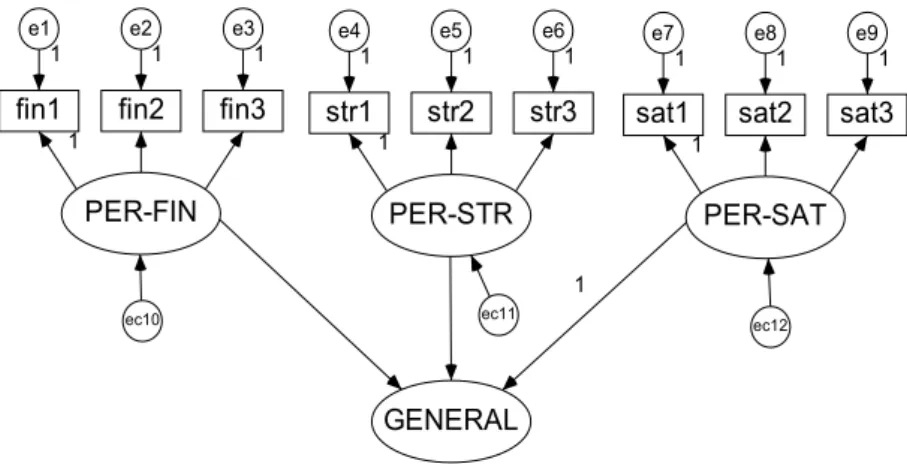
For exemple, Garrido et al. (2009), validate the Experf scale in the Brazilian context. This kind of validation is related to the Zou, Taylor and Osland (1998) claims to the need of validation in other markets (systemati-cally) to expand the capacity of the scale comparisons. The scale dimensions are: [1] financial; [2] strategic; and, [3] satisfaction. Below, is presented a structural model to better illustrate the international Experf scale adoption to the comprehensiveness for “Brazilian market export activities”. The fi-nancial, strategic and satisfaction factors performance generates the general export performance.
Figure 1 – Model of Export Performance – Brazilian Experf validation
Source: adapted by the author, from Garrido et al. (2009, p. 320) model.
Note that each factor is loaded by three items. As recommended by Iacobucci (2009), for the individual construct, in this case the first order constructs, need to be measured by three indicators (observed variables), and the kind of measurement must be reflective. As noted, General Performance is a second order construct measured by their first order relaters.
PER-FIN PER-STR PER-SAT
GENERAL str1 e4 1 1 str2 e5 1 str3 e6 1 sat1 e7 1 1 sat2 e8 1 sat3 e9 1 fin1 e1 1 1 fin2 e2 1 fin3 e3 1 1
The performance of individual constructs constitute the general export performance measurement, and the model tested is very close to the original proposed by Zou, Taylor and Osland (1998), but as mentioned below, not constitutes the unique alternative to measure the International Market Orientation General (and specific) Performance.
For example, Cadogan and Diamantopoulos (1995) developed a paper integration to the external market based on the seminal works made by Narver and Slater (1990), and Kohli and Jaworski (1990), trough the insertion of an international dimension to the main construct. Continuing this research, Cadogan, Diamantopoulos and Mortanges (1999) presented, tested and validated a new scale for International Market Orientation, the “External MO” scale. The dimensions proposed are: intelligence generation; intelligence dissemination; responsiveness; and, coordination mechanism. But, as stated by Cadogan, Diamantopoulos and Siguaw (2002) the “External MO” scale, still in the development stages. For example (scale innovati-veness), they found relations between the external market orientation and activities coordination.
Last articles comment from top Jibs selection list
For maintenance in the logical / analytical articles process, some papers not adequate to previous considerations are discussed in this mis-cellaneous session. Also some topics about the authors’ production of Jibs list are stated. In “Table 2”, is showed each author number of papers in the list, where if more than one author per paper both are considered in counting.
Table 2 – Number of articles per author in the Jibs top 25 most cited.
ARTICLES AUTHOR(S)
4 John H. Dunning
2 Bruce Kogut; J. Michael Geringer; Louis Hebert; Warren J. Bilkey
1 Andrea Bonaccorsi; Arvind Parkhe; Benjamin M. Oviatt; Daniel Sullivan;
Erik Nes; Erin Anderson; Geert Hofstede; George Tesar; Harbir Singh;
Hubert Gatignon; Jane E. Salk; Jan-Erik Vahlne; Jan Johanson; John C. Banks; J. S. Black; Keith Pavitt; Marjorie A. Lyles;
Nitin Nohria; Oded Shenkar;
Otto Andersen; Pari Patel; Patricia P. McDougall; Paul W. Beamish; P. Hwang; Philip M. Rosenzweig; S. Agarwal; S. N.
Ramaswami; Udo Zander; W. C. Kim
Source: Author.
As observed, John H. Dunning heads the list, and other academics vary from one to two contributions. In this set of papers all was written only per one or two authors.
Table 3: Relationship between the author’s and the article’s number
NUMBER OF AUTHORS NUMBER OF ARTICLES
2 15
1 11
Source: Author.
Andersen (1993) discusses performance evaluations abroad, which could be interesting to mix with Oviatt and McDougall (1994) that focus on born global resource assets and selection of adequate transactions to be made. Controversially, Rosenzweig and Nohria (1994) understand that humans are similar, and the changes are variations in scenarios. Geringer and Hebert (1989) focus control impacts on management and performance, that is continued in Geringer and Hebert (1991) related to joint ventures.
Expatriation is discussed by Black (1988) that recommends clear direct instructions that could be compared with Rosenzweig and Nohria (1994) propositions about human role. Sullivan (1994) proposes a scale to measure export level, and Bonaccorsi (1992) mentioned that firm size is not a central attribute. Defending that export is not the only way to prosper, Patel and Pavitt (1991) states that in some situations, local market actions are a better choice.
Discussions: Relationship among Papers
and Theoretical Connections
In general terms, the field of international business discusses two main subjects: theoretical issues and entry modes to foreign markets. The theory encompass all the issues related to culture, ways to understand the phenomena and gives support for the practical issues. The practical issues deals with the firms’ practices, and also build explanations for the ways companies go abroad. For example, in the Jibs list there is only one paper related to measurement, the work from Sullivan (1994), a scale to measure internationalization (something more usual in the marketing approaches).
The first considered group of papers aggregate studies related to ob-servation of the cultural aspects, as the initial works of Johanson and Vahlne (1977), related to gradual integration and gradual action abroad. The network papers, in some extent, also observe this kind of procedure. Following the Johanson and Vahlne (1977) paper, Andersen (1993), Shenkar (2001) and Rosenzweig and Nohria (1994) are guided by same principles, and a word stated by this last one means to much for this kind of international process: The world is “adaptation” to the markets.
The notions of networks and alliances are very close to the Uppsala school in many aspects. For example, one of the observed issues in this collaborative way to act is the cultural aspects. The work of Hofstede (1983) fits well to this kind of thought, because the impact of cultural values also
is very strong in alliances and networks cooperation systems. Parkhe (1991) make evident in his paper the importance of the notion of sum of forces for action in international business. In advance, Oviatt and McDougall (1994) mentions the notion of born international, something very difficult in prac-tical terms, but very related to the notion of culture. Kogut and Singh (1988) also fit to this way of thinking, mentioning the impact of national culture in international business, in line with Hofstede (1983) paper. Kogut and Zander (1993) continues this notion, expanding to the discussion for the transfer knowledge made by the own firm. This can be related to marketing practices in international settings.
The International Market Orientation (a Marketing approach) links some elements with cultural aspects. The value creation for the customers is an aggregative element (a typical marketing way of thinking that can contribute in the quality of international action). Basically the intelligence generation, dissemination and action (responsiveness) are knowledge and cultural valuable elements that fit with the ideas from Johanson and Vahlne (1977) in terms of knowledge and Hofstede (1983), related to cultural issues.
In line with the above discussion, specially related to networks and alliances, and also from the knowledge flows and cultural attributes, Geringer and Hebert (1989), Geringer and Hebert (1991) and Lyles and Salk (1996) deals with the structure of International Joint Ventures. This structure mixes elements from the initial schools of internationalization with some modern notion of cooperation and competition. As complementary papers, Bilkey and Tesar (1977) mention stages of internationalization, in line with Johanson and Vahlne (1977) study, verifying motivations to export. Agarwal and Ramaswami (1992) discusses the importance of interactions, Bilkey and Nes (1982) the effects of “country of origin” concept, and Black (1988) describes the importance of clear tasks for the international action. Patel and Pavitt (1991) are more dramatically positioned, mentioning to not going international if there’s no advantage.
Dunning (1980, 1988, 1995, 1998) and also Kim and Hwang (1992) are papers more oriented to a strategically oriented position in international business. The Eclectic Paradigm Theory considers many criteria from ope-rations management and strategy field itself, for example, intangible assets, local assets and structure knowledge. The notion of differentiation focus in the resources management perspective of action. Also focus in how to balance the domestic and the international actions. There is some similarities with the network perspective, that uses the cooperation as a way to reinforce the assets availability and the share of knowledge.
In an economic oriented notion, Transaction Cost Analysis Theory is the centrality for Anderson and Gatignon (1986), and Beamish and Banks (1987). The first paper clearly integrates this economic notion with Marke-ting. The second paper integrates the notion with alliances as a good option to act international. The balance among control and risk are very close to any way to go abroad, and the notion of risk is very clear for the Marketing area. The autonomy and risk are constructs that the marketing area deals with frequency. As this discussion shows, the different approaches to go international have more common features than the schools shows. Maybe this happens because all this papers assumes a single perspective of tough rather than an integrative approach (this paper discussed some of those links among the theories).
Figure 2 – Main relational aspects among International Business articles subject
Source: Author.
In “Figure 2” the approach of the analized papers are separated in two main groups, respectively cultural and practice oriented studies. The theoretical dominant papers and Uppsala School are located in the cultural group, because their action based in learning for a second practical step in international action. Networks, alliances and entry modes are a little beat more practical, even supported by knowledge foundations. The Market(ing) orientations, as position and the more economical based papers are oriented by practical situations. The figure doesn’t bring all the papers from the list, only the main studies by conceptual issues. The general discussion of the paper relationships in this illustrative representation follows.
As illustrated above, one of the cultural main perspectives deals with the Uppsala school of internationalization tought, represented by the Johanson and Vahlne (1977) seminal paper and following studies by other academics from this stream. Many of the Uppsala concepts are observed in the Network school, more practical in nature but with strong conection
with the culture of the contries when the subject is international alliances. Cultural values and culture itself are considered also in the cultural mindset, because the importance of the knowledge for the adaptation in the external markets. On the other hand, the practical studies are strongly oriented by position, as the Dunning’s work and followers in this paradigm of research. The economic oriented papers also are practical in nature, because the way they observe the market is based in variables in constant change and dynamics per nature. Discussed the classification of papers, final considerations are provided bellow.
Final Considerations
This research brings to light main characteristics of important studies concerning the internationalization process. In fact, Jibs is a considerable resource to study international operations management. The main contribu-tion of this paper is the referential argument that could be used to empirical examinations, or as a reference to new readers in this area.
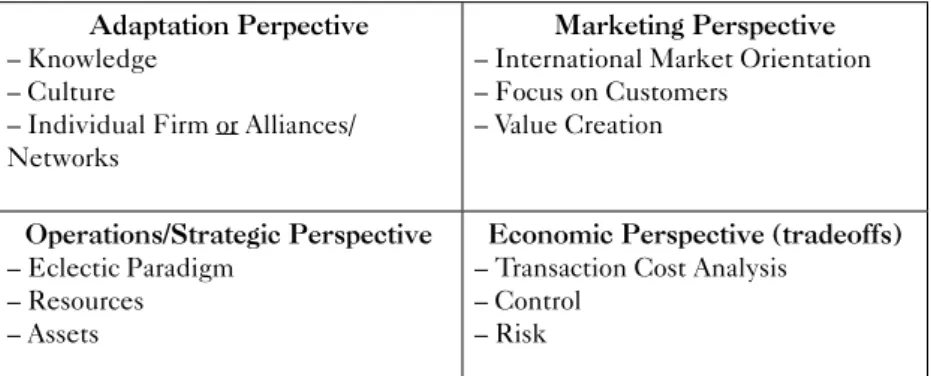
To conclude the general analysis, it’s possible to aggregate all the is-sues discussed in the papers list, and also from the complementary literature, in some constructs. This constructs share communalities among schools of thought. In this paper are separated in four groups that share many features and common ideas.
The cultural and knowledge aspects are triggers for the adaptation, and two papers that represents this line of internationalization is Johanson and Vahlne (1977) and Hofstede (1983). These papers can be seen as the individual adaptation that is strongly related to the networks and alliances approaches, which introduce the notion of collaborative action among firms (that’s a migration from individual to collective actions based in knowledge and cultural shared aspects).
The marketing theories also consider knowledge and specially the cultural elements. The International Market Orientation clearly is a different approach to deal with adaptation in international markets. The important additional notion is the focus in costumers, and not only in the firm. The value creation for costumers is and important and additional feature for this second classification.
The third group is related to the work of Dunning (1980) and latter papers. The Eclectic Paradigm Theory represents an approximation with operations and strategy management, considering the resources schools. The notion of assets is an important reference for the construction of the school.
Finally, the Transaction Cost Analysis Theory, based in Anderson and Gatignon (1986) and Beamish and Banks (1987) brings an economic view for the international business field. The main notion here is the tradeoff, and the pendulum extremes consider control and risk as a choice for the international action. More control can represents autonomy, but even can improve the risk. More flexible structures and partnerships can share the risk, but also there some consequences to assume. The “Table 4” summarizes the findings from this study.
Table 4 – Main elements for action in international markets
Adaptation Perpective
– Knowledge – Culture
– Individual Firm or Alliances/ Networks
Marketing Perspective
– International Market Orientation – Focus on Customers – Value Creation Operations/Strategic Perspective – Eclectic Paradigm – Resources – Assets
Economic Perspective (tradeoffs)
– Transaction Cost Analysis – Control
– Risk Source: Author.
As limitations, the difficulties about completeness of argument, in front of that quite extended literature. Complementary literature, on more detailed analyses is required. Also some metrics must to be observed in future studies, to link theory and practice.
For future research, the lastly articles discussion could be better explored, as well as the relationships between the papers from the Jibs list. The first step was done, challenging academics to still ahead and walks through that important theme.
References
AGARWAL, Sanjeev; RAMASWAMI, Sridhar N. Choice of Foreign Market Entry Mode: Impact of Ownership, Location and Internationalization Factors. Journal of
International Business Studies, v. 23, n. 1, p. 1-27, 1992.
ANDERSEN, Otto. On the Internationalization Process of Firms: A Critical Analysis.
Journal of International Business Studies, v. 24, n. 2, p. 209-231, 1993.
ANDERSON, Erin; GATIGNON, Hubert. Modes of Foreign Entry: A Transaction Cost Analysis and Propositions. Journal of International Business Studies, v. 17, n. 3, p. 1-26, 1986.
AXELROD, Robert. The Evolution of Cooperation. London: Penguin Books, 1990. BEAMISH, Paul W.; BANKS, John C. Equity Joint Ventures and the Theory of the Multinational Enterprise. Journal of International Business Studies, v. 18, n. 2, p. 1-16, 1987.
BILKEY, Warren J.; NES, Erik. Country-of-Origin Effects on Product Evaluation.
Journal of International Business Studies, v. 13, n. 1, p. 89-99, 1982.
BILKEY, Warren J.; TESAR, George. The Export Behavior of Smaller-Sized Wis-consin Manufacturing Firms. Journal of International Business Studies, v. 8, n. 1, p. 93-98, 1977.
BLACK, J. Stewart. Work Role Transitions: A Study of American Expatriate Managers in Japan. Journal of International Business Studies, v. 19, n. 2, p. 277-294, 1988. BONACCORSI, Andrea. On the Relationship between Firm Size and Export Intensity. Journal of International Business Studies, v. 23, n. 4, p. 605-635, 1992.
CADOGAN, John W.; DIAMANTOPOULOS, Adamantios; MORTANGES, Charles Pahud de. A Measure of Export Market Orientation: Scale Development and Cross-Cultural Validation. Journal of International Business Studies, v. 30, n. 4, p. 689-707, 1999.
CADOGAN, John W.; DIAMANTOPOULOS, Adamantios. Narver and Slater, Kohli and Jaworski and the Market Orientation Construct: Integration and Interna-tionalization. Journal of Strategic Marketing, v. 3, p. 41-60, 1995.
CADOGAN, John W.; DIAMANTOPOULOS, Adamantios; SIGUAW, Judy A. Ex-port Market-Oriented Activities: Their Antecedents and Performance Consequences.
Journal of International Business Studies, v. 33, n. 3, p. 615-626, 2002.
CASTELLS, Manuel. O poder da identidade. 6.ed. São Paulo: Paz e Terra, 1999. CHEN, I. J.; PAULRAJ, A. Towards a Theory of Supply Chain Management: The Constructs and Measurements. Journal of Operations Management, v. 22, p. 119-150, 2004.
CHESBROUGH, Henry W. The Era of Open Innovation. MIT Sloan Management
Review, v. 44, n. 3, p. 33-41, 2003.
DUNNING, John H. Location and the Multinational Enterprise: A Neglected Fac-tor? Journal of International Business Studies, v. 29, n. 1, p. 45-66, 1998.
______. Reappraising the Eclectic Paradigm in an Age of Alliance Capitalism. Journal
of International Business Studies, v. 26, n. 3, p. 461-491, 1995.
______. The Eclectic Paradigm of International Production: A Restatement and Some Possible Extensions. Journal of International Business Studies, v. 19, n. 1, p. 1-31, 1988. ______. Toward an Eclectic Theory of International Production: Some Empirical Tests. Journal of International Business Studies, v. 11, n. 1, p. 9-31, 1980.
DYER, J.; NOBEOKA, Kentaro. Creating and Managing a High-Performance Knowledge-Charing Network: Toyota Case. Strategic Management Journal, v. 21, p. 345-367, 2000.
DYER, J.; SINGH, H. The Relational View: Cooperative Strategy Sources Interor-ganizational Competitive Advantage. Academy of Management Review, v. 23, n. 4, p. 660-679, 1998.
ELANGO, B.; PATTNAIK, Chinmay. Building Capabilities for International Opera-tions through Networks: A Study of Indian Firms. Journal of International Business
Studies, v. 38, p. 541-555, 2007.
FLEURY, Afonso; FLEURY, Maria Tereza. Competitive Strategies and Core Com-petencies: Perspectives for the Internationalization of Industry in Brazil. Integrated
Manufacturing Systems, v. 14, n. 1, p. 16-25, 2003.
GARRIDO, Ivan Lapuente et al. A Escala Experf e os modos de entrada: uma pro-posta de mensuração de desempenho internacional em empresas brasileiras. Revista
Base, v. 6, n. 4, p. 312-327, 2009.
GERINGER, J. Michael; HEBERT, Louis. Measuring Performance of International Joint Ventures. Journal of International Business Studies, v. 22, n. 2, p. 249-263, 1991. ______. Control and Performance of International Joint Ventures. Journal of
Inter-national Business Studies, v. 20, n. 2, p. 235-254, 1989.
GRANOVETTER, Mark. Ação econômica e estrutura social: o problema da imersão.
RAE-eletrônica, v. 6, n. 1, p. 1-40, 2007.
HOFSTEDE, Geert. The Cultural Relativity of Organizational Practices and Theo-ries. Journal of International Business Studies, v. 14, n. 2, p. 75-89, 1983.
HUMAN, S.; PROVAN, K. Emergent Theory Structure and Outcomes in Small Firm Strategic Manufacturing Network. Academy of Management Journal, v. 40, n. 2, p. 368-403, 1997.
HUNT, Shelby D.; LAMBE, C. Jay. Marketing’s Contribution to Business Strategy: Market Orientation, Relationship Marketing and Resource-Advantage Theory.
International Journal of Management Reviews, v. 2, n. 1, p. 17-43, 2000.
IACOBUCCI, Dawn. Structural Equations Modeling: Fit Indices, Sample Size, and Advanced Topics. Journal of Consumer Psychology, p. 1-9, 2009.
JARILLO, J. Carlos. On Strategic Networks. Strategic Management Journal, v. 9, p. 31-41, 1988.
JAWORSKI, Bernard J.; KOHLI, Ajay K. Market Orientation: Antecedents and Consequences. Journal of Marketing, v. 57, p. 53-70, 1993.
JIBS. Journal of International Business Studies. Most Cited Jibs Articles. 2009. Available in: <http://www.palgrave-journals.com/jibs/most-cited.html>. Access on: 10 mar. 2009.
JOHANSON, Jan; VAHLNE, Jan-Erik. The Internationalization Process of the Firm: A Model of Knowledge Development and Increasing Foreign Market Commitments.
Journal of International Business Studies, v. 8, n. 1, p. 23-32, 1977.
JONES, S. R. H. Transaction Costs and the Theory of the Firm: The Scope and Limi-tations of the New Institutional Approach. Business History, v. 39, n. 4, p. 9-25, 1997. KIM, W. Chan; HWANG, Peter. Global Strategy and Multinationals’ Entry Mode Choice. Journal of International Business Studies, v. 23, n. 1, p. 29-53, 1992.
KOGUT, Bruce. Designing Global Strategies: Comparative and Competitive Value-Added Chains. Sloan Management Review, v. 26, n. 4, p. 15-28, 1985.
KOGUT, Bruce; SINGH, Harbir. The Effect of National Culture on the Choice of Entry Model. Journal of International Business Studies, v. 19, n. 3, p. 411-432, 1988. KOGUT, Bruce; ZANDER, Udo. Knowledge of the Firm and the Evolutionary Theory of the Multinational Corporation. Journal of International Business Studies, v. 24, n. 4, p. 625-645, 1993.
KOHLI, Ajay K.; JAWORSKI, Bernard J. Market Orientation: The Construct, Research Propositions, and Managerial Implications. Journal of Marketing, v. 54, p. 1-18, 1990.
LYLES, Marjorie A.; SALK, Jane E. Knowledge Acquisition from Foreign Parents in International Joint Ventures: An Empirical Examination in the Hungarian Context.
Journal of International Business Studies, v. 27, n. 5, p. 877-903, 1996.
MATSUNO, Ken; MENTZER, John T.; RENTZ, J. O. A Refinement and Valida-tion of the MARKOR Scale. Journal of the Academy of Marketing Science, v. 28, n. 4, p. 527-539, 2000.
MATSUNO, Ken; MENTZER, John T. The Effects of Strategy Type on the Market Orientation-Performance Relationship. Journal of Marketing, v. 64, p. 1-16, 2000. MENTZER, John T. et al. Defining Supply Chain Management. Journal of Business
Logistics, v. 22, n. 2, p. 1-25, 2001.
MILES, Raymond E.; SNOW, Charles C. Organization Theory and Supply Chain Management: An Evolving Research Perspective. Journal of Operations Management, v. 25, p. 459-463, 2007.
NARVER, John C.; SLATER, Stanley F. The Effect of a Market Orientation on Business Profitability. Journal of Marketing, v. 54, n. 4, p. 20-35, 1990.
OVIATT, Benjamin M.; McDOUGALL, Patricia Phillips. Toward a Theory of International New Ventures. Journal of International Business Studies, v. 25, n. 1, p. 45-64, 1994.
PARKHE, Arvind. Interfirm Diversity, Organizational Learning, and Longevity in Global Strategic Alliances. Journal of International Business Studies, v. 22, n. 4, p. 579-601, 1991.
PATEL, Pari; PAVITT, Keith. Large Firms in the Production of the World’s Tech-nology: An Important Case of “Non-Globalisation”. Journal of International Business
Studies, v. 22, n. 1, p. 1-21, 1991.
PERROW, Charles. Small-Firm Networks. In: NOHRIA, N.; ECCLES, R. Networks
and Organizations: Structure, Form and Action. Boston: Harvard Business School, 1992.
PRAHALAD, C. K. A riqueza na base da pirâmide. Porto Alegre: Bookman, 2005. RABELLOTTI, Roberta. How Globalization Affects Italian Industrial Districts: The Case of Brenta. Paper presented at the RSA International Conference: Pisa, April, p. 1-26, 2003.
REZENDE, Sérgio Fernando Loureiro. Multinationals and Interdependence in Internationalization Processes. Brazilian Administration Review, v. 3, n. 1, art. 1, p. 1-16, 2006.
ROSENZWEIG, Philip M.; NOHRIA, Nitin. Influences on Human Resource Ma-nagement Practices in Multinational Corporations. Journal of International Business
Studies, v. 25, n. 2, p. 229-251, 1994.
ROTHWELL, Roy. Industrial Innovation: Success, Strategy, Trends. In: DODG-SON, M.; Rothwell, Roy. The Handbook of Industrial Innovation. Cheltenham: Edward Elgar, 1995.
SAMUELS, W. J. Markets and their Social Construction. Social Research, v. 71, n. 2, p. 357-370, 2004.
SHENKAR, Oded. Cultural Distance Revisited: Towards a More Rigorous Con-ceptualization and Measurement of Cultural Differences. Journal of International
Business Studies, v. 32, n. 3, p. 519-535, 2001.
SHI, Yongjiang; GREGORY, M. International Manufacturing Networks: To De-velop Global Competitive Capabilities. Journal of Operations Management, v. 16, p. 195-214, 1998.
SLATER, Stanley F.; NARVER, J. C. The Positive Effect of a Market Orientation on Business Profitability: A Balanced Replication. Journal of Business Research, v. 48, p. 69-73, 2000.
SRIVASTAVA, Rajendra K.; SHERVANI, Tasadduq A.; FAHEY, Liam. Market--Based Assets and Shareholder Value: A Framework for Analysis. Journal of Marketing, v. 62, p. 2-18, 1988.
SULLIVAN, Daniel. Measuring the Degree of Internationalization of a Firm. Journal
of International Business Studies, v. 25, n. 2, p. 325-342, 1994.
WERNERFELT, Birger. A Resource-Based View of the Firm. Strategic Management
Journal, v. 5, n. 2, p. 171-180, 1984.
ZOU, Shaoming; TAYLOR, Charles R.; OSLAND, Gregory E. The EXPERF Scale: A Cross-National Generalized Export Performance Measure. Journal of International
Marketing, v. 6, n. 3, p. 37-58, 1998.
Recebido em: 5/9/2013 Aceito em: 25/4/2014