CONSUMER’S BEHAVIOR FACING WORD-OF-MOUTH
AND THE IMPACT ON MARKETING POINT OF VIEW:
EXPLORATORY ANALYSIS
Hortense Gabeur
Project submitted as partial requirement for the conferral of Master in Marketing
Supervisor:
Dr. Nebojsa Davcik, Assistant Professor of Marketing & BRU Research Fellow, ISCTE Business School
CO
N
S
U
M
E
R’
S
B
E
H
A
V
IO
R
FA
CI
N
G
W
O
RD
-OF
-MO
U
T
H
A
N
D
T
H
E
IM
P
A
C
T
O
N
M
A
R
K
E
T
IN
G
P
O
IN
T
O
F
V
IE
W
H
or
te
ns
e
G
ab
eu
r
Aknowledgments
I wish to express my sincere thanks to Dr. Nebojsa Davcik, for taking the time to supervise this work & letting me express myself on the subject that I wanted.
I place on record, my sincere thank you to Diana Malyszek Oliveira, for the good organization of the thesis and her great support in case of questions.
I am also grateful to the professor Maria de Fátima Salgueiro, in the Department of quantitative method. I am extremely thankful and indebted to her for sharing expertise, and sincere and valuable guidance with the quantitative method science to me.
I take this opportunity to express gratitude to all of the KEDGE und ISCTE Professors for their help and support. I also thank my colleagues for the unceasing encouragement, support and attention.
I also place on record, my sense of gratitude to one and all, who directly or indirectly, have lend their hand in this venture.
Resumo
Com o desenvolvimento da Web 2.0 e das novas tecnologias, apareceu uma nova forma de-boca a de-boca (BAB). Os consumidores têm um acesso mais rápido às informações e podem facilmente ler e partilhar opiniões sobre um produto ou serviço. Como as pessoas não confiam mais nos mídia tradicionais, as empresas devem entender essa nova ferramenta para desenvolver uma estratégia de marketing melhor. De forma a ajudar um comerciante a entender o comportamento do consumidor enfrentando o boca-a-boca eletrónico, uma tipologia para motivar o consumidor a ler opiniões on-line foi desenvolvido. Usando uma amostra on-line de cerca de 200 entrevistados, informações sobre a estrutura e relevância dos motivos dos consumidores para ler os comentários on-line foi gerado. A análise dos resultados sugere que as pessoas lêem feedbacks on-line antes de comprar um produto por quatro razões: reduzir a pesquisa e avaliação esforço, reduzir os riscos, conhecer os prós e contras e obter uma garantia social. Estes quatro fatores que levam ao comportamento do E-BAB são importantes, mas não exaustiva. As empresas devem prestar atenção às reações ao E-BAB, adaptar as suas estratégias de marketing e seguir algumas regras para implementar um bom comportamento do BAB entre os seus consumidores.
Palavras-chave: Boca-a-boca, boca-a-boca eletrónico, comportamento do consumidor, opiniões on-line.
JEL Classification System: M30: General Marketing M31: Marketing
Abstract
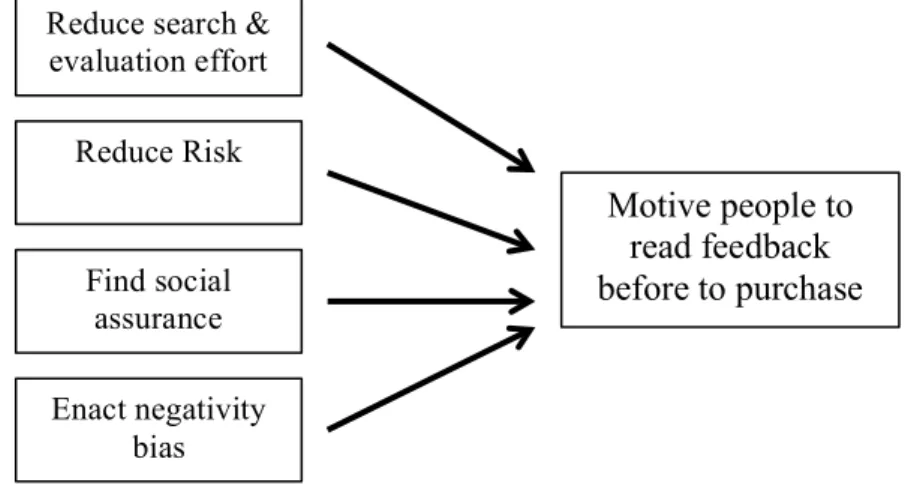
With the development of the Web 2.0 and the new technologies, a new form of word-of mouth (WOM) appears. Consumers have a faster access to information and can easily read and share feedbacks about a product or service. Since people no longer trust the traditional media, companies must understand this new tool to develop a better marketing strategy. To help marketer to understand consumer’s behavior facing electronic word-of-mouth (EWOM), a typology for consumer’s motivation to read online feedbacks is developed. Using an online sample of some 200 respondents, information on the structure and relevance of the consumers’ motives to read online comments is generated. The resulting analysis suggests that people read online feedbacks before buying a product for four reasons: reduce search and evaluation effort, reduce risks, enact negativity bias and social assurance. These four factors leading to EWOM behavior are important but not exhaustive. Companies should pay attention to EWOM reactions, adapt their marketing strategies and follow some rules to implement a good WOM behavior among their consumers.
Keywords: Word-of-mouth, electronic word-of-mouth, consumer’s behavior, online feedbacks.
JEL Classification System: M30: General Marketing M31: Marketing
Table of Contents
Aknowledgments ... I Resumo ... II Abstract ... III Index of Figures and Tables ... VI List of Abbreviations ... VII Sumário Executivo ... VIII
I. Introduction ... 1
A. Problem Definitions and Objectives ... 1
B. Course of Investigation ... 2
II. The Power of Word-‐of-‐Mouth ... 3
A. Definitions ... 3
1. Word-‐of-‐Mouth ... 3
2. Consumer’s Behavior ... 4
B. New Opportunities of the Electronic Worf-‐of-‐Mouth ... 5
1. Electronic Word-‐of-‐Mouth (EWOM) ... 5
2. Comparison With the Traditional Word-‐of-‐Mouth ... 8
C. A Powerful Tool ... 11
1. The Different Properties of WOM ... 11
2. How Word-‐of-‐Mouth Works for Different Types of Decision Makers? ... 14
III. Marketing Implication ... 17
A. Marketing Word-‐of-‐Mouth ... 17
1. A New Pillar in the Marketing Strategy ... 18
2. Application of the Two-‐Step-‐Flow Model to the Marketing ... 19
3. Rules to Implement a Word-‐of-‐Mouth Marketing Strategy ... 21
B. Buzz Marketing ... 23
1. Definition of the Traditional Concept of Buzz ... 23
2. The Modern Age of Buzz Marketing ... 26
3. Examples of Buzz Marketing ... 29
C. Understand Consumer Behavior in the Age of Web 2.0 ... 31
1. Why People Speak About a Product or a Service ... 31
2. Why People Read Comments on Internet Before to Purchase a Product or a Service ... 34
3. Research's Purpose ... Erreur ! Signet non défini. IV. Empirical Study: Consumer’s Motivation to Read Feedbacks on Internet ... 36
A. Data Collection ... 36
2. Primary Data ... 37
B. Methodology ... 38
1. Collection Instrument & Procedures ... 38
2. Questionnaire Structure & Questions ... 39
3. Statistic Study Method ... 39
C. Results ... 41
1. Descriptive Analysis ... 41
2. Statistical Results and Validation of the Model ... 50
V. Conclusion ... 55
A. Managerial Implication ... 55
B. Discussion & Contribution ... 58
C. Limitation & Future Research Direction ... 60
References ... 61
Index of Figures and Tables
Figure 1: Decission Process (Kotlet et al. 2009) ... 4
Figure 2: A Typology of EWOM Channels (from Litvina et al., 2008) ... 7
Figure 3: Mail of Air France ... 22
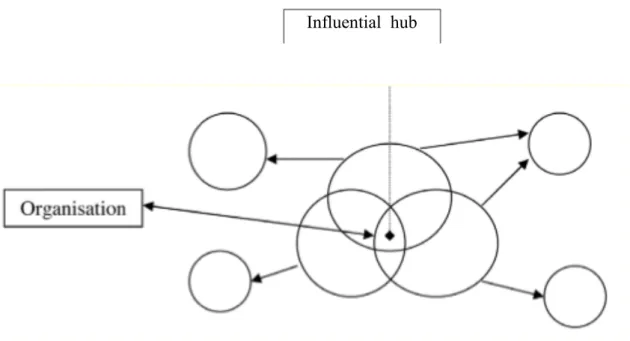
Figure 4: The Central of Influencer in the Networks (from Maunier, 2008) ... 26
Figure 5: Carambar Buzz: the End of Carambar Joke ... 30
Figure 6: United Breaks Guitar Video (Youtube) ... 31
Figure 7: Conceptual Framework ... 37
Figure 8: Methodology Summary ... 40
Figure 9: Bar Chart Gender ... 42
Figure 10: Bar Chart Age ... 43
Figure 11: Bar Chart Educational Level ... 44
Figure 12: Bar Chart for the Frequency of Internet Usage ... 45
Figure 13: Bar Chart for the Review Reader ... 46
Figure 14: PLS Diagram (SmartPLS Software) ... 51
Table 1: Classification of the Web Platform's Content (from Kaplan & Heinlein, 2010) ... 7
Table 2: Decision Matrix (from Silverman, 2011) ... 16
Table 3: Continued Decision Matrix (from Silverman, 2011) ... 17
Table 4: Modern vs. Traditional Buzz (from Mourdoukoutas & Siomkos, 2009) ... 27
Table 5: Motives for WOM Communication Behavior Identified in the Literature (Hennig, Gwinner, Walsh & Gremler, 2004) ... 32
Table 6: Mean Profile of Reduce Search & Evaluation Effort Variable ... 47
Table 7: Mean's Profile of the Reduce Risks Variable ... 48
Table 8: Mean's Profile of Social Assurance Variable ... 49
Table 9: Mean's Profile of Enact Negativity Bias Variable ... 50
Table 10: VIF ... 52
Table 11: Path Coefficients Evaluation (SmartPLS) ... 53
List of Abbreviations
CBSEM Covariance-Based Structural Equation Modeling
EWOM Electronic Word-Of-Mouth
PLS Partial Least Square
SEM Structural Equation Modeling
UGC User Generated Content
VBSEM Variance-Based Structural Equation Modeling
WOM Word-Of-Mouth
WOMM Word-Of-Mouth Marketing
Sumário Executivo
Hoje em dia os consumidores estão constantemente a receber ofertas comerciais através dos mídias. Estes já não confiam nos mídia tradicionais e as empresas têm cada vez mais dificuldade em captar a sua atenção. Tendo em conta o sucesso das novas estratégias de marketing, o poder do marketing tradicional pode ser questionado. Uma dessas novas estratégias é o boca-a-boca (BAB).
A comunicação através do BAB tem provado ter uma grande influência na tomada de decisão do consumidor devido ao fato de que a informação é recebida de relações de confiança e evita as confusões comerciais. Com o surgimento da Internet e da Web 2.0, a técnica BAB tornou-se virtual e os consumidores passaram a ter um mais rápido acesso à informação. Assim sendo, não estão mais restritos à sua rede pessoal para fazer comentários sobre um produto, podendo mesmo obter recomendações de pessoas desconhecidas via Internet.
O BAB tem muitas propriedades. Ela afeta o comportamento de compra e é um dos mais fortes influenciadores na decisão de compra de novos produtos. Por causa de seu impacto significativo e alcance, boca-a-boca é comumente identificado como um motorista de vendas. Tornou-se uma ferramenta interessante que permite às empresas alcançar mais consumidores muito rapidamente. Por isso, as empresas precisam de entender o funcionamento do BAB para incentivar o seu uso e geri-lo corretamente.
Os comerciantes precisam de usar esta ferramenta na sua estratégia de marketing. De acordo com o modelo de fluxo de duas etapas, a primeira coisa a fazer, a fim de ter um bom marketing BAB é identificar indivíduos influentes nas redes sociais e de ligação com eles de forma a incentivar o movimento da mensagem BAB. Para incentivar os consumidores a falar, as empresas podem usar o marketing buzz, que é a forma mais comum de BAB.
Para desenvolver uma estratégia de marketing melhor em torno de fenómenos BAB, os comerciantes precisam de entender o comportamento do consumidor perrante esta ferramenta. É necessário estudar como as pessoas reagem ao BAB no ambiente web 2.0. As empresas não podem projetar uma mensagem de BAB eficiente se eles próprios não entenderem a motivação das pessoas para falar sobre um produto e por que razão lêem os comentários antes de comprá-lo.
Para ajudar os comerciantes a entender o comportamento do consumidor frente ao BAB, um estudo empírico é realizado com foco na motivação do consumidor para ler os comentários on-line. Usando uma amostra on-line de cerca de 200 entrevistados, a análise resultante sugere que as pessoas lêem feedbacks on-line antes de comprar um produto por quatro razões principais: reduzir a pesquisa e avaliação esforço, reduzir os riscos, conhecer os prós e contras e obter uma garantia social.
Após a realização de uma investigação sobre o marketing BAB, demonstrámos claramente a importância e utilidade do E-BAB uma vez que a maioria dos consumidores lê opiniões antes de comprar um produto (87% dos inquiridos1). Os profissionais de marketing têm que saber como funciona o E-BAB e como lidar com esta forma de marketing. Existem algumas regras para ajudá-los a implementar uma estratégia de marketing BAB: perguntar, usar a mídia social, construir uma comunidade, monitorar a reputação, pagá-lo para a frent
1 See Appendix 5
I.
Introduction
A. Problem Definitions and Objectives
When a consumer decides to buy a product or a service, he must take a decision between several choices. Such decision rarely occurs without the influence from the external environment or personal predisposition. Indeed “no individual decision-making is completely independent of the social or collective framework in which it takes place” (Zeleny, 1982, p.92). Nowadays consumers are overwhelmed with commercial offers through many media (Godin, 2000). They don’t know what information to believe and 70% of young people between 15 and 30 years old estimate that there are too much advertising in the street, TV and newspaper (Ipsos study, 2011). They no longer trust the traditional media and companies have more and more difficulties to catch the attention of consumers. The power of the traditional marketing can be also questioned considering the success of the new marketing strategies using different ways to develop the company’s notoriety. Most of these new alternatives are coming from one of the most ancient phenomena in the history of human society: the word-of-Mouth (WOM).
Literature has agreed on the effectiveness of WOM defined as “an informal person-to-person communication between perceived non-advertising communicator and a consumer about ownership, or characteristics of a brand, a product, a service, an organization or a seller” (Landhari, 2007). The information from WOM has been proved to have a higher influence on the consumer decision-making than the information from the marketers through classical types of advertising or promotional activities, due to the fact that information is received from trusted relations and avoids the trade confusions (Engels, Keferreis and Blackwell, 1969; Katz and Lazarfeld, 1995).
With the emergence of Internet and the Web 2.0, consumers can have a faster access to the information. Consumers found new, easy and accessible tools to obtain and compare information about products and services with other people: the electronic-word-of mouth EWOM (Barreto, 2013). Consumers are no longer restricted to have information from their friends and family but also have from unknown people via Internet.
During the process of decision-making, consumers are not alone facing several choices but can have all the information about a brand, a service, and a product. EWOM is an informal
advice passed between consumers. It is another way to have information about products without the influence of brands. Lots of consumers take the decision of buying a product or a service after reading a positive comment. Companies need to understand and include the WOM in their marketing strategy to enhance their consumer’s relationship. The purpose of this study is to develop a better understanding of consumer’s behavior facing EWOM in order to help marketer to implement EWOM in their marketing strategies. In our study, we will focus our research on the consumer’s motivations to read online feedbacks about a product before the acquisition. During our investigation, we will make sure to well understand the link between WOM and the decision to purchase for a consumer. What are the consequences from a marketing point of view? Correspondingly, we will enter in the web 2.0 to complete our understanding of consumer’s behaviors while facing EWOM.
B. Course of Investigation
After conducting a broad literature review we will start this study by defining the WOM, the new opportunities of EWOM and their impact in the consumer’s purchasing decision. In the same part, we will demonstrate the power of the WOM with their different properties and how it works for different types of decision makers in order to get an intelligible and unambiguous view of the literature findings. In the second part, we will establish a clear link between WOM and marketing implications by defining the marketing applications and the consumer behavior in the web 2.0 revolution. In the third part, we will conduct an empirical review by studying the consumer’s motivation to read feedback on Internet. Finally we will conclude
II. The Power of Word-of-Mouth
A. Definitions
1. Word-of-Mouth
WOM is defined as “interactions with members of one’s social and professional network regarded the service encounter, usually by talking to family members, friends, relatives, fellow customers and the like. It refers to all communication concerning the evaluations of goods and services rather than to formal complaints to the organization or its personnel” (Zeelenberg and Pieters, 1999). The simple fact to give an opinion about a product to a friend is a form of WOM. Consumers are more trust in WOM than others forms of information because it is not influence by the brand. It results from real conversions with real people. WOM is an excellent tool for company because it can spread very quickly. For example, a person just discovers a very good restaurant. He talks about it to colleagues. One of them talks about the restaurant to his wife by email. The wife talks about it to a friend and this friend go to the restaurant. The friend talks about the restaurant to other friends during a party. One of them has a blog. He writes a post about the restaurant. A reader decides to test this restaurant and writes a good comments about it on the restaurant website. And so forth. WOM has an incredible power.
There are two types of WOM: positive WOM and negative WOM.
Positive WOM occurs when consumer is satisfied with his experience of a product, service or brand. “Positive WOM includes complimenting and relating pleasant and vivid experiences” (Ladhari, 2017). This type of WOM allows that consumer will recommend the product or service to other consumer. According to some theoretical researches, there is a positive relationship between WOM and consumer satisfaction: satisfied customers engage in greater WOM (Anderson, 1998). It can have several reasons to this positive relationship as “altruism (desire to help others), instrumentalism (a desire to appear well informed), ego defense and reduction of cognitive dissonance” (Anderson, 1998). Consumers want to talk about good news and positives comments to spread positive things in their life.
Negative WOM occurs when consumer is dissatisfied with his experience of a product, service or brand. “Negative WOM includes behaviors such as product denigration, relating unpleasant experiences, rumor, and private complaining” (Anderson, 1998). This type of
WOM allows that consumers will not recommend the product or service to other consumers and will talk negatively about it. According to some theoretical research, there is a negative relationship between WOM and consumer satisfaction: dissatisfied customers engage in greater WOM (Anderson, 1998). There are some theoretical reasons to this negative relationship: “to vent hostility, as well as reduce anxiety, warn others, or seek vengeance” (Anderson, 1998). Dissatisfied consumers are more willingness to talk about his negative experience with a product than satisfied consumers.
The literature shows conflicting evidence regarding the impact of consumer satisfaction and the level of WOM. The both type of WOM has an impact on the consumer decision-making. The positive WOM will convince consumers to buy and the negative WOM will convince consumers to not purchase the product.
2. Consumer’s Behavior
Consumer’s behavior can be defined as: “the study of the processes involved when individuals or groups select, purchase, use or dispose of products, services, ideas or experiences to satisfy needs and desires” (Solomon, M. Russell-Bennett, R. and Previte, J, 2012)
Consumer buying decision
The buying decision’s process is all the steps before a consumer buy a product. This process explains the behavior of consumers before the buying decision.
Figure 1: Decission Process (Kotlet et al. 2009)
The decision process is more and more complex for consumers. “The increasing numbers of consumers facing the issue of confusing by over-choice and disbelieving the claims of the product, cutting through advertising “clutter” with the message has never been more important” (Nawaz, Jolita and Rizwan, 2014). Consumers don’t know which product to choose and in which source of information they can trust. WOM is involved in all the step of the process decision by convincing consumers to buy or not. Consumers ask others consumers in their decision process to be sure to make the good act of purchase.
Problem Recognition Information Search Evaluate Alternatives Purchase Decision Post-purchase evaluation
B. New Opportunities of the Electronic Worf-of-Mouth
1. Electronic Word-of-Mouth (EWOM) Definition
a)
With the emergence of Internet, and especially of the Web 2.0, consumers have new tools at their disposal to search information. Internet has transformed the way we search for recommendation, how we interact with each other and, more importantly, the way we shop (King, Racherla and Bush, 2014). They can obtain and compare information about a product or a service with new, easy and fast tools with other consumers. As a result, consumers are no longer restricted to their personal network to have comments about a product or service, but they can also obtain recommendations from unknown people via Internet (Barreto, 2013). This new form of information seeking via Internet is called electronic word-of-mouth (EWOM). EWOM can be seeing as a recent extension of the traditional WOM by implementing the person-to-person communication into the new form of cyberspace. “EWOM allows consumers to socially interact with one another, exchanger product-related information, and make informed purchase decisions via computer-mediated conversation” (King, Racherla and Bush, 2014).
In deed based on the original definition of WOM by Westbrook (1987), electronic word-of-mouth can be considered as “all informal communications directed at consumers through Internet-based technology related to the usage or characteristics of particular goods and services, or their sellers”. This contains the communication between professionals and consumers (B2C) as well as those between consumers themselves (C2C). Both integrate the EWOM flow and are respectively differentiated from communications through mass media (Goldsmith, 2006; Lazarsfeld et al., 1944). The traditional WOM, as already said, was historically the most influential resource of information transmission but it also has some limitations due to its frontier restriction. With the new technologies the barriers are breaking down and the online social network represents nowadays a free of frontier world that allows a message to be transmitted to anyone. Comments and reviews regarding products can be found in many various online supports where people can express their opinion and provide experience-based information. (e.g., online discussion forums, consumer review sites, weblogs, social network sites, etc.). Then it appears natural that marketers look for managing
interpersonal influence and with the spread of new technologies, it is not surprising that virtual interactions among consumers have proliferated. So a second definition has defined the communication of EWOM as “any positive or negative statement made by potential, actual or former customers about a product or company, which is made available to a multitude of people and institutions via internet” (Henning-Thurau, Gwinner, Walsh and Gremler, 2004 ). This second definition insists on the issue flexibility of the EWOM that is the base of its contagion. The WOM, which was targeted to a few friends, is now a permanent message visible to the whole wide world. Varadarajan and Yadav (2002) found four critical changes resulting of the EWOM introduction in the buying environment. First consumer has an access to the price and non-price attributes of the product. Second, a lot of alternative comparisons and evaluations based on buyers’ considerations are available online. Third the quality of information is improved. Lastly the information is well structured and organized. These changes in the buying environment have occurred with the come out of the Web 2.0.
Different Forms of EWOM
b)
The popularity of the Web 2.0 favors consumers to influence others through various platforms. The social medias are referring to the different activities integrating the technology, the social interaction and the content creation. Kaplan and Haenlein (2010) describe the social medias as “a group of internet-based application that build on the ideological and technological foundations of the Web 2.0 and that allow the creation and exchange of user-generated content”. With Internet, it’s possible to create content and share it with a multitude of Internet users and this rapidly and at a low price, that for example make easy the self-defense marketing. The term of user generated content (UGC) refers to the various forms of media content that users have created and publicized (Kaplan and Henlein, 2010). In these circumstances, the Internet users are no more consumers but become prosumers, that is to say consumers and producers (Tapscott and Williams, 2008). Consequently, instead of simply consume the end product, the consumers are able to participate in the design of goods and services by sharing their opinions. The Internet users are using different platforms enabling the sharing of content and where the watchwords are transparency, collaboration, sharing and globalization. (Tapscott and Williams, 2008). Several types of social media can be identified such as the collaborative projects, content communities, blogs, microblogs, wikis, social networks and virtual worlds. According to their characteristics, it’s possible to classify the social medias as a function of their communication
scope and their level of interactivity. Some are more synchronous, like chat rooms or instant messaging, and others bring more or less people together (Hoffman and Novak, 1996).
Figure 2: A Typology of EWOM Channels (from Litvina et al., 2008)
Furthermore Kaplan and Henlein (2010) build a model in order to make a first classification according to the media richness & its social presence degree and a second classification referring to the type of self-presentation and its degree of self-disclosure.
Table 1: Classification of the Web Platform's Content (from Kaplan & Heinlein, 2010)
These websites of which the users generate the content, have simply reinvent the way to use Internet. Called social media, these platforms are redefining how the web is working. Internet users have nowadays the option of posting comment, sharing pages, making connections and building a social network, a community (Smith 2009). When people are looking for information about a product, they usually find the best recommendation among the many online consumers’ reviews. Thus the consumers’ influence network became more important
and is no more limited to the close entourage of the person but is opened to strangers (Smith, 2009).
New Opportunities for Companies
c)
Internet has transformed the way people search for information. EWOM allows consumers to socially interact with one another and exchange product-related information (King, Racherla and Bush, 2014). With the development of social media that aim to encourage social interaction, WOM became an important and interesting phenomenon for companies. It is an important tool to reach more consumers quite rapidly and increase product sales. Therefore companies need to understand WOM to encourage and manage it. “Companies have become aware that they can also take advantage of the same online communication channels that have been changing consumers’ information search habits and use them to encourage consumers to engage in WOM activities to the companies’ own benefit” (Barreto, 2014). Thanks to the web 2.0, companies can establish a close relationship between their brands and consumers. They can build consumer loyalty and convert consumers into brand ambassadors and obtain new clients through positive WOM.
Comments on Internet are written to be read and analyzed by a multitude of consumers and companies. What consumers say about brands or products? What do they need? What don’t they like? EWOM facilitates the understanding of consumers’ need and help companies to learn how consumers feel about their brand, products or services. WOM is essential because it provides to companies real perceptions and attitudes of current customers and future ones (Silverman, 2001). It is important for companies to listen what people are saying online about their brand to be able to react quickly.
Another opportunity of the EWOM for companies is the advantage to reach audience at low cost and quickly. Companies no longer need to spend lots of money in advertising and promotion tool, they can broadcast information at low cost to a large scale and create new dynamics in the market (Basarani, 2011).
2. Comparison With the Traditional Word-of-Mouth
Even if the EWOM has some common characteristics with the traditional WOM, several dimensions gathered under 3 main differences haven been identified. The uncommon new scale, design and interactions of the EWOM are contributing to the uniqueness of this kind of
communication.
New Scale
a)
The scale is critical to the efficiency of the WOM networks by enabling novel applications. Effectively sellers care about EWOM only if they are persuaded that it might affect their future sales. That’s the case only if a sufficient number of users are providing feedbacks regarding the product or service that can affect potential customers. According to the theory, a certain level of involvement in the WOM communities is required before assuring the cooperation inducing by the reputation’s strength. After the fulfillment of this prerequisite, the power of EWOM instantaneously appears and an unprecedented scale achieved through the utilization of the Internet’s low-cost for online information search and dissemination (Bakos and Dellarocas, 2002). With this low cost of access and information exchange, EWOM can create potential new dynamics in the market. It is more likely that consumers in online buying environments are simultaneously exposed to an abundance of EWOM and extensive objective product information. Consequently the large scale of the online feedback reinforces the relevance of the internet-based medias regarding to the traditional WOM medias, which become less effective devices. As with these latter, the dissemination of information occurs between a few individuals in synchronous modes through more immediate intimate dialogs or private conversation. It makes difficult the transmission of the information to people, who are not present at the time of the information exchange. On the contrary, EWOM uses the bidirectional communication property and unlimited reach of the Internet to involve multi-way exchanges of information in asynchronous mode. That’s when information sender and receiver are separated by both space and time (Hung and Li, 2007). For example, users of forum can read and comment a post after the creation of the topic and not imperatively when the topic is being posted.
New Format
b)
Before Internet, the WOM saw the light of the day naturally and was difficult to control in the society. The Internet enables this puissant social strength to be precisely measured and controlled. By definition, EWOM communications are more persistent, accessible and carry more weight, thanks to its print format as compared to the purely verbal exchange of traditional WOM (Herr, Kardes and Kim, 1991). Most of the text-based information presented on the Internet is archived and thus would be made available for an indefinite period of time (Hennig-Thurau et. al., 2004; Sen, 2008; Park and Lee, 2009; Hung and Li; 2007). This new
format allows to find WOM information online far more voluminous in quantity compared to information obtained from traditional contacts in the offline world because investigators can easily get a multitude of EWOM information and examine their characteristics such as the number of emotional words, the style of the message and the number of likes etc. (Park et al., 2007). The abundance, the form, and the constancy of the EWOM messages have made them more observable (Chatterjee, 2001). EWOM exists in online space, which can be accessed, linked and searched. Therefore a control is possible by using technical of the information system to moderate feedbacks in the virtual social communities. These feedback mediators automatically are implemented to choose who can participate, what kind of information is needed from users, how it is assembled and what sort of information is made public etc. By designing these mediator tools properly, the system designers can control precisely different parameters that were difficult or impossible to drive in the traditional social environment. For instance, feedback mediators can introduce a large amount of various statistics to illustrate a person’s feedback history, apply filtering algorithms to delete suspicious ratings and impolite comment or nuancing ratings depending on communicator’s trustworthiness, reputation etc. This large possibility of control can affect the social communication and transformed the problem of social science in a designing technical problem. All the design possibilities have to be concerned before choosing the specific design and understanding the different impact on the social outcome.
New Interaction
c)
The volatile character of the online world introduces some new challenges related to the understanding and use of EWOM. The major part of theses challenges is due to the subjective aspect of online feedbacks. The traditional WOM occurred in a context where numbers of cue are available to assist the receiver in the proper interpretation of the given opinions. Original WOM emanates from a sender who is known to the receiver of the information, thereby the credibility of the communicator and the message is known to the receiver. On the contrary, the electronic nature of EWOM in most applications eliminates the receiver’s ability to judge the credibility of the sender and his or her message. For example the familiarity between both persons can be used as source of credibility or the physical expressions or appearance can provide inferences to be drawn. Many of these cues don’t exist online. Internet users have to assess the feedback of complete strangers. This lack of familiarity between EWOM receivers and senders may heighten the potential for the posting and use of fraudulent EWOM (Hagel and Armstrong, 1997). However, the literature has proven that the homophily of online users
present in typical WOM exchanges is not necessary critical. On the contrary the shared group interests and mindsets are of higher value (Edwards, 2006; Mayzlin, 2004; Sussan, Gould and Weisfeld-spolter, 2006). Correspondingly, the concept of the strength of close ties in EWOM is not as much important as it is in interpersonal face-to-face interaction. Maybe it’s better to see Internet as a “bridge” between people, but the honest interaction is created due to the specific shared interest existing in the forums, blogs or online review’s topics (Kiecker and Cowles, 2001). Nevertheless one other part of challenges regarding feedback interpretations comes from the facility of changing online identities. This opens the way to different sort of strategic manipulation. For instance, some members can improve their reputation in a community by cheating others members and then disappear and reappear under a new clean identity (Friedman and Resnick 2001). Or they can create fake members’ account to either support written feedbacks and try to ameliorate their online image or post dishonest feedbacks in order to affect their competitors. The unknown anonymous source of information in EWOM has the possibility of non-altruistic or profit-motivated communication exists (Dwyer, 2007). At the end, the nature of the online social mechanism point out the problem of trust regarding the Internet users and encourage the development of adequate defences to assure a trustfully EWOM.
After understanding and comparing the traditional WOM with the new one, it is essential to notice that both types of WOM can walk hand in hand. They are not substitutable, but complementary (Barreto, 2014).
C. A Powerful Tool
1. The Different Properties of WOM
WOM affects purchase behavior and is one of the strongest influencers on the decision of buying new products or services. Because of its significant impact and reach, WOM is commonly identified as a driver of sales (Meuter, Mccabe and Curran, 2013).
In his book, Silverman explain the different properties of WOM. According to him, it is important to understand these properties to better use this wonderful tool.
Everyone talk about the power of the WOM but no one knows how powerful it really is. Indeed “WOM is much more powerful than even the experts think it is” (Silverman, 2011). Silverman proof WOM’s power simply by the fact that in everyday life, people are exposed to a multitude non-word-of-mouth communication in the forms of: TV ads, print ads in the street, radio commercials, product packaging, emails, salespeople, Internet banners… But most people respond to a commercial communication once every few days so this form of communication has a very poor impact. And Silverman adds to this argument that “the response is rarely to purchase. It’s usually just to get more information”. Contrary to this fact, if a friend calls someone and recommends a product or a service, the person will take his recommendation. People don’t retain all the recommendation but approximately one out of two so this form of communication has a great impact. “Customers are thousands of times more likely to act on a recommendation of a friend, colleague, or trusted adviser than they are to a commercial communication. And this action is often to make a purchase, not just to get more information” (Silverman, 2001). The reason why people listen more friends than conventional marketing is the customized answers to questions that provide relevance, which in our society of overload information, is as important as truth.
Property 2. The Speed of WOM
The WOM is the faster communication tool. Indeed one person who likes a product will recommend it to some friends. At their turn, the friends (if they like this product) will recommend it. Before to recommend, the first person made two choices: the product is good enough and new enough to tell people about and the particular person is someone who is potentially interested to hear about it. A person doesn’t recommend a good product to everybody. He is not going “to share his new information with people who have no use for it, people about whom don’t care or people won’t appreciate his informational generosity” (Silverman, 2011). This person does a real choice to recommend a product or a service to one person and not to another. In his book Silverman explains that new persons who have now the information about the product or service “have a better understanding and appreciation of it”. The information will benefit them more because they are more concerning. As a result, “their message about the product (or service) is probably more articulate and emotionally engaging than the original message they received” (Silverman, 2011). So the content of the information gain in quantity and quality because it reaches and is spread by people who care about the content. According to Silverman “the quality, relevance, and enthusiasm of the information passed on through WOM can, under some conditions, actually improve through successive
iterations of transmission. In addition, the ability of people to transmit it to the right people often improves”. To conclude we can say that WOM is a self-improving system. Silverman doesn’t compare WOM to a viral growth but to an exponential growth of a nuclear chain reaction. “Both, WOM and nuclear chain reaction need to start with the right condition. They need critical mass, sufficient density and a jump start” (Silverman, 2011).
Property 3. Independent Credibility
The power of the WOM comes from its independency and objectivity. A consumer is more likely to trust an independent third party than someone who works in the involved company or has an interest to promote the product. “It is the credibility that gives WOM much of its power” (Silverman, 2011).
Property 4. The Hidden Advantage of WOM: Experience Delivery
This fourth property is the most powerful one. When a person asks a friend about a product or a service, he just wants to have the point of view of his friend who already has tried the product. “He has to know how the product really works in the real word. In other word, he needs experience” (Silverman, 2011). People can get experience in two ways: directly and indirectly. The direct experience is about trying the product. “It is the best teacher, but it is often the most costly in time, money, and risk of failure” (Silverman, 2011). The direct experience can have also negative consequences like confusion, uncertainty, feeling like an idiot and not sure about his own decision. So the direct experience can be a good solution to have information about a product or a service before the decision-making but it can be also a source of stressful situation. “With indirect experience, someone else is footing the bill and spending the time” (Silverman, 2011). The consumer is not alone anymore to choose a product or a service. He can deal with different experiences of his friends and compare them. The risk will be low and during the decision-process, the consumer will know which product to choose. According to Silverman, “indirect experience, that is hearing about other people’s experience, is actually much better than direct experience in many ways”.
Property 5. WOM is More Relevant and Complete
When a friend tells to another friend about a product or a service, he thinks that the information about this product could interest his friend. He knows his friend and he thinks that he would like to know his information and experience about it. He doesn’t want to tell this information to a stranger but to his friend who he knows that he is interested in it. “When
someone recommends a product to a colleague, he is not giving a pitch. He is responding to questions, the ones the decisions makers themselves are asking” (Silverman, 2011). In consequence, consumers pay more attention to his recommendation because it is perceived as more relevant and more complete than any other forms of communication (Silverman, 2011)
Property 6. WOM Feeds on Itself
“WOM is self-generating and self-contained, and it wastes nothing. Further, it is amplified by fountainhead and leveraged influencers powerful enough to spark a chain reaction.” (Silverman, 2011).
Property 7. WOM Itself Becomes One of the Product’s Attributes
It is important for decision makers to know that a product is recommended by a friend or by experts. For example, before to go to the cinema, some people go to Allocine website and are looking for rate of the movie in number of stars. Then they can say: we can go to watch this movie because according to Allocine he has four stars so it is for sure a good movie. So the recommendation from friends or experts finish to convince the decision maker and it becomes a product attribute. In his book, Silverman explains “The ‘recommended by’ becomes one of the product attributes, often the most important one.”
2. How Word-of-Mouth Works for Different Types of Decision Makers?
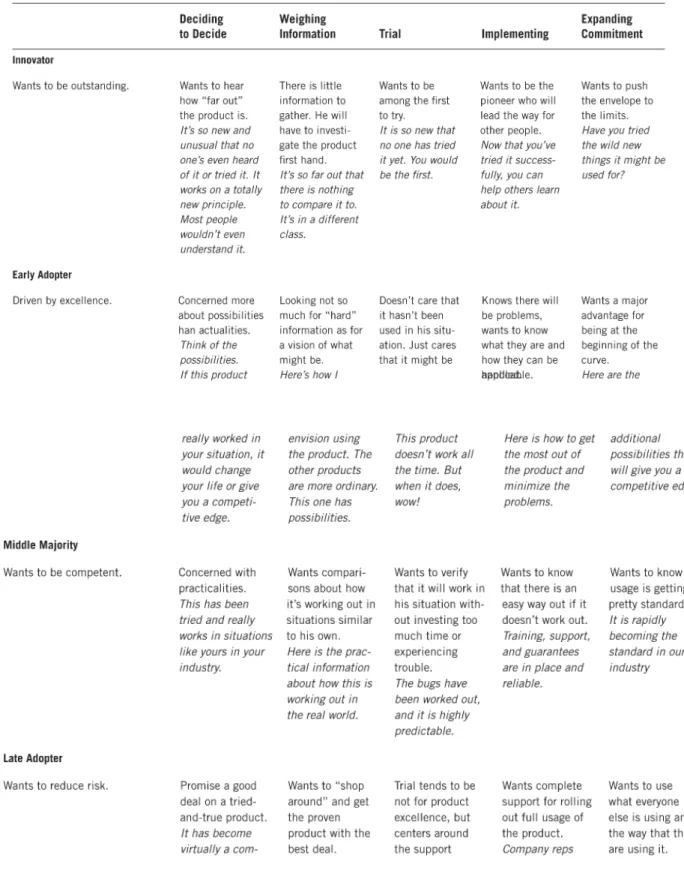
The decision process of buying a product or not is a complex process that we have explained in a preceding part. This process shows the different steps during the consumer’s decision to buy a product or not. During the decision process, it exists five different types of decision makers. It is important to analyse these types because WOM affects them differently depending on which step of the decision process they are in, the kind of person they are talking with and their style in making decisions (Silverman, 2011). For a company choosing the right kind of WOM for each type of adopter is crucial to influence positively the decision process by transmitting relevant messages (Silverman, 2011).
The Innovator
Innovators need to be the first one to know the product and the first to adopt it. They need to hear that a product is new and that very few people have heard about the new product. According to Silverman, they need to hear things such as: “Did you hear that company X is
coming out with a new…? No one else has it.” They are motivated by the idea that they are the first to try the innovation. WOM for innovator must be adapted and must tell about the technological advanced and the uniqueness of the product. “They are driven by the desire to be outstanding” (Silverman, 2011).
The Early Adopter
The early adopters are visionaries. They are attracted by the possibilities and potential of the product. For them, the WOM must be about the power of the product and its eventual advantages (Silverman, 2011). They are driven by the desire to be excellent.
The Middle Majority
The middle majority don’t want to be the first to try a new product but don’t want to be the last one. “They are more concerned with the practicalities of applying the product” (Silverman, 2011). They choose a product not because it is a new product but for its attributes such as price, delivery, service and terms. For them, the WOM must be about quality, consistency and ease of use. “They are driven by the desire to be competent” (Silverman, 2011).
The Late Adopters
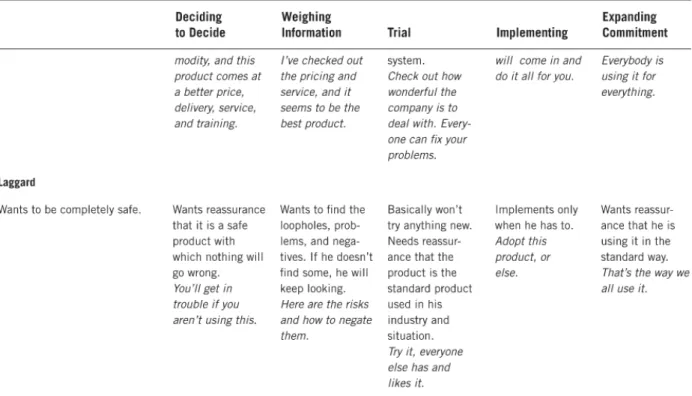
The late adopters want to choose a product without any risk. They don’t want to make mistake and to be sure to make the right choice. They want to hear that lots of people have good experiences with this product and they would not have any difficulties or problems with the product. “They are more concerned with issues of self-protection” (Silverman, 2011). WOM for late adopter must be adapted and speak about security, mature product, easy to learn and have collected positive feedbacks.
The Laggards
The laggards reject technologies and don’t want to adopt a new product until they are forced to. They search safety. They will adopt a product only if they are no other choice. For them, the WOM must be about the reassurance that they are using it in the standard way (Silverman, 2011).
In his book, Silverman proposes to put together the adopter types with the decision stage in a decision matrix. In the following table, we can understand the differences between the types of adopters and better adapt the WOM according to them.
Table 3: Continued Decision Matrix (from Silverman, 2011)
After having a look at all the WOM’s properties and how WOM can be adapted depending of the type of decision maker, we are now aware about its power and the necessity to for companies to use it cleverly in their marketing strategy.
III. Marketing Implication
A. Marketing Word-of-Mouth
WOM has become an unavoidable term in the marketing activities and a powerful tool for the marketing professionals (Lo, 2012). “The study of WOM can thus be said to be an important contribution in the marketing aspect of an organization and have been a profitable solution for the success of different companies” (Lo, 2012).
WOM Marketing (WOMM) is a type of marketing that “specifically promotes natural interpersonal communication in the most diverse ways” (Meiners, Schwarting and Seeberger, 2010). The American WOM Association (WOMMA), founded in 2005, defined it as “giving people a reason to talk about your products and services, and making it easier for that conversation to take place. It is the art and science of building active, mutually beneficial consumer-to-consumer and consumer-to-marketer communications” (WOMMA, 2008). WOMM becomes a generic term, including tactics such as viral marketing or buzz marketing.
“WOMM is accordingly not about generation conversations between consumers, but rather to encourage these conversations and to anchor them in the overall marketing strategy” (Meiners, Schwarting and Seeberger, 2010).
1. A New Pillar in the Marketing Strategy
With the development of new technologies, we assist in an evolution of the “4P” in the marketing activities. Lots of literatures speak about this mutation. In the book Buzz marketing, Stambouli and Briones (2002) explain these changes in each pillar of the marketing strategy. P like Product
With these changes, products must have unique quality in the eyes of each consumer. Products must not appeal to “everyone” but must appeal to each consumer. A product must be created for one person and not for everyone (no matter which one). In their book, Stambouli and Briones argue the fact that society move from mass men phenomenon to a society of individualization. Companies must offer “made to measure” product to attract each person and offer a high range of customized possibilities.
P like Price
The pricing policy has changed. Price has become an important element of the product and consumers don’t allow an uncertainty concerning the price anymore. They want information and the price must make sense and be justified.
P like place
With the arrival of new technologies, the concepts of space and time have taken new dimensions. This is no distributor that sets the place of purchase and the place of consumption but there is only a consumer. The usage of digital distribution channels and deployment of new delivery platforms tend to give the power to consumers. This explosion of geographical and temporal dimensions is a bargain for companies. Indeed it extends the act of consumption since new consumers can consume anywhere at any time.
P like Promotion
The mass advertising has shown its limits. It is replaced by a real dialog with the consumer. The new goal for marketer is to build a personal and lasting relationship between the brand
and the consumer for better responding to consumer distrust advertising and constructing a loyal customer.
A New Pillar: Word-of-Mouth Marketing
A new pillar seems to be emerging for the professional of marketing: WOMM. “Marketers are particularly interested in better understanding WOM because traditional forms of communication appear to be losing effectiveness” (Trusov, Buckling and Pauwles, 2009). According to Stambouli and Briones, this form of interpersonal communication between consumer about their personal experiences with products or company is a powerful asset for marketer. Positive WOM increases the intentions of consumers to purchase innovative products. It helps to give a positive image to a brand or product, and can help to reduce advertising and promotional expenses. Therefore marketers support WOM’s growth and spread. They use networks of influence, communication with opinion leaders and create distribution networks between consumers in order to build a complete WOMM strategy (Stambouli and Briones, 2002).
2. Application of the Two-Step-Flow Model to the Marketing
Regarding Katz (1955), the Marketing WOM is nothing other than the application of the two-step flow model to the Marketing, i.e. “identifying influential individuals in social networks and connecting with them in ways that encourage WOM message movement” (Smith, 2009). In this section, the focus will relate to the implementation of the influences models in the marketing perspective.
How companies can influence the WOM in order to control it or use it for marketing reasons? “One of the first possibilities consists for the firm to exploit the EWOM environment’s change, by creating firm-to-consumer communications that look like consumer- to-consumer communications” (Mayzlin, 2004). But this cynic and risky approach can only be working on a small case. However this kind of practices, should not be neglected because thanks to the web 2.0 new ways are opened to be involved incognito in the online users’ conversation. The second more recognized possibility is to establish a communication from the firm to the influencer, which should diffuse the message in its entourage. One question quickly arises: how to identify the influencer and assess their real influence?
For the marketers, the challenge is to position them on the common place. “We have all seen headlines suggesting that 1 in 10 Americans influences the opinions of the rest of the population” (Allsop, Bassett and Hoskins, 2007). The aim is to reach leaders in integrated groups with relevant tools. Regarding news products, Brooks recommends to inform opinions leader through private sales conducting by commercial agents. Indeed, this aggressive commercial effort can have a “starter” effect allowing the sought snowball effect. After that the author insist on the risky marketing implementation of the WOM marketing that can forget the contextual characteristic of the influence. Since opinion leaders are specialized by groups and by type of product, a marketing researcher should not attempt to find opinion leaders “in general” (Brooks, 1957, p. 161). The opinions leader should be researched in each strata of users of a particular product. Finally Brooks remembers the importance of the traditional media regarding the branding communication that should be addressed to the mass of individuals. In this perspective Horsky and Simon (1983) develop a diffusion model of a new production that use traditional advertising and WOM. Regarding to these authors, it’s possible to control the sales among the time in the bank industry by modulating its communication strategy. The optimal strategy consists firstly in an intensive targeted advertising investment to inform the innovators about the product’s existence. Then since the innovators, who are transformed in spokesperson, adopt the product, the advertising investment can be gradually reduced. In fact, the definition and delimitation of influential arise a problem. For example, Karlz and Lazarsfeld define as influencer women who can influences individuals. Similarly Coleman, Katz and Menzel (1966) consider doctors as influencer that influence three or four of their peers. More recently Burson-Marsteller (2001) estimates that one opinion leader has an influence on 14 persons on average. As to Keller and Berry (2003), they mark as influencer 10% of the population supposed to influence the 90% left.
As you can see above, a grand part of the literature support the affirmation of Katz (1955) that says the WOM marketing is the strict marketing application of the two-step-flow model. If the influence of interpersonal relationship model is not questioned, the opinion leader concept has been disputed in the recent past years.
According to Balter and Butman (2005), “everybody talks about products and services and they talk about them all the time. Word of mouth is not about identifying a small subgroup of highly influential or well-connected people to talk up a product or service. It’s not about mavens or bews or celebrities or people with specialist knowledge. It’s about everybody”. This affirmation is reflecting through the example of the shoes brand Hush Puppies, which
know a growth of 5000% of sales without any advertisement when young trendy group from New York decided to wear it (Gladwell, 2000). The concept of “superinfluential” has been launched to designate these happy few able to rapidly promote a brand. According to Allsop et al. (2007) explains that “what is important is to understand how the specific social network in your category operates, and in particular, which individuals within that social network are most active in creating and spreading messages about your product category to others”.
After getting a first look in the marketing WOM through its common mechanism of implementation and its natural propagation sources, we will study some rules to help marketers in the implementation of a WOMM strategy.
3. Rules to Implement a Word-of-Mouth Marketing Strategy
In his paper, Sujanto (2014) developed five rules to help marketers to improve their marketing strategy.
Ask for it
A good strategy to deal with WOM marketing is to ask for comments. Company must ask their consumers to give their feeling and opinion about their product. The principal reason why people are not giving referrals is because companies are not asking for, assuming that happy customers will naturally provide the comments (Sujanto, 2014). So company have to ask consumers to get feedback or even better referrals. It as simple as: “I grow my business through direct referrals from satisfied people like yourself. Please feel free to refer me if you think of anyone who could benefit from our services” (Sujanto, 2014). By asking, consumers will remember you and do it with pleasure. For example, the air flight company Air France send an email to all of their customers after a flight to ask them about comments.
Figure 3: Mail of Air France
Use Social Media
According to Sujanto, leveraging social media can help foster WOM marketing. When companies have satisfied customer, they can ask to them to give an online comments. An online testimonial will help companies to get a positive WOM especially on platforms like LinkedIn, Facebook, Twitter or Youtube, which particularly viral. Sujanto explains that “It’s one thing seeing a testimonial on the company’s website, but a testimonial given by a real person – publicly – adds a new level of credibility to the referral.” Personal reviews will highlight products and companies and how good they are. So companies have to make an effort concerning social media by being connected and interacting with the maximum of people. The real power of social media is reaching people online to make an impact offline.
Build a community
Building a community around the brand is crucial. Indeed a good community helps users to construct a global identity. It convinces them that buying their product are making them special member. By giving personal statements they can join special ranks. “This king of engagement is crucial as not only are the company receiving invaluable feedback about his business, this space also helps to encourage dialogue with your past and potential customers” (Sujanto, 2014).
Monitor your reputation
Marketers have to keep a watchful eye on the feedback and comments they are getting. Positive WOM is a wonderful tool for a company and can push the sales. But negative WOM can go downhill very quickly and bad reviews will easily outrank the good. So marketers must be reactive to explain and solve possible issues as soon as a negative review appears in a
social media. WOM marketing is largely based on customer experience so marketers have to make customer’s experience a priority. They have to watch out for their reputation.
Pay it forward
WOM marketing is not just a one-way street. Company must be generous and give awards to good consumer when appropriate. For example a company can give to its customer a small gift in exchange for reviews. The gift will be appreciated and consumer will be more likely to speak about the product.
After explaining some rule to help marketers to implement a good WOMM strategy, we will now have a look on the concrete application of WOMM. Let’s begin with the most formal form of WOMM: Buzz Marketing.
B. Buzz Marketing
1. Definition of the Traditional Concept of Buzz A Type of Viral Marketing
The viral marketing is a phenomenon, which facilitates and encourages people to pass on a marketing message. This promotional message is so interesting and exciting that it raises stupefaction among the medias and consumers, who multiply its propagation (Hughes, 2005; Mohr, 2007). This phenomenon of euphoria is at the core of the viral marketing principle. Like in the case of viruses, people disseminate messages from person to person leading to the following definition of viral marketing supported by Mohr (2007) and Thomas (2004): “Viral marketing describes any strategy that encourages individuals to pass on a marketing message to others, creating the potential for exponential growth in the message’s exposure and influence.” This marketing model appears then much more complex than the traditional one because the message control is left to the receiver. Moreover, the Internet has strongly increased the viral marketing potential due to its ease of transmission and the use of the social medias which happen to be excellent viral networks (Thomas, 2004; Sernovitz, 2011; Wheeler, 2009; Rosen, 2009; Penenberg, 2009). Therefore companies are actively looking for opportunities to take advantage from the power of this marketing channel in order to promote their products or services (Kozinets, Valck, Wojnicki and Wilner, 2010). However the concept of marketing buzz tends to supplant the one of viral marketing (Thomas, 2004).
Indeed, both involve people in the WOM campaign and the concerned organisation. They have a commercial goal of developing sales and positive behaviours towards the brand. Their common purpose is to create a noise regarding the brand, the product or service and to provide an exponential transmission of the message.
The viral marketing research has shown the importance of identifying the best ambassadors of the brand (as seen before with two-step-flow model). It’s about using the existing ties between consumers. The influence is on one hand explicit through consumers’ advice and on the other hand implicit through the simple consumption of the product. Consequently the viral marketing can be active but also frictionless.
As far as the buzz marketing is concerned, it is often compared to a “buzzing” and contributes to the viral marketing campaigns. This inexpensive method has a positive valence and allows companies to promote a new product in a great scope. According to Carles (2006), it’s possible to observe positive as well as negative communication because the agents can be persons paid to talk about the brand, volunteers to test a new brand or totally independent people from the organisation. These relays are not passive to the extent that they can degrade the informational content of the message by reinforcing or weakening it. The communication process is more important than the source because a lot of conversations take place in the social networks during unplanned interactions. Stambouli and Briones (2002) distinguish also two categories of buzz. The first one, the “buzz image” regroups all the discussions between consumers regarding the brand image. The second one, the “buzz product” corresponds to consumer’s reviews regarding the product’s consumption.
Benefit
Even if the marketing buzz is legally risky (Steinman and Hawkins, 2010), the advantages for marketers are numerous. For instance, the marketing costs are decreasing because of the avoidance of the advertisement creation and media cost. In addition, the transmission through the WOM makes the message more credible and increases the brand visibility and differentiation. In Rosen’s opinion (2009), the marketing buzz includes all activities organised with the aim of generating an enjoyable experience during a communication related to a product or service. This latter is particularly efficient if the product is fascinating, innovative, complex or observable. Because their interest for the product, people will speak about it and others are likely to listen in order to ameliorate their understanding. Some targeted markets are obviously more sensitive to buzz than others like teenagers, who are easily influenced by various opinions. Finally the buzz marketing is resulting from more and more carefully
operated marketing programs (Dye, 2000). It can be combined to any other marketing techniques giving that they support the same main strategy (Mohr, 2007). Nevertheless as attested by Bernoff and Li (2008), marketing belongs nowadays more to clients than before. The brands are more and more in the hands of the consumers. That’s the groundswell, the transfer of power from companies to consumers and communities that can modify the corporate culture through the two-way communication. However, the first objective of the buzz is to create or renew the attention on the product, the brand or the organisation. It operates more on the consumer’s behaviors and the perceived brand image. Furthermore the buzz helps to build a relationship with the customer but it is not immediate (Henry, 2003). The buzz is consequently complementary to traditional ways of communications of the organisation. For Rosen (2009), it’s judicious to integrate it to the mix media in order to support the viral mechanism.
Basic Implementation
To describe the implementation of a buzz marketing strategy, the basic transmission through the viral ambassadors is suggested. An organisation willing to implement a buzz marketing campaign is well advised to make first of all inquiries about the information’s sources used by the potential clients and also determine the motivations of individuals associated to brand (Rosen, 2009). Every activity allowing to identify, to discuss with, and to recruit the buzz agents is essential (Godin, 2000; Blackshaw, 2001) and should be included in the communication plan (e.g. sponsoring of cultural event, participation to festivals etc.). These procedures are more or less comfortable to the extent that people tend to communicate spontaneously with the company (Blackshaw, 2001). The setting up of a toll-free phone number or an email address facilitates these interrelations. To identify the leaders, the individuals can be asked to name their guiding persons or to assess themselves their influence level. (Vernette, 2006)
The attributes, related to the product or the message, are also important to touch the buzz agents. Indeed agents or non-agents are talking voluntarily about contagious products if they are original. The influencers’ ties can be then used.