BJRS
RADIATION SCIENCES
04-02 (2016) 01-20Concentration of fallout Cesium-137 in soils of the Rio de
Janeiro State, Brazil.
F. C. A. Ribeiro
a, D. C. Lauria
a, J. I. R. Silva
a, E. S. A. Lima
b, N. M. B. do Amaral
Sobrinho
b, D. V. Perez
c.
aDivisão de Radioproteção Ambiental e Ocupacional /Instituto de Radioproteção e Dosimetria.
Avenida Salvador Allende, s/nº, Barra da Tijuca, CEP 22783-127, Rio de Janeiro – RJ, Brasil [email protected]
b Departamento de Solos, Instituto de Agronomia (IA), Universidade Federal Rural do Rio de Janeiro (UFRRJ).
Rodovia BR 465, Km 07, s/n - Zona Rural, Seropédica - RJ, 23890-000.
c Centro Nacional de Pesquisa de Solos (CNPS), Empresa Brasileira de Pesquisa Agropecuária (EMBRAPA). Rua
Jardim Botânico, nº 1024, Bairro Jardim Botânico, Rio de Janeiro – RJ, 22460-000.
ABSTRACT
The distribution of fallout 137Cs in soil samples of the Rio de Janeiro State was investigated. Two-hundred sixty-two
samples of soil were analyzed for 137Cs by gamma spectrometry. A reference data set was built containing thirty-six
detected values (14%) and two hundred twenty-six (86%) multiple detection limits of non-detected observations. Distribution pattern of the radionuclide, as well their controlling factors were evaluated based on statistical methods for censored data set (with non-detected observations). The mean of concentration values of thirty-six detected observations was 1.25 Bq.kg-1, while for the censored data sets the mean value was 0.51 Bq.kg-1. The references
values for the Rio de Janeiro State were estimated as 1.44 Bq.kg-1 (75th) and 1.78 Bq.kg-1 (90th) (considering the
year of 2015). 137Cs concentrations tend to be higher in soils with high levels of organic matter and clay and
locations with high levels of these parameters would provide higher Cs fixation. No influence of the rainfall index and soil pH on the Cs content in soil was observed. The data and information gathered in this study provide valuable information for decision making purposes in case of soil contamination.
Keywords: Cesium-137, soil, radioactivity mapping.
1. INTRODUCTION
The testing of nuclear weapons introduced in the environment man-made radionuclides, which were widely scattered in the atmosphere, and deposited on the entire surface of Earth. Although in a regional scale, the nuclear accidents, as Chernobyl and Fukushima, also spread
man-made radionuclides in atmosphere and on the ground. Nuclear power plants also routinely release man-made radionuclides to the environment, nonetheless in a controlled way. Among the man-made released radionuclides, 137Cs is one of the most important [1].
Due to its chemical characteristics, 137Cs is strongly adsorbed on soil particles and, in
consequence, its mobility in soil depends largely on physical processes [2]. Nevertheless, 137Cs
mobility can be affected by some characteristics of the soil. The element is nearly immobile in soils with high clay or organic matter content, thus making it difficult to move to deeper layers. [3, 4, 5]. Because of its low mobility, some studies have showed that the distribution in undisturbed soil decreases exponentially with depth [6, 7, 8]. However, in agricultural soils 137Cs tend to exhibit a uniform concentration in the arable layer due to ploughing [9, 10]. As a consequence of its limited migration, 137Cs is used on studies to quantify the erosion of soil [3, 11].
The distribution of 137Cs spread on the Earth crust is not homogeneous. As few atomic tests were carried out in the southern hemisphere, the highest concentrations of 137Cs in soil are found mainly in the middle and high latitudes of the northern hemisphere and in the central area of Australia [3, 12, 13]. According to UNSCEAR [14], around 25 per cent of the total 137Cs released by the testing of nuclear weapons and other atmospheric emissions were deposited in the southern hemisphere, while the prediction of the distribution of global inventory for 137Cs for the equatorial region is to reach the minimal values.
Although many studies have been conducted to establish the 137Cs baseline in the northern hemisphere, the southern hemisphere studies are still scarce [15]. In Chile, the radionuclide deposition density was higher than the predicted to the hemisphere and similar to that found in Europe, ranging from 450 Bq.m-2 to 5410 Bq.m-2 [16, 17, 18]. No dependence
between concentration values and geographic location was found, but of the average annual rainfall. Labrecque et al. [19] found concentrations of 137Cs in Venezuelan soils varying between
16.3 and 30.8 Bq.kg-1, which are considered anomalous (high) for the region that is located near
the equator. These high concentration values were attributed to the high annual rainfall and to the organic soils of the area.
Levels of background and baseline on distribution of radioactivity in soils are performed worldwide with the aim of providing useful information to assess human exposure to radiation, epidemiological studies and to building a "reference” database that can be useful to evaluate changes of environmental radioactivity caused by nuclear, industrial or other human activities [20-25]. In this context, the knowledge about the relationship between levels of 137Cs in soils and
environmental variables may provide valuable information about the region vulnerability to contamination, which are good sources of information for decision making purposes in case of soil contamination.
Most of 137Cs surveys carried out in Brazilian soils aimed to study erosion rates [26-30]. As results of these studies, undisturbed soils showed concentration values of 137Cs ranging between 0.3 and 5.2 Bq.kg-1. A comparison among soils from different latitudes showed that the
137Cs deposition increases with the distance from the equator: as farther from the equator, as
higher is the 137Cs deposition, which endorsed the information provided by SCHULLER et al. [16-18] and HANDL et al. [15]. A survey in 33 soils of São Paulo State, 0 to 20 cm depth, found an average concentration value of 1.9 Bq.kg-1 (values ranging from <0.3 to 4.1 Bq.kg-1) [30].
The knowledge of the “current concentration” of 137Cs in soil is important, because it's
concentration in the environment depends only on human activities as atomic weapon tests, power plant releases, nuclear accidents and so on. The reference values can be established at the same methodology as the one preconized by the Brazilian National Council of Environment (CONAMA), in which the samples are collected in the undisturbed soil in a depth of 0-20 cm [31]. This way, a baseline can be established to serve as a reference to assess risks of potential contamination and the influence of anthropic activities in the environment. In the absence of a baseline, and if international values or the ones defined in other regions are used, inadequate evaluations can be generated, since there are marked differences in geological, water and soil characteristics among regions [32].
The Brazilian state of Rio de Janeiro is located in the Southeastern region and comprises different types of soils, geology features and climatic conditions. The State has the only Brazilian nuclear power plants, two in operation and one under construction. Surveys for
assessing the baseline data of 137Cs in a systematic way in soil were not reported for Rio de Janeiro State. Therefore, this study contributes to increase the knowledge of the state environment and to establish a "baseline" of the content of 137Cs in the soil of the State. With the
aim of investigating trends of 137Cs accumulation, the relationships between 137Cs and the main characteristics of environment (rainfall) and soils (pH, organic matter and granulometry) that are reported as influencing 137Cs accumulation on soil, were studied.
2. MATERIAL AND METHODS
Study Area
Rio de Janeiro is a state located in the Southeastern region of Brazil, with about 43,000 km2, and is the second Brazilian state regarding population and industry [33, 34]. Its geology consists of sequences of igneous and metamorphic rocks as granite, gneiss and migmatites, forming mountains chain and sedimentary areas mainly in the coastal plains of fluvial or marine origin. In small areas spread by the state it occurs alkaline rocks with uranium and thorium associated to the minerals. The state has a variety of soils, influenced by the parent material and diversification of climate types. The rainfall is seriously influenced by the geographical localization and by the orographic factors. At the mountain chains of Serra dos Órgãos and Serra do Mar, the precipitation is higher than in the Metropolitan, North and Medium Valley of Paraíba do Sul River regions [35]. The climate types are classified as Aw, Am, Af, BSh, Cfa, Cfb, Cwb e Cwa, according to Köppen System [36].
Sample collection and laboratory analyses
Following the methodology established by CONAMA [31], this study analyzed a total of 262 samples of top soil (0-20 cm) that were collected by Lima [37] in undisturbed areas to stablish quality reference values of toxic metals. The sampling points were selected on the basis of a joint analysis of maps of soils, geology, land cover and use of the State of Rio de Janeiro, all on scale 1:500,000, covering a wide state area. The superimposition of maps was carried out using the program ArcGIS Desktop 10, produced by ESRI, and to obtain the sampling points it
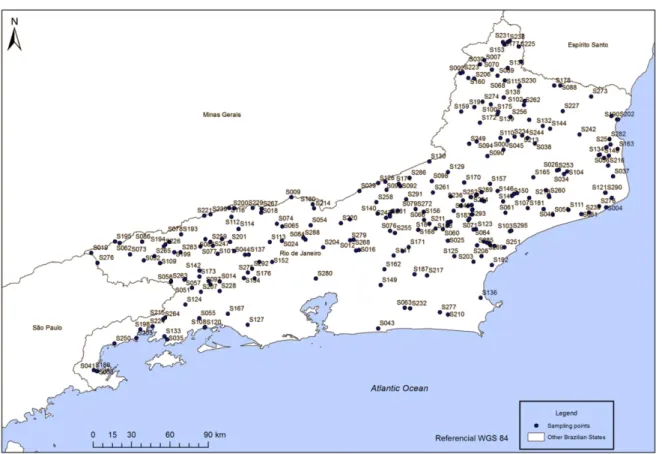
was used the cLHS program – Conditioned Latin Hypercube System. It was also used the road map of the State of Rio de Janeiro, to orient the offset into the sampling areas. The sampling areas were defined to be at least 200 m from the roads to avoid contamination. Still in the field the samples were identified and georeferenced. The geographical location of the soils sampling points can be seen in the figure 1.
The samples were air dried and sieved using 2-mm nylon sieve before further analysis by the staff of Laboratory of Soil Pollution at Universidade Federal Rural do Rio de Janeiro – UFRRJ who classified the soils samples according to Brazilian Classification System [38] and FAO/WRB Soil Classification System [39] and chemical and physical-chemical characteristics. The granulometry quantification (sand, silte and clay), pH in H2O and organic matter were
determined in accordance with the methodology described by DONAGEMMA et al. [40].
Sample aliquots of approximately 300 grams were conditioned in pots of polyethylene with 300 ml of volume, sealed and then analyzed by gamma spectrometry with six hyper pure germanium detectors (HPGe) systems from Canberra Inc. (Meriden, CT, USA) at the Institute of Radiation Protection and Dosimetry (IRD), at Rio de Janeiro. The used detectors have relative efficiencies of 20%, 25%, 40% and 100%. The activities concentrations and respective uncertainties were determined according to statistical uncertainty of peak areas provided by Genie2000 software.
The radionuclide 137Cs concentration was measured by the gamma ray line of 661.6 keV. The background radiation spectra were measured for 230,000 seconds to decrease the uncertainty. The detectors were calibrated in the 300 ml geometry with a standard aqueous solution containing various radionuclides (57Co, 109Cd, 203Hg, 139Ce, 210Pb and 241Am) in a nitric acid medium, supplied by the Laboratorio Nacional de Metrologia de Radiação Ionizantes (LNMRI), a laboratory of IRD, which is the Brazilian laboratory of radiation metrology, tracked by Bureau International des Poids et Measures (BIPM), France. The energy calibration of the detectors was routinely performed with a 152Eu source. To ensure the quality of the analysis a certified reference material of soil (089/ERA) provided by the National Institute of Standards and Technology (NIST) was analyzed several times as a blind sample, between the analysis of the samples. Routinely, the performance of the laboratory is evaluated by participation in intercomparison exercises MAPEP (Radiological and Environmental Science Laboratory Mixed Analyze Performance Evaluation Program) of USDOE (United States Department of Energy). In addition, the LGS also takes part in Brazilian intercomparison exercises provided by the LNMRI/IRD. The results of these exercises have annually pointed out the good performance of the laboratory.
Statistical Analyses
Environmental data sets commonly contain analytical values that are lower than limits deemed reliable enough to report as numerical values [41]. The Minimum Detectable Concentration (MDC), also denoted by detection limit (DL), is the lowest concentration of a chemical that a particular protocol or methodology is capable of consistently quantify. Due to the
fact that levels below the MDC (LD) are usually found in environmental samples, the environmental data sets unsurprisingly contain non-detect (ND) values and may result in left-censored data. A ND value means that the analyte concentration in the sample is between zero and the MDC value.
Due to diversity of the density of the analyzed material, the chemical recovery of the sample processing, the efficiency of the utilized equipment, among other, the environmental data set typically contain more than one value of MDC. Data sets containing various values of MDCs or multiple detection limits are called multiply censored data sets.
Descriptive statistical analysis and distribution and comparison tests have been specially developed for multiply censored data set, and have been employed for environmental statistics [42, 43]. Basically, three data-analysis procedures are available for multiply censored data [42, 44]: i) Simple-Substitution Methods: recommendations are to replace the ND with half of the DL (DL/2), DL/10 or by the DL value itself, but this replacement is known to cause a frequency spike at that value [45]. Since any single value between zero and the DL is arguably as good as another, simple substitution method, particularly when used on multiply censored data, may introduce a signal that is not present in the data, or obscure a signal that is present. In consequence, this method is considered to be the least precise method [47, 48]. ii) Parametric Methods that require sufficient data to validate the use of a specific distributional model — a requirement that is difficult to meet with small multiply censored datasets and iii) Nonparametric Methods. Maximum likelihood estimation (MLE), regression on order statistics (ROS) and Kaplan-Meier are the methods most often cited in the literature for handling non-detect values.
The regression on order statistics (ROS) is a probability plotting and regression procedure that models censored distributions using a linear regression model of detected concentrations versus their normal quantiles. The regression line is used to fill in values imputed from the straight line for the data below the detection limit.
Nonparametric distributional modeling, such as methods based on Kaplan–Meier statistics, do not require the assumption of a specific distribution to estimate summary statistics for multiply censored datasets. This least procedure is the one adopted by the ProUCL software
package [49], a computational code made available to free download by the US Environmental Protection Agency’s (USEPA). It has graphical, estimation and hypotheses testing methods for uncensored-full data sets and for left-censored data sets consisting of NDs observations with multiple detection limits (DLs). For data sets with NDs, ProUCL has several estimation methods including the Kaplan-Meier (KM) method and regression on order statistics (ROS) methods. Graphical methods in ProUCL include histograms, multiple quantile-quantile (Q-Q) plots, and side-by-side box plots. The Oneway Analysis of Variance (ANOVA) module in ProUCL has both classical and nonparametric Kruskal-Wallis (K-W) tests.
From a theoretical point of view, ProUCL can compute various statistics based upon data sets consisting of at least 3 detected observations [49].
The maps of sampling points and of 137Cs distribution were performed with the use of the free software Qgis v.2.12.2 Lyon [50], which is free to download.
3. RESULTS AND DISCUSSION
137 Cs concentrations in Rio de Janeiro soils
The data set comprises two hundred and sixty-two samples, in which the values of concentrations of 137Cs varied between <0.2 and 4.23 Bq.kg-1. From the data set, thirty-six samples (14%) were detected values and two hundred twenty-six (86%) were multiple detection limits of non-detected observations.
Tough the same counting geometry (300 ml) and time were used to analyze all the soil samples, to carry out the analysis of such big number of samples in a shorten time, six gamma detectors were used. Considering that each sample has its specific density and each detector has its efficiency of counting for 137C, 662 keV, many DL values were observed. The range of the DL values ranged from <0.2 to <2.3 Bq.kg-1.
According to the recommendations of the technical guide of the ProUCL, prior the statistical analysis, the outliners, observations coming from population(s) other than the main
dominant population, should be identified. The Dixon test point out the value of 4.23 Bq.kg-1 as an outliner and in consequence, this value was not considered in the subsequent statistic tests.
Consistent with the Saphiro Wilk GOF test, the thirty six samples with detected values do not follow normal, lognormal or gamma distribution, with 95% of significance. The concentration values for the detected observations varied between 0.32 and 3.42 Bq.kg-1, with
mean value of 1.18 Bq.kg-1, standard deviation (SD) value of 0.47. The range of detected values
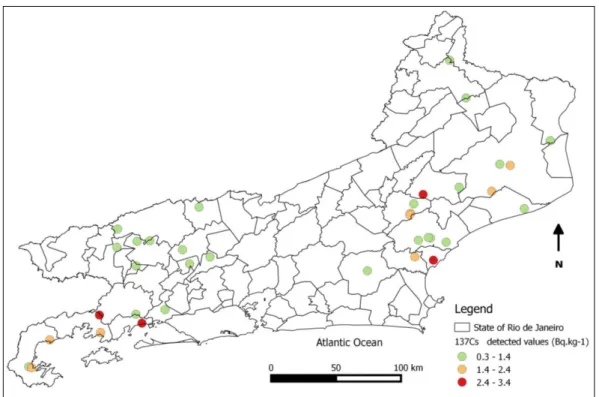
found for Rio de Janeiro State is within of the range found for São Paulo State [30]. Figure 2 shows the distribution of the detected values of 137Cs concentration in soil of Rio de Janeiro.
The mean of the concentrations of the censored datasets (with detected and non-detected values) was estimated by Kaplan Meier Method as 0.51 Bq.kg-1, the SD of 0.47 Bq.kg-1 and the 75th percentile, which means that values expected from observation coming from the population (or comparable to the population) will be ≤ X0.75 with probability 0.75, was 1.44 Bq.kg-1 and the
90th percentile was 1.78 Bq.kg-1.
Figure 2. Distribution of the detected values of 137Cs concentration in soil of Rio de Janeiro State (color figure available online).
Influence of rainfall index, organic matter, clay and pH in 137Cs soil concentration.
As described before, some environmental parameters have been pointed out by others authors as having influence on 137Cs concentrations in soils, as the rainfall index, pH, organic
matter and clay contents. These parameters were counterpoise to 137Cs levels in soil. For the
comparison among the data sets, only those populations with more than 3 detected data were statistically evaluated.
Rainfall index- The deposition of 137Cs fallout has been described by other studies as directly
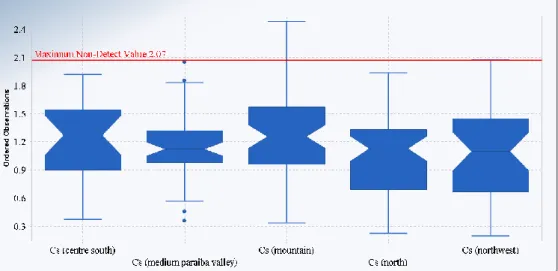
related with rainfall. This way, regions with high rainfall index would present higher 137Cs in their soil [3,7-10] The state regions have different rainfall index, varying between 1805 - 2202 mm of the Centre South region and 766 - 946 mm of the North region, table 1 [35]. Figure 3 shows a visual comparison among the data sets of the State´s region.
Figure 3. Box plot of the data set of different regions of Rio de Janeiro State (colored figure available online).
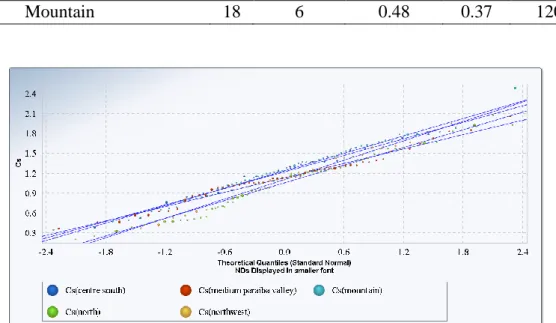
No influence of rainfall index in the mean/median concentrations of 137Cs in soils was observed, since the analysis of variance ANOVA by Kaplan-Meir test suggested that mean/median characteristics of the various groups are comparable at 0.05 level of significance. Also, the visual comparison with multiple Q-Q plots did not pointed out any significant difference among the data sets (Figure 4).
Table 1. Number of analyzed samples (N), Kaplan Meier Method´s mean and standard deviation and ranging of average annual rainfall of the Rio de Janeiro State regions.
Region N Detected KM Mean
(in Bq.kg -1) KM SD Range of Rainfall (mm) Centre South 48 4 0.58 0.25 1805 - 2202
Medium Valley of Paraíba do Sul River
33 9 0.59 0.52 1431 - 1771
Northwest 51 4 0.59 0.66 1003 - 1210
North 48 9 0.53 0.41 766 - 946
Mountain 18 6 0.48 0.37 1203 -1532
Figure 4. Visual comparison among the State´s regions with multiple Q-Q plots.
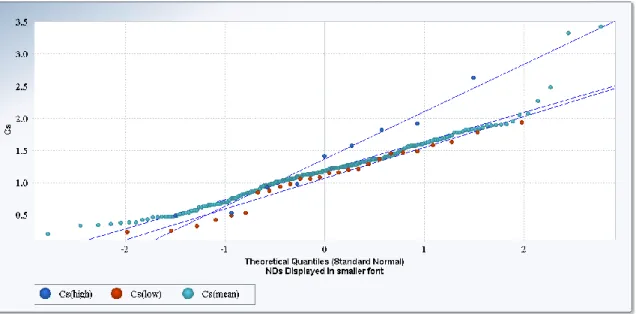
Organic Matter - The content of organic matter (OM) in the Rio de Janeiro soils varied from 5.3 to 69 g.kg-1. The goodness-of-fit test showed the distribution of data fit a lognormal distribution, with 95% of significance. The median, mean and standard deviation values were 23.2, 24.8 and 9.2 g.kg-1 respectively. For studying the OM influence on the 137Cs concentration in the soil, the content of OM was grouped in: high OM, values higher than 45 g kg-1 (4.5%); medium values, ranging from, 15 g to 45 g kg-1 (1.5% a 4.5%); and low values, values lower
medium content of OM (87%), 10% of the soils had low content of OM and 3% had high levels of OM. The Nonparametric Oneway ANOVA (Kruskal-Wallis Test) suggested that mean/median characteristics of the various groups of OM are comparable. However, the visual comparison with multiple Q-Q plots showed that the upper halves of the “High” and “Low” data sets are quite different (figure 5). “High” group has generally higher values than the “Low” group. On the other hand, the “mean or medium” group showed many values compatible with the “Low” data set, but high values compatible with the “High” data set were also observed.
Figure 5. Visual comparison among the 137Cs and Organic Matter content in soils with multiple Q-Q plots.
pH - Quantitatively, the degree of acidity of the soil is identified as neutral, with pH around 7; slightly acidic, with a pH between 6.0 and 7.0; moderately acid pH between 5.5 and 6.0; strongly acidic pH between 5.0 and 5.5; very acid, pH 4.5 to 5.0; and extremely acidic pH less than 4.5 [51]. According with this degree of acidity, most of the soil samples, 29%, were soil moderately acidic, 26% were strongly and 26% very acidic soils, 11% were slightly acidic, 4% extremely acidic and 3% neutral. The statistical test showed that the means/medians are compatible. Also, no influence of the degree of acidity over 137Cs level in the soils was observed by visual
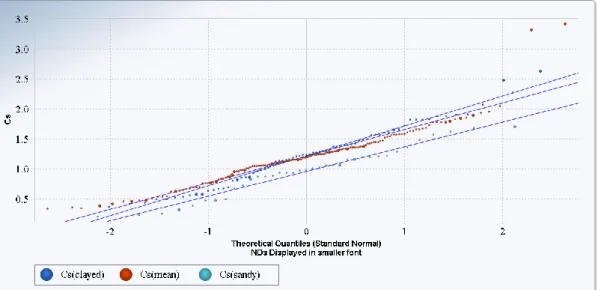
Clay - As the content of clay was pointed out as an important factor for immobilizing 137Cs on soil [3-5], the samples were grouped into intervals of clay content according to the following criteria (http://www.pedologiafacil.com.br/textura.php): 0-15%, sandy (37 samples); 15-35%, mean (149); 35-60%, clayed (73 samples) 60-100%, very clayed (3 samples). According with the statistical test for data sets with Non-Detects, no statistical differences were found among the content of clay groups. However, the visual comparison with multiple Q-Q plots showed that the upper halves of the “Clayed” and “Mean or Medium” data sets are compatible, but both are moderately different from the sandy group. “Clayed and Medium” groups had higher values than the “Sandy” group (Figure 6).
Figure 6. Visual comparison among the 137Cs and the intervals of Clay content. with multiple Q-Q plots.
4. CONCLUSION
137Cs was analyzed in two-hundred sixty-two samples of soil collected over all state of
Rio de Janeiro. The samples were analyzed by gamma spectrometry for 137Cs determination. Due
to the different efficiencies of detection of the six used gamma spectrometry systems and to the different densities of the samples, multiple detection limits were obtained. A multiply censored data set was built containing thirty-six detected values (14%) and one two hundred twenty-six
(86%) multiple detection limits of non-detected observations. The specific statistical methods for censored data with multiple detection limits available in the ProUCL software were used to estimate mean/median, standard deviations, make comparison among mean/median of the data sets and build visual comparison plots.
The mean value of concentration values of thirty-six detected observations was 1.25 Bq.kg-1, with standard deviation (SD) value of 0.78 Bq.kg-1. The mean of the concentrations of
the censored datasets (with detected and non-detected data) was estimated as 0.51 Bq.kg-1, the SD of 0.47 Bq.kg-1 and the 75th and 90Th percentiles as 1.44 Bq.kg-1 and 1.78 Bq.kg-1, respectively. This way the reference value of 137Cs in the Rio de Janeiro State is estimate as 1.44 or 1.88 Bq.kg-1 (considering the year of 2015), depending of the percentile considered.
Since the higher concentrations of 137Cs was observed in the soils with high content of organic matter and medium and high content of clay, a trend of influencing of the two parameters on the fixation of 137Cs on soils was pointed out. And in consequence, the fixation of
137Cs would not be favorable for soils with low content of organic matter and clay. Therefore, we
suggest that specific studies focused on Cs accumulation on Rio de Janeiro soils are performed to verify this trend and provide useful information for decision-making in case of accidents. No influence was observed of the rainfall index and pH on the 137Cs content in the Rio de Janeiro soils.
Finally, it is important to note that, despite the high number of undetected values, this study provides valuable information about the occurrence and behavior of 137Cs in the soil of Rio de Janeiro State and in the Southern hemisphere.
REFERENCES
1. UNSCEAR – United Nations Scientific Committee on the Effects of Atomic Radiation. Ionizing Radiation: Sources and Biological Effects: 1982 Report to the General Assembly. New York: UN, 1982, 727p.
2. ZAPATA, F. Handbook for the assessment of soil erosion and sedimentation using environmental radionuclides. London: Kluwer Academic Publishers, 2002.
3. RITCHIE, J. C.; HENRY, J. R. Application of radioactive fallout caesium-137 for measuring soil erosion and sediment accumulation rates and patterns: a review. Journal of Environmental Quality, v. 19, p. 215-233, 1990.
4. DURRANCE, E. M.. Radioactivity in geology: principles and application. Chichester: Ellis Horwood Ltd., 1986.
5. ANSPAUGH, L. R.; SIMON; S. L.; GORDEEV; K. I.; LIKHTAREV; I. A.; MAXWELL; R. M.; SHINKAREV; S. M. Movement of radionuclides in terrestrial ecosystems by physical processes. Health Physics, v. 82, p. 669 – 679, 2002.
6. BECK, H. L. Environmental gamma radiation from deposited fission products 1960-1964. Health Physics, v. 12, p. 313-322, 1966.
7. RITCHIE, J. C.; MCHENRY, J. R.; GILL, A. C.; HAWKS, P. H., 1970. The use of fallout cesium-137 as a tracer of sediment movement and deposition. p. 149-162. In: Proc. Miss. Water Resour. Conf., Jackson, MS. 15 April. Mississippi Water Resources Institute, Mississippi State, USA.
8. RITCHIE, J. C.; MCHENRY, J. R.; GILL, A. C.; HAWKS, P. H. Fallout 137Cs in reservoir sediment. Health Physics, v. 22, p. 97-98, 1972.
9. CLINE, J. F.; RICKARD, W. H. Radioactive strontium and cesium in cultivated and abandoned field plots. Health Physics, v. 23, p. 317-324, 1972.
10. RITCHIE, J. C.; MCHENRY, J. R. Vertical distribution of fallout cesium-137 in cultivated soils. Radiat. Data Rep. v. 14, p. 727- 728, 1973.
11. ANDRELLO, A. C.; APPOLONI, C. R.; GUIMARÃES, M. F. Uso do césio-137 para avaliar taxas de erosão em cultura de soja, café e pastagem. Revista Brasileira de Ciência do Solo, v. 27, p. 223-229, 2003.
12. GODOY, J.M; SCHUCH, L.A.; NORDEMAN, D.J.R.; REIS, V.R.G.; RAMALHO, M.; RECIO, J.C.; BRITO, R.R.; OLECH, M.A. 137Cs, 226;228Ra, 210Pb and 40K concentrations in antartic soil, sediment and selected moss and lichen samples. Journal of Environmental Radioactivity, v. 41 (1), p. 33-45, 1998.
13. WALLING, D. E.; HE, Q. Improved models for estimating soil erosion rates from cesium-137 measurements. Journal of Environmental Quality, v. 28, p. 611-622, 1999.
14. UNSCEAR – United Nations Scientific Committee on the Effects of Atomic Radiation. Report to the General Assembly Annex B: Exposures of the public and workers from various sources of radiation. New York: UN, 2008. 245p.
15. HANDL, J.; SACHSE, R.; JAKOB D.; MICHEL, R.; EVANGELISTA, H.; GONÇALVES, A.C.; FREITAS, A.C. Accumulation of 137Cs in Brazilian soils and its transfer to plants under different climatic conditions. Journal of Environmental Radioactivity, v. 99, p. 271-287, 2008.
16. SCHULLER, P.; VOIGT, G.; HANDL, J.; ELLIES, A.; OLIVA, L. Global weapon’s fallout 137Cs in soils and transfer to vegetation in south-central Chile. Journal of Environmental Radioactivity, v. 62, p. 181-193, 2002a.
17. SCHULLER, P.; BUNZL, K.; VOIGT, G.; HANDL, J.; ELLIES, A.; CASTILLO, A. Fallout radiocesium in an Antarctic region: deposition history, activity densities and vertical transport in soils. Radiation and Environmental Biophysics, v. 41, p. 295 – 302, 2002b.
18. SCHULLER, P.; BUNZL, K.; VOIGT, G.; ELLIES, A.; CASTILLO, A. Global fallout
137Cs accumulation and vertical migration in selected soils from South Patagonia. Journal of
Environmental Radioactivity 71, pp. 43-60, 2004.
19. LABREQUE J. J.; CORDOVES, P. R. Caesium-137 spatial activity in surface soils near and surrounding the Gurí Reservoir (Venezuela). Journal of Radioanalytical and Nuclear Chemistry 265: 91-94, 2005.
20. MARTINEZ, C.; HANCOCK, G. R.; KALMA, J. D. Comparison of fallout radionuclide (caesium-137) and modelling approaches for the assessment of soil erosion rates for an uncultivated site in south-eastern Australia. Geoderma, v. 151, p.128–140, 2009.
21. RITCHIE, J.; NEARING, M. A.; RHOTON, F. E. Sediment budgets and source determinations using fallout Cesium-137 in a semiarid rangeland watershed, Arizona, USA. Journal of Environmental Radioactivity, v. 100, p. 637-643, 2009.
22. DAMLA, N.; CEVIK, U.; KOBYA, A. I.; ATAKSOR, B.; ISIK, U. Assessment of environmental radioactivity for Batman, Turkey. Environmental Monitoring and Assessment, v. 160, p. 401-412, 2010.
23. JABBAR, A.; ARSHED, W., BHATTI, A.S., AHMAD, S.S., AKHTER, P., SAEED-U-R, ANJUM, M.I. Measurement of soil radioactivity levels and radiation hazard assessment in southern Rechna interfluvial region, Pakistan. Environmental Monitoring and Assessment, v. 169, p. 429-438, 2010.
24. ZHAO, Y.; YAN, D.; ZHANG, Q.; ZHAN, J.; HU. H, 2012. Spatial distributions of 137Cs in surface soil in Jing-Jin-Ji Region, North China. Journal of Environmental Radioactivity 113, pp. 1-7.
25. PILLAI, G. S.; HAMEED, P. S.; KHAN, S. M. M. Natural radioactivity levels in the soils and human risk assessment in Tiruchirappalli district (Tamil Nadu, India). Journal of Radioanalytical and Nuclear Chemistry v. 307, p. 1265-1277, 2016.
26. GUIMARÃES, M. F. 137Cs da precipitação radioativa (“fallout”) no estudo da erosão e sedimentação de solo. DSC Thesis, ESALQ/USP, Piracicaba, SP, 136p, 1988.
27. BACCHI, O. O. S.; REICHARD, K.; SPAROVEK, G.; RANIERI,S. B. L., 2000. Soil erosion evaluation in a small watershed in Brazil through 137Cs fallout redistribution analysis and conventional models. Acta Geologica Hispanica, v. 35, p. 251-259, 2000.
28. ANDRELLO, A. C.; APPOLONI, C. R.; GUIMARÃES, M. F. Uso do césio-137 para avaliar taxas de erosão em cultura de soja, café e pastagem. Revista Brasileira de Ciência do Solo, v. 27, p. 223-229, 2003.
29. ANDRELLO, A. C.; APPOLONI, C. R.Spatial variability and Cesium-137 inventories in native forest.Brazilian Journal of Physics, v. 34 (3A), p. 800-803, 2004.
30. HIROMOTO, G., PERES, A. C., TADEI, M. H., SOARES, M. R., ALLEONI, L. R. F. Radioactive soil characterization of São Paulo, Brazil. In: Proc. Annual Int. Conf. on Soils, Sediments, Water and Energy, 2007, v. 12, p. 198-200.
31. CONAMA, 2009. Conselho Nacional do Meio Ambiente. Resolução nº 420, de 28 de dezembro de 2009. “Dispõe sobre critérios e valores orientadores de qualidade do solo quanto à presença de substâncias químicas e estabelece diretrizes para o gerenciamento ambiental de áreas contaminadas por essas substâncias em decorrência de atividades antrópicas.", Diário Oficial [da República Federativa do Brasil], Brasília, DF, nº 249, de
30/12/2009, pp. 81-84. Available in
http://www.mma.gov.br/port/conama/legiabre.cfm?codlegi=620.
32. PEIXOTO, C. M., 2013. Determinação dos valores de referência de qualidade de solo para U e Th no Estado de Minas Gerais. MSc Thesis. CDTN, Belo Horizonte, 144.
33. CEPERJ, 2014. Estado do Rio de Janeiro – regiões de governo. Centro Estadual de Estatística, Pesquisa e Formação de Servidores Públicos do Rio de Janeiro. Available at: <http://www.ceperj.rj.gov.br/ceep/info_territorios/Reg%20Gov_2013.pdf.>. Last accessed: 21 Jun 2016.
34. IBGE, 2016. Brazilian Institute on Geography and Statistics. Information about the PNAD 2015. Available at: <http://www.ibge.gov.br/estadosat/perfil.php?sigla=rj.>. Last accessed: 21 Jun 2016.
35. ANDRÉ, R. G. B.; MARQUES, V. S.; PINHEIRO, F. M. A.; FERRAUDO A. S. Identificação de regiões pluviometricamente homogêneas no estado do Rio de Janeiro, utilizando-se valores mensais. Revista Brasileira de Meteorologia, v.23, n.4, 501 – 509, 2008.
36. CARVALHO FILHO, A. de; LUMBRERAS, J. F.; WITTERN, K. P.; LEMOS, A. L.; SANTOS, R. D. dos; CALDERANO FILHO, B.; MOTHCI, E. P.; LARACH, J. O. I.; CONCEIÇÃO, M. da; TAVARES, N. P.; SANTOS, H. G. dos; GOMES, J. B. V.; CALDERANO, S. B.; GONCALVES, A. O.; MARTORANO, L. G.; BARRETO, W. de O.; CLAESSEN, M. E. C.; PAULA, J. L. de; SOUZA, J. L. R. de; LIMA, T. da C; ANTONELLO, L. L.; LIMA, P. C. de; OLIVEIRA, R. P. de; AGLIO, M. L. D.; SOUZA, J. S. de; CHAFFIN, C. E. Levantamento de reconhecimento de baixa intensidade dos solos do Estado do Rio de Janeiro. Embrapa Solos, Rio de Janeiro, 2003.
37. LIMA, E. S. A. Valores de referência de qualidade de metais em solos do Estado do Rio de Janeiro e Organossolos no Brasil [D.Sc. thesis]. Seropédica: Universidade Federal Rural do Rio de Janeiro, 2016.
38. SANTOS, H. G. dos; JACOMINE, P. K. T.; ANJOS, L. H. C. dos; OLIVEIRA, V. A. de; LUMBRERAS, J. F.; COELHO, M. R.; ALMEIDA, J. A. de; CUNHA, T. J. F.; OLIVEIRA, J. B. de. Sistema brasileiro de classificação de solos. 3. ed. rev. e ampl. Brasília, DF: Embrapa, 2013.
39. FAO. Food and Agriculture Organization. Working Group WRB. World reference base for soil resources. International Soil Classification System for Naming Soils and Creating Legends for Soil Maps. World Soil, 106. Rome: FAO, 2014.
40. DONAGEMMA, G. K.; CAMPOS, D. V. B de; CALDERANO, S. B.; TEIXEIRA, W. G.; VIANA, J. H. M. Manual de métodos de análise de solos, 2 ed. Rio de Janeiro: EMBRAPA Solos, Documentos, 132, 2011.
41. ANTWEILER, R. C.; TAYLOR, H. E. Evaluation of statistical treatments of left-censored environmental data using coincident unleft-censored data sets: I. Summary statistics. Environmental Science and Technology, v. 42 (10), p. 3732-8, 2008.
42. LEE, L.; HELSEL, D. Baseline models of trace elements in major aquifers of the United States. Applied Geochemistry, v. 20 (8), p. 1560-1570, 2005.
43. FIÉVETA, B.; VEDOVA, C. D. Dealing with non-detect values in time-series measurements of radionuclide concentration in the marine environment. Journal of Environmental Radioactivity, v. 101 (1), p. 1–7, 2010.
44. HELSEL, D. R. Fabricating data: How substituting values for nondetects can ruin results, and what can be done about it. Chemosphere, v. 65, p. 2434–2439, 2006.
45. HELSEL, D. Insider censoring: distortion of data with nondetects. Human and Ecological Risk Assessment, v. 11 (6), p. 1127–1137, 2005.
46. SANFORD, R. F.; PIERSON, C. T.; CROVELLI, R. A. An objective replacement method for censored geochemical data. Mathematical Geology, v. 25, p. 59-80, 1993.
47. HELSEL, D. R. Less than obvious: statistical treatment of data below the detection limit. Environ Sci Technol, v. 24 (12), p. 1766-1774, 1990.
48. SINGH, A.; NOCERINO, J. M. Statistical methods for environmental applications using data sets with below detection limit observations as incorported in ProUCL 4.0. Presented at 26th Annual EPA Quality Assurance Conference, Cincinnati, OH, June 11 - 14, 2007.
49. SINGH, A.; SINGH, A. K. ProUCL Version 5.0.00 Technical Guide-Statistical Software for Environmental Applications for Data Sets with and without Nondetect Observations. EPA; Washington, WA, USA, 2013.
50. Open Source Geospatial Foundation, 2016. Qgis 2.12.2 Lyon. QGIS Development Team. Available at: <http://qgis.osgeo.org.>. Last accessed: 10 May 2016.
51. EMBRAPA, 2004. Embrapa Arroz e Feijão. Sistemas de Produção 4. Available at: <https://sistemasdeproducao.cnptia.embrapa.br/FontesHTML/Feijao/FeijaoVarzeaTropil/solos.ht m#mo>. Last accessed: 24 Aug. 2016.