GEOGRAPHY TEACHERS’ VIEWS ON TEXTBOOK USE IN PORTUGAL: A SMALL-SCALE STUDY IN CHALLENGING TIMES
Maria Helena ESTEVES
University of Lisbon, Institute of Geography and Spatial Planning, Lisbon, Portugal
Abstract
The aim of this research is to analyze Geography teachers’ views on textbook use in the classroom. Recent changes in the Portuguese national curriculum have brought additional demands both to teaching and learning. It was important to understand how textbook use in Geography classrooms is viewed in terms of assisting teachers to manage the new challenges introduced by the national curriculum and its relationship with school Geography. The preliminary results of the research show that textbook use is perceived as very important both for students and teachers, but it is still used in a very traditional way. The existence of new guidelines for teaching and learning present in the national curriculum has not changed the way teachers use textbooks in the classroom. Still, they recognize the need to adapt to the national curriculum guidelines. Some recommendations are presented based on the needs identified by the teachers.
Keywords: textbooks, geography teaching, national curriculum, teachers’ views
1. INTRODUCTION
The purpose of this study is to analyse geography teachers’ views on textbook use in the classroom considering recent changes in the Portuguese national curriculum. In 2017, a National Curriculum was published and compiles a set of learning outcomes that are considered as fundamental. The document, intitled “Students profile at the end of compulsory education", defines the main goals of the educational system. All school subjects are involved in terms of contributing to this profile. This fact has introduced some changes in school subject contents - teachers were required not only to focus on Geography content, but also in the development of the skills defined by the national curriculum. It was important to understand how textbook use was affected by this process and facilitated teachers’ activities related to the new challenges brought by the national curriculum.
Portuguese legislation puts forward a series of rules related to textbook production providing guidelines on several aspects to be observed when drawing up such manuals. According to Law no. 47/2006, of 28 August, a textbook is defined as "a relevant didactic-pedagogical educational resource, though not exclusive, of the teaching and learning process". Furthermore, it is identified as a resource to support the autonomous work of the student contributing to the development of skills and knowledge defined in the National Curriculum for basic (7th, 8th and 9th grade) and secondary education. In order to achieve these goals, textbooks should include all information corresponding to the nuclear content of the school
syllabuses, as well as suggestions related to teaching, learning and assessment. Finally, reference is made to the fact that textbooks may also include work guidelines for teachers.
Curricular reforms usually involve a recast of textbooks in order to meet the new disciplinary requirements. However, recent events in the Portuguese school system - such as the publication of the "Student Profile at the end of compulsory Education" in 2017 (to which all disciplines are expected to contribute) and the introduction of new reference documents that should guide teaching and learning (as it is the case of the Key Learning for all disciplines and years of schooling, which are to be implemented in the 7th and 10th grade of the present school year) - were not accompanied by a redesign of textbooks. Teachers are, thus, required, in view of these new references, to create learning experiences in the classroom that enable the acquisition of new transversal competences as defined in the "Student Profile at the exit of compulsory Schooling".
It was, therefore, important to understand how textbooks were being used in Geography classrooms and to know teachers’ views on how they allowed them to keep up (or not) with the new challenges posed by the national curriculum. Thus, this research paper identifies some aspects on the importance of textbooks as regards the organisation of school activities by Geography teachers. The perceptions of teachers are the starting point for important recommendations to make textbooks not only more effective educational resources, but also more suited to face the challenges posed by a curricular reform.
2. TEXTBOOKS AS EDUCATIONAL RESOURCES: FUNCTIONS AND USE
Research on the importance of textbooks for the organisation of classroom activities shows that these are key resources for both teachers and students. In a recent study, the Observatory of Educational Resources (Carvalho, 2018) concluded that textbooks are the educational resource par excellence selected by Portuguese teachers. In fact, the study revealed that approximately 97% of the teachers use textbooks as the exclusive resource used for planning their teaching (only 1% referred never using them). Moreover, the research has also concluded that 92% of the teachers use textbooks as the main resource to create teaching and learning activities in most of the subjects. To complement these data, around 95% of the teachers reported always (or almost always) using the textbook in their classes (only roughly 1% indicated that they never do so).
Textbooks play a key role in the preparation of teaching activities, i.e., they are a major source of information and activities to be implemented in the classroom. Literature on school textbooks suggests that this situation is not particular to the Portuguese reality, but a more generic one; textbook content analysis is the main indicator how teachers appropriate subject teaching as demonstrated in recent research on Geography textbooks (Boehn and Hamann, 2011; Behnke, 2014). Pingel (2009) also refers the fact that teachers mainly use textbooks to prepare their lessons, becoming, in the words of Miguel (2015), the de facto curriculum.
This central role played by the textbook in the educational process has been identified by research on the subject over the last decades. It was documented by Zabalza (1992) who identified several reasons for this centrality: the most relevant being the role of textbooks as mediators between the formal curriculum and school practice. Their centrality is so important that when teachers plan their classes, they do not work directly with school subjects’ syllabuses, but with textbooks operating as guides with a view to structuring their classes.
Research on the importance of textbooks reveals interesting data on how they are taken on by teachers (and students). According to Gerard (1998), textbooks accomplish different functions for teachers and students. For teachers, textbooks are viewed as pedagogical tools due to several dimensions:
-An informative dimension, as textbooks include effective approaches to the teaching and learning process, as well as opportunities of new pedagogical practices;
-A dissemination dimension, functioning as an instrument for disseminating scientific knowledge;
-A formative dimension, by presenting new teaching activities and strategies that allow teachers to develop their pedagogical knowledge;
-A supportive dimension, as textbooks present activities to be used in the preparation of classes, as well as suggestions for formative evaluation and remediation strategies. In the same research several functions are recognized in textbooks, from the students’ point of view: textbooks play an important role in the development of study methods, support the learning process and the development of subject knowledge and skills. They also allow formative assessment, self-assessment and include the most important subject knowledge. In general, students trust textbooks as the depositary of rigorous information in terms of scientific content, presented in the form of texts, graphic information, research suggestions, among others. Textbooks are also viewed as self-knowledge and social integration tools.
Lambert (1999) in his research on the use of textbooks in the classroom identified some other functions associated with the use of this educational resource:
- Textbooks are sometimes used in the classroom as management tools – they are used by the teacher to control students’ behaviour;
- Textbooks are used to structure lessons as they provide curricular topics following the curricular sequence - the research also recognises the central role of textbooks as curriculum mediators (confirming ideas already mentioned);
- Textbooks are also viewed as having a support role to teachers’ activities –the main source of knowledge being in this case the teachers themselves, whereas textbooks play a secondary role in classroom activities;
The usefulness of textbooks in their relationship with pedagogical practice was also identified by Graves (2000) that mentions several features of textbook relevance in the educational process:
-They organize the most important scientific content to be learned, since textbook authors have already selected the most important topics and the better learning sequence; -They facilitate the organisation of classroom activities as they inform students about the
subject organisation – in textbooks students apprehend what is expected of them in terms of subject learning and activities to be undertaken;
-They provide a set of information to be used by the teacher (and worked with students) in terms of activities, texts, images, etc.;
-Textbooks enable learning assessment moments (most textbooks include assessment tools); -They may include supporting materials to be used in classes (teacher's guidelines, work
sheets, CD/pen with additional information and activities);
-They play an important role in assuring consistency of the syllabuses taught in different levels of schooling (textbooks follow the same sequence defined by the subject syllabus);
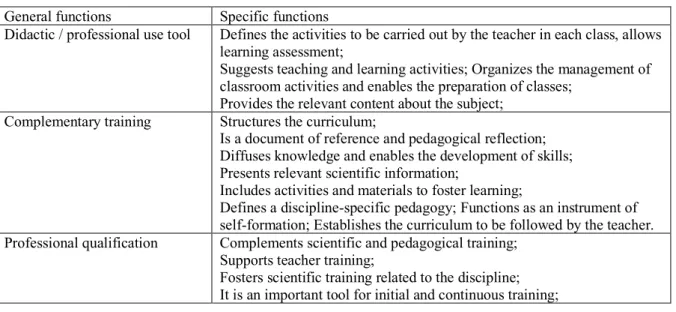
More recently, research on textbooks has included issues related to the use that teachers make of them. Junior and Régnier (2008) identify a set of general and specific functions associated with the use of textbooks by teachers:
Table 1. General and specific functions associated with the use of textbooks by teachers
General functions Specific functions
Didactic / professional use tool Defines the activities to be carried out by the teacher in each class, allows learning assessment;
Suggests teaching and learning activities; Organizes the management of classroom activities and enables the preparation of classes;
Provides the relevant content about the subject; Complementary training Structures the curriculum;
Is a document of reference and pedagogical reflection; Diffuses knowledge and enables the development of skills; Presents relevant scientific information;
Includes activities and materials to foster learning;
Defines a discipline-specific pedagogy; Functions as an instrument of self-formation; Establishes the curriculum to be followed by the teacher. Professional qualification Complements scientific and pedagogical training;
Supports teacher training;
Fosters scientific training related to the discipline; It is an important tool for initial and continuous training;
Source: adapted from Junior and Régnier, 2008
Some of the functions listed confirm previous research regarding the importance of textbooks in the organisation of classroom activities. Still, new functions have been identified – the idea of viewing textbooks as a formative tool in terms of continuous training and their role in presenting new contents and pedagogical practices to be explored in the classroom.
Rodriguez and Alvarez (2017) present an interesting systematization of textbook functions and use: the most relevant point has to do with the fact that, according to the research review made by the authors, teachers use textbooks as the main pedagogical resource. In fact, the textbook is considered curriculum to be implemented in classrooms. Still, it is used in combination with other resources.
Textbooks are not free from limitations. In this sense, it is useful to bear in mind those that researchers indicate as being the most frequent ones. According to Basturkmen (2010) the most relevant shortcomings relate to the following aspects:
- Inadequacy of the contents to the students that are using them - being textbooks prepared for the "reference student", they are not always in accordance with the needs and interests of specific groups of students;
- Problems related to the specific scientific terminology of the discipline;
- The sequence of curricular units may not be the most appropriate considering the levels of education for which they are intended;
- The proposed activities may be uninteresting;
Considering these issues, there are important recommendations on the use of the textbook that all teachers should know: it is an important resource, but it should not be the only resource used by the teacher. It is very important that the teacher uses the textbook as an "organizer" of both teaching and learning, but still a teacher has the possibility to modify, remove or add information to that included in the textbook.
Research demonstrates that textbooks are an important resource in education, an educational resource relevant to teachers and students. Thus, it was important to assess how Portuguese Geography teachers use textbooks in their classes. Teachers' perceptions are extremely important to understand how they adapt to curricular reforms and how they overcome the shortcomings of textbooks organisation when building their school practices. Research, results and reflections on the use of textbooks are presented in the next chapters.
3. GEOGRAPHY TEACHERS’ VIEWS ON TEXTBOOK FUNCTIONS AND USE 3.1 Research questions, sample and research methodology
The research carried out with Geography teachers was based on a sample of 70 teachers who had the opportunity to answer a set of questions on how they evaluate and use textbooks in their classes. Basically, the study was guided by two research questions:
1) How do teachers assess and use the textbooks they work with in classrooms?
2) What is (should be) for them a textbook as an important educational resource (also considering recent curricular reform)?
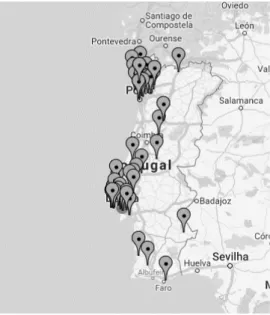
The sample, although relatively small in total, has allowed quite a good coverage in terms of geographical distribution of teachers as it is represented below:
Figure 1. Geographical distribution of Geography Teachers (Google Earth)
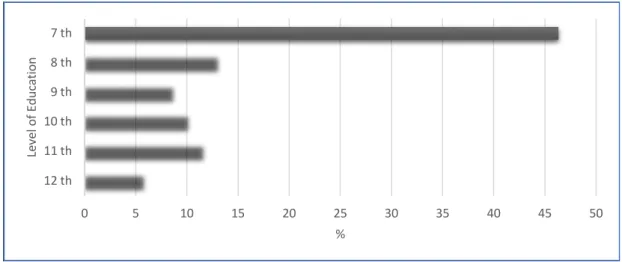
As regards educational levels the sample included teachers from different levels of education, ranging from basic education (where Geography is an independent and compulsory subject) to secondary education (where Geography is an elective subject in some scientific areas). The distribution of teachers according to the levels of education is presented in the following figure.
Figure 2. Teachers by level of education
The sample includes teachers from all levels of education but almost half were from the 7th grade (students are aged 11 – 12 years old) that is the first year in the Portuguese educational system where students attend Geography classes. Till the 9th grade (14 – 15 years old) Geography is a compulsory subject but in the 10th, 11th and 12th grade it is an elective subject.
In terms of research methodology, the following procedures were carried out: teachers’ views were collected through questionnaires and questionnaire analyses included both qualitative and quantitative methods -qualitative data were organized to comprehend in a global way the situations, experiences and meanings of the actions and perceptions of the subjects through their descriptions (Bogdan and Biklen, 1994). Quantitative data were statistically worked to represent the different topics under study for subsequent analysis and discussion.
3.2 Research results
In this chapter some results obtained in the investigation are presented. Some topics most directly related to the research questions were selected – textbook assessment, use of textbooks in the classroom and adaptation to curricular changes in Portugal, perceptions related to textbook efficiency and limitations of textbooks.
3.2.1 How do teachers assess and use the textbooks they work with in classrooms?
With regard to teachers' assessment of their textbooks the data were somewhat interesting: the evaluation of the textbooks using a scale of 1 to 5 points (1 being the lowest score and 5 being the highest score) showed a weighted average of textbooks of 3, 48 points as detailed in the following figure: 0 5 10 15 20 25 30 35 40 45 50 12 th 11 th 10 th 9 th 8 th 7 th % Le ve l o f E du ca tio n
Figure 3. Assessment of textbooks use by Geography teacher
It can be observed that approximately 45% of the teachers consider that their textbook is "Good". However, in weighted average terms the value obtained was 3.48. The option for the weighted average (and not the arithmetic average) is based on the fact that it is important to account for the weight of the different years of education in the calculation of this measure of central tendency (the teachers of the 7th grade have a significant weight in the sample) .
In any case, it is possible to conclude that a value of 3.48 for the classification of the textbooks under analysis considers their average value as "sufficient". It should also be noted that about 20% of the participating teachers work with textbooks that they consider to be "very poor" or "poor", which certainly creates problems in their use in classroom. To know more in detail, the opinion of teachers on the same topic was analysed for each year of education. The evaluation of textbooks by year of education reveals some interesting data as illustrated in the following figure:
Figure 4. Textbook assessment by year of education (weight average)
It is concluded that in the initial years of each educational cycle (7th and 10th grade) there increased requirements as far as the quality of textbooks is concerned- but as the year of education changes, textbook evaluation improves. It should be noted that the year of education where the average of the evaluation of the textbook is the lowest is exactly the year in which the students start studying Geography as an autonomous discipline in the Portuguese educational system (7th grade).
0 10 20 30 40 50
Very Poor(1) Poor (2) Suficient (3) Good (4) Very Good (5)
% 3,29 3,78 4 3,57 3,75 3 0 0,5 1 1,52 2,5 3 3,5 4 4,5 7 th 8 th 9 th 10 th 11 th 12º th As se ss m en t Level of Education
The use of textbooks by teachers was analysed according to its frequency and considering the activities that involve the use of this resource in the classroom. Regarding the frequency of textbook use in the classroom, the following results were obtained:
Figure 5. Textbook use by Geography teachers (frequency)
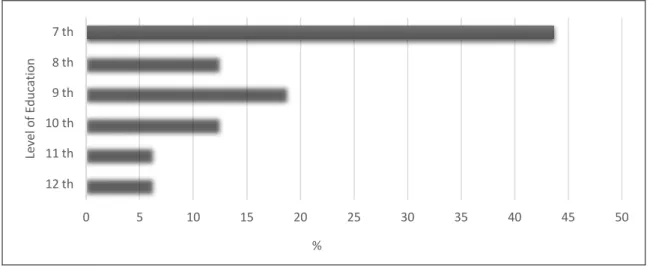
Most of the teachers mentioned that they use textbooks in some classes (almost 60%), which reinforces the idea that they use other educational resources in the organisation of their courses. To better understand in which level of education there is a greater dependence on textbooks in the structuring of the classes, the question was analysed by school year. Teachers who use the textbook in all classes (about 25% of respondents) do so in the following levels of education:
Figure 6. Teachers that use the textbook in all classes by year of education
The teachers of Basic Education (initial years of Geography) who use textbooks in all classes have a greater weight in the group of respondents. It should be noted that from the group of teachers who refer using the text in all classes, 43% were 7th grade teachers. As the year of education increases, the percentage of teachers who use the textbook in all classes decreases.
To complement the research question related to the use of textbooks it was important to identify the main activities involving their use. Therefore, the teachers were asked about the different activities they carry out with textbooks. The data collected are shown in the following figure: 0 10 20 30 40 50 60 70 Rarely All clases Some classes % 0 5 10 15 20 25 30 35 40 45 50 12 th 11 th 10 th 9 th 8 th 7 th % Le ve l o f E du ca tio n
Figure 7. Textbook use by Geography teachers (activities)
The textbook is mainly used for performing exercises and exploring content (reading texts, image analysis, etc.). Therefore, the textbook is a central document in Geography teaching , being at the same time an important source of information and a practical resource for teachers. Geography teachers recognise the importance of textbooks as learning resources. Textbooks are also used as a resource to be explored by the students (considering their importance in terms of activities that can be performed by students outside the classroom).
3.2.2 What is (should be) a textbook as an educational resource (also considering recent curricular reform)?
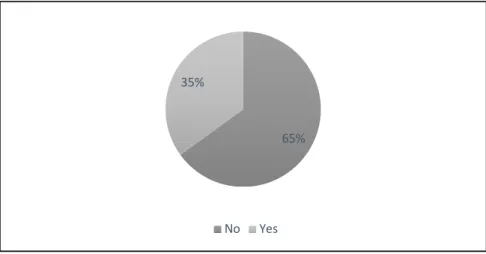
Regarding the adaptation to the curricular changes in Portugal, related to the publication of new documents guiding the educational policy and their articulation with the school subjects, Geography teachers presented their opinion. In relation to the existence in textbooks of activities related to competences to be developed according to the Profile of Students leaving Compulsory Education the following results were obtained:
Figure 8. Does the textbook includes activities related to the Profile of Students leaving Compulsory
Education?
0 10 20 30 40 50 60 70 80 90
Other Homework Peer work in the class Formative assessment Reading texts Analyse figures Exercises % 65% 35% No Yes
As it can be observed, approximately 65% of the respondents said that the activities of textbooks do not allow articulation with other learning than those of Geography. However, about 35% said that this articulation is possible. Therefore, it was important to know the context of these responses to understand the position of these teachers.
Geography teachers who mentioned that textbooks allowed working skills defined by the “Profile of the Students leaving Compulsory Education” were from different levels of education. Still, around 50% of them taught in the 7th and 8th grade (first years of Geography as an autonomous subject in the Portuguese curriculum) and among these same teachers 67% used the textbook only in some classes. The evaluation of the textbook they make is also higher than the general average (3.79). We can infer that the best quality of the textbook (recognized by teachers' evaluation) may play an important role in its use not only for teaching Geography, but for the development of transversal competences as well.
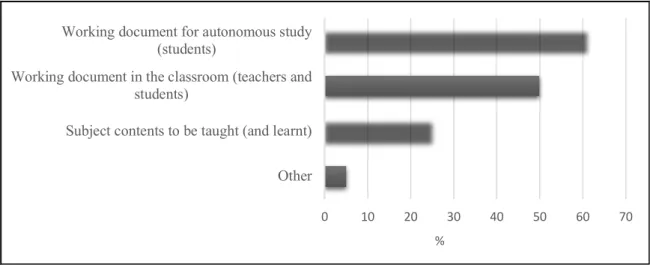
Referring to the perception and use of textbooks teachers, the next step was to obtain information on their understanding of the most important dimensions that should be present in a textbook. The results are presented in the following table:
Figure 9. Important dimensions of a textbook
Teachers consider that the most important function associated with a textbook is to be an educational tool for students. Further to this approach, emerges the idea that the textbook should also be an educational resource to be mobilized in the classroom. Only a smaller percentage of respondents (around 25%) recognize in textbooks the dimension of being a repository of scientific contents to be taught (and learnt).
This latter percentage was perhaps the more surprising one as it contradicts some of the scientific research carried out and presented in previous chapters. Particularly, if we recall that a huge percentage of teachers use the textbook to prepare their classes (not the official syllabus). Therefore, it was important to research a possible explanation for this opinion – it was decided to link this opinion with the teachers ‘assessment of their textbooks. Note that 25% of teachers’ assessment of their textbooks was about 3.19, lower than the general average. A less positive evaluation of the textbooks may account for these responses.
It was possible to conclude that the quality teachers recognize in their textbooks clearly conditions their opinion of what textbooks should be in general. They tend to value aspects lacking in the textbooks they use. The research also included the identification of the textbooks used in order to understand if it was possible to identify regularities in the best and worse textbooks (teachers were asked to identify the textbooks they are working with). This will be
0 10 20 30 40 50 60 70
Other Subject contents to be taught (and learnt) Working document in the classroom (teachers and
students)
Working document for autonomous study (students)
the next step in this ongoing research – trying to understand what makes a good and not so good textbook (according to teachers’ assessment) using content analyses methods.
4. DISCUSSION
The opinion given by the Geography teachers brought some elements of reflection that need to be addressed. In fact, when we compare teachers' perceptions on the use of textbooks and their importance in the organisation of classroom activities with the concept of a textbook present in Portuguese legislation (Law no. 47/2006, of August 28), there are some points of convergence and divergence. The following table summarizes some key ideas:
Table 2. Geography teachers’ views on textbook use comparing to national legislation
Concept of Textbook (Legislation) Geography teachers’ views …a relevant didactic-pedagogical resource,
though not exclusive, of the teaching and learning process …
The textbook is used: - In some classes– 59% - In all classes – 25% …resource to support the autonomous work of the
student
Document of autonomous study for students: 61% Exercises (learning activities): 80%
Homework: 31% …aiming at contributing to the development of
skills and learning defined in the National Curriculum for basic and secondary education.
Textbook assessment:
(1- very poor a 5 – very good): Weighted average – 3,48
Source: Law no. 47/2006, of August 28 and teachers’ views
Regarding the legal definition of textbooks and teachers’ views on the functions of textbooks, it is important to refer that the majority of teachers considered them as a relevant, although not exclusive, pedagogical resource: 59% of the teachers use textbooks in some classes, which means that in others classes they use other educational resources. It should be noted that a not relevant minority mentioned almost never using the textbook in the classroom. About the fact that a textbook is legally considered a resource to support student's autonomous work, this function is recognized by Geography teachers: 61% of the respondents considered that one of the most important dimensions of a textbook is to be a learning tool for students, 80% mentioned using textbooks for exercises in the classroom (as learning activities) and approximately 31% referred assigning the activities of textbooks as homework (autonomous learning).
The idea that the textbook is a resource that allows students to develop skills and learning (according to the legal framework) showed some diversity in terms of teachers’ opinion. In the first years of Geography education, this dimension was less recognized in textbooks. However, textbooks are clearly important resources for teachers as teaching and learning tools. The not so good assessment of textbooks showed a real dissatisfaction as regards their quality. It was then important to question teachers about what kind of problems textbooks had and what kind of improvements they should have. In general, three main problems were identified:
- Textbooks are not updated documents in terms of Geography content (mainly in what concerns data and texts): the period of validity of textbooks in Portugal is considered a problem for teachers, i.e., this period is currently 6 years which means that textbooks include outdated data and issues;
- Another problem mentioned is that they do not follow the new guidelines of the Ministry of Education;
-Textbooks also lack exercises and activities: although teachers recognize that textbooks are important working tools for students, they consider that these topics are insufficient in most textbooks in order to provide and promote the autonomous work of students;
Therefore, the main aspects to improve in textbooks relate to specific content. On one hand, it is important that textbooks include updated data and relevant working materials. The validity of 6 years for a textbook is identified by teachers as an important problem as they have to deal with data that no longer relate to current events (some examples were even given, such as migration, ICT and other topics important in Geography Education). On the other hand, teachers stressed the need to improve textbooks in terms of allowing more activities, reading and research to be done by students as autonomous work. These aspects are particularly important for textbook editors that in Portugal are private companies with a social and educational responsibility. These concerns will also be presented in order to avoid these issues in future textbook revision.
In the final chapter some of the main conclusions of the investigation are systematized. Textbooks are important tools in the educational process, both for students and teachers. They should, therefore, be effective working tools in the development of the teaching and learning process.
5. CONCLUSIONS AND RECOMMENDATIONS
Research on the use of textbooks in the educational process indicates that these are fundamental in organizing the work of teachers and students. In addition to their role in supporting the structuring of classroom activities, occasional or systematically, textbooks are understood as a key working document for teachers and students. The study on Portuguese Geography teachers’ views on textbooks confirmed these dimensions also present in the research carried out by Zabalza (1992), Lambert (1999), Graves (2000) and Junior and Régnier (2008).
However, despite this centrality, textbooks are pedagogical resources that present limitations - among the several pointed out in the bibliography and in the research carried out the most important referred by teachers were the need for a permanent updating in terms of scientific contents and data, learning activities and the promotion of the autonomous work of students. In Portugal, the fact that textbook validity period is of 6 years was pointed out as a problem by Geography teachers. Teaching Geography is about dealing with current physical and human phenomena and, most certainly, for that reason the issue concerning outdated statistical data and socioenvironmental subjects was presented as very problematic. Probably teachers from other school subjects do not feel this discrepancy, but in Geography education this is an important topic.
It is important to mention that this “insufficiency “of textbooks was also noted by Bohen and Hamann (2011) in their research considering how sustainable development was addressed in Geography textbooks. Their research demonstrated that it was considered very centred in the ecological dimension and not contemplating other important pillars that should be equally taken into account, such as economy and society: A very interesting example of how textbooks can show deficiencies in the approach current geographical topics.
It should be noted that one of the limitations of the study has to do with the fact that it has had the collaboration of a small number of teachers (70) despite the important geographical distribution that could be achieved. Sometimes the number of participants is high, but schools are concentrated in the metropolitan area of Lisbon and Oporto. Within the scope of the research carried out, it was possible to collect information about the perception of teachers
from practically the whole country. This aspect was undoubtedly relevant and made it possible to understand that the concerns related to textbooks are general.
Teachers who teach Geography in the first years of basic education (Geography only exists as an independent subject when students are about 12 years old in the 7th grade) are the ones who are most dissatisfied with textbooks in what concerns outdatedness, lack of diversified activities and tasks to be carried out by the students autonomously. This fact places an additional burden on teachers to bring to the classroom more updated and relevant topics to be worked on in the classroom (and may also explain the low assessment of textbooks).
The changes to be introduced in textbooks were presented by the teachers from all levels of education. Some topics were already mentioned in previous chapters, but more can be added: reformulation of the scientific content, lack of learning activities to be developed in classroom or as autonomous work, and want of suggestions of activities to be followed by students in terms of independent research or additional topics. When addressing the topic of the future of Geography textbooks, Behnke (2014) stresses the importance of the design quality of textbooks as an important factor for Geography learning. Textbooks need to be relevant from the point of view of students to become important sources of Geography learning and more effective as autonomous study resources.
Teachers’ recommendations suggest that Geography textbooks should not merely be a repository of relevant scientific knowledge and working documents to be mobilized by teachers. Textbooks should be user-friendly learning resources, include relevant texts, include updated statistical information, and display relevant graphic and cartographic information to be mobilized both by teachers and students. They should also include research suggestions and promote the development of national curriculum skills.
REFERENCES
Basturkmen, H. 2010. Developing Courses in English for Specific Purposes. New York: Paglave Macmillan.
Bogdan, R. 1994. Investigação Qualitativa em Educação: uma introdução à teoria e aos
métodos. Porto: Porto Editora
Behnke, Y. 2014. Visual qualities of future Geography textbooks. European Journal of
Geography: 5(4): 56- 66
Boehn,D, ; Hamann, B. 2011. Approaches to sustainability: Examples from Geography textbook analysis in Germany. European Journal of Geography: 2(1): 1-10
Carvalho, A. 2018. O tempo despendido e os recursos utilizados pelos/as professores/as na
preparação das atividades de ensino. ORE: Observatório dos Recursos Educativos
DGE. 2013. Metas curriculares de Geografia para o 3.º Ciclo do Ensino Básico. DGE: Ministério da Educação e Ciência
DGE. 2017. Perfil dos alunos à saída da Escolaridade Obrigatória. DGE: Editorial do Ministério da Educação e Ciência
Gérard, F. & Roegiers, X. 1998. Conceber e avaliar manuais escolares. Porto: Porto Editora. Graves, K. 2000. Designing Language Courses. A Guide for Teachers. Boston. Heinle
Cengage Learning.
Lambert, D. 1999. Exploring the use of textbooks in Key Stage 3 geography classrooms: a small-scale study. The Curriculum Journal: 10(1): 85-105
Lei 47/2006, de 28 de Agosto - Regime de avaliação, certificação e adopção dos manuais escolares do ensino básico e do ensino secundário.
Miguel, N. 2015. Textbook consumption in the classroom: Analyzing a classroom corpus.
Procedia - Social and Behavioral Sciences: 198: 309 – 319
Pingel, F. 2009. UNESCO Guidebook on Textbook Research and Textbook Revision. Paris: UNESCO.
Rodriguéz, J; Alvaréz, D. 2017. A investigação sobre manuais escolares e materiais curriculares. Revista Lusófona de Educação: 36 (9-24)
Zabalza, M. 1992. Planificação e desenvolvimento curricular na escola. Rio Tinto: Edições Asa