CUIDADO É FUNDAMENTAL
UNIVERSIDADE FEDERAL DO ESTADO DO RIO DE JANEIRO . ESCOLA DE ENFERMAGEM ALFREDO PINTO
RESEARCH DOI: 10.9789/2175-5361.rpcfo.v12.8501
DOI: 10.9789/2175-5361.rpcfo.v12.8501 | Pereira PPS, Araújo LX, Moreira KFA et al. | Mortality due to external causes...
CUIDADO É FUNDAMENTAL
UNIVERSIDADE FEDERALDO ESTADODO RIODE JANEIRO. ESCOLADE ENFERMAGEM ALFREDO PINTO
R E V I S T A O N L I N E D E P E S Q U I S A
MORTALITY DUE TO EXTERNAL CAUSES IN THE STATE OF
RONDÔNIA: TIME SERIES ANALYSIS FROM 1999 TO 2015
Mortalidade por causas externas no Estado de Rondônia: análise de série
temporal de 1999 a 2015
Mortalidad por causas externas en el Estado de Rondônia: análisis de serie
temporal de 1999 a 2015
Priscilla Perez da Silva Pereira1, Laís Xavier de Araújo2, Kátia Fernanda Alves Moreira3, Ana Claudia Morais Godoy Figueiredo4
How to cite this article:
Pereira PPS, Araújo LX, Moreira KFA, Figueiredo ACMG. Mortality due to external causes in the State of Rondônia: time series analysis from 1999 to 2015. Rev Fun Care Online. 2020 jan/dez; 12:270-275. DOI: http://dx.doi.org/10.9789/2175-5361.rpcfo.v12.8501.
ABSTRACT
Objective: the objective was to describe the mortality from external causes in the State of Rondônia in the
period of 1999 and 2015. Method: a time series study using data from the Death Certificates provided by the Health Surveillance Agency of the State of Rondônia. Linear regression was used for the trend analysis using the statistical package Stata®11. Results: 111,651 deaths were recorded in the State of Rondônia, 22.2% of which were classified as external causes. The mean number of deaths due to this cause in the period was 89.7 per 100,000 inhabitants and the standard deviation was 6.5. The linear regression showed an annual increase in deaths due to traffic accidents of 2.1%, deaths due to aggressions had an annual decrease of 1.98%, suicides and other external causes remained stationary. Conclusion: the results evidenced the need to strengthen preventive actions among young men and public policies to reduce accidents in the state of Rondônia.
Descriptors: External causes; Mortality; Time series studies; Rondônia; Brazil. RESUMO
Objetivo: descrever a mortalidade por causas externas no Estado de Rondônia no período de 1999 e 2015. Método: estudo de série
temporal utilizando dados da Declaração de Óbito disponibilizados pela Agência de Vigilância em Saúde do Estado de Rondônia. Para a análise de tendência realizou-se regressão linear utilizando o pacote estatístico Stata®11. Resultados: foram registrados no Estado de Rondônia 111.651 óbitos sendo 22,2% classificados como causas externas. O coeficiente médio de óbitos por esta causa no período foi 89,7 por 100.000 habitantes e desvio padrão de 6,5. A regressão linear apresentou um aumento anual nos óbitos por acidentes de trânsito de 2,1%, os óbitos por agressões tiveram um decréscimo anual de 1,98%, suicídios e outras causas externas permaneceram estacionárias. 1 Nurse graduated from the Faculty of Biomedical Sciences of Cacoal (FACIMED). PhD in Health Sciences from the University of
Brasilia (UNB). Assistant Professor of the Nursing Course at the Federal University of Rondônia (UNIR). 2 Student of the Nursing Course at the Federal University of Rondônia (UINR).
3 Nurse graduated from the Federal University of Pernambuco (UFPE). PhD in Public Health Nursing from the University of São Paulo (USP). Associate Professor of Nursing at the Federal University of Rondônia (UNIR).
4 Nurse graduated from the Federal University of Vale do São Francisco (UNIVASF). PhD in Health Sciences from the University of Brasilia (UNB). Nurse at the Information Management and Health Situation Analysis of the Federal District (GDF).
Conclusão: os resultados evidenciaram a necessidade de fortalecimento
das ações preventivas entre homens jovens e políticas públicas para redução de acidentes de trânsito no estado de Rondônia.
Descritores: Mortalidade; Causas externas; Estudos de séries temporais;
Rondônia; Brasil.
RESUMÉN
Objetivo: el objetive fue describir la mortalidad por causas externas en el
Estado de Rondônia en el período de 1999 y 2015. Método: estudio de serie temporal utilizando datos de la Declaración de Óbito disponibilizados por la Agencia de Vigilancia en Salud del Estado de Rondônia. Para el análisis de tendencia se realizó regresión lineal utilizando el paquete estadístico Stata® 11.
Resultados: se registraron en el Estado de Rondônia 111.651 óbitos siendo
22,2% clasificados como causas externas. El coeficiente medio de muertes por esta causa en el período fue 89,7 por 100.000 habitantes y desviación estándar de 6,5. La regresión lineal presentó un aumento anual en las muertes por accidentes de tránsito del 2,1%, las muertes por agresiones tuvieron un descenso anual del 1,98% y los suicídios y otras causas externas permanecieron estacionarias. Conslusión: los resultados evidenciaron la necesidad de fortalecimiento de las acciones preventivas entre hombres jóvenes y políticas públicas para reducción de accidentes en el estado de Rondônia.
Descriptores: Mortalidad; Causas externas; Estudios de series temporales;
Rondônia; Brasil.
INTRODUCTION
Deaths due to external causes represent one of the most significant public health problems in developing countries. Among other factors, their occurrence has been attributed to socioeconomic disparities between regions, countries and population groups.1 This group of causes of death corresponds to Chapter XX (VO1-Y98) of the 10th Revision of the International Classification of Diseases (ICD-10).2 External causes can be defined as trauma, injury or any other intentional or unintentional health problems of sudden onset and resulting from immediate violence or other exogenous cause. This group includes transport injuries, homicides, assaults, falls, drownings, poisonings, suicides, burns, landslide or flood injuries, and other occurrences caused by environmental circumstances.3
Deaths from external causes are not just a problem in developing countries. For example, in the United States of America, from 2000 to 2009, the death rate from traffic accidents decreased by 25%, but the death rate from unintentional intoxication, falls, and suicide increased by 128%, 71%, and 15% respectively in the period.4 Between 1990 and 2007 in Argentina death due to external causes grew by 54.5% while in Mexico and Colombia there was a decrease in deaths from these causes. Men were more vulnerable to homicide deaths, with a gender ratio of 9.1 in Colombia, 4.4 in Brazil, and 1.6 in Mexico based on Argentine rates.5
In 2013 in Brazil, according to the authors Abreu et al. (2018), mortality from external causes was the third most frequent cause of death.6 Injuries due to accidents or violence have a significant impact on society given the high mortality rate, health system expenditure, years of limited productivity and direct impacts on the individual, their family and society.7 Hospitalizations for external causes lead to a higher average daily cost of the Unified Health System (SUS) than other
health situations. In Brazil, in 2013, there were 170,805 SUS-funded hospitalizations for land transport accidents (ATT), with 78.2% of males, 48.6% in the age group of 20 to 39 years. The rate of hospitalization for ATT was 85.0 per 100 thousand inhabitants, the total expense of these hospitalizations reached R$ 231,469,333.13, with 1,072,557 days of stay and an average of 6.3 days of hospitalization per patient.8
The costs generated for SUS, due to the injures from external causes, range from hospital expenses to rehabilitation expenses. Victims may require prolonged hospitalizations and have highly disabling sequelae, with a major negative impact on quality of life, the performance of their daily activities, economic productivity and social life.9
According to the Ministry of Health (DATASUS) database report, in 2010, the external cause mortality coefficient in the state of Rondônia was 97.8 per 100,000 inhabitants, a figure higher than the national average of 75.1 per 100,000 inhabitants. In addition, Rondônia presented the highest coefficient in the northern region in 2010.10
Investigating the death profile of a region is important for understanding the epidemiological characteristics and their social impacts. Thus, mortality statistics represent essential information for understanding the health problems of a population and for supporting health policy planning and management mechanisms.3
The State of Rondônia has experienced a significant demographic change in the last ten years due to the construction of two hydroelectric plants. The state capital received approximately 140,000 new inhabitants impacting directly on all sectors of society. Studies on the theme in the northern region are scarce and few present data on the state of Rondônia. Thus, in this study we proposed to describe the temporal evolution of deaths from external causes in Rondônia between 1999 and 2015.
METHODS
This is a time series study conducted in the state of Rondônia from 1999 to 2015. The state’s population in 2015 was just over one and a half million individuals, the third most populous state in the northern region.10 The state of Rondônia has 52 municipalities and in 2010, 73.5% of Rondonians lived in urban areas, 10.3% were under five years of age and seven percent (7%) were elderly.11 The monthly per capita household income of the resident population 2015 was R$ 901.00; the HDI was 0.690, occupying the fifteenth place in the HDI ranking of the states of Brazil; the illiteracy rate was eight percent for individuals over 15 years.
Data on mortality were obtained from the State Department of Health (SESAU) on the Declarations of Death (DO) provided by the Health Surveillance Agency (AGEVISA), and information on the population of the Brazilian Institute of Geography and Statistics (IBGE) from the censuses and projections for the analysis period.
The mortality coefficient per 100,000 inhabitants from deaths from external causes and their subgroups was defined according to Chapter XX of the 10th International Classification of Diseases (ICD 10) organized in traffic
accidents (V01-V99), aggressions (X85-Y09), intentional self-harm / suicides / injuries (X60-X84) and other causes (Y10-Y34; W00-X59; Y35-Y98).2 The coefficients were analyzed according to gender (male and female); age group (<19 years, 20-39 years, 40-59 years and> 60 years); race / skin color (white, black, yellow, brown or indigenous); and region of health where death occurred (Madeira-Mamoré, Jamari Valley, Central, Zona da Mata, Coffee, Southern Cone or Guaporé Valley).
For trend analysis, defined as stationary, decreasing or increasing, linear regression was performed using the Prais-Winsten technique, after serial autocorrelation verification by Durbin and Watson test.12 The annual trend of mortality coefficient was presented for external causes with the 95% Confidence Interval (95% CI). Analyzes were performed using the Stata®11 statistical package.
This study is part of the matrix project entitled “Study on morbidities in Rondônia”, which was approved by the Research Ethics Committee of the Federal University of Rondônia-UNIR (CEP / UNIR) under opinion number 1.205923 and in accordance with the provisions of Resolution number 466 of December 12, 2012 for research with human beings.
RESULTS AND DISCUSSION
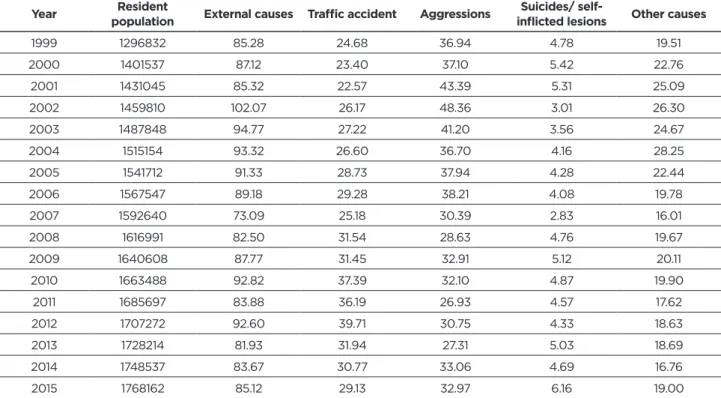
From 1999 to 2015, 111,651 deaths were recorded in the state of Rondônia. Of this total, 22.2% were deaths classified as deaths due to external causes. The average death coefficient for this cause in the study period was 87.75 per 100,000 inhabitants and standard deviation (SD) of 6.5 (Table 1). Among external causes, traffic accidents had a mean mortality coefficient of 29.53 (SD 4.9), aggressions 34.99 (SD 5.8), suicides or intentional self-harm 4.53 (SD 0.8) and the other causes 20.89 (SD 3.5).
Table 1 - Mortality coefficient due to external causes and subgroups, Rondônia, 1999 to 2015
Year populationResident External causes Traffic accident Aggressions inflicted lesionsSuicides/ self- Other causes
1999 1296832 85.28 24.68 36.94 4.78 19.51 2000 1401537 87.12 23.40 37.10 5.42 22.76 2001 1431045 85.32 22.57 43.39 5.31 25.09 2002 1459810 102.07 26.17 48.36 3.01 26.30 2003 1487848 94.77 27.22 41.20 3.56 24.67 2004 1515154 93.32 26.60 36.70 4.16 28.25 2005 1541712 91.33 28.73 37.94 4.28 22.44 2006 1567547 89.18 29.28 38.21 4.08 19.78 2007 1592640 73.09 25.18 30.39 2.83 16.01 2008 1616991 82.50 31.54 28.63 4.76 19.67 2009 1640608 87.77 31.45 32.91 5.12 20.11 2010 1663488 92.82 37.39 32.10 4.87 19.90 2011 1685697 83.88 36.19 26.93 4.57 17.62 2012 1707272 92.60 39.71 30.75 4.33 18.63 2013 1728214 81.93 31.94 27.31 5.03 18.69 2014 1748537 83.67 30.77 33.06 4.69 16.76 2015 1768162 85.12 29.13 32.97 6.16 19.00
Sources: IBGE, 2016; AGEVISA/RO, 2016
In the time series there was an annual increase in deaths from accidents of 2.09%, indicating a growth trend from 1999 to 2015 (Table 2). Deaths due to aggression had an annual decrease of 1.98%, deaths due to suicide or self-harm and other causes showed a steady tendency.
Table 2 - Annual trend of mortality coefficient of external causes and subgroups, Rondônia, 1999 to 2015
Type of external cause Annual tendency (IC 95%) Tendency
Accidents 2.09% (0.39; 3.83) Increasing
Aggressions -1.98% (-3.62; -0.31) Decreasing
Suicide or self-inflicted lesion -5.18 % (-11.94; 2.11) Stationary
Other causes -1.73 % (-3.49; 0.05) Stationary
Total -0.40 % (-1.25; 0.47) Stationary
Most cases of death from external causes occurred among men, with a mean mortality coefficient of 75.17 (SD 5.9) and in women 13.10 (SD 1.3) per 100,000 inhabitants.
Regarding the age of death, the highest mortality coefficient was found in the age group between 20 and 39 years old, and the lowest values were found among individuals over 60 years old (Figure 1). Notably, information about age was absent in 11.5% of the records analyzed.
Figure 1 - Mortality coefficient due to external causes
according to age group, Rondônia, 1999 to 2015
Source: IBGE, 2016; AGEVISA/RO, 2016
Regarding the distribution of the race / skin color characteristic in the analyzed period, the majority of deaths from external causes occurred among individuals declared as brown (53.9%), followed by white (32.6%), black (6.5%) and indigenous or yellow race (0.6%). During the study period, 6.5% of the records did not include skin color information. However, the distribution of the records over the years is not homogeneous. In 1999, this variable was not present in 32.2% of the records, but in 2015 only 1.5% of the records had the missing skin color variable.
The completion of the information on schooling in declarations of death, as well as race / skin color, presented higher frequency of completion over the period studied. In 1999, only 29.1% of the records had this information completed and in 2015 the variable was complete in 73.4% of the data. However, due to the lack of information or filling in the field as ignored, it was impossible to present this item in the study.
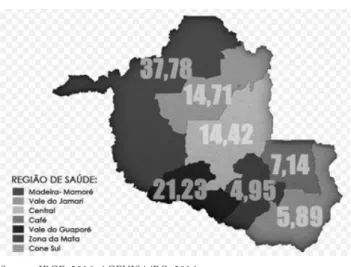
Figure 2 shows the mortality coefficient due to external causes distribution according to the regions of Rondônia State. In the region where the state capital (Madeira-Mamoré region) is located, the average external cause mortality coefficient was the highest (37.78 per 100,0000 inhabitants; SD 2.8), followed by the Guaporé Valley with 21.23 (SD 6.2). The region with the lowest average mortality coefficient was Central with 4.95 (SD 1.0).
Figure 2 - Average coefficient of mortality from external
causes according to health regions, Rondônia, 1999 to 2015
Source: IBGE, 2016; AGEVISA/RO, 2016
In Rondônia, from 1999 to 2015, there was an increase in the death rate from traffic accidents, an annual decrease in aggressions, and suicides and other causes showed a steady trend. Men aged 20 to 39 years were characterized as the group most vulnerable to death from external causes.
According to Andrade and Jorge (2016), between 2000 and 2013 the mortality rate due to external causes in Brazil increased by 10.5%, from 68.3 deaths per 100 thousand inhabitants in 2000 to 75.5 deaths per 100 thousand inhabitants in 2013. The Southeast Region had the lowest mortality rate from external causes (66 deaths per 100 thousand inhabitants), while the highest rates were observed in the Midwest (92.2 deaths per 100 thousand inhabitants) and Northeast (86.1 deaths per 100 thousand inhabitants).13
In Rondônia, a growing trend was found in the traffic accident mortality coefficient. This finding is aligned with national data showing that between 1998 and 2010, Brazil was considered one of the countries in the world with the most violent traffic despite changes in national legislation.14
Since the implementation of the new Brazilian Traffic Code (CTB) in 1998, the mortality rate from traffic accidents has remained stable at around 20 deaths per 100,000 inhabitants. In the period between 2001 and 2004 a progressive increase in traffic accidents in the country was recorded. Therefore, new laws, municipal traffic control, improved vehicle safety and electronic enforcement have not been able to significantly reduce deaths and disabilities resulting from traffic accidents.14,15 When conducting an analysis of the occurrences of traffic accidents and homicides it is impossible to disregard socioeconomic factors. A study conducted in Curitiba, Paraná, between 1996 and 2011 on social differences in adult mortality indicated that for traffic accidents and
homicides there was a higher risk of occurrence among people with lower socioeconomic status for both genders.16
The highest estimated homicide rates in the world are in the Americas, with an annual rate of 28.5 deaths per 100,000 people. The problem is most serious, particularly in Latin America, with countries such as Honduras, El Salvador, Colombia, Guatemala, Trinidad and Tobago, and Mexico, as well as Brazil, being the most violent in the world in terms of homicides.17 Between 2004 and 2012 research on homicide mortality in Brazil showed that the homicide rate in the country is four times higher than the world average (26.2 per 100 thousand), being 12 times higher among men (53/100 thousand) than among women (4/100 thousand). The risk of death from homicide among black Brazilians was 1.8 times higher than among whites indicating greater vulnerability among black and brown population.18
A study conducted in several Brazilian states, from 2002 to 2011, found that homicides have been the main cause of increase in violence-related mortality in Brazil since the 1980s.19 However, starting in 2003, there is a general reduction in this indicator. In the state of São Paulo, for example, there was a 73.7% drop in homicide mortality between 2001 and 2008, especially among men, young people aged 15 to 24, and residents in areas of extreme social exclusion. In Rondônia, from 1999 to 2015, despite the overall decreasing trend, deaths from homicide had the highest average coefficient among deaths from external causes (35 deaths per 100,000 inhabitants) following a national trend for the period.
According to Andrade and Jorge (2016), between 2000 and 2013, among deaths from self-harm, men presented a coefficient of 8.4 deaths per 100 thousand men, occurring mainly among those over 40 years (7.7 deaths by 100,000 inhabitants) and among residents of the Southern Region (8.2 deaths per 100,000 inhabitants).13 Vulnerability among adult men is a worldwide trend.3 In Brazil, unlike the situation related to traffic accidents and homicides, suicide rates remain relatively low and constant. Suicide is the third leading cause of death due to external causes, with a percentage representing 7.4% of these causes, being only behind homicides (40.3%), traffic accidents (30.0%), and other causes (22.3%). Suicide rates in some countries such as South Korea and Lithuania are around 31/100,000 inhabitants (h). In Brazil, epidemiological rates are lower, around 5.3/100.000h.20 As in the rest of Brazil, the state of Rondônia showed a steady trend during the study period for suicides indicating the need for planning of prevention actions mainly among the most vulnerable group - adult men.
Regarding deaths classified as other external causes, the state of Rondônia showed a steady trend. The classification called here as other external causes of accidental trauma within the ICD-10 external causes chapter represents a wide variety of events. These include falls in various situations, poisoning, problems caused by animals, sharp objects, accidental impact (blunt objects), among others. They cover
a broad spectrum of accidents at home, in the workplace, in leisure and sports, drowning, inhalations and accidental poisonings, burns, and so on.2
A cross-sectional study conducted in 86 SUS sentinel emergency services, located in the Federal District and 24 Brazilian capitals, in 2014, found that the age group from zero to nine years was the most affected by other causes with 28.8% of cases and this is a problem that affects the younger populations, as 62.6% of occurrences were under the age of 30 and 68.0% were male.21
For the distribution by region, the study showed a high percentage of mortality from external causes in the Madeira Mamoré Region. This region encompasses five municipalities in the state of Rondônia including the state capital. In general, the higher death rate from external causes in the populous municipalities is due to the accelerated industrialization and the migratory movement that caused the cities to absorb large numbers of people, without the timely and sufficient monitoring of urban infrastructure that triggered a host of social problems.14
CONCLUSIONS
In Rondônia, the intense migratory processes due to large development projects, such as hydroelectric plants, contributed to the increase of the fleet of vehicles on roads without adequate infrastructure, leading to the increase in the coefficient of traffic accidents. There was a decreasing trend in the coefficient of deaths from homicide while remaining as the main external cause of death in the state. Regarding deaths from suicide / self-harm and other causes, the trend remained stationary, pointing to the need to strengthen preventive actions, especially in the most vulnerable groups. The demographic growth and the impact of this migration that occurred in the state of Rondônia alert to the issues of public policy making that contribute to the reduction of accidents, violence, suicides or self-harm and other causes of mortality.
Among the limitations found in this study and the implications of using data from the Mortality Information System are the poor records of essential demographic information, such as education and race / skin color. The lack of recorded information limits the understanding of the profile of individuals directly interfering in the formulation of public policies and decision making by public managers. For further research we suggest an analysis of the budgetary impact and the organization of health care services for users victims of accidents, homicide or suicide attempt in the Unified Health System. Also, the investigation of the role of preventive actions already carried out in the State of Rondônia, such as educational programs and surveillance actions, aiming at understanding how these actions can contribute to the reduction of deaths from external causes in the State.
REFERENCES
1. Malta DC, Minayo MCS, Filho AMS, Silva MMA, Montenegro MMS, Ladeira RM, et al. Mortalidade e anos de vida perdidos por violências interpessoais e autoprovocadas no Brasil e Estados: análise das estimativas do Estudo Carga Global de Doença, 1990 e 2015. Rev bras epidemiol, 20(1): 142-156, 2017. https://www.scielosp.org/ pdf/rbepid/2017.v20suppl1/142-156/pt. Accessed on Jul 22, 2019. 2. Organização Mundial da Saúde. CID-10 Classificação Estatística
Internacional de Doenças e Problemas Relacionados à Saúde. 10 ed. São Paulo: Universidade de São Paulo, 1997.
3. Messias KLM, Júnior JPB, Pegado MFQ, Oliveira LC, Peixoto TG, Sales MAC, et al. Qualidade da informação dos óbitos por causas externas em Fortaleza, Ceará, Brasil. Cien Saude Colet, 21(1): 1255-1267, 2016. https://www.scielosp.org/pdf/csc/2016.v21n4/1255-1267/pt. Accessed on Jul 22, 2019.
4. Rockett IRH, Regier MD, Kapusta ND, Coben JH, Miller TR, Hanzlick RL, et al. Leading Causes of Unintentional and Intentional Injury Mortality: United States, 2000–2009. Am J Pub Health, 102(11): e84-e92, 2012. https://ajph.aphapublications.org/doi/pdf/10.2105/ AJPH.2012.300960. Accessed on Jun 10, 2019.
5. Souza ER, Melo AN, Silva JG, Franco SA, Alazraqui M, Pérez GJG. Multicentric study of deaths by homicide in Latin American countries. Cienc Saude Colet, 17(12): 3183-3193, 2012. http://www.scielo.br/pdf/ csc/v17n12/04.pdf. Accessed on June 10, 2019.
6. Abreu DROM, Novaes ES, Oliveira RR, Mathias TAF, Marcon SS. Internação e mortalidade por quedas em idosos no Brasil: análise de tendência. Cien Saude Colet, 23(1): 1131-1141, 2018. http://www.scielo.br/pdf/csc/v23n4/1413-8123-csc-23-04-1131.pdf. Accessed on Jul 22, 2019.
7. Mascarenhas MDM, Souto RMCV, Malta DC, Silva MMA, Lima CM, Montenegro MMS. Características de motociclistas envolvidos em acidentes de transporte atendidos em serviços públicos de urgência e emergência. Cien Saude Colet, 21(1): 3661-3671, 2016. https://www.scielosp.org/pdf/ csc/2016.v21n12/3661-3671/pt. Accessed on Jul 22, 2019.
8. Andrade SSCA, Jorge MHPM. Internações hospitalares por lesões decorrentes de acidente de transporte terrestre no Brasil, 2013: permanência e gastos. Epidemiol Serv Saúde, 26(1): 31-38, 2017. https://www.scielosp.org/pdf/ress/2017.v26n1/31-38/pt. Accessed on Jul 22, 2019.
9. Praça WR, Matos MCB, Fioravanti RK, Magro MCS, Hermann PRS. Perfil epidemiológico e clínico de vítimas de trauma em um hospital do Distrito Federal, Brasil. Rev Pre Infec e Saúde, 3(1): 1-7, 2017. http://www.ojs.ufpi.br/index.php/nupcis/article/view/6219/pdf Accessed on Jul 22, 2019.
10. Brasil. Ministério da Saúde. DATASUS – Indicadores de Mortalidade [Internet]. Brasília: Ministério da Saúde; 2010. http://tabnet.datasus. gov.br/cgi/tabcgi.exe?idb2011/c09.def. Accessed on May 5, 2018. 11. Instituto Brasileiro de Geografia e Estatística [homepage internet].
Censo Demográfico 2010 [Internet]. Brasília: Instituto Brasileiro de Geografia e Estatística; 2010. https://cidades.ibge.gov.br/brasil/ro/ panorama. Accessed on May 5, 2018.
12. Antunes JLF, Cardoso MRA. Uso da análise de séries temporais em estudos epidemiológicos. Epidemiol Serv Saude, 24(3): 565-576, 2015. https://www.scielosp.org/pdf/ress/2015.v24n3/565-576/pt. Accessed on June 10, 2019.
13. Andrade SSCA, Jorge MHPM. Estimativa de sequelas físicas em vítimas de acidentes de transporte terrestre internadas em hospitais do Sistema Único de Saúde. Rev bras epidemiol, 19(1): 100-111, 2016. https://doi. org/10.1590/1980-5497201600010009. Accessed on Jul 22, 2019. 14. Moreira MR, Ribeiro JM, Motta CT, Motta JIJ. Mortality by road
traffic accidents in adolescents and young people, Brazil, 1996-2015: will we achieve SDG 3.6?. Cien Saude Colet, 23(9): 2785-2796, 2018. http://www.scielo.br/pdf/csc/v23n9/en_1413-8123-csc-23-09-2785.pdf. Accessed on Jul 23, 2019.
15. Jomar RT, Ramos DO, Fonseca VAO, Junger WL. Effect of the zero-tolerance drinking and driving law on mortality due to road traffic accidents according to the type of victim, sex, and age in Rio de Janeiro, Brazil: An interrupted time series study. Traffic Inj Prev, 20(3): 227-232, 2019. https://www.tandfonline. com/doi/pdf/10.1080/15389588.2019.1576035?needAccess=true. Accessed on Jul 23, 2019.
16. Barreto MS, Teston EF, Latorre MRDO, Mathias TAF, Marcon SS. Mortalidade por acidentes de trânsito e homicídios em Curitiba, Paraná, 1996-2011. Epidemiol Serv Saúde, 25(1): 95-104, 2016. https://doi.
17. Wanzinack C, Signorelli MC, Shimakura S, Pereira PPG, Polidoro M, Oliveira LB, et al. Indigenous homicide in Brazil: geospatial mapping and secondary data analysis (2010 to 2014). Cien Saude Colet, 24(7): 2637-2648, 2019. https://doi.org/10.1590/1413-81232018247.23442017. Accessed on Jul 20, 2019.
18. Machado DB, Rodrigues LC, Rasella D, Lima Barreto M, Araya R. Conditional cash transfer programme: Impact on homicide rates and hospitalisations from violence in Brazil. PLoS One, 13(12): e0208925, 2018. https://journals.plos.org/plosone/article/file?id=10.1371/journal. pone.0208925&type=printable. Accessed on Jul 23, 2019.
19. Mascarenhas MDM, Barros MBA. Evolução das internações hospitalares por causas externas no sistema público de saúde, Brasil, 2002 a 2011. Epidemiol Serv Saude, 24(1): 19-29, 2015. https://www. scielosp.org/pdf/ress/2015.v24n1/19-29/pt. Accessed on Jun 10, 2019. 20. Ribeiro DB, Terra MG, Soccol KLS, Schneider JF, Camillo LA, Plein FAS.
Motivos da tentativa de suicídio expressos por homens usuários de álcool e outras drogas. Rev Gaúcha Enferm, 37(1): e54896, 2016. http://www. scielo.br/pdf/rgenf/v37n1/0102-6933-rgenf-1983-144720160154896. pdf. Accessed on Jul 23, 2019.
21. Malta DC, Mascarenhas MDM, Silva MMA, Carvalho MGO, Barufaldi LA, Avanci JQ, et al. - Brasil, 2014. Cien Saude Colet, 21(1): 3729-3744, 2016. https://www.scielosp.org/pdf/csc/2016.v21n12/3729-3744/pt. Accessed on Jul 23, 2019. Received in: 11/01/2019 Required revisions: 07/08/2019 Approved in: 13/08/2019 Published in: 10/01/2020 Corresponding author
Priscilla Perez da Silva Pereira
Address: Federal University of Rondonia
Department of Nursing, BR 364, Km 9,5 Porto Velho/RO, Brazil
Zip code: 76801-059 E-mail: [email protected] Telephone number: +55 (69) 2182-2113 Disclosure: The authors claim