Repositório ISCTE-IUL
Deposited in Repositório ISCTE-IUL:
2018-12-06Deposited version:
Publisher VersionPeer-review status of attached file:
Peer-reviewedCitation for published item:
Zhang, M. & Silva, M. G. (2018). Organizational work environment features influencing training transfer: the case of Chinese enterprises. In XXVIII Jornadas Luso-Espanholas de Gestão Científica. Guarda: Instituto Politécnico da Guarda.
Further information on publisher's website:
--Publisher's copyright statement:
This is the peer reviewed version of the following article: Zhang, M. & Silva, M. G. (2018). Organizational work environment features influencing training transfer: the case of Chinese
enterprises. In XXVIII Jornadas Luso-Espanholas de Gestão Científica. Guarda: Instituto Politécnico da Guarda.. This article may be used for non-commercial purposes in accordance with the Publisher's Terms and Conditions for self-archiving.
Use policy
Creative Commons CC BY 4.0
The full-text may be used and/or reproduced, and given to third parties in any format or medium, without prior permission or charge, for personal research or study, educational, or not-for-profit purposes provided that:
• a full bibliographic reference is made to the original source • a link is made to the metadata record in the Repository • the full-text is not changed in any way
The full-text must not be sold in any format or medium without the formal permission of the copyright holders.
Serviços de Informação e Documentação, Instituto Universitário de Lisboa (ISCTE-IUL) Av. das Forças Armadas, Edifício II, 1649-026 Lisboa Portugal
Phone: +(351) 217 903 024 | e-mail: [email protected] https://repositorio.iscte-iul.pt
HUMAN RESOURCES
ORGANIZATIONAL WORK ENVIRONMENT FEATURES INFLUENCING
TRAINING TRANSFER: THE CASE OF CHINESE ENTERPRISES
Mengyuan Zhang, [email protected], Southern Medical University, China and
Instituto Universitário de Lisboa (ISCTE–IUL), Portugal
Maria Gabriela Silva,
[email protected]
, Instituto Universitário de Lisboa (ISCTE – IUL),
Business Research Unit (BRU – IUL)
ABSTRACT
This study aims to find out which work environment factors may have the most significant
influence on affecting training transfer from the perceptions of trainees, in the Chinese
organizational context. Additionally, this study aims to find out different perceptions about work
environment factors and training transfer, based on some socio-demographic characteristics, as well
as company type where the respondent works. To gather data, it was used a self-administered
questionnaire delivered on the Internet, for two weeks in March 2017. Descriptive and inferential
are computed. The main results show that work environment factors significantly influence training
transfer. Findings also support the idea that there are significant differences on perceptions about
work environment factors and training transfer by socio-demographic variables. On the light of the
study findings, the researchers managed to provide some recommendations and suggestions for
managers of companies in China.
KEY WORDS: Training transfer, work environment factors, quantitative study, China
1 INTRODUCTION
It’s generally accepted that the 21-century is the time for competition of talents and the cultivation of high-quality talented people would rely largely on systematically organized training.
Most of the enterprises fully recognize the importance of training in recent years. However, the issue of transfer of training, commonly referred to as the practical application of knowledge learnt to the actual day-to-day work at workplace, is becoming a source of concern (Baldwin & Ford, 1988), because for most enterprises the training transfer rate is just between 10%-40%, that is to say, most of the training resource effect has been wasted.
Traditionally, studies on training transfer have focused on identifying the characteristics of some training affecting factors, such as learners’ characteristics and training design factors, which are often related to job performance. These researches have ignored the importance of the work environment and its influence on transfer of training. Hence, for the purpose of this research, we will analyse various organizational work environment factors that affect training transfer, and find out which are the more important factors for Chinese enterprises to improve training transfer, for the sake of increasing productivity and raising the performance of the trainees.
To achieve this aim, our research questions are:
What perceptions do participants have regarding the organizational work environment features, by type of training activity attended, in the Chinese context?
Do participants’ perceptions differ regarding the importance of different organizational work environment factors, by company type?
Which factors may influence transfer of training from the perception of workers in Chinese enterprises?
This research also provides some suggestions about how to increase training transfer in Chinese enterprises, and provide scientific basis and theoretical guidance to managers in the process of training.
In this article, staff training means the process of teaching the basic working skills to new staff and existing employees in order to cope with the challenge of new technology and competitors (Brown, 2005). Training transfer refers to the process of applying newly acquired skills and knowledge to the practical work of the trainees, where the final purpose is the organizational performance improvement (Pollock et al., 2015).
2 TRANSFER OF TRAINING: THE CRUCIAL ROLE OF WORK ENVIRONMENT FEATURES
In the last 30 years, scholars have tried to find an answer to the challenges that training transfer enforces. Baldwin and Ford’s (1988) meta-analysis suggests that three groups of inputs may influence the training transfer process: trainee characteristics, training design and work environment. The trainee’s characteristics include ability, personality, and motivation. Training design factors are composed of principles of learning, sequencing, as well as training content. Work environment factors are made up of opportunities to apply the knowledge to work and may include different support factors.
Based on this review, these inputs can be treated as predictors of training transfer. Some authors have argued that there is no evidence for a clear superiority of a particular group of variables over another group of variables (Blume et al., 2010). However, knowing that the work setting is of primary importance (Noe & Schmitt, 1986), some scholars have referred to the work environment as a powerful factor in the transfer of training process (Bossche & Segers, 2013).
Research has identified features of a positive transfer climate, such as adequate resources, cues to remind trainees of what they have learnt, opportunities to use new skills, timely feedback, and positive consequences for using new training (Tracey et al., 1995). Overall, in his review, Clarke (2002) states that the two key factors of the construct transfer climate suggested to influence the use of training on the job are opportunity to use and social support. The perception of support from supervisors and peers, as well as various task constraints, either directly or indirectly impact the level of transfer. If the level of support from a supervisor is positive yet the employee perceives the organization as unwilling and unsupportive toward the newly-acquired skills, then the level of transfer and associated level of performance is inhibited. The work setting becomes a demotivation factor for the trainee.
To further the understanding of the transfer process, we will adopt Grossman & Salas’ (2011) position which states that future research should focus on a deeper investigation of factors that have already yielded solid
evidence, rather than expand the list of factors that can influence transfer. One group of factors is the work environment factors. Although there is some research on them, there remain gaps in the literature regarding the work environment variables that influence transfer (Baldwin & Ford, 1988). A further examination of the content of the work environment role in transfer of training is therefore highly warranted (Van Der Klink et al., 2001). This article now discusses several social, individual and organizational support factors.
Peer Support
Peer support refers to the reinforcement that colleagues can provide to peers to use the learning acquired on the job (Swanson & Holton, 1997). In a study conducted by Facteau et al. (1995), trainees who perceived their peers as supportive were more likely to create greater transfer of the learnt skills from training than those who thought their peers are unsupportive. In the same vein, Chiaburu and Marinova (2005) found that peer support is related to skill transfer.
Supervisor Support
Supervisor support refers to the extent to which supervisors reinforce and support the use of learning on the job (Bates et al, 1996). In their meta-analysis, Baldwin and Ford (1988) conclude that supervisory support is a key environmental variable in influencing training transfer. Huczynski and Lewis (1980) also conducted a study to investigate supervisory influence on training transfer and noted that the number of trainees who communicated the content of the course with their supervisor before the course was twice as likely to attempt to transfer skills and knowledge after training as those who did not do it. Further, those participants, who had discussed the training issues with their supervisors, seemed to understand the goals and objectives of the course clearly. Hence, the authors suggest that supervisors influence transfer by facilitating openness, listening to skills, and empowerment. However, supervisors can also weaken training transfer through inhibitors, such as an excessive workload, unplanned work, and a high rate of change.
Opportunity to perform
Opportunity to perform refers to the extent to which the trainee is provided with or actively seeks experiences that allow him/her to apply the newly learnt knowledge, skill, and behaviours from the training program (Noe, 2002). Some scholars have suggested that the extent of opportunities provided to trainees to apply their knowledge and skills would influence training transfer. For example, Baldwin and Ford (1988) proposed a training transfer model that put this item into the work environment factors. Pentland (1989) points out that trainees, who practice newly learnt skills immediately after returning to the job, were able to retain the knowledge learnt in training for longer periods of time than those who did not have the opportunities to use the knowledge. According to Lim and Johnson (2002), the most significant reason of low transfer in their study refers to the lack of opportunity to apply the new learnt knowledge on the job.
Technological Support
Technological support refers to the services by which enterprises provide assistance to trainees in using technology products, such as mobile phones, computers, software products or other electronic or mechanical goods. The study of Rouiller and Goldstein (1993) shows that, with the use of technological resources, the transfer of training is more likely to support the organization’s development.
Budget refers to the financial expression of any given activity as agreed during its sanctioning process (Shad, 2008). Financial support has a significant influence on training transfer. For example, Shad (2008) found that there was a strong link between increased training budgets and decreases in personnel turnover.
Physical and Aesthetic Environment
Physical and aesthetic environment refers to the facilities and the environment the companies provided to their trainees to help to increase training transfer. According to the meta-analysis result of Colquitt et al. (2000), positive support environment were strongly related to transfer. Trainees may be better able to focus on transferring new knowledge to their workplace when they work in a supportive environment (Richman-Hirsch, 2001). Brill (1993) suggests that a supportive physical environment can result in productivity gains equal to two to five percent of annual salary in all job categories. Aesthetics environment is a vital part of the physical environment, it helps to reduce trainees’ stress and increase willingness to try new skills at work, and thus play a significant role in improving training transfer.
Workload
Workload refers to the amount of work an individual has to do. Porras and Hargis (1982) reported that there is a negative correlation between training skills used and overload and job-generated stress. Decker and Nathan (1985) found that the trainee’s workload is an important factor influencing training success. And similarly, Brown (2005) found workload as crucial factor for the aggregate time spent in e-learning training courses. Worsfold et al. (2004) found that lack of time is the main reason for not attending training activities.
3 TRANSFER OF TRAINING: THE LEARNING PROCESS MODEL
Generally speaking, training transfer is the evidence that learning is actually being applied to the job setting for which it was intended. Sekaran (2006) divides learning into three dimensions: understanding, retention, and application. In turn, understanding has two elements: answer questions correctly and give appropriate examples; retention has one element: recall material after some lapse of time; while application has two elements: solve problems, applying concepts understood and recalled, and integrate with other relevant material. This operationalization for measuring learning can be applied to transfer of training. However, researchers of transfer of training have considered categories of generalization, maintenance, and near and far transfer as more appropriate for measuring transfer of training, differentiating it from learning or transfer of learning. For the purpose of this research, to describe the transfer process, we include both the application of skills and knowledge learnt in training program and maintenance of the learnt skills and knowledge over a period of time in daily work. ‘Application,’ according to Noe (2002) refers to the ability of trainee to apply learned capabilities for example verbal knowledge, motor skills, etc, to the job-related issues and situations that are similar but not completely similar to those encountered in the studying environment. ‘Maintenance’ means the process where newfound acquired abilities are continuously used as time goes on (Noe, 2002).
4 METHOD
The questionnaire was designed for identifying some relevant organizational work environment factors that affect training transfer, in China. The seven factors of work environment and the three factors of training effects were measured using a questionnaire having closed ended statements requiring response on a Likert scale. The items used were adapted from previous measures developed by Shad (2008). The constructs related with supervisor support, peer support, workload and budget availability were measured using six items each. The dimensions of opportunity to perform, technological support, and physical and aesthetic environment were measured using five items each. To evaluate training transfer it was used twelve items, which may reflect the constructs of learning, maintenance, and application.
4.2 SAMPLING
To measure the different constructs, the initial questionnaire was presented to 10 employees working in a Chinese company through an email. Scores were collected through a widely used commercial online web-survey account. Few corrections were done and the final questionnaire contained 51 items.
Data were to be collected from employees who work in enterprises located in China and had attended a training program in the last 12 months. The enterprises included state-owned enterprises, privately owned enterprises and foreign-invested enterprises, which includes multinational companies and joint ventures.
The sample of this research consisted of 256 observations (a 85% response rate). The desired sample size was determined by following the recommendations proposed by Benson and Nasser (1998). They suggested factor analysis requires a minimum of five subjects per independent variable to assure adequate statistical power and generalizability of results.
18% of the trainees were from state-owned enterprises, 40% were working in private companies, and 18% of them were from foreign-owned enterprises, and the rest of respondents were from joint ventures. A slight majority of the sample was male (51%). Respondents were predominantly from 25 to 45 years old (80%) and most of the trainees held a bachelor’s degree or higher (74%). Over 57% of the respondents attend soft skills training.
5 DATA ANALYSIS
5.1 PRINCIPAL COMPONENT ANALYSIS FOR WORK ENVIRONMENT AND TRAINING TRANSFER
Principal Component Analysis was carried out with Kaiser’s criterion and Varimax Rotation. Before running the analysis, we checked the appropriateness of conducting principal component analyses. The values of KMO were always higher than 0.80 and Barlett’s tests of Sphericity showed significant correlations (Hair et al., 2010).
For social support, one item has a value of extraction below the limit of 0.5 and we decided to redo the same analysis without this element. Table 1 shows factor loadings of items that perform significantly on factor analysis for two dimensions: supervisor support and co-worker support. The first component extracted
explains about 39% of the variability of social support and the second explains a 21%. In total, the two components explain 60% of the variability of the data.
Table 1. Results of principal components analysis on social support
Component
1 2
My supervisor set new goals to make sure I can benefit from new skills and knowledge
that I learned from training .757
My supervisor helped me when I have problems in applying my new skills in training. .715
My supervisor gave me advice on how to apply skills and knowledge in training. .687
My supervisor concerned about practical applications of my training program .742
My supervisor praised my efforts in front of others after training .727
My colleagues help me to apply skills and knowledge that I learned from training .845
I receive cooperation of my peers while using new skills. .833
My co-workers are curious about my training. .810
My co-workers show interest in learning skills I acquired from training. .804
\My peers do not criticize me when I implement new skills. .674
My colleagues do not laugh at me when I make mistakes in applying new skills. .778
For individual work support, two components were extracted. The first component is labelled as workload, the second one as opportunity to perform (see table 2). The first component extracted explains about 55% of the variability of work support, the second explains a 16%. In total, the two components explain 71% of the variability of the data.
Table 2. Results of principal components analysis on individual work support
Component
1 2
Spared time was available to me to apply new skills .842
There was no increase in my workload after training .790
The office hours were enough to apply new skills .770
I do not have to work overtime frequently .851
Extra time spent to apply new skills was duly paid .672
My workload makes it possible to attend every class in training program .774
My supervisor gives me freedom to develop and work independently .806
Autonomy on making decisions related to work is available to me .837
My new skills could be implemented without amendments in the organizational policies .859
The situations used in training are very similar to those I encounter on my job .768
My jobs are more challenging after training .813
Regarding the resource support, the Principal Component Analysis showed that three items have a value of extraction below 0.5 and we decided to redo the same analysis without these elements. According to Table 3, the first component is made up of questions about comfortable work environment, so we labelled it as physical and aesthetic environment. The second component consists of questions on funds, here labelled as
budget support, and the last one was labelled as technological support. The first component extracted explains about 33% of the variability of resource support, the second explains a 23% and the third 10%. In total, these three components explain 66% of the variability of the data.
Table 3. Results of principal components analysis on resource support
Component
1 2 3
My company fully supported my demand for additional funds .851
Funds required for applying new skills were provided in time .839
I received my salary as usual when I attend the training program .832
My company provides me with reimbursement for my meals and transportation
when I attended training program .822
Additional equipment required to apply newly learned skills was available to me .786
Software similar to the one used during training was available to me after training .774
New sources of technical information were available to me after training .599
Technical manuals, publications were available to me when required after training .734
Air conditioner .836
Tea,refreshment .789
Noise-free .794
Leg space under the desk .749
Comfortable work place .821
For the training transfer section, only one component is extracted, so we called it as training transfer (see table 4). The component extracted explains about 75% of the variability of training transfer.
Table 4. Results of principal components analysis on training transfer
Component 1 After training I had a comprehensive understanding of the knowledge learned in training
program .874
I can answer all the questions about the training classes I attended .842
I can convey the skills to others what I learnt after training .823
I learned applying all the skills that I studied during training .826
I can recall the overall information of the training .898
I can recall details of each unit of training .871
I can recall the how to operate the skills of training .834
I can recall every knowledge the trainer teaches in training .896
I can apply all the skills learned from training to work .898
My job performance improved a lot after training .867
I found job is much easier for me after training .821
To measure the reliability of each variable, Cronbach's alpha was estimated to test the internal consistency among the items included in each of the formative scales. The resulting alpha values of the study ranged from 0.71 to 0.97 (see table 5). According to Hair et al. (2010), all the components are reliable.
Table 5. Results of the reliability analyses of variables
Variables No. Items Cronbach's alpha
Supervisor Support 5 0.79 Peer Support 6 0.88 Workload 6 0.90 Opportunity to Perform 5 0.91 Budget Support 5 0.89 Technological Support 5 0.71
Physical and Aesthetic Environment 5 0.87
Training Transfer 12 0.97
5.2 WHAT PERCEPTIONS DO PARTICIPANTS HAVE REGARDING THE ORGANIZATIONAL WORK ENVIRONMENT FEATURES, BY TYPE OF TRAINING ACTIVITY ATTENDED, IN THE CHINESE CONTEXT?
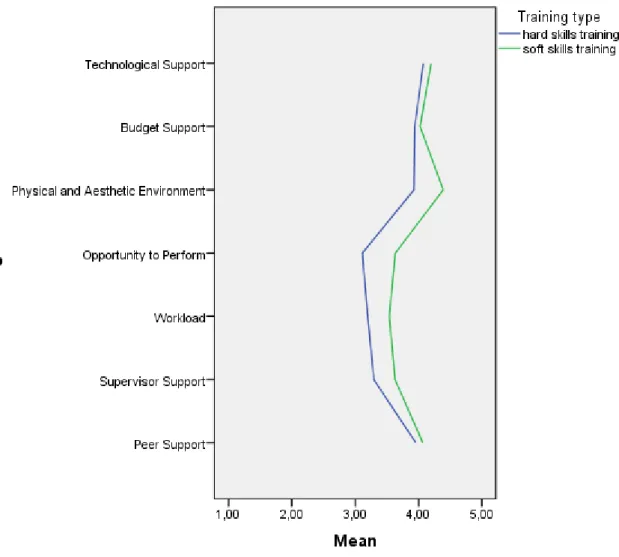
According with Figure 1, it seems that, on average, respondents have positive opinions about the support they received from the organization to use the learnt skills on their jobs. The most relevant dimensions are physical and aesthetic environment, peer support, and technological support. The less important dimensions are opportunity to perform and supervisor support. The employees who attended soft skills training activities have, on average, better opinions on all work environment features than those who attended hard skills training courses. However, the differences are not very substantial – the most relevant ones are associated with the physical and aesthetic environment and opportunity to perform.
Figure 1. Mean profile for variables of work environment factors
5.3 DO PARTICIPANTS’ PERCEPTIONS DIFFER REGARDING THE IMPORTANCE OF DIFFERENT ORGANIZATIONAL WORK ENVIRONMENT FEATURES, BY COMPANY TYPE?
Table 6 shows the results of one-way ANOVA. Except for the budget support construct, there are significant differences regarding the importance of different organizational work environment features, by company type. Five components (peer support, workload, technological support, opportunity to perform, and physical & aesthetic Environment) display significant difference between different company types.
For peer support, the opinions of trainees in private-owned companies are significantly lower than those in the other two company types. Trainees from foreign-invested companies appear to receive more support from their supervisors than those in Chinese enterprises, however the differences are not statistically significant when we analyse two groups each time.
Regarding the workload, the perceived level of workload is significant heavier in Chinese private-owned enterprises than in both stated-owned enterprises and foreign-invested companies. For the technological support, the significant differences are between privately-owned and foreign-owned enterprises, with the participants in the former type of company having the lowest perceptions. The opinions on opportunity to
perform are significant different between the three company types, with the trainees in foreign-invested companies having highest scores and the trainees in Chinese private-owned enterprises the lowest ones. Employees in privately-owned companies have significant lower perceptions on physical and aesthetic environment than those in foreign-invested companies, which means that the latter company type provide the most comfortable physical and aesthetic environment.
Table 6. ANOVA Results of organizational work environment factors by company type
Pee r S u p p o rt S u p er v iso r S u p p o rt Wo rk lo a d Te ch n o lo g ica l S u p p o rt O p p o rtu n it y to Per fo rm Ph y sic a l & Ae sthetic En v iro n m en t Bu d g et S u p p o rt Stated- owned Enterprises 3.82a 3.86 2.62a 4.14 3.18 ac 4.28 3.92 (0.65) (0.78) (0.87) (0.54) (1.14) (0.50) (0.58) Chinese private-owned Enterprises
2.78a,b 3.98 4.03a,b 4.06 a 2.71a,b 3.85 a 4.00
(0.63) (0.56) (0.43) (0.55) (0.49) (0.64) (0.65) Foreign- invested companies 4.00b 4.13 3.85b 4.24 a 4.17 bc 4.48 a 4.00 (0.37) (0.42) (0.52) (0.31) (0.42) (0.73) (0.56) F 144.95*** 2.83* 167.61*** 3.16* 143.19*** 24.26*** 0.7
Notes: Mean values are reported with standard deviations in parentheses.
Means with the same superscript letter (a, b or c) are significantly different at the 0.05 level by post hoc Scheffe test. *P≤.05, ** p ≤ .01, *** p < .001
5.4 WHICH WORK ENVIRONMENT FEATURES MAY INFLUENCE THE TRANSFER OF TRAINING FROM THE PERCEPTION OF WORKERS IN CHINESE ENTERPRISES?
Table 7 presents the regression analyses on training transfer. Results revealed that: 1) among the control variables, job position and the type of training activity attended have positive effects on training transfer; 2) when all work environment characteristics are in the model, almost all dimensions (except peer support and technological support) are predictors of training transfer; 3) around 82% of the variation of the training transfer is explained by the model.
Table 7. Fitted hierarchical regression model for training transfer
Model 1 Model 2 Age -0.49*** -0.08 Gender 0 0 Education level 0.32*** 0
Job position 0.22*** 0.10**
Training content type 0.22** 0.12*
Company type -0.13* 0
Peer support 0
Supervisor support 0.31***
Workload 0.35***
Opportunity to perform 0.33***
Physical & aesthetic Environment 0.09*
Budget support 0.14*** Technological support 0.10 R-square 0.38 0.83 Adjusted R-square 0.36 0.82 F-value 25.30*** 87.91*** Note: N = 256. * p ≤ .05, ** p ≤ .01, *** p ≤ .001 6 DISCUSSION
This study aims to increase our understanding about what organizational work environment features may influence training transfer by answering three questions:
• What perceptions do participants have regarding the organizational work environment features, by type of training activity attended, in the Chinese context?
• Do participants’ perceptions differ regarding the importance of different organizational work environment factors, by company type?
• Which factors may influence transfer of training from the perception of workers in Chinese enterprises? This study supports the idea that there are significant differences on the organizational work environment features by company type from the perception of workers in Chinese enterprises. Overall, it seems that the trainees in foreign-invested enterprises are the most willing to valorise the social environment characteristics. For peer support, the opinions of trainees in private-owned companies are significantly lower than those in the other two company types. One potential explanation may be the fact that most of the privately-owned companies focused mainly on the individual performance and ignored the importance of teamwork. Hence, in privately-owned enterprises, the competitive environment between the colleagues leads to the low support from peers. On the other side, the organizational culture of state-owned and foreign-invested companies seem to emphasize the importance of teamwork and add team performance into individual performance evaluation, so trainees feel to receive more support from their co-workers. Regarding the supervisor support, the lowest score belongs to state-owned enterprises, because mangers here care on meeting leaders’ expectations and do not have much time to spend on their subordinates.
However, employees in stated-owned enterprises perceive that their level of workload does not create difficulties to get the most benefit from a training activity. This is explained by the present situation in China. Most stated-owned enterprises in China are big companies with many people and the workloads are not as
heavy as in private-owned enterprises. Employees from stated-owned enterprises come to work and go home on the dot almost every day. Foreign-invested companies seem to offer a workload that allows employees to get good benefits from training activities.
For technological support, the three kinds of companies provide pretty good technological support for trainees. However, foreign-invested companies seem to provide better technological support than Chinese-owned enterprises. Regarding the opportunity to perform, employees in Chinese private-owned enterprises seem to have the lowest perceptions, next comes those in stated-owned enterprises, and finally the employees in foreign-invested companies. One reason to explain this significant difference is given by the fact that many privately-owned companies are small-scale companies and employees don’t have the autonomy to conduct their own ideas, most of them doing things by following the orders. On the other side, foreign-invested companies encourage employees to conduct their own ideas, so the trainees have enough opportunity to perform what they learnt from training. Finally, regarding the physical and aesthetic environment, higher perceptions were expressed by employees in stated-owned and foreign-invested companies. It reflects the idea that Chinese private-owned enterprises do not realize the importance of the physical and aesthetic environment and ignore its influence on training transfer.
According to the hierarchical regression model of training transfer, all the work environment dimensions (except peer support and technological support) have a positive influence on training transfer. The reason why peer support doesn’t have influence on training transfer may be explained by the current situation of China. Lots of companies emphasize individual performance, and employees compete against each other inside of the same company. It means that people are not willing to help each other and team building is not a key variable in the company culture of most Chinese enterprises. Regarding the technological support, it seems that this dimension does not influence the transference of the new acquired skills to the job. One reason may be the disconnection between the type of training attended and the technology sources available in different types of companies.
6.1 THEORETICAL AND PRACTICAL IMPLICATIONS
The factors influencing training transfer is mainly absorbed from the widely accepted models of transfer, consisting of learner characteristics, intervention design/delivery, and work environment (Baldwin & Ford, 1988). Without the effective transfer of training, the costs and time spent in training is simply wasted. In the past, researchers did a lot of researches in factors influencing training transfer. But, most of the study focus on the learner characteristics, intervention design/delivery, and ignored the importance of work environment factors.
Results of this study have potentially valuable implications for future research and practice. First, the results of this research explain all aspects of work environment factors that influence training transfer and these results provide empirical evidence to the former theoretical models (e.g. Baldwin & Ford, 1988) suggesting that transfer of training is impacted by the social support factors, individual work factors and resource support factors.
Second, all respondents in the sample are trainees from companies in China, so the results are suitable for Chinese enterprise to improve their training transfer.
Finally, we can argue that for Chinese enterprise to maximize their return on investment with regards to training transfer and to increase work performance, they need to focus on the work environment features that influence transfer of training, such as supervisor support, budget support, opportunity to perform, workload, and physical and aesthetic environment.
6.2. LIMITATIONS
As all studies, this research has some limitations:
We used a self-administered questionnaire and some of the subjects may have overestimated or underestimated their answers.
The purpose of our investigation was to analyse seven organizational work environment features. However, other dimensions may also influence training transfer.
The validity of the study relies on respondents’ honest responses to the questionnaires.
7 REFERENCES
Baldwin, T., & Ford, J. (1988). Transfer of training: A review and direction for future research. Personnel Psychology, 41(1): 63-105.
Bates, R. A., Holton, E. F. III, & Seyler, D. L. (1996). Validation of a transfer climate instrument. Proceedings of the Academy of Human Resource Development, 18(1): 426–433.
Blume, B.D., Ford, J.K., Baldwin, T.T. & Huang, J.L. (2010). Transfer of training: A meta-analytic review. Journal of Management, 36(4): 1065-1105.
Bossche, P.V. & Segers, M. (2013). Transfer of training: Adding insight through social network analysis. Educational Research Review, 8: 37–47
Brill, M. (1993). Now offices, no offices, new offices- wild times in the world of office work. Marlton, NJ: Teknion.
Brown, K. (2005). A field study of employee e-learning activity and outcomes. Human Resource Development Quarterly, 16(4): 465-480.
Chiaburu, D.S., & Marinova, S.V. (2005). What predicts skill transfer? An exploratory study of goal orientation, training self-efficacy and organizational supports. International Journal of Training and Development, 9(2): 110-123.
Clarke, N. (2002). Job/work environment factors influencing training transfer within a human service agency: Some indicative support for Baldwin and Ford’s transfer climate construct. International Journal of Training and Development, 6(3): 146–162.
Colquitt, J.A., LePine, J.A. & Noe, R.A. (2000). Toward an integrative theory of training motivation: A meta-analytic path analysis of 20 years of research. Journal of Applied Psychology, 85(5): 678–707.
Facteau, J., Dobbins, G., Russell , J., Ladd, R. & Kudisch , J. (1995). The influence of general perceptions of the training environment on pretraining motivation and perceived training transfer. Journal of Management, 21(1): 1-25.
Grossman, R. & Salas, E. (2011). The transfer of training: what really matters. International Journal of Training and Development, 15(2): 103–120.
Hair, J.F., Black, W.C., Babin, B.J. & Anderson, R.E. (2010). Multivariate Data Analysis: A Global Perspective, Upper Saddle River, NJ: Pearson.
Huczynski, A.A., & Lewis, J.W. (1980). An empirical study into the learning transfer process in management training. The Journal of Management Studies, 17(2): 227-240.
Lim, D.H., & Johnson, S.D. (2002). Trainees' perceptions of factors that influence learning transfer. International Journal of Training and Development, 6(1): 36-48.
Noe, R.A. & Schmitt, N. (1986). The influence of trainee attitudes on training effectiveness: Test of a model. Personnel Psychology, 39: 497-523
Noe, R. (2002). Employee Training and Development. New York: McGraw-Hill.
Pentland, B.T. (1989). The learning curve and the forgetting curve: The importance of time and timing in the implementation of technological innovations. Paper presented at the 49th annual meeting of the Academy of Management, Washington, DC.
Pollock, R.V.H., Jefferson, A. and Wick, C.W. (2015). The six disciplines of breakthrough learning: How to turn training and development into business results. 3rd ed. New York: Willey.
Porras, J.L., & Hargis, K. (1982). Precursors of individual change: Responses to a social learning theory based on organization intervention. Human Relations, 35: 973-990.
Richman-Hirsch, W. L. (2001). Post training interventions to enhance transfer: The moderating effects of work environments. Human Resource Development Quarterly, 12(2): 105–120.
Rouiller, J. & Goldstein, I. (1993). The relationship between organizational transfer climate and positive transfer of training. Human Resource Development Quarterly, 4(4): 377-390.
Shad, I. (2008). Influence of Organizational Work Environment on Transfer of Training in Banking Sector. Ph.D thesis from National University of Modern Languages, Islamabad. Link: http://prr.hec.gov.pk/Thesis/417S.pdf (October 2015).
Sekaran, U. (2006). Research Methods for Business: A Skill Building Approach. 4th Edition. Singapore: John Wiley & Sons.
Swanson, R.A. & Holton, E.F. (1997). Human resource development research handbook. San Francisco: Berrett-Koehler.
Tracey, J., Tannebaum, S., & Kavanagh, M. (1995). Applying trained skills on the job: The importance of the work environment. Journal of Applied Psychology, 80(2): 239–252.
Van Der Klink, M., Gielen, E., & Nauta, C. (2001). Supervisory support as a major condition to enhance transfer. International Journal of Training and Development, 5(1): 52.63.
Worsfold, D., Griffith, C. & Worsfold, P. (2004). A survey of environmental health officers’ views of food hygiene training. British Food Journal, 106(1): 51-64.