MIRROR MIRROR ON THE WALL, IS CREATIVITY
MAKING ME A NETWORKER AT ALL?
THE ROLE OF POLITICAL SKILLS ON THE
RELATIONSHIP BETWEEN CREATIVE ROLE IDENTITY
AND PERSONAL NETWORKING
Letícia Raquel Trindade Ferreira
Dissertation submitted as partial requirement for the conferral of Master in Business Administration
Supervisor:
Prof. Aristides Isidoro Ferreira, Prof. Auxiliar, ISCTE Business School, Departamento de Recursos Humanos e Comportamento Organizacional
“If I have seen further, it is by standing on the shoulders of giants.”
ACKNOWLEDGEMENTS
No single masterpiece of my favorite artists was build inspiration-free. And this work was no exception.
To my eyes, I am glad to be surrounded by the most inspiring, humble and bright human beings on the planet, and I am just as lucky I got to enjoy their support, ideas and energy. This work was only possible due to the impact these “giants” had on my motivation, resilience and perseverance to do more, do better and see further in the most challenging way and, to them, I owe well-deserved acknowledgements.
To “giant” Professor Aristides, for accepting the hard working mission of being my supervisor and believing in my bubbly personality with a challenging project that made me learn, grow and overcome myself in every step of the process. The knowledgeable and experienced inputs represented valuable and essential tools that without them, this work would certainly loose in its quality, innovation, interest and creativity. The patience, availability and kindness I had the chance to experience along this long journey truly inspired me to be a better professional in the future.
To my “giant” Joana, for being the inspiring, creative, extraordinary and bright personality that reads me like no other and picks me up whenever I’m drifting into cloudy cores of distant galaxies. My all time friend, present since day one and part of my chosen family, lighted the way and filled my journey backpack with powerful tools like humbleness, resilience, courage and an immense thirst for the unknown, always challenging me to overcome my insecurities with a tremendous belief in my doubting self. The tenacity, knowledge, creativity, innovation and non-stop support I had the chance to enjoy, made this work possible and gratifying.
To “giant” Magda, for being a constant in a universe of change, the wisdom, patience and availability helped me achieve ambitious learning goals and the rigorous inputs strongly enhanced my understanding, making this work possible.
To my “giant” Ricardo, for being the sun to my moon, the family I chose. Taking care of a boiling supernova demands strong beliefs, perfectly timed words and a sea of kindness. The laughs, the tears, the constant support and sharing of ideas and energy were essentials that made this journey lighter and easier.
To my “giant” Maria Inês, for being a force from the Dark Side, a galaxy full of wonder, creativity and intellectual energy, defying the heavy gravity of the mundane in every discussion or shared input, challenging me to see further and achieve greater.
To “giants” Rita e Paulo, for being my social coachers and introducing me to the startups world, and giving me courage to dive into valuable networks of entrepreneurs willing to share their knowledge of the field and to take part in the study that originated this work. The patience and availability proved to be crucial for this task to succeed.
To “giant” Jason Associates, for allowing me to meet interesting, talented and extraordinary professionals enthusiastic about sharing new ideas and new paths to problem solving. To Joana, for teaching and really showing me what resilience and people management is all about; To Pedro, for supporting and strengthening my goal orientation, motivating me to do better and to focus on the quality of the work developed. To Susana and Elsa, for the trust and autonomy you always gave me and the support you made me experience during the course of my work in your team.
To my “giants” Marisa, Sandra, Tânia, Rita e Maria, for the universe of laughs, advice, help, support and kindness you never failed to provide.
To my “giants” Sónia, Sofia e Catarina, for your constant sweet disposition and incessant support into making me feel home, even when I was miles away.
To my “giant” master workgroup colleagues Catarina, David, Naimeche, Raquel and Sofia, for teaching me what teamwork, leadership and common motivation really is. The challenges achieved together shaped my being into a better professional, and the values of our team were crucial for this work to be possible.
To my “giant” ISCTE Junior Consulting team Carolina, Duarte, Eloísa, João, José, Mafalda, Marta, Pedro, Telmo and Tiago, for the opportunity of enjoying rich, challenging and diversified points of view, ideas and intellectual energy that inspire me to look at reality with a visionary set of lenses, where innovation and out-of-the box thinking are major ingredients for a hopeful, dynamic and brighter future.
To “giants” Filipe Castro Matos, João Domingues, Luís Nuno Barbosa, Maria Miguel Ferreira, for opening the doors of the Portuguese startup world, engaging into contacts to further my network development and caring to share with me valuable insights of the national entrepreneurial movement.
And last but definitely not least, to my “giant” family, who taught me the most important lesson, representing an example of support, effort and sacrifice helping me achieve greater and look further yet showing humbleness, kindness and perseverance.
RESUMO
A criatividade, como o networking, são tipicamente modelados, respetivamente, como variáveis de outcome e input de fenómenos organizacionais; no entanto, as condições para o modelo reverso estão sub-desenvolvidas, tal como o efeito das competências políticas nesta relação. Assim, com base em teorias da identidade de papel e de competências sociais, o presente estudo argumenta que o networking pessoal beneficia da identidade de papel criativo e de competências políticas, através do efeito mediador destas últimas. Através de dados recolhidos a partir de 107 membros de 50 startups portuguesas, os resultados do estudo indicam que a identidade de papel criativo apresenta uma relação positiva com competências políticas, e confirmaram que as competências políticas têm um impacto positivo no networking pessoal. Adicionalmente, o nosso estudo evidenciou um efeito indireto das competências políticas na relação entre a identidade de papel criativo e o networking pessoal. A variabilidade encontrada entre startups indica ainda que variáveis de segundo nível deverão ser contempladas no modelo. No final do estudo, observações sobre as implicações destes resultados e orientações para futuras investigações são discutidas.
Palavras-chave: Identidade de papel criativo; Competências pessoais; Networking
pessoal; Empreendedorismo.
JEL Classification System:
M13 – Business Administration: New Firms • Startups M12 – Business Administration: Personnel Management
ABSTRACT
Creativity and networking are typically modeled, respectively, as outcome and antecedent variables of organizational phenomena; however, the conditions for the reverse model are under-explored, as is the effect of political skills in this relation. Accordingly, drawing on role identity and social competence theories, the current study argues that personal networking benefits of creative role identity and political skills, through a mediation effect of the latter variable. Using primary data gathered from 107 members of 50 startups operating in Portugal, the study findings indicate that creative role identity has a positive relation with political skills, and confirmed that political skills will have a positive impact on personal networking. Also, our study found an indirect effect of political skills on the relationship between creative role identity and personal networking. The variability between startups also indicates that second level variables should be accounted in the model. At the end of the study, insights on the implications of these findings and directions for future research were discussed.
Keywords: Creative role identity; Political skills; Personal networking; Entrepreneurship.
JEL Classification System:
M13 – Business Administration: New Firms • Startups M12 – Business Administration: Personnel Management
TABLE OF CONTENTS
SUMÁRIO EXECUTIVO ... III
1. INTRODUCTION ... 1
1.1 PERSONAL NETWORKING ... 4
1.2 CREATIVE ROLE IDENTITY AND PERSONAL NETWORKING ... 6
1.3 POLITICAL SKILLS AND PERSONAL NETWORKING ... 9
1.4 THE MEDIATOR ROLE OF POLITICAL SKILLS ... 11
2. METHOD ... 12
2.1 SAMPLE AND PROCEDURES ... 12
2.2 INSTRUMENTS ... 14
3. RESULTS ... 17
3.1 COMMON METHOD VARIANCE ... 17
3.2 DESCRIPTIVE ANALYSIS ... 17
3.3 TEST OF HYPOTHESES ... 18
3.4 MULTILEVEL MODELING ... 21
3.5 RANDOM INTERCEPT-ONLY MODEL ... 22
3.6 MULTILEVEL MEDIATION MODEL WITH ALL EFFECTS RANDOM (1-1-1) ... 23
4. DISCUSSION ... 25
5. PRACTICAL IMPLICATIONS ... 27
6. LIMITATIONS AND DIRECTIONS FOR FUTURE RESEARCH ... 29
7. CONCLUSION ... 31
LIST OF FIGURES
Figure 1. Proposed conceptual model ... 3
Figure 2. Proposed conceptual model hypotheses ... 12
Figure 3. Proposed conceptual model using PROCESS ... 20
LIST OF TABLES Table 1. Factor analysis and instrument characteristics ... 16
Table 2. Confirmatory factor analysis ... 16
Table 3. Intercorrelations and Descriptive Statistics ... 18
Table 4. Mediator analysis for personal networking with bootstrap re-sampling.a ... 19
Table 5. Intercept-only model for Personal Networking ... 22
Table 6. Average effects estimates post-bootstrapping for Multilevel Mediation with 50 CEO’s (N=107) ... 24
List of Abbreviations
𝜎ℯ2- Variance of the collaborator-level residual errors 𝜎𝜇2- Variance of the startup-level residual errors CFA- Confirmatory Factor Analysis
CFI- Comparative Fit Index CI- Confidence Interval
EFA- Exploratory Factor Analysis ICC1- Intraclass Correlation Coefficient k2- Kappa-squared
LL- Lower Limit of the confidence interval N- Sample Size
p- p value
r- Pearson’s correlation coefficient
RMSEA- Root Mean Square Error of Approximation s.e.- standard error
SD/s.d.- Standard Deviation
SRMR- Standardized Root Mean Square Residual TLI- Tucker-Lewis Index
UL- Upper Limit of the confidence interval VUCA- Volatile, Uncertain, Complex, Ambiguous - Cronbach Alpha Coefficient
- Standardized regression coefficient - Spearman’s linear correlation coefficient 2- Chi-square
SUMÁRIO EXECUTIVO
Mais do que nunca as organizações, e empreendedores em particular, procuram o sucesso numa era de inovação, revolução tecnológica e digital, expansão global dos mercados e onde os contactos das pessoas significam tanto ou mais do que as estruturas sólidas das suas empresas (Horney et al., 2010). Num estudo recente, Jørgensen & Ulhøi (2010), evidenciaram o papel essencial das networks face à criação de valor nas organizações através do desenvolvimento e sustentação da inovação. Na verdade, não só as networks são essenciais para qualquer organização que busque inovação, sobrevivência e crescimento, mas também a criatividade (Amabile, 1988; Shalley & Gibson 2004; Zhou & George, 2003; Zhou & Su, 2010).
Especificamente, Drazin et al., (1999) assinalaram a utilidade do conceito de identidade para perceber como os indivíduos se envolvem e demonstram comportamentos de criatividade. À luz da visão de Amabile (1988:126) criatividade surge enquanto “produção de ideias novas e úteis, por um indivíduo ou pequeno grupo
de indivíduos, que trabalham juntos”. Nesse sentido, Barron e Harrington (1981)
sugeriram que indivíduos criativos possuem autoimagens consistentes com o seu trabalho criativo. O conceito de identidade de papel associada à criatividade é atribuída a Petkus (1996), observando que as pessoas experienciam uma forte influência da identidade de papel criativo, no sentido de que estes indivíduos reconhecem-se, e gostam de ser reconhecidos, enquanto cumpridores de um papel relacionado à criatividade.
Indivíduos criativos ligam ideias como forma de responder a novos problemas, e dado que as networks proporcionam acesso a um vasto leque de recursos que apoiam essa resposta, uma prática comum destes é a construção e manutenção de networks amplas (Hargadon, 2008). O networking pessoal – comportamentos benéficos à construção, manutenção e uso informal de relações – detém potenciais vantagens face a atividades relacionadas com o trabalho, permitindo ainda a expansão de vantagens comuns (Wolff & Moser, 2009).
De acordo com Amabile e Gryskiewicz (1987), indivíduos altamente criativos utilizam competências políticas de forma positiva, capacitando-os a interagir com outras pessoas e a contactar com as suas visões e ideias. O conceito de competências políticas, enquanto “capacidade de efetivamente entender os outros no trabalho, e utilizar essa
organizacionais” (Ferris et al., 2005:127), está já amplamente cimentado na literatura.
Indivíduos politicamente competentes, acabam por conseguir atrair outras pessoas, dado os seus níveis elevados de autoconfiança, autoestima e sentido de controlo, reforçando, assim, o desenvolvimento do seu networking, uma vez que estes indivíduos reconhecem potenciais oportunidades nas interações interpessoais (Perrewé et al., 2004).
Porém, atendendo a que a relação entre a identidade de papel criativo e o
networking pessoal não se encontra ainda consolidada na literatura, restam ainda
questões por clarificar, nomeadamente, perceber o papel que as competências políticas desempenham nesta relação. Desta forma, o foco deste estudo incidirá em perceber se a autoimagem do indivíduo enquanto criativo catalisará o networking pessoal e de que forma é que essa auto perceção, influencia essa relação através das competências políticas.
Em suma, considerando que (1) indivíduos que possuem fortes identidades de papel criativo procuram a solidificação dessa identidade através da abordagem de problemas e desafios de forma criativa (Farmer et al., 2003; Jaussi, 2007; Petkus, 1996; Tierney 2015) e que networks externas representam uma ampla fonte de ideias, ou seja um meio de resolução de problemas (Haragadon, 2008; Hoang & Antoncic, 2003; Li, Veliyath & Tan, 2013; Watson, 2007); e que (2) indivíduos altamente criativos utilizam competências políticas, capacitando-os a interagir e a contactar com outras pessoas (Amabile & Gryskiewicz, 1987), construiu-se o modelo que se propôs estudar.
Assim, examinou-se a relação entre a identidade de papel criativo e o
networking pessoal, mediada pelas competências políticas em 107 participantes de entre
50 startups portuguesas, selecionadas à luz da definição de startup proposta por Ries (2011) baseado no trabalho desenvolvido de Steve Blank. A recolha de dados operacionalizou-se via questionário online e presencial, originando respostas posteriormente analisadas via ferramentas estatísticas.
Os resultados demonstraram que relativamente à relação entre a identidade de papel criativo e o networking pessoal, não foi identificado um efeito de mediação, mas sim um efeito indireto das competências políticas. Adicionalmente, foi evidenciada a relação positiva da identidade de papel criativo com as competências políticas. Face às competências políticas, os resultados foram de encontro aos estudos já existentes na literatura, demonstrando o impacto positivo destas no networking pessoal. Contudo, não foi encontrado suporte empírico para a hipótese relativa à relação entre a identidade de papel criativo e o networking pessoal. Estes resultados reforçam-se ainda ao nível da
existência de variabilidade individual entre as diferentes startups, remetendo para a necessidade de contemplação de variáveis de nível dois neste mesmo modelo. Estas últimas reforçaram a explicação face ao networking.
Estas evidências revestem-se de relevância dado adicionarem resultados concretos ao estudo da identidade de papel criativo aplicado ao networking pessoal. Até então, na sua grande maioria, o estudo do conceito de networking surge orientado à sua interpretação enquanto input (e.g. Hoang & Antoncic, 2003; Mohr, Garnsey & Theyel, 2014; Watson, 2007) e menos abordada como uma potencial variável de outcome (Forret & Dougherty, 2001), verificando-se na literatura o fenómeno contrário aplicado ao estudo da criatividade, onde parece existir uma aparente falta de interesse para com esta enquanto preditora, permanecendo um conjunto interessante de questões teóricas e empíricas por responder (Gilson, 2008; Mumford, 2003). Sendo, por essa razão, de salientar a evidência encontrada neste estudo de que a identidade de papel criativo apresenta uma relação positiva com o networking pessoal aquando da presença de competências políticas.
No presente estudo são ainda relevadas algumas implicações práticas, nomeadamente ligadas ao reconhecimento da importância da identidade de papel criativo, por parte das startups, que poderá potenciar competências políticas nos indivíduos que por sua vez terão efeitos concretos no que toca ao networking pessoal. Limitações associadas à amostra e sua dimensão foram consideradas assim como a argumentação da adopção do método longitudinal e métodos complementares de recolha de dados. Adicionalmente, novas direções para estudos futuros indicam foco em variáveis de nível organizacional e social network analysis.
1. INTRODUCTION
To embrace the VUCA world - a volatile, uncertain, complex and ambiguous environment extended to the highly dynamic business environment of our days -, is the challenge of most organizations nowadays. Like never before organizations, and entrepreneurs in particular, strive for success in an era of innovation frenzy, technological and digital revolution, global market expansion and times “when people
connections matter at least as much or more than solid structures” (Horney, Passmore
& O’Shea, 2010:33).
In particular, personal and interorganizational relationships have been recognized, in the past, as drivers for entrepreneurial success, suggesting that performance can definitely be influenced through networks (Hoang & Antoncic, 2003; Watson, 2007; Zhao & Aram, 1995). Igniting both academics’ and practitioners’ debate, the networking sphere has known a long path of development through the years, depicting a hot topic of discussion within the business and entrepreneurial streams of research. Thereby, it didn’t take long before the networking concept was applied to several other areas of relevance and interest, like startups’ performance (e.g. Cooper, Gimeno-Gascon & Woo, 1994; Duchenseau & Gartner, 1990; Shepherd & Douglas, 2000; Walter, Auer & Ritter, 2006; Watson, 2007).
Given the resources (e.g. information, financial, knowledge) limitation “newly born” businesses commonly face in early years, networking can be recognized as a privileged way of accessing such resources usually outside the firms’ range of access (Jarillo, 1989; Mohr, Garnsey & Theyel, 2014). In other words, entrepreneurs can be seen as business leaders entrusted with the role of building bridges of contact with external business links, either of personal or of an interorganizational kind, throughout the combination of both internal and external skills and resources, that seek to achieve competitive advantages (Jarillo, 1989; Larson, 1992). In that sense, the study of the individual factors that influence startup entrepreneurs’ personal networking behaviors continues to be critical.
Prior research has indicated that personal characteristics are often examined to help in the explanation of phenomena concerning entrepreneurial activity (e.g. networking behaviors). For instance, Amabile and Gryskiewicz (1987), found evidence of highly creative individuals to use political skills with a positive aim, empowering them to interact with other people and contact with their visions and ideas. As a
consequence, according to Ferris et al. (2005), politically skilled individuals tend to have a better adjustment to other people since they know how to understand them and influence them, making it easier to attract people into their beliefs and strengthening their personal networking behaviors.
Such support from literature regarding the relevance of personal traits when studying entrepreneurship constructs (eg. Phipps, 2012; Wincent & Westerberg, 2005), leads us to examine, in this particular study, the impact of variables like creativity and political skills on personal networking since, particularly, entrepreneurs also build and engage into personal networking in order to build valuable connections and maximize their creative solutions, visions and ideas (Phipps, 2012).
To our knowledge, no previous studies have examined the relation between creative role identity and political skills to predict personal networking, although the former mentioned studies provide some clues on a potential relation among such variables. Specifically, we intend to focus our efforts on creative role identity, which may contribute positively to startups’ personal networking. In addition, we intend to uncover how creative role identity influences personal networking through political skills.
Based on this, the main purpose of this study is to propose a creative role identity–political skills-personal networking model. Therefore, the present thesis intends to add to research on entrepreneurship and particularly to networking studies by answering the following question: is there a direct and significant effect of individuals’ creative role identity on one’s personal networking skills and is that effect positively mediated by political skills? Hence, the current study is innovative because it extends previous networking research by examining an additional potential predictor that has not been previously investigated and that is theoretically relevant to fostering personal networking.
In doing so, our study’s contribution on how individual creativity and political skills impact startups’ personal networking brings relevance on both theoretical and practical levels. On a theoretical level because it enlightens the understanding of the relation between creative role identity and personal networking, by addressing calls from previous studies, namely from Forret and Dougherty (2001), still current, who suggested that the research stream on networking behavior tends to focus on its outcomes (e.g. Boso, Story & Cadogan, 2013; Hoang & Antoncic, 2003; Jørgensen & Ulhøi, 2010; Mohr et al., 2014; Watson, 2007) and less attention is given to the
determinants of personal networking; and from Gilson (2008) and Mumford (2003) who noted the seemingly lack of interest in the study of creativity as the predictor, therefore holding an interesting body of work regarding both theoretical and empirical questions who remain unanswered, as well as from Anderson, Potočnik & Zhou (2014), that pointed the necessity of “examining consequences of creativity and innovation [since it]
holds much promise to move the field forward” (cf. 2014:40). Hence, the value added by
this study focuses on approaching the literature gap regarding the study of personal networking, seldom studied as an outcome of the organization, and provide answers or add to the known literature, a concept relatively little studied and applied as a predictor – creative role identity. And also at a practical level, because it provides startups’ CEOs and teams with guidance on enhancing personal networking in their startups, elucidating entrepreneurs on areas they should invest in order to further improve their skills and induce success into their startups. Furthermore, given the entrepreneurship concept hot topic nature in the current Portuguese business scenario, networking activities emerge as a relevant field of interest and investment due to the recent movement and birth of startups.
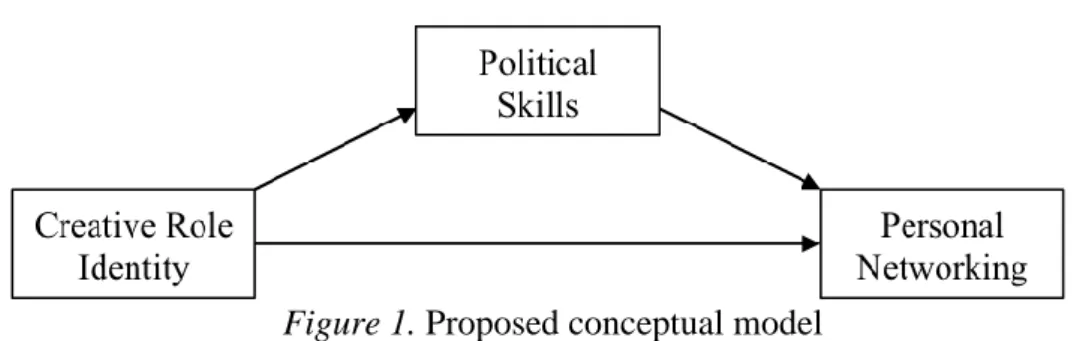
Below, the key constructs of this study are defined and the rationale for the conceptual model and hypothesis is developed. The conceptual model is illustrated in Figure 1.
1.1 Personal Networking
Interpersonal and interorganizational relationships are acknowledged as business ventures’ performance supporters, providing conditions for businesses to access resources ranging from capital to emotional support, ideas, and opportunities identification (Birley, 1985; Brüderl & Preisendorfer, 1998; Schmeltzer, Van Hook & Hutt, 1991; Zimmer & Aldrich, 1987). As studied by Granovetter (1985), several economic transactions that turned out to be crucial are embedded in “structures of social
relations” (cf. 1985:481). Such social relations, being them of the formal or informal
kind, like friends, colleagues, acquaintances and even family, prove themselves to be essential links for the success of businesses (Torres, 2005) and capable of exerting influence onto organizations’ performance (Thompson, 2005).
Attending to the diversity of studies recently emerging in the entrepreneurial research field, the network construct has been growing in its application and, derived from its popularity, misusages and inconsistencies have been identified (O’Donnell, Gilmore, Cummins & Carson, 2001). Since the concept of network entails a multidimensional approach to relationships and perspectives, including both interpersonal and interorganizational ties and, given the significant dissimilarities among networks, following the framework recently developed by Ferreira, Braun & Sydow (2014), interpersonal and interorganizational networks must be differentiated (O’Donnell et al., 2001). Specifically in this study, we will focus on interpersonal networks.
Interpersonal networking is defined by behaviors that individuals undertake and are beneficial to build, maintain and, use informal relationships that withhold potential advantages towards work related activities, acknowledging access to resources and expanding common advantages (Wolff & Moser, 2009). Following Birley & Cromie’s (1988) vision, entrepreneurs are offered two types of networks to start their business: the social and the professional network. The social network includes all the informal connections ranging from family, friends and acquaintances that relate with the entrepreneur on a frequent basis and in social spheres; the latter, the professional network, holds all the formal connections directly related to the business sphere, being them, individuals or organizations (e.g. clients, partners, suppliers). As suggested by the authors, even though it’s the social network sphere that predominates in entrepreneurs’ networks early stages, they are compelled to shift progressively into the professional
network environment, as the relevance of its advice, support and resources increase, as opposed to those offered by the social network.
A more recent yet similar prism is suggested by Hite & Hesterly (2001), stating that personal networks evolve according to the development stage of the firm. Namely, starting with identity-based networks from birth, that are associated with strong ties (family, friends, acquaintances) and, evolving into “calculative networks”, dominated by weak ties (market associated), when at an early growth stage of the venture.
Albeit the value associated with these proposed bi-dimensional views on the network environment, literature seems to focus its attention on the potential of these links as a whole not discriminating the outcomes of either formal or informal connections, with studies resuming them, in general, as social networks, network ties/relationships, or just networks (e.g. Borgatti & Halgin, 2011; Boso et al., 2013; Hoang & Antoncic, 2003; Li, Veliyath & Tan, 2013).
The social network theory, portraits, therefore a concept in entrepreneurship that is built upon two central premises, namely that i) the business venture process involves gathering scarce resources coming from the entrepreneurial environment and ii) those resources to be obtained via entrepreneurs’ personal network. Given startups’ “absence
of a track record”, that proves or supports its success or reliability, entrepreneurs have
to rely on their personal networking skills to obtain resources from either clients, suppliers, employees and investors (Birley & Cromie, 1988; Ostgaard & Birley, 1996). In this perspective, networking enables entrepreneurs to “build credibility, gain advice,
financing, customer access, build a positive image and obtain resources at below-market prices, obtain channel access, information and innovations” just to enumerate a
few from Zhao & Aram’s (1995:349) study.
Entrepreneurs with a strong “cultivation” of personal networking ties take advantage of support from public, peers and governing authorities, that allow them the access to information, resources and the latest and accurate local market knowledge (Boso et al., 2013). Following the same lead, Wolff, Schneider-Rahm & Forret (2011) revealed that entrepreneurs that invest time into building and maintaining personal networks fuel the much necessary trust in order to obtain resources from network connections which is converted into a capital that allows access to “resources such as
task advice and strategic information” (cf. 2011:244). Indeed, networking relationships
between entrepreneurial actors further develop “respect, trust, truthfulness, friendliness” (Li et al., 2013:3) and simplifies access to new information, suggestions, support, and
advice which helps on building social capital and also on problem solving (Hoang & Antoncic, 2003; Watson, 2007).
To invest and mainly maintain personal networking behaviors represents, therefore, a strategic opportunity for cultivating and harvesting new horizons of answers, ideas, opportunities, information, support, energy and a wider range of resources that may be crucial to overcome problems and challenges that affect the growth and market success of startups (Birley, 1985; Brüderl & Preisendorfer, 1998; Mohr et al., 2014; Schmeltzer et al., 1991; Zimmer & Aldrich, 1987).
However, and in line with Forret and Dougherty (2001), it has come to our attention, that over the last three decades, the research stream on networking behavior tends to focus on the outcomes and benefits of social contacts (e.g. Birley, 1985; Boso
et al., 2013; Brüderl & Preisendorfer, 1998; Hoang & Antoncic, 2003; Mohr et al.,
2014; Watson, 2007) and less attention is given to the determinants of personal networking skills.
1.2 Creative Role Identity and Personal Networking
In a study conducted by Jørgensen & Ulhøi (2010), it was found that networks played a critical role in value creation for organizations through the development and sustainment of innovation. In fact, not only networks but also creativity is essential for every organization pursuing the quest for innovation, survival and growth (Amabile, 1988; Shalley & Gilson 2004; Zhou & George, 2003; Zhou & Su, 2010).
A new economic paradigm has emerged where activities shifted from being mainly knowledge based towards a more creative, innovative, entrepreneurial and imaginative approach. Creativity, within the organizational context, gathers a collection of features that has been contributing to its definition over time, enabling the entrepreneur to undertake actions towards opportunities ultimately resulting in competitive advantages for the business venture (Fillis & Rentschler, 2010).
Still, Amabile’s (1988) vision has prevailed till today, explaining creativity as “the production of novel and useful ideas by an individual or small group of individuals
working together” (cf. 1988:126). The author also voices that new products, new
approaches or services are directly dependent from creative ideas of individuals within a work setting. Further and complementary views on creativity have been added over time portraying it as “the ability to produce work that is both novel (i.e., original,
unexpected) and appropriate (i.e., useful, adaptive concerning task constraints)”
(Sternberg & Lubart, 1999:3) as well as the “generation of new and useful ideas” (Zhou & Su, 2010:391) in every environment towards a “new product, service, idea,
procedure or process by individuals working together in a complex social system”
(Woodman, Sawer & Griffin, 1993:293).
Following such integrative definition, ideas and work are considered original if unique in a determined work context and at the current moment, useful if they add value to the organization and applicable if they can be put to action in the work environment (George, 2007; Shalley, Zhou & Oldham, 2004). Indeed, usefulness and applicability represent crucial features of ideas and work generated by creativity, since they are necessary conditions to problem solving in concrete scenarios and therefore add value to the business venture (Zhou & Shalley, 2003).
Understanding creativity and its dynamics within the work context is a relevant topic that has been addressed by recent studies. In parallel, the self-concept of identity emerged as an important mechanism for the “theoretical development and revelation” towards both employee and organizational-level phenomena (Albert, Ashford & Dutton, 2000:13), namely understand how individuals are attracted to engage in creativity in work settings (Brewer & Gardner, 1996; Drazin, Glynn & Kazanjian, 1999).
As a multiplex construct, individuals’ identity unfolds into multiples identities either formed by the impact of social classifications and membership – social identity theory – (Hogg et al., 1995; Tajfel, 1978, cit. in Tierney, 2015) or by socially constructed roles and its associated meanings – identity theory – (Burke, 1991; Stryker, 1980, 1987 cit. in Tierney, 2015). These provide mechanisms associated to the shaping of creative engagement and, as a consequence, creative performance outcomes should emerge (Drazin et al., 1999). By engaging into creative roles, individuals are associating self-images and self-concepts that are part of their role identity (Piliavin & Callero, 1991). In fact, evidence found by Barron and Harrington (1981:453), showed that creative people had “a firm sense of self as “creative””, thus suggesting that creative individuals possess self-images consistent with their creative work.
The concept of role identity associated with creativity is attributed to Petkus (1996), once he observed individuals displayed a high and positive interest with creative role identity in the extent that the image they build of themselves is the image perceived by others, fulfilling successfully a creative-related role. Farmer, Tierney & Kung-McIntyre (2003) conducted a study in which the concept of creative role identity was
applied and the self-concept was described as the proportion to which the role of being a creative individual was part of a person’s self-identity finding that, in general, collaborators showing stronger creative role identities to be tendentiously related with higher rates towards creative performance.
Specifically, individuals that exhibit a “salient” creative personal identity are able to perceive themselves as owners of skills, values and personality traits associated with creativity (Jaussi, Randel & Dionne, 2007) and as a way of self-validation, they search for opportunities to innovate and to self-validate their creative role identity and stand out as creative exemplars. Tierney (2015) goes further and suggests that considering an individual with a strong creative identity role, he/she will approach every task with innovation, since being disruptive and original is part of his core self, as is being highly interested in looking for problems and challenges that could be solved creatively and, as is addressing problems proposed by others.
As Petkus (1996) puts it, individuals with strong creative role identities engage in creative acts, playing roles of creative problem-solvers to earn creativity both in terms of individual work and also “role support” from their interpersonal interactions, benefitting their social networks and therefore validating and fulfilling the creativity-related role. Usually, when individuals are challenged to be creative and solve a problem within a work setting, there are typically two paths: the first and immediate reaction is to face it as an opportunity to prove and demonstrate our individual creative skills repertoire but the second encloses a much broader view of the issue that they are facing.
Creative individuals connect ideas as a means to answer to new problems, usually by asking themselves what they already know about the issue, where should they look to find different solutions and also, who should they reach and bring to the discussion in order to solve the problem. Given that networks provide access to a wide range of ideas, resources and energy that support problem solving, a common practice of creative individuals is to build and maintain wide-ranging external networks (Hargadon, 2008).
In short, and considering that (1) individuals who own strong creative role identities seek the solidification of their creativity-related identity through creatively addressing problems and challenges brought by others (Farmer et al., 2003; Jaussi et al., 2007; Petkus, 1996; Tierney 2015) and, that (2) external networks represent a broad source of ideas and energy, that is, a means of problem solving worth investing given its
usefulness, (Haragadon, 2008; Hoang & Antoncic, 2003; Li et al., 2013; Watson, 2007) we suggest that:
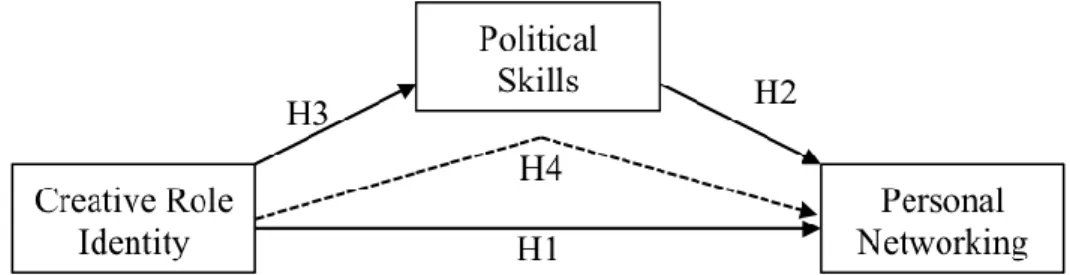
Hypothesis 1. Creative Role Identity will have a positive relationship with Personal Networking
1.3 Political Skills and Personal Networking
Research is rather aligned when it comes to the factors contributing to entrepreneurial firm failure, ranging from lack of resources, inexperienced management, volatile customer base and little to no support from peers or advisors established in the market (Christensen & Bower, 1996; Duchesneau & Gartner, 1990; Li & Zhang 2007; Vanacker, Collewaert & Paeleman, 2013).
Nevertheless, increasing efforts are being dedicated in literature aiming to explain the impact of social and political competences into entrepreneurial success. Baron & Markman (2000, 2003) have been shedding some light in this matter, focusing attention on a group of factors that demonstrated relevance towards social and political abilities. Specifically, they suggested that certain features of entrepreneurs’ behavior at the interpersonal interaction level, namely social and face-to-face contexts, perform an important role in their success. The authors acknowledge both social capital – “the sum
of the actual and potential resources individuals obtain from their relationships with others” (cf. 2003:43) – and social competence – “the entrepreneur’s overall effectiveness in interacting with others” (cf. 2003:43) – as playing rather distinct but
complementary roles when it comes to entrepreneurs’ success.
Perhaps social capital will help entrepreneurs “get through the door”, (allowing them to access venture capital investors, a customer base, among others resources), but it is social competence that will fuel the engine of interpersonal interactions maintenance and make them work in terms of the desired outcomes, (deciding, for example, if they end up getting financial capital from investors, orders from customers and captivate strategic partners and key employees) (Baron & Markman, 2000).
Social competence has been revealed to be a crucial concept that condenses the effects of several specific social skills, as the capacity to read other people with accuracy (Zebrowitz, 1997 cit. in Baron & Markman, 2003), to leave a positive first impression on them (Ferris et al., 2000 cit. in Baron & Markman, 2003) and, even to
persuade or change their behaviors or point of views (Shavitt & Brock, 1994 cit. in Baron & Markman, 2003). Especially, when it comes to new business ventures, social competence plays an essential role, since in its process of creation, and given the lack of previous performance and information that could make proof of its viability and value, entrepreneurs must introduce interpersonal interactions into their business dynamic strategy so that they can build from zero a source of resources that will further help them on the path of growth (Baron & Markman, 2003).
Consistent with previous literature, Li and Zhang (2007) found evidence of entrepreneurs’ ability to build and maintain external connections to be positively associated with new venture performance, lending some support to the premise that individual skills are indeed critical to attain higher levels of performance that later can be converted into competitive advantages (Baron & Markman, 2003).
Several authors (e.g. Blickle et al., 2008; Ferris et al., 2005) found evidence of the predictive value of political skills into a higher job performance given its social effectiveness in work settings (Blickle et al., 2008). Such findings further cemented both Pfeffer (1981) and Mintzberg (1983) pioneering views on political skills effectiveness onto political environments, comparing them to organizations, and suggesting that individuals needed to have political skills to be successful. In that way, political skills acted as a means of influencing other people via negotiations, persuasion and manipulation (Mintzberg, 1983).
As part of a relatively long path of research devotion to this field of investigation, Ferris et al., (2005:127) defined political skills as “the ability to
effectively understand others at work, and to use such knowledge to influence others to act in ways that enhance one’s personal and/or organizational objectives”. Thus,
politically-skilled persons own social competencies capable of boosting both their individual and organizational goals and achievements through a better adjustment to other people since they are able to understand and influence them (Ferris et al., 2007).
Individuals who are politically-skilled end up attracting other people given their high levels of confidence, esteem and sense of control, but not in a self-centered or egocentric way (Ferris et al., 2005), enhancing, therefore, their networking development, since these individuals look at interpersonal interactions as potential opportunities (Perrewé et al., 2004).
Indeed politically-skilled individuals invest in social networks as a mean to access critical resources by building, maintaining and making use of relationships with
key peers, potential partners and employees that could later determine the emergence of interesting and valuable business opportunities (Lux, 2005). Hence, we propose that:
Hypothesis 2. Political Skills will be positively related to Personal Networking
1.4 The Mediator Role of Political Skills
The way “we see ourselves – who we think we are – has a great deal to do with
how we act” (Farmer et al., 2003:618), and has an important effect on our creative role
identity (Riley & Burke, 1995). Specifically, creative persons hold strong self-images of being creative, and from that, creative outcomes will derive (Barron & Harrington, 1981; Petkus, 1996).
Evidence was found that social skills, namely political skills, had a positive role in the work lives of highly creative scientists. Specifically, scientists that revealed strong creativity, by assuming that they display “special problem-solving abilities and
tactics for creative thinking”, which indicates a strong self-image of them as creative
individuals, described themselves in interviews as “having good rapport with others,
being a good listener and a good team player, being broad minded or open to others’ ideas; having political savvy” (Amabile & Gryskiewicz, 1987:12).
As far as we know, there is a lack of studies that contemplate the relation between these variables. However, the abovementioned theoretical argument calls the attention of researchers for a possible relation between these variables. Following this, it can be assumed that when individuals meet the definition of creative role identity, because of their creative self-perception, and, when they acknowledge the importance of political skills in their working lives:
Hypothesis 3. Creative Role Identity will have a positive relationship with Political Skills
Furthermore, according to Amabile and Gryskiewicz (1987), highly creative individuals use political skills in a positive way. These, in turn, empower them to interact with other people and contact with their visions and ideas (Amabile & Gryskiewicz, 1987). Entrepreneurs, just like scientists, have to build and engage into personal networking so they can build valuable connections and maximize their creative
solutions, visions and ideas (Phipps, 2012). As a consequence, politically skilled individuals, as Ferris et al., (2005) suggested, tend to have a better adjustment to other people since they know how to understand them and influence them which, combined with their “social astuteness”, lends them a perceived sense of trust and sincerity, making it easier to attract people into their beliefs and strengthening their personal networking skills.
Again, no study has addressed this possible sequential relation. In this sense, the study of the relations between these variables will allow us to verify personal networking as an organizational outcome and study creative role identity as an input variable examining it through the study of a mediation. Namely assessing the buffering or nulling effect of political skills, in the relationship between creative role identity and personal networking and, in this way, innovate and add to both theoretical investigation backgrounds. Taking together these relations we propose that:
Hypothesis 4. Political Skills will positively mediate the relationship between Creative Role Identity and Personal Networking
Figure 2 illustrates all the conceptual model hypotheses.
Figure 2. Proposed conceptual model hypotheses
2. METHOD
2.1 Sample and Procedures
The sample for the present study consisted of Portuguese startups, contacted directly through personal network connections and startup incubators such as Startup Lisboa (Commerce and Tech), Lisboa Incubadora de Inovação (LABS), Startup Braga and UPTEC – Parque de Ciência e Tecnologia da Universidade do Porto.
Startups were selected as the sample for this study based on Ries’ (2011) definition of a startup, inspired on the work developed by Blank (2010). Specifically, Ries (2011) defines startup as:
“...a human institution designed to create new products and services under
conditions of extreme uncertainty.” (pp. 27)
Following Ries’ (2011) definition and as a result of our network connections, 50 Portuguese startups (1 to 6 collaborators per startup) agreed to participate in the study. Startup’s Chief Executive Officers – (CEOs) or founder(s) were contacted by phone and e-mail in order to validate their collaboration as well as their teams’ members in the study. Surveys were then distributed both personally, on paper format, and/or, sent by e-mail, providing a dynamic online link generated by an online survey software, specifically, Qualtrics. Confidentiality issues regarding information shared were a top priority and were guaranteed throughout the whole data collection process. Every questionnaire was used in the study since all the information provided was valid. The data collection period ranged from March to May 2015.
From the surveys distributed to the 50 Portuguese startups who agreed to participate, a final sample size of 107 collaborators was obtained. The average age of this sample was 27.97 years old (SD=5.05), 68.2% were males. Additionally, startup collaborators had an average of 1.25 years of experience and 69.2% had a Full-time work contract.
The startups considered were legally founded between the years of 2006 and 2015, with 71% being founded in 2012 or later (Mode=2014), and the average number of employees at the end of the latest business period was 9.89 (SD=18.49). These organizations operated in diversified industries such as IT/Internet/Web 2.0 (43%),
Tourism (10.3%), Art/Culture (8.4%), Trade (6.5%),
Construction/Engineering/Architecture/Real Estate (5,6%), Chemistry/Pharmaceutical Industry (4.7%), Electrical Engineering/Telecommunications (4.7%), Education (3.7%), Marketing/Media (3.7%), Consulting (2.8%), Biotechnology (1.9%), Social Work/Health Industry (1,9%), Food Engineering (1.9%) and Medical Engineering (0.9%).
Our sample showed an average of 384.992,232€ of sales at the end of the latest business period (2014), and only 28% of the considered startups already gained a positive outcome, and within those who hadn’t, 40% expect to break even two years after their foundation, 24% three years, 14% one year, and only 4% intend to gain a
positive outcome in the same year of their foundation. Most of the startups in the study provided services (75.97%) destined to other enterprises (51.64%).
2.2 Instruments
The present study gathered three self-report instruments in order to measure the constructs of personal networking, creative role identity and, political skills. We previously tested the psychometric evidence for all of the self-report measures (see Table 1). Regarding the personal networking and political skill scales, the Portuguese adapted versions of these questionnaires (Ferreira et al., 2014) were used in this study. About the 3 original items of the Role Identity Creative Employee scale (Farmer et al., 2003), these were translated into Portuguese by two experienced researchers, insightful in creative role identity theory and fluent in the English idiom. The Portuguese version of it was later translated back to English, by an organizational psychologist with proficiency level in English language to ensure the accuracy of the translation, warranting, therefore, items’ linguistic particularities.
Personal Networking. External networking by participants was measured using
Wolff et al., (2011) external contacts subscale assessing the factor Maintaining. The items reflected how individuals managed their external connections (e.g. “I meet with acquaintances from other organizations outside of regular working hours.”). All items were scored on a 4-point rating scale ranging from 1-Never/very seldom to 4-Very often/always. An initial analysis of the original 7 items was performed through two main factor analysis techniques, firstly an Exploratory Factor Analysis (EFA) to explore the existence of an “underlying structure” (Maroco, 2010, 2014) measuring the present scale. The extraction of factors was based on principal components analysis conducted with varimax and oblimin rotations, the latter one considering factors are correlated (Costello & Osborne, 2005). Items selection was achieved through a significant loading cut-off of .50 based on “pragmatic reasoning” (Yong & Pearce, 2013). The initial analysis retained only one component, using Kaiser’s criteria (components with eigenvalues above 1 should be retained). After rotation, it revealed a single factor structure with 7 items accounting for 43.6% of explained variance. Secondly a Confirmatory Factor Analysis (CFA) was used since there was previous information regarding the factorial structure, specifically structural patterns observed among the
items found in the previous EFA, that needed to be confirmed in order to conclude about the factor model’s quality of fit (Table 2). Using the lavaan package, (a library package developed specifically for the development of structural equation modeling) for the R system, a software for statistical computing (Rosseel, 2012), the data revealed a good fit, [2(25) = 18.971, p = .166, RMSEA = .058, CFI = .967, TLI = .951 and SRMR = .052]. This 7 items measure presented a fair internal consistency ( = .778).
Creative Role Identity. For the creative role identity assessment, we applied
Farmer et al. (2003) adapted 3 item scale of Role Identity as a Creative Employee (e.g. “I often think about being creative.”). Answers were given on a 4-point rating scale ranging from 1-Never/very seldom to 4-Very often/always. Performing the two basic factor analysis techniques again, in the EFA a single factor was found explaining 60% of the total variance and the one-factor model with three items revealed a very good fit through CFA analysis, [2(23) = .00, p = 0, RMSEA = .000, CFI = 1, TLI = 1 and SRMR = .000]. The Cronbach Alpha Coefficient was .661.
Political Skills. Participants’ political skills were assessed using the 6 original
items of Ferris et al. (1999) Political Skill Inventory (PSI). The 6 items reflected, among others, two dimensions of political skill “interpersonal influence” (e.g. “It is easy for me to develop good rapport with most people.”) and “social astuteness” (e.g. “I understand people very well.”), scored on a 4-point rating scale from 1-Never/very seldom to 4-Very often/always. Further factor analysis procedures, both EFA and CFA, were again conducted within our study following procedures previously described. The former, EFA, resulted in a single factor structure with 42.9% of explained variance and the latter, CFA, revealed a very good factor model fit, [2(27) = 11.437, p = .247, RMSEA = .050, CFI = .977, TLI = .961 and SRMR = .049]. The Cronbach Alpha Coefficient was .717.
Table 1. Factor analysis and instrument characteristics
Constructs Number of items Number of factors Dimensions Cumulative Percentage of
Explained Variance Cronbach Alpha(s)
1. Personal Networking 7 1 Maintaining 43.6% .778
2. Political Skills 6 1 - 42.9% .717
3. Creative Role Identity 3 1 - 60% .661
Table 2. Confirmatory factor analysis
Constructs χ2 p TLI CFI RMSEA SRMR
1. Personal Networking 18.971 .166 .951 .967 .058 .052 2. Political Skills 11.437 .247 .961 .977 .050 .049
3. RESULTS
Our study aims to examine the relationship between creative role identity, political skills and personal networking in Portuguese startups according to the following research question: is there a direct and significant effect of individuals’ creative role identity on one’s personal networking skills and is that effect positively mediated by political skills?
3.1 Common Method Variance
Our study included self-reported data with a cross-sectional research, which my cause common method variance biasing attributed to the instruments of measurement used instead of the constructs examined. Common method variance can lead to a possible effect of the relationship between variables leading the empirical conclusions to be associated with the method and not the constructs’ attributes themselves. The Harman’s one factor test represented our solution in order to detect potential common method variance effects (e.g. Podsakoff, MacKenzie, Lee & Podsakoff, 2003). Specifically, we are in presence of common method variance if after running an exploratory factor analysis, a single factor accounting for the majority of all the studied variables’ explained variance emerges. Our analysis showed, that for all the 16 items from all the constructs included in the EFA, a four-factor solution with an Eigenvalue greater than 1.0, rather than a single factor. This solution accounted for 56.83% of the total explained variance. Additionally, no single factor accounted for the majority of the variance and the first factor (largest) accounted for 23.24%, which is nearly half away from the majority of the variance (56.83%).
3.2 Descriptive Analysis
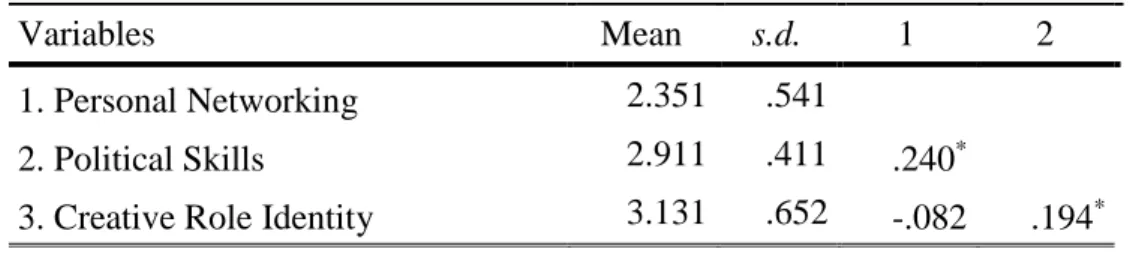
The mean variables and standard deviations, as well as the correlation matrix variables are presented in Table 3.
Variables were fairly correlated with all correlations below .5, suggesting not only independence but also absence of multicollinearity between variables (Barbaranelli, 2003).
Table 3 shows that political skills had a positive correlation with personal networking (r=.240; p < .05) and creative role identity (r=.194; p < .05).
Table 3. Intercorrelations and Descriptive Statistics
3.3 Test of Hypotheses
The conceptual model was assessed using the lavaan package, (a library package developed specifically for the development of structural equation modeling) for the R system, a software for statistical computing (Rosseel, 2012). The goodness of fit for the model was tested through the combination of the Root Mean Square Error of Approximation (RMSEA), the Comparative Fit Index (CFI), the Tucker-Lewis Index (TLI) and the Standardized Root Mean Square Residual (SRMR). As reported by Maroco (2010), RMSEA indicator should be less than .05 and no more than .10 for a good fit; the CFI and TLI indicators should be between .80 and .90 for an acceptable fit and the SRMR indicator should be less than .08 for a good fit. The conceptual model presented in Figure 3, revealed an acceptable adjustment [2(71) = 160.472, p = .000, RMSEA = .074, CFI = .841, TLI = .812 and SRMR = .101].
To test Hypotheses 1 to 4, we followed Preacher and Hayes’ (2004, 2008) methodology for the estimation of indirect effects in simple mediation models using PROCESS – an SPSS Macro – developed by Hayes (2012). This procedure tests the two single-steps of mediation (predictor to mediator, and mediator to outcome, more specifically in this study, creative role identity to political skills and political skills to personal networking, respectively) and then the total, direct and single-step indirect effects (specific and total) were estimated for the predictor variable (creative role identity) on the outcome variable (personal networking) through a proposed mediator variable (political skills). PROCESS (Hayes, 2012) calculates bias corrected with accelerated bootstrap confidence intervals for the indirect effects, meaning the mediator path is considered significant if the confidence interval does not contain zero.
Variables Mean s.d. 1 2
1. Personal Networking 2.351 .541
2. Political Skills 2.911 .411 .240*
3. Creative Role Identity 3.131 .652 -.082 .194* Note: *p < 0.05. s.d., standard deviation
According with Preacher and Hayes (2004, 2008) the bootstrap method is considered a more rigorous approach for estimating mediation and indirect effects, as it does not make assumptions about the distribution of indirect effect and it has reasonably controlled Type I error rate, unlike the Baron and Kenny (1986) causal steps approach and the Sobel test (1982). Bootstrapping reveals itself as a more powerful strategy since it only requires (1) the existence of an effect to be mediated and (2) an indirect effect that has to be statistically significant in the direction predicted by the mediation hypothesis (Preacher and Hayes, 2004).
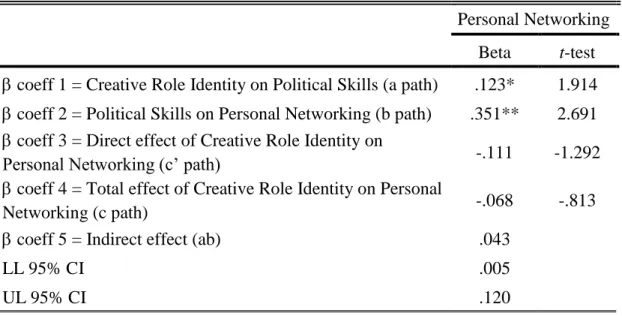
For this study, a single-level mediation analysis was calculated on a basis of 5000 bootstrap resamples, as recommended by Preacher and Hayes (2008). Table 4 presents these results.
Table 4. Mediator analysis for personal networking with bootstrap re-sampling.a
Personal Networking Beta t-test
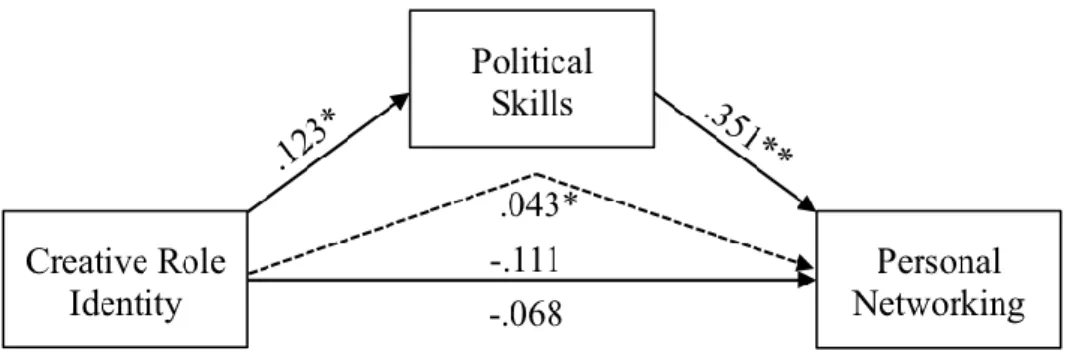
coeff 1 = Creative Role Identity on Political Skills (a path) .123* 1.914 coeff 2 = Political Skills on Personal Networking (b path) .351** 2.691 coeff 3 = Direct effect of Creative Role Identity on
Personal Networking (c’ path) -.111 -1.292
coeff 4 = Total effect of Creative Role Identity on Personal
Networking (c path) -.068 -.813
coeff 5 = Indirect effect (ab) .043
LL 95% CI .005
UL 95% CI .120
Note: aBootstrap re-sampling = 5000; N= 107 *p < .05, **p < .01
In Table 4 – regarding personal networking as the outcome variable – creative role identity positively predicted political skills (=.123, p < .05) and political skills positively predicted personal networking (=.351, p < .01). Also, the direct effect of creative role identity on personal networking, controlling for political skills, was negatively predicted albeit non-significant (=-.111, p > .05).
Hypothesis 1 (Creative Role Identity will have a positive relationship with
Personal Networking) was not supported by our results, because the total effect of
creative role identity on personal networking was not significant (=-.068, p > .05). However, Hypothesis 2 (Political Skills will be positively related to Personal
Networking) was supported, as political skills positively predicted personal networking
(=.351, p < .01). We also found support for Hypothesis 3 (Creative Role Identity will
have a positive relationship with Political Skills), as creative role identity positively
predicted political skills (=.123, p < .05).
The indirect effect of creative role identity on personal networking through political skills was =.043. Because zero is not in the 95% interval, as indicated in Table 4, we can conclude that the indirect effect is indeed significantly different from zero at p < .05. Although we cannot establish the presence of a mediation, political skills has an indirect effect on the relation between the predictor (creative role identity) and the outcome variable (personal networking). Hence, these results partially support Hypothesis 4 (Political Skills will positively mediate the relationship between Creative
Role Identity and Personal Networking). Figure 3 illustrates the model of relations
obtained through PROCESS.
Figure 3. Proposed conceptual model using PROCESS
Additionally, and as suggested by Preacher and Kelley (2011), effect size measures should be reported whenever possible, defined by the former authors as “any
measure that reflects a quantity of interest, either in an absolute sense or as compared with some specified value” (cf. 2011:95). Given the benefits associated with this
measure, such as standardized, bounded, interpretable scaling, confidence interval available and independent of sample size, the Kappa-squared effect size measure by Preacher and Kelley (2011) presents itself as “the proportion of the maximum possible
indirect effect that could have occurred, had the constituent effects been large as the design and data permitted” (cf. 2011:106). Interpreted following Cohen’s (1988:79-81)
guidelines, defining .01, .09 and .25 as small, medium and large effect sizes, respectively, in the current study, the point estimate of k2 = .054 with 95% CI [.008, .142]. According to Cohen’s guidelines one could argue that this point of estimate of k2 can be interpreted as lying in the medium range effect size and because the 95% confidence interval of k2 excluded .25 but contained .01 and .09, it was suggested that the indirect effect size of creative role identity on personal networking through political skills was medium.
3.4 Multilevel Modeling
The previous mediation model approach using PROCESS (Hayes, 2012) was done at a single-level, therefore not acknowledging individual observations (level 1) to be clustered within a group such as startups (level 2), which is the case for our study.
As Tingley, Yamamoto, Hirose, Keele & Imai (2014:16) put it “data on
individuals may be correlated within groups, but also different groups may have different data generating processes. Multilevel models take into account such heterogeneity within and between groups simultaneously”. Considering that our study
included several startups with multiple respondents (1 to 6 participants per startup), a multilevel modeling approach should be considered. Thus, our research model should also be tested contemplating the fact that all data came from different organizations. Following this methodology, it allowed us to test the model considering the different startups and specifically to understand if personal networking, our outcome variable, is influenced also by variables of level 2.
Following the grand mean centering method the explanatory variables were centered by subtracting the grand mean from all values of the considered variables (Hox, 2010). In order to fit the multilevel model that accounted for the previous structure in the data, we used the lme4 package in R software (Bates, Maechler, Bolker & Walker, 2015b), the canonical package for implementing multilevel models in R providing functions to fit and analyze linear mixed-models fit by REML (restricted
maximum likelihood), that includes both fixed and random effects terms (Bates, Maechler, Bolker & Walker, 2015a).
3.5 Random Intercept-only Model
The first type of multilevel model tested, the null model, sought to assess how much variation from the individual personal networking scores of collaborators is due to the variation observed within startups. Based on the calculation of the Intraclass Correlation Coefficient (ICC1) that, according to the random coefficient modeling literature, expresses the extent of individual-level variance that can be explained by group membership (Finch, Bolin & Kelley, 2014), it was possible to determine if a multilevel model was required in first place, or if the individual-level of analysis is sufficient to explain our outcome variable.
In this model, only the fixed effects for the intercept derived from the variable personal networking and the random effects for individual-level (collaborators, level 1) and group-level (startups, level 2) are calculated. No explanatory variable is introduced in this first test (Hox, 2010).
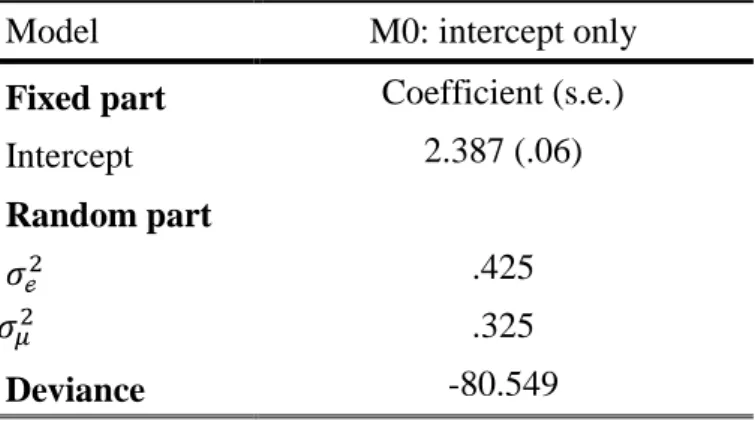
Table 5. Intercept-only model for Personal Networking
Model M0: intercept only
Fixed part Coefficient (s.e.)
Intercept 2.387 (.06)
Random part
𝜎ℯ2 .425
𝜎𝜇2 .325
Deviance -80.549
Note: s.e., standard error
Table 5 presents the parameters estimates and standard errors for the model. In this table, the intercept only model estimates the intercept as 2.387, which is simply the average of personal networking score across startups. The variance of the collaborator-level residual errors, symbolized by 𝜎ℯ2 is estimated as .425. The variance of the