Repositório ISCTE-IUL
Deposited in Repositório ISCTE-IUL: 2019-03-08Deposited version: Post-print
Peer-review status of attached file: Peer-reviewed
Citation for published item:
Mouro, C., Santos, T. & Castro, P. (2018). Past-present discontinuity in ecological change and marine governance: an integrated narrative approach to artisanal fishing. Marine Policy. 97, 163-169
Further information on publisher's website: 10.1016/j.marpol.2018.06.008
Publisher's copyright statement:
This is the peer reviewed version of the following article: Mouro, C., Santos, T. & Castro, P. (2018). Past-present discontinuity in ecological change and marine governance: an integrated narrative approach to artisanal fishing. Marine Policy. 97, 163-169, which has been published in final form at https://dx.doi.org/10.1016/j.marpol.2018.06.008. This article may be used for non-commercial purposes in accordance with the Publisher's Terms and Conditions for self-archiving.
Use policy
Creative Commons CC BY 4.0
The full-text may be used and/or reproduced, and given to third parties in any format or medium, without prior permission or charge, for personal research or study, educational, or not-for-profit purposes provided that:
• a full bibliographic reference is made to the original source • a link is made to the metadata record in the Repository • the full-text is not changed in any way
The full-text must not be sold in any format or medium without the formal permission of the copyright holders.
Serviços de Informação e Documentação, Instituto Universitário de Lisboa (ISCTE-IUL) Av. das Forças Armadas, Edifício II, 1649-026 Lisboa Portugal
Phone: +(351) 217 903 024 | e-mail: [email protected] https://repositorio.iscte-iul.pt
1 Past-present discontinuity in ecological change and marine governance:
An integrated narrative approach to artisanal fishing
Carla Mouroa, Tânia Santosa, Paula Castroa a
Instituto Universitário de Lisboa (ISCTE-IUL), CIS-IUL, Av. das Forças Armadas, 1649-026 Lisboa, PORTUGAL
[email protected], [email protected], [email protected]
*Corresponding author: Carla Mouro
Instituto Universitário de Lisboa (ISCTE-IUL), Av. das Forças Armadas, 1649-026 Lisboa PORTUGAL
Email: [email protected]
NOTICE: this is the authors’ POS-PRINT version of a work that was accepted for publication by Marine Policy. Changes resulting from the publishing process, such as peer review, editing, corrections, structural formatting, and other quality control mechanisms may not be reflected in this document. Changes may have been made to this work since it was submitted for publication. A definitive version was subsequently published as:
Mouro, C., Santos, T., & Castro, P. (2018). Past-present discontinuity in ecological change and marine governance: An integrated narrative approach to artisanal fishing. Marine Policy, 97, 163-169. https://doi.org/10.1016/j.marpol.2018.06.008
2 Abstract
Today artisanal fishers working in Natura 2000 coastal protected sites face two major types of change: in marine resources, and the governance of their professions. Such transformations affect fishers’ livelihoods, identities and traditions, yet little is known about how these professionals elaborate on these changes – i.e., as continuities or discontinuities - in the narratives they produce as a group. Interviews and focus-groups with artisanal fishers and shellfish harvesters (n=36) from the Portuguese Southwest coast were subjected to a two-step analysis. First, a textual analysis with Iramuteq helped select the themes directly related to marine resources and governance. Second, three main narratives - on algae, barnacles and fish - were reconstructed. These were then explored regarding: (1) narrative formats (stability, regressive, progressive, mixed); (2) whether/how these formats elaborated changes as continuities or discontinuities; (3) the roles attributed to Self and Others, and whether and how these legitimized the laws, opening avenues for change; and (4) whether narratives were unified or fragmented. This study illustrates how transformations are presented through various combinations of narrative formats, sometimes mobilized to resist and other times to legitimate legal institutional change. It shows how institutional change can be integrated into local narratives as a positive contribution through a process that implies re-constructing the collective identity and local traditions. Through a narrative approach, this paper offers an integrated examination of fishers’ concerns towards their professions and the laws regulating them, and provides useful insight into how and when marine governance is more/less likely to be legitimized.
Keywords: Narrative; Discontinuity; artisanal fishing; marine policy; Natura 2000; coastal protected areas
3 Highlights
•Artisanal fishers in Natura 2000 sites face ecological and governance changes. •An integrated narrative approach elucidates how they make sense of such changes. •Three narratives are characterized by formats, functions, and unity/fragmentation. •The analysis also examines how past-present changes are elaborated as dis/continuities. • These illustrate when/how marine governance is more/less likely to be legitimized.
4 1. Introduction
Today artisanal fishers working in coastal protected sites integrated in the European Union (EU) Natura 2000 network face two types of transformations: in marine resources and in the policies governing their profession. On the one hand, the availability and timings of some marine species are changing, due to various factors, including climate change and over-fishing [1]. On the other hand, in protected Natura 2000 coastal sites over-fishing activities are now regulated by various new laws and institutions [2]. The present paper aims to gain insight into how artisanal fishers make sense of these two types of changes: i.e., to what extent the accounts they give suggest these changes are lived as major discontinuities, and indicate acceptance or contestation of laws and institutions. It also seeks to reflect on what this
suggests for the formulation of marine conservation policies better adjusted to climate change and the professions affected.
This issue is made even more relevant by the fact that artisanal fishing1 has been steadily decreasing in EU member-states in recent decades, for reasons as yet unclear [1]. Some analysts point out how EU marine policies have followed a restrictive, top-down model, prioritizing ecological and biological factors, especially in Natura 2000 sites, and favouring a uni-directional communication that fails to listen to fishers and include their input
[e.g.2,3,4,5]. Some of these scholars argue that this may negatively affect the continuity of these communities [5,6,7], and that the decline of the communities may, in turn, negatively affect the very resources the policies seek to protect – since viable fisheries “need viable fishing communities” [5, pg.53].
Moreover, over the years artisanal fishing communities have consistently contested some aspects of this governance model [5,6], as well as some specific Natura 2000 coastal
1 ‘Artisanal fishing’ is broadly used in this paper to refer to the professional fishing, shellfish harvesting and
harvesting of other traditional marine resources. Distinctions and specific terminology are employed when justified.
5 and marine regulations [2,3]. It has, thus, become increasingly important to know more about how fishers make sense of Natura implementation and regulations. This means knowing more about how they view the state of marine resources and their relationship to them, what rights and duties they claim as institutionally regulated professionals, what accounts they offer about the institutions responsible for their governance, and what can be learned from these
responses.
In this regard, recent reviews of the studies that have analysed the implementation of
Natura 2000 reveal that the social and psycho-social aspects of this process remain
under-studied, as most analysis have focused on ecological outcomes only [cf.8]. Furthermore, the few investigations examining social and social-psychological aspects were mostly guided by such concepts as perceptions, attitudes or beliefs [cf.9]. However, studies guided by these concepts usually leave three types of lacunae. First, because these are atomistic or molecular concepts, studies fail to explore how beliefs and attitudes are integrated in meaning systems [10]. Second, the concepts are often used in a way that assumes that sense making is only an individual – not also a joint, social – endeavour, and therefore the collective, shared
dimensions of meaning making are left unexplored [11]. Third, they examine sense making in a static fashion, failing to analyse its temporal deployment. Even the few studies that have approached fishers’ views by exploring their shared, collective, dimensions [e.g. 4,12,13] have, nevertheless, left the temporal dimension undertheorized or forgotten.
There are, however, social-psychological approaches that developed a theorization of how making is jointly elaborated and transformed through integrated meaning-systems, and of the temporal dimension this entails. One example is the narrative approach [14], which assumes that narratives bring meaning and order to individual and collective experiences and events [10,15,16] by selecting and placing them in certain - culturally learned - typified sequences over time [17], and by ascribing also typified roles and responsibilities to
6 Self and Others [18,19]. The narrative approach has thus the potential to offer a richer
understanding of the relations between people, their environments [9] and their governing institutions [20], by namely helping explore how local narratives make sense of new fishing policies [e.g.21]. Therefore, this paper adopts an integrated narrative approach for exploring fishers’ accounts of marine resources and their governing institutions.
To this end, the transcriptions of narrative interviews and focus groups conducted with artisanal fishers and harvesters living in the Portuguese Natura 2000 Southwest Coast site were analysed. This is a coastal site where small-scale, artisanal fishing and the harvesting of sea-food (e.g., barnacles) are important activities, and were the object of a series of specific legislations in recent decades [cf.1,22], some of them actively contested by the local fishers [3]. The next section offers more details on Natura 2000 and the context of the study; then the theoretical tenets of a narrative approach are substantiated. After detailing the methodological and analytic procedures employed, the main narratives that emerged are presented. Lastly, the contributions of this study are discussed.
2. Natura 2000 and artisanal fishing – the context of the study
The Natura 2000 network - the largest network of protected sites in the world - is the cornerstone of EU biodiversity conservation policy [9]. Covering around 18% of the EU land area and almost 6% of its marine territory, the network resulted from the transposition to member-states of two EU Directives2 seeking to protect endangered habitats and species [23]. This was followed in most countries by the issuing of specific national legislation applying to the protected sites, which brought additional restrictions to local activities [2,3]. For instance, in the Southwest Coast area where the present study took place, the harvesting of barnacles is a traditional activity and a relevant source of economic income. This activity is now regulated
7 by specific rules, which include a limited number of harvesting licenses, the implementation of a closed season and a maximum daily catch per harvester [cf.22]. Similar rules were
imposed for fishing, later altered to less stringent ones following public opposition [cf.3]. The implementation of the protected sites has been also criticized by fishers for relying almost exclusively on biological and ecological expertise, neglecting local knowledge, actors and concerns [2,3]. The criticism is corroborated by a recent review showing how EU fisheries management often follows a top-down model with goals defined by governmental institutions, and collaborative governance is rare [24].
In sum, these changes in marine resources and in the governance of their profession affect fishers’ livelihoods, identities and traditions [13]. It is therefore relevant to know more about the narratives these professionals produce as a group about these changes: to what extent they are presented as discontinuities or accommodated as continuities, how they are contested or accepted, how they depict Self-Other relations over time. The next section presents the literature that will help explore fishers’ narratives.
3. Narratives of change: the elaboration of continuity and discontinuity
Narratives are cultural tools used for sense making [14,19]. They constitute forms of telling and remembering the past that carry and integrate values, beliefs, attitudes, norms and knowledge, and are key for defining identities and for legitimizing past, present and future actions and roles of Self and Others [10,15,16]. In the telling of personal or group stories, some authors consider that a sense of continuity is essential for sustaining a positive identity [25]. In the narrative literature, continuity is usually illustrated by one of the three
prototypical narrative formats [17], the stability format. This format narrates events as persistent or continuous over time. Changes that may challenge continuity – like a change of residence – can present identity threats that need to be dealt with [e.g.15]. In our case, the new
8 marine policies impose changes that can be seen as devaluing local traditions and may, thus, be elaborated and narrated by fishers as threatening discontinuities. Such negative
discontinuities are often contested and resisted through nostalgic narratives, where a
regressive format [17] elaborates change as a negative discontinuity that de-legitimizes the
present situation, and favours a return to the “good old days”.
However, changes and transformations can likewise be recounted in a way that is useful for a positive re-construction of collective identities [26], e.g., by defending a desired change for the group [27]. This may imply the recognition that some past actions of the Self had negative consequences (e.g., local fishing contributed to the scarcity of some species), and the integration of these actions into identity re-construction in such a way that the continuity of the group is defended [26] (e.g., fishers actively demanding limits to some activities, to avoid depletion). Such integration of changes in narratives, elaborating them as oriented to a future continuity, can be achieved through either a prototypical progressive format or a combination of two formats - the regressive and the progressive ones –, organizing a mixed downwards-upwards plot [17].
In short, when the group’s story is told, transformations can be presented as either continuities or discontinuities, and these, depending on the roles attributed to Self and Others [28], can be mobilized for either presenting change as positive or negative, legitimizing or delegitimizing it [26] and allowing or refusing convergence between local aspirations and legal impositions [3]. This intricate dynamic between continuity and discontinuity in narrative construction may help understand why local responses to conservation policies are often complex, combining both resistance to and integration of new meanings and arguments into the local narratives [28,29,30]. This paper will thus examine how the narrative formats and contents used by fishers elaborate changes as continuity or discontinuity.
9 Finally, it is important to note that the stories told by individuals through these cultural and shared formats – regressive, progressive, stable, or mixed [17] - are both personal and collective. They are personal narratives that help people maintain a sense of identity over time [18,pg.339,15]. Nevertheless, they are also learned stories that are told and shared in groups, marked by the awareness of how other group members tell them and by knowledge of the dominant and valued plot lines in a society [18,31]. Thus, they also testify to ways of
collective sense-making, in ways that can both reproduce or resist the status quo [19]. These two levels also mean that the stories told by individuals sometimes coalesce into highly shared versions, that everybody in a group repeats– unified narratives; while in other cases, different individuals tell different stories and taken at the community level the narrative is fragmented [18,32]. And sometimes the stories even crystallize into highly unified and hard-to-change, hegemonic narratives [16] that are characterized by features - a we versus them plot and the defence of the justness of own goals only [16] - that make the dialogue with alternative versions difficult. So, it is also important to analyse whether the narratives circulating amongst fishers appear to be unified or fragmented.
4. Methods 4.1 Participants and procedure
The participants (total n=36) were professional artisanal fishers and shellfish
harvesters (n=30), plus a few (n=6) retired and/or recreational fishers, living in the Portuguese
Natura 2000 site “Costa Sudoeste” and Natural Park “Sudoeste Alentejano e Costa
Vicentina”. Participant ages ranged between 25 and 78 years (mage=54) and all but two were
men, reflecting the almost absolute predominance of men in these professions. They took part in in-depth interviews (some of which in or near their working locations) and focus groups, between October 2014 and June 2015.
10 The interviews and focus groups were guided by Flick’s [33] suggestions regarding narrative interviews: to seek both concrete and lived descriptions and more abstract, generic and explanation-oriented statements. Thus, invitations to interviewees to recount specific episodes and events and depict fishing and harvesting activities were combined with questions asking for their views on how they had changed over time. The focus groups were conducted after the interviews, to collect additional episodes and possible contrasting positions that might not have emerged in the individual interviews [34]. The groups were composed of 3 to 6 participants and took place in the local fishers’ associations. Interviews averaged 1h24 (varying from 29m to 2h41) and the focus groups lasted on average 1h27 (varying from 1h03 to 1h40); all were audio recorded (with permission) and transcribed verbatim.
4.2 Analytic Method
The analysis of the textual material resulting from the verbatim transcriptions of the interviews and groups was carried out in two phases, oriented by distinct goals. The first phase was a computer-assisted thematic analysis seeking to identify the main themes present in the transcriptions, in order to keep for further analysis only those themes directly
discussing marine resources and policies. For this, the transcriptions were subjected to a Descendant Hierarchical Classification (DHC) in the Iramuteq (Interface de R pour les
Analysis Multidimensionnelles de Textes et de Questionnaires) software [35]. This software
searches for patterns of co-occurrence of words/lexemes through successive Chi square tests, and organizes themes/clusters based on them. It also identifies the 150 extracts most typical of each theme.
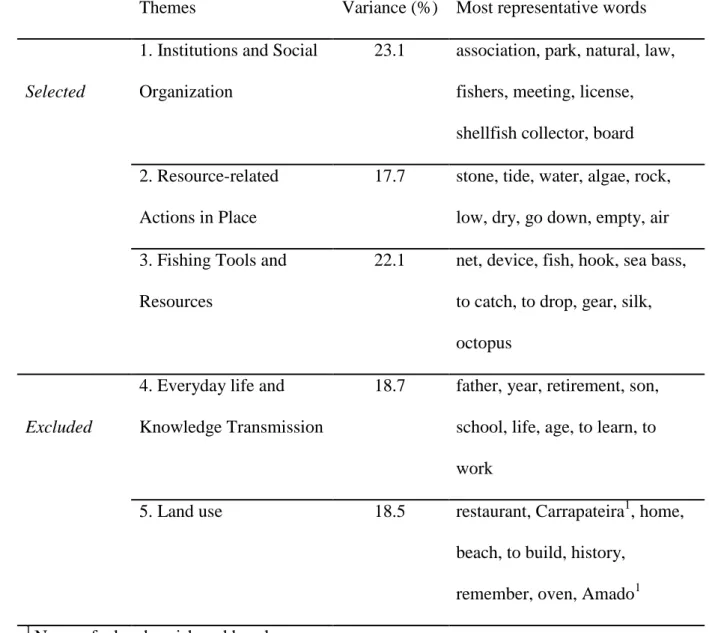
The second phase – the reconstruction of the narratives – took place in two steps. First, the 150 most typical extracts from the themes identified by Iramuteq as directly linked to marine resources and policies (see Table 1) were read and discussed by the authors several
11 times, until consensus was reached regarding: (1) how many narratives about marine
resources and their governance could be identified; (2) their formats (stability, progressive, regressive, mixed [17]); (3) if/how these formats portrayed past-present changes as
continuities or discontinuities [26]; (4) to whom/what the changes were attributed [28] (Self or Other) and whether this legitimized or delegitimized these changes [31]; (5) whether the narratives appeared as unified (i.e. were repeated in more or less similar way across the extracts) or fragmented (i.e. with different versions across the extracts) [18]; and (6) whether they appeared open or closed to dialogue and acceptance of the laws and change [16]. Two of the authors were well acquainted with the interviews and fishing communities, and this global perspective helped to interpret the extracts.
5. Results and Analysis
5.1 Phase I – Thematic Structure of the Interviews and Selected Themes
The DHC analysis of the corpus yielded five themes. Table 1 presents them, labelled according to the domain addressed, percentage of variance explained, and most representative words. The first three themes relate to fishing laws and practices – therefore meeting the criteria for subsequent analysis. These are: (1) Institutions and Social Organization
(assembling accounts about how laws have changed relationships among fishers and between fishers and institutions); (2) Resource-related actions in place (assembling accounts about ‘non-movable’ resources - algae and barnacles); and (3) Fishing tools and resources
(assembling accounts about fishing techniques and tools, and their impact on fish). The two final themes contain no direct mention to either fishing laws or fishing practices - and were therefore excluded from the present narrative analysis. These are: (4) Everyday life and
12 transmission of knowledge; and (5) Land Use, about how new laws have changed the ways in which the territory is/could be used.
Table 1 Here
Table 1. Themes organising the interviews, selected and excluded from narrative analysis
Themes Variance (%) Most representative words
Selected
1. Institutions and Social Organization
23.1 association, park, natural, law, fishers, meeting, license, shellfish collector, board 2. Resource-related
Actions in Place
17.7 stone, tide, water, algae, rock, low, dry, go down, empty, air 3. Fishing Tools and
Resources
22.1 net, device, fish, hook, sea bass, to catch, to drop, gear, silk, octopus
Excluded
4. Everyday life and Knowledge Transmission
18.7 father, year, retirement, son, school, life, age, to learn, to work
5. Land use 18.5 restaurant, Carrapateira1, home, beach, to build, history,
remember, oven, Amado1 1
Name of a local parish and beach
5.2 Phase II – Narratives, Their Forms and Functions
Phase two involved the reconstruction of three narratives by reading the 150 most typical extracts of the three selected themes (i.e., 450 extracts). The narratives were organized
13 around three resources: (1) algae, (2) barnacles, and (3) fish. Each narrative is now presented below and illustrated with extracts identified by participant number.
5.2.1. The disappearance of algae
Assuming a stability-progressive-regressive format, this narrative starts by describing how the practice of gathering algae at the shore for use as agricultural fertilizer was an old tradition, i.e., it recalls the long and stable past of the traditional use of algae.
In the extract below, a fisher recalls the gathering of algae that washed ashore.
“Back in the old days it [the algae] used to come to the shore (…) People used to harvest them right there, on the rocks; they just washed ashore” (I16)
Then the narrative expands on how this was followed by a brief but very intense period - from the late 1970’s to the 90’s - of profitable and massive harvesting at sea, using modern technologies (vessels with compressors). During this period large amounts of algae were harvested from the ocean floor, in quantities that reached as high as 2,000 kg per
day/person. The high market value of the algae - channelled to the pharmaceutical and beauty industries - made this a profitable source of income, and harvesters would dive 20 to 30 meters (using compressed oxygen) for shifts of up to 10 hours of intense and physically demanding activity, as the next extracts indicate:
“We dived to harvest the algae on the floor [of the ocean], we would put it in a bag tied around our waist that carried about 90 to 100kg” (I6)
14
“With the vessel anchored, we would look for the algae in specific zones, normally in rocky areas on the ocean floor, and then we would fill bags sometimes for stretches of 5, 6 hours
(…) Normally we caught 20 bags [per day]” (I5)
The narrative ends with the acknowledgment of an abrupt discontinuity: how algae have completely disappeared from that part of the ocean (“Today all is clean, clean, clean,
there’s nothing”, I11).
The fishers attribute this disappearance to pollution from greenhouses and an oil refinery up the coast, as illustrated below.
“[The algae] they disappeared, it’s what we said about the greenhouses over there, because of the pesticides (…) that infiltrate the land” (FG2/I20)
“The rocks stopped breeding, it’s said it is due to pollution (…) if the rocks do not breed it is because there is something there [in the water]” (I13)
The narrative about the algae was a rather unified one, with all accounts converging to a similar storyline. Changing points in the narrative are well identified: at a certain point, algae harvesting became very intense and profitable and then pollution caused its
disappearance. The institutional regulation of this activity (licenses needed, medical certificates) was not mentioned in the extracts. Due to the disappearance of the algae, this narrative is presented as closed. However, the consequences of the intensification of local harvesting, and of the technological innovations linked to it, were left unexplored, un-elaborated and unresolved.
15 The narrative about the harvesting of barnacles has a different format: it is a
stability-regressive-progressive narrative. Again, it starts with the depiction of the “good old days”
when barnacles were abundant and harvesters had plenty of freedom to work. This was followed by a regressive period, of decline in the availability of the resource, accompanied by feelings of constraint by legal restrictions, namely those that imposed a limit on the number of professional harvesting licences. These constraints are now slowly (and imperfectly, for fishers) being reversed. The following extracts illustrate the stability-regressive part of the narrative.
“Over there I used to catch loads of barnacles, but now I don’t. Because now... There aren’t as many as there used to be. You could get there, on top of that rock, and you’d be so pleased
[by the abundance of barnacles]” (I14)
“Before, we used to gather them freely, there were no suggested quantities, there was none of that.” (I6)
Harvesters themselves pointed out the decline in the resource, which they described as a negative change that justified another, the institutional/legal intervention, which was
necessary to prevent total loss. This second change - new laws making licenses mandatory for professional harvesting and setting up harvesting seasons and limits - slowly shifted the narrative to a progressive format of regained recovery of the resource, and regained continuity of practice and identity.
“The resource bottomed out because there were no regulations, laws. At one point harvesters started to cry in agony, warning the authorities ‘there’s nothing here anymore’. The Natural
16
Apparently, everyone supported this, the municipality and everything, but these are not
popular measures” (I4)
Although the fall in stock is integrated into the narrative as a reason for “agony”, the new limitations brought about by the legislation were nevertheless “not popular measures”. An initial reluctance to get involved with the institutional requirements permeated the relations between harvesters and park managers, who were responsible for issuing licenses. Initially many licenses remained unrequested and unused. However, over time, the regulations came to be accepted, and at some point the number of applications for licenses surpassed the established limit.
“During the first years, there were only 60 licenses applications and many [gatherers] who applied for these wouldn’t even pick them up afterwards. (…) Many were harvesting without
licenses. Then, 80 licenses were given out, and then more people started showing up wanting
licenses.” (I6)
Meanwhile, local professional associations were created, stimulated by the new laws. “When those [restrictions] appeared, the association was created (I6)”. It is through these associations that harvesters today argue there are enough barnacles to continue and expand the activity, even if the barnacles are not as good as they used to be: “These rocks are also full of
barnacles here, not the barnacles of highest quality, but anyway they have flesh inside” (I6).
Today, their dialogue with the central institutions through the local associations focuses on seeking the expansion of the number of professional harvesting licenses: “The
17 Moreover, the idea that harvesters themselves must maintain the resource through adjusting their practices became included in the narrative. “It is there on the rock that you
have to choose” (I14) the barnacles (e.g., with the right size, not the juveniles) in order not to
endanger (again) the continuity of the resource and the activity.
In sum, this second narrative dealt with the idea of a necessary change that legitimized the licensing of the barnacle harvest. The laws were portrayed as crucial for maintaining the activity and, consequently, they were assimilated in order to maintain the continuity of the group’s identity and traditions relative to those of the past. Like that of the algae, this
narrative about how barnacles became endangered but institutional intervention contributed to reversing the situation was a rather unified narrative. However, this storyline contrasted with the portrayal of the algae situation by showing reflexivity regarding local harvesting practices and their consequences.
5.2.3. The uncertain future of artisanal fishing
The last narrative started, again, in the “good old days”, when fish was abundant and fishers caught plenty. This period of stability in artisanal fishing was presented as followed by a somewhat regressive one, with some decline in the activity and clear complaints about the stringency of the laws now in effect. However, the reasons for the decline appeared to be less clear, and more varied and disputed than in the previous narratives.
The extracts below illustrate the intense fishing activity of the past, with abundant catches happening even without the use of sophisticated vessels or gears.
“In the old days, when there were piles of fish, here was a good place [to fish], with a lot of fish.” (I6)
18
“We would go over there [swimming] and the two of us would catch 100kg of fish (…). We placed the fish on the surfboard and brought it out like that.” (I11)
Artisanal fishing in the present time was described as an unstable activity, very much conditioned by the tools each fisher specialized in (and was licensed for) and on the
availability of their selected species.
“[Nowadays] in the end everyone catches, some more others less, it depends on the season. Each situation requires a way of dealing with it” (I16)
“(…) and then when the season opens I always catch a bit of monkfish, skate, turbot (…) the gears I have are specifically for those species.” (I16)
Some fishers use more modern tools like “silk”/nylon nets, which were described as being less specialized and easier to use: “with the silk nets (…) you catch a bit of everything” (I3). However, accounts on such technological innovations appear as dilemmatic because they stress both how these tools have improved the profession and enabled larger captures, and how they become a major reason for resource depletion along the coastline.
“Back in the old days, nets would capture 20 [kg] and now they take 100 or 200 kg. We now have the possibility to capture more. We have better vessels. Everything’s better.” (I16)
“It kills many fish, for instance… the silk net captures about 100 kg of fish. Half of it is practically spoiled. So, in a way it helped, but the fish started to disappear.” (I6)
19 A few voices argued in defence of considering the use of artisanal gears as the “best practice”. By allowing both a more selective catch and one with better quality, this
proposition addresses both sides of the dilemma (the collective good and individual income).
“It is not the gear that destroys the coastline (…) Nets destroy the coastline, nets kill everything, dragging everything (...) fish that is caught with gears is a good quality fish”
(I14)
The defence of traditional gears also represented a critique of how central institutions have been constraining artisanal fishing rather than closely monitoring more intensive and damaging practices (most notably, industrial fishing). Several other extracts overtly criticized the institutional intervention that took place from the 1990’s onwards, namely the
classification as a Natural Park and a Natura 2000 site. In them, fishers complained that the laws were too stringent, for instance by restricting access to some of their traditional fishing grounds, and disregarded the (low impact) characteristics of artisanal fishing.
“The existing laws have been giving us a hard time, because around here, they have not yet understood that this type of fishing here is artisanal fishing, it has nothing to do with the
industrial one. It does not. Even the boats, if they use nets, they do it in small quantities. (…)
the last law from the Natural Park claimed that no one could fish in Galé rock. This is
depriving us of our way of making a living.” (I17)
In other words, artisanal fishers offered here a narrative of struggle and survival [16]. They depicted the changes brought about by the laws as disruptive discontinuities,
20 barnacle story, the two changes here – in fish stocks and institutional regulations – were addressed separately throughout the narrative.
In sum, this last narrative incorporates not two, but three transformations: in fishing stocks, in regulations, and in tools and equipment. Stock changes were broadly seen as
negative, while modern techniques were instead presented in a dilemmatic tone. Opposition to fishing laws was more unified. The regulations were criticized for failing to recognize the specificities of artisanal fishing. There was not a well-articulated or common proposal about how to reverse this regressive narrative. Only a few accounts defended the use of traditional gears as more sustainable practices.
6. Discussion
Using a narrative approach, this paper examined how past-present transformations - in marine resources and marine governance - were given sense by professional artisanal fishers working in a Portuguese Natura 2000 coastal Protected Area. As narratives can contribute to stabilizing or transforming a course of action [17], their choices of formats and contents have inherent implications for the future, and need to be further understood. Thus, the analysis focused on whether and how ecological and institutional changes were elaborated as continuities or discontinuities, what roles were attributed to Self and Others in change, and whether the narratives appeared as unified, or, instead, if they differed across individual accounts, i.e., were fragmented.
Three main narratives emerged – about algae, barnacles, and fish. The first emphasised the time-period when algae suddenly became a source of high income, and it glossed over how and why they had abruptly disappeared, with the potential impacts of the intense local harvesting left without much reflexive consideration. Also, despite the existence of regulations for this harvesting, the institutional element hardly showed up in this
21 progressive-then-regressive narrative. The two discontinuities – in the abundance of the resource and in its governance - were thus kept disconnected from each other and from the Self in this unified and closed narrative.
In the barnacles’ narrative, on the other hand, the two discontinuities were clearly intertwined. This was, again, a unified narrative, but one clearly oriented to the future maintenance of the activity of harvester. The regressive period was portrayed as already incorporating a reflexion of the Self about the types of harvest and their consequences, thus legitimizing the institutional intervention that happened. Furthermore, when describing their activities in local associations, fishers also described themselves as protagonists in reversing the regressive period.
In the third narrative, a more fragmented one, the transformations in fish stocks were sometimes linked to technological innovations, such as “silk” nets, a discontinuity both contested (for the overfishing it allows) and praised (for improving work conditions) by the fishers. This dilemma was tackled by a few fishers that defended the recognition of traditional gears as less destructive. In turn, ecological governance was consistently presented as
threatening the continuity of artisanal fishing, in accounts that stressed the power asymmetries [28] between fishers and governing institutions. There was no report of a collective
intervention for dealing with the discontinuities, which were kept separated from each other throughout this still open-end narrative.
Overall, these three narratives shared two features: first, they all start with accounts of abundance, at a time when the relationship between the fisher and the fish was less
formalized, i.e., they start in a golden period (unlike other narratives, which may start in less favourable times and proceed to brighter futures – as personal merit narratives do [36]). Second, they all described ecological change as a negative discontinuity. Yet two aspects differentiate them. One concerns the role of the collective in ecological change. In the algae
22 narrative, change is distanced from the collective Self, and attributed to an Other (responsible for water pollution). On the contrary, in the fish narrative, there is a (dilemmatic, and
somehow unstable) recognition of the negative consequences of certain fishing practices. In the barnacle narrative, in turn, intensive local harvesting is reflexively assumed as the cause of change. A second distinction regards the role attributed to the institutional other: the laws are either absent (in the algae narrative), a positive and legitimized discontinuity (in the barnacle narrative) or a disruptive and delegitimized discontinuity (in the fish narrative). These combinations shown how examining the combinations of roles attributed to the collective Self and the institutional Other [28] across the narrative formats provided useful insights about when and how institutional changes are more/less likely to be legitimated.
This paper contributes to the current literature in a number of ways. First, by adopting a narrative approach, the paper offers an integrated examination of the psycho-social
dimensions of Natura 2000, still uncommon in the literature [9], contributing to a better understanding of how fishers and harvesters make sense of their professions and the laws regulating them. It converges with the literature examining responses to Natura 2000 [8,9] by showing that fishers’ narratives contest some aspects of the current model of marine
governance, while also pointing out how some transformations are legitimized, and
institutional change is sometimes integrated as a progressive step. Instrumental in unveiling this was the theorization of narratives as resorting to different combinations of formats for accounting for how change unfolds over time [17] and as having differing types that were more or less open [16] to dialogue with alternative ones and change. This allowed showing the coexistence of closed and open narratives, the later seeking some convergence between the local and the legal spheres. This theorization and these evidences are particularly relevant at a time when future narrative scenarios are being used as tools for improving adaptation policies [e.g.37].
23 A second contribution of this study is that it extends in two ways the literature on the role of elaborating change as continuity or discontinuity. First, it has provided additional evidence about how institutional changes can be integrated into local narratives as positive transformations, not negative discontinuities, in a process that implies a re-construction of the collective identity [cf.27] and traditions. A second contribution in this regard is the fact that our conclusions suggest that when changes (ecological, institutional, technological) are presented as discontinuities, i.e. as disconnected with the past, this might be a sign of resistance, particularly if the Self is kept distant from the changes.
Thirdly, at the methodological level, the paper has used an innovative two-step approach for analysing narrative material, demonstrating its value. We first used a computer-assisted procedure (through Iramuteq) for systematically identifying the main themes relevant for our goals, and the extracts grounding them - which is a standardized and replicable
procedure, as well as a parsimonious one. Afterwards we used the themes and the relevant extracts identified by this procedure for exploring narrative forms and functions. Future research can use this procedure for examining the narratives of other actors (e.g., policy-makers, industrial fishers), exploring their convergence/divergence [10,28,32] with ecological and governance goals.
Finally, the paper contributes to marine governance by highlighting the need to create conditions for the active involvement of local fishers in reversing the negative turns affecting their profession, crucial for maintaining viable fisheries [5]. As shown in the barnacle’s narrative, the possibility of playing an active role helps fishers construct collective narratives that sustain positive collective identities while building social cohesion in the face of change. Such an active involvement requires different types of opportunities [12]. For instance, horizontal (i.e., within-community) workshops (see for example “project website”) are
24 arguments integrating various perspectives, and originating over time more unified and
complex narratives oriented to common goals. These more reflexive arguments and common narratives are then important resources in negotiations with the policy sphere [3,19]. Another type of workshops – vertical ones, joining fishers and community members with Natura managers, scientists and policy-makers – can furthermore help fishers to build trust in institutions. For this to happen, governing institutions have to offer a clear recognition of the potential contribution of local knowledge and other forms of local input. When interactions with institutions are impoverished, and fishers have no opportunities to share their lived experiences, important sources of knowledge are disregarded, and silenced [19]. It falls thus upon institutions to organize consultation as more than a formal procedure, assuming that a successful governance of coastal areas requires hearing all voices, and surely the (multiple) local level ones [1,2], and participatory processes need to occur at various periods: before, during and after the creation of new laws and policies [2,24]. Social scientists can have here an important role, in helping creating and moderating such workshops as spaces of reflexivity, offering to all involved an awareness of the narrative formats employed by different groups for making sense of changes and relationships. Then perhaps these conditions can foster the emergence of more integrated and sustained schemes of governance, and even of
co-management [1,22].
Acknowledgments: This research was supported by Fundação para a Ciência e Tecnologia, Portugal, through project MEMOTRADE “Social Memory of Water-Related Trades and Practices: Local Knowledge and Climate Change Adaptation”
[ERANET/CIRCLE-MED2/0003/2013] hosted at CIS-IUL [UID/PSI/03125/2013]; and a post-doctoral grant to the first author [POCH/SFRH/BPD/93564/2013].
25 References
[1] J. Lloret, I. Cowx, H. Cabral, M. Castro, T. Font, J. Gonçalves, et al., Small-scale coastal fisheries in European Seas are not what they were: Ecological, social and economic changes,Mar. Policy (2016) doi.org/10.1016/j.marpol.2016.11.007. [2] H. Fock, Natura 2000 and the European common fisheries policy, Mar. Policy 35
(2011) 181-188.
[3] P. Castro, E. Seixas, P. Neca, L. Bettencourt, Successfully Contesting the Policy Sphere: Examining Through the Press a Case of Local Protests Changing New Ecological Laws, Pol. Psychol. 39 (2018) 107-123.
[4] A. Delicado, L. Schmidt, S. Guerreiro, C. Gomes, Pescadores, conhecimento local e mudanças costeiras no litoral Português [Fishers, local knowledge and coastal changes in the Portuguese littoral], Rev. Gestão Costeira Integrada 12 (2012) 437-451.
[5] S. Jentoft, The community: a missing link of fisheries management, Mar. Policy 24 (2000) 53-59.
[6] S. Jentoft, Institutions in fisheries: what they are, what they do, and how they change, Mar. Policy 28 (2004) 137-149.
[7] N. Ross, Exploring concepts of fisheries ‘dependency’ and ‘community’ in Scotland, Mar. Policy 37 (2013) 55-61.
[8] V. Popescu, L. Rozylowicz, I. Niculae, A. Cucu, T. Hartel, Species, habitats, society: an evaluation of research supporting EU's Natura 2000 network, PLoS One 9 (2014) e113648.
[9] M. Blicharska, E. Orlikowska, J. Roberge, M. Grodzinska-Jurczak, Contribution of social science to large scale biodiversity conservation: A review of research about the Natura 2000 network,Biol. Conserv. 199 (2016) 110-122.
26 [10] S. Jovchelovitch, Narrative, Memory and Social Representations: A Conversation
Between History and Social Psychology, Integr. Psychol. Behav. Sci. 46 (2012) 440-456.
[11] C. Mouro, P. Castro, Self–Other relations in biodiversity conservation in the
community: representational processes and adjustment to new actions, J Community Appl Soc Psychology 26 (2016) 340-353.
[12] N. Bennett, P. Dearden, Why local people do not support conservation: community perceptions of marine protected area livelihood impacts, governance and management in Thailand, Mar. Policy 44 (2014) 107-116.
[13] M. Nakhshina, ‘Without fish, there would be nothing here’: Attitudes to salmon and identification with place in a Russian coastal village, J. Rural Stud. 28 (2012) 130-138. [14] J. Bruner, Acts of meaning, Harvard University Press, 1990.
[15] E. Bailey, P. Devine-Wright, S. Batel, Using a narrative approach to understand place attachments and responses to power line proposals: The importance of life-place trajectories, J. Environ. Psychol. 48 (2016) 200-211.
[16] N. Oren, R. Nets-Zehngut, D. Bar-Tal, Construction of the Israeli-Jewish Conflict-supportive narrative and the struggle over its dominance, Pol. Psychol. 36 (2015) 215-230.
[17] K. Gergen, M. Gergen, The social construction of narrative accounts, in K. Gergen, M. Gergen (Eds.), Historical Social Psychology, New Jersey, USA: Lawrence Erlbaum Associates, 1984, pp.173-189.
[18] M. Murray, Levels of narrative analysis in health psychology, J. Health Psychol. 5 (2000) 337-347.
[19] P. Hammack, Narrative and the politics of meaning, Narrative Inquiry 21 (2011) 311-318.
27 [20] P. Castro, Legal innovation for social change: Exploring change and resistance to
different types of sustainability laws, Pol. Psychol. 33 (2012) 105-121.
[21] K. Furlong, Unexpected narratives in conservation: Discourses of identity and place in Šumava National Park, Czech Republic, Space Polity 10 (2006) 47-65.
[22] A. Carvalho, P. Vasconcelos, D. Piló, F. Pereira, M. Gaspar, Socio-economic, operational and technical characterisation of the harvesting of gooseneck barnacle (Pollicipes pollicipes) in SW Portugal: Insights towards fishery co-management,Mar. Policy78 (2017) 34-44.
[23] P. Castro, C. Mouro, Psycho‐Social Processes in Dealing with Legal Innovation in the Community: Insights from Biodiversity Conservation, Am J Commun Psychol 47 (2011) 362-373.
[24] L. Leite, C. Pita, Review of participatory fisheries management arrangements in the European Union, Mar. Policy 74 (2016) 268-278.
[25] G. Breakwell, Coping with Threatened Identities, Psychology Press, 1986.
[26] R. Greenwood, ‘Yesterday redeemed and tomorrow made more beautiful’: Historical Injustice and possible collective selves, Pol. Psychol. 36 (2015) 19-34.
[27] S. Ybema, Talk of change: Temporal contrasts and collective identities, Organ. Studies 31 (2010) 481-503.
[28] L. Harris, Contested sustainabilities: Assessing narratives of environmental change in southeastern Turkey, Local Environment 14 (2009) 699-720.
[29] C. Mouro, P. Castro, Cognitive polyphasia in the reception of legal innovations for biodiversity conservation, Papers Social Representations21 (2012) 1-21.
[30] L. Oliveira, Fishers as advocates of marine protected areas: a case study from Galicia (NW Spain),Mar. Policy41 (2013) 95-102.
28 [31] P. Castro, C. Mouro, “Imagining ourselves” as participating publics: An example from
biodiversity conservation, Public Underst. Sci. 25 (2016) 858–872.
[32] D. Sumares, T. Fidélis, Natura 2000 and the narrative nature of nature: a case for critical discourse analysis, J. Integr Environ Sci 8 (2011) 53-68.
[33] U. Flick, Episodic interviewing, in M. Bauer, G. Gaskell (Eds.), Qualitative Researching with Text, Image and Sound, SAGE, 2000, pp.75-92.
[34] R. Krueger, M.A. Casey, Focus groups: A practical guide for applied research. SAGE, 2014.
[35] P. Ratinaud, S. Dejean, IRaMuTeQ: implémentation de la méthode ALCESTE d'analyse de texte dans un logiciel libre, Modélisation Appliquée aux Sciences Humaines et Sociales (MASHS2009), Toulouse, France: Le Mirail, 2009.
[36] M. Maclean, C. Harvey, R. Chia, Sensemaking, storytelling and the legitimization of elite business careers, Human Relations 65 (2012) 17-40.
[37] M. Haward, J. Davidson, M. Lockwood, M. Hockings, L. Kriwoken, R. Allchin,
Climate change, scenarios and marine biodiversity conservation, Mar. Policy 38 (2013) 438-446.