LISBON - PORTUGAL
23 - 26 June 1998
ASSOCIA9AO PORTUGUESA DAS EMPRESAS DE SETAO PRONTO
Volume 1
A
Proceedings of the
12th EUROPEAN
READY MIXED CONCRETE CONGRESS
u..I
LISBON
23/26
JUNE
o
Z G">12th
E U R 0 PEA N
1998
o
u
~ ~The fantastic input of information technologies in rmc activities: Challenge or illusion?
Pierre E Richelle (Belgium).. 411
Session 6A - NEWTECHNOLOGIESI
Brief presentation on the production of ready mixed concrete in Mozambique
Antonio E Alves (Mozambique) 404
Quality for durability - Driving force for rmc in India
Ajoy K Mullick, Christopher Rajkumar (India) 394
Experiences in technical marketing in Finland
Seppo Petrow (Finland). 388
On the delay in payments in the commercial transactions
Felix R Massa (Spain) 381
"We have a - business - dream" 'But how about commitment...'-The story of the Dutch marketing of ready mixed concrete
Robert JAM Woltering (Netherlands).. 368
Concept marketing for RMC - consumer orientation focusing on costs versus price and costumer satisfaction
Roger Johansen (Norway)... 362
Markets and sales of ready mixed concrete
Michele Valente (Italy) 351
Session 5B- MARKETINGOF CONCRETE
Evaluation of in-place concrete strength by near-to-surface tests
Sergio M R Lopes,Miguel C S Nepomuceno (Portugal) 338
Compressive strength of young concrete obtained in drilled cores
Madalena Teles, Juliano Barbosa (Portugal) 329
Discussion of the factors that control the form of the cement content to strength relationship
PMBarber (UK) 322
The use of concrete families for the production and conformity control of concrete
Thomas A Harrison (UK) 312
x
Risks associated to the compressive strength conformity criteria resulting from the application of the Portuguese Standard NP ENV 206 (1993)
Miguel C. S. Nepomuceno, Civil Engineer, Lecturer of Department of Civil Engineering
-University of Beira Interior,Portugal.
Sergio M.R.Lopes, Civil Engineer,Assistant Professor of Department of Civil Engineering
-University of Coimbra,Portugal.
Keywords: Penetration Resistance test, Windsor Probe Test System, Pull-out test, Capo
-test,Normal Strength Concrete,High Strength Concrete, In-place testing.
The obtained correlations are also presented and compared to those obtain by other research works.
This paper discusses the reliability of two of this techniques, penetration resistance test and pull-out tests, as a construction tool for the evaluation of the in-place concrete strength both
in normal and high strength concrete.For penetration resistance test applied to high-strength concrete an alternative firing apparatus to the standard apparatus, Windsor Probe Test System,is used.
Since these tests measure only a property of concrete close to the surface,the evaluation of in-situ strength of concrete mass has to be obtain by a experimentally correlation between the near-to surface test results and the compressive strength of concrete mass.
ABSTRACT
The near-to-surface tests, as described by British Standard BS 1881: Part 207: 1992,
comprises different techniques which were developed to evaluate in-situ strength of concrete,and it includes:internal fracture, pull-out, pull-off, penetration resistance and break-off tests.
Sergio M.R. Lopes Miguel C. S. Nepomuceno
EVALUATION OF IN-PLACE CONCRETE STRENGTH
BY NEAA-TO-SURFACE TESTS
The Capo-test system can be applied on hardened concrete at any time, by the following procedure:test location is selected,the reinforcement is located and the cover is estimated;
a 18 mm centre hole is drilling with the drill unit; the drilled core is broken with the In the Lok-test system the Insert(25 mm disc with a stem) ISembedded during casting, firmly attached and perpendicular to the test surface, in a zone unaffected by the reinforcement. The disc can be pulled right out,but usually it is only loaded to failure of the concrete; if it is unloaded Immediately afterwards, no damage will be visible on the surface. Otherwise if the disc IS pulled out some surface damage will occur.The only disadvantage of Lok-test is that it needs to be plan before concreting.
The Pull-out test Include Lok-test and Capo-test systems, and both measure the force by which a 25 mm disc or ring placed in a depth of 25 mm is pulled out of the concrete through a 55 mm inner diameter counterpressure placed on the testing surface.
1.2 Pull-out test (Capo-test)
A test apparatus,designed for this purpose, using a special probe and standardised powder charge, was developed in the USA during the 1960s' and is known as Windsor Probe Test and covered by the ASTM Standards [1]. In Europe, similar standards are the British Standards [2].
The relationship between the compression strength of a given concrete and its resistance to penetration by a steel probe fired into the concrete surface has been used for evaluation of in-situ concrete strength for Normal Strength Concrete. As for others near-to-surface tests this correlation has to be established experimentaJly.
1.1
Penetration Resistance testThe monitoring of in-situ strength development of concrete structures is of great importance from the construction point of view. Several techniques developed on the past for evaluation of in-situ concrete strength, and previously used in normal strength concrete, have been adapted and its applicability extended to high strength concrete.
Sometimes, concrete specimens are cast on-site and cured alongside the structure to achieve a more close evaluation of the in-situ strength than the standard cured specimens. Although, even this results are often different from structures as it was demonstrated by Robert
L.
Yuan et all [71for high strength concrete's.Strength development of concrete cast in-situ depends on several effects, most of them related with curing conditions (moisture condition as well as temperature history). Since this conditions are probably different from those of standard test specimens cured on laboratory controlled conditions,the strength development will be also different and it will not provide a quantitative measurement of concrete's in place load carrying capacity [6,7]. However, those specimens are useful for quality control purposes and for checking the acceptability of concrete as it is produced.
1
.
INTRODUCTION339
Five different mix proportions were produced in order to obtain five sets of specimens with five different classes of compression strength. The specimens were cured together at approximately 12°C and relative humidity of 65%. The mix proportions were established in order to fix the maximum number of parameters. Therefore, the Faury modules of fineness were kept constant and the workability of fresh concrete, measured by the slump test, varied between 80 mm and 120 mm. Also the operations of mixing and compacting (type and The test specimen consists In sets, each one comprising a 750x550x170 mm slab and 4
cubs of 150 mm,all obtained by using metallic moulds. Each slab should be able to support 6 tests of WPT System and,at least,12 tests by the Alternative Firing Apparatus.
The probe was made of steel alloy with 4.5 mm diameter and 52 mm length,a conical end and a plastic guide. The exposed length was directly measured, by using a depth gauge, relatively to the original surface of the concrete.
The Alternative Firing Apparatus enables the control of the level of energy delivered to the probe by the driver,as well as different dimensions and geometry for the probe.Therefore, a preliminary study was carried out in different concrete strengths In order to define the parameters,which,of course,remain fixed during the present Investigation.
The Windsor Probe Test System allows the use of two kind of probes: the silver coloured probe, for use in concrete with natural aggregate; and the gold coloured probe, for use with lightweight concrete. Two different power levels are also possible, uSing the same power load,by an adjustment in the instrument: the standard power and low power. For the purpose of this study, it was decided to use the silver coloured probe (of hardened steel alloy with 6.35 mm diameter, 79.5 mm length. a blunt conical end and a plastic guide) associated with the standard power. Probes were fired into concrete using the driver unit and the triangular device. In spite of a triangular device has been used, the exposed length was measured individually by using a rectangular plate. placed over probe and pressured against the concrete by a knurled spring-nut, and a measuring cap threaded on top of probe. The distance was measured from top of cap to plate with the micrometer depth gauge.
2.1 Comparison between WPT system and the Alternative Firing Apparatus for
Normal Strength Concrete.
2. PROCEDUREAND RESULTS
screwdriver and removed in its full 65mmlength; thediamond recess router is inserted in the drilled hole in a depth of 25 mm from the surface and the flange is pressed towards the surface and moved in bigger and bigger circles until the router shaft follows the circumference of the core hole (the diameter of recess has to be between 25.0 to 25.4 mm); the expansion unit is inserted in the hole and the Capo-insert is fully expanded to 25 mm diameter;the counterpressure and coupling are installed;the same hydraulic pullmachine as used for Lok-test is attached to the coupling and the instrument is loaded by turning the loading handle clock-wise at a constant speed, until rupture occurs; the peak-load in kNis recorded and the cone is fully dislodged; finally the peak-load is transformed to actual pullforce in kN by the hydraulic pullmachines calibration table. The only disadvantage of Capo-test is that the cone is fully dislodged and surface is partially damage. Forthe present investigation,concerning to pull-out test,only CAPO-TEST system will be used.
A normal Portland cement, type I, class 42.5 was used. The coarse aggregates was a crushed rock from granite with a maximum dimension of 25.4 mm and its intrinsic strength was found to be acceptable since it was high;a mean compressive strength of 200 MPa was measured in 70 mm cubes. A Mohs' hardness scale level 7 was found for coarse aggregates. The fine aggregate was a natural sand from the Tagus river with a fineness modulus about 3.5.
The test specimen consists In 5 sets. each one comprising a 550x500x170 mm slab and 3 cubs of 150 mm.
The Alternative Firing Apparatus previously used in normal strength concrete was adapted for high strength concrete by increasing the level of energy delivered to the probe and using a new probe.The probe was made of steel alloy, 4.5 mm diameter and 42 mm long, with a conical end and a plastic guide. The exposure length from original concrete surface was directly measured by using a depth gauge.
2.2 Penetration Resistance tests on High Strength Concrete using the Alternative Firing Apparatus A
B
C 0 E Cubes of 15 cm fanfMPa] 17.70 23.80 37.43 42.33 53.18 cured at 12°C. (4) (3) (4)141
141
R.H.65%, tested SDXN fMPa] 0.47 2.62 0.87 1.74 1.94 dry, at 28 days CV r%) 2.66 11.0 2.32 4.11 3.65 Penetration Test E [mm] 39.14 43.59 51.52 52.97 54.70 Resistance by (6) (6) (6) (6) (5) WPT System SDXN [mm] 3.34 1.54 1.65 1.64 2.34 CV [%] 8.53 3.53 3.20 3.10 4.27 Penetration Test E [mm] 16.40 19.82 24.53 25.08 26.92 Resistance by (17) (13) (12) (13) (17) the Alternative SDXN [mm] 1.40 0.85 1.65 0.80 1.13 Firing Apparatus CV [%] 8.54 4.29 6.73 3.19 4.20Table 1- Results obtainedfor Normal Strength Concrete (number in parenthesis shown the number of tests).
Icm
[MPa] is the mean value of compressive strength on standard cubes. E [rnrn] is the mean value of the exposure length (all specimens tested dry).All the tests were performed at 28 days age for each group of specimens and. at the time of testing, the specimens were dry. The obtained results are presented onTable 1.
frequency) were kept constant in all the cast specimens. The coarse aggregates were crushed rock from granite with the maximum dimension of 25.4 mm and a Mohs' hardness scale level 7. The fine aggregate was a natural sand from the Tagus river.
341
Table 3shows the data collect from Capo-test actual pullforce and the in-situ cube strength. The Capo-test was applied only in the lateral vertical faces of concrete slabs which were in contact with the mould when cast. Five readings of pullforce were executed in each slab. Afterconverting the readings of pullforce in actual pullforce using the calibration data off the pullmachine,the mean value was determined and plotted against the estimated in-situ cube strength.
The measuredcore strength was converted into an estimated in-situ cube strength according to the Britishstandards BS1881:Part 120:1983131.
Three 100 mm diameter cores were drilled from eachconcrete slabs at approximately 300 days after casting (Capo-test was simultaneously applied). The cores were cut to a length/diameter ratio between 1 and 1,2 and the ends ground flat and perpendicular to the longitudinal axis.
The same slabs described in 2.1and 2.2 were used to establish the correlation between pull -out force using Capo-test system and the estimated in-situ cube strength obtained from compressive strength of drilled cores. After 28 days the slabs were kept in the laboratory but without any cure controlled conditions.
2.3 Correlation between Pull-out force (Capo-test) and compressive strength of
drilled cores applied to Normal and High Strength Concrete.
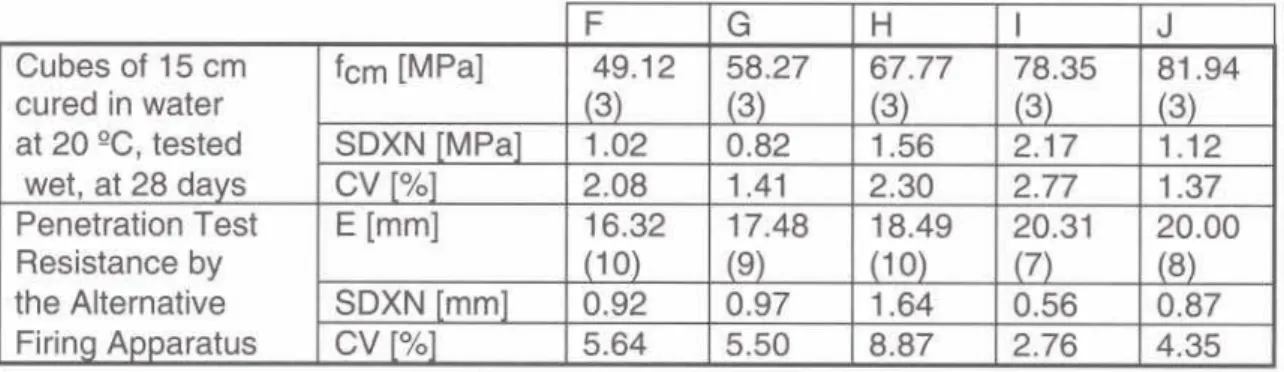
F G H I J Cubes of 15 cm fcm [MPa] 49.12 58.27 67.77 78.35 81.94 cured in water (3) (3) (3)
1
31
1:n
at 20lIC,tested SDXN [MPa] 1.02 0.82 1.56 2.17 1.12 wet,at 28 days CV [%] 2.08 1.41 2.30 2.77 1.37 PenetrationTest E [mm] 16.32 17.48 18.49 20.31 20.00 Resistance by (10) (9) (10)in.
1~
the Alternative SDXN[mmJ 0.92 0.97 1.64 0.56 0.87 Firing Apparatus CV [%] 5.64 5.50 8.87 2.76 4.35Table 2 - Results obtained for High Strength Concrete. (number in parenthesis show the numberof measurements).
E [mm] is the mean value of the exposure length (all specimens testedwet).
Icm
[MPa] is the mean value of compressive strength on standard cubes.All specimens (slab and cubes) were cured in water at controlled temperature of 20 ± 2
°
c
and presented wet atthe time of testing. At 28 days, compression tests were carried out on cubes and penetration resistance test measure on concrete slab surface using the "Alternative FiringApparatus".The obtained results are presented on table 2.All mixes were studied Inorder to keep constant the maximum number of parameters, such as, mixing, workability andcompacting.The workability, measured by Slump test, remained between 60 and 100mm.
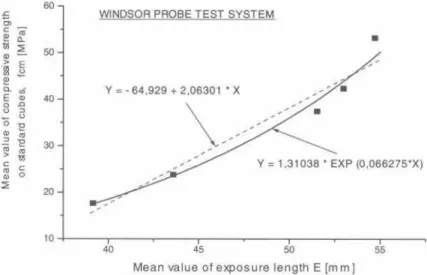
Figure 1-Results obtained from the Windsor Probe Test for Normal Strength Concrete
Mean value of exposure length E(mm]
104---_r--~---.---,_--~--_r--~ 20 55 50 45 40 y=-64.929 +2.06301 •X
•
60The results obtained for the range of Normal Strength Concrete, Fig. 1 and Fig. 2,showed that the Alternative Firing Apparatus could be a suitable mean for the assessment of in-situ strength, and gives a good agreement when compared to Windsor Probe Test System. When testing High Strength Concrete (Fig.3), theAlternative Firing Apparatus appears to be particularly useful since the results obtained so far are very consistent [5].
3.
RESULT ANALYSIS(*)Additional concrete element.
Capo-testactual pullforce Estimated in-situcube stren_g_th
Ref. MEANX SDXN CV MEANX SDXN CV
[kN] [kN] [%] [MPa] 1MPC!} 1%1 A
14
.
96
2
.
83
1
8
.
92
1
5
.
0
1
.
6
10.7
B23
.
40
1
.
44
6
.
1
5
22
.
5
2
.
5
1
1
.
1
C33
.
54
1
.
30
3.87
28
.
5
1
.
5
5.26
0
32
.
05
2.41
7.50
26
.
8
1
.
1
5
4
.2
9
E4
0
.
22
5
.
19
1
2.90
37
.
5
3
.
3
8
.
8
F35
.
22
2
.
38
6
.
76
38
.
5
6
.
3
1
6
.4
G42
.
54
1
.
24
2
.
9
1
52
.
0
7
.
64
14
.
7
H49
.
29
3.46
7.02
54
.
5
2
.
93
5.38
I58
.
03
2
.
34
4
.
03
6
1
.
1
1
2
.
81
2
0
.
9
J
58
.
14
2
.
70
4
.
64
69
.
5
6
.
52
9
.
38
K (*)27
.
12
2
.
30
8.48
33
.
0
3
.
3
10
.
0
Table 3 -Capo-test actual pullforce and Estimated in-situcube strength.
WINDSORPROBE TEST SYSTEM
s:
g.
-! :. : ~ 50
i
~
l! a. <4 E C> 4() o D u :> _ u o 't> C> ;;; ~ ~ 30 > 111 c c : 0 ~ 343Figure 3- Results obtained from the Alternative Firing Apparatus
for High Strength Concrete.
21
17 16 19 20
Mean value of exposure length E (mm]
16
ALTERNAIIVE FIRINGAPPARATUS
y
=
'81,5344 + 8,02508 • X50
Penetration Resistance tests applied to High Strength Concrete, using the Alternative Firing Apparatus has shown a linear correlation, Fig. 3, which probably can be impute to more closeness between cement paste and aggregate strength.
In an attempt to use Windsor Probe Test Systemin High Strength Concrete, it was found that the available probes and/or the power level are unsuitable; probes didn't penetrate the
concrete surface. It means that probably a new probe and/or a new power level has to be provide by manufacturer in order to be possible its use in High Strength Concrete.
Figure 2- Results obtained from the Alternative Firing Apparatus for Normal Strength Concrete
18 20 22 24 28 28
Mean value of exposure length E (mmJ
ALTERNATIVE FIRING APPARATUS .r:. 60 Co c: -t! <II 1IlQ. <II~
m ~
50 e-~<1S E ~ 8a
40 o'E <II <II :> '0 _ c: ~;
30 c: c:'"
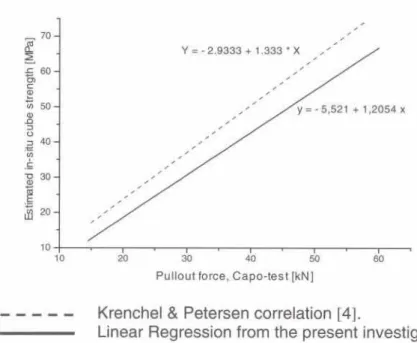
0 <II ::ii 20 10 18 344Figure 5 illustrates the comparison between correlation from the present investigation and that presented by Krenchel and Petersen [4J.Deviation for the above correlations could be explain by different procedures used.
Robert L. Yuan et al [7]have similar conclusion for High Strength Concrete; they have found that at any given age, core strength is smaller than moist-air cured cylinder strength (about 75%), and that core strength after 1 year is only equal to 28-day moist-air cured cylinder strength.
It can be concluded that the estimated in-situ compressive strength as determined using drilledcoresis less than that of standard cured specimens at the same age.
Figure 4- Pull-out actual pullforce versus estimated in-situ cube strength.
Pullout force,Capo-test [kN)
60 50 40 30 20 Y= -5,521 + 1,2054x .c:.60
g.
~ U;50 ~=> o => 40 ,(/)'" .~ -g 30 ~ ~ 20•
Linear Regression _ 70 ~When observing the mean coefficient of variation of estimated in-situ cube strength, table 3, obtained by drilled cores, about 10.6
0/0,
it was found that it is very high compared with the mean coefficient of variation of compressive strength of standard 150 mm cube specimens tested at 28 days,table 1 and table 2, which was found to be 3.37%. Estimated in-situ cube strength obtain from drilled cores at 300 days after casting was also found to be less than compressive strength of 150 mm standard cube specimens at 28 days.The variability in pull-out tests,table 3, has shown a mean standard deviation of 2.51 and a mean coefficient of variation of 7.56. Identical values were presented by Krenchel and Petersen [4]; based on several research works,they have found as typical a pullout standard deviation of 1.9 kNto 2.5 kN and a coefficient of variation of 6.8% to 7.5%. They have also concluded that if pull-outs are carried out onlarger specimens than on standard cylinders or cubes, higher variations must be expected, which indeed coincides with the present investigation.
345 Session 5A- Production and Conformity Control
The pull-out test measurements and its correlation to the estimated in-situ cube strength is presented in Fig. 4, based on data presented on table 3.
As shown on Fig.4 and Fig. 5 pull-out test is also a powerful tool for estimating the in-situ strength of concrete.
Other aspect that cannot be ignored is the higher cost of WPT System equipment and probes in Europe when compared with the Alternative Firing Apparatus.
The main physical limitation of penetration resistance tests is the surface damage and the danger of splitting of members,which limits the zones of testing. However, it was found that the Alternative Firing Apparatus causes less damages than WPT System. Consequently,
minor distances between probes are possible.
The obtained results show that the Alternative FiringApparatus could be a suitable mean for the assessment of in-place strength. The Alternative Firing Apparatus is particularly useful for high strength concrete since the results obtained so far are very consistent.
It is clear and mentioned by different authors that. as most other non-destructive tests,
aggregate characteristics and other factors may have a considerable influence on the results and, therefore, the validity of calibration tables has to be carefully analysed for each situation. So, the results presented here are valid for the established conditions of this investigation.
4. CONCLUSIONS
Figure 5- Pull-out actual pullforce versus estimated in-situ cube strength. - - - Krenchel& Petersen correlation [41.
Unear Regression from the present investigation. 60
20 30 40 50
Pullout force,Capo-test [kNJ
10-t-~--'---"---'---'---r--'--r----'--'---' 10 " , , , , , , , , , , Y= -2.9333 ... 1.333 • X , , 346
11] - ASTM C803-90. Standard Test Method for Penetration Resistance of Hardened
Concrete.American Society forTesting and Materials.
[2] - BS 1881:Part 207: 1992 - Recommendations for the assessment of concrete strength
by near-to-surface tests. British Standards Institution,London.
l3
J -
BS 1881:Part 120: 1983 - Method For Determination ot The Compressive Strength ofConcrete Cores.British Standards Institution,London.
14) - Krenchel, H.; Petersen, C.G. - In-situ Pullout Testing With Lok-test, Ten Years'
Experience, Intern. Cont. on In-situ/Non-destructive Testing ot Concrete, Ottawa, Ontario,
October2-5, 1984.
(5) - Lopes, Sergio; Nepomuceno,Miguel - A Comparative Study of Penetration Resistance
Apparatus on Concrete,ICCEl4,Hawaii,Jul 1997.
[61 - Price, W. F. ; Hynes, J. P. - In-situ Strength Testing of High Strength Concrete,
Magazine of Concrete Research,48, NQ176,pp 189 to 197,Sept 1996.
l7] -Yuan, Robert L.;Ragab, Mostafa;Hill, Robert
E.;
Cook,JamesE.
-
Evaluation of CoreStrength in High-Strength Concrete,Concrete International,Vol 13, pp 30 to 34,May 1991.
6. REFERENCES
The authors wish to thank the University of Beira Interior and the University of Coimbra for
providing the laboratory conditions. They also want to acknowledge the support given by
JNICT, ref.PBIC/C/CEG/2384/95.
5. ACKNOWLEDGEMENTS
347 Session 5A - Production and Conformity Control