Universidade de Lisboa
Faculdade de Ciências
Departamento de Biologia Animal
Connectivity among estuarine and coastal fish
populations using otolith geochemistry
Susanne Eva Tanner
Doutoramento em Biologia
Especialidade de Biologia Marinha e Aquacultura
2012
Universidade de Lisboa
Faculdade de Ciências
Departamento de Biologia Animal
Connectivity among estuarine and coastal fish
populations using otolith geochemistry
Susanne Eva Tanner
Tese orientada por
Professor Auxiliar com Agregação Henrique Nogueira Cabral
Senior Scientist Dr. Simon R. Thorrold
Doutoramento em Biologia
Especialidade de Biologia Marinha e Aquacultura
2012
Doctoral dissertation in Biology
(specialization in Marine Biology and Aquaculture)
presented to the University of Lisboa
Dissertação apresentada à Universidade de Lisboa
para obtenção do grau de doutor
(especialidade Biologia Marinha e Aquacultura)
Susanne Eva Tanner
TABLE OF CONTENTS
ABSTRACT AND KEYWORDS 7
RESUMO E PALAVRAS-CHAVE 9
RESUMO ALARGADO 11
LIST OF PAPERS 15
CHAPTER I 17
General introduction 19
Aims and importance of the thesis 22
Thesis outline 23
CHAPTER II 29
Does otolith geochemistry record ambient environmental conditions in estuaries?
CHAPTER III 53
Spatial and ontogenetic variability in the chemical composition of juvenile common sole (Solea solea) otoliths
CHAPTER IV 75
Otolith geochemistry discriminates among estuarine nursery areas of Solea solea and S. senegalensis over time
CHAPTER V 97
Testing an otolith geochemistry approach to determine population structure and movements of European hake in the northeast Atlantic Ocean and Mediterranean Sea
CHAPTER VI 117
Integrating microsatellite DNA markers and otolith geochemistry to assess stock structure of European hake (Merluccius merluccius)
CHAPTER VII 145
Population connectivity of Solea solea and Solea senegalensis over time
CHAPTER VIII 165
General discussion and Future perspectives
Abstract
Connectivity is a critical property of marine fish populations as it defines population replenishment, colonization patterns and populations’ resilience to harvesting. Otolith geochemistry is one of the techniques with greatest potential to determine fish movements, especially at early life stages. The accurate use of otolith geochemical signatures as natural tags in connectivity and population structure studies is tied to a thorough assessment of the variability of these markers at different spatio-temporal scales. Additionally, understanding the relationships between otolith geochemical composition and physicochemical properties of ambient water is necessary for tracking fish movement patterns. Several otolith elemental and isotopic ratios were identified as potentially useful proxies for temperature or salinity in estuarine environment which might allow the accurate reconstruction of habitat use of juvenile Solea solea. The significant differences between the geochemical composition of otolith core and edge observed in S. solea and Merluccius merluccius were possibly related to ontogenetic and environmental factors. Otolith geochemical signatures of juvenile S. solea and Solea senegalensis varied significantly between and within years yet without interfering in the spatial discrimination of estuaries. Juvenile soles were accurately assigned to their estuaries of origin and the established geochemical signatures constitute the baseline data for assessments of connectivity between juvenile and adult populations. The estimated relative contributions from estuarine source areas to adult coastal populations allowed the successful identification of the estuarine systems that accounted most for the replenishment of adult stocks of both sole species in two years. The integration of otolith geochemistry and microsatellite DNA markers, applied in a hierarchical manner, enhanced population structure estimates of M. merluccius since the two markers act at different spatio-temporal scales. Overall, the present results should promote the development of effective conservation strategies for ecologically important habitats and integrated fisheries management plans for these commercially important species.
Keywords: otolith geochemistry, natural markers, spatio-temporal variability,
Resumo
A conectividade é uma característica importante de populações de peixes marinhos, pois determina a reposição populacional, os padrões de colonização e a resiliência das populações à pesca. A geoquímica de otólitos é uma das técnicas com maior potencial para determinar movimentos de peixes, sobretudo nos estados de vida iniciais. A aplicação correcta das assinaturas geoquímicas de otólitos como marcadores naturais depende duma avaliação abrangente da sua variabilidade a diferentes escalas espácio-temporais. Além disso, é necessário um conhecimento sobre as relações entre a composição geoquímica e as propriedades físico-químicas da água para seguir os movimentos dos peixes. Diferentes elementos e isótopos foram identificados como potenciais indicadores de temperatura ou salinidade em estuários, que poderão permitir a determinação do padrão de utilização por habitats de juvenis de Solea solea. As diferenças significativas entre a composição geoquímica do núcleo e da margem de otólitos de S. solea e Merluccius merluccius estão provavelmente associadas a factores ontogenéticos e ambientais. As assinaturas químicas dos juvenis de S. solea e Solea senegalensis variaram significativamente entre anos e meses, porém sem interferir com a discriminação espacial entre estuários. Os juvenis foram correctamente atribuídos aos seus estuários de origem e as assinaturas estabelecidas constituem as bases de referência para avaliar a conectividade entre populações de juvenis e adultos. As estimativas de contribuições relativas das áreas estuarinas para as populações adultas na costa permitiram a identificação dos estuários que mais contribuem para a reposição dos mananciais das duas espécies de linguado em dois anos distintos. A integração de geoquímica de otólitos e marcadores genéticos melhorou as estimativas de estrutura populacional de M. merluccius, quando aplicada hierarquicamente, pois os dois marcadores naturais têm resoluções espácio-temporais diferentes. Globalmente, os resultados obtidos poderão ajudar a promover o desenvolvimento de estratégias de conservação eficientes e planos de gestão integrados para estas espécies.
Palavras-chave: geoquímica de otólitos, marcadores naturais, variabilidade
Resumo alargado
Muitas espécies de peixes marinhos utilizam estuários, baías ou áreas costeiras para completar o seu ciclo de vida. Os juvenis destas espécies podem passar meses ou até anos nestes ambientes mais abrigados e com maior disponibilidade de alimento, antes de se juntarem às populações de adultos ao largo da costa. Um melhor conhecimento sobre os padrões e taxas de movimento de peixes entre diferentes habitats, ou seja sobre a conectividade destas populações, pode fornecer dados importantes relativamente às dinâmicas populacionais, aos padrões de colonização de novos habitats e à resiliência das populações ao impacto da pesca. Estas informações são essenciais para o desenvolvimento adequado de estratégias de conservação e planos de gestão de recursos.
A quantificação do movimento individual e da conectividade entre populações de peixes constitui uma tarefa difícil, sobretudo em fases iniciais do ciclo de vida. Neste contexto, a análise de assinaturas geoquímicas de otólitos de peixes e a sua utilização como marcadores naturais representa um avanço notável e é, sem dúvida, uma das metodologias com maior potencial na quantificação da conectividade e na sua caracterização espácio-temporal.
O presente estudo tem como objectivo principal a avaliação da variabilidade espácio-temporal das assinaturas geoquímicas de otólitos de peixes em ambiente estuarino e costeiro. Pretende-se utilizar estas assinaturas na estimativa das contribuições relativas das áreas estuarinas utilizadas por juvenis para os mananciais de adultos, bem como determinar os padrões de movimento e a estrutura populacional de peixes marinhos.
A presente tese é composta por oito capítulos, seis dos quais correspondem a artigos científicos elaborados de forma a responder directamente aos objectivos propostos, estando publicados ou em revisão em revistas internacionais com arbitragem científica e incluídas no Science Citation Index. Estes capítulos são precedidos de um capítulo de introdução geral e seguidos de um capítulo de discussão geral com sugestão de desenvolvimentos futuros.
Na introdução geral (Capítulo I) é apresentado um enquadramento teórico do tema da presente tese, focando a importância da avaliação da conectividade em populações de organismos marinhos, com uma descrição de abordagens directas e
indirectas aplicadas ao longo das últimas décadas. É dado particular destaque às assinaturas geoquímicas de otólitos, enquanto marcadores naturais, e à integração de diferentes marcadores naturais (i.e. geoquímica de otólitos e marcadores genéticos) em estudos de conectividade e estrutura populacional de peixes.
As relações entre a composição geoquímica de otólitos de juvenis de linguado legítimo (Solea solea) e as propriedades físico-químicas da água do estuário (i.e. temperatura, salinidade e composição química) são exploradas no Capítulo II. A utilização da geoquímica de otólitos para seguir migrações de peixes ou reconstruir o uso de habitats em ambientes estuarinos exige que as relações entre a composição geoquímica dos otólitos e o meio ambiente sejam significativas. No presente estudo, os resultados indicaram uma relação negativa entre a incorporação de lítio (Li) nos otólitos e a temperatura, salientando assim o potencial deste elemento na reconstituição de padrões de exposição à temperatura ao longo da vida dos peixes. De modo similar, as razões de Ba:Ca, δ13C e δ18
O foram identificadas como possíveis marcadores de uso de habitat em ambientes eurihalinos. Estes elementos apresentaram padrões de mistura significativos ao longo do gradiente salino do estuário, evidenciando a relação entre as suas incorporações e a disponibilidade e concentração dos respectivos elementos na água.
O Capítulo III é relativo à investigação da variabilidade espacial e ontogenética das assinaturas geoquímicas dos otólitos de juvenis de S. solea, recolhidos nos principais estuários da costa portuguesa. No que diz respeito à variabilidade espacial, foram encontradas diferenças significativas tanto entre estuários, como entre locais dentro de um mesmo estuário. As diferenças encontradas entre a composição química do núcleo e da margem do otólito foram provavelmente influenciadas por factores ambientais, bem como por efeitos ontogenéticos. As variações espaciais observadas entre estuários e entre locais de um mesmo estuário indicam que as assinaturas geoquímicas de otólitos são marcadores naturais apropriados para esta espécie. Porém, a variação ontogenética deve ser considerada em estudos de conectividade e estrutura populacional desta espécie.
Antes de utilizar as assinaturas geoquímicas de otólitos para determinar a residência estuarina ou origem natal de indivíduos, é necessária uma avaliação completa da variabilidade espácio-temporal, que é apresentada no Capítulo IV deste trabalho. Determinar a variação temporal a diferentes escalas é particularmente importante, uma vez que esta pode confundir a discriminação espacial entre os
estuários. As assinaturas geoquímicas dos otólitos de juvenis de linguado legítimo (S. solea) e de linguado do Senegal (Solea senegalensis), recolhidos durante dois anos em estuários portugueses, mostraram variabilidade em todas as escalas temporais examinadas sem, no entanto, interferir com a discriminação espacial. Em geral, os juvenis foram correctamente classificados nos seus estuários de origem, embora variando entre anos e espécies. As assinaturas geoquímicas determinadas nos otólitos de juvenis de S. solea e S. senegalensis constituem as bases de referência para subsequentes avaliações de conectividade entre populações de juvenis e de adultos nestas duas espécies de linguado.
A variabilidade das assinaturas geoquímicas de otólitos a larga escala espacial foi investigada usando a pescada (Merluccius merluccius). Em resposta a algumas lacunas acerca da estrutura populacional desta espécie, certos aspectos fundamentais para esta espécie são tratados e desenvolvidos nos Capítulos V e VI. A geoquímica de otólitos foi utilizada para examinar movimentos de pescada entre populações locais no Atlântico Norteste e no Mediterrâneo (Capítulo V). A composição geoquímica encontrada no núcleo dos otólitos distinguiu-se da determinada nas suas margens. Estas diferenças estão possivelmente associadas a alterações ontogenéticas da fisiologia e da ecologia alimentar desta espécie. Os resultados obtidos sugeriram que existe movimento de indivíduos entre as populações locais dentro do Atlântico Norteste, bem como dentro do Mediterrâneo. No entanto, não foram encontrados indícios de migração através do Estreito de Gibraltar, que indicasse a ligação entre as populações das duas regiões. Os padrões de movimento de pescada observados não coincidiram com os limites de mananciais implementados no Atlântico Norte. Recomenda-se, portanto, uma reavaliação das unidades de gestão desta espécie demersal, de forma a tornar a sua gestão mais adequada e eficiente.
No Capítulo VI, a estrutura populacional e os padrões de movimento de M. merluccius, considerando sete locais no Atlântico Norteste e no Mediterrâneo, foram investigados utilizando uma abordagem integradora baseada em assinaturas geoquímicas e marcadores genéticos (microssatélites). As assinaturas geoquímicas do núcleo dos otólitos, utilizadas para investigar a separação espacial nas fases iniciais do ciclo de vida, não foram suficientemente robustas para identificar grupos em toda a escala geográfica estudada. No entanto, dentro de cada região hidrogeográfica (Atlântico Norteste e Mediterrâneo) foram identificados três grupos com base nesta metodologia. De modo semelhante, os microssatélites não esclareceram a estrutura
genética da população a uma escala mais reduzida (dentro de cada região hidrogeográfica), tendo sido encontrados indícios de uma separação genética evidente próximo do Estreito de Gibraltar que divide claramente as populações do Atlântico Norteste e do Mediterrâneo. A integração das duas técnicas melhorou as estimativas de estrutura populacional da espécie, quando aplicadas de maneira hierárquica, pois os dois marcadores naturais actuam a escalas espácio-temporais diferentes.
No Capítulo VII, apresenta-se a determinação dos estuários de origem dos indivíduos adultos recolhidos ao longo da costa portuguesa, utilizando as bases de referência das assinaturas geoquímicas dos juvenis de S. solea e S. senegalensis de duas classes anuais diferentes (apresentadas no Capítulo IV). As contribuições relativas estimadas variaram entre os dois anos analisados. No entanto, foram identificados sistemas estuarinos que, durante o período estudado, forneceram muitos indivíduos para as populações de adultos (e.g. Ria de Aveiro) e outros que não tiveram um papel importante nestas contribuições (e.g. Mira). As comparações das assinaturas geoquímicas de juvenis de áreas de viveiro estudadas com as de adultos indicaram a possibilidade de existirem áreas de viveiro desconhecidas, não incluídas na base de referência, e que possam ter contribuído para as populações de adultos. Porém, as estimativas das contribuições relativas das áreas estuarinas para as áreas ao largo da costa permitiram a identificação dos sistemas estuarinos que mais contribuíram para a reposição dos mananciais das duas espécies de linguado durante os dois anos estudados.
Finalmente, no Capítulo VIII é apresentada uma discussão geral que engloba as principais conclusões dos capítulos anteriores e são delineadas perspectivas futuras de investigação. São também tecidas algumas considerações finais acerca da relevância do presente trabalho para o conhecimento geral sobre a conectividade entre populações e a estrutura populacional de peixes marinhos, bem como a integração de diferentes marcadores naturais.
LIST OF PAPERS
This thesis is comprised by the papers listed below, each corresponding to a chapter (Chapter II to VII). The author of this thesis is the first author in all papers and was responsible for conception and design of the work, field surveys, sample collection and processing, laboratory analytical procedures, data analysis and manuscript writing of all the papers. Remaining authors collaborated in some or several of these procedures. All papers published or in press were included with the publishers’ agreement.
CHAPTER II: Does otolith geochemistry record ambient environmental conditions in estuaries?
Susanne E. Tanner, Patrick Reis-Santos, Rita P. Vasconcelos, Vanessa Fonseca, Susana França, Henrique N. Cabral & Simon R. Thorrold
In review in Journal of Experimental Marine Biology and Ecology
CHAPTER III: Spatial and ontogenetic variability in the chemical composition of juvenile
common sole (Solea solea) otoliths
Susanne E. Tanner, Rita P. Vasconcelos, Patrick Reis-Santos, Henrique N. Cabral & Simon R. Thorrold
Published in Estuarine, Costal and Shelf Science (2011) 91: 150-157
CHAPTER IV: Otolith geochemistry discriminates among estuarine nursery areas of
Solea solea and S. senegalensis over time
Susanne E. Tanner, Patrick Reis-Santos, Rita P. Vasconcelos, Susana França, Simon R. Thorrold & Henrique N. Cabral
Published in Marine Ecology Progress Series (2012) 452: 193-203
CHAPTER V: Testing an otolith geochemistry approach to determine population
structure and movements of European hake in the northeast Atlantic Ocean and Mediterranean Sea
Susanne E. Tanner, Rita P. Vasconcelos, Henrique N. Cabral & Simon R. Thorrold Published in Fisheries Research (2012) 125-126: 198-205
CHAPTER VI: Integrating microsatellite DNA markers and otolith geochemistry to assess
stock structure of European hake (Merluccius merluccius)
Susanne E. Tanner, Montse Pérez, Pablo Presa, Simon R. Thorrold & Henrique N. Cabral
In review in Fisheries Oceanography
CHAPTER VII: Population connectivity of Solea solea and Solea senegalensis over time
Susanne E. Tanner, Patrick Reis-Santos, Rita P. Vasconcelos, Simon R. Thorrold & Henrique N. Cabral
CHAPTER I
General introduction
Aims and importance of the thesis
Thesis outline
General introduction
Aims and importance of the thesis
Thesis outline
GENERAL INTRODUCTION
Connectivity, or exchange among geographically separated groups, is a critical component in marine fish populations as it determines population replenishment, colonization patterns and the resilience of populations to harvesting (Thorrold et al. 2001, Cowen et al. 2007). Understanding this link provides important information on the dynamics, genetic structure and biogeography of populations (Cowen et al. 2000). Furthermore, it contributes significantly to the identification of ecologically important habitats, the sustainable management of fish populations and the design of marine protected areas (Thorrold et al. 2007) which are major concerns since marine species are under considerable and increasing stress from human activities (Pauly et al. 1998, Jackson et al. 2001). These anthropogenic pressures significantly contribute to the deterioration and fragmentation of estuarine and coastal habitats, biodiversity loss and stock depletion (Jackson 2008).
Many marine fish species occupy spatially separated habitats during their life history cycle. Adults generally show broad and continuous distributions, whereas juveniles use more discrete geographic areas such as estuaries, bays or shallow coastal areas that favor survival and growth of early life stages of fish (Beck et al. 2001, Gillanders et al. 2003, Able 2005). Juveniles remain in these sheltered areas for months or years, depending on the species, before migrating to the adult populations offshore (Beck et al. 2001, Able 2005). The concept of a population is central to the fields of ecology, evolutionary biology, and conservation biology, and many definitions can be found in the literature. In the present work, population refers to a group of juvenile or adult individuals of a species that occupy the same space at a particular time (reviewed by Waples & Gaggiotti 2006). Following this definition, the present work will use the terms adult population and juvenile population.
Quantifying the movement of fishes is a challenging task that, over the decades, has been tackled by a variety of indirect and direct approaches. Although only direct approaches can provide quantitative measurements of individuals shifting between groups, a large number of studies has used indirect approaches including differences
in distribution, abundance and size structure (reviewed by Gillanders et al. 2003). Artificial and natural tags are direct approaches that provide estimates of rate and extent of movement between habitats. Despite technological advances, conventional artificial tagging techniques are logistically difficult to execute in early life stages, such as larvae and juveniles due to small body size, high mortality and low recapture rates. However, artificial tags in calcified tissues of fish using chemical (fluorescent compounds, elemental tags, enriched isotopes) or physical markers have been used more routinely and have provided insight into movement patterns in early life stages of fish (reviewed by Thorrold et al. 2002). Recently, transgenerational otolith marking using enriched isotopes has emerged as a promising artificial chemical tagging technique (e.g. Thorrold et al. 2006, Almany et al. 2007, Munro et al. 2009). This technique relies on the premise that the chemical tags are passed from the female to the eggs during oocyte development and are subsequently incorporated into embryonic otoliths. However, this technique is technically and logistically difficult to implement, labor-intensive and depends on the species and systems under study which is reflected in the low number of studies that have used otolith transgenerational marking in the field (Thorrold et al. 2006, Almany et al. 2007, Planes et al. 2009). The numerous difficulties associated with artificial tags have led to an increased interest in the use of natural tags to track movement patterns in fish. Naturally occurring markers (chemical, genetic and parasitic tags) are particularly interesting since they depend on differences in environmental conditions or genetic heterogeneity to produce group-specific tags and inevitably every individual in a group is tagged (Thorrold et al. 2002). Amongst natural tags, otolith geochemistry has developed into one of the most promising techniques to determine population connectivity and quantify movement patterns of fish (Gillanders 2005, Elsdon et al. 2008). The first studies investigating geochemical composition of otoliths date back up to four decades (Degens et al. 1969, Gauldie et al. 1986, Radtke 1987) and mainly focused on the potential use of otolith chemical composition to reconstruct environmental life histories of fish. Since then otolith geochemistry has been applied in a wide variety of studies, namely to estimate stock identity and population structure (e.g. Thresher 1999, Newman et al. 2009, Steer et al. 2010), assess migration patterns (e.g. Hamer et al. 2006, Suzuki et al. 2008, Limburg et al. 2011), identify natal origin or nursery areas (e.g. Vasconcelos et al. 2007, Clarke et al. 2009, Cuveliers et al. 2010) and to retrospectively determine the origin of adults (e.g. Thorrold et al. 2001, Vasconcelos et al. 2008, Wright et al. 2010).
This wide array of applications is based on the metabolic inertness of otoliths (Campana & Neilson 1985), which results in the permanent retention of the geochemical tag. Calcium carbonate (usually in the form of aragonite) and proteins are continuously accreted to the otolith surface forming daily and annual increment patterns that can be used as chronological recorders of environmental conditions (Campana & Thorrold 2001). Finally, the incorporation of at least some elements is influenced by environmental conditions (e.g. water temperature, salinity, chemical composition of the water) while other elements are under physiological or genetic control (Campana 1999). Hence, fish occupying habitats with different environmental conditions may present distinct otolith geochemical signatures. To use otolith geochemical signatures as natural tags in connectivity and population structure studies three assumptions should be met. First, otolith geochemical signatures of fish from different groups of interest must differ significantly. Second, the geochemical signatures of all possible groups contributing to the mixture need to be characterized and third, the geochemical signatures should remain stable over the time period during which group assignments are to be made (Campana 1999, Campana et al. 2000). By complying with these criteria, otolith geochemistry is an outstanding tool to address a number of core challenges of marine ecology, such as determining the spatio-temporal scale of connectivity, the underlying processes of dispersal, the impacts of connectivity on population structure and dynamics and effectively applying this information to management (Cowen & Sponaugle 2009).
Genetic markers are another natural tag that is well established in studies of population structure and connectivity in marine populations (Hellberg et al. 2002, Hedgecock et al. 2007). Marine fish are expected to show low genetic differentiation and high gene flow due to large population sizes, broad geographic distributions, high fecundity and high dispersal potential (DeWoody & Avise 2000). Highly variable codominant microsatellite DNA markers have been used in many population genetic studies to identify genetic structure in populations with low genetic differentiations such as marine fish species (White et al. 2010). The ecological implications of low but significant genetic structure in fish populations are difficult to assess, especially because estimates of gene flow are generally made on recent and/or past evolutionary time scales rather than an ecological time frame over which most management decisions are made (Palumbi 2003).
processes that act over a range of temporal scales. Therefore the use of multiple and complementary techniques that integrate over different scales might provide the best inference on population connectivity and structure (Thorrold et al. 2002, Lowe & Allendorf 2010). Several studies have combined genetic markers and otolith geochemistry as these two natural tags provide complementary information on population structure and connectivity patterns over evolutionary and ecological time scales, respectively (Miller et al. 2005, Bradbury et al. 2008, Woods et al. 2010). The chronological properties of otoliths may provide information on demographic connectivity patterns of fish, whereas genetic markers may resolve population structure over various time scales.
Along the Portuguese coast, few studies have addressed fish population structure (Correia et al. 2011, Correia et al. 2012) or population connectivity (Vasconcelos et al. 2007, Vasconcelos et al. 2008) using otolith geochemistry. The latter confirmed the applicability of otolith geochemistry to investigate the movement of individuals between estuarine and coastal environments and provided the first estimates of estuarine contributions to adult populations. However, spatio-temporal variability of otolith geochemical signatures has not been evaluated. A sound assessment of spatio-temporal variability at different scales is vital to accurately use otolith geochemistry in connectivity and population structure studies. Only with geochemical baselines that are spatially-explicit, can the relative contributions of different juvenile areas to the adult population be feasibly determined. Genetic markers have commonly been employed to address fish population structure in Portuguese waters (e.g. Castilho & McAndrew 1998, Cabral et al. 2003, Correia et al. 2006) however, combining them with other natural markers has not been attempted yet. The integration of different natural markers (i.e. genetic markers and otolith geochemistry) that act at different temporal scales has shown very promising results that complement our understanding of connectivity and structure of natural populations even though it is still in its infancy.
AIMS AND IMPORTANCE OF THE THESIS
The present work aims to assess the spatio-temporal variability in otolith geochemical signatures in estuarine and coastal fish populations, and to use these signatures to evaluate relative contributions of estuarine areas inhabited by juveniles to coastal adult stocks as well as to determine movement patterns and population structure of marine fish.
Otolith geochemistry is used in a wide variety of studies, although still many uncertainties persist regarding the factors affecting element incorporation into otoliths (e.g. Elsdon et al. 2008, Thorrold & Swearer 2009). An in situ approach is employed to address the effects of environmental factors on otolith geochemical composition. Such approaches are highly valuable since the high variability of the physicochemical properties of the water in estuaries can complement finding from laboratory experiments.
Variation in geochemical composition of otoliths at different temporal scales (e.g. inter-annual, seasonal) may confound spatial discrimination and lead to inadequate interpretations of geochemical data (e.g. Gillanders 2002, Hamer et al. 2003). Moreover, ontogenetic effects may also contribute to variations in otolith geochemistry. Therefore, a thorough assessment of the spatio-temporal variability in otolith geochemical signatures at different scales is essential to correctly and feasibly apply them as natural tags in connectivity studies. The identified spatially-explicit signatures will constitute the geochemical baselines used to evaluate the rate and extent of connectivity between juvenile source areas and coastal adult populations.
Integrating natural markers that provide information at different ecological and evolutionary time scales complements and enhances our understanding of demographic and genetic connectivity in marine systems. The determination of quantitative estimates of relative contributions from juvenile source areas to adult populations identifies the areas that most account for stock replenishment, and focusing on two different years quantifies inter-annual variability. Both approaches should produce much needed multifaceted information to prioritize conservation strategies towards areas identified as essential to fish recruitment and stock maintenance, as well as sustainable management of marine capture fisheries.
THESIS OUTLINE
The present thesis comprises six scientific papers published or in review in peer reviewed international journals. Each paper corresponds to a chapter.
In chapter II, otolith geochemical composition of juvenile Solea solea is related to the physicochemical properties of estuarine water at a small spatio-temporal scale. Significant relationships between otolith geochemical composition and environmental factors are established and potential proxies for temperature and salinity are identified. Spatial and ontogenetic variability in the otolith geochemical composition of juvenile S. solea is evaluated in chapter III. The accuracy of assignment of individuals
to their estuary of origin is assessed and the environmentally- and ontogenetically-induced differences in otolith geochemical composition of juvenile common sole are discussed.
Otolith geochemistry is used to discriminate estuarine nursery areas of S. solea and Solea senegalensis over time in chapter IV. Temporal variation in otolith geochemical signatures is assessed at different scales and its potentially confounding effect on spatial discrimination is explored. The established elemental signatures constitute the baseline data for the subsequent assessments of connectivity between juvenile and adult populations of the two sole species.
In chapter V, movement of Merluccius merluccius among local populations is examined at a large spatial scale and the accuracy of current stock boundaries for this species is tested using otolith geochemistry. Differences between otolith core and edge composition are appraised and discussed with respect to ontogenetic changes in physiology and feeding habits of M. merluccius.
An integrative approach based on otolith core and edge geochemical composition and microsatellite DNA is used to investigate population structure and movement patterns of M. merluccius in chapter VI. The complementarity of the information on population structure and connectivity patterns obtained using the two markers is discussed.
In chapter VII, relative contributions of estuarine nursery areas to the coastal adult populations of S. solea and S. senegalensis are estimated based on otolith geochemical signatures. Inter-annual stability of estuary-specific contributions is examined and important nursery areas, in terms of high contribution proportions, are identified.
In the final chapter, a general discussion addresses the major conclusions obtained in the different studies regarding otolith geochemistry as a valuable tool in connectivity studies and stock structure assessment. Further, the potential advantages of integrating different natural markers are discussed. Perspectives for future research are also included in this chapter.
LITERATURE CITED
Able KW (2005) A re-examination of fish estuarine dependence: Evidence for connectivity between estuarine and ocean habitats. Estuar Coast Shelf Sci 64:5-17
Almany GR, Berumen ML, Thorrold SR, Planes S, Jones GP (2007) Local Replenishment of Coral Reef Fish Populations in a Marine Reserve. Science 316:742-744
Beck MW, Heck Jr. KL, Able KW, Childers DL, Eggleston DB, Gillanders BM, Halpern BS, Hays CG, Hoshino K, Minello TJ, Orth RJ, Sheridan PF, Weinstein MP (2001) The Identification, Conservation, and Management of Estuarine and Marine Nurseries for Fish and
Invertebrates. BioScience 8:633-641
Bradbury IR, Campana SE, Bentzen P (2008) Estimating contemporary early life-history dispersal in an estuarine fish: integrating molecular and otolith elemental approaches. Mol Ecol 17:1438-1450
Cabral HN, Castro F, Linhares D, Alexandrino P (2003) Genetic differentiation of Solea solea (Linnaeus, 1758) and Solea senegalensis Kaup, 1858, (Pisces: Pleuronectiformes) from several estuarine systems of the Portuguese coast. Sci Mar 67:43-52
Campana SE, Neilson JD (1985) Microstructure of fish otoliths. Can J Fish Aquat Sci 42:1014-1032
Campana SE (1999) Chemistry and composition of fish otoliths: pathways, mechanisms and applications. Mar Ecol Prog Ser 188:263-297
Campana SE, Chouinard GA, Hanson JM, Fréchet A, Brattey J (2000) Otolith elemental fingerprints as biological tracers of fish stocks. Fish Res 46:343-357
Campana SE, Thorrold SR (2001) Otoliths, increments, and elements: keys to a comprehensive understanding of fish populations? Can J Fish Aquat Sci 58:30-38
Castilho R, McAndrew BJ (1998) Population structure of seabass in Portugal: evidence from allozymes. J Fish Biol 53:1038-1049
Clarke LM, Walther BD, Munch SB, Thorrold SR, Conover DO (2009) Chemical signatures in the otoliths of a coastal marine fish, Menidia menidia, from the northeastern United States: spatial and temporal differences. Mar Ecol Prog Ser 384:261-271
Correia AT, Faria R, Alexandrino P, Antunes C, Isidro EJ, Coimbra J (2006) Evidence for genetic differentiation in the European conger eel Conger conger based on mitochondrial DNA analysis. Fish Sci 72:20-27
Correia AT, Pipa T, Goncalves JMS, Erzini K, Hamer PA (2011) Insights into population structure of Diplodus vulgaris along the SW Portuguese coast from otolith elemental signatures. Fish Res 111:82-91
Correia AT, Gomes P, Goncalves JMS, Erzini K, Hamer PA (2012) Population structure of the black seabream Spondyliosoma cantharus along the south-west Portuguese coast inferred from otolith chemistry. J Fish Biol 80:427-443
Cowen RK, Lwiza KMM, Sponaugle S, Paris CB, Olson DB (2000) Connectivity in marine populations: Open or closed? Science 287:857-859
Cowen RK, Gawarkiewicz G, Pineda J, Thorrold SR, Werner FE (2007) Population connectivity in marine systems: an overview. Oceanography 20:14-21
Cowen RK, Sponaugle S (2009) Larval dispersal and marine population connectivity. Annu Rev Mar Sci 1:443–466
Cuveliers EL, Geffen AJ, Guelinckx J, Raeymaekers JAM, Skadal J, Volckaert FAM, Maes GE (2010) Microchemical variation in juvenile Solea solea otoliths as a powerful tool for studying connectivity in the North Sea. Mar Ecol Prog Ser 401:211-220
Degens ET, Deuser WG, Haedrich RL (1969) Molecular structure and composition of fish otoliths. Mar Biol 2:105-113
DeWoody JA, Avise JC (2000) Microsatellite variation in marine, freshwater and anadromous fishes compared with other animals. J Fish Biol 56:461-473
Elsdon TS, Wells BK, Campana SE, Gillanders BM, Jones CM, Limburg KE, Secor DH, Thorrold SR, Walther BD (2008) Otolith chemistry to describe movements and life-history parameters of fishes: hypotheses, assumptions, limitations and inferences. Oceanogr Mar Biol Annu Rev 46:297-330
Gauldie RW, Fournier DA, Dunlop DE, Coote G (1986) Atomic emission and proton microprobe studies of the ion content of otoliths of chinook salmon aimed at recovering the temperature life history of individuals. Comp Biochem Physiol A: Physiol 84:607-615
Gillanders BM (2002) Temporal and spatial variability in elemental composition of otoliths: implications for determining stock identity and connectivity of populations. Can J Fish Aquat Sci 59:669-679
Gillanders BM, Able KW, Brown JA, Eggleston DB, Sheridan PF (2003) Evidence of connectivity between juvenile and adult habitats for mobile marine fauna: an important component of nurseries. Mar Ecol Prog Ser 247:281-295
Gillanders BM (2005) Otolith chemistry to determine movements of diadromous and freshwater fish. Aquat Living Resour 18:291-300
Hamer PA, Jenkins GP, Gillanders BM (2003) Otolith chemistry of juvenile snapper Pagrus auratus in Victorian waters: natural chemical tags and their temporal variation. Mar Ecol Prog Ser 263:261-273
Hamer PA, Jenkins GP, Coutin P (2006) Barium variation in Pagrus auratus (Sparidae) otoliths: A potential indicator of migration between an embayment and ocean waters in south-eastern Australia. Estuar Coast Shelf Sci 68:686-702
Hedgecock D, Barber PH, Edmands S (2007) Genetic approaches to measuring connectivity. Oceanography 20:70-79
Hellberg ME, Burton RS, Neigel JE, Palumbi SR (2002) Genetic assessment of connectivity among marine populations. Bull Mar Sci 70:273-290
Jackson JBC, Kirby MX, Berger WH, Bjorndal KA, Botsford LW, Bourque BJ, Bradbury RH, Cooke R, Erlandson J, Estes JA, Hughes TP, Kidwell S, Lange CB, Lenihan HS, Pandolfi JM, Peterson CH, Steneck RS, Tegner MJ, Warner RR (2001) Historical overfishing and the recent collapse of coastal ecosystems. Science 293:629-638
Jackson JBC (2008) Ecological extinction and evolution in the brave new ocean. Proc Natl Acad Sci 105:11458-11465
Limburg KE, Olson C, Walther Y, Dale D, Slomp CP, Høie H (2011) Tracking Baltic hypoxia and cod migration over millennia with natural tags. Proc Natl Acad Sci 108:E177-E182
Lowe WH, Allendorf FW (2010) What can genetics tell us about population genetics? Mol Ecol 19:3038-3051
Miller JA, Banks MA, Gomez-Uchida D, Shanks AL (2005) A comparison of population structure in black rockfish (Sebastes melanops) as determined with otolith microchemistry and microsatellite DNA. Can J Fish Aquat Sci 62:2189-2198
Munro AR, Gillanders BM, Thurstan S, Crook DA, Sanger AC (2009) Transgenerational marking of freshwater fishes with enriched stable isotopes: a tool for fisheries management and research. J Fish Biol 75:668-684
Newman SJ, Buckworth RC, Mackie MC, Lewis PD, Wright IW, Williamson PC, Bastow TP, Ovenden JR (2009) Spatial subdivision among assemblages of Spanish mackerel, Scomberomorus commerson (Pisces: Scombridae) across northern Australia: implications for fisheries management. Global Ecol Biogeogr 18:711-723
Palumbi SR (2003) Population genetics, demographic connectivity, and the design of marine reserves. Ecol Appl 13:S146-S158
Pauly D, Christensen V, Dalsgaard J, Froese R, Torres Jr. F (1998) Fishing down marine food webs. Science 279:860-863
Planes S, Jones GP, Thorrold SR (2009) Larval dispersal connects fish populations in a network of marine protected areas. Proc Natl Acad Sci 106:5693-5697
Radtke RL (1987) Age and growth information available from the otoliths of the Hawaiian snapper, Pristipomoides filamentosus. Coral Reefs 6:19-25
Steer MA, Halverson GP, Fowler AJ, Gillanders BM (2010) Stock discrimination of Southern Garfish (Hyporhamphus melanochir) by stable isotope ratio analysis of otolith aragonite Environ Biol Fishes 89:369-381
Suzuki KW, Kasai A, Ohta T, Nakayama K, Tanaka M (2008) Migration of Japanese temperate bass Lateolabrax japonicus juveniles within the Chikugo River estuary revealed by δ13
C analysis. Mar Ecol Prog Ser 358:245-256
Thorrold SR, Latkoczy C, Swart PK, Jones CM (2001) Natal homing in marine fish metapopulation. Science 291:297-299
Thorrold SR, Jones GP, Hellberg ME, Burton RS, Swearer SE, Neigel JE, Morgan SG, Warner RR (2002) Quantifying larval retention and connectivity in marine populations with artificial and natural markers. Bull Mar Sci 70:291-308
Thorrold SR, Jones GP, Planes S, Hare JA (2006) Transgenerational marking of embryonic otoliths in marine fishes using barium stable isotopes. Can J Fish Aquat Sci 63:1193-1197 Thorrold SR, Zacherl DC, Levin LA (2007) Population connectivity and larval dispersal using
Thorrold SR, Swearer SE (2009) Otolith chemistry. In: Green BS, Mapstone BD, Carlos G, Begg GA (eds) Tropical Fish Otoliths: Information for Assessment, Management and Ecology. Springer, Netherlands, pp. 249-295
Thresher RE (1999) Elemental composition of otoliths as a stock delineator in fishes. Fish Res 43:165-204
Vasconcelos RP, Reis-Santos P, Tanner S, Fonseca V, Latkoczy C, Günther D, Costa MJ, Cabral H (2007) Discriminating estuarine nurseries for five fish species through otolith elemental fingerprints. Mar Ecol Prog Ser 350:117-126
Vasconcelos RP, Reis-Santos P, Tanner S, Maia A, Latkoczy C, Günther D, Costa MJ, Cabral H (2008) Evidence of estuarine nursery origin of five coastal fish species along the
Portuguese coast through otolith elemental fingerprints. Estuar Coast Shelf Sci 79:317-327 Waples RS, Gaggiotti O (2006) What is a population? An empirical evaluation of some genetic
methods for identifying the number of gene pools and their degree of connectivity. Mol Ecol 15:1419-1439
White C, Selkoe KA, Watson J, Siegel DA, Zacherl DC, Toonen RJ (2010) Ocean currents help explain population genetic structure. Proc R Soc B 277:1685-1694
Woods RJ, Macdonald JI, Crook DA, Schmidt DJ, Hughes JM (2010) Contemporary and historical patterns of connectivity among populations of an inland river fish species inferred from genetics and otolith chemistry. Can J Fish Aquat Sci 67:1098-1115
Wright PJ, Tobin D, Gibb FM, Gibb IM (2010) Assessing nursery contribution to recruitment: relevance of closed areas to haddock Melanogrammus aeglefinus. Mar Ecol Prog Ser 400:221-232
CHAPTER II
Does otolith geochemistry record ambient environmental
conditions in estuaries?
Susanne E. Tanner1, Patrick Reis-Santos1, Rita P. Vasconcelos1, Vanessa Fonseca1, Susana França1, Henrique N. Cabral1 & Simon R. Thorrold2
1
Centro de Oceanografia, Faculdade de Ciências da Universidade de Lisboa, Campo Grande, 1749-016 Lisboa, Portugal
2
Biology Department MS 50, Woods Hole Oceanographic Institution, Woods Hole, MA 02543, USA
Does otolith geochemistry record ambient environmental
conditions in estuaries?
ABSTRACT The use of otolith geochemistry to track fish migration patterns and
establish past habitat use in estuarine environments relies on the presence of significant correlations between the physicochemical properties of ambient water and otolith composition. To test this assumption, juvenile Solea solea and ambient waters were sampled at fortnightly and monthly intervals in six sites within the Tejo estuary (Portugal) from May to October 2009. A number of element:Ca ratios (Li:Ca, Mg:Ca, Mn:Ca, Cu:Ca, Sr:Ca, Ba:Ca) along with δ13C and δ18
O values were measured in otoliths and water samples. The distributions of most element:Ca ratios (with the exception of Mn:Ca and Sr:Ca) and both δ13
C of dissolved inorganic carbon (DIC) and δ18
Owater values were correlated with salinity in the estuarine waters. Otolith Ba:Ca,
δ13C and δ18
O ratios were significantly correlated with their respective ambient water values. Each of these variables showed distinctive mixing patterns along the salinity gradient of the estuary and therefore may be valuable tracers of habitat use in euryhaline environments. Surprisingly, only Li:Ca ratios in otoliths were significantly negatively correlated with ambient temperature. While more work is obviously needed, Li:Ca may be a useful, but currently overlooked, temperature proxy in fish otoliths. Our results highlight the difficulties of linking measurements of otolith geochemistry to individual water masses or habitats in estuarine systems with large physicochemical gradients over relatively small spatial and temporal scales.
Keywords: otolith geochemistry, estuary, Solea solea, temperature, salinity, water
chemistry
INTRODUCTION
Otolith geochemistry has been used in a wide variety of studies to identify fish stock structure (e.g. Kalish 1996, Campana et al. 2000, Bergenius et al. 2005), assess migration patterns (e.g. Secor et al. 1995, Tsukamoto & Arai 2001, Hamer et al. 2006) and to retrospectively assign natal origins of adult fishes (e.g. Gillanders & Kingsford 1996, Thorrold et al. 2001, Vasconcelos et al. 2008). These applications are typically based on geographic variability in otolith geochemistry, the chronological record provided by referencing daily and annual increments present in otoliths, and the assumption that otoliths are metabolically inert and therefore their composition remains unaltered after deposition. Potential mechanisms generating geographic differences in otolith geochemistry include variability in physicochemical properties of ambient waters (Bath et al. 2000), genetic differences among populations (Clarke et al. 2011), and physiological effects that may or may not be correlated with temperature, salinity or
metabolic activity (Elsdon et al. 2008). In many instances it is not necessary to understand the mechanisms generating geographic variability in otolith geochemistry provided it is possible to compile an atlas of this variability for locations of interest. Nonetheless, most studies to date have at least implicitly assumed that physicochemical properties of ambient water masses have generated observed geographic variability in otolith chemistry. Indeed, the prospect of retrospectively determining habitat use based on reconstructing ambient water mass characteristics at different life history stages motivated the initial studies on otolith chemistry (Radtke 1987, Radtke et al. 1996).
It is, however, by no means certain that environmental variability plays a major or even significant role in determining otolith geochemical composition. Dissolved ions in the ambient waters must cross intestinal and endolymphatic membranes before being available for deposition at the otolith surface. There are opportunities for considerable isotopic and elemental fractionation during ion transport across both these membranes. Otolith composition is therefore, not necessarily a direct reflection of the chemical composition of the surrounding water and the factors affecting elemental and stable isotope uptake in otoliths remain obscure (Campana 1999, Campana & Thorrold 2001). Laboratory studies have provided the most definite results linking otolith chemistry to physicochemical properties of ambient water (e.g. Farrell & Campana 1996, Thorrold et al. 1997, Bath et al. 2000, Martin & Thorrold 2005). However, even under controlled experimental conditions there appear to be few general responses of otolith chemistry to environmental variability. Otolith Sr:Ca has, for instance, been shown to be positively, negatively and uncorrelated with ambient temperature (e.g. Townsend et al. 1995, Bath et al. 2000, Martin et al. 2004).
The lack of a predictive and mechanistic understanding of ion uptake in otoliths makes it difficult to extrapolate the results of laboratory studies to field collections (Elsdon & Gillanders 2005). In laboratory experiments, many factors that potentially affect otolith composition are controlled and maintained stable (e.g. diet, oxygen, light, temperature and salinity). However, in field situations these same factors may vary enough over short temporal scales to confound comparisons among locations. The problem is exacerbated in estuaries where sites will likely see distinct water masses at frequencies ranging from tidal cycles to inter-annual variability in freshwater discharge (Dorval et al. 2005, Dorval et al. 2007).
estuarine environment using common sole (Solea solea) as our focal species. Along the Portuguese coast, juveniles of common sole use estuaries as nursery grounds for up to two years before migrating to coastal waters (Quéro et al. 1986, Koutsikopoulos et al. 1989, Cabral et al. 2007, Vasconcelos et al. 2010). Estuarine colonization of S. solea begins in May and several cohorts may recruit to estuaries along the Portuguese coast (Cabral 2003).
The aim of the present study was: 1) to assess variability of water chemistry and otolith composition at small spatio-temporal scales (within an estuary and within a recruitment season); 2) to determine how changes in water chemistry, salinity and temperature affect otolith composition in the field; 3) and to identify element:Ca and stable isotope ratios that may be useful in tracking fish migration pathways and habitat use.
MATERIAL AND METHODS
Sample and environmental data collection
Our study was conducted in the Tejo estuary, the largest estuarine system along the Portuguese coast with an approximate area of 320 km2 with several important nursery areas for juvenile S. solea (Costa & Bruxelas 1989, Cabral & Costa 1999, Cabral et al. 2007, Vasconcelos et al. 2010).
Juvenile S. solea were collected from May to October 2009, fortnightly for the first ten weeks and then monthly for the following three months. Six sites within the Tejo estuary (Fig. 1) were sampled using a beam trawl. Fish were stored and transported on ice to the laboratory and preserved frozen until dissection. Total length of each individual was determined and sagittal otoliths were removed, cleaned of adhering tissue and dried (Table 1). Right otoliths were mounted on glass slides with cyanoacrylic glue and ground to the midplane using 30 μm and 3 μm lapping film for elemental analysis; left otoliths were preserved whole for isotope analysis. Surface contamination was removed by immersing the otoliths in ultrapure water, sonicating for 2 min and triple-rinsing with ultrapure water in a class-100 clean room.
Fig. 1. Sampling sites (a – f) of juvenile Solea solea within the Tejo estuary, Portugal.
Water samples (3 replicates) were collected at each site within the Tejo estuary concurrently with fish collections. All glass and plastic material used in this study was initially acid washed in a 10% nitric acid (HNO3) bath. Water samples were collected in
glass sample jars. The samples were stored on ice until return to the laboratory and then filtered using polyvinylidene difluouride (PVDF) syringe filters. Filtered 50 ml samples (n=144) were acidified by adding 1 ml of concentrated ultrapure HNO3 for
elemental analysis while 20 ml samples (n=144) were transferred to glass vials and poisoned with 40 μl saturated mercury chloride (HgCl2), for stable C and O isotope
analysis. All samples were stored refrigerated at 4°C until analysis.
Water temperature (°C) was measured hourly by temperature loggers (HOBO Water Temp Pro v2 Logger) that were deployed at each sampling site in May 2009. Salinity was measured at each site using a portable multiparameter instrument (YSI 6820) during fish collections.
Table 1. Mean values and standard error (SE) of fish total length (Lt in mm) and sample size (n) of Solea solea at each sampling occasion during 2009 in the different sampling sites in the Tejo estuary. Sampling occurred fortnightly for the first ten weeks passing to monthly for the following three months.
Sampling
occasion Sampling month
Site a b c d e f Lt SE n Lt SE n Lt SE n Lt SE n Lt SE n Lt SE n t1 May 53.3 1.9 8 44.8 2.9 10 52.6 1.8 10 - - - 48.1 1.2 7 - - - t2 May - - - 55.1 1.4 10 52.6 1.5 10 63.6 2.1 10 54.1 1.4 10 - - - t3 June 64.9 2.3 9 65.9 2.0 11 64.3 1.2 10 - - - 67.0 6.5 3 - - - t4 June 69.0 1.6 11 69.5 5.0 6 72.0 1.6 10 71.9 2.2 10 71.6 6.1 5 74.4 3.0 7 t5 July 81.8 2.3 9 79.6 1.9 11 79.2 1.3 9 86.1 0.7 10 75.9 3.0 9 86.7 2.6 3 t6 August 88.4 2.0 10 - - - 88.0 7.8 6 106.6 6.5 7 - - - 92.1 2.7 10 t7 September 94.0 3.1 3 94.0 9.0 2 85.2 5.3 6 92.0 5.5 5 - - - - t8 October 98.8 5.7 8 84.8 3.8 10 106.5 5.5 2 112.5 5.5 2 - - - -
Otolith analysis
Otoliths were analysed for Li:Ca, Mg:Ca, Mn:Ca, Cu:Ca, Sr:Ca, Ba:Ca on a Thermo Finnigan Element2 single collector inductively coupled plasma mass spectrometer (ICP-MS) coupled to a New Wave 193 nm excimer laser ablation system. The laser software was used to trace 450 µm lines along the posterior, dorsal edge of the sectioned otoliths. The ablated material was transported via a He gas stream to the dual-inlet quartz spray chamber where it was mixed with a 2% HNO3 aerosol from a
self-aspirating PFA 20 μl min–1 nebulizer. The analyte was then transported to the ICP-MS via an Ar carrier gas.
The elemental ratios were quantified by measuring 7Li, 25Mg, 48Ca, 55Mn, 63Cu, 88Sr and 138Ba in the ablated otolith material. Instrumental blanks (2% HNO3) were run at
the beginning and end of each set of 10 otoliths. Blank correction of all measured raw isotope counts was done by linear interpolation between the measured blanks. A dissolved otolith certified reference material (CRM) (Sturgeon et al. 2005), diluted to a Ca concentration of 40 µg g-1, was used to correct for instrument mass bias. Instrument precision was assessed by running another CRM (Yoshinaga et al. 2000). External precision (relative standard deviations) for this reference material (n=60) were as follows: Li:Ca=1.9%, Mg:Ca=13.3%, Mn:Ca=12.0%, Cu:Ca=6.0%, Sr:Ca=0.8%, Ba:Ca=1.4%.
Left otoliths were analysed for δ13C and δ18
O using isotope ratio monitoring mass spectrometry (irm-MS). Otoliths were crushed and the resulting powder was transferred to acid washed vials. Samples were analyzed on a Thermo Finnigan MAT253 equipped with a Kiel III carbonate device following methods outlined by Ostermann and Curry (2000). Isotopic values were expressed in standard δ notation and reported relative to Vienna Pee Dee belemnite (VPDB). Long-term precision estimates of the mass spectrometer based on analyses of NBS19 are ±0.03 for δ13C and ±0.07 for δ18
O.
Water sample analysis
Filtered and acidified water samples were diluted 1:20 with 2% HNO3 and analyzed
using solution-based ICP-MS to quantify 7Li, 25Mg, 48Ca, 55Mn, 63Cu, 88Sr and 138Ba using the instrument described above. Instrumental blanks (2% HNO3) were run every
8 samples. Measured blanks were used for correction as described for the otoliths. Two seawater CRMs were run; a simulated seawater standard (High Purity Standards)
was used to correct for instrument mass bias and SLEW-3 (National Research Council of Canada) was used to assess instrument precision. External precision (relative standard deviations) for this CRM (n=20) were as follows: Li:Ca=8.8%, Mg:Ca=5.5%, Mn:Ca=5.5%, Cu:Ca=7.3%, Sr:Ca=4.1%, Ba:Ca=3.8%.
Values of δ13C of dissolved inorganic carbon (δ13
CDIC) in the water samples was
quantified by generating CO2 via H3PO4 acidification of a 5 cm 3
aliquot and then measuring δ13C using a Finnigan-MAT 251 irm-MS. All δ13
CDIC values were reported
relative to VPDB and the analytical precision measure was ±0.1‰. Values of δ18
O of the ambient water samples (δ18
Owater) were quantified by equilibrating 1 cm 3
of sample with CO2 at atmospheric pressure following the method described by Epstein and
Mayeda (1953). The resulting gas was transferred from the water equilibration system to a Europa GEO 20-20 dual-inlet mass spectrometer. All δ18
Owater values were
reported relative to Vienna Standard Mean Ocean Water (VSMOW) and the analytical precision measure based on an internal standard was ±0.08% (Swart & Price 2002).
Data analysis
Pearson’s correlation coefficient was used to determine if fish total length was significantly correlated with the measured element:Ca and stable isotope ratios. None of the variables analysed showed significant correlations with fish total length. Similarly, temperature and salinity were not significantly correlated considering a significance level of 0.01.
Hourly measured temperatures at the different collection sites in the Tejo estuary were averaged over the time between two sampling occasions, i.e. temperature of tx
was the average between tx and tx-1, with the exception of t1. For t1 a daily mean
temperature of the first sampling day was used.
Site-specific partition coefficients (DMe) were calculated for each sampling occasion
(t) by dividing the element:Ca ratio of an otolith by the mean element:Ca ratio measured in the water samples collected in each site during each sampling occasion (Morse & Bender 1990).
water otolith Me Ca : element Ca : element D (1)The oxygen isotope fractionation is expressed as 1000ln(α) where: 1000 O δ 1000 O δ α water 18 otolith 18 (2)
The conversion equation of the VSMOW standard (for water samples) to the VPDB standard (for carbonate samples) of Coplen et al. (1983) was used:
30.91 + O δ * 1.03091 = O δ18 (VSMOW) 18 (VPDB) (3)
For stable C isotopes, ∆13C was calculated by subtracting the δ13
CDIC values
measured in the water samples from the δ13
C values of the otoliths.
Linear regression was used to investigate the influence of ambient water temperature, salinity and chemistry on otolith composition. For all regression analyses, otolith elemental and isotopic ratios, partition coefficients and fractionation factors were averaged per sampling site and sampling occasion. R2 values were used for the assessment of fitness and t-tests of slope parameters were performed in order to evaluate if the slope was significant.
RESULTS
Water temperature at study sites in the Tejo estuary varied between 17.9°C and 27.8°C during the 6 months of sampling (Fig. 2). Throughout the study period only small differences were observed among sampling sites, although one site (site f) showed a broader temperature range while remaining largely in phase with within-season temperature variability at the other sites.
Fig. 2. Daily mean temperature from May to October during sampling occasions (t1 – t8) at the different sampling sites (□ – a, ∆ - b, ○ – c, + - d, * - e, ◊ - f).
Mean salinity at sampling sites ranged from 4.46 (site a) to 23.42 (site e) with the largest amplitude observed at site b (Table 2). A number of variables were significantly correlated with ambient salinity, including Li:Cawater, Mg:Cawater and Cu:Cawater, along
with both δ13
CDIC and δ 18
Owater (Fig. 3a). Alternatively, Ba:Cawater showed a significant
negative relation with salinity (Fig. 3a). Interestingly, Sr:Cawater was not significantly
correlated to salinity, while Mn:Cawater values were dominated by high values at one
site (site f). Finally, δ13
CDIC was significantly (negatively) related with temperature (Fig.
3b).
Table 2. Mean, standard deviation (in brackets), minimum and maximum salinity, element:Ca and stable isotope ratios in the ambient water in sampling sites in the Tejo estuary.
Site a b c d e f Salinity 4.46 (2.16) 16.40 (4.78) 8.79 (4.37) 21.32 (3.55) 23.42 (3.09) 21.45 (5.61) 1.00-6.84 8.55-25.15 4.85-16.00 16.00-26.90 18.13-29.10 18.13-29.10 Li:Cawater (mmol mol-1) 2.11 (0.38) 2.23 (0.20) 2.07 (0.11) 2.27 (0.12) 2.36 (0.17) 2.32 (0.08) 1.61-2.75 1.86-2.55 1.92-2.22 2.07-2.41 2.07-2.57 2.23-2.49 Mg:Cawater (mol mol-1) 3.43 (0.79) 4.62 (0.25) 4.14 (0.47) 4.92 (0.18) 5.07 (0.34) 5.02 (0.22) 1.65-4.34 4.18-4.89 3.42-4.68 4.63-5.15 4.53-5.65 4.74-5.45 Mn:Cawater (μmol mol-1 ) 16.00 (19.16) 3.76 (4.16) 5.37 (6.18) 14.14 (17.73) 2.33 (2.01) 225.49 (173.55) 3.96-61.55 0.76-12.83 1.06-19.63 1.88-44.37 0.76-6.75 52.29-565.38 Cu:Cawater (μmol mol-1 ) 7.43 (1.37) 11.53 (2.42) 9.75 (1.67) 13.27 (2.55) 13.53 (1.79) 12.58 (1.75) 5.67-9.08 8.08-16.04 7.66-12.98 10.14-17.35 11.03-16.34 10.60-15.46 Sr:Cawater (mol mol-1) 7.80 (0.85) 7.83 (0.47) 7.59 (0.29) 8.03 (0.28) 8.19 (0.45) 7.99 (0.43) 6.51-9.33 7.04-8.75 7.16-7.92 7.75-8.60 7.50-8.92 7.43-8.81 Ba:Cawater (μmol mol-1 ) 60.55 (16.23) 25.80 (12.93) 37.16 (7.92) 16.26 (3.09) 13.29 (2.14) 33.64 (9.08) 48.88-90.69 14.13-56.82 21.29-47.54 13.05-21.42 8.81-15.11 21.65-45.13 δ13 CDIC (‰ VPDB) -4.62 (1.32) -3.89 (1.09) -4.62 (1.33) -2.60 (0.54) -2.67 (0.86) -3.89 (2.03) -6.33- -2.89 -6.00- -2.32 -6.09- -2.96 -3.41- -1.70 -3.78- -1.26 -7.72- -0.73 δ18 Owater (‰ VSMOW) -3.52 (0.39) -1.50 (0.71) -2.70 (0.77) -0.79 (0.67) -0.41 (0.63) 0.43 (0.74) -3.90- -2.92 -2.46- -0.61 -3.73- -1.57 -1.64-0.10 -1.52-0.51 -0.37-1.83
Fig. 3. Relationship between element:Ca and isotope ratios in the ambient water of the Tejo estuary and salinity (a) or temperature (b). Values represent means per sampling site and sampling occasion. R2 values are given. Only significant regressions (t-test, p<0.01) are shown.
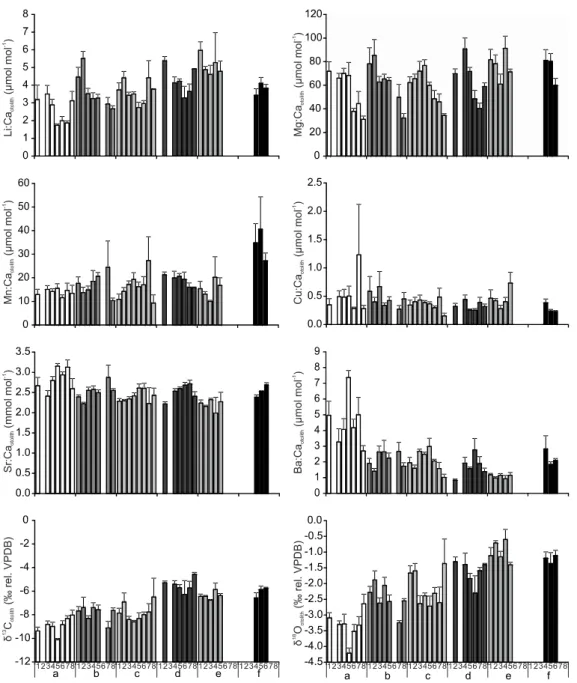
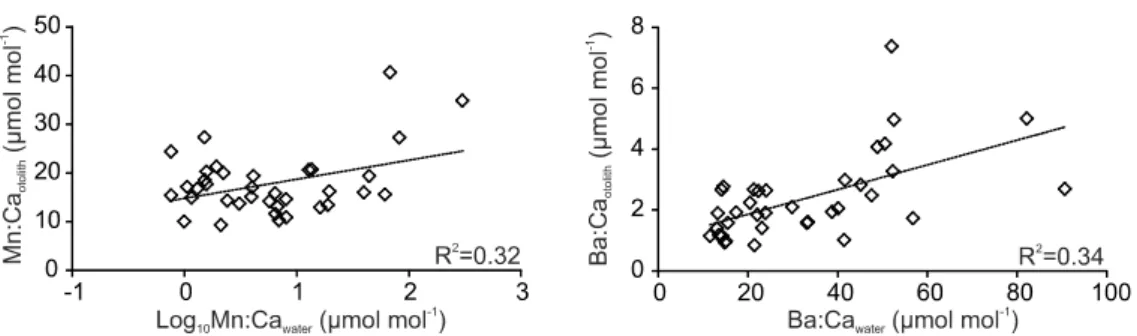
Element:Ca and stable isotope ratios in otoliths of juvenile S. solea showed significant variability both across sites and over time (Fig. 4). Some of these variations were correlated with similar patterns in water chemistry. For instance, otoliths from individuals collected at the site with the highest Mn:Cawater (site f) also had the highest
values of Mn:Caotolith. Similarly, for Ba:Caotolith the lowest and highest values were
recorded in site e and a, respectively, which had the highest and lowest Ba:Cawater
values (Fig. 5). Finally, both otolith δ13C and δ18
O showed significant and positive relationships with the concentration of δ13
CDIC and δ 18
Owater, respectively (Fig. 6).
Fig 4. Mean values and standard error of element:Ca and isotope ratios (Li:Ca, Mg:Ca, Mn:Ca, Cu:Ca, Sr:Ca, Ba:Ca, δ13C, δ18
O) in otoliths of juvenile Solea solea in the different sampling sites in the Tejo estuary during the sampling occasions (t1 – t8).
Fig. 5. Relationship between element:Ca in otoliths of juvenile Solea solea and in the ambient water of the Tejo estuary. Values represent means per sampling site and sampling occasion. R2 values are given. Only significant regressions (t-test, p<0.01) are shown.
Fig. 6. Relationship between isotope ratios in otoliths of juvenile Solea solea and in the water of the Tejo estuary. Values represent means per sampling site and sampling occasion. Isotopic equilibrium lines are shown in dashed grey. R2 values are given. Only significant regressions (t-test, p<0.01) are shown.
Analysis of otolith chemistry, accounting for the ambient composition of the water, revealed non-linear uptake for one element (Mn) and a number of significant correlations with temperature and salinity (Table 3). Manganese ions were apparently actively incorporated in otoliths at low dissolved Mn:Ca levels in ambient waters (DMn >
1), but were discriminated against at high levels at site f (DMn < 1). Partition coefficients
of all other elements were less than 1 and ranged from 0.36 (DSr) to 1.2x10 -5
(DMg),
indicating a broad range of elemental discrimination across the intestinal and endolymphatic membranes. We also detected significant, negative, temperature effects on fractionation for both DLi and 1000lnα (Fig. 7). Finally, salinity was negatively
correlated with DCu, DSr and 1000lnα, and positively correlated with ∆ 13
Table 3. Mean, standard deviation (in brackets), minimum and maximum of element partition coefficients and isotope fractionation factors in otoliths of juvenile Solea solea in the different sampling sites in the Tejo estuary.
Site a b c d e f DLi (10-3) 1.27 (0.48) 1.67 (0.47) 1.76 (0.33) 1.87 (0.36) 2.17 (0.31) 1.64 (0.17) 0.76-1.98 1.05-2.49 1.24-2.18 1.53-2.47 1.88-2.69 1.45-1.77 DMg (10-5) 1.85 (1.15) 1.34 (0.33) 1.41 (0.32) 1.28 (0.35) 1.51 (0.27) 1.53 (0.28) 0.96-4.35 0.74-1.76 0.79-1.76 0.78-1.77 1.08-1.81 1.20-1.69 DMn 1.66 (1.22) 10.81 (10.55) 6.96 (6.53) 4.13 (4.64) 11.58 (6.57) 0.35 (0.24) 0.25-3.81 1.47-32.00 0.83-18.08 0.40-11.02 1.93-20.20 0.12-0.60 DCu 0.05 (0.01) 0.04 (0.02) 0.04 (0.01) 0.02 (0.01) 0.04 (0.01) 0.02 (0.01) 0.05-0.06 0.02-0.06 0.02-0.05 0.01-0.03 0.02-0.04 0.01-0.04 DSr 0.36 (0.05) 0.32 (0.04) 0.32 (0.02) 0.31 (0.02) 0.27 (0.02) 0.32 (0.01) 0.28-0.43 0.28-0.41 0.30-0.34 0.28-0.35 0.24-0.28 0.30-0.33 DBa 0.08 (0.03) 0.10 (0.05) 0.06 (0.03) 0.12 (0.05) 0.08 (0.02) 0.07 (0.01) 0.03-0.14 0.03-0.19 0.02-0.13 0.04-0.19 0.06-0.10 0.06-0.08 ∆13 C -4.06 (1.18) -4.06 (1.20) -3.18 (1.30) -2.90 (0.85) -3.72 (0.94) -2.11 (0.60) -5.31- -2.13 -5.08- -1.64 -5.43- -1.90 -3.70- -1.46 -4.44- -2.34 -2.63- -1.45 1000lnα 30.73 (0.46) 29.35 (0.86) 30.98 (0.87) 29.49 (0.79) 29.93 (0.46) 28.64 (0.45) 30.13-31.42 27.80-30.50 29.37-31.75 28.62-30.60 29.29-30.41 28.13-28.99