1
HOW THE DIFFERENT VOICES THAT ENGAGE IN
CRISIS COMMUNICATIONS, INFLUENCE CONSUMERS
NWOM INTENTIONS AND CORPORATE REPUTATION
DURING A CUSTOMER COMPLAINT PARACRISIS
OCCURRING ON FACEBOOK
André Gomes de Castro Soares
Dissertation submitted as a partial requirement for the conferral of Master in Marketing
Supervisor:
Prof. Daniela Langaro, Visiting Assistant Professor, ISCTE Business School, Departamento de Marketing, Operações e Gestão Geral
HOW
T
H
E
DIFFER
E
T
VO
ICE
S T
H
A
T
E
N
G
A
G
E
IN CRI
SI
S
CO
MM
U
N
IC
A
T
IO
N
S,
IN
FL
U
E
N
CE
CO
N
S
U
ME
RS NW
O
M
IN
T
E
N
T
IO
N
S
A
N
D
O
R
G
A
N
IZ
A
T
IO
N
A
L
RE
P
U
T
A
T
IO
N
D
U
RI
N
G
A C
U
ST
O
ME
R
CO
MPL
A
IN
T
PAR
A
CRISIS
O
CC
U
RRI
N
G
O
N
F
A
CE
B
O
O
K
A
ndré G
o
m
es
de
C
a
str
o
So
a
re
s
Acknowledgements
This project has been one of the most challenging journeys I had the opportunity to experience so far. During the past year I have been working full time and at the same time building up the present research work. It required a lot of hard work dedication and sacrifice to balance the two experiences simultaneously and to be able to deliver superior value in both projects. I am grateful for all the support system I had during this journey; I was only able to complete this experiences successfully with the continuous support of the people around me. I want to express my special acknowledgement to those that directly or indirectly helped me and motivated me during this long journey.
Firstly want to thank Professor Daniela Langaro for accepting to supervise me during this experience and to thank her for all the support, patience and counselling offered. This ambitious project was only possible due to the knowledge, and experience she kindly shared as well for her assertiveness and strategic thinking. Also, I want to thank Professor Helena Carvalho, for her help and shared knowledge regarding statistical analysis.
To my thesis partners in crime, Andreia, Beatriz and Hélder, thank you for sharing every step of the road with me. It was a stressful journey, and I would not be able to complete it without your continuous help and emotional support during every long night, day and weekend, spent in the university to complete this project.
To my girlfriend Liliana Costa, who more than anyone else, was there for me, every day to support me and cheer me up during my frustrations, fears and anxieties. Thank you for being so understanding and caring, and most importantly, thank you for being there all the time, I appreciate it from the bottom of my heart.
To all my friends, thesis buddies and all the people who were always ready to help, and share their experience with their research projects, thank you for giving me the privilege to be surrounded by amazing people. Also, I am grateful for all the collaboration offered by participants in this study, whose contribution was vital for the conclusion of this study.
To my family, thank you for all the support, that always gave me calm and courage to continue, with a special thanks to my uncle Oscar for all the advice offered and support given during this experience. Finally, I would like to thank my mother Adriana and my father Marlon, whose example of effort and sacrifice has been a living inspiration. Thank you for teaching me how to pursue my dreams and to be the curious person I am today. This project would not have been possible without your continuous support and motivation.
Abstract
The present dissertation aims to understand how the Portuguese telecommunication companies can effectively minimise the negative impact of a customer complaint paracrisis, occurring on their own Facebook-branded page. The research analyses how Facebook complaints and the comments posted in response to those complaints, by consumers and organisations, influence negative word-of-mouth intentions and perceived organizational reputation, of consumers who read those complaints and responses on their Facebook feed. The goal is to evaluate how the consumer ‘attitudes and perceptions towards their own telecommunication service provider, varies when they are exposed to different types of organizational and consumer responses. The method conducted was a between-subjects experimental design (N=707), divided into 7 groups with 1 (Control group: Consumer complaints) + 2 (Valence of consumer responses to complaints: faith-holders positive reactions vs hate-holders negative reactions) + 2 (Company response strategies to complaints: webcare vs neutral) x 2 (Tone of voice of company responses to complaints: personalized vs corporate). The data collection was carried out via a standardised online-survey, and each respondent was exposed to five manipulations, 2 news posts and 3 complaints followed by a response type. The experimental condition was tested by investigating significant statistical differences among groups and comparing their mean ranks.
The results of the experimental study suggest that when compared to the control group the faith-holders positive comments to Facebook complaints help organisations to protect their reputation, by enhancing the perceived organizational reputation the consumers have about their own service provider The results also suggest that hate-holder negative comments contribute to an increase in negative word-of-mouth intentions of consumers, in comparison to the control group. Furthermore, organisational responses that signal webcare elements (corrective action, favourable employee behaviour and organisational procedures) are more likely to decrease the readers’ negative word of mouth intentions when compared to the organizational responses with neutral content and the control group.
Keywords: Customer Complaint Paracrisis; Crisis Communications; Organizational
Reputation; Webcare; Online complaint management; Negative word-of-mouth; Electronic word of mouth; Personalization; Facebook; Rhetorical Arena; Faith-Holders; Hate-Holders; JEL Classification System:
M30 – Marketing and Advertising: General M31 - Marketing and Advertising: Marketing
Resumo
A dissertação visa compreender como as empresas portuguesas de telecomunicações podem minimizar eficazmente o impacto negativo de uma paracrise gerada a partir de reclamações de clientes na página de Facebook das respetivas empresas. A investigação analisa como as reclamações colocadas no Facebook e os comentários colocados pelas organizações e pelos consumidores, influenciam as intenções de passa-palavra negativo e a reputação organizacional percebida dos consumidores que leem essas reclamações e comentários no seu feed de notícias do Facebook. O objetivo é avaliar como as atitudes e perceções dos consumidores em relação à sua operadora de telecomunicações variam quando elas são expostas a diferentes tipos de respostas dadas pelas organizacionais e consumidores.
O método utilizado foi uma experiência entre participantes (N = 707), com 7 grupos; 1 (Grupo de controlo: reclamações de consumidores) + 2 (Valência das respostas do consumidor: reações positivas de defensores da marca vs reações negativas de detentores de ódio) + 2 (Estratégias de resposta da organização: webcare vs neutra) x 2 (Tom de voz das respostas da organização: personalizada vs corporativa). A recolha de dados foi realizada através de um questionário online, tendo cada respondente sido exposto a cinco estímulos. Para testar as hipóteses foram analisadas as diferenças estatisticamente significativas entre os grupos e comparadas as classificações médias de cada grupo. Os resultados sugerem que comparativamente ao grupo de controlo, os comentários positivos dos defensores da marca ajudam as organizações a melhorar a reputação organizacional que os consumidores têm sobre a sua própria operadora. Os comentários negativos de detentores de ódio, contribuem para um aumento das intenções passa-palavra negativo dos consumidores, em comparação com o grupo de controlo. Além disso, as respostas organizacionais que sinalizam elementos de webcare (ação corretiva, comportamento favorável do funcionário e procedimentos organizacionais) têm maior probabilidade de diminuir as intenções de passa-palavra negativo dos leitores quando comparadas às respostas organizacionais com conteúdo neutro e o grupo de controlo.
Palavras Chave: Paracrises de reclamações de clientes; Comunicação de crises; Reputação
Organizacional; Webcare; Gestão de reclamações on-line; palavra negativo; Passa-palavra online; Personalização; Arena Retórica; Defensores da marca; Detentores de ódio; JEL Classification System:
M30 – Marketing and Advertising: General M31 - Marketing and Advertising: Marketing
I
List of Figures
__________________________________________________ IV
List of tables
___________________________________________________ V
List of abbreviations
_____________________________________________ VI
1. Introduction to the context and the research problem
... 1
2. Literature review
... 7
2.1 Word-of-Mouth
... 7
2.1.1 Negative Word-of-Mouth
... 9
2.1.2 Online Word-of-Mouth
... 9
2.1.3 Online word-of-Mouth in Social Media Environments
... 11
2.1.3.1 Brand and Online Communities
... 14
2.2 Crisis communications
... 15
2.2.1 Definition of Crisis, Reputation and risk for brands
... 15
2.2.2 Types of social media crisis (Paracrisis)
... 19
2.2.3 The Rhetorical Arena Theory
... 21
2.3 Webcare as a response strategy during a customer complaint Paracrisis..
24
2.3.1 Online complaints as a form of Negative Word-of-Mouth
... 24
2.3.2 Using Webcare to reduce Negative Word of Mouth
... 26
2.3.3 What should be the content of the organisational responses to Complaints in SNSs
... 28
2.3.3.1 Corrective action
... 30
2.3.3.2 Favorable employee behaviour
... 30
2.3.3.3 Organizational Procedures
... 31
2.3.4 How organisations should respond to complaints in social media
.... 31
3. Purposed model and scope of the study
...35
4. Method
... 37
4.1 Research design and sampling procedure
... 37
II
4.3 Stimuli
... 41
4.3.1 News post stimuli
... 42
4.3.2 Group 1 (Control Group)
... 45
4.3.3 Group 2 & 3 (Positive user reactions vs Negative user reactions)
...46
4.3.4 Group 4, 5, 6 & 7 (Content of company responses to complaints: Webcare Neutral) x 2 (Tone of voice of company responses to complaints: personalised vs corporate)
... 46
4.4 Measures
...49
4.5 Pretest to test the manipulations of the stimuli
... 50
4.6 Data analysis procedure
... 52
5 Results
... 57
5.1 Measuring Instrument
... 57
5.2 Sample Characterization
... 58
5.3 Validation of measures
... 59
5.4 Checking if groups are comparable
... 62
5.5 Hypothesis testing
... 64
5.5.1 Checking differences between groups 1, 2 and 3, Negative Word-of-Mouth intentions and Organizational Reputation
... 64
5.5.2 Checking if the perceived Webcare elements and Personalization of response were perceived differently among groups
... 67
5.5.3 Checking differences between groups 4, 5, 6 & 7, Negative Word-of-Mouth Intentions and Organizational Reputation
... 70
6 Conclusions
... 75
6.1 Marketing and Managerial Implications
... 79
6.2 Limitations and directions for future research
... 81
III
Appendix A: Example of Facebook posts with complaints and responses
... 95
Appendix B: Social media categories
... 97
Appendix C: Types of paracrisis
... 97
Appendix D: Questionnaire structure
... 98
Appendix E: Online Questionnaire in Portuguese (including manipulations in Portuguese)
... 98
Appendix F: Online Questionnaire in English (including manipulations in Portuguese)
. 135
Appendix G: Descriptive statistics table, distribution of descriptive variables per sample and groups... 172
IV
List of Figures
Figure 1: Customer complaint in Vodafone UK Facebook page………... 95
Figure 2: (Appendix): Facebook complaint post by consumer about Uber surge………... 95
Figure 3: Twitter complaint post by consumer about Uber surge………... 96
Figure 4: Promoted Complaint about British Airways……… 2
Figure 5: Twitter complaint post by consumer ………... 4
Figure 6: Comments by users following the complaint………... 4
Figure 7: Comments by users following the complaint………... 4
Figure 8: Facebook complaint post by consumer and respective comments…………..……… 96
Figure 9: A typology of electronic word-of-mouth channels ………. 11
Figure 10: Social media categories………. 97
Figure 11: The evolution of WOM Theory………. 13
Figure 12: Consumer exchange of EWOM in social media……… 14
Figure 13: Crisis types matrix ………. 18
Figure 14: The development of an issue into a crisis………...19
Figure 15: Types of Social Media Crisis………. 20
Figure 16: Voices in the Telenor Facebook Subarena………. 23
Figure 17: Webcare as an integrative organisational tool……….. 27
Figure 18: Description of organisational responses……… 30
Figure 19: Research model purposed……….. 35
Figure 20: News article about NOS, Público………... 43
Figure 21: News article about NOS, Expresso……… 43
Figure 22: News article about MEO, Público……… 43
Figure 23: News article about MEO, Expresso……….. 43
Figure 24: Complaint nº1 presented to respondents (Group 1)……….. 45
Figure 25: Complaint nº2 presented to respondents (Group 1)……….. 45
Figure 26: Complaint nº3 presented to respondents (Group 1)……….. 45
Figure 27: Example of complaint followed by a positive comment by a faith-holder (Group 2)………….. 46
Figure 28: Example of complaint followed by a negative comment by a hate holder (Group 3)…………... 46
Figure 29: Example of complaint followed by neutral response and corporate tone of voice (Group 4)……. 48
Figure 30: Example of complaint followed by a neutral response and personalised tone of voice (Group 5). 48 Figure 31: Example of complaint followed by webcare response and corporate tone of voice (Group 6)……48
V
Figure 33: Kruskal-Wallis test results for pairwise comparisons regarding the variable webcare elements. 68
Figure 34: Kruskal-Wallis test results for pairwise comparisons regarding the variable personalisation….. 69
Figure 35: Kruskal-Wallis H test results with pairwise comparisons regarding the variable NWOM…….. 71
List of Tables Table 1: EWOM characteristics ………... 10
Table 2: Subgroups and stimulus presented……… 40
Table 3: Likert Scales and respective items………. 49
Table 4: Nº of respondents per group……….. 58
Table 5: Descriptive statistics table, distribution of descriptive variables per sample and groups………….172
Table 6: PCA values from the rotated component matrix using varimax rotation and Cronbach Alpha values with 3 factor loadings………... 60
Table 7: PCA values from the rotated component matrix using varimax rotation and Cronbach Alpha values. with 5 factor loadings……… 61
Table 8: Control variables to test for comparability, regarding demographics……….. 62
Table 9: Control variables to test for comparability, regarding Facebook behaviour………..…….. 62
Table 10: Control variables to test for comparability, regarding the relationship with the service provider. 62 Table 11: Kruskal-Wallis results, each row corresponds to a single pairwise comparison test……… 62
Table 12: Kruskal-Wallis results, each row corresponds to a single pairwise comparison test………. 62
Table 13: Pearson Chi-Square test of Homogeneity (Rx2) and Pearson Chi-Square test of Independence. (RxC) test results………...……….. 64
Table 14: Kruskal-Wallis H test results for the variables NWOM intentions and Organizational Reputation to test differences between group 1, group 2 and group 3……….. 65
Table 15: Kruskal-Wallis H test results with pairwise comparisons for the variable NWOM intentions…. 65 Table 16: Kruskal-Wallis H test results with pairwise comparisons for the variable organisational………. reputation………. 66
Table 17: Kruskal-Wallis H test results for the variable Webcare elements and Personalization………….. 67
Table 18: Kruskal-Wallis H test results with pairwise comparisons for the variable Webcare elements….. 68
Table 19: Kruskal-Wallis H test results with pairwise comparisons regarding the variable personalisation. 69 Table 20: Kruskal-Wallis H test results for the variable NWOM intentions and Organizational Reputation 70 Table 21: Kruskal-Wallis H test results with pairwise comparisons regarding the variable NWOM……… 71
Table 22: Kruskal-Wallis H test results with pairwise comparisons regarding the variable organizational Reputation………... 72
VI
List of abbreviations
WOM………....Word-of-Mouth
PWOM………. Positive Word-of-Mouth
NWOM……… Negative Word-of-Mouth EWOM……… Electronic Word-of-Mouth OR……… Organisational Reputation SM……….Social Media
SNSs………..Social Networking sites RAT……….. Rhetorical Arena Theory
1
1. Introduction to the context and the research problem
According to Hirschman (1970) (as cited by Van Noort et al., 2014) customers have three forms of reacting to unpleasant consumption experiences, they either 1) Stop using an organization’s products/services and switch to a competitor, 2) Complaint to the organization that caused the dissatisfying consumption experience, or 3) Share their dissatisfaction with other consumers through negative word-of-mouth. Nowadays with the power of social media customers can combine all the three types of reactions, into a single action, by posting negative comments on a brand social media page. By doing so, consumers are not only complaining to the organisation but also sharing their negative experiences with other members of the community; consumers can even publicly threat the organisation by stating they may switch to a competitor if the complaint isn't resolved. In the appendix A, in fig. 1 is possible to see an example of a consumer complaint posted on the Facebook page of Vodafone UK that combines the three outcomes mentioned.
Social media is indeed a communication medium that has empowered users to share word-of-mouth (WOM) about products, services and experiences, which has motivated companies to increasingly engage in dialogues with consumers in social networking sites, and use them as a tools for, marketing, customer service and public relations purposes (Van Noort et al., 2014). However, unlike other customer care channels, social media is of public nature as other users can view the negative comment of the user, and interact with it in either a positive or negative manner (Coombs, 2015). Brands, politicians, celebrities and governmental institutions are increasingly being influenced by negative online WOM and complaint behaviour on social media (Pfeffer et al., 2014). Many companies from time to time face mass complaint situations that can quickly escalate, potentially leading to the beginning of crisis situations. Let’s take as an example, Uber, one of the most famous ride-sharing companies, which in 1st January 2016,
came under fire, after social media users started complaining in Facebook and Twitter about substantial price increases that occurred during the 2015 new year’s eve. This rise in prices was due to Uber’s dynamic pricing based on supply and demand of drivers and riders, and was perceived by many users as being an abusive tactic to generate more profit, as many riders had to pay at least three times the usual fare to get home, as it is possible to see in fig 2 and 3 on appendix A. After only a few hours, the consumers complains quickly escalated, started harnessing media coverage and seeding a public relations crisis for Uber (McNeal, 2016). Another great example on how complaints can threaten organisations reputations and generate discussion around its actions comes from a regular Twitter user, Hasan Syed, which challenged
2
one of the biggest airline corporations in the world with a single tweet. After a disgruntling experience with British Airway, in which the company lost his father’s luggage and failed to provide a successful customer recovery, Hasan Syed decided to post a complaint on Twitter and to the surprise of many, he decided to promote the post investing $1,000 of his own money, in order for the complaint to reach more people (Wasserman, 2013). The post in question said "Don't fly @BritishAirways. Their customer service is horrendous” the post was quickly seen by tens of thousands of people, generating a discussion among different members of the community and ultimately gained media attention, which amplified the WOM about the topic, posing a significant threat to British Airways reputation (Mahdawi, 2013).
Fig 4. Promoted Complaint about British Airways by Hasan Syed (Wasserman, 2013)
In the examples provided above, by posting a negative comment on the company’s Twitter or Facebook page, users have the power to execute critical strikes on organisations, as the post stimulates a discussion with other users, harnessing bigger amounts of word-of-mouth in the form of comments, which can eventually escalate into a crisis (Coombs & Holladay, 2012). Crisis occurs when a business faces a critical situation, such as a natural or human-made disaster or even a legal violation, often crisis result in the weakening of stock value or loss of lives (Coombs, 2015). According to Coombs & Holladay (2012), social media complaints that escalate can pose a risk of triggering a crisis. Often people call this type of events, “online crisis”, which isn’t the most suitable term, that is why the previous authors felt the need to craft the term Paracrisis, which is described as “publicly visible crisis threat that charges an organization with irresponsible or unethical behavior and potentially damages the organization reputation” (Coombs & Holladay, 2012: 409) (as cited by Einwiller & Steilen, 2015). The previous authors stress the idea that paracrisis often look like crisis and require swift action from the organization through effective crisis communication, yet according to Coombs (2015) this threat differs from actual crisis as there isn’t the need to assemble the crisis team and to operate in a crisis mode, because there is no actual disruption in the organisations operations and a threat to its survival, rather a paracrisis can be seen as an issue that antecedes an actual crisis and if the threat isn’t contained through effective crisis communication it may escalate into a crisis. The previous author also posit the existence of different types of Paracrisis
3 suggesting that one of the most common types, is the customer complaints paracrisis, which occurs when customers are dissatisfied with products, services, or customer service of an organization and start posting their complaints in a public manner, such as using the company’s social media pages as a complaint channel, which can influence how users who visualize that content, perceive the reputation of the organization. Also, it can incentivise this type of users to engage in a discussion and share NWOM. Einwiller and Steilen (2015), posit that the most suitable strategy to combat customer complaints paracrisis is the use of online complaint management to contain the threat and prevent it from escalating into a crisis.
Social media has changed how organisations interact with stakeholders and many practices of public relations and corporate communications (González-Herrero & Smith, 2008). According to Frandsen & Johansen (2017), social media has empowered its users to exchange word-of-mouth in interactive conversations that are of positive or negative nature, and in order to better understand the crisis communications dynamics in social media the authors developed the Rhetorical Arena Theory (RAT), which defends the idea that there are multiple voices, that participate in crisis communications, during a crisis. When customers start complaining about their experiences with certain products and services on a company’s Twitter or Facebook page, a Rhetorical Arena opens up (Johansen et al., 2016). According to Coombs, (2013) interpretation of RAT, a rhetorical arena is a space that can open during a crisis and where a variety of voices engage in crisis communications with each other, either spreading positive or negative sentiment towards the organisation. In this kind of space, organisations are forced to interact with the different users that can be either supportive or destructive, about the organisation actions (Frandsen & Johansen, 2017). Users who demonstrate support and spread positive WOM about the organization are known as faith-holders, whereas users who distrust the organization and show hate by spreading negative WOM are known as hate-holders, there are also passive stakeholders, that observe this users interaction but don’t engage in communications remaining neutral (Luoma-Aho, 2015). The Rhetorical Arena usually tends to be fragmented into smaller Subarenas, which can be confined to a specific social media channel, or an online news story, and can be described as “a limited space where a message is “heard” and potentially responded to by a restricted set of actors.” (Coombs and Holladay, 2014: 44). According to the previous authors in order for subarenas to emerge through a news story or social media channel, the messages need to generate a large number of interactions creating a forum of discussion. To better understand the idea of how faith-holders and hate-holders
4
interact in the Subarena, let’s consider the previous example presented of Uber complains during New Year's Eve regarding the surge pricing, Uber’s dynamic pricing system.
Fig 5, 6 & 7. Twitter complaint post by consumer Brian Stelter and comments (Mcneal 2016; Stelter, 2016) In this case a user called Brian Stelter, posted a complaint exposing his surprise with the enormous increase in price and quickly he gained the attention of other users who rushed to comment on the post, creating a forum of discussion, in a limited space in which the message was heard and responded by different users which engaged in crisis communications with each other. Some users played the role of hate-holders, by sharing negative sentiment towards Uber, as one consumer called "Ricksta" who posted the following comment suggesting the company was taking advantage of the situation in an unfair way "@Brianstelter @uberoutrage it is the sharing economy!... They are sharing it out in an offshore bank" other users actually defended the brand, playing the role of faith-holders, as for example the consumer “Scott Cohen” who posted “@brianstelter it is called supply and demand no one is forced to pay”, suggesting that despite the price, in the end, it is up to the consumer to make the choice of using or not the service. According to Frandsen & Johansen, (2017), Rhetorical Arena Theory not only the users engage in an exchange of interactions, but also the organisation takes a key role in engaging in conversations with users. In the presented example Uber didn’t intervene in the Subarena, however across other subarenas, for example the one created by user complaints, in Uber’s Facebook branded page, the company tried to engage in crisis communication with users, by explaining the situation, as it can be seen in fig. 8, present in the appendix.
Besides the organisation, the faith-holders and hate-holder, it is also important to consider that there are also passive observers that assist to the discussion and may be influenced by this exchanges of positive and negative word-of-mouth (Luoma-Aho, 2015). As we can see in the example above, 266 people liked the post, but only 38 engaged in communications, which
5 suggests there is a large audience that is observing the discussion and remaining passive towards it. There is still insufficient knowledge about the role of social media during crisis communications. Therefore it is essential to use theories that can help to analyse how stakeholders and organisations create crises, and how social media is being used in crisis communications (Coombs, 2013).
In consequence of stakeholder’s complaint behaviour in online environments, social media channels have become a fertile ground for Customer Complaint Paracrisis (Einwiller & Steilen, 2015). Thus it is relevant to evaluate the public’s perceptions about organizational reputation and their relationships with the organisations during a paracrisis situation, since researchers on crisis communications tend to focus more on what crisis managers should say during a crisis, there is a compelling need for researchers to explore further how the stakeholders react to the crisis communication (Ki & Nekmat, 2014). However, there is a lack of empirical studies and investigation on how the different voices of the organisation’s, the faith-holders and hate-holders, influence the perceived corporate reputation and WOM intentions of observing consumers exposed to a customer complaint paracrisis in Facebook. As Luoma-Aho (2015), suggests there is a need for studies that measure the actual contribution of faith-holders and hate-holders, to organisational reputation. Whereas (Coombs & Holladay, 2014) (as cited by Crijns et al., 2017), defends that crisis communications, have a substantial amount of research focused on what the organisations have to say during a crisis, however there is still a lack of investigation on how organisations can deal effectively with the input of consumers and how should the organization engage with the multiple voices that engage in crisis communications.
In sum social media platforms such as Facebook and Twitter have transformed into complaint channels for consumers who seek to share their negative experiences with products and services, and there is still a lack of research on the effects the organization responses to complainants in social media can have on consumers who watch those interactions (Van Noort et al., 2014). There is already a plethora of studies related to complains voiced in traditional media, as for the complaint behaviour in the context of online forums and review sites. Nonetheless, there is still a shortage of research dedicated to understanding the effectiveness of complaint handling in social media contexts (Einwiller & Steilen, 2015). Therefore it is relevant to study what are the most effective types of responses and tone of voice the organisations can deploy in order to minimise the impact of complaints have in observing consumers during a complaints paracrisis context. As Hennig-Thurau et al. (2013) suggest, there is a constant need
6 to develop a deeper understanding into social media environments and how it can influence marketing issues.
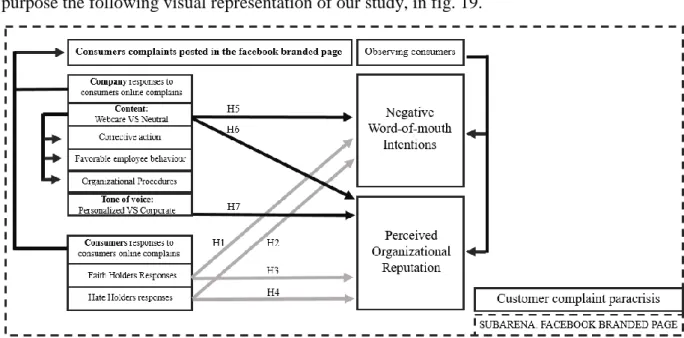
In order to fill this gap in the literature, the following dissertation will focus on understanding how faith-holders, hate-holders and organization responses to Facebook complaints, influence the consumers who read that content and how this consumer's negative word-of-mouth intentions and perceived organizational reputation regarding their telecommunications service provider will be affected, during a customer complaint paracrisis in the Portuguese telecommunication sector. Therefore this dissertation will help to provide better clearance on the impact that the exposure to negative brand-related WOM and the corresponding responses, have on readers of these complaints. Also, we aim to discover what are the key variables that contribute to an effective organisational response that reduces as much as possible NWOM intentions and enhances the perceived corporate reputation of exposed consumers. Therefore to understand the phenomena, and its effects on organisation reputation and NWOM intentions, and how can organisations effectively manage this threat, we aim to pursue the following research questions:
RQ1: How do faith-holders and hate-holders responses to other user’s complaints affect the
perceived organisational reputation and WOM intentions of consumers who read that content, during a customer complaint paracrisis?
RQ2: What is the most effective type of response to complaints, companies can use, to
neutralise negative word of mouth intentions and protect the perceived organisational reputation, of consumers who read that content during a customer complaints paracrisis? This research questions will be pursued in the context of the Portuguese telecommunication sector, because the telecommunications industry is the sector that receives the higher amount of online complaints in Portugal, with national brands such as MEO and NOS being among the top 10 brands that receive the most complaints (Malhão, 2018). Therefore this industry proves to be a fertile ground for the study of online complaints and negative word-of-mouth behaviour in social media environments. The Portuguese telecommunication industry is a mass market, with few players that control significant parts of the market. Therefore it can be best described as an oligopoly. The four main players are MEO, NOS, Vodafone and NOWO, according to the Portuguese National Communications Authority (Anacom) each player market shares measured by nº of subscribers is respectively 40,1%, 38%, 17% and 4,8%, with 0,03% being attributed to other service providers (Anacom, 2017).
7
2. Literature Review
A variety of studies were consulted to build this study. Three principal literature streams were used 1) Word-of-mouth 2) Crisis communication and 3) Webcare. The current study applies to an online context, and therefore there is also a strong presence of literature related to social media and online environments that ties all of the three streams together. The literature review is divided into three main sections, starting from the broadest themes and progressively narrowing it down to the specific theme of the investigation, thus developing a holistic perspective about the different research streams and its connections.
The first section is about word-of-mouth (WOM), and it covers the most relevant insights on how this phenomenon affects organisations and stakeholders, especially negative word of mouth (NWOM). The section also aims to explain how the emergence of the internet has changed human relationships and consequently word-of-mouth. The section continues to refine the concept of WOM, in online environments by presenting the differences and dynamics of electronic word-of-mouth (EWOM) and social media (SM), exploring vital constructs such as online communities and providing a deeper understanding about the relationships and interactions companies and consumers exchange in this environment.
The second section aims to develop a clear understanding of what is the crisis phenomena and its ravaging effects on corporate reputation and the role of crisis communication. Shine light on the different types of crisis that can haunt organisations and the main differences between regular crisis and crisis originated exclusively in social media, the so-called paracrisis. In this section, it is discussed the most pivotal crisis communication theories, alongside their limitations when applied to the social media context. Finally, it is identified and characterised the most suitable crisis communication theory to study the flow of WOM and its effects on the user’s WOM behaviour and corporate reputation during an online crisis in social media. The third section considers the impact of online complaints in a firm’s performance, its relationship with NWOM and how company’s responses affect the complaint behaviour in social media. Since this study focus on the effects of NWOM applied to a customer’s complaints paracrisis context, it is vital to understand what will be the effects of the webcare responses in the user’s WOM behaviour, and what variables will influence the webcare responses.
8
Every day we face different needs and wants and are confronted with decisions about what products or services to buy in order to fulfil them. We often find ourselves looking for advice from other consumers, particularly a trusted friend or family member, in order to make more informed decisions. The described behaviour is more commonly known as word-of-mouth, which is a form of oral or written recommendation shared by a customer or a potential consumer of a good or service (Arndt, 1967). According to Higie, Feick, and Price (1987) (as cited by Eisingerich, 2015), word-of-mouth can be described as an oral, informal, person-to-person communication between a communicator perceived with having noncommercial intentions and a receiver, regarding a brand, a product, an organisation, or a service. Whereas according to Katz and Lazarsfeld (1995), WOM is the act of exchanging information between consumers and it is likely to influence consumer attitudes and behaviours towards products and services.
To date, WOM behaviour has been paid much attention by researchers and companies alike due to its effects and impact on consumer behaviour. Some authors purpose that WOM behaviour is influenced mostly by consumer’s personal experiences with products and services (Richins, 1984; Bone, 1995). Several researchers defend that WOM has a significant impact on consumer’s attitudes and purchase decisions. (Amdt, 1967; Bone, 1995; Chevalier & Mayzlin, 2006). Some even suggest that WOM influences consumer behaviour due to higherperceived credibility, less biased information, and more authentic evaluations by consumers (Dellarocas, 2003; Keller, 2007; Daugherty & Hoffman, 2014).
Ditchter (1966) was one of the first researchers to investigate consumer’s word-of-mouth motivations and applying it to the context of brands, in his seminal study the author defends that people have four motivations to share WOM about brands: 1) perceived product involvement; 2) self-involvement; 3) other-involvement and 4) message involvement. The author also defends that people determine if they want to listen or ignore the brand-related word of mouth conversations, suggesting that listeners are primarily concerned with two factors, listener’s credibility and if the speaker has a genuine interest in the listener wellbeing. The investigation of Dichter (1966) on the motives why people send and receive WOM was further expanded by Sundaram et al. (1998), which developed one of the most pivotal investigations around the topic, defending that there are eight motives for people sharing word of mouth, that relate to different types of consumption experiences. The findings reported by the author identified four motives for users to engage in positive WOM (PWOM), 1) altruism, product involvement, self-enhancement, and desire to help the company. However, the author also
9
identified four reasons, for why users share negative WOM (NWOM), 1) altruism, 2) anxiety reduction, 3) vengeance and 4) advice seeking reasons.
From a marketing perspective, WOM can either positive or negative. PWOM can be described as the likelihood of consumers sharing favourable information about the organisation, products and services through the form of recommendations (Maxham et al., 2003) (as cited by Gelbrich & Roschk, 2011). Whereas NWOM is the opposite, thus it is a form of unfavourable information passed about an organisation after a negative experience with a product or service (Blodgett, Hill, & Tax, 1997). While product-related information shared by the satisfied consumer, positive WOM, contributes for faster adoption of a product, negative WOM convey opposite effects, dissuading potential consumers from buying a product or brand, thus damaging the company's reputation and performance (Holmes & Lett, 1977).
2.1.1 Negative word-of-Mouth
According to Keller (2003), the NWOM can cause damage for organisations not only by impacting perceptions consumers have about products and services but also by harming the brand equity and the corporate reputation of the organisations. Organisations need to be aware of the adverse outcomes of NWOM, because dissatisfied consumers tend in engaging in the higher word of mouth than satisfied ones, with consumers distributing NWOM in order to communicate their dissatisfaction with consumption experiences (Anderson, 1998). Even though positive and negative word-of-mouth might look as opposing forces that cannot coexist it is untrue, since one may be likely to tell positive as well as negative things about a company (Blodgett & Anderson, 2000). According to Sundaram, et al. (1998) there are four types of consumption experiences that influence NWOM: 1) product performance; 2) response to product/purchase problems; 3) price/value perceptions, and 4) employee behaviour. The authors argue that company responses can influence negative WOM, suggesting that if companies give a delayed response or fail to solve the problem, it will encourage consumers to seek vengeance and express their frustrations through NWOM behaviour.
2.1.2 Online Word-of-Mouth
As presented earlier, scholars recognize the relevance of word-of-mouth phenomena in influencing consumer behaviour (Arntd, 1967; Bone, 1995; Chevalier & Mayzlin, 2006; Keller, 2007), however according (Daugherty & Hoffman, 2014) these theories and studies about WOM were developed during a period oblivious to the internet reach, speed and multiplicity (Kozinets et al., 2010) and therefore there was a need for researchers to explore the
10
characteristics and effects of WOM in online environments. The internet is a global phenomenon that has been leading enormous socio-economic transformations in society and has changed many things, especially how the consumers gather information, shop and develop relationships with people and brands. Internet communication channels, such as websites, blogs, microblogs, forums, image sharing, instant messaging, and social networking sites, allow users to connect and interact among each other and to express their concerns more efficiently than traditional communication channels. (Coombs, 2015) Internet has changed how consumers exchange opinions and share experiences related to products, services and organisations. Thus consumers share and receive electronic word-of-mouth (Blazevic et al., 2013).
Electronic WOM (EWOM) is likely to affect consumer purchasing decisions (Jalivand et al., 2011), and influence many different metrics such as, product sales, brand evaluations, purchase intentions and firm value (Chevalier & Mayzlin, 2006; Trusov et al., 2009; Sridhar & Srinivasan, 2012). Consequently, online WOM should be a relevant topic for companies with an online presence. Hennig-Thurau et al. (2004: 39) have defined EWOM has been "any positive or negative statement made by potential, actual or former customers about a product or company, which is made available to a multitude of people and institutions via the internet". The described form of WOM differs significantly from traditional WOM because while the second one usually happens in a face-to-face and one-to-one context, with the conversations being mostly of private nature, in online word-of-mouth consumers engage in a communication with a network of people, where conversations are public, and anyone can see them. Users who are part of this networks or communities usually don't know themselves however they share common interests in either specific products or services or a particular topic or activity and maintain their relationships through online communications (Kozinets et al., 2010). Unlike traditional WOM, E-WOM, according to King et al. (2014), has six characteristics that make this type of WOM unique and a powerful force in influencing consumer attitudes and behaviour:
EWOM
Characteristics Description
Enhanced-volume The WOM conversations are capable of reaching more consumers in a short period of time Dispersion The internet has many platforms and communities, which means WOM is widely spread
across different places Persistence and
observability
The EWOM once is upload in the web it usually stays there accessible to everyone, influencing future WOM
Anonymity and deception
The Internet is a relatively anonym medium, being more difficult to identify the credibility of the source, it becomes easier to launch false rumours and gossip when compared to traditional Word-of-Mouth
11 Salience and
valence
Users often give ratings of products in Likert type scales, which makes it easier for other users to interpret consumers opinions
Community engagement:
Online platforms enable brands to create more interactive experiences with consumers which in turn can augment consumer engagement.
Tab. 1. EWOM characteristics (Source: Developed by the author based on information from (King et al. 2014) Some authors also focused their studies in providing a better understanding of the different types of EWOM and according to Litvin et al. (2008) electronic word-of-mouth differs according to the communication scope and level of interactivity, depending on the platform the conversation will be either one-to-one, one-to-many, many-to-many and can also be happening in a synchronous or asynchronous manner.
Fig 9. A typology of electronic word-of-mouth channels (Litvin et al., 2008)
2.1.3 Online Word-of-Mouth in Social Media Environments
Many online platforms allow consumers to engage in online word-of-mouth, such as websites and blogs but the rise of social networks such as Facebook, Twitter, YouTube or WhatsApp has been revolutionising the notion of online communications and how users interact with each other. Social Media (SM) has become such a significant global phenomenon that to date it is estimated to have massed 2,46 billion users. (Statista, 2017 a). As defined by Scott (2013: 56) social media is “The way people share ideas, content, thoughts, and relationships online. Social media differs from so-called mainstream media in that anyone can create, comment on and add social media content.”. In this regard, SM sites are all about interaction (O’Reilly, 2007) and have transformed consumers from isolated and invisible individuals into a noisy collective public (Patterson, 2012), that engage in online communities in SNS both with other individuals and with brands (Dessart et al., 2015). Being the most notable difference between traditional media (e.g., television, magazines, radio) and social media, the interactive nature of the medium, as users can be both receivers and senders of information since they can create content and react to online activities of others (Dijkmans et al. 2015).
12
The concept of social media is often associated with a single platform. However, it actually is composed of several types of systems, as we can see in fig. 10, present in the appendixes, the platforms can be categorized into social networking sites (SNSs) (e.g., Facebook and Instagram), creativity works-sharing sites (e.g., YouTube and Pinterest), collaborative websites (e.g., Wikipedia) and microblogging sites (e.g., Twitter) (Mangold & Faulds, 2009).
Coombs, (2015) defends that five key features characterise social media: 1) Participation: Anyone can create and give feedback to the content created 2) Openness: Most content is of public nature any user can access to it 3) Conversation: It enables two-way interactions
4) Communities: It facilitates the aggregation of groups of people with the same interests
5) Connectedness: There is heavy use of links to other contents from other platforms
According to the author, in social media, information is no longer controlled by organisations and traditional media as users are empowered by this technologies to create and share information among their network of connections. The author also stresses that social media also enables consumers and other stakeholders to express their opinions and exchange information about certain organisations and products. This flow of WOM in social media (Kozinets et al., 2010), is of particular importance because research provided by Jansen et al. (2009), suggests that social media is perceived as a more trusted source of information than traditional media having a higher influence on brand perceptions and consumer intentions. This idea is also supported by (Hennig-Thurau et al., 2010) which defends that electronic word-of-mouth in social media channels is becoming more likely to influence consumer behaviour than traditional word-of-mouth. Dijkmans et al. (2015: 633), posits that due to a growing presence of brands in social media, stakeholders perceptions are increasingly influenced by the exposure of branded content in social media, which is content created by brands, thus this exposure can be either be “self-imposed (e.g., By liking a brand page on Facebook or following a brand on Twitter) or involuntary (e.g., through promoted posts on Facebook).” (Coombs & Holladay, 2012 a: 409) suggests that social media is public and other users might visualise certain pieces of content if they are “connected to the individual or group creating the content” or “actively searching for that type of content”.
Cheung and Lee (2012) suggested that the SNSs provides network members with greater opportunities to share their product or service experiences. Moreover, by associating with products or services through their reviews, customers use as a tool for self-expression and for
13
enhancing their ability to give advice and recommendations to network members. EWOM usually involves non-simultaneous conversations with a network of people (Verhagen, Nauta, & Feldberg, 2013). According to research provided by Brown, Broderick, and Lee (2007) (as cited by Daugherty & Hoffman, 2014) traditional WOM theories may be useful to understand the WOM dynamics from an interpersonal point of view (one to one communication) however the theories do not consider the effects of social media in WOM which enables a many to many communication dynamic among users. In line with the previous author, (Kozinets et al., 2010) suggests that organizational messages in social media don’t flow unidirectional, as legacy media, instead, the author’s purposes that the WOM communication flow has evolved with technology and within social media word-of-mouth, nowadays is exchanged interactively among consumers of a network as illustrated in the most updated model of WOM flow, the model C, the network coproduction model presented in fig. 10.
Fig.11 The evolution of WOM Theory (Kozinets et al. 2010)
The same idea of an interactive flow of WOM in social media is also embraced by Daugherty and Hoffman (2014) which purposes that all the community members can participate in two-way communication by exchanging different reactions, such as, likes, shares, comments, and by posting user-generated content. The authors also stress that the connecting link to the community is made through the social media platform and represents the strongest flow of WOM. However, users can also communicate directly to other users without using the platform,
14
(e.g., by sending an individual message) but the authors argue, it is less common and represents a weaker flow of WOM.
Fig 12. Consumer exchange of eWOM in social media (Daugherty & Hoffman, 2014)
2.1.3.1 Brand and Online Communities
Mcalexander, Schouten, and Koenig (2002) suggest that firms are increasingly trying to use online communities to nurture the relationship between the brand and consumers. According to Habibi et al. (2014) social media and brand communities, are concepts that tend to overlap. Scholars have used the concept of brand communities as a way to understand how consumers generate value around a brand in the online context (Arvidsson & Caliandro, 2015).
Online communities can be described “as groups of people with similar goals or interests that connect with one another and exchange information using web tools” (Coombs, 2015: 19), whereas the brand communities can be defined as being a "specialized, non-geographically bound community based on a structured set of social relationships among admirers of a brand”. Muniz (2001:412). Organisations can use online brand communities as forums for exchanging ideas and thoughts with consumers (Hennig Thurau et al. 2010). Chu and Kim (2011: 48), defend that “social and collaborative characteristics of SNSs have enabled the consumer to engage in consumer-to-consumer conversations about brand-related word-of-mouth, transforming them from passive observers to active participants.” Therefore there is a double focus of community participation, on one hand users interact with the brand community through
15
personalized interactions with other individuals in the group on the other hand individuals can interact with the brand itself, through a conversation with the online administrator of the brand social media page (Dessart et al., 2015). The existence of this two distinct dimensions, brands and consumers within online brand communities context is also explored by (Wirtz et al., 2013), which defends that both are part of the community and engage in a relationship. Therefore it is possible to consider that both this two intervenient coexists in online communities having parallel relationships. The interactions among users occur when they interact with one another whereas the brand interactions with users are managed by the community manager of the social media company page, with the purpose of sharing content related with a brand and engage with the online community members that engage with the brand (Koetsier, 2013).
2.2 Crisis communication
2.2.1 Definition of Crisis, Reputation and risk for brands
According to Coombs (2015), one of the most pivotal authors in the field of crisis communications, no organisation is immune to crisis, and when crisis management fails, stakeholders and organisations suffer. Every day we are likely to find new stories of different crisis that affect even the most respected and prominent organisations. Thus it is imperative for managers to learn more about crisis management and how to properly use crisis communications to protect organisations from negative consequences.
Hermann (1963) was one of the first scholars to study crisis and to define this phenomenon, and according to the author, crisis tend to have the following characteristics: “(1) Threat to high-priority values of an organization; (2) Presents a restricted amount of time in which a response can be made, and (3) Is unexpected or unanticipated by the organization.” Hermann (1963: 64). Building upon the previous author research scholars such has (Ulmer et al., 2007) also defend that a crisis is an unexpected event or series of events that can create uncertainty and threaten or are perceived to threaten an organisation.
However the previous definitions can still be applied to other similar concepts, such as the concept of disaster, therefore is of significant value to clarify the difference between disasters and crisis, in order to better understand the phenomena. According to research by Perry and Quarantelli (2005) disasters are events that can dangerously disrupt routines of systems and require new courses of action to deal with the caused disruption. Whereas according to Cornelissen (2011) a crisis is public concern about the organisation's decision and operations, which may or may not involve a point of conflict in opinions and judgement regarding those
16
decisions and operations, that requires not only decisive but immediate action from an organisation. The differential point of view the author purposes regarding crisis is that they depend on a public concern of stakeholders and therefore they are perceptual whereas disasters are events that disrupt organisations despite stakeholder judgment. Coombs (2015) also defends the same idea, that when a crisis occurs, it often disturbs stakeholder’s expectations, resulting in people becoming upset and angry. It is essential to keep in mind that reputation is how stakeholders perceive organisations and therefore when there is a breach in the confidence of this group, the institution will be perceived less positively, and the reputation will be harmed. Household products are expected not be harmful, as cars are expected to shoot airbags in case of a collision, management is expected to run businesses in a compliant and sustainable form, as companies are expected to deliver the promises made to consumers regarding product attributes and performance, these are all examples of stakeholders expectations.
Consequently, a crisis can be defined as: “the perception of an unpredictable event that threatens important expectancies of stakeholders related to health, safety, environmental and economic issues, and can seriously impact an organisation's performance and generate negative outcomes.” (Coombs, 2015: 3)
According to (Cornelissen, 2011; Coombs, 2015; Frandsen & Johansen, 2017) a key focus of researchers in crisis communications has been on the negative effects a crisis can have on organisations and the scholars seem to corroborate that crisis can have damaging effects in two main dimensions, the organisations operations (Mitroff & Pearson, 1993) and organization reputation (Benoit, 2004; Coombs, 2007). According to (Fombrun, 1996) a company’s reputation can be an important asset that allows to build a competitive advantage over competitors, because the organization will be perceived as more credible, trustworthy and capable of meeting stakeholders needs, the author also defends that a good reputation has positive outcomes for institution because they are more likely to win the preference of consumers, attract investors and talented employees to help the organization grow. Coombs and Holladay (2012) defend that reputation is how people perceive an organisation, and it is shaped on the information people learn about it, through direct, and indirect sources of information, such as the media and word-of-mouth. Lange et al. (2011) research provides evidence that the reputation of an organization is shaped by its actions and historical behaviours, the reputation is not a permanent condition, it is rather a metamorphosing state that can suddenly change if new information about the institution past behaviours is provided or if the latest actions are perceived negatively by stakeholders. When consumers receive negative
17
information about a certain organisation, it can damage its reputation because the stakeholder’s perceptions about it will influence their decisions to invest time and money in the institution. According to Rozin and Royzman (2001) research into the negative bias, humans give greater weight to negative events and information than to positive ones. Therefore negative information shared about an organisation poses a major threat to institutions reputation, because it may lead to the generation of negative word-of-mouth which will likely impact the financial performance of organisations (Carroll & McCombs, 2003; Cornelissen, 2011; Kerkhof et al., 2011)
“As Waren Buffet once said: It takes 20 years to build a reputation and five minutes to ruin it. If you think about that, you’ll do things differently.” (Lowenstein, 1995: 109)
Organisational reputation has been studied across different fields, such as economics, marketing, strategy, accounting and sociology, and all seem to agree that reputation is a collective construct that consists in the organisational associations and perceptions stakeholders establish about the company (Fombrun et al. 2000). The authors also stress that reputation can be measured by analysing stakeholders perceptions on different dimension such as familiarity with the brand, perception of the company management style, competitive factors such as price, quality, innovation, the company position in the industry, distinguishing factors, credibility, trust and social responsibility.
Both negative consequences of crisis to organisations, the disruption of operations and the damage to reputation, are related because on one end a crisis is likely to threaten directly the company ability to operate by causing disruption in its value chain and on the other end it will likely tarnish the reputation of an organisation. (Dilenschneider, 2000). In order to understand better this relationship between the two dimensions let’s consider a real-life example from Toyota. In 2009 the company faced one of the most challenging product recall crisis in its history, due to an improper installation of a floor mat into its cars, which led to the vehicle’s accelerator getting stuck, which had the potential to cause severe crashes and even fatal accidents (The Guardian, 2010). Consumers perceived Toyota’s reputation as being associated with attributes such as safety and quality (Lange et al., 2011; Liker & Ogden, 2011). When the media discovered that Toyota vehicles had problems causing the normal functioning of vehicles, the company was publicly shamed and vilified, and consumers promptly started to return their vehicles and the manufacturer. The company had a disruption in its operations, having to recall more than 10 million cars, this means the company had to allocate financial and human resources to solve the situation, but also its reputation was affected, contributing to a decrease of consumer trust and purchase intentions which led to a decrease in sales and stock
18
during the recall period (Brauer, 2014). As research provided by Coombs and Holladay (2014) suggests, crises have the potential to cause financial loss by creating a disruption in the company’s operations, which may lead to a loss in market share, a decrease in consumers purchase intentions and even the spawn of judicial action by stakeholders and government entities to add up to the damage of operations the crisis is also likely to harm the reputation of an organization to some degree, since consumers may perceive the organization in a more unfavourable form.
It is vital for crisis managers to be aware that not all crisis are equal and in order to effectively respond to a crisis, they have to adapt the communication message according to the type of crisis the organisation is dealing with (Coombs, 1995). Due to the threat crisis pose to organisations reputation and relationships with stakeholders, it is essential to anticipate and prepare for different crisis scenarios. It is also relevant to classify crisis into different types in order to identify the most suitable communication strategy for each situation (Cornelissen, 2011). One of the first authors to classify crisis into different clusters was Coombs (1995) which defends, it is possible to position them in a matrix depending on two dimensions, and therefore crisis can be classified in four types as seen in fig. 7.
Fig 13. Crisis types matrix (Coombs, 1995)
“Faux Pas”: is a type of crisis that occurs when there is a violation of social rules and stakeholders expectations, and it usually begins with an external agent who challenges the organisations actions; (e.g., A group of stakeholders who start a movement for boycotting beauty products of a cosmetics company, because the organization tests on animals)
“Accidents”: Are unintentional and happen during the course of normal organisation operations. (e.g., product defects, employee injuries and natural disasters)
“Transgression”: Often occur when stakeholders perceive organisations violated law and order on purpose (e.g., tampering with products in order to bypass governmental tests, or by incurring creative accounting practices).
19 “Terrorism”: Refers to intentional acts that are executed by external agents in order to purposefully harm the organisation (e.g., product tampering or sabotage).
2.2.2 Types of crisis originated in social media (Paracrisis)
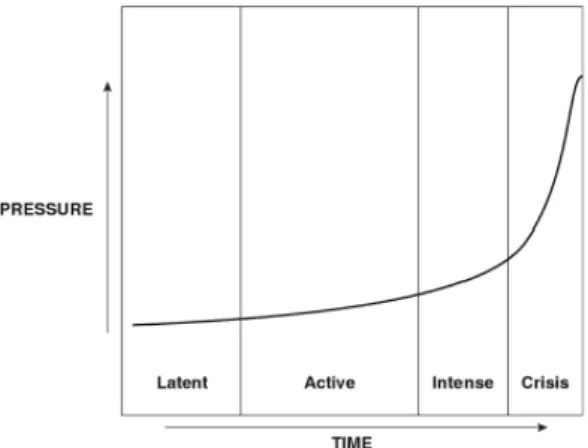
According to Fink (1986) crisis can have multiple stages and usually, there are warning signs that can be identified before a crisis breaks out. Crisis tend to evolve over time, from issues that gradually grow their intensity until becoming a crisis as seen in fig 13. According to Cornelissen (2011: 180), issues are “A public concern about the organisation's decision and operations, which may or may not involve, a point of conflict in opinions and judgement regarding those decisions and operations. The author contends that issues are the primal nature of crisis. Thus organisations should monitor their evolution in order to be able to prevent a future crisis. Issues pose a lurking threat that might harm the organisation reputation. However, they do not necessarily require immediate action from organisations. An excellent way to understand issues is to think of a fast food company and obesity, consumers may perceive the organisation as a contributor to this problem and might judge this organisation. This is an issue that deserves close attention from the organisation because it has the potential to escalate into a crisis.
Fig 14. The development of an issue into a crisis (Cornelissen, 2011)
Monitoring social media conversations and engaging with users has become a regular practice for companies, as even a minor complaint about the organisation actions can mutate into a crisis (Grégoire, Salle, & Tripp, 2015). SNSs enables consumers and other stakeholders to publicly share their complaints about organisations, making them more vulnerable to sudden discharge of NWOM, creating an online firestorm that creates controversy around organisations (Pfeffer, Zorbach, & Carley, 2013). Online firestorms are also known by the term paracrisis (Lim, 2017). Paracrisis are described as “publicly visible crisis threat that charges an organisation with irresponsible or unethical behaviour” and potentially damages the organisation reputation (Coombs & Holladay, 2012: 409) (as cited by Einwiller & Steilen, 2015). According to Coombs
20 & Holladay (2012), paracrisis are a particular type of crisis threat that has the potential to escalate to an actual crisis, what Fink (1986) determines as a warning sign or what Cornelissen (2011), defines as an issue. Paracrises “look like” crisis and are unique, because they still require action from the organisation similar to a regular crisis. However they don’t necessarily disrupt organisations operations, neither requires the activation of the crisis team, both key characteristic of crisis (Coombs, 2015). According to Einwiller & Steilen (2015), since paracrisis antecede actual crisis, complaint management has an essential role in this stage, as it may help organisations to contain the threat and prevent it from escalating into a crisis. Furthermore, Coombs and Holladay (2014), acknowledge that a paracrisis can be seen as a rhetorical arena that opens before an actual crisis appears, as signs of an emerging crisis can be identified in online environments, as they are public and gain visibility to stakeholders.
In 2008 Motrin, a Johnson & Johnson’s brand, displayed an edgy add that offend the public implying that moms carry their babies as fashion accessories, users stormed Twitter discharging vast amounts of negative word of mouth against Motrin, which in less than 48 hours, removed the add and replaced it with an apology (Learmonth, 2008). According to Coombs (2015), this event is an excellent example of paracrisis, as the company, wasn’t affected by a disruption in the production or sales of Motrin, despite suffering light damage to the brand reputation, a quick and effective response defused the potential crisis. Coombs (2015), defend that paracrisis can be categorised into three types, as seen in fig. 14 bellow and fig 15 present in the appendixes.
Fig 15.Types of Social Media Crisis (Coombs, 2015)
“Organizational Misuse paracrisis”: Is a type of crisis that occurs when organisations don’t fulfil the social norms of behaviour expected in a certain social media channel and misuse SM. (e.g., During the Super Storm Sandy, GAP used the #Sandy to encourage online shopping, and the brand community members perceived it as a disrespectful action.)
“Dissatisfied customer or customer complaints paracrisis”: This is one of the most common