Research Article
Port J Public HealthI Feel Safe Doing It! Prevalence,
Risk Perception, and Motives for
Risky Driving in Portugal
Ana Patrícia Duarte
a, bCarla Mouro
a, caInstituto Universitário de Lisboa (ISCTE-IUL), Lisbon, Portugal; bBusiness Research Unit (BRU-IUL), Lisbon, Portugal; cCentre for Psychological Research and Social Intervention (CIS-IUL), Lisbon, Portugal
Received: September 19, 2019 Accepted: January 13, 2020 Published online: February 17, 2020
Ana Patrícia Duarte
Business Research Unit (BRU-IUL), Instituto Universitário de Lisboa (ISCTE-IUL) Av. das Forças Armadas, Campus ISCTE-IUL, Edifício I, Room 2w15
© 2020 The Author(s). Published by S. Karger AG, Basel on behalf of NOVA National School of Public Health
DOI: 10.1159/000505998
Keywords
Risky driving behaviour · Risk perception · Motive · Perceived control
Abstract
Introduction: Road traffic injuries are among the top 10
causes of death and thus a major public health issue world-wide. Consistent differences between countries in the Euro-pean Union justify a closer examination of the problem at a national level. The present study focused on identifying the socio-psychological factors behind risky driving, which can help interventions more successfully foster safer driving practices in Portugal. More specifically, this research ana-lysed the prevalence of self-reported risky driving behav-iours and their association with perceived risks to establish whether this relationship differs across risk-taking practices. The study also examined drivers’ motives for taking risks.
Methods: A telephone survey about road safety collected
responses from 635 adult drivers. The respondents provid-ed sociodemographic information so comparisons could be made between groups of drivers based on age, gender, and frequency of driving. Results: The risky driving practices
most frequently reported by Portuguese drivers were speeding and disregarding the need for rest breaks. The re-spondents also evaluated these two practices as the least risky, suggesting that drivers minimise their personal risk of traffic accidents. The most frequently mentioned motives for risky driving were a perceived control over vehicles and road conditions. Male, younger, and everyday drivers have higher risk profiles since they reported engaging in risky driving practices more often and perceiving these behav-iours as less risky. Conclusion: Portuguese drivers reported engaging consistently in risky driving practices, while evalu-ating their risk as moderate and their control over driving conditions as high. This contextualised understanding of factors that strengthen the likelihood of risky driving can help facilitate tailor-made interventions to reduce Portu-guese drivers’ unrealistic perceptions of control and invul-nerability, thereby ensuring safer roads.
© 2020 The Author(s). Published by S. Karger AG, Basel on behalf of NOVA National School of Public Health
An earlier version of this study was presented in 2013 at the VIII Simpósio Nacional de Investigação em Psicologia and at the II Con-gresso Ibero-Americano de Psicologia da Saúde.
Sinto-me seguro a fazê-lo! Prevalência, perceção de risco e motivos para a condução de risco em Portugal
Palavras Chave
Comportamentos de risco na condução · Perceção de risco · Motivo · Controlo percebido
Resumo
Introdução: A sinistralidade rodoviária encontra-se entre
as 10 principais causas de morte, constituindo um prob-lema de saúde pública ao nível mundial. A existência de diferenças consistentes nos níveis de sinistralidade rodoviária entre países na União Europeia justifica uma análise aprofundada do problema a nível nacional. Este estudo focou-se na identificação de fatores psicossociais subjacentes à condução de risco que podem ajudar as in-tervenções a promover práticas de condução mais segu-ras em Portugal. Mais especificamente, esta pesquisa analisou a prevalência de comportamentos auto-relata-dos de condução de risco e a sua associação aos riscos percebidos para estabelecer se esta relação difere conso-ante os comportamentos examinados. Este estudo tam-bém analisou os motivos para a adesão a comportamen-tos de risco. Método: Realizou-se um inquérito telefónico sobre segurança rodoviária a 635 condutores adultos. Os dados sociodemográficos fornecidos pelos respondentes foram utilizados para realizar comparações entre grupos de condutores com base na idade, no género e na frequên-cia de condução. Resultados: As práticas de conduções de risco mais frequentemente reportadas pelos condu-tores portugueses foram o circular com excesso de velo-cidade e a não observância de períodos de descanso. Os respondentes avaliaram estas práticas como sendo as menos arriscadas, o que sugere que os condutores mini-mizam o seu risco pessoal de acidentes rodoviários. Os motivos mais frequentemente mencionados para com-portamentos de condução de risco foram o controlo per-cebido sobre os veículos e as condições da rodovia. Os condutores do género masculino, os mais jovens e os que conduzem todos os dias apresentaram perfis de risco mais elevado. Estes indivíduos reportaram envolver-se mais frequentemente em práticas de risco e percecionam as mesmas como menos arriscadas. Conclusão: Os con-dutores portugueses reportam envolver-se frequente-mente em práticas de condução de risco, que avaliam como tendo um risco moderado, enquanto consideram o seu controlo pessoal sobre as condições de condução como elevado. Este conhecimento contextualizado de
fa-tores que aumentam a probabilidade de condução de ris-co pode ajudar a facilitar intervenções mais ajustadas ao contexto nacional que reduzam as perceções irrealistas de controlo e de invulnerabilidade, assegurando assim es-tradas mais seguras.
© 2020 The Author(s). Published by S. Karger AG, Basel on behalf of NOVA National School of Public Health
Introduction
Road traffic injuries are among the top 10 causes of death worldwide [1] and thus a major public health issue in most countries. In the European Union (EU), a con-tinuous investment in road safety programmes has de-creased the rates of road injuries and fatalities in recent decades. However, the statistics are still worrying [2], with an average of 49.7 fatalities per million inhabitants in 2017 [3]. Given the difficulty of reducing the number of EU road accident fatalities between 2013 and 2017, the European Commission has declared that further efforts are needed to continue reducing the number of fatalities [4].
In the EU [3] and worldwide [1], significant differenc-es in traffic fatalitidifferenc-es exist between countridifferenc-es, usually cor-relating with income gaps and/or geographical locations. Low- or middle-income, southern countries report worse results than high-income, northern countries do. Com-parative studies on the level of self-reported violations and risky driving behaviours, based on European surveys by the SARTRE Consortium, also indicate north-south differences, with higher compliance with regulations be-ing reported by northern European drivers [5]. These dis-crepancies indicate a need for tailor-made interventions [6], which in turn require detailed, contextualised knowl-edge of the factors that determine and increase the likeli-hood of traffic violations and risky driving in each coun-try.
In Portugal, a middle-income, southern EU member state, the statistics on road traffic fatalities have been con-sistently above the EU average. Although Portugal’s num-bers have been halved in the last 2 decades [7], thus fol-lowing the general tendency in the EU, the last compara-tive report still showed that, in 2017, Portugal had 58 fatalities per million inhabitants [3]. Moreover, the num-ber of accidents has not diminished, suggesting that there has been an improvement in safety conditions (vehicles and roads), but not in drivers’ behaviour [8]. This persis-tently higher prevalence of accidents and fatalities in Por-tugal makes a deeper understanding of the factors
under-lying these statistics necessary. The Decade of Action for Road Safety 2011–2020 – a United Nations-World Health Organisation initiative [9] – has put pressure on EU member states to reduce their 2010 traffic fatalities by half by 2020 [3]. The present study was part of this initiative in Portugal [10], specifically focusing on identifying the socio-psychological factors behind risky driving, which can help interventions to encourage the adoption of safer driving practices in this country.
Theoretical Framework and Research Aims
The most comprehensive set of studies on road safety conducted in Portugal took place more than a decade ago [11], which produced results used to create the first Na-tional Plan for Road Safety in 2003. At the time, Reto and Sá [11] reported that Portuguese drivers have a positive self-image even though they acknowledge frequently dis-regarding various traffic rules such as speed limits. Sub-sequent research has been more restricted in scope, with a focus on a specific region (e.g., the Algarve) or age group (e.g., adolescents) [12–14], or has been conducted as part of large European surveys [5, 15, 16] with limitations on the dimensions examined. Consequently, an updated perspective is needed on how often Portuguese drivers engage in risky driving practices and how they perceive and justify their risk-taking behaviours. The present study thus sought to examine systematically the preva-lence, risk perceptions of and motives for engaging in risk-taking practices among Portuguese drivers a decade after the first National Plan was defined. This research was initiated in a context of worldwide investment in pol-icies and regulations seeking to reduce the social impacts of road fatalities [9].
The current study focused on six risky driving behav-iours identified in previous research in the Portuguese context [10, 11, 15, 17]: speeding both on highways and in residential areas, drinking and driving, talking on a cel-lular phone while driving, driving without resting, and constantly changing lanes. The literature on road safety provides clear evidence that most traffic accidents occur because of these risk-taking behaviours, particularly speeding and drinking and driving [18–20]. Personal be-liefs about the risk associated with these risky driving practices are an important predictor of drivers’ behav-iours [21], with perceptions of higher levels of risk being linked to lower levels of risky behaviours [22].
However, many drivers also report engaging in driving practices that they see as risky [11, 16, 18]. One reason for
this may be that drivers tend to minimise their personal risk of accident due to unrealistic optimism [23] and per-ceived invulnerability [24], which, in turn, are linked to an exaggerated sense of control gained through experi-ence [25]. This perceived control justifies these drivers’ intention to adopt driving behaviours that they acknowl-edge are risky, such as speeding [26] and drinking and driving [25]. Another possible motive is a norm-based justification for risky behaviours, that is, the belief that most drivers engage in risky driving. For instance, dis-tracted driving is predicted not only by a driver’s percep-tion of being in control while talking on a cellular phone and driving, but also by their perception of this being most drivers’ normal behaviour [27].
The literature further suggests that different risky driv-ing behaviours do not necessarily co-occur [5, 20] and that they may have distinct determinants across countries [5]. Some risky behaviours, such as speeding, are more widespread and consistent over time in certain cultural contexts, thus becoming highly underestimated and so-cially tolerated in these contexts [18]. In a study compar-ing a high-income (i.e., the Netherlands) and low-income (i.e., Turkey) country, Şimşekoğlu et al. [6] found that, in Turkey, drivers reported a higher level of risk associated with driving than they did in the Netherlands. No signif-icant associations were, however, found between risk per-ceptions and risk behaviours in Turkey. The reported lev-els of risky driving were also different for the two coun-tries depending on the driving practice in question [6]. These findings underline the importance of examining how levels of self-reported risk behaviours and risk per-ceptions interact for different risky driving practices, as well as the motives sustaining risk taking in specific coun-tries.
The present study defined three objectives for its as-sessment of Portuguese drivers’ risky driving. The first was to provide an updated perspective on the prevalence of self-reported risky driving behaviours. The second ob-jective focused on establishing whether risk evaluations differ across risk-taking practices. Last, this research in-cluded examining the motives for risk taking, including Portuguese drivers’ perceived control and normative be-liefs. The study also investigated the relationship between the main variables and sociodemographic factors previ-ously found to differentiate the involvement in fatal traf-fic accidents [8] and drivers’ responses about risky driv-ing [21] in order to provide guidelines for road safety pol-icies and campaigns.
Materials and Methods
Participants and Procedures
The data analysed in this study were part of a larger research project on the attitudes and behaviours of Portuguese drivers and non-drivers regarding road safety. The data were collected in Au-gust 2012 using a telephone survey administered to a large sample of Portuguese citizens (n = 800). For each household, the last per-son to turn 18 years old or above was asked to answer the survey. Stratification quotas were defined based on the 2011 census, hav-ing as criteria region (NUTS II, Continental Portugal) and habitat (four levels from less than 5,000 inhabitants to more than 50,000 inhabitants). The sampling margin of error was 3.46% for a confi-dence interval of 95%. The study was introduced to the respon-dents as having the goal of collecting their opinions about road safety in Portugal. Anonymity and confidentiality were ensured, and the data collection process followed the International Cham-ber of Commerce/European Society for Opinion and Marketing Research’s International Code on Market, Opinion, and Social Re-search and Data Analytics.
Given this study’s objectives, only individuals who reported having a valid driving license were included in the subsequent analysis (n = 635). The drivers surveyed were between 18 and 86 years old (mean 44.2; standard deviation [SD] 16.0). A little over half (53.7%) were male, while 31.5% had completed 9 years of schooling or less and 65.0% were employed. The average time of having a driving license was 21.2 years (SD 13.7), with a range from less than 1 year to 62 years. Drivers’ age and years of having a driv-ing license were strongly correlated (r = 0.91; p < 0.01), thus only age was considered in subsequent data analyses.
Most respondents reported driving every day (75.4%) in an au-tomobile (81.1%) or an auau-tomobile and a two-wheeled motor ve-hicle (9.1%). More than half of the drivers (55.5%) had been in-volved in traffic accidents while at the steering wheel: 27.9% in 1 accident and 27.6% in 2 or more accidents. Two drivers (0.6%) mentioned a fatality, and 5.1% referred to serious injuries as a re-sult of their accidents.
Measures
Risky Driving Practices
This variable measured self-reported levels of 6 risky driving practices (e.g., “How frequently do you … drive at more than 50 km/h in residential areas” and “… talk on the cell phone while driving”). The survey items were adopted from prior research [11, 22] and a previous qualitative study within the same research proj-ect [10]. Higher scores indicate higher levels of risky driving prac-tices (1 = never; 5 = always).
Perceived Risk of Driving Practices
This variable measured the risk drivers associated with each of the six practices in question, using items based on existing research [22] and a previous qualitative study within the same project [10] (e.g., “It is dangerous … to drive at more than 120 km/h in resi-dential areas” and “… to drive more than 2 h without resting”). Higher scores reflect a higher level of perceived risk (1 = totally disagree; 5 = totally agree).
Motives for Risk Taking
This variable assessed seven reasons for risk taking while driv-ing based on extant research [12, 14, 22, 27] and a previous
quali-tative study within the same project [10]. Two survey items mea-sured direct perceived control (i.e., “I know the roads well” and “I know the vehicle well”). Two other items assessed indirect per-ceived control [27] (i.e., “I get bored” and “I’m in a rush”). Two more items measured driving while distracted and/or being ab-sentminded (i.e., “I’m distressed, tired, and/or worried” and “I go into automatic pilot mode”), and one item assessed the use of a norm-based justification [27] (i.e., “I just do what all drivers do on the road”). Higher scores indicate a more frequently presented motive for risk-taking practices (1 = never; 3 = very often).
Sociodemographic Information
Respondents were also asked to provide a large set of sociode-mographic information. For the present study, comparisons were made between groups of drivers based on age, gender, and fre-quency of driving.
Results
Prevalence of Risky Driving Practices
The self-reported frequency of risky driving practices (Table 1) indicates that the most prevalent behaviours were speeding both in residential areas and on highways. Only a fifth of the drivers surveyed denied engaging in these behaviours. In contrast, most respondents reported never talking on a cellular phone while driving (61.9%) or consuming alcohol before driving (76.7%).
Some statistically significant differences in terms of gender, age, and frequency of driving were found. More specifically, female respondents less frequently reported driving without taking a break every 2 h (t = 4.694; p < 0.001) and after drinking alcohol (t = 4.960; p < 0.001) than male respondents did.
Regarding age, respondents over 65 years old less frequently said they use a cellular phone while driving
(F(4, 633) = 11.890; p < 0.001), as well as speeding on
high-ways (F(4, 632) = 17.461; p < 0.001) and not taking rest
breaks often enough (F(4, 633) = 4.667; p < 0.001).
Con-versely, this age group more often reported consuming alcohol before driving than other drivers did (F(4, 633) =
2.882; p < 0.05). In addition, 25- to 34-year-old drivers indicated they had an overall higher tendency to engage in risky driving practices than other age groups did, namely, talking on a cell phone while driving, not stop-ping to rest, and speeding on highways and in residential areas (p < 0.05 for all practices). For the latter behaviour, no statistically significant difference was found for 18- to 24-year-old drivers. Respondents who drive every day reported a higher adoption of risky behaviours for all practices compared to less frequent drivers (p < 0.05 for all practices).
Perceived Risk of Driving Practices
Table 1 also lists the perceived risk associated with each driving practice. All practices were considered dan-gerous by at least half of the respondents. Speeding on highways was the practice with the lowest perceived risk since 32.8% of the drivers disagreed with this being a dan-gerous driving practice, thus indicating that they consid-ered speeding on the road to be safe. All other practices were seen as risky by 70–90% of the respondents.
A comparison of the prevalence of risky driving prac-tices and their associated perceived risk revealed that the drivers perceived the practices they engage in the most as the least dangerous. Therefore, from the respondents’ point of view, speeding and not resting enough were more common and safer practices, while changing lanes, talk-ing on a cellular phone, or drinktalk-ing and drivtalk-ing were risk-ier and less common practices. Regarding differences re-lated to gender, female drivers reported higher levels of perceived risk than male drivers did for speeding on high-ways (t = –5.074; p < 0.001), constantly changing lanes
(t = –3.474; p < 0.001), and drinking before driving (t = –8.004; p < 0.001).
The results for age revealed that younger drivers (i.e., 18–24 years old) reported perceiving lower risk levels than other drivers did for three practices: speeding on highways (F(4, 618) = 4.036; p < 0.01) and in residential
ar-eas (F(4, 633) = 7.231; p < 0.01), and drinking before driving
(F(4, 633) = 4.384; p < 0.01). Drivers between 35 and 44
years old perceived higher risk for speeding both on high-ways and in residential areas, constantly changing lanes, and drinking and driving (p < 0.05 for all practices) than the other age groups did.
Most driving practices were considered equally dan-gerous by drivers who drive every day and those who drive less frequently, except speeding on highways (t = 3.125; p < 0.01) and in residential areas (t = 2.554; p < 0.01). More specifically, everyday drivers associate a low-er risk level with these two driving practices than less fre-quent drivers did.
Table 1. Risky driving practices and risk perceptions
How frequently do you …? It is dangerous to …
never rarely/
sometimes very often/ always totally disagree/ disagree neither agree nor disagree agree/ totally agree
… drive at speeds of more than 120 km/h on highwaysa 24.1 54.1 21.8 32.8 14.4 52.8
… drive over two hours without resting 34.0 46.9 19.3 12.8 13.8 73.4
… drive at speeds of more than 50 km/h in residential areasa 26.8 61.0 12.2 11.7 14.5 73.8
… constantly change lanes 51.6 45.7 2.7 9.3 6.5 84.2
… talking on a cell phone while driving 61.9 35.3 2.8 8.1 2.5 89.4
… consume any amount of alcohol before driving 76.7 21.7 1.6 13.3 3.7 83.0 All values are percentages. a Speed limits imposed by Portuguese traffic laws at the time of survey.
Table 2. Motives for risk taking while driving
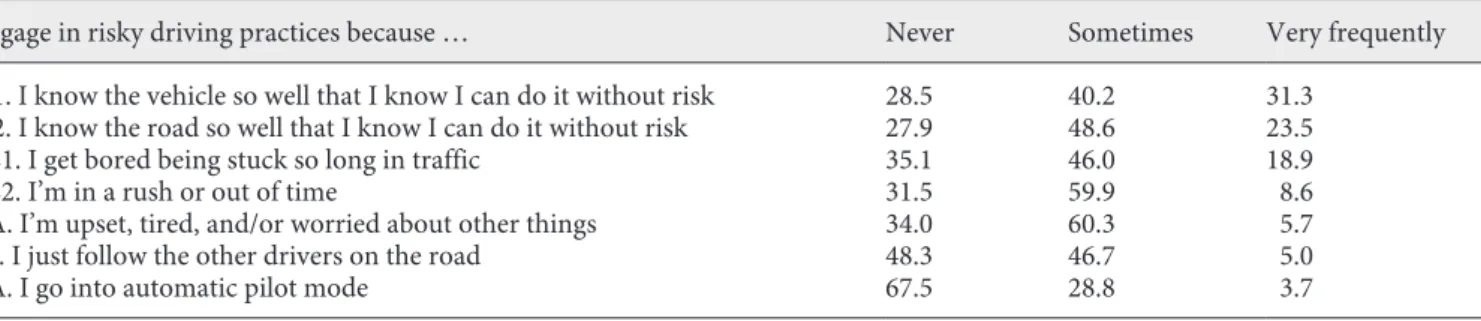
I engage in risky driving practices because … Never Sometimes Very frequently PC1. I know the vehicle so well that I know I can do it without risk 28.5 40.2 31.3
PC2. I know the road so well that I know I can do it without risk 27.9 48.6 23.5
IPC1. I get bored being stuck so long in traffic 35.1 46.0 18.9
IPC2. I’m in a rush or out of time 31.5 59.9 8.6
D/A. I’m upset, tired, and/or worried about other things 34.0 60.3 5.7
DN. I just follow the other drivers on the road 48.3 46.7 5.0
D/A. I go into automatic pilot mode 67.5 28.8 3.7
Motives for Risky Driving Practices
Table 2 presents the frequency of motives for engaging in risky driving practices, showing that nearly half of the sample felt their risky driving practices were justified. Perceived control beliefs were the most prevalent reasons, whether measured directly – personal knowledge of the vehicle (31.3%) and roads (23.5%) – or indirectly – being bored due to being caught in traffic (18.9%) and being in a rush (8.6%). The least frequent motives were feeling dis-tracted and/or being absentminded (i.e., automatic pilot mode, 3.7%; feeling distressed about other situations, 5.7%) and conforming to the norm by mimicking other drivers’ behaviours on the road (5.0%).
No statistically significant differences were found for gender comparisons, except for male drivers reporting be-ing more motivated by mimickbe-ing others (i.e., descriptive norm) than female drivers did (t = 3.514; p < 0.001). Re-garding age, drivers aged over 45 years old presented themselves as less motivated by a lack of time (i.e., indirect perceived control) than other drivers did (F(4, 632) = 10.323;
p < 0.001). Younger drivers (i.e., 18–24 years old) were
more motivated by their perceived control over driving conditions than other drivers were (F(4, 632) = 6.086; p <
0.001). In comparison with other drivers, individuals who drive every day more often mentioned having control over their vehicle (t = –3.095; p < 0.01) and the roads (t = –3.891;
p < 0.001), having a lack of time (t = –4.290; p < 0.001),
and being distressed or tired (t = –2.055; p < 0.05) as their motives for risky driving practices.
Sociodemographic Risk Profiles
The above results highlight the need to target specific risk groups. Male drivers, younger drivers (i.e., 18–34 years old), and everyday drivers appear to have higher risk profiles since they: (1) reported engaging in risky driving practices more often, and (2) perceived these be-haviours as less risky. Everyday drivers were also the ones who associated risk taking with having more control over traffic conditions – a factor that raises the probability of these drivers being exposed to risky situations.
Discussion
The present study sought to examine the prevalence of self-reported risky driving practices, perceived risk, and motives for risky driving in Portuguese drivers. The risky driving practices most frequently reported were speed-ing, both on highways and in residential areas, and disre-garding the need for a rest break every 2 h. These
behav-iours were also perceived as the least risky driving prac-tices, suggesting that Portuguese drivers tend to minimise their personal risk of traffic accidents by lowering the per-ceived risk level of the most common risky driving prac-tices. This indicates that the risk of speeding – the most prevalent and “safest” practice – is underestimated. Ac-cording to Elvik [18], highly prevalent risky driving be-haviours become socially tolerated, and they are regarded less often as being problematic. However, excessive speed has consistently been one of the main causes of fatal traf-fic accidents in Portugal [17], which highlights the need to dispel drivers’ unrealistic optimism about and percep-tions of their invulnerability regarding this behaviour [23–26]. Further research is needed to better understand how drivers evaluate the suitability of legal speed limits in specific contexts (e.g., highways, residential roads, school surroundings). This information can help in developing campaigns that address the contested dimensions of legal speed limits.
A different pattern was found for drinking and driv-ing, a risky practice that also predicts Portuguese drivers’ risk of being involved in traffic accidents [17]. While speeding appears to be a common, tolerated practice, the present results indicate that driving under the influence of alcohol is not socially tolerated to the same extent giv-en that few of the drivers surveyed admitted doing this. The high level of denial could, however, be the result of inaccurate evaluations of the effects of “one or two drinks” [10]. The illusion of maintaining control while drinking and driving could cause drivers to not report alcohol-re-lated infractions. As this represents one of the main fac-tors related to traffic accidents in Portugal [9], further investment in drivers’ education and re-education cam-paigns is needed.
Drivers’ main motives for risky driving behaviours were their perceived control of vehicles and roads. As highlighted in the literature, illusions of invulnerability contribute to an overvaluation of personal skills, which, in turn, weakens perceptions of personal risk and justifies the adoption of risky driving practices [11, 22, 25–27]. The respondents surveyed for the present study also re-ported a lack of time and boredom while stuck in traffic as significant situations that enhance risky behaviours on the roads. This result points to the need to invest further in strategies that facilitate better time organisation and help counter the tendency to want to save time by speed-ing on roads.
In addition, interventions need to address specific groups of drivers. Male drivers, as compared with fe-males, described themselves as driving more frequently
without taking rest breaks and after drinking alcohol, and reported lower levels of risk perception for speeding on highways and drinking before driving. As these can be linked to male gender-role expectations (e.g., high perfor-mance, risk taking), interventions will require developing campaigns that are not identity threatening but at the same time try to deconstruct gender stereotypes. More-over, in their motives for engaging in risk-taking prac-tices, males included mimicking other drivers (i.e., a norm-based justification) more often than female drivers did. Thus, this specific group should not be exposed to messages that highlight how common risky practices are; this can be counterproductive [27] because it would rein-force one of their stated motivations.
As in previous research [21–23], age group compari-sons revealed the need to consider this characteristic when developing intervention measures. In the present study, 25- to 34-year-old drivers reported an overall high-er tendency to engage in risky driving practices than oth-er age groups did. Youngoth-er drivoth-ers (i.e., 18–24 years old) also perceive lower levels of risk regarding speeding and drinking before driving, and they declared higher levels of perceived control. In contrast, drivers between 35 and 44 years old overall perceive higher levels of risk for the practices under study. This finding suggests that one way of reducing risk taking and risk minimisation in younger drivers could be for them to drive accompanied by some-one older – a kind of tutor who would manage the youn-ger person’s risk exposure. This is a community-based approach successfully tested in northern European coun-tries (e.g., Germany). Overall, the findings suggest that a stronger investment in road safety education, not only in earlier years but also along the life span, can also have a relevant impact on the way people perceive and adhere to safety behaviour on the road.
Regarding respondents’ frequency of driving, those driving every day reported a higher level of risky prac-tices compared with less frequent drivers. Everyday driv-ers also associated lower levels of risk with speeding and justified engaging in risky driving practices by referring to their perceived control and lack of time, as well as to feeling distressed or tired. Once more, this highlights the need to tailor campaigns to address specific groups of drivers, in this case by giving them access to information on the state of traffic and road conditions, as well as of-fering alternative travel routes and trip lengths. Mobile applications already exist that provide this real-time in-formation, but the literature appears to include no assess-ments of whether this has contributed to reducing the number of accidents over time.
In summary, the present findings underline the need for Portuguese road safety campaigns to more intensively target younger drivers, male drivers, and those driving every day. This is very much aligned with the recommen-dations of the latest national strategic plan for road safety (PENSE2020) [8].
This study, however, has some limitations. One of them arises from the use of data on self-reported behav-iour rather than observed driving patterns. Associations between respondents’ beliefs and attitudes and their self-reported behaviour can sometimes be stronger than with their actual behaviour [27]. Any interpretation of the pres-ent results thus needs to be made with due caution. None-theless, the argument can also be made that self-reported behaviour is closer to an accurate assessment of behaviour than is, for instance, a self-reported intention to perform that behaviour [28]. Future studies with observations of actual behaviours are needed to confirm the current find-ings’ robustness. Another potential limitation has to do with the broader context in which the data were gathered. Namely, literature reports a negative relation between the economic performance and road safety indicators [29]. As this study was conducted in a post-crisis period, we cannot be sure that respondents’ driving patterns (i.e., frequency of driving) were not affected by their financial condition. Finally, despite the substantial decline in the number of road fatalities in Portugal over the last decade, the pres-ent results are overall similar to those reported by Reto and Sá [11] in 2003. Portuguese drivers continue to report engaging in risky driving practices and to perceive mod-erate levels of risk and high levels of control regarding driving conditions. A possible explanation of this is that more time is still needed for EU policies to be translated and implemented at the national level and to have their full effect [30]. For this, a deeper engagement in road safe-ty of municipalities, as foreseen in PENSE2020 [8], can be crucial. These local entities can, for instance, contribute for the identification of accident blackspots in their ter-ritories, promote local road safety campaigns, engage dif-ferent local players in municipal road safety planning, and promote education on road safety in local schools.
The present findings also indicate that policymakers need to discuss why the preventive measures implement-ed in recent decades appear to have been effective at a behavioural level (e.g., reducing occurrences through sanctions) but not at the level of beliefs and attitudes to-wards risk taking. This misalignment between ideas and behaviours suggests that safe driving is not being ade-quately promoted amongst drivers, especially new ones. Understanding the prevalence and perceived risk of and
motives for risky driving in Portugal is a step forward to-wards ensuring local interventions are more adequately tailored for the specific populations in question, and thus more likely to increase road safety.
Acknowledgments
This study was part of a larger project with the following part-ners: Fundação Galp Energia, Galp Energia, Autoridade Nacional de Segurança Rodoviária (National Road Safety Authority), Di-recção Geral de Saúde (Directorate-General for Health), and Sair da Casca Consultoria em Sustentabilidade and Responsabilidade Social (Social Responsibility and Sustainability Consultant). The authors wish to thank the partners for their comments and sugges-tions during the study’s preparation phase and the respondents who made this research possible.
Statement of Ethics
This research followed the Code of Ethics developed by the Or-der of Portuguese Psychologists (see https://www.ordemdospsi-cologos.pt/ficheiros/documentos/opp_cod_deontologico_web.
pdf). The respondents gave their verbal consent before participat-ing in the study, and the data were processed anonymously.
Disclosure Statement
The authors have no conflicts of interest to declare. Funding Sources
This work was supported by the Fundação Galp Energia and Galp Energia, Portugal, within the framework of the “Aliança para a Prevenção Rodoviária” (Alliance for Road Safety) project, and by the Fundação para a Ciência e Tecnologia, Portugal (grants UID/ GES/00315/2013 and UID/PSI/03125/2013).
Author Contributions
A.P.D. coordinated the study. Both A.P.D. and C.M. worked on all stages of the research, such as project design, survey develop-ment, data analysis, and writing of the manuscript. Both authors approved the final version of the manuscript.
References
1 World Health Organization [Internet]. The top 10 causes of death [cited 2019 Sept 12]. Available from: https://www.who.int/news- room/fact-sheets/detail/the-top-10-causes-of-death.
2 European Commission [Internet]. Towards a European road safety area: policy orientations on road safety 2011–2020 (COM(2010) 389) [cited 2019 Sept 9]. Available from: http:// www.who.int/roadsafety/decade_of_action/ plan/national/en/.
3 Eurostat [Internet]. Road accident fatalities – statistics by type of vehicle [cited 2019 Sept 9]. Available from: https://ec.europa.eu/euro- stat/statistics-explained/index.php/Road_ac-cident_fatalities_-_statistics_by_type_of_ v e h i c l e # R a t i o _ p e r _ i n h a b i t a n t s : _ Denmark.2C_Sweden_and_the_United_ Kingdom_appear_safest.
4 European Road Safety Observatory [Inter-net]. Annual accident report 2018 [cited 2019 Sept 9]. Available from: https://ec.europa.eu/ transport/road_safety/sites/roadsafety/files/ pdf/statistics/dacota/asr2018.pdf.
5 Golias I, Karlaftis MG. An international com-parative study of self-reported driver behav-ior. Transp Res Part F Traffic Psychol Behav. 2001;4(4):243–56.
6 Şimşekoğlu Ö, Nordfjærn T, Rundmo T. Traffic risk perception, road safety attitudes, and behaviors among road users: a compari-son of Turkey and Norway. J Risk Res. 2012; 15(7):787–800.
7 Autoridade Nacional de Segurança Rodoviária [Internet]. Relatórios de Sinistralidade [Fatal-ity Reports] [cited 2019 Sept 9]. Available from: http://www.ansr.pt/Estatisticas/Relato-riosDeSinistralidade/Pages/default.aspx. 8 Conselho de Ministros [Internet]. Resolução
do Concelho No. 85/2017 - PENSE 2020 - Plano Estratégico Nacional de Seguran- ça Rodoviária [cited 2019 Nov 20]. Avail- able from: https://dre.pt/application/file/a/ 107515163.
9 United Nations Road Safety Collaborations [Internet]. Decade of action for road safety 2011-2020 seeks to save millions of lives [cited 2019 Sept 9]. Available from: http://www. who.int/roadsafety/decade_of_action/en/. 10 Duarte AP, Mouro C. Relatório. Aliança para
a prevenção rodoviária. Estudo das atitudes e comportamentos dos portugueses face à sinis-tralidade rodoviária. Lisbon: Instituto Univ de Lisboa; 2012.
11 Reto L, Sá J. Porque nos matamos na estada… e como o evitar. Lisbon: Editorial Notícias; 2003.
12 Cunha O, Abrunhosa R. Consumos recreati-vos e (in)segurança rodoviária. Revista Toxi-codependências. 2009;15(2):35–42.
13 Pimentão C. Análise do comportamento de risco ao volante de jovens condutores com base no modelo do comportamento planeado de Ajzen. Revista Faculdade Ciências Soc Hum Universidade Fernando Pessoa. 2008;5: 204–17.
14 Soares R. Perceção de riscos na estrada: uma perspetiva antropológica sobre o Algarve [dissertation]. Lisbon: University of Lisbon; 2008.
15 SARTRE Consortium. European drivers and road risk – SARTRE 3 reports. Lyon: Institut National de Recherche sur les Transports et leur Sécurité; 2004.
16 Bon de Sousa T, Santos C, Mateus C, Areal A, Trigoso J, Nunes C. Road traffic accidents and self-reported Portuguese car driver’s atti-tudes, behaviors, and opinions: are they re-lated? Traffic Inj Prev. 2016 Oct;17(7):705– 11.
17 Faria N. Mortalidade rodoviária em Portugal: abordagem sócio-demográfica [dissertation]. Lisbon: University of Lisbon; 2010.
18 Elvik R. Why some road safety problems are more difficult to solve than others. Accid Anal Prev. 2010 Jul;42(4):1089–96.
19 Lahausse JA, van Nes N, Fildes BN, Keall MD. Attitudes towards current and lowered speed limits in Australia. Accid Anal Prev. 2010 Nov;42(6):2108–16.
20 Lunevicius R, Herbert HK, Hyder AA. The epidemiology of road traffic injuries in the Republic of Lithuania, 1998-2007. Eur J Pub-lic Health. 2010 Dec;20(6):702–6.
21 Shinar D, Schechtman E, Compton R. Self-reports of safe driving behaviors in relation-ship to sex, age, education and income in the US adult driving population. Accid Anal Prev. 2001 Jan;33(1):111–6.
22 Rhodes N, Pivik K. Age and gender differenc-es in risky driving: the roldifferenc-es of positive affect and risk perception. Accid Anal Prev. 2011 May;43(3):923–31.
23 Deery HA. Hazard and risk perception among young novice drivers. J Safety Res. 1999;30(4): 225–36.
24 Weinstein ND. Unrealistic optimism about future life events. J Pers Soc Psychol. 1980; 39(5):806–20.
25 Chan DC, Wu AM, Hung EP. Invulnerability and the intention to drink and drive: an ap-plication of the theory of planned behavior.
Accid Anal Prev. 2010 Nov;42(6):1549–55. 26 DeJoy DM. The optimism bias and traffic
ac-cident risk perception. Accid Anal Prev. 1989 Aug;21(4):333–40.
27 Forward SE. Intention to speed in a rural area: reasoned but not reasonable. Transport Res F Traffic Psychol Behav. 2010;13(4):223–32. 28 Chen HY, Donmez B, Hoekstra-Atwood L,
Marulanda S. Self-reported engagement in driver distraction: an application of the theory of planned behaviour. Transport Res F Traffic Psychol Behav. 2016;38:151–63.
29 International Transport Forum [Internet]. Why does road safety improve when econom-ic times are hard? [cited 2019 Nov 20]. Avail-able from: https://www.itf-oecd.org/file/ 13933/download?token=iOhfgtqB.
30 Mouro C, Castro P, Kronberger N, Duarte P. A multilevel approach to energy options across the EU: the role of supra-national gov-ernance, values and trust. Rev Int Psychol Soc. 2013;26(3):73–95.