jfq_2891..20
ANTIOXIDANT PROPERTIES AND FRUIT QUALITY DURING LONG-TERM STORAGE OF “ROCHA” PEAR: EFFECTS OF
MATURITY AND STORAGE CONDITIONS
FILIPE J.P. SILVA1,2, MARIA HELENA GOMES3, FERNANDA FIDALGO1, JOSÉ A. RODRIGUES1,4and DOMINGOS P.F. ALMEIDA1,3,5
1Faculdade de Ciências Universidade do Porto
Rua do Campo Alegre, 4169-007 Porto, Portugal
2CPF – Centro de Produção e Comercialização Hortofrutícola, Lda. Estrada Nac. 8
Sobreiral, Bombarral, Portugal 3CBQF, Escola Superior de Biotecnologia
Universidade Católica Portuguesa R. Dr António Bernardino de Almeida
4200-072 Porto, Portugal
4REQUIMTE – Departamento de Química, Faculdade de Ciências Universidade do Porto
Rua do Campo Alegre, Porto, Portugal
Free radical scavenging activity and the content of ascorbic acid and glutathione were investigated during long-term storage of the pear (Pyrus communis L. ‘Rocha’) fruit harvested at different maturity stages, stored in air or under controlled atmosphere and subjected to postharvest treatments with diphenylamine (DPA) and 1-methylcyclopropene (1-MCP). Harvest maturity had a significant effect on storage disorders, fruit firmness, soluble solids content and acidity. Differences in ascorbate content and free radical scav-enging activity at harvest did not persist during storage. Controlled atmo-sphere and DPA strongly reduced the incidence and severity of browning disorders and superficial scald, whereas 1-MCP provided the most effective control. Neither DPA nor 1-MCP affected the free radical scavenging activity
5 Corresponding author. TEL: 351-22-040-2000; FAX: 351-22-040-2009; EMAIL: [email protected]
or the levels of ascorbate and glutathione in the pear. These results suggest that the benefits of 1-MCP on internal breakdown are not directly related with its effects on the antioxidant levels and that, under good storage conditions, the antioxidant properties of the “Rocha” pear can be maintained for up to 8 months.
The importance of fruit antioxidant metabolites as beneficial phytochemi-cals has been widely recognized. Interestingly, the same metabolites are also essential for the health of the fruit itself. Thus, maintaining high levels of antioxidants in fruits throughout the supply chain is of utmost importance to maintain fruit quality and to deliver to consumers the health benefits of fruit consumption. Many studies have addressed fruit antioxidants, but these studies either report comparisons among fruit types analyzed at a single (often unchar-acterized) stage of development or they study changes during short storage periods. European consumers have pears available all year round and the typical storage duration of European pears extends up to 8 months. Moreover, different storage regimes and several postharvest treatments that may impact fruit antioxidants are used in commercial practice. It is thus relevant to char-acterize pear antioxidants during long-term storage and the effect of storage conditions and common postharvest treatments on fruit antioxidants. Harvest data are known to have a large effect on post-storage fruit quality, but its effect on antioxidants during storage is unknown. This information is useful to nutritionists and consumers who have to choose fruit and to all involved in the fruit supply chain in order to provide fruit with better quality.
The health-promoting effects of fruits are partially related to compounds with antioxidant activity (Temple 2000). Fruit antioxidant metabolites that impact human health are also relevant from the standpoint of fruit health and quality. In fact, antioxidant metabolites play a key role in the detoxification of reactive oxygen species in fruit cells (Hodges et al. 2004), thus protecting fruits from storage-related disorders (Larrigaudière et al. 2001a; Zerbini et al. 2002; Fernández-Trujillo et al. 2003; Larrigaudière et al. 2003; Franck et al. 2003a). Several stressful environmental conditions result in increased production of reactive oxygen species in fruit tissues. Excessive accumulation of these reactive molecules causes cell damage whenever the cellular enzymatic and nonenzymatic antioxidant defense mechanisms are unable to prevent the
cyto-Practical Aplications
toxic effects of free radicals. The nonenzymatic scavengers of reactive oxygen species include low molecular mass antioxidants with high-reducing poten-tials, such as ascorbic acid and glutathione (GSH). Ascorbic acid plays a key role against free radicals, while GSH is essential for the regeneration of ascorbic acid, via the ascorbate–GSH cycle (Noctor and Foyer 1998). This cycle constitutes an efficient antioxidant network where GSH and ascorbic acid cooperate with enzymes to modify the cellular oxidation state.
Antioxidant properties have been extensively characterized in a wide range of fruits (Eberhardt et al. 2000; Gil et al. 2002; Kondo et al. 2002; Łata and Przeradzka 2002; Leong and Shui 2002; Guo et al. 2003; Leja et al. 2003; García-Alonso et al. 2004). Pears rank relatively low among fruits regarding antioxidant activity and concentration of phenolics (Campanella et al. 2003; García-Alonso et al. 2004) but have higher antioxidant activity than many common vegetables (Höner and Cervellati 2002; Triantis et al. 2005). Despite their moderate antioxidant activity, the contribution of pears to the intake of antioxidants can be substantial in European countries with high per capita consumption, e.g., 12.6 kg in Switzerland, 14.4 kg in Italy and 16.1 kg in Portugal (FAO 2007), occurring year round.
The antioxidant activity of pears depends on the cultivar (Schieber et al. 2001; Sanchéz et al. 2003; García-Alonso et al. 2004), orchard, harvest date, storage duration and storage conditions (Morais et al. 2001; Larrigaudière et al. 2001b, 2003; Franck et al. 2003a,b). However, most studies of fruit antioxidants have been performed over a short storage period, whereas in commercial practice, the storage of pears is often extended up to 9 months. Moreover, the postharvest behavior of “Rocha” pear is somewhat unique because this cultivar is suitable for long-term storage such as a winter cultivar but ripens promptly after only about 1 month in cold storage such as a summer pear.
The antioxidant properties of the “Rocha” pear have not been docu-mented during long-term storage. Moreover, current and novel postharvest treatments may impact the evolution of fruit antioxidants during storage. Here, we report on the free radical scavenging activity and the antioxidant metabo-lites of the ascorbate–GSH cycle during long-term storage of the “Rocha” pear. The effect of harvest maturity and postharvest treatments with the antioxidant diphenylamine (DPA) and the ethylene action inhibitor 1-methylcyclopropene (1-MCP) were evaluated.
Fruit Material
The pear (Pyrus communis L. “Rocha”) fruits were harvested from a 5-year-old orchard located in Bombarral (39°19′ N, 9°11′ W), Portugal. The
fruits located on the west side of the trees were harvested with different maturities. The fruits harvested with 67, 57 and 51 N of firmness are hereafter referred to as early, optimal and late harvest dates, respectively. After harvest, the fruits were sorted by hand to select the undamaged fruits of uniform size (60–70 mm in diameter), washed, subjected to postharvest treatments and stored.
Postharvest Treatments and Storage Conditions
The fruits harvested at optimal maturity (57 N of firmness) were sub-jected to postharvest treatments with DPA or 1-MCP. DPA was applied after harvest by dipping the fruits for 5 min in 0.9 g/L of DPA (Nutea Scald Control Plus, Nutea, Bombarral, Portugal). The fruits treated with 1-MCP were cooled for 24 h to a pulp temperature of 1C after which the fruits were placed inside an airtight container and exposed to 0.5mL/L of 1-MCP (SmartFresh, Agrof-resh, Inc., Springhouse, PA) for 24 h. The 1-MCP concentration was calculated from the concentration of active ingredients in SmartFresh (0.14% w/w) and released into the free space of the plastic container.
After the postharvest treatments, the fruits were stored at -0.5C and 90–95% relative humidity of air or in 2.5 kPa O2+ 0.7 kPa CO2(balance N2).
Steady-state gas concentration was achieved in 5 days for all the treatments. In the experiment designed to evaluate the effect of harvest maturity, the impo-sition of the controlled atmosphere was delayed 15 days to assure that the samples harvested at different dates could be stored in the same room. The fruits from each maturity stage or postharvest treatment were divided by three plastic crates, stored for 240 days and sampled during storage life at 60-day intervals.
Determination of Free Radical Scavenging Activity
Longitudinal pear slices weighing c. 2 g were excised from each of the five fruits, homogenized in a solution of 2 mM NaF in MeOH. The homoge-nate was filtered through a cellulose paper filter and the free radical scavenging activity measured using the 2,2-diphenyl-2-picrihidrazyl free radical as described by Brand-Williams et al. (1995). The free radical scavenging activ-ity was expressed as ascorbate equivalents using ascorbic acid as a standard.
Determination of Ascorbate and GSH
The fruits removed from storage were immediately frozen in liquid nitro-gen and stored at-80C until analyzed. Frozen pear tissue was macerated at 4C using a prechilled mortar and pestle with 5% metaphosphoric acid, and the extract was centrifuged at 19,000 g for 15 min at 4C. The supernatant was used for analysis of ascorbate and GSH.
For the analysis of ascorbate, an aliquot of 0.5 mL was combined with 25 mL of acetate buffer (200 mM, pH 5.0) and 100mL of 2.8 mM N-bromosuccinimide. The mixture reacted for 5 min under N2 before the
addition of 1,000mL of 115.6 mM o-phenylenediamine, and total content of ascorbate was analyzed by polarography by the method of Ohmori et al. (1983) as modified by Rodrigues et al. (1993). Dehydroascorbic acid (DHA) was determined using the same method except that the oxidation step with N-bromosuccinimide was omitted. The reduced form of ascorbate was calcu-lated as the difference between total and oxidized ascorbate.
Total GSH content was assessed using an enzymatic recycling method of the oxidized to the reduced form by the action of GSH reductase in presence of nicotinamide adenine dinucleotide phosphate (Law et al. 1983). The oxi-dized form of GSH (GSSG) was determined by masking the reduced GSH with the addition of 2-vinylpyridine. GSH was obtained by the difference between total GSH and GSSG.
Quality Assessment
Fruit firmness, soluble solids content and titratable acidity were measured throughout the storage period in 15 fruits per treatment. Firmness was mea-sured on opposite sides of each fruit after peel removal, using a digital firmness tester (model 53205, TR di Turoni, Forli, Italy) mounted on a standard drill press and fitted with an 8-mm probe.
To obtain juice samples, fruit wedges were homogenized and filtered through a cellulose paper filter. Total soluble solids were measured in the juice with an Atago PR-100 palette refractometer (Tokyo, Japan) and titratable acidity was determined by titration with 0.1 N NaOH to pH 8.1.
After 8 months, the fruits were removed from storage and placed at 20C for 8 days, after which time, internal browning disorders and superficial scald were visually evaluated. The incidence of these physiological disorders is reported as the percentage of individual fruits affected.
Data Analysis
Data were analyzed by one-way analysis of variance, and the means compared using Tukey’s test (a = 0.05). All statistical analyses were per-formed with the software package SPSS (SPSS Inc., Chicago, IL).
Effect of Harvest Maturity on Quality Attributes and Storage Disorders
Harvest maturity in “Rocha” pear is determined by firmness, soluble solids content and titratable acidity. Significant differences in fruit firmness at
harvest remained throughout the storage period (Fig. 1A). Consistent with a more advance developmental stage, late harvested pears had a significantly higher soluble solid content at harvest (Fig. 1B) but titratable acidity was similar in the fruits harvested at optimal maturity and late harvested (Fig. 1C). The occurrence of physiological disorders after 8 months in storage was strongly affected by fruit maturity at harvest (Fig. 2). The development of internal browning disorders and superficial scald was lower when the fruits were harvested at optimal maturity.
Effect of Harvest Maturity on Antioxidant Activity, Ascorbate and GSH Levels
Fruit-free radical scavenging activity at harvest was highly dependent on the harvest date (Fig. 3). The highest value (160 mg/kg) was observed in fruits from the early and optimal harvest dates, whereas in the late harvest date, the activity was 34% lower (102.8 mg/kg). The initial differences, however, did not persist during storage. After the initial adjustment during the first 60 days in storage, free radical scavenging activity remained stable for the remaining storage period (Fig. 3) in contrast with the increase observed by Leja et al. (2003) in two apple varieties during 120 days in storage or the increase reported by Vilaplana et al. (2006) during storage of “Golden Smoothee” apples for 15–30 days.
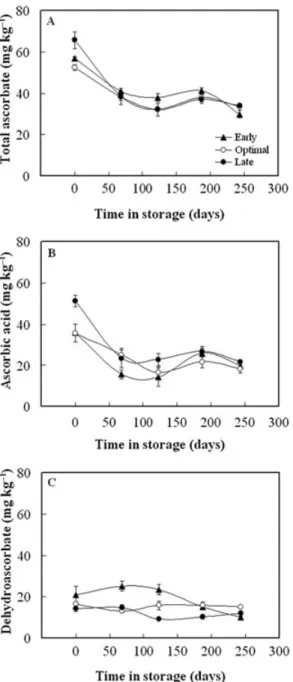
Total ascorbate content, averaged over the storage period, was 40.6 mg/ kg, and the reduced form of ascorbate averaged 25.0 mg/kg, corresponding to 62% of the total. The level of ascorbate was influenced by the harvest date (Fig. 4). The highest levels of total ascorbate (65.7 mg/kg) were observed in the late harvest and the smallest level in the optimal harvest date (52.4 mg/kg). Climatic conditions prior to harvest may account for part of the differences because in the 5 days that preceded the optimal harvest date, rainfall was 19.2 mm compared with only 6.4 mm in the early harvest date and 0 mm prior to the late harvest date. In fact, maximum ascorbate levels in pear are achieved at different maturity stages depending on the year (Zerbini et al. 2002). The total ascorbate content decreased in the first 2 months of storage, in agreement with the date reported by Veltman et al. (2000) and Zerbini et al. (2002).
Although the levels of reduced ascorbate in pear varies among orchards and years (Morais et al. 2001; Zerbini et al. 2002), the values reported herein are within the range reported by Morais et al. (2001) after 4 and 6 months in storage followed by 6 days of shelf life.
The content of ascorbic acid decreased during storage as reported elsewhere for “Conference” pear (Veltman et al. 1999; Zerbini et al. 2002; Larrigaudière et al. 2003; Franck et al. 2003b). The magnitude of the reduc-tion observed is similar to that reported by Veltman et al. (2000) in “Rocha”
FIG. 1. EFFECT OF HARVEST MATURITY ON FRESH FIRMNESS (A), SOLUBLE SOLIDS CONTENT (B) AND TITRATABLE ACIDITY (C) OF “ROCHA” PEAR
pear and for Franck et al. (2003b) in “Conference” pear but modest compared with the reduction of 70% reported by Veltman et al. (2000) or 95% observed by Zerbini et al. (2002).
A rapid decrease in ascorbic acid content following harvest was also observed by other authors as Franck et al. (2003a), who observed a decrease of 30% in this antioxidant in the three following weeks to harvest in “Confer-ence” pear, similar to the result previously obtained by Veltman et al. (2000) and Larrigaudière (2001b).
FIG. 2. EFFECT OF HARVEST MATURITY ON THE INCIDENCE OF SUPERFICIAL SCALD AND INTERNAL BROWNING DISORDERS IN “ROCHA” PEAR FOLLOWING 8 MONTHS
IN STORAGE AT-0.5C
Values are mean⫾ SE (n = 15).
FIG. 3. EFFECT OF HARVEST MATURITY ON FREE RADICAL SCAVENGING ACTIVITY OF “ROCHA” PEAR DURING COLD STORAGE
FIG. 4. EFFECT OF HARVEST MATURITY ON TOTAL ASCORBATE (A), ASCORBIC ACID (B) AND DEHYDROASCORBATE CONTENT (C) OF “ROCHA” PEAR DURING
COLD STORAGE Values are mean⫾ SE (n = 3).
The decrease in the average values of DHA over 8 months of storage was not significant, with DHA accounting for c. 30% of total ascorbate content. Zerbini et al. (2002), working with “Conference” pears, also reported that DHA remained stable during storage and represented 37% of the total ascor-bate content.
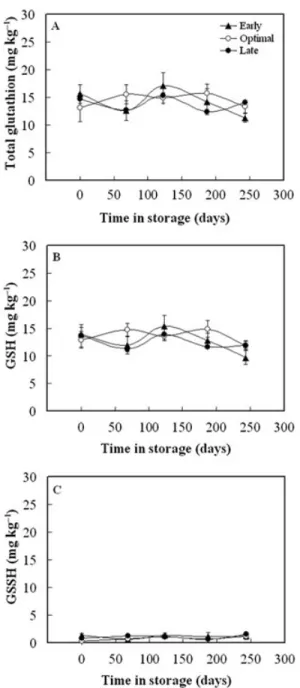
The level of GSH in “Rocha” pear was not influenced by harvest date (Fig. 5). At harvest, total GSH was present at 15.5 mg/kg; the reduced form accounted for 93.5% of the total. GSH levels remained constant during storage. On average, the fruit contained 14.2 mg/kg of total GSH, 13.0 mg/kg of GSH and only 1.2 mg/kg of the oxidized form. The oxidized form accounted for 8.5% of the total GSH, a ratio typically found in plant cells (Foyer et al. 2001).
The GSSG levels observed in this study are smaller than those reported by Larrigaudière et al. (2003) for “Conference” (196 mg/kg). In “Blanquilla,” GSH levels were approximately 46 mg/kg (Pintó et al. 2001). The GSH value obtained on average of all the observations of 13.0 mg/kg is similar to that obtained by Łata and Przeradzka (2002) for four varieties of apples.
In this study, GSH levels remained relatively constant during storage. In contrast, Lentheric et al. (1999) observed a significant decrease in GSH levels in ripening “Conference” pear. The proportion of oxidized GSH is much higher than that reported by Larrigaudière et al. (2003), who measured GSSG levels between 30% and 60% in “Conference” pears stored for 15 days in air and in controlled atmosphere browning disorders inductor conditions. These differences in GSH evolution in harvest date and in reduced and oxidized levels are justified by these authors for a variety characteristic or for the preharvest factors.
Effect of Postharvest Treatments and Storage Conditions on Fruit Quality
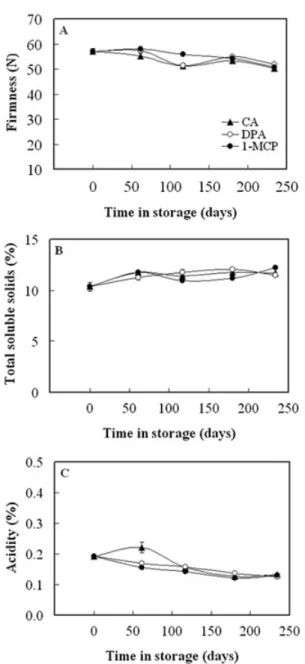
Firmness, soluble solids and acidity were measured immediately after removal of fruit from cold storage. Treating the fruit with DPA or 1-MCP did not affect the firmness, soluble solids or acidity of the fruit (Fig. 6). 1-MCP is generally reported to reduce fruit softening and increase acidity (Blankenship and Dole 2003). However, we observed no consistent effect of 1-MCP on flesh firmness immediately after removal from controlled atmosphere storage (Fig. 6A). Crouch (2003) observed no differences in the firmness of 1-MCP-treated pear fruits immediately after removal from cold storage, but significant firmness retention in 1-MCP-treated apples immediately exiting cold storage has been observed (Zanella 2003; Delong et al. 2004; Bai et al. 2005).
Controlled atmosphere strongly decreased the incidence of superficial scald and browning disorders as compared with cold storage in air (Fig. 7).
FIG. 5. EFFECT OF HARVEST MATURITY ON TOTAL (A), OXIDIZED (B) AND REDUCED GLUTATHIONE CONTENT (C) OF “ROCHA” PEAR DURING COLD STORAGE
FIG. 6. EVOLUTION OF FLESH FIRMNESS (A), SOLUBLE SOLIDS CONTENT (B) AND TITRATABLE ACIDITY (C) OF “ROCHA” PEAR STORED IN CONTROLLED ATMOSPHERE
AND TREATED WITH 1-MCP OR DPA
DPA further reduced these physiological disorders, and 1-MCP provided the most effective control. The inhibition of superficial scald by 1-MCP is well documented in apples (Zanella 2003) and pears (Crouch 2003; Ekman et al. 2004; Isidoro and Almeida 2006). The effect of 1-MCP on browning disorders is not clear. 1-MCP reduced internal browning in “Bartlett” pears (Ekman et al. 2004), but in apple, 1-MCP treatments have been reported to reduce (Fan et al. 1999) or enhance browning disorders (De Ell et al. 2003). The absence of significant differences in antioxidants levels observed in this work suggest that the benefits of 1-MCP on browning disorders and superficial scald are not directly related with its effects on the antioxidant content of the tissue.
Effect of Postharvest Treatments and Storage Conditions on Antioxidants
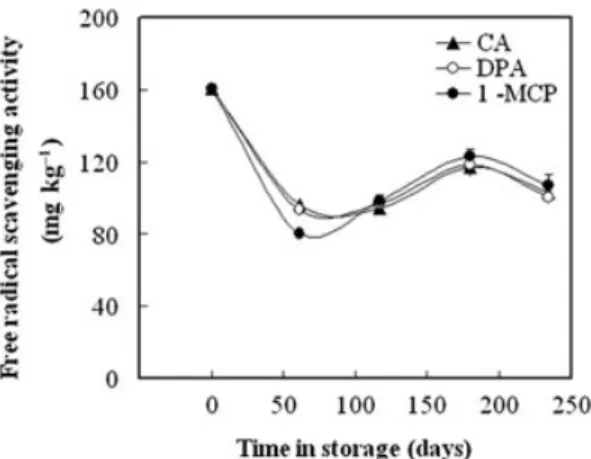
Free radical scavenging activity was not affected by controlled atmo-sphere storage or by the treatments with DPA or 1-MCP throughout the 234 days in storage. Independently, of the storage regime or postharvest treat-ments, free radical scavenging activity decreased, on average, 42% in the first 60 days in storage and remained relatively constant during the remaining storage period (Fig. 8). In apples, free radical scavenging activity increased during storage because of synthesis of phenolic compounds (Leja et al. 2003). In the short-term storage of “Golden Smoothee” apples, there was an increase in free radical scavenging activity (Vilaplana et al. 2006). The dynamics of the antioxidants and especially of their total content is not still completely under-stood.
FIG. 7. EFFECT OF STORAGE CONDITIONS AND POSTHARVEST TREATMENTS WITH 1-MCP AND DPA ON THE INCIDENCE OF SUPERFICIAL SCALD AND INTERNAL BROWNING DISORDERS IN “ROCHA” PEAR FOLLOWING 8 MONTHS IN STORAGE
AT-0.5C
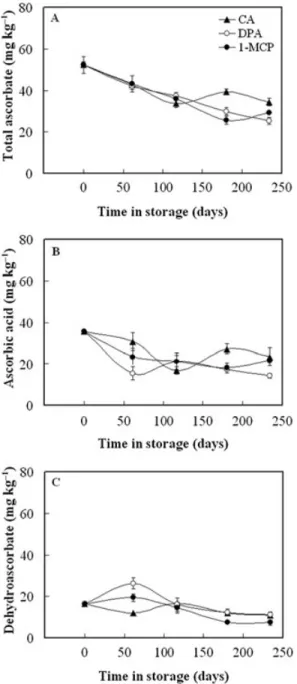
Ascorbic acid content was not affected by the storage regime or posthar-vest treatments with DPA or 1-MCP in a consistent way during storage (Fig. 9). Total ascorbate (average of four treatments) decreased 39.4% during storage. The reduced form of ascorbate decreased 40.3%. We observed similar ascorbate contents in fruits stored in air or in a controlled atmosphere in contrast with the results reported by Veltman et al. (1999) in “Conference” pears. These authors reported that the decrease in ascorbate content during storage was inversely proportional to CO2concentration. Veltman et al. (2000)
reported a decrease in ascorbate content>50% when “Rocha” or “Conference” pears were stored in a controlled atmosphere for 260 days. The effect of 1-MCP on ascorbate content is not clear. 1-MCP had no significant effect on ascorbate content of “Rocha” pears (Fig. 9). Similarly, Vilaplana et al. (2006) observed no influence of 1-MCP on ascorbate levels in “Golden Smoothee” apples, but other authors reported lower ascorbate content in “Blanquilla” pears and “Golden Smoothee” apples treated with 1-MCP (Larrigaudière et al. 2004; 2005).
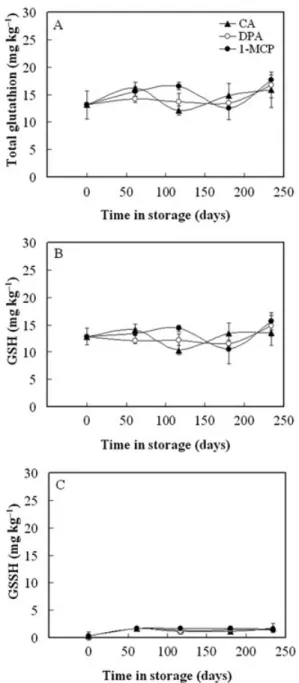
GSH content was not influenced by storage regime or treatments with DPA and 1-MCP (Fig. 10). GSH levels remained relatively stable during the 8 months of storage (Fig. 10). The reduced form of the GSH was present at 13.3 mg/kg throughout storage and accounted for 84.4% of the total GSH content. The average GSSG content throughout storage was 1.3 mg/kg. The content of GSSG is higher than the 5% indicated by Foyer et al. (2001) for plant cells.
FIG. 8. FREE RADICAL SCAVENGING ACTIVITY OF “ROCHA” PEAR DURING STORAGE IN AIR OR CONTROLLED ATMOSPHERE AND TREATED WITH 1-MCP OR DPA
FIG. 9. EVOLUTION OF TOTAL ASCORBATE (A), ASCORBIC ACID (B) AND DEHYDROASCORBATE CONTENT (C) OF “ROCHA” PEAR STORED IN CONTROLLED
ATMOSPHERE AND TREATED WITH 1-MCP OR DPA Values are mean⫾ SE (n = 3).
FIG. 10. EVOLUTION OF TOTAL (A), OXIDIZED (B) AND REDUCED GLUTATHIONE CONTENT (C) IN “ROCHA” PEAR STORED IN CONTROLLED ATMOSPHERE AND
TREATED WITH 1-MCP OR DPA Values are mean⫾ SE (n = 3).
Although harvest maturity significantly affected the occurrence of storage disorders and fruit physicochemical properties, differences in ascorbate content and free radical scavenging activity at harvest did not persist during long-term storage, suggesting that healthy pears maintain their antioxidant homeostasis if properly stored. A controlled atmosphere, DPA and 1-MCP showed different levels of efficacy against browning disorders and superficial scald but did not affect free radical scavenging activity or the levels of ascor-bate and GSH in the fruit, indicating that the occurring physiological disorders are not directly related to the levels of antioxidants in whole fruit. Properly stored “Rocha” pears maintain their antioxidant levels during long-term storage, with little or no effect of current commercial postharvest treatments.
BAI, J., BALDWIN, E.A., GOODNER, K.L., MATTHEIS, J.P. and BRECHT, J.K. 2005. Response of four apple varieties to 1-methylcyclopropene treatment prior to air or controlled atmosphere storage: Variety dependent differences in apple quality factors before and after simulated marketing period. HortScience 40, 1534–1538.
BLANKENSHIP, S.M. and DOLE, J.M. 2003. 1-Methylcyclopropene: A review. Postharvest Biol. Technol. 28, 1–25.
BRAND-WILLIAMS, W., CUVELIER, M.E. and BERSET, C. 1995. Use of free radical method to evaluate antioxidant activity. Lebensm. Wiss. Technol. 28, 25–30.
CAMPANELLA, L., BONANNI, A., FAVERO, G. and TOMASSETTI, M. 2003. Determination of antioxidant properties of aromatic herbs, olives and fresh fruit using an enzymatic sensor. Anal. Bioanal. Chem. 375, 1011–1016.
CROUCH, I. 2003. 1-Methylcyclopropene (SmartFresh) as an alternative to modified atmosphere and controlled atmosphere storage of apples and pears. Acta Hortic. 660, 433–440.
DE ELL, J.R., MURR, D.P., WILEY, L. and PORTEOUS, M.D. 2003. 1-Methylcyclopropene (1-MCP) increase CO2 injury in apples. Acta Hortic. 600, 277–280.
DELONG, J.M., PRANGE, R.K. and HARRISON, P.A. 2004. The influence of 1-methylcyclopropene on “Cortland” and “MacIntosh” apple quality following long term storage. HortScience 39, 1062–1065.
EBERHARDT, M.V., LEE, Ch.Y. and LIU, R.H. 2000. Nutrition: Antioxidant activity of fresh apples. Nature 405, 903–904.
Conclusion
EKMAN, J.H., CLAYTON, M., BIASI, W.V. and MITCHAM, E.J. 2004. Interactions between 1-MCP concentration, treatment interval and storage time for “Bartlett” pears. Postharvest Biol. Technol. 31, 127–136. FAN, X.T., MATHEIS, J.P. and BLANKENSHIP, S. 1999. Development of apple superficial scald, soft scald, core flush, and greasiness is reduced by MCP. J. Agric. Food Chem. 47, 3063–3068.
FAO. 2007. FAOSTAT database. Rome. http://faostat.fao.org (accessed December 14, 2008).
FERNÁNDEZ-TRUJILLO, J.P., NOCK, J.F., KUPFERMAN, E.M., BROWN, S.K. and WATKINS, C.B. 2003. Peroxidase activity and super-ficial scald development in apple fruit. J. Agric. Food Chem. 51(24), 7182–7186.
FOYER, C., THEODOULOU, F. and DELROT, S. 2001. The functions of inter- and intracellular glutathione transport systems in plants. Trends Plant Sci. 6, 486–492.
FRANCK, C., BAETENS, M., LAMMERTYN, J., SCHEERLINCK, N., DAVEY, M.W. and NICOLAI, B.M. 2003a. Ascorbic acid mapping to study core breakdown development in “Conference” pears. Postharvest Biol. Technol. 30, 133–142.
FRANCK, C., BAETENS, M., LAMMERTYN, J., VERBOVEN, P., DAVEY, M.W. and NICOLAI, B.M. 2003b. Ascorbic acid concentration in cv. Conference pears during fruit development and postharvest storage. J. Agric. Food Chem. 51, 4757–4763.
GARCÍA-ALONSO, M., PASCUAL-TERESA, S., SANTOS-BUELGA, C. and RIVAS-GOZALO, J.C. 2004. Evaluation of the antioxidant proper-ties of fruits. Food Chem. 84, 13–18.
GIL, M.I., TOMÁS-BARBERÁN, F.A., HESS-PIERCE, B. and KADER, A.A. 2002. Antioxidant capacities, phenolic compounds, carotenoids and vitamic C of nectarine, peach and plum cultivars. J. Agric. Food Chem. 50, 4976–4982.
GUO, C., YANG, J., WEI, J., LI, Y., XU, J. and JIANG, Y. 2003. Antioxidant activities of peel, pulp and seed fractions of common fruits as determined by FRAP assay. Nutr. Res. 23, 1719–1726.
HODGES, D.M., LESTER, G.E., MUNRO, K.D. and TOIVONEN, P.M.A. 2004. Oxidative stress: importance for postharvest quality. HortScience. 39, 924–929.
HÖNER, K. and CERVELLATI, R. 2002. Measurements of the antioxidant capacity of fruits and vegetables using the BR reaction method. Eur. Food Res. Technol. 215, 437–442.
ISIDORO, N. and ALMEIDA, D.P.F. 2006.a-Farnesene, conjugated trienols, and superficial scald in “Rocha” pear as affected by 1-methylcyclopropene and diphenylamine. Postharvest Biol. Technol. 42, 49–56.
KONDO, S., TSUDA, K., MUTO, N. and UEDA, J. 2002. Antioxidative activity of apple skin or flesh extracts associated with fruit development on selected cultivars. Sci. Hortic. 96, 177–185.
LARRIGAUDIÈRE, C., PINTÓ, E., LENTHERIC, I. and VENDRELL, M. 2001a. Involvement of oxidative processes in the development of core browning in controlled-atmosphere stored pears. J. Hortic. Sci. Biotechnol. 76, 157–162.
LARRIGAUDIÈRE, C., LENTHERIC, I., PINTÓ, E. and VENDRELL, M. 2001b. Short-term effects of air and controlled-atmosphere storage on antioxidant metabolism in “Conference” pears. J. Plant Physiol. 158, 1015–1022.
LARRIGAUDIÈRE, C., PINTÓ, E. and LENTHERIC, I. 2003. Oxidative behaviour of “Conference” pears stored in air and controlled-atmosphere storage. Acta Hortic. 600, 355–357.
LARRIGAUDIÈRE, C., VILAPLANA, R., SORIA, Y. and RECASENS, I. 2004. Oxidative behaviour of “Blanquilla” pears treated with 1-methylcyclopropene during cold storage. J. Sci. Food Agric. 84, 1871–1877.
LARRIGAUDIÈRE, C., VILAPLANA, R., SORIA, Y. and RECASENS, I. 2005. Effects of 1-methylcyclopropene on antioxidant metabolism in cold-stored fruit. Acta Hortic. 682, 957–964.
ŁATA, B. and PRZERADZKA, M. 2002. Changes of antioxidant content in fruit peel and flesh of selected apple cultivars during storage. J. Fruit Ornamental Plant Res. 10, 5–13.
LAW, M.Y., CHARLES, S.A. and HALLIWELL, B. 1983. Glutathione and ascorbic acid in spinach (Spinacia oleracea) choroplasts. The effect of hydrogen peroxide and of paraquat. Biochem. J. 210, 899–903.
LEJA, M., MARECZEK, A. and BEM, J. 2003. Antioxidant properties of two apple cultivars during long-term storage. Food Chem. 80, 303–307. LENTHERIC, I., PINTÓ, E., VENDRELL, M. and LARRIGAUDIÈRE, C. 1999. Harvest date affects the antioxidative systems in pear fruits. J. Hortic. Sci. Biotechnol. 74, 791–795.
LEONG, L.P. and SHUI, G. 2002. An investigation of antioxidant capacity of fruits in Singapore markets. Food Chem. 76, 69–75.
MORAIS, A.M.B., AVELAR, M.L. and RODRIGUES, A.C. 2001. Influence of delayed CA storage on ascorbic acid content and brown-heart incidence in “Rocha” pear. Acta Hortic. 552, 647–650.
NOCTOR, G. and FOYER, C.H. 1998. Ascorbate and glutathione: Keeping active oxygen under control. Annu. Rev. Plant Physiol. Plant Mol. Biol. 49, 249–279.
OHMORI, M., TSUJIMOTO, Y. and TAKAGI, M. 1983. Further polaro-graphic studies on the condensation products of dehydro-L-ascorbic acid
with o-phenylenediamine in acetate buffer, pH 3.6. Bull. Chem. Soc. Jpn. 56, 2033–2036.
PINTÓ, E., LENTHERIC, I., VENDRELL, M. and LARRIGAUDIÈRE, C. 2001. Role of fermentative and antioxidant metabolisms in the induction of core browning in controlled-atmosphere stored pears. J. Sci. Food Agric. 81, 364–370.
RODRIGUES, J.A., MIRANDA, P. and BARROS., A.A. 1993. Determinação por polarografia diferencial de impulsos da vitamina C após derivatização com o-fenilenodiamina. Port. Electrochim. Acta 11, 41–45.
SANCHÉZ, A.C.G., GIL-IZQUIERDO, A. and GIL, M.I. 2003. Comparative study of six pear cultivars in terms of their phenolic and vitamin C contents and antioxidant capacity. J. Sci. Food Agric. 83, 995–1003. SCHIEBER, A., KELLER, P. and CARLE, R. 2001. Determination of
phe-nolic acids and flavonoids of apple and pear by high-performance liquid chromatography. J. Chromatogr. A 910, 265–273.
TEMPLE, N.J. 2000. Antioxidants and disease: More questions than answers. Nutr. Res. 20, 449–459.
TRIANTIS, T., STELAKIS, A., DIMOTIKALI, D. and PAPADOPOULOS, K. 2005. Investigations on the antioxidant activity of fruit and vegetable aqueous extracts on superoxide radical anion using chemiluminescence techniques. Anal. Chim. Acta 536, 101–105.
VELTMAN, R.H., KHO, R.M., VAN SCHAIK, A.C.R., SANDERS, M.G. and OOSTERHAVEN, J. 2000. Ascorbic acid and tissue browning in pears (Pyrus communis L. cvs “Rocha” and “Conference”) under con-trolled atmosphere conditions. Postharvest Biol. Technol. 19, 129–137. VELTMAN, R.H., SANDERS, M.G., PERSIJN, S.T., PEPPELENBOS, H.W.
and OOSTERHAVEN, J. 1999. Decreased ascorbic acid levels and brown core development in pears (Pyrus communis L. cv. Conference). Physiol. Plant. 107, 39–45.
VILAPLANA, R., VALENTINES, M.C., TOIVONEN, P. and LARRIGAUD-IÈRE, C. 2006. Antioxidant potential and peroxidative state of “Golden Smoothee” apples treated with 1-methylcyclopropene. J. Am. Soc. Hortic. Sci. 131, 104–109.
ZANELLA, A. 2003. Control of apple superficial scald and ripening – a comparison between 1 and methylcyclopropene and diphenylamine post-harvest treatments, initial low oxygen stress and ultra low oxygen storage. Postharvest Biol. Technol. 27, 69–78.
ZERBINI, P.E., RIZZOLO, A., BRAMBILLA, A., CAMBIAGHI, P. and GRASSI, M. 2002. Loss of ascorbic acid during storage of “Conference” pears in relation to the appearance of brown heart. J. Sci. Food Agric. 82, 1007–1013.