Engaging socially-vulnerable communities in science:
exploring Science & Art approaches
Ana Margarida de Almeida Matias
Project Report
Master of Science in Science Communication
2
Project report submitted in fulfilment of the requirements for the degree of Master in Science Communication, conducted under the scientific supervision of Ana Lúcia Mena and Paulo Nuno
3
Como diria o Panda do Kung Fu “Não há dinheiro que pague a tamanha altamentidez e atraentidez” de Miguel Mariana, Pedro e Gil Shanti e Ria
4
De Cabo Verde vestida de coragem,
bebemos esperança dos bebés da casa.
Tenho memórias bonitas do meu bairro,
estou grata pelo amor dentro do museu e
estou feliz porque o meu cérebro está ligado ao Centro de Apoio a Migrantes.
5
Abstract
Social inclusion in science is a complex issue. During the past decades, research centres, science centres, museums and other institutions invested in science communication aiming to promote cultural activities to diverse audiences. Despite this investment, science
communicators from all over the world face the same challenge: how to reach citizens that are not interested in science? The main goals for this project were to explore innovative
techniques to engage socially-vulnerable communities with science, and propose a model of science communication built on this practice-based research. The project, named “Embodying Memories”, was developed in a collaborative way between science partners (IGC - Instituto Gulbenkian de Ciência, iNOVA Media Lab), art partners (museum from FCG – Fundação Calouste Gulbenkian) and administrative partners (Câmara Municipal de Oeiras). The target audience, a senior community of women, most illiterate and migrant from Africa, was involved on the project plan since early stages, starting with the topic choice - Memory. The project implementation consisted of eight sessions that took place over a period of more than two months in 2018, covering several themes related to memory and brain. Diverse formats were used for the session’s activities, from scientific presentations, neuroscience stories or study cases, community memories sharing, to more interactive activities stimulating body
movement, abstraction and self-expression. Besides in-door sessions at the migrant support centre, a visit to the FCG museum and a visit to IGC laboratories were organized, and a project public presentation was performed. The project was qualitatively evaluated to identify
changes in awareness, knowledge, engagement, attitude and social inclusion, which was made by the analysis of field notes, attendance record, pre/post assessment focus group, community project evaluation, project narrative, and public presentation content. Overall, it was
considered that the project had a moderate achievement, from a balance between very high attendance and willingness to participate in new cultural experiences, high engagement with the project, moderate increase in knowledge about neuroscience, and some increase in awareness and engagement with science, stimulation of curiosity, abstraction and self-expression. To achieve a high level of engagement, a dynamic equilibrium was constantly in a trial between the six axes of the project (science education, art education, cultural
entertainment, social inclusion, mental health promotion, institutional advertising), and respective institutions. The most important project achievements were the fluidity and fruition of the project itself, and the opportunity given to participants to engage with Science & Art, to visit the museum and laboratories, to meet scientists and science instruments. A relevant asset of the project, was the existence of the boundary spanner, which was developed along pre- and during sessions by taking actions, visits, share experiences and events to inhabit the laboratory sphere, the museum sphere, and the community world. The role of the boundary spanner was crucial, yet challenging to balance between how much would be desirable for each partner to stay in and out of their comfort zones and territories. Based on insights gained from the project development and evaluation, a model was proposed to guide science
communication projects using Science & Art approaches to promote social inclusion. The model entails the following phases: Phase 1. Design, plan and collaboration; Phase 2. Implementation; and Phase 3. Evaluation.
6
Resumo
A inclusão social em ciência é um tema complexo. Todavia tem-se assistido nas últimas décadas a um esforço crescente por parte das instituições de investigação científica, dos centros de ciência, museus, e outras organizações, na promoção de atividades culturais dirigidas a públicos diversificados. Apesar deste investimento, por todo o mundo os
comunicadores de ciência deparam-se com o mesmo desafio: como chegar a cidadão que não estão interessados em ciência. Os objetivos principais deste projeto foram a exploração de técnicas inovadoras de envolvimento de comunidades socialmente vulneráveis em ciência e a proposta de um modelo de comunicação de ciência decorrente desta investigação de base-prática. O projeto, denominado “Dar Corpo às Memórias”, desenrolou-se de forma
colaborativa entre os parceiros científicos (IGC - Instituto Gulbenkian de Ciência, iNOVA Media Lab), artísticos (museu da FCG – Fundação Calouste Gulbenkian) e administrativos (Câmara Municipal de Oeiras). O público-alvo, uma comunidade sénior de mulheres maioritariamente iletradas e migrantes de África, foi envolvido no projeto desde as fases iniciais, começando na própria escolha do tema – Memória. A fase de implementação do projeto consistiu num conjunto de oito sessões, ao longo de mais de dois meses, durante as quais foram abordados vários temas ligados à memória e ao cérebro. As atividades tiveram natureza diversa desde a apresentação de informação científica, narrativa de histórias da neurociência ou casos de estudo interessantes, partilha de memórias das participantes, até atividades mais interativas de estímulo ao movimento, à abstração e autoexpressão. Além das sessões que decorreram no centro de apoio a migrantes, foram também efetuadas duas visitas (ao museu da FCG e aos laboratórios do IGC) e uma apresentação pública do projeto. O projeto foi qualitativamente avaliado para identificar mudanças de consciencialização, conhecimento, envolvimento, atitude e inclusão social, com recurso à análise das notas de campo, registo de assiduidade, pré/pós grupos de foco, avaliação qualitativa feita pela comunidade, narrativa do projeto feita pela comunidade e conteúdo da apresentação pública. De forma global, considerou-se que o impacto do projeto foi moderado, com níveis de participação e abertura a novas experiências culturais muito elevados, elevado envolvimento com o projeto, moderado aumento de conhecimentos nas áreas das neurociências, e algum aumento de consciencialização,
envolvimento com a ciência, estímulo da curiosidade, abstração e autoexpressão. Para atingir elevados níveis de envolvimento, foram efetuadas constantes tentativas de equilíbrio
dinâmico entre os seis eixos do projeto (educação científica, educação artística, animação cultural, inclusão social, promoção da saúde mental, publicidade institucional) e respetivas instituições. Os maiores sucessos do projeto foram a sua própria fluidez e fruição e a
oportunidade dada às participantes de envolvimento com a ciência e a arte, participação numa visita ao museu e noutra aos laboratórios, o encontro com cientistas e os instrumentos da ciência. Uma mais-valia relevante do projeto foi a existência de uma “boundary spanner” – uma pessoa facilitadora de várias valências - , que se foi desenvolvendo durante as fases pré-sessões e durante as pré-sessões, através de ações, visitas, partilha de experiências e eventos para habitar a esfera do laboratório, a esfera do museu e o universo da comunidade. O papel do “boundary spanner” foi crucial, mas também desafiante, na medida em que requereu uma avaliação do quão cada parceiro estava disponível para permanecer ou sair da sua zona de conforto e territórios. Com base nos conhecimentos ganhos durante o desenvolvimento e avaliação deste projeto, foi proposto um modelo para projetos de comunicação de ciência para a promoção da inclusão social com recurso a abordagens de ciência & arte. O modelo consiste nas seguintes fases: Fase 1. Conceção, planeamento e colaboração; Fase 2. Implementação, e Fase 3. Avaliação.
7
Index
Abstract 5
Resumo 6
1. Introduction 8
1.1. Science & Society 8
1.2. Science & Art 10
1.3. Science & Social Inclusion 11
1.3.1 Projects for Social Inclusion in Science 13
1.4. Objectives and framework 16
2. The project “Embodying Memories” 17
2.1. Phase 1: Project design and planning 17
2.1.1. Establishment and characterization of partners 17
2.1.2. Development of a boundary spanner and establishment of relationships 19 2.1.3. Definition of the project scientific topic, goals and structure 20
2.1.4. Establishment of the evaluation plan 22
2.2. Phase 2: Implementation of the project 23
2.2.1. Project spaces and resources 23
2.2.2. Sessions execution 23
2.3. Phase 3: Project evaluation 30
3. Discussion 37
3.1. Insights and limitations from the project “Embodying Memories” 37
3.2. Model proposal for engaging vulnerable communities 41
4. Conclusions 45
Acknowledgements 47
References 48
Annexes 54
Annexe 1. List of acronyms 54
Annexe 2. Structure and plan of the project sessions 55
8
1. Introduction
1.1. Science & Society
Science and technology are embedded in every aspect of modern life (McCallie et al. 2009), therefore science literacy is considered an essential component of a democratic society, supporting a modern technology-based economy and promoting the cultural values of society (Falk et al., 2007). Moreover, Science, Technology, Engineering and Maths (STEM) are
enablers; they enable people to make sense of the world around them, they enable people to make informed decisions, and they enable people to pursue a wealth of exciting and fruitful career opportunities (Atkinson et al., 2014). A mature science culture is a complex of high literacy, sceptical but utilitarian attitudes, and moderate interest, and these are part and parcel of a productive knowledge society (Bauer, 2008). Consequently, to pursuit this maturity the society needs to build a multi-element resource system that includes teachers, schools, governments, scientists, science communicators and science institutions and create an extensive, spacious arena for cooperation and collaboration (Donghong and Shi, 2008). As such, informal science learning, broadly defined to include attitudinal and behavioural change, as well as changes in conceptual understanding, plays an increasingly important role in cultural engagement, political practices (Dawson, 2014b) and is a lifelong endeavour (Falk et al. 2007). In this work the term publics, as opposed to public or general public, is used to acknowledge the multiple identities and diversity that exist within the concept of public [as suggested in McCallie et al. (2009)]. In a survey undertaken by Grand et al. (2015) in a UK University, researchers gave a wide range of responses about the communities with which they engaged: media professionals, teachers, parents, school pupils, learned societies, health-care
professionals, patients, policy-makers, non-governmental organizations, companies, industrial partners, charities, community groups, voluntary and third sector organisations, university students and anonymous audiences such as viewers, listeners and readers of mass media. This diversity highlights the challenge of identifying the publics in engaged research, and the need for resources to support the processes of public formation.
The discussion of science communication has moved through three paradigms: science literacy, public understanding of science and science and society (e.g., Bauer et al., 2007). Goals for science and society, in addition to mutual learning, include civic engagement skills and empowerment, increased awareness of the cultural relevance of science, and the
recognition of the importance of multiple perspectives and domains of knowledge to scientific endeavours (American Association for the Advancement of Science, 2019). The British House of Lords report, published almost two decades ago, stated that public confidence in science had been severely eroded and that science should engage the public with direct and full-scale activities (House of Lords, 2000). Public Engagement with Science (PES) can help facilitate science literacy through Informal Science Education (ISE), even though PES does not
specifically include science literacy as a goal. The concept PES is substituting its predecessor, public understanding of science (PUS), and refers to activities, events, or interactions characterized by mutual learning among people of varied backgrounds, scientific expertise, and life experiences who articulate and discuss their perspectives, ideas, knowledge, and values (McCallie et al., 2009). PES recognises not just the mutual learning that occurs by publics and scientists during their interactions (Bultitude, 2011), but also the increased familiarity with a breadth of perspectives, frames, and worldviews (American Association for the Advancement of Science, 2019). There are a vast range of approaches to engaging public
9
audiences with scientific concepts; Rowe and Frewer (2005) identified around a hundred participatory activities and Mesure (2007) identified 1500 active initiatives within the UK alone. Nevertheless, PES experiences focus on current science or science-related societal issues, such as stem cell research and cloning; evolution and science education; STEM and national security; bioterrorism; energy policy; sustainable development; the environment; climate change; genetic medicine; emerging infectious diseases; genetically modified foods; space exploration; and nanotechnology” (American Association for the Advancement of Science, 2019). For example, Newton’s Law and Ohm’s Law are not typically good topics for PES, although they may be for PUS (McCallie et al., 2009); there is little controversy around them and therefore little room for discussion in a PES context or for public input.
Thousands of organizations dedicate themselves to developing, documenting, and improving science learning in informal environments for learners of all ages and backgrounds. They include informal learning and community-based organizations, libraries, schools, think tanks, institutions of higher education, government agencies, private companies, and philanthropic foundations (Bell et al., 2009). Informal environments include a broad array of settings, such as family discussions at home, visits to museums, nature centres, or other designed settings, and everyday activities such as gardening, as well as recreational activities like hiking and fishing, and participation in clubs (Bell et al., 2009). Historically, most of the focus of science education has been on pre-college and college level schooling; however, a growing body of evidence supports the assertion that science learning occurs in other places for other reasons, particularly when one looks beyond schooling for the source of that understanding. For example, people learn about science while engaged in personal investigations, through civic organizations and active leisure pursuits, such as visits to national parks, science centres and botanical gardens (Falk et al., 2007). Adults take their children to these settings because they feel such experience are worthwhile, educational and fun, and that they and their children learn science in the process [e.g., Borun et al. (1997), Rounds (2004), Ballantyne and Packer (2005)]. Similar motivations and findings can be ascribed to watching nature or science specials on television, using the Internet to access science-, environmental- or health-related
information, and engaging in science-related hobbies and special interest groups (e.g., Elder et al., 1998; Eveland and Dunwoody, 1998; Batts et al., 2008; Warden, 2010). Science learning is a natural and common outcome of living within a science-rich world, situated within the
activities of everyday life. This more asset-based perspective, characterized as socio-cultural-centred by some investigators (e.g., Brown et al., 2005), posits that science learning, like all learning, is driven by each individual’s need to know. From this perspective, PUS is not some generalized body of knowledge and skills that every citizen should have by a certain age, but rather a series of specific sets of only moderately overlapping knowledge and abilities that individuals construct over their lifetimes (Falk et al., 2007). For example, it has been shown that amateur astronomers are highly knowledgeable about astronomy, and years of club membership and engagement in education and public outreach activities are far better predictors of their astronomy knowledge than is formal training in science and astronomy (Berendsen, 2005). On the other hand, in an informal conversation in 1990 with the
geophysicist Robert Hazen about a recent earthquake, a Nobel Prize-winning chemist stated that never heard of plate tectonics (Pool, 1991). The nature of science learning is changing worldwide as individuals have unprecedented access to science education opportunities from cradle to grave, 24/7, through an ever-growing network of educational opportunities beyond schooling which include visits to museums, zoos, aquariums, science centres, natural area parks and reserves, television, radio, films, books and magazines, and increasingly through
10
personal games, podcasts, the Internet, and other social networking media (Falk and Dierking, 2012). While schools and mass media will doubtless continue to represent important sites for learning and engagement with science, a growing theme within the science education literature focuses instead on the roles played by other forms of so-called ‘informal’ or ‘free-choice’ science education (Dawson, 2014a).
1.2. Science & Art
In 1959, C.P. Snow described the communication between science and art as difficult. In the Rede Lecture “The two cultures” (Snow, 1959a) and then on the book “Two Cultures and the Scientific Revolution”(Snow, 1959b), Snow called attention to the dichotomy of “two cultures”, recognizing that the intellectual life of the whole of western society was increasingly being split into two polar groups: at one pole the literary intellectuals, at the other scientists. Between the two a gulf of mutual incomprehension—sometimes (particularly among the young) hostility and dislike, but most of all lack of understanding. In relation to this
polarisation, Snow believed it was sheer loss to all, to people, and to society. It is at the same time practical and intellectual and creative loss, and it is false to imagine that those three considerations are clearly separable.
Today, communication is seen as a necessary (but insufficient) contribution to science and society’s dialogue to reintegrate science within culture. Scientific thinking and activities are not outside culture, but well within; science in not another culture, alien to society (Donghong et al., 2008). Scientific discoveries and technological advances are seen by many as cultural achievements, as worthy in shaping the average person’s concept of self and a person’s worldview as philosophy, art, humanities, or the personal sphere. They are part of humanity’s cultural achievements and should be familiar to members of a modern, knowledge-based society (Falk et al., 2007). Moreover, knowledge is a plural and malleable phenomenon that can comprise different epistemic forms and ultimately different rationalities, a concept named as cognitive polyphasia by Jovchelovitch (2002). Arts and sciences may seem opposite poles at first sight; yet both are looking for the essence of things and both need creativity and
perseverance (Scheffer et al., 2017). Shein et al. (2015) in an innovative study of publics of art museums and science and technology museums demonstrated the existence of a group of citizens open to a diverse selection of museum exhibits, which the authors named the “third culture”, that complements to Snow’s dichotomy of “two cultures”. On this study’s third culture group, those who are knowledgeable and interested in science could be as likely to visit art museums as science museums.
Strategies fusing arts and science (e.g. using games, poetry, music, painting, sketching) are becoming a favoured medium for conveying science to the public. Collaborative projects between artists and STEM fields are not new, with renewed interest over the last decades (Heras and Tàbara, 2014). Following this, STEAM (Science, Technology, Engineering,
Mathematics + Arts and Humanities) integrations and cross-pollinations are becoming more relevant than ever (de la Garza and Travis, 2019). Science can benefit from philosophical, ethical and aesthetic insights, in order to better deal with issues of uncertainty and contingency. Conversely, arts and humanities disciplines can be energized by scientific understandings of dynamic processes, technological innovations and the process of exploration and discovery.
11
The role of the arts in communicating issues has a long tradition in the humanities, but it has been often overlooked by scientists (Belfiore and Bennett, 2007). Science & Art true cross-sectoral collaboration requires the combined efforts of one or more individuals from each sector to achieve common goals. They result in new knowledge or understanding that could not be achieved through a single sector alone (Metcalfe et al., 2008).
Arts are able to attract larger audiences (Opermanis et al., 2015), and the arts, together with science, can make the ‘invisible visible’ (Curtis, 2009). A maturing body of work indicates that the arts can deeply engage people by focusing on the affective domain of learning (i.e., engagement, attitude, or emotion) rather than on the cognitive domain (i.e., understanding, comprehension, or application), which is often emphasized in science education (Friedman, 2013). The objective of science communication through art is to bring science to the public in ways that are engaging, instructive, artistic and, always, content-driven (Schwartz, 2014). Examples of Science & Art projects for science communication are theatre as a way of communicating coastal risk (Brown et al., 2017), hip-hop dance as a way of learning ecology (Wigfall, 2015), or art installations inspired in neuroscience laboratories (Lopes 2015). Varelas et al. (2010) observed that while participating in a play representing STEM concepts, students engaged in comprehending science from multiple perspectives. Embodied exercises situate abstract concepts in a concrete context, thus relating intangible ideas with corporeal
information, and so rich multimodal distributed neural representations are forged (Hayes and Kraemer 2017). Chang (2015) compiled and environmental science artwork database that consisted of 252 artworks, but only 4% included artistic mediums like poetry, dance and performances; the majority was from the visual arts domain.
1.3. Science & Social Inclusion
Informal science education has been found to provide participants with opportunities to engage with science in ways that are inspiring, relevant and educational in both affective and cognitive terms; questions remain, however, about how accessible, inclusive and equitable ISE practices are (Dawson, 2014a). The theme of social inclusion in the science communication field is not new; the political value of science communication was explicit in many
cornerstones of the history of this field (Massarani and Merzagora 2014). There is a broad consensus among governments, industry, and the science communication community that more needs to be done to increase and widen participation in science, particularly in areas such as physical sciences and engineering and among those from under-represented groups, such as women, working-class, and some minority ethnic groups (Archer et al., 2015). A survey conducted by the British Science Association (2016) to 516 science communicators and public engagement practitioners in the UK showed that 45% targeted children (that represent about 16% of the UK population), with only 9% targeted those aged 65 and over. This is highly skewed towards school age children. The majority of science communicators that participated in the survey targeted those who are ‘open’ to science (59%); while the percentage serving those who ‘do not currently think science is for them’ (20%) is low compared to the proportion of the actual population in this group (30%).
Across Europe, opportunities to participate in ISE activities appear to be increasing. In 2004, it was estimated that 35 million European citizens, of whom 37% are youngsters, visit science centres and museums in Europe every year – i.e. about 10% of the whole population of Europe (European Commission 2004). However, European Union participation statistics in the field of adult lifelong learning demonstrate that those with the lowest levels of qualifications, from the
12
lowest socio-economic backgrounds and in the least knowledge intensive jobs do not strongly engage with education and training (Boeren and Whittaker, 2018; Desjardins et al., 2006). In the UK, white, middle-class people living with their families in urban areas are more likely to participate in activities ranging from visits to botanic garden, aquaria and museums to science talks or science festivals (Dawson, 2018). Likewise in USA those most likely to participate in science communication activities are more educated, earn more money and have young children in their household (Bell et al., 2009). Data from a 2012 report from the US National Science Foundation suggest that informal learning education inaccessibility and
non-participation are marked by age (with older people participating less), family status (those without children participate less) and social class (those in working-class and lower socio-economic positions participate less); and it is interesting to note that ethnicity and gender were not mentioned in the US data (Dawson, 2014a).
While in the last 30 years the public have become plural and heterogeneous, this nod towards plurality does not tell the full story (Dawson, 2018). The exclusion from science communication activities is not only a statistical fact, but also a neglected matter on communication research. The field of science communication has too often neglected social class as a variable (Dawson and Jensen, 2011). There is a great deal of empirical research on how visitors to museums, science centres, aquaria or other informal science learning environments behave, learn, socialise or recall their visits, however there is comparatively little research on questions of access, inclusion/exclusion, ‘non-visitors’ or ‘new-audiences’ (Dawson, 2014a). Research by Falk et al. (2012) that reviewed 553 articles (between 1980 and 2011) on ‘free-choice learning’ and ‘informal science learning’ found that only 27 addressed participants, visitors or audiences who could be considered disenfranchised in some way, suggesting that questions of inclusion and exclusion from ISE are under-researched and questions about ISE participants narrowly framed.
Archer et al. (2015) proposed the concept of “science capital” to supplement the influential French sociologist Pierre Bourdieu’s theory. Bourdieu conceptualized “cultural capital” as the legitimate, valuable, and exchangeable resources in a society that can generate forms of social advantage within specific fields (e.g., education) for those who possess it. Bourdieu identified four key types of capital— economic, social, cultural, and symbolic capital—which through interactions with habitus (a person’s internalized matrix of dispositions, which guides
behaviour) within fields (social contexts), produce relations of privilege or subordination within society (Bourdieu, 1986). The conceptual model of “science capital” proposes that scientific forms of cultural capital (comprising scientific literacy, a cultural appreciation of science, particular symbolic forms of capital regarding the transferability of science qualifications), behaviour and practices (including consumption of science-related media and out-of-school science learning contexts) and social capital (knowing people with science-related jobs, qualifications, talking to others about science) can have a significant use-value and/or exchange-value within society (Archer et al., 2015). However, Jensen and Wright (2015) contend that the phenomena described as “science capital” should remain within the bounds of “cultural capital”, given that science and other forms of legitimate culture occupy similar social space and have similar consequences; it is just one element of a larger unjust
sociocultural system. There are similarities in patterns of exclusion in cultural participation and science engagement activities, including overlap between consumers of arts and culture experiences more generally and those who attend science museums and events (e.g., Jensen, 2014). The Taking Part survey, which measured engagement and non-engagement in culture, leisure and sport in England, showed that people who live in the lowest socioeconomic status
13
areas of England are significantly less likely than those in the highest socioeconomic status areas to visit museums and galleries, heritage sites and public libraries and they are also less likely to engage in arts (Department of Culture, Media and Sport, 2010, in Atkinson et al., 2014). Results of Archer et al. (2015) study with 3,431 students from 45 schools across England, showed that science capital appears to align closely with cultural capital. Results of Kennedy et al. (2018) study with three major UK science festivals showed that for the majority of attendees, science festivals are simply one of many activities on the agenda of highly culturally active citizens. It must be stressed, however, that when Archer et al. (2014) firstly presented the concept of science capital, they did not propose “science capital” as a separate type of capital but rather a conceptual device for collating various types of economic, social and cultural capital that specifically relate to science. To address the equity challenge in public science communication, new tools and communication approaches are needed, and it would be helpful to document promising practices for inclusion from events around the globe (Kennedy et al., 2018). Moreover, the authors propose that effective social inclusion efforts should be viewed as a key mark of event quality.
1.3.1 Projects for Social Inclusion in Science
The number of projects specifically designed and executed for social inclusion increased number during recent years, but still numbers are relatively low. Described below are eight examples of social-inclusive projects of science communication: 1) “Urban Garden” for youth in USA (1998); 2) “Questioning Workshops” for children in Palestine (2009) and Croatia (2013); 3) “Parque Explora” open for all in Colombia (2007); 4) “Native Waters” open for all in USA (2003); 5) “Knowledge Rooms” open for all in Austria (2013); 6) “Scientific Racism” for adults in the UK (2007); 7) “Creative Canals” for adults in the UK (2003 - 2009); and 8) “Propage” for adults in France (2014). These projects cover different scientific areas and require contrasting resources.
Most inclusive programmes are intended for youth, which is the case of the “Urban Garden” project. A nine-month community-based science project [described in detail in Fenichel and Schweingruber (2010), and Fusco and Barton (2001)] was developed with more than 40 children and teenagers living on a large homeless shelter in New York City that housed up to 200 families. The majority of the youths revealed that the shelter felt like prison (Fusco and Barton, 2001). Discussions about issues and concerns of the teenagers were the basis to decide what action/practice to create, that turned to be to transform an empty lot (filled with
garbage, drug needles and other debris) into a usable public space. Teenagers collected relevant information, develop several plausible ideas and did conceptual drawings of the space. The agenda was shared with the group, and they had the option of not acting on suggestions; in fact, there were several sessions in which they played basketball or baseball, developed improvisational skits rather than working directly on the design of the lot. The science was enacted in the processes and methods by which the young people questioned urban violence, brainstormed ideas for bettering their community and tested their feasibility, in researching the lot – its physical (size, soil quality, living and non-living characteristics) and social elements [history as a garden, current contents that reflected political and economic conditions (Fusco, 2001)].
A shorter duration project was the “Questioning Workshops” for children in Palestinian schools, by “L’ Atelier des Jours à Venir” (a French NGO for scientific culture) facilitated during the Science Days of Palestine, in 2013 (Perié et al., 2014). The same organization also
14
performed research-based activities combined with sport and theatre activities, in Vukovar, a Croatian city, in 2009, where young Serbs & Croats still lived quite apart. These initiatives intended to let people experience scientific research and its values as tools for empowerment, which is particularly relevant whenever the target population is experiencing poverty,
segregation, ongoing conflicts or their aftermath, and needs to collectively find answers to their problem (Perié et al., 2014).
An excellent example of high-budget inclusive science communication developed for all ages was the creation of “Parque Explora”, a science centre located in Moravia (Medellin,
Colombia), a zone of great vulnerability, with a very low index of human development and quality of life (Aguirre, 2014). Within Moravia area of influence, 2’654 families were living in 10 acres of lands, in a mountain 35 meters high, totally made up by 1.5 million tons of garbage. Parque Explora developed programmes to foster neighbouring communities’ reception to science and technology, to strengthen bonds with its immediate surroundings and to
contribute to the reduction of the existing technology gap of the inhabitants of this area of the city. From this major project, Aguirre (2014) acknowledges that science museums should engage in creating scenarios for different audiences based on scientific and citizenship skills; should work with developers and neighbourhood leaders in vulnerable communities for a close relationship with the population; and alternative languages such as art, science and
experimental activities become relevant for the approach to complex communities, which are more easily committed to the process if they feel involved in the formulation and
understanding of the problem.
The “Native Waters: Sharing the Source” was a traveling exhibit designed by the Montana State University in conjunction with the Science Museum of Minnesota to share cultural views about water held by the tribal peoples of the Missouri River Basin as well as scientific concepts about the Missouri River and its watershed [description in detail in Sachatello-Sawyer and Cohn (2005), and in Fenichel and Schweingruber (2010)]. The process of developing the exhibition began by conducting over 100 interviews to tribal elders, resource specialists, educators, and cultural specialists about what they believe young people needed to know about water. The broad array of responses included cultural beliefs, cultural practices, water science, language preservation, water law, water rights, water quality, sources of
contamination, environmental justice issues, and water history (Sachatello-Sawyer and Cohn, 2005). The ~46 m2 exhibition was set up like an Indian tipi, with the inside space designed as a place to hear stories about native culture. It included a sculpture of a spring, panels of quotes from elders and tribal members, of sunrise, sunset, and the phases of the moon, and on the tipi wall was the story of the river, told as a blend of scientific and native elements. After a preview at Montana State University in September 2003, the two identical exhibit travelled to Missouri River Basin tribal communities’ schools, museums, libraries, and cultural centres, reaching more than 120,000 children and adults (Sachatello-Sawyer and Cohn, 2005). The “Knowledge Rooms” pilot project was developed in areas of Vienna (Austria) with a socially disadvantaged population, with a high migrant proportion, to temporarily offer science centre activities in empty shops (Streicher et al., Schulze 2014). During 72 days of 2013, 3500 people, mostly children up to the age of 13, teenage and school groups as well as a few adult groups, entered the rooms that had a setting which would not intimidate people. To include all ethnicities, the flyer and window labels contained key words in the prevalent migrant
languages (Turkish, Bosnian, Serbian, Croatian, Polish, etc.) and rules of the house were hung up in several translations. Additionally, some staff of the knowledge room spoke those
15
languages themselves. All knowledge rooms had access to a close-by outdoor space that at times was used for teaser activities, activities that require outdoor space and as a connect space between visitors and the community. Based on this project, (Streicher et al., 2014) identified some key factors enabling to attract “difficult-to-reach” audiences with diverse socio-economic background: the location inside the community, the type of space (an everyday place), the design with an air of improvisation, the concept of openness, the self-chosen investment of time, the multiple languages and the direct contact with communities groups and representatives with the possibility to develop tailor-made activities and content together.
During 2007 the Science Museum’s Dana Centre, in the UK, was involved in the project
“Scientific Racism” where members of London’s African-Caribbean community were consulted in order to inform a series of events about Scientific Racism at the Dana Centre (Foggett, 2008). This audience-led process resulted in two events: “Scientific Racism: A History” and “Is Science Colour Blind?”. The project intended to explore the needs, wants, expectations of the African-Caribbean community in London, one of the under-catered for and under-represented in the Museum’s visitor profile.
The “Creative Canal” project was carried out at the Science Museum in London, between 2003-2009, and developed relationships with 63 schools and 72 community groups to deliver a sustained programme of free outreach events (Science Museum Group 2019), with the focus on identifying and addressing barriers to using the museum and to feel confident with science. Each group enjoyed three outreach events, a show or workshop at the school or community centre, a visit to the Science Museum, a visit to the Canal Museum and a trip on the
Beauchamp Lodge floating classroom on the Regents Canal. Over the course of the project, 20 groups took part, key target audiences for the museums who live in deprived areas bordering the Regents Canal. As part of the project a group of Bangladeshi women from the area of London described as ‘deprived’ were recruited via links with a community organisation that provided English language teaching. The project evaluation team concluded that the move from ‘one off’ sessions to the three-stage model is a step in the right direction to engaging more in-depth with groups but it still very much feels like they are at the beginning of the process of really understanding why the Science Museum is important to these people (Hooper-Greenhill et al., 2007).
An example of inclusive engagement with science for adults was found in a citizen science initiative in 2014 in Grenoble, France, where a project (the butterfly monitoring programme “Propage” launched in 2010) developed by the French National Museum of Natural History, in collaboration with environmental non-governmental organisations involved 12 green space workers in detection and identification of butterflies (Peltola and Arpin 2018). In “Propage” project several techniques were used (such as affective techniques), which were able to involve less experienced and less privileged participants and broaden the role of participants, address their concerns and support ownership of the learning process.
16
1.4. Objectives and framework
The main goals for this study are to explore innovative techniques to engage
socially-vulnerable communities in science, and propose a model of science communications built on this practice-based research. Our exploratory approach brings together science, art and communication to develop new conceptual and operational definitions as well as improve future research design. More specifically, this project identifies and explores ways to bring science closer to a community with limited education and resources, using unconventional techniques and artistic tools. As a secondary outcome, the project pursuits ways of
participatory action and collaboration by actors and institutions from different cultures. The study intends to demonstrate how art can contribute to the engagement with the project (as shown for example in Koo, 2015), how openness and trust can contribute to communication effectiveness, and how science can relate to everyday life. The project objectives bend towards the community’s empowerment, willingness to participate in cultural experiences, and
awareness of science, more than to increase knowledge about science.
The project was designed as a participatory research project, giving opportunities for the community to explore and represent perspectives in their own terms; therefore, this is a project where the emphasis is not just on outcomes, but on the process itself (Cornwall and Jewkes, 1995). Participatory models of communication are thought to be able to situate science within the social context, because they not only take social concerns and insights into account but treat them as central to the communication process (Metcalfe et al., 2008). All activities are done in a collective way, as a dialogue with the community, stimulating curiosity and self-expression. Communications are adequate if they reach people with the information that they need in a form that they can use (Fischhoff, 2013). There is ample evidence that children and adults reason about issues that are important to them while interacting with other people (Fenichel and Schweingruber, 2010).
Complementary to talking about science, the project adopts a Science & Art approach. The rationale behind it is that artistic techniques evoke emotions (e.g., Pinto and Riesch, 2017; Stiller-Reeve and Naznin, 2017), activate processes of participation and dialogue (e.g. Curtis et al., 2012; Heras and Tàbara, 2014), and play the role of mediator between science and society (e.g., Von Roten and Moeschler, 2007; Opermanis et al., 2015). Art is also a way of promoting engagement which was conceptualized by Kim (2012) as a process that develops from the acts of exposing and focusing attention to the act of cognizing.
The project bridges specialists and institutions of science communication, neuroscience research, art and art education, and social inclusion, which requires individuals who mediate and effectively inhabit multiple social entities - boundary spanners, which are key agents managing within inter-organizational theatres (Williams, 2002). These individuals allow two different cultures to communicate successfully without the need for either to adapt culturally to the other (Kirby, 2008).
For the purpose of nomenclature clarification, in this work an activity is considered a short-duration isolated interaction (typically around one hour or less) between two or more individuals (e.g., a lecture, a laboratory experiment, a drafting exercise). The word session is used for longer-duration interactions (typically more than one hour and up to one day), that generally comprise several activities and take place as part of a plan.
17
2. The project “Embodying Memories”
2.1. Phase 1: Project design and planning
2.1.1. Establishment and characterization of partners
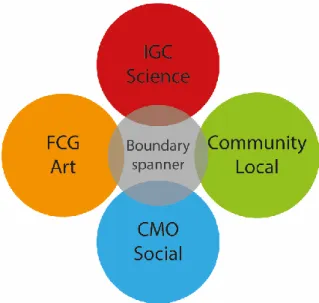
The project was coordinated by the Science Communication and Outreach office from Gulbenkian Institute of Science (Instituto Gulbenkian de Ciência, IGC, Figure 1). The office’s Head, Ana Lúcia Mena, is an experienced science communicator with deep knowledge of IGC’s scientists, and life sciences. Besides the science communication fellow, IGC contributed with the neuroscientist that participated in the project sessions. This scientist, Cláudia Gonçalves, is a PhD student from the Integrative Behavioural Biology research group. Also, on the academic side of the project, the researcher Paulo Nuno Vicente, from iNOVA Media Lab (applied research laboratory at NOVA FCSH) was included due to expertise in Science & Art as well as projects with vulnerable communities.
From the artistic counterpart, the partner was the Calouste Gulbenkian Foundation (Fundação Calouste Gulbenkian, FCG), through the Education Service of the Calouste Gulbenkian
Museum. The Foundation is a philanthropic institution whose main purpose is to improve the quality of life through art, charity, science and education. The museum fellow of the project was the art education professional Andreia Dias, experienced in both visual and performative arts.
The social partner of the project was Oeiras Municipality (Câmara Municipal de Oeiras, CMO), through the Division of Social Cohesion that promotes and executes measures, policies and projects of social inclusion and municipality programmes in the areas of social care, health, employment and professional formation. This institution contributed to the project as an expert on the municipality population, thus more equipped to identify the project target audience. The municipality social worker Maria da Assunção Tavares, was the technician from the municipality devoted to this project.
Figure 1 – Project partners of “Embodying Memories” from the science, art, social and community spheres, including project mediator - the boundary spanner.
18
It was defined that the target audience would be adults (because most science communication activities are devoted to children and teenagers), significantly apart from the scientific
community (to allow a clearer evaluation of the engagement variation), and living within the same municipality as the research centre (to encourage institutional bounding).The study population was chosen after a series of contacts and meetings with the municipality social workers, following the defined above criteria. The project’s target audience was an
underprivileged community composed of 14 women, 13 of which migrants from the Republic of Cabo Verde, aged 64 to 84 years (average 73 years), and low literacy levels (maximum of fourth grade, six never attended school, Figure 2). All women were retired from jobs that required almost no scholar qualifications, such as factory manual workers, housekeepers, and fish sellers.
Figure 2 - Main characteristics of the project “Embodying Memories” local community. Below panel represents the number of participants in each age category (in blue), showing most have between 65-69 and 70-74; and the average schooling per age category (in orange), showing that between 60-64 year old women attended 4th grade,
while none of the 80-84 women attended school.
According to the Foreign Services, in 2009 there were 10,525 foreigners living in Oeiras municipality area, and the two main origin countries were Brazil (30%) and the Republic of Cabo Verde (28%; Mendes et al., 2011). Within the migrants, individuals from Cabo Verde were the ones presenting the lowest level of literacy (Mendes et al., 2011). The selected target
19
audience was assembled as a group by the municipality social worker in November 2016 (about a year before the project), with the aim of supporting elderly women migrant from Africa (Figure 2). The initial group identified by the technician was composed of 22 women, 58 to 90 years old, named “As Marias” (Tavares, 2016). These women were under a rehousing programme from slum dwellers (“Alto de Santa Catarina” and “Pedreira dos Húngaros”). When the community was gathered to start the project, some members of the community “As Marias” were absent, mostly due to health issues.
2.1.2. Development of a boundary spanner and establishment of relationships
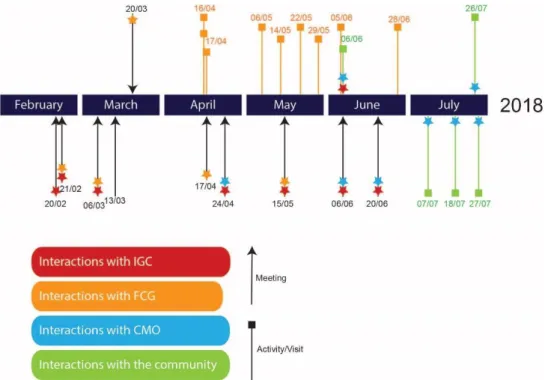
In a multiple partners project such as this, where each has their own ways and customs, the mediator (defined as boundary spanner in section 1.4, Figure 1) needs to reinforce his/her role as an inhabitant of the multiple social entities. In section 3.2 the role of the boundary spanner is further discussed.The development of the boundary spanner involved the following tasks: 1) inhabiting the laboratory sphere, 2) inhabiting the museum sphere, and 3) inhabiting the community world. The boundary spanner interactions timeline (Figure 3) shows how these relationships
developed over time. The boundary spanner of this project was Ana Matias, the author of this thesis.
Figure 3 – Timeline of the interactions between the boundary and the several partners, during the phase of project design, plan and collaboration.
To inhabit the laboratory sphere, regular meetings with the science communicator of IGC were held at an initial stage (Figure 3). Project management was on IGC side, therefore meetings included definition of goals, technical possibilities, and available resources. To get familiar with
20
the space and the atmosphere, the boundary spanner benefited from sharing the IGC communication office at a number of occasions, from June to November 2018.
To inhabit the museum sphere, three meetings and contacts with the museum fellows were made to define a participation plan in the museum educational practices. In addition, the boundary spanner joined in a series of activities implemented by the museum fellows. The activities participation was divided in two types:
a) Visits and activities: The boundary spanner attended visits and activities undertaken by different guides (Susana Quaresma, Cristina Campos, Paula Ribeiro, Miguel Horta, Joana Andrade) to different target audiences from pre-school children, 5th grade students, 8th grade students, general public, disabled and incapacitated people. b) Long-term projects: The boundary spanner attended an FCG project “Entre-Vizinhos”
(Between Neighbours) with elderly people from the museum’s vicinity to promote their contact with the institution, whilst stimulating creativity and art engagement. The boundary spanner attended four sessions at the social institutions, and one at the museum, coordinated by Diana Pereira and Joana Andrade.
Visitations, activities and project participation served the purpose of learning about art, getting familiar with the museum collection, getting acquaintance with the museum staff, and learning about the museum educational practices and art engagement techniques.
To inhabit the community sphere, several informal gatherings took place in June and July 2018. These occasions, mediated by the social worker, were used to establish a relationship with the community, generating empathy and trust, and to learn about the community’s interests and its dynamics. This relationship was established and nurtured by a series of interactions: 1) The first contact occurred during a fund-raising lunch organized and prepared by the community serving traditional Cabo Verdean food.
2) The first formal meeting was held with representatives from other institutions that also intended to collaborate with the community. During this meeting, all members of the
community introduced themselves and showed their handicrafts. To identify possible research topics to be addressed in this project, a discussion about the community was held. An ice-breaker activity was made by the IGC, which consisted on an experiment with flowers that had been put in coloured water for some minutes.
3) A meeting between the boundary spanner and the community took place to further know common interests and practices.
4) The boundary spanner participated in two summer trips to the beach within a programme from Oeiras Municipality that promotes a healthier life-style and enables beach access to people with mobility issues. During these gatherings, the boundary spanner tried to merge with the community, and at the same time identify their individual characteristics (outgoing, sceptical, insecure, interested, introvert, confidant, …).
5) The boundary spanner and the community attended a lunch gathering hosted by the Community Centre “Alto da Loba”, where another vulnerable senior community from the same municipality is supported. These two communities had met during the beach summer trips, within the municipality mobility programme.
2.1.3. Definition of the project scientific topic, goals and structure
The scientific topic was defined after acknowledging on the one hand, the community’s significant attachment to old memories from experiences lived in Africa, and on the other hand, some concerns expressed by the community on short-span memory deterioration. The
21
topic ‘Memory’ arose during the encounters with the community described earlier, after agreement with all partners. It is a topic that appreciates diversity, can elicit emotions, allows for clear transference of science knowledge to everyday life, it is bursting with suggestive processes and images suitable for artistic approaches, and for which all partners have different perspectives. The title of the project – Embodying Memories – was chosen to meet the topic as a multiple entendre: the body part where memories are stored (the human brain, hence the science connection), the allusion to objects that give body to individual (community’s) and collective (museum pieces) memories, and the possible use of performative arts to express memories. Project “Embodying Memories” specific goals were to engage the community with the project, increase their awareness while promoting their engagement with science, increase knowledge of scientific topics related to neuroscience, stimulate creativity, curiosity,
abstraction and self-expression, and to encourage the community’s willingness to participate in cultural experiences.
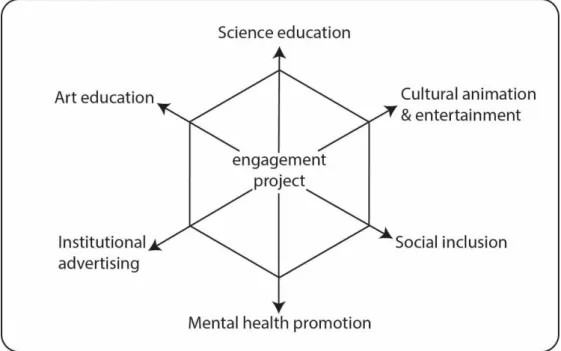
The project was planned as a sequence of sessions, that could be small workshops, visits or round-table discussions, that intended to promote the community engagement in science through a dynamic equilibrium over several axis: science education, art education, health education, cultural animation and entertainment, social inclusion, and institutional advertising (Figure 4).
Figure 4 - Axes of the project “Embodying Memories”.
Objectives and practices of these six axes can be adopted, namely techniques of art engagement and education that museums offer, science communication and education techniques that scientific and academic institutions offer, cultural animation and
entertainment that cultural and social institutions offer, social inclusion that public institutions offer, with an underpinning institutional advertising from all partners. The inter-institutional proximity, a side-effect of the project, was considered important as well since most projects are single or bilateral; science, art, academic and the social institutions seldomly are involved
22
in a single project. Multi-partners projects although challenging to manage, have the
advantage of bringing to the table multiple spaces and resources, thus have the potential to go further.
The generic structure of project sessions was established in five segments: reception, resume, science explanation, practical activities, and wrap-up. This structure incorporated elements from the project’s axes. The common course consisted of: 1) an initial group reception and room arrangement; 2) a brief resume of previous activities; 3) an explanatory segment about the session theme; 4) practical activities recurring to artistic techniques and narratives in relation to the theme; and 5) a wrap-up of the session. The plan for each session was based on the generic structure, scientific outline, and former interactions with the community and the neuroscientist. A number of practical activities were proposed by the art specialist from FCG. Visits and discussions had a different scheme, depending on the institution, goals, and resources.
2.1.4. Establishment of the evaluation plan
Several evaluation elements were planned to provide evidences of the project impacts in relation to the objectives established for the project (section 2.1.3), according to the
Framework for Evaluating Impacts of Informal Science Education Projects (described in detail in Allen et al., 2008). This evaluation sets a system of six impact categories: 1) awareness, knowledge or understanding, 2) engagement or interest, 3) attitude, 4) behaviour, 5) skills, and 6) others - project specific. Project intended impacts should fall within some, but not all these categories (Dierking, 2008). For the project “Embodying Memories” the chosen categories were: Awareness and knowledge, Engagement, Attitude, and Social Inclusion.
Because most of the community is illiterate or has low levels of literacy (Figure 2), no questionnaires, written information or ratings could be supplied or used. The project evaluation plan consisted on the analysis of the following:
1) Two semi-structured focus groups before and after the project sessions, hereafter called pre/post assessment, addressing the community’s perception and involvement with science. 2) Project logbook, hereafter called session notes.
3) Participants attendance throughout the project. This element is hereafter called attendance record.
4) At the end of the project sessions, participants were asked to list aspects they liked more, liked less, and that were relevant, during the project. This element is hereafter called project evaluation.
5) At the end of the project sessions, participants were asked to describe the project contents in their own words. This element is hereafter called the project narrative.
6) A public presentation or performance of the project by the community was foreseen. This presentation, hereafter called the project presentation, was analysed.
23
2.2. Phase 2: Implementation of the project
2.2.1. Project spaces and resources
Most project sessions took place at the Local Centre of Support to the Integration of Migrants (Centro Local de Apoio à Integração de Migrantes - CLAIM Carnaxide), in Outurela – Carnaxide, that resulted from a cooperation protocol established between the Oeiras Municipality and the Portuguese High Commission for Migration, a public institution dependent of the
Presidency of the Ministers Council. The centre seeks to provide support tailored to migrant’s needs such as family reunification, social security and social support. The centre is coordinated by the social work professional from CMO, Maria da Assunção Tavares, the project partner, that manages the space, identifies the needs, and contacts and gathers the community. A room in CLAIM was the main venue for regular sessions. Oeiras Municipality also provided transportation for the group visits to the artistic and scientific facilities.
The visit to the museum took place at the Calouste Gulbenkian Museum. The museum houses the founder’s private collection, alongside a collection of modern and contemporary art, open to the public. Within the scope of this project, the museum organized and hosted an adapted activity with a guide.
The visit to a research centre occurred at the IGC. Researchers and technicians were mobilized to explain their scientific instruments, laboratory techniques, research objects, and their scientific models. The tour included laboratories, the microscopy unit and a fish room within the animal house facility.
2.2.2. Sessions execution
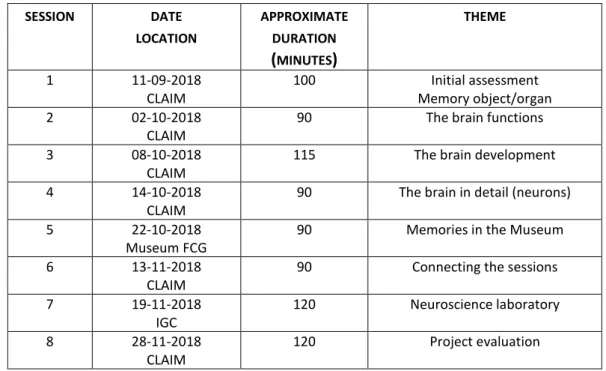
The project development consisted in eight sessions with diverse themes and formats, from more explanatory to more interactive, from in-door sessions in CLAIM room to visits to the museum and laboratories (Table 1). The details about the development of each session can be found in Annexe 2 (in Portuguese). The sessions started in September 11th and ended in November 28th 2018, with a duration of 90 to 120 minutes each. Because of the community’s characteristics and following the social inclusion axis, the entire project was designed in order to allow the participation by illiterate people. This implied that no game or activity could require reading, no institutional leaflet could be used, and the community participants could not take notes. Moreover, modern technological tools (computers, tablets, smart phones) were avoided as much as possible since all depend on some degree of literacy. All scientific or artistic images were printed on paper or visualized in a computer screen (on session 7, at the laboratory, Figure 8).
24
Table 1: Session number, date, location, duration and main theme of the Project “Embodying Memories”.
SESSION DATE LOCATION APPROXIMATE DURATION
(
MINUTES)
THEME 1 11-09-2018 CLAIM 100 Initial assessment Memory object/organ 2 02-10-2018 CLAIM90 The brain functions
3 08-10-2018
CLAIM
115 The brain development
4 14-10-2018
CLAIM
90 The brain in detail (neurons)
5 22-10-2018
Museum FCG
90 Memories in the Museum
6 13-11-2018
CLAIM
90 Connecting the sessions
7 19-11-2018 IGC 120 Neuroscience laboratory 8 28-11-2018 CLAIM 120 Project evaluation
Regular sessions followed the generic scheme presented in section 2.1.3, that consisted of: 1) an initial group reception and room arrangement according to the boundary spanner and science communicator suggestions; 2) a brief resume of previous activities by the science communicator; 3) an explanatory segment about the session theme shared between the neuroscientist (sessions 1, 2, 3, 4), the science communicator (sessions 1, 2, 3, 4, 6) and the community (session 1); 4) practical activities recurring to artistic techniques and narratives in relation to the theme by the boundary spanner, the science communicator, the art specialist (session 4) and the community; and 5) a wrap-up of the session where the community members were asked to name three words related to the session. This general structure was adjusted on each session according to convenience, for example, of scientific topic fluidity, level of engagement, earlier demonstrated interest, and narrative purposes.
The scientific alignment of the project consisted in introducing the organ where memories are stored (i.e. introducing the brain anatomy, Figure 5b), presenting the areas of the brain and the main functions associated with these areas, the human brain development, and the brain cells (i.e. neurons) and connections.
25
Figure 5 - Photographs of the project "Embodying Memories" in-house sessions. (a) Session 1 with memory objects; (b) Session 1 with the brain model; (c) Session 2, mimic of dressing; (d) Session 3, movement of representing (brain) growth; (e) Session 3, game of brain regions and brain functions; (f) Session 4, arm coordination activity; (g) Session
26
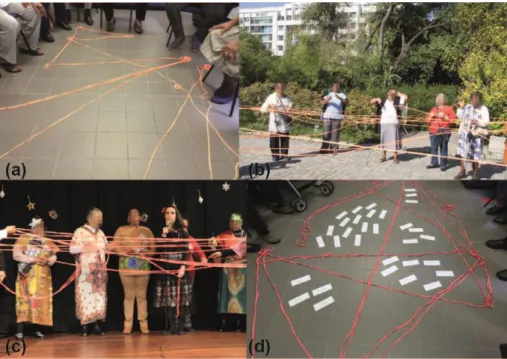
Figure 6 - Photographs of the four occasions where the fabric yarn network was used: (a) sessions 4, (b) FCG garden, (c) project presentation, and (d) session 6.
Brief description of each section:
During session 1, at CLAIM (Table 1), after the community reception, the science
communicator conducted a pre-assessment focus group to assess (mainly) attitudes towards science (questions in Annexe 3). Next, participants were asked to talk about a past event related to an object of their choice brought to the session (or described). Objects included a clay craft by a granddaughter, a plant, a guitar from childhood, a dress wore during the boat trip to Portugal, a trophy earned during an evening at the casino offered by the employer, a piece of woollen fabric offered by the employer, and handmade dolls (Figure 5a). The neuroscientist presented the organ where all these memories are stored - the brain. Main morphological characteristics of the brain were mentioned, using a real-scale human brain model (Figure 5b) to support the description. The boundary spanner asked participants to provide three words that described the session (words: brain, daisy, memory, patience, and head).
During session 2, after the community reception, a resume of session 1 was made by the science communicator, giving space for the presentation of more memory objects (a mug was added). Images of a brain section with coloured regions and a matching 9-piece puzzle were distributed among participants. The neuroscientist explained several brain functions related with the coloured brain regions, and located them in her own head. The boundary spanner asked participants to create movements mimicking functions related to the memory objects (Figure 5c). The neuroscientist related the memory objects with the several functions and regions of the brain (e.g., the fabric and the sense of touch, the clay craft and the motor control region). The neuroscientist talked about other brain functions and told famous cases of brain study cases (e.g. Phineas Gage accident survival). The boundary spanner asked
participants to provide three words that described the session (words: educational, dress, knead, fabric).
27
During session 3, at CLAIM, after the community reception, a resume of sessions 1 and 2 was made by the science communicator, mentioning memory objects, brain regions and functions. To further remember the brain functions, images and puzzles of the brain regions were shown again, and a game that relates activities with brain regions was made (Figure 5e). The
neuroscientist explained the phases of brain development in uterus, childhood, adolescence, and adult life. The explanation included factors that can benefit or compromise brain
development, as well as simple suggestions for everyday life brain stimulation, helpful for the community. Images of stages of brain development before birth were shown. The boundary spanner asked participants to create movements or gestures that represent stages of brain development as growth (Figure 5d), pathways, social interaction and exercise. The boundary spanner asked participants to provide three words that described the session (words: babies, hugs, kisses, affection).
During session 4, at CLAIM, after the community reception, a resume of sessions 1, 2 and 3 was made by the science communicator, mentioning memory objects, the word collection, brain regions, functions and development. The art specialist participated on the session for the first time, thus the resume worked as an update for her. The neuroscientist introduced the concept of cells in the human body, and in particular the neurons; and explained how neurons connect in networks. Images of cells (e.g. skin cell, blood cell, egg) and neuron network were shown, as well as a model of a neuron handmade by the neuroscientist. The art specialist proposed an activity carried out in groups of three people that while freely moving the arms needed to collectively maintain three hands in the centre (Figure 5f). The art specialist, inspired by the neuron network, rolled fabric yarn around participant’s hands, once at a time, by participant’s choice. At the end a network connecting participants (cells) was obtained (Figure 6a). The boundary spanner asked participants to provide three words that described the session (words: cell, electricity, hands, and network).
Session 5, at the Museum Calouste Gulbenkian (Table 1), was adapted from an activity offered by the museum educational service called “Between places, between cultures in 180
degrees1”. The visit had a first part where the relevance and significance of objects was approached in an interactive way. This discussion revolved around small objects that were distributed among participants: a compass, a pen drive, a japamala (a string of prayer beads), a matryoshka doll, a mummy representation, a tea box, a cloth ring, a mikado game, and a feather lapel pin. The second part developed around four art pieces: two European paintings (Figure 7), a Persian carpet, and an ancient Egypt sculpture, which were described, put into context and discussed with participants. At the end the fabric network was done in the museum garden (Figure 6b), and participants were asked to provide a word about the session (words: holy family, paintings, carpet, St. Joseph, painting by Rubens, Mr. Gulbenkian, horses and baby Jesus, love it, gratitude, cloth ring, expectation, happiness, beautiful, thank you).
28
Figure 7 - Photographs from the visit to the museum, session 5 in 22/10/2018; and images from the two favourite paintings in the museum collection: Top right: Portrait of Helene Fourment, by Peter Paul Rubens, ca. 1630-32; and bottom left: Holy Family and Donors by Vittore Carpaccio, 1505; © Calouste Gulbenkian Foundation.
During session 6, at CLAIM, after the community reception, the resume of previous sessions was made by the science communicator by asking participants to remember the word
collection. A fabric yarn network was made while each community participant was asked to tell something to the science communicator about what happened during session 5. With the yarn network on the floor, pieces of papers with the words from the project’s collection were distributed inside the polygons by word classes (nouns, verbs, adjectives, places, feelings; Figure 6d). Each participant collected five words from the five polygons and a poem line was created with each set. A five-line poem was generated in this collaborative way:
De Cabo Verde vestida de coragem, bebemos esperança dos bebés da casa. Tenho memórias bonitas do meu bairro, estou grata pelo amor dentro do museu e
estou feliz porque o meu cérebro está ligado ao Centro de Apoio a Migrantes.
During session 7, at the Gulbenkian Institute of Science, several laboratories and facilities were visited (Figure 8): the space where the collaborating neuroscientist Cláudia Gonçalves works regularly (Integrative Behavioural Biology Laboratory), a room in the animal house facility hosting zebrafish production, the Histopathology Laboratory were organ samples and sections
29
of sampled tissues were observed, and the Advanced Imaging Laboratory were live neurons from flies were observed under the microscope.
Figure 8 - Photographs from the visit to IGC, session 7, in 19/11/2018; and an image from an embryo section from the Histopathology Unit, © Instituto Gulbenkian de Ciência.
During session 8, several elements of the project evaluation were conducted. The science communicator ran the focus group (post-assessment), the science communicator and the boundary spanner asked the community participants to describe the project in their own words (project narrative), the boundary spanner asked the community participants to evaluate the project (project evaluation, described in section 2.3). The boundary spanner, the social worker together with the community started to prepare the project public presentation. The project public presentation took place on 30th November 2018, within a party to celebrate the second birthday of the community “As Marias” organized by the social worker, with the support of the municipality. The party took place at a concert hall/sport facility of “Associação de Moradores do Bairro 18 de Maio”, a residents’ association. The public presentation
consisted on a sequence of individual statements about the project “Embodying Memories”, created and recited by each community participant and the boundary spanner, while a
network of fabric yarn was created on stage. The placement on stage, wardrobe, sequence and props (Figure 6c) were discussed, prepared and rehearsed by the community and the