IMPACTS OF CO
2-INDUCED
OCEAN ACIDIFICATION ON
PREDATOR DETECTION ABILITY
AND DEVELOPMENT OF
TEMPERATE FISH
SARA ISABEL GONÇALVES MARTINSOrientador de Dissertação:
DOUTORA ANA MARGARIDA DA SILVA FARIA
Coordenador de Seminário de Dissertação:
DOUTOR EMANUEL GONÇALVES
Tese submetida como requisito parcial para a obtenção do grau de:
MESTRE EM Biologia Marinha e Conservação
Dissertação de Mestrado realizada sob a orientação da Doutora Ana Margarida da Silva Faria, apresentada no ISPA – Instituto Universitário de Ciências Psicológicas, Sociais e da Vida para obtenção de grau de Mestre na especialidade de Biologia Marinha e Conservação.
“Thus human beings are now carrying out a large scale geophysical experiment of a kind that could not have happened in the past nor be reproduced in the future.” (Revelle and Suess, 1957)
Agradecimentos
Gostaria de dirigir os meus sinceros agradecimentos e profunda gratidão à orientadora de dissertação Doutora Ana Faria pela orientação, paciência, compreensão, motivação e ajuda inestimável no campo e laboratório do dia-a-dia. Também por sempre acreditar em mim, incentivando-me a continuar nos momentos difíceis. Sem dúvida este trabalho não teria sido possível sem ela.
Agradeço à Ana Lopes pela sua amizade, ajuda, apoio, paciência e transmissão de conhecimento no decorrer do trabalho de laboratório.
Agradeço à equipa de investigação do ISPA (Diana, Paulo, Pedro, Sílvia, Henrique, Gonçalo, António, João e Fred) por toda a ajuda e apoio, bem como pela sua amizade e afeto.
Agradeço também a todos os que me apoiaram e me incentivaram para levar este percurso a bom termo, sobretudo às minhas colegas de mestrado (Diana Vieira, Ana Coelho) que sempre estiveram presentes e nos fomos amparando e suportando nos altos e baixos do caminho.
Por último não me esqueço de agradecer à minha família, à minha mãe e ao meu irmão, pelo apoio e suporte. Agradeço ao meu marido, pelo seu apoio, força e amor incondicional, mas também pela ajuda e paciência nas piores horas. Sem ti, tudo tinha sido mais difícil!
Este trabalho foi apoiado por uma bolsa pós-doc atribuída a A. Faria (SFRH / BPD / 68673/2010), pelo projeto ACIDLARVAE (PTDC / MAR-EST / 4627/2012) e pelo projeto estratégico (UID / MAR / 04292/2013), todos financiados pela Fundação para a Ciência e Tecnologia.
Resumo
A acidificação do oceano, causada por níveis elevados de dióxido de carbono (CO2) atmosférico, é reconhecida como uma ameaça aos ecossistemas marinhos. A maioria dos estudos tem-se centrado nos organismos de calcificação marinha, devido à dependência de carbonato de cálcio, que poderá ficar limitado no futuro. Menos atenção tem sido dada aos peixes, mas estudos recentes sobre os estados larvares sugerem que o comportamento, crescimento, desenvolvimento e mesmo a dimensão de estrutura como otólitos podem ser afetados com o aumento dos níveis de CO2. Contudo, outros estudos não conseguem detectar efeitos negativos, sugerindo vulnerabilidades variáveis entre espécies.
Neste estudo foram testados os efeitos da acidificação no período larvar de Lepadogaster lepadogaster, uma espécie de peixe marinho temperado. Foram incubados ovos e desenvolvidas as larvas em cativeiro e em condições de controlo e de pCO2 elevado. As alterações morfométricas e o tamanho de otólitos foram examinados em larvas em pré-assentamento. Foi ainda testada a resposta comportamental a um odor de predador em larvas de L. lepadogaster e de Atherina presbyter, mantidas em condições de pCO2 elevado. A capacidade de reconhecer odores de predadores por ser uma resposta chave para a sobrevivência, sendo reconhecido em diversos estudos como um dos mais afetados em peixes expostos a altos níveis de CO2.
Os resultados sugerem que as fases larvares de L. lepadogaster podem ser mais resilientes a cenários de acidificação, enquanto A. presbyter parece ser mais suscetível, com potenciais efeitos na sua sobrevivência. Estudos futuros deverão abordar a capacidade de diferentes espécies se adaptarem às condições de acidificação previstas até final deste século.
Palavras-chave: Acidificação; Desenvolvimento larvar; Comportamento larvar;
Abstract
Ocean acidification, caused by elevated levels of atmospheric carbon dioxide (CO2), is recognized as a serious threat to marine ecosystems. Until now, most studies have focused on marine calcifying organisms, due to dependence on calcium carbonate, which is likely to become limited under future acidification scenarios. Less attention has been given to fish, but recent studies on the early life stages suggest that behavior, growth, development and otolith size may be highly affected by increasing CO2 levels. Other studies, on the other hand, fail to detect negative effects, suggesting species-specific vulnerabilities to increasing concentrations of CO2 and point to a need of further research.
Here we tested the effects of CO2-induced ocean acidification on the early life stages of a temperate marine fish, the clingfish Lepadogaster lepadogaster, by rearing larvae since hatching in control and high pCO2 conditions. Size-at-age metrics and otolith size were examined in pre-settlement stage larvae. Additionally, behavioral response to a predator odour was tested in L. lepadogaster larvae and in Atherina presbyter larvae, maintained in high pCO2 conditions. Recognition of predator odours is a key behavior for predator avoidance and survival, and is one of the most commonly affected behaviors in fishes exposed to high CO2 levels.
Results suggest that early life stages of L. lepadogaster might be resilient to future scenarios of ocean acidification, whereas A. presbyter might be more susceptible, with potential impacts on its future survival. Future studies should address species capacity to adapt to the predicted ocean acidification over the next century.
Keywords: Ocean acidification; larval development; larval behavior;
Lepadogaster lepadogaster; Atherina presbyter.
Table of contents
Agradecimentos ... iv Resumo ... v Abstract ... vi List of tables ... viii List of figures ... ix Introduction ... 11 Methods ... 13 1. Collection of Samples ... 131.1. Collection of Lepadogaster lepadogaster eggs and larval rearing ... 13
1.2. Collection of Atherina presbyter larvae and larval rearing ... 13
2. Experimental setup and seawater manipulations ... 14
3. Larval development ... 15
4. Olfactory choice tests ... 15
5. Statistical analysis ... 17
Results ... 18
Larval development (Lepadogaster lepadogaster) ... 18
Olfactory choice tests ... 19
Lepadogaster lepadogaster...19 Atherina presbyter...22 Discussion ... 23 Final Considerations ... 26 References ... 27 Attachment ... 34 Introduction ... 36 Ocean acidification...36 Conservation efforts...42
List of tables
Table 1. Measured seawater parameters in the experimental systems for a) Lepadogaster lepadogaster and b) Atherina presbyter ... 14 Table 2. Results of Mann-Whitney U Test for left (a) and right (b) otoliths of L. lepadogaster larvae (8 days post hatching), reared under control (n= 23) and high pCO2 conditions (n= 22). ... 19
List of figures
Figure 1.Two channel choice flume (design adapted from Gerlach et al., 2007). ... 16 Figure 2. Morphometric traits of L. lepadogaster larvae reared for 8 dph under control and acidified conditions. Results are expressed as mean ± 0.95 confidence interval. The two different treatments – Control (n=155) and High (n=182) are represented in white and black bars. SL = Standard Length; TL = Total Length; HA = Anal Height; HH = Head Height; BL = Precaudal body length. ... 18 Figure 3. Percentage of time (mean ± 0.95 confidence interval) that L. lepadogaster larvae, reared under control or high pCO2 conditions, spend on the side of flume that contains the olfactory cue from a predator (first pair of columns; control: n= 54, high: n= 64), or no cue (second pair of columns; control: n= 41, high: n= 34). ... 20 Figure 4. Percentage of time (mean ± 0.95 confidence interval) that L. lepadogaster larvae, reared under control or high pCO2 conditions, spend on the side of flume that contains the olfactory cue from habitat water (first pair of columns; control: n= 27, high: n= 28), or no cue (second pair of columns; control: n= 41, high: n= 34). ... 21 Figure 5. Percentage of time (mean ± 0.95 confidence interval) that L. lepadogaster larvae, reared under control or high pCO2 conditions, spend on the side of flume that contains the olfactory cue from habitat water with adult conspecifics (first pair of columns; control: n= 13, high: n= 13), or no cue (second pair of columns; control: n= 41, high: n= 34). ... 22 Figure 6. Percentage of time (mean ± 0.95 confidence interval) that A. presbyter larvae, reared under control, mid or high pCO2 conditions, spend on the side of flume that contains the olfactory cue from predator (first pair of columns; control: n= 17, mid: n= 14, high: n= 15), or no cue (second pair of columns; control: n= 8, mid: n= 6, high: n= 6). ... 23 Figure 7. Important abiotic changes related with global change. Human activities lead to higher concentrations of greenhouse gases in the atmosphere, which results in physical and chemical changes in oceans. Upwelling consequences are uncertain (adapted from Harley et al., 2006) ... 36 Figure 8. Projected values of atmospheric CO2 concentrations and seawater surface pH under three different scenarios: IS92a the "business-as-usual" CO2 emissions, B1 the most and A1F1 the least conservative scenario (Adapted from Meehl et al., 2007 in Fabry et al., 2008). ... 38 Figure 9. Sensitivities of animal taxa to ocean acidification. Percentage (%) of coral, echinoderm, mollusc, crustacean and fish species demonstrated negative, no or positive
effects on performance indicators related to pCO2 ranges (µatm). Significantly count ratios are represented in bars above columns (adapted from Wittmann & Pörtner, 2013). ... 39
Introduction
Oceans are a natural carbon sink and uptake nearly thirty to forty percent of the anthropogenic carbon dioxide (CO2) added to the atmosphere (Doney, Fabry, Feely, & Kleypas, 2009; Wood, Spicer, & Widdicombe, 2008). However, the continuous uptake of atmospheric CO2 is changing oceans’ chemistry, leading to increasing levels of CO2 partial pressure (pCO2) and decreasing pH levels, in a process known as ocean acidification (OA) (Doney, Balch, Fabry, & Feely, 2009). Average pH has decreased by approximately 0,1 units since preindustrial times, while ocean pCO2 levels have increased from approximately 280 ppm to 406 ppm in 2016 (www.esrl.noaa.gov/gmd/ccgg/trends/, 25 July 2016), which is the highest recorded level in the past 800 000 years (Lüthi et al., 2008). Depending on the emission trajectory, pCO2 is expected to reach 800 to 900 ppm by the end of this century and pH is expected to fall a further 0,3-0,4 units (IPCC, 2013). Effects of ocean acidification may be more pronounced in coastal zones compared to open-ocean waters (Reum et al., 2014), due to processes related with coastal erosion, upwelling, eutrophication and also abundant and biologically active assemblages of coastal organisms (Cai et al., 2011; Hendriks et al., 2015; Melzner et al., 2013). As a result, contemporary coastal organisms already experience a wide range of pH and CO2 conditions, most of which are not predicted to occur in the open ocean for hundreds of years (Hofmann et al., 2011).
Due to reduced carbonate ion saturation states caused by ocean acidification, most studies have traditionally focused on calcifying organisms, such as corals and other invertebrates that precipitate aragonite skeletons (Orr et al., 2005). Effects include, among others, the dissolution of calcifying plankton, reduced growth and shell thickness in gastropods and echinoderms, and reduced growth of reef-building corals (Hoegh-Guldberg et al., 2007).
Although the impact in calcifying organisms is well-known, the increase of atmospheric CO2 could have significant impacts on a wide range of marine species, including fish (Philip L Munday, Jones, Pratchett, & Williams, 2008). The available literature suggests that adult fishes are relatively tolerant to moderate increases in CO2 and decreases in pH, likely due to well-developed mechanisms for acid-base regulation that can cope with pCO2 levels, preventing the acidosis of the blood and tissues (Brauner & Baker, 2009; Ishimatsu, Kikkawa, Hayashi, Lee, & Kita, 2004; Kikkawa, Ishimatsu, & Kita, 2003). However, early life history stages are more vulnerable to changes in the environment because they are yet developing the physiological regulatory processes and at the same time undergoing rapid morphological changes (Llopiz et
al., 2014; Munday et al., 2009a). Therefore, effects of acidification are most likely to be detected on this critical phase of the lifecycle. Understanding the consequences of high pCO2 levels and low pH on survival, growth and behavior during these early life stages is critically important as what happens during this phase will have major implications for recruitment and adult populations (Llopiz et al., 2014).
It has been shown that survival and growth (Baumann et al., 2011), tissue development (Frommel et al., 2011), otolith morphometry (S Bignami, Sponaugle, & Cowen, 2014; Sean Bignami, Sponaugle, & Cowen, 2013), and behavior, such as olfactory preferences (Dixson, Munday, & Jones, 2010; Dixson, Pratchett, & Munday, 2012; Philip L Munday, Dixson, et al., 2009), are compromised by exposure to elevated CO2 levels. However, other studies fail to recognize any impact of acidification on early development (S Bignami et al., 2014; Sean Bignami, Sponaugle, et al., 2013; Chambers et al., 2014a, 2014b; Franke & Clemmesen, 2011; Hurst, Fernandez, & Mathis, 2013; Hurst, Laurel, Mathis, & Tobosa, 2015; P. L. Munday, Hernaman, Dixson, & Thorrold, 2011; Philip L Munday, Donelson, et al., 2009) or behavior (S Bignami et al., 2014; Sean Bignami, Sponaugle, et al., 2013; Dixson et al., 2012; Jutfelt & Hedgärde, 2013, 2015; Philip L Munday, Dixson, et al., 2009), pointing to a species-specific response to increasing pCO2 levels and need of further research.
In this study, we examined the effects of exposure to high pCO2 levels on larvae of two temperate species – clingfish, Lepadogaster lepadogaster, and sand smelt, Atherina presbyter. L. lepadogaster are small-size reef associated fish, demersal spawners, and like most reef fishes, have a pelagic larval phase, after which larvae settle to a hard substrate and remain hidden underneath rocks during their entire adult life (Gonçalves, Gonçalves, Almada, & Almeida, 1998). A. presbyter is a coastal associated species, spawning benthic eggs attached to vegetation, but opposite to L. lepadogaster, larvae do not settle to a benthic habitat, but remain in the pelagic environment.
The specific goals of the study were to investigate the effects of high pCO2 on:
1) Larval and otolith development. Otoliths are an important part of the auditory lateralization and body orientation in fishes, and since they are composed of aragonite, they could be susceptible to the declining carbonate ion concentrations associated with ocean acidification (Sean Bignami, Enochs, Manzello, Sponaugle, & Cowen, 2013). For this goal, L. lepadogaster eggs were collected in the field, brought to the laboratory, and hatching larvae were randomly assigned to either a control or a high pCO2 treatment, and reared till pre-settlement phase. At this phase larvae were sampled for morphometric traits and otoliths’ size and shape;
2) Olfactory preferences, specifically, the response to predator odours. Olfactory preferences are one of the most commonly affected behavior in marine fishes exposed to high CO2 levels (Dixson et al., 2010; Jutfelt, Bresolin de Souza, Vuylsteke, & Sturve, 2013; Philip L Munday, Cheal, Dixson, Rummer, & Fabricius, 2014) and is key to predator avoidance and survival. For this goal, L. lepadogaster larvae reared for 8 days under control and high pCO2 conditions, and wild-caught A. presbyter larvae maintained for approximately 15 days under control, mid and high pCO2 conditions were tested in a choice flume chamber.
Methods
1. Collection of Samples
1.1. Collection of Lepadogaster lepadogaster eggs and larval rearing
L. lepadogaster eggs were collected between April and June 2015, during low tide, at Praia de Alpertuche, Luiz Saldanha Marine Park (38°28'04.1"N 8°59'26.3"W), Portugal. Rocks with eggs were placed in buckets with fresh seawater, with gentle aeration, immediately transferred to the laboratory, and placed in a 100-L aquarium until larvae hatched. Eggs were maintained with gentle aeration and daily inspected for removal of dead eggs and assessment of embryonic stage. At hatching, larvae were gently collected using a plastic pipette, randomly placed in 35-L aquaria assigned to either a control or high pCO2 treatment, and reared under these conditions for 8 days post hatching (dph, close to settlement stage). Due to the low availability of L. lepadogaster larvae it was not possible to rear larvae under a medium pCO2 condition. Larvae were daily fed with Artemia naupli ad libitum and maintained under a light cycle of 12 h simulated with fluorescent lights.1.2. Collection of Atherina presbyter larvae and larval rearing
Shoals of A. presbyter larvae were collected in July 2015, at Portinho da Arrábida, Luiz Saldanha Marine Park (8º 28’48’’ N | 8º 58’59” W), Portugal, using a 1 mm mesh hand net. Larvae were placed in a bucket with fresh seawater, with gentle aeration, immediately transferred to the laboratory and placed in 35-L aquaria with continuous supply of recirculating seawater matching field temperature conditions and left for one day to recover from transport and handling stress. Subsequently, larvae were randomly assigned to a control and two acidified
treatments (medium and high pCO2) and reared under these conditions for 13-15 days. Larvae were daily fed with Artemia naupli ad libitum and maintained under a light cycle of 12 h simulated with fluorescent lights.
2. Experimental setup and seawater manipulations
Artificial seawater was used in the experiments by blending a commercial salt mixture (Tropic Marin®) with filtered freshwater. Seawater was diffused with either ambient air (control) or CO2, in 200 l sumps to achieve the chosen pH. A pH-controller (Tunze Aquarientechnik, Germany) set pH at the desired level in the mid and high pCO2 treatment (pHNBS 7.8 and pHNBS 7.6, respectively). Each 200 l sump, equipped with biological, mechanical, chemical and ultraviolet filtration, delivered seawater at approximately 600 ml min-1 into 35-L rearing tanks, sealed on top with clear glass lids to limit CO2 exchange with the atmosphere. Oxygen levels were maintained above 90% saturation and temperature, salinity, and pH of each aquarium were measured twice daily, with a portable meter (SevenGo DuoPro, SG23).
Samples for total alkalinity (TA) determination were collected every week from each treatment, and analyses performed using automated Gran titrations, with certified reference material supplied by A. Dickson (Scripps Institutions of Oceanography, San Diego). Average seawater pCO2 was calculated using TA and pHNBS in CO2SYS, with the constants of Mehrbach, Culberson, Hawley, & Pytkowicx, (1973) refit by Dickson & Millero, (1987). Estimated seawater parameters are shown in Table 1.
Table 1. Measured seawater parameters in the experimental systems for a) Lepadogaster lepadogaster and b) Atherina presbyter.
a)
Treatment pHNBS ± SD T(ºC) ± SD Salinity ± SD TA µmol Kg-1 SW ± SD
pCO2 µatm ± SD Control 8.10±0.05 15.91±0.65 33.85±0.71 2545.00±231.39 537.15±55.98 High CO2 7.61±0.02 15.98±0.42 33.69±0.22 2876.67±148.99 2080.56±99.37
b)
Treatment pHNBS ± SD T(ºC) ± SD Salinity ± SD TA µmol Kg-1 SW ± SD pCO2 µatm ± SD Control 8.00±0.05 16.00±0.42 33.75±1.06 2224.87±0.90 623.83±7.06 Medium CO2 7.81±0.01 16.10±0.14 35 2217.00±5.43 1011.14±42.29 High CO2 7.65±0.06 16.55±0.49 35.25±0.35 2214.61±1.54 1541.68±235.87
3. Larval development
Impacts of exposure to high pCO2 on larval development were followed only for L. lepadogaster, as we were able to rear larvae since hatching in each treatment. Multiple clutches were used for this purpose. At hatching and at 8 dph, larvae were sampled (control n=155, high n=182), anesthetized using MS-222, and immediately photographed under a dissecting microscope for morphometric traits measures. Standard length (SL), Total length (TL), Anal Height (HA), Head Height (HH) and precaudal body length (BL) were extracted from photographs using ImageJ software (http://imagej.nih.gov/ij/). Larvae were then placed in 96º ethanol for otoliths extraction.
Relative growth rate (RGR) was calculated as: RGR = (LnSLf –LnSLi)*100)/ (tf-ti), where SL = standard length, i and f correspond to 0 and 8 dph, and t = time.
Survival Rate (SR) was calculated as: SR = (Nf/Ni)*100,
where N= number of larvae that survived till 8 days and, i and f correspond to 0 and 8 dph.
Left and right sagitta otoliths (control n=23, high n=22) were dissected and mounted in preheated microscope slides using CRYSTAL BOND™, and photographed under immersion oil using a compound microscope for later size and shape measurements. Using ImageJ software (http://imagej.nih.gov/ij/), each otolith was digitally outlined and data was collected for otolith area, length, width, rectangularity, and roundness.
4. Olfactory choice tests
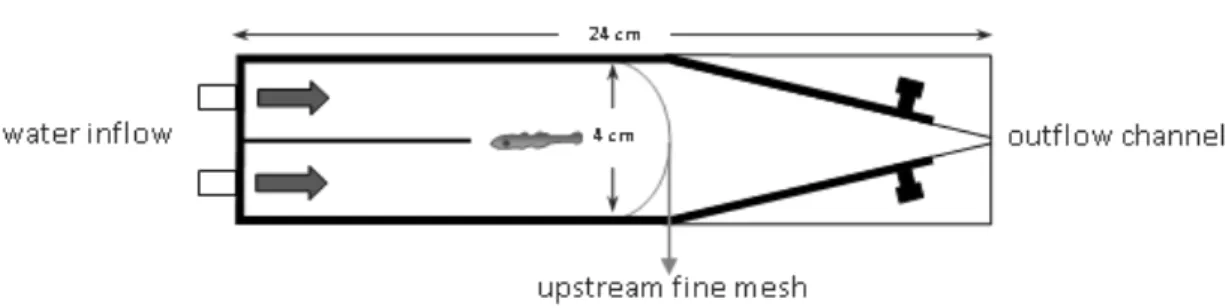
A two channel choice flume was used, adapted from Gerlach, Atema, Kingsford, Black, & Miller-Sims,(2007). Larvae could swim freely to either side of the chamber. Water from two different sources, treated with different olfactory cues, flowed through plastic tubes to the chamber (see figure 1). The flume allows a laminar flow separation of the two water sources,
and a 100-mL min-1 flow per channel, measured with a flow meter, was maintained throughout the trial. At the beginning of each trial, a single larva was released into the center of the downstream end of the chamber and allowed to acclimatize to the two water choices for 2 min. After this, the position of larva on each side of the chamber was recorded every 5 secs, over 2 min. This procedure was followed by 1 min of rest, during which the water sources were switched, to outwit any side preference unrelated with the water source, and after this minute, the entire test was repeated, including the 2-min acclimation period.
Figure 1.Two channel choice flume (design adapted from Gerlach et al., 2007).
In each trial, a larva was given a choice in the flume chamber between a water source treated with a specific olfactory cue and a water source without biological cues (artificial seawater). Each larva was used only once.
For logistical reasons, untreated (control) seawater was used for all groups. However, preliminary tests suggested that there was no difference in behavior when larvae were tested in control or treatment water. Moreover, it has been reported that the behavioral CO2 effects are retained for several days after transfer to untreated seawater (Philip L Munday et al., 2010).
Both species were tested in the following pairwise choices:
(1) Artificial seawater vs. artificial seawater (blank 1 vs. blank 2) - used as a blank control (L.lepadogaster - control: n=41, high: n=34; A.presybter - control: n=17, mid: n=14, high: n=15))
(2) Predator odour vs. artificial seawater (L.lepadogaster - control: n=54, high: n=64; A.presybter - control: n=8, mid: n=6, high: n=6))
Juvenile Diplodus sargus were used as the source of predator odours. D. sargus were kept in a 100-l tank with gentle aeration, fed every day with mussel, except for the day before the experiments took place.
choices:
(3) Reef water vs. artificial seawater (control: n=27, high: n=28)
(4) Reef water with conspecific odour vs. artificial seawater (control: n=13, high: n=13)
For test (3), reef water at the habitat site was collected, and for test (4), adult conspecifics were immersed in reef water from the habitat site and used as potential odour cue. Due to low availability of larvae, these two tests are considered preliminary as the number of tested larvae does not allow to make further conclusions.
5. Statistical analysis
Data were analyzed in Statistica 10, following verification of normality and homoscedasticity by Shapiro–Wilk.
A one-way analysis of variance (ANOVA) was used to compare size-at-age between larvae reared in control water vs. larvae reared in acidified water (L. lepadogaster).
A Wilcoxon test was used to compare the proportion of time that individuals spent in the stream of water containing the olfactory cue versus the proportion of time that individuals spent on one side of the chamber when no cues were presented. A one-way analysis of variance (ANOVA) was also used to compare the proportion of time that individuals spent in the stream of water containing the olfactory cue when reared in control water vs. the proportion of time that individuals spent in that stream of water when reared in acidified water, when normality was obtained. In non-normal distribution of data, Kruskal -Wallis ANOVA was used.
To investigate directional asymmetry of the otoliths (i.e. is the right or left otolith usually larger), signed differences in otolith morphometries were obtained by subtracting the value for the left otolith from that of the right otolith (R- L) for otolith area, maximum length, and maximum breadth. To determine if pCO2 condition affected the magnitude of otolith asymmetry with respect to otolith area, maximum length, and maximum breadth, a Mann-Whitney U test was used to compare unsigned differences between left and right otoliths for these traits.
When applicable, results are presented as mean ± standard-deviation (SD). For all statistical tests, the significance level was set at p-value ≤0.05.
Results
Larval development (Lepadogaster lepadogaster)
Exposure to acidification did not influence most of the measured morphometric traits in L. lepadogaster larvae, at 8 dph - Standard length (SL) (p = 0.211), Total length (TL) (p = 0.269), Anal Height (HA) (p = 0.164) and precaudal body length (BL) (p = 0.072). However, larvae under high pCO2 have higher Head Height (HH) compared to control larvae (p = 0.016) (Figure 2b).
a)
b)
Figure 2. Morphometric traits of L. lepadogaster larvae reared for 8 dph under control and acidified conditions. Results are expressed as mean ± 0.95 confidence interval. The two different treatments – Control (n=155) and High (n=182) are represented in white and black bars. SL = Standard Length; TL = Total Length; HA = Anal Height; HH = Head Height; BL = Precaudal body length.
Relative growth rate did not differ between treatments (p = 0.787), neither did survival rate, with mean (± SE) SR’s of 12.06 ± 3.29 and 9.78 ± 2.29 for control and high pCO2 treatment, respectively.
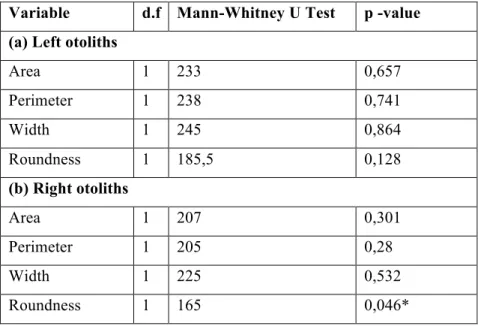
Regarding otolith metrics of pre-settlement phase larvae, there were no significant differences between treatments, except for roundness in right otoliths, although its p-value is close to non-significance. There was no evidence of directional asymmetry between the left or the right otolith, and no difference in the distribution of positive and negative asymmetry among treatments for any of the otolith measurements (Table 2).
Table 2. Results of Mann-Whitney U Test for left (a) and right (b) otoliths of L. lepadogaster larvae (8 days post hatching), reared under control (n= 23) and high pCO2 conditions (n= 22).
Variable d.f Mann-Whitney U Test p -value (a) Left otoliths
Area 1 233 0,657 Perimeter 1 238 0,741 Width 1 245 0,864 Roundness 1 185,5 0,128 (b) Right otoliths Area 1 207 0,301 Perimeter 1 205 0,28 Width 1 225 0,532 Roundness 1 165 0,046*
Olfactory choice tests
Lepadogaster lepadogaster
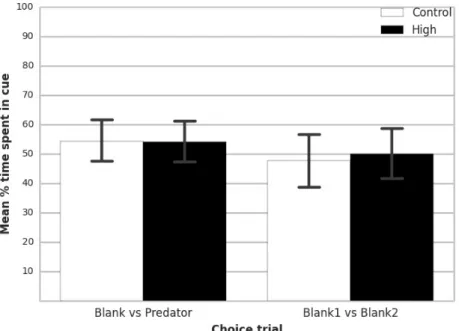
When tested in control situation (artificial seawater in both sides of the choice flume), larvae from both treatments spent equal amounts of time on each side of the chamber (p = 0.722), and no pCO2 effect was detected (p = 0.736), which indicates that larval behavior was what would be expected in the flume chamber when both water streams contained unmanipulated water (figure 3).
There were also no significant differences between treatments in artificial seawater vs predator odour (p = 0.977). Larvae reared under high pCO2 conditions showed no preference between cues, spending almost the same time in both sides of the choice flume (p = 0.227). Control larvae showed the same behavior as larvae from high pCO2 conditions (p = 0.235) (figure 3).
Figure 3. Percentage of time (mean ± 0.95 confidence interval) that L. lepadogaster larvae, reared under control or high pCO2 conditions, spend on the side of flume that contains the olfactory cue from a
predator (first pair of columns; control: n= 54, high: n= 64), or no cue (second pair of columns; control: n= 41, high: n= 34).
In the preliminary test that tested the potential use of habitat water as a preferred odour cue, no significant differences between larvae reared under control and high pCO2 conditions were detected (p =0.488), although larvae from high pCO2 treatment tends to spend less time in reef-water (p = 0.205). Larvae reared in control treatment showed no preference between the choice waters, spending almost the same time in both (p = 0.518) (figure 4).
Figure 4. Percentage of time (mean ± 0.95 confidence interval) that L. lepadogaster larvae, reared under control or high pCO2 conditions, spend on the side of flume that contains the olfactory cue from habitat
water (first pair of columns; control: n= 27, high: n= 28), or no cue (second pair of columns; control: n= 41, high: n= 34).
When tested in reef water with conspecifics, larvae reared under control conditions showed no preference between choice waters (p = 0.673) (figure 5). However, larvae from high pCO2 treatment spent more time in reef-water with conspecific odours when compared to artificial seawater (blank) (p = 0.046*).
Figure 5. Percentage of time (mean ± 0.95 confidence interval) that L. lepadogaster larvae, reared under control or high pCO2 conditions, spend on the side of flume that contains the olfactory cue from habitat
water with adult conspecifics (first pair of columns; control: n= 13, high: n= 13), or no cue (second pair of columns; control: n= 41, high: n= 34).
Atherina presbyter
Summary to L. lepadogaster, in the blank control, A. presbyter showed no preference for either sides of the chamber (control (p = 0.612), mid (p = 0.281) and high (p = 0.753), and no significant differences between rearing conditions were detectable (p =0.704) (figure 6). When given the choice between artificial seawater and a predator odour, A. presbyter larvae reared under control conditions showed no preference for either cues (p = 0.569), but larvae from mid and high pCO2 conditions were significantly attracted to predator odour (p = 0.030). Percentage of time larvae spent in predator odour was significantly different between control and high pCO2 conditions (p = 0.006) and, although not significant, some tendencies can be observed between control and mid pCO2 conditions (p = 0.096) (figure 6).
Figure 6. Percentage of time (mean ± 0.95 confidence interval) that A. presbyter larvae, reared under control, mid or high pCO2 conditions, spend on the side of flume that contains the olfactory cue from
predator (first trio of columns; control: n= 17, mid: n= 14, high: n= 15), or no cue (second trio of columns; control: n= 8, mid: n= 6, high: n= 6).
Discussion
Improving the knowledge about which marine species are sensitive to elevated CO2 and reduced pH, and which species can tolerate these changes, is critical for assessing the impacts of ocean acidification on marine biodiversity and ecosystem function (Fabry, Seibel, Feely, & Orr, 2008).
Our study suggests that L. lepadogaster larvae are more resilient to future ocean acidification scenarios, as neither survival, growth, size-at-age, otolith size and shape or olfactory capability were significantly influenced by an increase in pCO2. On the contrary, A. presbyter might be more vulnerable to future scenarios of ocean acidification as exposure to high levels of pCO2 lead to olfactory disruption.
The lack of a treatment effect on morphometric traits of L. lepadogaster is consistent with studies on temperate and cold-water fishes (Ishimatsu et al., 2004; Kikkawa et al., 2003), which indicate that they can tolerate high CO2 levels. Perry et al., (2015) show that elevated
levels of pCO2 (1200-2600 µatm) had no effect on growth and survival of juvenile scup,
Stenotomus chrysops, after an 8-week exposure period.
Although previous study have found potential effects of ocean acidification on fish
a
b
in L. lepadogaster pre-settlement larvae were not influenced by exposure to simulated ocean acidification scenarios. Other authors corroborate this lack of effect. Frommel, Schubert, Piatkowski, & Clemmesen, (2013) did not detect any effect of elevated CO2 on otolith size of
Baltic cod, Gadus morhua, reared for 2 weeks in treatment up to 3.200 µatm CO2. On a tropical
species, Munday, Hernaman, Dixson, & Thorrold, (2011) did not detect any effect of elevated CO2 on otolith size of juvenile spiny damselfish, Acanthochromis polyacanthus, reared for 3
weeks in treatments up to 841 µatm CO2.
L. lepadogaster and A. presbyter larvae, reared under increasing pCO2 levels, responded differently in the olfactory choice test in the presence of a predator odour. However, and opposite to what was expected, larvae of both species, reared in control conditions, did not avoid the predator chemical cue. This lack of anti-predator response was surprising since D. sargus is known to be an omnivore fish with various preys (Figueiredo, Morato, Barreiros, Afonso, & Santos, 2005; Osman & Mahmoud, 2009). We argue there might be four hypotheses explaining these results:
i) The first possibility might be related to the predator’s diet – a recent study suggests that larvae respond to the predator’s diet odour and not the predator’s odour itself. Juvenile D. sargus, used as source of predator odours, were fed a mixture of clams and shrimps, which could explain the results. The role of predator diet in predator detection has been well studied
in freshwater systems, with most studies showing the importance of predator diet with naïve prey organisms responding to chemical cues. However, in some scenarios, prey may respond to lingering chemical alarm cues from ingested prey in the faecal matter of the predator, and, therefore generalization of predators is limited because recognition of alarm cues requires learning and tends to be species specific (G. E. Brown, Chivers, & Smith, 1995).
ii) Second possibility is that it is known that the development of anti-predator response of many fish is influenced by learning (Ferrari et al., 2012; Ferrari, Wisenden, & Chivers, 2010). This learning can be key to acquire new knowledge, skills and behaviors, and interaction/experience with predators. For aquatic species, one way to learn to recognize predators is through the simultaneous detection of novel predators and cues from injured conspecifics (Ferrari et al., 2012). Learning can also play a role to individuals in identifying new food sources, habitats or mates, new threats and, due to environmental changes, adapt their phenology and behavior (G. Brown & Chivers, 2005; Dugatkin, 1992; Visser & Visser, 2008). It is possible that L. lepadogaster larvae were still naïve to any cues produced by juveniles D. sargus, due to the absence of previous contact with the species; given that A. presbyter were
also recently hatched larvae at the time they were sampled, it is also likely that they haven’t experienced any predator attack by D. sargus.
iii) Another possibility is related to the fact that predator’s body size influences prey response (odours and others) to potential predators (Kusch, Mirza, & Chivers, 2004). Perhaps L. lepadogaster and A. presbyter larvae small body is not part of the size selection ranges of the juveniles D. sargus, and therefore do not represent a major predator threat. However, there is no evidence of this fact (Figueiredo et al., 2005; Osman & Mahmoud, 2009).
iv) The last hypotheses is related to the lack of knowledge of the olfactory system: the spectra, sensitivity, nature and sources of olfactory signals to detect odours is largely unknown for most species. Studies suggest that the type and development of the olfactory system may influence the capacity to recognize the cues, and that may affect the detection of predators (Atta, 2013; Kasumyan, 2004; Pashchenko & Kasumyan, 2015). L. lepadogaster larvae might still lack a fully developed olfactory system, which might help explaining the lack of response to olfactory stimuli in general (predator, habitat water and conspecifics). This hypothesis, however, cannot be applied to A. presbyter, as in this case, it was observed a disruption in the olfactory system under high pCO2 levels, suggesting that the olfactory system is well developed.
Exposure to elevated pCO2 levels did not cause any disruption in the olfactory behavior of L. lepadogaster, but A. presbyter under high pCO2 levels were significantly attracted to the predator odour. This result agrees with other published results on tropical fish species odours (Dixson et al., 2010; Philip L Munday et al., 2010). The mechanisms responsible for behavioral impairment in fish larvae exposed to high CO2 appear to be caused by a disturbance in the GABA-A receptor, the primary inhibitory neurotransmitter receptor in the vertebrate brain (Hamilton, Holcombe, & Tresguerres, 2013; Nilsson et al., 2012). Future studies should address this hypothesis by treating larvae with an antagonist of GABA-A receptor, such as gabazine (Hamilton et al., 2013; Lopes et al., 2016; Nilsson et al., 2012).
The lack of significant pCO2 effects on L. lepadogaster larvae suggest that this species is less susceptible to environmental disturbances. Clingfish inhabit the intertidal rock pools, and are likely to be better adapted to stressful environmental conditions, namely daily pH fluctuations. The pCO2 is elevated by excessive photosynthetic activity relative to respiration in tide pools, when they are isolated at low tide, promoting and precipitation drop in CO2
to ocean acidification may vary within species and can be related to their life histories. For example, the spiny damselfish, A. polyacanthus, also seems to be quite resilient to increasing
pCO2 levels. It has direct developing juveniles that stay on the reef after hatching, and juveniles
remain in shelter with their parents in small caves, where CO2 levels may rise due to respiration,
being adapted to periods of high ambient CO2 (Philip L Munday et al., 2010). Other example
is the clownfish, Amphiprion percula, which has pelagic larvae but is a demersal spawner. Benthic eggs are likely to experience significant fluxes in ambient CO2 due to consumption of
CO2 by photosynthesis during the day and release of CO2 by respiration of reef organisms at
night. Hatching them may precondition larval clownfishes to moderate increases in ambient CO2 (Philip L Munday et al., 2008). On the contrary, it is suggested that pelagic species, which have adapted to a much stable environment, may be more susceptible to future environmental changes (Philip L Munday et al., 2008; Pörtner, 2008). A. presbyter is a benthic spawner, as L. lepadogaster, however larvae, juveniles and adults live in the pelagic environment, and might experience more stable environmental conditions throughout their life, being more susceptible to changes in CO2 conditions. In fact, recent studies on this species suggest altered behavior (lateralization, Lopes et al., 2016), and changes in growth and energy allocation (Silva et al., 2016) under high pCO2 levels.
Overall, this study adds to the growing body of literature that suggests species-specific response to future levels of ocean acidification, and reinforces the need of additional studies across a wide range of fish species with contrasting life histories and habitats. Moreover, it will be critically important to evaluate speciescapacity to adapt to the predicted ocean acidification over the next century. It has recently been shown that transgenerational plasticity could be an important mechanism by which fish can adjust to higher pCO2 levels (Miller, Watson, Donelson, McCormick, & Munday, 2012; Philip L Munday, 2014), but due to complexity associated to multigenerational experiments on long-generation species, there are still few studies. This should, however, be a priority for future research.
Final Considerations
Results of the present study contribute to the increasing list of bibliography on the effects of exposure to high CO2 levels on marine fish larvae. However, and as most studies, it has its limitations and ends with more relevant questions that need to be addressed in the future. I herein present suggestions of future studies which will provide a better understanding of the responses seen in this study:
- The use of video monitoring to assess fish behavior in the choice flume has been recently suggested as a complementary tool, as it allows to analyze not only the percentage of time spend in each side of the flume, but also mean and variance of speed, rapid and accelerated changes in movements as a response of passing through different water masses , Jutfelt, Sundin, Raby, Krång, & Clark, (2016).
- Testing wild caught larvae vs. laboratory reared larvae will allow to understand whether larvae have an innate ability to recognize predator odours or if there is a learning process involved.
- Testing a different predator, and changing our predators’ diet to a diet rich in fish proteins, will allow us to test the hypothesis that larvae are not responding to the predators’ odours but to their diet (Dixson et al., 2012).
- Histological studies of the olfactory organs will provide extra information on the ability to detect chemical stimuli.
- Future studies should also aim at increasing the number of tested larvae, as for some cues (habitat water and conspecifics) there seemed to be a trend, but the low availability of larvae did not allow to make further conclusions.
- finally, it will be critically important to evaluate species capacity to adapt to the predicted ocean acidification over the next century. This represents a major challenge for future studies, as it requires multigenerational experiments, which are logistically very demanding.
References
Atta, K. I. (2013). Morphological, anatomical and histological studies on the olfactory organs and eyes of teleost fish: Anguilla anguilla in relation to its feeding habits. The Journal of Basic & Applied Zoology, 66(3), 101–108.
Baumann, H., Talmage, S. C., & Gobler, C. J. (2011). Reduced early life growth and survival in a fish in direct response to increased carbon dioxide. Nature Climate Change, 2(1), 38– 41.
Bignami, S., Enochs, I. C., Manzello, D. P., Sponaugle, S., & Cowen, R. K. (2013). Ocean acidification alters the otoliths of a pantropical fish species with implications for sensory function. Proceedings of the National Academy of Sciences, 110(18), 7366–7370.
Bignami, S., Sponaugle, S., & Cowen, R. K. (2013). Response to ocean acidification in larvae of a large tropical marine fish, Rachycentron canadum. Global Change Biology, 19(4),
996–1006.
Bignami, S., Sponaugle, S., & Cowen, R. K. (2014). Effects of ocean acidification on the larvae of a high-value pelagic fisheries species, mahi-mahi Coryphaena hippurus. Aquatic Biology, 21(3), 249–260.
Brauner, C. J., & Baker, D. W. (2009). Patterns of Acid–Base Regulation During Exposure to Hypercarbia in Fishes. In Cardio-Respiratory Control in Vertebrates: Comparative and Evolutionary Aspects. (pp. 43–46). Glass, M.Wood, S.C.
Brown, G., & Chivers, D. (2005). Learning as an adaptive response to predation. In P. Barbosa & I. Castellanos (Eds.), Ecology of predator-prey interactions. (pp. 34–54). Oxford: Oxford University Press.
Brown, G. E., Chivers, D. P., & Smith, R. J. F. (1995). Fathead minnows avoid conspecific and heterospecific alarm pheromones in the faeces of northern pike. Journal of Fish Biology, 47(3), 387–393.
Cai, W.-J., Hu, X., Huang, W.-J., Murrell, M. C., Lehrter, J. C., Lohrenz, S. E., Chou, W- C., Zhai, W., Hollibaugh, J. T., Wang, Y., Zhao, P. Guo, X., Gundersen, K., Dai, M., Gong, G.-C. (2011). Acidification of subsurface coastal waters enhanced by eutrophication. Nature Geoscience, 4(11), 766–770.
Chambers, R. C., Candelmo, A. C., Habeck, E. A., Poach, M. E., Wieczorek, D., Cooper, K. R., Greenfield, C. E., Phelan, B. A. (2014). Effects of elevated CO2; in the early life stages of summer flounder, Paralichthys dentatus, and potential consequences of ocean acidification. Biogeosciences, 11(6), 1613–1626.
Checkley, D. M., Dickson, A. G., Takahashi, M., Radich, J. A., Eisenkolb, N., & Asch, R. (2009). Elevated CO2 enhances otolith growth in young fish. Science, 324, 1683–1683. Dickson, A. G., & Millero, F. J. (1987). A comparison of the equilibrium constants for the
dissociation of carbonic acid in seawater media. Deep Sea Research Part A. Oceanographic Research Papers, 34(10), 1733–1743.
Dixson, D. L., Munday, P. L., & Jones, G. P. (2010). Ocean acidification disrupts the innate ability of fish to detect predator olfactory cues. Ecology Letters, 13(1), 68–75.
Dixson, D. L., Pratchett, M. S., & Munday, P. L. (2012). Reef fishes innately distinguish predators based on olfactory cues associated with recent prey items rather than individual species. Animal Behaviour, 84(1), 45–51.
Doney, S. C., Balch, W. M., Fabry, V. J., & Feely, R. A. (2009). Ocean acidification A critical emerging problem. Oceanography, 22(4), 16–25.
Other CO2 Problem. Annual Review of Marine Science, 1(1), 169–192.
Dugatkin, L. A. (1992). Sexual Selection and Imitation: Females Copy the Mate Choice of Others. The American Naturalist, 139(6), 1384.
Fabry, V. J., Seibel, B. A., Feely, R. A., & Orr, J. C. (2008). Impacts of ocean acidification on marine fauna and ecosystem processes. ICES Journal Of Marine Sciences, 65(Dic), 414– 432.
Ferrari, M. C. O., Manassa, R. P., Dixson, D. L., Munday, P. L., McCormick, M. I., Meekan, M. G., Sih, A., Chivers, D. P. (2012). Effects of ocean acidification on learning in coral reef fishes. PLoS ONE, 7(2), e31478.
Ferrari, M. C. O., Wisenden, B. D., & Chivers, D. P. (2010). Chemical ecology of predator– prey interactions in aquatic ecosystems: a review and prospectus.The present review is one in the special series of reviews on animal–plant interactions. Canadian Journal of Zoology, 88(7), 698–724.
Figueiredo, M., Morato, T., Barreiros, J. P., Afonso, P., & Santos, R. S. (2005). Feeding ecology of the white seabream, Diplodus sargus, and the ballan wrasse, Labrus bergylta, in the Azores. Fisheries Research, 75(1–3), 107–119.
Franke, A., & Clemmesen, C. (2011). Effect of ocean acidification on early life stages of Atlantic herring (Clupea harengus L.). Biogeosciences, 8, 3697–3707.
Frommel, A. Y., Maneja, R., Lowe, D., Malzahn, A. M., Geffen, A. J., Folkvord, A., Piatkowski, U., Reusch, T. B. H., Clemmesen, C. (2011). Severe tissue damage in Atlantic cod larvae under increasing ocean acidification. Nature Climate Change, 2(1), 42–46. Frommel, A. Y., Schubert, A., Piatkowski, U., & Clemmesen, C. (2013). Egg and early larval
stages of Baltic cod, Gadus morhua, are robust to high levels of ocean acidification. Marine Biology, 160(8), 1825–1834.
Gerlach, G., Atema, J., Kingsford, M. J., Black, K. P., & Miller-Sims, V. (2007). Smelling home can prevent dispersal of reef fish larvae. Proceedings of the National Academy of Sciences of the United States of America, 104, 858–863.
Gonçalves, D. M., Gonçalves, E. J., Almada, V. C., & Almeida, S. P. (1998). Comparative behaviour of two species of Lepadogaster (Pisces : Gobiesocidae) living at different depths. Journal of Fish Biology, 53, 447–450.
Hamilton, T. J., Holcombe, A., & Tresguerres, M. (2013). CO2-induced ocean acidification increases anxiety in Rockfish via alteration of GABAA receptor functioning. Proceedings of the Royal Society B: Biological Sciences, 281(1775), 20132509–20132509.
J. A., McCulloch, M. (2015). Biological mechanisms supporting adaptation to ocean acidification in coastal ecosystems. Estuarine, Coastal and Shelf Science, 152, A1–A8. Hoegh-Guldberg, O., Mumby, P. J., Hooten, A. J., Steneck, R. S., Greenfield, P., Gomez, E.,
Harvell, C. D., Sale, P. F., Edwards, A. J., Caldeira, K., Knowlton, N., Eakin, C. M., Iglesias-Prieto, R., Muthiga, N., Bradbury, R. H., Dubi, A., Hatziolos, M. E. (2007). Coral Reefs Under Rapid Climate Change and Ocean Acidification. Science, 318(5857), 1737– 1742.
Hofmann, G. E., Smith, J. E., Johnson, K. S., Send, U., Levin, L. A., Micheli, F., Paytan, A., Price, N. N., Peterson, B., Takeshita, Y., Matson, P. G., Crook, E. D., Kroeker, K. J., Gambi, M. C., Rivest, E. B., Frieder, C. A., Yu, P. C., Martz, T. R. (2011). High-Frequency Dynamics of Ocean pH: A Multi- Ecosystem Comparison. PLoS ONE, 6(12). Hurst, T. P., Fernandez, E. R., & Mathis, J. T. (2013). Effects of ocean acidification on hatch
size and larval growth of walleye pollock (Theragra chalcogramma). ICES Journal of Marine Science, 70, 812–822.
Hurst, T. P., Laurel, B. J., Mathis, J. T., & Tobosa, L. R. (2015). Effects of elevated CO2 levels on eggs and larvae of a North Pacific flatfish. ICES Journal of Marine Science.
IPCC. (2013). Climate Change (2013): The Physical Science Basis. Contribution of Working Group I to the Fifth Assessment Report of the Intergovernmental Panel on Climate Change. In T. F. Stocker, Q. D., G.-K. Plattner, M. M. B. Tignor, S. K. Allen, J. Boschung, … P. M. Midgley (Eds.), (p. 1535). Cambridge, United Kingdom and New York, NY, USA: Cambridge University Press.
Ishimatsu, A., Kikkawa, T., Hayashi, M., Lee, K.-S., & Kita, J. (2004). Effects of CO2 on Marine Fish: Larvae and Adults. Journal of Oceanography, 60(4), 731–741.
Jutfelt, F., Bresolin de Souza, K., Vuylsteke, A., & Sturve, J. (2013). Behavioural Disturbances in a Temperate Fish Exposed to Sustained High-CO2 Levels. PLoS ONE, 8(6), 6–11. Jutfelt, F., & Hedgärde, M. (2013). Atlantic cod actively avoid CO2 and predator odour, even
after long-term CO2 exposure. Frontiers in Zoology, 10(1), 81.
Jutfelt, F., & Hedgärde, M. (2015). Juvenile Atlantic cod behavior appears robust to near-future CO2 levels. Frontiers in Zoology, 12(1), 11.
Jutfelt, F., Sundin, J., Raby, G. D., Krång, A.-S., & Clark, T. D. (2016). Two-current choice flumes for testing avoidance and preference in aquatic animals. Methods in Ecology and Evolution, (7491).
Kasumyan, A. O. (2004). The olfactory system in fish: structure , function, and role in behavior. Journal of Ichthyology, 44, 180–223.
Kikkawa, T., Ishimatsu, A., & Kita, J. (2003). Acute CO2 tolerance during the early developmental stages of four marine teleosts. Environmental Toxicology, 18(6), 375–382. Kusch, R. C., Mirza, R. S., & Chivers, D. P. (2004). Making sense of predator scents: Investigating the sophistication of predator assessment abilities of fathead minnows. Behavioral Ecology and Sociobiology, 55(6), 551–555.
Llopiz, J. K., Cowen, R. K., Hauff, M. J., Ji, R., Munday, P. L., Muhling, B. A., Peck, M. A., Richardson, D. E., Sogard, S., Sponaugle, S. (2014). Early Life History and Fisheries Oceanography. Oceanography, 27(4), 26–41.
Lopes, A. F., Morais, P., Pimentel, M., Rosa, R., Munday, P. L., Gonçalves, E. J., & Faria, A. M. (2016). Behavioural lateralization and shoaling cohesion of fish larvae altered under ocean acidification. Marine Biology, 163(12).
Lüthi, D., Le Floch, M., Bereiter, B., Blunier, T., Barnola, J.-M., Siegenthaler, U., Raynaud, D., Jouzel, J., Fischer, H., Kawamura, K., Stocker, T. F. (2008). High-resolution carbon dioxide concentration record 650,000–800,000 years before present. Nature, 453(7193), 379–382.
Mehrbach, C., Culberson, C. H., Hawley, J. E., & Pytkowicx, R. M. (1973). Measurement of the apparent dissociation constants of carbonic acid in seawater at atmospheric pressure. Limnology and Oceanography, 18(6), 897–907.
Melzner, F., Thomsen, J., Koeve, W., Oschlies, A., Gutowska, M. A., Bange, H. W., Hansen, H. P., Körtzinger, A. (2013). Future ocean acidification will be amplified by hypoxia in coastal habitats. Marine Biology, 160(8), 1875–1888.
Miller, G. M., Watson, S.-A., Donelson, J. M., McCormick, M. I., & Munday, P. L. (2012). Parental environment mediates impacts of increased carbon dioxide on a coral reef fish. Nature Clim. Change, 2(12), 858–861.
Munday, P. L. (2014). Transgenerational acclimation of fishes to climate change and ocean acidification. F1000prime Reports, 6(November), 99.
Munday, P. L., Cheal, A. J., Dixson, D. L., Rummer, J. L., & Fabricius, K. E. (2014). Behavioural impairment in reef fishes caused by ocean acidification at CO2 seeps. Nature Climate Change, 4(April), 1–6.
Munday, P. L., Dixson, D. L., Donelson, J. M., Jones, G. P., Pratchett, M. S., Devitsina, G. V, & Døving, K. B. (2009). Ocean acidification impairs olfactory discrimination and homing ability of a marine fish. Proceedings of the National Academy of Sciences of the United States of America, 106(6), 1848–1852.
P., & Karl, D. (2010). Replenishment of fish populations is threatened by ocean acidification. Proceedings of the National Academy of Sciences of the United States of America, 107(29), 12930–12934.
Munday, P. L., Donelson, J. M., Dixson, D. L., & Endo, G. G. K. (2009). Effects of ocean acidification on the early life history of a tropical marine fish. Proceedings of the Royal Society of London B: Biological Sciences, 276(1671), 3275–3283.
Munday, P. L., Hernaman, V., Dixson, D. L., & Thorrold, S. R. (2011). Effect of ocean acidification on otolith development in larvae of a tropical marine fish. Biogeosciences, 8(6), 1631–1641.
Munday, P. L., Jones, G. P., Pratchett, M. S., & Williams, A. J. (2008). Climate change and the future for coral reef fishes. Fish and Fisheries, 9(261–285).
Nilsson, G. E., Dixson, D. L., Domenici, P., McCormick, M. I., Sørensen, C., Watson, S.-A., & Munday, P. L. (2012). Near-future carbon dioxide levels alter fish behaviour by interfering with neurotransmitter function. Nature Climate Change, 2(3), 201–204. Orr, J. C., Fabry, V. J., Aumont, O., Bopp, L., Doney, S. C., Feely, R. A., Gnanadesikan, A.,
Gruber, N., Ishida, A., Joos, F., Key, R. M., Lindsay, K., Maier-Reimer, E., Matear, R., Monfray, P., Mouchet, A., Najjar, R. G., Plattner, G-K., Rodgers, K. B., Sabine, C. L., Sarmiento, J. L., Schlitzer, R., Slater, R. D., Totterdell, I. J., Weirig, M-F., Yamanaka, Y., Yool, A. (2005). Anthropogenic ocean acidification over the twenty-first century and its impact on calcifying organisms. Nature, 437(7059), 681–686.
Osman, A. M., & Mahmoud, H. H. (2009). Feeding Biology of Diplodus sargus and Diplodus vulgaris (Teleostei, Sparidae) in Egyptian Mediterranean Waters. World Journal of Fish and Marine Sciences, 1(4), 290–296.
Pashchenko, N. I., & Kasumyan, A. O. (2015). Scanning Electron Microscopy of Development of the Olfactory Organ in Ontogeny of Grass Carp Ctenopharyngodon idella. Journal of Ichtyology, 55(6), 880–899.
Perry, D. M., Redman, D. H., Widman, J. C., Meseck, S., King, A., & Pereira, J. J. (2015). Effect of ocean acidification on growth and otolith condition of juvenile scup, Stenotomus chrysops. Ecology and Evolution, 5(18), 4187–4196.
Pörtner, H. O. (2008). Ecosystem effects of ocean acidification in times of ocean warming: A physiologist’s view. Marine Ecology Progress Series, 373, 203–217.
Reum, J. C. P., Alin, S. R., Feely, R. A., Newton, J., Warner, M., & McElhany, P. (2014). Seasonal carbonate chemistry covariation with temperature, oxygen, and salinity in a fjord estuary: Implications for the design of ocean acidification experiments. PLoS ONE, 9(2).
Silva, C. S. E., Novais, S. C., Lemos, M. F. L., Mendes, S., Oliveira, A. P., Gonçalves, E. J., & Faria, A. M. (2016). Effects of ocean acidification on the swimming ability, development and biochemical responses of sand smelt larvae. Science of The Total Environment, 563– 564, 89–98.
Visser, M. E., & Visser, M. E. (2008). Keeping up with a warming world ; assessing the rate of adaptation to climate change Keeping up with a warming world ; assessing the rate of adaptation to climate change. Proceedings of the Royal Society of London B: Biological Sciences, 275(March), 649–659.
Wood, H. L., Spicer, J. I., & Widdicombe, S. (2008). Ocean acidification may increase calcification rates, but at a cost. Proceedings of the Royal Society B: Biological Sciences, 275(1644), 1767–1773.
According to the regulations of ISPA-IU, dissertations include a literature review, commonly known as “State of the art”, about the theme of the dissertation which will be presented below.
Introduction
Ocean acidification
Anthropogenic climatic changes have been associated with extremely high greenhouse gases emissions, resultant mainly from deforestation, cement production, fossil fuel combustion and agriculture (IPCC, 2014). Carbon dioxide, CO2, is one the major greenhouse gases, and is nowadays recognized as one of the most serious threats to our planet as its effects are irreversible on ecological timescales and globally pervasive (Doney et al., 2012). The consequences of the emissions are related with higher global mean temperatures (global warming), and multiple physical and chemical changes in marine ecosystems (Figure 7).
Direct effects of changes in ocean temperature and chemistry may alter the physiological functioning, behaviour, and demographic traits (e.g., productivity) of organisms, leading to shifts in the size structure, spatial range and seasonal abundance of populations (Doney et al., 2012).
Figure 7. Important abiotic changes related with global change. Human activities lead to higher concentrations of greenhouse gases in the atmosphere, which results in physical and chemical changes in oceans. Upwelling consequences are uncertain (adapted from Harley et al., 2006)
Recent studies suggest that prior to the industrial revolution, and for at least 650 000 years, atmospheric CO2 concentrations varied between 180 and 300 ppm (Siegenthaler et al., 2005). Over the last century, atmospheric CO2 levels increased by nearly 40%, from preindustrial levels of approximately 280 ppm (parts per million) to nearly 384 ppm in 2007 (IPCC, 2007). Currently, as a result of human activity, today´s atmospheric CO2 concentration is ~ 404 ppm and increases at a rate of 2 ppm year -1 (Dlugokencky & Tans, 2016; Melzner et al., 2013).
Oceans act as a natural carbon sink, absorbing nearly 30% of atmospheric CO2. However, the absorption of the CO2 in excess in the atmosphere leads to an increase of oceanic CO2 partial pressure (pCO2), which in turn results in a pH decrease and reduction in the availability of carbonate ions, a process known as ocean acidification (Doney, Fabry, Feely, & Kleypas, 2009). Ocean acidification is recognized as an emerging global threat to the health of marine ecosystems, because it alters patterns of biogenic carbonate formation and may also significantly affect other ocean biogeochemical cycles (Cai et al., 2011). Ocean’s acidification process starts when atmospheric CO2 reacts with ocean surface, being absorbed by ocean water. CO2 is dissolved in water and reacts with its molecules (H2O) forming carbonic acid (H2CO3):
(1) [CO2](atmos) « [CO2] (aq) +[H2O] « [H2CO3 ]
Carbonic acid dissociates into H+ (hydrogen ion) and HCO3- (bicarbonate ion):
(2) [H2CO3] « [H +
] + [HCO3 −
]
Due to the increase of H+, CO32- (carbonate ion) reacts with H+ forming HCO3-:
(3) [H + ]+ [CO3 2− ] « [HCO3 − ]
For calcifying organisms, CO32- is crucial to form calcium carbonate, along with calcium atoms (Ca2+):
(4) [CaCO3] « [CO3 2−
] + [Ca2+
]
The seawater reactions are reversible and near equilibrium; adding CO2 to seawater increases hydrogen ion concentrations that can also recombine with carbonate ions forming more bicarbonate instead of calcium carbonate (Fabry et al., 2008).
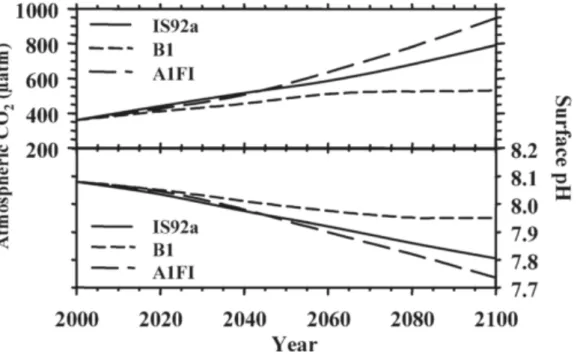
Since preindustrial times, and with the increase of pCO2, the average ocean surface water pH has fallen by approximately 0.1 units, from approximately 8.21 to 8.10, and it’s expected to decrease a further 0.3–0.4 pH units by the end of 21stcentury (year 2100), corresponding to an increase of pCO2 to 700-1,000 µatm (Figure 2) (Caldeira & Wickett, 2005; The Royal Society, 2005).
Figure 8. Projected values of atmospheric CO2 concentrations and seawater surface pH under three different scenarios: IS92a the "business-as-usual" CO2 emissions, B1 the most and A1F1 the least conservative scenario (Adapted from Meehl et al., 2007 in Fabry et al., 2008).
The ocean uptake of anthropogenic CO2 will occur more rapidly in coastal regions when compared to open-ocean waters (Reum et al., 2014). Coastal regions are typically unequilibrated, because of high rates of respiration, eutrophication and heterotrophic degradation. Changing land use and river flow can alter river alkalinity and, in turn, influence coastal inorganic carbon balance, which is necessarily related to the production of CO2 (Cai et al., 2011; Frank Melzner et al., 2013). Moreover, in coastal ecosystems, the excessive biological production of organic matter induced by human inputs of nutrients (eutrophication) - and the subsequent development of hypoxia due to respiration of the sinking organic matter -, has been reported with increasing frequency, which leads to carbon dioxide production and increased acidity (Hendriks et al., 2015; Frank Melzner et al., 2013). Additionally, upwelling systems may be particularly vulnerable to acidification because upwelling process brings deep, cold, nutrient-rich waters up onto the continental shelf, with relatively low pH, increased via dissolution of CO2 into seawater.
Impacts of ocean acidification on marine organisms
Recent work shows that the oceanic uptake of anthropogenic CO2 and the concomitant changes in seawater chemistry produce adverse consequences for many calcifying organisms, and may result in changes to biodiversity, trophic interactions, and other ecosystem processes (Fabry et al., 2008).
Elevated pCO2 in seawater (also known as hypercapnia) can impact marine organisms both via decreased calcium carbonate (CaCO3) saturation, which affects calcification rates, and via disturbance to acid–base (metabolic) physiology (Fabry et al., 2008). Due to the dependence of calcium carbonate to form shells and skeletons, most studies on the impacts of ocean acidification have focused on marine calcifying organisms (Figure 9). A reduction in the number of carbonate ions available, due to the recombination with reactive hydrogen ions, will likely make these organisms more susceptible to the destruction of their external structures, which in turn will cause a greater exposure to predators, pathogens, infections, debility and even death (Hoegh-Guldberg et al., 2007; Hofmann et al., 2010).
Figure 9. Sensitivities of animal taxa to ocean acidification. Percentage (%) of coral, echinoderm, mollusc, crustacean and fish species demonstrated negative, no or positive effects on performance indicators related to pCO2 ranges (µatm). Significantly count ratios are represented in bars above columns (adapted from Wittmann & Pörtner, 2013).
Due to increase energetic costs of calcification, ocean acidification may have major negative impacts on biogenic habitat (e.g., coral reefs, oyster beds) (Guinotte & Fabry, 2008; Hoegh-Guldberg et al., 2007), food webs (e.g., pteropods and other mollusks) (Doney et al., 2012; Guinotte & Fabry, 2008) and even geochemical cycles at the planetary scale, due to
reduced growth and calcification of coccolithophore algae. Coccolithophores are responsible for producing an important contributor to the formation of clouds – dimethyl sulfide ((CH3)S2), so alterations on their existence may increase the rate of global warming(Malin & Steinke, 2004).
For carbon-limited autotrophs (including seagrasses and some phytoplankton) (Harley et al., 2006), on the contrary, increased CO2 may promote photosynthesis, whereas for others (particularly calcifying taxa) photosynthesis may be either reduced or unaffected (Doney et al., 2012).
Marine fishes do not have extensive calcium carbonate skeletons, and therefore the decline in seawater pH and concomitant changes in the saturation state of carbonate ions is not considered a threat to fishes in general. However, the rise in ocean pCO2 is likely to be a greater concern as higher ambient CO2 levels (hypercapnia) can cause acidosis of the blood and tissues (Llopiz et al., 2014). In general, juvenile and adult fishes appear to be relatively tolerant to mild increases in CO2 and decreases in pH, due to well-developed mechanisms for acid-base regulation, mostly across the gills, and small changes in internal or external pH can readily be compensated (F. Melzner et al., 2009). Despite these compensatory mechanisms, early life history stages are likely to be most vulnerable because physiological homeostasis might not be fully developed and their small body size makes them more sensitive to environmental variation (Brauner, 2008; F. Melzner et al., 2009).
Early research on larval fishes demonstrated significantly reduced survival at low pH (Ishimatsu, Kikkawa, Hayashi, Lee, & Kita, 2004; Kikkawa, Ishimatsu, & Kita, 2003), and verified that CO2-induced acidification produces negative effects. Literature suggests that, for some species, exposure to elevated pCO2 adversely affects embryonic development and hatching (Frommel, Schubert, Piatkowski, & Clemmesen, 2013), larval and juvenile growth (Baumann, Talmage, & Gobler, 2011), tissue/organ health (Frommel et al., 2011), survival (Baumann et al., 2011), metabolism and condition (Franke & Clemmesen, 2011), and behavior (Dixson, Munday, & Jones, 2010; Ferrari et al., 2012; Leduc, Munday, Brown, & Ferrari, 2013; Philip L Munday, Dixson, et al., 2009; Philip L Munday et al., 2010; Simpson et al., 2011). However, other studies show that eggs and embryos of some marine fishes appear to be relatively tolerant to CO2 levels within the range projected for the near future. Embryonic duration and hatching success are unaffected at high CO2 in the majority of experiments conducted to date (review by Llopiz et al., 2014). This fact is corroborated with other studies, which state that it wasn’t detected any effect upon embryogenesis (Franke & Clemmesen, 2011), hatching (Frommel et al., 2013), growth and development (Bignami, Sponaugle, &