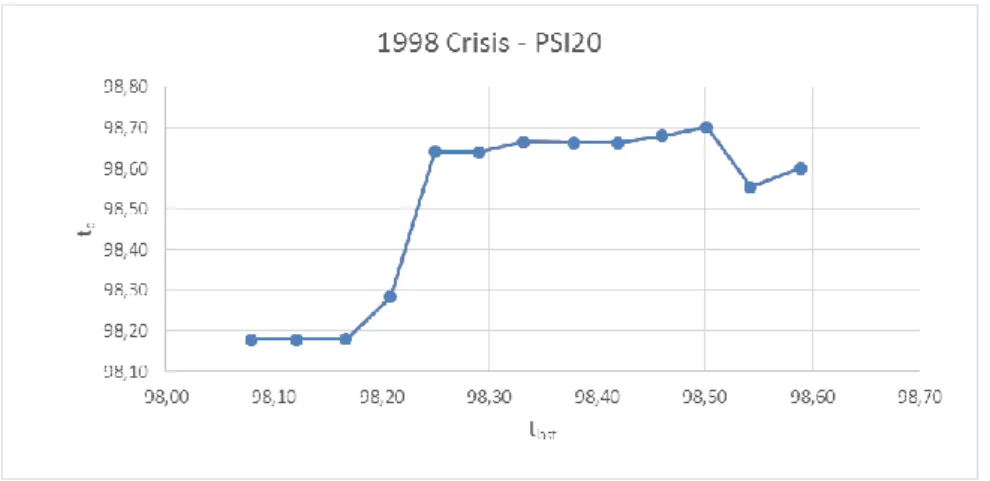
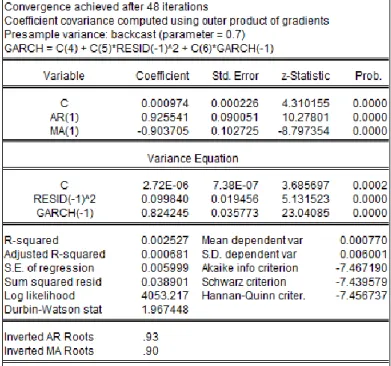
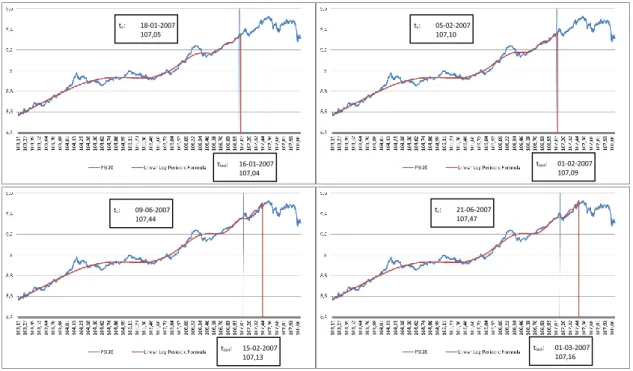
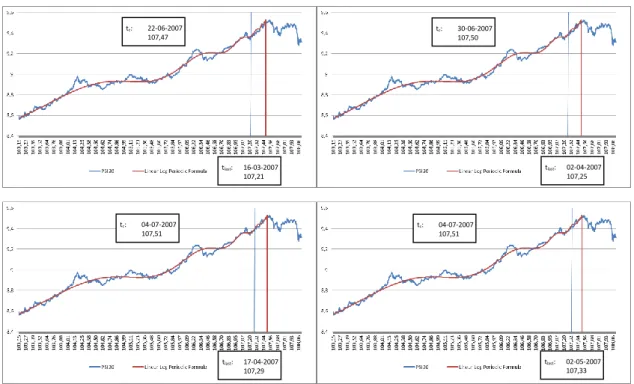
M
ESTRADO
M
ESTRADO EM
C
IÊNCIAS
E
MPRESARIAIS
T
RABALHO
F
INAL DE
M
ESTRADO
D
ISSERTAÇÃO
L
OG
P
ERIODIC
A
NALYSIS OF
C
RITICAL
C
RASHES IN
THE
P
ORTUGUESE
S
TOCK
M
ARKET
J
ORGE
V
ICTOR
Q
UIÑONES
B
ORDA
M
ESTRADO EM
C
IÊNCIAS
E
MPRESARIAIS
T
RABALHO
F
INAL DE
M
ESTRADO
D
ISSERTAÇÃO
L
OG
P
ERIODIC
A
NALYSIS OF
C
RITICAL
C
RASHES IN
THE
P
ORTUGUESE
S
TOCK
M
ARKET
J
ORGE
V
ICTOR
Q
UIÑONES
B
ORDA
O
RIENTAÇÃO:
M
ESTRE PEDRON
UNOR
INOC
ARREIRAV
IEIRADOUTOR
PEDRO
LUIS
PEREIRA
VERGA
MATOS
i
Resumo
O estudo de fenómenos críticos que se originaram nas ciências naturais e encontraram muitos campos de aplicação foi estendido nos últimos anos aos campos da economia de finanças, fornecendo aos investigadores novas abordagens para problemas conhecidos, nomeadamente aos que estão relacionados com a gestão de risco, a previsão, o estudo de bolhas financeiras e crashes, e muitos outros tipos de problemas que envolvem sistemas com criticalidade auto-organizada.
A teoria de singularidades de tempo oscilatório auto-similares é apresentada, uma metodologia prática é exposta, juntamente com alguns resultados de análises semelhantes de diferentes mercados em todo o mundo, como uma maneira de obter de alguns exemplos da forma como a função "linear" log-periódica de potências funciona.
Apresento alguns contextos onde o tempo de crise é apresentado aos mercados internacionais - como uma maneira de demonstração de antecedentes -, assim como apresento também três aplicações práticas do mercado de acções português (1997, 2008 e 2015). A sensibilidade dos resultados e do significado das oscilações log-periódicas são avaliadas.
ii
Abstract
The study of critical phenomena that originated in the natural sciences and found many fields of applications has been extended in the last years to the financial economics’ field, giving researchers new approaches to known problems, namely those related to risk management, forecasting, the study of bubbles and crashes, and many kind of problems involving complex systems with self-organized criticality.
The theory of self-similar oscillatory time singularities is presented. A practical methodology is exposed along with some results from similar analysis from different markets around the world, as a way to get some examples of the way the ´Linear´ Log-Periodic Power Law formula works.
Some context presenting the international markets at the time of crisis is given as a way of having some background, and three practical applications for the Portuguese stock market are made (1997, 2008 and 2015). The sensitivity of the results and the significance from the log-periodic oscillations is assessed.
It concludes with some recommendations and future proposed research.
Keywords: Financial bubble, Self-organized criticality, Crash, Log-periodic power law, Prediction, Financial Crisis
iii
Acknowledgments
To those that helped me to advance.
"Errors of Nature, Sports and Monsters correct the understanding in regard to ordinary things, and reveal general forms. For whoever knows the way of nature will more easily notice her deviations; and, on the other hand, whoever knows her deviations will more accurately describe her ways" Francis Bacon, Novum Organum
iv
Table of Contents
Resumo ... i
Abstract ... ii
Acknowledgments ... iii
Table of Contents ...iv
List of Abbreviations ...vi
List of Figures ... vii
List of Tables ... viii
1) Introduction ... 2
2) Literature Review ... 3
2.1) Market Rationality, Random Walk and Efficiency... 3
2.2) Introduction to the Theory of self-similar oscillatory finite-time singularities in Finance 5 2.3) Self Organized Criticality and Market Rationality ... 7
2.4) Bubbles and Anti-Bubbles ... 7
2.5) Drawdowns ... 10
2.6) Feedback, Herding and Imitation ... 11
3) The model: The Log-Periodic Power Law ... 14
3.1) Macroscopic Modelling ... 15
3.2) Microscopic Modelling ... 16
3.3) Price dynamics ... 18
3.4) The LPPL Equation ... 20
3.5) The Fitting Process and Expected Results ... 21
4) Contextual Analysis ... 23
4.1) 1997-1998 Crisis ... 23
4.2) 2007-2008 Crisis ... 23
4.3) 2015 Crisis ... 24
5) Data Analysis, Methodology and Results ... 26
5.1) Data ... 26
5.2) Methodology ... 26
5.3) Results and Discussion ... 26
5.3.1) Analysis of the 1998 Crash ... 26
5.3.2) Analysis of the 2007 Crash ... 30
5.3.3) Analysis of the 2015 Crash ... 33
v
5.3.5) Artificial Series and Critical Time Sensitivity ... 39
6) Conclusions, Recommendations, Limitations and Future Research ... 41
6.1) Main Conclusions ... 41
6.2) Recommendations ... 41
6.3) Limitations and Future Research ... 41
References ... 42
vi
List of Abbreviations
CDO – Collateralized Debt ObligationsDDM – Dividend Discount Model (also known as the Gordon growth model) DJIA – Dow Jones Industrial Average
EVT – Extreme Value Theory GNP – Gross National Product IMF – International Monetary Fund MBS – Mortgage Backed Security LPPL – Log Periodic Power Law
RMSD – Root Mean Squared Deviation SOC – Self Organized Criticality
SSE CI – Shangai Stock Exchange Composite Index VaR – Value at Risk
vii
List of Figures
Figure 1: Representation of a) An equilibrated market on a 256x256 plane, b) A market in a
Critical State, c) A bubble. Taken from (Sornette, 2003) ... 15
Figure 2: Representation of a trader as part of a network (Prepared by the Author) ... 16
Figure 3: Price dynamics, taken from Ide & Sornette (2002, p. 90) ... 19
Figure 4: Log of the SSE CI for the 2013-2015 period. ... 25
Figure 5: Log(PSI20) for the 96-98 period. ... 27
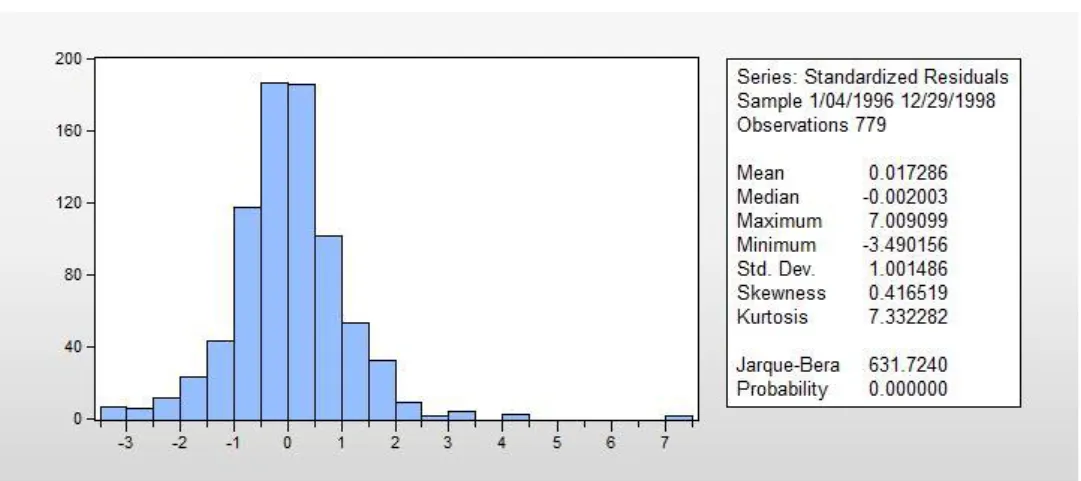
Figure 6: Histogram of the Standardized Residuals for the GARCH (2,2) model for the 96-98 period. ... 27
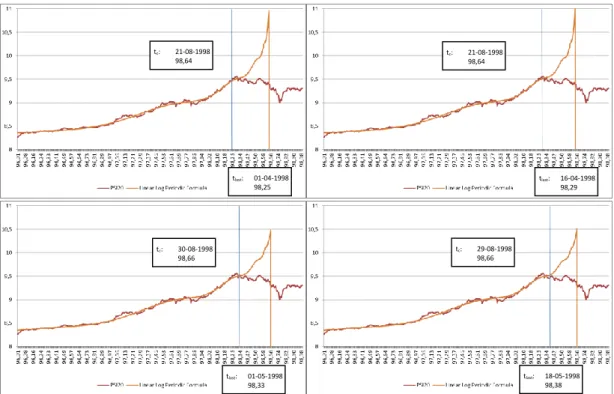
Figure 7: Results obtained with tlast points ranging from 98.25 to 98.38... 29
Figure 8: Results obtained with tlast points ranging from 98.42 to 98.54... 29
Figure 9: Sensitivity Analysis of the Critical Times tc – 1998 Crisis. ... 30
Figure 10: Log(PSI20) for the 2003-2008 period. ... 30
Figure 11: Histogram of the Standardized Residuals for the GARCH (1, 1) model for the 2003-2007 period. ... 31
Figure 12: Results obtained with tlast points ranging from 107.04 to 107.16. ... 32
Figure 13: Results obtained with tlast points ranging from 107.21 to 107.33. ... 33
Figure 14: Sensitivity Analysis of the Critical Times tc – 2007 Crisis. ... 33
Figure 15: Log(PSI20) for the 2012-2015 period. ... 34
Figure 16: Histogram of the Standardized Residuals for the GARCH (2, 2) model for the 2012-2015 period. ... 35
Figure 17: Results obtained with tlast points ranging from 115.17 to 107.29. ... 36
Figure 18: Results obtained with tlast points ranging from 115.34 to 115.46. ... 36
Figure 19: Sensitivity Analysis of the Critical Times tc – 2015 Crisis. ... 37
Figure 20: Result obtained for the 1998 crisis minimizing RMSD and using tlast=98.50 (Left). ... 38
Figure 21: Result obtained for the 2007 crisis minimizing RMSD and using tlast=107.29 (Right). 38 Figure 22: Result obtained for the 2015 crisis minimizing RMSD and using tlast=115.42. ... 38
Figure 23: Critical times generated using the artificial series for the 1998 Crash (Left). ... 39
Figure 24: Critical times generated using the artificial series for the 2007 Crash (Right). ... 39
viii
List of Tables
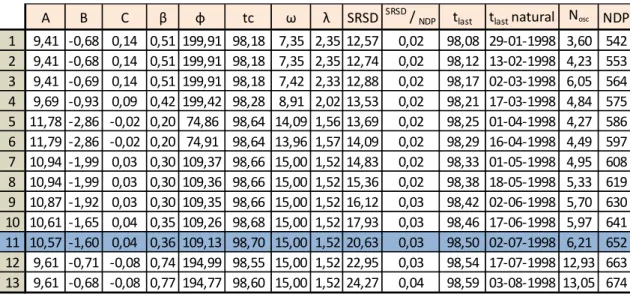
Table 1: Summary of the parameters of the Log-Periodic Power Law fit to the main bubbles and crashes up to 1998, taken from (Johansen & Sornette, 1999) ... 22 Table 2: Fitting of a GARCH (2, 2) Model for the 1996-1998 period. ... 27 Table 3: Fitting of the Log-Periodic “Linear” Model for the 1996-1998 period for samples with different ending points (tlast). ... 28
Table 4: Fitting of a GARCH (1, 1) Model for the 2003-2007 period. ... 31 Table 5: Fitting of the Log-Periodic “Linear” Model for the 2003-2007 period for samples with different ending points (tlast). ... 32
Table 6: Fitting of a GARCH (2, 2), using an Auto Regressive Distributed Lag Model with one lag and no intercept as the main equation for the 2012-2015 period. ... 34 Table 7: Fitting of the Log-Periodic “Linear” Model for the 2012-2015 period for samples with different ending points (tlast). ... 35
Table 8: Fitting of the Log-Periodic “Linear” Model for the selected ending points for 1998, 2007 and 2015 Crisis, minimizing the RMSD. ... 38
2
1) Introduction
In this work we will present the theory of self-similar oscillatory finite-time in finance and its application to the prediction of crashes. First we will present some terms and concepts that will be used with regularity, and later we will make a brief introduction to the theory before starting to analyse its different aspects and the challenges concerning the prediction aspect.
In the Literature Review, we will discuss the different points of view regarding market rationality, and its relationship with SOC. In the third chapter we will present the model behind the LPPL formula and some guidelines for its application. In the Contextual Analysis chapter, the most important international actors behind the 1998, 2007-2008 and the 2015 crisis are presented.
The Data Analysis, Methodology and Results will present the results obtained from the analysis of the Portuguese Stock Market in three critical periods (1997, 2007-2008 and 2015). Chapter 6 concludes and presents recommendations and suggestions for future research.
The importance of bubbles and crashes in the stock market has always attracted a lot of interest, given how wealth is created so fast as if it didn´t came from nowhere, just to end abruptly when most economists, forecasters and experts expected the positive trend to continue in an indefinite way.
Bubbles and the way these develop have been present in different markets during different eras, showing common features despite technological changes or countries differences. And in all cases, when the bubble ends, Analysts would start looking for a cause for the crash, and they´ll usually find it, in some piece of news. However, it seems to be that financial markets are unstable by design, and that the oscillations of prices before crashes, could be caused by the way markets are organized. It is possible that the cause of the crashes are the bubbles itself, and the news are just triggers, but the instability has to exist to begin with.
3
2) Literature Review
2.1) Market Rationality, Random Walk and Efficiency
Markets are considered efficient if all available information about the assets is reflected in current market prices (Johansen, et al., 2000; Blume & Siegel, 1992), An important aspect of price dynamics is noise trading, being defined as “trading on noise as if it were information” (Black, 1986). In this context, we will consider the effects of the interactions of so-called technical traders and fundamental traders. Technical traders use chartist techniques that attempt to predict future behaviour of stock prices based on the knowledge of the past behaviour of price series (Fama, 1965). It was noted that this assumes dependencies among successive price changes, as well as gives importance to past series of prices for prediction purposes.
Technical trading is in contradiction with the majoritarian opinion that states that the market follows a random-walk. This has been defined as “a market where successive price changes in individual securities are independent” (Fama, 1965, p. 5).
Fundamental analysis is based on the assumption of the existence of an intrinsic value (or equilibrium price) that is based on the potential earnings of the stock, which in turn is based on many different factors (management quality, state of the industry, country situation, etc.). A fundamentalist would determine the intrinsic value, and by its comparison with the market´s price, would determine if it´s over or undervalued. This will then, in fact, represent a prediction of the future path of the stock since an eventual return to the intrinsic price is to be expected (Fama, 1965).
Maximally rational markets are markets where all investors are rational, in that scenario trading volume would be very small and investors would invest mostly in index funds Rubinstein (Rubinstein, 2000). However, since that´s not the world where we live in, we know that markets are not maximally rational. A more realistic approach considers that the markets are rational, understood as a market where “prices are set as if all investors are rational” (Rubinstein, 2000, p. 4). A market like that can be obtained even if not all investors are rational, that is, they can trade in excess or diversify too little. In recent investigations, it has been found that the main features of financial markets (volatility clustering and heavy tails) can be replicated without assuming rationality using the `zero-intelligence’ approach (Thompson & Wilson, 2013). Market efficiency could emerge on a macro level even if market participants behave in an irrational way, since market structure seems to be more important than its participants (Gode & Sunder, 1993) . These conclusions were in line with Farmer et al (2005, p. 2259), who concluded that “institutions strongly shape our behaviour, so that some of the properties of markets may depend more on the structure of institutions than on the rationality of individuals.” Farmer also suggested that rational effects are the ones behind price levels, but that volatility could be related to random fluctuations.
The theory of random walks “implies that a series of stock price changes has no memory-the past history of memory-the series cannot be used to predict memory-the future in any meaningful way” (Fama, 1965, p. 6). He also considers that even when price changes could not have a zero correlation, this could be small enough to ignore, if we are not able to gain abnormal profits by trading on knowledge of the past of the series.
4
The independence assumption among prices, suggested by the random-walk model, has been usually considered a reasonable representation of the behaviour of stock markets given that no complex trading rule has ever proved superior to the simple buy-and-hold1 (Fama, 1965; Tryfos, 2001). Rubinstein (2000) mentions that even if markets are irrational and discrepancies between market prices and fundamental prices are found, that wouldn´t necessarily represent a profit opportunity, if there is no way to exploit the advantage due to market structure, regulations or trading costs. Rubinstein (2000, p. 4) adds that markets “are at least minimally rational: although prices are not set as if all investors are rational, there are still no abnormal profit opportunities for the investors that are rational”.
One problem with Fundamental Analysis is that the fundamental or true price, could never be observed in reality (Blume & Siegel, 1992). This happens because full information is never disclosed and not all investors are equally informed, and because “in an uncertain world the intrinsic value of a security can never be determined exactly” (Fama, 1965, p. 4), however, it could be expected that stock prices wander in a random way around its true value.
According to the rational markets view, price irregularities and systematic patterns are due to mistakes in “the collective judgment of investors” (Malkiel, 2003, p. 80), and those systematic irregularities could persist only for short periods since investors would make it disappear by trying to profit from them For the same reason, individual forecasting models would also show declining value after some time (Timmermann & Granger, 2004). That is, by creating forecasting models that correctly predict the patterns, and by acting on them, the patterns will disappear in time.
According to Romer (1993), there is an extreme efficient-markets view of markets, which considers that all information is processed in a mechanical way and arrives to optimal estimates of fundamental variables. However, given that this extreme view doesn´t perform adequately in empirical tests, a second view emerged, one that considers that markets are irrational and suffer waves of optimism and pessimism not entirely based on news. In addition to those ways of explaining the behaviour of markets, (Romer, 1993, p. 1129) suggested “an intermediate view: that the market is, in effect, engaged in a many-dimensional and a many-agent inference problem with multiple layers of uncertainty and heterogeneity and with frictions in the trading process”. Because of this, market prices are not related in a simple way to news; the process is not direct, and it explains why it could be compatible to have rational investors and price movements without the arrival of news. Talking about this process, Fama (1965), mentioned that instantaneous adjustments would lead to over-adjustments and under-adjustments in the same proportion, and the lag of adjustment to a more precise level would be a random variable. The ´paradox´ in efficient markets says that markets can only be efficient if there are investors that think that the market is inefficient and spend time and money trying to get information to be able to exploit the perceived inefficiencies (Blume & Siegel, 1992). This is related to the noise traders or liquidity traders, which by their operations, add noise. Their counterparties never know if the initiator of the trade is acting based on information or noise. Through these operations, additional volatility is entered into the
1 After trading commissions.
5
market, and “with a lot of noise traders in the market, it now pays for those with information to trade. It even pays for people to seek out costly information which they will then trade on” (Black, 1986, p. 531). However, if the markets were perfectly efficient, professional investors wouldn´t have incentives to gather information since it would be reflected too quickly in market prices (Malkiel, 2003) .
We are faced with a puzzling situation where even when we know that technical trading couldn’t work due to the efficiency of markets, this is still widely used, even when its basic assumption is that history tends to repeat itself and past patterns will recur at some point in the future (Fama, 1965). However, given that market participants have an effect on market behaviour, we get as a result “a symmetric Nash equilibrium at which the average final wealth of agents in the market is lower than in the hypothetical equilibrium in which everyone uses only fundamental trading rules” (Joshi, et al., 1999, p. 2). Other effects mentioned as a consequence of the use of technical trading is the reduced ability to forecast due to the reinforcement of price trends, an increased volatility and noise, and smaller earnings.
We could be in a prisoner’s dilemma that lands us in a sub-optimal equilibrium, where technical trading is the dominant strategy because “it makes each agent better off regardless of what strategy other traders in the market follow” (Joshi, et al., 1999, p. 15). They consider that even when technical trading would be inevitable, it could be better if it would be possible to avoid it, given that a market where investors follow fundamental trading rules would have a higher optimum.
2.2) Introduction to the Theory of self-similar oscillatory finite-time singularities in Finance
In this framework, markets are considered as open and non-linear complex systems that exhibit emanating patterns (Bastiaensen, et al., 2009) include evolutionary adaptive characteristics and are “populated by bounded rational agents interacting with each other” (Sornette & Andersen, 2002, p. 173)2.
An important property of complex systems is the possible manifestation “of coherent large-scale collective behaviours with a very rich structure, resulting from the repeated nonlinear interactions among its constituents: the whole turns out to be much more than the sum of its parts” (Sornette, 2003, p. 12). Sornette adds that most complex systems can´t be solved, instead should be explored using numerical methods. In most cases, given that the systems are computationally irreducible, their dynamical future time evolution wouldn´t be predictable. Even with the continuous increasing of computing power, prediction of critical events could still be difficult, due to the under sampling of extreme situations (Sornette, 2003).
However, it should be noted that the interest is not in predicting the detailed evolution of systems, but in trying to detect the arrival of critical times and the extreme events (Sornette, 2003). Talking about weather prediction, Lorenz (1972, p. 4), stated that “certain special quantities such as weekly average temperatures and weekly total rainfall
2 Related research includes analysis of epidemics, spread of opinions, large natural catastrophes, social
6
may be predictable at a range at which entire weather patterns are not.”, showing that at that time, even when the complete system could not be solved, some measures could still be anticipated.
Self-Organized Criticality is defined as “the spontaneous organization of a system driven from the outside into a globally stationary state, which is characterized by self-similar distributions of event sizes and fractal geometrical properties” (Sornette, 2007, p. 7013). This stationary state is dynamical and characterized by the emergence of statistical fluctuations that are usually called ´avalanches´. In this context “´criticality´ refers to the state of a system at a critical point at which the correlation length and the susceptibility become infinite in the infinite size limit” (Sornette, 2007, p. 7013), while self-organized is related to “pattern formation among many interacting elements. The concept is that the structuration, the patterns and large scale organization appear spontaneously. The notion of self-organization refers to the absence of control parameters” (Sornette, 2007, p. 7013). Critical points are points in time where you observer “the explosion to infinity of a normally well-behaved quantity” (Johansen, et al., 2000, p. 1), these situations could be a common occurrence.
The ´Dragon King´ concept was proposed by Sornette, where the term ´king´ is used “to refer to events which are even beyond the extrapolation of the fat tail distribution of the rest of the population” (Sornette, 2007, p. 7018).
Endogeneity in stock markets, what according to according to Sornette & Cauwels (2014) is known as ´reflexivity´ by George Soros, is defined as “the fraction of transactions that are triggered internally or are self-excited, (…) and that are not the result of some new external information” (Sornette & Cauwels, 2014, p. 123).
Inside the SOC framework, stock market crashes are due to “the slow build-up of long-range correlations” (Johansen, et al., 2000, p. 220), and the markets eventually land into a crash because those correlations lead to a global cooperative behaviour (Kaizoji & Sornette, 2008). This theory can be applied equally to bubbles ending in a crash and to those that land smoothly (Johansen, et al., 1999).
The forecasting of crashes is compatible with rational markets, because even if investors know that there is a high risk of a crash, this crash could happen anyway, and investors would not be able to earn any abnormal risk-adjusted return by the use of this information (Johansen, et al., 2000), because “investors must be compensated by the chance of a higher return in order to be induced to hold an asset that might crash” (Johansen & Sornette, 1999, p. 3). That is, the price of the assets go up, but that´s rational because the risk of a crash has increased.
The similar patterns arising before crashes at different times, have been attributed to the stable nature of humans, since they are essentially driven by greed and fear in the process of trading. And even when technology changes the ways of interaction, the human elements remain (Sornette, 2003).
Two characteristics usually associated with crashes are: 1) Crashes come unexpectedly 2) Financial collapses never occur when the future looks bad (Sornette, 2003). A possible explanation is that people tend to forecast the future as a linear continuation of the present.
7
It was first believed that there haven´t been financial crashes not preceded by log-periodic precursors in the 80s and 90s (Johansen, et al., 1999). However, 11 years later, two cases were identified: 1987 drawdown outliers in the German DAX index and in the Japanese Nikkei index. These crashes were classified as exogenous because they were not connected to the internal political or economic situation but were just a reflection of a crash in the US market. This means that the crash was not due to an instability due to a bubble (and that´s why the log-periodic signatures were not present). Some parallels between these exogenous crises and the contagion of crises due to an increase in correlation among markets in crises periods has been suggested (Johansen & Sornette, 2010)
2.3) Self Organized Criticality and Market Rationality
Self-Organizing Criticality theory is consistent with a weaker form of the weak efficient market hypothesis (Sornette, 2004, p. 279) that purports that market prices contain not only easily accessible public information (information that has been demonstrated to disseminate in an efficient way under controlled circumstances (Sornette & Andersen, 2002)) , but also more “subtle information formed by the global market that most or all individual traders have not yet learned to decipher and use” (Sornette, 2003, p. 87). It was also proposed that “the market as a whole can exhibit an ´emergent´ behaviour not shared by any of its constituents” (Sornette, 2003, p. 87), in a process compared to the behaviour of an ant colony.
The aggregate effect of market participants could take the price to the level expected by the rational expectations theory, even when every participant traded in a sub-optimal way. Prices could not be in a journey to an equilibrium point, but in a self-adaptive dynamical state emerging from traders´ actions (Johansen, et al., 2000). There’s an emphasis in the possibility of achieving near-optimal markets with sub-optimal traders.
News could be unnecessary in order to provoke movement in financial prices, given that “self-organization of the market dynamics is sufficient to create complexity endogenously” (Sornette & Andersen, 2002, p. 173). In this case, it wouldn´t be necessary to match every price movement to different news, that´s in contrast to the efficient markets theory, where crashes are caused by “the revelation of a dramatic piece of information” (Johansen, et al., 2000, p. 219). They also mentioned that typical analysis after crashes usually have conflicted conclusions as to what that information could have been
2.4) Bubbles and Anti-Bubbles
A market will be in a bubble state when “faster-than-exponential accelerating price”
behaviour appears (Zhou & Sornette, 2009, p. 871), and a crash will be defined as “an extraordinary event with an amplitude above 15%” (Johansen & Sornette, 1999, p. 91). Controversy regarding the existence of bubbles appears because we never know with certainty which are the fundamentals (Youssefmir, et al., 1998), and because bubbles can be reinterpreted as unobserved market fundamentals (Sornette & Andersen, 2002). Another point of discussion is about if bubbles should appear if market participants are rational or if that demonstrates that they are irrational. There has been analysis providing rational explanations for the South Sea Bubble, the Mississippi Bubble and the
8
Tulipmania,3 using analysis with omitted variables where the crash didn’t occur.
However, it’s also mentioned that it’s difficult to find a rational explanation based on news for the October, 19, 1987 crash, where US stocks went down around 22%.
Bubbles and crashes could also be understood on the context of business cycles, these depend on many little factors that are difficult to measure and control, instead of a few large controllable parameters, what makes business cycles essentially uncontrollable (Black, 1986). And additional complication is the fact that “speculative bubbles may take all kinds of shapes. Detecting their presence or rejecting their existence is likely to prove very hard” (Blanchard, 1979, p. 387).
There are authors who consider that speculative bubbles and market crashes are not opposed to the idea of rational expectations (Orlean, 1989; Blanchard, 1979). Based on his analysis of rational bubbles, Orlean (1989) cites Keynes while affirming that the emergence of bubbles is an expected outcome due to the operating conditions of financial markets, where operators try to maximize its benefits constrained by markets limitations. It´s also important to notice that, even when investors react to market conditions, market conditions are also affected by agents´ actions (Farmer, et al., 2005).
A test to detect bubbles in single stocks based on the dividend discount model (DDM), using the equation usually referred as the Gordon growth model, presented by Weites & Maravic (2010), starts with the typical equation:
𝑃𝑡 =
𝐷𝑡+1 𝑟 − 𝑔
Where P represents the price, D the expected dividends, r is the constant discount rate and g is the constant period growth of dividends. Later an * is used to denote fundamental prices or values:
𝑃𝑡∗ = 𝐷𝑡+1
𝑟 − 𝑔∗
Rearranging, that would give us the fundamental constant period growth of dividends: 𝑔∗= 𝑟 −𝐷𝑡+1
𝑃𝑡∗
Then, using real prices and we would get gB and Bt :
𝑃𝑡= 𝐷𝑡+1 𝑟 − (𝑔∗+ 𝑔 𝐵)𝑡 = 𝑃𝑡 ∗+ 𝐵 𝑡 (𝑔∗+ 𝑔 𝐵)𝑡 = 𝑟 − 𝐷𝑡+1 𝑃𝑡
3 A recent analysis providing a rational markets approach to the Tulipmania can be found in (Thompson,
9
Where Bt is the excess of the price of the stock considering the fundamentals and g*
represents market´s growth expectation excessive to the fundamentals dividends growth. Using this methodology, we would identify a bubble whenever Bt and gB are higher than
zero.
During a bubble, the prices of assets not only reflect fundamentals, but also an extra that arises because investors expect to sell the asset in the future for a value higher than what they believe is worthy (Youssefmir, et al., 1998). In these cases, price predictions become self-fulfilling. However, this extrapolation into the future reaches a top when investors following fundamentals start to withdraw from the market. The price stops growing and the self-fulfilling prophecies stop coming true; in this case, the unsustainable growing stops and there could be a crash.
A summary of the stages of bubbles presented by (Kaizoji & Sornette, 2008) citing (Kindleberger, 1978) considered the following steps: 1) Emergence of a new opportunity due to changes in markets, technology or others, with investors eager to participate 2) Euphoria, increase of prices and expansion of credit that fuels growth 3) Maniac phase with novice investors that could end with illiquid assets 4) Markets stop rising and those who were on credit are not able to payback, failures and a stop to new credits. 5) Self-sustained panic, the bubble bursts, those that are in try to get out at any price. Prices go lower and lower, and everybody wants to have cash, instead of assets.
According to Malkiel (2003), periods like the 1999 bubble are the exception instead of the rule, and even if some irregularity could be detected, it wouldn´t provide a way to get abnormal returns.
The definition of a bubble as a “transient upward acceleration of prices above fundamental value” (Yan, et al., 2011), brings us to another problem, given that we can´t differentiate easily between a growing bubble price and a growing fundamental price, as mentioned by Yan et al. A more direct approach to bubble identification, would be to consider that markets are in a bubble when prices accelerate at a faster-than-exponential rate, also known as ´super-exponential´, in those cases the growth rate itself keeps growing, something that is inevitable unsustainable (Zhou & Sornette, 2009). A super-exponential growth process would lead to finite-time singularities, at that point the bubble dynamics have to end and the market has to change to a different regime (Kaizoji & Sornette, 2008).
A recurrent characteristic of stock prices during bubbles is their accelerating oscillations “roughly organized according to a geometrically convergence series of characteristic time scales decorating the power law acceleration. Such patterns have been coined ´log-periodic power law´ (LPPL)” (Zhou & Sornette, 2009, p. 870). Another fact observed during bubbles is the observed reduced liquidity as we approach the top of the bubble, this occurs because “an increase in the rate of market order submission reduces liquidity and thus increases price” (Farmer, et al., 2005, p. 2258).
A famous example of bubble is the tulip mania. Even though it is usually considered as a period of craziness, at the time it was considered a ´sure-thing´ business (Sornette, 2003), and just before the crash, most participants made money since the mid-1500s to 1637. However those earnings were not gained through the process of production, but as a result of speculation.
10
It has been proposed by Yan et al (2011) that negative bubbles can exist, and that these transient regimes would exhibit downward prices and faster-than-exponential downward acceleration. In these regimes, after every decrease of price, an additional reduction is expected, “the positive feedback reflects the rampant pessimism fuelled by short positions leading investors to run away from the market which spirals downwards also in a self-fulfilling process” (Yan, et al., 2011, p. 8). This symmetry can be observed easily analysing pairs of currencies, when one is going up in a bubble, the other one is going down in an anti-bubble. The main result of Yan et al (2011) was the discovery of an association between anti-bubbles and large rebounds or rallies.
2.5) Drawdowns
A drawdown is defined as “a persistent decrease in the price over consecutive days” (Sornette, 2004, p. 51) and as “the cumulative loss from the last local maximum to the next minimum” (Johansen & Sornette, 1999, p. 91). Drawdowns directly measure the cumulative loss that investment may suffer and also quantify the worst-case scenario of an investor buying at the local high and selling at the next minimum (Sornette, 2004). Research of drawdowns is important because the study of the markets under extreme circumstances could reveal its fundamental properties (Johansen & Sornette, 2002) . Johansen & Sornette (2002) analysed the most important financial indices, currencies, gold and a sample of individual stocks in the US, finding fat tails in all series (with the exception of the CAC40). In addition to that they found that 98% of drawdowns and drawups could be fitted to an exponential model, 98% of the time. These 98% could be produced by a financial market following a GARCH process. While around 1-2% of the largest drawdowns couldn´t be fitted to the exponential or Weibull functions.
This could indicate that the largest drawdowns are outliers, even when most of the time, the very largest daily drops are not outliers. An explanation for this could be the emergence of a sudden persistence of consecutive daily drops, with a correlated magnification of the amplitude of drops (Johansen & Sornette, 2002).
Their main result was the discovery of the existence of the emergence of transient correlations across daily returns. These have been found in emerging markets (reflecting the low volume) but also in the Oct. 1987 crash. These would lead us to analyse the problem related to the extended use of Value-at-Risk and extreme value theory (EVT). In the case of VaR, this is focused on the analysis of one-day extreme events happening during a specified timeframe. However, the bigger losses occur due to the emergence of transient correlation, which in turn will lead to runs of cumulative losses. These correlations would make the drawdowns much more frequent than expected when independence between daily returns is assumed. Regarding EVT, if large drawdowns are outliers, extrapolating the tails from smaller values cannot be correct.
11
2.6) Feedback, Herding and Imitation
Threshold models, where outcomes depend on how people react to other people´s actions4, apply to a multitude of situations, including the stock market5. These models start with the initial distribution of thresholds and try to estimate how many will end choosing each of the two alternatives presented (Granovetter, 1978), that is, to find the equilibrium that will arise over time. Finding these equilibriums is difficult since people have different thresholds regarding how many people would have to hold an opinion for them to consider changing their own opinion.
Thresholds models and mimetic contagion processes are related since these processes can be identified because as the imitation disseminates, “it reinforces itself in that individuals show an increasing tendency to imitate” (Orlean, 1989, p. 83). That is, an opinion shared by a great number of people would be very attractive, increasing the chances that those that ignored it at first, could change their mind. The exception being a self-enclosed individual, who won´t change his mind, no matter how strong is the pressure by the other agents, however it could be very difficult to find an investor that doesn´t interact and it is influenced by others. Devenow & Welch (1996) mention that influential market participants highlight the high influence that other market participants have in their decisions, which could lead to mimetic contagion whenever there’s a bubble or crash. It has been considered by Orlean (1989), that a trader that analyses information taking into account the Walrasian general equilibrium would decide if this is relevant or not, in an objective way, according to market fundamentals. However, in his framework, the speculator would only take into account how other traders think and act, drawing a parallelism between this situation and the beauty contest example created by Keynes. In cases of mimetic contagion, investors are not interested in fundamentals, but only in the information they can get from market participants; they could just copy the actions of their neighbours6 (Orlean, 1989). This explanation could help explain bubbles and crashes, but received little attention since it was considered akin to irrationality. However, when an agent has no information it could end better off by copying somebody with information, or simply end in the same situation (in case the copied agent has not information).
Between the two extreme positions, where one extreme sees herding as an example of irrational behaviour where investors act like lemmings while others that act in a more rational way see benefits, and the other extreme sees it as an example of rationality but considers externalities, information and incentives, there’s an intermediate view that “holds that decision-makers are near-rational, economizing on information processing or information acquisition costs by using 'heuristics', and that rational activities by third-parties cannot eliminate this influence” (Devenow & Welch, 1996, p. 604).
4 Usually binary models: yes/no - buy/sell.
5 Other example are the diffusion of innovations, rumours, diseases, strikes, votes, the time of leaving
social occasions, migration, among others (Granovetter, 1978).
6 In cases where 1) private information is limited 2) agents have to take decisions based on observed
actions and 3) there are limited possible actions, informational cascades could emerge. Agents gain information from observing other agents and could discard their own private information in a rational and optimal way (Devenow & Welch, 1996).
12
Orlean’s model is compatible with the model proposed by Graham (1999), where there are two types of traders: smart ones, who receive informative signals, and dumb ones, who receive uninformative signals. Given that the smart analysts’ signals are positively correlated, they would tend to act in a similar way, as a consequence “in certain circumstances, an analyst can ´look smart` by herding” (Graham, 1999, p. 238). On the other hand, an analyst would have a bigger tendency to ignore leaders’ opinions and trust his own personal information if he has a bigger perceived ability (or high confidence)7.
This point of view is shared by Zhou & Sornette (2009, p. 869) who add that “it is actually ´rational´ to imitate when lacking sufficient time, energy and information to take a decision based only on private information and processing, that is..., most of the time”. Bubbles are more likely to appear in isolated industries or markets (Krause, 2004), given that analysts and traders in the sector are usually interacting among themselves most of the time, and that those industries or markets could be not well integrated into the rest of the economy, magnifying the effects of biases8. It´s also mentioned that behind bubbles,
there´s always a specific industry standing out. Johansen & Sornette (1999) mention that traders do not maintain a fixed position with respect to their colleagues, instead, they are in constant change, creating new interactions and correlations.
The effects of herding behaviour in financial markets can be seen as “positive or negative feedback mechanisms causing price accelerations or decelerations and (anti)-bubble formation, where asset prices become detached from the underlying fundamentals” (Bastiaensen, et al., 2009, p. 2)9. This phenomena is closely related to the concepts of
positive and negative feedbacks, the latter tend to regulate systems towards an equilibrium, while positive feedbacks make high prices or returns, even higher (Sornette, 2003). In the stock market's context, positive feedback would be referred as trend-chasing (Johansen & Sornette, 1999), however it´s also noted that at some point, not only technical analysts but also fundamentalists will have to act as trend-chasers as a way to increase benefits.
Positive feedbacks, caused among others by derivative hedging, portfolio insurance and imitative trading, are considered “an essential cause for the appearance of non-sustainable bubble regimes. Specifically, the positive feedbacks give rise to power law (i.e., faster than exponential) acceleration of prices” (Zhou & Sornette, 2009, p. 870).
Using tools to quantify the degree of endogeneity, it has been determined that it has increased “from 30% in the 1990s to at least 80% as of today” (Sornette & Cauwels, 2014, p. 123), showing that due to technological advances, that make possible to trade many times in a short period of time, we get bubbles and crashes that can “develop and evolve increasingly over time scales of seconds to minutes” (Sornette & Cauwels, 2014, p. 123).
7There is also a tendency for youngsters to exaggerate private information in order to gain a reputation,
while older investors try to hide in the herd, since they have a reputation to protect, for more in the topic, (Graham, 1999) and (Devenow & Welch, 1996) can be consulted.
8 Some examples mentioned are the Tulipmania 1634-1637, South-Sea Bubble 1717-1720, Railways
1847, Automobiles 1922, Internet 1998-2000
9 Besides the stock market, there are many different examples of complex systems exhibiting
self-reinforcing behaviour, for example: feedbacks in technology (VHS vs Betamax) or the accelerating activity observed before a big earthquake (Sornette & Andersen, 2002).
13
Drastic price changes without a change in economic fundamentals, could be explained by panicked uninformed traders that sell causing prices to drop (Barlevy & Veronesi, 2003). However, those sells could be rational if they are acting in response to perceived information that they received from the market. If that´s the original cause of crashes, there wouldn´t be a need of an exogenous cause to crashes. Eguiluz & Zimmermann (2000) seem to agree when they mention that the occurrence of crashes could be explained by the mechanisms of information dispersion and herding.
14
3) The model: The Log-Periodic Power Law
The proposed framework, following Ling et al (2014), considers the existence of 2 types of traders:
Perfectly Rational Investors (Fundamental Value Investors) with rational expectations Irrational Traders (Trend Followers/Noise Traders/Technical Traders that exhibit
herding behaviour)
From their interaction, we get the characteristic periodic oscillations in the stock market that are visible in the logarithm of the price in periods previous to crashes. These oscillations will evidence increasingly “greater frequencies that eventually reach a point of no return, where the unsustainable growth has the highest probability of ending in a violent crash or gentle deflation of the bubble” (Yan, et al., 2011, p. 3). These patterns are not exclusive to the stock markets since they appear in hierarchical network structures10. In a crash, “there is a steady build-up of tension in the system (…) and without any exogenous trigger a massive failure of the system occurs. There is no need for big news events for a crash to happen” (Bastiaensen, et al., 2009, p. 1).
Accelerating prices at the end of bubbles occur because “the higher the probability of a crash, the faster the price must increase (conditional on having no crash)” (Johansen, et al., 2000, p. 223). This happens because investors expect higher prices in order to be compensated for the higher risk of a crash, that way prices are driven by the hazard rate of a crash, being this defined as “the probability per unit of time that the crash will happen in the next instant if it has not happened yet” (Johansen, et al., 2000, p. 219). We will represent the hazard rate conditional on time as h(t), the higher the hazard rate, the higher the price, being this is the only result consistent with rational expectations.
A criticism from Feigenbaum (2001) stated that serial correlation could affect regression estimators when applied to serial-correlated time series if first differences are not used, suggesting that log-periodicity could appear in financial series if this problem is not treated (random effects being another possible cause). To test this idea he analysed data from the S&P 500 from 1980 to 1987 in first differences and obtained a statistically significant specification11. However when he analysed data ending in June 1986, he obtained a critical date shortly after the last day included and way before the real crash, leading him to conclude that log-periodicity is either negligible or not present in this set of data. Responding to that analysis, Sornette & Johansen (2001) mention that those results were not surprising considering that it would be difficult to get reliable predictions after removing the last 15% of data. They also mention that based on the value of one of the coefficients (out of normal bounds), they would have discarded that prediction and state that no prediction was possible so ahead in time.
10 Another example is the emergence of patterns when groups start clapping, without the need of a
master of ceremony (Bastiaensen, et al., 2009).
15
3.1) Macroscopic Modelling
The state of the market can be represented with a diagram, where white points show bullish traders (traders that expect prices to go up) and black points represent bearish traders.
Figure 1: Representation of a) An equilibrated market on a 256x256 plane, b) A market in a Critical State, c) A bubble. Taken from (Sornette, 2003)
In a normal situation, represented by (a) in the graphic, we would see black and white points equally dispersed through the market, meaning that there are approximately the same amount of buyers and sellers, keeping the markets working in a fluid way despite the apparently chaos reigning in the market. These are the times where a crash does not occur (Johansen, et al., 2000). Due to the forces of imitation, we will see an enlargement of clusters, we can observe this at (b): at this moment the market will start showing fractal properties, which are the sign of an upcoming phase transition (Sornette, 2003). In the moment just before a crash, we will see a mostly white plane and just scattered and dispersed small black clusters. The great white areas indicate that there´s a strong bubble, in this situation, the slightest disturbance would cause a crash.
This model is compatible with a weaker form of the ´weak efficient market hypothesis´, where prices contain, in addition to the information available to all, subtle information formed by the market as a whole. Information that almost no investors have learnt to decipher. The forecasting of financial crashes raises the question of why if traders know that a crash is coming, they don´t prevent it. A possible answer is that the macroscopic entity (the entire market) could display behaviours not shared by any (or just a very limited number) of its constituents (the individual investors); a process resembling the emergence of intelligence at a macroscopic scale, that is not noticed by individual entities at a microscopic scale (Sornette, 2004)12.
Two characteristics of critical systems have also been observed in the stock market by Johansen et al (2000, p. 233): a) “local influences [that] propagate over long distances” that makes the average state of the system very sensible to small perturbations (that is, it becomes highly correlated) and b) self-similarity across scales at critical points where big concentrations of bearish traders “may have within it several islands of traders who are mostly bullish, each of which in turns surrounds lakes of bearish traders with islets of
16
bullish traders; the progression continues all the way down to the smallest possible scale: a single trader” (Johansen, et al., 2000, p. 234).
Local imitation cascades through the scales into global coordination because of critical self-similarity (Johansen, et al., 2000). Given that what are in essence similar crashes have happened during this century, we will have to consider that maybe it´s the structure of markets what leads to crashes, since almost everything else have changed during the years. The origin of the crashes could lay on the organization of the system itself:
“The concept that emerges here is that the organization of traders in financial markets leads intrinsically to “systemic instabilities” that probably result in a very robust way from the fundamental nature of human beings, including our gregarious behaviour, our greediness, our reptilian psychology during panics and crowd behaviour and our risk aversion”
In (Johansen & Sornette, 1999) According to (Crutchfield, 2009), when you add intelligence to a group, this starts to behave in more complicated ways, because agents try to anticipate each other creating oscillations in the market; something that wouldn´t happen with simple agents without big memories or complex strategies. He concludes that “dynamical systems consisting of adaptive agents typically do not tend to a mutually beneficial global condition—they cannot find the Nash Equilibrium. The lesson is that dynamical instability is inherent to collectives of adaptive agents" (Crutchfield, 2009).
3.2) Microscopic Modelling
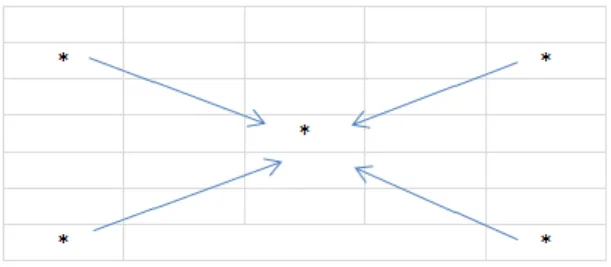
Traders are inserted inside a network of contacts, and it´s from these interactions that they will be influenced and take decisions: buy or sell. Traders tend to imitate their closest neighbours, in periods where imitation is high there would be an increased order in the market (e.g.: people agreeing to sell), and that would lead to a crash (Johansen, et al., 2000). However, the normal state of the market is a disordered one where “buyers and sellers disagree with each other and roughly balance each other out” (Johansen, et al., 2000, p. 225). Despite the usual characterisation of chaos as something negative, it´s actually the predominance of order what brings bubbles and crashes to the market. Let´s consider this simple example:
Figure 2: Representation of a trader as part of a network (Prepared by the Author)
This trader will be influenced by 4 traders, but he will also produce his own idiosyncratic signal. He could still follow his own ´hunch´, but if the social pressure becomes too high, he will probably follow the majoritarian decision even if it goes against his own ideas.
17
The trader´s own signal could be considered a stochastic component of the model, while the influence of the other traders would tend to standardize the decisions in the market. This trader could also influence other traders which will extend the opinion of its small network. The main benefit of a micro-model based on imitation is that an overarching coordination mechanism is not required, and “that macro-level coordination can arise from micro-level imitation”13 (Johansen, et al., 2000, p. 225). This network of investors would exhibit a scaling symmetry (Feigenbaum, 2001).
A micro-model developed by Johansen et al (2000), calculates a ´sign´ for a trader (where positive equates to buying and negative to selling). Random idiosyncratic shocks are represented by εi,a global influence term is represented by G, the coupling strength or the
tendency towards imitation is given by K, tendency towards idiosyncratic behaviour is represented by σ and susceptibility is represented by χ. The susceptibility will measure “the sensitivity of the average state to a small global influence” (Johansen, et al., 2000, p. 229). Another interpretation will be that “if you consider two agents and you force the first one to be in a certain state, the impact that your intervention will have on the second agent will be proportional to χ” (Johansen, et al., 2000, p. 229), they mention that susceptibility would measure how easy is for a large group of members of the network to agree on an opinion.
The micro-model is represented as: (1) 𝑠𝑖 = 𝑠𝑖𝑔𝑛(𝐾 ∑𝑗∈𝑁(𝑖)𝑠𝑗+ 𝜎𝜀𝑖 + 𝐺)
Where if the global influence (G) is bigger than 0, then state +1 tends to be favoured, and vice versa, and if the case of absence of global influence, we will have that traders will be evenly split between positives and negatives. We can represent this as the expected state of the market, E[M] = 0: where agents are in favour of buying as much as they are in favour of selling. And we will see that “in the presence of a positive (negative) global influence, agents in the positive (negative) state will outnumber the others: E[M] × G ≥ 0” (Johansen, et al., 2000).
Representing the susceptibility of the market as 𝑥 we will have: (2) 𝑥 =𝑑 ( 𝐸[𝑀])𝑑𝐺 |𝐺 = 0
It´s because of this imitation process and the susceptibility of traders that a process starting with local imitation can end in a crash (Johansen, et al., 2000). Even when the hazard rate could be related to susceptibility, it´s not possible to make a one to one scaling between them because there are other aspects to consider like correlation lengths (how far imitation propagates) as well as “the other moments of the fluctuations of the average opinion” (Johansen, et al., 2000, p. 229).
At a microscopic level, a trader only has three options: buy, sell or wait. Moving from one state to a different one is usually related to a price threshold being exceeded (Johansen, et al., 2000). Given that in general, transactions are irreversible and traders
13 For a non-exhaustive list of mechanisms exhibiting self-similar behaviour that will lead to power law
distributions (Sornette, 2007) can be consulted, cracking noise and avalanches are among the examples mentioned.
18
work based on limited information and can only see the cooperative responses to variations of price, it could be tempting to equate the stock market to other dynamical out-of-equilibrium systems, however we can´t forget that there´s a “reflectivity mechanism: the “microscopic” building blocks, the traders, are conscious of their actions.” (Johansen, et al., 2000, p. 219).
3.3) Price dynamics
Fundamental value investors buy/sell stocks when market values differ in significant amounts from the fundamental value of stocks. They will buy when the stock market price is lower that the fundamental value and sell when the opposite is true. That way they will mitigate crashes by buying stocks from those selling in panic (Barlevy & Veronesi, 2003)14.
Given that it´s not possible to calculate the fundamental value of a stock in a precise way (because every model needs inputs difficult to predict like interest rates and company growth15), forecast estimates could differ in great amounts. That´s why fundamental values are usually considered as a band, leading to low rotation of the portfolio of value investors, given that they will need a big movement in a stock price to make them take the decision to sell or buy a stock in their portfolio.
Trend followers will buy when they detect a rise in the price, causing a further rise. They will sell when they see falling prices, deepening crises. Noise traders think that they have information about the stock market, but they are only adding noise to the stock market, giving to the market its random motion component (Black, 1986). The hazard rate could be driven by the collective behaviour of noise traders.
This will be reflected on prices showing super-exponential acceleration and possibly “additional so-called ´log-periodic´ oscillations associated with a hierarchical organization and dynamics of noise traders” (Lin, et al., 2014, p. 210). Another dynamical explanation of the emergence of oscillatory patterns in prices considers “the competition between positive feedback (self-fulfilling sentiment), negative feedbacks (contrarian behaviour and fundamental value analysis) and inertia (everything takes time to adjust)” (Zhou & Sornette, 2009, p. 870). According to them, the competition between these market participants plus the effect of inertia would “lead to nonlinear oscillations approximating log-periodicity” (Zhou & Sornette, 2009, p. 870). Another point to have in mind, as to what provokes the log-periodic behaviour, is the fact that most investment strategies followed by trend followers are not linear “they tend to under-react for small price changes and over-react for large ones” (Ide & Sornette, 2002, p. 69).
The log-periodicity observed in the stock market before crashes has been interpreted as “the observable signature of the developing discrete hierarchy of alternating positive and negative feedbacks culminating in the final ´rupture´, which is the end of the bubble often associated with a crash” (Zhou & Sornette, 2009, p. 870). On the other hand, Feigenbaum
14 However (Barlevy & Veronesi, 2003) also observed a “shift from passive investing strategies to more
aggressive trading practices such as day-trading” which could cause an amplification of the magnitude of crashes, if they were to occur.
15Even volatilities and the expected return on the market tend to change over time, and we don´t know
19
(2001, p. 2) mentions that log-periodicity in a physics environment is interpreted as “the signature of a spatial environment with a discrete scaling symmetry” and mentions that some studies have interpreted that log-periodicity patterns followed by crashes can be considered analogous to a physics interpretation of a critical point that corresponds with a phase transition.
A dynamical representation in 2 dimensions of the oscillations present in the stock market has been developed by Ide & Sornette (2002):
Figure 3: Price dynamics, taken from Ide & Sornette (2002, p. 90)
This graph represents the ´reduced price´-´velocity´ plane (y1, y2), and it shows the
connection from the origin y1=0, y2=0 to infinity, by reduced price we mean “the time
evolution of the logarithm of the market price normalized by the fundamental value” (Sornette, 2004, p. 223). Regarding the importance of the origin in this representation it has been said that:
“The origin (y1 = 0, y2 = 0) plays a special role as the unstable fixed point
around which spiral structures of trajectories are organized in phase space
(y1, y2). It is particularly interesting that this point plays a special role since y1
= 0 means that the observed price is equal to the fundamental price. If, in
addition, y2 = 0, there is no trend, i.e., the market “does not know” which
direction to take. The fact that this is the point of instability around which the price trajectories organize themselves provides a fundamental understanding of the cause of the complexity of market price time series based on the instability of the fundamental price ´equilibrium´.”
In Ide & Sornette (2002), p. 71. Price trajectories “will be guided within the spiralling channel, winding around the central point 0 many times before exiting towards the finite-time singularities” (Sornette, 2004, p. 226), This situation originates because of the opposing forces of the fundamental traders creating reversals and the acceleration introduced into the market by trend followers, giving origin to the oscillations into the time vs. log-price graphs.
Initial crash rates are exogenous and investors get this information and translate it into prices. Later, there could be or not be a feedback between agent actions and the hazard
20
rate. The crash itself is an exogenous event, even when everybody knows that it could be coming, nobody knows exactly why, so even when they can get compensated for it in the form of high prices, they can´t get abnormal returns (after adjusting by risk) by anticipating the crash (Johansen & Sornette, 2002). However, the specific way the market collapsed “is not the most important problem: a crash occurs because the market has entered an unstable phase and any small disturbance or process may have triggered the instability” (Sornette, 2003, p. 88). Once a system is unstable, many situations could have triggered the reaction (the crash), that´s why sometimes it is so difficult to find the exact origin of a crash and many different news could be pointed as the ´origin´ of the crisis, even when the real origin, was that the hazard rate was already high and the log-periodic price oscillations had no room to keep accelerating.
It has been suggested by Sornette & Johansen (1997, p. 420) that “the market anticipates the crash in a subtle self-organized and cooperative fashion, hence releasing precursory ´fingerprints´ observable in the stock market prices.” That is, they consider that there´s information to be picked up by investors from prices, however these subtle information has not been discovered by most.
Specific events can act as “revelators rather than the deep sources of the instability” (Johansen, et al., 1999, p. 20). Even political events can be considered revelators of the state of a bigger dynamical system in which the stock market is included. Endogenous crashes can be understood as “the natural deaths of self-organized self-reinforcing speculative bubbles giving rise to specific precursory signatures in the form of log-periodic power laws accelerating super-exponentially” (Johansen & Sornette, 2010, p. 5). However, there have been some exogenous crashes identified, in those cases, crashes can be related to some extraordinary events (Johansen & Sornette, 2010).
3.4) The LPPL Equation
Originally, the equation designed to predict the critical time used the market index as a measure of the level of the market. However, to avoid getting distorted signals due to the exponential rise of price (and avoiding the need to de-trend, getting additional distortion), the logarithm of the index was preferred (Sornette & Johansen, 1997). Another advantage of this specification is due to investors being “primarily concerned with relative changes in stock prices rather than absolute changes” (Feigenbaum, 2001, p. 8).
Correct specification depends on the initial assumptions regarding the expected size of the crash, if we expect it to be proportional to the current price level, we would need to use the logarithm of the price (preferred for longer time scales like 8 years), however, if we expect the crash to be proportional to the amount earned during the bubble, the price itself should be used. This could be better suited for shorter time scales like two years (Johansen & Sornette, 1999).
The equation used in this document has been dubbed the “Linear” Log-Periodic Formula (even when it´s not really linear)16:
(3) log[𝑝(𝑡)] = 𝐴 + 𝐵(𝑡𝑐− 𝑡)𝛽{1 + 𝐶 cos[ 𝜔 log(𝑡𝑐− 𝑡) + 𝜙]}
21
Where: tc = critical time, ω = log-periodic angular frequency, ϕ = phase, β = exponent,
other important quantities that don´t appear in the equation are tfirst and tlast which
represent the first and last data point used for the fit.
An interesting relationship is 𝜆 ≡ 𝑒2𝜋𝜔, which represents the ratio of consecutive time intervals. This is important because it´s a constant and permits us to identify the oscillations that contain the critical date tc. This is possible because the time intervals tend
to zero at the critical date and do it in a geometric progression (Johansen, et al., 1999). A curious observation with regards to λ is that it tends to be around 2 in a wide variety of system including growth processes, rupture and earthquakes (Sornette, 1998). In this representation ω is “encoding the information on discrete scale invariance and thus on the preferred scaling ratio between successive peaks”17.
With regards to tc, we can say that it´s determined by initial conditions (Johansen &
Sornette, 1999) and marks the estimated end of a bubble, which could take the form of a significant correction or a crash a 66% of the time (Zhou & Sornette, 2009). However, there is a finite probability of a phase transition to a different regime (without a crash) such as a slow correction, this finite probability is given by 1 − ∫ ℎ(𝑡)𝑑𝑡 > 0𝑡𝑐
𝑡0 . It is important to stress the importance of this residual probability for the coherence of the model, since “otherwise agents would anticipate the crash and not remain in the market” (Johansen & Sornette, 1999, p. 91).
Tests of sensitivity and robustness, found that tc and ω “are very robust with respect to
the choice of the starting time tfirst of the fitting interval” (Zhou & Sornette, 2009, p. 878).
They found similar results analysing the sensitivity of tlast, these results confirmed that
fits are robust and predictions reliable.
Using parameters obtained from fitting the LPPL equation (tc and ω), it´s possible to
calculate the number of oscillations (represented as Nosc) appearing in the time series by
using an equation presented by Zhou & Sornette (2009, p. 873): 𝑁𝑜𝑠𝑐 =
𝜔 2𝜋ln |
𝑡𝑐− 𝑡𝑓𝑖𝑟𝑠𝑡
𝑡𝑐− 𝑡𝑙𝑎𝑠𝑡|
It is mentioned that “multiplicative noise on a power law accelerating function” has a most probable value of Nosc ≈ 1.5, and that if Nosc≥ 3 we can reject with 95% of confidence
that the log-periodicity observed comes from noise (Zhou & Sornette, 2009).
3.5) The Fitting Process and Expected Results
We will use the usual restrictions suggested by (Sornette, 2004):
β → 0.2 – 0.8 (the exponent needs to be between 0 and 1, in order to accelerate and to remain finite, but we will use a more stringent suggested range)
ω → 5 – 15 (this corresponds to 1.5 < λ < 3.5) tc → tc > tlast
17 Private communication with Dr. Sornette.