https://doi.org/10.1590/0004-282X20180043
ARTICLE
Painful temporomandibular disorder, sleep
bruxism, anxiety symptoms and subjective sleep
quality among military firefighters with frequent
episodic tension-type headache. A controlled study.
Desordens temporomandibulares dolorosas, bruxismo do sono, sintomas de ansiedade
e qualidade subjetiva do sono em bombeiros militares com cefaleia do tipo tensional
episódica frequente. Estudo controlado.
Bianca de Araújo Wagner1, Pedro Ferreira Moreira Filho2
The serious political, economic and moral crisis that affects Brazil, especially the state of Rio de Janeiro, with vio
-lence and neglect of public institutions, is reflected in the life and work of our population.
Studies have indicated that the activities of military fire
-fighters have direct correlations with occupational stress, high risk of back injuries, dangerous working conditions,
complaints of anxiety and depression, irregular work shifts and consequent changes in sleep patterns1,2,3.
Anxiety symptoms and changes in sleep patterns have been correlated with the presence of headaches and tem
-poromandibular disorders (TMDs)4,5,6,7. Some studies have
described associations of this nature in the profession of mili
-tary firefighter1-3. Also, in these professionals, deficiencies in
1Universidade Federal Fluminense, Pós-Graduação em Neurociências, Niterói RJ, Brasil; 2Universidade Federal Fluminense, Departamento de Neurologia, Niterói RJ, Brasil.
Correspondence: Bianca de Araújo Wagner; Praça Carlos Gardel, 32 / apto 301; 22790-460 Rio de Janeiro RJ, Brasil. E-mail: [email protected] Conflict of interest: There is no conflict of interest to declare.
Received 19 August 2017; Received in final form 14 February 2018; Accepted 26 February 2018. ABSTRACT
Objective: To investigate associations of temporomandibular disorders (TMDs), bruxism, anxiety and sleep quality among military firefighters with frequent episodic tension-type headache (FETTH). Methods: The sample comprised two groups (80 individuals): controls (mean age 35.2 years) and study group (mean age 38.5 years). Headache was diagnosed in accordance with the ICHD-III. The Research Diagnostic Criteria for TMDs were used to classify the TMDs; bruxism was diagnosed in accordance with the International Classification of Sleep Disorders; anxiety was classified using the Beck Anxiety Inventory; and sleep quality was assessed using the Pittsburgh Sleep Quality Index. In the statistical models, we used a significance level of 95%. Results: Associations were found between participants with FETTH and TMDs (p < 0.001) and anxiety (p = 0.002).Poor quality of sleep (p = 0.687) and bruxism (p = 0.670) were not risk factors. Conclusion: The study found that TMDs and anxiety among firefighters were associated with FETTH.
Keywords: tension-type headache; temporomandibular joint disorders; bruxism; surveys and questionnaires.
RESUMO
Objetivo: Investigar associações de distúrbios temporomandibulares (DTM), bruxismo, ansiedade e qualidade subjetiva do sono entre bombeiros militares com cefaleia do tipo tensional episódica frequente (CTTEF). Método: A amostra consistiu em dois grupos com 80 indivíduos cada: controles (idade média 35,2 anos) e grupo de estudo (idade média 38,5 anos). A dor de cabeça foi diagnosticada de acordo com a Classificação Internacional de Cefaleias, 3a edição. Os critérios de diagnóstico de pesquisa para DTM (RDC / TMD) foram utilizados para classificar DTM; o bruxismo foi
diagnosticado de acordo com a Classificação Internacional de Distúrbios do Sono; a ansiedade foi classificada usando o Inventário de Ansiedade Beck; e a qualidade do sono foi avaliada usando o Índice de Qualidade do Sono de Pittsburgh (PSQI). Nos modelos estatísticos utilizamos um nível de significância de 95%. Resultados: Foram encontradas associações entre indivíduos com CTTEF e presença de DTM (p <0,001) e ansiedade (p = 0,002). A baixa qualidade do sono (p = 0,687) e o bruxismo (p = 0,670) não foram fatores de risco para CTTEF. Conclusão: O estudo verificou que DTM e ansiedade entre os bombeiros estavam associados a CTTEF, mas a qualidade subjetiva do sono e o bruxismo não foram fatores de risco.
sleep quality have been correlated with work accidents and thus represent a risk to their safety8
.
Frequent episodic tension-type headache (FETTH) is described as frequent episodes of headache that are typically bilateral, of a pressing or tightening quality and of mild to moderate intensity. They may last for periods of minutes to days. The pain does not worsen with routine physical activ
-ity and is not associated with nausea, but photophobia or phonophobia may be present and there may be at least 10 episodes of headache occurring on 1 to 14 days per month, which are repeated, on average, for more than three months (≥ 12 days and < 180 days per year)9
.
Pericranial myofascial nociception may be important in the pathophysiology of FETTH, whereas sensitization of central nociceptive pathways seems to be responsible for conversion of episodic headache to chronic tension-type headache10.
In spite of the high frequency of tension-type headaches in the population, a low demand for medical attention has been registered9
. For this reason, few articles have discussed associations of symptoms in episodic cases. Although the interweaving of symptoms makes diagnosis difficult11
, the presence of oral parafunctional habits, that are inappropriate for treatment by analgesic drugs, suggests that more training in the field of headache and orofacial pain is required at pri
-mary healthcare units12.
Headache is also a frequent complaint among patients with TMDs10,13,14,15,16. According to the American Academy of
Orofacial Pain, TMD is defined as a set of disorders involv
-ing the masticatory muscles, temporomandibular joint and associated structures17.
The etiology of TMDs is considered to be multifactorial and its natural course remains unclear. It is believed that there are risk factors that contribute to its onset or to the per
-petuation of the pain17. One of these factors is sleep bruxism,
which is defined as repetitive jaw-muscle activity character
-ized by clenching or grinding of the teeth and/or by bracing or thrusting of the mandible18
.
Some studies have found an interaction between the pres
-ence of primary headaches and TMDs10,13,15,16, but few studies
have been conducted on their relationship to frequent epi
-sodic tension-type headache14
. None have been conducted among military firefighters.
All these symptoms and complaints are common. Patient education, behavioral intervention, drugs, individually fab
-ricated occlusal splint therapy, physical therapies, postural training and exercises are examples of available treatment options. Evidence-based dentistry advocates treatment through multidisciplinary teams (doctors, dentists, physio
-therapists and psychologists) working in their specific areas, with conservative proposals17.
The objective of our study was to evaluate associations of painful TMD, sleep bruxism, subjective sleep quality and
anxiety symptoms among military firefighters with and without FETTH.
This study was approved by the Ethics Committee for Research on Human Beings of the Medical School of the Fluminense Federal University, and the approval was filed under number #1341316.
The study was conducted within the Military Firefighters’ Department of the State of Rio de Janeiro, over the period from December 1, 2015, to April 26, 2016.
METHODS
A total of 285 individuals between the ages of 18 and 55 years were examined and 125 were excluded through the fol
-lowing criteria: loss of more than two posterior teeth, except third molars (n=11); presence of a total or partial prosthesis (n=24); presence of toothache or neuropathic pain (n= 3); continuous treatment of psychiatric disorders, major rheu
-matological, neurological or chronic pain syndrome (n=31); presence of other headaches (n=42); diagnosis or signs and symptoms compatible with other sleep disorders (n=5); and impossibility of regular monitoring because of not attending all assessment visits (n=9).
The sample was made up through spontaneous demand from the military firefighters who sought treat
-ment at the Orofacial Pain Clinic at the General Command Headquarters of the Military Fire Brigade of the State of Rio de Janeiro.Each of the 160 individuals (mean age 36.9 years; standard deviation ± 9.9 years; 52.5% females and 47.5% males) who took part in the survey read and signed a free and informed consent form. There was no external financ
-ing source for this study.
A standardized protocol test was applied to all patients, using the following diagnostic tools: anamnesis, medical and dental history and physical examination in accordance with standardized clinical records. Through this, the main complaint, pain characteristics (location, intensity, quality, duration, worsening period, mitigating and aggravating factors), presence of headache and pain in other parts of the body and the patient’s medical his
-tory were detailed.
The evaluation of FETTHs was performed by a single neu
-rologist through a questionnaire containing objective ques
-tions that were in line with the diagnostic criteria estab
-lished through the International Classification of Headache Disorders – III, 3rd edition (beta version)9
.
The individuals diagnosed with FETTH presented with: frequent episodes of headache, typically bilateral, pressing or tightening in quality and of mild to moder
-ate intensity, lasting minutes to days. The pain did not worsen with routine physical activity and was not associ
-ated with nausea, but photophobia or phonophobia may have been present9
TMD assessment
The Research Diagnostic Criteria for Temporomandibular Disorders (RDC/TMD)19
Portuguese version20; were applied to
classify TMDs. The RDC/TMD is a standardized system that can be used to classify the most common subtypes of TMD through a questionnaire and a physical examination. Based on Axis I of the RDC/TMD, patients were classified into: group I (muscle disorders); group II (disc displacements) and group III (arthralgia, arthritis and arthrosis). Subsequently, they were divided into two groups. Individuals with com
-plaints of painful TMD (group I: myofascial pain TMD or myofascial pain TMD with limited opening; and/or group III: temporomandibular joint arthralgia and/or osteoarthritis), which became the study group; and the control group who had no complaints of painful TMD (only group II diagnosis: disc displacement with or without reduction or absence of TMD; no diagnoses of groups I, II or III).
During the evaluation of masticatory muscle sensitivity, the participants of the control group confirmed that the pain caused was similar to the pain reported by the patients in the study group21. Muscle examination (masseter and tempo
-ral) and joint capsules to assess sensitivity were done manu
-ally. A standard pressure of 1 kg was applied to the extra-oral muscles and 0.5 kg to the joints.20 The pressure was calibrated
using a digital electronic scale. The balance was set to zero and the digital pressure of 1 kg was placed on the plate. The individuals who reported sensitivity in masticatory mus
-cles and joint capsules with intensity of at least 3 in the last month were considered patients with painful TMD.
Assessment of sleep bruxism
The diagnosis of sleep bruxism was made in two stages: application of a questionnaire consisting of seven objective questions in accordance with the criteria of the International Classification of Sleep Disorders, 3rd edition22; and a physical
examination. This assessment consisted of a systematic eval
-uation of signs and symptoms of sleep bruxism in terms of the following:
1) Frequency of days of self-reported sleep bruxism, which was evaluated through five possible choices: (0) none of the time; (1) < 1 night per month; (2) 1–3 nights per month; (3) 1–3 nights per week; (4) 4–7 nights per week23.
2) The questionnaire for sleep bruxism, based on the International Classification of Sleep Disorders, 3rd edi
-tion, which included three questions about the presence or absence of transient morning jaw muscle pain or fatigue, temporal headache, and jaw locking upon awakening22.
3) Assessment of abnormal tooth wear, which was observed through an ordinal scale of five points. The incisor, canine and last molar present in the fourth dental quadrant were inspected. Tooth wear was classified on a tooth-by-tooth basis using an ordinal scale of five points24.
Patients were considered to have sleep bruxism when it was self-reported on more than four nights a week and,
in addition, these patients presented with: 1) incidences of abnormal tooth wear; or 2) incidences of transient morning jaw muscle pain or fatigue. For a diagnosis of sleep brux
-ism to be made, it would need to be impossible to explain the jaw muscle activity in terms of any other current sleep disorder, medical or neurological disorder, medication use, substance use disorder, or use of selective serotonin reup
-take inhibitors25.
Assessment of anxiety symptoms
Anxiety symptoms were assessed using the Beck Anxiety Inventory. This instrument features 21 items that somatically, emotionally and cognitively reflect anxietysymptoms26. It is
used to measure the severity of an individual’s anxiety. The instrument consists of a self-report questionnaire with 21 mul
-tiple-choice questions about how the individual has felt over the last week, expressed in terms of common anxiety symp
-toms. Each symptom item has four possible response options, as follows, with the corresponding scores: not at all (0); mildly but it didn’t bother me much (1); moderately, and it wasn’t pleasant at times (2); and severely, and it bothered me a lot (3). The values for each item are summed to produce a total score for all 21 symptoms that can range from 0-63 points, and higher values mean higher levels of anxiety symptoms.
Assessment using the Pittsburgh Sleep Quality Index
The Pittsburgh Sleep Quality Index (PSQI) provides a combination of quantitative and qualitative information on sleep27. There are 19 items in the PSQI, and these provide esti
-mates of the quality and duration of sleep, sleep onset, fre
-quencies of various sleep-related disturbances and daytime sequelae. It yields seven “components”, which can be summed to give an overall score ranging from 0-21, in which higher values represent a greater disturbance of sleep. Individuals can thus be classified as having the following: good sleep (scores of 0–4), bad sleep (scores of 5-10) and the presence of a sleep disturbance (scores > 10).
The statistical analysis was conducted using the SPSS version 19. A logistic regression model was used to calculate the odds ratios (OR) as a relative measurement of risk.
Descriptive statistics and frequency counts were used to characterize the sample. Quantitative outcomes (age, Beck Anxiety Inventory and PSQI) are presented as means and standard deviations (SD), along with the distribution accord
-ing to sex. For the ORs, and in correlations and tables, a sig
-nificance level of 95% was used.
RESULTS
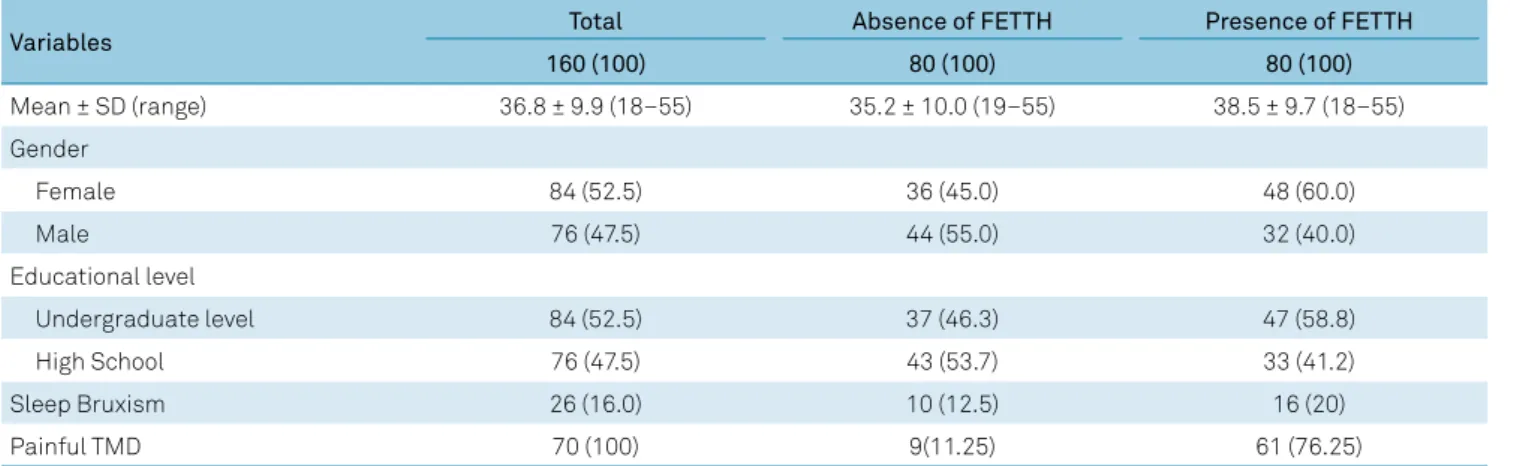
Two groups were formed, divided according to the pres
36 women (45%), mean age 35.2 years (range 19–55 years); the majority (54% n = 43) had completed high school. The study group (FETTH patients) comprised 48 women (60%) and 32 men (40%), mean age 38.5 years (range 18–55 years); 58.8% (n = 47) had completed undergraduate education (Table 1).
The presence of painful TMD was higher in the study group (76.25%; n = 61). Headache complaints were more common among women (60.0%; n = 48). The prevalence of sleep bruxism was 16.0% (n = 26) and the activity level was higher in the study group (n = 16).
Table 2 shows the interaction between painful TMD and FETTH (OR = 26.4; 95% confidence interval, CI: 10.4-64.6;
p < 0.001). The presence of sleep bruxism did not represent a risk of occurrence of FETTH (OR = 0.7; 95% CI: 2.0-2.5; p = 0.670).
The mean PSQI components were slightly higher in the study group (PSQI = 5.3) than among the controls (PSQI = 4.5). However, we did not find any significance in these data (p = 0.687), indicating that sleep quality assessments did not show increased risk of FETTH.
The individuals in the study group had more anxiety symptoms (p = 0.002).
Individuals with sleep bruxism (Table 3) had more com
-plaints of painful TMD (p = 0.012).
Table 1. Distribution of the sample by the presence of FETTH n (%).
Variables Total Absence of FETTH Presence of FETTH
160 (100) 80 (100) 80 (100)
Mean ± SD (range) 36.8 ± 9.9 (18–55) 35.2 ± 10.0 (19–55) 38.5 ± 9.7 (18–55)
Gender
Female 84 (52.5) 36 (45.0) 48 (60.0)
Male 76 (47.5) 44 (55.0) 32 (40.0)
Educational level
Undergraduate level 84 (52.5) 37 (46.3) 47 (58.8)
High School 76 (47.5) 43 (53.7) 33 (41.2)
Sleep Bruxism 26 (16.0) 10 (12.5) 16 (20)
Painful TMD 70 (100) 9(11.25) 61 (76.25)
FETTH: frequent episodic tension-type headache.
Table 2. Analysis of results.
Variables Study Group Control Group Total Odds Ratio
Painful TMD diagnoses Presence of FETTH n (%) Absence FETTH n (%) Total n = 160 OR (95%CI)
Absence of TMD 19 (21.0%) 71 (79.0%) 90 Reference
Presence of TMD 61 (87.0%) 9 (13.0%) 70 26.4 (10.4; 64.6)
p < 0.001 Sleep bruxism
Absence 64 (48.0%) 70 (52.0%) 134 Reference
Presence 16 (62.0%) 10 (38.0%) 26 0.7 (0.2; 2.5)
p = 0.670 Mean PSQI
Good sleepers 33 (41.5%) 31 (38.5%) 64 Reference
Bad sleepers 42 (52.5%) 46 (57.5%) 88 1.8 (0.41; 8.1)
Sleep disturbance 5 (6.0%) 3 (4.0%) 8
p = 0.687
Mean PSQI = 5.3 Mean PSQI = 4.5
Beck anxiety inventory
Minimum 33 (41.3%) 61 (76.3%) 94 Reference
Light 32 (40.0%) 16 (20.0%) 48 1.000 (0.1;1.9)
Moderate 13 (16.2%) 2 (2.5%) 15 0.3 (0.0;5.1)
Severe 2 (2.5%) 1 (1.2%) 3
DISCUSSION
This study is the first to assess the presence of painful TMD, sleep bruxism, anxiety symptoms and subjective sleep quality among military firefighters with FETTH.
The presence of FETTH was shown to be directly linked to the presence of painful TMD symptoms (p < 0.001).
Some studies on the interactions between primary head
-ache and the presence of TMD symptoms10,14,15,16,17 have
shown that despite methodological differences (sample, headache classification and use of non-standardized ques
-tionnaires), this association was greater when there was pain in the masticatory muscles.
The conditions relating to primary headaches have been little studied among military firefighters. In this specific group, symptoms relating to insomnia, anxiety, depression and low back pain were directly associated with loss of qual
-ity of life and occurrences of work accidents1,2,3,8.
There are significant clinical overlaps between some painful TMDs and headache conditions that may hamper the diagnostic process and treatment. The important pain mech
-anisms contributing to the close association and complex relationship between TMDs and headache disorders include the following: processes of peripheral and central sensiti
-zation that take place in similar anatomical areas; possible impairment of the descending modulatory pain pathways; and the processes of reporting pain. In addition, clinical examinations do not always provide distinguishing informa
-tion to differentiate between headaches and TMD11 .
When peripheral alterations persist and other external factors such as emotional disturbances, stress and parafunc
-tional habits are associated, changes to the central nervous system may occur. These changes to the conduction system and pain processing are called central sensitization28.
The presence of sleep bruxism (Table 3) was higher among individuals with complaints of painful TMD (p = 0.012). This probably occurred because of the concomitant presence of sleep bruxism and clenching of teeth during wakefulness, although ascertaining this relationship was not an objective of the present study.
When sleep bruxism and daytime tooth clenching occur separately, they increase the risk of painful TMD symptoms. When they act simultaneously, the risk is even greater29.
A systematic review has shown that sleep bruxism may be associated with myofascial pain, arthralgia and pathological
conditions of joints, such as disc displacement and joint noises. Although the evidence is currently not conclusive and does not provide information according to the type of brux
-ism (sleep and/or waking brux-ism), it is possible to suggest that bruxism would be associated with TMDs30.
It was found that sleep bruxism alone did not increase the risk of any primary headache, but when it was associated with a painful TMD, the odds of having chronic migraine, epi
-sodic migraine and epi-sodic tension-type headache were sig
-nificantly increased16.
Sleep and headache are closely related. Insufficient sleep may increase the risk of headache in a general manner; it may trigger headache and may also reduce pain thresholds31.
The anxiety symptoms observed increased the risk of FETTH (p = 0.002), while the subjective quality of sleep mea
-sured by the PSQI was not shown to be a risk factor (p = 0.687). The anxiety symptoms observed in individuals with FETTH and TMD are in agreement with other studies4,5,6,31.
Sleep and pain perception are two phylogenetically well-conserved functions, strictly influenced by environmental and psychological factors, and are able to interact recipro
-cally both in physiological and pathological situations32.
In a study on sleep among tension-type headache patients, it was observed that these patients presented with more anxiety, insomnia and fatigue during the day and lower subjective quality of sleep than did healthy controls, despite presenting with a nor
-mal duration of sleep in diaries and in polysomnographic exami
-nations. It has been proposed that, on average, these individuals need more sleep time than required by healthy controls33.
There was a significant association between severe sleep disturbances and primary headache, and this was most pro
-nounced for those with chronic headache4 .
The study had some limitations. The sample consisted of patients who sought treatment for TMD and the results are not representative of the general population. Laboratory sleep assessment is required to establish a definitive diagnosis of sleep bruxism; but for large samples it is expensive and inaccessible.
The study’s methodology had important strengths. Headache and TMD were diagnosed and classified follow
-ing the “gold standard” of the RDC/TMD19
and International Classification of Headache Disorders – III9
.
In conclusion, based on the data of this study, an associa
-tion between the presence of painful TMD complaints and subjective anxiety symptoms was found among individuals with FETTH.
Sleep quality assessments and the presence of sleep brux
-ism without painful TMD complaints did not increase the risk of FETTH.
Acknowledgments
We thank the Military Fire Brigade of the State of Rio de Janeiro for its support.
Table 3. Association of painful TMD diagnoses with sleep bruxism.
TMD Diagnoses n (%) Presence of SB
Absence of SB
Odds ratio (95% CI)
Painful TMD n (%) 17 (66.4) 53 (39.6) Reference No Painful TMD n (%) 9 (34.6) 81 (60.4) 2.9 (1.2–6.9)
p = 0.012
References
1. Lusa S, Miranda H, Luukkonen R, Punakallio A. Sleep disturbances predict long-term changes in low back pain among Finnish firefighters: 13-year follow-up study. Int Arch Occup Environ Health. 2015; 88 (3):369-379. https://doi.org/10.1007/s00420-014-0968-z 2. Marconato R S, Monteiro M I. Pain, health perception and
sleep: impact on the quality of life of firefighters/rescue professionals. Rev Lat Am Enfermagem. 2015; 23(6):991-9. https://doi.org/10.1590/0104-1169.0563.2641
3. Punakallio A, Lusa S, Luukkonen R, Airila A, Leino-Arjas P. Musculoskeletal pain and depressive symptoms as predictors of trajectories in work ability among Finnish firefighters at 13-year follow-up. J Occup Environ Med. 2014; 56(4):367-75. https://doi.org/10.1097/JOM.0000000000000139 4. Vazquez- Delgado E, Schmidt JE, Carlson CR, DeLeeuw Rd, Okeson JP. Psychological and sleep quality differences between chronic daily headache and temporomandibular disorders patients. Cephalalgia. 2004; 24 (6):446-54. https://doi.org/10.1111/j.1468-2982.2004.00698.x 5. Reiter S, Emodi - Perlman A, Goldsmith C, Friedman-Rubin P, Wincur
E. Comorbidity between depression and anxiety in patients with temporomandibular disorders according to the research diagnostic criteria for temporomandibular disorders. J Oral Facial Pain Headache. 2015; 29 (2):135-43. https://doi.org/10.11607/ofph.1297 6. Lampl C, Thomas H, Tassorelli C, et al. Headache, depression and
anxiety: associations in the Eurolight project. J Headache Pain. 2016; 17(1):59.https://doi.org/10.1186/s10194-016-0649-2
7. Rener-Sitar K, John MT, Pusalavidyasagar SS, Bandyopadhyay D, Schiffman EL. Sleep quality in temporomandibular disorder cases. Sleep Med. 2016; 25:105-12. https://doi.org/10.1016/j.sleep.2016.06.031 8. Barger LK, Rajaratnam SM, Wang W, et al. Common sleep disorders
increase risk of motor vehicle crashes and adverse health outcomes in firefighters. J Clin Sleep Med. 2015; 11(3):233-40. https://doi.org/10.5664/jcsm.4534
9. Headache Classification Committee of the International Headache Society. The International Classification of Headache Disorders, 3rd edition (beta version). Cephalalgia. 2013; 33 (9):629-808. https://doi.org/10.1177/0333102413485658
10. Graff-Radford SB. Temporomandibular disorders and headache. Dent Clin North Am. 2007; 51(1):129-44. https://doi.org/10.1016/j.cden.2006.09.005 11. Conti PC, Costa YM, Gonçalves DA, Svensson P. Headaches and
myofascial temporomandibular disorders: overlapping entities, separate managements? J Oral Rehabil. 2016; 43 (9):702-15. https://doi.org/10.1111/joor.12410
12. Tomaz-Morais JF, Lucena LB, Mota IA, et al. Temporomandibular disorder is more prevalent among patients with primary headaches in a tertiary outpatient clinic. Arq Neuropsiquiatr. 2015; 73 (11):913-7. https://doi.org/10.1590/0004-282X20150145
13. Ballegaard V, Thede-Schmidt-Hansen P, Svensson P, Jensen R. Are headache and temporomandibular disorders related? A blinded study. Cephalalgia. 2008; 28(8): 832-41. https://doi.org/10.1111/j.1468-2982.2008.01597x
14. Troeltzsch M, Cronin RJ, Brodine AH, Frakenberger R, Messlinger K. Prevalence and association of headaches, temporomandibular disorders, and occlusal interferences. J Prosthet Dent. 2011; 105 (6): 410-7. https://doi.org/10.1016/S0022-3913(11)
15. Glaros AG, Urban D, Locke J. Headache and temporomandibular disorders: evidence for diagnostic and behavioural overlap. Cephalalgia. 2007; 27(6):542-9. https://doi.org/10.1111/j.1468-2982.2007.01325.x 16. Fernandes G, Franco AL, Gonçalves DA, Speciali JG, Bigal ME,
Camparis CM. Temporomandibular disorders, sleep bruxism, and primary headaches are mutually associated. J Orofac Pain. 2013; 27(1):14-20. https://doi.org/10.11607/jop.921
17. Leeuw R. Orofacial pain: guidelines for assessment, diagnosis, and management. 4th ed. Chicago: Quintessence; 2008.
18. Lobbezoo F, Ahlberg J, Glaros AG, et al. Bruxism defined and graded: an international consensus. J Oral Rehabil. 2013; 40(1):2-4. https://doi.org/10.1111/joor.12011
19. Dworkin SF, LeResche L. Research diagnostic criteria for temporomandibular disorders: review, criteria, examinations and specifications, critique. J Craniomandib Disord. 1992; 6(4):301-55. 20. Pereira Júnior FJ, Favilla EE, Dworkin S, Huggins K. Critérios de
diagnóstico para pesquisa das disfunções temporomandibulares (RDC/TMD): tradução oficial para a língua portuguesa. J Bras Clin Odontol Integ. 2004; 8(47):384-95.
21. Schiffman EL, Ohrbach R, Truelove EL, et al. The research diagnostic for temporomandibular disorders. V: methods used to establish and validate revised Axis I diagnostic algorithms. J Orofac Pain. 2010; 24(1):63-78.
22. American Academy of Sleep Medicine. International classification of sleep disorders. 3rd ed. Darien: American Academy of Sleep Medicine; 2014.
23. Stuginski-Barbosa J, Porporatti AL, Costa YM, Svensson P, Conti PC. Agreement of the International Classification of Sleep Disorders Criteria with polysomnography for sleep bruxism diagnosis: a preliminary study. J Prosthet Dent. 2017; 117(1):61-6. https://doi.org/10.1016/j.prosdent.2016.01.035
24. Lobbezoo F, Naeije M. A reliability study of clinical tooth wear measurements. J Prosthet Dent. 2001; 86(6):597-602. https://doi.org/10.1067/mpr.2001.118892
25. Lobbezoo F, Denderen RJ, Verheij JG, Naeije M. Reports of SSRI-associated bruxism in the family physician’s office. J Orofac Pain. 2001; 15(4):340-6.
26. Beck AT, Epstein N, Brown G, Steer RA. An inventory for measuring clinical anxiety: psychometric properties. J Consult Clin Psychol. 1988; 56 (6):893-7. https://doi.org/10.1037/0022-006X.56.6.893 27. Buysse DJ, Reynolds CF 3rd, Monk TH, Berman SR, Kupfer DJ. The
Pittsburgh Sleep Quality Index: a new instrument for psychiatric practice and research. Psychiatry Res. 1989; 28 (2):193-213. https://doi.org/10.1016/0165-1781(89)90047-4
28. Woolf CJ. Central sensitization: implications for the diagnosis and treatment of pain. Pain. 2011; 152:2-15. https://doi.org/10.1016/j.pain.2010.09.030
29. Sierwald I, John MT, Schierz O, et al. Association of temporomandibular disorder pain with awake and sleep bruxism in adults. J Orofac Orthop. 2015; 76(4):305-17. https://doi.org/10.1007/s00056-015-0293-5 PMID: 26123732 30. Silva A, Peña-Durán C, Tobar-Reyes J, Frugone-Zambra R. Sleep and
awake bruxism in adults and its relationship with temporomandibular disorders: A systematic review from 2003 to 2014. Acta Odontol Scand. 2017; 75(1):36-58. https://doi.org/10.1080/00016357.2016.1247465 31. Smitherman TA, Davis RE, Walters AB, Young J, Houle TT. Anxiety
sensitivity and headache: diagnostic differences, impact, and relations with perceived headache triggers. Cephalalgia. 2015; 35(8):710-21. https://doi.org/10.1177/0333102414557840 32. Lovati C, D’Amico D, Raimondi E, Mariani C, Bertora P. Sleep and
headache: a bidirectional relationship. Expert Rev Neurother. 2010; 10(1):105-17. https://doi.org/10.1586/ern.09.135