Anais da Academia Brasileira de Ciências (2014) 86(4): (Annals of the Brazilian Academy of Sciences)
Printed version ISSN 0001-3765 / Online version ISSN 1678-2690
www.scielo.br/aabc
1673-1691
http://dx.doi.org/10.1590/0001-3765201420140455
A new prozostrodontian cynodont (Therapsida) from the Late Triassic
Riograndia
Assemblage Zone (Santa Maria Supersequence) of Southern Brazil
MARINA B. SOARES1, AGUSTÍN G. MARTINELLI1 and TÉO V. DE OLIVEIRA2
1Laboratório do Setor de Paleovertebrados, Departamento de Paleontologia e Estratigrafia, Instituto de Geociências,
Universidade Federal do Rio Grande do Sul/UFRGS, Av. Bento Gonçalves, 9500, 90540-000 Porto Alegre, RS, Brasil
2Museu de Zoologia, Departamento de Ciências Biológicas, Universidade Estadual de Feira de Santana/UEFS,
Av. Transnordestina, s/n, Novo Horizonte, 44036-900 Feira de Santana, BA, Brasil
Manuscript received on September 8, 2014; accepted for publication on October 14, 2014 ABSTRACT
We report here on a new prozostrodontian cynodont, Botucaraitherium belarminoi gen. et sp. nov.,
from the Late Triassic Riograndia Assemblage Zone (AZ) of the Candelária Sequence (Santa Maria
Supersequence), collected in the Botucaraí Hill Site, Candelária Municipality, state of Rio Grande do Sul, Brazil. The new taxon is based on a single specimen (holotype MMACR-PV-003-T) which includes the left lower jaw, without postdentary bones, bearing the root of the last incisor, canine and four postcanines plus one partial crown inside the dentary, not erupted, and two maxillary fragments, one with a broken canine and another with one postcanine. The features of the lower jaw and lower/upper postcanines resemble those of the prozostrodontians Prozostrodon brasiliensis from the older Hyperodapedon AZ and Brasilodon quadrangularis and Brasilitherium riograndensis from the same Riograndia AZ. The inclusion of Botucaraitherium within a broad phylogenetic analysis, positioned it as a more derived taxon than
tritylodontids, being the sister-taxon of Brasilodon, Brasilitherium plusMammaliaformes. Although the
new taxon is based on few cranial elements, it represents a additional faunal component of the Triassic
Riograndia AZ of southern Brazil, in which small-sized derived non-mammaliaform cynodonts, closely
related to the origin of mammaliaforms, were ecologically well succeed and taxonomically diverse.
Key words: Cynodontia, Prozostrodontia, Santa Maria Supersequence, Triassic.
Correspondence to: Marina Bento Soares E-mail: [email protected]
INTRODUCTION
The rich fossil tetrapod content from the Middle-Upper Triassic of southern Brazil is recorded in beds related to the Santa Maria Supersequence, in which four recognized faunal tetrapod associations succeed in time: Dinodontosaurus, Santacruzodon, Hyperodapedon and Riograndia Assemblage Zones (AZ) (Soares et al. 2011) (Fig. 1). In all of these bio stratigraphic unities, whose proposed ages are
based on correlations with Argentinean and Malagasy faunas (Abdala and Ribeiro 2010), the non-mammaliaform cynodonts (Therapsida, Eucynodontia) account for a significant percentage of the recorded taxa, taxonomically com prising the most diverse group. In fact, the diversity of the
derived non-mammaliaform probainognathian
its global fossil record, based upon poorly preserved specimens. At least two prozostrodontians are known from the Hyperodapedon AZ (Bonaparte and Barberena 2001) and at least five from the younger Riograndia AZ (Bonaparte et al. 2001, 2003, 2005, 2010, 2012, Martinelli et al. 2005, Soares et al. 2011). Recent studies on these taxa have highlighted their essential contribution to the understanding of the mammaliaforms origin (Bonaparte et al. 2005, Luo 2007, Abdala 2007, Liu and Olsen 2010, Bonaparte 2012), illustrating the climbing mosaic of characters developed during the Middle-Late Triassic transition (Bonaparte et al. 2005, Martinelli and Rougier 2007, Martinelli and Bonaparte 2011, Bonaparte 2012, Rodrigues et al. 2012, 2013).
In the late Carnian Hyperodapedon AZ, the prozostrodontians Therioherpeton cargnini Bonaparte and Barberena (1975) and Prozostrodon brasiliensis Bonaparte and Barberena (2001) are recognized, both displaying several derived features in the skull and dentition (e.g. lack of prefrontal and postorbital, constricted root in postcanines) that positioned them as basal prozostrodontians (Liu and Olsen 2010). From this AZ, Charruodon tetracuspidatus Abdala and Ribeiro (2000) and Trucidocynodon riograndensis Oliveira et al. (2010) are also known. Charruodon was originally
related to Therioherpeton due to the morphology
of the lower postcanines; nonetheless, based on the deep and robust lower jaw (unexpected for Therioherpeton based on its skull), we consider that the phylogenetic position of Charruodon cannot be elucidated until new specimens come to light. On the
other hand, Trucidocynodon represents a member of
the Ecteniniidae (Oliveira et al. 2010, Martinez et al. 2013), which is positioned outside, as sister-group of Prozostrodontia (Martinez et al. 2013).
With regard to the prozostrodontian content, the early Norian Riograndia AZ includes Riograndia guaibensis Bonaparte et al. (2001) Irajatherium hernandezi Martinelli et al. (2005), Brasilodon quadrangularis, Brasili therium riograndensis
Bonaparte et al. (2003), and Minicynodon Bonaparte et al. (2010). Riograndia is the most
common cynodont of this AZ, represented by several exquisitely pre served specimens. Riograndia is considered as a basal member of the Tritheledontidae Clade (Bonaparte et al. 2001, Soares et al. 2011) or a basal Ictidosauria, sister-taxon of Tritheledontidae (sensu Martinelli et al.
2005, Martinelli and Rougier 2007). Irajatherium is still poorly represented in comparison to other cynodonts from this AZ. However, its dentition
resembles that of Chaliminia from the Late
Triassic of Argentina and Pachygenelus from the
Early Jurassic of Africa (Martinelli and Rougier 2007). Hence, Irajatherium is positioned as a basal
Tritheledontidae (Martinelli et al. 2005, Martinelli and Rougier 2007, Oliveira et al. 2011). Brasilodon,
Brasilitherium (Bonaparte et al. 2003, 2005, 2012), and Minicynodon (Bonaparte et al. 2010,
2012) are relatively well-documented and they are crucial taxa in cynodont evolution because they constitute the sister-group of Mammaliaformes (e.g., Bonaparte et al. 2003, 2005, 2012, Abdala 2007, Martinelli and Rougier 2007, Luo 2007, Liu and Olsen 2010, Rodrigues et al. 2012, 2013, Ruff et al. 2014). Bonaparte et al. (2005) created the Family Brasilodontidae to include Brasilodon and
Brasilitherium, and, subsequently, other taxa were included in it such as Protheriodon estudianti (Bonaparte et al. 2006, Bonaparte 2012). Some authors (e.g., Liu and Olsen 2010) pointed out
that Brasilodon and Brasilitherium are synonym
and also that a monophyletic Brasilodontidae has not been recovered (e.g., Abdala 2007). Notwithstanding these issues that are currently under revision, the impact that the discovery of
the brasilodontids from the Riograndia AZ of
southern Brazil has caused is unprecedented (Bonaparte et al. 2003, 2005, 2012, Rodrigues et al. 2012, 2013).
1675
A NEW CYNODONT FROM THE LATE TRIASSIC OF BRAZIL
the Candelária Municipality, state of Rio Grande do Sul, Brazil. The new taxon is described, compared and included in a broad phylogenetic analysis of cynodonts. Although based on a partial lower jaw and maxillary fragments, the specimen represents a new taxon of prozostrodontian
with several features shared with Prozostrodon
from the Hyperodapedon AZ and especially
with Brasilodon and Brasilitherium from the
Riograndia AZ. The new specimen contributes to the understanding of the non-mammaliaform prozostrodontian diversity.
Fig. 1 - A: Geographical location of the Santa Maria Supersequence (Paraná Basin) in the state of Rio Grande do Sul, Brazil. B: Chronostratigraphy of the southern Brazilian Triassic, showing the four Assemblage Zones (AZ) based on tetrapods context.
From Horn et al. 2004. Biostratigraphy after Soares et al. 2011. Abbreviations: Any, Anisian; Car, Carnian; Ind, Induan; Lad, Ladinian; Nor, Norian; Ole, Olenekian; Rha, Rhaetian.
GEOLOGICAL SETTING AND BIOSTRATIGRAPHY
The Upper Triassic Candelária Sequence corres ponds to a third-order sequence placed in the Santa Maria Supersequence (sensu Zerfass et al. 2003, Horn et al. 2014) (Fig. 1). The basal portion of the Sequence consists of a coarsening-upward succession that begins with red mudstones interbedded with small-scale trough cross-bedded sandstone lenses. Rhytmites and sigmoidal massive to climbing cross-laminated sandstone bodies are also present (Soares et al. 2011). This facies association is interpreted as a lacustrine-deltaic depositional system in a humid climate (Holz
and Scherer 2000, Zerfass et al. 2003). The Candelária Sequence encompasses the Hyperodapedon AZ (sensu Abdala et al. 2001), in which the most abundant components are the rhynchosaur Hyperodapedon sp. and the traversodontid cynodont Exaeretodon riograndensis Abdala et al. (2002). Besides the aforementioned cynodonts (e.g., Trucidocynodon,
230.3-231.4 ± 0.3My (Rogers et al. 1993, Furin et al. 2006, Martinez et al. 2011). The top of the Candelária Sequence, where the younger Riograndia AZ is recognized, has an increased content of sandstone. The layers occur as narrow, massive or stratified (horizontal and trough cross bedding)
lenses interpreted as amalgamated sandstone
bodies related to high width/depth ratio channels. This succession is interpreted as the progressive replacement of a lacustrine-deltaic by a fluvial system (Rubert and Schultz 2004, Soares et al. 2011). The Riograndia AZ is characterized by a rich association of small tetrapods, such as the procolophonid Soturnia caliodon Cisneros and Schultz (2003),
and the sphenodontid Clevosaurus brasiliensis
Bonaparte and Sues (2006), among others, and the five taxa of advanced non-mammaliaform cynodonts aforementioned (Riograndia, Brasilodon, Brasilitherium, Irajatherium and Minicynodon). The dinosaurs are represented by the plateo saurid Unaysaurus tolentinoi Leal et al. (2003), the theropod (sensu Langer et al. 2009) Guaibasaurus candelariensis Bonaparte et al. (1999), and new specimens with sauropodomorph affinities (Bittencourt et al. 2013), plus the dinosauriform Sacisaurus agudoensis Ferigolo and Langer (2007). Also compose the Riograndia AZ the dicynodont Jachaleria candelariensis Araújo and Gonzaga (1980), an indeterminate phytosaur (Kischlat and Lucas 2003), isolated teeth of archosaurs (Dornelles 1990), and a stereospondyl amphibian (Dias-da-Silva et al. 2009). This whole fauna occurs in a series of outcrops mainly located in Candelária and Faxinal do Soturno municipalities, and the record of Riograndia guaibensis in at least five of them, enables their correlation to the Riograndia AZ (Soares et al. 2011, Bittencourt et al. 2013). In turn, Riograndia AZ can be correlated to the fauna from the base of the Los Colorados Formation of Argentina (Early Norian) due to the presence of the same dicynodont genera, Jachaleria (Bonaparte 1971, see also comments in Martinelli and Rougier 2007).
The Botucaraí Hill Site (sensu Bittencourt et al. 2013) crops out along the highway BR 287, Candelária Municipality, state of Rio Grande do Sul, Brazil (29° 40’ 53” S; 52° 50’ 28” W). This site is characterized by twelve meters of massive to laminar mudstones intercalated by centimeter massive sandstones lenses, followed by a layer of massive sandstones and another layer of trough cross bedded sandstone, one meter thick each. The holotype of the new cynodont was collected at the
same level where several materials of Jachaleria
and some sauropodomorph dinosaur remains were found (Bittencourt et al. 2013) (Fig. 2).
SYSTEMATIC PALEONTOLOGY
THERAPSIDA Broom, 1905 CYNODONTIA Owen, 1861 EUCYNODONTIA Kemp, 1982 PROBAINOGNATHIA Hopson, 1990 PROZOSTRODONTIA Liu and Olsen, 2010
Botucaraitherium gen. nov.
DIAGNOSIS
Botucaraitherium is diagnosed by the following association of characters: upper postcanines with a prominent central cusp (A), with symmetric mesial and distal edges, two cusps mesio-lingually (cusp B) and disto-lingually (cusp C) arranged (being A>>B=C), and two accessory cuspules in the mesio-labial border
1677 A NEW CYNODONT FROM THE LATE TRIASSIC OF BRAZIL
edge; cusps c and d with symmetrical mesial and distal edges; reduced and basal positioned cusp b (cusp a>c>d>>b); lower postcanines with multicuspidated lingual cingulum shelf, with small mesial cusp e; upper and lower postcanines with 8-shaped cross-section root; large diastema between canine and postcanines in adult stage; postcanine replacement including the loose of anterior postcanines, addition of new ones at the rear and substitution of other functional teeth.
TYPE AND ONLY KNOWN SPECIES
Botucaraitheriumbelarminoi sp. nov.
ETYMOLOGY
Botucarai, in reference to the Botucaraí Hill, which dominates the landscape of the Candelary City (state of Rio Grande do Sul) and where there are
several outcrops with Triassic fauna. In one of these outcrops, Botucaraí Hill Site (sensu Bittencourt et al. 2013) the holotype was found. Therium, from
the New Latin, that derives from the Greek thērion,
which means “beast”, frequently used in mammals and close relative forms.
Botucaraitherium belarminoi sp. nov.
HOLOTYPE
MMACR-PV-003-T, left lower jaw, without postdentary bones, bearing the root of last incisor, the canine, and four partially preserved postcanines plus one partial crown inside the dentary (not erupted), and two left maxillary fragments, one with a broken canine and the other with one postcanine
and the root of the following two teeth.
DIAGNOSIS
Same as for genus.
Fig. 2 - A: Road map with City of Candelária indicated. B: View of the Botucaraí Hill site, southern margin of BR 287 road, with
ETYMOLOGY
belarminoi, named in honor of Mr. Belarmino Stefanello, a volunteer at the Museu Municipal Aristides Carlos Rodrigues, who found the fossil.
LOCALITY AND HORIZON
From the Botucaraí Hill Site (sensu Bittencourt et al. 2013) near the level where the dicynodont Jachaleria (Aráujo and Gonzaga 1980) and dinosaur remains with sauropodomorph affinities (Bittencourt et al. 2013) were recovered. It is located about 8 kilometers west of Candelária City, in a roadcut of the route BR-287, state of Rio Grande do Sul, Brazil (Fig. 2), Candelária Sequence, Santa Maria Supersequence (Zerfass et al. 2003, Horn et al. 2014), Riograndia AZ (Soares et al. 2011), possibly Early Norian (Fig. 1).
DESCRIPTION
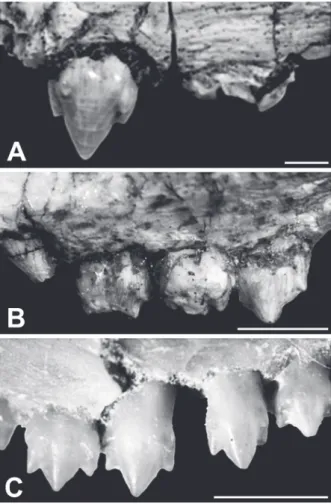
The specimen MMACR-PV-003-T is mostly not well-preserved due to several breakages in the lower jaw and the maxillary fragments are isolated (Fig. 3). Only the lower canine, one upper and some lower postcanines preserve most of their crown. All the material included in the holotype specimen was found in association and corresponds to only one individual.
MAXILLA
The two available portions of maxilla are extremely fragmented, without much information. Based on the preserved teeth, they correspond to the left side of the skull. One of the fragments, which preserves the left canine, has the external surface anteropos-teriorly concave, highlighting the prominent canine root (Fig. 3A). Just posterior to it there is a small foramen, facing anteriorly. The second fragment has a complete anterior postcanine and the two 8-shaped roots of the two following ones (described later) (Fig. 3B). Above the first broken postcanine (i.e. the first root) there is a concavity and subtle notch which possibly corresponds to a large exit of the infraorbital branch of the trigeminal nerve.
LOWER JAW
The dentary is only observed in medial view (Fig. 4). The jaw is anteroposteriorly larger than any of the known specimens of Brasilodon,
Brasilitherium and Minicynodon from the same
Riograndia AZ, and smaller than Prozostrodon from the Hyperodapedon AZ. The horizontal ramus is slender along the anterior half and becomes slightly deeper at the rear. Therefore, the alveolar level and the ventral margin of the horizontal ramus are slightly divergent posteriorly. The mandibular symphysis is unfused as in prozostrodontians (e.g., Prozostrodon,
Brasilodon, Brasilitherium; Bonaparte and Barberena 2001, Bonaparte et al. 2003, 2005) and has some longitudinal ridges and a small foramen. The trough for the postdentary bones is relatively reduced and runs forward, becoming smaller, parallel to the ventral edge of the dentary. The dentary seems to be transversely wide at the angular process; this region is not well-preserved although its shape seems to
be similar to that of Prozostrodon
(UFRGS-PV-0248-T). Below the alveolar line, the dental lamina is observed, mainly at the level of the fourth postcanine. The dentary has a large diastema between canine and postcanines and the canine base and alveolar level of the incisor is positioned slightly dorsal to the alveolar level of the postcanine series (Fig. 4A). This condition is similar to that observed in Prozostrodon,
Brasilodon, Brasilitherium (Bonaparte and Barberena 2001, Bonaparte et al. 2003, 2005) and other possibly related forms such as Microconodon and
Dromatherium (Hahn et al. 1994, Sues 2001).
1679
A NEW CYNODONT FROM THE LATE TRIASSIC OF BRAZIL
Only the anterior 1/3 portion of the horizontal ramus of the dentary can be observed in lateral view. The surface is slightly convex dorso-ventrally and
there are at least two small mental foramina below
and anteriorly to the level of the canine.
UPPER DENTITION
Theupper incisors are not preserved. One fragment of maxilla keeps the left canine which is partially broken. It is elliptical in cross section, at the base,
twice mesio-distally longer than transversely wide. The preserved mesial and distal edges are gently concave, without evidence of a ridge or crenulations (Fig. 3A). The mesial edge is subtle convex whereas the distal one is straight to slightly concave. The upper canine is larger than the lower one.
first postcanine and the condition of the diastema. In addition, the upper postcanine count is unknown as is the exact position of the preserved postcanine.
The preserved postcanine has the crown as long as tall, mesio-distally, and about two times long than wide. The crown is dominated by a central cusp (A), with symmetric mesial and distal edges, and two cusps mesio-lingually (cusp B) and disto-lingually (cusp C; the tip of this cusp is broken) arranged. Cusps B and C have quite similar sizes but cusp B is positioned slightly more dorsal than cusp C. In oclusal view, the three cusps form a subtle angle, opposite to the condition observed
in mammaliaforms with the reverse triangle pattern
(Crompton and Jenkins 1968). In addition, there are accessory cingular cuspules on the labial side. On the mesio-labial corner there are two tiny cuspules (the more mesial the smallest) which are the most dorsally positioned cusps of the crown. Hence, there is some considerable distance between these cuspules and cusp B. Also, these accessory cuspules make the mesial width of the crown slightly wider than the distal width. The disto-labial accessory cusp is near cusp C, at its dorsal base (Fig. 3C). In oclusal view the labial surface of the crown is fairly straight whereas the lingual one is concave, with a flexion. The root of this postcanine is entirely inside the alveolus, but in labial view, the beginning of a longitudinal groove can be observed, constricting the root. The size of the only known upper postcanine is considerably smaller than the lower ones, a condition observed in some other probainognathians (e.g., Prozostrodon, Brasilodon,
Irajatherium, Bonaparte and Barberena 2001, Bonaparte et al. 2003, 2005, Martinelli et al. 2005).
The upper postcanine pattern of the Botuca raitherium is quite different from those of the tritheledontids (Irajatherium, Chaliminia), in which there are a mesiodistally compressed and transversely broad main cusp, with small mesial and distal cusps (with a labial cingulum in the postcanines of Pachygenelus; Gow 1980, Martinelli et al. 2005,
Martinelli and Rougier 2007). Botucaraitherium also
differs from Riograndia because the latter taxon has
up to nine cusps mesiodistally aligned without any cingulum (Bonaparte et al. 2001, Soares et al. 2011). The upper postcanines of Prozostrodon display four aligned cusps (A, B, C, D) (Bonaparte and Barberena 2001) without lingual cusps or any cingular cuspules. Thus, the upper postcanines of Botucaraitherium differ significantly from those of Prozostrodon in having three main cusps (instead of four) plus accessory labial cingular cuspules (Fig. 5A, B).
The upper postcanine pattern of Botucarai therium is more closely related to that of Brasilodon,
Brasilitherium and Minicynodon (Fig. 5A, C) (Bonaparte et al. 2003, 2005, 2010, 2012) than to any other prozostrodontian. Regarding the brasilodontids, its postcanines have a prominent central cusp (A), one mesial (B) and one distal (C), small accessory cusps aligned on the lingual side, and one mesial and one distal small cusp on the labial side, giving a symmetrical cusp arrangement. This pattern is consistent in all specimens of Brasilodon and
Minicynodon, but in some specimens referred to Brasilitherium the distal labial accessory cusp is placed more posteriorly (Bonaparte et al. 2010, Martinelli and Bonaparte 2011).
Botucaraitherium is differentiated from
brasilo-dontids by a notoriously more bulbous crown and two (not one) mesio-labial accessory cusps. These features have never been observed even in the largest specimens of the aforementioned brasilodontids. Therefore, we considered this feature as unique
of Botucaraitherium, since in the large sample of
brasilodontids from the Riograndia AZ, this condition
was never observed.
1681 A NEW CYNODONT FROM THE LATE TRIASSIC OF BRAZIL
LOWER DENTITION
The number of lower incisors is unknown. The root of the last incisor is preserved, which is circular in cross-section. It is next to the canine, indicating the lack of a diastema. Anteriorly to this root, the dentary is partially broken off and it is impossible to deduce the number and size of the other incisors (Fig. 4A). In Brasilodon there are three incisors and based on its dentary morphology the number of incisors for Botucaraitherium is likely to be the same.
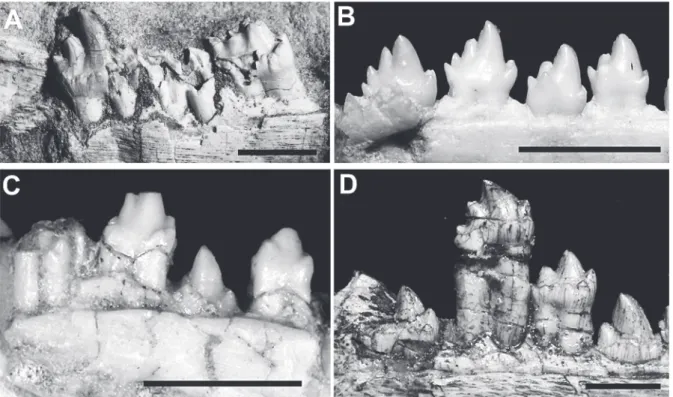
The canine is broken at the tip (Fig. 4A). It is sub-circular in cross-section, with the mesial edge slightly convex and the distal one slightly concave. On the distal edge there is a thin longitudinal ridge, without serrations. The enamel covering the crown is very thin and a large portion of the root is observed outside the alveolus. There is a large diastema between the canine and the postcanines. Along the posteriormost portion of the diastema there is a mesio-distally oriented sulcus that could Fig. 4 - Holotype (MMACR-PV-003-T) of Botucaraitherium belarminoi gen. nov. et sp. nov. A: Left lower jaw in medial view.
B and C: detail of the postcanines in medial view. Scale bar equals 10mm in A and 3mm in B. Gray areas indicate broken surfaces.
Abbreviations: a-e, refers to name of cusps; ca, canine; ci, cuspidated cingulum; co, coronoid process of dentary; cr, constricted
correspond to closed alveoli of the lost teeth. The loss of the anterior postcanines and concomitantly
the enlargement of the diastema are a pattern
obser-ved in several taxa, such as some tritylodontids (e.g., Oligokyphus, Tritylodon; Kemp, 1982) Brasilodon and Brasilitherium (Martinelli and Bonaparte 2011), and some early mammaliaforms (e.g., Sinoconodon; Crompton and Luo 1993, Luo et al. 2004).
The postcanine series includes five teeth (Fig 3). The pc1 consists of a main cusp that was in process of eruption. Unfortunately, at this region there is a large breakage that obscures the anatomy of the tooth.
The pc 2-4 are similar in size. Although the crown of pc2 and pc3 are extremely damaged, they show similar crown morphology. There is a main large cusp (a) on the mesial half of the crown, followed by two cusps (c and d) that decrease in size posteriorly. These three cusps are slightly posteriorly projected, but not
to the degree of, for example, Chiniquodon (Abdala
and Giannini 2002). The cusps are not bulbous and constitute the sectorial portion of the crown. Cusp a is totally asymmetrical with the mesial edge concave and about two times taller than the straight distal edge. Cusps c and d have symmetrical mesial and distal edges. On the mesio-labial edge of the crown, in a basal position, there is a small cusp b. In the pc2 and pc4 that better preserve the crown morphology, the cusp size is a>c>d>>b. In the lingual side of the postcanines there is a well-developed cingulum with a small mesial cusp e (better observed in pc2), followed by a series of tiny cuspules that reach the distal margin of the crown, forming a cingular shelf (Fig. 4B, C).
The posteriormost portion of the pc4 lies internally to the coronoid process. The postcanine roots are incipiently bifurcated, with a well-developed longitudinal groove. Just below the pc4, there is a main cusp (a) of a non-erupted last postcanine.
The tooth morphology of Botucaraitherium is reminiscent of Prozostrodon and brasilodontids.
The multicuspidated lingual cingular shelf of Botucaraitherium is similar to that of Prozostrodon.
In contrast, Brasilodon and Brasilitherium have
less crenulated labial cingulum, and instead there are more discrete cuspules (cusps e and g) (e.g., UFRGS-PV-0603-T). With regard to the main cusps, the crown is taller in Botucaraitherium than in Prozostrodon, and in the latter taxon, cusps a, b and c are more bulbous (less sectorials) with less contrast in height among them (Fig. 6).
TOOTH REPLACEMENT
The information on a single lower jaw is limited but a few comments on tooth replacement are possible. The large diastema posteriorly to the canine and Fig. 5 - Comparisons of upper postcanines. A:Botucaraitherium
belarminoi gen. nov. et sp. nov(Holotype MMACR-PV-003-T) in left labial view. B:Prozostrodon brasiliensis (Holotype
UFRGS-PV-0248-T) in left labial view. C:Brasilodon quadrangularis
1683
A NEW CYNODONT FROM THE LATE TRIASSIC OF BRAZIL
the closed mesial alveoli, indicate that the anterior most postcanines were lost and not replaced. The anteriormost postcanine (i.e., labeled along the text as pc1) partially inserted in the alveolus shows that some teeth of the series were replaced and the last postcanine (pc5), represented by a non-erupted tooth, indicates that new teeth were added at the rear. Among prozostrodontians, some mix of alternate and sequencial replacement was observed in Brasilodon
and Brasilitherium, being apparently polyphyodonty taxa (Bonaparte et al. 2003, 2005, Martinelli and Bonaparte 2011). It should be emphasized that the sequence of postcanine eruption and the number of replacement per locus at the non-mammaliaform prozostrodontians-mammaliaforms boundary is a matter still poorly understood.
DISCUSSION
Botucaraitherium belarminoi constitutes a new prozostrodontian cynodont from the Riograndia AZ
of southern Brazil. The holotype represents an adult individual, larger than any known brasilodontid from the same AZ. There are no recorded specimens of Brasilodon and Brasilitherium in the Botucaraí Hill Site. In turn, these taxa are relatively abundant in the Sesmaria do Pinhal 1 Site, located about 600 meters away (Bonaparte et al. 2003, 2005). In addition, within the Botucaraí region there is a record of Brasilitherium-like teeth in Sesmaria do Pinhal 3 Site, located about 1000 meters away from the Botucaraí Hill Site (Soares et al. 2011, Bittencourt et al. 2013).
The new species is clearly related to prozos-trodontians, and especially to Brasilodon and
Brasili therium (Bonaparte et al. 2003, 2005), due to the morphology of the upper and lower postcanines (see Fig. 5, 6). They can be differentiated by the presence in Botucaraitherium of a well-developed
multicuspidated lingual cingular shelf in lower postcanines and more bulbous upper postcanines, with more than one mesio-labial accessory cuspules. Fig. 6 - Comparisons of the right posterior lower postcanines in lingual view. A:Botucaraitherium belarminoi gen. nov. et sp. nov (Holotype MMACR-PV-003-T). B:Brasilitherium riograndensis (UFRGS-PV-0603-T); C:Brasilodon quadrangularis
Its resemblance to Prozostrodon, from the older
Hyperodapedon AZ, is also noteworthy. The lower dentition of both taxa is quite similar, especially because of the multicuspidated lingual cingular shelf. However, the sectorial portion of the postcanines
of Botucaraitherium seems to be less bulbous with taller main cusps. The upper postcanines have stronger differences, due to the fact that the teeth
of Prozostrodon are less quadrangular (with the exception of the last non-erupted postcanine of the holotype), and with three more developed accessory cusps in relation to the main cusp.
PHYLOGENETIC ANALYSIS
A parsimony analysis was performed based on 34 taxa and 145 morphological cranial, dental and postcranial characters (see Appendices 1 and 2), modified from the matrix presented by Liu and Olsen (2010). Some characters and codifications were modified (Appendix 1) and two new terminal taxa (i.e., Brasilitherium riograndensis
and Botucaraitherium belarminoi) were added. Liu and Olsen (2010) considered Brasilodon and
Brasilitherium as synonyms; therefore, they used only Brasilodon as a terminal taxon. The proposal synonymy for these two species is a matter not clearly understood yet (see for example, Martinelli and Bonaparte 2011, Bonaparte et al. 2012) and will be further analyzed. We considered them as separate taxa in the current analysis.
The data matrix (Appendix 2) was analyzed using Maximum Parsimony with equally weighted characters with the computer program TNT 1.1 (Goloboff et al. 2008). All characters were treated as non-additive. The equally weighted parsimony analysis was conducted performing a heuristic search of Wagner trees with 500 random addition sequences, followed by TBR (Tree Bisection Reconnection), and saving 20 trees per round, which improve the searches and ensures to find all optimal trees.
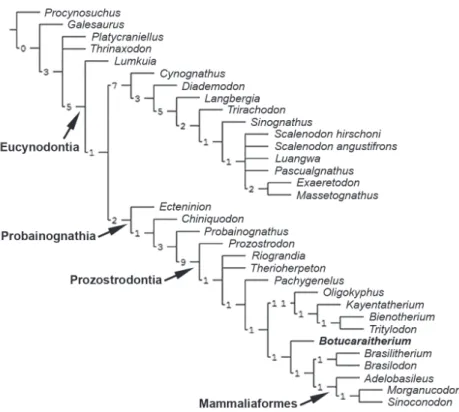
Our analysis resulted in four most parsimonious trees of 441 steps, with a consistency index (CI)
1685 A NEW CYNODONT FROM THE LATE TRIASSIC OF BRAZIL
of 0.481 and a retention index (RI) of 0.780. The strict consensus and Bremer index of each node are shown in Figure 7.
In the four most parsimonious trees obtained, the affi nities of Botucaraitherium with the brasilodontids
are supported. Indeed, Botuca raitherium is positioned
as a more derived taxon than tritylodontids, as the sister group to the clade composed by Brasilodon
and Brasilitherium plus Mammaliaformes. Despite the fragmentary aspect of the new taxon, especially the characters of the dentary and dentition give support to this relationship.
The presence of Botucaraitherium in the Rio grandia AZ (Fig. 8), adding to the already known brasilo dontids, reinforces the idea that the non-mammaliaform prozostrodontians enjoyed their greater representativeness during the Late Triassic in South America, which outlined the evolutionary scenery where the most profound anatomical steps related to the origin of mammaliaforms have taken place.
ACKNOWLEDGMENTS
The authors thank Carlos Nunes Rodrigues, Curator of the Museu Municipal Aristides Carlos Rodrigues (Candelária, RS), for permitting the study of the specimen MMACR-PV-003-T. The authors would also like to thank Bruno L.D. Horn for providing the Figure 2 and for the Botucaraí Hill Site stratigraphic profi le (Fig. 3) and Luiz Flávio Lopes for the photographs. We also thank to Jorge Blanco for the skillful drawing
of Botucaraitherium (Fig. 8). Funds were provided by the Conselho Nacional de Desenvolvimento Científi co e Tecnológico (CNPq nº 304143/2012-0; grants to MBS and AGM). We are grateful for the comments of Dr. Guillermo Rougier, Dr. Ricardo Martinez, the anonymous reviewer and the Editor of AABC, Dr. Alexander Kellner, which greatly improved the Ms.
INSTITUTIONAL ABBREVIATIONS
MMACR-PV-T, Museu Municipal Aristides Carlos Rodrigues, (Paleovertebrates, Triassic collection), Candelária, Rio Grande do Sul, Brazil; UFRGS-PV-T, Universidade Federal do Rio Grande do Sul (Paleovertebrates, Triassic collection), Porto Alegre, Rio Grande do Sul, Brazil.
RESUMO
Nós reportamos aqui um novo cinodonte prozostrodonte,
Botucaraitherium belarminoi gen. et sp. nov., do Triássico
Tardio da Zona de Assembleia (ZA) de Riograndia da
Sequência Candelária (Supersequência Santa Maria), coletado no afl oramento Sítio Botucaraí, no município de Candelária, Rio Grande do Sul, Brasil. O novo táxon está baseado em um único espécime (holótipo MMACR-PV-003-T) o qual inclui a mandíbula esquerda, sem os ossos pós-dentários, com a raiz do último incisivo preservada, o canino e quatro dentes pós-caninos, além de uma coroa parcial, não erupcionada, do quinto pós-canino, e dois fragmentos maxilares, um com um canino quebrado, e outro portando apenas um dente pós-canino. As feições mandibulares e dentárias assemelham-se àquelas dos cinodontes prozostrodontes Prozostrodon brasiliensis
da ZA de Hyperodapedon, mais antiga, e de Brasilodon
Fig. 8 - Artistic reconstruction of Botucaraitherium belarminoi
quadrangularis e Brasilitherium riograndensis da mesma
ZA de Riograndia. A inclusão de Botucaraitherium em
uma ampla análise filogenética posicionou-o como um táxon mais derivado do que os tritilodontídeos, sendo o táxon-irmão de Brasilodon, Brasilitherium e mais
Mammaliaformes. Apesar de o novo táxon ser baseado em poucos elementos cranianos, ele representa um componente faunístico adicional na ZA de Riograndia do Triássico
sul-brasileiro, na qual os cinodontes não-mamaliaformes de pequeno tamanho, intimamente relacionados à origem dos mamíferos, foram ecologicamente bem sucedidos e taxonomicamente diversos.
Palavras-chave: Cynodontia, Prozostrodontia,
Super-sequência Santa Maria, Triássico.
REFERENCES
ABDALA F. 2007. Redescription of Platycraniellus elegans
(Therapsida, Cynodontia) from the Lower Triassic of South Africa, and the cladistic relationships of eutheriodonts. Palaeontology 50: 591-618.
ABDALA F, BARBERENA MC AND DORNELLES JE. 2002. A new species of traversodontid cynodont Exaeretodon from the Santa Maria Formation (Middle/Late Triassic) of Southern Brazil. Journal of Vertebrate Paleontology 22(2):313-325. ABDALA F AND GIANNINI NP. 2002. Chiniquodontid
cynodonts: systematic and morphometric considerations. Palaeontology 45: 1151-1170.
ABDALA F AND RIBEIRO AM. 2000. A new therioherpetid cynodont from the Santa Maria Formation (middle Late Triassic), sourthern Brazil. Geodiversitas22:589-596. ABDALA F, RIBEIRO AM, SCHULTZ CL, 2001. A rich cynodont
fauna of Santa Cruz do Sul, Santa Maria Formation (Middle-Late Triassic), Southern Brazil. Neues Jahrb für Geol Paläontol Monatsh. 11, p. 669-687.
ABDALA F AND RIBEIRO AM. 2010. Distribution and diversity patterns of Triassic cynodonts (Therapsida, Cynodontia) in Gondwana. Palaeogeography, Palaeoclimatology, Palaeoecology 286: 202-217.
ARAÚJO DC AND GONZAGA TD. 1980. Uma nova especie de Jachaleria (Therapsida, Dicynodontia) do Triassico do
Brasil. In:Actas Del Ii Congreso Argentino De Paleontología Y Biostratigrafía. I Congresso Latinoamericano de Paleontología, Buenos Aires, p. 159-174.
BITTENCOURT J, DA ROSA AAS, SCHULTZ CL AND LANGER MC 2013. Dinosaur remains from the ‘Botucaraí Hill’(Caturrita Formation), Late Triassic of south Brazil, and their stratigraphic context. Historical Biology: An International Journal of Paleobiology 2012: 1-13.
BITTENCOURT JS AND KELLNER AWA. 2009. The anatomy and phylogenetic position of the Triassic dinosaur
Staurikosaurus pricei Colbert, 1970. Zootaxa 2079: 1-56.
BONAPARTE JF. 1971. Los tetrápodos del sector superior de la Formación Los Colorados, La Rioja, Argentina (Triásico Superior). I Parte. Opera Lilloana 22: 1-183
BONAPARTE JF. 2012. Evolution of the Brasilodontidae (Cynodontia-Eucynodontia). Historical Biology 25(5-6): 643-653.
BONAPARTE JF AND BARBERENA MC. 1975. A possible mammalian ancestor from the Middle Triassic of Brazil (Therapsida-Cynodontia). J Paleontol 49: 931-936. BONAPARTE JF AND BARBERENA MC. 2001. On two advanced
carnivorous cynodonts from the Late Triassic of Southern Brazil. Bull Mus of Comp Zool 156: 59-80.
BONAPARTE JF, FERIGOLO J AND RIBEIRO AM. 1999. A new Early Late Triassic saurischian dinosaur from Rio Grande do Sul State, Brazil. National Sciences Museum Monographs 15: 89-109.
BONAPARTE JF, FERIGOLO J AND RIBEIRO AM. 2001. A primitive Late Triassic “ictidosaur” from Rio Grande do Sul, Brazil. Palaeontology44: 623-635.
BONAPARTE JF, MARTINELLI AG, SCHULTZ CL AND RUBERT R. 2003. The sister group of mammals: small cynodonts from the Late Triassic of southern Brazil. Rev Bras Paleontol5: 5-27. BONAPARTE JF, MARTINELLI AG AND SCHULTZ CL. 2005. New
information on Brasilodon and Brasilitherium (Cynodontia,
Probainognathia) from the Late Triassic of southern Brazil. Rev Bras Paleontol8: 25-46.
BONAPARTE JF, SCHULTZ CL, SOARES MB AND MARTINELLI AG. 2010. La fauna local de Faxinal do Soturno, Triásico Tardío de Rio Grande do Sul, Brasil. Rev Bras Paleontol 13(3): 233-246.
BONAPARTE JF, SOARES MB AND SCHULTZ CL. 2006. A new non-mammalian cynodont from the Middle Triassic of southern Brazil and its implications for the ancestry of mammals. Bulletin of the New Mexico Museum of Natural History & Science 37: 599-607.
BONAPARTE JF, SOARES MB AND MARTINELLI AG. 2012. Discoveries in the Late Triassic of Brazil improve knowledge on the origin of mammals. Historia Natural, Fundación Felix de Azara, Tercera Serie 2012(2): 5-30. BONAPARTE JF AND SUES HD. 2006. A new species of
Clevosaurus (Lepidosauria: Rhynchocephalia) from the
Upper Triassic of Rio Grande do Sul, Brazil. Palaeontology 49: 917-923.
BROOM R. 1905. On the use of the term Anomodontia. Records of the Albany Museum 1: 266-269.
CABREIRA SF, SCHULTZ CL, BITTENCOURT J, SOARES MB, FORTIER DC, SILVA LM AND LANGER MC. 2011. New stem-sauropodomorph (Dinosauria, Saurischia) from the Triassic of Brazil Naturwissenschaften 98:1035-1040. CISNEROS JC AND SCHULTZ CL. 2003.Soturnia caliodon n. g.
n. sp., a procolophonid reptile from the Upper Triassic of Southern Brazil. Neues Jahrbuch für Geologie und Paläontologie, Abhandlungen 227: 365-380.
1687
A NEW CYNODONT FROM THE LATE TRIASSIC OF BRAZIL
CROMPTON AW AND LUO Z-X. 1993. Relationships of the Liassic mammals Sinoconodon, Morganucodon oehleri, and Dinnetherium. In: SZALAY FS, NOVACEK MJ AND
MCKENNA MC (Eds), Mammal Phylogeny: Mesozoic Differentiation, Multituberculates, Monotremes, Early Therians and Marsupials. Springer-Verlag, New York. p. 30-44.
DIAS-DA-SILVA S, DIAS EV AND SCHULTZ CL. 2009. First record of stereospondyls (Tetrapoda, Temnospondyli) in the Upper Triassic of Southern Brazil. Gondwana Res 15(1): 131-136.
DORNELLES JEF. 1990. Registro sobre a ocorrência de dentes de um arcossáurio para a Formação Caturrita, Triássico Superior do Rio Grande do Sul. Ciência & Natura 12: 99-101. FERIGOLO J AND LANGER MC. 2007. A Late Triassic dinosau-riform from south Brazil and the origin of the ornithischian predentary bone. Hist Biol 19(1): 23-33.
FURIN S, PRETO N, RIGO M, ROGHI G, GIANOLLA P, CROWLEY J L AND BOWRING SA. 2006. High-precision U-Pb zircon age from the Triassic of Italy: Implications for the Triassic time scale and the Carnian origin of calcareous nannoplankton and dinosaurs. Geology 34(12): 1009-1012.
GOLOBOFF PA, FARRIS JS AND NIXON KC. 2008. TNT, a free program for phylogenetic analysis. Cladistics 24: 1-13. HAHN G, HAHN R AND GODEFROIT P. 1994. Zur stellung der
Dromatheriidae (Ober-Trias) zwischen den Cynodontia und den Mammalia. Geol Palaeontol 28:141-159.
HOLZ M AND SCHERER CMS. 2000. Sedimentological and paleontological evidence of paleoclimatic change during the Southbrazilian Triassic: the register of a global trend towards a humid paleoclimate. Zentralblatt fur Geologie und Palaontologie (11-12): 1589-1609.
HOPSON JA. 1990. Cladistic analysis of therapsid relationships. J Vertebr Paleontol 10(3, Suppl.):28A.
HORN BLD, MELO TM, SCHULTZ CL, PHILIPP RP, KLOSS HP AND GOLDBERG K. 2014. A new third-order sequence stratigraphic framework applied to the Triassic of the Paraná Basin, Rio Grande do Sul, Brazil, based on structural, stratigraphic and paleontological data. J S Am Earth Sci 55: 123-132.
HOPSON JA AND BARGHUSEN H. 1986. An analysis of therapsid relationships. In: HOTTON N, MACLEAN PD, ROTH JJ and ROTH EC (Eds), The ecology and biology of mammal-like reptiles. Smithsonian Institution Press, Washington DC, p. 83-106.
HOPSON JA AND KITCHING JK. 2001. A probainognathian cynodont from South Africa and the phylogeny of nonmammalian cynodonts. Bull Mus Comp Zool 156: 5-35. KEMP TS. 1982. Mammal-like Reptiles and the Origin of
Mammals. Academic Press, London, 363 p.
KISCHLAT EE AND LUCAS SG. 2003. A phytosaur from the Upper Triassic of Brazil. J Ver Paleont 23: 464-467. LANGER MC, ABDALA NF, RICHTER M AND BENTON MJ.
1999. A sauropodomorph dinosaur from the Upper Triassic, Carnian of southern Brazil. Comptes Rendus de l’Academie des Sciences, serie II, fascicule A. Sciences de la Terre e des Planetes 329, 511-517.
LANGER MC, ESCURRA MD, BITTENCOUT JS AND NOVAS F. 2009. The origin and early evolution of dinosaurs. Biol Rev 85: 55-110.
LEAL LA, AZEVEDO SAK, KELLNER AWA AND DA ROSA AAS. 2003. A new early dinosaur (Sauropodomorpha) from the Caturrita Formation (Late Triassic), Paraná Basin, Brazil. Zootaxa 690:1-24.
LIU J AND OLSEN PE. 2010. The phylogenetic relationships of Eucynodontia (Amniota, Synapsida). J Mamm Evol 17: 151-176.
LUCAS SG AND LUO Z-X. 1993.Adelobasileus from the Upper Triassic of west Texas: the oldest mammal. J Vertebr Paleontol13: 309-334.
LUO Z-X. 1994. Sister-group relationships of mammals and transformations of diagnostic mammalian characters. In: FRASER NC AND SUES HD (Eds), In the Shadow of the Dinosaurs. Cambridge University Press, Cambridge, p. 98-128.
LUO Z-X. 2007. Transformation and diversification in the early mammalian evolution. Nature 450: 1011-1019.
LUO Z-X AND CROMPTON AW. 1994. Transformation of the quadrate (incus) through the transition from non-mammalian cynodonts to mammals. J Vertebr Paleontol 14: 341-374.
LUO Z-X, KIELAN-JAWOROWSKA Z AND CIFELLI RL. 2002. In quest for a phylogeny of Mesozoic mammals. Acta Paleontol Pol47: 1-78.
LUO Z-X, KIELAN-JAWOROWSKA Z AND CIFELLI RL. 2004. Evolution of dental replacement in mammals. Bull Carnegie Mus Nat Hist 36: 159-175.
MARTINELLI AG AND BONAPARTE JF. 2011. Postcanine repla-cement in Brasilodon and Brasilitherium (Cynodontia,
Probainognathia) and its bearing in cynodont evolution. In: CALVO J, PORFIRI J, RIGA BG AND DOS SANTOS D (Eds), Dinosaurios y Paleontología desde América Latina, Anales del III Congreso Latinoamericano de Paleontología (Neuquén, 2008), Editorial de la Universidad Nacional de Cuyo, Mendoza, p. 179-186. MARTINELLI AG, BONAPARTE JF, SCHULTZ CL AND RUBERT
R. 2005. A new tritheledontid (Therapsida, Eucynodontia) from the Late Triassic of Rio Grande do Sul (Brazil) and its phylogenetic relationships among carnivorous non-mammalian eucynodonts. Ameghiniana 42:191-208. MARTINELLI AG AND ROUGIER GW. 2007. On Chaliminia
musteloides Bonaparte (Cynodontia, Tritheledontidae)
and the phylogeny of the Ictidosauria. J Vertebr Paleontol 27: 442-460.
MARTINEZ RN, FERNANDEZ E AND ALCOBER OA. 2013. A new non mammaliaform eucynodont from the Carnian-Norian Ischigualasto Formation, northwestern Argentina. Rev Bras Paleontol 16: 61-76.
MARTINEZ RN, SERENO PC, ALCOBER OA, COLOMBIA CE, RENNE PP, MONTAÑEZ IP AND CURRIE BS. 2011. A basal dinosaur from the Dawn of the Dinosaur era in Southwestern Pangaea. Science 331: 206-210.
OLIVEIRA EV. 2006. Reevaluation of Therioherpeton cargnini
Bonaparte and Barberena, 1975 (Probainognathia, Therioherpentidae) from the Upper Triassicof Brazil. Geodiversitas 28: 447-465.
OLIVEIRA TV, MARTINELLI AG AND SOARES MB. 2011. New material of Irajatherium hernandezi Martinelli, Bonaparte,
Schultz & Rubert 2005 (Eucynodontia, Tritheledontidae) from the Upper Triassic (Caturrita Formation, Paraná Basin) of Brazil. Paläontologische Zeitschrift 85: 67-82. OLIVEIRA TV, SOARES MB AND SCHULTZ CL. 2010.
Trycidocynodon riograndensis gen. nov. et sp. nov. (Eucynodontia), a new cynodont from the Brazilian Upper Triassic (Santa Maria Formation). Zootaxa 2382: 1-71. OWEN R. 1861. Palaeontology, or a Systematic Summary of
Extinct Animals and Their Geological Relationships. Adam and Black, Edinburgh, 463 p.
RODRIGUES PG, RUF I AND SCHULTZ CL. 2012. Digital Reconstruction of the Otic Region and Inner Ear of the non-mammalian cynodont Brasilitherium riograndensis
(Late Triassic, Brazil) and its relevance to the evolution of the mammalian ear. J Mamm Evol 20(4): 291-307. RODRIGUES PG, RUF I AND SCHULTZ CL. 2013. Study of a digital
cranial endocast of the non-mammaliaform cynodont
Brasilitherium riograndensis (Later Triassic, Brazil) and
its relevance to the evolution of the mammalian brain. Palaontologische Zeitschrift 88: 329-352.
ROGERS RR, SWISHER III CC, SERENO PC, MONETTA AM, FORSTER CA AND MARTÍNEZ RN. 1993. The Ischigualasto tetrapod assemblage (Late Triassic, Argentina) and 40Ar/39Ar dating of dinosaur origin. Science 260: 794-797.
ROWE T. 1988. Definition, diagnosis, and origin of Mammalia. J Vertebr Paleontol 8: 241-264.
RUBERT R AND SCHULTZ CL. 2004. Um novo horizonte de correlação para o Triássico Superior do Rio Grande do Sul. Pesq Geociênc 31: 71-88.
RUFF I, MAIER W, RODRIGUES PG AND SCHULTZ CL. 2014. Nasal anatomy of the non-mammaliaform cynodont
Brasilitherium riograndensis (Eucynodontia, Therapsida)
reveals newi into mammalian evolution. The Anatomical Record 297(11): 2018-2030.
SIDOR CA AND SMITH RMH. 2004. A new galesaurid (Therapsida: Cynodontia) from the Lower Triassic of South Africa. Palaeontology47: 535-556.
SOARES MB, SCHULTZ CL AND HORN BLD. 2011. New information on Riograndiaguaibensis Bonaparte, Ferigolo
& Ribeiro, 2001 (Eucynodontia, Tritheledontidae) from the Late Triassic of southern Brazil: anatomical and biostratigraphic implications. An Acad Bras Cienc 83: 329-354.
SUES H-D. 2001. On Microconodon, a Late Triassic cynodont
from the Newark Supergroup of Eastern North America. Bull Mus Comp Zool 156(1): 37-48.
WIBLE JR AND HOPSON JA. 1993. Basicranial evidence for early mammal phylogeny. In: SZALAY FS, NOVACEK MJ AND MCKENNA MC (Eds), Mammal Phylogeny: Mesozoic Differentiation, Multituberculates, Monotremes, Early Therians and Marsupials. Springer Verlag, New York, p. 45-62.
1689
A NEW CYNODONT FROM THE LATE TRIASSIC OF BRAZIL
Appendix 1. Phylogenetic Analysis
Botucaraitherium was included into the phylogenetic framework of Liu and Olsen (2010), which constitutes the largest matrix of non-mammaliaform cynodonts to date. This matrix is based upon several previous contributions, including that of Hopson and Barghusen (1986), Rowe (1988), Wible and Hopson (1993), Lucas and Luo (1993), Luo (1994), Luo and Crompton (1994), Martínez et al. (1996), Hopson and Kitching (2001), Luo et al. (2002), Bonaparte et al. (2003, 2005), Sidor and Smith (2004), Martinelli et al. (2005), Abdala (2007), Martinelli and Rougier (2007), and Oliveira et al. (2010).
The data matrix of Liu and Olsen (2010) was modified for the current analysis:
1) CHANGES IN SCORINGS OF TAXA:
Character 01:Prozostrodon changes from 1 to 2 (based on Bonaparte and Barberena 2001). Riograndia changes from 0 to 1 (based on Bonaparte et al. 2001, Soares et al. 2011)
Character 07: Therioherpeton changes from ? to 1 (based on Bonaparte and Barberana 2001, Oliveira 2006).
Character 11:Brasilodon changes from 1 to 2.
Character 13:Prozostrodon changes from 0 to 1 (based on UFRGS-PV-0248-T; Martinelli et al. 2005, Martinelli and Rougier 2007).
Character 14:Prozostrodon changes from 1 to 2 (based on UFRGS-PV-0248-T; Martinelli et al. 2005, Martinelli and Rougier 2007).
Character 19:Riograndia changes from ? to 0 (based on Bonaparte et al. 2001, Soares et al. 2011).
Character 26:Riograndia changes from ? to 0 (based on Soares et al. 2011).
Character 27:Riograndia changes from ? to 1 (based on Bonaparte et al. 2001).
Character 30:Prozostrodon changes from ? to 2.
Character 35:Riograndia changes from 2 to 1. Brasilodon changes from 2 to 1 (based on Bonaparte et al. 2005).
Character 37:Brasilodon changes from ? to 1 (based on Bonaparte et al. 2005).
Character 93:Prozostrodon changes from 0 to 1 (based on UFRGS-PV-0248-T).
Character 96: Exaeretodon and Scalenodon angustifrons change from 1 to 0 (due to change in character definition).
Character 98:Brasilodon changes from ? to 0.
Character 103:Prozostrodon changes from 0 to 1.
Character 119:Brasilodon changes from 0 to 0+1.
2) CHANGES IN CHARACTER DEFINITION:
Character 37 (modified according to Hopson and Kitching 2001, Martinelli and Rougier 2007: ch. 47): Length of palatine relative to maxilla in secondary palate: shorter (0); about equal (1); longer (2).
Character 96 (redefined): Incisors: all of similar size (0); some incisor large (1).
Character 106 (new state and re-ordered):Upper postcanine roots: single (0); constricted root, with incipient longitudinal groove (1); divided into two longitudinal aligned roots (2); multiple roots (more than two) (3). Character 107 (new state and re-ordered): Lower postcanine roots: single (0); constricted root, with incipient longitudinal groove (1); divided (2).
3) ADDITION OF NEW TAXA:
Appendix 2. Data matrix
Distribution of character-states for the 145 characters based on Liu and Olsen (2010) plus the modification in Appendix 1, among Procynosuchus delaharpeae as outgroup and 32 ingroup terminal taxa considered in the analysis.
Procynosuchus delaharpeae
0000000100000000000000000000000000000000000000000000000000000001[01]00000000000000000 000001000000000100010000000--00-0000000000000-00000000000000002
Galesaurus planiceps
010000000000000000100000100001100000000000000000000000000000000000000000000001000010
0000000001100100000010000--00-1000000001100????00??0??0000000
Thrinaxodon liorhinus
01[01]0000000000000000000000000001110000000000000000000000000000000000000001001010000
100000110001100000010000000--00-1000000001100-00000000000?0000?
Platycraniellus elegans
0110000000000000001100000000010110000000??00000000?0000000000000000000101??101000?101 0?0??0001?0?100000000000--0?-0?000??????????????????????????
Cynognathus crateronotus
00000000000000001021002110000011100001011100010100?0000000000000100000111001011011201
011120001101000100010000--00-1001000000111000000110000000000
Diademodon tetragonus
[01]0000000000000001022012111000111100000011100010100000000[01]000000000000000100101111
120101112113110100012001000100100?000100001111000000110000000000
Trirachodon berryi
11100100[01]00000001121011111010011101002011100010100000002100000000000110111020110111
010111211311010001211100020110100101???01111000000????00000000
Sinognathus gracilis
1020?100100000??11010011110?1?1?1010?0011000010100???????00000?000?01101110201101110101 1??113120000002?0?00?201100?0201??????????????????????????
Langbergia modisei
001000000000000001210111110100111010000110000101?0?000?21??0000000001?0?11????101110101 11211311010001200100020110100101?????1????????????????????
Pascualgnathus polanskii
1691
A NEW CYNODONT FROM THE LATE TRIASSIC OF BRAZIL
Luangwa drysdalli
??00?1000?0000010121001111????1110?00001???00101000000?2??00000???0???????????1011201011 ??113110100012[12][12]000-202100-12010???110110000???1100000000
Massetognathus pascuali
0111110010000000110101111101121110200001000001010000001211000000000011011102011011[12]
01011??11311021110211000-222100-120100000101101000??1100000000
Exaeretodon argentinus
00111110100000111121012111011211101[01]00010?00010100010002110000000000?101????01101121 1011??113210010102[12][12]000-120100-122100000001101001111100000000
Scalenodon angustifrons
??10?1?0000000??1101012111?????1101?0??1??00010100?0000211000000?000??0?????0?[01]0?12??0 11??113110100012[12][12]000-202100-1201??????????????????????????
Scalenodon hirschoni
???0010?????001?11?????111011211101?0?0?0??00????????????1?000?0?????1??1?0?0?[01]??1???011 ??113220001002[12][12]000-222100-1201??????????????????????????
Chiniquodon theotonicus
11101010100000101011000001011[12]11112100011000010100000001000000000000?1?01???11101120 1011120001100000000010000--00-100000??000011010001110000?0000
Lumkuia fuzzi
??1000101000000?00000000010?1201101001010100010010?0000001000000000000001000011011201 000120001100000000010000--00-10000?????001????????????0?????
Ecteninion lunensis
001??0021000002000000000000?1[01]11100002011100010100?10001010000000000110011021110110 01011??00011000001[01]0010000--00-?00000???1??110??0?????0???????
Probainognathus jenseni
0110100210000010010110000101121111100001110001000000001100000000000011001102111021001
011120001100000010000000--00-00110000?000110???0??11000?0000
Therioherpeton cargnini
?????0121?11122?2100??0????????1111???????????????????????????????????????????????????????00 0????????0?0?1100--00-?00000??1?00?????????1111110011
Riograndia guaibensis
0113101211111221?10???0000111201111120110001020000?0000102000010001121102?13????0030111 1??001211001100[12]001100--00-10100??????????????????????????
Pachygenelus monus
Prozostrodon brasiliensis
21?010?2????1221?1?????????112?1111?1????????????????????????????????????????????0301111??00 10000000111001100--00-001000???000?????0???1111110000
Botucaraitherium belarminoi
?????0???????????????????????????????????????????????????????????????????????????0???11????01 ??????001?001110--01-00?????????????????????????????
Brasilodon quardangularis
[01]000?0121121122120001000?00?1201111102110001021001?0?112220?00111011211022131320?03 01111??0011100001011001110--01-001[01]1??????0111??11????????????
Brasilitherium riograndensis
0000?0121121122120001000000?1201111102110001021011?01112220???11?011211022131320103011 11??0010100001011001110--01-001[01]1????????????11????????1111
Tritylodon longaevus
102-1111110112211102001111011211102122110000110110110102121111011010311022031202003
11111??1132210-22-222-32-2-1100-03221??????210??????1?????1111
Oligokyphus major
[12]??-1111?10112???102010110?1?2?1??21????????110?10110102?211110110003100220312020 0311111??1132110-22-222-32-2-1100-0322111100?2101111??1121111111
Bienotherium yunnanense
102-11111101122111?201?111011211102122110000110110110?02?01111?110?031??22131?02003 11111??1132110-22-222-32-2-1100-03221??????210??11??????111111
Kayentatherium wellesi
102-11111?0112211102011111111201102122110000110110110102121111?110?0311022131202003111 11121132110-22-222-32-2-1100-0322?11100021011?1111121??1111
Adelobasileus cromptoni
???????01121?2????????????????0??????2110001021011?21112210000101110?????????????????????? ???????????????0?????0??1??????????????????????????????
Sinoconodon rigneyi
0002?0101121122120001000?01?1211112102110011031011?21112221011101010????????0?302030111 2??2001000001001002210--00-10101??????????????????????????
Morganucodon oehleri
Anais da Academia Brasileira de Ciências (2014) 86(4): (Annals of the Brazilian Academy of Sciences)
Printed version ISSN 0001-3765 / Online version ISSN 1678-2690
www.scielo.br/aabc
ERRATUM
A new prozostrodontian cynodont (Therapsida) from the Late Triassic
Riograndia
Assemblage Zone (Santa Maria Supersequence) of Southern Brazil
MARINA B. SOARES, AGUSTÍN G. MARTINELLI and TÉO V. DE OLIVEIRA
ABSTRACT
Linha 1 – leia-se ‘We report here on...’
Linha 2 – leia-se ‘from the Late TriassicRiograndia...’ Linha 4 – leia-se ‘includes the left...’
Linha 10 – leia-se ‘positioned it as a more derived taxon...’ Linha 11 – leia-se ‘tritylodontids, being the sister-taxon…’ Linha 11 – leia-se ‘Brasilitheriumplus Mammaliaformes’ Linha 13 – leia-se ‘...cynodonts, closely related...’
INTRODUCTION
Coluna 2, linha 2 – adicionar ‘(Abdala and Ribeiro 2010)’ após ‘Malagasy faunas Coluna 2, última linha – leia-se ‘based upon poorly preserved’
PÁGINA 2
Coluna 1, parágrafo 2, linha 7 – leia-se ‘...and postorbital, constricted root...’
Coluna 1, parágrafo 2, linha 15 – leia-se ‘...lower jaw (unexpected for Therioherpeton based on its skull), we consider…’ [[adicionar o trecho entre parênteses e remover o trecho que começa com ‘that differs’ até ‘Terioherpeton’s one’
Coluna 2, linha 7 – leia-se ‘(sensu Martinelli et al...’ Coluna 2, linha 10 – leiase ‘cynodonts from this...’ Coluna 2, linha 22 – colocar uma vírgula após ‘e.g.’
Coluna 2, linha 25 – leia-se ‘et al. 2012, 2013, Ruff et al. 2014)’ Coluna 2, linha 30 – colocar uma vírgula após ‘e.g.’
Coluna 2, linha 33 – colocar uma vírgula após ‘e.g.’
PÁGINA 3
Coluna 1, linha 1 – leia-se ‘...do Sul, Brazil. The new...’
Coluna 2, linha 2 – leia-se ‘...Riograndia AZ. The new specimen contributes to the understanding of the non-mammaliaform prozostrodontian diversity.’ (termina aqui o parágrafo)
Coluna 2, parágrafo 2, linha 8 – colocar vírgula após ‘e.g.’
http://dx.doi.org/10.1590/0001-37652014864
PÁGINA 4
Coluna 1, linha 21 – substituir ‘prosauropod’ por plateosaurid
Coluna 1, linha 24 – leia-se ‘…(1999), and new specimens with sauropodomorph affinities (Bittencourt et al. 2013), plus the dinosauriform…’
Coluna 1, linha 30 – leia-se ‘1990), and a stereospondyl…’
Coluna 1, linha 32 – remover ‘and new materials…’ até ‘…(Bittencourt et al. 2013).’
Coluna 1, última linha – leia-se ‘Bonaparte 1971, see also comments in Martinelli and Rougier 2007)’ Coluna 2, linha 2 – leia-se ‘crops out along the...’
Coluna 2, linha 4 – leia-se ‘(29º 40’ 53” S; 52º 50’ 28” W). This site is characterized...’ Coluna 2, linha 10 – leia-se ‘The holotype of the new cynodont…’
Coluna 2, parágrafo 2, linha 11 – leia-se ‘of the crown of upper postcanines slightly...’ Coluna 2, parágrafo 2, linha 13 – remover os parênteses em (a)
PÁGINA 6
Coluna 1, parágrafo 3, linha 4 – leia-se ‘(Fig. 3). Only the lower canine, one upper and...’ Coluna 1, parágrafo 4, linha 4 – substituir size por side
Coluna 1, parágrafo 4, linha 4 – leia-se ‘...skull. One of the fragments, which preserves the left canine,
has the external surface anteroposteriorly concave,…’ Coluna 1, parágrafo 4, linha 6 – após root adicionar ‘(Fig. 3A)’
Coluna 1, parágrafo 4, linha 10 – leia-se ‘the two following ones (described later) (Fig. 3B)’ Coluna 1, última linha – leia-se ‘...large exit of the infraorbital branch of the trigeminal...’ Coluna 2, linha 1 – leia-se ‘The dentary...’
Coluna 2, linha 2 – leia-se ‘The jaw is anteroposteriorly larger than...’ Coluna 2, linha 11 – colocar vírgula após ‘e.g.’
Coluna 2, linha 18 – leia-se ‘be transversely wide at the...’ Coluna 2, linha 19 – leia-se ‘although its shape seems to be...’ Coluna 2, linha 26 – colocar ‘(Fig. 4A)’ após postcanine series
Coluna 2, parágrafo 2, linha 2 – adicionar ‘(Fig. 4A)’ após dorsoventrally Coluna 2, última linha – colocar vírgula após e.g.
PÁGINA 8
Coluna 1, linha 2 – adicionar (Fig. 3A) após crenulations Coluna 1, parágrafo 2, linha 2 – substituir Fig. 4 por Fig. 3A
Coluna 1, parágrafo 3, linha 22 – colocar ‘(Fig. 3C)’ após dorsal base Coluna 1, última linha – colocar vírgula após e.g.
Coluna 2, parágrafo 2 – este parágrafo deve ficar como abaixo:
The upper postcanine pattern of the Botucaraitherium is quite different from those of the tritheledontids (Irajatherium, Chaliminia), in which there are a mesiodistally compressed and transversely broad main cusp, with small mesial and distal cusps (with a labial cingulum in the postcanines of Pachygenelus; Gow 1980, Martinelli et al. 2005, Martinelli and Rougier 2007). Botucaraitherium also differs from
III
A NEW CYNODONT FROM THE LATE TRIASSIC OF BRAZIL
(Bonaparte et al. 2001, Soares et al. 2011). The upper postcanines of Prozostrodon display four aligned cusps (A, B, C, D) (Bonaparte and Barberena 2001) without lingual cusps or any cingular cuspules. Thus, the upper postcanines of Botucaraitherium differ significantly from those of Prozostrodon in
having three main cusps (instead of four) plus accessory labial cingular cuspules (Fig. 5A, B).
Coluna 2, parágrafo 3, linha 3 – leia-se ‘(Fig. 5A, C)’
Coluna 2, parágrafo 3, linha 5 –adicionar ‘non-mammaliaform’ antes de ‘prozostrodontian.’ Coluna 2, parágrafo 3, penúltima linha – substituir ‘cuspule’ por ‘cusp’
Coluna 2, parágrafo 4 – este parágrafo deve ficar como abaixo:
‘Botucaraitherium is differentiated from brasilodontids by a notoriously more bulbous crown and two (not one) mesio-labial accessory cusps. These features have never been observed even in the largest specimens of the aforementioned brasilodontids. Therefore, we considered this feature as unique of Botucaraitherium, since in the large sample of brasilodontids from the Riograndia AZ, this condition was never observed.’
Coluna 2, parágrafo 5 – leia-se ‘In addition to the only preserved upper postcanine, the maxillary fragment preserves the root of the two following teeth. The roots increase in size posteriorly and are 8-shaped in cross-section…
PÁGINA 9
Coluna 1, linha 2 – leia-se ‘…lingual sides, with each lobe having its own root canal.’
Coluna 1, parágrafo 2, linha 5 – leia-se ‘…it is impossible to deduce the number and size of the other
incisors (Fig. 4A). In Brasilodon…’
Coluna 1, parágrafo 2, última linha – ‘…Botucaraitheriumis likely to be the same.’ Coluna 1, parágrafo 3, linha 1 – substituir (Fig. 3) por (Fig. 4A)
Coluna2, linha 9 – colocar vírgula após e.g. Coluna 2, linha 12 – colocar vírgula após e.g.
Coluna 2, parágrafo 2, linha 2 - substituir (Fig. 3) por (Fig. 4A)
Coluna 2, parágrafo 2, linha 4 – leia-se ‘…obscures the anatomy of the tooth.’ Coluna 2, parágrafo 2, linha 6 – substituir ‘possess’ por ‘show’
PÁGINA 10
Coluna 1, penúltima linha – substituir ‘which better preserved’ por ‘that better preserve’ Coluna 2, linha 5 – após ‘shelf’ adicionar ‘(Fig. 4B, C)’
Coluna 2, parágrafo 3, linha 1 – substituir ‘pattern’ por ‘morphology’ Coluna 2, parágrafo 3, linha 7 – colocar vírgula após e.g.
Coluna 2, parágrafo 3, linha 9 – substituir ‘cups’ por ‘cusps’ Coluna 2, parágrafo 4, linha 2- substituir noteworthy por ‘possible’
Coluna 2, parágrafo 4, linha 5 – leia-se ‘The anterior most postcanine (i.e., labeled along the text as pc1) partially inserted…
‘being apparently polyphyodonty taxa (Bonaparte et al. 2003, 2005, Martinelli and Bonaparte 2011). It should be emphasized that the sequence of postcanine eruption and the number of replacement per locus at the non-mammaliaform prozostrodontians-mammaliaforms boundary is a matter still poorly understood. (remover Deep analyses… até o final)
PÁGINA 11
Coluna 1, parágrafo 1 – após ‘the same AZ.’ Até o fim do parágrafo, deve ser lido da seguinte maneira There are no recorded specimens of Brasilodon and Brasilitherium in the Botucaraí Hill Site. In turn, these taxa are relatively abundant in the Sesmaria do Pinhal 1 Site, located about 600 meters away (Bonaparte et al. 2003, 2005). In addition, within the Botucaraí region there is a record a Brasilitherium
-like teeth in Sesmaria do Pinhal 3 Site, located about 1000 meters away from the Botucaraí Hill Site (Soares et al. 2011, Bittencourt et al. 2013).
Coluna 1, parágrafo 2, linha 3 – leia-se ‘...2003, 2005), due to the morphology of the upper and lower postcanines (see Fig. 5, 6). They can be…
Coluna 2, linha 1 – leia-se …to Prozostrodon,from the older Hyperodapedon AZ, is also noteworthy.’ (finalizar a frase aqui, removendo ‘since this taxon…’ até ‘Hyperodapedon AZ’)
Coluna 2, linha 9 – substituir more notorious por ‘stronger’ Coluna 2, linha 9 – leia-se ‘due to the fact that the teeth’ Coluna 2, linha 10 – substituir being por ‘are’
PÁGINA 12
Coluna 1, linha 6 – substituir taxa por ‘taxon’
Coluna 1, parágrafo 1, última linha – substituir ‘units’ por ‘taxa’
Coluna 2, parágrafo 2, linha 4 – substituir ‘a less inclusive’ por ‘more derived’ Coluna 2, parágrafo 2, linha 4 – substituir ‘but outside’ por ‘as the sister group to’ Coluna 2, parágrafo 3, linha 2 – após ‘AZ’ adicionar ‘(Fig. 8)
Coluna 2, parágrafo 3, linha 3 – substituir ‘Prozostrodontia’ por ‘non-mammaliaform prozostrodontians’ Coluna 2, parágrafo 3, linha 4 – substituir its por ‘their’
Coluna 2, parágrafo 3, linha 7 – leia-se ‘...steps related to the origin of mammaliaforms have taken place.
PÁGINA 13
Acknowledgments, linha 3 – após ‘Rodrigues’ colocar (Candelária, RS)
Acknwoledgments, linha 7 – Antes de ‘Funds were...’ adicionar a seguinte frase: ‘We also thank to Jorge Blanco for the skillful drawing of Botucaraitherium (Fig. 8).’
Acknowledgments, última linha – adicionar a frase seguinte no final do parágrafo: ‘We are grateful for the comments of Dr. Guillermo Rougier, Dr. Ricardo Martinez, the anonymous reviewer and the Editor of AABC, Dr. Alexander Kellner, which greatly improved the Ms.’
RESUMO
Coluna 1, Linha 1 – substituir ‘Aqui é reportado’ por ‘Nós reportamos aqui’