(Annals of the Brazilian Academy of Sciences)
Printed version ISSN 0001-3765 / Online version ISSN 1678-2690 www.scielo.br/aabc
http://dx.doi.org/10.1590/0001-3765201520140024
Efficiency of eugenol as anesthetic for the early life
stages of Nile tilapia (
Oreochromis niloticus
)
PAULA A.P. RIBEIRO, KLEBER C. MIRANDA-FILHO, DANIELA C. DE MELO and RONALD K. LUZ
Escola de Veterinária, Departamento de Zootecnia, Laboratório de Aquacultura,
Universidade Federal de Minas Gerais, Av. Antônio Carlos, 6627, 31270-901 Belo Horizonte, MG, Brasil
Manuscript received on February 24, 2014; accepted for publication on August 6, 2014
ABSTRACT
In aquaculture, activities with anesthetic compounds are usually used in order to ensure the welfare
of farmed fish, allowing handling out of water with decreased trauma by stress. Presently, there is no
information about anesthetic action of eugenol in early life stages of Nile tilapia (Oreochromis niloticus). The objective of this study was to evaluate different concentrations of eugenol for larvae and juveniles of Nile tilapia. Sixty animals were used for each group of weight, group I = 0.02 g; group II = 0.08 g; group III = 0.22 g; group IV = 2.62 g; and group V = 11.64 g. The eugenol concentrations tested were 50, 75, 100, 125, 150 and 175 mg L-1
. No mortality was reported during the tests with eugenol. Tilapia larvae with 0.02 g and juveniles around 11.64 g can be anesthetized with eugenol concentrations between 150 and 175 mg L-1, since they determine the shortest sedation time (23 and 72 seconds, for the group of lowest and highest weights, respectively).
Key words: anesthesia, cichlid, handling, welfare.
Correspondence to: Kleber Campos Miranda-Filho
E-mail: [email protected] / [email protected] INTRODUCTION
In fish farming, handling procedures are common
during routine work or research. These activities
(netting, tagging, sorting, vaccination, weighing,
transporting, surgical procedures, etc.) are
asso-ciated with acute stress of animals. Fish often
struggle during handling, which can lead to injuries,
increasing susceptibility to infectious diseases. This
is even more relevant when handling is required in
early life stages (e.g. larvae and juveniles) because
the loss of young animals is very common, in view
of their weakness. According to some authors
(Waterstrat and Pinkham 2005, Palic et al. 2006,
Zahl et al. 2011), the use of appropriate anesthetics
is considered an important activity in aquaculture
because it can reduce possible suffering of fish.
However, the lack of knowledge about
anes-thetics may be the limiting factor for the use thereof
(Inoue et al. 2003, Vidal et al. 2006). The concentration
and efficacy required for induction may vary among
species, age, size, gender and even among the
para-meters of water quality (Walsh and Pease 2002,
The choice of anesthetic is based on economic
viability and legal implications (Cho and Heath
2000). Data on sedation consider that the product
should have characteristics such as short periods
of induction and recovery, 180 and 300 seconds
respectively, easy application and low risk to
animals, humans and the environment (Marking
and Meyer 1985, Keene et al. 1998).
The evaluation of the degree of insensitivity is
based on the observation of animal behavior (Walsh
and Pease 2002, Hoskonen and Pirhonen 2004),
starting with the reduction of opercular movement,
until complete loss of response to manipulation
(Woody et al. 2002).
Chemicals such as benzocaine, tricaine
metha
nesulfonate (MS 222), 2-methylquinoline
(quinaldine) and 2-phenoxyethanol can be used
as anesthetics for fish (Hovda and Linley 2000).
However, some of them are expensive and difficult
to obtain, and often have a low safety range,
which may lead to mortality if the recommended
dosage are exceeded (Roubach et al. 2005). Other
restrictions also exist for some of these products.
For example, MS-222 was approved for use as an
anesthetic in fish, but a period of 21 days to get
rid of this compound is necessary and it is also
considered a carcinogen (Anderson et al. 1997). In
the case of benzocaine, Bressler and Ron (2004)
described that this anesthetic is associated with the
suppression of cells involved in immune system
response in gilthead seabream
Sparus aurata
.
The eugenol (4-allyl-2-methoxyphenol) is
natural and is the main constituent of clove oil,
contituting about 70-95 % and can be used as an
anesthetic substance (FDA 2002, Ross and Ross
2008). It is a phenolic compound extracted from
the leaves, flowers and small branches of the tree
Syzygium aromaticum
(Eastern Hemisphere) or
Eugenia caryophyllata
and
Eugenia aromaticum
(Western Hemisphere). It is considered relatively
inexpensive, not unpleasant to handle and harmless
to the user (Keene et al. 1998, Griffiths 2000).
Guénette et al. (2007) studying the
pharmaco-kinetics of eugenol in rainbow trout
Oncorhynchus
mykiss
, reported half-life of 12 h. More recently,
Delbon and Ranzani-Paiva (2012) described that
the eugenol residue is eventually removed from the
body of the fish in up to 24 h. This substance acts as
a depressant of the central nervous system causing
anesthesia and reduction of breathing movements
and heartbeats (Anderson et al. 1997).
The tolerance of fish to eugenol exposure varies
according to the species. Keene et al. (1998) working
with
O. mykiss
juveniles, estimated the Median Lethal
Concentration (LC
50) 96 h as 9 mg L
-1of eugenol, and
Charoendat et al. (2009) reported for tilapia juveniles
(mean weight 3.0 g ), LC
5024 h as 16.95 mg L
-1.
Based on data described in recent studies,
eugenol has been considered effective as a fish
anesthetic (Honczaryk and Inoue 2009, Okamoto et
al. 2009, Da Cunha et al. 2010, Delbon and
Ranzani-Paiva 2012, Ribeiro et al. 2013). However, studies
reporting the effects of eugenol in early life stages
of fish are still scarce demanding more information.
The aim of this study was to evaluate the
effi-ciency of eugenol as an anesthetic for the early life
stages of Nile tilapia under laboratory conditions.
MATERIALS AND METHODS
The assays were carried out at the Aquaculture
Laboratory of the Federal University of Minas
Gerais, Veterinary School, Brazil.
FISH
Tilapia larvae were maintained in 30 L tanks in
a recirculating water system, with a temperature
of 27.0 ± 0.5 °C, dissolved oxygen > 4 mg L
-1,
10 h photoperiod. During the first 30 days, fish
were fed five times a day (8:00, 10:00 and 12:00
a.m.; 2:00, and 4:00 p.m.) with commercial tilapia
diet containing 50% crude protein (Fri-Ribe
®).
ANESTHETIC
The eugenol was diluted in 5 mL of absolute ethanol
PA in the concentrations to be tested in 1 L of water,
using 2 L polyethylene containers. The water used
for fish induction and recovery was provided by
a recirculation water system used to maintain the
fish. The variables of water quality, temperature,
dissolved oxygen and pH, were measured in all
replicates (with and without anesthetic) using a
multiparameter probe (YSI 6920 VZ2).
EXPERIMENTAL PROCEDURE
Sixty animals were used in each group of weight:
group I = 0.02 ± 0.001 g; group II = 0.08 ± 0.007 g;
group III = 0.22 ± 0.04 g; group IV = 2.62 ± 0.33
g; e group V = 11.64 ± 0.80 g. The experiments
were conducted independently for each group,
using a completely randomized design, with six
concentrations of eugenol (50, 75, 100, 125,
150 and 175 mg L
-1) and 10 replicates (animals
individually evaluated).
Fish were starved for 12 h before the experiment.
Animals from each group were individually tested
(as described before) with different concentrations
of anesthetic in order to monitor the time sedation.
Anesthesia was characterized by loss of reflexes to
external stimuli and slow opercular movements as
described by Small (2004). When the fish reached
the dormant state, biometric data (weight and length)
were obtained, followed by a recovery time when
fish was placed in anesthetic-free water. The times
required for the induction and recovery of fish were
recorded individually and the latter also took into
account the time spent for measuring length and
weight. The biometric data was precisely timed in
order to avoid the influence on the time of recovery
from anesthesia. The fish were considered recovered
from anesthesia when they showed certain set of
signals, such as normal equilibrium reaction and
external stimuli reaction, as described by Ross
and Ross (2008). After the experiments, the fish
from each replicate were pooled and kept in 30 L
tanks in a recirculating water system in order to
observe survival rate after 24 h. At the end of the
experiments, all fish were euthanized by anesthetic
overdose. All procedures were carried out according
to the international practices for animal use and
care under the control of an internal Committee of
the Universidade Federal de Minas Gerais, Brazil.
STATISTICAL ANALYSIS
The results were analyzed using SAS-Statistical
Analysis System software (SAS 2002). The
treatments were subjected to multiple regressions,
using the method of least squares to estimate the
regression coefficients, and Stepwise method to
choose the regression equation that best describe
the behavior in the stages of anesthesia and
recovery of fish.
RESULTS
Water quality was monitored during the anesthetic
procedures and the parameters, pH = 7.83 ± 0.38,
dissolved oxygen = 5.78 ± 0.51 and temperature =
26.17 ± 0.37, were within the recommended ranges
for freshwater fish (Vinatea 2004).
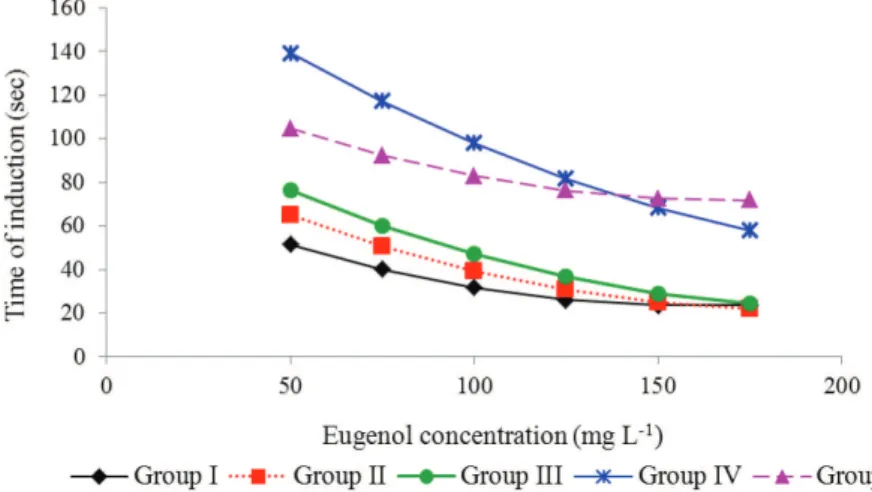
The eugenol concentration affected the
induc-tion time (p < 0.05) for each weight group of tilapia
(Fig. 1). The concentration between 150 and 175 mg
L
-1can be used for group I (0.02 g) and group V (11.64
g), since these concentrations had the lowest sedation
times (around 23 and 72 seconds, respectively).
Figure 2 demonstrates the relationship between
exposure to eugenol concentrations and time of
recovery of the different groups of tilapia.
After 24 h of testing, survival was 100% for
the different groups of tilapia. Moreover, all the fish
resumed eating.
DISCUSSION
efficient to anesthesize fish. The registered time
did not exceed 180 seconds, time recommended by
Keene et al. (1998) as ideal for induction time to
the anesthesia condition.
Data regarding anesthesia with eugenol in
the early life stages of fish are scarce.
Pereira-da-Silva et al. (2009) studied the effectiveness
of eugenol on fingerlings (mean weight = 0.6 g)
of “lambari”
Astyanax altiparanae
and found
that concentrations between 50 and 150 mg L
-1promotes deep anesthesia, in less than 90 seconds,
however, mortalities following higher dosages
(150 mg L
-1) were documented.
Eugenol was also effective in inducing deep
anesthesia in juveniles (mean weight = 3.31 g) of
“matrinxã”
Brycon cephalus
. The concentrations
of 50 to 100 mg L
-1of eugenol were effective in
inducing and regarding recovery time (Vidal et
Figure 1 - Induction time to increasing concentrations of eugenol in differentweight 1 groups of tilapia.
al. 2007b). It has been described that larvae of
sturgeon
Acipenser gueldenstaedtii
(mean length
= 13.7 mm) were anesthetized with 0.20 mg L
-1of eugenol (Akbulut et al. 2011) and juveniles of
Pseudoplatystoma corruscans
(mean weight = 27
g) were anesthetized with 50 mg L
-1of eugenol
(Vidal et al. 2006).
According to Vidal et al. (2008), a
con-centration of 75 mg L
-1of eugenol presented the
best response of anesthesia for juvenile tilapia
(mean weight = 5.34 g); while 100 mg L
-1of
eugenol was indicated for induction and recovery
in older tilapias, with mean weight of 670 g
(Simões et al. 2010) and also indicated for tilapia
with mean weight of 47.73 g, as described by
Delbon and Ranzani-Paiva (2012).
According to Zahl et al. (2009, 2011), body
weight is an important factor that affects the
effi-cacy of the anesthetic agents, regarding induction
and recovery times. In the current investigation,
the response of larvae (time of induction) was
shorter than in juveniles and this has been reported
by Brown et al. (1972) as a result of the normal
uptake of anesthetic across the skin being higher
than through the gills. Opiyo et al. (2013) working
with
O. niloticus
reported that body weight had a
direct relationship with anesthetic concentration
(sodium bicarbonate). Notwithstanding, Ribeiro
et al. (2013) working with eugenol in two juvenile
classes of
Lophiosilurus alexandri
(mean weight
= 0.72 and 7.44 g, respectively), recommended
the same concentration of this anesthetic (120 mg
L
-1) to both juvenile classes. Corroborating Ribeiro
et al. (2013), Nile tilapia larvae and juveniles can
be anesthetized with the same range of eugenol
concentration (present manuscript).
According to Keene et al. (1998), the
recommended time of animal recovery after
anesthesia should remain below the limit of 300
seconds. In general, the augment of eugenol
concentrations reflects increasing recovery
time for the fish. Notwithstanding, for all tested
concentrations of eugenol, the recovery time for the
different groups of tilapia remained below (53.07 to
184.31 seconds) the recommended limit. Okamoto
et al
.
(2009) working with dosages of eugenol
between 25 and 75 mg L
-1observed a recovery time
after induction varying from 120 to 480 seconds
for juveniles (mean weight = 51.4 g) of pompano
Trachinotus marginatus
. Concentrations of eugenol
of 50 to 200 mg L
-1were used for induction of
“matrinxã” juveniles. The recovery time after
eugenol anesthesia ranged from 186 to 292 seconds.
According to the data presented it is possible
to observe a wide range of eugenol concentrations
to anesthetize the fish. It is noteworthy that eugenol
has a large margin of safety, is easy to apply, and
results in low stress for the fish and low risk to the
animal (while out of water) and to the handler.
Comparing our results with published data,
we conclude that the optimal concentrations to
anesthetize the larvae of
O. niloticus
are similar to
those observed for other species in early stages of
development, and equal or higher in comparison to
juveniles of Nile tilapia.
In addition, the survival rates showed that
eugenol concentrations between 150 and 175 mg
L
-1may be considered safe for Nile tilapia larvae
and juveniles, since they determine the shortest
sedation time, 23 and 72 seconds, respectively.
These results demonstrated the possibility of
handling the animals avoiding death rates.
ACKNOWLEDGMENTS
The present research was supported by Fundação
de Amparo à Pesquisa do Estado de Minas
Gerais (FAPEMIG), Conselho Nacional de
Desenvolvimento Científico e Tecnológico (CNPq)
and Ministério de Pesca e Aquicultura (MPA).
RESUMO
Na aquicultura, as atividades com anestésicos são
normalmente empregadas a fim de assegurar o
fora da água diminuindo desta forma o trauma por estresse. Atualmente, não há nenhuma informação sobre a ação anestésica do eugenol em fases iniciais de vida de tilápia do Nilo (Oreochromis niloticus). O objetivo deste estudo foi avaliar diferentes concentrações de eugenol para larvas e juvenis de tilápia do Nilo. Sessenta animais foram usados em cada grupo de peso, o grupo I = 0,02 g; grupo II = 0,08 g; grupo III = 0,22 g; grupo IV = 2,62 g; e grupo V = 11,64 g. As concentrações de eugenol testadas foram 50, 75, 100, 125, 150 e 175 mg L-1
. Não houve mortes durante os testes com eugenol. Larvas de tilápia com 0,02 g e juvenis em torno de 11,64 g podem ser anestesiados com concentrações de eugenol entre 150 e 175 mg L-1
, uma vez que determinam o menor tempo de sedação (23 e 72 segundos, para o grupo de peso menor e maior, respectivamente).
Palavras-chave: anestesia, ciclídeo, manipulação, bem-estar.
REFERENCES
ACERETE L, BALASCH JC, ESPINOSA E, JOSA A AND TORT L. 2004. Physiological responses in Eurasian perch (Perca fluviatilis, L.) subjected to stress by transport and handling. Aquaculture 237: 167-178.
AKBULUT B, ÇAVDAR Y, ÇAKMAK E AND AKSUNGUR N. 2011. Use of clove oil to anaesthetize larvae of Russian sturgeon (Acipenser gueldenstaedtii). J Appl Ichthyol 27: 618-621.
ANDERSON WG, MCKINLEY RS AND COLAVECCHIA M. 1997. The use of clove oil as an anesthetic for rainbow trout and its effects on swimming performance. North Am J Fish Manage 17: 301-307.
BRESSLER K AND RON B. 2004. Effect of anesthetics on stress and the innate immune system of gilthead bream (Sparus aurata). Isr J Aquacult 56: 5-13.
BROWN EAB, FRANKLIN JE, PRATT E AND TRAMS EG. 1972. Contributions to the pharmacology of quinaldine uptake and distribution in the shark and comparative studies. Comp Biochem Physiol 42A: 223-231.
CHAROENDAT U, AREECHON N, SRISAPOOME P AND CHANTASART D. 2009. The efficacy of synthetic eugenol as an anesthetic for tilapia (Oreochromis niloticus Linn.) fry. Kasetsart J (Nat Sci) 43: 132-140.
CHO GK AND HEATH DD. 2000. Comparison of tricaine methanesulphonate (MS 222) and clove oil anaesthesia effects on the physiology of juvenile Chinook salmon
Oncorhynchus tshawytscha (Walbaum). Aquacult Res 31: 537-546.
DA CUNHA MA, ZEPPENFELD CC, GARCIA LO, LORO VL, DA FONSECA MB, EMANUELLI T, VEECK APL, COPATTI CE AND BALDISSEROTTO B. 2010. Anesthesia of silver catfish with eugenol: time of induction, cortisol response and sensory analysis of fillet. Cienc Rural 40(10): 2107-2114. DELBON MC AND RANZANI-PAIVA MJT. 2012. Eugenol em
juvenis de tilápias no Nilo: concentrações e administrações sucessivas. Bol Inst Pesca 38(1): 43-52.
FDA - FOOD AND DRUG ADMINISTRATION. 2002. Status of clove oil and eugenol for anesthesia in fish. Guidance for industry. U.S. Department of Health and Human Services, Rockville, MD, 4 p.
GOMES DP, CHAVES BWC, BECKER AG AND BALDISSEROTTO B. 2011. Water parameters affect anaesthesia induced by eugenol in silver catfish, Rhamdia quelen. Aquacult Res 42: 878-886.
GRIFFITHS SP. 2000. The use of clove oil as an anesthetic and method for sampling intertidal rockpool fishes. J Fish Biol 57: 1453-1464.
GUÉNETTE SA, UHLAND FC, HÉLIE P, BEAUDRY F AND VACHON P. 2007. Pharmacokinetics of eugenol in rainbow trout (Oncorhynchus mykiss). Aquaculture 266: 262-265. HONCZARYK A AND INOUE LAKA. 2009. Anestesia do pirarucu
por aspersão direta nas brânquias do eugenol em solução aquosa. Cienc Rural 39(2): 577-579.
HOSKONEN P AND PIRHONEN J. 2004. Temperature effects on anesthesia with clove oil in six temperate-zone fishes. J Fish Biol 64: 1136-1142.
HOVDA J AND LINLEY TJ. 2000. The potential application of hypothermia for anesthesia in adult pacific salmon. North Am J Aquacult 62: 67-72.
INOUE LAKA, SANTOS NETO C AND MORAES G. 2003. Clove oil as anaesthetic for juveniles of matrinxã Brycon cephalus
(Gunther, 1869). Cienc Rural 33(5): 943-947.
KEENE JI, NOAKES DIG, MOCCIA RD AND SOTO GC. 1998. The efficacy of clove oil as an anesthetic for rainbow trout,
Oncorhynchus mykiss (Walbaum). Aquacult Res 29: 89-101. MARKING LL AND MEYER FP. 1985. Are better fish anesthetics
needed in fisheries? Fisheries, Bethesda 10(6): 2-5. OKAMOTO MH, TESSER MB, LOUZADA LR, DOS SANTOS
RA AND SAMPAIO LA. 2009. Benzocaína e eugenol como anestésicos para juvenis do pampo Trachinotus marginatus. Cienc Rural 39(3): 866-870.
OPIYO MA, OGELLO EC AND CHARO-KARISA H. 2013.
Effecti-veness of sodium bicarbonate as an anesthetic for different sizes of Nile tilapia (Oreochromis niloticus L., 1758) juveniles. Int J Aquat Sci 4(2): 14-22.
PALIC D, HEROLT DM, ANDREASEN CB, MENZEL BW AND ROTH JA. 2006. Anesthetic efficacy of tricaine methanesulfonate, metomidate and eugenol: effects on plasma cortisol concentration and neutrophil function in fathead minnows (Pimephales promelas Rafinesque,
1820). Aquaculture 254: 675-685.
RIBEIRO PAP, MIRANDA-FILHO KC, MELILLO-FILHO R, SANTOS AEH, SILVA WSS, RODRIGUES LA AND LUZ RK. 2013. Eugenol como anestésico para juvenis de pacamã. Pesq Agropec Bras 48(8): 1136-1139.
ROSS LG AND ROSS B. 2008. Anaesthetic and sedative techniques for aquatic animals. 3rd ed., Oxford: Blackwell Science, 236 p.
ROUBACH R, GOMES LC, FONSECA FAL AND VAL AL. 2005. Eugenol as an efficacious anaesthetic for tambaqui,
Colossoma macropomum (Cuvier). Aquacult Res 36(11): 1056-1061.
SAS - STATISTICAL ANALYSIS SYSTEM. 2002. User’s guide. Version 9.1. Cary: SAS Institute Inc., CD-ROM.
SIMÕES LN, PAIVA G AND GOMES LC. 2010. Óleo de cravo como anestésico em adultos de tilápia-do-Nilo. Pesq Agropec Bras 45: 1472-1477.
SMALL BC. 2004. Effect of isoeugenol sedation on plasma cortisol, glucose, and lactate dynamics in channel catfish Ictalurus punctatus exposed to three stressors. Aquaculture 238: 469-481.
VIDAL LVO, ALBINATI RCB, ALBINATI ACL, DE LIRA AD, DE ALMEIDA TR AND SANTOS GB. 2008. Eugenol como anestésico para a tilápia-do-Nilo. Pesq Agropec Bras 43: 1069-1074.
VIDAL LVO, ALBINATI RCB, ALBINATI ACL AND DE MACEDO GR. 2006. Utilização do Eugenol como Anestésico para o Manejo de Juvenis de Pintado (Pseudoplatystoma corruscans). Acta Sci Biol Sci 28(3): 275-279.
VIDAL LVO, FURUYA WM, GRACIANO TS, SCHAMBER CR, SILVA LCR, SANTOS LD AND SOUZA SR. 2007b. Eugenol como anestésico para juvenis de matrinxã (Brycon cephalus). Rev Bras Saude Prod Anim 8: 335-342.
VINATEA L. 2004. Princípios químicos de qualidade de água em aquacultura: uma revisão para peixes e camarões. 2a ed., Florianópolis: Ed. UFSC, 231 p.
WALSH CT AND PEASE BC. 2002. The use of clove oil as an anesthetic for the long finned eel, Anguilla reinhardtii
(Steindachner). Aquacult Res 33: 627-635.
WATERSTRAT PR AND PINKHAM L. 2005. Evaluation of eugenol as an anesthetic for the American lobster Homarus americanus. J World Aquacult Soc 36(3): 420-424. WOODY CA, NELSON J AND RAMSTAD K. 2002. Clove oil as
an anesthetic for adult sockeye salmon: field trails. J Fish Biol 60: 340-347.