Crop Breeding and Applied Biotechnology S2: 111-120, 2012 Brazilian Society of Plant Breeding. Printed in Brazil
Contributions of plant breeding in Brazil – progress and perspectives
Magno Antonio Patto Ramalho1*, Luiz Antônio dos Santos Dias2 and Bruna Line Carvalho1
Received 15 September 2012 Accepted 03 October 2012
Abstract –Agribusiness is fundamental for the Brazilian economy. This has become possible due to the use of science and technology in agriculture in the last 35 years. Among the technologies, the use of improved cultivars stands out. This article presents the situation of the species grown in the country in recent years and the contribution of genetic plant breeding to the performance of these species. Challenges multiplied because of populational growth associated with the ever-growing concern of society with the environment. Breeders of the present and future must base plant selection in the field on new technologies so that it is possible to meet demand. Key words: Plant breeding, genetic progress, agribusiness, demand for food.
1 Universidade Federal de Lavras (UFLA), Departamento de Biologia, C.P. 37, 37.200-000, Lavras, MG, Brazil. *E-mail: [email protected] 2 Universidade Federal de Viçosa (UFV), Departamento de Fitotecnia, 36.570-000, Viçosa, MG, Brazil
INTRODUCTION
Brazil, up to the beginning of the 1970s, was a food importer. Practically forty years later, the country that went through the greatest populational increase on the planet during the 20th Century – a ten-fold increase in 100 years – has been transformed into one of the largest exporters of agricultural products in the world. Brazilian agribusiness is now responsible for practically 1/3 of the gross domestic product (GDP) and is the main driving force for development of the countryside and improvement of living conditions of innumerable cities whose main source of income is agribusiness.
What occurred in these four decades to bring about this growth in Brazilian agribusiness is the fruit of governmental policies to promote agriculture, of pioneering farmers who with great sacrifice and work established a new agricultural system, and also, without a doubt, of the development of science and technology specific to the growing conditions in the different regions of the country.
The success of generation of science and technology is due to several factors, and among them is rural extension service, created at the end of the 1960s. Extension technicians acquired new technologies and passed this knowledge on to farmers. Fortunately, a significant part of the spread of technology has also been carried out by means of technicians from agricultural input companies upon disseminating the experiences obtained from the success of other farmers. Other decisive factors were creation of the Empresa Brasileira de Pesquisa Agropecuária
(Embrapa) [Brazilian Crop and Livestock Research Company] and of state research companies and, above all, the establish-ment of various graduate study programs in different areas of the agrarian sciences. Joint activity of state research companies and Universities generated an enormous range of technolo-gies and services and made Brazil a reference in science and technology information for tropical conditions.
Among the technologies that most contributed to the country’s agricultural success is obtaining new cultivars better than existing ones. Brazil is a country that exhibits enormous diversity in diverse aspects, such as biology, climate, soil, and farmers, among others. Developing cultivars adapted to the various regions is not an easy task and requires a great deal of competence from breeders. For that reason, the institutions found in the different regions of the country have played a fundamental role in developing cultivars which are able to meet the demands of each one of them. Currently, species are being grown in locations difficult to imagine before, with some of them producing quite well. This has been possible through the persistence and hard work of professionals involved in plant breeding.
accomplishments of the SBMP, creating the journal Crop Breeding and Applied Biotechnology (CBAB) stands out. In 2012, CBAB is 11 years old and, in commemoration of this fact, this special edition is being published. In it, breeders from throughout the country present the achievements of their institutions and/or region and succinctly discuss the future of genetic breeding in the country.
This article seeks to present a compilation of the data on yield evolution of some species grown in Brazil to complement the information presented in the other articles. The purpose is also to estimate what genetic breeding has represented in terms of financial return.
RETROSPECTIVE OF PLANT BREEDING IN BRAZIL
The cultivation of some species has a long history in Brazil. From all indications, Indians already grew some plants such as corn and manioc. Soon after European discovery, the introduction of other planted species began. The first two were wheat and sugar cane, already in 1534. It should be emphasized that nearly all the plants currently grown in Brazil are from introductions made in the past (Nass et al. 2012).
Although growing of these crops began hundreds of years ago, research, for its part, especially in regard to genetic breeding, is much more recent. Perhaps the starting point is foundation of the Estação Agronômica de Campinas (Campinas Agronomic Station) by D. Pedro II in 1887 (Carbonell et al. 2012). This Station gave rise to the Instituto Agronômico de Campinas – IAC (Campinas Agronomic Institute), whose impact on Brazilian agribusiness is quite notable (Carbonell et al. 2012).
Another decisive mark in Brazilian agronomic science was the creation of Agronomy schools. Among them are the Escola Superior de Agricultura “Luiz de Queiroz” (ESALQ) [“Luiz de Queiroz” Higher School for Agriculture] in 1901; the Agricultural School of Lavras, now UFLA, in 1908; and the Escola Superior de Agricultura de Viçosa [Higher School for Agriculture of Viçosa], now UFV, in 1927. A more detailed retrospective of the creation of Agronomy schools has been presented by Sediyama et al. (2012).
Research activities on a national level began in 1940 with the creation of the Serviço Nacional de Pesquisa Agronômica [National Agronomic Research Service], which has undergone some changes through time. More recently, Embrapa was created in 1974. Some of the accomplish-ments of this company were highlighted by Lopes et al. (2012). Also at the beginning of the 1970s, state crop and livestock research institutes and companies were created. As indicated by Cirino et al. (2012), creation of the Instituto Agronômico do Paraná (IAPAR) [Agronomic Institute of
Parana] in 1972 was fundamental for transformation of the state into the largest grain producer in the country.
Graduate study courses in Agrarian Sciences began in 1966. The first one in the area of Plant Genetics and Breeding was that of ESALQ, in 1969. Then came the courses of UFV, da UFLA and various others. A descrip-tion of these programs and contribudescrip-tion of their former students was described by Geraldi (2012). The contribu-tion of Universities in obtaining cultivars is discussed by Sediyama et al. (2012) and by Barbosa et al. (2012). The latter authors emphasize the work of sugar cane breeding, which is performed under a public-private partnership, in this case, universities-sugar mills.
The Law for Protection of Cultivars, promulgated in 1997, was another landmark for genetic breeding of plants in Brazil. There was intense debate among breeders in the months before its approval by the Brazilian Congress. Such debates focused on the pros and cons of this Law. Fifteen years have passed and it has truly improved the plant breeding scenario in Brazil, as highlighted by Santos et al. (2012).
The contributions that have occurred since the found-ing of IAC and especially after the creation of Embrapa, Institutes and state companies and the establishment of graduate study programs in Genetics and Plant Breeding in Brazil have been enormous. Some examples will be given in a succinct manner below.
Apple consumption in Brazil until the end of the 1970s was very small. The fruit was only consumed under very specific conditions, as at Christmas or when a child was sick. Practically all apples were imported and expensive. With the work of introducing clones and making selection under the conditions of the south of Brazil, it was possible to meet the demand of the domestic market and even to export. One of the important traits for adaptation of this fruit-bearing plant is the demand for hours of winter dormancy temperatures less than or equal to 7.2 0C for fructification. While clones used under
typically temperate conditions require more than 800 hours of winter dormancy, clones were identified with the winter dormancy requirement of less than 500 hours (Denardi and Camilo 1998, Denardi and Kvitschal 2012). More recently, by means of crop management, it has been possible to grow apples in the Brazilian Northeast, hitherto unimaginable.
Precoce no. 1. This new line was used intensively in the hybridizations carried out as of then. With carrots, another plant originating from temperate climate, success in obtaining cultivars adapted to tropical conditions was enormous. Cur-rently, cauliflower, carrots and other garden crops originating from temperate conditions are grown in regions of Brazil where it was unimaginable some decades ago.
Another notable example of genetic breeding in Brazil is the case of Eucalyptus. Most species of this plant come from Australia. Its introduction occurred in 1825 in the Botanical Gardens of Rio de Janeiro, but the main introductions were undertaken at the beginning of the 20th Century by Edmundo Navarro de Andrade. The purpose was to identify species capable of production for the bed of the railroad line (Silva and Barrichelo 2006). Breeding, strictly speaking, only began around 1940 by IAC. Great advancement occurred by means of government financial incentives, with a view toward encourag -ing the plant-ing of forests in Brazil, which occurred as of the end of the 1970s. Companies intensified breeding programs by introducing new species and, above all, by making mass selection in commercial plantations and vegetative propagation of the best individuals. The yield, which was less than 20 m3
ha-1 year-1, grew to 40 m3 ha-1 year-1 in a very short period of
time, considering that this is a perennial species. This increase occurred, in part, due to improvement in management, but, undoubtedly, genetic breeding made an enormous contribution. As a result of this work, Brazil came to be the largest cellulose exporter on the planet, was able to supply most of the demand for charcoal, and came to use eucalyptus as sawn lumber. This work not only led to the growth of the cellulose industry, as already mentioned, and expansion of iron and steel mills, but also kept an enormous quantity of native forests from being cut with a view toward lumber production.
Other examples of success in Brazilian plant breeding will be mentioned below, considering evolution in productivity in the last 40 years. The importance of the success in plant selection for Brazilian agribusiness should be emphasized at this time. It is evident that selection has been, and continues to be, one of the main tools for people to be able to achieve the goal of producing for the necessary demand of fruit, grains, fibers, and other products derived from agriculture.
YIELD EVOLUTION IN THE MAIN SPECIES GROWN IN BRAZIL
Information regarding yield evolution of the main Brazil-ian crops was obtained from data from the FAO (2012). This organization supplies statistical data on production, yield and area of the main species grown in the world since 1961. Part of the references were obtained as of 1974/75 which, as has already been mentioned, was the period in which agricultural research increased in Brazil with intensification
in creation of graduate study programs of the Institutes, of the state research companies and of Embrapa.
Linear regression was estimated between the dependent variable, yield per area, and the independent variable, the year. Percentage gain was obtained considering the ratio between the estimate of the linear regression coefficient (b1) and the
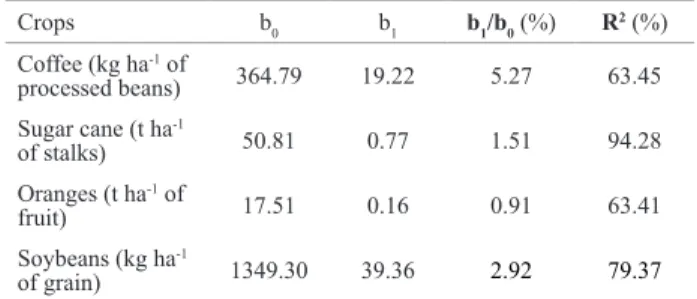
estimate of mean yield in year zero (b0), in other words, in 1974/75 (Table 1). Estimates of the percentage gains for products that meet the needs of the domestic market and exportation were relatively high (Table 1). Although the es-timate of fitting the linear regression equation varies accord -ing to the crop, in all cases and consider-ing that the statistics involve a continental country like Brazil, it may be considered that it was relatively high. Comparison of the percentage gains among the crops is hindered by the magnitude of the estimate of b0, which corresponds to yield in the 1974/75 crop season. Even so, it may be inferred that it was greatest for coffee. It should be highlighted that with coffee growing, a perennial plant, appropriations of the results of research are long term and this progress certainly reflects the work of the IAC with this crop, which had already begun some decades ago (Car-bonell et al. 2012). In the case of soybeans, progress was also expressive and reflected the effort in research and expansion of the planted area to the center-west region and later to the north of the country. In this case, the work of numerous in -stitutions should be considered and the articles of this special edition of CBAB reflect this fact.
In the case of sugar cane, there was wide variation in the investment applied to research in the period under consideration, which is the reason for modest progress (Table 1). But if the production of TRS (total recoverable sugars, namely, sucrose, fructose and glucose) specifically is considered, progress is expressive. Domestic yield of TRS, which was 3712 kg ha-1 in 1970, reached 9148 kg ha-1
in 2011. Thus, the yield of TRSs in Brazil has increased at the rate of 155 kg ha-1, in other words, a gain of 4% a
year (Barbosa et al. 2012). Brazilian sugar cane breeding
Table 1. Estimates of linear regression between yield per area, independent variable, and the year, dependent variable, in the period from 1974/75 to 2009/10, for the main crops whose product is exported by Brazil
Crops b0 b1 b1/b0(%) R
2(%)
Coffee (kg ha-1 of
processed beans) 364.79 19.22 5.27 63.45
Sugar cane (t ha-1
of stalks) 50.81 0.77 1.51 94.28
Oranges (t ha-1 of
fruit) 17.51 0.16 0.91 63.41
Soybeans (kg ha-1
of grain) 1349.30 39.36 2.92 79.37
b0: intercept of the equation (yield estimate in 1974/75); b1: linear regression
programs have already officially launched 111 sugar cane cultivars, and in the past decade alone (2000-2009), new cultivars were responsible for 20.8% of yield gain (in m3
ha-1) with ethanol (Dias 2011).
The orange crop undergoes great fluctuation in Brazil in accordance with the international market (Table 1). This fact is enhanced by the lower estimate of the coefficient of determination. However, it should be emphasized that it is normally a crop of large companies, which have already used a great deal of technology for some time. In addition, in the period under consideration, various problems of pathology occurred that reduced the orange yield. Genetic breeding of oranges is performed only by the public sector.
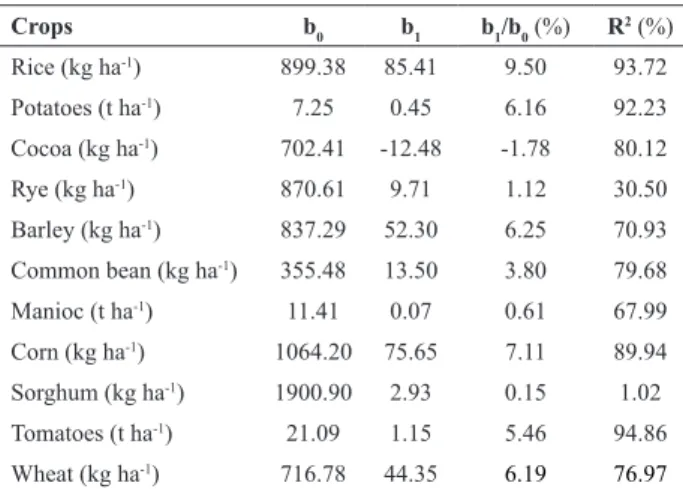
For the crops predominantly consumed in the country, progress estimates are presented in Table 2. It should be highlighted that the fits of the linear regression equation were not good only for sorghum and rye. That was expected because these crops underwent enormous oscillation in the planted area and in the management adopted in the period.
In general, yield gains in the period were even greater (Table 2) than those obtained for export crops (Table 1). This is a surprising fact because, in the export crops, the technological level of the farmers is greater, and they adopt the technologies generated more rapidly. In the case of soybeans (Table 1), as will be mentioned, there was a period of incorporation of new areas and only recently with promulgation of the Law for Protection of Cultivars did the private companies intensify their breeding programs.
The cocoa crop was the only one that showed yield reduction in the period. The occurrence of the pathology known as Witches’ Broom Disease (WBD), caused by the
fungus Moniliophthora perniciosa in the southern Bahia cocoa region in 1989, was certainly largely responsible for this setback. The production of dry cocoa beans, which was 340 thousand t in 1988, decreased to 141 thousand t in 1998 (FAO 2003). Dias (2001), analyzing the impacts of infesta-tion of WBD in the region, foresaw changes of direcinfesta-tion in two aspects: i) administration on a business basis, or less amateur style, of the cocoa properties, now living with the pathogen, and ii) the window of opportunity created for breeding of the cocoa tree showing competence. Production of Brazilian cocoa shows signs of recovery, reaching 200 thousand t of dry beans in 2011.
The important thing is that the most consumed foods in people’s diet, like rice, potatoes, beans, tomatoes, wheat and corn, showed expressive gains (Table 2). This was probably the main reason for the country no longer having to import most of these products already in the 1970s. In respect to grain production and the planted area in the country, from 1976 to 2011 (Figure 1), it may be observed that production more than tripled, i.e., 3.5 times more in 35 years, while the cultivated area increased only 1.35 times. That means that the increase in yield contributed to savings of planted area in the order of 128 million hectares.
Regression equations (Figure 2) allow comparison in regard to yield gain of three important vegetable species produced in Brazil and in the United States of America (USA). The first reservation in the comparison is in relation to the point of reference (b0), which for the USA was always greater. However, for the three species evaluated, the estimate of percentage gain was greater in Brazil (Figure 2). These results are relevant because tropical growing conditions, es-pecially for corn and soybeans, are much more unstable than temperate conditions (Paterniani 1990). Taking corn raising as a reference, for example, sowing time in the USA does not vary a great deal. In Brazil, the crop is sown practically throughout the entire year with the inclusion of what is called
“safrinha” (second crop) in the production system. This fact
contributes to pests, diseases and weeds being disseminated with much greater ease due to the existence of sources of inocula throughout practically the whole year. In the USA, the well-defined winter season restricts the occurrence of pests, pathogens and weeds. It should be emphasized that, historically, the investment in agricultural research in the USA is much greater and, in addition, it was initiated with greater intensity at a time well before that in Brazil.
Another aspect to be discussed is how agriculture was carried out in Brazil before the 1970s. The text presented by Hannicutt (1914) reflects what occurred up to this date: “The system generally used in Brazil in corn growing, in spite of good immediate results, is very bad. We clear a piece of forest and we plant corn year after year until entirely exhausting
Table 2. Linear regression estimates between yield, independent variable, and the year, dependent variable, in the period from 1974/75 to 2009/10 for the main crops whose product is sold predominantly in Brazil
Crops b0 b1 b1/b0 (%) R2(%)
Rice (kg ha-1) 899.38 85.41 9.50 93.72
Potatoes (t ha-1) 7.25 0.45 6.16 92.23
Cocoa (kg ha-1) 702.41 -12.48 -1.78 80.12
Rye (kg ha-1) 870.61 9.71 1.12 30.50
Barley (kg ha-1) 837.29 52.30 6.25 70.93
Common bean (kg ha-1) 355.48 13.50 3.80 79.68
Manioc (t ha-1) 11.41 0.07 0.61 67.99
Corn (kg ha-1) 1064.20 75.65 7.11 89.94
Sorghum (kg ha-1) 1900.90 2.93 0.15 1.02
Tomatoes (t ha-1) 21.09 1.15 5.46 94.86
Wheat (kg ha-1) 716.78 44.35 6.19 76.97
b0: intercept of the equation (yield estimate in 1974/75); b1: linear regression
fertility, then abandoning it to clear a new piece of land. The future generation will certainly grow very sad of this legacy of drained and ruined lands and the devastation of the forests. There is a saying: Blessed is the one who makes two shoots of grass grow where before only one grew, and it could well have been added: Cursed is the one who makes one shoot grow where before two grew. It is absolutely indispensable that in Brazilian farming we make use of more rational processes for maintaining fertility. Up to this time, we are often exploiters of the soil instead of growers of the soil.”
This itinerant agriculture, namely razing the forest and planting for two to three crop seasons, then migrating to other areas of recently cut down forest, continued until around 1960. This was the main reason for drastic reduction of the Atlantic Forest in Brazil. As of 1960, with a great increase in population, the demand for food intensified and it was no longer possible to continue deforestation to meet these needs. Also in this period, practically no limestone or fertilizer was used in planting. To highlight what oc-curred in the period after 1960, linear regression equations of grain yield are presented, considering corn, common beans and soybeans from 1961 to 1975 and, afterwards, from 1975 to 2010. In the case of common bean (Figure 3), there was a decrease in yield in the period before 1975. Without use of fertilizers, with few improved cultivars and without the possibility of using recently deforested areas, yield decreased. In the case of corn, there was no reduction (b1=15.56), but the increase was very small, i.e., only 1.26%. It should be emphasized that already in 1946, the first double hybrid was placed on the market. In 1951, the double hybrid H-6999-A was sold. This hybrid spread rapidly above all because the IAC made the simple parental hybrids available so that recently created domestic seed companies could produce the hybrid cultivar (Miranda Filho and Viégas 1987). These hybrids certainly
contrib-uted so that crop yield did not have a reduction like that of common bean in the period before 1975.
With soybeans, a different situation occurred. Up to 1974, this legume was predominantly sown in the south of the country under the conditions of long summer days, due to its sensitivity to photoperiod. The level of technology used in this growing was already good. As of 1970, upon obtaining soybean lines with alleles that provide for a long juvenile period (Destro et al. 2001, Pipolo et al. 2002), growing spread to the central-west and then to the north of the country. Environmental conditions, such as soil fertil-ity and physics after razing the cerrado (tropical savanna) vegetation, posed a great challenge for obtaining high yields. Even so, the linear regression coefficient from 1961 to 1975 was practically the same for the later period (Figure 3).
ECONOMIC RETURN OF GENETIC BREEDING OF PLANTS IN BRAZIL
The success of yield increase of species grown in Brazil (Tables 1 and 2) is the result of various factors. As already mentioned, the dedication of farmers in the constant search for new technologies was fundamental. Nevertheless, from the perspective of technology, two aspects are important. The first is what is called crop management. Included here are practically all plant science techniques, among them soil management, with emphasis on the introduction of no till planting experimentally as of 1972; the use of fertilizers that, as has already been emphasized, was minimal before 1975; the rational use of agricultural chemicals in control of pests, diseases and weeds; and some other technolo -gies. The other aspect is genetic breeding in the search for new cultivars superior to those already in existence. There is no detailed information on the relative contribution of management and of the cultivar on yield increase. Studies
performed in the United States with corn indicate that such increase in these two aspects is equivalent, in other words, practically 50% each (Cardwell 1982).
Considering that the introduction of new cultivars contributes to 50% of the yield increase, we estimate the economic return of genetic breeding. For that purpose, the estimate of b1 was considered, which represents an annual increase per ha from 1975 to 2010 and the total mean area planted in the last 20 years, obtaining the annual increase of the agricultural product. This estimate was multiplied by the average price of the product in dollars in the last 20 years (FAO 2012) (Table 3).
It must be considered that the pathogen and pest resis-tance alleles introduced in the commercial cultivars are not included in this estimate. Evidently, they reduce the use of agricultural chemicals and, consequently, reduce production costs. The selection carried out with a view toward efficiency in uptake of fertilizers is also difficult to be measured. In this case, however, the work aiming at improving efficiency in nitrogen (N) fixing in soybeans cannot fail to be considered. At the beginning of soybean growing in the recently cleared cerrado, the selection of N-fixing bacteria strains adapted to
local conditions was necessary in reference to various fac-tors, such as soil temperature and acidity, and the existence of antibiotic-producing bacteria that evidently reduced the efficiency of the strains available up until then. The selec -tion of soybean lines that would interact well with the new strains of N-fixing bacteria was also necessary, increasing the efficiency of the process. As fruit of this work of selection of microorganisms and plants, soybean growing came to be performed without the use of nitrogen fertilizers. Estimating economic return in this case is relatively easy. Considering that soybeans contain on average 40% protein (Sediyama et al. 2005) and that 16.6% of this protein consists of N, 1 kg of soybeans therefore contains 0.066 kg of N. If the soybean yield in 2010 is considered to be in the order of 2941 kg ha-1 (FAO 2012), this represents 195.32 kg of N per ha. Urea, the commonly used nitrogen fertilizer, contains 45% N. Thus, on
A)
B)
C)
Figure 2. Linear regression equation obtained for yield: (A) oranges, (B) corn, (C) soybeans, in Brazil (blue line) and in the United States (red line) in the period from 1975 to 2010.
A)
B)
C)
one hectare, 434 kg of urea would be necessary just to supply the N taken up by the grain. In the 2010 crop season, the area planted to this legume was 23.3 million ha (FAO 2012), thus requiring 10.1 million tons of urea. At current prices for urea of around US$ 780 a ton, the savings from exclusive use of N-fixing bacteria is 7.9 billion dollars per year.
Soybean and corn crops are among those that provided the greatest annual economic return (Table 3). In spite of the gain in yield having been much less than that of other crops like potatoes, sugar cane, oranges and tomatoes, the total growing area was much greater than all of them, which may explain the high magnitude of the estimate of economic return. On the other hand, rye, barley and sorghum had a minimal return. The annual increase in income was 262.24 million dollars. At first, this value may appear small, but it must be considered that it is annual and cumulative. Con-sidering the 35 years of the statistics presented, the figure of US$ 165.2 billion is arrived at, which is expressive.
It is important to highlight that some crops in which companies show little interest, because they are mainly planted for family farming, had a considerable return, such as rice, potatoes, coffee and common beans. This shows the importance of involvement of public institutions in breeding programs with these species which are highly important for internal consumption of the country or even for export, as is the case of coffee.
The contribution of breeding in terms of tolerance to biotic and abiotic stresses is even more difficult to measure. In a survey performed by the American Society of Agronomy among ten areas of knowledge, genetic breeding was the first science cited as having the most expressive contribution to mitigating the ecological damages arising from agriculture (Crookston 2006). Unfortunately, in Brazil there is no in -formation similar to this; however, if there were, it would likely ratify what the American professionals mention.
CHALLENGES TO BE OVERCOME
There are various challenges to be overcome in the coming years, among them:
A) The need for increasing grain production. Projections of population growth indicate that already by 2025 we will have around 8 billion individuals on the planet. This fact, together with the possibility of increase in per capita income, show that the demand for agricultural products will be enormous. Considering that the possibility of expanding the growing area is ephemeral, as will be commented on below, the option that
remains is increasing the yield per area;
B) The cost of inputs will likely increase. In Brazil, a large
corn producer, for example, can easily obtain yields of up to 10 t ha-1. In contrast, family agriculture cannot easily afford
these inputs, due to their cost. This trend will expand, in other words, the greatest yields at the lowest possible cost
must be obtained;
Table 3. Estimate of b1 from 1975 to 2010, planted area, price per kilogram of the product, considering the average of the last 10 years, and annual economic return from genetic breeding
Crops b1
(kg ha-1)
50% b1
(kg ha-1) Area* (million ha) (US$ kgPrice-1) Annual return(million US$)
a b c a.b.c
Rice 85.41 42.71 3.51 0.21 31.48
Potatoes 446.37 223.19 0.16 0.28 10.00
Coffee 19.22 9.61 2.24 0.93 20.02
Sugar cane 769.02 384.51 5.58 0.01 21.46
Rye 9.71 4.86 0.01 0.10 0.00
Barley 52.30 26.15 0.11 0.13 0.37
Common bean 13.50 6.75 4.2 0.60 17.01
Oranges 163.08 81.54 0.88 0.12 8.61
Manioc 69.26 34.63 1.76 0.06 3.66
Corn 75.65 37.83 12.62 0.13 62.06
Soybeans 39.36 19.68 15.85 0.22 68.62
Sorghum 2.93 1.46 0.48 0.06 0.04
Tomatoes 1,152.60 576.30 0.06 0.37 12.79
Wheat 44.34 22.17 1.84 0.15 6.12
Total 262.24
C) Societal pressure for reducing the impacts of agriculture on the environment will be greater. Breeding with a view toward mitigating abiotic and biotic stresses will be more and more required. In this context, breeding may provide its greatest socio-economic-environmental contribution, particularly for family farming. Plant selection for low input conditions may enable the viability of these farmers, but it will require joint efforts among breeders of the public and private sectors and
among breeders in the field and the laboratory so as to broaden dialogue among them, incorporating innovations and redefin -ing their activities (Delmer 2005).
D) A smaller number of people will likely be involved in field work. Interest of young people in agricultural activities will
continue to decrease. Plant architecture, for example, aiming to facilitate management and allow mechanization of most
activities should be a priority;
E) Climate changes, if predictions are confirmed, will make agricultural production more difficult in many regions of the country;
F) The impossibility of incorporation of new areas. Incorpora-tion of new farmable areas to the productive process will be
more and more difficult, above all because of societal pressure
regarding changes in the ecosystems.
PERSPECTIVES FOR BREEDING IN THE NEXT 25 YEARS
To meet the entire future demand for food and other agricultural products, the contribution of breeding must continue. Based on the above, the perspectives for breeding are enormous and give rise to the following considerations:
a) The investment in breeding will certainly be greater in the future, with the need for providing a greater return than that
previously obtained;
b) Research studies on plant breeding that have already proven their effectiveness should be continued. Nevertheless, new
areas of knowledge should be incorporated in the process of generation of science and technology in the field, e.g., some
biotechnologies, nanotechnologies and all emerging areas of
knowledge which may make the products and processes in plant breeding more effective;
c) Rural extension should be expanded and strengthened so that the innovations generated, especially new cultivars, may
be appropriated as rapidly as possible by farmers;
d) Use marketing strategies to show the importance of the work of breeders and the role of the rural producer to society.
REFERENCES
Barbosa MHP, Resende MDV, Dias LAS, Barbosa GVS, Oliveira RA,
Peternelli LA and Daros E(2012)Genetic improvement of sugar
cane for bioenergy: the Brazilian experience in network research with
RIDESA. Crop Breeding and Applied Biotechnology S2: 87-98.
Carbonell SAM, Guerreiro Filho O and Siqueira WJ (2012) Contributions
of the Instituto Agronômico (IAC) for plant breeding. Crop Breeding
and Applied Biotechnology S2: 15-24.
Cardwell VB (1982) Fifty years of Minnesota corn production: sources
of yield increase. Agronomy Journal 74: 984-990.
CONAB - Companhia Nacional de Abastecimento (2012) Séries históricas. Available at <www.conab.gov.br>. Accessed in Oct. 2012. Crookston RK (2006) Top list of development issues impacting crop
management and ecology during the past 50 years. Crop Science
46: 2253-2262.
Delmer DP (2005) Agriculture in the developing world: connecting innovations in plant research to downstream applications. Proceedings of the National Academy of Sciences of the USA 102: 15739-15746. Denardi F and Camilo AP (1998) Daiane: nova cultivar de macieira para
colheita em março. Agropecuária Catarinense11: 6-8.
Denardi F and Kvitschal MV (2012) Melhoramento genético da macieira na Epagri, SC – avanços obtidos e estratégias para o futuro. In
Simpósio nacional de atualização em genética e melhoramento de plantas – o melhoramento de plantas no contexto das mudanças climáticas. UFLA, Lavras, p. 1-13.
Destro D, Carpentieri-Pípolo V, Kiihl RAS and Almeida LA (2001) Photoperiodism and genetic control of the long juvenile period in
soybean: a review. Crop Breeding and Applied Biotechnology
1:72-92.
Dias LAS (2001) New approaches in breeding. In Dias LAS and FAO Ecoport (eds.) Genetic improvement of cacao. Available at <http:// ecoport.org/ep?SearchType=earticleView&earticle Id=197&page=-1&checkRequired=Y> Accessed on Oct 26, 2012.
Dias LAS (2011) Biofuel plant species and the contribution of genetic
improvement. Crop Breeding and Applied Biotechnology S1: 16-26.
FAO - Food and Agriculture Organization of the United Nations (2003)
Medium-term prospects for agricultural commodities: projections to the year 2010. FAO, Rome, 89p.
FAO - Food and Agriculture Organization of the United Nations – FAOSTAT (2012) Avaliable at <faostat.fao.org>. Accessed in Oct. 2012.
Geraldi IO (2012) Contribution of graduate programs in plant breeding to
the education of plant breeders in Brazil. Crop Breeding and Applied
Biotechnology S2: 1-6.
Hunnicutti BH (1924) O milho: sua cultura e aproveitamento no Brasil.
Leite Ribeiro, Rio de Janeiro, 243p.
Lopes MA, Faleiro FG, Ferreira ME, Lopes DB, Vivian R and Boiteux LS (2012) Embrapa's contribution to the development of new plant
varieties and their impact on Brazilian agriculture. Crop Breeding
and Applied Biotechnology S2: 31-46.
MAPA/AGE – Ministério da Agricultura, Pecuária e Abastecimento/
Assessoria de Gestão Estratégica (2012) Brasil: projeções do
agronegócio 2011/12 a 2021/22. MAPA/AGE, Brasília, 51p.
Miranda Filho JB and Viégas GP (1987) Milho híbrido. In Melhoramento
e produção de milho. 2nd ed., vol 1, Fundação Cargill, Campinas,
p. 275-340.
Moda-Cirino V, Gerage AC, Riede CR, Sera G, Takahashi M, Abbud NS,
Nazareno NRX, Araújo PM, Auler PM, Yamaoka RS, Sera T and Almeida WP (2012) Plant breeding at Instituto Agronômico do Paraná
Nass LL, Sigrist MS, Ribeiro CSC and Reifschneider FJB (2012) Genetic resources: the basis for sustainable and competitive
plant breeding. Crop Breeding and Applied Biotechnology
S2: 75-86.
Paterniani E (1990) Maize breeding in the tropics. Critical Review in
Plant Sciences 9: 125-154.
Pipolo CV, Almeida LA and Kiihl RAS (2002) Inheritance of a long
juvenil period under short day condition in soybean. Genetics and
Molecular Biology 25: 463-469.
Ramalho MAP, Toledo FHRB and Souza JC (2010) Melhoramento genético de plantas no Brasil. In Ramalho MAP, Toledo FHRB, Souza
JC and Teixeira RA (eds.) Competências em melhoramento genético
de plantas no Brasil. Arka, Viçosa, p. 16-38.
Santos FS, Aviani DM, Hidalgo JAF, Machado RZ and Araújo SP (2012) Evolution, importance and evaluation of cultivar protection in Brazil: the work of the SNPC. Crop Breeding and Applied Biotechnology S2: 99-110.
Sediyama T, Teixeira RC and Reis MS (2005) Melhoramento da soja. In Borém A (ed.) Melhoramento de espécies cultivadas. 2nd ed., Editora
UFV, Viçosa, p. 487-533.
Sediyama CS, Carneiro JES, Fritsche-Neto R, Sediyama T, Barbosa MHP, Galvão JCC and Souza MA (2012) Contribution of the universities to the development of field crop cultivars. Crop Breeding and Applied Biotechnology S2: 121-130
Silva PHM and Barrichelo LEG (2006) Progressos recentes na área florestal. In Paterniani E (ed.) Ciência, agricultura e sociedade.