outubro de 2015
Margarida Pinto Monteiro
Potential Implications of Ketamine
Anesthesia on Zebrafish Behavior
Escola de Psicologia
Dissertação de Mestrado
Mestrado Integrado em Psicologia
Trabalho efetuado sob a orientação do
Professor Doutor Armando Machado
Escola de Psicologia, Universidade do Minho
e coorientação da
Doutora Ana Maria Valentim
Instituto de Biologia Molecular e Celular
outubro de 2015
Margarida Pinto Monteiro
Potential Implications of Ketamine
Anesthesia on Zebrafish Behavior
Escola de Psicologia
Index Agradecimentos ... v Abstract ... vi Resumo ... vii Background ... 1 Methods ... 5
Animals and Husbandry ... 5
Drugs Exposure ... 5
Behavioral Methods ... 6
Procedure ... 9
Statistical Analysis ... 9
Results ... 10
Locomotion and Thigmotaxis ... 10
Locomotion ... 10
Thigmotaxis ... 12
Novel Tank ... 14
Differences across time/sessions: inter trial habituation ... 14
Differences between control and ketamine-treated groups in each session ... 14
T-Maze ... 19
Discussion ... 20
Limitations and Suggestions ... 22
Conclusion ... 23
Index for Tables Table 1. Number and percentage of zebrafish used in the different behavioral assessments per group………...6
Table 2. Percentage of time spent in each of the speed categories: low; intermediate and high in each group…..………….………... 11
Table 3. Percentage of distance traveled at each of the speed categories: low; intermediate and high in each group ………. 12
iv
Index for Figures
Figure 1. Diagram of the experimental design of the study. ………...….9 Figure 2. T1 and D1 indices for each of the groups. ………..….13 Figure 3. Total distance traveled (upper and bottom halves of the tank) during the 3 novel
tank sessions……… ……….…...15
Figure 4. Global velocity in three sessions of the novel tank test………..….…16 Figure 5. Number of visits to the upper half of the tank during the three sessions of novel
tank test …….………..…17
Figure 6. Latency to enter the upper half of the tank in the three sessions of the novel tank
test ………..17
Figure 7. Percentage of distance traveled in the upper half of the tank during the three
sessions of novel tank test………..………...18
Figure 8. Percentage of time spent in the upper half of the tank during the three sessions of
novel tank test ………...19
Agradecimentos
Em primeiro lugar, ao Professor Doutor Armando Machado, pela orientação e transmissão de conhecimentos ao longo destes últimos anos, assim como aos restantes membros do grupo Animal Learning and Behavior.
À Doutora Ana Maria Valentim, por todo o apoio e orientação ao longo deste projeto. Pela compreensão e pela ajuda ao longo de cada etapa que constituiu a realização desta dissertação. Aos restantes membros do grupo Laboratory Animal Science pelo feedback e contribuição para a realização deste projeto, bem como por todas as oportunidades que me proporcionaram.
Ao Tiago Arantes, ao Luís Calheiros, ao Diogo, ao Henrique, ao Filipe, ao Luís Lopes e ao Daniel Oliveira pela amizade, pela compreensão e por, de formas diferentes, terem contribuído para a conclusão desta etapa.
À Daniela, à Renata por todos os momentos partilhados ao longo destes últimos cinco anos. Ao Rui, pela amizade, pelos conselhos e, acima de tudo, pelas gargalhadas.
À Alexandra, à Diana Marques por terem sido as melhores companheiras neste longo percurso. Pela troca de opiniões, ideias e, acima de tudo, pela amizade nos momentos críticos. Ao Luís Pinheiro e ao Tiago Pinto, por toda a amizade ao longo destes anos, por serem o motivo dos melhores momentos, dos momentos mais divertidos, sem esquecer toda a orientação e ajuda que permitiram a conclusão deste percurso. Serão, certamente, o que levo de melhor destes cinco anos.
À Filipa, à Filipa, à Joana e à Rita, pelo apoio incondicional, por acreditarem sempre em mim e pela segurança que me transmitem.
À minha família e, em especial, à minha avó por ser o exemplo a seguir.
Ao Hugo, pelo incansável esforço em mostrar-me que isto seria possível. O maior obrigada por, apesar de todos os momentos complicados, me mostrares o caminho a seguir, por compreenderes as inseguranças e por nunca desistires. Obrigada por me incentivares a seguir o meu próprio caminho.
Ao meu irmão, Pedro, por me ensinar a distinguir o certo do errado, por me ajudar a adotar uma postura crítica e, acima de tudo, pela compreensão e apoio.
Ao meu pai, por exigir sempre mais de mim e pelo apoio incondicional.
À minha Mãe, pela compreensão, pelo apoio incondicional e inquestionável e pela vontade de tentar ajudar. Não só neste projeto mas ao longo de todo o caminho. Toda esta dissertação não seria suficiente para te agradecer.
vi
Potential Implications of Ketamine Anesthesia on Zebrafish Behavior
Abstract
The main goal of this study was to analyze the effects of different concentrations of ketamine exposure during segmentation phase in larvae and adult zebrafish, on locomotion, anxiety-like behaviors and learning. In the segmentation stage, 119 larvae and 65 mixed-sex (6-7 months) AB zebrafish were exposed to high, medium or low ketamine concentration (10 hours post-fertilization) during 20 minutes or to no treatment (control group). Locomotion and thigmotaxis was assessed in larvae 6 days post-fertilization. Adult zebrafish were tested in the novel tank and t-maze procedures. Non-parametric tests were conducted. Results suggested that ketamine administration doesn’t affect locomotion and thigmotaxis at the larvae stage. At the adult stage, only the animals treated with the high concentration of ketamine behaved significant differently from the control group in the novel tank (anxiogenic effect of 0.8% of ketamine concentration). In the t-maze procedure, animals’ performance improved throughout time. However, no significant differences were found between groups. Results suggested that ketamine exposure during segmentation phase does not significantly affect larvae behavior at six days post-fertilization. At the adult stage, results suggested that learning isn’t impaired but the administration of higher dosages of ketamine during segmentation phase induce anxiety-like behaviors.
Potenciais Implicações da Anestesia de Cetamina no Comportamento de Peixes-Zebra
Resumo
O objetivo deste estudo foi analisar os efeitos de exposição de cetamina na fase de segmentação em peixes-zebra (larvas e adultos), na locomoção, comportamentos de ansiosos e aprendizagem. Na fase de segmentação, 119 larvas e 65 (6-7 meses) peixes-zebra AB foram expostos a alta, média ou baixa concentração de cetamina (10 horas pós-fertilização) durante 20 minutos ou a nenhum tratamento (grupo controlo). A locomoção e tigmotaxia foram medidas em larvas 6 dias-pós-fertilização. Peixes adultos foram testados no novel tank e t-maze. Testes não-paramétricos foram realizados. Os resultados sugeriram que a administração de cetamina não afeta a locomoção e tigmotaxia na fase larvar. Na fase adulta, apenas os animais expostos a elevada concentração de cetamina se comportaram de forma significativamente diferente do grupo controlo no novel tank (efeito ansiogénico da exposição à concentração de 0,8% de cetamina). No t-maze, o desempenho dos animais melhorou ao longo do tempo. Contudo, não foram encontradas diferenças significativas entre os grupos. Os resultados sugerem que a exposição cetamina durante a fase de segmentação não afeta significativamente o comportamento das larvas 6 dias pós-fertilização. Em adultos, os resultados sugerem que a aprendizagem não foi prejudicada, mas a administração de doses mais elevadas induziu comportamentos ansiosos.
Palavras-chave: peixe-zebra; cetamina; aprendizagem; comportamentos ansiosos;
Running Head: KETAMINE ANESTHESIA ON ZEBRAFISH BEHAVIOR 1
Potential Implications of Ketamine Anesthesia on Zebrafish Behavior
Background
Zebrafish (Danio Rerio) is considered a good animal model to study several diseases, since they present 70-80% of genetic homology with humans (Goldsmith, 2004). Although the similarity between humans and zebrafish is smaller than between human and rodents, zebrafish presents advantages over other animal models (Gebauer, Pagnussat, Piato, Schaeffer, Bonan, & Lara, 2011). Some of these advantages are: (1) zebrafish is a small vertebrate, easily kept in captivity in large numbers reducing housing space and husbandry costs (Goldsmith, 2004; Hill, Teraoka, Heideman & Peterson, 2005); (2) the breeding process of this specie is very simple and fast, resulting in a large number of embryos; and (3) zebrafish embryos are transparent and contain a smaller number of cells, facilitating the study of development, genetic conservation, and molecular mechanisms compared with more complex vertebrates (Matthews, Trevarrow, & Matthews, 2002).
In fish, anesthesia is a common procedure in veterinary practice, animal experimentation and aquaculture (Schoettger & Julin, 1967). During capture and handling, fish usually struggle, affecting both physiology and behavior, leading to a high-anxiety state. Thus, anesthesia may be necessary to reduce negative effects of procedures like weighing, vaccination, blood sampling or tagging. Nevertheless, not only in minor procedures as the ones described before is anesthesia helpful. Full or deep anesthesia is essential in invasive procedures as surgery or substance injection to reduce pain and insure full immobility (Ross & Ross, 2008). Several studies have reported the adverse side effects of anesthesia (Hollister & Burn, 1974; Huang et al., 2010; Cottrell, 2008). However, this remains controversial because these side effects depend on the anesthetic nature, anesthesia concentration and duration, animals’ age and specie. This requires to proceed with caution when using anesthesia, being imperative to determine possible side effects and to adapt the anesthetic protocol to the situation (Neiffer & Stamper, 2009). The process of anesthesia is usually accomplished by intraperitoneal or intravenous injection in large fishes, and especially immersion in small fish like zebrafish. In this case, the drug is dissolved in the water in which the fish is placed, and it is absorbed through the gills and skin (Sneddon, 2012). This high and rapid absorption difficult the control of the anesthetic depth which may cause overdose and high mortality in zebrafish.
The most common anesthetic used in fishes is tricaine methanesulfonate, also known as MS-222, very popular due to aquaculture and it is the only agent approved by the FDA
(U.S. Food and Drug Administration) to be used in food fish in USA (Carter, 2001). MS-222 is a local anesthetic, administrated in a water bath and absorbed through animals’ skin and gills (Carter, Woodley, & Brown, 2011). As a local anesthetic, this compound blocks the entrance of sodium into the cell by inhibiting the initiation and propagation of action potentials. Concerns have been raised about this mechanism of action, as MS-222 may be acting as a neuromuscular blocker rather than inducing loss of unconsciousness, which may cause distress to the fish (Reed, 2011). Furthermore, in zebrafish, the administration of this drug seems to reduce its heart rate and may lead to a high mortality rate (Huang et al, 2010). Therefore, it appears to be necessary to find better alternatives to the anesthetics currently used in zebrafish.
Ketamine is a dissociative anesthetic drug, with analgesic properties and it has been widely used in veterinary and human medicine (Liu, Paule, Ali, & Wang, 2011). It mainly act as a non-competitive antagonist of N-methyl-D aspartate (NMDA) glutamate receptors (Riehl et al, 2011). This could be an alternative anesthetic as it showed hemodynamic stability with no behavioral side effects in other vertebrates (Ribeiro et al, 2012). However, some studies have suggested that this drug may cause cell death in rodents and nonhuman primates, when exposed during animals’ development (Liu, Paule, Ali, & Wang, 2011; Slikker et al., 2007). Therefore, due to its high number of offspring and quick development, this animal model may be ideal to study the long-term effects on behavior induced by ketamine when animals are exposed to it in the first stages of life.
Besides the potential side-effects that anesthetic exposure may have in development, it is also important to explore the possible behavioral consequences that this exposure may have in adult animals that may be used in neurobehavioral research later on. Zebrafish model is often used in research since embryonic stages, and it is important to clarify if anesthesia is a variable to control. One of the developmental stages is segmentation phase that occurs between 10 and 24 hour post fertilization (hpf), which is marked by the development of somites, the appearance of the tail, and neuromeres that will correspond to different brain regions. The diencephalon and telencephalon are two of these regions which neuromeres develop in the beginning of segmentation (Kimmel, Ballard, Kimmel, Ullmann, & Schilling, 1995; Flood et al, 1976; Maximino et al, 2010).
Despite of not being as complex as mammals, many complex behaviors can be observed in zebrafish, from an early developmental stage. Anxiety-like behaviors, similar to fear-like behaviors, are observed in a potentially dangerous situation, such as an unknown environment and can also be elicited by an acoustic or vibrational stimulus (Kalueff et al, 2013). Some of these behaviors identified in zebrafish are: startle response; thigmotaxis; freezing behavior; and
KETAMINE ANESTHESIA ON ZEBRAFISH BEHAVIOR 3
erratic movements. The startle response consists of an escape response, mediated by a neural circuit in the brain steam and spinal cord (Roberts et al, 2011). This is called the C-start response (C-bend response) and consists in a high velocity turn that translates into a bend in the shape of the letter C (Budick & O’Malley, 2000). Thigmotaxis can be observed in many other species such as humans or rodents and it is a very common behavioral endpoint (Schnorr, Steenbergen, Richardson, & Champagne, 2012). It is characterized by a preference for the edges or walls of a new environment. This behavior, also known as “wall-hugging”, is common to adult and larvae (Kallueff et al, 2013). Freezing behavior is also associated with anxiety or fear in zebrafish and it is observed by a complete cessation of movement, with the exception of the eyes and gills, and it is easily observed in procedures like the Novel Tank Test. Erratic movements are also anxiety-like behaviors and are easily observed in stressed animals, consisting of sudden changes of direction accompanied with high velocity. Freezing behavior and erratic movements are more common in adults (Kallueff et al, 2013).
Since zebrafish exhibit anxiety-like behaviors and habituation to a new environment from an early stage, it may be important to assess it throughout zebrafish life (Blaser, Chadwick & McGinnis, 2010). Thigmotaxic behavior can be measured in a simple locomotion observation of larvae and adults. Besides giving information about the distance and speed of the animals, this observation also allows to assess the spatial occupation of the new environment (a microplate well or tank for larvae or adult, respectively). But some behaviors may depend on zebrafish age, for example studies have shown that in early developmental stage, larvae exhibit a preference for a bright environment (scotophobia) while adult or mature animals showed a preference for deep and dark places when placed in a novel environment (scototaxis) (Kallueff et al., 2013; Sackerman et al., 2010).
At larvae stage, zebrafish exhibit a repertoire of simple sensorimotor behaviors that are well-defined and stereotyped which can be observed in plate wells (Roberts et al., 2011; Burgess & Granato, 2007; Granato et al, 1996).
In adults, the novel tank test is a widely used method to assess stress or anxiety-like behaviors. This procedure consists in introducing fish in an unfamiliar environment, a novel tank. A zebrafish with high levels of anxiety is expected to stay longer in the bottom half of the tank. Thus, latency to enter the upper half of the tank can be a reliable measure to assess anxiety, as well as erratic movements or freezing (Egan et al, 2009; Maximino et al, 2012).
Habituation is considered the simplest form of learning, consisting in nonassociative learning and can also be assessed in the novel tank procedure. Habituation is characterized by a decrease of the response to a repeated stimulus, inducing the attenuation of some innate
behaviors as exploration. Although considered a simple process, neurobiological, biochemical and genetic studies suggest that it may be more complex than it appears (Bolivar, 2009). Several studies have shown that habituation phenotypes are highly sensitive to pharmacological manipulations (Wong et al., 2010; Stewart et al., 2013). This form of learning can be observed in very simple and very complex organisms, as rodents or humans. The open field test used in rodents is a homologous task to the novel tank task. Animals are placed in an open arena (novel environment) and allowed to explore; the level of exploration and locomotor activity tend to decrease throughout time, exhibiting habituation to this new environment (Bolivar, 2009). In zebrafish, habituation is possible to observe during several sessions of the novel tank test, when freezing, erratic movements, transitions and time spent in the bottom of the tank are decreased (Wong et al., 2010).
Zebrafish also shows that it is capable to learn tasks in laboratory. One of the most common and simple procedures to assess zebrafish learning abilities is the T-Maze test. Many studies have focused on the effects of certain substances on learning using this procedure. Cocaine impaired learning in zebrafish with genetic mutations while piracetam improved the performance of zebrafish in a similar procedure to the T-Maze, the plus-maze (Darland & Dowling, 2001; Grossman et al., 2011). Colwill and colleagues (2005) tested zebrafish in a visual discrimination task using the Maze. Animals learned to discriminate one side of the T-maze, and, after extinction of that information, they were able to revert the initial discrimination, indicating zebrafish as a good model to study behavioral plasticity.
Zebrafish exhibit developed patterns of behavior that may be influenced by several compounds (Lockwood, Bjerke, Kobayashi, & Guo, 2004; Choi, Lee, & Kim, 2011), suggesting that it may be important to assess be the behavioral effects of early exposure to anesthetics such as ketamine.
The main goal of this study is to analyze the effects of ketamine in larvae and adult zebrafish exposed previously in the embryonic stage of segmentation on functions like (a) locomotor behavior; (b) anxiety-like behaviors; and (c) learning, addressing the role of ketamine concentration in the potential changes that the animal may exhibit.
The outcomes of this study bring implications for pediatric/ obstetric practice where ketamine is often used (Green, Nakamura, & Johnson, 1990; Parker et al, 1997; Wang et al, 2014). Furthermore, as anesthesia is a very common procedure in research, this study is important to perceive if ketamine anesthesia may be a variable in neurobehavioral research, with a potential to bias the experimental results. Moreover, evaluating the effects of different
KETAMINE ANESTHESIA ON ZEBRAFISH BEHAVIOR 5
concentrations of anesthetic drugs may refine the future anesthetic protocol to be used in order to improve animals’ wellbeing.
Methods Animals and Husbandry
The sample was comprised by 119 6 days post-fertilization larvae and 65 mixed-sex 6-7 months adult zebrafish of wild-type AB strain. To assess locomotion and thigmotaxis, 119 larvae were tested. Two different behavioral tests were conducted with adults: the novel tank test where 65 animals were used and the T-maze task, where only 45 animals from the previous ones were tested.
The progenitors of the tested animals were mixed-sex wild-type (AB strain) adult zebrafish housed in 20L tanks and maintained at 28±0.5ºC, in a 14:10h light:dark cycle, in a semi-closed water system with aeration and mechanical and biological filtration. Feeding occurred twice a day (morning and afternoon), with flake food (Sera, Heinsberg, Germany), supplemented with Artemia sp. Nauplii. Zebrafish embryos were obtained when these animals were placed in tanks overnight with substrate (marbles) and plastic vegetation. The beginning of the light period induced spawning. Eggs were collected in the same morning and rinsed several times in system water and bleach (0.06%) to remove debris and to disinfect the eggs. Unfertilized, unhealthy and dead embryos were removed. Embryos were maintained in a 50mL beaker and observed until hatching (3-5 days post-fertilization) to remove further dead and unhealthy embryos. Animals were kept in treatment groups so the products of drug metabolism didn’t influence animals from different groups. After one month of fertilization, animals were placed in groups in 5L tanks and in visual contact with the neighbours. This system was a semi-closed water system with mechanical, biological, and carbon filters, with 100% water exchange per day and aeration. All tanks had UV sterilized water.
Drugs Exposure
After cleaning the eggs, they were randomly distributed in treatment groups: (a) control group (0.0% ketamine); (b) low concentration (0.2%) of ketamine; (c) medium concentration (0.4%) of ketamine; and (d) high concentration (0.8%) of ketamine. Animals were exposed to the previously referred concentrations of ketamine in beakers of 50 mL 10 hpf for a period of 20 minutes, i.e., in the beginning of segmentation phase. At the end of the exposure, embryos were washed three times with system water and allowed to develop until 6 days post-fertilization (dpf), and 6-7 months, when different behavioral tests were performed (Table 1).
For larvae observation, a positive control was added: 6 dpf larvae exposed to 1.5% of ethanol during 30 minutes.
Table 1
Number and percentage of zebrafish used in the different behavioral assessments per group
Groups Test Control Low Concentration Medium Concentration High Concentration Positive Control n % n % n % n % n % Locomotion 24 20.17% 24 20.17% 24 20.17% 24 20.17% 23 19.32% Novel Tank 12 18.46% 22 33.85% 12 18.46% 19 29.23% 0 0% T-Maze 7 15.56% 15 33.33% 8 17.78% 15 33.33% 0 0%
Notes. SD=Standard Deviation
Behavioral Methods
Methods using 6 dpf larvae
Locomotor behavior and thigmotaxis
To assess locomotor behavior, 119 zebrafish larvae (Table 1) were gently transferred from the 50 mL beaker where they were maintained to a 6-well illuminated plate (~2mL of water/well) with a plastic pipette. One larva was placed in each well and the treatment groups location was counterbalanced. Each well had an agarose ring to minimize the wall shadows in the analysis. In this test, a positive control was added: animals were exposed to 1.5% of ethanol in the wells 30 minutes before the behavioral recording according to Lockwood and colleagues (2004). This treatment was expected to induce hyperactivity and reduce thigmotaxis in zebrafish larvae. Before the experiment began, all larvae were acclimatized to the testing room conditions (e.g. temperature) during 30 minutes, reducing the stressful effect of larvae transportation. The behavior of the larvae was recorded with a camera suspended from above during 10 minutes, for posterior analysis with ZebraLab software (ViewPoint Life Sciences, Lissieu, France).
The video analysis assessed: (a) distance and swim speed; (b) period of inactivity; and (c) spatial occupation of the plate (i.e., time spent, and visits made to the center and periphery of the well - inner and outer region). The regions were defined in the analysis software by a
KETAMINE ANESTHESIA ON ZEBRAFISH BEHAVIOR 7
concentric line 0.82cm from the wall, dividing the well into two equivalent areas. The time that the larva spent in each of these regions was used to assess thigmotaxic behavior. Three different categorizations were made according to the velocity of the larvae: low speed referred to the time when the animal was moving at a velocity lower than 2 mm/s; intermediate speed included periods in which the velocity of the animal was between 2 and 12 mm/s; and the high speed referred to moments in which the velocity was higher than 12 mm/s.
After the end of the experiment, animals from the control and ketamine treatments groups were housed together according to the concentration that they were exposed. The animals from the positive control group were euthanized by ketamine overdose.
Methods using 6-month old zebrafish Novel Tank
The novel tank test was conducted with 65 zebrafish (Table 1) in a trapezoidal tank (15 height×28 top×23 bottom×7cm width). The test consisted on placing the fish individually in the tank with system water for a period of 7 minutes, and recording its behavior with one camera placed in front of the tank. This procedure was performed in three consecutive days (one session per day) to assess the anxiety-like behaviors and habituation to this novel environment.
The recorded sessions were used for posterior behavioral software analysis (Riehl et al, 2011). In the software VideoMot 2 (TSE-Systems, Bad Homburg, Germany), the tank was divided equally in bottom and top by an imaginary horizontal line for analysis. Several parameters were assessed: (a) latency to reach the upper half of the tank; (b) time spent in the upper half of the tank; (c) number of transitions to the upper half of the tank; (d) distance traveled; (e) fish speed; (f) number of erratic movements, which consist in sharp changes in direction or velocity; and (g) number of freezing bouts, i.e., the animals stands still at the bottom of the tank with no movement except for eyes and gills (Kalueff et al, 2013). Number of erratic movements and number and duration of freezing bouts were manually measured.
T-Maze
The T-Maze procedure was used to assess learning in 45 adult zebrafish (Table 1). The apparatus in T-shape was made of transparent glass with a central arm and two lateral arms of 50x10cm (Length x width). The T-maze was filled with system water to a depth of 2.7cm. Based on the previous work developed by Colwill and collaborators (2005), the design of this procedure comprised two phases: habituation and acquisition. Animals were food deprived 24
hours before the first session of habituation and they only ate during the T-maze task, except if they ate less than 4 pieces of commercial flocks. In this case they were fed individually with a controlled amount of food (3-4 pieces of flocks).
Habituation Phase: Habituation sessions began the day after the end of the novel tank
test. The first trial consisted on placing the animals that lived together in the T-maze for a period of 15 minutes, when they were allowed to explore the maze in groups to reduce the stress to a new environment; 3 minutes afterwards, each fish was placed in the apparatus to explore it individually for 5 minutes. After 1.5 hours, each fish performed four trials, wherein an alternate manner, one arm was rewarded (commercial flocks) and the other was blocked by a transparent glass door, the piece of flock was delivered with forceps. In the following day, each animal performed two trials: in the first one animals could choose between arms and it was rewarded independently of the arm chosen; in the second trial, the arm previously chosen was blocked and the animal was rewarded when it entered in the open arm. This rewarded habituation intended to guarantee that the fish had no previous preference for any of the arms. At the end, each fish had entered the right and left arms three times each. An arm entry was determined when the entire fish body was in the selected arm. After eating, the door was lifted and the animal was able to return to the start arm, where a door was closed and the next trial started in 30 seconds.
Acquisition phase: Testing period began with the acquisition period that was composed
by 13 sessions of six trials, during five consecutive days. As in habituation, fish was placed in the central arm and blocked by a door for 30 seconds. Then, the door was lifted to allow the fish to choose between the right and left arms of the maze. If the fish made the correct choice, food was delivered as described before. However, if the wrong arm was chosen, a sliding door was lowered and the animal was kept in the incorrect arm for 20 seconds. Then, the animal returned to the central arm and was kept there for 30 seconds before the next trial. In the case of fish choosing the incorrect arm in all six trials of a session, a forced trial was performed, i.e., fish would be obligated to choose the correct arm, as the incorrect one was blocked. The percentage of correct arm choice per each session and day was measured.
Two exclusion criteria were used: (1) changes in protocol; and (2) the animals didn’t left the central arm of the maze for a period of two minutes in, at least, two sessions in a row. After the experiment, animals were euthanized by immersion in cold water (4ºC) followed by decapitation.
KETAMINE ANESTHESIA ON ZEBRAFISH BEHAVIOR 9
Procedure
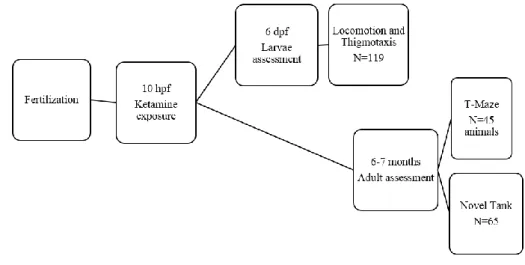
The anesthetic procedure, ketamine exposure, occurred at 10 hpf. Some of the animals were tested at 6 days post fertilization, where locomotion and thigmotaxis at the larvae stage were assessed. Other animals were tested only at the 6-7 months of age. These animals started to be tested in the novel tank procedure and were then tested in the T-maze (Figure 1).
Figure 1. Diagram of the experimental design of the study
Statistical Analysis
Exploratory analysis of all the variables were performed, showing that data were not normally distributed (Shapiro-Wilk test), and didn’t follow parametric statistical tests assumptions: non-parametric tests were used.
In order to assess the pattern of locomotion of larvae, Kruskal-Wallis tests were conducted regarding the percentage of time and distance traveled at each of the speeds, and total distance traveled to assess if there were significant differences between groups.
Regarding thigmotaxis in larvae zebrafish a One Sample Wilcoxon Signed Rank Test was conducted to compare the percentage of time spent and distance traveled in one of the areas with the value expected if the animal was moving by chance, i.e., if the animal traveled randomly between each of the areas, it would be expected that the animal spent 50% of time and swam 50% of total distance in each of the areas. Also, Kruskal-Wallis test was used to assess differences between the five groups, with Mann Whitney Tests to pairwise comparisons with Bonferroni correction regarding the percentage of time and distance traveled in the periphery.
In the Novel Tank procedure, several Wilcoxon Tests were performed to assess differences between session 1 and 3 for each of the variables: distance traveled in the upper half; distance traveled in the bottom half; total distance traveled; number of visits to the upper
half; latency to enter the upper half; global velocity; freezing and erratic movements; percentage of time spent and distance traveled in the upper half. Also, to assess differences in these variables between the control group and the experimental groups, Kruskal-Wallis test was used with several Mann Whitney Tests assess pairwise comparisons with Bonferroni correction.
To compare the percentage of correct trials of the T-maze procedure across time, a Friedman Test was conducted. To assess differences between groups Mann Whitney Tests with Bonferroni corrections were performed in each day.
All hypotheses tested were two-tailed and significance was set at p=0.05, except when Bonferroni corrections were needed (p=0.05/number of comparisons). All results were explored using Microsoft Office Excel 2007 (Microsoft Corporation, Redmont, WA, USA) and SPSS 19.0 for Windows (SPSS Inc., Chicago, IL, USA), for data acquisition and statistical analyses.
Results Locomotion and Thigmotaxis
Locomotion
Locomotion of larvae was studied regardless of the area in which the animals were. Mostly, the animals swam at low speed, independently of the group (Table 1). The percentage of time that animals spent at this state didn’t significantly differ between groups, as well as in intermediate and high velocity states.
KETAMINE ANESTHESIA ON ZEBRAFISH BEHAVIOR 11
Table 2
Percentage of time spent in each of the speed categories: low; intermediate and high in each group
Group
Low speed Intermediate speed High speed
M SD M SD M SD Control 97.35% 1.46% 2.65% 1.46% 0.00% 0.00% Low concentration 98.54% 0.96% 1.46% 0.96% 0.00% 0.00% Medium concentration 94.45% 3.36% 5.55% 3.36% 0.00% 0.03% High concentration 97.13% 2.08% 2.86% 2.08% 0.01% 0.01% Positive control 93.43% 3.99% 0.0657 3.99% 0.00% 0.00% Notes. M=Mean
Regarding the percentage of distance traveled by the animals, the majority of the swimming activity occurred at a low speed (Table 4). The results showed significant differences between groups regarding the percentage of distance traveled at a high speed, since the animals in the high concentration group spent more time swimming at this speed than control group (H(4)=12.024, p = .017). The control, low concentration and positive control groups didn’t traveled at high speed.
Table 3
Percentage of distance traveled at each of the speed categories: low; intermediate and high in each group
Group
Low speed Intermediate speed High speed
M SD M SD M SD Control 93.25% 2.93% 6.75% 2.93% 0.00% 0.00% Low concentration 94.50% 2.86% 5.50% 2.86% 0.00% 0.00% Medium concentration 87.28% 4.76% 12.63% 4.74% 0.09% 0.09% High concentration 90.76% 3.82% 8.85% 3.75% 0.39% 0.25% Positive control 87.73% 5.46% 12.27% 5.46% 0.00% 0.00% Notes. M=Mean
Results revealed no significant differences between groups in the total distance traveled by the larvae, regardless of the area and speed in which they were.
Thigmotaxis
For thigmotaxis analysis, two different zones with equal areas were defined in the video tracking software: central and peripheral area. This software provided information about the distance traveled in each of the areas, as well as the number of visits and time spent in each of these areas.
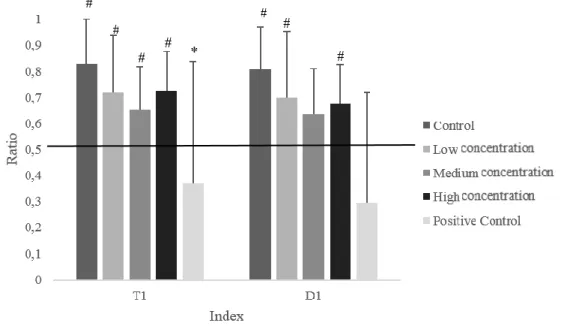
The preference for the peripheral area was assessed. Two additional variables were computed: an index of distance traveled in the peripheral area (D1) and an index of time spent in the peripheral zone (T1). These variables were calculated by dividing the distance or time spent in the peripheral area by the total distance and time, respectively. D1 and T1 ranged between zero and one: zero meant that all the distance traveled or time spent was in the central zone, while one indicated that the animal was always in the peripheral area.
If the animals didn’t exhibit thigmotaxis, the distance traveled and time spent in these two areas would be similar and, consequently, D1 and T1 would be 0.5.
KETAMINE ANESTHESIA ON ZEBRAFISH BEHAVIOR 13
Regarding D1, significant differences were found in the control (Z=228.00, p =.001); low concentration (Z=191.00, p =.009); and high concentration groupd (Z=193.00, p = .031). All the observed median was superior to chance, revealing that the animals had traveled a higher distance in the peripheral area than in the central area. Regarding the positive control group, the observed median was inferior to 0.5, showing that animals swam more in the central area. However, no significant differences were found.
In T1, significant differences were found in the control (Z=234.00, p =.000); low concentration (Z=201.00, p = .003); medium concentration (p=.031); and high concentration groups (Z=221.00, p = .006), revealing that the animals spent more time in the peripheral area, since the observed mean was higher than 0.5. The medium concentration group also had a T1 index higher than 0.5, however this difference was marginally significant (Z=107.500, p = .062). The results of the positive control group showed that no significant differences were found. However, the majority of the time was spent in the central area.
Differences in these indexes were also calculated to assess differences between groups. In terms of D1, no significant differences were found (H(4)=8.057, p = .090). Regarding T1, results showed that the control group spent more time in the periphery (higher T1) than the positive control group (U=138.50, p = .024), but this difference is not statistically significant when Bonferroni correction is implemented. No significant differences were found when comparing the control group with the low, medium and high concentration groups.
Figure 2. T1 and D1 indices for each of the groups. The horizontal line represents the value by
and positive control group, # p ≤ 0.050 between the value of chance and the value observed in each group.
Novel Tank
Novel Tank test was conducted in 3 different sessions, which allowed not only to study anxiety-like behaviors but also to assess habituation to this unfamiliar environment by analyzing several variables: time spent on the upper half of the tank; distance traveled in upper and lower half, as well as the total distance; number of visits to the upper half; latency to enter the upper half; global velocity; freezing and erratic movements.
Differences across time/sessions: inter trial habituation
To assess differences across time, first and third sessions were compared for each of the variables. Animals exposed to a low concentration of ketamine had higher latencies to enter the upper half in the first session than in the third session of novel tank (Z=-2.243, p = .025). In the high concentration group, several significant differences were found between the first and third sessions: distance moved in the bottom half (Z=-2.334, p = .020), and total distance (Z=-2.133,
p = .033) that is proportional to global velocity as the duration of the test is equal to all animals.
All these three variables were higher in the first session in comparison with the third. No significant differences were found for each of these variables in the control and medium concentration groups.
Differences between control and ketamine-treated groups in each session Distance traveled in the upper half of the tank
The analysis showed that the control group swam more in the upper half of the tank than the medium concentration group during the second and third sessions (U=33.00, p = .023; and U=26.00, p = .007; respectively); the difference detected in the second session disappeared with the use of Bonferroni correction Also, the control swam more in the upper half of the tank than the high concentration group in all of the sessions (U=54.00; p = .014; U = 53.00; p = .012; and U=37.00; p = .001).
Distance traveled in the bottom half of the tank
Distance in the bottom half differed significantly between control and ketamine-treated groups in the first session (H(3)=17.78, p = .000). The control group swam more than the
KETAMINE ANESTHESIA ON ZEBRAFISH BEHAVIOR 15
animals in the low concentration group (U=72.00, p = .031; no significant with Bonferroni correction), while the animals in the high concentration group significantly swam a higher distance at the bottom than the control group during the same session (U=35.00; p = .001).
Total distance traveled and global velocity
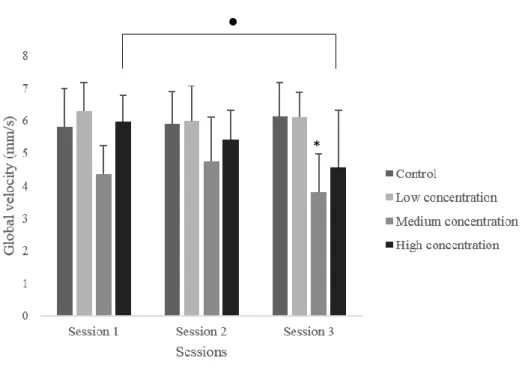
Total distance, and so global velocity, differed significantly between groups in the third session (H(3)=18.456, p = .000). The animals in the control group significantly swam more, and so presented a higher velocity, than the animals in the medium concentration group (U=19.00, p = .001), and the animals in the high concentration group (U=60.00; p = .028). This difference was not significant due to Bonferroni correction.
Figure 3. Total distance traveled (upper and bottom halves of the tank) during the three novel
tank sessions. Data is presented as median. ∆ p ≤ 0.050 between control and high concentration group on distance traveled on the upper half of the tank, ○ p ≤ 0.050 between control and ketamine-treated groups on distance traveled on the bottom half of the tank, ▪ p ≤ 0.050 between control and ketamine-treated groups on total distance traveled.
Figure 4. Global velocity in the three sessions of the novel tank test. Data is presented as median
+ IQR. *p ≤ 0.050 between control and medium concentration group, ● p ≤ 0.050 across sessions between the animals in the same group.
Number of visits to the upper half of the tank
The number of visits to the upper half of the tank was significantly different between groups during the third session (H(3)=11.205, p = .011). The control group visited significantly more the upper half of the tank than the medium concentration group (U=23.000, p = .003) and the high concentration group (U=48.50; p = .007).
KETAMINE ANESTHESIA ON ZEBRAFISH BEHAVIOR 17
Figure 5. Number of visits to the upper half of the tank in the three sessions of the novel tank
test. Data is presented as median + IQR. *p ≤ 0.050 between control and ketamine-treated groups.
Latency to enter the upper half
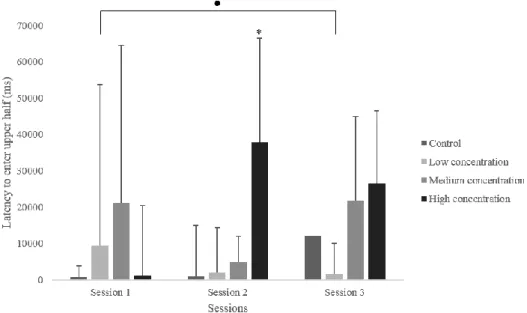
There were significant differences between groups in the latency to enter the upper half of the tank during the second session (H(3)=10.980, p = .012). The latency to enter the upper half was significantly higher in the high concentration group than in the control group (U=38.00, p = .003).
Figure 6. Latency to enter the upper half of the tank in three sessions of the novel tank test.
Data is presented as median + IQR. ● p ≤ 0.050 between session 1 and 3 of the low concentration group; *p ≤ 0.050 between control and high concentration group
Erratic movements and freezing
The analysis showed that the control group and experimental groups did not differ in the number of erratic movements nor in the number of freezing bouts performed during the 3 sessions. The same results were found regarding freezing bouts.
Percentage of distance traveled in the upper half
Regarding the differences between groups in each of the sessions, the results found suggest that there were significant differences during the first session (H(3)=9.010, p = .029). In this session, the animals in the control group spent significantly more time in the upper half when compared with the high concentration group (U=19.425, p = .032; no significant with Bonferroni correction). No significant differences were found between the control group and the remaining experimental groups. Also, no significant differences were found between the percentage of distance traveled in the upper half of the tank, with the value of chance (0.5).
Figure 7. Percentage of distance traveled in the upper half of the tank during the three sessions
of novel tank task. Data is presented as median + IQR. *p ≤ 0.050 between control and high concentration group.
Percentage of time traveled in the upper half
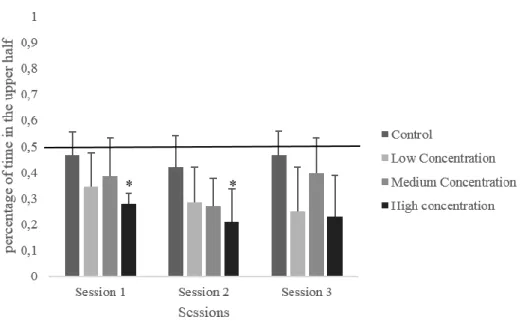
The percentage of time spent in the upper half of the tank significantly differed during the first and second session (H(3)=9.422, p = .024; H(3)=8.226, p = .042; respectively). During the first session, the animals in the high concentration group spent significantly less time in the upper half when compared with the control group (U=21.044, p = .016). In the second session,
KETAMINE ANESTHESIA ON ZEBRAFISH BEHAVIOR 19
the results are similar since the control group spent more time in the upper half of the tank in comparison with the high concentration group (U=20.053, p = .027; no significant with Bonferroni correction). No significant differences were found when comparing the percentage of time spent in the upper half with the value of chance.
Figure 8. Percentage of time spent in the upper half of the tank during the session of novel tank
task. Data is presented as median and IQR. *p ≤ 0.050 between control and high concentration group.
T-Maze
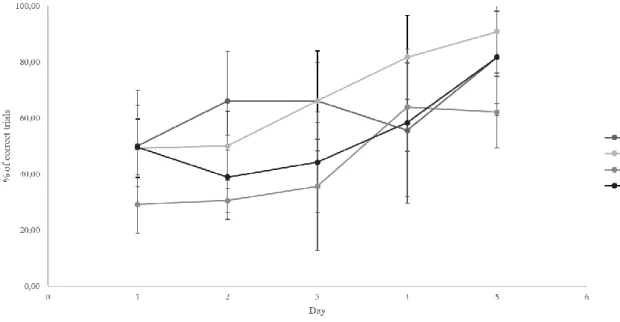
The T-maze test intended to assess the learning ability of these animals, comparing the learning rate of the animals from the control group and the animals from the remaining experimental groups. The results showed significant differences across days, in the low, medium and high concentration groups (χ2(4)=16.192, p = .003; χ2(4)=14.256, p = .007; χ2(4)=28.918, p = .000). However, no significant differences were found in the control group. Regarding significant differences between groups, the results showed that no significant differences were found in each day, emphasizing that at the end of testing, the performance of the animals did not significantly differed.
Figure 9. Percentage of correct answers in the T-Maze across the 5 days of testing.
Discussion
The main goal of this study was to assess the effects that ketamine exposure in segmentation stage could have on zebrafish behavior in two subsequent phases: larvae stage and adult stage. During larvae stage, this behavioral consequences were studied by the assessments of the animals’ locomotion and thigmotaxis. At the adult stage, anxiety-like behaviors and habituation were evaluated by using the Novel Tank Test, and learning ability was studied in the T-maze.
The comparison of the referred behaviors between the control group and the remaining experimental groups (low, medium and high concentration) made it possible to evaluate the effects of early ketamine exposure.
Regarding the assessments made in larvae, the results showed no differences regarding the locomotor pattern of the animals, independently of the concentration of ketamine that the animals were previously exposed. Thigmotaxic behavior was measured by assessing the preference of larvae for a peripheral area. The results suggested that the ketamine exposure did not affect the thigmotaxic behavior since the behavior of the animals from the experimental groups did not differ from the behavior of the animals on the control group, while the ethanol treated animals (positive control group) spent more time in the central area than control.
Literature showed that at this stage, larvae usually have a tendency to occupy the peripheral area of the plate and, consequently, spent more time in that area than in the central area (Kalueff et al., 2013; Colwill & Creton, 2011; Lockwood et al., 2004). This behavior is
KETAMINE ANESTHESIA ON ZEBRAFISH BEHAVIOR 21
also referred to as wall-hugging, consisting in a valid index of anxiety in animals (Schnorr et al., 2012). Ethanol acts as an anxiolytic substance which, in terms of human behavior, contributes to disinhibition (Fadda & Rossetti, 1998) and, in this particular conditions, could diminish the preference for periphery. Indeed, it has been suggested that ethanol acts as an anxiolytic in adult zebrafish (Egan et al, 2009; Mathur & Guo, 2011) when they are exposed to high concentrations. Thus, ethanol was used as positive control allowing to verify that this test really measured thigmotaxic behavior. The use of this procedure is suitable to study the anxiolytic or anxiogenic properties of ketamine. If the preference for the peripheral area would be high in ketamine treated groups that would suggest that ketamine may had acted as an anxiogenic. In the other hand, if these animals showed a higher preference for the central area, similar to what was found in the positive control group that would suggest the anxiolytic action of this compound. However, the results showed no significant differences in thigmotaxic behavior between the control group and any of the ketamine treated groups, suggesting that ketamine didn’t influence thigmotaxic behavior in zebrafish larvae.
In the locomotion assessment, only the animals in the medium and high concentration groups had traveled in the higher category of speed. In rodents, the administration of higher dosages of ketamine has been reported to induce hyperlocomotion (e.g. Irifune, Shimizu, & Nomoto, 1991; Ribeiro et al, 2012) and this result may suggest that ketamine administration at this stage may induce a higher level of locomotion.
At the adult stage, two procedures allowed the assessment of the effects of ketamine administration during segmentation phase. In the novel tank test, the most consistent differences are related to the time and distance traveled in the upper half of the tank, which suggested that the early exposure to high concentrations of ketamine may result in high levels of anxiety at the adult stage. Some studies have been conducted to assess the effects of ketamine exposure on anxiety-like behaviors, using the same behavioral procedure (novel tank). However, when it comes to acute ketamine exposure right before testing, the results seemed to suggest a reduction in the levels of anxiety of these animals (Rihel et al., 2011). Nevertheless, it is important to take in consideration the methodological differences between the two procedures adopted: it was not expected that the results obtained right after exposure could be the same as the results obtained six months after exposure. When animals are tested immediately or some minutes after exposure, they are still under ketamine effect which has anxiolytic properties and has been used as anti-depressant (Wang et al., 2014). It has been suggested that NMDA receptors may influence anxiety behaviors in rodents (see Barkus et al., 2010 for review). The developmental ketamine exposure may modify brain neurochemistry, for example NMDA receptors formation,
inducing anxiogenic traits at high concentration. In this study, ketamine exposure took place during the first hours of segmentation phase, where the telencephalon starts to form (Kimmel et al.,, 1995). The limbic system in mammals is the main responsible for anxiety. It has been reported that the limbic system is represented in fish by the telencephalon (Maximino et al., 2010). Therefore, the administration of ketamine in the beginning of this region may have an impact on subsequent stages, namely on anxiety, justifying the elevated levels of anxiogenic traits found in the animals previously exposed to high concentrations of ketamine.
The results obtained in the T-maze procedure showed that all animals increased their performance across time, but only treatment groups had a significantly increase in performance comparing the first and the last days of T-Maze test. These results pointed to a learning improvement in ketamine treated groups, however there were no significant differences between groups regarding the percentage of correct responses in the T-maze in each day or session. These differences may be related with lower performance of the ketamine groups in the beginning of the test, while control group started with a higher performance. Nevertheless, these performances were not different between groups. NMDA receptors have been linked to learning in other species and other studies have been conducted to assess the effect of the administration of certain drugs. Several studies have assessed the effects of ketamine on learning in other species, reporting that chronic administrations (Venâncio et al., 2011) or higher dosages of ketamine seem to impair learning in rats, hours post-administration. (Pitsikas & Boultadakis, 2009). Also, other studies in humans, rodents (Fredriksson, & Archer, 2004), and non-human primates (Paule et al., 2011) showed some long-term learning deficits induced by ketamine. However, the time at which the exposure is performed may alter the behavioral outcome. An example is the administration of perinatal ketamine at embryonic day 18 and 19 that induced learning impairments in the test conditioned taste aversion in adult rats only in the animals exposed in embryonic day 18 (Mickley et al., 2004). There are no literature about the learning effects of ketamine in zebrafish, however the non-competitive antagonist of the NMDA receptors, MK-801, induced a learning deficit in these animals (Choi et al., 2011). The differences in the results of these authors and ours may be due to the use of a different compound that was administered in an early stage of development.
Limitations and Suggestions
One limitation that could be pointed in this study is the number of animals used at the adult stage and the discrepancy between groups. Although this is a difficult variable to control due to high mortality rates, it would be important to have a larger sample to conduct the
KETAMINE ANESTHESIA ON ZEBRAFISH BEHAVIOR 23
behavioral procedures at the adult stage, with a more equilibrated number of fish between groups.
Another limitation is related to the transversal design adopted. The use of a longitudinal design from larvae to adults that allowed the assessment of the evolution of the animals which could improve the data collection.
It would also be important to study the differences between animals’ gender in adults. Several studies regarding zebrafish behavior use mixed-sex animals but differences in locomotion between male and female zebrafish have been reported (Philpott, Donack, Cousin, & Pierret, 2012). In the larvae, this evaluation is not possible and, in this study in particular, it was not possible to control the sex of the animals at the adult stage also. However, in future studies, this would be an important variable to control since it may have an impact on the results obtained.
Some questions regarding the analysis of the videos could also be raised as a limitation to the results’ consistency. The videos collected did not presented the best quality, which could have interfered with the manual and tracking software analysis. Also, the definition of behaviors such as freezing or erratic movements is very specific and some body positions are difficult to identify in the videos. Hence, the poor quality of these videos might have influenced the reliability of the data collected.
The results of the novel tank showed that even in the control group no changes were observed across sessions. This does not reflect the habituation to the novel environment. The open field test is usually conducted with rodents and constitutes a similar task to the novel tank test, which allows to evaluate the habituation to a novel environment. Studies have shown that with three sessions, rats reduced their activity throughout time, indicating habituation to a new environment (Venâncio, Magalhães, Antunes, & Summavielle, 2011). In zebrafish, inter-session habituation has been reported when novel tank procedure is repeated in 7 consecutive days. In this protocol, habituation was not observed in the control group, suggesting that 3 days may not be enough to zebrafish to habituate to a new environment and more sessions should be included in future studies.
Conclusion
These results seemed to suggest that, in terms of behavior, the ketamine exposure to segmentation embryos did not have a significant effect, in larvae stage (6 dpf). The presence of the positive control only reinforced the results found by supporting the validity of the study of
thigmotaxis. The same exposure did not affect the learning ability of adult stage. However, high ketamine concentrations seem to induce anxiogenic behaviors in adults.
In future studies, it would be recommended the use of a positive control in all of the behavioral assessments. Also, the use of a longitudinal design, that allowed the assessment of the animals’ behavior evolution across time, would be an advantage.
Ketamine exposure to 10 hpf embryos seems to be safe to 6 dpf larvae but it may alter the anxiety-like behaviors in adults when used in high concentration, raising awareness to the quantity of anesthetic administered to subjects in development.
KETAMINE ANESTHESIA ON ZEBRAFISH BEHAVIOR 25
References
Barkus, C., McHugh, S. B., Sprengel, R., Seeburg, P. H., Rawlins, J. N. P., & Bannerman, D.
M. (2010). Hippocampal NMDA receptors and anxiety: at the interface between
cognition and emotion. European Journal of Pharmacology, 626, 49-56.
doi:10.1016/j.ejphar.2009.10.014
Blaser, R. E., Chadwick, L., & McGinnis, G. C. (2010). Behavioral measures of anxiety in
zebrafish (Danio Rerio). Behavioral Brain Research, 208, 56-62.
doi:10.1016/j.bbr.2009.11.009
Bolivar, V. J. (2009). Intrasession and intersession habituation in mice: from inbred strain
variability to linkage analysis. Neurobiology of Memory and Learning, 92, 206-214.
doi:10.1016/j.nlm.2009.02.002
Budick, S. A. & O'Malley, D. M. (2000). Locomotor repertoire of the larval zebrafish:
swimming, turning and prey capture. Journal of Experimental Biology, 203, 2565-2579.
doi:10.1016/j.nlm.2009.02.002
Burgess, H. A. & Granato, M. (2007). Sensorimotor gating in larval zebrafish. Journal of
Neuroscience, 27, 4984 - 4994. doi:10.1523/JNEUROSCI.0615-07.2007
Carter, K. M., Woodley, C. M., & Brown, R. S. (2011). A review of tricaine methanesulfonate
for anesthesia of fish. Reviews in Fish Biology and Fisheries, 21, 51-59.
doi:10.1007/s11160-010-9188-0
Choi, Y. S., Lee, C. J., & Kim, Y. H. (2011). MK-801-induced learning impairments reversed
by physostigmine and nicotine in zebrafish. Animal Cells and Systems, 15, 115-121.
doi:10.1080/19768354.2011.555124
Colwill, R. M. & Creton, R. (2011). Locomotor behaviors in zebrafish (Danio rerio) larvae.
Colwill, R. M., Raymond, M. P., Ferreira, L., & Escudero, H. (2005). Visual discrimination
learning in zebrafish (Danio rerio). Behavioural Processes, 70, 19–31.
doi:10.1016/j.beproc.2005.03.001
Cottrell, J. E. (2008). We care, therefore we are: Anesthesia-related morbidity and mortality:
The 46th Rovenstine Lecture. Anesthesiology, 109, 377.
doi:10.1097/ALN.0b013e31818344da
Darland, T. & Dowling, J. E. (2001). Behavioral screening for cocaine sensitivity in
mutagenized zebrafish. Procedings of National Academy of Sciences, 98, 11691-11696.
doi:10.1073/pnas.191380698
Egan, R. J., Bergner, C. L., Hart, P., Cachat, J. M., Canavello, P. R., Elegante, M. F., Elkhayat,
S. I., Bartels, B. K., Tien, A. K., Tien, D. H., Mohnot, S., Beeson, E., Glasgow, E., Amri,
H., Zukowska, Z., & Kalueff, A. V. (2009). Understanding behavioral and physiological
phenotypes of stress and anxiety in zebrafish. Behavioral Brain Research, 205, 38-44.
doi: 10.1016/j.bbr.2009.06.022
Fadda, F., & Rossetti, Z. L. (1998). Chronic ethanol consumption: From neuroadaptation to
neurodegeneration. Progress in Neurobiology, 56, 385-431.
doi:10.1016/S0301-0082(98)00032-X
Flood, N. C., Overmier, J. B., & Savage, G. E. (1976). Teleost telencephalon and learning: an
interpretive review of data and hypotheses. Physiology and Behavior, 16, 783–798.
doi:10.1016/0031-9384(76)90251-1
Fredriksson, A. & Archer, T. (2004). Neurobehavioural deficits associated with apoptotic
neurodegeneration and vulnerability for ADHD. Neurotoxicity Research, 6, 435-456.
doi:10.1007/BF03033280
Gebauer, D. L., Pagnussat, N., Piato, A. L., Schaefer, I. C., Bonan, C. D., & Lara, D. R. (2011).
KETAMINE ANESTHESIA ON ZEBRAFISH BEHAVIOR 27
buspirone and ethanol. Pharmacology Biochemistry and Behavior, 99, 480-486.
doi:10.1016/j.pbb.2011.04.021
Goldsmith, P. (2004). Zebrafish as a pharmacological tool: The how, why and when. Current
Opinion in Pharmacology, 4, 504–12. doi:10.1016/j.coph.2004.04.005
Granato, M., van Eeden, F. J. M., Schach, U., Trowe, T., Brand, M., Furutani-Seiki, M., Haffter,
P., Hammerschmidt, M., Heisenberg, C. P., Jiang, Y. J., Kane, D. A., Kelsh, R. N., Mullis,
M. C., Odenthal, J., & Nusslein-Volhard, C. (1996). Genes controlling and mediating
locomotion behavior of the zebrafish embryo and larva. Development, 123, 399-413. Retrieved from http://dev.biologists.org/content/123/1/399
Green, S. M., Nakamura, R., & Johnson, N. E. (1990). Ketamine sedation for pediatric
procedures: Part 1, a prospective series. Annals of Emergency Medicine, 19, 1024-1032.
doi:10.1016/S0196-0644(05)82568-5
Grossman, L., Stweart, A., Gaikwad, S., Utterback, E., Wu, N., DiLeo, J., Frank, K., Hart, P.,
Howard, H., & Kalueff, A. V. (2011). Effects of piracetam on behavior and memory in
adult zebrafish. Brain Research Bulletin, 85, 58-63.
doi:10.1016/j.brainresbull.2011.02.008
Hill, A. J., Teraoka, H., Heideman, W., & Peterson, R. E. (2005). Zebrafish as a model
vertebrate for investigating chemical toxicity. Toxicological Sciences, 86, 6-19.
doi:10.1093/toxsci/kfi110
Hollister, G. R. & Burn, J. M. B. (1974). Side effects of ketamine in pediatric anesthesia.
Anesthesia & Analgesia, 53, 264-267. Retrieved from
http://journals.lww.com/anesthesia-analgesia/Abstract/1974/03000/Side_Effects_of_Ketamine_in_Pediatric_Anesthesia.20.
Huang, W. C., Hsieh, Y. S., Chen, I. H., Wang, C. H., Chang, H. W., Yang, C. C., ... & Chuang,
Y. J. (2010). Combined use of MS-222 (tricaine) and isoflurane extends anesthesia time
and minimizes cardiac rhythm side effects in adult zebrafish. Zebrafish, 7, 297-304.
doi:10.1089/zeb.2010.0653
Irifune, M., Shimizu, T., & Nomoto, M. (1991). Ketamine-induced hyperlocomotion associated
with alteration of presynaptic components of dopamine neurons in the nucleus
accumbens of mice. Pharmacology, Biochemistry and Behavior, 40, 399–407.
doi:10.1016/0091-3057(91)90571-I
Kalueff, A. V., Gebhardt, M., Stweart, A. M., Cachat, J. M., Brimmer, M., Chawla, J. S., …, &
Schneider, H. (2013). Towards a comprehensive catalog of zebrafish behavior 1.0 and
beyond. Zebrafish, 10, 70-86. doi:10.1089/zeb.2012.0861
Kimmel, C. B., Ballard, W. W., Kimmel, S. R., Ullmann, B., & Schilling, T. F. (1995). Stages
of embryonic development of the zebrafish. Developmental Dynamics, 203, 253-310.
doi:10.1002/aja.1002030302
Liu, F., Paule, M. G., Ali, S., & Wang, C. (2011). Ketamine-induced neurotoxicity and changes
in gene expression in the developing rat brain. Current Neuropharmacology, 9,
256-261. doi:10.2174/157015911795017155
Lockwood, B., Bjerke, S., Kobayashi, K., & Guo, S. (2004). Acute effects of alcohol on larval
zebrafish: a genetic systemfor large-scale screening. Pharmacology, Biochemistry and
Behavior, 77, 647-654. doi:10.1016/j.pbb.2004.01.003
Mathur, P. & Guo, S. (2011). Differences of acute versus chronic ethanol exposure on
anxiety-like behavioral responses in zebrafish. Behavioural Brain Research, 219, 234–239.
doi:10.1016/j.bbr.2011.01.019
Matthews, M., Trevarrow, B., & Matthews, J. (2002). A virtual tour of the guide for zebrafish
KETAMINE ANESTHESIA ON ZEBRAFISH BEHAVIOR 29
Maximino, C., Benzecry, R., Oliveira, K. R., Batista, E., Herculano, A. M., Broock Rosemberg,
D., Oliveira, D. L., & Blaser, R. (2012). A comparison of the light/dark and novel tank
tests in zebrafish. Behaviour, 149, 1099-1123. doi:10.1163/1568539X-00003029
Maximino, C., de Brito, T. M., da Silva Batista, A. W., Herculano, A. M., Morato, S., &
Gouveia, A. (2010). Measuring anxiety in zebrafish: A critical review. Behavioural Brain
Research, 214, 157-171. doi:10.1016/j.bbr.2010.05.031
Mickley, G. A., Kenmuir, C. L., McMullen, C. A., Snyder, A., Yocom, A. M., Likins-Fowler,
D., ... & Biada, J. M. (2004). Long-term age-dependent behavioral changes following a
single episode of fetal N-methyl-D-Aspartate (NMDA) receptor blockade. BMC
pharmacology, 4, 28. doi:10.1186/1471-2210-4-28
Neiffer, D. L. & Stamper, M. A. (2009). Fish sedation, anesthesia, analgesia, and euthanasia:
considerations, methods, and types of drugs. ILAR Journal, 50, 343-360.
doi:10.1093/ilar.50.4.343
Parker, R. I., Mahan, R. A., Giugliano, D., & Parker, M. M. (1997). Efficacy and safety of
intravenous midazolam and ketamine as sedation for therapeutic and diagnostic
procedures in children. Pediatrics, 99, 427-431. doi:10.1542/peds.99.3.427
Paule, M. G., Li, M., Allen, R. R., Liu, F., Zou, X., Hotchkiss, C., ... & Wang, C. (2011).
Ketamine anesthesia during the first week of life can cause long-lasting cognitive deficits
in rhesus monkeys. Neurotoxicology and Teratology, 33, 220-230.
doi:10.1016/j.ntt.2011.01.001
Philpott, C., Donack, C. J., Cousin, M. A., & Pierret, C. (2012). Reducing the noise in
behavioral assays: Sex and age in adult zebrafish locomotion. Zebrafish, 9, 191-194.
Pitsikas N, & Boultadakis A. (2009). Pre-training administration of anesthetic ketamine
differentially affects rats’ spatial and non-spatial recognition memory. Neuropharmacology, 57, 1–7.
Ribeiro, P. O., Valentim, A. M., Rodrigues, P., Olsson, I. A., & Antunes, L. M. (2012).
Apoptotic neurodegeneration and spatial memory are not affected by sedative and
anaesthetics doses of ketamine/medetomidine combinations in adult mice. British
Journal of Anaesthesia, 108, 807-814. doi:10.1093/bja/aes003
Riehl, R., Kyzar, E., Allain, A., Green, J., Hook, M., Monnig, L., Rhymes, K., Roth, A., Pham,
M., Razavi, R., DiLeo, J., Gaikwad, S., Hart, P., & Kalueff, A.V. (2011). Behavioral and
physiological effects of acute ketamine exposure in adult zebrafish. Neurotoxicology and
Teratology, 33, 658–667. doi:10.1016/j.ntt.2011.05.011
Roberts, A. C., Reichl, J., Song, M. Y., Dearinger, A. D., Moridzadeh, N., Lu, E. D., Pearce,
K., Esdin, J., & Glanzman, D. L. (2011). Habituation of the C-Start response in larval
zebrafish exhibits several distinct phases and sensitivity to NMDA receptor blockade.
PLoS ONE, 6, 1-10. doi:10.1371/journal.pone.0029132
Ross, L.G. & Ross, B. (2008). Anaesthetic and Sedative Techniques for Aquatic Animals.
Oxford, UK: Blackwell Publishing.
Sackerman, J., Donegan, J. J., Cunningham, C. S., Nguyen, N. N., Lawless, K., Long, A.,
Benno, R. H., & Gould, G. G. (2010). Zebrafish behavior in novel environments: Effects
of acute exposure to anxiolytic compounds and choice of Danio Rerio line. International
Journal of Comparative Psychology, 23, 43-61. Retrieved from
http://www.ncbi.nlm.nih.gov/pmc/articles/PMC2879659/
Schnorr, S. J., Steenbergen, P. J., Richardson, M. K., & Champagne, D. L. (2012). Measuring
thigmotaxis in larval zebrafish. Behavioural Brain Research, 228, 367-374.
KETAMINE ANESTHESIA ON ZEBRAFISH BEHAVIOR 31
Schoettger, R. A. & Julin, A. M. (1967). Efficacy of MS-222 as an anesthetic on four salmonids.
Investigations in Fish Control, 3, 1-15. Retrieved from
https://pubs.er.usgs.gov/publication/ifc13
Slikker, W., Zou, X., Hotchkiss, C. E., Divine, R. L., Sadovova, N., Twaddle, N. C., Doerge, D.R., Scallet, A. C., Patterson, T. A., Hanig, J.P., Paule, M. G., & Wang, C. (2007). Ketamine-induced neuronal cell death in the perinatal rhesus monkey. Toxicological
Sciences, 98, 145-158. Retrieved from
http://toxsci.oxfordjournals.org/content/early/2007/04/10/toxsci.kfm084.full.pdf
Sneddon, L. U. (2012). Clinical anesthesia and analgesia in fish. Journal of Exotic Pet
Medicine, 21, 32-43. doi:10.1053/j.jepm.2011.11.009
Stewart, A. M., Cachat, J., Green, J., Gaikwad, S., Kyzar, E., Roth, A., ... & Kalueff, A. V.
(2013). Constructing the habituome for phenotype-driven zebrafish research.
Behavioural Brain Research, 236, 110-117. doi:10.1016/j.bbr.2012.08.026
Venâncio, C., Magalhães, A., Antunes, L., & Summavielle, T. (2011). Impaired spatial memory
after ketamine administration in chronic low doses. Current Neuropharmacology, 9,
251-255. doi:10.2174/157015911795016912
Wang, J., Zhou, M., Wang, X., Yang, X., Wang, M., Zhang, C., Zhou, S., & Tang, N. (2014).
Impact of ketamine on learning and memory function, neuronal apoptosis and its potential
association with miR-214 and PTEN in Adolescent Rats. PLoS ONE, 9, 1-9.
doi:10.1371/journal.pone.0099855
Wong, K., Elegante, M., Bartels, B., Elkhayat, S., Tien, D., Roy, S., …, & Kalueff, A. V.
(2010). Analyzing habituation responses to novelty in zebrafish (Danio reio). Behavioral