Analysis of cargo stability in container
transportation
Ant´
onio Jos´e Galr˜
ao Ramos
Faculdade de Engenharia da Universidade do Porto Department of Industrial Engineering and Management
Supervisor
Professor Jos´e Fernando da Costa Oliveira Co-supervisors
Professor Jos´e Fernando Gon¸calves Professor Manuel Joaquim Pereira Lopes
Submitted in partial fulfilment of the requirements for the degree of Doctor of Philosophy in Industrial Engineering and Management.
Faculdade de Engenharia da Universidade do Porto 2015
by the Portuguese Government through the FCT (StableCargo - PTDC/SEN-TRA/121715/ 2010 and PTDC/EGE-GES/117692/2010) and by the Project BEST CASE - SAESCTN-PIIC&DT/1/2011, which is co-financed by the North Portugal Regional Operational Pro-gramme (ON.2 - O Novo Norte), under the National Strategic Reference Framework (NSRF), through the European Regional Development Fund (ERDF).
It is never too late to be what you might have been. George Eliot Matthew 25:14-30
To Vanessa, the love of my life, Sim˜ao and Teresa. For your unconditional love.
Acknowledgements
This thesis was a long and challenging endeavour that would not have been possible without the academic and personal support of a number of people, to whom I am very grateful.
I would like to start by thanking Professor Jos´e Fernando Oliveira, who generously accepted to be my supervisor, and welcomed me into his research family when I arrived at a crossroads in life. He provided the idea and funding for this research and guided my development as a researcher. Sometimes we just have the good fortune of coming across remarkable people. To him I am forever grateful.
To Professor Jos´e Fernando Gon¸calves who accepted to co-supervise this work, for his helpful and dedicated supervision throughout the project. His advice and incentive along the way have been an invaluable contribution to this thesis. To Professor Pereira Lopes, co-supervisor, colleague and friend that encouraged and helped me find the right path in my academic career.
To Professor Miguel Gomes, for the brainstorming sessions, patience and companion-ship. Along with my supervisors’, his advice has been of tremendous benefit to the work presented in this thesis. To Jo˜ao Pinho for the support and help with my graphic work. To L´ucia Flores, for all the support with the English language. To Elsa Silva and Pedro Rocha, for their companionship throughout this journey. To Professor Francisco Parre˜no who kindly provided his CLP solutions to be used as test instances. Special thanks go to the co-authors who have contributed directly to the written parts of this thesis.
In addition, I express my gratitude to the Funda¸c˜ao para a Ciˆencia e Tecnologia and the Instituto Superior de Engenharia do Porto for partially supporting this research.
Finally, to my family, to whom I express my deepest and sincerest love. To my mother and father, who always encouraged and actively supported me all my life, to find and realize my potential. To my in-laws and my sister-in-law for always providing the much needed backup.
To my children, Sim˜ao and Teresa, that came into my life during this period. You suffered my absence through the long working hours and travels, but were a fundamental source of motivation and unconditional love. I love both of you - your smiles, your laughs and your powerful hugs.
And also, last but never least, to my loving wife Vanessa, who endured the most hardship from this project with me and enjoyed very few of the joys and excitements in return. You have been my bedrock, providing the stable background that made all of this possible with your love, strength and determination. Being found by you still is my greatest achievement.
Abstract
The main focus of this thesis is to address cargo stability within the container loading problem (CLP). In the last years the transport industry has been facing increasing chal-lenges. Whether as a result of new regulations or of the increasing service levels demanded by customers, the pressure for high levels of performance from transportation companies will continue in the short, as well as in the long term.
This combination between compliance and service level challenges, has a strong im-plication in the way cargo transportation will be addressed in the future. The need to maximize the usage of space within the different transport modes without deterioration of the cargo is one of the main problems that highlights the effect of these challenges. Given the complexity of the problem, the need for cargo planning tools that can be effectively used in practice, is expected to increase.
The amount of research that has addressed the problem of optimization of the spatial arrangement of cargo inside trucks or containers has grown in the last decade. The problem, known in the literature as the CLP, belongs to the more generic combinatorial optimization class of Cutting and Packing problems.
Although several approaches to this problem have been proposed, their wide adoption by transportation companies did not occur. This mainly results from the fact that the basic formulation of the problem does not address the requirements of the real-world problem, that is, it does not address a set of practical constraints that influence the way cargo is arranged inside the container. One of the most important practical constraints is cargo stability, and even though it has been addressed in the literature, it has been done in an over-simplified way that does not actually translate real-world stability.
The proposed work aims to develop new algorithms for the CLP, based on heuristics and metaheuristics that will contribute to close the gap between research and the industry practice. Particular attention was given to cargo stability, which will be studied, modelled and integrated with the optimization of cargo spatial arrangement.
The first part of this thesis contains a comprehensive introduction to the CLP and cargo stability. This includes CLP typologies, modelling approaches, heuristic solution methods and practical constraints. An extensive analysis of cargo stability within the CLP is also presented.
The second part of this thesis reflects the defined approach to cargo stability, that is, that cargo stability should be addressed by separating static and dynamic stability. It first proposes an algorithm for evaluating static stability based on the static mechanical
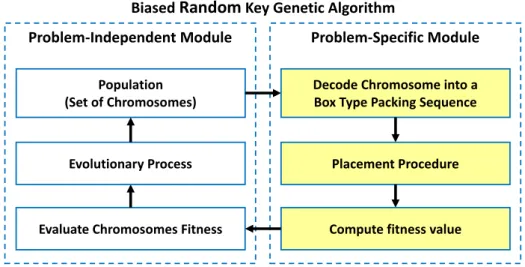
equilibrium conditions applied to rigid bodies and a physical packing sequence algorithm that, given a container loading arrangement, generates the actual sequence by which each box is placed inside the container, considering static stability and loading operations effi-ciency. Secondly, it proposes for the CLP, a multi-population biased random-key genetic algorithm that combines a genetic algorithm and a constructive heuristic algorithm. The constructive heuristic uses the proposed static stability approach to evaluate stability dur-ing the filldur-ing of the container and the proposed physical packdur-ing sequence algorithm to evaluate the feasibility of loading arrangements. Thirdly, to explore dynamic stability, a physics simulation tool is presented and its main physical parameters validated. The tool was developed to simulate the external forces to which the container is exposed during transportation. It is followed by the development of a set of dynamic stability evaluation metrics to be used within CLP algorithms.
Aside from a comprehensive introduction to CLP and cargo stability, the main contri-butions of this thesis are the proposed static stability approach, the CLP algorithm, the physics simulation tool and a set of dynamic stability metrics.
Resumo
O principal foco desta tese ´e a estabilidade de carga no ˆambito do problema de empa-cotamento em contentores (PEC). Nos ´ultimos anos, o sector dos transportes tem vindo a enfrentar desafios cada vez maiores. A press˜ao sobre as transportadoras para atingir elevados n´ıveis de performance, resultado de novos regulamentos ou dos n´ıveis de servi¸co exigidos pelos consumidores, continuar´a, a curto e a longo prazo, a aumentar.
Esta combina¸c˜ao entre cumprimento dos regulamentos e resposta aos desafios ao n´ıvel da qualidade de servi¸co, est´a intimamente relacionada com a evolu¸c˜ao do transporte de carga. A necessidade de maximizar o espa¸co ´util em diferentes meios de transporte, garantindo a integridade da carga, ´e uma das principais quest˜oes enfrentadas.
A investiga¸c˜ao realizada na ´area da optimiza¸c˜ao espacial de carga em cami˜oes ou con-tentores aumentou significativamente na ´ultima d´ecada. O problema, referido na literatura como o PEC, pertence a um conjunto de problemas de optimiza¸c˜ao combinat´oria: os Prob-lemas de Cortes e Empacotamentos.
Apesar de j´a terem sido propostas v´arias abordagens ao problema, nunca houve uma adop¸c˜ao generalizada por parte das empresas transportadoras, principalmente, porque a formula¸c˜ao base do problema n˜ao contempla os requisitos reais, ou seja, n˜ao tem em consid-era¸c˜ao um conjunto de restri¸c˜oes pr´aticas que influenciam a forma como a carga ´e disposta no interior de um contentor. Uma das restri¸c˜oes mais importantes ´e a estabilidade da carga, que na literatura, tem sido sempre estudada numa ´optica simplista, que n˜ao traduz a realidade.
O trabalho proposto pretende desenvolver novos algoritmos para o PEC, baseados em heur´ısticas e meta-heur´ısticas, contribuindo para aproximar a investiga¸c˜ao e a pr´atica na ind´ustria. Deu-se particular aten¸c˜ao `a estabilidade da carga, que ser´a estudada, modelada e integrada com a optimiza¸c˜ao do arranjo espacial da carga.
A primeira parte desta tese cont´em uma introdu¸c˜ao abrangente ao PEC e `a estabilidade da carga, incluindo tipologia do PEC, modelos abordados, m´etodos heur´ısticos e restri¸c˜oes pr´aticas. ´E apresentada uma an´alise extensiva da estabilidade da carga, no ˆambito do PEC.
A segunda parte desta tese reflecte a op¸c˜ao de abordagem `a estabilidade da carga, ou seja, que a estabilidade da carga dever´a ser analisada separando a estabilidade est´atica da estabilidade dinˆamica.
Em primeiro lugar, prop˜oe um algoritmo para avalia¸c˜ao da estabilidade est´atica, baseado nas condi¸c˜oes de equil´ıbrio est´atico de corpos r´ıgidos e um algoritmo de sequenciamento
do carregamento que, a partir da estrutura de carga de um contentor, gera a sequˆencia pela qual cada caixa dever´a ser colocado dentro do mesmo, tendo em conta a estabilidade est´atica e a eficiˆencia das opera¸c˜oes de carga.
Em segundo lugar prop˜oe um algoritmo gen´etico multi-popula¸c˜ao com chaves aleat´orias enviesadas para o PEC, que combina um algoritmo gen´etico com uma heur´ıstica constru-tiva. A heur´ıstica construtiva utiliza a abordagem da estabilidade est´atica para avaliar a estabilidade durante a carga do contentor, e o algoritmo de sequenciamento do carrega-mento proposto para validar a aplicabilidade das sequˆencias de carga.
Em terceiro lugar, ´e apresentada uma ferramenta de simula¸c˜ao de f´ısica, para explora¸c˜ao da estabilidade dinˆamica e s˜ao validados os seus principais parˆametros f´ısicos. A ferra-menta foi desenvolvida para simular as for¸cas externas a que o contentor ´e sujeito durante o transporte. Segue-se o desenvolvimento de um conjunto de m´etricas de avalia¸c˜ao da estabilidade dinˆamica, a utilizar no contexto dos algoritmos do PEC. Para al´em de uma introdu¸c˜ao exaustiva ao PEC e `a estabilidade da carga, as principais contribui¸c˜oes desta tese s˜ao a abordagem proposta `a estabilidade est´atica, o algoritmo do PEC, a ferramenta de simula¸c˜ao de f´ısica e um conjunto de m´etricas de avalia¸c˜ao da estabilidade dinˆamica.
Palavras-chave : problema de empacotamento em contentores, estabilidade, motor de f´ısica
Preface
This thesis has been submitted at the Department of Industrial Engineering and Manage-ment, Faculty of Engineering, University of Porto in partial fulfilment of the requirements for acquiring the degree of Doctor of Philosophy in Industrial Engineering and Manage-ment.
The PhD study has been partly supported by the ERDF via the COMPETE Pro-gram, by the Portuguese Government through the FCT (StableCargo - PTDC/SEN-TRA/121715/2010 and PTDC/EGE-GES/117692/2010) and by the Project BEST CASE - SAESCTN-PIIC&DT/1/2011, which is co-financed by the North Portugal Regional Op-erational Programme (ON.2 - O Novo Norte), under the National Strategic Reference Framework (NSRF), through the European Regional Development Fund (ERDF), from July 2012 to January 2015.
The work was supervised by Full Professor Jos´e Fernando da Costa Oliveira from the Department of Industrial Engineering and Management, Faculty of Engineering, University of Porto and co-supervised by Associate Professor Jos´e Fernando Gon¸calves, from the Faculty of Economics, University of Porto and Associate Professor Manuel Joaquim Pereira Lopes from the School of Engineering, Polytechnic of Porto.
The thesis deals with different aspects of optimisation within the container loading problem and consists of two parts. The first part serves as an general introduction to the container loading problem and to the specific topic of cargo stability explored during the PhD study. This part also contains an overview of the work conducted during the PhD study as well as an overall conclusion on the conducted study. The second part of the thesis contains a collection of four research papers written during the PhD study. These research papers are all co-authored. One of the four papers is in press and available on-line in a peer review journal and the other three are currently submitted to peer reviewed journals within the field.
Contents
Abstract . . . i
Resumo . . . iii
Preface . . . v
I
Cargo stability within the container loading problem
1
1 Introduction 3 1.1 Background and motivation . . . 41.2 Problem description. . . 7
1.3 Thesis structure . . . 9
2 State of the art 11 2.1 Types of Container Loading Problem . . . 11
2.2 Modelling approaches . . . 14
2.3 Heuristic algorithms . . . 14
2.3.1 Spatial representation . . . 18
2.3.2 Box arrangement strategy . . . 22
2.4 Benchmark instances . . . 24
2.5 Practical constraints . . . 25
2.5.1 Cargo Stability in the Container Loading Problem . . . 27
2.6 Current status and research focus . . . 37
3 Thesis Contribution 41 3.1 A new approach to static stability . . . 41
3.2 Incorporating the static stability algorithm within the CLP . . . 43
3.3 Developing a physics simulation evaluation tool for dynamic stability within the CLP . . . 44
3.4 Developing of dynamic stability metrics for the CLP. . . 45
4 Conclusion 47 4.1 Discussion . . . 47
4.2 Main contributions . . . 48
4.3 Future Work . . . 49 vii
II
Scientific Papers
51
5 A Physical Packing Sequence Algorithm for the Container Loading
Prob-lem with static mechanical equilibrium conditions 53
5.1 Introduction . . . 54
5.2 Literature review . . . 55
5.2.1 Static stability . . . 55
5.2.2 Physical packing sequence . . . 56
5.3 Static stability . . . 58
5.3.1 Static Stability Algorithm . . . 60
5.4 Loading/unloading operations efficiency. . . 68
5.4.1 The loading efficiency metrics . . . 70
5.5 The Physical Packing Sequence Problem . . . 71
5.5.1 The Physical Packing Sequence Algorithm . . . 72
5.6 Numerical experiments . . . 72
5.6.1 Test problem instances . . . 72
5.6.2 Computational results . . . 73
5.7 Concluding remarks. . . 74
6 A Container Loading Algorithm with Static Mechanical Equilibrium Sta-bility Constraints 77 6.1 Introduction . . . 78
6.2 Literature review . . . 79
6.2.1 Static stability . . . 82
6.3 The container loading algorithm with static stability . . . 84
6.3.1 Chromosome encoding and decoding . . . 85
6.3.2 The placement heuristic . . . 86
6.3.3 Solution fitness computation . . . 90
6.3.4 Static stability constraint . . . 90
6.4 Computational experiments . . . 94
6.4.1 Test problem instances . . . 95
6.4.2 Genetic algorithm parameters . . . 95
6.4.3 Static Stability Algorithm performance compared to other CLP al-gorithms . . . 96
6.4.4 Container Loading Algorithm with Static Stability performance for the different versions . . . 97
6.4.5 Performance of statically stable algorithms . . . 99
6.5 Conclusion . . . 99
7 Cargo dynamic stability in the container loading problem – A physics simulation tool approach 101 7.1 Introduction . . . 102
CONTENTS ix
7.3 StableCargo – physics simulation tool . . . 105
7.3.1 The StableCargo application and interface . . . 107
7.3.2 Input files . . . 110 7.3.3 Output files . . . 113 7.4 Benchmark tests . . . 115 7.4.1 Friction equations . . . 116 7.4.2 Sliding test . . . 117 7.4.3 Tipping Test . . . 118 7.4.4 Movement test . . . 118
7.5 Conclusions and future work . . . 120
8 Dynamic stability metrics for the container loading problem 123 8.1 Introduction . . . 124
8.2 Literature review . . . 126
8.3 New dynamic stability performance indicators for the CLP . . . 128
8.3.1 StableCargo physics simulation tool . . . 129
8.4 Multiple regression analysis . . . 132
8.4.1 Independent variables used to represent cargo arrangement features 132 8.4.2 Multiple regression models . . . 136
8.5 Computational experiments . . . 138
8.5.1 Test instances . . . 138
8.5.2 Evaluation Methodology . . . 139
8.5.3 Correlation between new performance indicators and literature dy-namic stability metrics . . . 139
8.5.4 Multiple regression results . . . 140
8.5.5 Illustrative example . . . 144
8.6 Conclusions and future work . . . 144
Bibliography 149
List of Tables
1.1 Guidelines and standards for cargo securing . . . 5
2.1 Cutting and Packing typologies . . . 13
2.2 Characteristics of the classes of problem instances of Bischoff et al. (1995) and Davies and Bischoff (1999) . . . 26
2.3 Practical constraints classification . . . 27
2.4 Box properties required for safety constraints. . . 28
2.5 Comparison of the best existing algorithms with static stability constraints 32 2.6 Reference acceleration values (in g) for different transport modes (IMO/ILO/UNECE, 2014) . . . 35
2.7 Performance comparison of the percentage of the container volume packed by boxes . . . 37
2.8 Performance comparison of the M1 metric . . . 38
2.9 Performance comparison of the M2 metric . . . 38
5.1 Computational experiments . . . 75
6.1 Comparison of the best existing algorithms using Full Support and Unsup-ported variants . . . 84
6.2 Genetic algorithm parameters used in all computational experiments . . . 95
6.3 Performance comparison of Unsupported variants . . . 96
6.4 Performance comparison of Full Support variants . . . 97
6.5 Average computational times (s) for test classes BR1 to BR15 . . . 97
6.6 Performance comparison of CLA-SS versions . . . 98
6.7 Number of times the CLA-SS versions provided better solutions . . . 99
6.8 Performance comparison of statically stable solutions . . . 100
7.1 Physics engines validated in the literature . . . 105
8.1 Algorithm performance for the M1 metric . . . 127
8.2 Algorithm performance for the M2 metric . . . 128
8.3 Correspondence between model variables, acceleration direction and N um∆z metrics . . . 136 8.4 Correspondence between model variables, acceleration direction and HDisp 136
8.5 The categorisation of Pearson’s r value given byEvans (1996) . . . 138
8.6 Average correlation between the new and literature dynamic stability metrics141 8.7 Average values of the geometric independent variables. . . 142
8.8 Multiple regression of the NFB . . . 143
8.9 Multiple regression of the NB DBC . . . 145
8.10 Values for the independent variables. . . 146
8.11 N um∆z and HDisp values for the cargo arrangement example . . . 146
8.12 NFB calculation example . . . 147
8.13 NB DBC calculation example . . . 148
A.1 Characteristics in publications on the container loading problem that ad-dress stability . . . 160
A.2 Constraints and filling strategies in publications on the container loading problem that address stability . . . 163
List of Figures
1.1 Large cargo claims - Type of damage (UK P&I Club, 2000) . . . 5
2.1 Input minimization problem types (W¨ascher et al., 2007) . . . 12
2.2 Output maximization problem types (W¨ascher et al., 2007) . . . 12
2.3 Illustration of a wall-building approach . . . 16
2.4 Illustration of a stack-building approach . . . 16
2.5 Illustration of a horizontal layer-building approach. . . 16
2.6 Illustration of a block-building approach. . . 17
2.7 Illustration of a guillotine-cutting approach . . . 17
2.8 Representation of three boxes in a container . . . 18
2.9 Example of corner points in 2D and 3D packings . . . 19
2.10 Example of extreme points in 2D and 3D packings . . . 20
2.11 Example of corner points and normal points in 2D and 3D packings . . . . 20
2.12 George and Robinson (1980) empty space subdivision . . . 21
2.13 Variants of the empty space subdivision. . . 21
2.14 Maximal-space representation . . . 22
2.15 Six different alternatives for positioning a box . . . 22
2.16 Three different alternatives to generate a column . . . 23
2.17 Six different alternatives to generate a layer . . . 24
2.18 Different alternatives to generate a block . . . 24
2.19 Number of publications that address the cargo stability constraint . . . 29
2.20 Unstable patterns examples with full base support . . . 30
2.21 Mack et al. (2004) center of gravity condition example . . . 31
2.22 Difference in percentage points between the results of the unsupported and static stability variants . . . 33
2.23 Forces acting on the cargo . . . 35
2.24 Types of cargo movements . . . 36
2.25 Flexible sliding and tipping . . . 36
5.1 Maximum reach parameter . . . 57
5.2 Untouchable box parameters . . . 58
5.3 Free body diagram of box B . . . 59
5.4 Example support polygon for condition 2 . . . 62 xiii
5.5 Example support polygon for condition 3 . . . 62 5.6 The four possible types of intersection (Adapted from Edelsbrunner and
Maurer (1981)) . . . 64
5.7 Gift Wrapping algorithm illustration . . . 65 5.8 Point-in-polygon determination . . . 67 5.9 Stacking methods of container loading . . . 69 5.10 Example of a cargo loading sequence . . . 70 5.11 arm’s-length metrics . . . 71
6.1 George and Robinson (1980) empty space subdivision . . . 81
6.2 Variants of the empty space subdivision. . . 81 6.3 Maximal-space representation . . . 82 6.4 Architecture of the base algorithm. . . 85 6.5 Strongly heterogeneous chromosome decoding procedure example . . . 86 6.6 Weakly heterogeneous chromosome decoding procedure example . . . 87 6.7 Distances between container corners and the maximal-space reference vertex 88 6.8 Two potential placements of a layer in a maximal-space . . . 88 6.9 Example of the six different feasible layer types for a box position . . . 89 6.10 Condition 2 support polygon example . . . 91 6.11 Condition 3 support polygon example . . . 92 6.12 Best-overhanging criterion illustration example . . . 94 6.13 Influence of the number of generations . . . 98 7.1 Unstable pattern example . . . 103 7.2 General Purpose Module design (Erleben,2002) . . . 104 7.3 StableCargo’s workflow . . . 107 7.4 Typical Damage Boundary Curve . . . 108 7.5 The StableCargo physics simulator . . . 109 7.6 Representation of a loaded Cargo Arrangement file . . . 109 7.7 Final cargo arrangement after stabilization . . . 111 7.8 Example of a Cargo Arrangement file . . . 113 7.9 Example of an Accelerations file . . . 113 7.10 Forces acting on a box . . . 117 7.11 Measured coefficient of static friction . . . 118 7.12 Measured coefficient of static friction for tipping . . . 119 7.13 Force applied to the box . . . 119 7.14 Displacement values for the box . . . 120 7.15 Velocity values for the box . . . 121 7.16 Acceleration values for the box . . . 121 8.1 Approach to determine dynamic stability metrics . . . 125 8.2 Typical damage boundary curve . . . 129 8.3 Representation of a loaded Cargo Arrangement file . . . 131
LIST OF FIGURES xv 8.4 Illustration of the four compacting directions . . . 133 8.5 Example of the compacting procedure. . . 134
Part I
Cargo stability within the container
loading problem
Chapter 1
Introduction
This thesis addresses cargo stability within the container loading problem (CLP). The CLP is a combinatorial optimization problem, which belongs to the wider combinatorial opti-mization class of Cutting and Packing problems (C&P). As frequently occurs in operations research problems, it has a multidisciplinary nature that encompasses other areas such as computer science and mechanical engineering.
The CLP as it has been addressed in the field of operations research has found limited applicability in practice, mainly due to a limited or inefficient approach to the problem when taking into account a number of practical constraints, such as the container weight limit, weight distribution or cargo stability.
It is this framework that is in the genesis of the research program, and the project from which it was designed, “StableCargo - Cargo stability analysis in container transportation: a hybrid optimization - heuristics framework” funded by the Funda¸c˜ao para a Ciˆencia e Tecnologia and contracted by INESC TEC. The aim of the project was to address the CLP, a real world driven combinatorial optimization problem with particular focus given to cargo stability.
The expected outcomes of the StableCargo project were:
• New stability measures that take into account both loading stability and transporta-tion stability;
• Implementation of a software model to access cargo plans stability measures;
• Improved container loading algorithms, that incorporate stability goals in the solution build and search processes;
• A simulation tool, based on a physics dynamics model, which will allow the simulation of cargo transportation and constitute a workbench for new stability measures and criteria development.
To achieve the project goals, the research program followed a hierarchical approach by tackling first the challenges related with the CLP loading stability and then moving to the CLP transportation stability.
The work presented in this thesis is divided into two parts. The first part (which includes this introduction), describes the CLP and reviews the literature on CLP with particular focus on the stability constraint. The second part of the thesis contains four scientific papers that reflect the research done throughout the course of this study.
This chapter introduces the background and motivation for the research project, details its aims and objectives and provides an overview of each chapter of the thesis.
1.1
Background and motivation
Cargo transportation has played an important role throughout the history of mankind. Either by the proximity to the sea or by the control of land routes, the connection to the exterior as a way to expand and create wealth, was at the genesis of the great civilizations of history. It is not by chance that most of those civilizations of ancient times, developed around the Mediterranean Sea and the large rivers that pay tribute, taking the advantages offered by river and maritime transportation.
This link between transports and the development of mankind has been present through-out history until the modern day. The effect of globalization led to a world where products and services are exchanged in increasing numbers and distances by and to an increasing number of origins and destinations.
The role that cargo transportation plays as the basis of worldwide trade, places enor-mous challenges to transport managers to continuously research for ways to increase the rational use of transportation. Cost, security, speed, efficiency or consistency in transport are permanently under scrutiny.
Cargo transportation management has the goal of transporting the correct product, in the correct quantity, to the correct location at the lowest cost, in the correct instant and the desired quality. It covers a broad spectrum of fields that go beyond the transport mode selection. It includes issues like route definition, cargo packaging and conditioning, handling, insurance, etc.
Packaging takes an important role in the support of the logistical process. It has an impact on the majority of logistics activities since the size and density of packaging are directly linked with transport and warehousing cost (Ballou, 1999).
The purpose of packaging goods for transportation is to protect them from possible damage, allow for proper handling, and obtain an efficient space usage inside the transport unit while permitting the stability of the transport vehicle (Hellstr¨om and Saghir,2007).
Throughout the several levels of packaging, the unitization of the product is obtained, contributing to a more efficient and safe handling and transportation of the product.
One of the major innovations within the field of transport management in the last 100 years was the container. The shipping container was invented and patented in 1956 and has revolutionized the transport of goods and cargo worldwide and has made container-ization the standard method of transporting break bulk cargo. Containercontainer-ization of cargo contributes to the speedy loading and unloading of cargo as well as providing additional protection for the cargo from theft, breakage, and contamination. From a logistics
per-1.1 Background and motivation 5 spective it conducted to a “unitarization” of loads, that is, loads with the same dimensions that permitted multimodal transportation (Levinson, 2008).
It was expected that through containerization, the cargo damage would be limited. The reality showed that putting cargo in a metal box does not guarantee that it will arrive in good condition. Figure 1.1 sets out the most frequent types of container cargo damage that give rise to major insurance claims, measured against all cargo damage. According to the financial insurer UK P&I Club, 20% of all container cargo related claims can be traced back to bad stowage (UK P&I Club, 2000).
0 5 10 15 20 25 30 (%) Numer o f cl ai ms
Containerised cargo All cargo
Figure 1.1: Large cargo claims - Type of damage (UK P&I Club, 2000)
For safety reasons, it is of the utmost importance that when cargo is placed on the transport vehicle, it is done in a way that it can neither endanger persons nor goods and cannot slide or fall off the vehicle. Particularly on road transport, safety during cargo transportation is a major concern. According to the European Union, cargo-securement failure contributes to up to 25% of accidents involving trucks (EC,2012). Important efforts were directed towards developing guidelines and standards for cargo securing. Table 1.1 presents the main guidelines and standards.
Table 1.1: Guidelines and standards for cargo securing
Document References
IMO/ILO/UN ECE Guidelines for Packing of Cargo Transport Units (IMO/ILO/UNECE,2014)
European Best Practice Guidelines on Cargo Securing for Road Transport EC(2010)
Container Handbook GDV(2003)
Cargo safety is not the only challenge in transportation management. The European Commission considers that an efficient transport system is a condition for maintaining prosperity in the EU, and the present scenario of oil dependency, growing congestion and looming climate change, requires a new strategy for the European transportation systems. The strategy established aims to achieve a 60% reduction of the CO2 emissions and of oil dependency by 2050, without limiting the freedom of movement. A strong focus is placed in the optimising the performance of multimodal logistic chains, and on increasing the efficiency of transport with information systems (EC, 2011).
It is thus expected that in the next decades, freight transportation costs will rise, and the need for increased efficiency and security in the transportation sector will drive companies to adopt cargo planning tools that can be effectively used in practice. It is not thus surprising the amount of research that has been carried out in the operations research field, that focus on the optimization of the spatial arrangement of cargo inside transportation vehicles or containers, maximizing the space usage of cargo transport units (CTU).
This problem is known in the literature as the CLP, which belongs to the more generic combinatorial optimization class of Cutting and Packing problems. In the CLP, a set of rectangular shaped boxes (small items) must be packed orthogonally in a set of containers (three dimensional, rectangular large objects), in a way that the boxes do not overlap and all the boxes of the subset lie entirely within the container, as to maximize the space usage
(W¨ascher et al., 2007).
The majority of CLP approaches, found in the literature, are of limited applicability in practical situations. The existence of a series of real world constraints that have a strong influence on the loading arrangement of a container, that are not properly addressed, contributes to that limitation (Bischoff et al., 1995; Bortfeldt and Gehring, 2001). The main constraints encountered in practice are (Bischoff et al.,1995;Bortfeldt and W¨ascher,
2013):
• Cargo stability - refers to the necessity of guaranteeing the integrity of the cargo, as well as safety conditions on loading, unloading and transport operations;
• Complexity of loading arrangements - refers to the effort required to handle materials in order to fulfil loading patterns;
• Complete shipment of certain groups of items - addresses the need for cargo grouping as a result of product functional or administrative reasons;
• Grouping of items - refers to the impact of grouping cargo as a way to improve loading and unloading operation efficiency;
• Positioning of items within a container - refers to the impact that the interrelation-ships between the properties of products during transport can have on the cargo location and to the direct impact that the weight or size of an item can have on the positioning of the item in a container. This impact can also be due to the handling and loading equipment required;
1.2 Problem description 7 • Shipment priorities - refers to the priority shipping rating of an item, as a result, for
example, of delivery deadlines;
• Orientation - refers to the orientation instruction for box positioning. It can be the result of, for example, the ”this side up” instruction on a box or the pallet loading orientation;
• Load bearing strength of items - refers to the amount of weight a box can support per unit area. The instruction on a box ”Stack no more than x items high” illustrates this constraint;
• Container weight limit - refers to the maximum weight that can be loaded inside a container. For high mass density products, the main constraint is the container weight limit, not the container volume;
• Weight distribution within the container - refers to the the distribution of the weight of the cargo along and across the container. It affects the handling and transporta-tion.
The stability constraint previously referred has already been studied in the literature. Previous works that address the cargo stability constraint uses the term ”stability” in a rather simplified way and sometimes as if the term was self-explanatory. Different concepts, as stability during loading operations and stability during transportation are not addressed separately and are dealt with as no different. Usually, stability is achieved by guaranteeing that each box has a full base support or almost full base support. This approach penalizes the space usage of the container as the existing cargo stability measures only partially grasp the stability problem essence, failing to assess the way in which real loading stability and transportation stability are achieved (Bischoff et al., 1995).
The present research aims to refine the concept of cargo stability and develop an eval-uation of cargo stability under a realistic framework. It is considered that cargo stability has been addressed in the past under over simplified assumptions, and that cargo sta-bility must be studied separating static from dynamic stasta-bility. This goal is pursued by developing stability metrics that can be applied to solutions generated by existing CLP algorithms, or used within algorithms, and to develop an efficient algorithm for the CLP that incorporates the new stability approach.
1.2
Problem description
The container loading problem can be stated as follows:
A given set of n types of small items of parallelepiped shape, designated as boxes, B = (b1, b2, ..., bn) where for each box type i = (1, ..., n) the following set of characteristics is defined:
• width (wi); • height (hi); • quantity (qi);
• all boxes have the same density; • all boxes are perfectly rigid;
• the centre of gravity of each box is assumed to be at its geometric centre; • all boxes have the same friction coefficient,
are to be loaded in a large object of parallelepiped shape, designated as container C with the following characteristics:
• length (D); • width (W ); • height (H);
• the length, width and height lie parallel to the x, y and z-axis of the first octant of a Cartesian coordinates system, with the back-bottom-left corner lying in the coordinates system origin;
• the container provides lateral support; • with rigid walls;
with the objective of achieving a maximum utilization of the volume of the container, while meeting the following loading constrains:
• orthogonal loading of each box - each face of the box must be parallel to the faces of the container;
• no overlapping between the boxes;
• all the boxes lie entirely within the container;
• the packing of the boxes into the container is constrained by the physical packing sequence, that is, from back to front;
• all the walls of the container are solid, and the practical constraint:
1.3 Thesis structure 9 • stability constraint - the ability of each box to maintain the loading position without
significant change. Stability must be considered during:
– the cargo loading operation (usually addressed in the literature as vertical or static stability) and;
– the transport operation (usually addressed in the literature as horizontal or dynamic stability).
The placement of a box bij , that is, the jth box of type i, in a loading space is given by its minimum and maximum coordinates, (x1ij, y1ij, z1ij) and (x2ij, y2ij, z2ij), respectively. Even though these assumptions reduce the complexity of the problem, it remains ex-tremely hard to solve.
In the typology proposed by W¨ascher et al. (2007) for Cutting and Packing problems, the problem addressed in this work can be classified as the 3D Single Knapsack Problem (SKP) or the 3D Single Large Object Placement Problem (SLOPP), depending on the level of heterogeneity of the cargo, with additional stability constrains.
1.3
Thesis structure
This thesis is structured in two separate parts. The first part contains an introduction to the CLP and the specific topics explored in this PhD study. Aside from this introductory chapter, Part I consists of three separate chapters:
• Chapter2describes the main characteristics of the CLP, reviews the literature on the CLP with the stability constraint and discusses in further detail the most commonly used and interesting solution methods for this problem.
• Chapter3lists the main contributions of the work conducted during this PhD study. This includes a detailed overview of the work contained in the research papers that constitutes Part II of this thesis.
• Finally, Chapter 4 expounds the conclusion on the work of this thesis. It also high-lights the contributions from this thesis and reflects on possible directions for future research within the CLP.
The second part of this thesis contains the four research papers written during the PhD study that constitute the major scientific contributions of this thesis:
• Chapter 5addresses the stability of the cargo during container loading and proposes two algorithms. The first is a Static Stability Algorithm based on static mechanical equilibrium conditions that can be used as a stability evaluation function embedded in CLP algorithms (e.g. constructive heuristics, metaheuristics). The second proposed algorithm is a Physical Packing Sequence Algorithm that, given a container loading arrangement, generates the actual sequence by which each box is placed inside the container, considering static stability and loading operations efficiency constraints.
• Chapter 6explores the use of the static stability constraint based on the static me-chanical equilibrium conditions applied to rigid bodies which derive from Newton’s laws of motion embedded in a constructive heuristic placement procedure, used as part of a multi-population biased random-key genetic algorithm. The new hybrid genetic algorithm is extensively tested on well-known benchmark instances using three variants: no stability constraint, the classical full base support constraint and with the new static mechanical equilibrium stability constraint—a comparison is then made with the state-of-the-art algorithms for the CLP. The results show that with the new static stability criterion, a higher percentage of space utilization is obtained on average, than with the classical full base support condition. Moreover, for highly het-erogeneous cargo the new hybrid genetic algorithm with full base support constraint outperforms the other literature approaches.
• Chapter 7 proposes a physics simulation tool to be used for evaluation of dynamic stability of CLP solutions within a realistic framework. The proposed physics simu-lation tool is based on a physics engine and a library for computer graphics based on OpenGL. The results of the physics simulation tool are compared with the state-of-the-art simulation engineering software Abaqus Unified FEA, having allowed us to conclude that our tool is a promising alternative for dynamic stability evaluation. • Chapter8addresses dynamic stability within the CLP. It starts by proposing two new
performance indicators to evaluate the dynamic stability of cargo arrangements, the number of fallen boxes (NFB) and the number of boxes within the Damage Boundary Curve damage area (NB DBC). Using 1500 solutions generated by a CLP algorithm for well known literature problem instances, the performance indicators are measured using the physics simulation tool, StableCargo, presented on Chapter 7. Then, the existing literature metrics for dynamic stability, that is, the mean number of boxes by which items other than those on the floor are supported (M1) and the percentage of boxes with insufficient lateral support (M2), and the percentage of volume occupied in the container, are evaluated by measuring the correlation between the metrics and performance indicators results. Since the calculation of the NFB and the NB DBC performance indicators using StableCargo is computationally expensive, two new dynamic stability metrics are proposed, so that they can be integrated within a con-tainer loading algorithm. The metrics are models of the proposed dynamic stability performance indicators, derived using multiple linear regression analysis. The results show that the proposed metrics are a better surrogate measure for dynamic stability measurement for the CLP.
At the time of writing, four of the research papers have been submitted to international journals, one is in press and available on-line and three are in the peer revision process.
The layout of the papers follows the style of the remainder of the thesis, nevertheless, the content of each paper is exactly the same as the content submitted to the journals.
Chapter 2
State of the art
The purpose of this chapter is to present the current understanding and conceptualization of the cargo stability constraint within the context of the CLP, which influences the direction that the research will take and the areas of the literature that the dissertation will focus on. It starts by focusing on the positioning of the CLP within the Cutting and Packing problems, the different solution approaches to the problem and the main constraints found in the scientific literature. It will then focus on the different approaches to the stability constraint and how it is addressed in the literature.
2.1
Types of Container Loading Problem
The Container Loading Problem is a combinatorial optimization problem, which belongs to the wider combinatorial optimization class of the Cutting and Packing problems. The essential form of the Cutting and Packing problems can be summarised as follows: given a set of large objects and a set of small items (both defined in a number of geometric dimensions), the small items must be assigned to the large objects and a dimensional objective function is optimised satisfying two geometric conditions, all small items lie entirely within the large objects and the small items do not overlap (W¨ascher et al.,2007). A preliminary analysis of the literature on Cutting and Packing problems led to the conclusion that it has received a lot of attention, and that the problems it addresses are referred to by many names in literature. This is due to the large spectrum of industrial applications that these problems address and to the different fields in which they are inserted. The multitude of Cutting and Packing problems names, which several times refer to the same type of problem, posed difficulties in investigating the underlying structure within Cutting and Packing problems and in facilitating the cross-fertilisation of research within the academic community.
In order to classify the Cutting and Packing problems, Dyckhoff (1990) proposed a typology that could describe the type of Cutting and Packing problems based on four characteristics. However, the typology proposed by Dyckhoff (1990) has not been widely accepted. W¨ascher et al.(2007) identified several limitations of theDyckhoff(1990)
ogy and presented an improved typology, which modified the Dyckhoff (1990) criteria for the definition of problem types. The criteria used by the two typologies are presented in Table 2.1.
The combination of the different criteria from theW¨ascher et al.(2007) typology, allows to distinguish different problem types. Figures2.1 and2.2 present the problem types with input minimization objective and output maximization objective, respectively.
assortment of small items characteristics of large objects weakly heterogeneous strongly heterogeneous all dimensions fixed identical Single Stock-Size Cutting Stock Problem
(SSSCSP)
Single Bin-Size Bin Packing Problem
(SBSBPP)
weakly heterogeneous
Multiple Stock-Size Cutting Stock Problem
(MSSCSP)
Multiple Bin-Size Bin Packing Problem
(MBSBPP)
strongly heterogeneous
Residual Cutting Stock Problem
(RCSP)
Residual Bin Packing Problem
(RBPP)
one large object variable dimensions(s)
Open Dimension Problem (ODP) (ODP/W) (ODP/S)
Figure 2.1: Input minimization problem types (W¨ascher et al., 2007)
assortment of small items characteristics
of large objects identical
weakly heterogeneous strongly heterogeneous all dimensions fixed one large object Identical Item Packing Problem (IPP)
Single Large Object Placement Problem (SLOPP) Single Knapsack Problem (SKP) identical
Multiple Identical Large Object Placement Problem (MILOPP) Multiple Identical Knapsack Problem (MIKP) heterogeneous Multiple Heterogeneous Large Object Placement Problem (MHLOPP) Multiple Heterogeneous Knapsack Problem (MHKP)
Figure 2.2: Output maximization problem types (W¨ascher et al., 2007)
The general definition of the CLP can be stated as a three dimensional (3D) Cutting and Packing Problem where a set of parallelepiped shaped boxes (regular small items) must be packed orthogonally in a set of parallelepiped shaped containers (regular large objects), in a way that the boxes do not overlap and all the boxes of the subset lie entirely
2.1 Types of Container Loading Problem 13 T able 2.1: Cutting and P ac king typ ologies Dyc khoff ( 1990 ) typ ology W ¨asc her et al. ( 2007 ) typ ology Dimensionalit y • one dimensional • tw o dimensional • three dimensional • N dimensional wit h N > 3 • one dimensional • tw o dimensional • three dimensional Kind of assignmen t • all ob jects and a selection of items • a selection of ob jects and all items • output v alue maximization • input v alue minimization Assortmen t of large ob jects • one ob ject • iden tical figure • differen t figures • one large ob ject – all dimensions fixed – one or more v aria ble dimensions – sev eral large ob jects • iden tical large ob jects – w eakly heterogeneous assortmen t – strongly heterogeneous assortmen t Assortmen t of small ob jects • few items (of differen t figures) • man y items of man y differen t figures • man y items of rela tiv ely few differen t (non-congruen t) figures • congruen t figures • iden tical small items • w eakly heterogeneous assortmen t • strongly heterogeneous assortmen t Shap e of small items (for tw o and th ree dimensional problems) • regular small ite ms • irregular small items
within the container. As an assignment problem it can have two basic objectives, the output value maximization (knapsack problem) and the input value minimization (bin packing problem). The first one refers to problems where the number of containers is not sufficient to accommodate all the boxes. The latter refers to problems where the number of containers is sufficient to accommodate all the boxes (W¨ascher et al., 2007).
This thesis addresses two types of problems with an output value maximization objec-tive, with one large object with fixed dimensions and regular shaped small items. These problems can be classified either as three-dimensional, rectangular single large object place-ment problems (3D-SLOPP) or as three-dimensional, rectangular single knapsack problems (3D-SKP), depending on the cargo heterogeneity. This class of problems is the focus of the thesis and the remaining literature review will mainly focus on these problems.
2.2
Modelling approaches
The CLP is considered an extremely difficult problem. That is probably the main reason why in the literature, only a small number of models and exact methods were proposed. The proposed models for the SKP and SLOPP problems are mainly mixed integer linear (MIP) models. One of the first models was proposed by Fekete and Schepers(1997). They presented a general framework for the exact solution of the multi-dimensional knapsack packing problems using an approach based on graph-theoretical characterization of feasi-ble packings. Fasano (1999) proposed an MIP model, based on the one that Chen et al.
(1995) proposed for the CLP problem types with an input minimization objective, where variables are based on a Cartesian coordinate system. As additional constraints Fasano
(1999) includes the static balancing constraint, that is, the weight distribution constraint defined by Bortfeldt et al. (2003). Padberg (2000) later extended the model of Fasano
(1999) to achieve a minimal formulation of the problem. Allen et al.(2012) extended the Fasano/Padberg model by adding further constraints, but concluded that even though it achieved a time reduction, the formulation was still of limited applicability to solve in-stances with more than 20 boxes. Considering the results obtained, Allen et al. (2012) proposed an alternative formulation that uses space-indexed binary variables, that place the boxes in a discrete container where its units of space are given by the largest common denominator of the respective dimensions of the boxes. This approach presented better per-formance than the one of Padberg(2000). Junqueira et al. (2012b) also proposed an MIP model with variables based on a Cartesian coordinate system that included constraints for the vertical and horizontal stability of the cargo, and for its load bearing strength. An ex-tension to this model that includes a multidrop constraint was proposed byJunqueira et al.
(2012a), and an integration with the Vehicle Routing Problem formulation was proposed
by Junqueira et al. (2013). All of these proposals are only suitable to solve small-sized
2.3 Heuristic algorithms 15
2.3
Heuristic algorithms
The usual approach to the CLP is based on heuristics, that allow achieving a near-optimum solution within an acceptable amount of time. Even though exact methods have had a considerable development, good solutions for real-world problem sized instances can only be obtained in a reasonable amount of time by heuristic algorithms. Fanslau and Bortfeldt
(2010) proposed a categorization of heuristic methods. They were categorized according to the method type, as conventional heuristics, metaheuristics and tree-search methods.
Conventional heuristics include construction heuristics and improvement heuristics. Construction heuristics derive a single feasible solution that is directly returned or used as a starting point for local search heuristics. They do not attempt to improve the ob-tained solution. Improvement heuristics try to iteratively improve already known solutions
(Rothlauf, 2011). Examples include the construction heuristics developed by George and
Robinson(1980),Bischoff et al. (1995) andLim et al.(2003) and the improvement
heuris-tic of Egeblad et al. (2010). Metaheuristics can be seen as general-purpose methods that aim to effectively and efficiently explore a search space using intensification (exploitation) and diversification (exploration) strategies. According to the philosophy followed, meta-heuristics can be seen as extended variants of improvement meta-heuristics that aim to escape from a local optimum solution and continue with the exploration of the search space with the expectation of finding a better solution, or as a population-based approach where the search space is explored in each iteration by a population (Blum and Roli, 2003). Exam-ples of such approaches can be found in the Genetic Algorithms of Bortfeldt and Gehring
(2001) and Gon¸calves and Resende (2012), in the use of Tabu Search by Bortfeldt et al.
(2003) and Liu et al. (2011a) and the greedy randomized adaptative search procedures (GRASP) of Moura and Oliveira (2005) andParre˜no et al. (2008). The Tree-search meth-ods include tree-search and graph-search methmeth-ods. These are methmeth-ods that can be used when the set of all feasible solutions of the optimization problem can be represented by a tree or a graph. Examples include the works of Fanslau and Bortfeldt (2010), Zhu and Lim (2012) and Araya and Riff (2014). Metaheuristics and Tree-search methods search over a representation or codification of the solution (usually box sequences) and therefore require a constructive heuristic for box loading in order to generate a feasible solution to the problem.
The vast number of packing heuristics found in literature use different approaches and methodologies which influences the structure of generated packing plans. In order to differentiate the approaches Pisinger (2002) suggests a classification based on four load-ing patterns of the container: wall-buildload-ing, stack-buildload-ing, guillotine-cuttload-ing and cuboid-arrangement. Fanslau and Bortfeldt(2010) later extended this classification by dividing the loading patterns as wall-building, stack-building, horizontal layer-building, block-building, and guillotine-cutting.
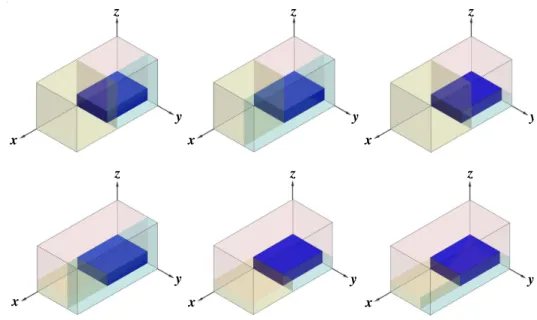
The wall-building approach fills the container with vertical layers (”walls”) transversal to the depth of the container. Figure2.3presents an example of the wall-building approach. The stack-building approach fills the container with stacks. Each box is packed in suitable stacks which are then arranged on the floor of the container by solving a
two-Figure 2.3: Illustration of a wall-building approach
dimensional packing problem. The stacks do not form walls as defined before. In Figure2.4 an example of the stack-building approach is presented.
Figure 2.4: Illustration of a stack-building approach
The horizontal layer-building approach fills the container using horizontal layers from the bottom to the top of the container. It is similar to the wall-building approach and is based on the pallet loading problem layer approach. An example is presented in Figure2.5. The block-building approach fills the container with cuboid blocks. Cuboid blocks are arrangements of similar boxes with the same spatial orientation. An illustration of the block-building approach is presented in Figure 2.6.
The guillotine-cutting approach is based on a slicing tree representation of a packing plan. Each slicing tree corresponds to a successive segmentation of the container into smaller pieces by means of guillotine cuts, where the leaves correspond to the boxes to be packed. A guillotine-cutting approach example is presented in Figure2.7.
Even though the proposed classification of the packing heuristics approaches ofPisinger
2.3 Heuristic algorithms 17
Figure 2.5: Illustration of a horizontal layer-building approach
x
y z
Phase I Phase II
Figure 2.6: Illustration of a block-building approach
do not actually translate the fundamental structural decisions of the authors in those approaches.
Usually, the constructive heuristic iteratively selects a location inside the container and a box (or set of boxes) to place at that location, until no more locations or boxes are available. Both these decisions are related to the way the empty space of the container is managed (and therefore the way in which all potential placement locations are evaluated) and the way box arrangements are generated. The constructive heuristics result from the combination of the selected spatial representation and box arrangement strategy and a set of rules that select location and box arrangement at each iteration. Considering these elements we present the most commonly used spatial representation of the container and the box arrangement strategies.
2.3.1
Spatial representation
The spatial representation method used to manage the space inside the container is an element of relevance and distinction, in the different approaches to the CLP, and influences the identification of potential placement locations of boxes.
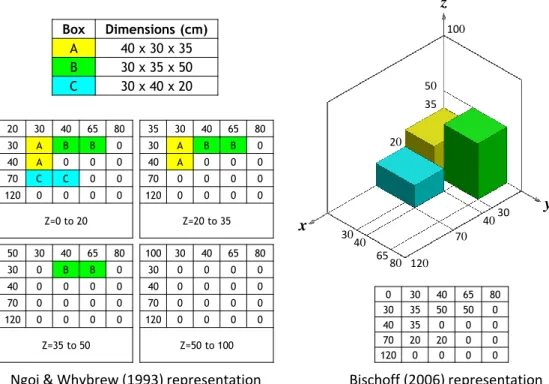
Ngoi and Whybrew (1993) use a single three-dimensional matrix representation of
objects and empty spaces as a combination of variable orthorhombic cells. Each three-dimensional matrix is composed by a chain of two-three-dimensional matrices that represent the details of horizontal layers of constant thickness. In each layer of the matrix the first row contains the y coordinates of the vertices of the boxes (excluding the first position), the first column contains the x coordinates (excluding the first position) and the row one, column one cell contains the z coordinate of the layer. The remaining matrix cells con-tain the identification number of a packed box or the value 0 (zero) if the space is empty.
Bischoff (2006) proposed an adaptation of the Ngoi and Whybrew (1993) representation,
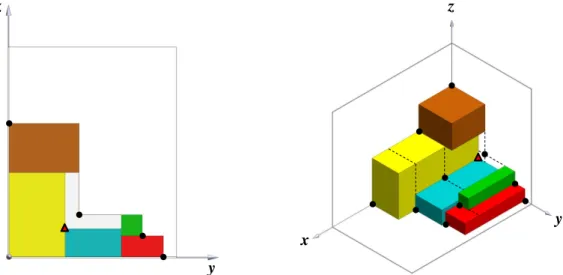
that does not involve the creation of the horizontal layer matrices. Instead a single two dimensional matrix that represents a view from the top of the container is required. The first row and first column of the matrix have the same meaning as in the Ngoi and Why-brew (1993) method, but the contents of the remaining cells correspond to the height of potential loading surfaces. An example of a three box representation is shown in Figure2.8. The concept of envelopes is also used for space management in the CLP, and is appro-priate for methods that place one box at a time. The purpose of the envelope is to divide the container volume into two sub-volumes, an inaccessible and an accessible one, and to determine a set of corner points that define the positions where a new box can be placed. The corner points are the points of the envelope were its slope changes from vertical to horizontal. The envelope and corner points are updated each time a box is placed in the container. This approach, illustrated in Figure2.9 was firstly used in the CLP byMartello
et al. (2000).
Even though this method is efficient and accurate, it may result in direct loss of space, because it can encapsulate volume in the inaccessible region that cannot be used later on. To solve this problem,Crainic et al. (2008), developed the concept of extreme points, that is, a series of potential insertion points generated each time a box is placed, that include the
2.3 Heuristic algorithms 19 x y z 30 40 70 120 30 40 80 100 35 50 20 65
Ngoi & Whybrew (1993) representation Bischoff (2006) representation
Box Dimensions (cm) A 40 x 30 x 35 B 30 x 35 x 50 C 30 x 40 x 20 20 30 40 65 80 30 A B B 0 40 A 0 0 0 70 C C 0 0 120 0 0 0 0 Z=0 to 20 35 30 40 65 80 30 A B B 0 40 A 0 0 0 70 0 0 0 0 120 0 0 0 0 Z=20 to 35 50 30 40 65 80 30 0 B B 0 40 0 0 0 0 70 0 0 0 0 120 0 0 0 0 Z=35 to 50 100 30 40 65 80 30 0 0 0 0 40 0 0 0 0 70 0 0 0 0 120 0 0 0 0 Z=50 to 100 0 30 40 65 80 30 35 50 50 0 40 35 0 0 0 70 20 20 0 0 120 0 0 0 0
Figure 2.8: Representation of three boxes in a container
x
y z
y z
corner points of Martello et al. (2000) and insertion points for the otherwise inaccessible region (see Figure 2.10).
x
y z
y z
Figure 2.10: Example of extreme points in 2D and 3D packings
Tao and Wang (2013) had a similar approach to Crainic et al. (2008) to overcome
potential loss of volume, but they distinguished between corner points and normal points. In Figure 2.11 the approach is illustrated.
x
y z
y z
Figure 2.11: Example of corner points and normal points in 2D and 3D packings Another approach to space management was proposed byGeorge and Robinson(1980). Their methodology is based on the assumption that after the placement of a box in a packing space, the remaining unused space gives origin to three new spaces. The three spaces, illustrated in Figure2.12, are created in the following order: spare depthwise space,
2.3 Heuristic algorithms 21 spare widthwise space and spare heightwise space. Each space is therefore represented by its length, height and width and the coordinates of its rear left bottom vertex.
Spare depthwise space Spare widthwise space Spare heightwise space x y z
Figure 2.12: George and Robinson (1980) empty space subdivision
This approach only considers one way of partitioning the empty space. Other authors,
likeBortfeldt et al.(2003) andFanslau and Bortfeldt(2010) later extended theGeorge and
Robinson (1980) approach and considered other subdivision variants of the empty space,
as illustrated in Figure 2.13. In these approaches empty spaces are represented as a set of disjoint spaces.
For the two and three-dimensional cutting stock problem,Lai and Chan(1997) proposed a representation of empty spaces as a set of non-disjoint empty spaces. These empty spaces have the largest parallelepiped shape that can be considered and are managed using the ”Interval Generation” procedure. However, this procedure was not applied to the three-dimensional CLP. Later Parre˜no et al. (2008) used this representation in the CLP and designated the non-disjoint empty spaces as maximal-spaces. The maximal-spaces representation is illustrated in Figure 2.14. A maximal-space s representation is given by its minimum and maximum coordinates, (x1s, y1s, z1s) and (x2s, y2s, z2s), respectively, and an Insertion Vertex V , (i.e., the vertex of the maximal-space where the boxes will be packed).
2.3.2
Box arrangement strategy
A box can be placed inside the container in at most 6 different orientations (Figure 2.15, depending on its orientation constraints. The strategy followed when placing boxes inside the container is also a key element to differentiate the approaches proposed in the literature. We can separate between single box or multiple box strategies: in each iteration of the former, only one box is placed inside the container; in each iteration of the latter a set of boxes are placed together.
x y z x y z x y z x y z x y z x y z
Figure 2.13: Variants of the empty space subdivision
x y z x y z x y z
Figure 2.14: Maximal-space representation
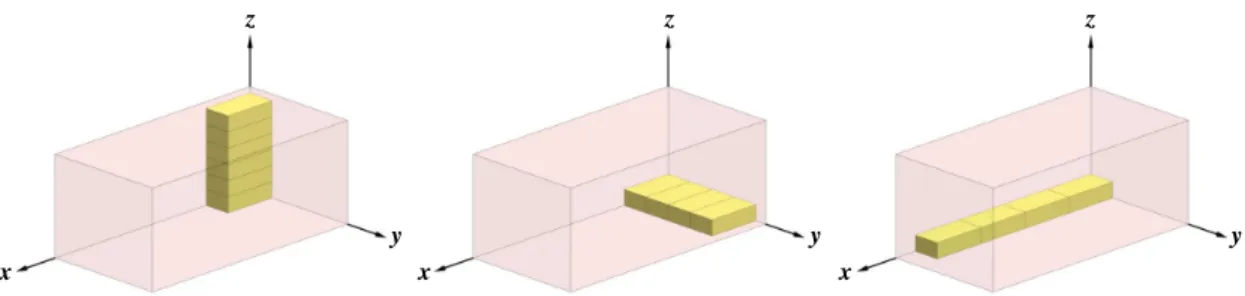
2.3 Heuristic algorithms 23 In a multiple box strategy the arrangements can be formed from sets of identical or non-identical boxes. Multiple boxes can also be arranged by dimensionality, that is, one, two and three dimensions. In the one dimensional arrangement, boxes are grouped along a single axis, and therefore generate a column. Usually the dimension of the column is determined by the empty space available, and only identical boxes with the same orienta-tion are considered. Figure 2.16 illustrates, for a defined orientation of a box, the three alternatives for generating a column of identical boxes. Examples can be found inParre˜no
et al. (2008). x y z x y z x y z
Figure 2.16: Three different alternatives to generate a column
In a two dimensional arrangement, boxes are grouped in a plane, that is, along two axes, generating layers. In this case, the layer is built first by generating a column along one of the axis of the plane, and then replicating the column along the other axis of the layer. It is the available space and the first axis selected for layer building that most frequently determines the layer configuration. The two dimensional arrangement is usually determined for identical boxes with the same orientation (Figure 2.17). Examples can be found in Parre˜no et al. (2008) and Gon¸calves and Resende (2012). Both one and two dimensional approaches have as main purpose to build faster algorithms while taking advantage of the box identical dimensions for better space usage.
In the three dimensional arrangement, boxes are grouped along the three axes, gener-ating blocks. A high number of approaches fall into this category. Whether designated as stacks, walls, or blocks, these approaches have the main purpose of diminishing the complexity of the problem through the grouping of boxes. In the existing approaches two types of blocks can be found, simple and general blocks (Fanslau and Bortfeldt, 2010). In simple blocks all the boxes are identical and have the same orientation. In general blocks there can be several types of boxes and different orientations of identical boxes. Figure2.18 illustrates the two types of blocks. Examples can be found inFanslau and Bortfeldt(2010),
Zhu and Lim (2012) and Araya and Riff (2014).
The most effective CLP algorithm in the literature to date that uses a two dimensional arrangement strategy is the multi-population biased random-key genetic algorithm devel-oped byGon¸calves and Resende(2012), while the most effective CLP algorithm that uses a three dimensional arrangement strategy is the Beam Search Approach developed byAraya
x y z x y z x y z x y z x y z x y z
Figure 2.17: Six different alternatives to generate a layer
(a) Simple block (b) General block
Figure 2.18: Different alternatives to generate a block
2.4
Benchmark instances
The purpose of benchmark instances is to compare the performance of different algorithms in order to identify state-of-the-art approaches. There are only a few sets of instances for the CLP, and from these, only a few consider an additional constraint, which is the orientation constraint. For problem types with input minimization objective there are four main data sets:
• The Ivancic et al. (1989) data set contains 47 instances and is used in the SSSCSP problem;
• The Martello et al. (2000) data set contains 320 instances that include orientation constraint. It is for the SBSBPP problem;
• The Mack et al. (2004) data set that contains 100 instances that include orientation constraints. Used for the ODP/W problem;