KEY COMPETENCIES FOR TECHNOLOGICAL WORK:
EMPLOYERS AND EMPLOYEES OPINION
Inês Raquel da Costa Faina
Dissertation submitted as partial requirement for the conferral of
Master in Human Resources Management and Organizational Consultancy
Supervisor:
Professor Filomena Almeida
Assistant Professor, ISCTE-IUL, Department of Human Resources and Organizational Behaviour
- Spine -
CO
MPE
T
E
N
C
IE
S T
H
A
T
L
E
A
D
T
O
A
W
O
R
K
E
R’S P
O
SIT
IV
E
RE
A
CT
IO
N
T
O
A T
E
CH
N
O
L
O
G
ICA
L
PRE
SE
N
CE
I
N
W
O
R
K
PL
A
CE
E
MPL
O
Y
E
R
V
S E
MPL
O
Y
E
E
PE
RCE
PT
IO
N
I. Abstract
The purpose of this research is to identify which competencies are more valuable for workers who handle technology or robots in their workplaces. This aspect is explored both by the perspective of employees and employers. Results are gathered through a Delphi study within a group of experts (employers) and a questionnaire within a group of Portuguese workers (employees). It is finding that employees and employers perception of the most valuable competencies are not aligned. Identifying this failure, this research intends to contribute to its overcome.
JEL Classification: J240 - Human Capital; Skills; Occupational Choice; Labor Productivity
I. Resumo
O objetivo desta investigação é identificar as competências que são mais úteis para trabalhadores que lidam com tecnologia ou robots nos seus locais de trabalho. Este aspeto é explorado por ambas as perspetivas: empregados e empregadores. Os resultados são recolhidos através do método Delphi, aplicado a um grupo de peritos (empregadores), e através da utilização de um questionário, aplicado a um grupo de trabalhadores portugueses (empregados). Constata-se que a perceção dos empregados e empregadores não está alinhada. Através da identificação desta falha, esta investigação pretende contribuir para potenciar a sua superação.
JEL Classificação: J240 - Human Capital; Skills; Occupational Choice; Labor Productivity
II. Acknowledgments
I would like to express my deepest appreciation and gratitude to those who provided me the possibility to complete this research: professors, mentors, experts, friends and family.
Firstly, a thank you to all my professors, through my academical life, not only for their capacity to share knowledge and to develop my competencies, but also for their presence in of building myself as professional and person.
To my thesis supervisor, Professor Filomena Almeida, my truly and special gratitude. Her door office was always open whenever I ran into a trouble spot or had a question about my research or writing. She consistently allowed this dissertation to be my own work but steered me in the right the direction whenever she thought I needed it.
I would also like to thank the experts who were involved in the Delphi Method for this research project: Ana Rocha; Anabela Fernandes; Ariana Cabral; Pedro Ramos; Ricardo Vilhena and Margarida Frias. Without their passionate participation and input, the Delphi Method would not have been successfully conducted.
A deepest thank you to my very special co-workers, for their presence monitoring the process of this thesis, so important for the fulfilling of my own goals.
A special gratitude to my beloved friends, who constantly supported my work and my efforts, being always by my side.
Last, but not the least, the most special and deepest thank you to my family: mom, dad and sister. Thank you for encouraging me in all of my pursuits and inspiring me to follow my dreams. I am especially grateful to my parents, Ana e António, for teaching me that my job in life is to learn, to be happy, and to know and understand myself; only then could I know and understand others. Thank you, also, to my little sister, Matilde, for being the sweetness in my life.
XI III. Index I. Abstract ... 5 I. Resumo ... 7 II. Acknowledgments... 9 III. Index ... XI IV. Figures Index ... XIII V. Tables Index ... XIV VI. Introduction ... 17
VII. Review of the Literature ... 19
Competencies: Historical Review, Definitions and Discussions ... 19
Competencies, Skills and Labour Market ... 29
Technologies, Automation and Artificial Intelligence... 45
Organizational Change and Employees Reaction ... 53
VIII. Study Methodology ... 55
Employers Perception – Delphi Study ... 55
Delphi Method ... 55
Designing the Delphi Panel - sample ... 56
Data Collection Instrument – Questionnaire... 59
Delphi Study – First Round ... 62
Delphi Study – Second Round ... 65
Delphi Study – Third Round ... 68
Results Analysis – Delphi Study... 72
Employees Perception – Questionnaire Analysis ... 76
Construction of the data collection instrument – Questionnaire ... 76
Population, Sample and Data Collection ... 79
XII
Results Analysis – Portuguese Workers ... 83
IX. Conclusion ... 86
X. Limitations and Future Research ... 89
XI. Bibliography ... 91
XIII
IV. Figures Index
Figure 1 – General model of technology and performance, by Lane Heine, Grover and Malhotra (2003) ... 48 Figure 2 – Conceptual Framework of Technological Change and Posited Relationship, by Ghani and Jayabalan (2000) ... 49 Figure 3 – Complementarity of humans and AI in decision-making situations, typically characterized by uncertainty, complexity, and equivocality, by Jarrahi (2018) ... 53 Figure 4 – Spectrum of Employees’ Reactions to Organizational Change, by Wittig (2012). 53 Figure 5 – Situation presented in Part III of Questionnaire – Delphi Study ... 61 Figure 6 – Proposed relation by experts ... 75
XIV
V. Tables Index
Table 1 – Types of Competencies used by Teijeiro, Rugo and Freire (2013) ... 31
Table 2 – Categories of traits and skills, by Cotton (1993) ... 32
Table 3 – Skills and competencies, by Gainer (1988) ... 33
Table 4 – Seven categories of employability skills, by Lanckard (1987) ... 34
Table 5 – Review of the literature regarding competencies, by Young (1986) ... 36
Table 6 – General skills students should have, by Michigan Employability Skills Task Force (Stemmer, Brown and Smith, 1992) ... 38
Table 7 – Competencies by type, by Blásquez, Herrarte and Llorente-Heras (2018) ... 43
Table 8 – Answers to Part II of the questionnaire – First Round – Delphi Study ... 64
Table 9 – Answers to Part IV of the questionnaire – First Round – Delphi Study ... 65
Table 10 – Answers to Part II of the questionnaire – Second Round – Delphi Study ... 67
Table 11 – Answers to Part IV of the questionnaire – Second Round – Delphi Study ... 68
Table 12 – Answers to Part II of the questionnaire – Third Round – Delphi Study ... 69
Table 13 – Answers to Part IV of the questionnaire – Third Round – Delphi Study ... 71
Table 14 – Competencies proposed by experts through the three rounds of Delphi Study ... 73
Table 15 – Percentage of reference by experts through the Delphi Study... 74
Table 16 – Percentage of reference by experts through the Delphi Study... 78
Table 17 – Sample Characterization – Years of work ... 81
Table 18 – Sample Characterization – Professional Situation ... 81
Table 19 – Sample Characterization – Field of Action ... 82
Table 20 – Sample Characterization – Education Level ... 82
Table 21 – Adaptability – Importance for the worker – Employees’ Perception ... 83
Table 22 – Proactivity – Importance for the worker – Employees’ Perception... 83
Table 23 – Learning Skills – Importance for the worker – Employees’ Perception ... 84 Table 24 – Computer Competencies – Importance for the worker – Employees’ Perception 84
XV
Table 25 – Resilience – Importance for the worker – Employees’ Perception ... 85
Table 26 – Creativity – Importance for the worker – Employees’ Perception ... 85
Table 27 – Employers’ Perception of the most important competencies ... 87
Table 28 – Employees’ Perception of the most important competencies ... 87
17
VI. Introduction
The research question of this dissertation is which competencies are the ones that makes a worker leads and responds positively to a technological implementation in their workplace. Furthermore, the main point of this dissertation is to compare both the perspectives: of the employees and the employers.
Not only in a way to understand how the employee should adapt himself to the presence of that technology, learning how to work with that, but also to understand, which competencies are more valuable in a market of constant technological changes and implementations.
On top of that, it appears as crucial to know and understand the factors, intrinsic and dependent to the worker, which relate the presence of technology and robotic and a worker positive reaction to that.
In order to accomplish this objective, it will be used the Delphi Method and a questionnaire to a sample of Portuguese workers.
It is important to understand that this research question is an important object of discussion and study because of two main points.
Firstly, there is the evidence of the impact of automation and artificial intelligence in almost all jobs and functions of the current job market, as well as the urgency to understand the phenomena and to act within that.
While automation and artificial intelligence will eliminate very few jobs and occupations during the next decades, they will affect and be present for sure portions of almost all jobs, either in a greater or lesser degree.
The certainty of this impact conduct academic and business worlds to concern about that, analysing and tending to take conclusions about next decades regarding workplace and workers capacities to deal with that. It seems to be crucial to understand the phenomena before it grows unduly and uncontrolled.
Secondly, there is the need that companies have to clarify and help their own employees in understand the impact of automation in their workplace. This is important because, nowadays, the impact and relevance of the increasing automation in production and services is yet seen for many as a cause of aggregate unemployment.
18
Companies, mostly managers and decision-takers, have the liability to put this problem not in a negative perspective but in a positive one, considering not the question robot vs people (which sees robotic and artificial intelligence as a way of steeling jobs and functions of humans – the first ones, robots, are collectors of the people’s jobs) but the question of which competencies should an employee have or develop to make himself as an adaptable employee, an employee who has a positive reaction to a technological change in his functions or even in his workplace. As stated, this problem gathered two different perspectives: the one from the employers and the one from the employees. Different perspectives, different perceptions and different needs conducts mainly, and naturally, to different actions and performances.
As important to understand this problem of robotic and technological implementation and its presence in companies is to understand which competencies are considered important when facing this.
During this research, as previously referred, a Delphi Method will be conducted to understand which competencies employers more value in a worker who handle technology or robots in his workplace.
After this Delphi Study, it will be assessed competencies to which the Portuguese population of workers attribute more value regarding the main topic of this research.
Conclusions of this research dissertation are expected to be useful for practitioners, in order to them to use information gathered and conclusions taken to define approaches and strategies to develop and promote competencies more valuable within the employees.
19
VII. Review of the Literature
For the past decades, employee’s competencies have played an important role within both the labour market and the academical literature. Realising the importance of certain characteristics of the employees, companies, employers and academics have further look to these characteristics.
Furthermore, competencies have attracted much attention in practical and theoretical fields. Quoting Dubois, 1996, Rothwell and Lindholm say ‘there is growing interest in competencies in medium-sized and smaller organisations’ as well as
‘Interest in using competencies as a foundation for human resource management programmes stems from continued downsizing in organisations, declining profit margins, increasing market volatility in many industries, and growing acceptance of behaviourally-based research.’(Rothwell and Lindholm, 1999).
Given this reality, the first step of this research project is to review the field, surveying, synthesising, critically analysing and presenting in more detail the existing literature. By this revision of the literature, it will be possible to identify gaps in current knowledge, avoid researching something already researched and carrying on the research from where other authors have already reached.
Competencies: Historical Review, Definitions and Discussions
In order to build a critical and constructive analysis in the scope of competencies, with the aim to critically analyse the existing research and literature, and knowing that there are, through the existent literature, a proliferation of meanings, discussions and researches assigned to the concept of competence, it is needed to pass through not only the historical path of the concept of competencies but also through discussions and investigations taking into account competencies.
In this sense, in the section here presented, it will be pointed many definitions presented in literature for the concept of competencies. Although the importance of the literature references and expert authors, in this scope is also important to analyse other sources of information, that is the reason why it is also presented in this section the definitions of competence provided by OECD - Organisation for Economic Co-operation and Development and UNESCO.
20
In 1953, David McClelland, an American expert in the field of management, for the first time documented a human trait: the “competence”, so he called.
Then in 1959, Robert White, and later McLagan, Boyatzis, Spencer and Ulrich, outstandingly developed the concept of ‘competencies for the organization‘s survival and sustained competitive advantage’.
In the year of 1973, David McClelland, Professor of Psychology at Harvard University, wrote his paper, the “Testing for Competence Rather than Intelligence”, (McClelland, 1973) stirring the field of industrial psychology. According to McClelland, as cited by Chouhan and Srivastava (2014)
‘McClelland‘s research indicated that although traditional academic aptitude and knowledge content tests were good predictors of academic performance, they seldom predicted on-the-job performance (…) went on to argue that the best predictors of outstanding on-the-job performance were underlying, enduring personal characteristics that he called ―competencies’(Chouhan and Srivastava, 2014).
McClelland presented
‘that traditional achievement and intelligence scores may not be able to predict job success and what is required is to profile the exact competencies required to perform a certain job effectively and measure them using a variety of tests”. This author defined “Competence” as “a personal trait or set of habits that leads to more effective or superior job performance‖, in other words, an ability that adds clear economic value to the efforts of a person on the job’(Chouhan and Srivastava, 2014).
The McClelland work was majority focused on application on the education sector, Boyatzis was the responsible for the business perspective of competence (Boyatzis, 2008).
In his book “The Competent Manager”, Boyatzis (1982) defines competency as “an underlying characteristic of a person which results in effective and/ or superior performance in a job”, an underlying characteristic, it is proposed by the author, could include a motive, trait, skill, an aspect of one‘s self-image or social role, or a body of knowledge. Boyatzis (1982, 2007) identified that there were 19 generic competencies that outstanding managers tend to have. He gathered those 19 generic management competencies into five distinct clusters, as a “goal and action management, leadership, human resource management, directing subordinates and focus on others”(Boyatzis, 2008).
21 In 1980, Klempt defined competency as ‘an underlying characteristic of a person which results in effective and/or superior performance on the job’ (Klempt, 1980).
During the year of 1989, quoted by Chouhan and Srivastava (2014), Hornby and Thomas (1989) refer that
‘Competency is the ability to perform effectively the functions associated with management in a work situation”, for Jacobs (1989) “Competency is an observable skill or ability to complete a managerial task successfully” and for Hogg B (1989) “Competencies are the characteristics of a manager that lead to the demonstration of skills and abilities, which result in effective performance within an occupational area. Competency also embodies the capacity of transfer skills and abilities from one area to another’(Chouhan and Srivastava, 2014)
Spencer and Spencer (1993), who furthered Boyatzis‘ original work, define competency ‘as an underlying characteristic of an individual that is causally related to criterion referenced effective and/or superior performance in a job or situation”. They also say that “Competencies are skills & abilities-things you can do -acquired through work experience, life experience, study or training’ (Spencer and Spencer, 1993)
Page and Wilson (1994) after revising 337 citations regarding competencies, defined it as ‘the skills, abilities, and personal characteristics required by an “effective” or “good” manager’(Page and Wilson, 1994). This definition also includes both directly observable and testable competencies, such as knowledge and skills, and the less assessable competencies related to personal characteristics or personal competencies.
During the year of 1998, Evarts defined competency as an ‘underlying characteristic of a manager which causally relates to his/her superior performance in the job’ and Woodall and Winstanley maintain competency as ‘the skills, knowledge and understanding, qualities and attributes, sets of values, beliefs and attitudes which lead to effective managerial performance in a given context, situation or role’.
Many definitions of the term “competency” have risen over the last years. According to Chouhan and Srivastava (2014), the definition that is most preferred is that ‘Competencies include the collection of success factors necessary for achieving important results in a specific job or work role in a particular organization’. Additionally, these authors enhance that ‘success factors are combinations of knowledge, skills, and abilities (more historically called ―KSA‘s)
22
that are described in terms of specific behaviours and are demonstrated by superior performers in those jobs or work roles’.
The Observatoire des Réformes en Education, from UNESCO, which is composed by Philippe Jonnaert, Johanne Barrette, Domenico Masciotra and Mane Yayarefers, in their Revisiting the Concept of Competence as an Organizing Principle for Programs of Study: From Competence to Competent Action refer that “an analysis of the literature in certain fields that frequently appeal to the concept of competence reveals both discrepancies and uniformities in how this concept is understood.”
According to the OECD, in its paper The Definition and Selection of Key Competencies, ‘a competency is more than just knowledge and skills. It involves the ability to meet complex demands, by drawing on and mobilising psychosocial resources (including skills and attitudes) in a particular context. For example, the ability to communicate effectively is a competency that may draw on an individual’s knowledge of language, practical IT skills and attitudes towards those with whom he or she is communicating.’ When UNESCO reviews the concept of competence, it refers that there are authors who propose a definition of competence from a situate perspective. Jonnaert (2002) refers that “situation is both the origin and the criterion of competence”. For other word, according to this author, that is only in situation that a person develops his/her competence, and therefore the situation is the source of competence. Besides, it is only by dealing successfully with this situation that a person can be considered competent: Unesco writes that “the competent handling of a situation thus constitutes the principal criterion for evaluating situated competence”. As Jonnaert (2002) indicates,
‘... competencies can only be defined in relation to situations and are therefore as much situated as knowledge is situated in its physical and social context. The concept of situation thus takes on a central role in the learning process: it is only in situation that a learner can construct, modify or disconfirm his/her situated knowledge and develop competencies that are equally situated. This constitutes a determining factor in school learning ... Education is no longer a matter of teaching decontextualized subject-matter content (geometric shapes, addition of fractions, mental calculations, rules of syntax, verb conjugations, etc.), but rather of identifying situations in which learners can construct, transform or repudiate the knowledge and competencies associated with this content. Subject-matter content is no longer seen as an end-in-itself, but rather as a
23 means at the service of handling situations, just as any other resource.’(Jonnaert et al., 2007)
In what concerns to “situated competence”, the Observatoire des Réformes en Éducation, defined it as a dynamic structure, powerfully rooted in the person’s experience and practice in situation. It is through her activity that a person develops her competencies.
UNESCO also says that ‘the starting point for analysing competencies is the actions that a person in situation undertakes and the resources required to perform those actions’. This is what the authors have designated by the expression “competent action in situation”.
From UNESCO report, it is possible to conclude that a competence cannot be reduced to a simple description of an expected action or behaviour, ‘it is much more than that’. Authors from the field called, by UNESCO observatory, ‘Ergonomics and didactics of vocational training’ consider competence as an ‘organising structure of activity’.
Masten and Coatsworth (1998) define competence as
‘a pattern of effective adaptation in the environment, either broadly defined in terms of reasonable success with major developmental tasks expected for a person of a given age and gender in the context of his or her culture, society, and time, or more narrowly defined in terms of specific domains of achievement, such as academics, peer acceptance, or athletics.’(Masten and Coatsworth, 1998)
It carries a dual significance that there is a track record of such achievement (competent performance) and also that the individual has the proficiency to perform satisfactory in the future. It last item refers to good adjustment and not necessarily to superb achievement. Peters and Zelewski (2005) refer that the concept of competence can be defined as the ability of an employee to utilize his or her knowledge to achieve a predefined goal, such as an effective and efficient execution of a task. These authors also organize competences in a, so they call, “competence hierarchy” (Peters and Zelewski, 2005)
As Le Deist and Winterton say, in their “What Is Competence?” publication, “the concept of competence or competency (…) dominated the management strategy literature of the 1990s, which emphasized ‘core competence’ as a key organizational resource that could be exploited to gain competitive advantage”(Le Deist and Winterton, 2005).
It is usual to seen references to both the concept of “competence” and the concept of “competency”. In fact, even Le Deist and Winterton, as seen previously in this review of the
24
litherature, started their “What is competence?” paper presenting both concepts, stating that ‘‘competence’ generally refers to functional areas and ‘competency’ to behavioural areas but usage is inconsistent, as shown below’(Le Deist and Winterton, 2005).
Teodorescu (2006) devoted herself to understand not only the distinction, but also the approximation, of both concepts: competence and competency, analysing information resulted from David Dubois and Thomas Gilbert research.
According to Dubois (1998), competencies (plural for competency) are “those characteristics—knowledge, skills, mindsets, thought patterns, and the like—that when used whether singularly or in various combinations, result in successful performance”.
In the other hand, according to Gilbert (1996), “Human competence is a function of worthy performance (W), which is a function of the ratio of valuable accomplishments (A) to costly behaviour (B)”, it means
𝑊 =𝐴
𝐵 (1)
𝑃𝑒𝑟𝑓𝑜𝑟𝑚𝑎𝑛𝑐𝑒 = 𝐵 + 𝐴. (2)
This author also refers that “competent people are those who can create valuable results without excessively costly behaviour”.
In the scope of this distinction, which appears to be not so distinctive like it was supposed to, it performs as important, according to Teodorescu (2006), to understand the area of focus of “competency models” and “competence models”.
About “Competency models”, the focus is to define skills, knowledge, attributes, and behaviours that successful people have. Teodorescu believe as “if other people know what skills, knowledge, attributes, and behaviours successful people have, these others will be motivated to acquire them and will in turn become more successful”. The desired results for these competency models us to replicate the competencies of the successful people in less successful people through hiring, training, assessment and development programmes.
Moreover, the area of focus of “Competence Models” is the “definition of measurable, specific, and objective milestones describing what people have to accomplish to consistently achieve or exceed the goals for their role, team, division, and whole organization”. As the author refers, the role expected to “Competence Models” to play is the role of Roadmap to Success.
25 Regarding “Core Competencies”, Prahalad and Hamel (1990) defined it as ‘the collective learning in the organization, especially how to coordinate diverse production skills and integrate multiple streams of technologies’(Prahalad and Hamel, 1990). These authors offer three tests to identify a core competence, namely, as Jurow (1996) synthetize:
− A core competence ‘provides a long-term strategic advantage’; − A core competence ‘contributes to customer benefit’; and
− A core competence is ‘difficult for other to imitate’.(Jurow, 1996)
Leonard-Barton (1996) distinguishes core competencies from supplemental or enabling capabilities in the following way: supplemental capabilities ‘add value to the core competence but can be imitated by others’ and enabling capabilities are the ones which are ‘necessary to success, but which are not marks of superiority’.
This author also extends core competencies to more than the knowledge and skills of employees, including the ways in which work gets done in an organization, considering also the technical and managerial systems, and the culture of the organization.
Realising that a competence cannot be reduced to a simple definition, it can be considered two levels of competences, the “Actual Competence” and the “Virtual Competence” (Jonnaert et al., 2007).
According to Jonnaert et al. (2007), an “Actual Competence” refers to ‘the competence that a person develops in action in order to adapt to situations, whether these are teaching/learning situations, real-life situations or work-related situations’. This is the result of all the actions that a person undertakes by mobilising and using a group of resources in order to handle a situation in which is involved.
Furthermore, proposed by Jonnaert et al., the “Actual Competence” of a person (𝐴𝐶
𝑃), in
determined situation (Si), is given by: 𝐴𝐶
𝑃 × 𝑆𝑖 = {𝐶𝑜 × 𝐼𝑛 × 𝑖𝑅𝑒𝑠𝑜𝑢𝑟𝑐𝑒𝑠 × 𝑒𝑅𝑒𝑠𝑜𝑢𝑟𝑐𝑒𝑠 × 𝐴𝑃 × 𝐶𝑅 × … } (3) Where:
− Co is the comprehension that the person has of the situation;
− In is the degree of involvement of the person in the situation in order to achieve certain goals;
26
− iResources is the person internal resources (cognitive, dispositional and physical) that are useful in dealing with the situation;
− eResources is the external resources (material, social and spatiotemporal), inherent in the situation and the context that are useful in dealing with the situation;
− AP is the person’s action possibilities that are constrained by the situation and the context;
− CR is the person’s critical reflection on his/her own actions and their results.
The description of the Actual Competence of a person is made after the facts occurrence and takes into consideration all factors an external observer uncovers during the observation. In the other hand, a “Virtual Competence” is
‘only a hypothesis (a virtuality) formulated in an educational programme and indicates how a person could potentially handle situations with competence if he/she appropriates a certain number of resources prescribed by the programme.’
In this same work, Jonnaert et al., analysed the literature regarding competence from different perspectives: situated action; situated cognition; distributed cognition; distributed intelligence; collective intelligence and enation. Having these six perspectives, it is possible to define and characterize four types of competences: “situated competence”; “distributed competence”; “collective competence” and “enacted competence”.
Jonnaert et al. refer that proponents of “Situated competence”, namely Lucy A. Schuman (1985), argue that ‘all action is grounded in a situation, outside of which it would no longer have the same meaning’. According to Jonnaert et al., a situated competency is a truism, as far as it is necessarily situated, as well as the resources that it engages.
Although, competences are necessarily situated, they are also distributed. Perkins (1993) introduced the concept of “Distributed Competence”, including the person-plus notion, as opposite of the person-solo notion. Person-plus notion refers to the elements of person’s immediate surroundings, which include, according to Perkins, the physical, social and spatiotemporal resources.
“Collective Competence” is, according to Jonnaert et al. (2007), the s the property of a group of people who are concerned by a common situation. Authors highlight the fact that a collective competency is not the sum of individual competencies. Quoting Lave and Wenger (1991), ‘in fact, the group can impair or even impede the development of a collective competency’.
27 And eventually, for “Enacted Competence” Jonnaert refers that, whether competence pertains to a person-in-situation, so “situations are occasions for individuals to enact themselves, to be fully engaged through their action possibilities”. Points also that being competent means doing something in a field of action, and that a person is competent in action.
Chan et al. (2017), use in their work the expression ‘‘generic competencies’, an umbrella term inclusive of different types of generic skills (such as communication, teamwork, problem-solving, f and time management), positive values and attitudes (such as consideration, respect, appreciation and lifelong learning) for student development.’ (Chan et al., 2017), assuming that this topic of research has generated a lot of discussions among key stakeholders, namely students, employers, academics and parents.
Due to the importance given to “generic competencies” by these key stakeholders, it is possible to recognize that this concept plays an important role for competencies not only in the psychological field, but also in the business one. If there is so many relevance in the topic, its ways of measure appears as a concern to all these referred stakeholders, as logic. However, research by Badcocko et al. (2010) and Chan (2012) point that “due to their different natures and properties, many generic competencies may not be amenable to assessment and cannot be represented or rated on scales.” So that, it was possible, for the authors, to identify that there are really difficulties in the assessment/measurement of generic competencies, mainly because they are rarely assessed and reported as individual learning outcomes, bur more holistically within the disciple knowledge – in a perspective of the university teaching.
According to Tucker and Cofsky (1994), quoted by Chouhan and Srivastava (2014), there are five major components of competency:
1) “Knowledge -This refers to information and learning resting in a person, such as surgeon‘s knowledge of Human Anatomy.
2) Skill -This refers to a person‘s ability to perform a certain task, such as surgeon‘s skill to perform a surgery.
3) Self-Concepts and Values -This refers to a person‘s attitudes, values and self-image. An example is self-confidence, a person‘s belief that he or she can be successful in a given situation, such as a surgeons self confidence in carrying out a complex surgery. 4) Traits -Traits refer to physical characteristics and consistent responses to situations or
information. Good eyesight is a necessary trait for surgeons, as is self-control is an ability to remain calm under stress.
28
5) Motives -Motives are emotions, desires, physiological needs or similar impulses that prompt action. For example, surgeons with high interpersonal orientation take personal responsibility for working well with other members of the operating team.’(Chouhan and Srivastava, 2014)
Katz and Kahn (1986) grouped competency into three areas which later expanded into the following four: Technical or Functional (knowledge, attitudes, skills, etc. associated with the technology or functional expertise required to perform the role); Managerial (knowledge, attitudes, skills, etc. required to plan, organize, mobilize and utilize various resources); Human (knowledge, attitudes and skills required to motivate, utilize and develop human resources); and Conceptual (abilities to visualize the invisible, think at abstract levels and use the thinking to plan future business).(Chouhan and Srivastava, 2014)
Carrol and McCrackin (1988) organized competencies into three main categories.
1) Core competencies (Hamel and Prahalad, 1994): A core competency forms the basis for strategic direction; it is something a company does well relative to other competitors. Core competencies refer to the elements of behaviour that are important for all employees to possess as, for example, a core competency in "result/quality orientation";
2) Leadership/managerial competencies: This category involves competencies that are related to leading an organization and people. Some examples include "visionary leadership", "strategic thinking", and "developing people";
3) Functional competencies: These are job-specific skills required to perform a particular job role or profession (Ozcelik and Ferman, 2006:75).
As seen by the presentation of all these existing literature and authors, and as referred by Shippman et al. in their paper “The practice of competency model” (2000), terms like “competent” or “competency” appeared for the first times in fields like law and, later, clinical psychology. In these fields, initially, the term where the term ‘evolved to define legal standards of mental capacity and awareness, the ability to care for oneself or others, and/or the ability to function in multiple activities of “daily living”’ (Shippman et al., 2000)
It seems to be very interesting to summarise some peculiarities of the terms “competency” and “competent” before proceeding with this study. “Competency” was included in the vocational counselling profession to define broad areas of knowledge, skills, and abilities linked to specific occupations. The word also has an extensive history in the field of education with an
29 emphasis on broader traditional “knowledge” areas (e.g., mathematics, English). Immediately, industrial psychologists used the term “competent” to describe successful individuals in specific professions. Furthermore, as pointed by Shippman et al. (2000) “in all of the above contexts-legal, clinical psychology, vocational, educational, and industrial psychology-the term “competence” defines “successful” performance of a certain task or activity, or “adequate” knowledge of a certain domain of knowledge or skill”, which seems to be very opportune for this study.
Although all the previous presentation of different meaning and definitions for the concept of “competency” or “competence”, both terms are, as seen, still subject to debate within the academic population.
In this scope, and marking the relevance of the topic, Shippman et al. (2000) refer that
‘Clearly, there is a wide range of definitions, even among a fairly homogeneous expert population, underscoring the difficulty of pinpointing a standard definition of the term. This lack of consensus shouldn’t be too surprising, given the multiple domains in which the terms “competent” or “competency” are prevalent.’(Shippman et al., 2000)
For the purposes of these research, it was adopted the definition proposed by Dubois, in his book “The Competency Casebook”, where he defined, as previously presented, competencies (plural for competency) are ‘those characteristics - knowledge, skills, mindsets, thought patterns, and the like - that when used whether singularly or in various combinations, result in successful performance’
Competencies, Skills and Labour Market
Teijeiro, Rungo and Freire (2013) refer that ‘there is no agreement about the best combination of competencies for enhancing labour market success’. In fact, when dealing and referring to the labour market, one can understand the complexity in establish and state a group of competencies that all professionals valorise in same way. These authors present as a possible reason for this lack of consensus the ‘difficulty in measuring competencies and the variety of approaches available for doing so’, as well as observable within the different literature used through this section (Teijeiro, Rungo and Freire, 2013)
These authors analysed the fit, or the inexistence of that, between graduates and professionals, using both samples. Outputs from the sample of the graduates allow to analyse the “mean
30
scores of professional competencies that these young individuals claim to have acquired”. Teijeiro, Rungo and Freire (2013) gather, from the graduates sample, results:
‘ranging from a minimum of 4.31, equivalent to ‘‘reasonable’’ acquired competencies in decision making, to a maximum score of 5.441, in this case, i.e. ‘‘sufficient or good capacity for learning.’’’(p.289)
From business professionals, these authors presented ‘the scores given by business professionals reflecting what they require of their workers by way of competencies.’ gathering the following information:
‘the evaluation of the competencies ranges from a minimum of 5.49 for the ability to work independently, to a maximum of 6.6 points for responsibility at work. Among the next highest values are, the ability to learn with a score of 6.326, which is only slightly higher than the two that follows: motivation to work and problem solving with 6.309 and 6.308, respectively. The rest of the items analysed score significantly lower than the scores mentioned.’ (Teijeiro, Rungo and Freire, 2013)
In this scope, these authors noticed differences between items considered as acquired by graduates and items that business professionals demand for their companies. They refer that, within competencies analysed, the ones which professionals values more and graduates less are ‘problem solving’ and the ‘ability to apply knowledge to practical situations’. In other hand, competencies more valuable by graduates and less by professionals (and, consequently, companies) are ‘ability to work independently’ and ‘interpersonal abilities’.
The work carried out by Teijeiro, Rungo and Freire is, once more, an alert for the fact that competencies expected, and demanded, by companies in their employees are a topic marked by a lack of consensus, and where is important to have new and renewable results.
For this lack of consensus, it is pointed by authors that:
‘It could be argued that each firm, or at least each productive sector, requires a specific set of competences; if so, the definition of a unique set of competences that increase success at work would be meaningless.’ (Teijeiro, Rungo and Freire, 2013)
For the purposes of the research here presented it is also important to analyse and point competencies gathered and proposed by Teijeiro, Rungo and Freire in their study. Table 1 illustrates those 19 competencies classified by types, as defined by the authors. (Teijeiro, Rungo and Freire, 2013: p.288).
31
Table 1 – Types of Competencies used by Teijeiro, Rugo and Freire (2013)
Instrumental Basic knowledge of the profession Ability to communicate
Problem solving
Ability to organize and plan Decision making
Information management abilities Ability to analyse and synthesize Interpersonal Ability to work as a team
Interpersonal abilities Systemic Ethical commitment
Responsibility at work Ability to learn Motivation for work
Concern about quality and improvement
Ability to apply knowledge to practical situations Motivation to reach goals
Ability to adapt to new situations Ability to work independently Ability to generate new ideas
This distinction in three main domains was based on the study entitled ‘‘Tuning Education Structures in Europe’’ (2007), carried out by over 100 universities, coordinated by the University of Deusto (Spain) and the University of Groninger (The Netherlands) and supported by the European Commission. In this scope, authors defined these three domains as:
‘Instrumental competencies are defined as cognitive, methodological, technological and linguistic abilities, which are necessary for understanding, construction, operation and critical use in different professional activities. Interpersonal competencies are related to one’s ability to interact and network with people, as well as the ability to actively participate in specific or multidisciplinary work groups. Systemic competencies are skills relative to systems, and require a combination of understanding, sensitivity and knowledge that allows one to see how the parts of a whole relate and come together.’ (Teijeiro, Rungo and Freire, 2013)
32
Teijeiro, Rungo and Freire (2013) ‘emphasise the role of skills that are transferable across jobs, such as problem-solving skills, interpersonal skills, and the ability to learn’ (Blásquez, Herrarte and Llorente-Heras, 2018). These authors showed that only the proximity of systemic skills, such as the ‘ability to learn’ or the ‘ability to work independently’, influence the probability of employment (Teijeiro, Rungo and Freire, 2013).
Cotton (1993) find out, reviewing existent literature from different author, that ‘the "critical employability skills" identified by these different researchers vary considerably in the way they are organized.’ However, the author also notes a great level of agreement within skills and traits identified through the literature.
This author has done a work of comparison, stating and gathering the attributes listed more frequently among the literature, which were organized in three categories: basic skills; higher-order thinking skills; affective skills and traits, as shown in table 2 (Cotton, K., 1993). In her research, she states that ‘It should also be noted that, within each of the three categories, the skills and traits are arranged in descending order according to the frequency with which each was cited in the research.’. (Cotton, 1993).
Table 2 – Categories of traits and skills, by Cotton (1993)
Basic Skills Oral communication (speaking, listening)
Reading, esp. understanding and following instructions Basic arithmetic Writing High-Order Thinking Skills Problem Solving Learning Skills
Creative, innovative thinking Decision making
Affective Skills and Traits
Dependability/responsibility Positive attitude towards work
Conscientiousness, punctuality, efficiency
Interpersonal skills, cooperation, working as a team member Self-confidence, positive self-image
Adaptability, flexibility Enthusiasm, motivation
Self-discipline, self-management Appropriate dress, grooming
33 Honest, integrity
Ability to work without supervision
Cotton (1993) cites Charner (1988), identifying and cataloguing reasons given by employers for not hiring young people for entry-level jobs, namely:
− ‘Low grades and low levels of academic accomplishments; − Poor attitudes, lack of self-confidence;
− Lack of goals, poorly motivated;
− Lack of enthusiasm, lack of drive, little evidence of leadership potential; − Lack of preparation for the interview;
− Excessive interest in security and benefits, unrealistic salary demands and expectations; − Inadequate preparation for type of work, inappropriate background;
− Lack of extracurricular activities;
− Inadequate basic skills (reading, writing, math).’ (Charner, 1998) Charner (1988), in this scope, also refers that:
‘Although a high school diploma may demonstrate a certain level of maturity, motivation, perseverance, and some specific academic skills, it does not provide an adequate picture of the employability or marketable skills, knowledge, and competencies that an individual possesses. In order for youth to make successful transitions to work they need more than their high school diplomas.’
This author defends that young employees, recently graduated, need more than their diplomas, they need an ‘employability credential’ which identifies and describes their developmental experiences, converting these ones to component competencies (Charner, 1988). This will, according to Charner (1988), help newly employee understanding their own marketability, as well as their personal brand and competencies.
Gainer summarized a group of competencies in four categories, namely Individual Competence; Personal Reliability Skills; Economic Adaptability Skills and Group and Organizational Skills (Gainer, 1988). Each one of these groups has a list of competencies, like detailed in Table 3.
34 Individual Competence Communication skills Comprehension Computation Culture Personal Reliability Skills Personal management Ethics Vocational maturity Economic Adaptability Skills Problem solving Learning Employability Career development Group and Organizational Effectiveness Skills Interpersonal skills Organizational skills
Skills in negotiation, creativity, and leadership
In other hand, (Lankard, 1990) suggests seven categories of employability skills, offering, additionally, competency-based training modules for each. This last part, suggested by the author does not seems as relevant for the topic under analysis within this research work, but appears as important to the understanding of the field of study.
Table 4 presents the seven categories identified by Lanckard (1987). As observable, some of these capabilities or competencies are, or not, evident in employees to employers even in the job interview phase.
Table 4 – Seven categories of employability skills, by Lanckard (1987)
Present a Positive Image
Follow good grooming practices Practice good health habits Dress appropriately for the job Exhibit self-confidence Exhibit Positive
Work Attitudes
Use basic social skills,
Be creative and willing to learn Take pride in your work Practice Good
Work Habits
Maintain regular attendance Be thorough and diligent Follow safety practices
35 Practice Ethical
Behaviour
Respect property Follow company rules Communicate
Effectively
Demonstrate speech, writing, and nonverbal communication skills; Demonstrate good listening habits
Cooperate with Others
Work as a member of a team, Work under supervision
Regarding automation and current challenges for businesses, managers and decision makers, Lanckard (1990) refers that:
‘Increased automation has reduced the need for supervision of entry-level workers. These workers are now expected to operate independently in roles that require problem-solving and decision-making skills. Increased competition from national and international markets is also influencing changes in the workplace. (Lankard, 1990) According to this researcher, current competition is a key factor conducting business to be more efficient and to employ strategies that will improve production, service, and product quality. Consequently, strategies involve improving worker relationship and cooperation. Due to that, employers need creative, flexible workers, who have a broad range of interpersonal and managerial skills. (Lanckard, 1990)
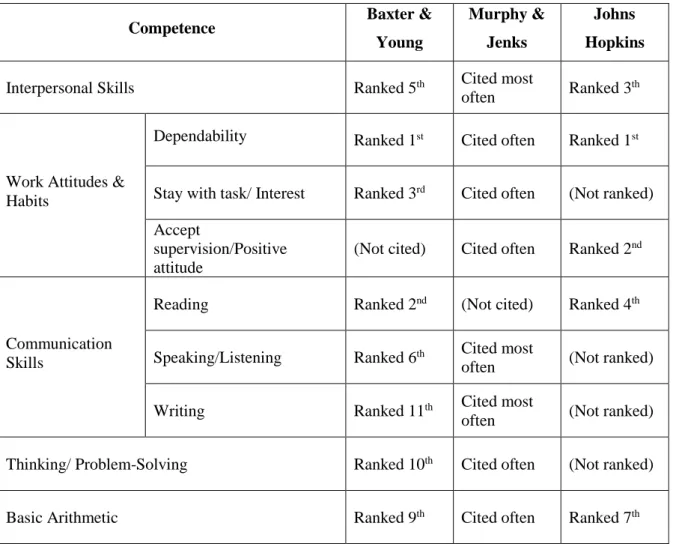
Work of Young (1986) summarizes the competencies most needed by employees, selected by three studies: High school curriculum study (Baxter and Young, 1980); Getting a job after college - What skills are needed? (Murohy and Jenkins, 1983) and a Johns Hopkins research. Young (1986) synthetizes his results in a table, Table 5. It seems as important to have the perception of these competencies, and their relevance in the existing literature. Although, one can realise the evolution of the field of study since the 80’s until the current state of investigation, these are the basis of current results.
36
Table 5 – Review of the literature regarding competencies, by Young (1986) Competence Baxter &
Young
Murphy & Jenks
Johns Hopkins
Interpersonal Skills Ranked 5th Cited most
often Ranked 3 th
Work Attitudes & Habits
Dependability Ranked 1st Cited often Ranked 1st
Stay with task/ Interest Ranked 3rd Cited often (Not ranked)
Accept
supervision/Positive attitude
(Not cited) Cited often Ranked 2nd
Communication Skills
Reading Ranked 2nd (Not cited) Ranked 4th
Speaking/Listening Ranked 6th Cited most
often (Not ranked)
Writing Ranked 11th Cited most
often (Not ranked)
Thinking/ Problem-Solving Ranked 10th Cited often (Not ranked)
Basic Arithmetic Ranked 9th Cited often Ranked 7th
As seen in Table 5, the three studies reviewed by Young highlighted the need for employees to develop social skills, positive attitudes about work, and basic skills of communication. Specialized or highly technical skills were not as stressed but were actually deemphasized. If employees are not expected to have these for entry-level positions, it must be assumed that they will acquire them both as part of their on-the-job training and/or on their own initiative, if required from them later (Young, 1986).
Baxter and Young (1982) conclude, through a survey to 96 employers, that they are asking for: ‘potential workers with good attitudes and the ability to communicate, think, and solve problems and we can teach them specific job skills. Another message is that the high schools share a large part of the responsibility for the development of these qualities in their students.’ (Baxter and Young, 1982)
37 1. ‘Schools must recognize the importance of attitudinal development and strive to foster good attitudes. Much can be done by setting an example, providing opportunities, and having high expectations. For example, the teacher who wants students to be in class on time must also be on time. Students must be provided a reasonable amount of time to get to class and then be expected to be there.
2. The current emphasis on “basic” education may be entirely justified, especially if it includes communication skills, thinking, and solving problems.
3. Although important, instruction in vocational skills at the high school level may be less critical comparatively than the attitudes and skills rated so highly by employers. 4. The school curriculum should include coursework on the development and
understanding of the world of work, the free enterprise system, and consumerism. Special emphasis should be given to interviewing for a position and working under supervision.
5. Mechanisms should be established to permit educators and lay people to interact so that the curriculum can be structured to meet employment needs.
6. Each school system should have a follow-up on former students in order to keep its curriculum relevant.
7. There should be continuing examination of the schools’ curricula and the relationship to employment.’ (Baxter and Young, 1982)
This perspective in what concerns to which is, or should be, the school role for the competencies employees have seems important when understanding which competencies can be, or not, developed by the curricula.
During the 1990-1991 school year, Michigan schools piloted an innovative portfolio approach to enable students to discover, document and develop their employability skills (Stemmer, Brownell and Smith, 1992). It is interesting for research to understand their first step in developing their portfolio theory, Michigan Employability Skills Task Force, which includes leaders from business, labour, government and education, defined ‘the general skills that every student should have, not only for entry-level jobs but for jobs at all levels’ (Stemmer, Brown and Smith, 1992), which is presented in Table 6.
38
Table 6 – General skills students should have, by Michigan Employability Skills Task Force (Stemmer, Brown and Smith, 1992)
Academic Skills Read and understand written materials Understand charts and graphs
Understand basic math
Use mathematics to solve problems Use research and library skills
Use specialized knowledge and skills to get a job done Use tools and equipment
Speak in the language in which business is conducted Write in the language in which the business is conducted Use scientific method to solve problems
Personal Management Skills
Attend school/work daily on time Meet school/work deadlines Develop career plans
Know personal strength and weaknesses Demonstrate self-control
Pay attention to details
Follow written and oral instructions Follow written and oral direction Work without supervision Learn new skills
Identify and suggest new ways to get the job done Teamwork Skills Maintain regular attendance
Be thorough and diligent Follow safety practices Actively participate in a group Know the group’s rules and values Listen to other group members Express ideas to other group member
Be sensitive to the group members’ ideas and views
Be willing to compromise of necessary to best accomplish the goal Be a leader or a follower to best accomplish the goal
39 As important to retain from this conclusion of Michigan Employability Skills Task Force is the distinction of competencies in three main groups, namely Academic Skills; Personal Management Skills and Teamwork Skills.
Mason (1990) found that, in labour market for engineering, science and IT graduates ‘The great majority of mismatches between supply and demand for technical graduates are attributable to quality problems rather than any overall shortfall in quantity.’ This author pointed as employability skills for engineering, science and IT graduates the technical competencies they should learn, have and develop (Mason, 1990). According to his research:
‘The main reasons for the slower growth in electronic engineering graduate output compared to computer science appear to be the following:
− Many prospective students are attracted to the apparently superior salary and career prospects attached to degrees in computing/IT areas.
− Many students have not studied physics to A level standard at school and are therefore not qualified to study electronic engineering (by contrast, physics is not a prerequisite for studying computer science).
− Many students with relatively weak mathematical backgrounds believe that they are more likely to be able to ‘cope’ with computer science than with electronic engineering.’ (Mason, 1990)
This author identified work readiness – the knowledge, skills, and commercial understanding which make graduates deploy-able soon after hiring – as one of the most important factors for the employability of engineering and science graduates in the UK (Mason, 1999).
Not only in 80’s and 90’s, but also in recent years, competencies and skills among higher education graduates have received much attention in both the economics and educational literature. Notwithstanding, while the literature linking cognitive skills to economic success is a substantial area of economics research, and in other social sciences, the effects of non-cognitive skills have only recently been examined by economists.
Mueller and Plug (2006) have shown that ‘personality matters and that its impact on earnings is comparable to that of cognitive ability’(Mueller and Plug, 2006). These authors examined personality traits, namely extroversion, agreeableness, conscientiousness, neuroticism, and
40
openness to experience, in a group of highly educated of mainly white men and women, raised in Wisconsin. Their results indicate that:
‘(a) men who were antagonistic, open, and, to a lesser extent, emotionally stable enjoyed earnings advantages over otherwise similar men; (b) women received a premium for being more conscientious and open; (c) returns to non-agreeableness were very different for men and women; but (d) the positive returns to openness were very similar across gender, suggesting that being creative, unconventional, and artistic was equally important for the man and woman observed.’ (Mueller and Plug, 2006)
Using data from National Longitudinal Survey of Youth 1979 (NLSY79), Heckman, Stixrud and Urzua (2006) present evidence that ‘both cognitive and non-cognitive abilities determine social and economic success’, challenging the existing statement that cognitive skills are more important than non-cognitive ones, mainly diffused by economic and psychology literature. From this research, authors conclude that:
‘Although cognitive skills explain much more of the variance of (log) wages, their effects on (log) wages (as measured by skill gradients) are similar to the effects of the noncognitive traits. In fact, noncognitive skills are about equally strong in many outcomes and are stronger for some outcomes. Of course, equal strength in the sense we have used it does not translate into equal cost of changing these skills.’ (Heckman, Stixrud and Urzua, 2006)
Additionally, authors evidence that non-cognitive skills are significant in explaining a diverse group of behaviours helps, also, to explain why early childhood programs, like Headstart and the Perry Preschool program, are successful. According to authors, these programs ‘do not boost IQ but they raise noncognitive skills and therefore promote success in social and economic life’ (Heckman, Stixrud and Urzua, 2006).
In what regards to results of employees’ competencies in labour market outcomes, Fletcher (2013) findings suggest that:
‘personality measures have important associations with labour market outcomes in adulthood and that the results vary considerably by demographic group. The findings also highlight the potential role of extraversion in being associated with favourable
41 labour market outcomes, which has not been documented in many other studies.’ (Fletcher, 2013)
The research of Fletcher (2013) links ‘specific personality traits with labour market returns by using a recent national sample of young adults from the US. Fletcher found out a ‘large association between extraversion and earnings’. Author point as possible reason to this association ‘the differing composition of jobs in the US in recent years, specifically the growth of service jobs and the requirement of social interactions in the workplace.’. Author also refers that:
‘Interestingly, the result is not explained by occupational sorting and is large in magnitude compared with more traditional characteristics, such as cognitive skills and even attractiveness. The results also cast some doubt on the robustness of links between conscientiousness and earnings found in the prior literature – the effects are replicated in the baseline models but are then reduced substantially with the inclusion of sibling fixed effects.’ (Fletcher, 2012)
Facing expression of discontent with the prevailing measurements of skill mismatch, Sgobbi and Suleman (2013) state that:
‘The opposition between core and supplementary skills has proven to be a viable solution for identifying different types of alignment and misalignment between required and provided skills. The results obtained for a sample of Portuguese retail bankers emphasize the importance of accounting for the job-specific nature of skills.’ (Sgobbi and Suleman, 2013)
In a review of the literature on the different definitions and measures of non-cognitive skills, Morrison and Schoon (2013) stated that “the term non-cognitive skills refers to a set of attitudes, behaviours, and strategies that are thought to underpin success in school and at work”. Explicitly, they identified 8 types of non-cognitive skills: self-perceptions, motivation, perseverance, self-control, meta-cognitive strategies, social competencies, resilience and coping, and creativity.
According to Blásquez, Herrarte and Llorente-Heras (2018), more attention to non-cognitive skills and competencies starts by the fact that the switch from university to work has become a crucial phase in graduates’ lives, due to that, it is important to know which competencies will
42
enable them to benefit of gifted job chances. Additionally, authors refer that to know this is crucial not only from the perspective of the individual but also from the point of view of education policy.
These authors consider that there are two main topics within the studies on this topic, first group observes the correlation between labour market outcomes and skills depending on their cognitive or non-cognitive nature, second one emphasis the specific competencies regardless of whether they are cognitive or non-cognitive.
Regarding the first group of researches and its conception of cognitive and non-cognitive skills, Blásquez, Herrarte and Llorente-Heras (2018) also refer that:
‘(…) cognitive skills are defined as conceptual and intellectual skills such as intelligence, knowledge, analytical thinking, mathematics, and reading, among others. Non-cognitive skills comprise many aspects related to specific aptitudes (interpersonal skills, communication skills, social skills, leadership, etc.) as well as personality traits (motivation, perseverance, self-control and self-confidence, charm, etc.).’ (Blázquez, Herrarte and Llorente-Heras, 2018)
This distinction also implies to recognize differences in the way of measure both, the cognitive and non-cognitive skills. In what concerns to this, while cognitive skills can be measured by objectives tests (IQ and other homogenous achievement test scores), non-cognitive skills, harder to measure, are analysed by means of self-reported information. Due to that, most studies have primarily concentrated on cognitive skills ‘with the general finding that higher levels of these skills are associated with better labour market out comes’, namely ‘lower unemployment, higher wages, high-skilled jobs, and others’ (Blásquez, Herrarte and Llorente-Heras, 2018).
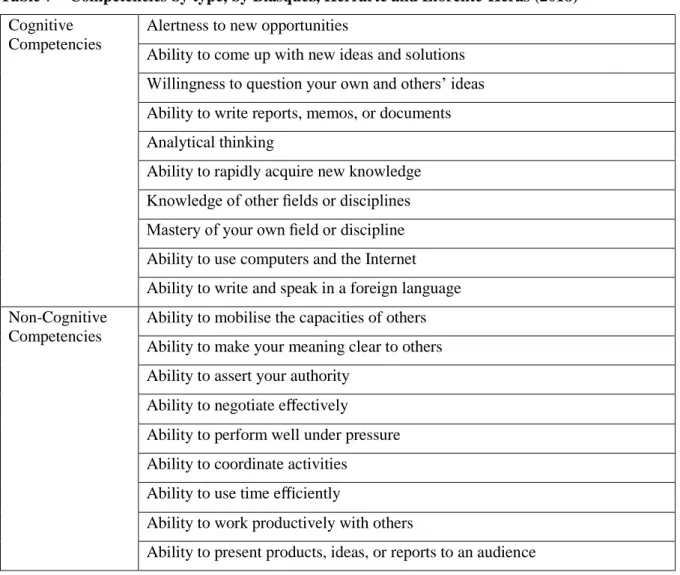
Based on both, literature review and REFLEX database, which is a large survey conducted among higher education graduates who earned their degree in 1999/2000, Blásquez, Herrarte and Llorente-Heras (2018) define competencies by type (cognitive or non-cognitive), this information is presented in Table 7.
To identify Non-Cognitive Competencies, these authors focus on Morrison and Schoo’s (2013) approach and on REFLEX database, being able to identify non-cognitive competencies among the 19 competencies included in this database. According to these authors:
43 ‘(Non-Cognitive Competencies) include the ability to negotiate effectively; ability to perform well under pressure; ability to coordinate activities; ability to work productively with others; ability to mobilise the capacities of others; ability to make your meaning clear to others; ability to assert your authority; ability to present products, ideas, or reports to an audience; and ability to use time efficiently.’ (Blásquez, Herrarte and Llorente-Heras, 2018)
Table 7 – Competencies by type, by Blásquez, Herrarte and Llorente-Heras (2018)
Cognitive Competencies
Alertness to new opportunities
Ability to come up with new ideas and solutions Willingness to question your own and others’ ideas Ability to write reports, memos, or documents Analytical thinking
Ability to rapidly acquire new knowledge Knowledge of other fields or disciplines Mastery of your own field or discipline Ability to use computers and the Internet Ability to write and speak in a foreign language Non-Cognitive
Competencies
Ability to mobilise the capacities of others Ability to make your meaning clear to others Ability to assert your authority
Ability to negotiate effectively
Ability to perform well under pressure Ability to coordinate activities
Ability to use time efficiently
Ability to work productively with others
Ability to present products, ideas, or reports to an audience
Regarding correlation between competencies and hourly earnings, which appears as an interesting topic in current challenges for management, these authors conclude that non-cognitive competencies do not show relation with hourly earnings levels. Although, in the other hand, they conclude that ‘leadership appears to be positively associated with graduates’ earnings, which is somewhat in line with previous works’. They also notice that:
‘In contrast, cognitive skills seem to play a slightly more relevant role in explaining earnings of European graduates. In particular, our results support the well-known