E S T U D O S I I
Cidadania, Instituições e Património Economia e Desenvolvimento Regional Finanças e Contabilidade Gestão e Apoio à Decisão Modelos Aplicados à Economia e à Gestão
Faculdade de Economia da Universidade do Algarve
2005
F
F
E
E
COMISSÃO EDITORIAL António Covas
Carlos Cândido Duarte Trigueiros Efigénio da Luz Rebelo João Albino da Silva João Guerreiro
Paulo M.M. Rodrigues Rui Nunes
_______________________________________________________________________
FICHA TÉCNICA
Faculdade de Economia da Universidade do Algarve Campus de Gambelas, 8005-139 Faro
Tel. 289817571 Fax. 289815937 E-mail: [email protected]
Website: www.ualg.pt/feua Título
Estudos II - Faculdade de Economia da Universidade do Algarve Autor
Vários Editor
Faculdade de Economia da Universidade do Algarve Morada: Campus de Gambelas
Localidade: FARO Código Postal: 8005-139 Capa e Design Gráfico Susy A. Rodrigues
Compilação, Revisão de Formatação e Paginação Lídia Rodrigues
Fotolitos e Impressão Grafica Comercial – Loulé ISBN 972-99397-1-3 Data: 26-08-2005 Depósito Legal 218279/04 Tiragem 250 exemplares Data Novembro 2005
RESERVADOS TODOS OS DIREITOS REPRODUÇÃO PROIBIDA
615
The irruption of the electronic distribution channels and the
new banking system scenario∗
Fernando Alberto Freitas Ferreira1
Escola Superior de Tecnologia e Gestão de Beja
Pedro Manuel Mendonça da Silva Cravo
Escola Superior de Tecnologia e Gestão de Beja
António Alberto da Silva Monteiro de Freitas
Faculdade Social da Bahia
Resumo
Nos últimos anos, temos vindo a verificar uma crescente preocupação com o papel que a tecnologia deverá assumir no processo de modernização do sector financeiro e bancário. Com efeito, o impacto das novas Tecnologias de Informação e Comunicação nos serviços bancários tem recebido significativa atenção, materializada em diversos estudos académicos e científicos, em função da sua importância para o processo de reestruturação do sector. Actualmente, com a introdução da Internet na actividade bancária – Internet Banking – parece evidente que a difusão dessas novas tecnologias constitui um dos principais fundamentos para uma reorientação estratégica dos canais de distribuição, contribuindo para a criação de um ambiente gradualmente competitivo e hostil. Partindo deste cenário, o presente artigo visa promover uma reflexão sobre o impacto que as novas Tecnologias de Informação e Comunicação acarretam para o sector, nomeadamente na criação de novas oportunidades de negócio e no aumento dos índices de competição e rivalidade entre instituições financeiras e bancárias.
Palavras-chave: Canais Electrónicos de Distribuição; Reforma da Estrutura do Siatema Bancário.
Abstract
In the last couple of years, there has been a growing concern about the important role that technology should play in the process of modernization of the financial and banking sectors. In fact, the impact of the Information and Communication Technologies on banking services has received significant attention in several academic and scientific
∗ Paper reviewed and presented in the 1st International Conference on Internet Technologies and Applications, held in the University of Wales, Wrexham, UK.
1 Doutorando em Métodos Quantitativos Aplicados à Economia e à Gestão, especialidade de Investigação
Ferreira, Cravo e Freitas_________________________________________________________
616
studies due to their importance to the sector’s reform process. Nowadays, with the introduction of the Internet into the banking activity – Internet Banking – we can assume that the diffusion of those new technologies has been one of the main reasons for a total redefinition of the distribution services and has been responsible for the creation of a very hostile and competitive environment. In this context, the major point of this paper is related to the fact that the development of Information and Communication Technologies can lead the banking activity to a range of new business opportunities and this evidence can foster increased competition between financial and banking institutions.
Keywords: Electronic Distribution Channels; Banking System Structure Reform. 1. Introduction
Some ideas have been laid out on the analysis of the innovation phenomenon in the specific context of the financial services. In particular, concerning the Portuguese banking sector, the last three decades’ evolution tendencies have showed that technological progress brought important strategic and structural implications to the several economic agents (Baliño and Ubide, 2000). From liberalization to technological innovation, many were the factors that contributed to the sector’s modernization: impulse of new private banks; deeper connection to the European Community; introduction of the new technologies to the banking activity; and so on. The technological innovation in particular turned the banking services into a complex market where the frontier between financial services can no longer be easily distinguished (Ferreira and Freitas, 2004). This tendency is well expressed in the banking insurance activity, where the distribution of insurance products is made by banking agencies. This leads to the creation of important economic groups that offer all kinds of financial services. From this perspective, the major concern of the present paper is to offer an analysis of the Portuguese banking sector’s evolution trends, considering the contribution of technological innovation to its modernization and development. Since technology can be responsible for the promotion of development, it is stated that competitive advantage will largely depend on technological innovation (Ferreira, 2003). Thus, the analysis developed in this paper has the objective of showing that technology can increase the market’s competition level and create or destruct competitive advantage.
2. The new banking system scenario
Because of the most recent world economic trends, financial institutions have been reacting to an increasing competition environment that can be defined by: a scenario fulfilled by new and more aggressive competitors; globalization; technological innovation’s continuous process in the financial activity; the need for human resources
______The irruption of the electronic distribution channels and the new banking system scenario
with the right skills; among others. From this perspective, we cannot assume that national financial services’ development process will occur without major hindrances. In fact, Portuguese financial and banking institutions have been having several difficulties concerning: Information and Communication Technologies use; strategies’ implementation; introduction of new financial products and services; and clients’ adaptation to the new distribution channels. As it is explicit in Tavares (2001),“in the last
couple of years, our country has improved, but with different speeds in the essential dimensions of its development”. Thus, the increasing economic agents’ efficiency
demands (clients and stakeholders in particular), have motivated the acceleration of deeper structural reforms, where the role of the new technologies is doubtless important and determinant. Due to the importance of ICT as an alternative distribution channel, banks have been doing a huge effort to diversify their distribution nets, in order to improve clients’ access to their products or services. The tendency to use electronic distribution channels has been increasing if we consider: the present significant importance of direct access (web, call centers, automated teller machines and points of
sale); the irruption of online services and sophisticated video terminals; and the
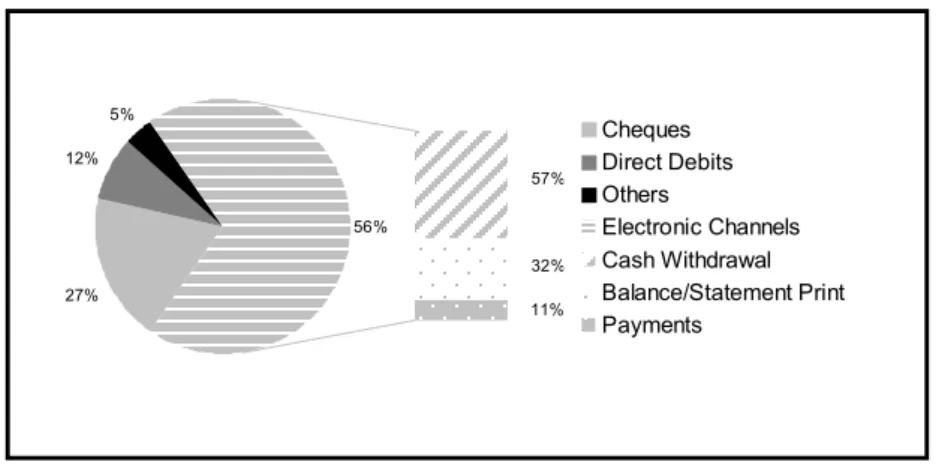
progressive decreasing rate of traditional channels’ use (Figure 1).
Figure 1. Importance of the distribution channels in 2001 (% volume)
11% 32% 57% 56% 27% 12% 5% Cheques Direct Debits Others Electronic Channels Cash Withdrawal Balance/Statement Print Payments
Source: Own elaboration
As explicit in Baliño and Ubide (2000) and Henriques (2000), the traditional distribution channels will suffer significant disinvestments in the next couple of years, as opposed to ICT investment. Hence, the financial activity will be led by information access’ equity power and by the offer of new financial products and services, where the
client centric concept will be dominant. Based on this concept, business will focus on
clients, instead of products. Thus, clients’ loyalty will be a critical factor for the survival of financial institutions. “The logic (...) is transferred from a particular product or
service’s linear profitability to the client’s profitability” (Almeida, 2000).
As defended in Videira (2000), nowadays we cannot expect an institution to adopt a standard strategy for all its customers. In fact, institutions should sell the right products
Ferreira, Cravo e Freitas_________________________________________________________
618
or services to the right clients. In such context, instead of developing innovative products and services in order to promote differentiation, the present trend focuses on the client’s orientation. In other words, unlike a few years ago, financial and banking institutions
“found out that products and services can be easily copied and improved” (Videira,
2000), and the investment in products and services’ improvement does not make sense any more. According to this author, the importance of the new online channels is inevitable and, in a short time period, Portugal can be qualified as a case study in the adoption of financial services’ multi-channel distribution strategies, where the reduction of the traditional agencies net is the most immediate consequence. This idea seems to be shared by Tavares (2001), who states that virtual agencies will behave as true attackers in the financial markets. According to thisidea, it seems urgent to understand that ICTs’ use is no longer simply convenient, but also an important factor of competitive advantage in the financial markets, where qualified teams are formed in order to improve knowledge transfer processes.
As quoted in Henriques (2000), “those recent tendencies are most likely related
with the advantages promoted by the new distribution channels, concerning higher rates of penetration between clients and lower costs”. Thus, it seems logical to assume that
online banking will become the client’s preferred distribution channel, not only because of its advantages in terms of convenience but also in terms of its lower cost, especially when compared to traditional agencies (Ferreira, 2003). Furthermore, the online bank shows the following major advantages for clients: 24-hour services; immediate access to information; privacy; and a range of personalized products and services. For financial and banking institutions, the online connection can also bring clients’ liability (through personalized products and services); real time information about transactions; quick sale of new products with low costs; and human error reduction. Nevertheless, it seems relevant to refer that the expansion of this (new) distribution channel strongly depends on the number of Internet users. Given this, it is important to analyse, among others, some potential strategic hindrances as: Electronic Found Transfers insecurity; ICT inadequacy; or Data Mining incorrect use (Ferreira and Freitas, 2004).
______The irruption of the electronic distribution channels and the new banking system scenario
3. Conclusions
The irruption of a highly competitive scenario demands a positive and effective response from the institutions that are operating in the financial markets. As referred in Henriques (2000), “challenges increase according to clients’ expectations, (...) and those
expectations increase according to the emergence of new transaction methods based on new technologies”. The new Information and Communication Technologies, with special
emphasis to the Internet, easily increment the access to information, bringing important changes not only in customers’ behavior but also in financial institutions’ activity. In this logic, it seems clear that if banks and financial institutions achieve: good information about clients and competitors; automatic systems for products and services’ configuration; immediate access to information; opportunities’ management systems; and processes and routines’ flexibility, they will be able to establish a preferred interaction with clients,
“fulfilling their needs” (Henriques, 2000). Nevertheless, behind the existence of different
distribution channels (Internet, PC banking, phone, mail, automated teller machine and traditional agency), the majority of the Portuguese banking institutions recognize the deficient use of those technologies. This way, an optimistic attitude concerning ICTs’ use is required, even if this optimism becomes the basis for more and deeper reforms in the banking system.
Acknowledgements
This paper is part of Fernando Ferreira’s PhD thesis’ research, undertaken at the Faculty of Economics, University of Algarve (Portugal). The author is sincerely grateful to his tutors: PhD Carlos António Bana e Costa (IST/UTL) and PhD Paulo Manuel M. Rodrigues (FE/UALG). The contribution of Pedro Cravo and António Freitas to this paper is connected to their research on ICT, developed at the Faculty of Communication of the Vilnius University (Lithuania) and the Social Faculty of Bahia (Brazil), respectively. The authors are also indebted to Maria João Ramos for paper’s English review and to the School of Technology and Management of Beja for its institutional and financial support.
Ferreira, Cravo e Freitas_________________________________________________________
620 References
Almeida, P. (2000) “Novos Canais, Mais Flexibilidade”, Economia Pura, 27, 30-35.
Baliño, T. and A. Ubide (2000), “Uma Possível Missão Impossível”, Economia Pura, 27, 46-49.
Ferreira, F. (2003) Inovação Tecnológica no Sistema Financeiro Português: Evolução e
Perspectivas, Coimbra, Pé-de-Página Editores.
Ferreira, F. and A. Freitas (2004), “A Inovação Tecnológica e a Qualidade do Sistema Bancário em Portugal: Alguns Entraves Estratégicos na sua Optimização”, Proceedings
of the 5th Conference for the Quality in Information and Communications Technology – QUATIC’04, Porto, Portuguese Institute for Quality, 25-28.
Henriques, J. (2000) “Serviços Financeiros no Séc. XXI”, Economia Pura, 27, 39-41. Portuguese National Bank, online at www.bp.pt [12/12/2004].
Tavares, L.V. (2001) “Inovação: Que Engenharia e Tecnologia para os Próximos 20 Anos?”, Economia Pura, 32, 46-47.
Videira, A. (2000) “O Marketing e a Fidelização de Clientes”, InforBanca, 46, online at www.ifb.pt [12/12/2004].