. . .
BARROS, Luís Cláudio; CARVALHO, Any Raquel; BORGES, Diego. The “Artistic Image” Concept Applied to a Fugue at the Early Stage of Piano Practice: An Observational Study. Opus, v. 23, n. 3, p. 9-22, dez. 2017.
The “Artistic Image” Concept Applied to a Fugue at the Early
Stage of Piano Practice: An Observational Study
Luís Cláudio Barros
(UDESC, Florianópolis-SC)
Any Raquel Carvalho
(UFRGS, Porto Alegre-RS)
Diego Borges
(UDESC, Florianópolis-SC)
Abstract: This article presents the results of an investigation on the concept of “artistic image of a
musical composition” proposed by Heinrich Neuhaus (1888-1964) at the initial stage of learning a fugue by J.S. Bach. The data was gathered during the first practice session of six undergraduate piano majors learning a fugue, all from two public universities in southern Brazil. The concepts proposed by Neuhaus served as a parameter for an observational study of the students’ behavior and the technical-musical activities undertaken during their practice. The aim was to verify if the concept of artistic image had been used during practice and, if so, how it was established. We also examined the study strategies that helped comprehend the musical content, guiding the learning process and organization of practice. The results should assist in increasing our knowledge of the processes involving piano practice and the strategies linked to the concept of artistic image, stressing empirical observation as an important tool to validate theoretical concepts.
Keywords: Heinrich Neuhaus; artistic image; piano practicing.
A imagem artística no estágio inicial da prática pianística: um estudo observacional Resumo: Este artigo apresenta uma investigação em torno do termo “imagem artística de uma obra
musical” proposto por Heinrich Neuhaus (1888 - 1964) no estágio inicial da aprendizagem de uma fuga de J. S. Bach. Os dados foram coletados durante a primeira sessão de prática de seis estudantes do bacharelado em piano aprendendo uma fuga, todos de duas universidades públicas no sul do Brasil. Os conceitos propostos por Neuhaus serviram como parâmetro para um estudo observacional do comportamento dos estudantes e das atividades técnico-musicais realizadas durante sua prática. O objetivo foi verificar se o conceito de imagem artística estava presente durante a prática e, se sim, como foi estabelecido. Examinamos, também, as estratégias de estudo que ajudaram a compreensão do conteúdo musical, guiando o processo de aprendizagem e a organização da prática. Os resultados deverão auxiliar no aumento do conhecimento do processo envolvendo a prática pianística e as estratégias ligadas ao conceito de imagem artística, salientando a observação empírica como ferramenta importante para validar conceitos teóricos.
he purpose of this article is to examine the piano practice of undergraduate piano majors during the initial stage of learning a fugue by J.S. Bach to verify whether they used aspects of forming an “artistic image of a musical piece” as proposed by Heinrich Neuhaus (1888-1964). The concepts proposed by Neuhaus served as a parameter for observing the students’ behavior and the technical-musical activities undertaken during their practice.
Heinrich Neuhaus was born in 1888 to a Ucranian family with a strong musical tradition. His parents were piano teachers – his uncle, Félix Blumenfeld, taught pianists Vladimir Horowitz, and his cousin, Karol Szymanowski. As a child, Neuhaus was self-taught, having studied later with Leopold Godowsky, among others. In 1932 he began teaching piano at the Moscow Conservatory. Some of his pupils include world-renown pianists such as Sviatoslav Richter, Emil Gilels and Radu Lupu.
In 1958, Neuhaus published his most important work, The Art of Piano Playing, dealing with rhythm and sound, as well as how to develop technique, teaching skills and a quality concert performance. Among the topics discussed in his book, one in particular provided strong potential for empirical research: “the artistic image of a musical composition” (Chapter I). Neuhaus recognizes the validity of the concept and asks: ”But what is ‘the artistic image of a musical composition’ but music itself, the living fabric of sound, musical language with its rules, its component parts, which we call melody, harmony, polyphony, etc., a specific formal structure, an emotional and poetic content?” (NEUHAUS, 1973: 7).
According to Neuhaus, the artistic image may be defined as every mental representation concerning music that reaches beyond the musical instrument. It is the idea formed by all of one’s knowledge to give meaning to the written score, that is, to understand the musical content of a work. When we attend a piano recital, we are receiving the artistic image that the performer has in regards to the work and expressed by the action of the performance. Reading a score without meditating over its content can be compared to reading a written page without paying attention to what you are actually reading. Thus, reflection over the content generates emotional impulses or images of facts or characters.
Neuhaus (1973: 24) states that all the work done in his classes were “centered, to the utmost of our ability, on music and its embodiment in piano playing, in other words, on the artistic image and on piano technique”. He considered the artistic image as the first step in the learning process of a musical work, as mentioned by Lisboa, Chaffin and Logan (2011: 517): “when a great musician first approaches a new piece, ‘an instantaneous and subconscious process of “work at the artistic image” takes place’.”
I can say without exaggeration that three-quarters of all work is work on tone. It may be said that the sequence, the causal relationship in our work naturally falls into the following pattern: first — the image (i.e., the meaning, content, expression, the what-it-is-all-about); second — tone in time — the embodiment, the materialization of the image, and finally, the third — technique as a whole, as the sum total of all means essential for solving the artistic problem of piano playing as such, i.e., mastery of the muscular movements of the performer and of the mechanism of the instrument (NEUHAUS, 1973: 56-57).
Several actions carried out during instrumental practice are linked to the concept of artistic image proposed by Neuhaus and were considered in the present investigation as the parameters of our observation, namely:
(1) Identification and analysis of form and structure of the work; (2) Verbalization of theoretical and analytical aspects of the piece; (3) Self-regulation or self-monitoring during practice;
(4) Analogies regarding natural phenomena and human beings;
(5) Knowledge of other musical areas and appreciation for other arts; (6) Concern with expression and appropriate character;
(7) Use of various strategies to apply artistic image.
According to Neuhaus (1973: 8), pianists who comprehend the musical content and seek artistic quality and technique are able to sight-read a score almost perfectly. This was the case of his most famous student Sviatoslav Richter by virtue of his excellent technical level and artistic quality. Based on this consideration, the authors raised the question: What are the characteristics found in the practice of an expert pianist concerning the development of the artistic image during first contact with the score? Research in this area has tried to explain this. Chaffin, Imreh and Crawford (2002: 88) verified that one of the aspects of practice of expert musicians is their inherent interest in attaining high levels of performance as: “For each piece of music, the pianist first formed a general idea […] of the significant values, and then decided how to execute them”. The authors also comment that interpretative and expressive decisions are incorporated at the beginning of practice and the choice of fingering, as well as resolving technical difficulties are achieved based on these decisions (2002: 176). Lisboa, Chaffin and Logan (2011: 517) highlighted in their longitudinal case study with a professional cellist the big picture of the piece as a guide to expert problem solving and then related it to a suggestion by Neuhaus that “a musician’s first goal in approaching a new piece should be to develop an ‘artistic image’ of its musical shape.” Chaffin and Lemieux verified that professional musicians uphold a broader musical vision, that is, an “artistic image” of the work, while focusing on technical and interpretative details (NEUHAUS apud WILLIAMON, 2004: 28). They also point out that the initial technical decisions should be based on the final musical idea and expressive performance goals. Without this in mind, many decisions may be necessary in the future, thus prolonging the learning period (2004: 28). As indicated in both studies, the more experienced the musician, the greater their capacity to anticipate problems and foresee the final desired interpretation, as well as changing their focus from a panoramic view to a detailed view and vice versa (2004: 28).
The case studies by Héroux (2016) tried to understand the creative process by two professional guitar players while building their interpretation during the entire process of learning a new piece. The author (2016: 321) observed that the search of an artistic image was one of the elements present in their practice even before playing the piece on the instrument.
An interview with ten eminent Russian pianists, including Neuhaus, by Wicinski (apud HÉROUX, 2016: 305), determined that seven of them showed similar work patterns: “each would first read a piece to develop a mental representation of the work, then focus on technical problems, and finally return to a global vision of the parts in relation to the sequencing of the entire piece.”
The experimental research by Rostron and Bottrill (2000) with eight participants also confirmed that pianists with greater skills were those observant of interpretative aspects (expression, dynamics) as an integral component in the early stages of practice. This is reflected in their capacity to form multiple representations of the music.
Method
The purpose of this article is to investigate the practice of undergraduate piano students based on the assumption that they should be able to acquire the capacity to develop a practice routine in the same manner as professional musicians. The observational method is one of the main tools to validate the theoretical concepts, along with the description and analysis of the practice content. The observation of their practice was restricted to the initial learning stage of a musical work, since research shows that it is in this stage that a more accomplished musician makes decisions about the artistic concept that will entail the forthcoming practice sessions. According to Neuhaus (1973: 10), working with the artistic image “should begin at the very first stage of learning the piano and note reading”.
The proximity between the subject of the present study and the academic reality originated a question not yet brought up: how is the concept of “artistic image” applied during the first practice session by undergraduate piano students? With this in mind, our goal was to verify, through video analysis, the concept proposed by Neuhaus in the first stage of learning a fugue by J. S. Bach. We also intended to describe and discuss the activities undertaken during the pianists’ practice, looking for strategies that somehow facilitated the comprehension of the musical content and reflected their search for the artistic image of the piece. This might increase knowledge of the processes involving piano practicing as well as strategies that could turn out to be more efficient in optimizing their performance results.
Participants. Six undergraduate piano majors from two public universities in southern Brazilian participated in this observational study. They were divided into two groups according to their level of study: three were in their first year of the undergraduate course (A1, A2, A3) and three in the third year (B1, B2, B3). The requirement to participate was to have performed at least one fugue from the Well-Tempered Clavier by J. S. Bach. All students received a copy of the book Contraponto tonal e fuga (Tonal Counterpoint and Fugue) by Carvalho (2002) to support their knowledge of fugue structure. As Neuhaus states (1973: 20), getting familiar with the elements of the piece at hand, such as “the form, the thematic material, and the harmonic and polyphonic structure of the composition being performed”, should be encouraged from the beginning. All this data could possibly help musicians “memorize music by reading the score without touching the piano”. By reading the counterpoint book, it was possible to neutralize the variable of “lack of knowledge of the structure of a fugue”, since it clearly presents this information.
Materials and procedures. The score chosen was J. S. Bach’s Fugue in C Minor; BWV 871 (from the Well-Tempered Clavier, Book 2), a four-voice fugue, since none of the participants had studied this piece before (Fig. 1). A fugue by Bach was selected because it is a polyphonic work, thus requiring a meticulous study of each voice, as opposed to a homophonic piece.
Fig. 1: Exposition of J. S. Bach’s Fugue in C Minor BWV 871 (from the Well-Tempered Clavier, Book 2).
Much of the repertoire used in empirical studies is often by J. S. Bach, as seen in Williamon (1999, 2002), Williamon and Valentine (2000), Chaffin, Imreh and Crawford (2002), Ericsson, Krampe and Tesch-Römer (1993), Ericsson and Krampe (1996) and Camp, Binkofski and Halsband (1994). Neuhaus considered polyphonic music his “most beloved element” (1973: 138):
If I were to attempt to say as briefly as possible why polyphony is so dear to me (as well as the greatest polyphonist of all times — Bach) I would say: polyphony expresses in musical language the highest union of the personal and the general, of the individual and the masses, of Man and the Universe, and it expresses in sound everything philosophical, ethical and aesthetic that is contained in this union. It fortifies the heart and the mind. When I play Bach, I am in harmony with the world and I bless it (NEUHAUS, 1973: 138).
A semi-structured interview was conducted with each participant to collect data on their musical background and practicing routine. They also signed an image rights term of participation in the research. Then they all received a copy of an Urtext edition of the fugue. The students were asked to videotape their first session, practicing as they would normally, without the presence of the researchers. The term “artistic image” was never mentioned to the participants. No time limit was established for the practice session, so as not to interfere in their normal practicing process, based on the principle that each musician knows the amount of time they need to accomplish their practicing goals. All filming was individual and the participants were encouraged to verbalize any comments they found necessary.
The data was transcribed and analyzed, followed by a comparative analysis with Neuhaus’ theoretical concepts. The analysis of the practice concentrated on the seven activities linked to the concept of the artistic image as proposed by Neuhaus, as previously mentioned. Results
The results of the observation based on the videos of each student’s practice will be presented followed by a comparison of this data. To maintain the anonymity of the students, all will be referred to in the male gender.
Student A1 spent twenty-nine minutes practicing the fugue. Analysis was his main approach to practice, counting the number of bars, looking for both the subject and the
countersubject throughout the fugue, indicating them on the score. He also analyzed the tonal relations and played these sections once. Many of these analytical activities were verbalized and involved 80% of his practice time. In the stretto passage, Student A1 played each voice separately, then in paired voices (soprano/alto; alto/tenor, etc.). These strategies demonstrated the use of activities linked to Neuhaus’ concept of artistic image of a work.
Student A2’s practice lasted twenty-seven minutes and his focus was sight-reading. However, at the entrance of the third voice, he had fingering problems. At this point, he practiced this passage several times, each voice separately and then combined. From the beginning of the practice session, he was concerned with sonority, melodic direction, expression and the importance of each voice in context. Other important activities were also observed, such as verbalization of technical difficulties, practicing smaller sections and finding good fingering. Various activities proposed in Neuhaus’ theory were adopted by this student.
Student A3 practiced for forty-two minutes. His main activity was sight-reading the first part of the fugue with both hands. He used a metronome and gradually advanced the tempo at
every repetition. A rocking gesture of the body accompanied the metronomic pulse. He returned to structural points when an error occurred. No activities directly related to Neuhaus’ concept of artistic image were found.
Student B1’s practice session was the longest of all six participants, 53 minutes, in which 25% of the time was spent sight-reading the piece slowly. When an error occurred, he played the note before it and repeated the passage. Playing hands together dominated the session, but at times, B1 looked for the subject, indicated sections on the score, played scales in the same key and clapped or counted the pulse with his foot. Although some aspects of Neuhaus’ concept were found, his persistency in correcting errors impaired his ability to have a broader musical comprehension of the piece.
Student B2 practiced the fugue for twenty-three minutes. He started by sight-reading the last few bars of the fugue, dividing it into smaller sections by cadences, melodic direction of one voice or the relation between two voices. His practice had the most numerous practice strategies, namely singing one voice while playing another, using different dynamics and articulation, verbalizing harmonic progressions, writing down information on the score, and performing passages with expressive intentions at the final tempo. All of these activities are linked to Neuhaus’ proposal.
Student B3’s session lasted thirty-three minutes. He sight-read the first page and then practiced smaller sections with both hands. He had the tendency to accelerate the tempo when he felt secure but when an error occurred, he repeated notes and his tempo decreased. Maintaining a steady tempo was not typical of his practice. Different dynamic ranges among the voices were adopted only to make the theme stand out. These activities are not related to those described by Neuhaus.
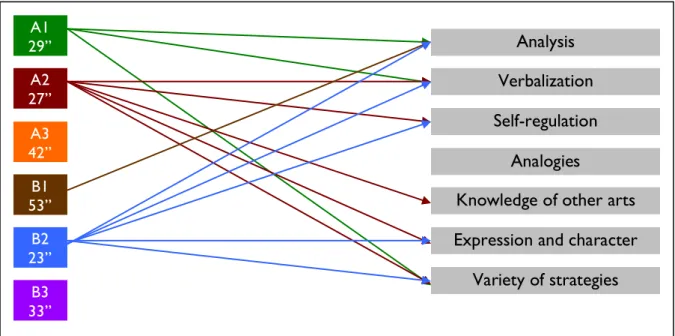
Fig. 2 summarizes the activities linked to artistic image observed in each student’s first practice session, including the time spent in each practice session.
Fig. 2: Activities linked to artistic image in the students’ first practice session.
Discussion
Two first-year students (A1 and A2) and one third-year student (B2) used activities related to artistic image. On the other hand, the practice sessions of the remaining students (A3, B1, B3) lasted longer and they focused on sight-reading and/or playing larger sections with both hands, but presented few or no activities linked to artistic image.
Verbalization in planning the performance, identifying problems and analyzing the score is one of the main common characteristics found among Students A1, A2 and B2. They utilized strategies more related to the comprehension of musical content such as analysis, practicing separate voices, verbalization, etc. According to Neuhaus (1973: 20), the student should be able to verbally express theoretical and analytical aspects of passages of the entire score once they know how to play it technically correct and with an appropriate artistic image. Besides these aspects, artistic image can be developed through the use of analogies regarding natural phenomena and human beings, as well as the use of metaphors and poetic images, but none of these were observed in any of the students’ practice session.
The longest practice sessions were among Students B1, A3, B3, respectively, who spent more time practicing repeatedly longer passages with both hands and with little attention given to artistic image. The fact that B1’s session was the longest might be explained by his difficulty in absorbing musical unity due to constant repetition of single notes. Observation showed that the three aforementioned students practiced in a more mechanical manner, that is, with no concern for sound quality, phrasing and expression. Playing longer sections may have hindered their capacity to retain musical content because of the greater number of aspects to be considered, as well as losing the global vision of the piece. Lisboa, Chaffin and Logan (2011: 517) point out that “experts start with the big picture while novices plunge into the details without developing a clear idea of the big picture.”
A1 29” A2 27” A3 42” B1 53” B2 23” B3 33” Analysis Verbalization Analogies Self-regulation Variety of strategies Expression and character
The practice sessions of A1, A2 and B2, while shorter, presented more activities related to Neuhaus’ artistic image. A1 used verbalization and analysis as his main activities; A2 was concerned with sonority, melodic direction, expression and the importance of each voice in its context. B2’s practice was the most numerous in practice strategies, including singing one voice while playing another, using different dynamics and articulation, verbalizing harmonic progressions, writing down information on the score, and performing passages with expressive intentions in the final tempo. The case studies by Héroux (2016: 304) also mentioned that both professional musicians used varied strategies in order to create an original interpretation.
The variable “influence of the academic year (first or third year students)” did not affect the results, as two of the three that presented activities related to Neuhaus’ theory were first-year students (A1, A2). Other factors could have affected the results, including their musical background, the quality of their teachers (although they were not allowed to consult their piano teachers about this piece), piano repertoire and knowledge of other artistic areas, as they claimed during their interview.
One of the ways to identify the artistic image according to Neuhaus (1973: 7) is by recognizing the form, the harmonic and the polyphonic structure of a work. This can be seen in A1’s analytical approach to practice. The comprehension of the structure of the work at the beginning of the learning process is verified in empirical studies involving professional musicians. Hallam (2001a: 30) states that almost all professional musicians try to gain a general overview while learning a new piece by sight-reading or analyzing it. This approach helps identify difficulties, evaluates the tempo and its technical-musical implications, as well as aspects concerning structure and thematic material. Alfred Cortot emphasized that when learning a new piece, one should analyze it completely, verifying its structure and the composer’s intentions (BROWER apud CHAFFIN; IMREH; CRAWFORD, 2002: 45). Pianist Leon Fleisher affirms that one should comprehend the work’s structure, sing the themes and feel the rhythm before practicing it (NOYLE apud CHAFFIN; IMREH; CRAWFORD, 2002: 47).
Another strategy used by Student A1 implies alternating between a more detailed study of musical elements and a broader study of the piece. This expresses precisely what Neuhaus suggests:
I suggest to the pupil that he should study a piano composition, i.e. the notes, as a conductor studies a score, that is, not only as a whole […] but also in detail, taking the composition apart to see its component elements, the harmonic structure, the polyphonic structure; separating the main elements — for instance, the melodic line, the “secondary” element, for instance, the accompaniment […] Moreover, he [the student] begins to understand that a composition that is beautiful as a whole is beautiful in every detail, that each such detail has sense, logic, expressiveness, it is an organic part of a whole (NEUHAUS, 1973: 21).
Neuhaus (1973: 10) emphasizes that the student should play the theme in an expressive manner during their first contact with the score. This was established by Student A2, as he repeated each voice observing melodic direction which helped him determine appropriate aspects of dynamics and articulation. The attention given to melodic contour was confirmed in his
interview, as he mentioned his experience with vocal ensembles and other artistic areas, prior to his undergraduate piano studies. Artistic image indeed involves the acquisition of taste for other arts, such as poetry, architecture, painting, and other musical areas (NEUHAUS, 1973: 21).
Identification of problems, verified in A2’s practice, is a fundamental activity as it helps the student self-regulate the implementation of strategies to solve any problems encountered and prevent errors such as repeating notes out of musical context or loss of pulse which hinders the understanding of the artistic image of the music. Nielsen (2001) conducted a case study with two advanced-level organists to examine the behavioral aspects occurring in the initial study of a repertoire focusing on how these instrumentalists self-regulate the use of strategies during practice. The results corroborate those of Chaffin and Imreh (1997) and Miklaszewski (1989), confirming that the technical-motor difficulties to be resolved are influenced by the formal structure of the piece and self-assessment of this practice by use of metacognitive strategies (NIELSEN, 2001: 164). Although Student A2 practiced focusing on the opening bars of the fugue, the repetition of sections was done consciously, considering the delimitation of musical ideas that, studied in detail, constituted a clear interpretive source, which could be later applied to subsequent sections of the piece.
Student A3 presented a body gesture of bending forward and backward (following the metronome) in each beat of the measure during his practice session. This led to a “vertical” performance of the piece, even though the melodic fluency of the voices should be more “horizontal” since the piece presents a purely contrapuntal texture. The lack of dynamics and articulation linked to the body movement showed that A3 was concerned only with carrying out the written notes on the score, without reflecting on the role of each voice in context. When A3 played a wrong note, he returned to the previous section, being it a structural or a random point. There was no concern for the context of these points (beginning of a phrase or section, for example), only its repetition due to an error, often in mid-phrase, resulting in loss of phrasing that would lead to a more accurate understanding of the musical content.
Hallam (2001b: 9, 21) conducted an empirical study with string players to check the effect of strategies on the musical development by analyzing the practice of a short passage in a new piece. The results showed that only one out of forty-nine participants from the early and intermediate stages reported having done some activity during practice that was linked to the interpretative aspects. The main goal of most of the participants was playing the section “correctly” without rhythmic errors and notes. The interpretation and observation of dynamics were only emphasized when the student reached a higher skill level. It is our understanding that this unexpected data has implications for how teachers think about teaching, so that the student’s first contact with the score should be established not only by technical aspects, but also by interpretative parameters and the artistic image of the final performance. This feature found in expert musicians should be taught from the beginning of musical training, regardless of skill level or if the piece is at an early, intermediate or final stage of the learning process, as highlighted by Neuhaus (1973: 9-10).
Using the metronome had influence in the way Student A3 organized his practice. However, it was not possible to infer whether its use was the real cause of the lack of artistic image on the fugue, evidenced specifically by non-differentiating articulation, phrasing direction and dynamics. In this context, two hypotheses arose: the use of the metronome and body movement
impeded the student’s musical perception of the passage; and, A3 did not consider it to be important to have a global vision of the piece and began his practice with one specific activity.
As for Student B1’s practice, excessive repetition of notes observed throughout the study undermined the sense of pulse and melodic continuity of the piece. The loss of direction became evident by how the notes were performed: all with the same articulation and dynamic range in a continuously repeating process of small sections with constant errors. For this reason, the student seemed not to receive adequate auditory or cognitive information on what was happening in relation to the musical continuity. Perhaps this explains the large amount of time spent on practicing (this student used the greatest amount of time when compared to the others).
B1 indicated sections and themes in the score, but these were not used as structural units while correcting errors. Gruson (1988), as well as Rostron and Bottrill (2000), investigated the use of strategies in the practice of pianists. Both studies used similar investigative approaches and evaluation criteria. They found that the most experienced pianists paid more attention to the structural units of the music to organize their practice while employing more complex strategies. These pianists also stressed the importance of correcting errors in the context of each phrase, as opposed to correcting single notes.
B2’s practice has some features in common with Student A2, as his practice focused on short passages with conscious repetition of small musical elements. This might help in understanding the musical content and its memory retention while forming an artistic image. In addition, we identified self-regulation in the use of strategies according to the length of the passage and its musical content during the practice of both students. However, B2 planned his practice by deliberately applying a variety of strategies to the same passage, while A2 used repetition of musical elements until the appropriate character was achieved before inserting them into context.
A systematic, conscious and reflexive organization of instrumental practice through a set of strategies and study skills (used with a specific goal to be achieved) are related to what Hallam (1997: 209) calls metacognition. Metacognitive strategies are centered on planning, monitoring and evaluating learning. Hallam points out that professional musicians have control over instrumental practice, as these have the “need to continually adjust the planning process, collecting information, formulating hypotheses, making choices and reconsidering decisions,” in other words, “reaching the target product in the shortest possible time” (1997: 181). These characteristics are attributes of what Hallam considers to be effective practice, modeled on the examination of practice approaches of professional musicians. Hallam (2001b: 13) suggests that the increased level of planning of instrumental practice can be a necessary feature to become a musician of excellence. According to Chaffin and Lemieux (2004: 28), the musician must have a variety of strategies to be used flexibly in accordance with the study purpose and the difficulties to be resolved.
Student B3’s practice showed rhythmic problems that may be connected to two separate factors. One may be related to technical-motor difficulties since the student accelerated the tempo in less technically demanding passages with no regard to articulation and phrasing. He deliberately slowed down when a technical difficulty occurred, also disregarding phrasing and articulation. Another factor was the lack of attention to sound quality and melodic direction. Neuhaus (1973: 45-46) mentions this problem by suggesting practicing at a slower tempo precisely at points where there is unconscious acceleration. B3 accelerated at the points where Neuhaus suggests reducing the tempo of the section in order to generate unity and coherence
with the following difficult passage. Thus, melodic fluency would be maintained, regardless of the tempo of the passage. Neuhaus also advises to listen to singers, violinists and cellists in order to acquire the same concern with melodic contour and sound, as a sound error inevitably leads to an error in tempo. He adds that “many rhythmic inadequacies are due, in fact, to an insufficient understanding of the composer’s spirit and style. The artistic image is not clear and this affects the rhythmic element” (1973: 46). The fact that B3 constantly maintained different dynamics between the voices throughout the fugue (his only concern was playing one voice louder than the other) could indicate that the student was more concerned with the linear aspect of the voices without considering the relation between them.
Students A2 and B2 based their study on small sections, while A1 opted for a more analytical approach focused on the piece as a whole. Despite the focus contrast, various activities related to the concept of artistic image were verified in the practice of these three students, indicating that there is no generic formula to begin the process of learning a new piece that includes aspects of an artistically conscious interpretation. Many of the activities recorded in the first session of Students A1, A2 and B2 were also found in the practice of professional musicians, confirming the assumption that enabled this research with respect to the musical abilities of a student in a Bachelor of Arts program. At the same time, this research has also shown that not every piano major has characteristics common to a professional musician in their practice.
Final remarks
Considering the three first-year students, only A1 and A2 presented activities directly linked to the concept of artistic image. B2 was the only third-year student to use strategies that facilitated the understanding of musical content. This demonstrated that the distinction between first and third year students had no influence on the results obtained and might be related to their previous musical knowledge and background. Despite the different approaches to the same piece, they showed an effective use of artistic image aspects. A1, A2 and B2’s practice demonstrated that they tended to practice each voice separately, repeating the musical content consciously and with appropriate character. They also verbalized the activities both as a process of reflection on what was being practiced, as well as planning the performance.
Students A3, B1 and B3 showed little or no activity directly related to the concept of Neuhaus. They opted to sight-read with both hands, giving little attention to aspects of artistic image, practicing for a longer period of time than the other students. Problems identified in their practice that may have caused difficulty in acquiring musical content include the repetition of notes outside the musical context and the large amount of information received by sight-reading long passages, usually with both hands. Other activities conducted by these students denote a poor artistic image, such as the lack of dynamic range and articulation related to phrase structures, unconscious acceleration of passages of short notes, and inappropriate body gesture.
The activities found in the practice of Students A1, A2 and B2 were found in empirical research involving the practice routine of professional musicians. This validates the assumption that students in an undergraduate music program may have some abilities compatible to those found in musicians of higher ranking. On the other hand, not all piano students may have characteristics in their practice common to professional musicians, considering their first contact with a piece.
Empirical research of the practice of professional musicians has shown that the use of strategies agrees with the concept of artistic image making it a vital requirement for a highly artistic performance. As noted earlier, the artistic image should occur during the first contact with the score. This study demonstrated, by describing the instrumental practice of six students, that this does not always occur during piano practice at the undergraduate level. The data demonstrates that only 50% of the group applied strategies linked to the concept of Neuhaus. These results show how important it is for piano teachers to be concerned with the instruction of appropriate practicing strategies that can lead to high-level expertise.
The results found in this observational study, while not conclusive, led us to the hypothesis that, through knowledge and the application of the artistic image, students may reach a more effective means of optimizing piano practice in order to produce a conscious and convincing interpretation. Since this study presented only one practice session, we strongly encourage further studies to verify such a hypothesis in other types of research, such as in a longitudinal study or an experimental research involving a greater number of participants.
References
CAMP, Max; BINKOFSKI, Ferdinand; HALSBAND, Ulrike. The Role of the Perception of Rhythmic Grouping in Musical Performance: Evidence from Motor-Skill Development in Piano Playing. Music Perception, Berkeley, v. 11, n. 3, p. 265-288, 1994.
CARVALHO, Any Raquel. Contraponto tonal e fuga: manual prático. Porto Alegre: Editora Novak Multimedia, 2002.
CHAFFIN, Roger; IMREH, Gabriela. Pulling Teeth and Torture: Musical Memory and Problem Solving. Thinking and Reasoning, v. 3, p. 315-336, 1997.
CHAFFIN, Roger; IMREH, Gabriela; CRAWFORD, Mary. Practicing Perfection: Memory and Piano Performance. Mahwah: Erlbaum, 2002.
CHAFFIN, Roger; LEMIEUX, Anthony F. General Perspectives on Achieving Musical Excellence. In: WILLIAMON Aaron (Ed.). Musical Excellence: Strategies and Techniques to Enhance Performance. Oxford: Oxford University Press, 2004. p. 19-40.
ERICSSON, K. Anders; KRAMPE, Ralf. Maintaining Excellence: Deliberate Practice and Elite Performance in Young and Older Pianists. Journal of Experimental Psychology: General, v. 125, n. 4, p. 331-359, 1996.
ERICSSON, K. Anders; KRAMPE, Ralf; TESCH-RÖMER, Clemens. The Role of Deliberate Practice in the Acquisition of Expert Performance. Psychological Review, v. 100, n. 3, p. 363-406, 1993.
GRUSON, Linda. Rehearsal Skill and Musical Competence: Does Practice Makes Perfect? In: SLOBODA, John. Generative Processes in Music: The Psychology of Performance, Improvisation and Composition. Oxford: Clarendon Press, 1988. p. 91-112.
HALLAM, Susan. The Development of Metacognition in Musicians: Implications for Education. British Journal of Music Education, Cambridge, v. 18, n. 1, p. 27-39, 2001a.
_________. The Development of Expertise in Young Musicians: Strategy Use, Knowledge
Acquisition and Individual Diversity. Music Education Research, v. 3, n. 1, p. 7-23, 2001b. Available at: <http://www.tandfonline.com/doi/abs/10.1080/14613800020029914>. Accessed on: Aug. 9, 2016.
_________. What Do We Know about Practicing? Towards a Model Synthesising at the Research Literature. In: JORGENSEN, Harald; LEHMANN, Andreas. Does Practice Make Perfect? Current Theory and Research on Instrumental Music Performance. Oslo: Norwegian State Academy of Music, 1997. p. 179-231.
HÉROUX, Isabelle. Understanding the Creative Process in the Shaping of an Interpretation by Expert Musicians: Two Case Studies. Musicae Scientiae, v. 20, n. 3, p. 304-324, 2016.
LISBOA, Tânia; CHAFFIN, Roger; LOGAN, Topher. A Self-Study of Practice: Words Versus Action in Music Problem Solving. In: INTERNATIONAL SYMPOSIUM ON PERFORMANCE SCIENCE, 3., 2011, Toronto. Proceedings. Utrecht: European Association of Conservatoires, 2011. p. 517-522. MIKLASZEWSKI, Kacper. A Case Study of a Pianist Preparing a Musical Performance. Psychology of Music, United Kingdom, v. 17, p. 95-109, 1989.
NEUHAUS, Heinrich. The Art of Piano Playing. New York: Praeger Publishers, 1973.
NIELSEN, Siw. Self-Regulating Learning Strategies in Instrumental Music Practice. Music Education Research, v. 3, n. 2, p. 155-67, 2001.
ROSTRON, Andrew; BOTTRILL, Suzanne. Are Pianists Different? Some Evidence from Performers and Non-Performers. Psychology of Music, United Kingdom, v. 28, p. 43-61, 2000.
WILLIAMON, Aaron (Ed.). Musical Excellence: Strategies and Techniques to Enhance Performance. Oxford: Oxford University Press, 2004.
________. Memorizing Music. In: RINK, J. Musical Performance: A Guide to Understanding. Cambridge: Cambridge University Press, p. 113-126, 2002.
________. The Value of Performing from Memory. Psychology of Music, United Kingdom, v. 27, n. 1, p. 84-95, 1999.
WILLIAMON, Aaron; VALENTINE, Elizabeth. Quantity and Quality of Musical Practice as Predictors of Performance Quality. The British Journal of Psychology, Cambridge, v. 91, p. 353-376, Aug., 2000.
. . .
Luís Cláudio Barros is a Piano Professor in the Music Department at the State University of Santa Catarina (UDESC), in Florianópolis, Brazil. He holds a bachelor's degree in piano from FAMES (Vitória, Brazil), a master's degree in piano from the Eastman School of Music (NY, USA) and a doctorate in piano from the Federal University of Rio Grande do Sul (UFRGS), in Porto Alegre, Brazil, the latter with residence at the Music Psychology Lab of the University of Connecticut (USA) under the co-orientation of Dr. Roger Chaffin. Luís Cláudio has an article published in the periodical PER MUSI, as well as publications, oral presentations and lecture-recitals at international congresses in Brazil, Argentina, Portugal and USA. His research field focuses on piano pedagogy and performance planning. He holds numerous prizes in national and South America piano competitions, highlighting six first prizes. He performs as soloist and as part of the Castelan & Barros Piano Duo, nationally and abroad. The Duo premiered various duo compositions abroad, as well as the national debut of the Concert for Four Hands and Orchestra by Liduíno Pitombeira, with the Symphony Orchestra of UNICAMP. [email protected]
Any Raquel Souza de Carvalho is the first to hold a doctorate degree in organ performance in Brazil, receiving her master's and doctorate degrees from the University of Georgia (USA) and a bachelor's degree in organ and piano from the Federal University of Rio Grande do Sul-UFRGS. Any Raquel is full professor and advisor in the Postgraduate Program in Music and the Department of Music of the Institute of Arts at UFRGS. As a CNPq researcher, she developed works in counterpoint and fugue, publishing two books that are widely used in undergraduate music courses, as well as in the field of Brazilian organ music. Her current research involves practice strategies applied to keyboard instruments (organ and piano). Any Raquel has performed several organ concerts in Brazil, Canada USA and Germany, while regularly presenting papers in national and international congresses. She is a founding member of the Brazilian Association of Organists and the Association of Organists of Rio Grande do Sul. [email protected]
Diego Borges recently graduated with a bachelor’s degree in Piano from the State University of Santa Catarina (UDESC) under the auspices of Dr. Luís Cláudio Barros. Diego was awarded a scientific initiation scholarship from PROBI/UDESC to participate in a research project entitled "The maintenance of the piano repertoire during a bachelor’s program in Piano: a case study involving the retention of musical content in long-term memory and the preservation of motor performance" coordinated by researchers Dr. Luís Cláudio Barros (UDESC) and Dr. Any Raquel Carvalho (UFRGS). Diego was awarded first place in the general classification of UDESC’s XXI Seminar of Scientific Initiation and CEART’s VI Journey of Research (Oral Communication). He was awarded a scholarship from the CAPES/FIPSE Exchange Program to study at Morehead State University (USA) from August to December 2010. Diego’s graduating project entitled "Harmonic dualism: a bibliographic review was elaborated under the orientation of Dr. Sérgio Paulo Ribeiro de Freitas (UDESC) [email protected]