Structure in Brazilian maternity hospitals: key
characteristics for quality of obstetric and
neonatal care
Estrutura das maternidades: aspectos relevantes
para a qualidade da atenção ao parto e
nascimento
Estructura de los hospitales de maternidad:
aspectos relevantes para la calidad de la
atención durante el parto y el nacimiento
1 Escola Nacional de Saúde Pública Sergio Arouca, Fundação Oswaldo Cruz, Rio de Janeiro, Brasil.
2 Subsecretaria de Vigilância, Fiscalização Sanitária e Controle de Zoonoses, Secretaria Municipal de Saúde, Rio de Janeiro, Brasil. 3 Faculdade de Ciências da Saúde, Universidade de Brasília, Brasília, Brasil. 4 Centro Universitário do Estado do Pará, Belém, Brasil.
5 Centro de Ciências Biológicas, Universidade Federal de Mato Grosso do Sul, Campo Grande , Brasil. Correspondence S. A. Bittencourt Departamento de Epidemiologia e Métodos Quantitativos em Saúde, Escola Nacional de Saúde Pública Sergio Arouca, Fundação Oswaldo Cruz. Rua Leopoldo Bulhões 1480, Rio de Janeiro, RJ 21041-210, Brasil. [email protected]
Sonia Duarte de Azevedo Bittencourt 1 Lenice Gnocchi da Costa Reis 1 Márcia Melo Ramos 2
Daphne Rattner 3
Patrícia Lima Rodrigues 1 Dilma Costa Oliveira Neves 4 Sandra Lúcia Arantes 5 Maria do Carmo Leal 1
Abstract
This study aimed to evaluate key characteristics of structure in a sample of maternity hospitals in Brazil. Structure was evaluated according to Ministry of Health criteria and included: geo-graphic location, obstetric volume, presence of ICU, teaching activities, staff qualifications, and availability of equipment and medicines. The results showed differences in staff qualifications and availability of equipment in obstetric and neonatal care according to type of financing, re-gion of the country, and degree of complexity. The North/Northeast and Central-West regions presented the most serious problems with struc-ture. The public and mixed hospitals were better structured in the South/Southeast, reaching sat-isfactory levels on various items, similar or su-perior to the private hospitals. The current study contributes to the debate on quality of structure in Brazil’s hospital services and emphasizes the need to develop analytical studies considering process and results of obstetric and neonatal care.
Maternity Hospitals; Structure of Services; Quality of Health Care
Resumo
Avaliar aspectos da estrutura de uma amostra de maternidades do Brasil. A estrutura foi avaliada tendo como referências as normas do Ministério da Saúde e englobou: localização geográfica, vo-lume de partos, existência de UTI, atividade de ensino, qualificação de recursos humanos, dis-ponibilidade de equipamentos e medicamentos. Os resultados evidenciam diferenças na quali-ficação e na disponibilidade de equipamentos e insumos dos serviços de atenção ao parto e nascimento segundo o tipo de financiamento, regiões do país e grau de complexidade. As regi-ões Norte/Nordeste e Centro-oeste apresentaram os maiores problemas. No Sul/Sudeste, os hospi-tais estavam melhores estruturados, atingindo proporções satisfatórias em vários dos aspectos estudados, próximas ou mesmo superiores ao patamar da rede privada. O presente estudo traz para o debate a qualidade da estrutura dos ser-viços hospitalares ofertados no país, e sublinha a necessidade de desenvolvimento de estudos ana-líticos que considerem o processo e os resultados da assistência.
Introduction
Recent decades have witnessed important strides in women’s healthcare as a result of col-lective efforts, with the important participation of social movements. The inclusion of maternal death as a serious human rights violation defi-nitely helped to include the reduction in mater-nal mortality as one of the Millennium Develop-ment Goals 1.
During this period, maternal mortality de-creased significantly in Brazil, although the tar-geted reduction of 75% by 2015 (compared to the rate in 1990) will not be reached 2. Infant mor-tality has also decreased significantly, especially due to the post-neonatal component 2. Most of these maternal and neonatal deaths are known to be avoidable 3 and occur (mainly) in hospitals 4.
The quality of obstetric services thus plays an important role in improving maternal and child health. However, quality assessment of ob-stetric services is not simple, since two patients are involved, sometimes with conflicting needs, and this balance requires complex and careful calculation 5.
To measure quality of healthcare, Donabe-dian 6 proposed a theoretical framework based
on structure, process, and outcomes, a triad that has been widely used in health services research
7. Structure refers to the relatively stable charac-teristics of services, including the availability of human and financial resources, equipment, and inputs, in addition to their organizational for-mat. Structure alone does not determine quality of care, but its deficiencies can interfere in the results, as studies have shown for some time. Stil-well et al. 8 analyzed maternity hospitals in a re-gion of England and demonstrated a relationship between number of pediatricians and perinatal mortality rate.
Studies in Brazilian maternity hospitals showed deficiencies in the availability of equip-ment, surgical instruments, staff training, and presence of intensive care units (ICU) 9,10,11,12,13, thereby revealing gaps and potentialities in the health system for providing care during labor and delivery with appropriate case resolution.
This study intends to provide a broad over-view of structure issues in the sample of health-care facilities participating in the survey Birth in Brazil 14.
Method
Birth in Brazil was a nationwide hospital-based cohort study on labor and birth 14, the aim of which was to evaluate labor and childbirth
con-2012.
The study included healthcare facilities that had assisted more than 500 births in the year 2007 according to the Brazilian Information Sys-tems on Live Births (SINASC).
The sample was stratified according to Bra-zil’s five major geographic regions, location (State capital versus non-State capital), and type of facil-ity according to funding of the deliveries (private, public, or mixed). Mixed facilities were defined as those listed as private in the National Registry of Healthcare Establishments, but which also had beds outsourced by the public sector. Together with the public facilities, these mixed facilities had the Brazilian Unified National Health System (SUS) as their funding source.
Six strata were generated for each of the five regions: location in State capitals (private/mixed/ public) and outside State capitals (private/mixed/ public). The final sample consisted of 30 strata. For each stratum, a two-stage probabilistic sam-ple was selected. The healthcare establishments were selected in the first stage and the postpar-tum women and their infants in the second.
Sampling weights were based on the inverse probability of inclusion in the sample. To ensure that the total estimates were equal to the number of hospitals in the sample, in 2011 a calibration process was used in each stratum. The results shown are estimates for the study’s total universe of hospitals (1,402), based on the sample of 266 hospitals visited.
To meet the study’s objectives, in addition to the questionnaires applied to the 23,940 selected postpartum women, a questionnaire on hospital structure was completed by the field supervisors during interviews with sampled healthcare facil-ity administrators.
The data collection instrument was devel-oped according to the prevailing Brazilian leg-islation: RDC/Anvisa n. 36 June 3, 2008 15; RDC/ Anvisa n. 50 of February 21, 2002 16; Ruling GM/
MS n. 1,091 of August 25, 1999 17; Ruling GM/ MS n. 3,432 of August 12, 1998 18; Ruling GM/MS n. 2,048 of November 5, 2002 19; Ruling n. 1,071 of July 4, 2005 20; and Ruling GM/MS n. 2,418 of
December 2, 2005 21.
Hospitals were classified as follow: accord-ing to obstetric volume or number of deliveries per year 22, categorized as low (≤ 999 deliveries),
medium (1,000 to 2,999), and high (≥ 3,000); exis-tence of an adult and/or neonatal intensive care unit (ICU); provision of teaching activities; and whether the facility was a referral hospital for high-risk pregnancy, via a referral call center.
nurses with specialized training in obstetrics and neonatology.
According to the structure required by Brazil-ian legislation, the study verified the existence of emergency equipment for treating the mother (mechanical respirator/ventilator, manual re-suscitator, laryngoscope, and endotracheal tube) and newborns (laryngoscope and neonatal en-dotracheal tube, valve-less neonatal suction catheters, meconium aspirator, aspirator with manometer and oxygen, gastric aspiration tube, and material for ventilation). The questionnaire also checked the existence of a blood bank or transfusion service, clinical pathology laborato-ry, and the availability of an ambulance for moth-ers and newborns.
The questionnaire also asked about the avail-ability of the following drugs in the hospital: anti-hypertensive drugs, anxiolytics/hypnotics, steroids, oxytocin, uterine contraction inhibitors, coagulants/hemostatic drugs for the woman and newborn, and specifically magnesium sulfate (anticonvulsant), surfactant (to induce neona-tal pulmonary maturation), solution or ointment for the prevention of neonatal conjunctivitis, and anti-D immunoglobulin for Rh-negative women. The analysis included distribution of the rel-ative frequency of the target variables according to type of financing (public, mixed, and private). Within each of these three strata, hospitals were grouped by similarity into three macro-regions: North/Northeast; South/Southeast, and Cen-tral. Finally, structure data were observed ac-cording to two groups of hospitals, those with higher complexity, defined as having a neonatal ICU with six or more beds, plus ICU beds for adults, while the rest were defined as having lower complexity.
The research project was approved by the In-stitutional Review Board of the National School of Public Health/Fiocruz (review n. 92/10). There was no conflict of interest with the research methods or any financial conflict of interest for the researchers.
Results
Of all the healthcare establishments studied, 36.1% were public, 45.7% mixed, and the rest pri-vate (18.2%). When analyzing the three macro-regions, in the North/Northeast slightly more than half of the hospitals were public, compared to 43% in the Central and 23.5% in the South/ Southeast. Mixed hospitals accounted for 24.6% in the North/Northeast, 34% in the Central, and 60.9% in the South/Southeast. Private hospi-tals varied from 15.5% in the South/Southeast
(the lowest proportion) to 23% in the Central, the highest.
According to Table 1, nearly 30% of the pub-lic and private maternity hospitals were located in State capitals, as compared to 13.4% of mixed hospitals. The pattern changed in the Central, with most public and mixed hospitals in the State capitals (63% and 68%, respectively), suggesting coverage problems outside the capital cities in this region.
The study also analyzed the obstetric volume or number of deliveries per maternity hospital. For the country as a whole, most hospitals per-formed a medium volume (from 1,000 to 2,999 deliveries per year). The exception was the Cen-tral region, where most facilities performed fewer deliveries, both in mixed (56%) and private hos-pitals (61%).
Table 1 also shows that hospitals with ICU beds were more common in the South/Southeast (69% of public, 67% of mixed, and 98% of private maternity hospitals) and were also more mon in private hospitals (86%). The most com-mon situation was to have both neonatal and adult ICU beds.
Teaching was conducted mostly in public (77%) and mixed hospitals (74%), and was espe-cially common in hospitals in the Central (100% of public and 85% of mixed hospitals).
A specific question for public and mixed hos-pitals was whether they were referral facilities for high-risk pregnancy and were connected to a call center for high-risk beds. Public hospitals showed the highest proportion of high-risk refer-ral facilities (35%), compared to 25% in mixed hospitals. In the South/Southeast, 56% of public hospitals and 30% of mixed hospitals received high-risk referrals.
Proportion of maternity hospitals according to type of financing and major geographic region, location in State capital, and key infrastructure characteristics. Brazil, 2010 *.
Public (%) Mixed (%) Private (%) Brazil (%)
N/NE S/SE C N/NE S/SE C N/NE S/SE C Public Mixed Private
Located in State capital
16.9 38.7 62.8 18.4 8.1 67.6 32.4 23.0 39.1 28.8 13.4 28.3
Obstetric volume
High 15.1 36.0 7.1 28.0 10.0 17.6 3.7 14.8 0.0 22.3 13.9 8.7
Medium 46.4 53.8 76.2 52.8 51.8 26.5 49.1 50.8 39.1 51.7 50.6 48.8
Low 38.5 10.2 16.7 19.2 38.3 55.9 47.2 34.4 60.9 26.0 35.5 42.5
ICU 32.9 69.2 48.8 55.6 67.2 42.4 76.1 97.6 69.6 47.7 63.7 86.2
Type of ICU
Adult ICU 29.7 3.9 23.8 57.1 38.0 14.3 0.0 15.8 0.0 15.4 40.4 8.7 Neonatal
ICU
29.7 15.6 0 2.9 3.1 7.1 9.6 14.2 31.3 19.6 3.2 13.7
Adult and neonatal ICU
40.7 80.5 76.2 40.0 59.0 78.6 90.4 70.0 68.8 65.0 56.4 77.6
Teaching hospital
69.4 82.8 100.0 52.4 79.2 85.3 0.0 21.1 13.0 76.9 74.1 11.4
High-risk referral hospital
20.1 56.1 32.6 7.1 30.1 20.6 0.0 0.0 0.0 34.5 25.2 0.0
C: Central; N: North; NE: Northeast; S: South; SE: Southeast; ICU: intensive care unit. * Values weighted according to sampling plan.
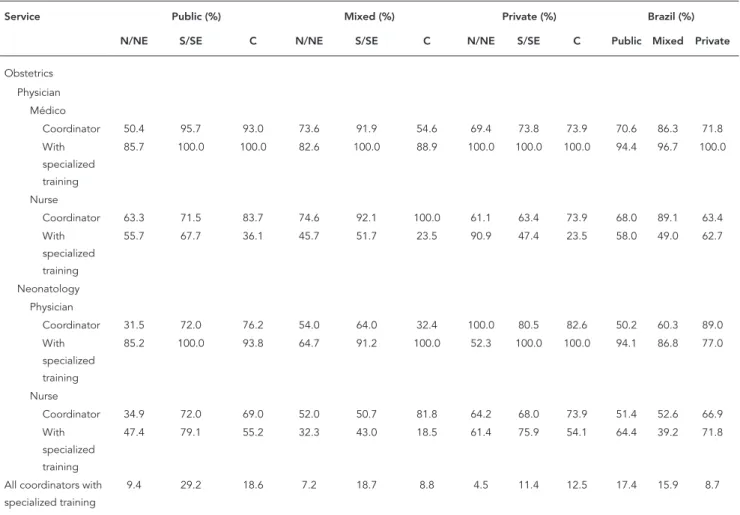
in the North/Northeast to 82% in mixed facili-ties in the Central. The proportion of maternity hospitals where all four coordinators had special-ized training (both head physicians and nurses in both obstetrics and neonatology) was higher in the South/Southeast and in public hospitals and was especially low in the North/Northeast, possibly due to the lack of such specialists in that macro-region.
Table 3 shows the availability of essential and strategic equipment for maternal and neonatal survival in emergencies. For maternal emergen-cies, the availability was greater in private (99%) and mixed (89%) and lower in public hospitals (71%), with a greater need in the North/North-east, where only 56% of public hospitals had such equipment. For neonatal emergencies as well, the availability was higher in private hos-pitals (88%), compared to 82% in mixed and 68% in public hospitals. Again, the gaps were greater in hospitals in the North/Northeast: only 45% of public hospitals and 64% of mixed hospitals had
all the necessary equipment. The availability of a blood bank or transfusion service varied from 48% in mixed hospitals in the North/Northeast to 84% in mixed hospitals in the South/South-east; overall, it was 75% in mixed, 69% in public, and 67% in private hospitals. Clinical pathology laboratories existed in 70% of mixed hospitals in the North/Northeast and 100% of public hospi-tals in the Central; the overall figures were 92% in public, 87% in private, and 85% in mixed hos-pitals. The availability of an ambulance for the woman varied from 50% in private hospitals in the North/Northeast to 100% in various regions and types of financing; overall, it was 97% in pub-lic, 88% in mixed, and 61% in private hospitals. Ambulance availability for the newborn varied from zero in private hospitals in the Central to 100% in public hospitals in the Central; overall, it was 67% in public, 51% in mixed, and 17% in private hospitals.
lower proportions in the private sector, except for surfactant and coagulant/hemostatic drugs for the woman. Still, concerning the availability of all drugs listed as essential, there was a rever-sal, with the following rates: private (71%), mixed (59%), and public (43%). Again, the largest gaps appeared in the North/Northeast, where only 37% of public and 35% of mixed hospitals had the complete list.
Table 5 shows that hospitals with higher com-plexity, defined here as having six or more neona-tal ICU beds plus adult ICU beds, comprised 30% of the public and mixed and 59% of the private hospitals. They were generally located in State capitals, especially in the case of public maternity hospitals (64%). There were proportionally more hospitals with higher complexity in the mixed fi-nancing category (80% in the North/Northeast
and 64% in the South/Southeast) and in the pri-vate category (68% in the South/Southeast and 57% in the Central). Hospitals with higher com-plexity tended to have a medium obstetric vol-ume, while those with lower complexity mostly performed fewer deliveries. Higher-complexity hospitals frequently included teaching activi-ties, served as high-risk referral, and had head physicians and nurses with specialized train-ing. These were also the hospitals that tended to have essential maternal and neonatal emergency equipment. Except for the private hospitals, the higher-complexity facilities were also more likely to have blood banks or transfusion services, clini-cal pathology laboratories, and ambulances for mothers and newborns.
Table 2
Proportion of maternity hospitals according to type of financing, major geographic region, and head physicians and nurses with specialized training. Brazil, 2010 *.
Service Public (%) Mixed (%) Private (%) Brazil (%)
N/NE S/SE C N/NE S/SE C N/NE S/SE C Public Mixed Private
Obstetrics
Physician
Médico
Coordinator 50.4 95.7 93.0 73.6 91.9 54.6 69.4 73.8 73.9 70.6 86.3 71.8 With
specialized training
85.7 100.0 100.0 82.6 100.0 88.9 100.0 100.0 100.0 94.4 96.7 100.0
Nurse
Coordinator 63.3 71.5 83.7 74.6 92.1 100.0 61.1 63.4 73.9 68.0 89.1 63.4 With
specialized training
55.7 67.7 36.1 45.7 51.7 23.5 90.9 47.4 23.5 58.0 49.0 62.7
Neonatology Physician
Coordinator 31.5 72.0 76.2 54.0 64.0 32.4 100.0 80.5 82.6 50.2 60.3 89.0 With
specialized training
85.2 100.0 93.8 64.7 91.2 100.0 52.3 100.0 100.0 94.1 86.8 77.0
Nurse
Coordinator 34.9 72.0 69.0 52.0 50.7 81.8 64.2 68.0 73.9 51.4 52.6 66.9 With
specialized training
47.4 79.1 55.2 32.3 43.0 18.5 61.4 75.9 54.1 64.4 39.2 71.8
All coordinators with specialized training
9.4 29.2 18.6 7.2 18.7 8.8 4.5 11.4 12.5 17.4 15.9 8.7
Proportion of maternity hospitals according to type of financing, major geographic region, availability of emergency equipment, blood bank, clinical pathology laboratory, and ambulances. Brazil, 2010 *.
Emergency equipment
Public (%) Mixed (%) Private (%) Brazil (%)
N/NE S/SE C N/NE S/SE C N/NE S/SE C Public Mixed Private
Obstetric Mechanical respirator/ Ventilator
62.9 91.4 74.4 69.0 95.0 97.1 97.2 100.0 100.0 74.4 90.0 98.8
Laryngoscope and endotracheal tube
85.6 100.0 100.0 89.6 100.0 100.0 100.0 100.0 100.0 92.1 98.0 100.0
Manual resuscitator
94.2 100.0 100.0 98.4 100.0 100.0 100.0 100.0 100.0 96.8 99.7 100.0
All equipment 56.3 91.4 74.4 64.3 95.0 97.1 97.2 100.0 100.0 70.6 89.1 98.8 Neonatal
Laryngoscope and endotracheal tube
83.8 100.0 100.0 85.7 100.0 100.0 100.0 95.9 100.0 91.1 97.2 98.0
Valve-less neonatal suction catheters
73.2 99.5 100.0 86.5 97.2 100.0 100.0 95.9 100.0 85.3 95.2 98.0
Meconium aspirator and aspirator with manometer and O2
55.0 94.1 100.0 86.5 90.6 73.5 100.0 76.2 95.7 73.2 88.9 88.2
Material for ventilation manual resuscitator)
88.5 100.0 100.0 92.1 100.0 100.0 100.0 95.9 100.0 93.8 98.4 98.0
All equipment 44.8 93.5 100.0 64.3 87.7 73.5 100.0 75.6 95.7 67.7 82.1 87.8
Blood bank or transfusion service
62.2 77.0 74.4 47.6 83.6 58.8 56.5 74.6 75.0 68.8 75.2 66.9
Clinical pathology laboratory
91.7 89.8 100.0 69.6 87.6 97.1 79.8 91.1 95.7 91.9 84.6 86.6
Ambulance for mothers
95.3 100.0 100.0 77.0 90.9 88.2 49.5 62.6 100.0 97.4 88.1 60.6
Ambulance for newborns
64.7 63.1 100.0 60.3 46.4 87.9 28.7 8.9 0.0 67.1 51.3 16.5
C: Central; N: North; NE: Northeast; S: South; SE: Southeast. * Values weighted according to sampling plan.
Discussion
By producing an overview of key structure issues in Brazilian maternity hospitals, this study aimed to identify the potentialities and deficiencies of the country’s health system in obstetric and neonatal care. This subject has drawn increas-ing attention from Brazilian researchers, given the country’s persistently and unacceptably high maternal and perinatal mortality rates, despite
the increasing coverage of in-hospital deliveries
4,10,22,23,24,25.
The study’s sampling design allowed a more in-depth investigation of variations in the struc-ture of maternity facilities according to type of financing and geographic location.
The study showed that the largest network of obstetric and neonatal care is outsourced by the SUS, corroborating similar studies in Rio de Ja-neiro 3,7, Greater Metropolitan São Paulo 22, and Santa Catarina State 27.
For maternity hospitals with mixed financ-ing, the study did not determine the proportions of users of the SUS versus clientele of private health plans or out-of-pocket users. However the results confirmed that the proportionally larger network of public maternity hospitals of SUS in the North/Northeast is due to the low population contingent covered by private health plans in that macro-region. Meanwhile, the concentration of the clientele covered by private health plans or paying out of pocket in the South/Southeast may indicate different patterns of health plans between the mixed and private maternity hos-pitals, besides expressing the organization of the supply in some locations with fewer public fa-cilities, the need to hire private services, and the need for private facilities to complement their revenue through service provision agreements with the SUS.
The greater availability of healthcare facilities outsourced by the SUS outside the State capitals was expected, given the population’s dispersal in large numbers of small cities and towns, espe-cially in the North/Northeast. The different pat-tern in the Central region of Brazil is worrisome, with an over-concentration of maternity hospi-tals in the State capihospi-tals. Unlike other regions, in the South/Southeast nearly all of the maternity hospitals with mixed financing were located out-side the State capitals, suggesting that in small-er cities the availability must be divsmall-ersified for the two clienteles to avoid multiplying services, which would be cost-ineffective; meanwhile, the public hospitals were concentrated in the State capitals, with a similar distribution to that of the private sector. The percentages of private hospi-tals located outside the State capihospi-tals varied little between regions, suggesting a private network organized according to its own logic.
The analysis of maternity hospitals accord-ing to complexity (whether they had a neona-tal ICU with six or more beds and an adult ICU) showed evidence of a difference in organization according to the three types of financing. The private network was better equipped, and there was no difference in the distribution of hospi-tals classified according to complexity between
Table 4
Proportion of maternity hospitals according to type of financing, major geographic region, and availability of medicines. Brazil, 2010 *.
Public (%) Mixed (%) Private (%) Brazil (%)
N/NE S/SE C N/NE S/SE C N/NE S/SE C Public Mixed Private
Medicines
Anti-hypertensives 100.0 99.5 100.0 100.0 100.0 100.0 92.7 89.4 100.0 99.8 100.0 92.1 Anxiolytics/Hypnotics 97.1 94.7 88.4 92.9 95.8 100.0 92.7 87.7 100.0 95.7 95.5 90.9 Steroids 97.1 100.0 100.0 93.6 100.0 100.0 97.2 89.4 100.0 98.4 98.8 94.1
Oxytocin 100.0 100.0 100.0 100.0 100.0 100.0 90.7 89.4 100.0 100.0 100.0 90.9 Uterine contractility
inhibitors
100.0 97.3 100.0 98.4 97.7 100.0 97.2 89.4 100.0 99.0 98.0 94.1
Magnesium sulfate 100.0 98.4 95.3 100.0 97.7 100.0 97.2 89.4 100.0 99.0 98.3 94.1
Surfactant 58.6 88.2 83.3 39.2 73.7 64.7 97.2 87.0 87.0 71.6 66.6 91.3 Coagulants/Hemostatic
drugs for woman
87.5 70.4 76.2 92.9 89.2 100.0 97.2 85.2 95.7 80.3 90.5 91.3
Coagulants/Hemostatic drugs for newborn
98.6 100.0 100.0 100.0 100.0 100.0 97.2 89.4 100.0 99.2 100.0 94.1
Solution for prevention of neonatal conjunctivitis
87.8 81.7 88.4 96.0 93.3 100.0 97.2 84.6 100.0 85.8 94.2 91.7
Anti-D immunoglobulin 74.8 95.7 88.4 96.0 93.3 100.0 97.2 84.6 100.0 83.6 93.6 79.5 All medicines 37.3 48.1 53.5 34.9 64.2 64.7 66.1 71.8 83.3 42.6 58.6 70.6
Proportion of maternity hospitals according to type of financing, level of complexity, location in State capital, and structure. Brazil, 2010 *.
Neonatal ICU with six or more beds and adult ICU (%)
Public Mixed Private
No Yes No Yes No Yes
Location in State capital 13.6 63.6 9.9 20.3 25.0 30.7
Obstetric volume
High 14.7 39.6 10.2 22.1 4.8 12.0
Medium 50.5 54.6 41.3 69.7 23.8 66.0
Low 34.8 5.8 48.5 8.2 71.4 22.0
Total 100.0 100.0 100.0 100.0 100.0 100.0
Teaching hospital 70.3 91.6 67.4 88.0 2.9 17.3
High-risk referral hospital 12.7 84.4 5.8 65.7 0.0 0.0
Head physician and head nurse with specialized training 5.4 45.5 5.1 38.5 4.8 12.0 Obstetric emergencies
All equipment 53.3 100.0 76.1 94.2 97.1 100.0
Neonatal emergencies
All equipment 61.8 90.9 87.3 92.3 87.5 88.7
Availability
Blood bank or transfusion service 57.2 94.8 65.8 94.7 71.4 63.3
Clinical pathology laboratory 89.0 98.7 83.6 86.5 73.1 96.0
Ambulance for mothers 96.3 100.0 87.8 88.9 61.9 59.3
Ambulance for newborns 70.8 58.4 48.8 56.9 34.3 4.0
Medicines
All medicines 32.6 66.0 48.1 80.3 46.2 88.0
* Values weighted according to sampling plan.
the State capitals, countryside, or region of the country. Most of the higher complexity public hospitals were located in the State capitals, with fewer in the countryside in the regions, espe-cially in the North/Northeast. This suggests pos-sible gaps for the population who have exclusive access to healthcare facilities through the SUS, and who may or may not be covered by mixed hospitals, of which the ones with higher com-plexity are concentrated in the countryside and with an important share in the North/Northeast of the country.
Despite the study’s inherent limitations, espe-cially the lack of detailed data on the number of available beds for admissions and the size, demo-graphic and social profile, and health needs of the childbearing-age and newborn population 10, the results presented here emphasize the geographic inequality in the supply of hospital services in the SUS, especially hospitals with higher complexity. The findings also show healthcare gaps that can force patients to travel long distances for hos-pitalization to give birth in a context of limited
support for pregnant women, thereby increasing the risk of infant death, as shown by Almeida & Szwarcwald 28, in addition to confirming that the regionalization of hospital care is still a challenge for Brazil.
The indirect indicators of the degree of com-plexity in the study sample’s maternity hospitals were the number of procedures performed, the existence of a neonatal ICU with at least six beds and/or an adult ICU, teaching activities, head physicians and nurses with specialized training in obstetrics and neonatology, and specifically for the public and mixed hospitals, being a refer-ral hospital for high-risk pregnancies.
in the use of sophisticated medical technology for managing emergency situations 23,29. How-ever, there were numerous public and mixed hospitals that performed more than a thousand deliveries in 2007 and that did not have an ICU. Meanwhile, in the private network, although there were more hospitals that performed fewer deliveries, facilities with an ICU were more com-mon – which could be indicative of the need for intensive care for the newborns, associated with either high cesarean rates in this sector or the cli-entele’s demands.
Many public and mixed hospitals conducted teaching activities, which could be indicative of more experienced staff and thus greater pos-sibility for a positive impact on quality of care. With the assumption that head physicians and nurses with specialized training in obstetrics and neonatology could show greater clinical compe-tence for decision-making to perform appropri-ate procedures 13,30, the article simply listed the existence of a head physician and/or nurse and their academic degrees. Even so, the presence of head physicians and nurses in the obstetrics and neonatology services was low, especially those with specialized training, even in higher-com-plexity hospitals. The most dramatic situation was in public maternity hospitals in the North/ Northeast. In the other regions, head physicians and nurses were nearly two times as common in public and mixed maternity hospitals compared to the private network.
Another mechanism with the potential to ex-pand access for patients that most need care was the regulation of hospitalization for delivery in the SUS, especially for high-risk pregnant wom-en and newborns.
Higher-complexity public and mixed mater-nity hospitals predominated among those serv-ing as high-risk referral facilities through hospital admissions call centers. Even so, a surprising per-centage of these hospitals failed to inform that they served as referral facilities for other mater-nity hospitals, thus displaying a lack of organiza-tion in the network for high-risk pregnancies and neonatal care. Another important point was the existence of low-complexity facilities that identi-fied themselves as referral hospitals for high-risk pregnancies. Of this total, 33% were located out-side the State capitals in the Northeast.
The study identified major gaps in hospital structure that can jeopardize the quality of ob-stetric and neonatal care, potentially increasing adverse maternal and neonatal outcomes 12.
The study showed that the minimum equip-ment for managing obstetric emergencies was reported as available in all hospitals in the pri-vate network and in all public and mixed facilities
with higher complexity. As for neonatal emergen-cy equipment, a significant proportion of hos-pitals failed to present the complete set of nec-essary equipment. This situation is worrisome, especially in lower-complexity public and mixed hospitals in the North and Northeast, which can further appear in the neonatal mortality rates.
Hemorrhage is one of the main causes of maternal death in Brazil, so it is worrisome that 40% of higher-complexity maternity hospitals in the private sector lack blood banks or transfu-sion services, especially considering their high surgery rates. The lack of blood transfusion ca-pability in the hospital delays treatment in these cases 13.
Although the availability of ambulances in maternity hospitals is necessary to guarantee timely hospitalization for adequate obstetric care, the study detected a critical situation, es-pecially in the private sector. The situation was even worse for transferring newborns from low-er-complexity maternity hospitals, potentially contributing to avoidable neonatal deaths, since the most common reason for transferring new-borns is the need for neonatal intensive care 4,13.
At the time of the interview, an important percentage of maternity hospitals reported not having one or more of the essential medicines available. The missing medicines included those for inducing pulmonary maturation in the new-born, interrupting hemorrhage, preventing Rh-negative alloimmunization, or preventing neo-natal conjunctivitis. This scenario is problematic since it can directly increase rates of such com-plications as miscarriage, neonatal respiratory distress syndrome 31, maternal and infant death, and Sheehan syndrome 32.
The study showed a large proportion of poorly equipped maternity hospitals lacking specialized staff, and the results indicate that the distribution of higher-complexity hospitals is more unequal than that of lower-complexity facilities. Of all the regions, the North/Northeast, followed by the Central, showed the worst gaps and problems, especially in public and mixed maternity hospi-tals. In the South/Southeast, these hospitals had better structures, reaching similar or even higher proportions than in the private sector. The re-sults indicate that an important share of mothers and newborns were exposed to unnecessary and avoidable risks.
ability of equipment and inputs does not neces-sarily mean that the women’s health needs were met when they sought care at these facilities.
Even considering the study’s limitations, the results provide backing for the debate on quality of hospital services in Brazil. They point to the need to continue the evaluation of hospital struc-ture and develop analytical studies to explore the question of variation in hospital performance, which will require more detailed information on other aspects of hospital structure, the socioeco-nomic profile and case severity of the clientele, and the process of obstetric and neonatal care,
women and retrieving data from patient files in the Birth in Brazil survey.
Finally, future studies should focus on the structure of regionalized perinatal care networks as the unit of analysis, since the issues of com-plexity, regulation, availability of blood banks and transfusion services, and others should be measured according to regional health needs, thus contributing to proposals for quality im-provement and suggesting paths for the organi-zation of regional healthcare networks 14, from the perspective of backing the organization and operation of the SUS.
Resumen
El presente estudio evalúa aspectos en cuanto a la es-tructura de una muestra de hospitales de maternidad en Brasil. El marco ha sido evaluado en función de pa-trones de referencia del Ministerio de Salud y abarca: ubicación geográfica, volumen de nacimientos, pre-sencia de IU, actividades de aprendizaje, formación de recursos humanos, disponibilidad de equipos y me-dicamentos. Los resultados muestran diferencias en la cualificación y disponibilidad de equipos y servicios de suministros para el parto, según regiones, y su grado de complejidad. El Norte/Nordeste y Centro-Oeste mostra-ron los mayores problemas. En el Sur/Sudeste, los
hospi-tales estaban mejor estructurados, alcanzando propor-ciones satisfactorias en diversos aspectos del estudio, cercanos o justo por encima del nivel de la red privada. Este estudio aporta al debate la cuestión la calidad es-tructural de los servicios hospitalarios que se ofrecen en el país, y hace hincapié en la necesidad de desarrollo de estudios de análisis que tengan en cuenta los procesos y resultados de la atención.
Contributors
S. D. A. Bittencourt participated in the study project’s national coordination and collaborated in the data analysis and writing of the article. L. G. C. Reis colla-borated in the elaboration of the questionnaire, data analysis, and writing of the article. M. M. Melo and P. L. Rodrigues collaborated in the elaboration of the ques-tionnaire and writing of the article. D. Rattner, D. O. Neves and S. L. Arantes were State coordinators of the study and collaborated in the data analysis and writing of the article. M. C. Leal was the national study coordi-nator and collaborated in the data analysis and writing of the article.
Acknowledgments
The authors wish to thank the project’s regional and State coordinators, supervisors, interviewers, and tech-nical staff and the participating mothers, who made this study possible, the Carmela Dutra and Xerém Munici-pal Maternity Hospitals for their trust in allowing their facilities to help test the questionnaire on structure in maternity hospitals. They also wish to thank Stella Lenz and Katherine Knust, scholarship holders under the Institutional Program for Scientific Initiation (PIBIC) for their help in organizing the references and elabora-ting the tables.
Funding
Funding for this study was provided by the National Council on Scientific and Technological Development (CNPq); Science and Tecnology Department, Secreta-riat of Science, Tecnology, and Strategic Inputs, Brazi-lian Ministry of Health; National School of Public He-alth, Oswaldo Cruz Foundation (INOVA Project), and the Rio de Janeiro State Research Foundation (Faperj).
References
1. Ministério da Saúde. Objetivos de desenvolvimen-to do milênio: relatório nacional de acompanha-mento. http://www.portal.saude.gov.br/portal/ar- quivos/pdf/relatorio_nacional_acompanhamen-to_220910.pdf (accessed on Sep/2013).
2. Victora CG, Aquino EM, do Carmo Leal M, Mon-teiro CA, Barros FC, Szwarcwald CL. Maternal and child health in Brazil: progress and challenges. Lancet 2011; 377:1863-76.
3. Leal MC, Gama SGN, Campos MR, Cavalini LT, Garbayo LS, Brasil CLP, et al. Fatores associados à morbi-mortalidade perinatal em uma amostra de maternidades públicas e privadas do Município do Rio de Janeiro, 1999-2001. Cad Saúde Pública 2004; 20 Suppl 1:S20-33.
4. Schramm JMA, Szwarcwald CL, Esteves MAP. Assis-tência obstétrica e risco de internação na rede de hospitais do Estado do Rio de Janeiro. Rev Saúde Pública 2002; 36:590-7.
5. Korst LM, Gregory KD, Lu MC, Reyes C, Hobel CJ, Chavez GF. A framework for the development of maternal quality of care indicators. Matern Child Health J 2005; 9:317-41.
do hospital organizational structure and processes affect quality of care? A critical review of research methods. Med Care Res Rev 2008; 65:259-99. 8. Stilwell J, Szczepura A, Mugford M. Factors
affect-ing the outcome of maternity care. 1. Relation-ship between staffing and perinatal deaths at the hospital of birth. J Epidemiol Community Health 1988; 42: 57-69.
9. Magluta C, Noronha MF, Gomes MAM, Aquino LA, Alves CA, Silva RS. Estrutura de maternidades do Sistema Único de Saúde do Rio de Janeiro: desafio à qualidade do cuidado à saúde. Rev Bras Saúde Matern Infant 2009; 9:319-29.
10. Leal MC, Viacava F. Maternidades do Brasil. Radis 2002; 2:8-26.
11. Conselho Regional de Medicina do Estado de São Paulo. Avaliação dos serviços de assistência ao parto e ao neonato no Estado de São Paulo, 1997-1998. São Paulo: Conselho Regional de Medicina do Estado de São Paulo; 2000.
12. Costa JO, Xavier CC, Proietti FA, Delgado MS. Ava-liação dos recursos hospitalares para assistência perinatal em Belo Horizonte, Minas Gerais. Rev Saúde Pública 2004; 38:701-8.
13. Rosa MLG, Hortale VA. Óbitos perinatais evitáveis e estrutura de atendimento obstétrico na rede pú-blica: estudo de caso de um município da região metropolitana do Rio de Janeiro. Cad Saúde Públi-ca 2000; 16:773-83.
14. do Carmo Leal M, da Silva AA, Dias MA, da Gama SG, Rattner D, Moreira ME, et al. Birth in Brazil: national survey into labour and birth. Reprod Health 2012; 9:15.
15. Agência Nacional de Vigilância Sanitária. Reso-lução RDC no 36, de 3 de junho de 2008. Dispõe
sobre Regulamento Técnico para Funcionamento dos Serviços de Atenção Obstétrica e Neonatal. Di-ário Oficial da União 2008; 4 jun.
16. Agência Nacional de Vigilância Sanitária. Resolu-ção RDC no 50, de 21 de fevereiro de 2002.
Regula-mento técnico para planejaRegula-mento, programação, elaboração e avaliação de projetos físicos de esta-belecimentos assistenciais de saúde. Diário Oficial da União 2002; 20 mar.
17. Ministério da Saúde. Portaria GM/MS no 1.091 de
25 de agosto de 1999. Cria a Unidade de Cuidados Intermediários Neonatal, no âmbito do SUS, para o atendimento ao recém-nascido de médio risco. Diário Oficial da União 1999; 26 ago.
18. Ministério da Saúde. Portaria GM/MS no 3.432, de
12 de agosto de 1998. Estabelece critérios de clas-sificação para as Unidades de Tratamento Intensi-vo – UTI. Diário Oficial da União 1998; 13 ago. 19. Ministério da Saúde. Portaria GM/MS no 2.048, de
5 de novembro de 2002. Regulamento técnico dos sistemas estaduais de urgência e emergência. Diá-rio Oficial da União 2002; 5 nov.
20. Ministério da Saúde. Portaria GM/MS no 1071, de
4 de julho de 2005. Política Nacional de Atenção ao Paciente Crítico. Diário Oficial da União 2005; 8 jul.
2 de dezembro de 2005. Garante às parturientes o direito à presença de acompanhante durante o trabalho de parto, parto e pós-parto imediato, no âmbito do Sistema Único de Saúde – SUS. Diário Oficial da União 2005; 2 dez.
22. Silva ZPD, Almeida MF, Ortiz LP, Alencar GP, Alen-car AA, Schoesp, et al. Morte neonatal precoce se-gundo complexidade hospitalar e rede SUS e não- SUS na Região Metropolitana de São Paulo, Brasil. Cad Saúde Pública 2010; 26:123-34.
23. Novaes MHD. Mortalidade neonatal e avaliação da qualidade de atenção ao parto e ao recém-nascido no Município de São Paulo. São Paulo, 1999 [Tese de Livre-Docência]. São Paulo: Faculdade de Me-dicina, Universidade de São Paulo.
24. Almeida MFD, Novaes HMD, Alencar GP, Rodri-gues LC. Mortalidade neonatal no Município de São Paulo: influência do peso ao nascer e de fa-tores sócio-demográficos e assistenciais. Rev Bras Epidemiol 2002; 5:93-107.
25. Barros AJD, Matijasevich A, Santos IS, Albernaz EP, Victora CG. Neonatal mortality: description and effect of hospital of birth after risk adjustment. Rev Saúde Pública 2008; 42:1-9.
26. Machado JP, Martins ACM, Martins MS. Avalia-ção da qualidade do cuidado hospitalar no Brasil: uma revisão sistemática. Cad Saúde Pública 2013; 29:1063-82.
27. Neumann NA, Tanaka OY, Victora CG, Cesar JA. Qualidade e equidade de atenção ao pré-natal e ao parto em Criciúma, Santa Catarina, Sul do Brasil. Rev Bras Epidemiol 2003; 6:307-18.
28. Almeida WS, Szwarcwald CL. Mortalidade infantil e acesso geográfico ao parto dos municípios brasilei-ros. Rev Saúde Pública 2012; 46:68-76.
29. Mayfield JA, Rosenblatt RA, Baldwin LM, Chu J, Logerfo JP. The relation of obstetrical volume and nursery level to perinatal mortality. Am J Public Health 1990; 80:819-23.
30. Rosa MLG, Hortale VA. Óbitos perinatais evitáveis e ambiente externo ao sistema de assistência: es-tudo de caso em município da Região Metropo-litana do Rio de Janeiro. Cad Saúde Pública 2002; 18:623-31.
31. Barría-Pailaquilén RM1, Mendoza-Maldonado Y, Urrutia-Toro Y, Castro-Mora C, Santander-Man-ríquez G. Trends in infant mortality rate and mortal-ity for neonates born at less than 32 weeks and with very low birth weight. Rev Latinoam Enferm 2011; 19:977-84.
32. Ruano R, Yoshizaki CT, Martinelli S, Pereira PP. Intercorrências clínico-cirúrgicas. In: Zugaib M, organizador. ZUGAIB obstetrícia. Barueri: Editora Manole; 2008. p. 851-82.
Submitted on 11/Oct/2013