www.bjorl.org
Brazilian
Journal
of
OTORHINOLARYNGOLOGY
ORIGINAL
ARTICLE
Difficult
septal
deviation
cases:
open
or
closed
technique?
夽
Sultan
S
¸evik
Elic
¸ora
∗,
Duygu
Erdem,
Hüseyin
Is
¸ık,
Murat
Damar,
Aykut
Erdem
Dinc
¸
ZonguldakBülentEcevitUniversity,FacultyofMedicine,DepartmentofOtorhinolaryngology,Zonguldak,Turkey
Received16December2015;accepted18March2016 Availableonline29April2016
KEYWORDS
Nasalseptum; Nasalsurgical procedures; Intranasalsurgery
Abstract
Introduction:Theaimofthisstudy istocomparethefunctionalaspects ofopentechnique (OTS)andendonasalseptoplasty(ENS)in‘‘difficultseptaldeviationcases’’.
Methods:60patientswithseverenasalobstructionfromS-shapeddeformities,multiple defor-mities,highdeviationsetc.wereincludedinthestudy.TheOTSwasusedin30patientsandthe ENSwasperformedin30patients.TheNasalObstructionSymptomEvaluation(NOSE)scalewas administeredpreoperativelyandatfirstmonthfollowingsurgery.Patientswerealsoevaluated forpainpostoperativelywithVisualAnalogScale(VAS).
Results:ThemeanNOSEscorewasdecreased62.5---11.0intheOTSgroupand61.3---21.33in theENSgroup.Improvementofthesymptomsfollowingthetwosurgicaltechniquesissimilar andnostatisticallysignificantdifferencewasfoundbetweenbothtechniques.Alsotherewas nostatisticallysignificantdifferenceinpostoperativepainbetweentheOTSandENSgroups evaluatedbyVAS.
Conclusion:ENS isassuccessfulas theOTSinmanagementdifficultseptaldeviationcases. Inpatients withsevereseptaldeformities typeofthesurgicaltechniqueshouldbeselected accordingtothesurgeon’sexperienceandthepatient’spreference.
© 2016 Publishedby Elsevier EditoraLtda. on behalf ofAssociac¸˜ao Brasileira de Otorrino-laringologiaeCirurgiaC´ervico-Facial.ThisisanopenaccessarticleundertheCCBYlicense (http://creativecommons.org/licenses/by/4.0/).
PALAVRAS-CHAVE
Septonasal; Procedimentos cirúrgicosnasais; Cirurgiaendoscópica
Casosdifíceisdedesvioseptal:técnicaabertaoufechada?
Resumo
Introduc¸ão:OobjetivodesteestudoécompararosaspectosfuncionaisdaSeptoplastiaentrea técnicaaberta(STA)eaendonasal(SEN)em‘‘casosdifíceisdedesviodeseptonasal’’.
夽
Pleasecitethisarticleas:S¸evikElic¸oraS,ErdemD,Is¸ıkH,DamarM,Dinc¸AE.Difficultseptaldeviationcases:openorclosedtechnique? BrazJOtorhinolaryngol.2017;83:256---60.
∗Correspondingauthor.
E-mail:[email protected](S.S¸evikElic¸ora).
PeerReviewundertheresponsibilityofAssociac¸ãoBrasileiradeOtorrinolaringologiaeCirurgiaCérvico-Facial.
http://dx.doi.org/10.1016/j.bjorl.2016.03.015
Método: Foramincluídos60pacientescomobstruc¸ãonasaldevidoadeformidadesemforma deS,múltiplasdeformidades,desviosaltosetc.ASTAfoiusadaem30pacienteseaSENem30. Aescaladeavaliac¸ãodosintomadeobstruc¸ãonasal(NOSE)foiadministradanopré-operatório enoprimeiro mêsapósacirurgia. OspacientestambémforamavaliadoscomEscalaVisual Analógica(EVA)paradornopós-operatório.
Resultados: Oescoremédio deNOSEfoireduzido de62,5-11,0 nogrupodaSTAe de 61,3-21,33nogrupodaSEN.Houvemelhoradossintomascomasduastécnicascirúrgicasenãofoi encontradadiferenc¸aestatisticamentesignificativaentreelas.Tambémnãohouvediferenc¸a estatisticamentesignificativanosgrausdedornopós-operatórioquetenhasidoavaliadapela EVAentreogrupodeSTAeodeSEN.
Conclusão:Deacordocomnossosdados,aSENétãobem-sucedidaquantoaSTAnotratamento de casosdifíceis dedesviode septonasal. Empacientescomdeformidadesseptaisgraves, otipodetécnicacirúrgicadeveserescolhidodeacordocomaexperiênciadocirurgiãoea preferênciadopaciente.
© 2016Publicadopor ElsevierEditora Ltda.em nomede Associac¸˜ao Brasileira de Otorrino-laringologia eCirurgiaC´ervico-Facial.Este ´eumartigo Open Accesssob umalicenc¸a CCBY (http://creativecommons.org/licenses/by/4.0/).
Introduction
Septoplastyis a common procedure in dailyear nose and throatpractice.Variousmethodsofsurgicaltreatmentare definedin nasal deformities thatcause nasalobstruction: endoscopicseptoplastyforposteriornasalobstruction, Cot-tle’sseptoplastyforseptum’sluxationanddeviationonthe premaxillaarea,septoplasty withspreadergraftsfor dor-sumcartilagedeviations,extracorporealseptoplastywitha newseptum cartilage framefor the complex deviations.1 The mostlyusedtechniqueis stilltheonethat definedby Cottlein1958.2
Severe septal deviations, caudal deformities, anterior deviations, S-shaped deviations, high deviations and mid-dorsal abnormalities are the ones that are defined as ‘‘difficultseptaldeviations’’.Insuchcasesendonasal septo-plastycanbeusedbysomesurgeonsbutalsoopentechnique septoplasty can be preferred to increase angle of vision. Bothtechniqueshavedifferentlimitationsthataffecttheir success.Intheopenseptoplasty,thelongerdurationofthe operation and the formation of postoperative columellar incisionscarlimitthetechnique.3Ontheotherhandinthe endonasalseptoplasty,narrow angleof visionandfor that morelimitedinterventionareaemergesasadisadvantage. Inthisstudyweaimtocomparethefunctionalresultsofthe openandtheendonasalseptoplastytechniquesindifficult septaldeviationcases.
Methods
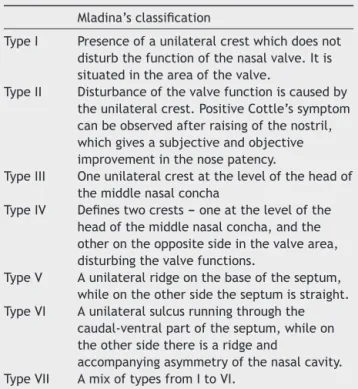
This study was designed asa prospective nonrandomized longitudinalstudyandapprovedbyethicalcommittee (Num-ber: 2014-119-01/07). Allparticipants signed an informed consent agreement. Patients who were applied to our ENT clinic because of nasal obstruction and diagnosed as nasal septal deviation between September 2014 and May 2015 were classified according to Mladina’s classification4
(Table 1). Among these patients who have had Mladina type4,6and7deviationswereincludedinthestudy.The patientswithinsufficient nasaltipsupportwere excluded fromthestudy.Beforethe surgery,informed consentwas obtained from all patients. The columellar incision was explainedparticularly.Patientswhohaveneeded an addi-tional surgery such as adenoidectomy, endoscopic sinus surgeryorturbinatesurgerywerenotincludedtothestudy. Revisioncasesandpatientswhoseagewas<16yearswere alsoexcluded.Opentechniquewasproposedtoallpatients, and the patients who agreed the open technique were
Table1 Mladina’sclassificationofdeviatedseptumnasi.
Mladina’sclassification
TypeI Presenceofaunilateralcrestwhichdoesnot disturbthefunctionofthenasalvalve.Itis situatedintheareaofthevalve.
TypeII Disturbanceofthevalvefunctioniscausedby theunilateralcrest.PositiveCottle’ssymptom canbeobservedafterraisingofthenostril, whichgivesasubjectiveandobjective improvementinthenosepatency.
TypeIII Oneunilateralcrestattheleveloftheheadof themiddlenasalconcha
TypeIV Definestwocrests---oneatthelevelofthe headofthemiddlenasalconcha,andthe otherontheoppositesideinthevalvearea, disturbingthevalvefunctions.
TypeV Aunilateralridgeonthebaseoftheseptum, whileontheothersidetheseptumisstraight. TypeVI Aunilateralsulcusrunningthroughthe
caudal-ventralpartoftheseptum,whileon theothersidethereisaridgeand
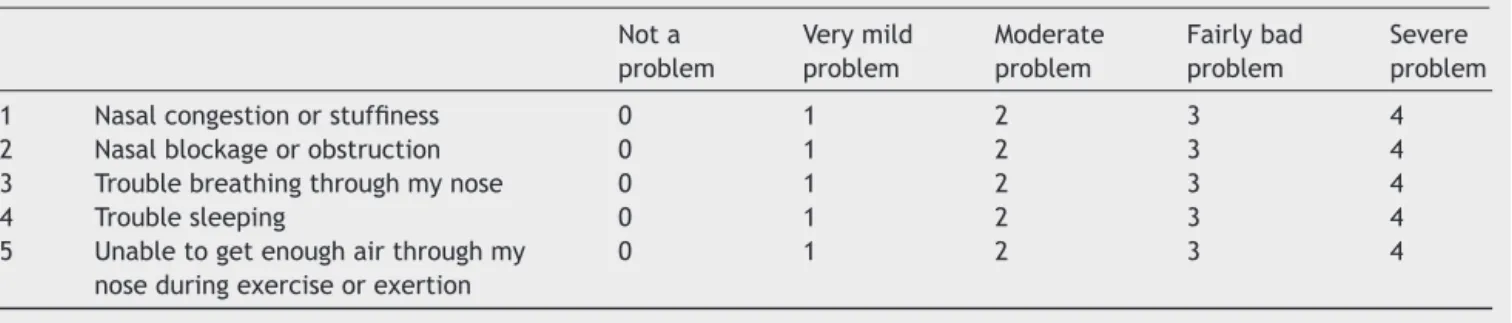
Table2 TheNoseObstructionSymptomEvaluation(NOSE)scale.
Overthepast1month,howmuchofaproblemwerethefollowingconditionsforyou?Pleasecirclethemostcorrectresponse
Nota problem
Verymild problem
Moderate problem
Fairlybad problem
Severe problem
1 Nasalcongestionorstuffiness 0 1 2 3 4
2 Nasalblockageorobstruction 0 1 2 3 4
3 Troublebreathingthroughmynose 0 1 2 3 4
4 Troublesleeping 0 1 2 3 4
5 Unabletogetenoughairthroughmy
noseduringexerciseorexertion
0 1 2 3 4
assignedtothe openseptoplastygroup. Thepatients who rejectedtheopentechniquegenerallybecauseofthe inci-sionscarwereincludedintheendonasalseptoplastygroup. Thestudywascompletedwhenthepatientnumberreached to30ineachgroup.
All surgical operations were carried out by the same team.To evaluatethefunctionalresultsof theoperations theNOSE scale (Table2) wasadministeredpreoperatively andat firstmonth following surgery. The NOSE scale is a symptomspecificscale,developedbyStewartetal.inwhich the patients scored five different symptom specific ques-tions, with 0 meaning ‘‘not a problem’’ and 4 meaning ‘‘severeproblem’’.Attheend,theseanswerswere calcu-latedwithatotalscorealwaysbetween0and20.Wethen multipliedthisscorebyfiveandcompleteditto100.Higher scoresmeanthesymptomseveritywashigher.Thescalewas translatedintoTurkish,anditsreliabilityintheTurkish pop-ulationwasdemonstratedby Kahvecietal. bya previous study.To get thebaselineNOSE scores, thepatientswere asked about the nasal obstruction symptoms prior tothe operation.
Midazolam was administered as premedication and surgeries were performed under general anesthesia with Remifentanilandinhalantanestheticforallpatients.
ForMladinatype4deviationsspreadergraftswereplaced afterseparationofthecartilagefromvomerandnasalcrest inopentechnique.Inclosedtechniqueaninvertedvshaped excisionandpartial thicknessscoringswereperformed on the posterior concave side of the deviated cartilaginous septum, excision is performed to inferior deviation and relaxation and minimal cartilage excision was applied to anteriordeviation.
ForMladinatype6deviationsafterelevationofbilateral mucoperichondrialflapsmaxillarycrestandasmallportion ofthecartilage wasresected.Thencartilage wasfixed in midlineandsuturatedtothesofttissuearoundthemaxillary crestinsuitablecases.
CombinationofthesemethodswasusedforMladinatype 7deviations.
Nonasal packingwasneeded. Bilateral internal silicon splints were used for all patients. For the postoperative painDiclofenacsodiumwasused.Inordertoanalyze post-operative pain,theVisual Analog Scale (VAS) wasusedat thepostoperativefirstday.VASisatoolbywhichpatients indicatedtheirgeneralsatisfactionwiththeoperation,with 1meaningleastand10meaningmaximumsatisfactionona 10cm line. Early follow up examinations were performed
with anterior rhinoscopy and endoscopic examination on thefirstandthethirdweekspostoperatively.Patientswere called tofollow-upexamination andfor asurveyonnasal obstruction symptoms at the postoperative first month. Patientswerefollowedupatleast6monthspostoperatively. Statistical analyses were performed using commercial software (IBM SPSS Statistics 20, SPSS Inc., an IBM Co., Somers, NY). Two paired sample t-test was usedto com-paretheNOSEscoresbetweenbaselineandpost-operative periods.Continuousvariableswerepresentedasthemean standarddeviation.Ap-value<0.05wasconsideredas sta-tisticallysignificant.
Results
60patientswereincludedinthestudy.Amongthesepatients 30weretreatedwiththeopentechniqueseptoplastyand30 werewiththeendonasalseptoplasty.Therewere23(76.6%) male and 7 (23.3%) female patients with a mean age of 35.2±12.6intheendonasalseptoplastygroup.Therewere 23(76.6%)maleand7(23.3%)femalepatientswithamean age of38.77±15.8in theopen techniquegroup.The dis-tributionofdeviationsaccordingtoMladina’sclassification amongtwogroupswasshowninTable3.Therewasno statis-ticallysignificant differenceamongMladina’sclassification betweentheopenseptoplastygroupandtheclosed septo-plastygroup(p=0.688).
In the open septoplasty group the mean NOSE scores at baselineand 1 month after surgeries were 62.5±22.2 and 11.0±13.2 and in the endonasal septoplasty group 61.33±20.38and21.33±25.4respectively.Thedifference between the baseline and the postoperative scores was highly significant (p<0.001), but the difference between thetwogroupswasnotstatisticallydifferent.InVASscores for evaluatingpostoperativepaintherewasnodifference
Table3 Thedistributionofdeviationsaccordingto Mlad-ina’sclassificationamongtwogroups.
Opentechnique septoplasty
Closedtechnique septoplasty
Total
Type4 5 3 8
Type6 4 5 9
Type7 21 22 43
betweenthetwogroups(p=0.106).Nomajorpostoperative complication(e.g.,saddling,recurrence,woundinfection, andseptalperforation)wasseeninanypatient.Mild bleed-ingoccurredinonepatientattheendonasalgroup.Minimal synechia occurred in one patient at the open technique group. Norevision septoplastysurgery wasneeded in any patient.
Discussion
Difficultyinnasal breathingisprobablythemost common complaint heard in rhinology practice. Among the major causes are nasal septum deviation and allergic rhinitis.5 Deviationofthenasalseptumcanresultinnasalobstruction, sinusdisease,crookednosedeformity,andotherstructural problems. Substantialdeviations ofthe nasalseptum may alsoaffect thehumidification, olfaction,air filtering,and temperatureregulationofthenoseandfinallysignificantly reducethequalityoflife.6,7
The bestmanagementofthepatientswithnasalseptal deviation is still under debate. There are no evidence-basedguidelinesfordecidingwhichpatientsaresuitablefor surgery,whatkindofoperationshouldbedone,andwhich patientswillbenefitthemost.8Especiallyindifficultseptal deviationcasesselectionofthesurgicaltechniquebecomes harder.Inthisstudy weevaluatedtheresults oftheopen techniqueandtheendonasalseptoplastyparticularlyin dif-ficultseptaldeviationcases.
It is hard to choose the exact surgical technique in these cases but it is also harder to evaluate this tech-niques’success.Ingeneral,evaluabletoolstomeasurethe septoplasty results can be categorized asobjective, such asrhinomanometry,acoustic rhinometry,computed tomo-graphy, and peak nasal inspiratory flow; and subjective, including patient history, the NOSE scale, questionnaires incorporatingVisual Analog Scale, theFairlay nasal symp-tomscore,theNottinghamHealthprofile,andthegeneral health questionnaire.5,7,9---12 Although noobjectivemethod hasbeen validatedyet,the NOSEscale developedby Ste-wartetal.isapromisingandreliablemethodforuseinnasal obstruction.13,14 Thisscale’sreliabilityintheTurkish popu-lationwasdemonstratedbyKahvecietal.9Wealsousedthe NOSEscoreforassessment.Eachparameterwasevaluated individuallyandnodifferencewasdeterminedbetweenthe twogroupsamongparameters.Wefoundthatthepatients withnasalobstructionandseptaldeformitywhoundergone nasalseptoplastyhaveverysignificantimprovementinnasal obstructionatfirstmonth.
In our study we alsoevaluated the postoperative pain degreebyVASbetweenbothsurgicaltechniques.Normally intheopenseptoplastybecausemuchdissectionwasdone in softtissues, itis expectedtohave muchpostoperative pain.15 Buttherewasnostatisticallysignificantdifference inpostoperativepaindegreesbetweenthetwogroups.
Thepresentstudyhasclearlimitations.Majorlimitations ofthis studyincludethefact thatonlyasmallnumberof patientsweresurveyedandthelackofrandomization.The lack of blindnesscouldbeexplained obviouslydue tothe externalscarintheopentechniqueseptoplastygroup.
Anotherlimitationofourstudyistheuseofasubjective evaluationmethodforcomparisonofdifferentseptoplasty
techniques. Therearemany studies in the literaturethat evaluatestheefficacyofseptoplastyprocedurebyseveral moreobjectivemethodssuchasrhinomanometry,acoustic rhinometryor peaknasalinspiratory flow.But in previous studiestheNOSEscale alonewasfound aseffective asall thosemethods.9
Anotherlimitationofourstudyisthatintheendonasal technique, external deformities accompanying to septal deviationcouldnotbefixedprecisely.Butinthebeginningof thestudyweinformedthepatientsabouttheoutcomesand complicationsofbothtechniquesandthepatientselected oneofthem. Andalsoin thatstudy weonly evaluatethe functionalresultsnottheestheticoutcomes.
Conclusion
Wecansay thatthetwodifferenttechniques canbe per-formed properly in ‘‘difficult septal deviation cases’’ for functionalresult.In suchdifficult casesthe closed septo-plastytechniqueisatleastassuccessfulasopentechnique inexperiencedhands.Thesurgicaltechniquemustbe cho-senaccordingtothespecificconditionsandthepreference ofthepatientortheexperienceofthesurgeon.
Conflicts
of
interest
Theauthorsdeclarenoconflictsofinterest.
References
1.BessedeJP,OrselS,AubryK,AlharethyS,LeratJ.Anewlook onseptoplasties: ananatomo-clinicalstudyand surgical pro-ceduresofthe4mainseptoplasties.RevLaryngolOtolRhinol. 2010;131:107---18.
2.OnealRM,Beil JrRJ,Schlesinger J.Surgicalanatomyofthe nose.OtolaryngolClinNorthAm.1999;32:145---8.
3.PhilipsPS,StowN,TimperleyDG,SacksR,SrubiskiA,HarveyRJ, etal.Functionalandcosmeticoutcomesofexternalapproach septoplasty.AmJRhinolAllergy.2011;25:351---7.
4.MladinaR.Theroleofmaxillarmorphologyinthedevelopment ofpathologicalseptaldeformities.Rhinology.1987;25:199---205. 5.Angelos PC, Been MJ, Toriumi DM. Contemporary review of
rhinoplasty.ArchFacialPlastSurg.2012;14:238---47.
6.MusaniMA,JavedI,KhambatyY,KhanFA,HasnainSWU.Quality oflifeafterseptalsurgery.JClinMedRes.2012;4:59---62. 7.KaratzanisAD,FragiadakisG,MoshandreaJ,ZenkJ,IroH,
Vele-grakisGA.Septoplastyoutcomeinpatientswithand without allergicrhinitis.Rhinology.2009;47:444---9.
8.KonstantinidisI,TriaridisS,TriaridisA,KaragiannidisK, Kont-zoglouG.Longtermresultsfollowingnasalseptalsurgery.Focus onpatients’satisfaction.AurisNasusLarynx.2005;32:369---74. 9.KahveciOK,MimanMC,YucelA,YucedagF,OkurE,AltuntasA.
Theefficiencyofnoseobstructionsymptomevaluation(NOSE) scaleonpatientswithnasalseptaldeviation.AurisNasus Lar-ynx.2012;39:275---9.
10.EdizerDT,ErisirF,AlimogluY,GokceS.Nasalobstruction follow-ingseptorhinoplasty:howwelldoesacousticrhinometrywork. EurArchOtorhinolaryngol.2013;270:609---13.
12.StewartEJ,RobinsonK,WilsonJA.Assessmentofpatient’s ben-efitfromrhinoplasty.Rhinology.1996;34:57---9.
13.StewartMG,WitsellDL,SmithTL,WeaverEM,YuehB, Hann-leyMT.DevelopmentandvalidationoftheNasalObstruction SymptomEvaluation(NOSE)scale.OtolaryngolHeadNeckSurg. 2004;130:157---63.
14.S¸ims¸ek G, Demirtas¸E.Comparison of surgicaloutcomes and patientsatisfactionafter2differentrhinoplastytechniques.J CraniofacSurg.2014;25:1284---6.