RBCCV 44205-1664 DOI: 10.5935/1678-9741.20150045
Effects of intraoperative diltiazem infusion on
low changes in arterial and venous grafts in
coronary artery bypass graft surgery
Efeitos da infusão intraoperatória de diltiazem sobre as mudanças do luxo em enxertos arteriais e
venosos em cirurgia de revascularização do miocárdio
Ozan Erdem
1, MD; Mehmet Erdem Memetoğlu
1, MD, PhD; Ali İhsan Tekin
1, MD; Ümit Arslan
1,
MD; Özgür Akkaya
1, MD; Rasim Kutlu
2, MD, PhD; İlhan Gölbaşı
1, MD; PhD
1Akdeniz University School of Medicine, Antalya, Turkey. 2Denizli State Hospital, Denizli, Turkey.
This study carried out at Akdeniz University School of Medicine, Antalya, Turkey.
No inancial support. No conlict of interest.
Correspondence Address: Mehmet Erdem Memetoğlu
Akdeniz University School of Medicine/Department of Cardiovascular Surgery DumlupÄnar Boulevard, 07058 - Antalya Campus, Antalya, Turkey E-mail: [email protected]
Article received on May 5th, 2015
Article accepted on June 22nd, 2015
Abstract
Objective: This study aimed to show the effects of
intra-op-erative diltiazem infusion on low in arterial and venous grafts in coronary artery bypass graft surgery.
Methods: Hundred fourty patients with a total of 361 grafts [205 (57%) arterial and 156 (43%) venous] underwent isolated
coronary surgery. All the grafts were measured by intraopera
-tive transit time low meter intra-opera-tively. Group A (n=70)
consisted of patients who received diltiazem infusion (dose of
2.5 microgram/kg/min), and Group B (n=70) didn’t receive dil
-tiazem infusion.
Results: Mean graft low values of left internal mammary
artery were 53 ml/min in Group A and 40 ml/min in Group B
(P<0.001). Pulsatility index (PI) values of left internal mamma
-ry arte-ry for Group A and Group B were 2.6 and 3.0 respec
-tively (P<0.001). No statistically signiicant difference was found
between venous graft parameters.
Conclusion: We recommend an effect of diltiazem
infu-sion in increasing graft lows in coronary artery bypass graft operations.
Descriptors: Flow Measurements. Coronary Artery Bypass.
Diltiazem. Myocardial Revascularization.
Resumo
Objetivo: Este estudo teve como objetivo mostrar os efeitos
da infusão de diltiazem intraoperatória no luxo arterial e en
-xertos venosos em cirurgia de revascularização do miocárdio.
Métodos: Cento e quarenta pacientes com um total de 361
enxertos [205 (57%) arteriais e 156 (43%) venosos] passaram por uma cirurgia coronária isolada. Todos os enxertos foram
medidos pelo medidor de luxo de tempo de trânsito intraope
-ratório. Grupo A (n=70), formado por pacientes que receberam infusão de diltiazem (dose de 2,5 micrograma/kg/min), e Grupo B (n=70), por aqueles que não receberam infusão de diltiazem.
Resultados: Os valores médios de luxo de enxerto de artéria ma
-mária interna esquerda foram 53 ml/min no grupo A e 40 ml/min no Grupo B (P<0,001). Valores do índice de pulsatilidade da artéria
mamária interna esquerda para o Grupo A e do Grupo B foram de 2,6 e 3,0, respectivamente (P<0,001). Não houve diferença estatistica
-mente signiicativa entre os parâmetros do enxerto venoso.
Conclusão: Sugerimos um efeito da infusão de diltiazem em
aumentar os luxos de enxerto em operações de bypass de arté
-ria coroná-ria.
Descritores: Medição de Vazão. Ponte de Artéria Coronária.
INTRODUCTION
Owing to technological developments and novel tech
-niques, coronary artery bypass graft (CABG) surgery is suc -cessfully performed in many centers.
The human internal mammary artery (IMA) is commonly used as a coronary graft in CABG surgery due to its superior
graft patency and increased long-term survival[1].
Graft spasm of the IMA is a long recognized problem, and vasospasm that may develop in arterial grafts during or after the surgery plays an important role in early postoper
-ative mortality and morbidity through impaired myocardial contraction and low output[2].
Despite extensive investigations on the antispastic ther
-apy in the past decades, IMA spasm sometimes still occurs even in the current practice. The mechanism of graft va
-sospasm is still unclear and many mechanisms can trigger
intraoperative and postoperative vasospasm; factors
in-cluding surgical stimulus, techniques used to remove the graft, or use of distal IMA segment as well as the effect of several mediators released into the circulation due to isch
-emic reperfusion damage that may result from the removal of cross clamp during cardio-pulmonary bypass (CPB) are involved in the development of vasospasm. Furthermore, reversal and prevention of graft vasospasm are often chal
-lenging and the most effective therapy to overcome spasm
is still controversial.
Intraoperative transit time low meter (TTFM) has been widely used to evaluate graft patency in CABG[3]. Compared with other methods for graft blood low measurement, intra
-operative TTFM is non-invasive, easy to use, reproducible and provides real-time information about the haemodynam
-ic characterist-ics of constructed grafts[4]. The TTFM can be
Abbreviations, acronyms & symbols
ACT Activated coagulation time
COPD Chronic Obstructive Pulmonary Disease CPB Coronary artery bypass graft
CVICU Cardiovascular intensive care unit DF Diastolic illing
IMA Internal mammary artery KCl Potassium chloride
LAD Left anterior descending artery LIMA Left internal mammary artery MI Myocardial infarction
NTG Nitroglycerin
PI Pulsatility index Qmean Mean graft low
RA Radial artery
SVG Vena saphenous vein graft TTF Transit-time lowmetry TTFM Transit time low meter
used to assess early graft function and to predict graft error
in CABG, thus allowing for prompt revision of anastomotic
imperfection and prevent graft failure[5].
Diltiazem is a benzothiazepine Ca channel blocker that can be used alone or in combination for the treatment of hy
-pertension (HT), angina and Prinzmetal angina and acts by blocking Ca aflux in myocardium and smooth muscle cells of vessels. It prevents extracellular Ca aflux between target
cells, decreases intracellular calcium and produces dilatation in systemic arteries[6].
In our study, we aimed to measure the effect of diltiazem in intraoperative graft lows using a quantitative method [transit-time lowmetry (TTF) technique], and to assess the predictive value of measured graft lows on in-hospital post -operative outcomes.
METHODS
Patients with coronary artery disease who underwent surgery in our clinic between March and July 2013 were in
-cluded in this prospective, randomized study. This study was approved by the Ethics Committee before initiation. Consent was obtained from the subjects for participation in the study in line with World Medical Association Declaration of Hel
-sinki (World Medicine Assembly, 2004 Tokyo, Japan). Cor
-onary artery bypass graft surgery was performed in the pa
-tients in accordance with the coronary artery bypass surgical revascularization indications established by ACC/AHA.
In this study, 140 patients underwent isolated coronary surgery with a total of 361 grafts. All the grafts that are op
-erated were measured by TTFM intra-operatively, among which 205 were arterial and 156 were venous. Age range was 36-81 (mean=59.8). 109 (78%) of the patients were male and 31 (22%) were female. Flow waves, mean graft low (Qmean) and Pulsatility index (PI) were used to consider graft as patent. Poor ventricular function (ejection fraction ≤ 40%), resting sinusal bradycardia (<55 beat/min), left bundle branch block were the preoperative exclusion criteria. Hemo
-dynamically unstable patients who required infusion of study drugs beyond the ranges of our study protocol, off-pump CABG, valve and additional aortic and non-cardiac surgery were also excluded intra-operatively. Risk classiication was performed using the EuroSCORE scale[7] created for surgical risk assessment. Demographic data were evaluated includ
-ing age, EuroSCORE scale, gender, hypertension, smok-ing, ejection fraction, diabetes mellitus, the use of intra-aortic bal
-loon pump, peripheral arterial disease, chronic renal failure, chronic obstructive pulmonary disease, previous myocardial infarction (MI), and emergency surgery.
The subjects were divided into two groups; Group A (n=70) consisting of patients who received diltiazem in
diltiazem infusion. Diltiazem was given at a dose of 2.5 microgram/kg/min (Diltizem-L, Mustafa Nevzat Pharma
-ceuticals, İstanbul, Turkey).
Surgical Procedure
The left IMA (LIMA) was dissected following median sternotomy. Distal IMA was divided under bleeding control before musculophrenic and superior epigastric branches, and prepared as graft with external administration of papaverine.
Radial artery (RA) and right vena saphenous vein graft (SVG) were prepared from non-dominant limbs in eligible patients simultaneously with IMA dissection. The possibili
-ty of postoperative extremi-ty ischemia was eliminated using modiied Allen test before RA dissection. A three-hundred unit/kg heparin was intravenously administered to maintain activated coagulation time (ACT) over 400 seconds. When this level was achieved, aorta and right atrium were cannu
-lated. The patients were cooled down to 30-32°C and cross clamp was placed. Extracorporeal circulation was established by roller pump (Sarns 9000 perfusion systems, Ann Arbor, Michigan USA) and membrane oxygenator (Sechrist 3500 HL, Anaheim USA). Pump prime solution was prepared us
-ing 1500 ml of R-inger Lactate, 150 ml of 20% mannitol and 60 ml of sodium bicarbonate. Keeping the mean arterial pres
-sure at 50-60 mmHg, pump low was adjusted at 2.2-2.4 l/m2/ min. Perfusion was continued in both groups so that hemato
-crit value would be over 25%.
A three-step cardioplegia was performed to protect myocardium. Following the cross clamp placement, 500 ml of normothermic blood cardioplegia was administered. The Ringer Lactate/blood content of normothermic blood cardioplegia was adjusted as 1:4. Then, topical cooling was administered with Ringer’s lactate solution at 4°C while 10 ml/kg cold crystalloid cardioplegia (St.Thomas sol.) was given at a mean pressure of 40 mmHg. The inal cardio
-plegia was given as a 500 ml of hot shot blood cardio-plegia immediately before the cross clamp removal. Distal coronary anastomoses were performed with 7/0 propylene material and proximal anastomoses with 6/0 propylene using contin
-ues suture technique. Proximal radial artery and saphenous vein anastomosis were done to aorta. Cross clamp was removed after distal anastomoses were inished and prox
-imal anastomoses were performed under side clamp prac
-tice. No hemoiltration was used. Bleeding was controlled at the surgery area after heparin effect was antagonized by protamine. Measurements were performed from the distal part of the graft and before sternum closure and recorded while taking into consideration Qmean, PI and diastolic illing (DF). The patients were taken to cardiovascular sur
-gery intensive care unit after sur-gery. They were connected
to ventilation and DII standard electrocardiogram, arterial pulse oximetry, arterial blood pressure and central venous
pressure were monitored.
Transit time low measurement
Flow measurement was performed using a transit time low meter (MediStim VeriQ System, Norway) after all anas
-tomoses were completed and haemodynamic parameters, such as blood pressure and heart rate, became stable. Based on graft diameter, either 3 or 4 mm, a low probe was used for low measurement. Measurements were performed from the distal part of the graft and before sternum closure, and low parameters recorded included Q mean, PI and diastolic illing (DF). Mean arterial pressure was strictly adjusted at 70-90 mmHg during measurements. Gel may be used during short segment IMA measurements to decrease the interposition be
-tween the vessel and the tissue and to increase probe-vessel relation. Before the measurements, blood low was increased by restoring the normal position of the heart by removing
pericardial suspenders.
Evaluation criteria for satisfactory anastomosis
Anastomotic patency was considered satisfactory when the following criteria were met: (i) waveform of blood low is normal and satisfactory. Blood illing is diastolic dominant. A DF value is >50 %, which is consistent with the characteris
-tics of coronary artery blood low. (ii) PI is acceptable (<5)[8]. Failure to meet either of the criteria indicated an anastomotic
defect and required an immediate revision.
All postoperative cardiac surgery patients were taken to a cardiovascular intensive care unit (CVICU). Patients dis
-charged from the CVICU were transferred to a general care ward under the care of the same team. All patients were mon
-itored continuously for a minimum of 24 h.
Postoperative parameters for investigation were as fol
-lows: need for revision, prolonged intubation, atrial ibrillation (AF), postoperative early myocardial infarction, postoperative development of acute renal failure and need for hemodialysis,
neurological complications, time spent in intensive care and
in-hospital mortality.
Statistics
Data was given as mean ± standard deviation. The sig
-niicance of demographic and clinical statistical difference between groups was evaluated using Student T test, Mann Whitney U test and Chi square tests. P values lower than 0.05 were considered signiicant. No signiicant difference was found between the groups in terms of demographic char -acteristics.
RESULTS
The study consisted of 140 patients underwent coronary sur
-gery with a total of 361 grafts. All the grafts that are operated were measured by TTF intraoperatively, among which 205 were arteri
In Group A, infusion with diltiazem was started in this group of patients following anesthesia induction and intu
-bation. In Group A, a total of 202 grafts were performed in 70 patients [69 (34%) LIMA, 63 (31%) saphenous vein, 70 (34%) radial artery], 43 (61%) of the patients were male and 27 (39%) were female. A total of 70 patients, 66 (94%) male and 4 (6%) female were evaluated. Age range was 36-78 with
an average of 57.
In Group B, a total of 159 grafts were performed in 70 pa
-tients [66 (42%) LIMA, 93 (58%) saphenous vein, 43 (61%) of the patients were male and 27 (39%) were female. Age range was 53-81 with an average of 64.7]. The mean car
-diopulmonary bypass time for Group A was 121.8±20.5 and 125±24.3 for Group B (minute, P=0.32).
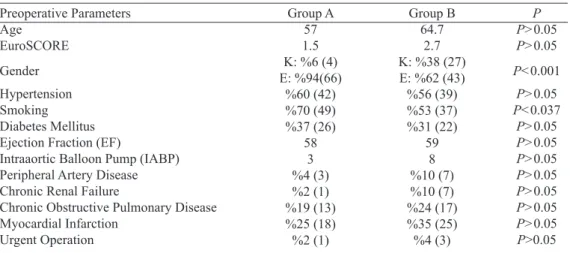
Comparison of the basal charecterictics, preoperative echocardiograic and clinical parameters among patients for Group A and Group B are shown in Table 1. Number of anas
-tomoses, Q mean, and PI and DF values for Group A and Group B patients are shown in Table 2.
In both Group A and B, LIMA-left anterior descending artery (LAD) anostomosis was performed in 69 patients, while LAD anastomosis was performed in one patient by us
-ing SVG because of the inconvenience of LIMA.
The detailed data revealed that the majority of the pa
-tients were male in Group A and were statistically different
(P<0.001).
Smoking was statistically signiicantly more common in Group A compared to Group B.
Table 1. Comparison of the basal charecterictics, preoperative echocardiograic and clinical parameters among patients from Group A and Group B.
Preoperative Parameters Age EuroSCORE Gender Hypertension Smoking Diabetes Mellitus Ejection Fraction (EF)
Intraaortic Balloon Pump (IABP) Peripheral Artery Disease Chronic Renal Failure
Chronic Obstructive Pulmonary Disease Myocardial Infarction
Urgent Operation
Group A 57 1.5 K: %6 (4) E: %94(66) %60 (42) %70 (49) %37 (26) 58 3 %4 (3) %2 (1) %19 (13) %25 (18) %2 (1) Group B 64.7 2.7 K: %38 (27) E: %62 (43) %56 (39) %53 (37) %31 (22) 59 8 %10 (7) %10 (7) %24 (17) %35 (25) %4 (3) P P>0.05 P>0.05 P<0.001 P>0.05 P<0.037 P>0.05 P>0.05 P>0.05 P>0.05 P>0.05 P>0.05 P>0.05 P>0.05
Table 2. Number, mean graft low, diastolic illing, and pulsatile index values for Group A and Group B patients. Group A LIMA-LAD RA-OM1 RA-RCA SVG-LAD SVG-DIAG SVG-OM1 SVG-RCA Group B LIMA-LAD SVG-LAD SVG-DIAG SVG-OM1 SVG-RCA Number 69 60 10 1 10 11 41 Number 69 1 11 43 38 Qmean 53 50 52 63 34 44 52 Qmean 40 8 39 45 65 PI 2.6 2.3 2.0 1.5 2.1 2.7 2.7 PI 3.0 4.5 2.4 3.3 2.8 DF 69 65 64 69 71 62 63 DF 66 55 71 66 61
LIMA=left Internal Mammary Artery; LAD=left anterior descending artery; RA=radial artery; OM=obtuse marginal; SVG=saphenous vein graft; DIAG=diagonal artery; RCA=right coronary artery; Q mean=mean
In a comparison between Group A and B, no difference was seen with respect to age, EuroSCORE, hypertension, di
-abetes mellitus, ejection fraction, peripheral arterial disease, chronic renal failure, Chronic Obstructive Pulmonary Dis
-ease (COPD), previous MI and emergency surgery.
All the arterial and venous grafts in both groups were re
-corded by measuring with TTF, and compared for Qmean, PI and DF values. Qmean and PI values were compared for IMA anastomoses, and a signiicant increase was found in Group A (P<0.001) (Table 3).
No signiicant difference was observed in the low mea -surements in venous graft anastomoses.
Among postoperative follow-up parameters, only the devel
-opment of atrial ibrillation was signiicantly different in Group A (6 patients) compared to Group B (16 patients) (P<0.020). Other parameters did not show any difference (Table 4).
not clearly deined. Many theories have been proposed in
-cluding techniques used to remove the arterial graft, inap
-propriate manipulations for the graft, over activation of Ca channels, increase in alpha-adrenergic activity, high blood pH, low body temperature, increased vasopressin levels, ex
-cessive release of histamine, low PaCO2, use of distal 1/3 part of IMA for anostomosis and smoking[9,10]. In addition, accu-mulation of depolarizing agents as KCl (potassium chloride), free radicals induced by alpha-adrenergic receptors, and in -crease in agents as arginine or vasopressine also play role in vasospasm[11].
In recent years, arterial grafts other than IMA have be
-come prominent since long term occlusion rates are high with saphenous vein. The most commonly used is the RA. Despite their high rate of staying patent, the most important problem when using arterial grafts is their susceptibility to vasospasm during perioperative period. In a meta-analysis issued by Wi
-jeysundera & Beattie[12], it was demonstrated that intraoper -ative use of diltiazem reduces the incidence of ischemia and supraventricular tachycardia, while being useful in reducing death and myocardial infarction in postoperative period.
Since vasospasm is induced by various pathways, gen
-eration of a synergic effect through simultaneous inhibition of different pathways by using Ca channel blockers and Ni
-troglycerin (NTG) concomitantly has been studied. Chanda
et al.[13] reported that concomitant use of diltiazem and NTG results in better outcomes in loosening of the contraction compared to when each drug is used alone.
Lemmer et al. reported in their study that intracoronary infusion of nitroglycerin had a beneicial effect in the loosen
-ing of vasospasm when used together with calcium channel blockers and that Ca channel blockers would have a benei -cial effect on ventricular dysfunction[14].
In the study of Tabel et al.[15], half of the patients under -going elective CABG were given diltiazem and the other half was given NTG together with anesthesia induction. Two mea
-surements had been taken. First, free low value was measured after IMA was cut from bifurcation level. Then, the second low measurement was performed after the distal segment was resected. The low values were found to be 53.8 ml/min in the irst measurement and 72.3 ml/min in the second in diltiazem group while the same values were 25.7 ml/min and 48.9 ml/ min, respectively, in NTG group (P=0.000, 0.004,
respective-ly). After the resection of distal segment, both agents increased the low (P=0.000, 0.000). However, they reported that dil
-tiazem was more effective in preventing IMA spasm. In our study, the low value in LIMA-LAD graft was 53 ml/min in the group that were given diltiazem and 40 ml/min in the group without diltiazem (P<0.001). Inokuchi et al.[16] reported that fasudil, a Rho-kinase inhibitor, is effective in suppressing cor
-onary artery spasm in patients with vasospastic angina. The IMA low can be increased by administering vasodi
-lators such as Ca channel blockers, long acting nitrates and Table 4. Comparison of number of Group A and Group B patients
according to postoperative parameters.
Need for Revision Prolonged Intubation Atrial Fibrillation Postop MI Postop HD Peripheral Embolus Neurologic Complication Duration of Intensive Care Mortality
Group A 4 6 6 0 1 0 3 4 0
Group B 4 10 16 0 7 0 2 3.3
4
P value >0.05 >0.05 <0.020
>0.05 >0.05 >0.05 >0.05 >0.05 >0.05 MI=myocardial infarction; HD=hemodialysis; Postop=postoperative Table 3. The Qmean and PI values compared for IMA anastomoses in Group A and B.
Grafts
LIMA - LAD (Q mean) LIMA - LAD (P)
Group A (n=69) 53 ml/min
2.6
Group B (n=66) 40 ml/min
3
P value
<0.001 <0.001 LIMA=left internal mammary artery; LAD=left anterior descending
artery; Q mean=mean graft low; PI=pulsatile index
DISCUSSION
In this study, by using intraoperative TTFM, it was ob
-served a statistically signiicant increase in arterial graft lows intraoperatively, and a lower incidence of atrial ibril
-lation during intra- and postoperative periods in the group that was given diltiazem.
Coronary artery spasm and the arterial graft that occurs
during and early after coronary artery surgery can result in a
sudden and severe cardiopulmonary failure. The mechanisms
phosphodiesterase inhibitors during surgery. Otherwise, this condition is associated with high mortality and morbidity. However, these agents are rather effective in decreasing graft spasm than their vasodilator effect. Apart from its effect on vasospasm, we discovered in our study that intraoperative use of diltiazem also reduces the development of atrial ibrilla
-tion. There was a statistically signiicant decrease compared to the other group (P<0.02). Besides its effect on arrhythmia, ventricle protecting and anti-ischemic effects have also been reported in the literature.
In a double blind, randomized study of Zhang et al.[17] on 71 elective CABG patients, diltiazem infusion provided a better protection against both ischemia and supraventricular arrhythmia.
It was also reported that preoperative diltiazem was effec
-tive in reducing arrhythmia and transient ischemic events in addition to prevention of IMA spasm[18].
The predicted blood low through LIMA-LAD graft is
25-50 ml/min[19]. This value is higher in venous grafts. That is because IMA cannot get adapted to the sudden decrease in the peripheral vascular resistance and increasing outlow. However, graft measurements in one year have shown a dou
-bled amount in blood low.
In the past, a number of methods had also been used to measure graft patency. Much better results have been reported with intraoperative TTF[20]. Perioperative low measurement protects the patient from unjustiiable complications and pro
-vides the surgeon with patency of the graft. We consider that use of TTF in CABG is important in order to achieve a high success and low mortality/morbidity. TTF measurement is fast, economic, effective and is a simple alternative that helps the surgeon compared to methods as CAG. Abnormal low was seen in ive of the grafts and revision was performed. We considered a possible anastomosis error in ive patients because of various reasons when all three parameters were assessed. All of these parameters recovered when the anosto
-moses were ixed. Thus, we protected the patients from any
postoperative complications.
The present study has several limitations. First of all, this study is not “surgeon-blind”, and the control group did not fully relect features of the study group. The number of pa
-tients who were included in the study was another limitation of our study. Although we adjusted for many clinical and proce
-dural characteristics, hidden confounders cannot be excluded, we did not measure other markers of speciic oxidative stress and inlammation which may be associated with vasospasm, such as free radical levels. In the studies, long term beneits were demonstrated for arterial grafts used in coronary revas
-cularization. Other studies should be performed in the future in order to understand the reasons and prevent arterial graft spasm which is the most important problem during intraop
-erative and early preop-erative period. In these studies, the novel techniques and treatment modes developed to prevent
vasospasm will contribute to the reduction of mortality and morbidity of future CABG surgery.
CONCLUSION
In conclusion, the beneicial effect of diltiazem on LIMA lows in patients undergoing CABG surgery was found in this study, we therefore recommend diltiazem infusion in in
-creasing LIMA graft lows.
Authors’ roles & responsibilities
OE Analysis and/or interpretation of data; inal manuscript ap -proval; implementation of projects and/or experiments MEM Analysis and/or interpretation of data; inal manuscript ap
-proval; implementation of projects and/or experiments AIT Analysis and/or interpretation of data; study design; imple
-mentation of projects and/or experiments ÜA Conduct of operations and/or experiments
ÖK Analysis and/or interpretation of data; implementation of projects and/or experiments
RK Analysis and/or interpretation of data IG Study conception and design
REFERENCES
1. He GW, Liu ZG. Comparison of nitric oxide release and endothelium-derived hyperpolarizing factor-mediated hyperpolarization between human radial and internal mammary arteries. Circulation. 2001;104(12 Suppl 1):I344-9.
2. He GW. Arterial grafts for coronary artery bypass grafting: biological characteristics, functional classiication, and clinical choice. Ann Thorac Surg. 1999;67(1):277-84.
3. Cerqueira Neto FM, Guedes MA, Soares LE, Almeida GS, Guimarães AR, Barreto MA, et al. Flowmetry of left internal thoracic artery graft to left anterior descending artery: comparison between on-pump and off-pump surgery. Rev Bras Cir Cardiovasc. 2012;27(2):283-9.
4. D’Ancona G, Karamanoukian HL, Ricci M, Schmid S, Bergsland J, Salerno TA. Graft revision after transit time low measurement in off-pump coronary artery bypass grafting. Eur J Cardiothorac Surg. 2000;17(3):287-93.
5. Di Giammarco G, Pano M, Cirmeni S, Pelini P, Vitolla G, Di Mauro M. Predictive value of intraoperative transit-time low measurement for short-term graft patency in coronary surgery. J Thorac Cardiovasc Surg. 2006;132(3):468-74.
6. Godfraind T. Calcium channel blockers in cardiovascular pharmacotherapy. J Cardiovasc Pharmacol Ther. 2014;19(6):501-15.
original EuroSCORE and EuroSCORE II in patients over the age of seventy. Interact Cardiovasc Thorac Surg. 2015;20(2):172-7.
8. Yu Y, Yan XL, Wei H, Yang JF, Gu CX. Off-pump sequential bilateral internal mammary artery grafting combined with selective arterialization of the coronary venous system. Chin Med J (Engl). 2011;124(19):3017-21.
9. Döpfmer UR, Braun JP, Grosse J, Konertz W. Temporary left ventricular assist and levosimendan for coronary artery spasm. Interact Cardiovasc Thorac Surg 2005;4(4):316-8.
10. Kimura N, Kawahito K, Adachi K, Murata H, Yamaguchi A, Adachi H, et al. Effects of intra-coronary and intra-graft administration of nicorandil for coronary spasm after coronary artery bypass grafting. Kyobu Geka. 2006;59(1):71-7.
11. Shapira OM, Alkon JD, Aldea GS, Madera F, Lazar HL, Shemin RJ. Clinical outcomes in patients undergoing coronary artery bypass grafting with preferred use of the radial artery. J Card Surg. 1997;12(6):381-8.
12. Wijeysundera DN, Beattie WS. Calcium channel blockers for reducing cardiac morbidity after noncardiac surgery: a meta-analysis. Anesth Analg. 2003;97(3):634-41.
13. Chanda J, Brichkov I, Canver CC. Prevention of radial artery graft vasospasm after coronary bypass. Ann Thorac Surg. 2000;70(6):2070-4.
14. Lemmer JH Jr, Kirsh MM. Coronary artery spasm following coronary artery surgery. Ann Thorac Surg. 1988;46(1):108-15.
15. Tabel Y, Hepağuşlar H, Erdal C, Catalyürek H, Acikel U, Elar Z, et al. Diltiazem provides higher internal mammary artery low than nitroglycerin during coronary artery bypass grafting surgery. Eur J Cardiothorac Surg. 2004;25(4):553-9.
16. Inokuchi K, Ito A, Fukumoto Y, Matoba T, Shiose A, Nishida T, et al. Usefulness of fasudil, a Rho-kinase inhibitor, to treat intractable severe coronary spasm after coronary artery bypass surgery. J Cardiovasc Pharmacol. 2004;44(3):275-7.
17. Zhang P, Chen G, Zhang P, Zheng K, Wang GL. Cardioprotective effects of diltiazem infusion in the perioperative period in patients undergoing coronary artery bypass grafting with extracorporeal circulation. Zhonghua Yi Xue Za Zhi. 2003;83(16):1387-90.
18. Hannes W, Seitelberger R, Christoph M, Keilich M, Kulinna C, Holubarsch C, et al. Effect of peri-operative diltiazem on myocardial ischaemia and function in patients receiving mammary artery grafts. Eur Heart J. 1995;16(1):87-93.
19. Di Giammarco G, Canosa C, Foschi M, Rabozzi R, Marinelli D, Masuyama S, et al. Intraoperative graft veriication in coronary surgery: increased diagnostic accuracy adding high-resolution epicardial ultrasonography to transit-time low measurement. Eur J Cardiothorac Surg. 2014;45(3):e41-5.