Original Ar
tic
le
Research conducted at the Speech-Language Pathology and Audiology Un-dergraduate Program, Universidade Federal de Santa Maria – UFSM – Santa Maria, RS, Brazil, with grants from the Coordenação de Aperfeiçoamento de Pessoal de Nível Superior – CAPES.
(1) Graduate Program (Master’s degree) in Human Communication Disorders, Universidade Federal de Santa Maria – UFSM – Santa Maria, RS, Brazil. (2) Speech-Language Pathology and Audiology Undergraduate Program, Graduate Program in Human Communication Disorders, Universidade Federal de Santa Maria – UFSM – Santa Maria, RS, Brazil.
Correspondence address: Jamile Konzen Albiero. R. Vale Machado, 1726/406, Centro, Santa Maria (RS), Brasil, CEP: 9701-500. E-mail: [email protected]
Received: 3/22/2010; Accepted: 11/29/2010
phonological disorder
Média dos valores da frase em crianças com desvio fonológico
evolutivo
Jamile Konzen Albiero1, Roberta Michelon Melo1, Fernanda Marafiga Wiethan1, Carolina Lisbôa Mezzomo2,
Helena Bolli Mota2
ABSTRACT
Purpose: To determine the average values of phrase in children with phonological disorder, and to compare it with benchmark values proposed in literature. Methods: The sample consisted of 16 children with phonological disorders, seven females and nine males, with ages between 4 years and 5 months and 7 years and 7 months. After confirmation of the diagnosis of developmental phonological disorder, subjects were submitted to language assessment through the investigation of the average values of phrase, as proposed in literature. In this assessment, using three different modalities of language enunciation, we collected the first five sentences spoken by each child, which were scored according to their complexity, by giving different weights to syntactic and lexical elements of each sentence. Results: When compared with the reference children, children with developmental phonological disorder presented lower values in all variables analyzed, and this difference was significant. The same was observed when the group was divided into age groups, however, in the age groups of 5 to 7 years some modalities analyzed showed no differences. Conclusion: According to this study, children diagnosed with developmental phonological disorder may present losses in other areas of language, such as semantics and morphosyntax, which are more evident in the early age groups.
Keywords: Speech disorders; Speech-language pathology; Child language; Child, preschool; Child; Semantics
INTRODUCTION
It is known that language consists of five subsystems: pragmatic, semantic, syntactic, morphological and phono-logical/phonetic(1). During the period of language acquisi-tion, these subsystems operate together and suffer mutual influences(2).
The acquisition of the phonological system involves three levels: perception, moment that the child pays attention in the adult speech, identifying the phonemes that she will produce; organization, in which the phonemes are used in a contrastive
way; and production, which represents the output sound of the phonemes(3,4).
This acquisition process occurs gradually until the esta-blishment of the phonological system is done according to the linguistic community in which the child is located(5). The age of four is considered an important landmark for the completion of the phonological inventory, and at this age most children have already acquired the contrasts of the adult phonemic system, and use language to communicate effectively(6).
Some children have alterations in the normal development of speech, which, in some cases, becomes unintelligible. These children present a Developmental Phonological Disor-der(DPD), which refers to disorders in the organization and classification of the sounds of speech. In this case, the child performs an inadequate production of phonemes, and makes inadequate use of phonological rules of the language(6-8).
Thus, the DPD is a linguistic disorder manifested by the use of abnormal patterns in spoken language(9). As phono-logy is an aspect of language, speech disorders that involve the organization of the sound system ought to be considered language problems(1).
neuromotor disorders, psychiatric disorders, hearing loss, or emotional and environmental factors(1).
Children with DPD usually present the following clinical features: spontaneous speech with loss of intelligibility, with the consonants being the segments more likely to present inadequacies; older than 4 years old; normal hearing for speech frequencies; absence of anatomical or physiological abnormalities in the mechanisms of the speech production; absence of neurological problems related to the speech pro-duction; adequate intellectual abilities for the development of oral language; oral language comprehension appropriate to the mental age; expressive language apparently well-developed in terms of vocabulary and length of utterances(8).
However, another author states that many children with DPD seem to have difficulties in other areas of the language such as syntax, morphology and lexicon. In some cases, the DPD prevents the development in these areas(1). Hence, accor-ding to the literature, pragmatic, semantic, morphosyntactic and phonological aspects should not be separated, as they are related in the development of linguistic abilities(9,10).
Due to the lack of an objective measure to classify a child’s language as delayed or deviant, a study(11) proposed the Ave-rage Values of Phrase (AVP), which provides qualitative and quantitative measures for the analysis of morphosyntactic and semantic elements, based on children with normal language development.
Other studies were carried out with the same purpose, using the Mean Length Utterance – MLU calculation(12,13). However, these measures can only be considerate an evolution reference regarding language development(13).
Based on the cited literature, it was drawn up the hypothesis that children with diagnosis of DPD, due to the fact that they have a deficit in one of the components of language – pho-nology, may present deficits in other areas of language, like semantics and morphosyntax.
In order to confirm or refute this hypothesis, the present study had the aim to determine the average values of phrase (AVP) in children with developmental phonological disorder, and to compare them with the reference values.
METHODS
This research is classified as experimental, descriptive and prospective, involving quantitative and qualitative measures of analysis.
The sample comprised two groups, one of children with normal phonological development (Group with Reference Values /Comparison(11) – RV Group), and one of children with DPD (DPD Group).
The group with reference/comparison values(11) consisted of 45 children with normal language development, which were submitted only to the AVP assessment. Children in this sample had ages between 2 and 7 years, but for the purposes of this research only the performances of children with ages from 4 to 7 years were analyzed, totalizing 29 children in the picture mode, 35 in the questions mode, and 30 in the story mode. All children in this group were enrolled in a private school and were part of high or middle high socio-economic classes.
The group of children with DPD was composed of 16 chil-dren in three modalities of language, being seven of the female gender and nine of the male gender, aged between 4 years and 5 months to 7 years and 7 months, the ones who make part of a research project approved by the Research Ethics Committee of the Universidade Federal de Santa Maria (UFSM), with the number 052/04. Moreover, most children with ages ranging from 5 to 7 years was already in school (public) and belong to a lower socioeconomic level.
These children with DPD were submitted to a speech- language pathology and audiology screening, and were waiting for care availability at the UFSM Speech-Language Pathology and Audiology Clinic. Parents or guardians signed the infor-med consent authorizing the participation of the children in this research.
The diagnosis of DPD was based on the following assess-ments: language, phonological awareness, phonology, working memory, vocabulary, stomatognathic system, hearing, auditory processing and auditory discrimination.
The main criterion for the inclusion of children in this scientific investigation was the diagnosis of DPD. Moreover, children should be authorized by their parents or their guar-dians to participate in the research by signing the informed consent. They also needed to be between 4 and 7 years old, because at 4 years old most children have concluded the phonological inventory, and the age of 7 years is considered the phase of stabilization or maturation of the language de-velopment, especially regarding the main morphosyntactic aspects(11).
The following aspects were considered exclusion criteria: subjects who had received or were receiving any kind of speech-language therapy; not signing the informed consent; presence of speech-language and/or audiological alterations other than the DPD; and the presence of evident neurological, cognitive and/or psychological impairments.
After confirming the DPD, children were submitted to further language evaluation with the research of the AVP(11). This assessment used the same instruments as the reference/ comparison study(11), that is, three different enunciation con-ditions (describing a picture, telling a story and answering questions) were used to collect and record the oral produc-tion of the subjects. The first five sentences spoken by the children in each evaluated modality were scored according to their complexity, i.e., different weights were attributed to syntactic and to lexical elements, according to a previous study(11).
According to this proposal(11), scoring was done as it follows: nouns and verbs, because they are considered the first to emer-ge in languaemer-ge acquisition and give meaning to the phrase, were considered semantic elements, and received two points each time they were used; adverbs, adjectives, prepositions, conjunctions, pronouns and articles were considered syntactic elements and received four points, as the use of these words would reveal a greater linguistic evolution.
and qualitative measures regarding the morphosyntactic and lexical aspects of the language of the subjects.
After score calculation, data were put in tables, for each modality of language, according to age range (4, 5, 6 and 7 years old) and, later, they were statistically analyzed.
For comparison, regarding all variables, between the DPD and the RV Group, which does not present complaints of delay in language development in general, it was used the Student’s t test. For this comparison, it was used all the collected data from each child in both groups, and not the final averages of each group.
For comparison between the ages of the DPD Group and the RV Group it was used the nonparametric Mann-Whitney U test. In both tests the significance level adopted was 5% (p<0.05).
RESULTS
Table 1 presents the averages for each variable analyzed for the group with DPD (Mean PD) and compared with the reference/comparison values of the task (Mean RV). In this first analysis, subjects were grouped according to the propo-sed variables (syntax, semantics, total construction and total extension), not considering their ages. For this, it was used the Student’s t test.
It can be observed in Table 1 that children with DPD ob-tained lower averages when compared to the averages of the children in the RV Group. This difference was significant for all analyzed variables.
Tables 2, 3, 4 and 5 present the comparative results between the averages obtained by children with DPD and the averages of the children in the RV Group, for syntax, semantics, total construction and total extension, considering the age range of
Table 1. Comparison between the values of the group with develop-mental phonological disorders and the reference/comparison values in the different language modalities
Modality Variable Mean PD
Mean
RV p-value
Picture
Syntax 7.25 14.52 ≤0.001*
Semantics 3.60 7.63 ≤0.001*
Total construction 10.80 22.16 ≤0.001*
Total extension 3.61 7.42 ≤0.001*
Story
Syntax 14.30 18.20 ≤0.002*
Semantics 6.65 7.73 0.02*
Total construction 20.95 25.93 ≤0.002*
Total extension 6.84 8.41 ≤0.001*
Questions
Syntax 10.65 15.31 ≤0.004*
Semantics 4.23 7.43 ≤0.001*
Total construction 14.78 22.74 ≤0.002*
Total extension 4.80 7.55 ≤0.008*
* Significant values (p≤0.05) – Student’s t test
Note: Mean PD = mean values of the group with developmental phonological disorder; Mean RV = mean reference/comparison values
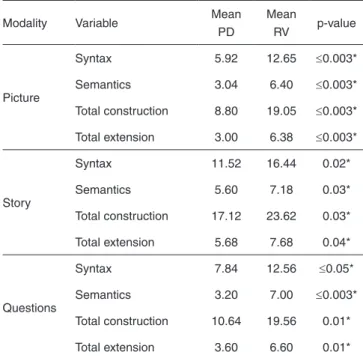
Table 2. Comparison between the values of children with developmental phonological disorders and the reference/comparison values in the age range of 4 years old
Modality Variable Mean PD
Mean
RV p-value
Picture
Syntax 5.92 12.65 ≤0.003*
Semantics 3.04 6.40 ≤0.003*
Total construction 8.80 19.05 ≤0.003*
Total extension 3.00 6.38 ≤0.003*
Story
Syntax 11.52 16.44 0.02*
Semantics 5.60 7.18 0.03*
Total construction 17.12 23.62 0.03*
Total extension 5.68 7.68 0.04*
Questions
Syntax 7.84 12.56 ≤0.05*
Semantics 3.20 7.00 ≤0.003*
Total construction 10.64 19.56 0.01*
Total extension 3.60 6.60 0.01*
* Significant values (p≤0.05) – Student’s t test
Note: Mean PD = mean values of the group with developmental phonological disorder; Mean RV = mean reference/comparison values
the children. For this, it was used the Mann-Whitney U test. It is observed that 4-year-olds with DPD present lower results in all analyzed variables (Table 2), with significant difference when compared with the results of the RV Group.
Table 3. Comparison between the values of children with developmental phonological disorders and the reference/comparison values in the age range of 5 years old
Modality Variable Mean PD
Mean
RV p-value
Picture
Syntax 6.60 12.91 0.02*
Semantics 3.40 7.20 0.01*
Total construction 10.00 20.11 0.01*
Total extension 3.35 6.80 0.01*
Story
Syntax 13.00 16.32 0.09
Semantics 7.10 7.44 0.78
Total construction 20.10 23.76 0.26
Total extension 6.55 7.82 0.16
Questions
Syntax 13.00 16.00 0.52
Semantics 5.30 7.80 0.14
Total construction 18.30 23.80 0.48
Total extension 6.00 7.96 0.40
* Significant values (p≤0.05) – Student’s t test
DISCUSSION
According to the literature, even though the different language subsystems are related, children with DPD only show deficits in the phonological aspect(7,8). However, in this research, the assessment showed that children with DPD presented, in all analyzed variables, lower results in lexical and morphosyntactic performances when compared with the results presented by children in the RV Group. That can also be observed in the comparison between age ranges, especially at the age of 4 years old.
Studies have shown that children from high socioecono-mic level have family environments that are more stimulating and conducive to learning than those of children from lower socio-economic levels(14-16). In addition, the educational level of parents may also influence children’s language develop-ment(14,17,18). Thus, it is inferred that the results of the present research may have been influenced by the socioeconomic level of the subjects, since the children in the RV Group were from a higher socio-economic level than the ones in DPD Group.
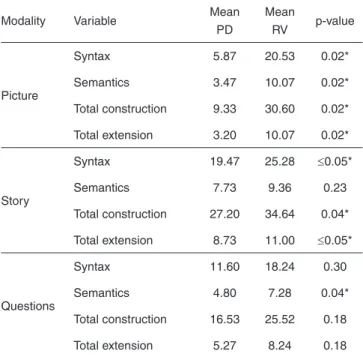
In Tables 3, 4 and 5, referring to ages of 5, 6 and 7 years, it was verified that not all values showed significant differences. These findings, according to some theoretical perspectives (cognitivism, for example), can be explained by the fact that language development is directly related to cognitive develo-pment. Thus, older children have better comprehension and use more accurate expressions than younger children(17,19).
Moreover, at the age ranges of 5, 6 and 7 years old, ac-cording to another research(20), children are in school age or they are entering school, developing greater ability to narrate facts, once that the school is where they begin to construct their narratives in a more systematic way, valuing the neces-sary aspects to be understood. This variable, school entrance, would equal the performance of children in both groups (DPD and RV) regarding lexical and morphosyntactic performance, eliminating the deficits observed in 4-year-old children, resul-ted from a low-stimulus environment.
Thus, it is possible to think that until 4 years old there is a greater inter-relationship between all areas of language (phonology, semantics and syntax), that becomes less intense after this age, when the linguistic components progressively become more independent.
Previous studies(21) have pointed out that children with DPD may show syntactic deficits, however, its influence is not yet clear. Hence, researchers have found that sentences with complex phonological forms were smaller and contained a greater number of grammatical and phonetic errors than sentences with more simple phonological forms. They also have found that a child correctly produced words when they were inserted in one-word sentences, but these same words contained mistakes when included in multi-word productions. These findings corroborate this research, since most of the children with DPD had lower performances regarding syn-tax in comparison to the performance of children in the RV Group. The results show that children in this study have a preference for less elaborated sentences from the linguistic point of view.
Regarding semantics, the difference found between
Table 4. Comparison between the values of children with developmental phonological disorders and the reference/comparison values in the age range of 6 years old
Modality Variable Mean PD
Mean
RV p-value
Picture
Syntax 10.60 13.30 0.61
Semantics 4.60 7.40 0.02*
Total construction 15.20 20.74 0.11
Total extension 4.95 7.03 0.07
Story
Syntax 15.20 18.40 ≤0.05*
Semantics 6.70 7.76 0.33
Total construction 21.90 26.16 0.04*
Total extension 7.15 8.48 0.07
Questions
Syntax 11.10 15.92 0.10
Semantics 4.00 7.56 0.02*
Total construction 15.10 23.48 ≤0.05*
Total extension 4.75 7.76 ≤0.05*
* Significant values (p≤0.05) – Student’s t test
Note: Mean PD = mean values of the group with developmental phonological disorder; Mean RV = mean reference/comparison values
Table 5. Comparison between the values of children with developmental phonological disorders and the reference/comparison values in the age range of 7 years old
Modality Variable Mean PD
Mean
RV p-value
Picture
Syntax 5.87 20.53 0.02*
Semantics 3.47 10.07 0.02*
Total construction 9.33 30.60 0.02*
Total extension 3.20 10.07 0.02*
Story
Syntax 19.47 25.28 ≤0.05*
Semantics 7.73 9.36 0.23
Total construction 27.20 34.64 0.04*
Total extension 8.73 11.00 ≤0.05*
Questions
Syntax 11.60 18.24 0.30
Semantics 4.80 7.28 0.04*
Total construction 16.53 25.52 0.18
Total extension 5.27 8.24 0.18
* Significant values (p≤0.05) – Student’s t test
Note: Mean PD = mean values of the group with developmental phonological disorder; Mean RV = mean reference/comparison values
children with DPD and children with normal language deve-lopment can be explained by a research that emphasizes that the extent of DPD presents negative correlation between the child’s phonological development stage and the size of his/her vocabulary(22,23). Another research has found that children with DPD name less often when asked than children within normal language development(23). Thus, with DPD being a language development alteration, the results found in the present study are relevant. However, these findings differ from other rese-arches that show no direct relationship between semantic and phonological development(9,24).
It is also possible to infer that the results of this study may have been a little different in relation to the baseline study due to the difference in the region of the country (South x Southeast of Brazil) in where children are located.
CONCLUSION
This research attained the initial purpose and, through its findings, it is possible to think that children diagnosed with DPD may have deficits in other subsystems of language. However, according to what has been discussed before and considering the possible influence of other variables in the results, it is suggested that further research with the same aim of the present study should be conducted in order to confirm or refute these findings.
Thus, it is emphasized the importance of the speech-langua-ge pathologist to understand and interpret the interrelationship between phonological deficits and the development of the other four subsystems of language – pragmatic, semantic, syntactic and morphological.
RESUMO
Objetivo: Verificar a média dos valores da frase em crianças com desvio fonológico e comparar com o padrão de referência proposto na literatura. Métodos: A amostra foi constituída de 16 crianças com desvio fonológico, sendo sete do gênero feminino e nove do gênero masculino, com idades entre 4 anos e 5 meses e 7 anos e 7 meses. Após a confirmação do diagnóstico de desvio fonológico evolutivo, os sujeitos foram submetidos à avaliação da linguagem por meio da pesquisa da média dos valores da frase, proposta na literatura. Nessa avaliação, por meio de três diferentes modalidades de enunciação da linguagem, foram coletadas as cinco primeiras frases faladas pelas crianças e pontuadas de acordo com a sua complexidade, sendo atribuídos pesos diferentes aos elementos sintá-ticos e aos elementos lexicais de cada frase. Resultados: Quando comparadas com as crianças de referência, as crianças com desvio fonológico evolutivo apresentaram valores inferiores em todas as variáveis analisadas, sendo a diferença significativa. O mesmo foi observado quando o grupo foi dividido em faixas etárias, porém, nas faixas de 5 a 7 anos algumas modalidades analisadas não apresentaram diferenças significativas. Conclusão: Conforme este estudo, crianças com diagnóstico de desvio fonológico evolutivo podem apresentar prejuízos em outros subsistemas da linguagem como o semântico e o morfossintático, sendo estes mais evidentes nas faixas etárias iniciais.
Descritores: Distúrbios da fala; Patologia da fala e linguagem; Linguagem infantil; Pré-escolar; Criança; Semântica
REFERENCES
1. Mota HB. Terapia fonoaudiológica para os desvios fonológicos. Rio de Janeiro: Revinter; 2001.
2. Schirmer CR, Fontoura DR, Nunes ML. Distúrbios da linguagem e aprendizagem. J Pediatr (Rio J). 2004;80(2):95-103.
3. Wertzner HF. Estudo da aquisição do sistema fonológico: o uso de processos fonológicos em crianças de três a sete anos. Pró-Fono. 1995;7(1):21-6.
4. Befi-Lopes DM, Gândara JP, Araújo K. Aquisição do sistema fonológico em crianças com alterações no desenvolvimento da linguagem. Pró-Fono. 2003;15(1):19-30.
5. Vieira MG, Mota HB, Keske-Soares M. Relação entre idade, grau de severidade do desvio fonológico e consciência fonológica. Rev Soc Bras Fonoaudiol. 2004;9(3);144-52.
6. Lamprecht RR, organizador. Aquisição fonológica do português: perfil de desenvolvimento e subsídios para terapia. Porto Alegre: Artmed; 2004. 7. Montenegro AC, Costa TL. Desvio fonético x desvio fonológico:
algumas considerações. J Bras Fonoaudiol. 2004;5(21):258-63. 8. Grunwell P. The nature of phonological disability in children. London:
Academic Press; 1981.
9. Befi-Lopes DM, Gândara JP. Desempenho em prova de vocabulário de crianças com diagnóstico de alteração fonológica. Rev Soc Bras Fonoaudiol. 2002;7(1):16-22.
10. Stoel-Gammon C. Normal and disordered phonology in two-year-olds.
Top Lang Disord. 1991;11(4):21-32.
11. Jakubovicz R. Atraso de linguagem: diagnóstico pela média dos valores da frase. Rio de Janeiro: Revinter; 2002.
12. Eisenberg SL, Fersko TM, Lundgren C. The use of MLU for identifying language impairment in preschool children: a review. Am J Speech Lang Pathol. 2001;10(1):323-42.
13. Fensterseifer A, Ramos AP. Extensão média de enunciados em crianças de 1 a 5 anos. Pró-Fono. 2003;15(3):251-8.
14. Beitchman JH, Jiang H, Koyama E, Johnson CJ, Escobar M, Atkinson L, et al. Models and determinants of vocabulary growth from kindergarten to adulthood. J Child Psychol Psychiatry. 2008;49(6):626-34. 15. Bagby JH, Rudd LC, Woods M. The effects of socioeconomic diversity
on the language, cognitive and social–emotional development of children from low- income backgrounds. Early Child Dev Care. 2005;175(5):395–405.
16. Hoff E, Tian C. Socioeconomic status and cultural influences on language. J Commun Disord. 2005;38(4):271-8.
17. Basilio CS, Puccini RF, Silva EM, Pedromônico MR. Living conditions and receptive vocabulary of children aged two to five years. Rev Saúde Pública. 2005;39(5):725-30.
19. Mecca FD. Investigação das funções da linguagem, da teoria da mente, do vocabulário e do desempenho escolar de alunos surdos. Rev Soc Bras Fonoaudiol. 2005;10(4):250.
20. Santos LF. O Valor do letramento escolar para o desenvolvimento da linguagem: expressões temporais em narrativas infantis. Monographia- Desafios do Nosso Tempo. 2007;3(4):230-42.
21. Schwartz RG. Interações entre os componentes da língua no desenvolvimento normal e com desvios. In: Yavas MS. Desvios fonológicos em crianças: teoria, pesquisa e tratamento. Porto Alegre: Mercado Aberto; 1990. p. 51-82.
22. Athayde ML, Carvalho Q, Mota HB. Vocabulário expressivo de crianças com diferentes níveis de gravidade de desvio fonológico. Rev CEFAC. 2009;11(Supl 2):161-8.
23. Mota HB, Kaminski TI, Nepomuceno MR, Athayde ML. Alterações no vocabulário expressivo de crianças com desvio fonológico. Rev Soc Bras Fonoaudiol. 2009;14(1):41-7.