Trypanosoma cruzi
: Acute and long-term infection in the vertebrate
host can modify the response to benznidazole
Se´rgio Caldas
a, Fabiane M. Santos
a, Marta de Lana
a,b, Lı´via F. Diniz
c,
George L.L. Machado-Coelho
a,d, Vanja M. Veloso
a,c, Maria T. Bahia
a,c,*aNu´cleo de Pesquisas em Cieˆncias Biolo´gicas, Universidade Federal de Ouro Preto, Minas Gerais, Brazil bDepartamento de Ana´lises Clı´nicas, Escola de Farma´cia, Universidade Federal de Ouro Preto, Minas Gerais, Brazil
cDepartamento de Cieˆncias Biolo´gicas, Instituto de Cieˆncias Exatas e Biolo´gicas, Universidade Federal de Ouro Preto, Minas Gerais, Brazil dDepartamento de Farma´cia, Escola de Farma´cia, Universidade Federal de Ouro Preto, Minas Gerais, Brazil
Received 20 March 2007; received in revised form 27 June 2007; accepted 29 August 2007 Available online 7 September 2007
Abstract
We analyzed the influence ofTrypanosoma cruzimaintenance in different hosts (dog and mouse) on its susceptibility to benznidazole treatment. FiveT. cruzistocks were isolated from dogs inoculated with Be-62 or Be-78 strain (both sensitive to benznidazole) 2–10 years ago, and the benznidazole sensitivity was then determined using the mouse as experimental model. The differentT. cruzistocks obtained from long-term infected dogs showed 50–90% drug resistance right after isolation. However, maintenance of theseT. cruzistocks in mice, by successive blood passages (2.5 years), led to either a decrease or stability of the drug resistance pattern and an increase in parasite virulence. We also demonstrated the effectiveness of the induction of parasitemia reactivation by cyclophosphamide immunosuppression in the evaluation of the response to the specific drug treatment.
2007 Elsevier Inc. All rights reserved.
Index Descriptors and Abbreviations: Trypanosoma cruzi; Chagas disease; Drug resistance; Chemotherapy; Cure control; Bz, benznidazole; Nf, nifurtimox
1. Introduction
The use of DNA probes targeted toT. cruzikinetoplast
DNA extracted from mummified Andean humans demon-strated that Chagas disease was highly prevalent in
South-ern Andean Coastal Area 9000 years ago (Aufderheide
et al., 2004). Currently, 16–18 million people in Mexico, Central American and Latin American countries are
infected with T. cruzi, and 40 million remain at risk of
acquiring the disease (WHO, 2002).
Specific chemotherapy for Chagas disease was devel-oped empirically about three decades ago but still remains very unsatisfactory. Currently available drugs are: a
nitro-imidazole compound, benznidazole (Bz) (Rochagan, Rada-nil, Roche) and a nitrofuran compound, nifurtimox (Nf) (Lampit, Bayer, recently discontinued). According to clini-cal trials, the earlier the diagnosis and specific treatment
the higher the chances of parasitological cure (Guedes
et al., 2006). Differences in drug susceptibility of T. cruzi
strains have been described by different authors (Filardi
and Brener, 1987; Toledo et al., 2003; Guedes et al., 2006). Filardi and Brener (1987) described the existence of strains naturally resistant to Bz and Nf. Recently, Toledo et al. (2003) demonstrated a correlation between
phylogenetic divergence among T. cruzi stocks and their
susceptibilities to chemotherapeutic agents in vivo. Their
data indicated that failure in clinical treatment, at least during the acute phase of infection, is most likely related
to theT. cruzistrain and its resistance to the specific drugs.
However, during the chronic phase, it is more difficult to correlate the parasite strain with drug resistance due to
0014-4894/$ - see front matter 2007 Elsevier Inc. All rights reserved. doi:10.1016/j.exppara.2007.08.016
* Corresponding author. Address: Departamento de Cieˆncias
Biolo´gi-cas, Instituto de Cieˆncias Exatas e Biolo´giBiolo´gi-cas, Universidade Federal de Ouro Preto, Minas Gerais, Brazil. Fax: +55 31 35591680.
E-mail address:[email protected](M.T. Bahia).
the low cure rates obtained. Only 27.1% of the T. cruzi strain isolated from different hosts and geographic areas
have been considered resistant to Bz and/or Nf (Andrade
et al., 1985; Andrade et al., 1992). Clinical trials have shown that treatment with Bz or Nf shows small or no effect in prevalent long-term Chagas disease, with cure
rates varying among 0–19% (de Ferreira, 1990; Viotti
et al., 1994; Suasna´bar et al., 2000; Lauria-Pires et al., 2000; Braga et al., 2000; Canc¸ado, 2002).
More recently, Veloso et al. (2001) showed that
long-term infection in vertebrate host can alterT. cruzi
suscep-tibility to Bz. In this work, two T. cruziisolates obtained
from dogs inoculated with Be-78 strain, which is 100%
sus-ceptible (Toledo et al., 1995) to Bz, showed 30–50%
resis-tance to the drug after 25 blood passages in mice. The
results indicated that long-term maintenance of T. cruzi
strains in vertebrate host may induce parasite drug resis-tance and can explain, at least in part, the therapeutic fail-ure observed for patients treated with Bz or Nf during the chronic phase of Chagas disease.
To confirm this hypothesis we studied fiveT. cruzi
pop-ulations isolated from dogs inoculated with 62 and Be-78 strains (sensitive to Bz) 2–10 years ago. Immediately after isolation, Bz sensitivity was determined using the mouse as experimental model. Soon afterwards these stocks were maintained by successive blood passages in mice during 2.5 years, and to each 5 or 10 blood passages a new determination to Bz sensitivity was performed. The main goal was to evaluate if the type of maintenance would
induce new alterations in Bz sensitivity pattern for eachT.
cruzistock isolated from dogs.
2. Materials and methods
2.1. T. cruzi stocks and their maintenance
Be-62 and Be-78 strains—T. cruziII. These strains were
isolated from patient Berenice in 1962 (Salgado et al., 1962)
and 1978 (Lana and Chiari, 1986), respectively, and
main-tained cryopreserved in liquid nitrogen as well as by succes-sive blood passages in mice. Berenice is considered to be
the first reported human case of Chagas disease (Chagas,
1909).
Five T. cruzi stocks were obtained from different out-breed dogs after long-term infection with either Be-62 or Be-78 strains. Two dogs had been inoculated with Be-62 strain 10 years ago (Be-62A and Be-62B), and three had been infected with Be-78 strain for two (Be-78D), seven
(Be-78C) and ten (Be-78E) years. Table 1 shows details
about the origin of theT. cruzistocks.
The parasites isolated from dogs were grown in LIT
(Liver Infusion Tryptose) medium at 28C (Camargo,
1964) and inoculated in Swiss mice. Blood from two mice
infected with each stock and with wild-type strains (Be-62 and Be-78) was collected from orbital venous sinus and inoculated by intraperitoneal route in normal mice. These stocks were maintained in mice for 60 blood passages
dur-ing a period of approximately 2.5 years. Blood from the 1st, 5th, 10th, 15th, 20th, 30th, 40th, 50th and 60th blood passage in mice was used to inoculate groups of 16 female
albino Swiss mice (about 18–20 g each) with 5·103
blood-stream forms of each stock. Bz resistance profile and para-sitemia curves were then evaluated. In parallel was evaluated the Bz resistance profile and parasitemia curves of Be-62 and Be-78 wild-type strains.
All procedures and experimental protocols were con-ducted in accordance with the COBEA (Brazilian School of Animal Experimentation) and behavior instructions for the use of animals in research.
2.2. Determination of the Bz susceptibility
Bz (N-benzyl-2-nitro-1-imidazolacetamide—Roche
Com-pany) resistance/susceptibility tests were performed in groups of 10 mice infected with parasites obtained from the different blood passages. Animals were treated after detection of parasitemia, which occurred around the 4th to the 10th day post-inoculation. Bz was administered orally (100 mg/kg of body weight) in a suspension made with 4% arabic gum, for 20 consecutive days. Theses stocks
were classified according toToledo et al. (2003)as resistant
(cure rates633%), partially resistant (346cure rates6
66%), and susceptible (cure ratesP67%) to Bz.
2.3. Evaluation of parasitological cure
To verify the occurrence of parasitological cure, a bat-tery of four independent tests was performed, including fresh blood examination before and after cyclophospha-mide immunosuppression, hemoculture, PCR and a
sero-logical enzyme-linked immunosorbent assay. The
therapeutic failure was based on both parasitological and serological methods. Animals presenting positive results in the parasitological and serological tests were considered non-cured.
2.3.1. Fresh blood examination and cyclophosphamide immunosuppression
Parasitemia of the animals was evaluated between the 15th and 25th day post-treatment to determine the natural reactivation of infection. Animals that did not present reac-tivation of parasitemia after treatment were submitted to immunosuppression with cyclophosphamide (Genuxal), which consisted of three cycles of 50 mg of cyclophospha-mide/kg of body weight, for four consecutive days, with intervals of three days between each cycle. Parasitemia of these animals was evaluated during the immunosuppres-sion cycles, as well as for the following 5 days after the end of the treatment.
2.3.2. Hemoculture
the orbital venous sinus and 400lL of blood was collected
and divided into two tubes containing 3 mL of LIT
med-ium. The tubes were incubated at 28C for 90 days and
examined monthly for parasite detection.
2.3.3. PCR assay
Mice were bled from the orbital venous sinus and
200lL of blood were collected 30 days after the end of
treatment. PCR was performed only in samples from ani-mals with negative fresh blood examination, before and after cyclophosphamide immunosuppression, and hemo-culture. DNA extraction and PCR was performed
accord-ing to Gomes et al. (1998) with some modifications. The
primers used for the parasite minicircle amplification were:
S35 50- AAATAATGTACGGG(T/G)GAGATGCATGA-30
and S36 50-GGGTTCGATTGGGGTTGGTGT-30 (A´ vila
et al., 1990). Thirty-five cycles of amplifications were car-ried out in a Research Programmable Thermal Controller (MiniCycler). The cycles consisted of an initial
denatur-ation of 5 min at 95C followed by 35 cycles of 1 min at
95C for denaturation, 1 min at 65C for primer annealing
and 1 min at 72C for primer extension. All the stages were
carried out in separate environments with reagents, mate-rial, and equipment exclusive to each area. Five microliters of the PCR product was analyzed by electrophoresis on a 6% polyacrylamide gel and visualized by silver staining (Santos et al., 1993).
2.3.4. Serological assay
Blood from treated mice was collected from orbital venous sinus (0.5 mL) in the 1st and 6th month after
treat-ment.T. cruzispecific antibodies were detected by the
tech-nique described by Voller et al. (1976). Enzyme-linked
immunosorbent assay plates were coated withT. cruzi
anti-gen prepared from alkaline extraction of the T. cruzi Y
strain at exponential growth in LIT medium. Anti-mouse IgG-peroxidase conjugated antibody (Sigma Chemical Co.) was used. The mean absorbance for 10 negative con-trol samples plus two standard deviations were used as the cut-off to discriminate positive and negative results.
2.4. Parasitemia curves
Groups of six mice were inoculated with eachT. cruzi
stock and the parasitemia was evaluated by examination of fresh blood collected from the mouse tail, starting from
day 4th post infection. The number of parasites was
calcu-lated as described by Brener (1962). Curves were plotted
using the mean of the parasitemia obtained from six mice. Mortality rate was cumulative and expressed as a percent-age of deaths within the period of 120 days after inoculation.
2.5. Statistical analysis
The area under the parasitemia curve was compared using the non-parametric Kolmogorov–Smirnov test.
Pear-son’s correlation (r) was used to evaluate the association
between the degree of resistance to Bz of eachT. cruzistock
and the number of blood passages in mice. Values of
P< 0.05 were considered significant.
3. Results
3.1. Bz susceptibility of Be-62 and Be-78 stocks after long-term infection in vertebrate host
Thein vivotrypanocidal effect of Bz for Be-62 and Be-78 stocks in comparison with wild-type strains are show in Fig. 1. Mice infected with wild-type strains, 62 or Be-78, showed 100% cure after treatment with Bz. In contrast, immediately after the isolation from long-term infected
dogs, allT. cruzistocks showed some level of Bz resistance.
Mice inoculated with Be-62A and Be-62B, showed 50% and Table 1
Origin of theTrypanosoma cruzistocks studied
Dog Wild-type strain Source of the trypomastigote Time of infection (years) Clinical form of disease in dog T. cruzistocks
1 Be-62 Metacyclica 10 Indeterminate Be-62A
2 Be-62 Metacyclica 10 Indeterminate Be-62B
3 Be-78 Blood 7 Indeterminate Be-78C
4 Be-78 Blood 2 Indeterminate Be-78D
5 Be-78 Metacyclica 10 Cardiac Be-78E
a Infected triatomine feces and urine
0 20 40 60 80 100
Resistance to
benznidazole (%)
Be-62
Be-62A Be-62B Be-78 Be-78C Be-78D Be-78E
Wild-type strains and stocks
60% resistance to Bz, while mice inoculated with Be-78C, Be-78D and Be-78E stocks were, respectively, 90%, 70% and 90% resistant to the drug.
3.2. Bz susceptibility of T. cruzi isolates during successive blood passages in mice
The effectiveness of each method used for control of cure and detection of therapeutic failure is shown in Fig. 2. Among treated and non-cured animals about 54% were positive for the fresh blood examination test, before (10.36%) or after (43.52%) cyclophosphamide immunosup-pression. For those negative samples in the fresh blood examination test, 28% were positive for the hemoculture and 18% of the remaining were positive for the PCR. The results of serological assays were concordant with the par-asitological tests, where all animals that showed at least one positive parasitological test were also positive for the serological test.
The results for Bz sensitivity ofT. cruzistocks after
suc-cessive blood passages in mice, using the four cure control
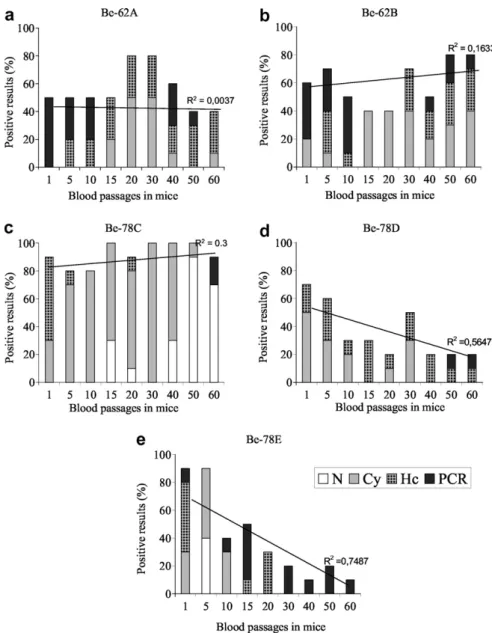
methods previously described, are shown inFig. 3.
Be-62A and Be-62B stocks were classified as partially resistant after isolation from dogs. For Be-62A an increase in Bz resistance level was observed after the 20th and 30th blood passages in mice, but these levels returned to initial values after the 50th passage and remained stable until the 60th blood passage. Be-62B, on the other hand, became resistant to Bz after the 50th blood passage in mice. Be-78C stock, showed the same Bz resistance pattern after isolation from dogs and during the whole period of evaluation. On the other hand, Be-78D and Be-78E stocks showed an alternation between Bz resistant and sensitive phenotypes during the successive blood passages in mice. These two stocks were classified as Bz resistant right after long-term infection in dogs. However, after 20–40 passages in mice they became sensitive to Bz like the wild-type strains.
The lines inFig. 3show two tendencies in Bz resistance
pattern during maintenance by successive blood passages (BP) in mice: (1) stabilization of Bz resistance level in
Be-62A (50–40% in 60 BP; R2= 0.0037), Be-62B (60–80% in
60 BP, R2= 0.1633) and Be-78C (90–90% in 60 BP;
R2= 0.3); and (2) reduction of Bz resistance level in
Be-78D (70–20% in 60 BP; R2= 0.5647) and Be-78E (90 to
10% in 60 BP;R2= 0.7487)T. cruzi stocks.
3.3. Biological characterization
Our results show significant biological differences
between Be-62 wild-type strain and its stocks. Fig. 4
shows the parasitemia curves obtained in mice inoculated with Be-62 strain and its two stocks after 1, 20, 40 and 60 blood passages in mice. All isolates showed a parasi-temia curve with one distinct peak. However, the wild-type strain, Be-62, induced higher parasitemia levels in
relation to the T. cruzi stocks Be-62A and Be-62B
(P< 0.001). A tendency of parasitemia increase was
observed for all stocks after 40 blood passages in mice, being it statistically significant only in parasitemia curves
obtained from mice infected with Be-62B stock
(P< 0.005). Concerning the infectivity and patent period,
no considerable differences were observed among the wild-type strain and its stocks. On the other hand, out-standing reduction was observed in the mortality rate induced by Be-62A and Be-62B stocks (0–16%), after one blood passage, in relation to Be-62 wild-type strain (100%). However, a tendency to increase the mortality rate after successive blood passages was also observed, being it 16% and 33% after the 1st and 60th blood pas-sage for Be-62A, and 0% and 33% for Be-62B.
Fig. 5shows the parasitemia curves in mice inoculated with Be-78 wild-type strain and its three stocks. Two types of parasitemia curves were observed. The first one was obtained for Be-78 wild-type strain as well as Be-78C and Be-78E stocks, where two distinct peaks could be detected. Be-78C, however, showed higher parasitemia levels after 20 blood passages in mice in relation to Be-78 wild-type strain
and Be-78E stock (P< 0.001). The second one was
obtained for Be-78D stock, which showed a rather flat curve. In spite of the presented differences, all stocks showed significant increase in parasitemia levels after the 20th or 40th blood passage, demonstrating a discreet ten-dency of parasitemia increase for these stocks after succes-sive blood passages in mice.
Concerning the infectivity as well as the pre-patent and patent periods for the wild-type strain and its stocks, no significant differences were observed. Also, the mor-tality rate was similar among the wild-type strain and its stocks until the 40th blood passage. Curiously though, Be-78D stock showed an increase in the mortality rate during the subsequent blood passages in mice, reaching 50% of mortality after the 60th passage, in contrast with 0% of mortality observed for mice inoculated with Be-78 wild-type strain.
0 10 20 30 40 50
N Cy Hc PCR
Methods used as cure control
Positive results (%)
FB
4. Discussion
Drug resistance is a particularly important problem in Chagas disease chemotherapy, but relatively few reports
have been published concerning this matter. In vitro and
in vivo studies have shown a tendency of T. cruzi stocks to increase resistance to clinical drugs. Induction of
resis-tance to fluconazole and Bz in vitro (Dvorak and Howe,
1977; Buckner et al., 1998; Villarreal et al., 2005), or
selec-tion of Bz resistant populaselec-tionsin vivo(Marretto and
And-rade, 1994; Murta and Romanha, 1998) by drug pressure have been described. In this work we demonstrated for
the first time the induction of Bz resistance in T. cruzi
stocks by long-term infection in vertebrate host, even in the absence of drug stress. Therefore, we considered that
the drug resistantT. cruzipopulations, obtained in absence
of drug stress, are representative of a mechanism of natural resistance and reflect more closely the situation of field infections.
Five T. cruzi stocks isolated from different dogs previ-ously inoculated (2–10 years ago) with Berenice-62 and
Berenice-78, considered 100% susceptible to Bz (Toledo
et al., 1995), started to show different levels of Bz resis-tance, and were classified as partially resistant (Be-62A and Be-62B) or resistant (Be-78C, D and E) according to
the classification proposed by Toledo et al. (2003). The
resistance induced by long-term infection in dogs may be related to genetic adaptability of the parasite to the mam-malian host. This high level of adaptability allows the par-asite to select appropriate strategies to circumvent the Fig. 3. Results of cure control with four methods of parasites detection—Fresh blood examination (N), Fresh blood examination after cyclophosphamide immunosuppression (Cy), Hemoculture (Hc) and Polymerase Chain Reaction (PCR) in mice infected with Be-62A, Be-62B, Be-78C, Be-78D and Be-78E Trypanosoma cruzistocks and treated with benznidazole after 1, 5, 10, 15, 20, 30, 40, 50 and 60 blood passages in mice. The lines on the graphs show two tendencies in benznidazole resistance pattern during maintenance by successive blood passages in mice (BP): (a, b and c) stabilization in benznidazole
resistance level of Be-62A (50–40% in 60 BP;R2= 0.0037), Be-62B (60–80% in 60 BP,R2= 0.1633) and Be-78C (90–90% in 60 BP;R2= 0.3); and (d and e)
Be-62 wild-type strain
0 50 100 150 200 250
0 10 20 30
Days after infection
Trypomas
tigotes/0.1 mL
of
bl
ood x 10³
Be-62A
0 10 20 30
0 10 20 30 40
Days after infection
Trypomastigotes/0.1 mL
of blood x 10³
Be-62B
0 5 10 15 20
0 10 20 30
Days after infection
Trypomastigotes/0.1 mL
of
bl
ood x 10³
1 BP 20 BP 40 BP 60 BP
a
b
c
Fig. 4. Parasitemia curves of Be-62 wild-type strain (a), Be-62A (b) and Be-62B (c)Trypanosoma cruzistocks, isolated from dogs with long-term infection,
after 1, 20, 40 and 60 blood passages in mice (BP). For details see Materials and Methods.
Be-78 wild-type strain
0 30 60 90 120
0 10 20 30 40 0 10 20 30 40 50 60
0 10 20 30 40 50 60
0 10 20 30 40
Days after infection
Trypomastigotes/0.1 mL
of bloo
d x
10³
Be-78C
0 400 800 1200 1600
Days after infection
Trypomastigotes/0.1 mL
of blood x 10³
Be-78D
0 5 10 15 20 25 30
Days after infection
Trypomastigotes/0.1 mL
of blood x 10³
Be-78E
0 20 40 60 80
Days after infection
Trypomastigotes/0.1 mL
of blood x 10³
1 BP 20 BP 40 BP 60 BP
a
c
d
b
Fig. 5. Parasitemia curves of Be-78 wild-type strain (a), and Be-78C (b), Be-78D (c) and Be-78E (d)Trypanosoma cruzistocks, isolated from dogs with
lethal effects of host immune response, and these altera-tions may be also important to develop mechanisms of
resistance to drugs. Data presented here suggests that T.
cruzi resistance to Bz may occur in human infections and may explain, at least in part, the low cure indexes observed for individuals with chronic Chagas disease treated with Bz.
The different levels of Bz resistance found for the studied T. cruzistocks demonstrate that parasite biological behav-ior is influenced by interaction with the vertebrate host.
These results agree with that obtained by Guedes et al.
(2002)that showed the influence of the vertebrate host in the success of Bz treatment, where 100% and 53% of cure
was observed in dogs and mice (Filardi and Brener,
1987), respectively, inoculated with the Y strain.
Several authors have shown that Bz and azole resistance phenotypes are stable in the absence of drug pressure (Buckner et al., 1998; Villarreal et al., 2005). To confirm
this hypothesis the resistant and partially resistantT. cruzi
stocks were maintained by successive blood passages in mice (acute phase) and to each 5 or 10 blood passages the Bz resistance pattern was determined. Three stocks maintained their resistance pattern. However two stocks became sensitive to the drug after 20–40 blood passages and remained stable for the following passages, showing that the acquired resistance during long-term infection in vertebrate host can again be altered. It is reasonable to speculate that parasite subpopulations with different geno-types were present in Be-62 and Be-78 stocks, and that Bz susceptible subpopulations can emerge during successive blood passages in mice becoming the dominant population.
These results are supported by previously data (Veloso
et al., 2005) where authors detected two distinct genetic
groups of parasites in fourT. cruzistocks isolated from
dif-ferent chronic chagasic dogs infected with Be-78 strain. Interestingly, a transition from one genetic group to
another was verified when theseT. cruzistocks were
main-tained by blood passages in mice. The authors showed that this transition occurs gradually and that eventually one subpopulation becomes dominant in relation to the other.
Our results reveal that theT. cruzistocks isolated from
long-term infected dogs showed significant decrease in vir-ulence for mice in relation to wild-type strains in the initial passages in mice. On the other hand, we detected a
consid-erable increase in parasitemia of allT. cruzi stocks during
maintenance in mice, occurring usually after the 20th blood passage. Many parasite biological characterization studies
have demonstrated that maintenance of T. cruzi in mice
and long-term chronic infection in human leads to
altera-tions in parasites original biological features (Brener
et al., 1974; Lana and Chiari, 1986). Regarding virulence,
for instance, both decrease (Brener et al., 1974; Arau´jo,
2000; Veloso et al., 2005) and intensification (Schlemper, 1982; Carneiro et al., 1991) have been described in
experi-mental infection. Our data support the hypothesis thatT.
cruzi populations present high levels of adaptability to the host, where appropriate strategies are selected to evade
the immune response during the acute or chronic phase of the infection. Apparently this phenomenon also is host
dependent, because when the differentT. cruzistocks were
isolated from dogs inoculated with the sameT. cruzistrains
(Be-62 or Be-78) different biological properties were observed.
In this study we also investigated the effectiveness of the induction of parasitemia reactivation by cyclophosphamide immunosuppression in the evaluation of the response to the specific drug treatment. Using this methodology it was possible to detect therapeutic failure in about 54% of the animals one month post-treatment. From the remain-ing, 27% were detected by hemoculture, evaluated up to 60 days and other 18% by PCR. The sensitivity of the
PCR assay to detect T. cruzi DNA in blood of treated
and non-cured mice not only shows the importance of the PCR assay for assessment of cure, but also strongly supports the use of this technique to assess efficacy of
etio-logical treatment ofT. cruzi infection. These results are in
accordance toMiyamoto et al. (2006)that detectedT. cruzi
DNA using PCR assay in 100% of mice infected with T.
cruzicloned stocks from genotypes 19, 20, 32 and 39, show-ing that PCR sensitivity for mice is high and independent of parasite genetic diversity.
The new methodology proposed here for the control of cure was very efficient. The immunosuppression allowed fast and unfailing results in about 43% of the cases of ther-apeutic failure and the PCR assay confirmed the doubtful results in the first 45 days after treatment. This allowed a much faster evaluation of treatment efficacy compared to the classical method. The classical method for cure control used by several authors require that animals are evaluated until the sixth month post-treatment for the detection of negative seroconversion and the execution of two
hemocul-ture tests (Filardi and Brener, 1987; Toledo et al., 1997;
Veloso et al., 2001; Toledo et al., 2003).
Our results have also shown to be a useful model for the study of the differential gene expression in sensitive and
resistant stocks of T. cruzi. According to Villarreal et al.
(2005), the mechanisms involved in natural drug sensitivity are different from those involved in drug induced chemore-sistance, and several different pathways are probably
involved in Bz resistance in T. cruzi. Also, Murta et al.
(2006) showed that the gene encoding old yellow enzyme
is down-regulated in a resistant T. cruzi population
obtained in vitro, but not in natural Bz resistant
popula-tions or Bz resistance selected in vivo. It is important to
mention that very few information is available about the biochemical mechanisms underlying drug resistance in field
isolates of T. cruziand new more informative models are
very important to change this scenario.
Acknowledgments
Coordenac¸a˜o de Aperfeic¸oamento de Pessoal de Nı´vel Superior (CAPES), Conselho Nacional de Desenvolvimen-to Cientı´fico e Tecnolo´gico (CNPq), and a research fellow-ships from CNPq (Bahia, M.T.).
References
Andrade, S.G., Andrade, V., Brodskyn, C., Magalha˜es, J.B., Netto, M.B., 1985. Immunological response of Swiss mice to infection with three
different strains ofTrypanosoma cruzi. Annals of Tropical Medicine
and Parasitology 79, 397–407.
Andrade, S.G., Rassi, A., Magalha˜es, J.B., Ferriolli, F.F., Luquetti, A.O., 1992. Specific chemotherapy of Chagas disease: a comparison between the response in patients and experimental animals inoculated with the same strains. Transactions of the Royal Society of Tropical Medicine and Hygiene 86, 624–626.
Arau´jo, I.B., 2000. Estudo Morfobiolo´gico e Isoenzima´tico de Amostras de Trypanosoma cruzi, Trypanosoma rangeli Isoladas de Casos Humanos, de Vetores e de Mamı´feros Silvestres da Regia˜o do Me´dio e Alto Rio Negro-Amazonas, MSc Thesis, Instituto Oswaldo Cruz, Rio de Janeiro.
Aufderheide, A.C., Salo, W., Madden, M., Streitz, J., Buikstra, J., Guhl, F., Arriaza, B., Renier, C., Wittmers Jr., L.E., Fornaciari, G., Allison, M., 2004. A 9,000-year record of Chagas’ disease. Proceedings of the National Academy of Sciences of the United States of America 101, 2034–2039.
A´ vila, H., Gonc¸alves, A.M., Nehme, N.S., Morel, C.M., Simpson, L.,
1990. Schizodeme analysis ofTrypanosoma cruzistocks from South
and Central America by analysis of PCR-amplified minicircle variable region sequences. Molecular and Biochemical Parasitology 42, 175– 187.
Braga, M.S., Lauria-Pires, L., Argan˜araz, E.R., Nascimento, R.J., Teixeira, A.R., 2000. Persistent infections in chronic Chagas’ disease
patients treated with anti-Trypanosoma cruzinitroderivatives. Revista
do Instituto de Medicina Tropical de Sa˜o Paulo 42, 157–161. Brener, Z., 1962. Therapeutic activity and criterion of cure on mice
experimentally infected withTrypanosoma cruzi. Revista do Instituto
de Medicina Tropical de Sa˜o Paulo 4, 389–396.
Brener, Z., Chiari, E., Alvarenga, N.J., 1974. Observations on
Trypano-soma cruzistrains maintained over an 8-year period in experimentally inoculated mice. Revista do Instituto de Medicina Tropical de Sa˜o Paulo 16, 39–46.
Buckner, F.S., Wilson, A.J., White, T.C., Van Voorhis, W.C., 1998.
Induction of resistance to azole drugs inTrypanosoma cruzi.
Antimi-crobial Agents and Chemotherapy 42, 3245–3250.
Camargo, E.P., 1964. Growth and differentiation inTrypanosoma cruzi. I.
Origin of metacyclic Trypanosomes in liquid media. Revista do Instituto de Medicina Tropical de Sa˜o Paulo 12, 93–100.
Canc¸ado, J.R., 2002. Long term evaluation of etiological treatment of chagas disease with benznidazole. Revista do Instituto de Medicina Tropical de Sa˜o Paulo 44, 29–37.
Carneiro, M., Romanha, A.J., Chiari, E., 1991. Biological
characteriza-tion of Trypanosoma cruzi strains from different zymodemes and
schizodemes. Memo´rias do Instituto Oswaldo Cruz 86, 387–393. Chagas, C., 1909. Nova tripanosomı´ase humana: estudos sobre a
morfologia e o ciclo evolutivo do Schizotrypanum cruzi n. gen., n.
sp., agente etiolo´gico de nova entidade mo´rbida do homem. Memo´rias do Instituto Oswaldo Cruz 1, 159–218.
de Ferreira, H.O., 1990. Tratamento da forma indeterminada da doenc¸a de Chagas com Nifurtimox e Benzonidazol. Revista da Sociedade Brasileira de Medicina Tropical 23, 209–211.
Dvorak, J.A., Howe, C.L., 1977. The effects of Lampit (Bayer 2502) on the
interaction of Trypanosoma cruziwith vertebrate cells in vitro. The
American Journal of Tropical Medicine and Hygiene 26, 58–63. Filardi, L.S., Brener, Z., 1987. Susceptibility and natural resistance of
Trypanosoma cruzistrains to drugs used clinically in Chagas disease.
Transactions of the Royal Society of Tropical Medicine and Hygiene 81, 755–759.
Gomes, M.L., Macedo, A.M., Vago, A.R., Pena, S.D., Galva˜o, L.M.,
Chiari, E., 1998.Trypanosoma cruzi: optimization of polymerase chain
reaction for detection in human blood. Experimental Parasitology 88, 28–33.
Guedes, P.M., Fietto, J.L.R., Lana, M., Bahia, M.T., 2006. Advances in Chagas disease chemotherapy. Anti-Infective Agents in Medicinal Chemistry 5, 175–186.
Guedes, P.M., Veloso, V.M., Tafuri, W.L., Galva˜o, L.M., Carneiro, C.M., Lana, M., Chiari, E., Soares, K.A., Bahia, M.T., 2002. The dog as model for chemotherapy of the Chagas’ disease. Acta Tropica 84, 9– 17.
Lana, M., Chiari, C.A., 1986. Comparative biological characterization of
Berenice and Berenice-78 strains ofTrypanosoma cruziisolated from
the same patient at different times. Memo´rias do Instituto Oswaldo Cruz 81, 247–253.
Lauria-Pires, L., Braga, M.S., Vexenat, A.C., Nitz, N., Simo˜es-Barbosa, A., Tinoco, D.L., Teixeira, A.R., 2000. Progressive chronic Chagas heart disease ten years after treatment with anti-Trypanosoma cruzi nitroderivatives. The American Journal of Tropical Medicine and Hygiene 63, 111–118.
Marretto, J.P., Andrade, S.G., 1994. Biochemical behavior of
Trypano-soma cruzistrains isolated from mice submitted to specific chemother-apy. Revista da Sociedade Brasileira de Medicina Tropical 27, 209– 215.
Miyamoto, C.T., Gomes, M.L., Marangon, A.V., Arau´jo, S.M., Bahia,
M.T., Lana, M., Toledo, M.J., 2006.Trypanosoma cruzi: sensitivity of
the polymerase chain reaction for detecting the parasite in the blood of mice infected with different clonal genotypes. Experimental Parasitol-ogy 112, 198–201.
Murta, S.M., Krieger, M.A., Montenegro, L.R., Campos, F.F., Probst,
C.M., A´ vila, A.R., Muto, N.H., de Oliveira, R.C., Nunes, L.R., Nirde´,
P., Bruna-Romero, O., Goldenberg, S., Romanha, A.J., 2006. Deletion of copies of the gene encoding old yellow enzyme (TcOYE), a
NAD(P)H flavin oxidoreductase, associates with in vitro-induced
benznidazole resistance in Trypanosoma cruzi. Molecular and
Bio-chemical Parasitology 146, 151–162.
Murta, S.M., Romanha, A.J., 1998. In vivo selection of a population of Trypanosoma cruziand clones resistant to benznidazole. Parasitology 116 (Pt 2), 165–171.
Salgado, J.A., Garcez, P.N., Olliveira, C.A., Galizzi, J., 1962. Revisa˜o clı´nica atual do primeiro caso humano descrito de Doenc¸a de Chagas. Revista do Instituto de Medicina Tropical de Sa˜o Paulo 4 (5), 330–337.
Santos, F.R., Pena, S.D., Epplen, J.T., 1993. Genetic and population study of a Y-linked tetranucleotide repeat DNA polymorphism with a simple non-isotopic technique. Human Genetics 90, 655–656.
Schlemper Jr., B.R., 1982. Caracterizac¸a˜o de Cepas doTrypanosoma cruzi
Isoladas de Pacientes com Diferentes Formas Clı´nicas da Doenc¸a de Chagas, PhD Thesis, Universidade Federal do Rio de Janeiro. Suasna´bar, D.F., Arias, E., Streiger, M., Piacenza, M., Ingaramo, M., Del
Barco, M., Amicone, N., 2000. Evolutive behavior towards cardio-myopathy of treated (nifurtimox or benznidazole) and untreated chronic chagasic patients. Revista do Instituto de Medicina Tropical de Sa˜o Paulo 42, 99–110.
Toledo, M.J., Bahia, M.T., Carneiro, C.M., Martins-Filho, O.A., Tibay-renc, M., Barnabe´, C., Tafuri, W.L., Lana, M., 2003. Chemotherapy with benznidazole and itraconazole for mice infected with different Trypanosoma cruzi clonal genotypes. Antimicrobial Agents and Chemotherapy 47, 223–230.
Toledo, M.J., Gasperi, M.V., Marques de Arau´jo, S., Lana, M., 1995.
Berenice 62 and Berenice 78 strains ofTrypanosoma cruzi: comparison
of their susceptibility to benzidazole. Memo´rias do Instituto Oswaldo Cruz 90 (suppl.), 201.
Toledo, M.J., Guilherme, A.L., Silva, J.C., de Gasperi, M.V., Mendes,
A.P., Gomes, M.L., Marques de Arau´jo, S., 1997.Trypanosoma cruzi:
Parana´ state and from different endemic areas of Brazil. Revista do Instituto de Medicina Tropical de Sa˜o Paulo 39, 283–290.
Veloso, V.M., Carneiro, C.M., Toledo, M.J., Lana, M., Chiari, E., Tafuri, W.L., Bahia, M.T., 2001. Variation in susceptibility to benznidazole in
isolates derived fromTrypanosoma cruziparental strains. Memo´rias do
Instituto Oswaldo Cruz 96, 1005–1011.
Veloso, V.M., Romanha, A.J., Lana, M., Murta, S.M., Carneiro, C.M., Alves, C.F., Borges, E.C., Tafuri, W.L., Machado-Coelho, G.L.,
Chiari, E., Bahia, M.T., 2005. Influence of the long-termTrypanosoma
cruziinfection in vertebrate host on the genetic and biological diversity of the parasite. Parasitology Research 96, 382–389.
Villarreal, D., Nirde´, P., Hide, M., Barnabe´, C., Tibayrenc, M., 2005.
Differential gene expression in benznidazole-resistant Trypanosoma
cruzi parasites. Antimicrobial Agents and Chemotherapy 49, 2701– 2709.
Viotti, R., Vigliano, C., Armenti, H., Segura, E., 1994. Treatment of chronic Chagas’ disease with benznidazole: clinical and serologic evolution of patients with long-term follow-up. American Heart Journal 127, 151–162.
Voller, A., Bidwell, D.E., Bartlett, A., 1976. Enzyme immunoassays in diagnostic medicine. Theory and practice. Bulletin of the World Health Organization 53, 55–65.